
Life, 1919-12-25 · page 24 of 37
Life — December 25, 1919 — page 24: what you’re looking at
What you’re looking at
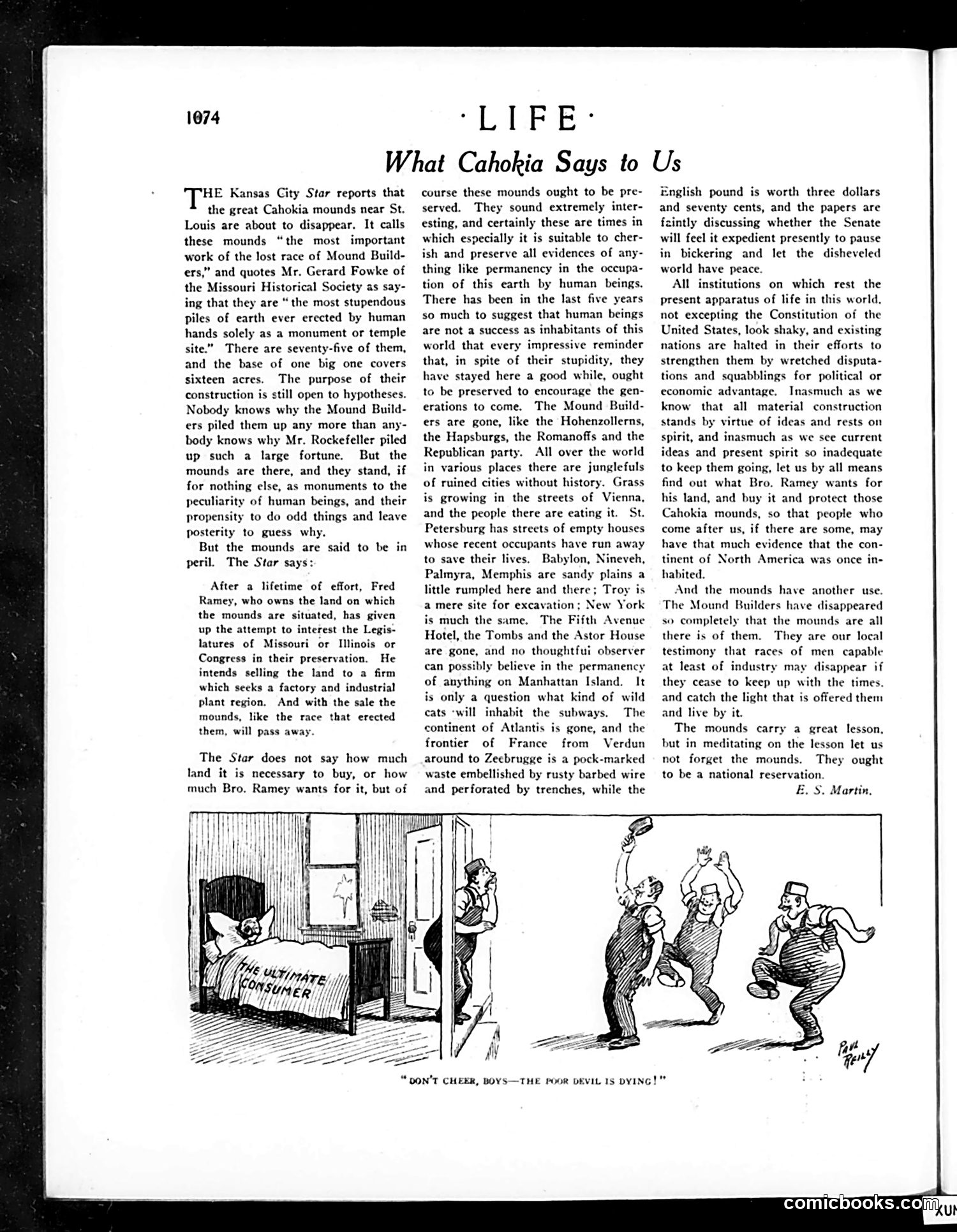
This page from Life magazine discusses the impending destruction of the Cahokia Mounds near St. Louis—ancient earthworks built by pre-Columbian peoples. The article argues these monuments should be preserved as historical testimony to human permanence. The satire is **post-World War I disillusionment**. The author sardonically catalogs civilization's collapse: Vienna's starving population, Petersburg's abandoned streets, destroyed French borders (Verdun to Zeebrugge), economic instability (British pound devaluation), and political gridlock. By comparing vanished empires (Babylon, Atlantis, Troy) to modern ruin, the piece suggests contemporary civilization is equally doomed. The implicit target: **American prosperity and complacency**. The Mounds become symbols of lost civilizations, mocking the belief that modern achievement is permanent. The veiled reference to "the Republican party" alongside fallen empires adds political critique. The cartoon (bottom) shows "The Ultimate Consumer" dying in bed while figures outside celebrate—darkly suggesting capitalism itself is expiring.
📄 Transcribed text from this page (OCR, searchable)
Machine-transcribed from the original scan — historical spelling and the odd misread are preserved.
"LIFE - What Cahokia Says to Us THE Kansas City Star reports that the great Cahokia mounds near St. Louis are about to disappear. It calls these mounds “the most important work of the lost race of Mound Build- ers,” and quotes Mr. Gerard Fowke of the Missouri Historical Society as say- ing that they are “the most stupendous piles of earth ever erected by human hands solely as a monument or temple site.” There are seventy-five of them, and the base of one big one covers sixteen acres. The purpose of their construction is still open to hypotheses. Nobody knows why the Mound Build- ers piled them up any more than any- body knows why Mr. Rockefeller piled up such a large fortune. But the mounds are there, and they stand, if for nothing else, as monuments to the peculiarity of human beings, and their propensity to do odd things and leave posterity to guess why. But the mounds are said to be in peril. The Star says: After a lifetime of effort, Fred Ramey, who owns the land on which the mounds are situated, has given up the attempt to interest the Legis- latures of Missouri or Illinois or Congress in their preservation. He intends selling the land to a firm which seeks a factory and industrial plant region. And with the sale the mounds, like the race that erected them, will pass away. The Star does not say how much land it is necessary to buy, or how much Bro. Ramey wants for it, but of course these mounds ought to be pre- served. They sound extremely inter- esting, and certainly these are times in which especially it is suitable to cher- ish and preserve all evidences of any- thing like permanency in the occupa- tion of this earth by human beings. There has been in the last five years so much to suggest that human beings are not a success as inhabitants of this world that every impressive reminder that, in spite of their stupidity, they have stayed here a good while, ought to be preserved to encourage the gen- erations to come. The Mound Build- ers are gone, like the Hohenzollerns, the Hapsburgs, the Romanoffs and the Republican party. All over the world in various places there are junglefuls of ruined cities without history. Grass is growing in the streets of Vienna, and the people there are eating it. St. Petersburg has streets of empty houses whose recent occupants have run away to save their lives. Babylon, Nineveh, Palmyra, Memphis are sandy plains a little rumpled here and there; Troy is a mere site for excavation; New York is much the same. The Fifth Avenue Hotel, the Tombs and the Astor House are gone, and no thoughtfui observer can possibly believe in the permanency of anything on Manhattan Island. It is only a question what kind of wild cats ‘will inhabit the subways. The continent of Atlantis is gone, and the frontier of France from Verdun around to Zeebrugge is a pock-marked waste embellished by rusty barbed wire and perforated by trenches, while the English pound is worth three dollars and seventy cents, and the papers are faintly discussing whether the Senate will feel it expedient presently to pause in bickering and let the disheveled world have peace. All institutions on which rest the present apparatus of life in this world. not excepting the Constitution of the United States, look shaky, and existing nations are halted in their efforts to strengthen them by wretched disputa- tions and squabblings for political or economic advantage. Inasmuch as we know that all material construction stands by virtue of ideas and rests on spirit, and inasmuch as we see current ideas and present spirit so inadequate to keep them going, let us by all means find out what Bro, Ramey wants for his land, and buy it and protect those Cahokia mounds, so that people who come after us, if there are some, may have that much evidence that the con- tinent of North America was once in- habited. And the mounds have another use. The Mound Builders have disappeared so completely that the mounds are all there is of them. They are our local testimony that races of men capable at least of industry may disappear if they cease to keep up with the times. and catch the light that is offered them and live by it. The mounds carry a great lesson, but in meditating on the lesson let us not forget the mounds. They ought to be a national reservation S. Martin, comicbooks.co wT,