
A complete issue · 46 pages · 1919
Life — November 20, 1919
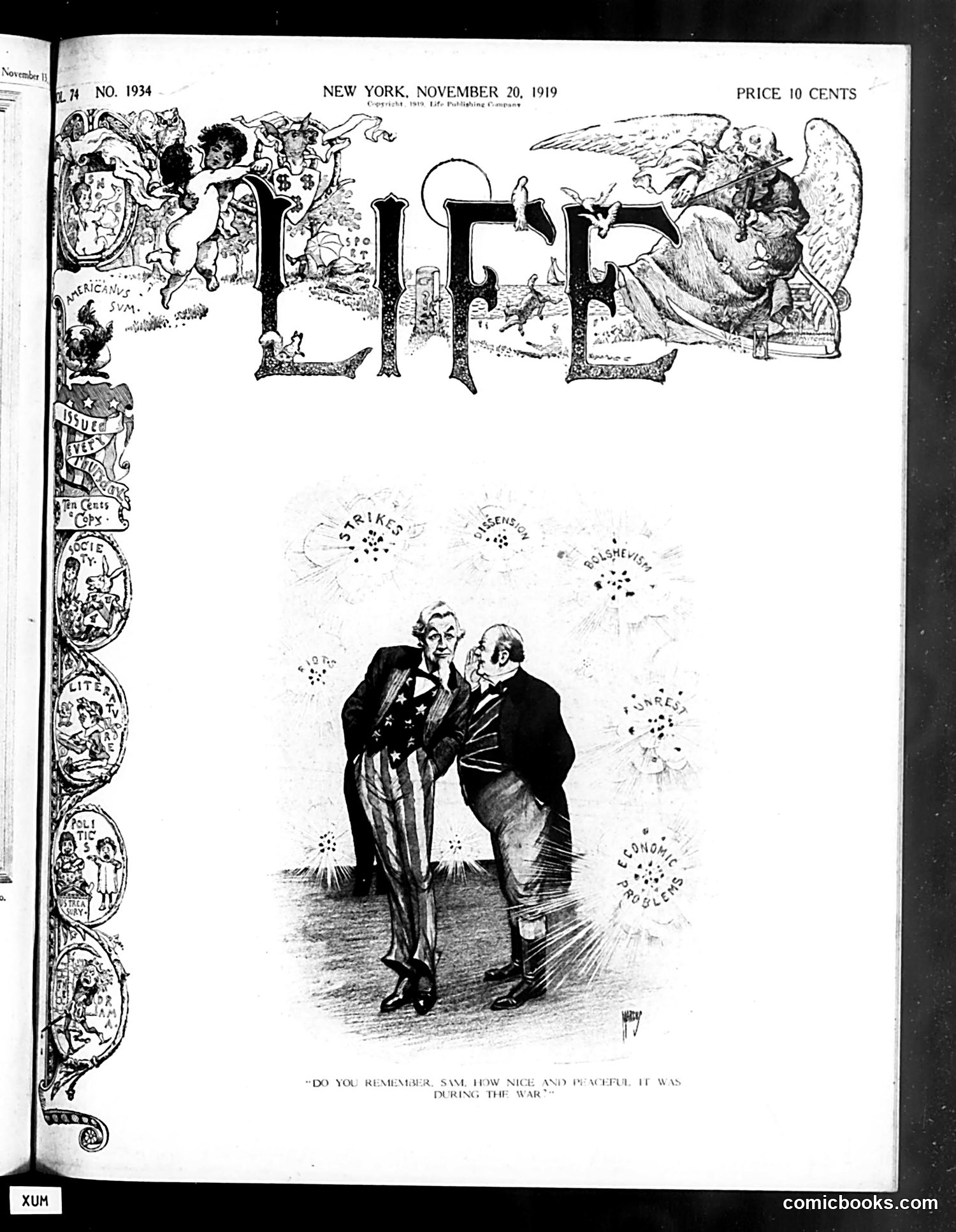
This page features a political cartoon satirizing post-World War I negotiations. Two figures stand amid floating bubbles labeled with terms like "MARINES," "GENERAL," "ROOSEVELT," and "CONDOMINIUM." The caption reads: "Do you remember Sam, how nice and peaceful it was during the war?" The cartoon appears to reference the Treaty of Versailles negotiations and post-war diplomatic tensions. The irony is stark: the speaker suggests wartime was more peaceful than the chaotic peace negotiations that followed. The bubbles likely represent competing nations' demands and conflicting interests during the peace process. This reflects widespread American anxiety about whether the peace settlement would actually produce lasting stability—a common concern in 1919 as the League of Nations debate raged in Congress.
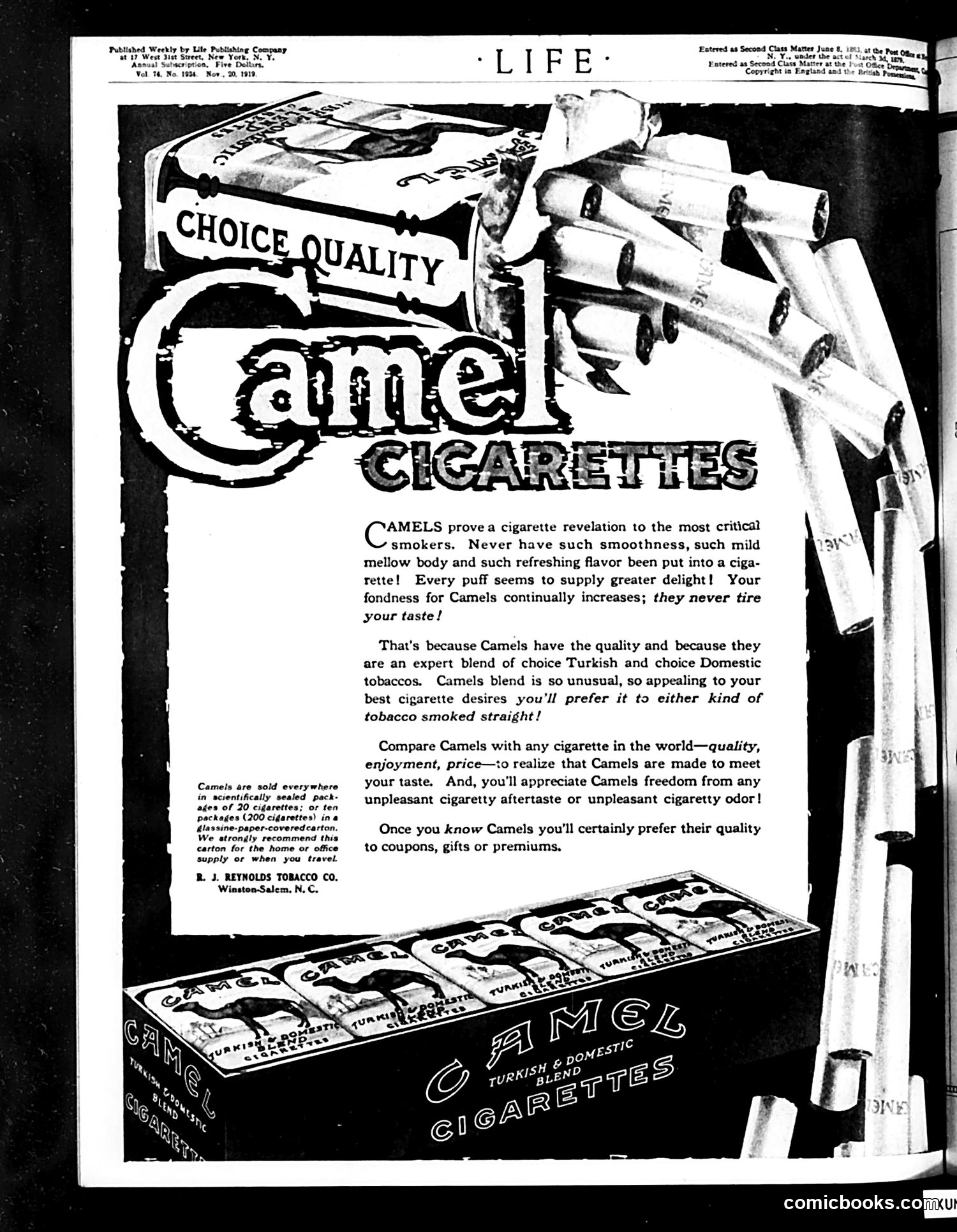
This page is **not a cartoon or satirical content**—it's a cigarette advertisement for Camel brand cigarettes by R.J. Reynolds Tobacco Company. The ad promotes Camels as superior quality smokes, emphasizing their Turkish and Domestic tobacco blend. Key claims include smoothness, mild flavor, and that they "never tire your taste." The visual shows a pack of Camels alongside individual cigarettes. Modern readers should note this represents an era when tobacco advertising was legal in mainstream magazines and made health claims (or implied them) without regulatory restrictions. The ad's language—"prove a cigarette revelation"—reflects 1920s marketing style. There is no satire present; this is straightforward product promotion from Life magazine's commercial pages.
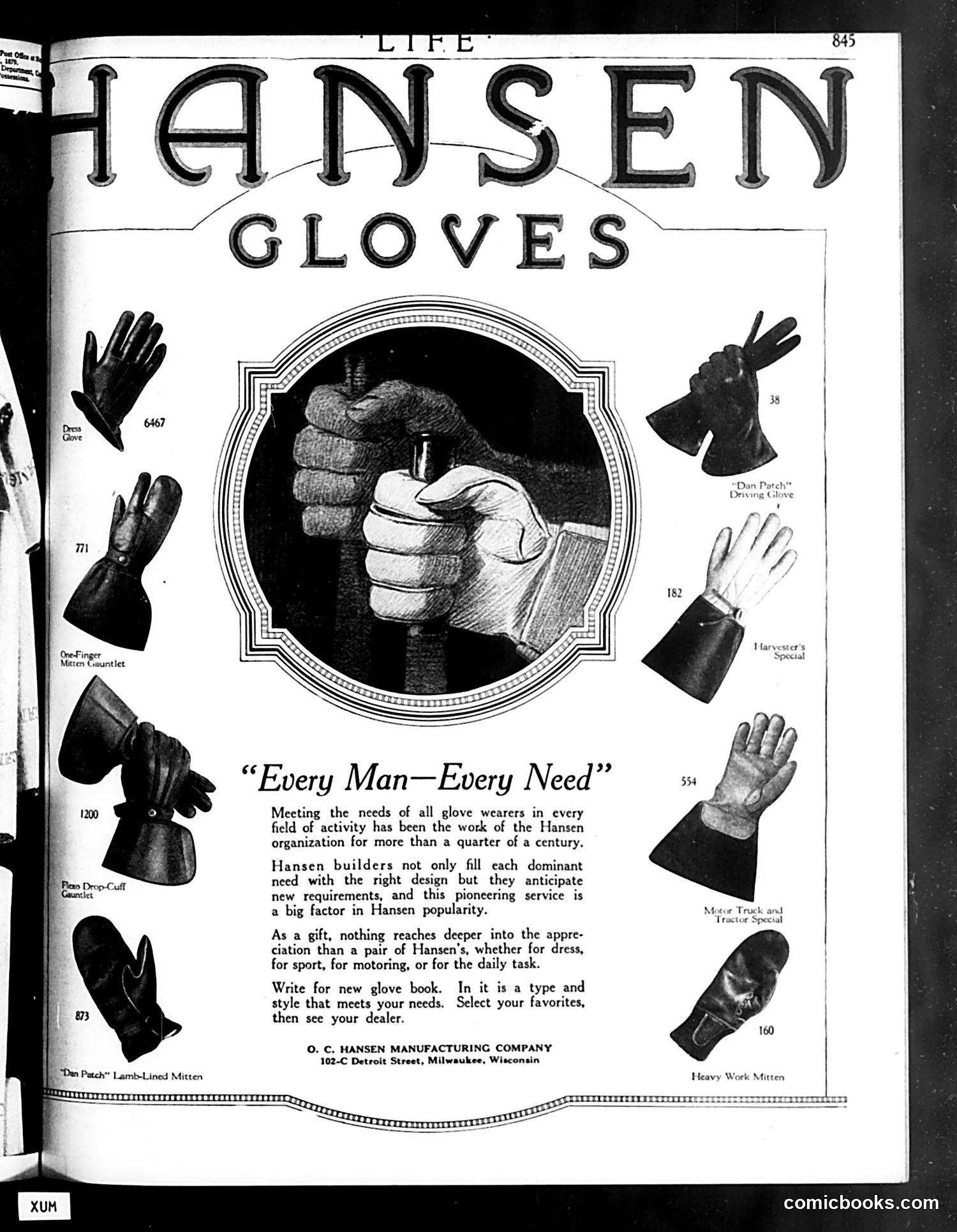
This is primarily a **product advertisement**, not a political cartoon. The page promotes Hansen Gloves from the O.C. Hansen Manufacturing Company (Milwaukee, Wisconsin). The central image shows a fist grasping what appears to be a hammer or tool, symbolizing work and labor. The surrounding images display various glove styles numbered with product codes—ranging from dress gloves to heavy work mittens designed for different professions and activities. The slogan "Every Man—Every Need" emphasizes that Hansen produced specialized gloves for diverse occupations and occasions. The accompanying text highlights the company's quarter-century history of meeting workers' practical needs across "every field of activity," positioning the product as an essential gift or necessity rather than a luxury item.
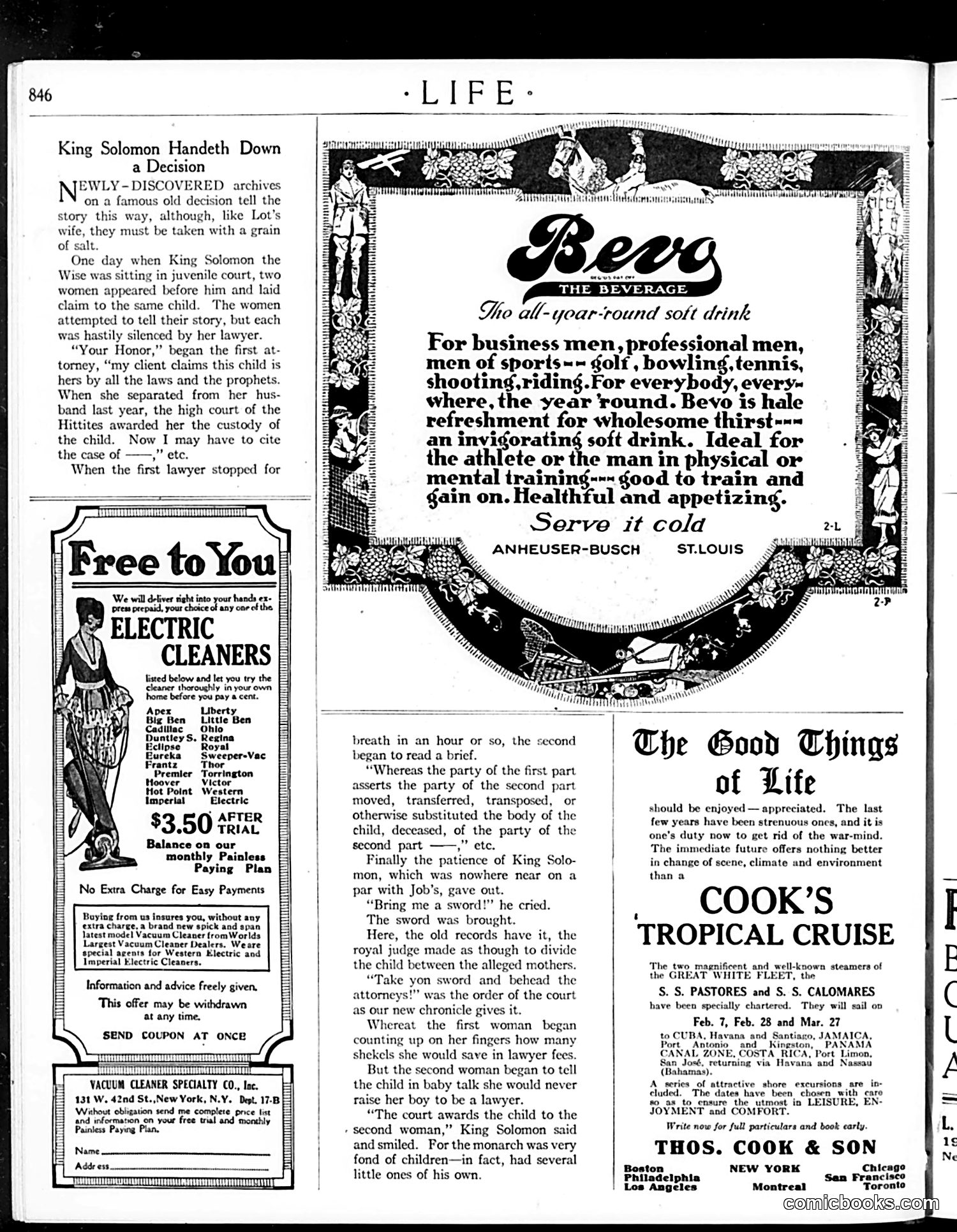
This Life magazine page is primarily **advertising and editorial content** rather than political satire. The main elements are: 1. **"King Solomon Handeth Down a Decision"** — A humorous anecdote about King Solomon settling a disputed child custody case, presented as an amusing historical tale rather than contemporary satire. 2. **Advertisements** dominate the page: Bevo (a soft drink by Anheuser-Busch), Electric Cleaners, and Cook's Tropical Cruise. These ads target affluent readers with leisure activities and domestic services. 3. **"The Good Things of Life"** — An editorial section discussing quality-of-life matters, emphasizing climate and environment. The page reflects early 20th-century consumer culture and advertising practices rather than containing pointed political commentary or caricature-based satire typical of Life's cartoons.
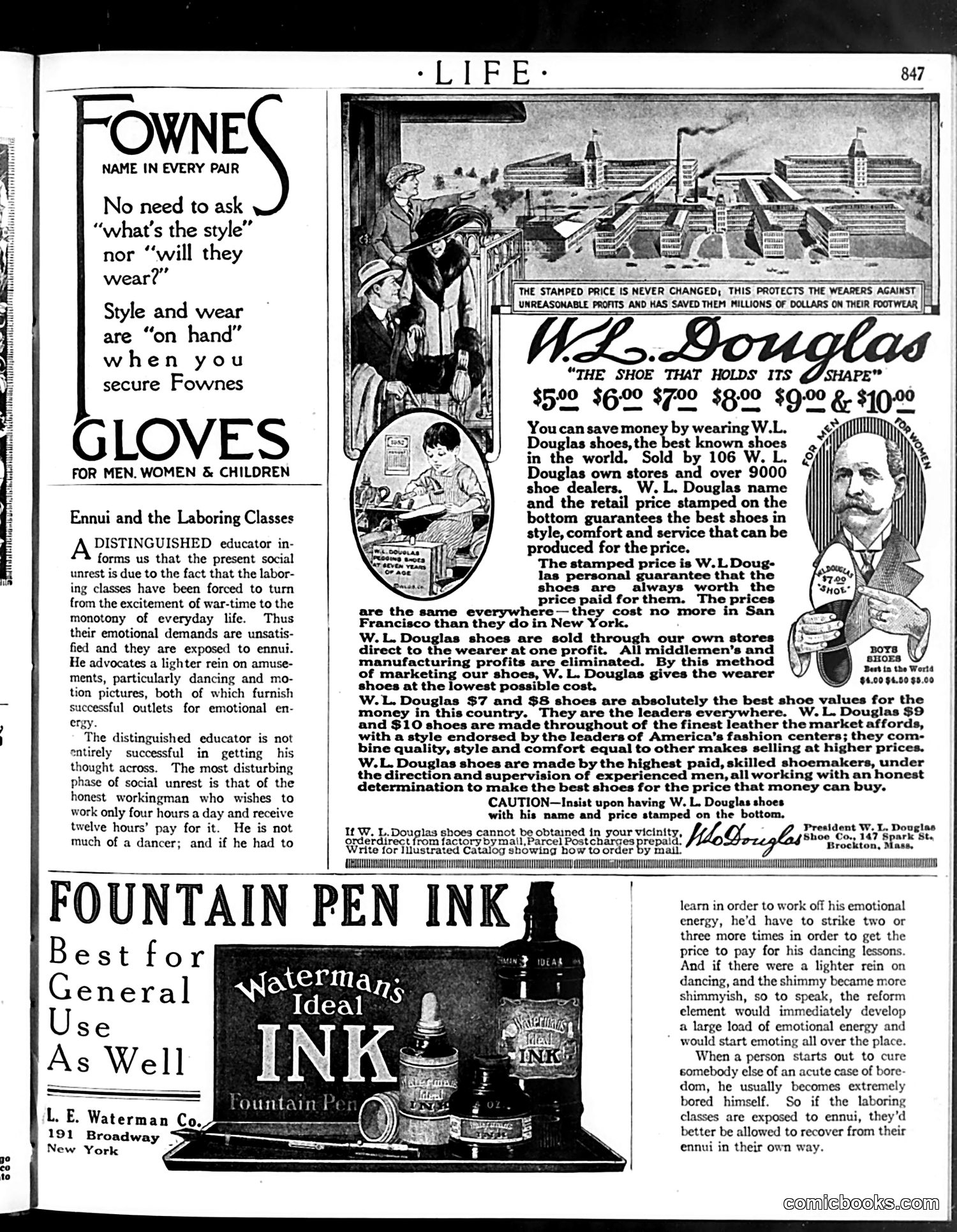
This page is primarily **advertising**, not satire or political commentary. The left side contains ads for **Fownes Gloves** and **Waterman's Ideal Fountain Pen Ink**—standard commercial products. The dominant feature is a large **W.L. Douglas Shoes advertisement**. The ad includes a portrait (appears to be W.L. Douglas himself) and emphasizes the company's direct-to-consumer sales model that allegedly keeps prices lower than competitors. The ad claims W.L. Douglas shoes are "sold by 106" dealers and emphasizes value and quality craftsmanship. Below this is an **article titled "Ennui and the Laboring Classes,"** discussing how monotonous work and emotional stress affect workers. The article advocates for recreational outlets like dancing to relieve workers' emotional burdens. **No political cartoon or satire is present on this page**—it's a typical Life magazine advertising section with accompanying editorial content.
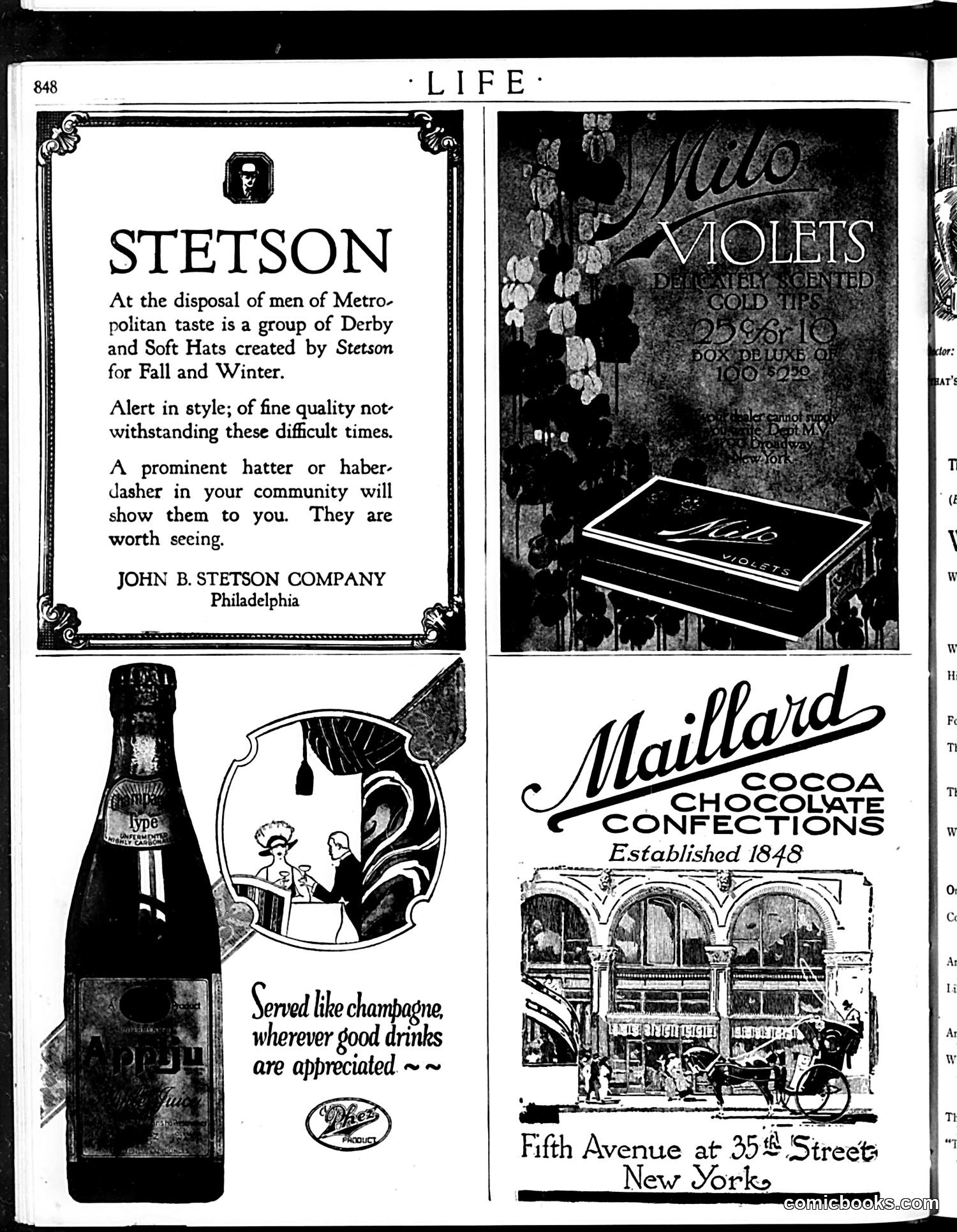
This page consists entirely of **period advertisements** rather than editorial cartoons or satire. The ads include: 1. **Stetson Hats** (top left): Promotes Derby and Soft Hat styles for fall/winter, emphasizing quality despite "difficult times" (likely referencing economic hardship). 2. **Milo Violets** (top right): A perfume or toiletry product marketed in an ornate box. 3. **An unnamed beverage** (bottom left): Shows a bottle "served like champagne," suggesting a sparkling wine or similar drink. 4. **Mailliard Cocoa & Chocolate** (bottom right): Features an elegant storefront at Fifth Avenue and 35th Street, New York, established 1848. No political satire or caricature appears on this page—it reflects early 20th-century consumer advertising and luxury goods marketing.
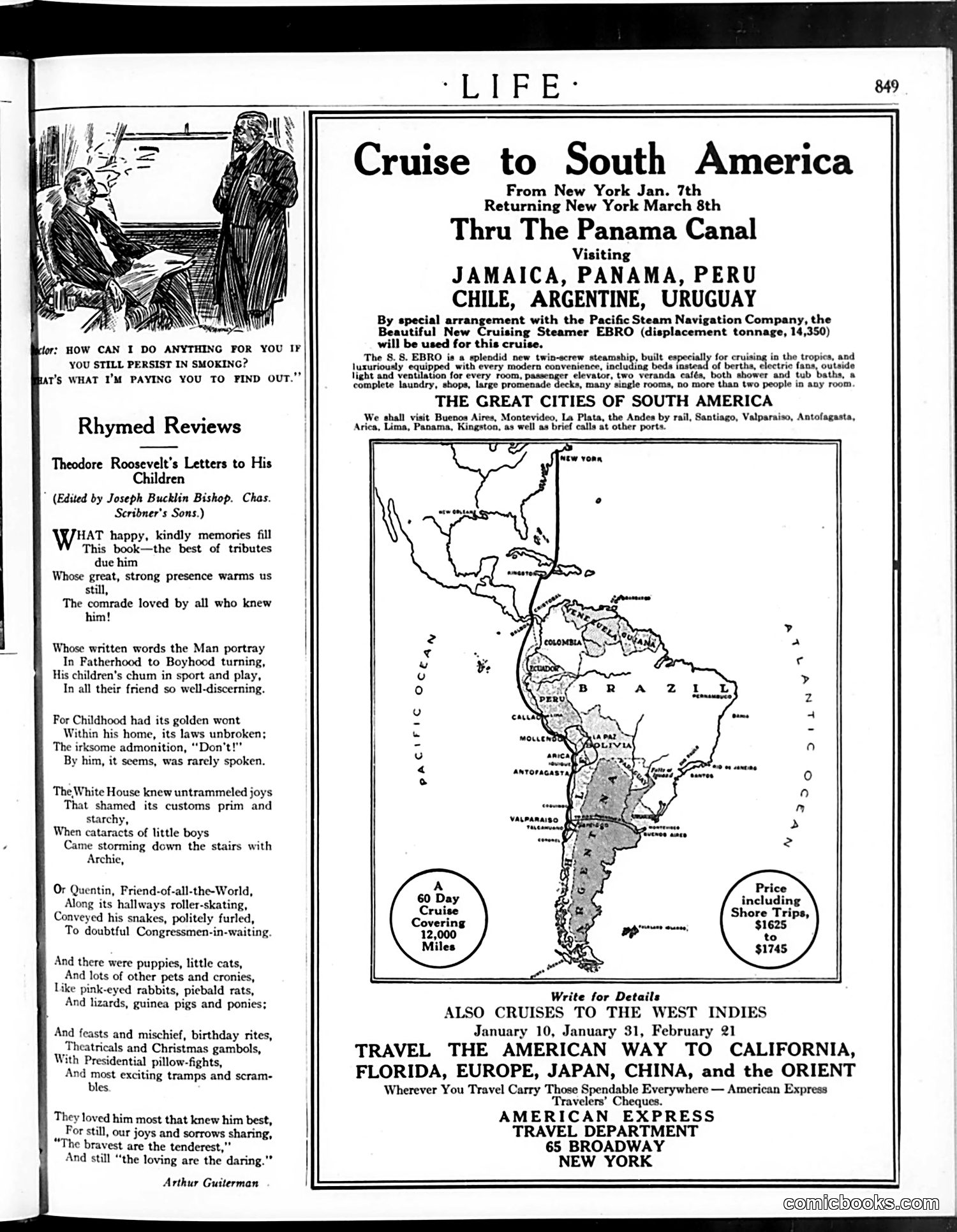
This page is primarily **advertising**, not satirical content. The cartoon at top-left appears to be a generic comic vignette about smoking etiquette—a man asks another, "How can I do anything for you if you still persist in smoking? That's what I'm paying you to find out." This is a mild joke about workplace annoyance with smoking, likely reflecting contemporary attitudes rather than political satire. The main content is a cruise advertisement for the S.S. EBRO visiting South American ports, and promotional material for American Express travel services. The left column contains a rhymed tribute to Theodore Roosevelt's letters to his children—a nostalgic celebration of the former president's family life, emphasizing his role as a devoted father. This reflects his positive cultural standing in the 1920s-30s era. No sharp political satire is evident on this page.
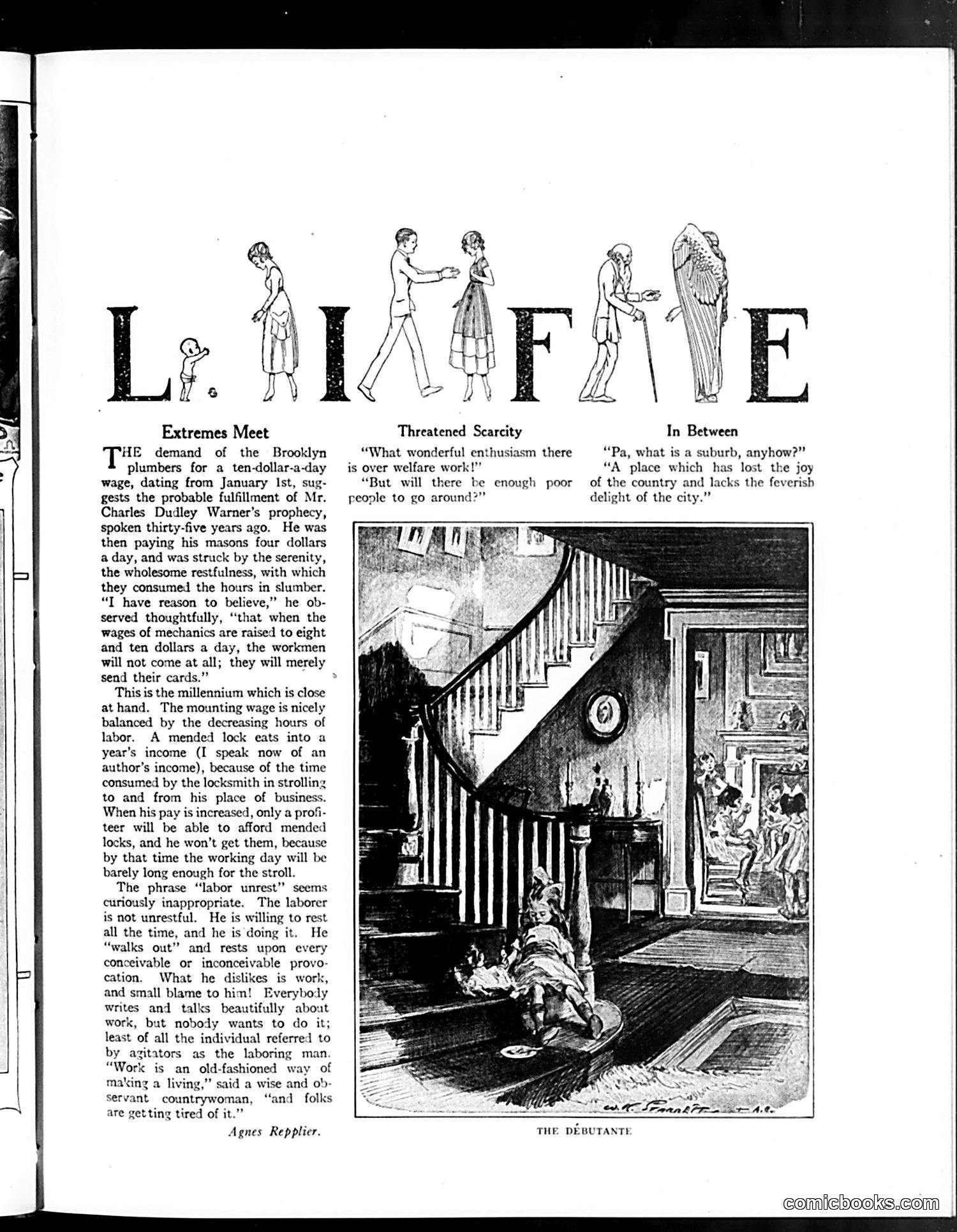
This page satirizes early 20th-century labor disputes and urban anxieties through three vignettes titled "Extremes Meet," "Threatened Scarcity," and "In Between." The left section mocks Brooklyn plumbers' wage demands (starting January 1st), quoting Charles Durley Warner's prediction that rising wages won't solve worker discontent. The satire suggests laborers complain perpetually regardless of pay increases. The center section ironically presents welfare concerns—the wealthy worry poverty will disappear, leaving insufficient poor people "to go around." The right section jokes about suburban flight, with someone asking "what is a suburb, anyhow?"—suggesting confusion among city dwellers about the emerging suburban lifestyle. "The Débutante" illustration (bottom) appears unrelated to the labor theme. Together, these pieces critique both labor unrest and class anxieties during an era of industrial change.
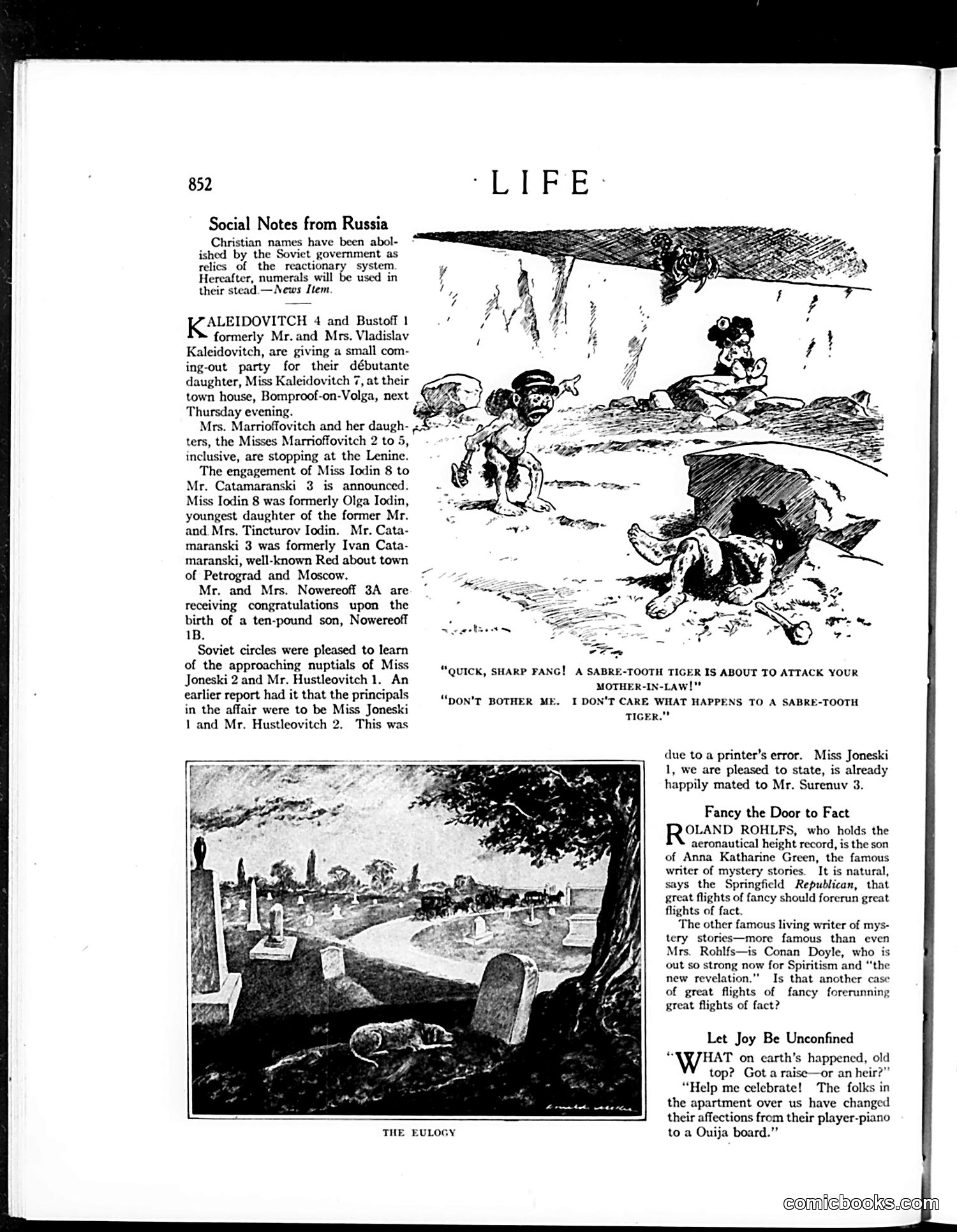
This page contains **social notes from Soviet Russia** mocking the Soviet government's abolition of Christian names in favor of numerals. The text lists Russian citizens with names like "Kaleidovitch 1" and "Bustof 1," satirizing this policy by presenting ordinary social announcements (engagements, births) using the new numerical system. The cartoon depicts a tiger about to attack a woman, with dialogue mocking danger ("Don't bother me, I don't care what happens to a sabre-tooth tiger"). This appears to be satirical humor about Soviet indifference to threats. Below are sections on writer Roland Rohlfs and a joke about a Ouija board replacing a player-piano. The page primarily ridicules Soviet social policies through satire rather than offering serious political critique.
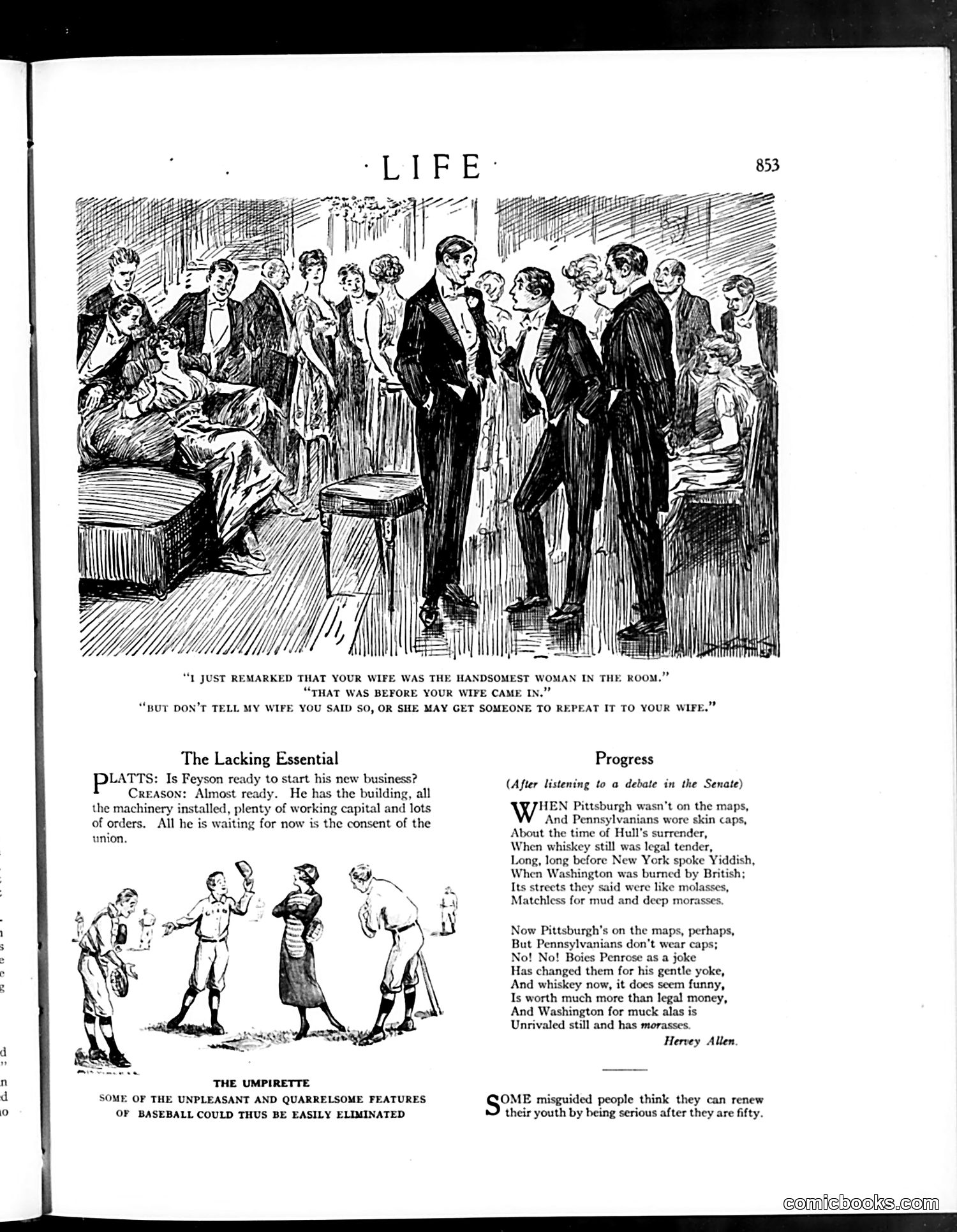
**Top Cartoon**: A social gathering where a man is warned not to repeat a compliment he made about another man's wife being "the handsomest woman in the room" — before that wife arrived. The joke satirizes gossip and social hypocrisy: the compliment becomes problematic once circumstances change, revealing how men's flattery is insincere and contextual rather than genuine. **"The Lacking Essential"**: A business dialogue where Platts asks Crerason if his new business is ready to start. Crerason has everything except "the consent of the union" — satirizing labor union power and their ability to block commercial enterprises regardless of other preparations. **"Progress"**: A poem by Hersey Allen contrasting Pittsburgh's past backwardness with its modern progress, noting how whiskey is now illegal (Prohibition era) and Washington's reputation has declined.
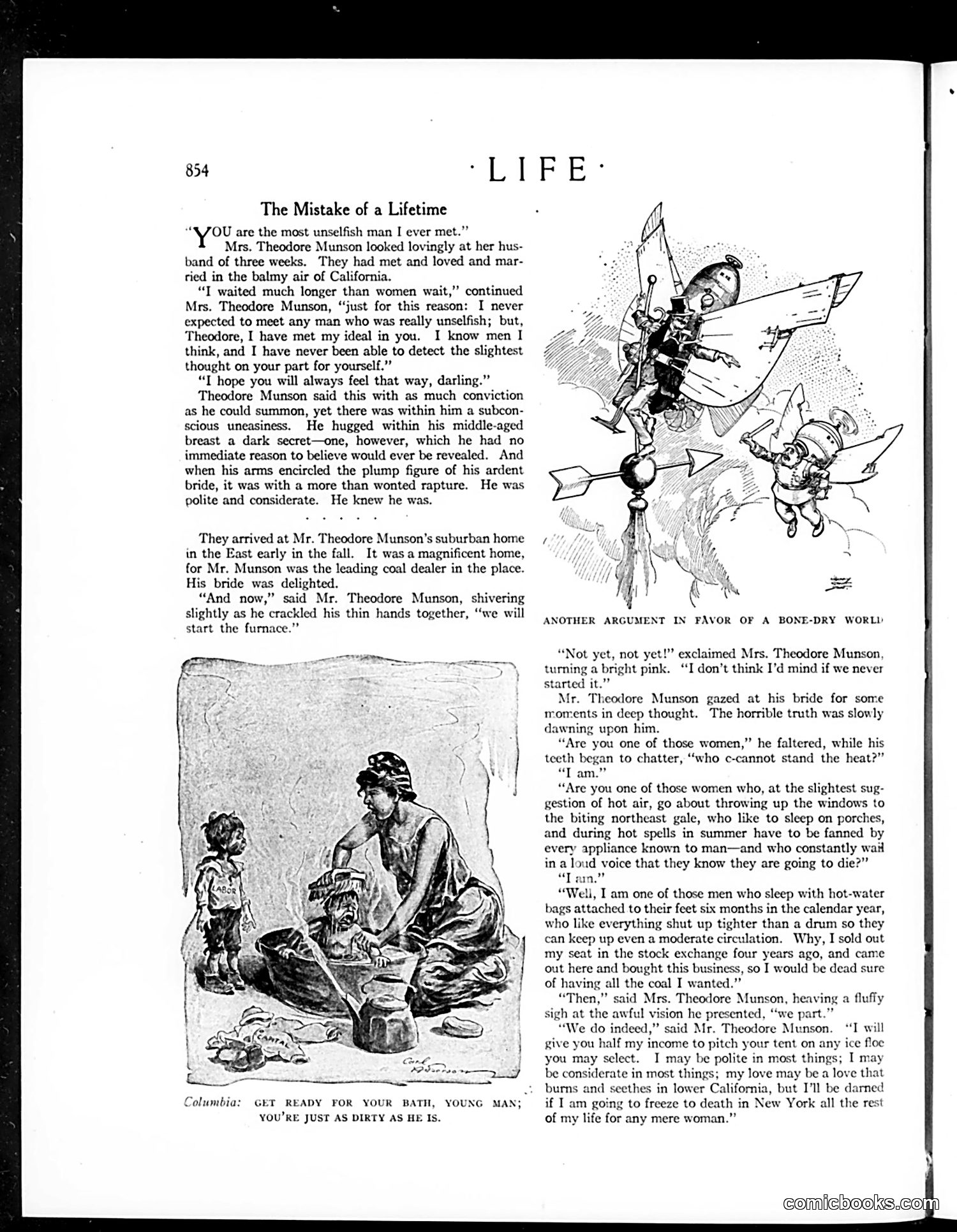
This page contains a short story about Theodore Munson, a wealthy coal dealer, and his new bride of three weeks. The narrative satirizes gender roles and marital expectations of the era. The top cartoon depicts cupids or cherubs arguing with weapons, captioned "Another Argument in Favor of a Bone-Dry World"—likely satirizing Prohibition debates by suggesting that without alcohol, even love itself becomes combative. The lower illustration shows a woman bathing, captioned "Columbia: Get Ready For Your Bath, Young Man; You're Just As Dirty As He Is"—this appears to be political commentary using "Columbia" (the American female personification) to criticize industrial pollution or social conditions, possibly directed at wealthy industrialists like the story's coal-dealing protagonist. Both pieces mock the wealthy while commenting on contemporary social issues around industry, morality, and gender.
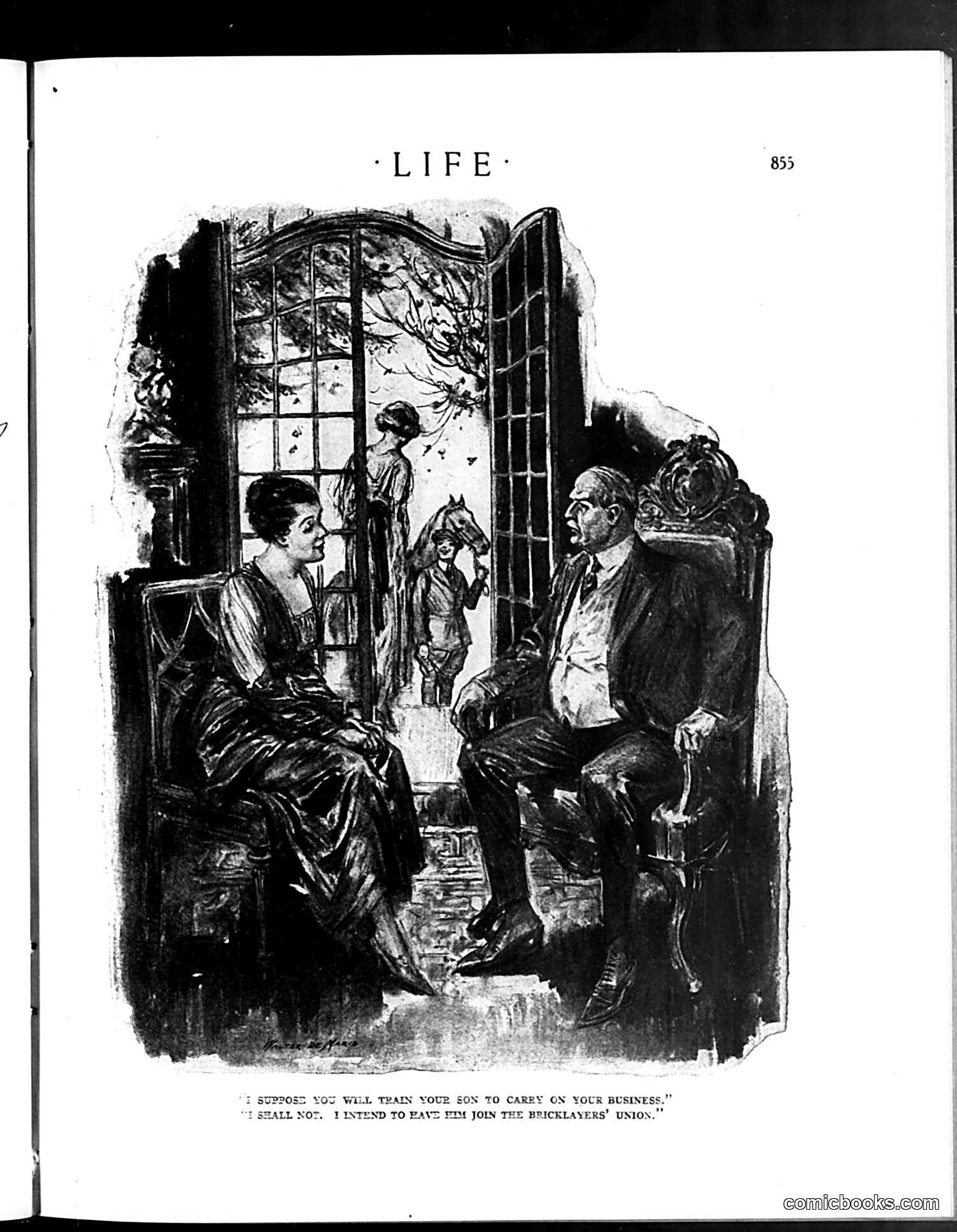
This is a single satirical illustration from *Life* magazine (page 855) depicting a domestic scene. A well-dressed man and woman sit facing each other in a doorway, with children visible in the background and a winter tree visible through the window. The caption reads: "I suppose you will train your son to carry on your business." / "I shall not. I intend to have him join the bricklayers' union." The satire mocks class pretensions and labor politics of the early 20th century. The father—apparently a businessman of means—expects his son to inherit the family enterprise. Instead, he plans for the boy to join the bricklayers' union, a working-class trade. The joke satirizes either the father's misplaced priorities or critiques contemporary attitudes about labor unions and class mobility, likely reflecting debates about industrialization and labor organization during this era.
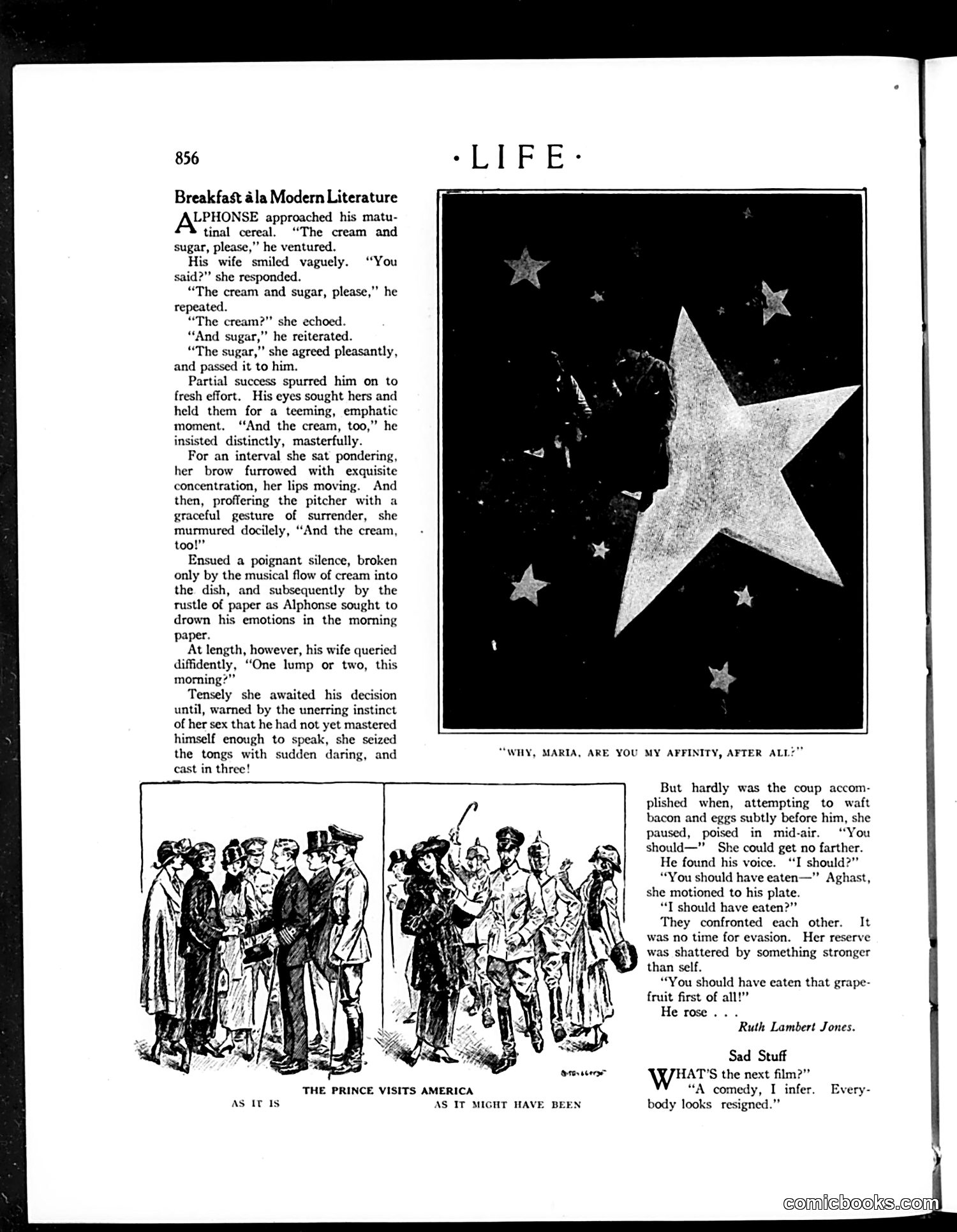
This page contains a satirical short story titled "Breakfast à la Modern Literature" and an unrelated cartoon. The story mocks overly-stylized modernist writing through a domestic scene where a husband repeatedly requests "cream and sugar" for cereal, while his wife responds with affected, literary silence and dramatic gestures. The humor lies in applying the self-conscious, minimalist, emotionally-laden prose style of contemporary "modern literature" to mundane breakfast conversation—suggesting such writing obscures rather than clarifies simple human interaction. The cartoon below, captioned "The Prince Visits America—As It Might Have Been," depicts what appears to be a royal visitor surrounded by American figures in period dress. Without visible dates or names, the specific reference is unclear, though it likely satirizes American reception of a foreign dignitary or parodies how Americans might stage-manage such visits.
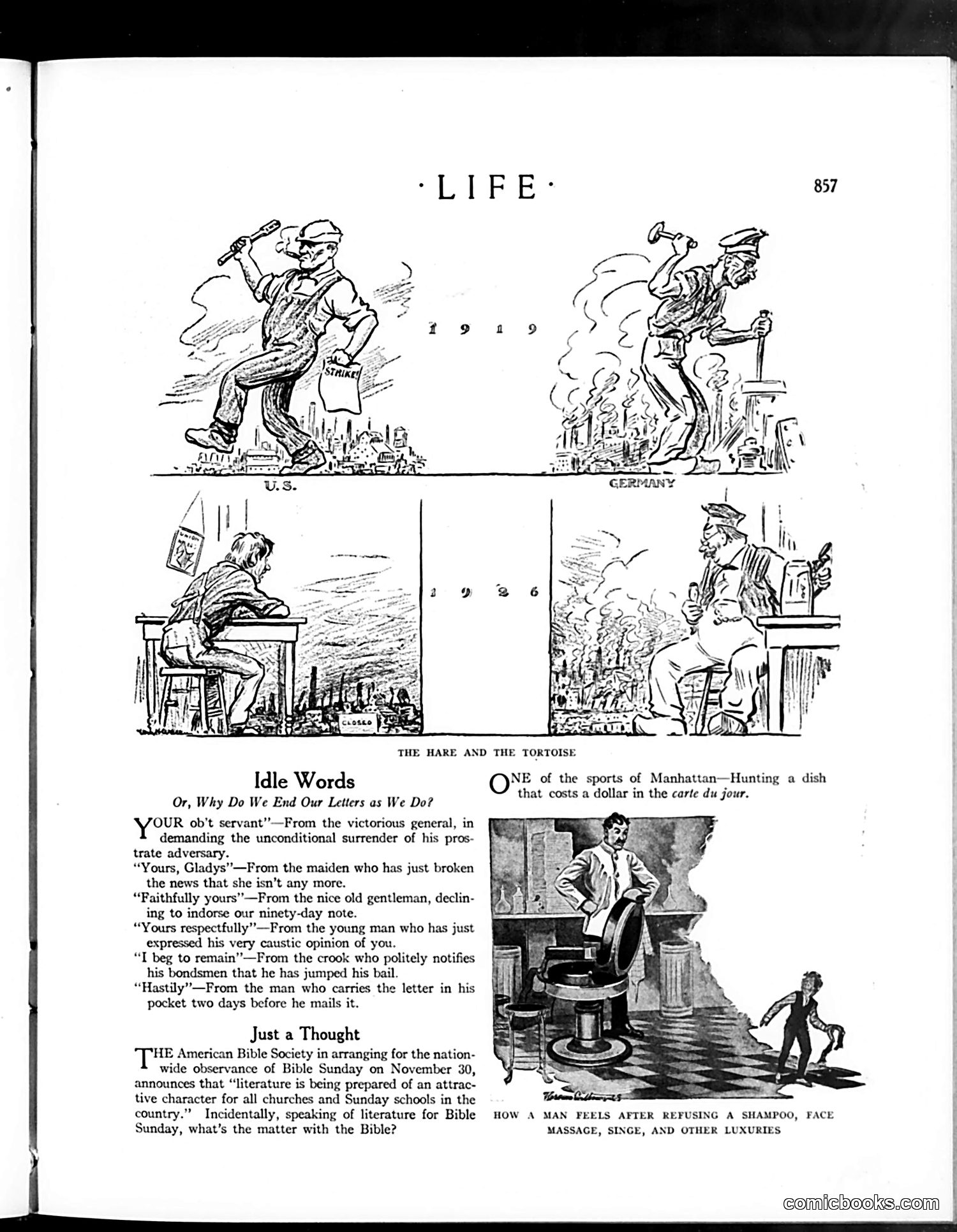
The top cartoon compares U.S. and Germany in 1919 and 1926, showing each nation's contrasting post-WWI trajectories. The U.S. figure appears energetic and productive, while Germany's figure seems chaotic and destabilized—likely reflecting anxieties about German recovery and potential resurgence after their WWI defeat. The lower sections include satirical "Idle Words" (humorous letter closings), and "The Hake and the Tortoise" cartoon mocking Manhattan's expensive dining culture. A separate illustration depicts "How a Man Feels After Refusing a Shampoo, Face Massage, Singe, and Other Luxuries"—satirizing pressure from barbers or spa attendants to purchase expensive add-on services. The page reflects 1919 American concerns about postwar economics and consumer culture.
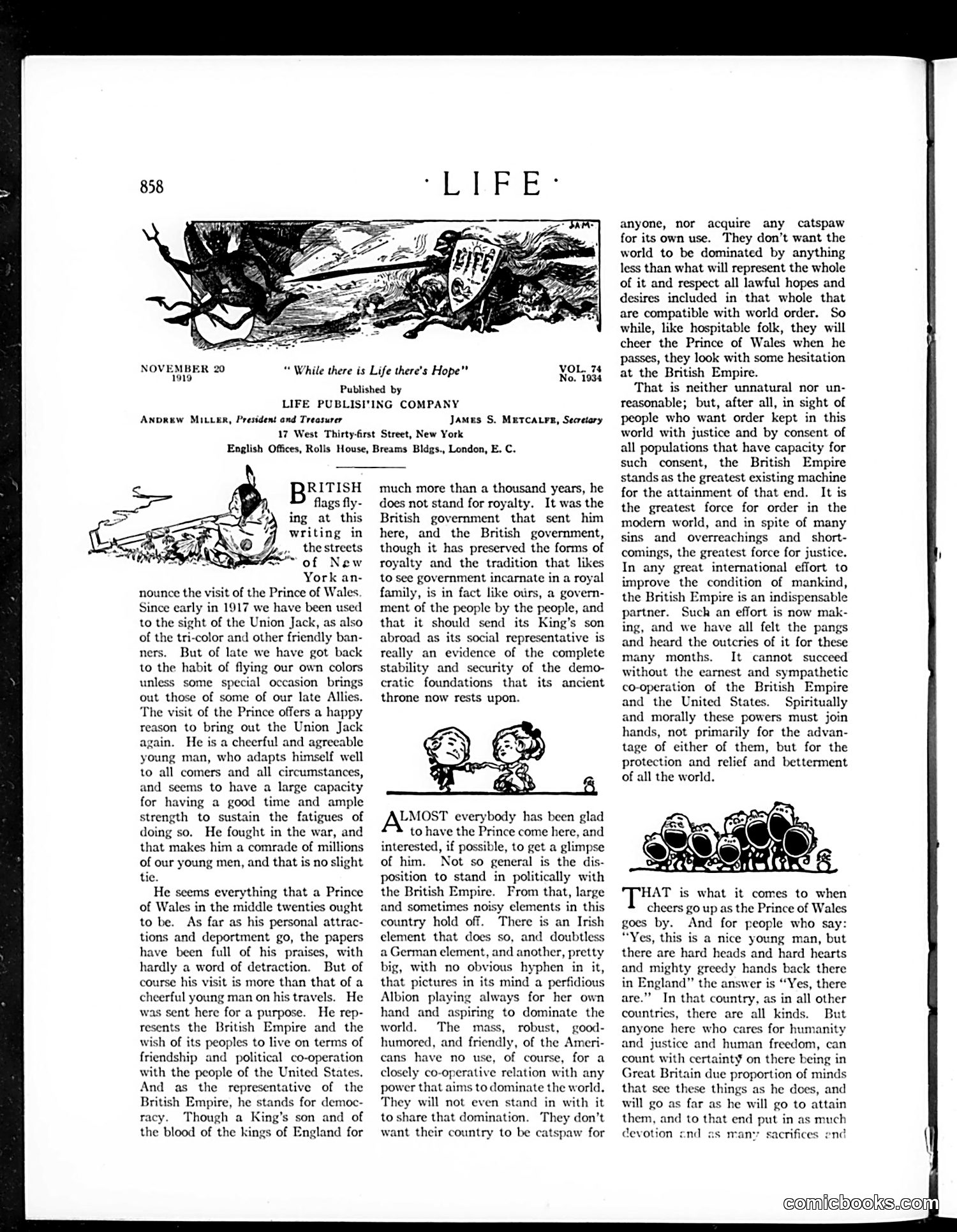
This page marks the Prince of Wales's 1919 visit to New York. The main illustration shows two simple child figures—likely representing America and Britain—in friendly embrace, symbolizing the hoped-for cooperation between the nations. The article's argument is nuanced: while Americans warmly welcome the young Prince personally (he's praised as cheerful, a war veteran, representing democratic principles), the magazine acknowledges American suspicion of the British Empire itself. It notes resistance from Irish-Americans and German-Americans, plus broader American wariness of any power seeking world dominance. The editorial stance advocates for U.S.-British cooperation, arguing that shared commitment to democratic world order—not imperial domination—should unite them. The piece attempts to distinguish between liking the Prince individually while remaining cautious about British imperial ambitions, reflecting post-WWI tensions over America's role in global affairs.
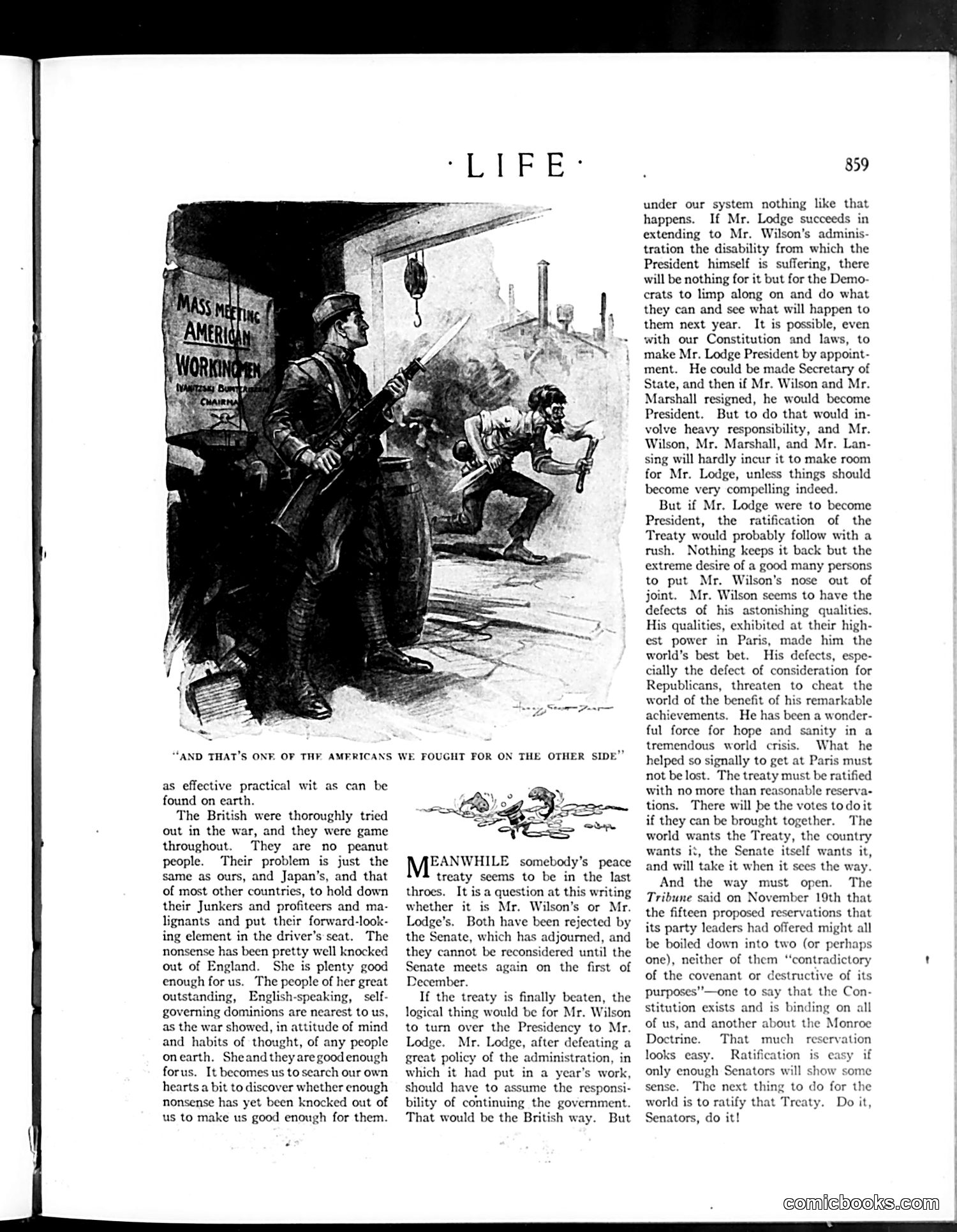
## The Cartoon The sketch depicts a soldier holding a rifle confronting what appears to be a radical or revolutionary figure near a "Mass Meeting of American Workingmen" sign. The caption reads: "AND THAT'S ONE OF THE AMERICANS WE FOUGHT FOR ON THE OTHER SIDE." ## Meaning This is **post-WWI satirical commentary** on American radicalism and labor unrest. The cartoon suggests ironic bitterness: American soldiers fought in Europe supposedly defending democracy and freedom, yet returned home to face domestic radicals and labor agitators demanding revolutionary change. The "other side" likely references both the enemy (Germany) and ideological opponents within America itself—suggesting that dangerous radical elements exist at home. ## Context The accompanying text discusses President Wilson's League of Nations treaty and Senate opposition (led by Henry Cabot Lodge). The broader context involves 1919-1920 post-war anxiety about Bolshevism, labor strikes, and political extremism in America—fears that radical foreign ideologies threatened American stability. The cartoon mocks this paradox: soldiers fought abroad for principles now seemingly threatened by domestic radicalism.
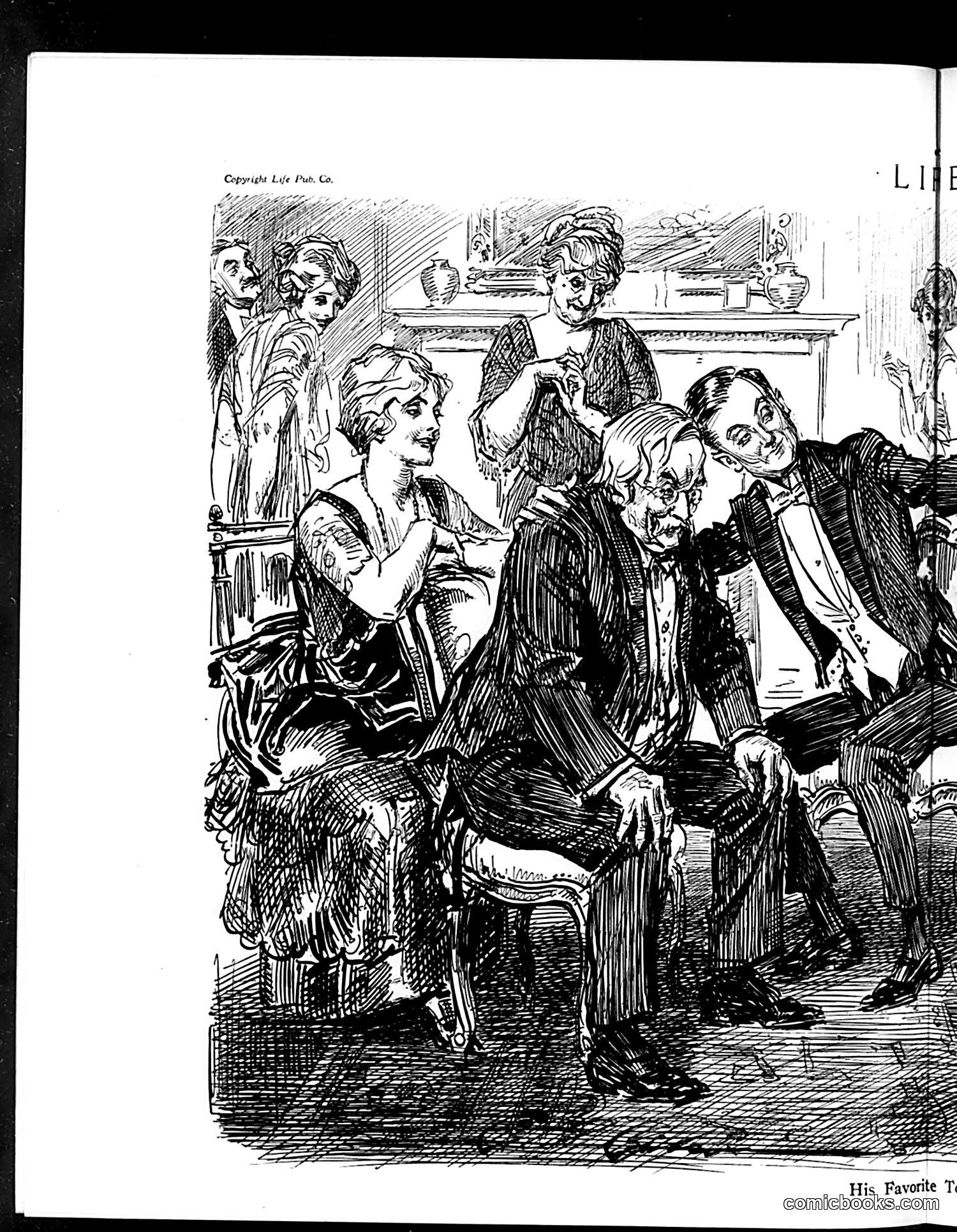
This is a black and white sketch from *Life* magazine showing a formal social gathering. Well-dressed men in evening wear and women in formal attire appear to be at an indoor social event, with some figures standing in the background near a fireplace or mantelpiece. The partial caption "His Favorite T[—]" is cut off, making the specific satirical point unclear. Without the complete title or text, I cannot definitively identify which public figures are caricatured or what social/political commentary is intended. The scene suggests satire of high society or formal gatherings, but the exact target and joke remain indeterminate from this page fragment alone.
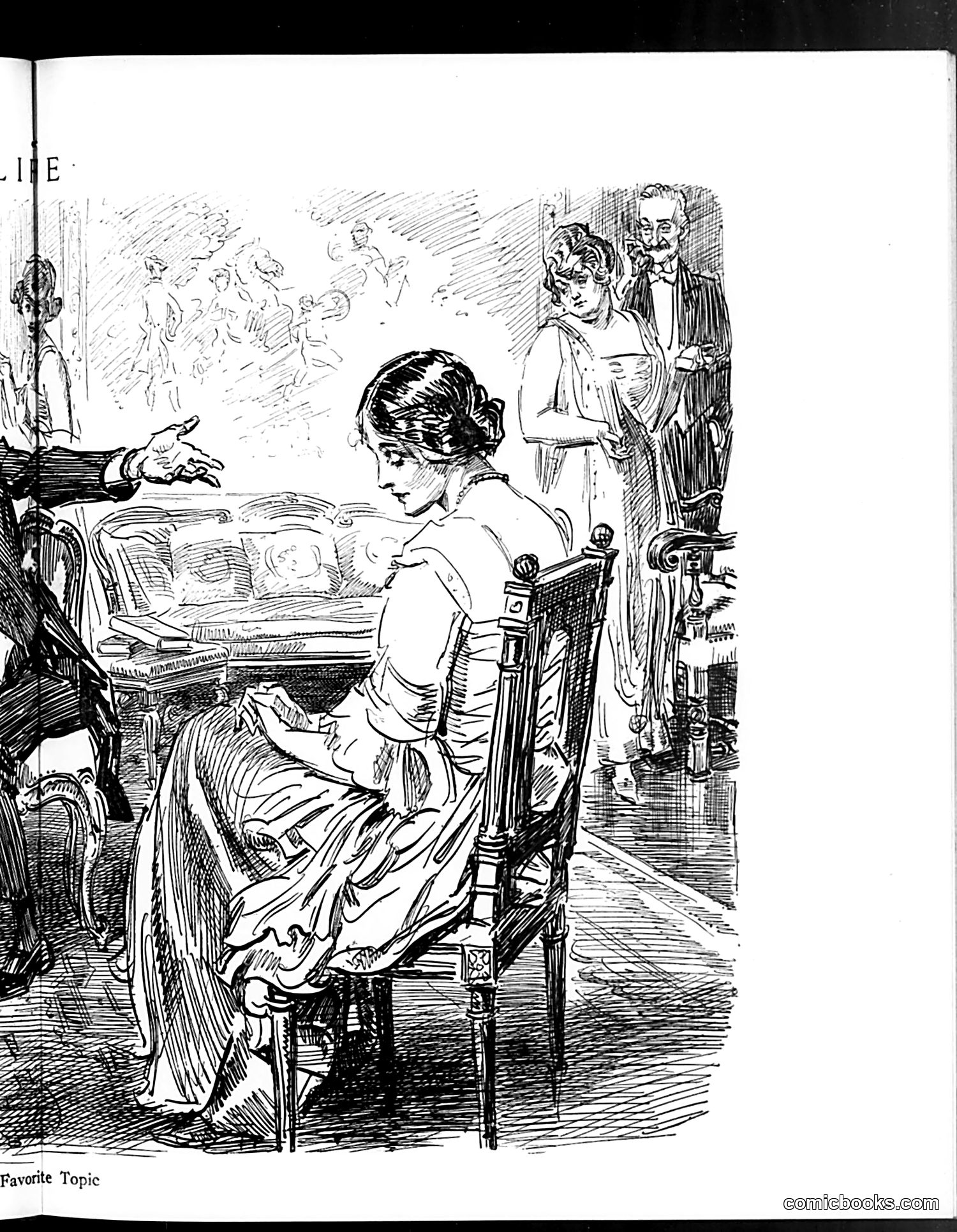
This sketch depicts a woman seated at a desk, studying what appears to be an illustrated book or portfolio, while well-dressed gentlemen stand conversing in the background. The title "Favorite Topic" suggests the cartoon satirizes social conversation and gender dynamics. The satire likely comments on what topics women and men discuss in polite society. The woman's absorbed attention to visual material contrasts with the men's conversation, possibly mocking either: (1) assumptions about women's intellectual interests versus men's, or (2) the gap between what women actually engage with versus what society expects them to discuss in mixed company. The formal dress and interior setting indicate upper-class social contexts. Without additional context from the magazine's publication date, the specific satirical point remains somewhat unclear, though it appears to critique Victorian or Edwardian-era social pretensions.
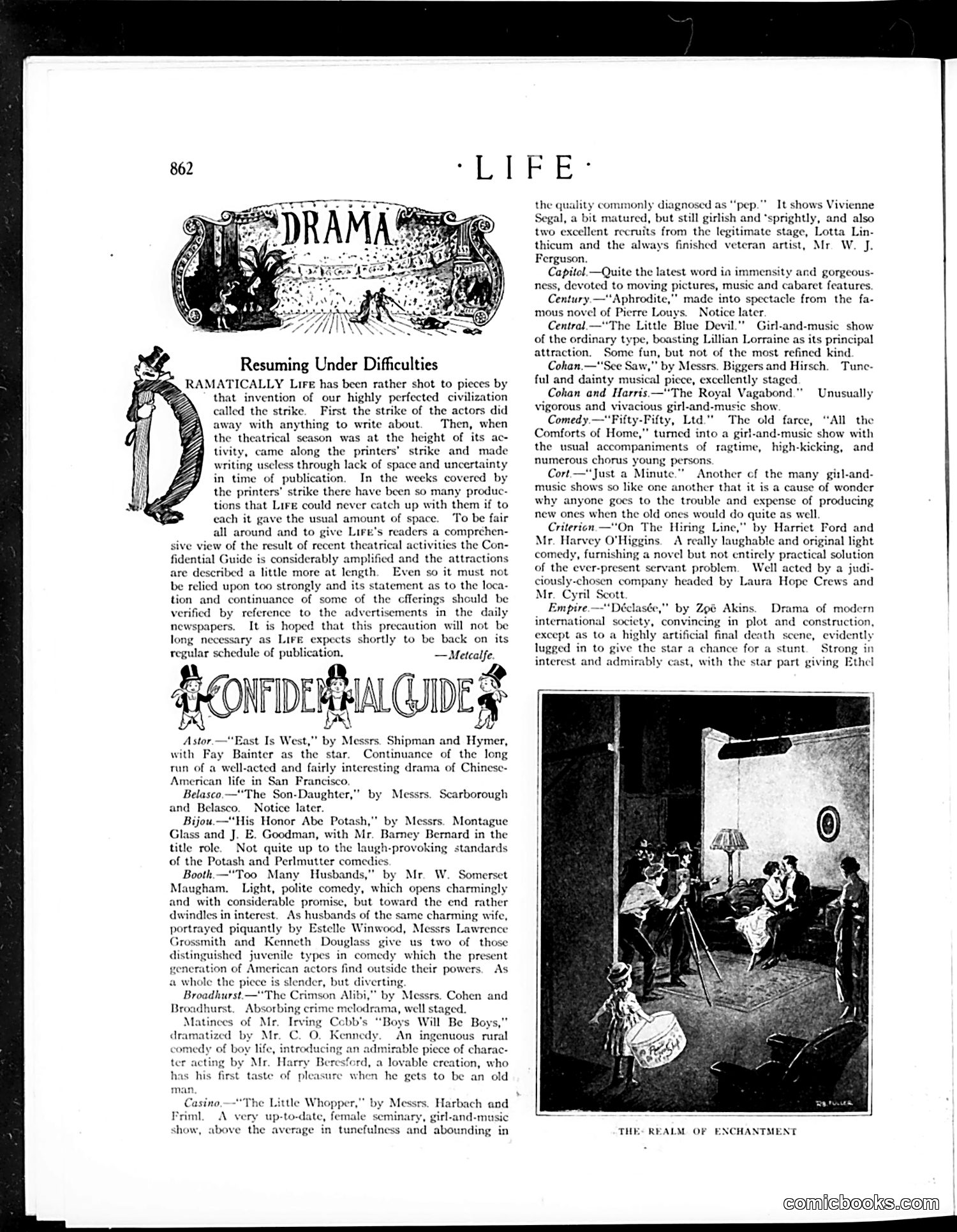
This page is primarily a theater review section titled "Resuming Under Difficulties," explaining publication challenges from recent strikes. The accompanying illustration shows a disheveled figure representing the magazine itself, battered by circumstances. The introductory text describes how both actors' and printers' strikes disrupted Life's ability to cover theatrical productions. As a result, the magazine expanded its "Confidential Guide" theater reviews to catch readers up on missed shows. The reviews catalog current Broadway productions—plays like "East Is West," "Too Many Husbands," and musical comedies—with brief critical assessments of their quality and cast performances. There's also a photograph labeled "The Realm of Enchantment" showing what appears to be a theatrical scene. The satire is gentle: Life presents itself as a victim of labor strikes beyond its control, explaining to readers why coverage gaps exist. The page's main point is apologetic—reassuring readers the magazine will resume normal publishing soon.
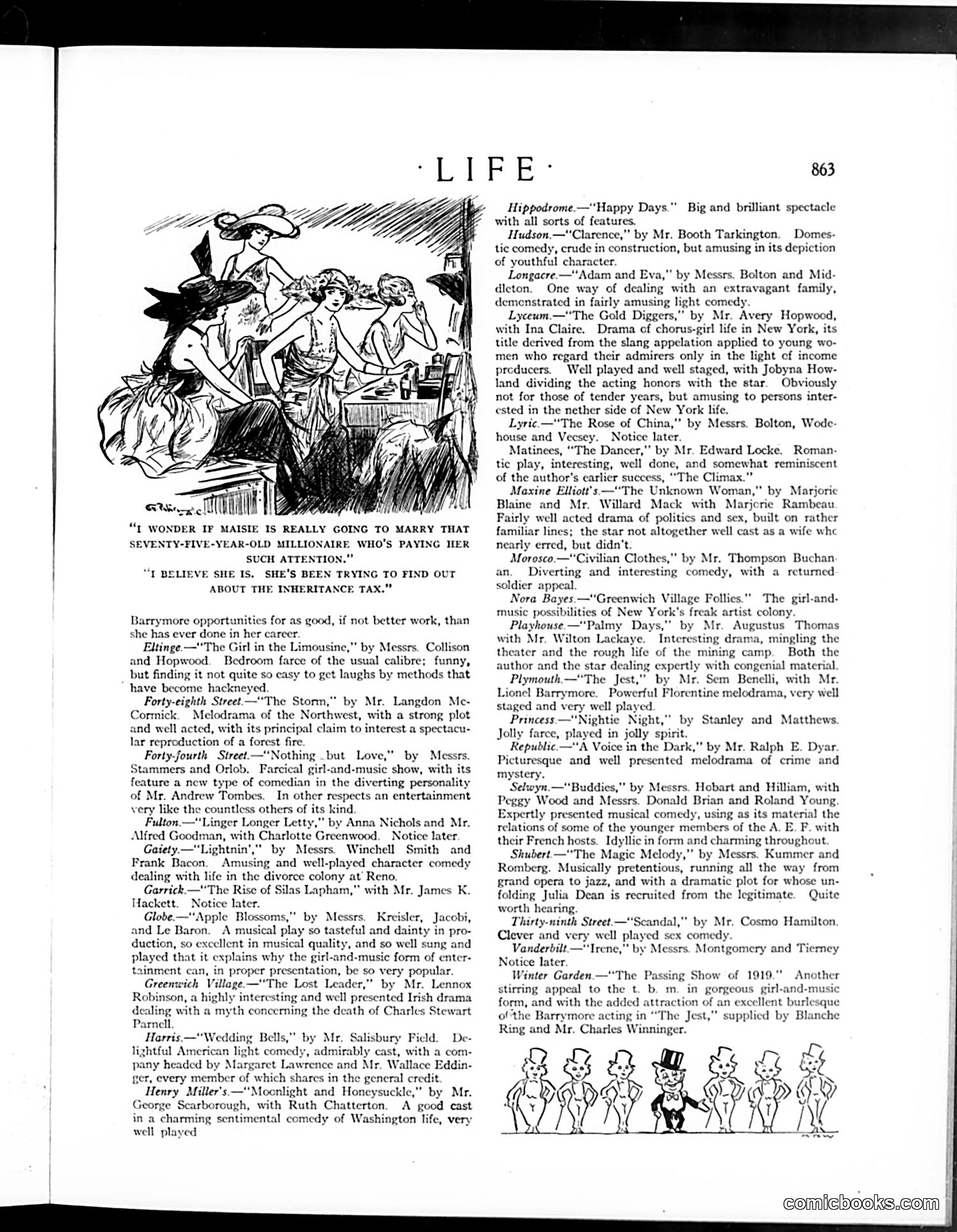
This page from Life magazine (appears to be early 1920s) combines theatre reviews with a satirical cartoon about marriage and money. **The Cartoon:** The illustration and captions mock a young woman named "Maisie" who is pursuing marriage to a wealthy seventy-five-year-old millionaire. The joke hinges on her real motivation: she's trying to understand inheritance tax law—suggesting she's calculating what she'll inherit after his death rather than marrying for love. This satirizes the "gold digger" phenomenon of the era, where women from lower economic circumstances sought wealthy older husbands for financial security. **Context for Modern Readers:** The inheritance tax (federal estate tax) was relatively new, having been introduced in 1916. The cartoon assumes readers understand both the concept of gold-digging and recent tax legislation—making it a sophisticated joke targeting an educated audience aware of current fiscal policy. The page's theatre reviews below reinforce the era's entertainment themes, including a play called "The Gold Diggers" (mentioned in the Lyceum review).
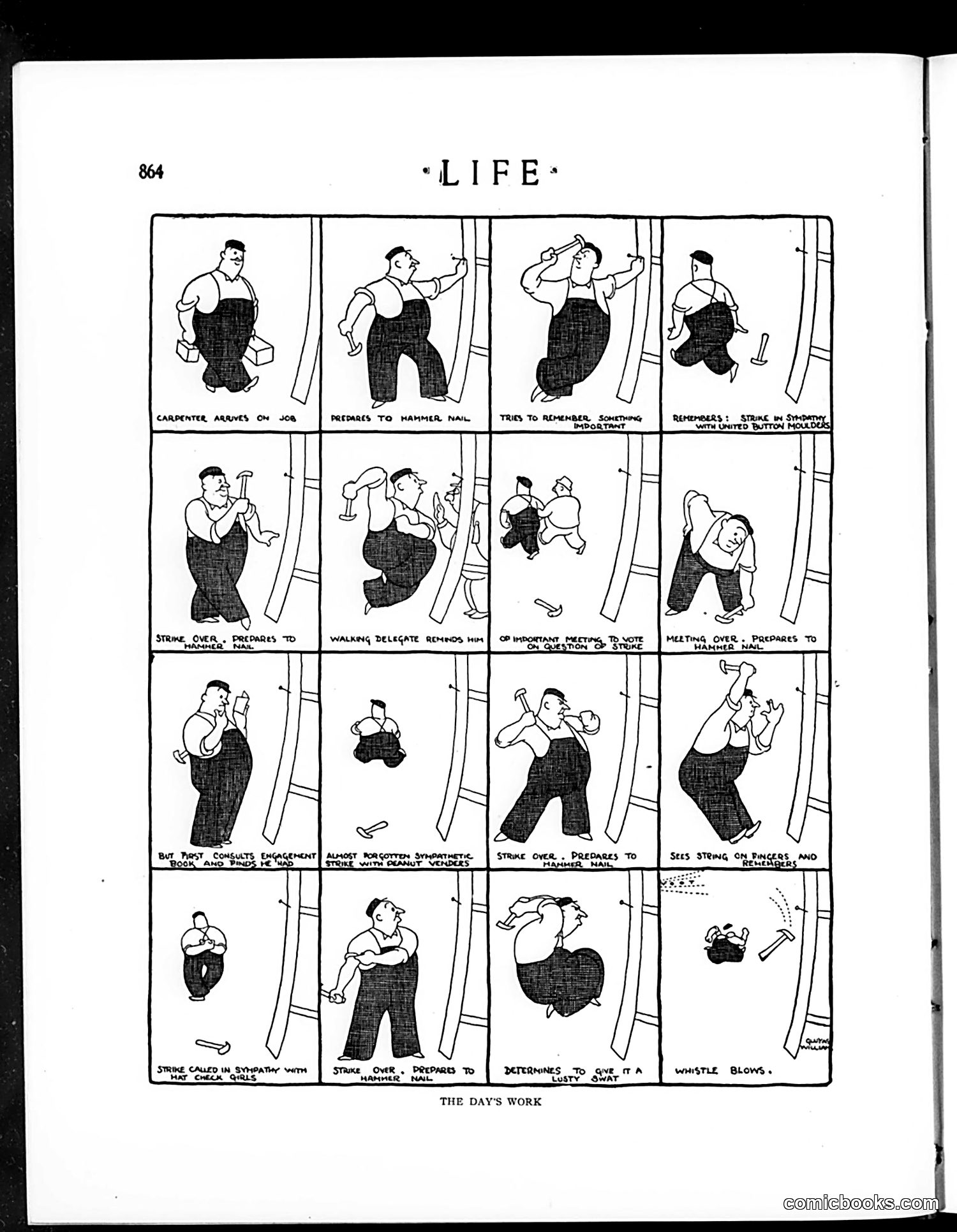
This comic strip satirizes a carpenter's workday during what appears to be a labor dispute era (likely early 20th century). The sequence shows a worker repeatedly striking his hammer against a nail, but the joke escalates absurdly: he strikes in preparation for a meeting, walks a delegate, attends meetings to vote on strike questions, strikes in solidarity, and finally—in the punchline—the "whistle blows," suggesting the entire day consisted of strike-related activities rather than actual work. The satire criticizes labor unions or strikers by suggesting they spend more time organizing, meeting, and preparing for strikes than performing actual labor. The repeated hammer motif becomes ironic: the tool meant for work becomes a symbol of labor activism instead.
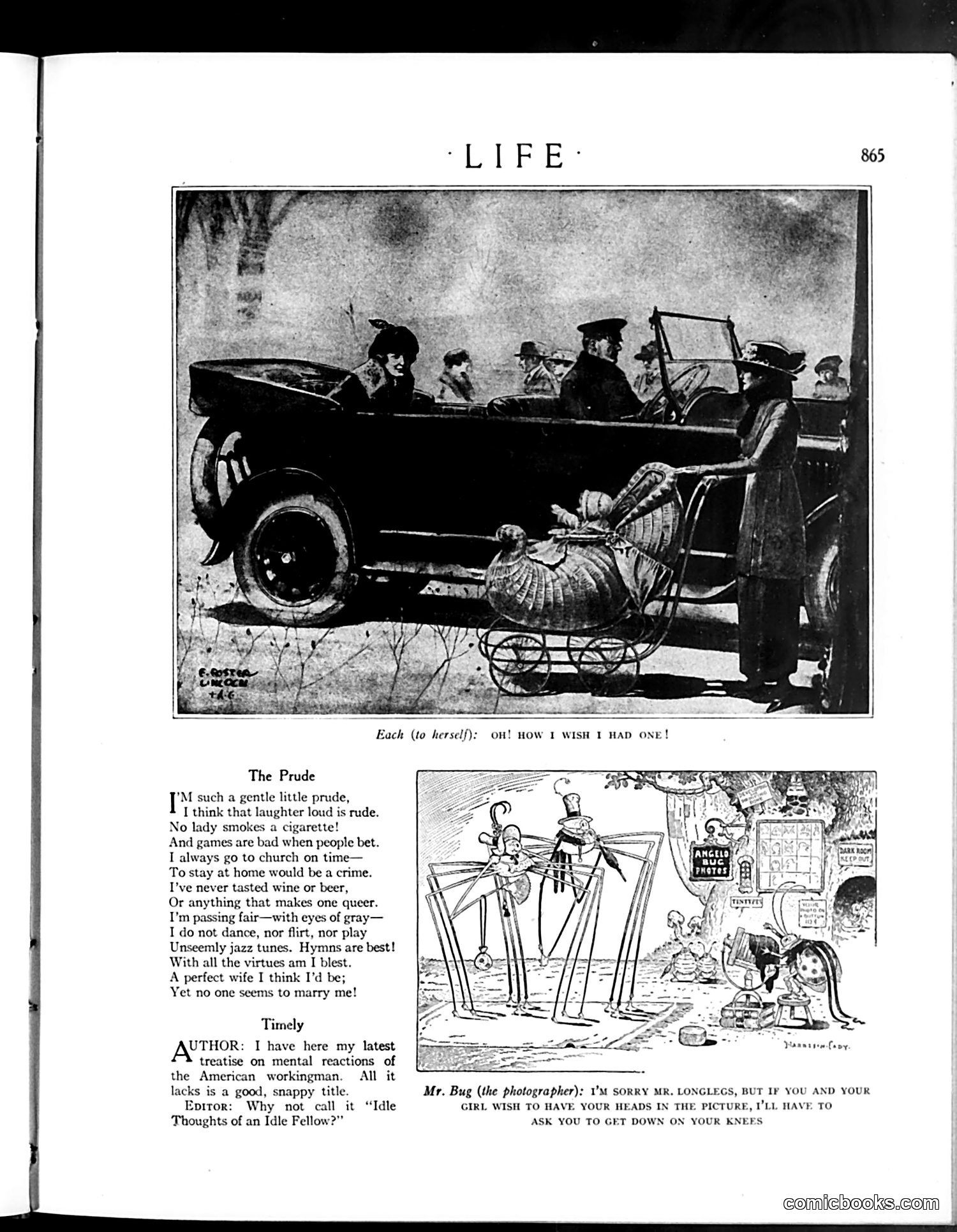
**"The Prude"** (poem): Mocks an excessively virtuous woman who rigidly follows social conventions—no smoking, drinking, dancing, or gambling—yet remains unmarried despite believing herself perfect wife material. The satire targets hypocrisy: her self-righteous propriety actually repels potential suitors rather than attracting them. **"Timely"** (dialogue): A brief joke about an author pitching a book on working-class psychology. The editor's suggested title—"Idle Thoughts of an Idle Fellow"—is a pun implying the author's manuscript is itself lazy/unoriginal, likely a reference to a famous essay series by Jerome K. Jerome. **"Mr. Bug (the photographer)"** (cartoon): Shows an insect photographer struggling to fit tall, long-legged human couple into his camera frame, asking them to kneel. The humor derives from the absurdist premise of a bug operating a camera and the couples' literal physical mismatch with the equipment. All three pieces use gentle social satire typical of early-20th-century humor magazines.
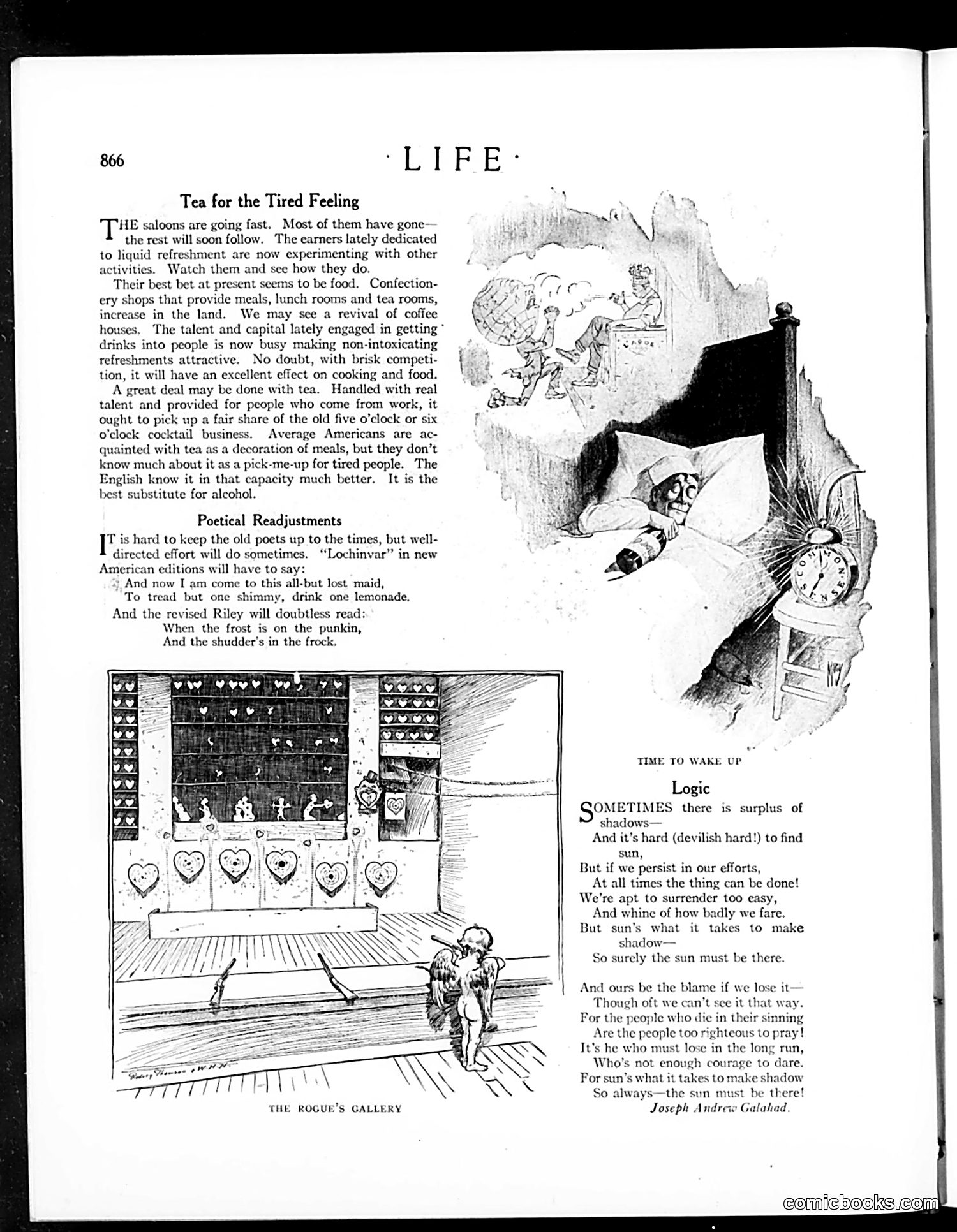
This page satirizes **Prohibition**, the recently enacted ban on alcohol sales in America. The lead article, "Tea for the Tired Feeling," mocks the transition from saloons to tea rooms and coffee houses as replacements for bars. It notes Americans are unfamiliar with tea as a restorative drink (the English use it better for this purpose) and jokes that establishments formerly dedicated to serving liquor are scrambling to rebrand as food venues. The satire suggests this substitution is foolish—tea cannot truly replace alcohol's appeal. "Poetical Readjustments" extends the joke by imagining how classic poems must be rewritten for Prohibition America. Lochinvar's romantic invitation becomes "drink one lemonade," and James Whitcomb Riley's nostalgic verse about frost gains a reference to "shudder's in the frock"—presumably nervous anxiety replacing cozy consumption. The cartoon "The Rogue's Gallery" (lower left) depicts a storefront decorated with hearts—likely a speakeasy or illicit establishment—showing how criminal enterprises emerged to circumvent Prohibition. The poem "Logic" appears unrelated social commentary on perseverance.
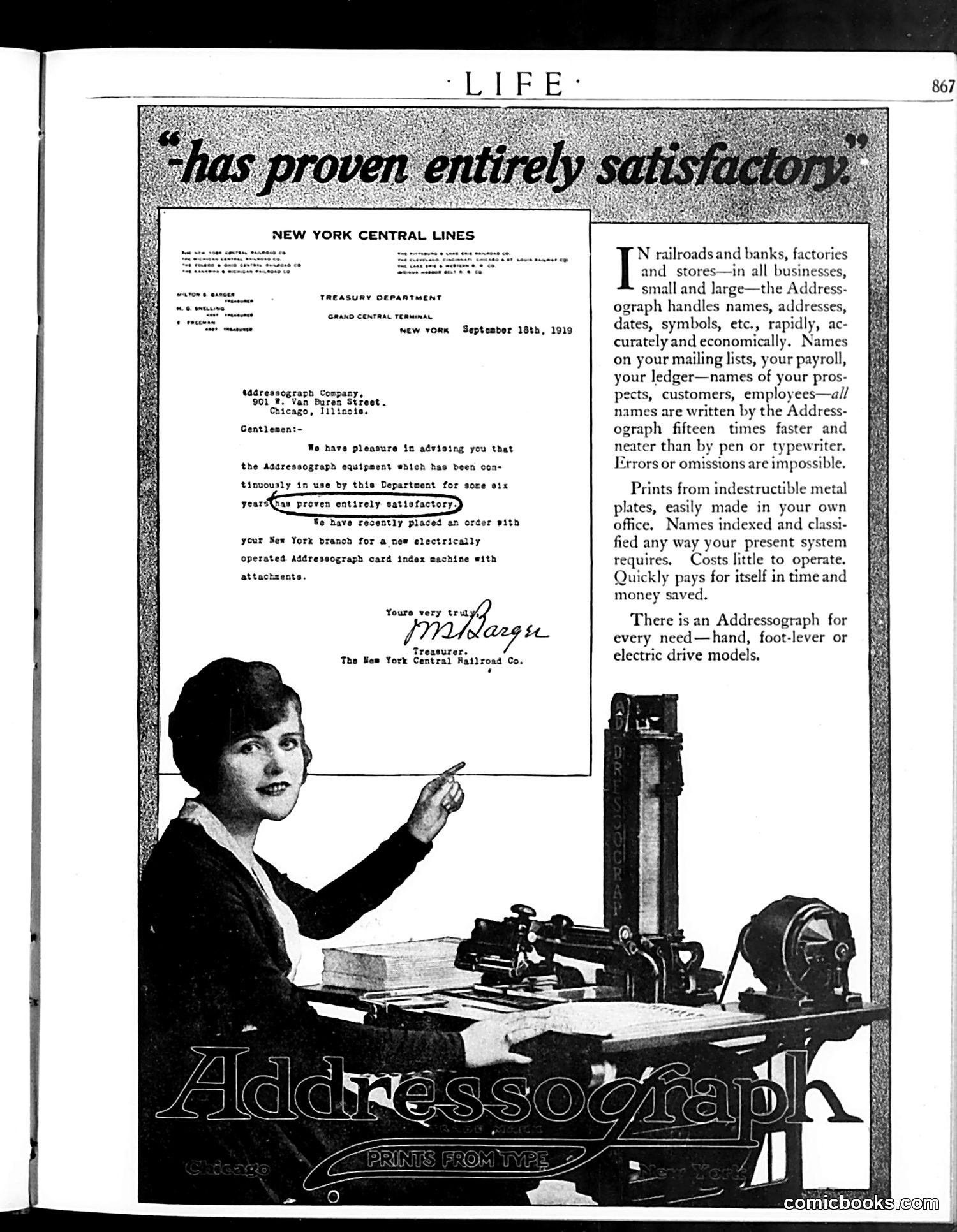
This is a **product advertisement for the Addressograph**, a mechanical name-and-address printing machine. There is no political cartoon here. The ad uses a endorsement strategy: it features an actual letter from the **New York Central Railroad's Treasury Department** (dated September 1919) praising the Addressograph equipment they've purchased. A woman operator is shown at the machine. The pitch targets businesses needing to handle large volumes of names—on mailing lists, payrolls, ledgers. The machine's selling points: it prints fifteen times faster than handwriting, produces clean results from metal plates, costs little to operate, and quickly pays for itself. For modern readers: this represents pre-digital office automation. The Addressograph was a genuine labor-saving device of the era, solving a real problem businesses faced before computers. The testimonial from a major railroad lends credibility to what was then cutting-edge clerical technology.
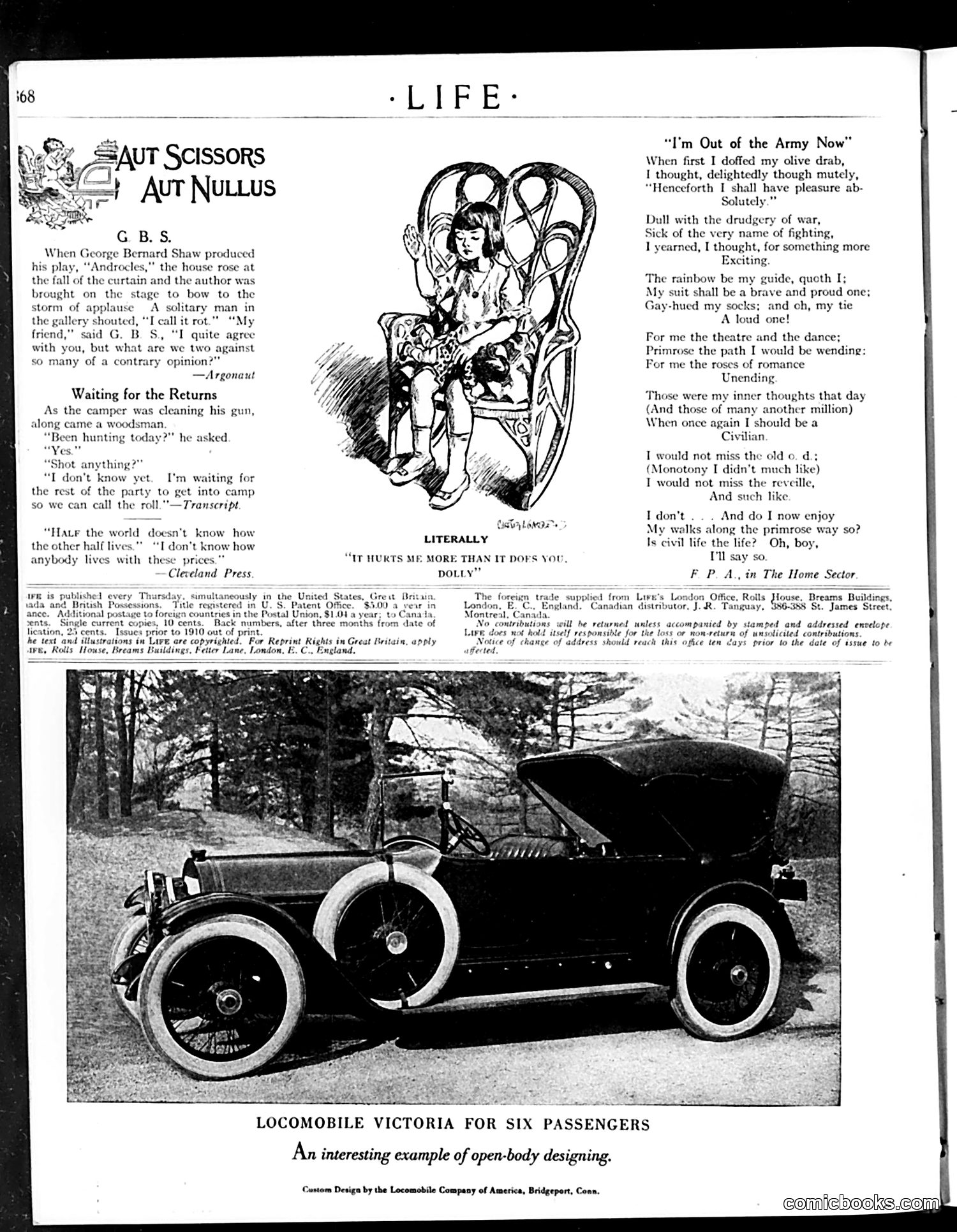
**The cartoons and jokes reflect post-WWI American concerns:** The main item, "I'm Out of the Army Now," satirizes soldiers returning from World War I. The poem depicts a soldier's naive optimism upon demobilization—imagining civilian life as theater, dance, and romance—contrasting sharply with the reality of postwar adjustment. The joke is that despite hoping to escape military monotony, he discovers civilian life offers no improvement. The shorter humor items address cost-of-living anxieties ("doesn't know how anybody lives with these prices") and domestic friction ("It hurts me more than it does you, Dolly"). The G.B.S. anecdote references George Bernard Shaw and his play "Androcles," using wit about critical disagreement. **The automobile advertisement** at page bottom represents 1920s consumer optimism and technological modernity—typical period marketing positioning cars as aspirational leisure goods. Overall, the page captures post-WWI American anxieties about readjustment, economic strain, and the gap between wartime sacrifice and peacetime reality.
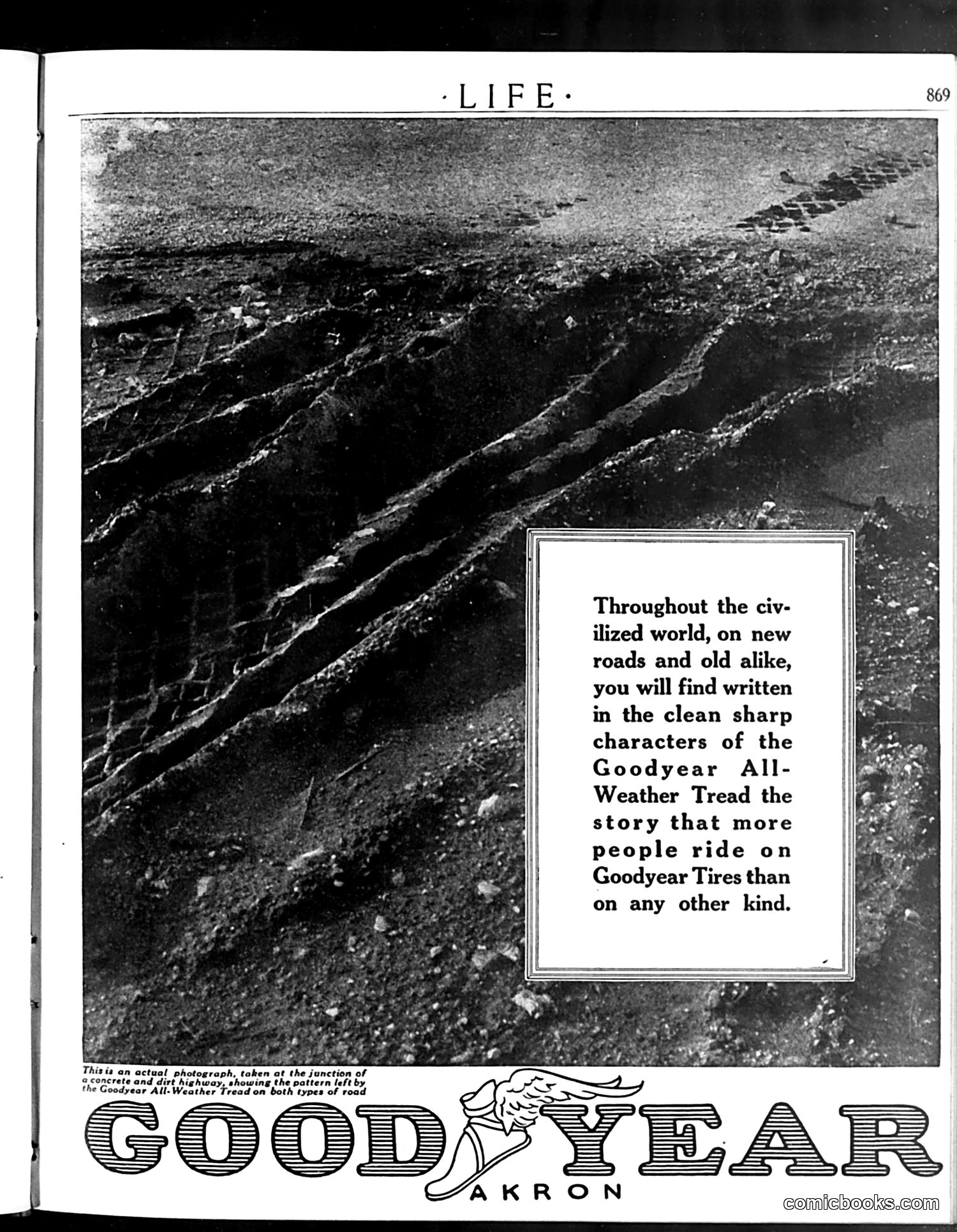
This is primarily a **Goodyear Tire advertisement**, not a political cartoon. The page depicts an aerial photograph showing tire tread marks on both concrete and dirt roads, visually demonstrating that Goodyear All-Weather Tread performs consistently across different road surfaces. The advertisement's claim—that "more people ride on Goodyear Tires than on any other kind"—uses the physical evidence of the tire tracks as persuasive proof. For a modern reader, this represents early 20th-century advertising strategy: using actual photography rather than illustration to create credibility. The reference to "the civilized world" reflects period language typical of that era. The Goodyear winged logo appears at the bottom, identifying the Akron, Ohio manufacturer. This is straightforward product marketing, not satire.
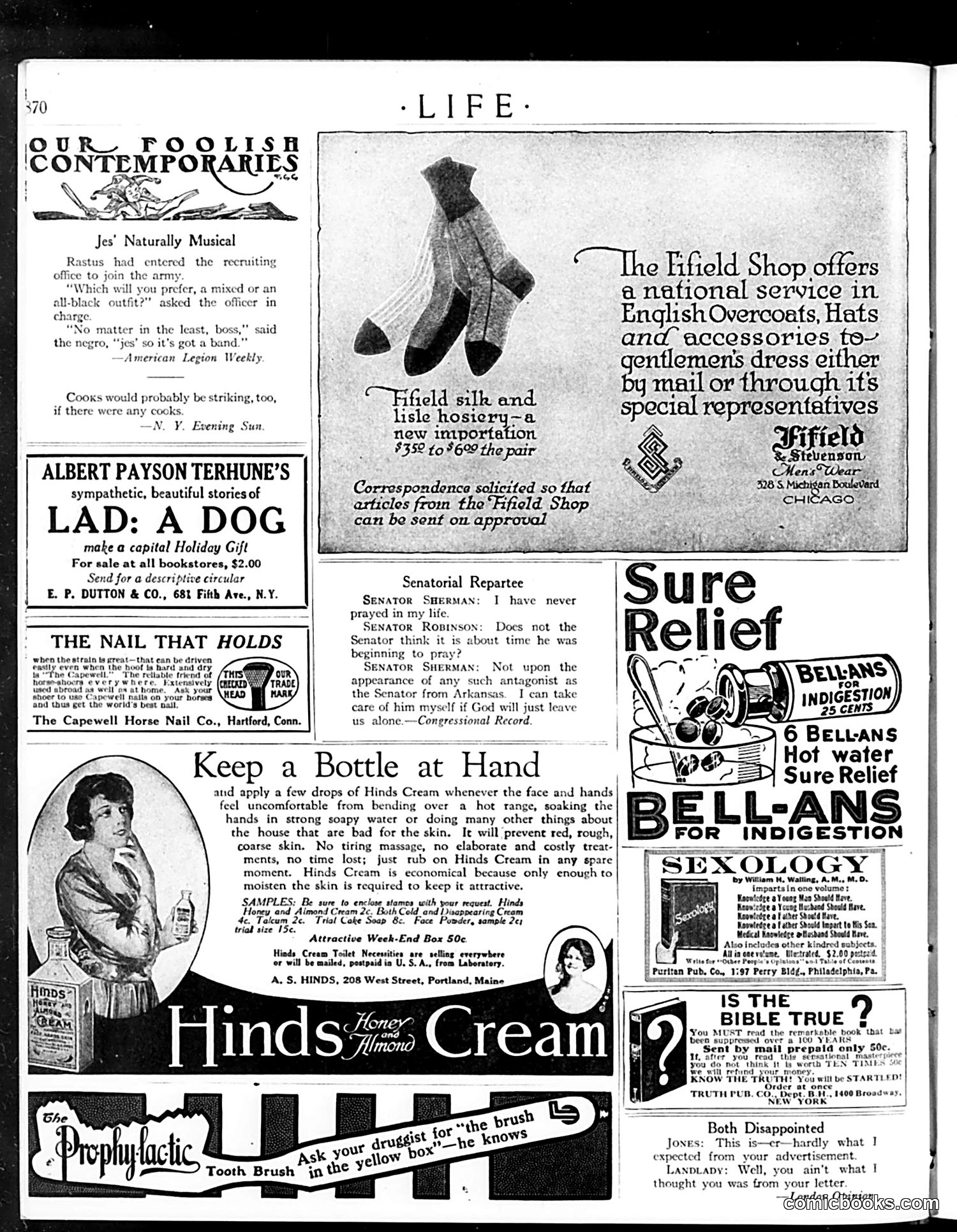
This page from *Life* magazine consists primarily of **advertisements and a brief satirical exchange**, rather than political cartoons. The main satirical content is "Senatorial Repartee," a short dialogue mocking senators Sherman and Robinson. Senator Robinson challenges Senator Sherman to begin praying, implying the senator has never prayed in his life. Sherman's response—that he'd prefer to handle his own affairs and leave God out of it—satirizes the hypocrisy of religious posturing in politics. The joke targets senatorial self-importance and irreverence. The remaining content is commercial: ads for Hinds Cream (skincare), Bellans (indigestion relief), a book on sexual knowledge, and various other products. The bottom includes a crude joke about a man and woman's mismatched expectations from correspondence—likely dating or mail-order humor typical of the era. The page reflects early 20th-century advertising conventions and light social satire rather than serious political commentary.
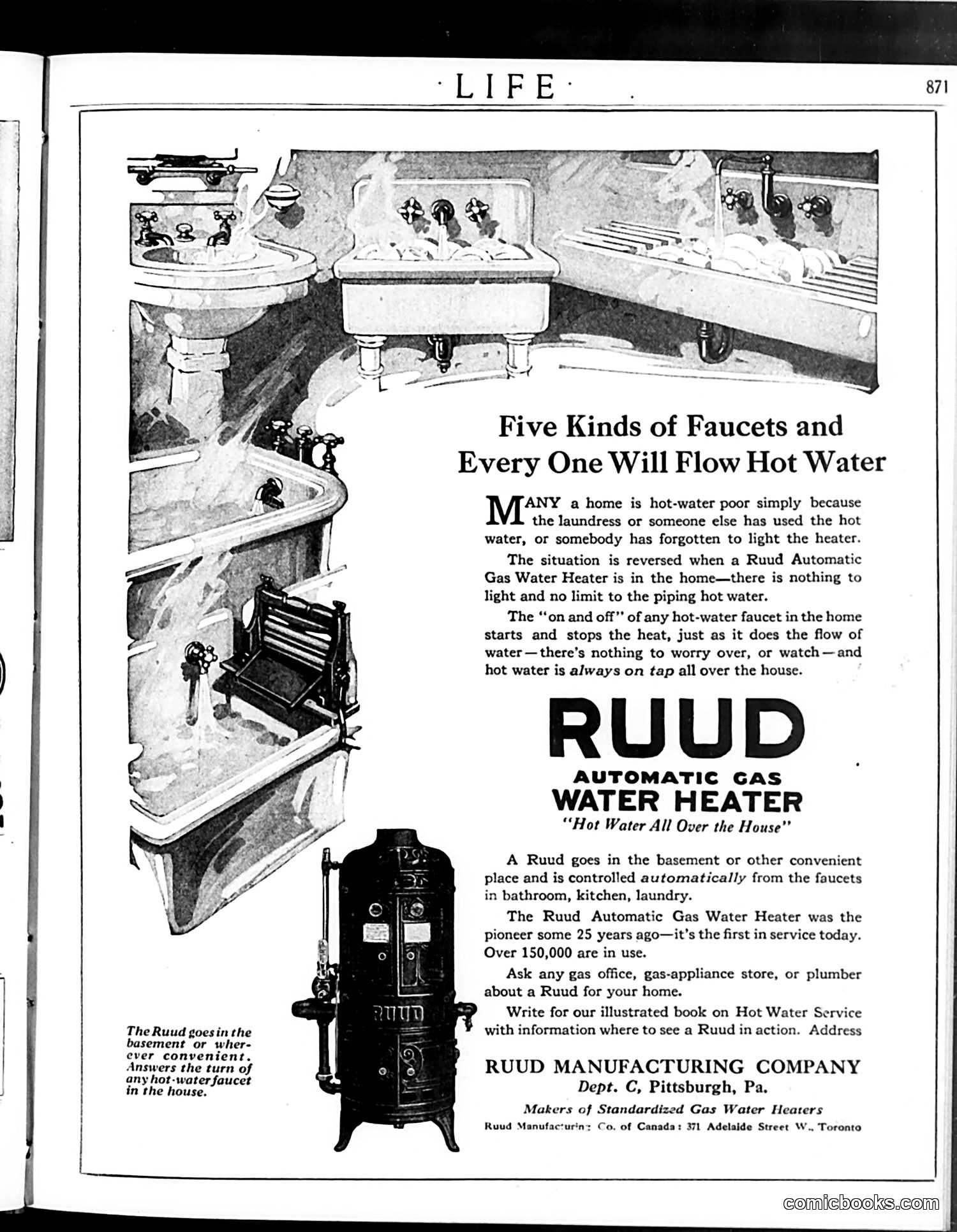
This page is **not a political cartoon or satire**—it's a straightforward **advertisement for Ruud Automatic Gas Water Heaters**, published in Life magazine (a general-interest publication, not primarily satirical by this era). The ad addresses a genuine domestic problem of the period: inconsistent hot water access in homes. It identifies the complaint humorously ("hot-water poor") but frames this as a real inconvenience—someone uses all the hot water, or the heater gets forgotten. The solution: an automatic gas water heater requiring no manual lighting and providing unlimited hot water throughout the house. The visual shows five different faucet styles and the basement-mounted heater unit. The appeal is to modern convenience and automatic operation, key selling points for early-20th-century appliances. This reflects the era's focus on labor-saving household technology, particularly relevant to families with laundresses or servants who managed water heating manually.
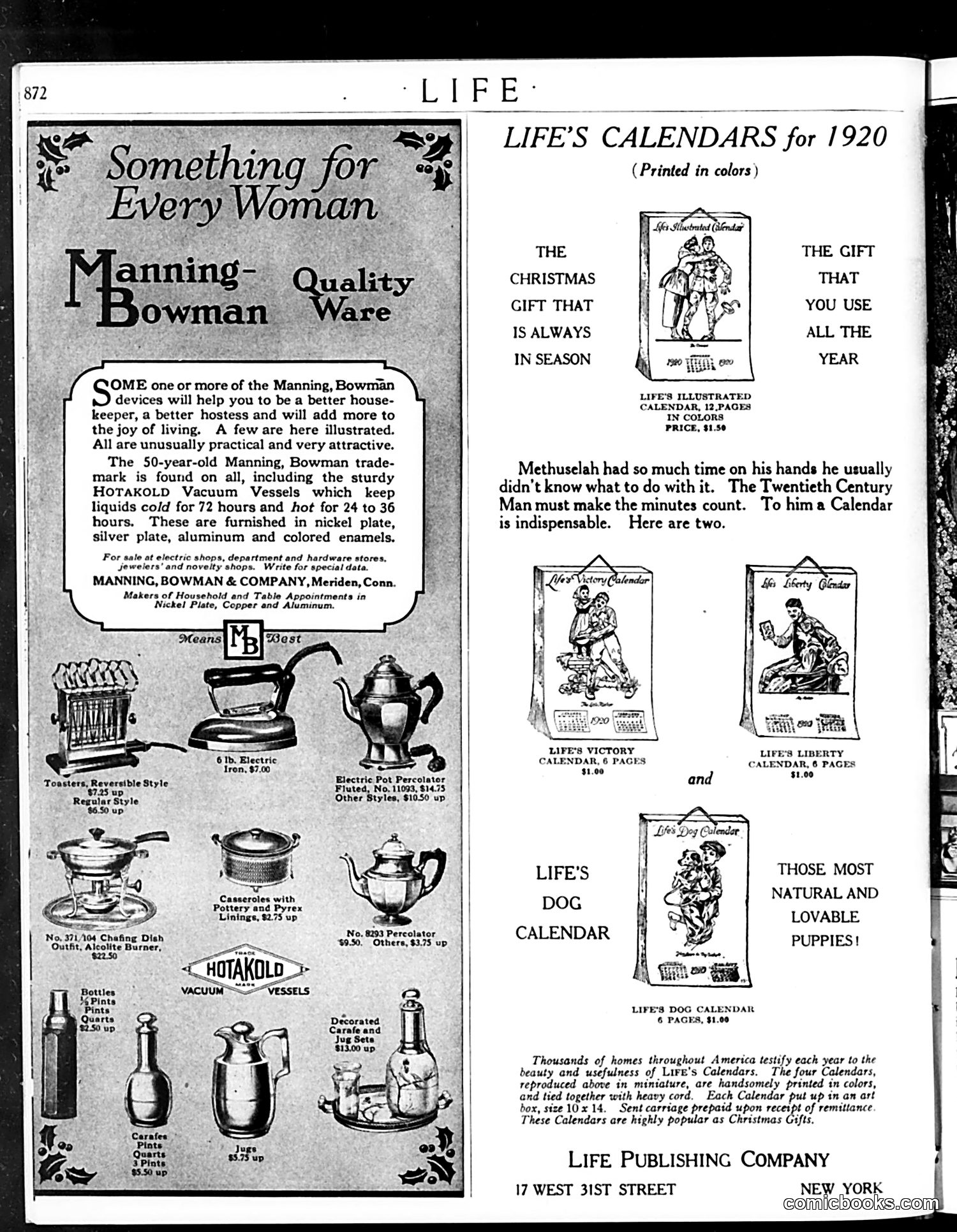
This page contains **two distinct advertisements** with no political cartoons or satire. **Left side:** Manning-Bowman advertises household appliances—electric irons, percolators, chafing dishes, and their "Hotakold" vacuum vessels (thermos bottles). The copy emphasizes these devices make women better housekeepers and hostesses. This reflects early 20th-century marketing that tied domestic technology to women's domestic roles. **Right side:** Life Publishing Company advertises four 1920 calendars. The text references "Methuselah" (biblical figure with excessive leisure time) to contrast with the "Twentieth Century Man" who must "make the minutes count"—positioning calendars as essential time-management tools. Four calendar options are shown: an illustrated Christmas calendar, a "Victory" calendar, a "Liberty" calendar, and a "Dog" calendar featuring puppies. Both ads target domestic consumers with practical gifts and household items typical of 1920s advertising.
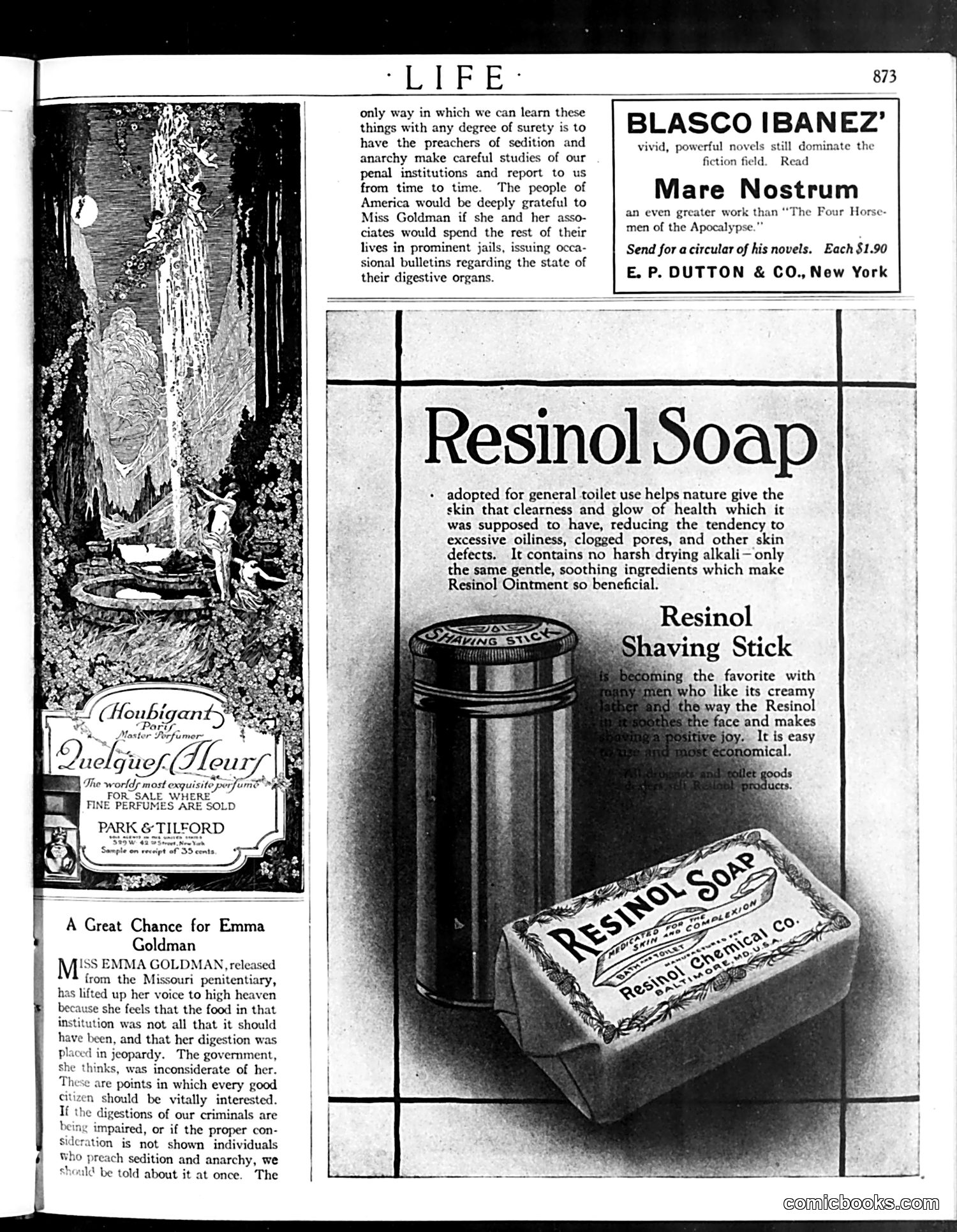
This is satirical commentary on anarchist Emma Goldman, who had recently been released from a Missouri penitentiary. The piece mocks her public complaints about poor prison food and inadequate digestion. The satire works through exaggerated mock-sympathy: the author sarcastically suggests that Goldman and fellow anarchists should spend their lives in jail—not as punishment, but as a *public service*. They could issue regular "bulletins regarding the state of their digestive organs" to inform Americans about prison conditions. The joke targets both Goldman's activism and her complaints. By presenting her prison grievances as absurd self-indulgence, Life ridicules her credibility as a social critic. The piece reflects deep contemporary hostility toward anarchists and radicals during the Red Scare era, dismissing Goldman's legitimate concerns about institutional conditions through sarcasm and mockery. The page also contains period advertisements (Resinol Soap, perfume, novels) typical of Life's commercial content.
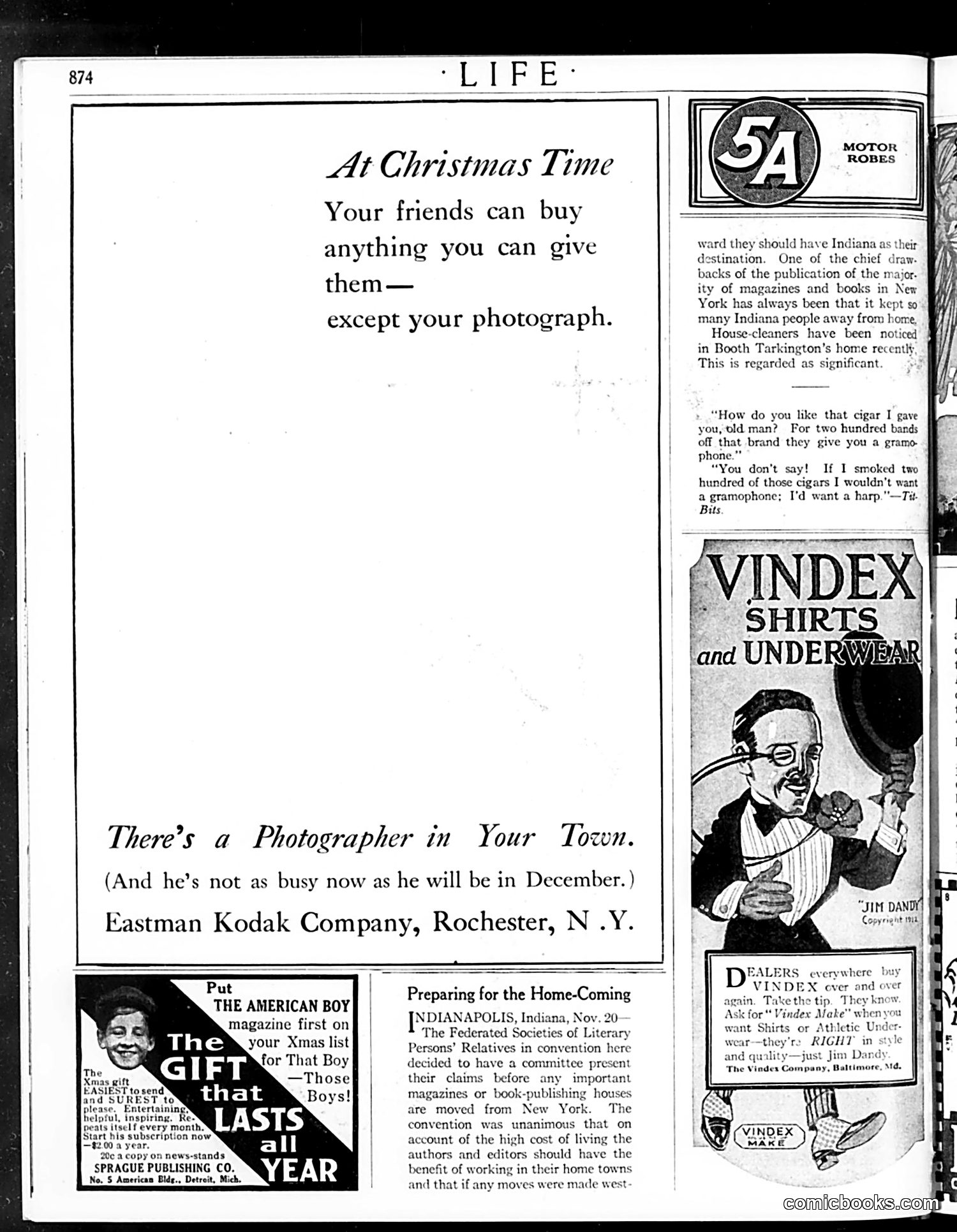
This page contains **advertisements and satirical content** from an early 20th-century American magazine. The main **Eastman Kodak advertisement** uses gentle satire: it suggests that while friends can purchase almost any gift, a personal photograph remains uniquely valuable and irreplaceable—implying readers should hire local photographers before the December holiday rush. Below is a **joke** mocking commercialism: a man boasts about receiving a cigar brand that offers a gramophone as a premium prize. The punchline ridicules the premise—smoking 200 cigars would be unpleasant enough that he'd prefer a harp (suggesting heavenly escape). The **"Preparing for the Home-Coming"** section describes Indianapolis literary figures petitioning that publishers relocate from New York to Indiana, keeping local talent and jobs at home during economically difficult times. The remaining content is **product advertising** for The American Boy magazine and Vindex shirts/underwear, typical of period publications. Overall, the page reflects early 1900s consumer culture and regional economic anxieties.
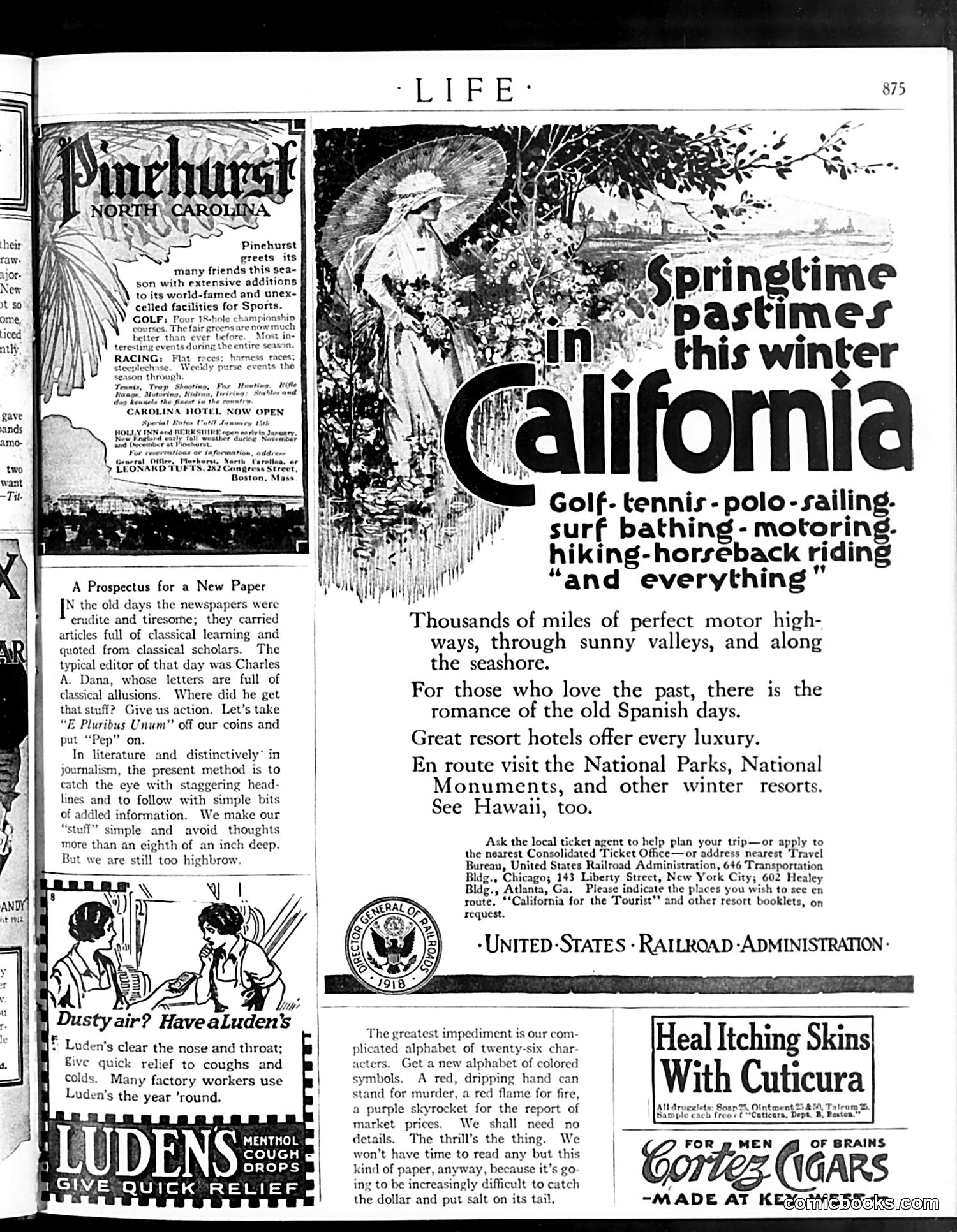
This page contains **primarily advertisements and promotional content**, not political satire. The main content is a **U.S. Railroad Administration advertisement** promoting California as a winter tourist destination, listing activities (golf, tennis, polo, sailing, surfing, motoring, hiking). This reflects post-WWI efforts to boost domestic travel and railroad usage. The left column includes editorial commentary titled "A Prospectus for a New Paper," critiquing old-fashioned newspaper journalism (represented by Charles A. Dana's classical, erudite style) and advocating for modern "pep"—punchy headlines and accessible information. This satirizes the contrast between 19th-century serious journalism and emerging 20th-century mass media sensationalism. The lower advertisements for **Luden's Cough Drops** and **Cuticura** are standard commercial pitches. **No clear political cartoon or caricature is present.** The "satire" is mild editorial commentary on journalism styles rather than pointed political commentary. The page primarily serves as a vehicle for advertising and travel promotion.
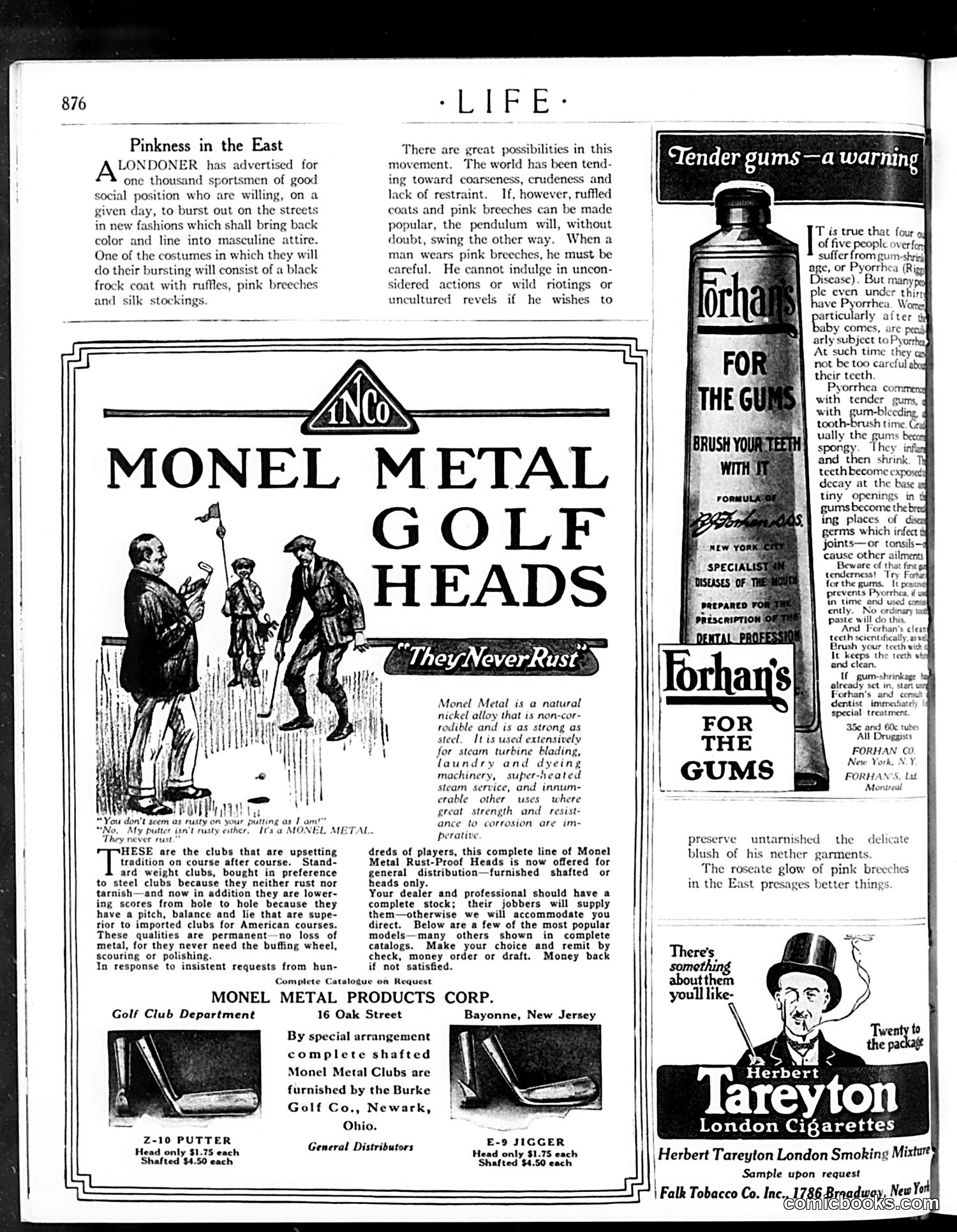
**Main Content: Satirical Commentary on Fashion** The "Pinkness in the East" article mocks a London advertising campaign seeking 1,000 upper-class sportsmen to wear pink breeches and ruffled coats in public. Life's satire is subtle: the magazine pretends to endorse this as a civilizing force, suggesting that wearing pink breeches would literally *compel* men toward refined behavior—they couldn't engage in "wild riotings" or "uncultured revels" while wearing such delicate garments. The humor lies in the absurd premise that clothing choice determines moral conduct. It's satirizing both: - The Edwardian obsession with fashion as a marker of respectability - The naive belief that superficial displays of elegance improve society **Surrounding Advertisements** The page also features period product ads (Monel Metal golf clubs, Forhan's gum treatment, Herbert Tareyton cigarettes) typical of early 20th-century Life magazine layout. The satirical point: elaborate dress codes won't solve social problems—a commentary on class-conscious pretension.
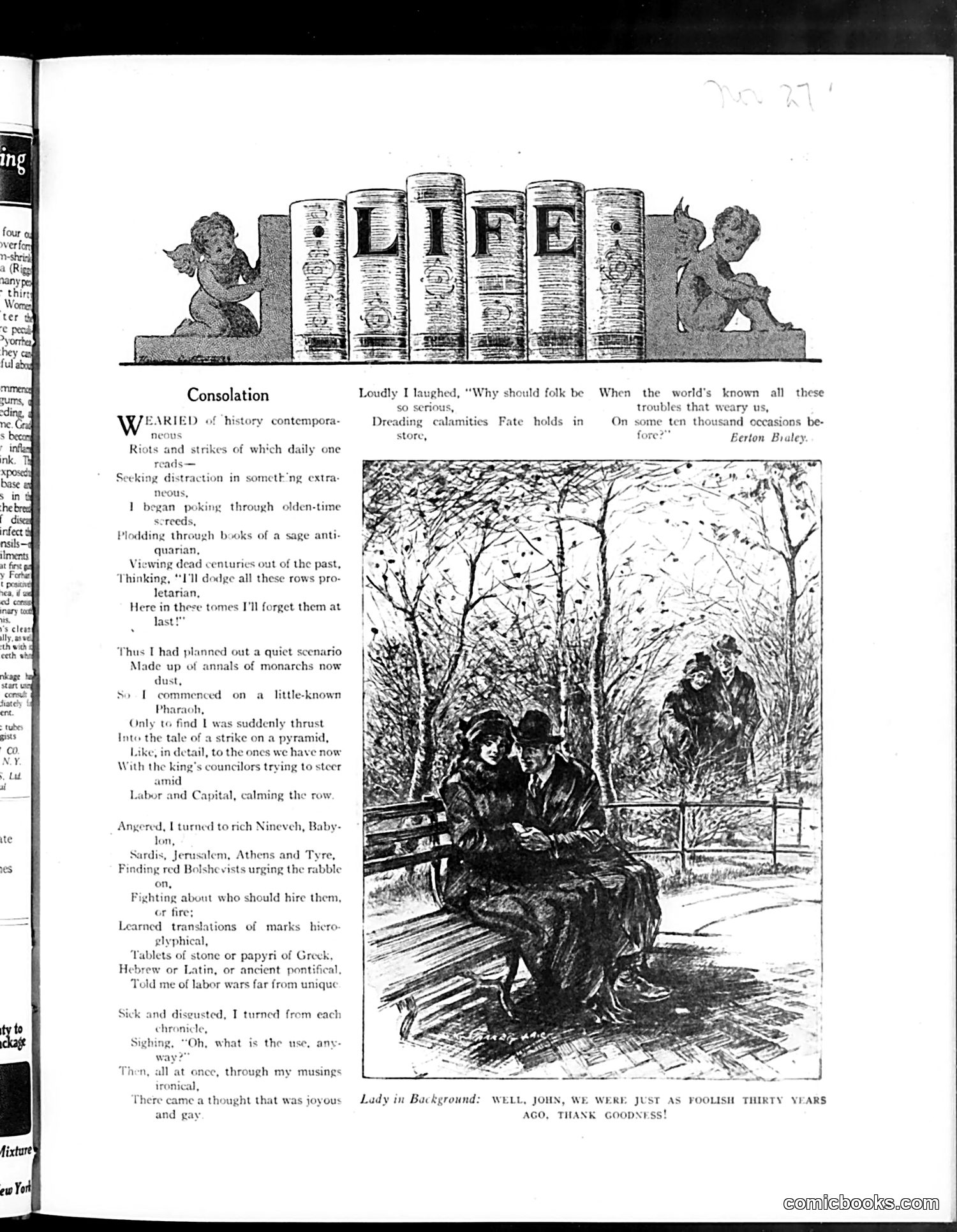
This poem-and-illustration piece satirizes early 20th-century American anxieties about labor strikes and social upheaval. The speaker, exhausted by contemporary "riots and strikes," seeks escape in ancient history—only to discover that labor disputes are timeless. References to "red Bolshevists" and conflicts between "Labor and Capital" reflect post-WWI fears of communist agitation in America. The illustration shows two figures on a park bench, with the woman's caption providing the joke's punchline: society's troubles aren't new. The decorative book-spine header labeled "LIFE" emphasizes that human folly repeats across centuries. The satire's point: modern labor unrest, while seeming urgent, merely echoes eternal human conflict—a consoling but somewhat resigned observation meant to reassure anxious readers that civilization has survived similar turmoil before.
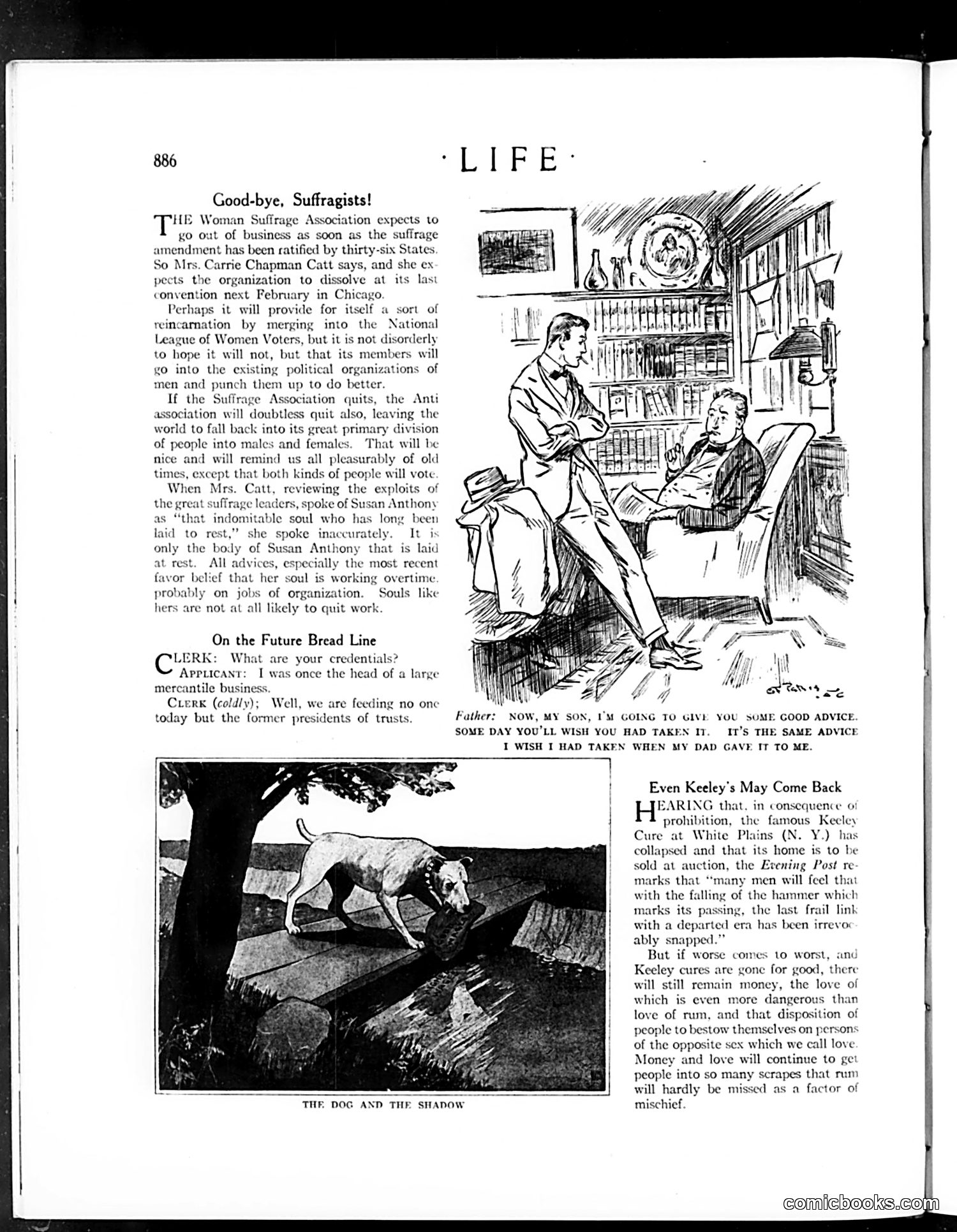
This page contains three separate satirical pieces from the prohibition/women's suffrage era: **"Good-bye, Suffragists!"** mocks the Women Suffrage Association's plan to dissolve after the 19th Amendment's ratification. The author sarcastically welcomes the organization's demise, suggesting women should simply join existing male-dominated political parties instead. The piece references Carrie Chapman Catt's leadership and ironically invokes Susan Anthony's legacy, claiming her "soul" continues activism even in death. **"On the Future Bread Line"** is a darkly comic sketch about economic collapse. A former trust president seeks relief at a breadline, but the clerk only serves "former presidents of trusts"—satirizing how corporate leaders face destitution during economic crisis. **"Even Keeley's May Come Back"** concerns the Keeley Cure Institute (an alcohol treatment facility closing due to prohibition). The author cynically argues that eliminating alcohol won't solve human problems since money-lust and romantic entanglement will continue causing social chaos regardless. All three pieces reflect post-WWI anxieties about social change, economic instability, and prohibition's promised but illusory salvation.
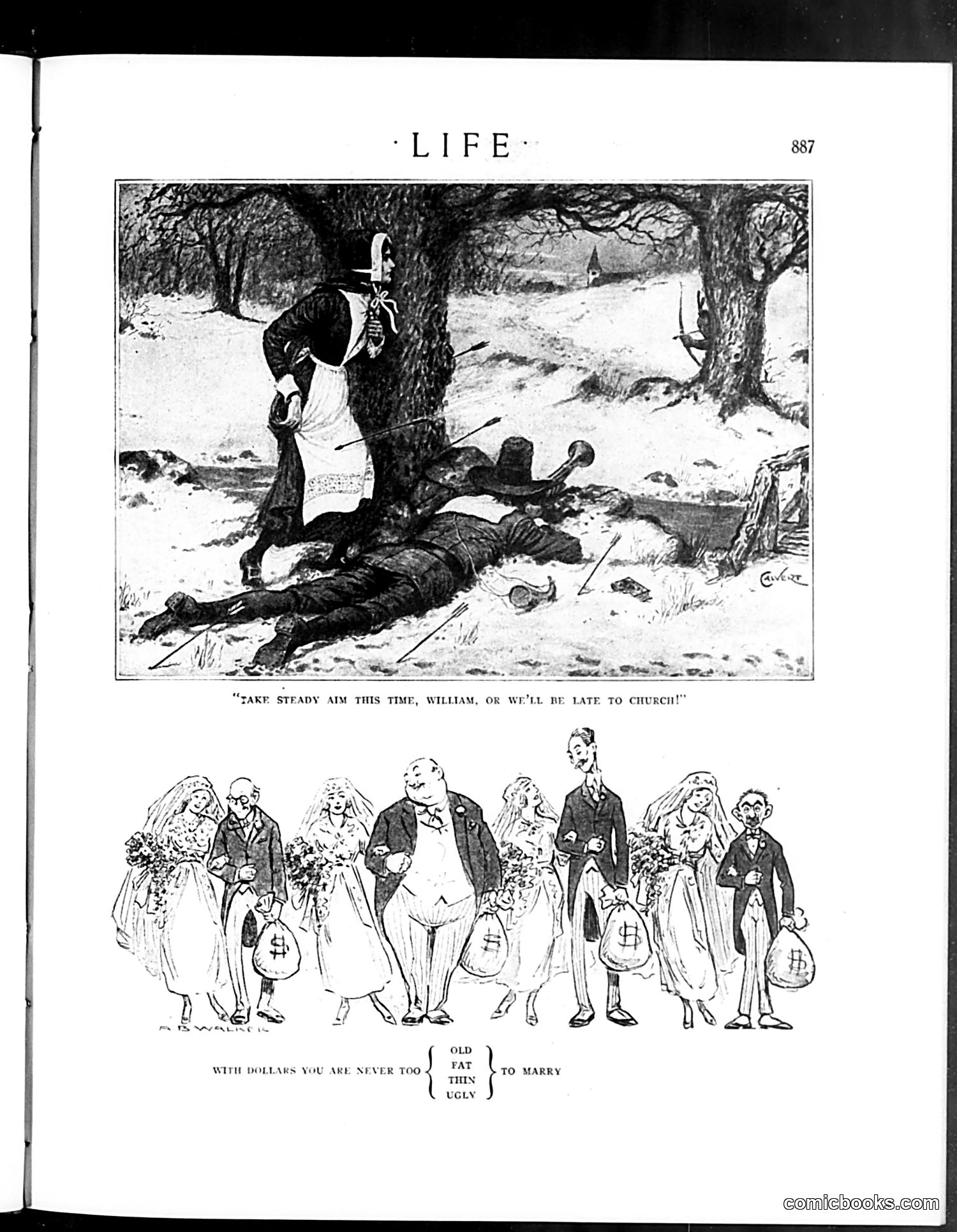
**Top cartoon:** A woman urges a man named William to hurry or they'll be late for church, while a body lies prone in the snow nearby—apparently an accident or death he's ignoring. The satire mocks prioritizing social obligations over human welfare. **Bottom cartoon:** Multiple brides and grooms are shown with money bags, illustrating the caption's cynical message: "With dollars you are never too old, fat, thin, or ugly to marry." This satirizes mercenary marriage practices and gold-digging, suggesting that wealth alone—regardless of physical appearance or age—can secure a spouse. The joke targets both wealthy suitors seeking younger partners and those marrying for money rather than love, reflecting early 20th-century anxieties about materialistic marriage.
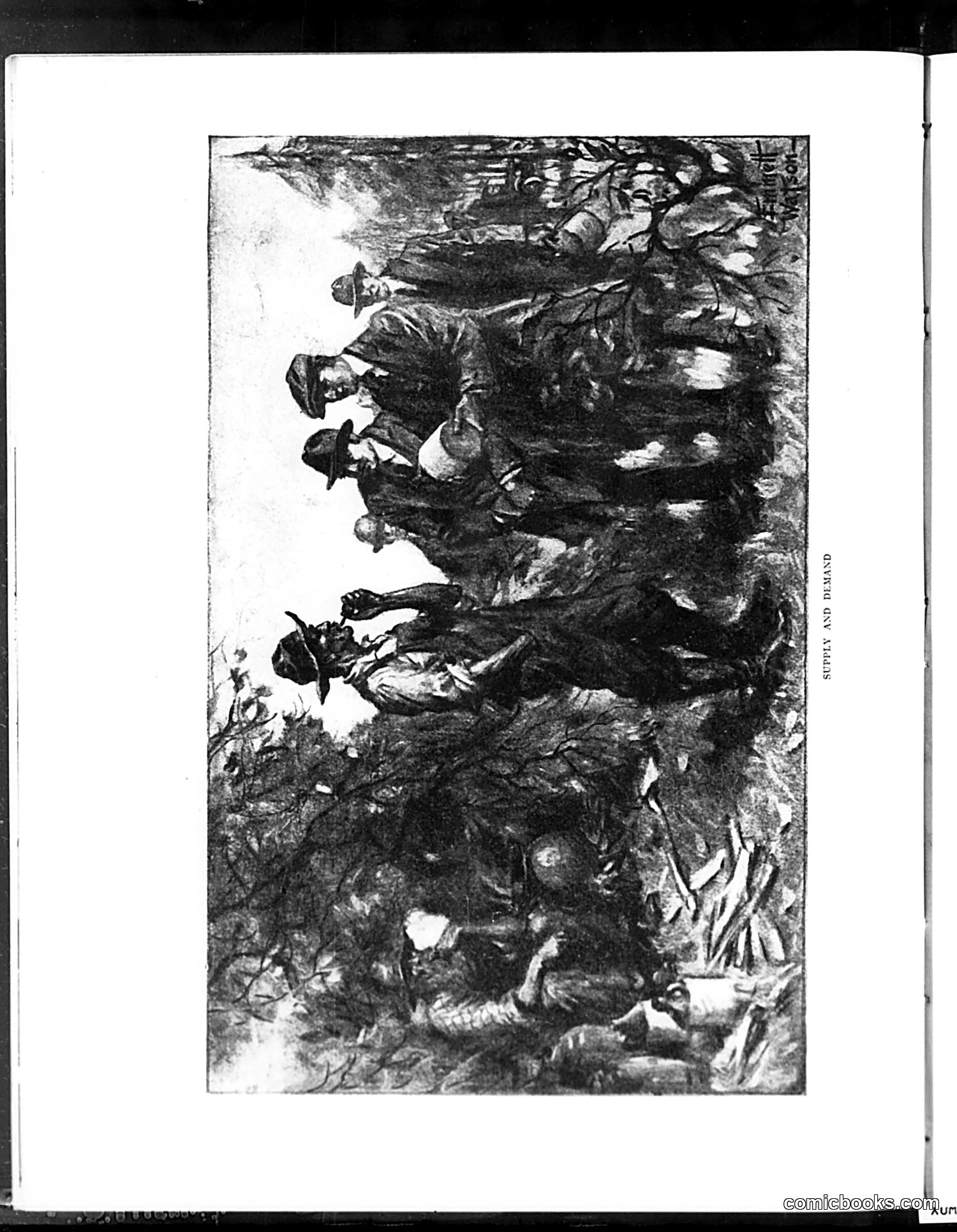
This appears to be a black and white illustration showing multiple figures in what looks like a woodland or garden setting. The image is rotated 90 degrees, making detailed interpretation challenging. The caption reads "SUPPER AND IRELAND" (visible on the right margin), suggesting the cartoon addresses Irish political or social matters. However, the OCR text is largely corrupted symbols and cannot provide reliable context about the specific satire. Without legible text explaining the cartoon's subject and without being able to confidently identify the depicted figures or their symbolic meanings, I cannot accurately explain what political or social commentary this illustration intends. The artistic style suggests late 19th or early 20th-century satirical work, but the specific targets and jokes remain unclear from this image alone.
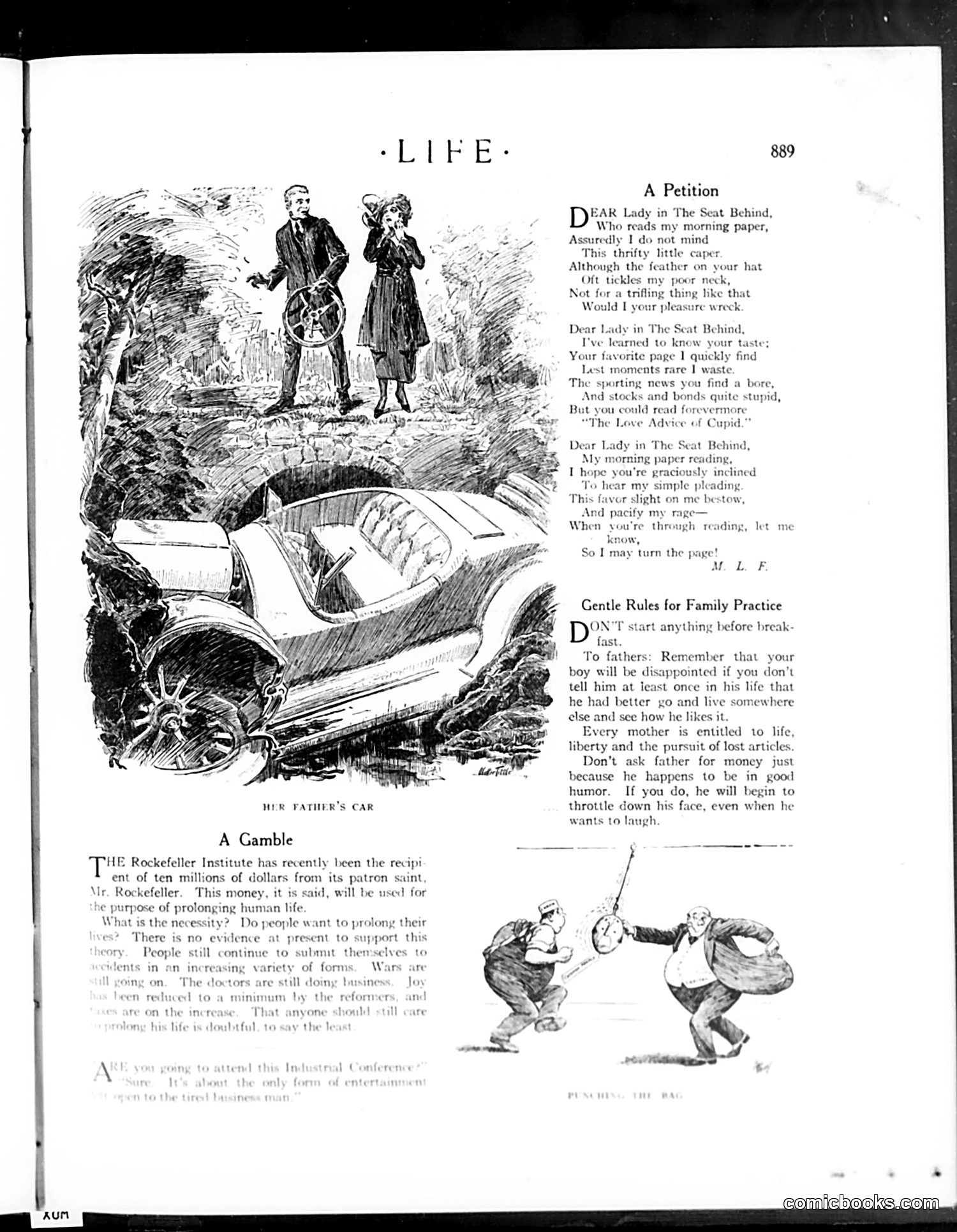
**"A Petition"** is a humorous poem about commuter etiquette on public transportation. A man sitting behind a woman requests she return his newspaper after she finishes reading it. He acknowledges her distracting hat feather and accepts her reading his paper—he's simply asking for it back so he can turn the pages himself. The joke captures early 20th-century tensions in shared public spaces and gender dynamics: a man politely tolerating a woman's use of his property while maintaining his own needs. **"Gentle Rules for Family Practice"** offers domestic advice in satirical form, addressing fathers, mothers, and children about household interactions—don't start arguments before breakfast, mothers deserve autonomy, don't manipulate fathers for money. **"A Gamble"** discusses Rockefeller's ten-million-dollar donation to his Institute for prolonging human life, questioning whether people actually want longer lifespans given ongoing wars and social problems. The cartoon "Her Father's Car" (bottom left) shows what appears to be an automobile accident or mishap—typical slapstick humor about early motoring.
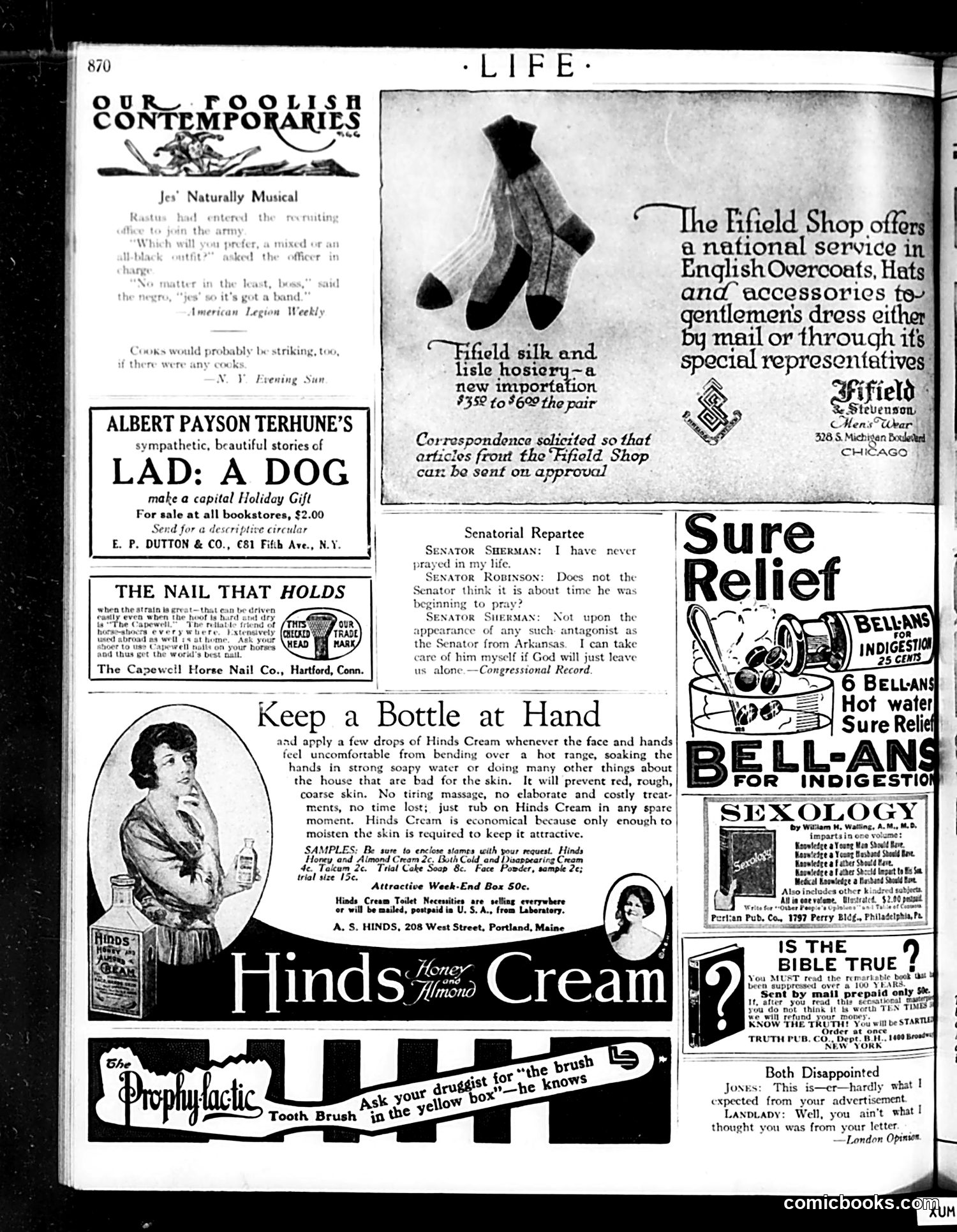
This is primarily an **advertising page** from Life magazine, with one small satirical feature. The main content consists of product advertisements (Fifield Shop hosiery, Hinds Cream, Bell-ans indigestion tablets, tooth brushes, and religious/self-help books) typical of early 20th-century magazines. The only cartoon appears at bottom: a brief dialogue joke titled "Both Disappointed," where a man (Jones) and woman (Landlady) meet after corresponding by letter. Each is disappointed the other doesn't match their written impression—a gentle satire on the gap between written self-presentation and reality, particularly relevant to mail-order courtship or rental arrangements of that era. Above this, "Senatorial Repartee" quotes a Congressional Record exchange where Senator Sherman claims he's "never prayed" in his life, and Senator Robinson quips that Sherman should pray for Arkansas—mild political humor about regional politics.

This is a **product advertisement**, not political satire or editorial cartoon. The page from *Life* magazine (page 871) promotes the Ruud Automatic Gas Water Heater. The advertisement addresses a common household problem of the era: inconsistent hot water access. It humorously references domestic frustration—the laundress or family members exhausting hot water, or someone forgetting to light the heater manually. The visual shows five different bathroom/kitchen faucet styles, illustrating that regardless of fixture type, the Ruud system delivers reliable hot water automatically. The large industrial heater unit pictured would be installed in a basement. The sales pitch emphasizes convenience: automatic operation, no manual lighting needed, unlimited hot water throughout the house. The ad claims over 150,000 units in use and positions Ruud as the 25-year industry pioneer. This represents early 20th-century consumer marketing targeting middle-class homeowners seeking modern domestic comfort and labor-saving devices.
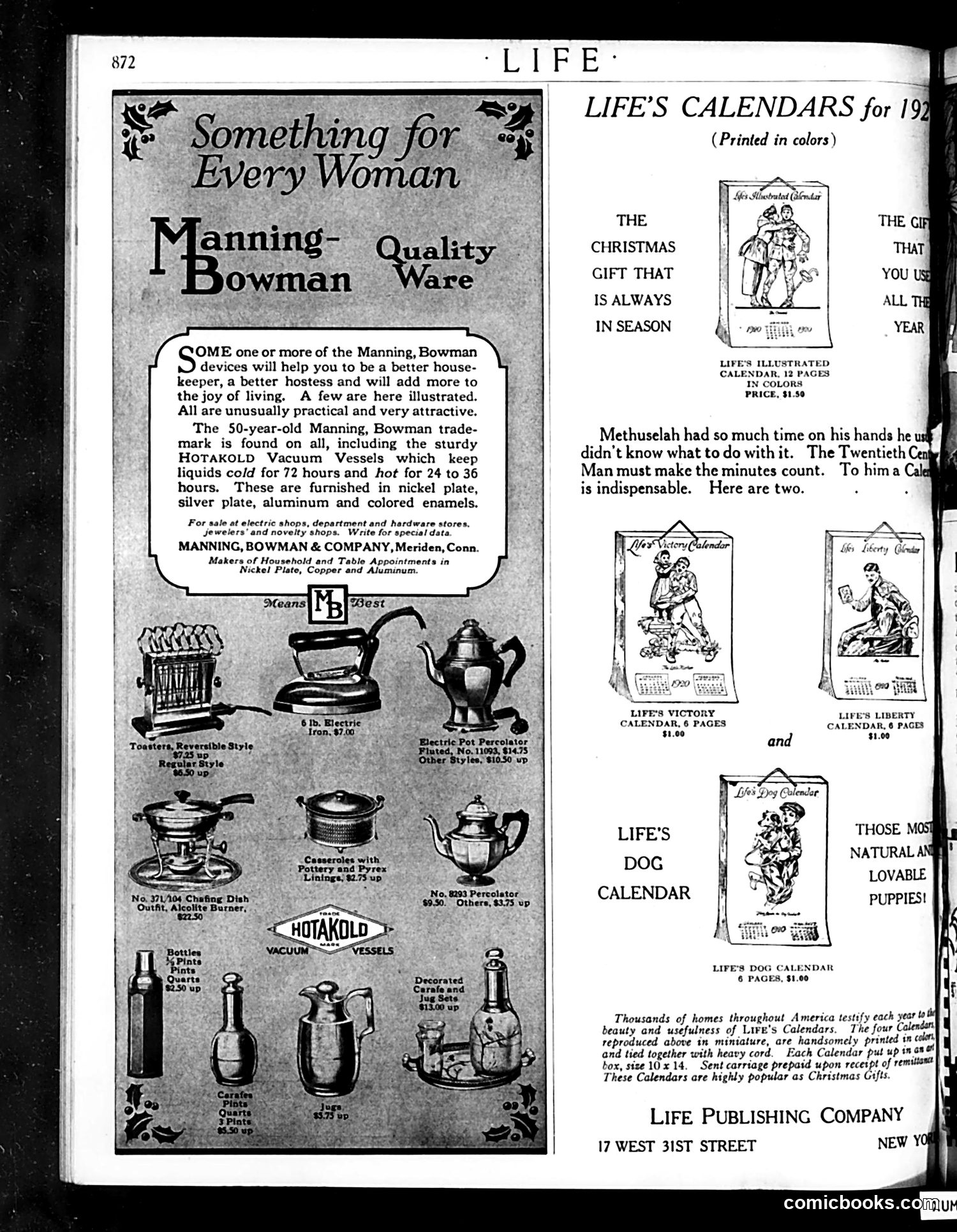
This page is primarily **advertising**, not satire or editorial content. The left side features a Manning-Bowman housewares advertisement showcasing kitchen appliances (vacuum vessels, toasters, percolators, teapots) marketed to women as homemaking aids. The tagline "Something for Every Woman" reflects early 20th-century gender assumptions about domestic roles. The right side advertises Life Publishing Company's 1920s calendars, including themed versions: Christmas, Victory, Liberty, and a Dog Calendar. One calendar references Methuselah (biblical long-lived figure) contrasting ancient leisure with modern time-consciousness—a period anxiety about industrial-era busyness. No political cartoons appear here. The content reflects **period attitudes**: women as homemakers, celebration of American patriotic themes (Victory/Liberty calendars), and consumer culture marketing domestic products as gifts. The advertising targets middle-class households, positioning modern appliances as status symbols and convenience solutions.
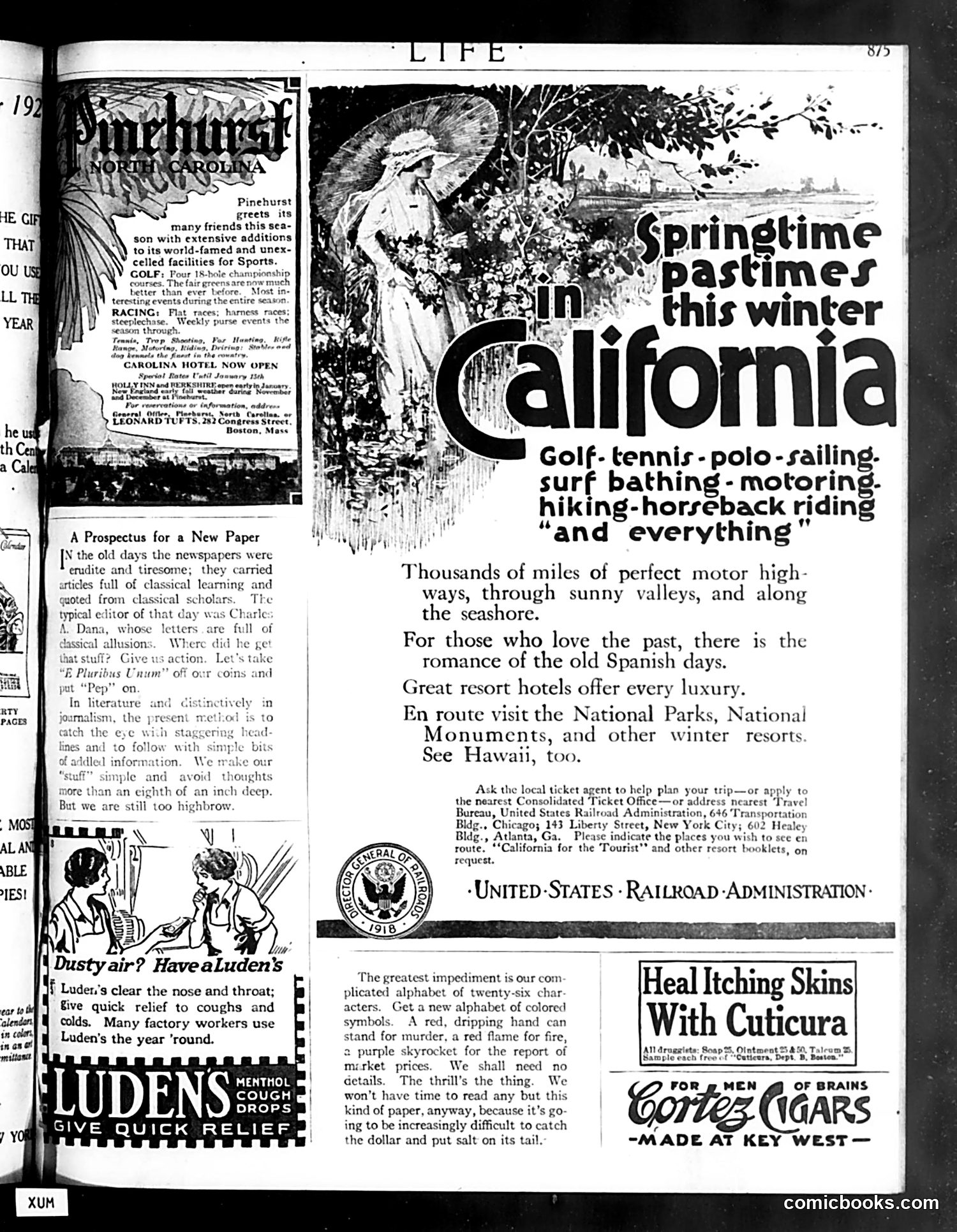
This page is primarily **advertising** rather than satirical content. The dominant feature is a large **United States Railroad Administration advertisement** promoting California as a winter destination, emphasizing recreational activities (golf, tennis, polo, sailing, hiking) and natural attractions (National Parks, Spanish missions, Hawaii access). The left side contains a brief satirical piece titled "A Prospectus for a New Paper," mocking the trend toward sensationalist, fast-paced journalism. It jokes that modern newspapers are abandoning erudite content for simplified, exciting material—suggesting readers want thrills over substance, making it increasingly hard to "catch the dollar." The remaining content consists of product advertisements: **Luden's cough drops**, **Cuticura** for skin conditions, and **Cortez cigars**. The page reflects 1920s consumer culture and the railroad industry's promotion of leisure travel, alongside commentary on changing American journalism standards toward entertainment over intellectual rigor.
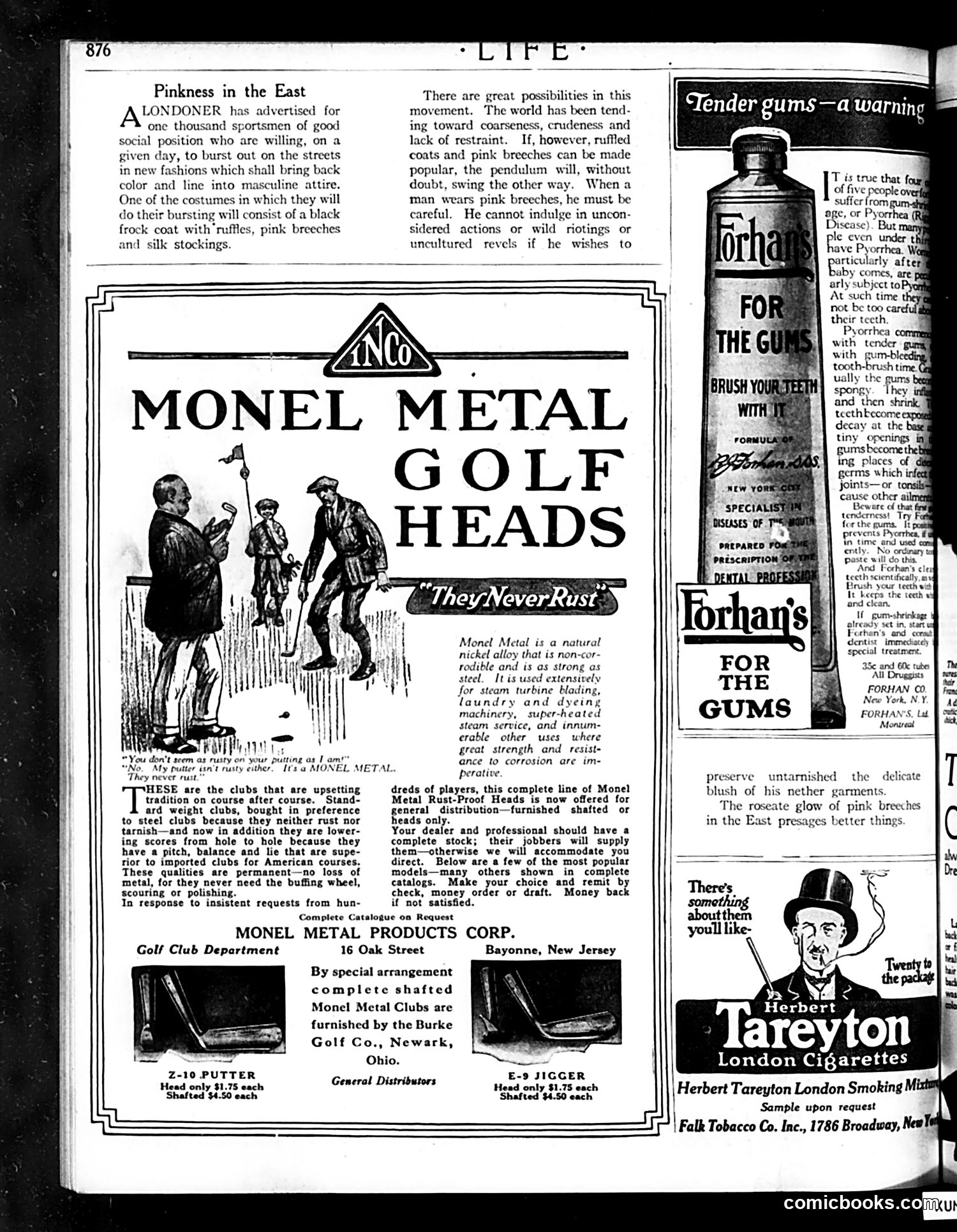
This page combines satirical commentary with period advertising. **"Pinkness in the East"** mocks a London movement proposing that 1,000 gentlemen wear pink breeches and ruffled coats to restore elegance and restraint to masculine fashion. The satire suggests that wearing pink clothing would naturally enforce proper, cultured behavior—a man in pink breeches "cannot indulge in unconsidered actions or wild riotings." The piece gently ridicules both the fashion proposal and the Victorian assumption that clothing determines moral conduct. The advertisements are era-typical: Monel Metal golf clubs (non-rusting), Forhan's gum treatment (addressing pyorrhea, a common dental concern), and Herbert Tareyton cigarettes. These ads reveal period anxieties about corrosion, dental disease, and smoking as acceptable leisure. The cartoon accompanying the golf club ad shows three gentlemen golfing, with a caption playing on the product's rust-resistance—a straightforward product joke with no political content.
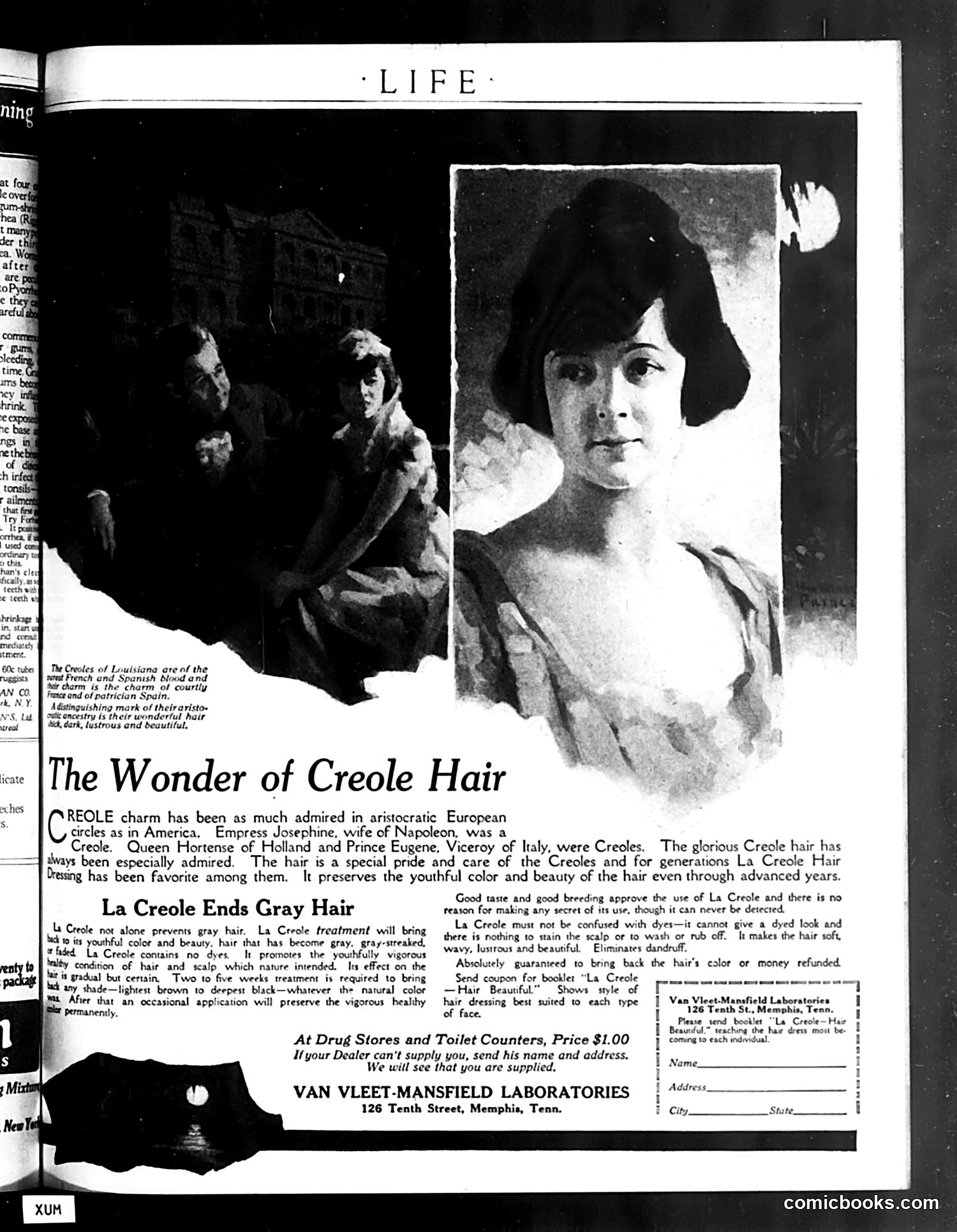
This is a **product advertisement**, not satire or political content. The page promotes "La Creole Hair Dressing," a hair treatment marketed to prevent and reverse graying hair. The advertisement appeals to aristocratic associations: it references historical Creole figures (Empress Josephine, Queen Hortense) to establish prestige and suggests that using the product is consistent with "good taste and good breeding." The two photographs show a woman's portrait (right) and what appears to be a scene of aristocratic French/Spanish figures (left), meant to evoke the elegant heritage the product claims to represent. The key marketing claim is that La Creole is **not a dye**—it gradually restores hair's natural color and youthfulness without visible artificiality. This distinction mattered socially; openly dyeing hair was considered unrefined, whereas a "natural" restoration was acceptable. The coupon at bottom was standard for mail-order products of this era. This reflects early-20th-century marketing targeting middle and upper-class consumers interested in appearing youthfully refined.
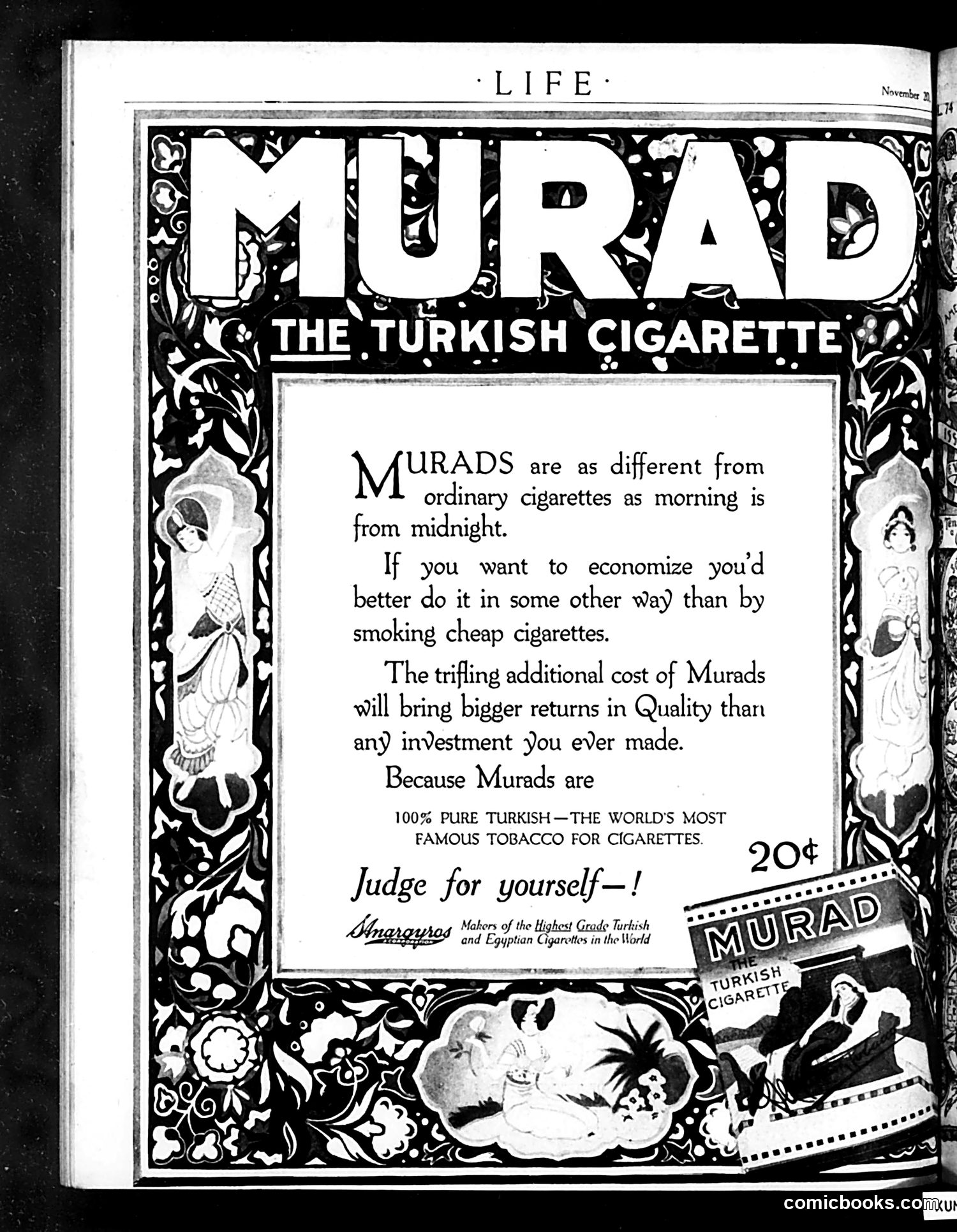
This is a cigarette advertisement for Murad brand Turkish cigarettes, not a political cartoon. The page features ornate decorative borders in an Art Deco or orientalist style, reflecting the "Turkish" marketing appeal of the product. The ad's main pitch argues that Murads' premium quality justifies their higher price—framing cheap cigarettes as a false economy. The "20¢" price point and claim of "100% PURE TURKISH" tobacco are key selling points. The manufacturer is listed as Anargyros. For modern readers: this exemplifies early 20th-century cigarette marketing that emphasized exotic foreign origins and quality as lifestyle markers, before tobacco health warnings existed.