
Life, 1919-11-20 · page 17 of 46
Life — November 20, 1919 — page 17: what you’re looking at
What you’re looking at
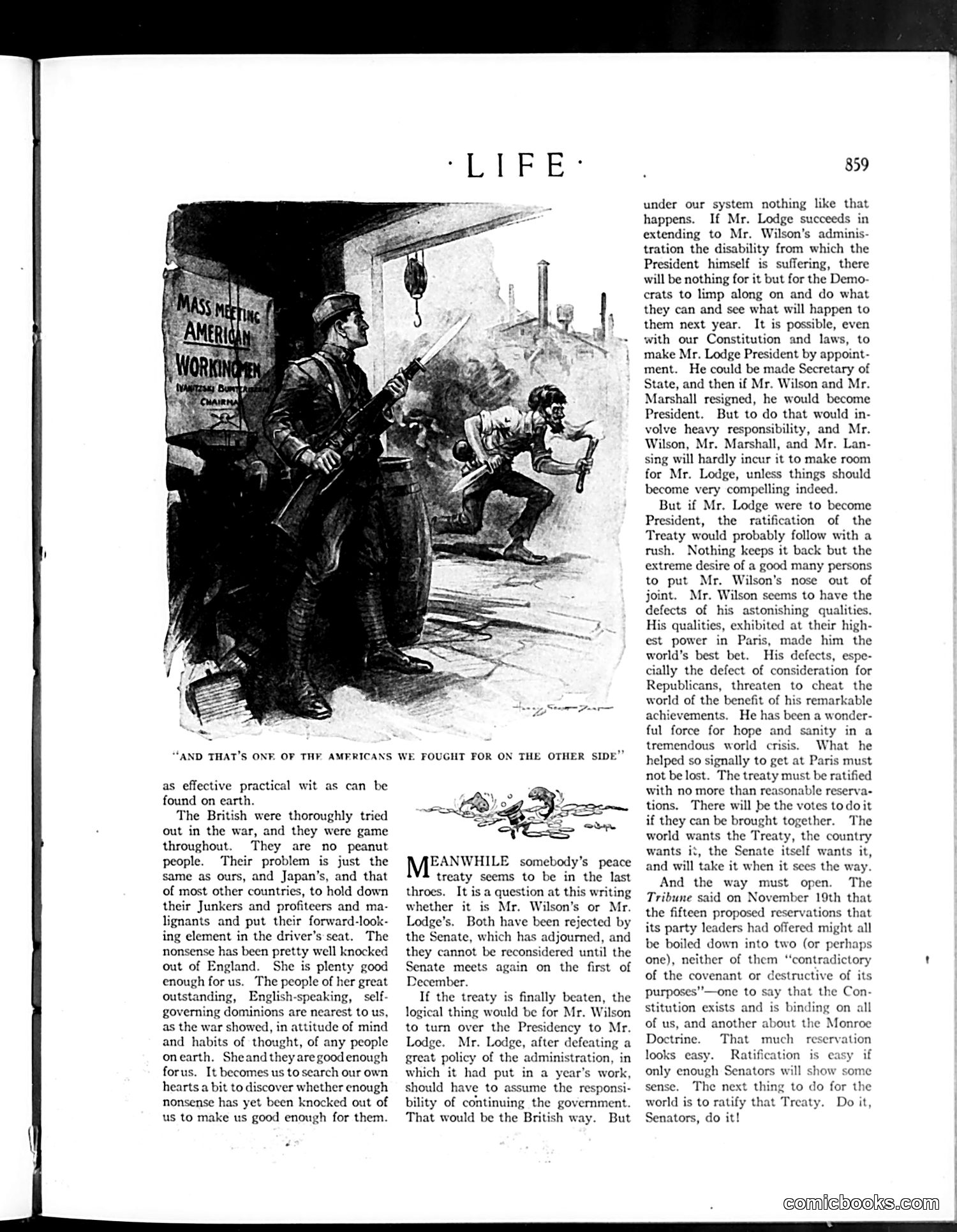
## The Cartoon The sketch depicts a soldier holding a rifle confronting what appears to be a radical or revolutionary figure near a "Mass Meeting of American Workingmen" sign. The caption reads: "AND THAT'S ONE OF THE AMERICANS WE FOUGHT FOR ON THE OTHER SIDE." ## Meaning This is **post-WWI satirical commentary** on American radicalism and labor unrest. The cartoon suggests ironic bitterness: American soldiers fought in Europe supposedly defending democracy and freedom, yet returned home to face domestic radicals and labor agitators demanding revolutionary change. The "other side" likely references both the enemy (Germany) and ideological opponents within America itself—suggesting that dangerous radical elements exist at home. ## Context The accompanying text discusses President Wilson's League of Nations treaty and Senate opposition (led by Henry Cabot Lodge). The broader context involves 1919-1920 post-war anxiety about Bolshevism, labor strikes, and political extremism in America—fears that radical foreign ideologies threatened American stability. The cartoon mocks this paradox: soldiers fought abroad for principles now seemingly threatened by domestic radicalism.
📄 Transcribed text from this page (OCR, searchable)
Machine-transcribed from the original scan — historical spelling and the odd misread are preserved.
“AND THAT'S ONE OF THF AMERICANS WE FOUGHT FOR ON THE OTHER SIDE” as effective practical wit as can be found on earth. The British were thoroughly tried out in the war, and they were game throughout. They are no peanut people. Their problem is just the same as ours, and Japan’s, and that of most other countries, to hold down their Junkers and profiteers and ma- lignants and put their forward-look- ing element in the driver’s seat. The nonsense has been pretty well knocked out of England. She is plenty good enough for us. The people of her great outstanding, English-speaking, self- governing dominions are nearest to us, as the war showed, in attitude of mind and habits of thought, of any people onearth. Sheand they are good enough forus. It becomes us to search our own hearts a bit to discover whether enough nonsense has yet been knocked out of us to make us good enough for them. EANWHILE somebody’s peace treaty seems to be in the last throes. It is a question at this writing whether it is Mr. Wilson's or Mr. Lodge’s. Both have been rejected by the Senate, which has adjourned, and they cannot be reconsidered until the Senate meets again on the first of December. If the treaty is finally beaten, the logical thing would be for Mr. Wilson to turn over the Presidency to Mr. Lodge. Mr. Lodge, after defeating a great policy of the administration, in which it had put in a year’s work, should have to assume the respons bility of continuing the government. That would be the British way. But 859 under our system nothing like that happens. If Mr. Lodge succeeds in extending to Mr. Wilson's adminis- tration the disability from which the President himself is suffering, there will be nothing for it but for the Demo- crats to limp along on and do what they can and see what will happen to them next year. It is possible, even with our Constitution and laws, to make Mr. Lodge President by appoint- ment. He could be made Secretary of State, and then if Mr. Wilson and Mr. Marshall resigned, he would become President. But to do that would in- volve heavy responsibility, and Mr. Wilson, Mr. Marshall, and Mr. Lan- sing will hardly incur it to make room for Mr. Lodge, unless things should become very compelling indeed. But if Mr. Lodge were to become President, the ratification of the Treaty would probably follow with a rush. Nothing keeps it back but the extreme desire of a good many persons to put Mr. Wilson's nose out of joint. Mr. Wilson seems to have the defects of his astonishing qualities. His qualities, exhibited at their high- est power in Paris, made him the world’s best bet. His defects, espe- cially the defect of consideration for Republicans, threaten to cheat the world of the benefit of his remarkable achievements. He has been a wonder- ful force for hope and sanity in a tremendous world crisis. What he helped so signally to get at Paris must not be lost. The treaty must be ratified with no more than reasonable reserva- tions. There will be the votes todo it if they can be brought together. The world wants the Treaty, the country wants it, the Senate itself wants it, and will take it when it sees the way. And the way must open. The Tribune said on November 19th that the fifteen proposed reservations that its party leaders had offered might all be boiled down into two (or perhaps one), neither of them “contradictory of the covenant or destructive of its purposes”’—one to say that the Con- stitution exists and is binding on all of us, and another about the Monroe Doctrine. That much looks easy. Ratific: only enough Senators sense. The next thing to do for the world is to ratify that Treaty. Do it, Senators, do it! reserv is ¢: show some comichooks.com