
Life, 1919-11-20 · page 21 of 46
Life — November 20, 1919 — page 21: what you’re looking at
What you’re looking at
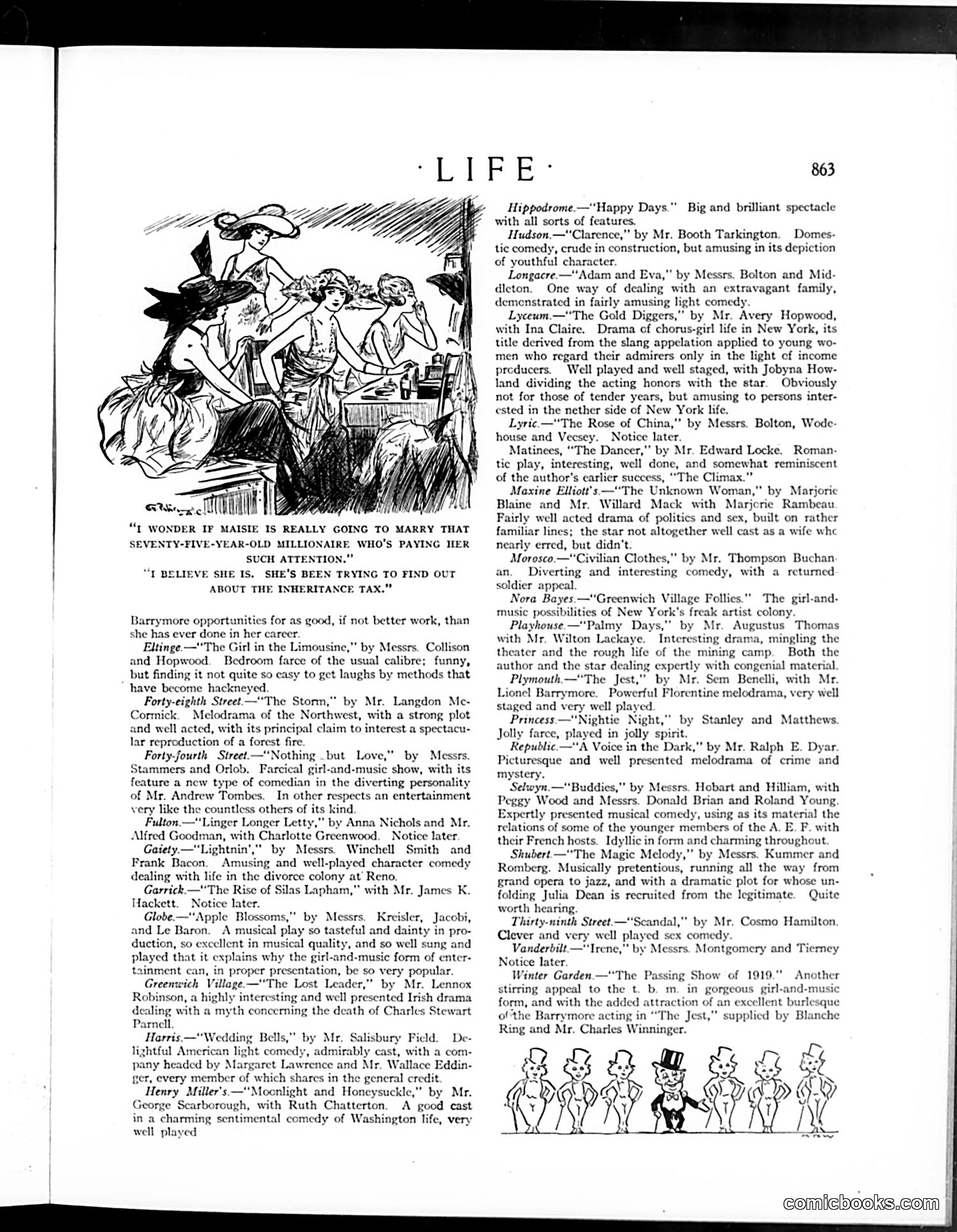
This page from Life magazine (appears to be early 1920s) combines theatre reviews with a satirical cartoon about marriage and money. **The Cartoon:** The illustration and captions mock a young woman named "Maisie" who is pursuing marriage to a wealthy seventy-five-year-old millionaire. The joke hinges on her real motivation: she's trying to understand inheritance tax law—suggesting she's calculating what she'll inherit after his death rather than marrying for love. This satirizes the "gold digger" phenomenon of the era, where women from lower economic circumstances sought wealthy older husbands for financial security. **Context for Modern Readers:** The inheritance tax (federal estate tax) was relatively new, having been introduced in 1916. The cartoon assumes readers understand both the concept of gold-digging and recent tax legislation—making it a sophisticated joke targeting an educated audience aware of current fiscal policy. The page's theatre reviews below reinforce the era's entertainment themes, including a play called "The Gold Diggers" (mentioned in the Lyceum review).
📄 Transcribed text from this page (OCR, searchable)
Machine-transcribed from the original scan — historical spelling and the odd misread are preserved.
“{ WONDER IF MAISIE IS REALLY GOING TO MARRY THAT SEVENTY-FIVE-YEAR-OLD MILLIONAIRE WHO'S PAYING HER SUCH ATTENTION.” E SHE IS, SHE'S BEEN TRYING TO FIND OUT ABOUT THE INHERITANCE TAX.” “I BELIE! Barrymore opportunities for as good, if not better work, than she has ever done in her career. Eltinge.—'‘The Girl in the Limousine," by Messrs. Collison and Hopwood. Bedroom farce of the usual calibre; funny, but finding it not quite so casy to get laughs by methods that have become hackneyed. Forty-eighth Street—"The Storm,” by Mr. Langdon Me- Cormick. Melodrama of the Northwest, with a strong plot and well acted, with its principal claim to interest a spectacu- lar reproduction of a forest fire. Forty-fourth Street—"Nothing but Love," by Messrs. Stammers and Orlob. Farcical girl-and-music show, with its feature a new type of comedian in the diverting personality of Mr. Andrew Tombes. In other respects an entertainment very like the countless others of its kind. Fulton.—"'Linger Longer Letty,” by Anna Nichols and Mr. Alfred Goodman, with Charlotte Greenwood. Notice later. Gaiety.—"Lightnin'," by Messrs. Winchell Smith and Frank Bacon. Amusing and well-played character comedy dealing with life in the divorce colony at Reno. Garrick.—"The Rise of Silas Lapham," with Mr. James K. Hackett. Notice later. Globe.—"Apple Blossoms," by Messrs. Kreisler, Jacobi, and Le Baron. A musical play so tasteful and dainty in pro- duction, so excellent in musical quality, and so well sung and played that it explains why the girl-and-music form of enter- tainment can, in proper presentation, be so very popular. Greenwich Village —'The Lost Leader,” by Mr. Lennox Robinson, a highly interesting and well presented Irish drama dealing with a myth concerning the death of Charles Stewart Parnell. Harris.—"Wedding Bells,” by Mr. Salisbury Field. De- lightful Ameri light come mirably cast, with a com- pany headed by Margaret Lawrence and Mr. Wallace Eddin- ger, every member of which shares in the general credit. Henry Miller's—"'Moonlight and Honeysuckle,” by Mr. George Scarborough, with Ruth Chatterton. A good cast in a charming sentimental comedy of Washington life, very 863 Hippodrome.—"‘Happy Days.” Big and brilliant spectacle with all sorts of features. Hudson.—"Clarence," by Mr. Booth Tarkington. Domes- tic comedy, crude in construction, but amusing in its depiction of youthful character. Longacre.—"Adam and Eva," by Messrs. Bolton and Mid- dicton. One way of dealing with an extravagant family, demonstrated in fairly amusing light comedy. Lyceum.—‘The Gold Diggers,"" by Mr. Avery Hopwood, with Ina Claire. Drama of chorus-girl life in New York, its title derived from the slang appelation applied to young wo- men who regard their admirers only in the light of income producers. Well played and well staged, with Jobyna How- land dividing the acting honors with the star. Obviously not for those of tender years, but amusing to persons inter- ested in the nether side of New York life. Lyric.—'The Rose of China,” by Messrs. Bolton, Wode- house and Vecsey. Notice later. Matinees, ‘The Dancer," by Mr. Edward Locke. Roman- tic play, interesting, well done lat reminiscent of the author's earlier success, Maxine Elliott's—''The Unknown Woman,” by Marjorie Blaine and Mr. Willard Mack with Marjcrie Rambeau Fairly well acted drama of politics and sex, built on rather familiar lines; the star not altogether well cast as a wife whc nearly erred, but didn't. Morosco.—"*Civilian Clothes," by Mr. Thompson Buchan an, Diverting and interesting comedy, with a returned soldier appeal. Nora Bayes.—"Greenwich Village Follies.” music possibilities of New York's Playhouse —‘Palmy Days," by Mr. Augustus Thomas with Mr. Wilton Lackaye. Interesting dri » mingling the theater and the rough life of the mining camp. Both the author and the star dealing expertly with congenial material Plymouth—"The Jest," by Mr. Sem Benelli, with Mr. Lionel Barrymore. Powerful Florentine melodrama, very well staged and very well played. Princess —"Nightie Night," by Stanley and Matthews. Jolly farce, played in jolly spirit. Republic.—"A Voice in the Dark," by Mr. Ralph E. Dyar. Picturesque and well presented melodrama of crime and mystery. Selwyn.—'*Buddies," by Messrs. Hobart and Hilliam, with Peggy Wood and Messrs. Donald Brian and Roland Young. Expertly presented musical comedy, using as its material the relations of some of the younger members of the A. E. F. with their French hosts. Idyllic in form and charming throughout Shubert —""The Magic Melody,” by Messrs, Kummer and Romberg. Musically pretentious, running all the way from grand opera to jazz, and with a dramatic plot for whose un- folding Julia Dean is recruited from the legitimate. Quite worth hearing. Thirty-ninth Street. candal,"" by Mr. Cosmo Hamilton. Clever and very well played sex comedy. Vanderbilt.—'‘Irene," by Messrs. Montgomery and Tierney Notice later. Winter Garden —'*The Passing Show of 1919." Another stirring appeal to the t. b. m. in gorgeous girl-and-music form, and with the added attraction of an excellent burlesque ofthe Barrymore acting in “The Jest,” supplied by Blanche Ring and Mr. Charles Winninger. The girl-and- freak artist colony, comichooks.com |