
Life, 1919-11-20 · page 9 of 46
Life — November 20, 1919 — page 9: what you’re looking at
What you’re looking at
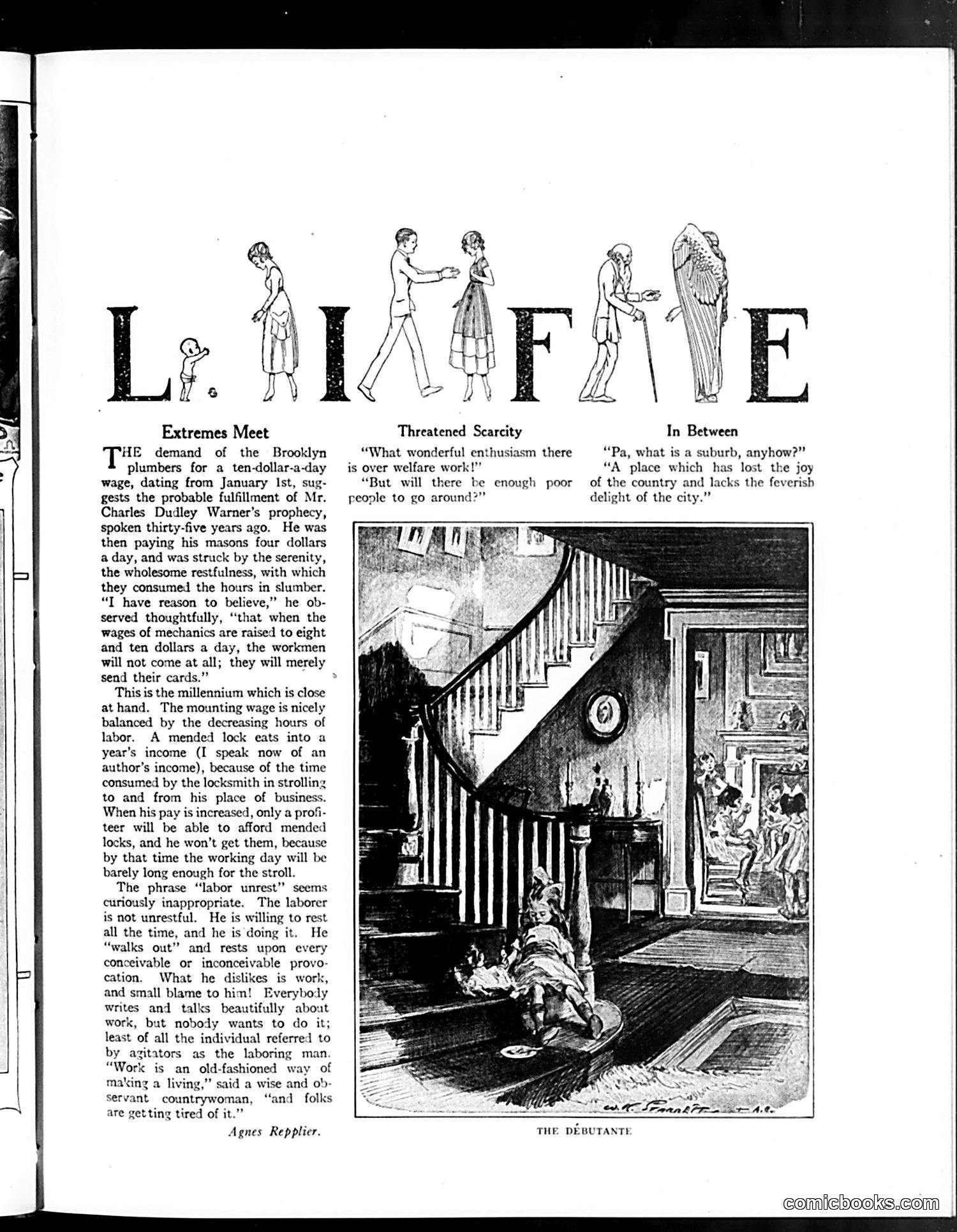
This page satirizes early 20th-century labor disputes and urban anxieties through three vignettes titled "Extremes Meet," "Threatened Scarcity," and "In Between." The left section mocks Brooklyn plumbers' wage demands (starting January 1st), quoting Charles Durley Warner's prediction that rising wages won't solve worker discontent. The satire suggests laborers complain perpetually regardless of pay increases. The center section ironically presents welfare concerns—the wealthy worry poverty will disappear, leaving insufficient poor people "to go around." The right section jokes about suburban flight, with someone asking "what is a suburb, anyhow?"—suggesting confusion among city dwellers about the emerging suburban lifestyle. "The Débutante" illustration (bottom) appears unrelated to the labor theme. Together, these pieces critique both labor unrest and class anxieties during an era of industrial change.
📄 Transcribed text from this page (OCR, searchable)
Machine-transcribed from the original scan — historical spelling and the odd misread are preserved.
Extremes Meet TH demand of the Brooklyn plumbers for a ten-dollar-a-day wage, dating from January Ist, sug- gests the probable fulfillment of Mr. Charles Dudley Warner’s prophecy, spoken thirty-five years ago. He was then paying his masons four dollars a day, and was struck by the serenity, the wholesome restfulness, with which they consumed the hours in slumber. “I have reason to believe,” he ob- served thoughtfully, “that when the wages of mechanics are raised to eight and ten dollars a day, the workmen will not come at all; they will merely send their cards.” This is the millennium which is close athand. The mounting wage is nicely balanced by the decreasing hours of labor. A mended lock eats into a year’s income (I speak now of an author’s income), because of the time consumed by the locksmith in strolling to and from his place of business. When his pay is increased, only a profi- teer will be able to afford mended locks, and he won’t get them, because by that time the working day will be barely long enough for the stroll. The phrase “labor unrest” seems curiously inappropriate. The laborer is not unrestful. He is willing to rest all the time, and he is doing it. He “walks out” and rests upon every conceivable or inconceivable provo- cation. What he dislikes is work, and small blame to him! Everybody writes and talks beautifully about work, but nobody wants to do it; least of all the individual referred to by agitators as the laboring man. “Work is an old-fashioned way of making a living,” said a wise and ob- servant countrywoman, “and folks are getting tired of it.” Agnes Repplier. Threatened Scarcity “What wonderful enthusiasm there is over welfare work!” “But will there be enough poor people to go around?” In Between “Pa, what is a suburb, anyhow?” “A place which has lost the joy of the country and lacks the feverish delight of the city.” THE DEBUTANTE comichooks.com