
A complete issue · 44 pages · 1919
Life — August 7, 1919
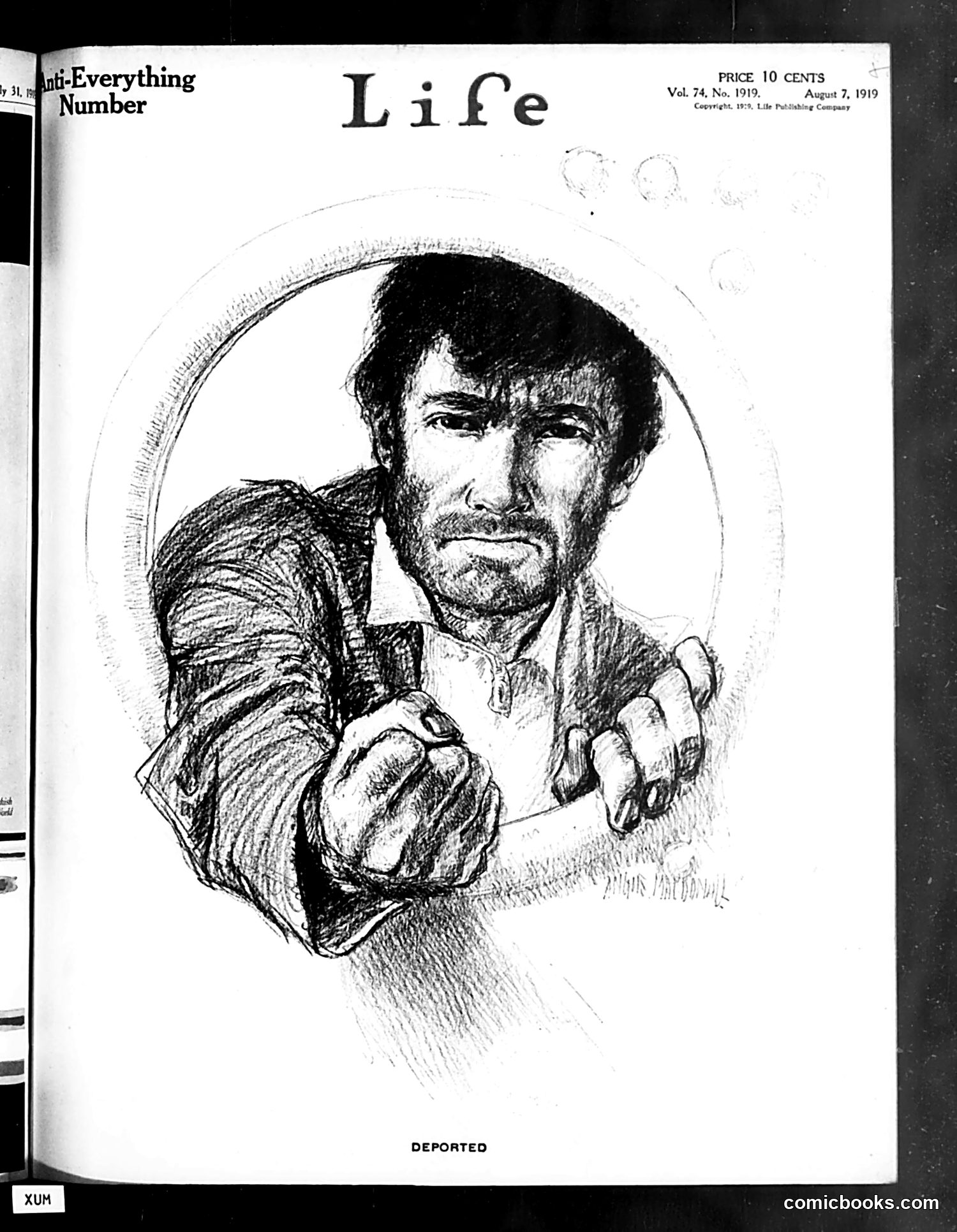
This cover depicts a man being forcibly removed, labeled "DEPORTED." The illustration likely references the Red Scare deportations of 1919-1920, when the U.S. government aggressively expelled foreign-born radicals, anarchists, and suspected communists. Following the Bolshevik Revolution and labor unrest, thousands faced removal. The sketch shows a bearded man—possibly representing a generic radical or anarchist figure—being physically ejected. The style suggests satirical commentary on these mass deportations, either criticizing the government's heavy-handed approach or mocking the perceived threat of foreign radicals. Without additional text identifying the specific individual, we cannot determine if this depicts a particular deportation case or serves as general social commentary on the period's anti-radical fervor.
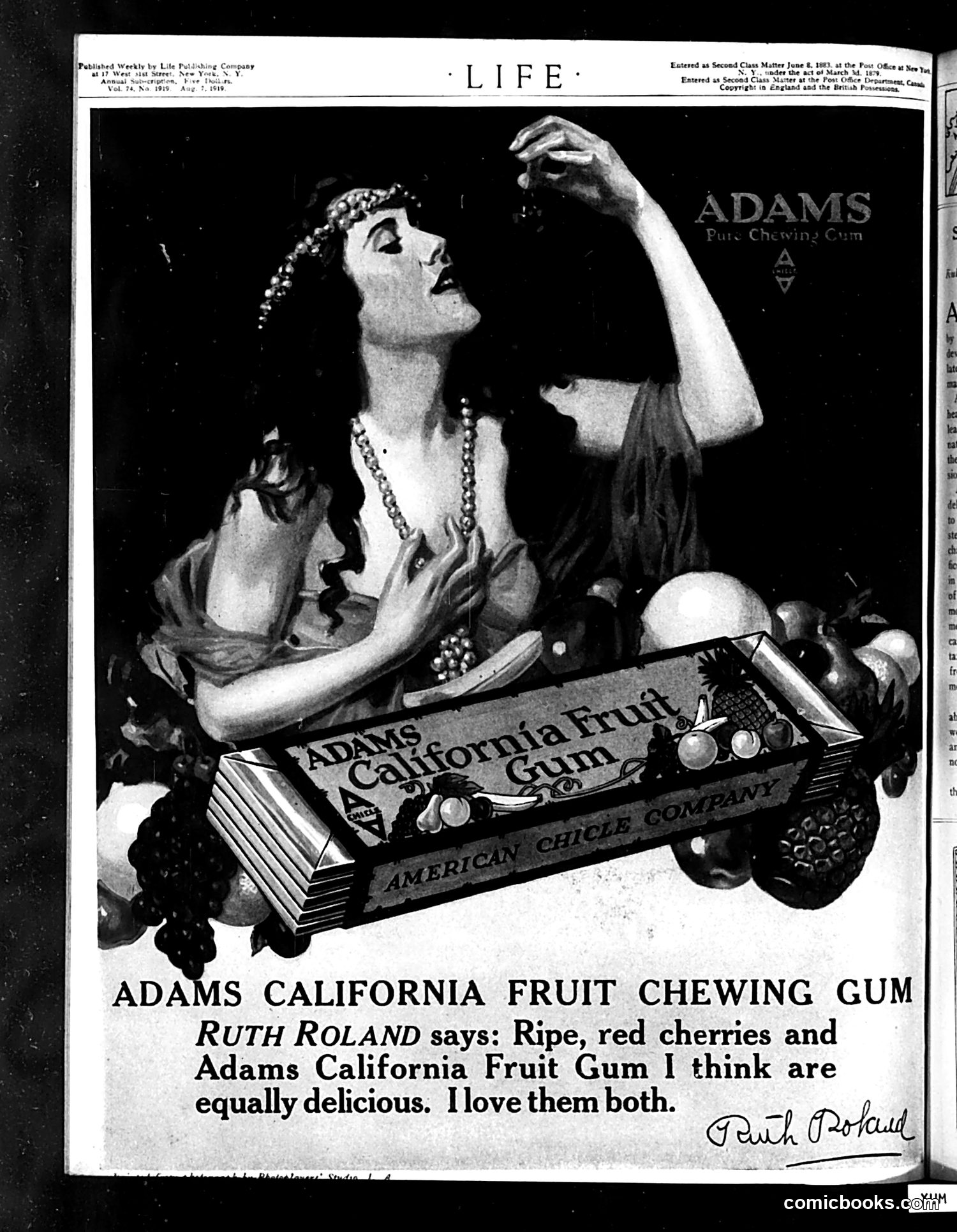
This page is primarily an **advertisement, not editorial content**. It features an endorsement ad for Adams California Fruit Chewing Gum by actress Ruth Roland. The image shows a glamorous woman in 1920s attire (pearls, headband, elegant dress) posed dramatically with fruit and a package of the gum. She's displayed as a desirable celebrity endorser—a common advertising strategy of the era. The accompanying quote attributes to "Ruth Roland" a claim that ripe cherries and Adams gum are "equally delicious," using celebrity testimonial to sell the product. This represents early celebrity endorsement marketing, where filmstars lent their names and images to consumer goods to boost sales. There is no political satire evident on this page.
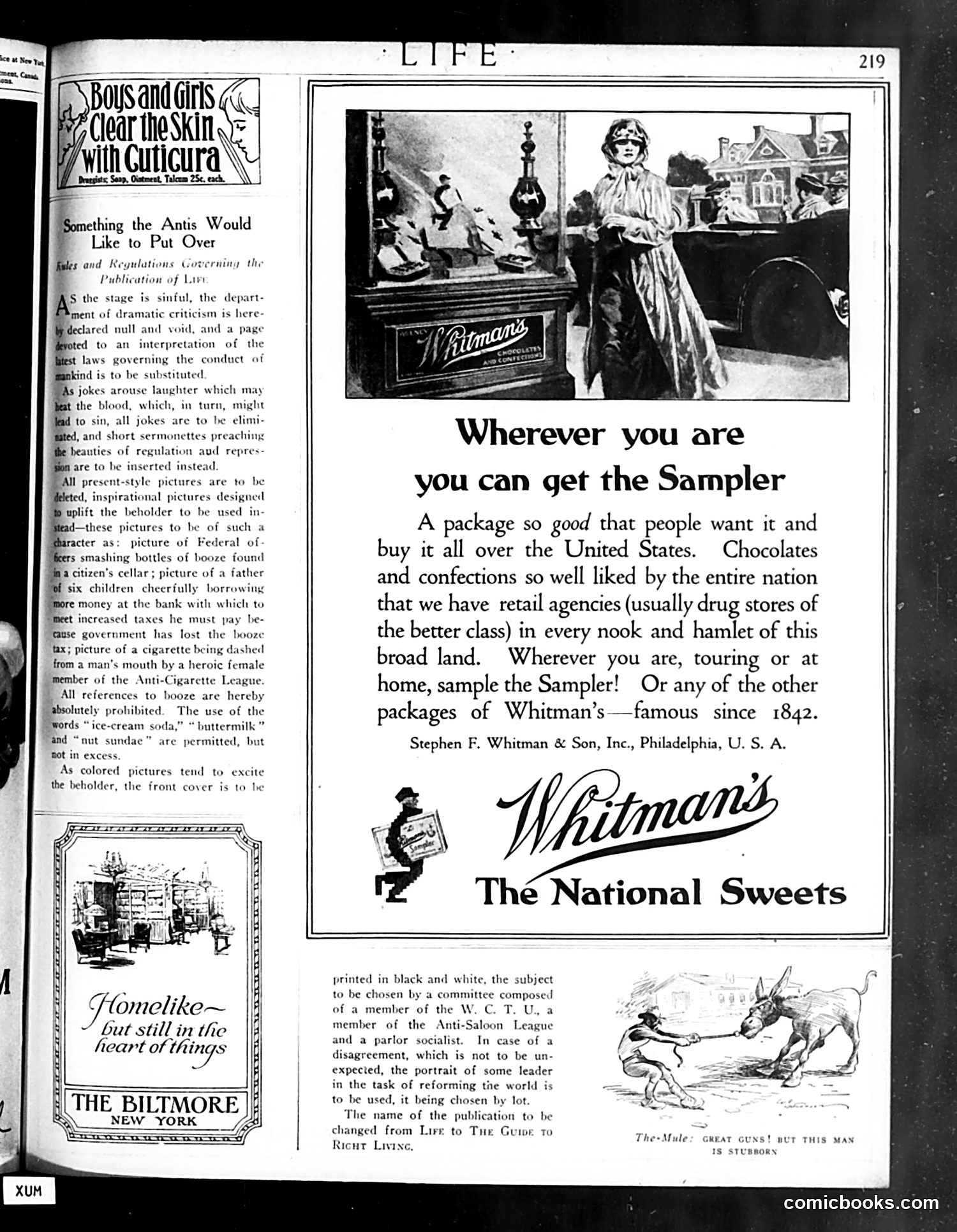
This page is primarily **advertising** rather than editorial content. The dominant feature is a Whitman's chocolates ad featuring a woman in elegant dress at what appears to be a department store counter, promoting their "Sampler" product as available nationwide. The left column contains **editorial content** about theatrical censorship—specifically rules governing what stage productions can depict. It references eliminating jokes that might "eat at the blood" and prohibits certain visual depictions (Federal officers, cigarettes being smashed, etc.). This reflects **post-WWI era theatrical regulation**. The small cartoon at bottom-right shows two figures labeled "The Mule: Great guns! But this man is stubborn"—likely a political commentary, though the specific reference is unclear without additional context. The Biltmore hotel ad is also present.
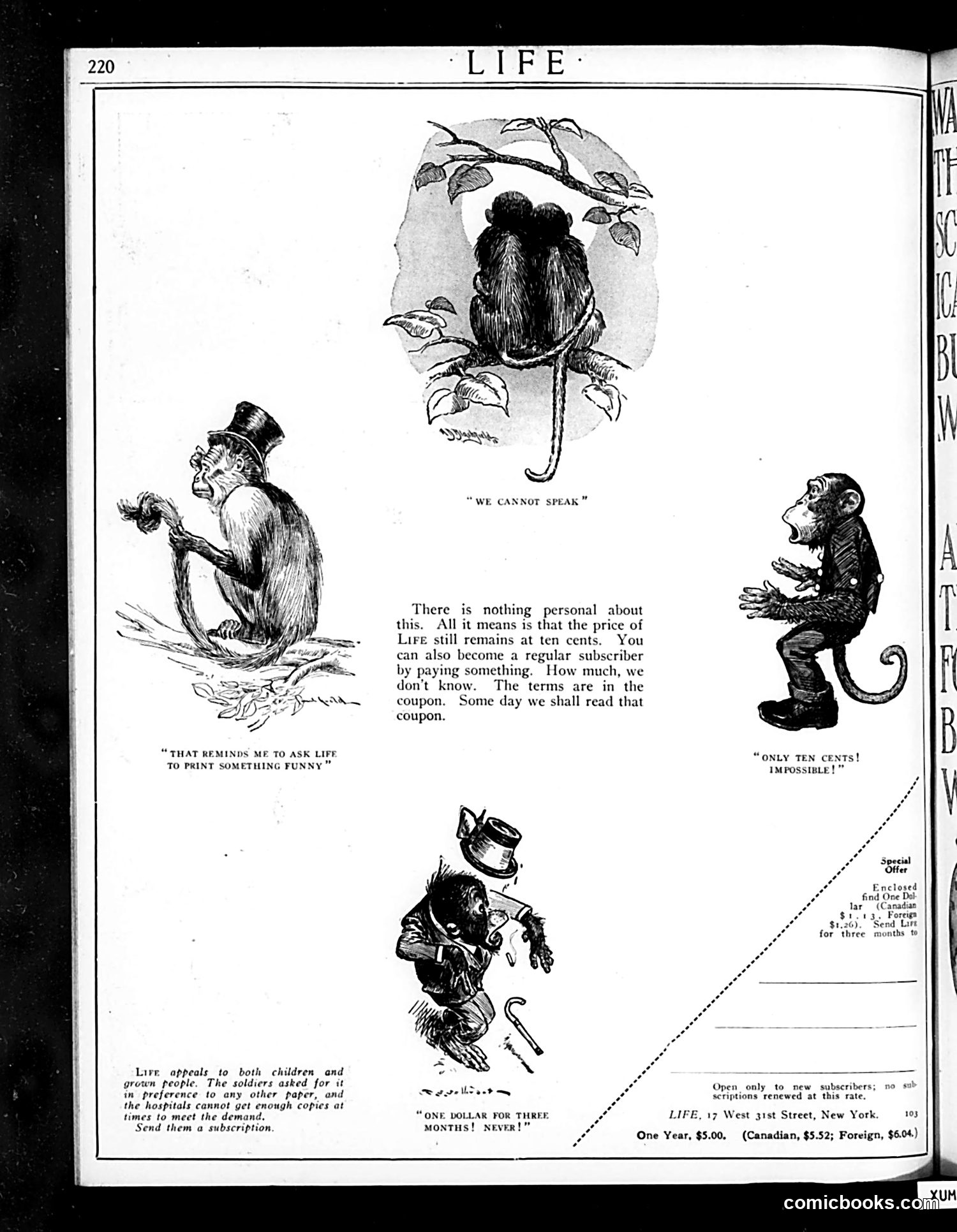
This page is primarily a subscription advertisement disguised as editorial content. The central image shows two birds (appearing to represent silence or muteness) with the caption "WE CANNOT SPEAK," likely alluding to censorship or suppressed speech—a relevant concern during WWI era when Life operated. The surrounding monkey caricatures represent potential subscribers with various objections: one finds it "funny" to ask Life to print something funny, another claims ten cents is impossible, and a third rejects three-month subscriptions. The satirical point: Life is humorously mocking subscriber excuses while promoting subscriptions at $5 annually. The page positions Life as appealing to "both children and grown people" and notes soldiers receive preference for copies. The imagery and tone suggest this dates to the early 20th century.
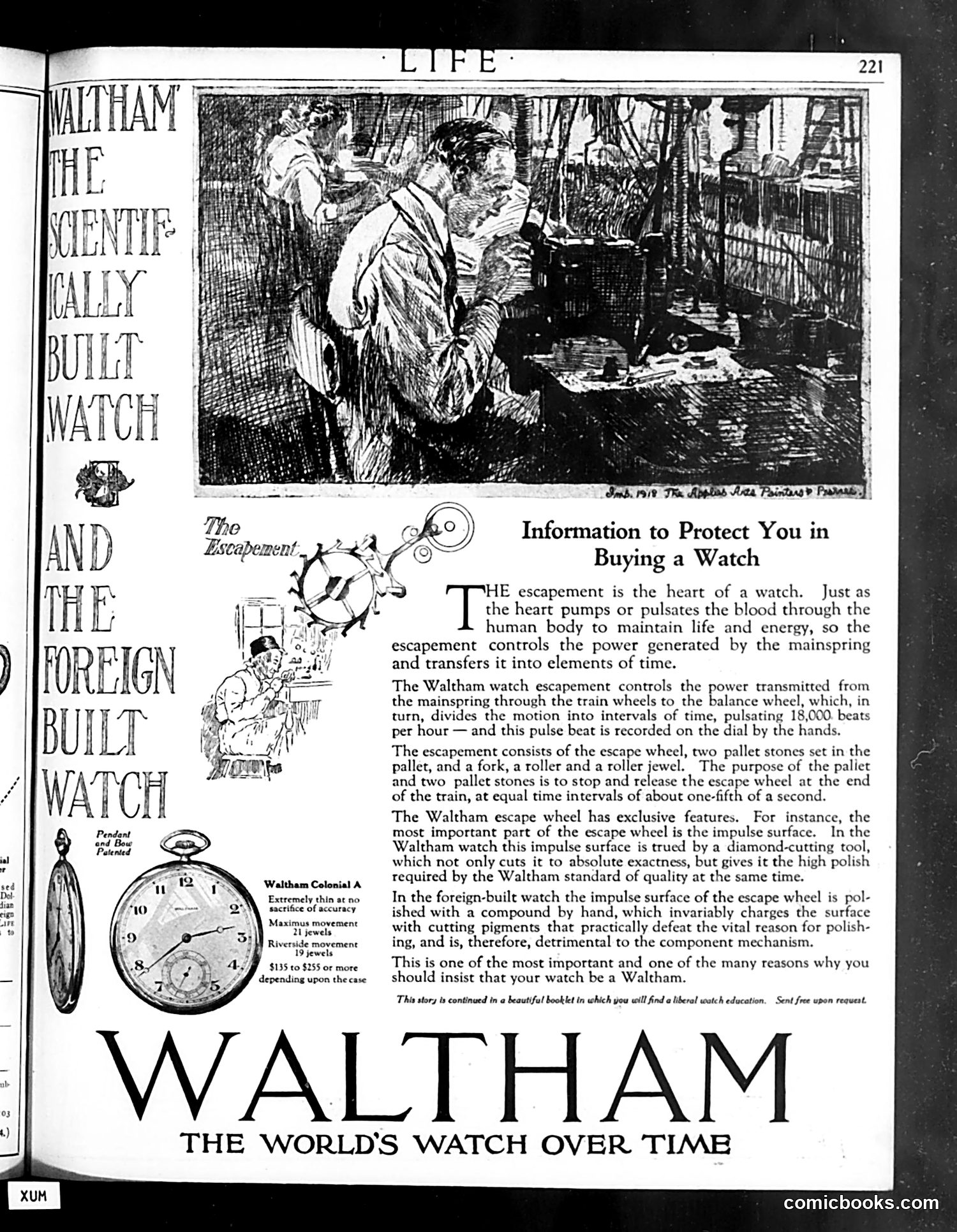
This page is primarily **advertising rather than satire**. It's a Waltham Watch company advertisement from *Life* magazine (page 221). The top illustration depicts a watchmaker or jeweler at work—likely representing Waltham's manufacturing expertise. The accompanying text explains watch mechanics to consumers: specifically, how the escapement (the heart of a watch) regulates timekeeping. The advertisement emphasizes Waltham's superior craftsmanship, particularly their precision-cut impulse surfaces on escape wheels, which they claim gives them quality advantages over foreign competitors. The "Waltham Colonial A" watch image and specifications appear below the educational text. The slogan "**The World's Watch Over Time**" plays on Waltham's reliability and global reputation. This is straightforward product marketing, not political or social satire.
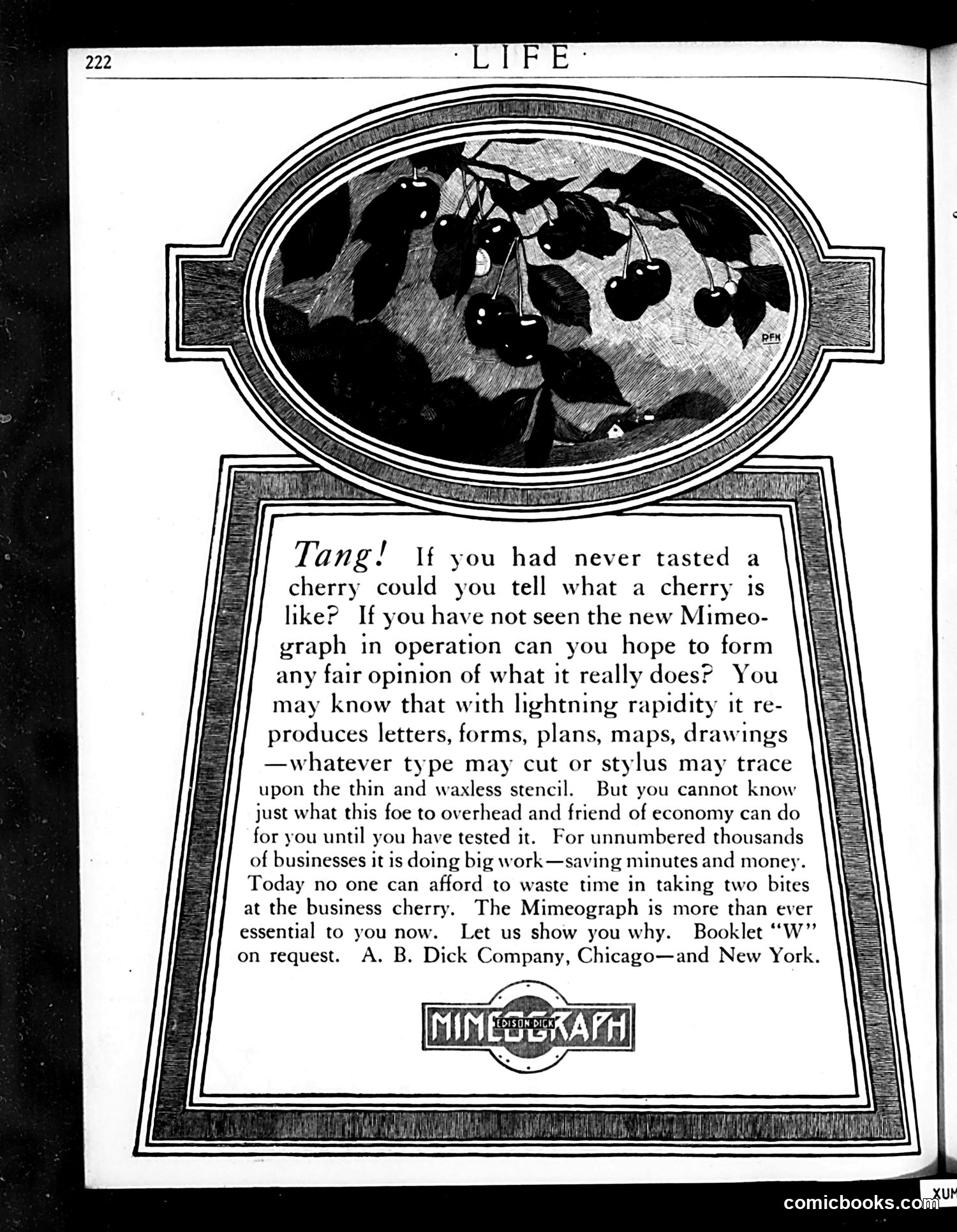
This page is primarily **advertising, not satire or political commentary**. The image shows cherries on a branch. The advertisement for the Mimeograph machine uses a rhetorical device comparing unfamiliar technology to unfamiliar taste: just as someone who'd never tasted a cherry couldn't describe it, someone who hasn't seen a Mimeograph in operation can't judge its value. The ad emphasizes the machine's speed and efficiency—it "reproduces letters, forms, plans, maps, drawings" rapidly using stencils. The pitch targets business users, claiming the device saves "minutes and money" for companies that "cannot afford to waste time." This reflects early 20th-century business culture's enthusiasm for labor-saving office technology. The cherry comparison is simply a marketing metaphor, not commentary on current events or political figures.
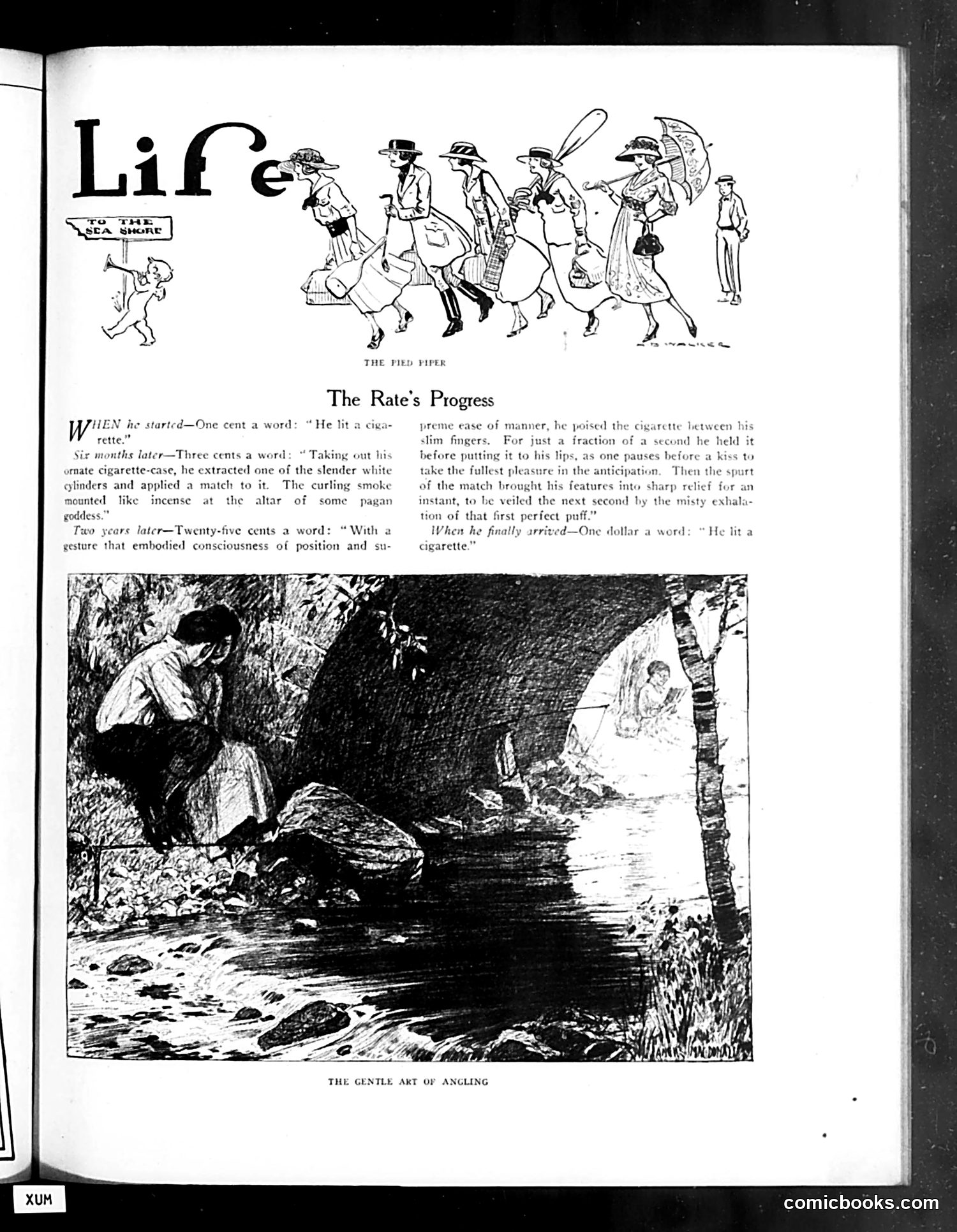
This satirical piece tracks a man's social and financial ascent through cigarette smoking, using a progressive narrative structure: **The progression:** - **One cent/word**: Starting broke, he smokes cheap cigars - **Three cents/word**: Six months later, he's upgraded to cigarette cases and matches - **Twenty-five cents/word**: Two years later, he's gained "conscientiousness of position and supreme ease of manner" The satire mocks how minor status symbols—particularly cigarettes and their accessories—signal and supposedly confer social respectability and financial success. The illustration of a well-dressed man fishing represents the final stage: leisure and gentility. The joke suggests that smokers delude themselves that tobacco consumption reflects or creates genuine social elevation, when it merely represents conspicuous consumption and superficial pretense.
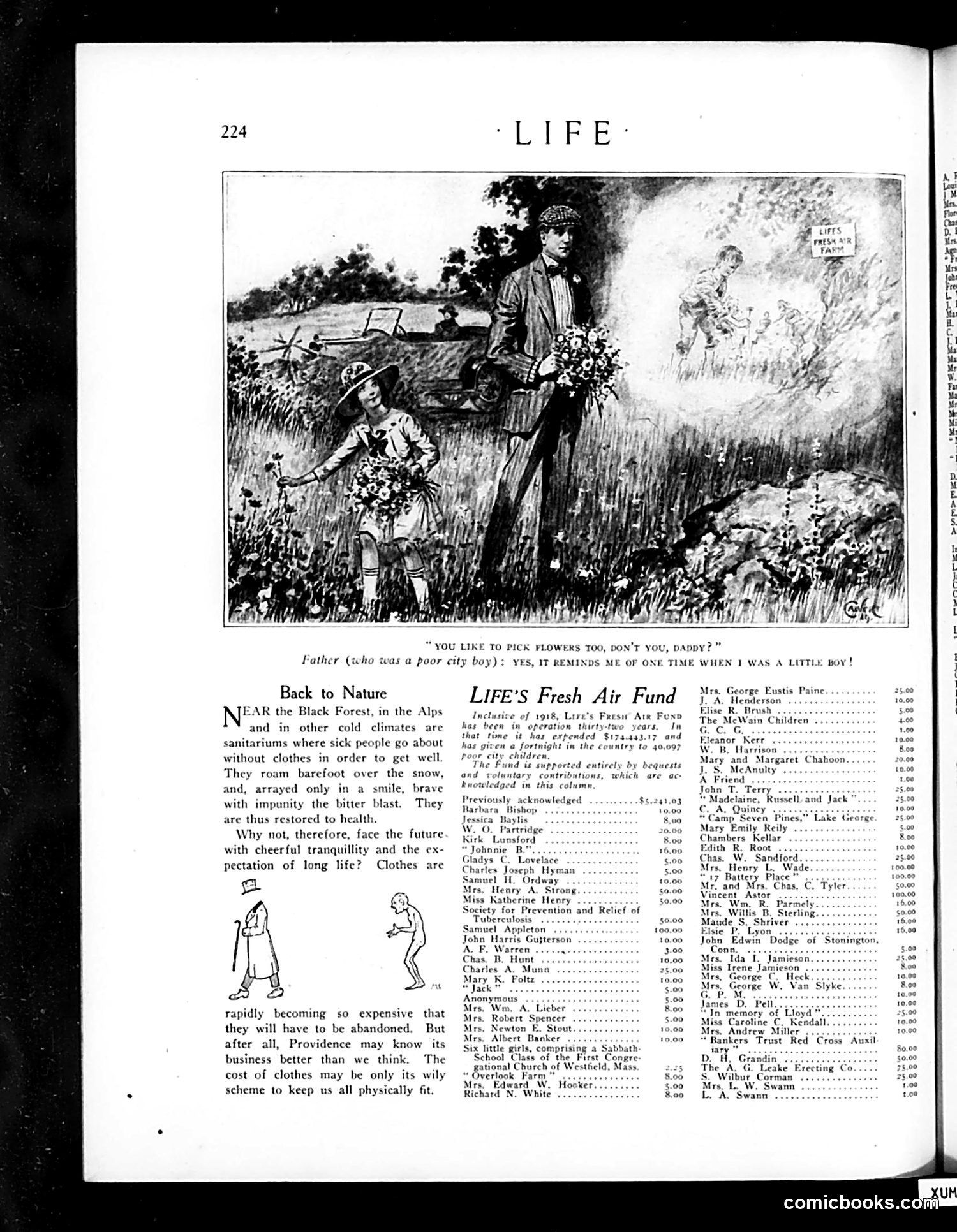
This page from *Life* magazine contains a satirical illustration titled "You like to pick flowers too, don't you, daddy?" showing an adult and child in a rural meadow with wildflowers and a bicycle. The accompanying text, "Back to Nature," critiques the fashion industry's expense and argues that clothes are becoming prohibitively costly. The satire suggests that people—especially the poor—should abandon expensive clothing and return to a simpler, natural state to achieve health and wellbeing. The illustration ironically depicts this "back to nature" philosophy: a father and daughter picking flowers outdoors, presumably freed from restrictive clothing. The text explicitly states clothes are becoming too expensive and argues that Providence might intend people to abandon them entirely for physical fitness and tranquility. This reflects early 20th-century primitivist and anti-consumerist social commentary.
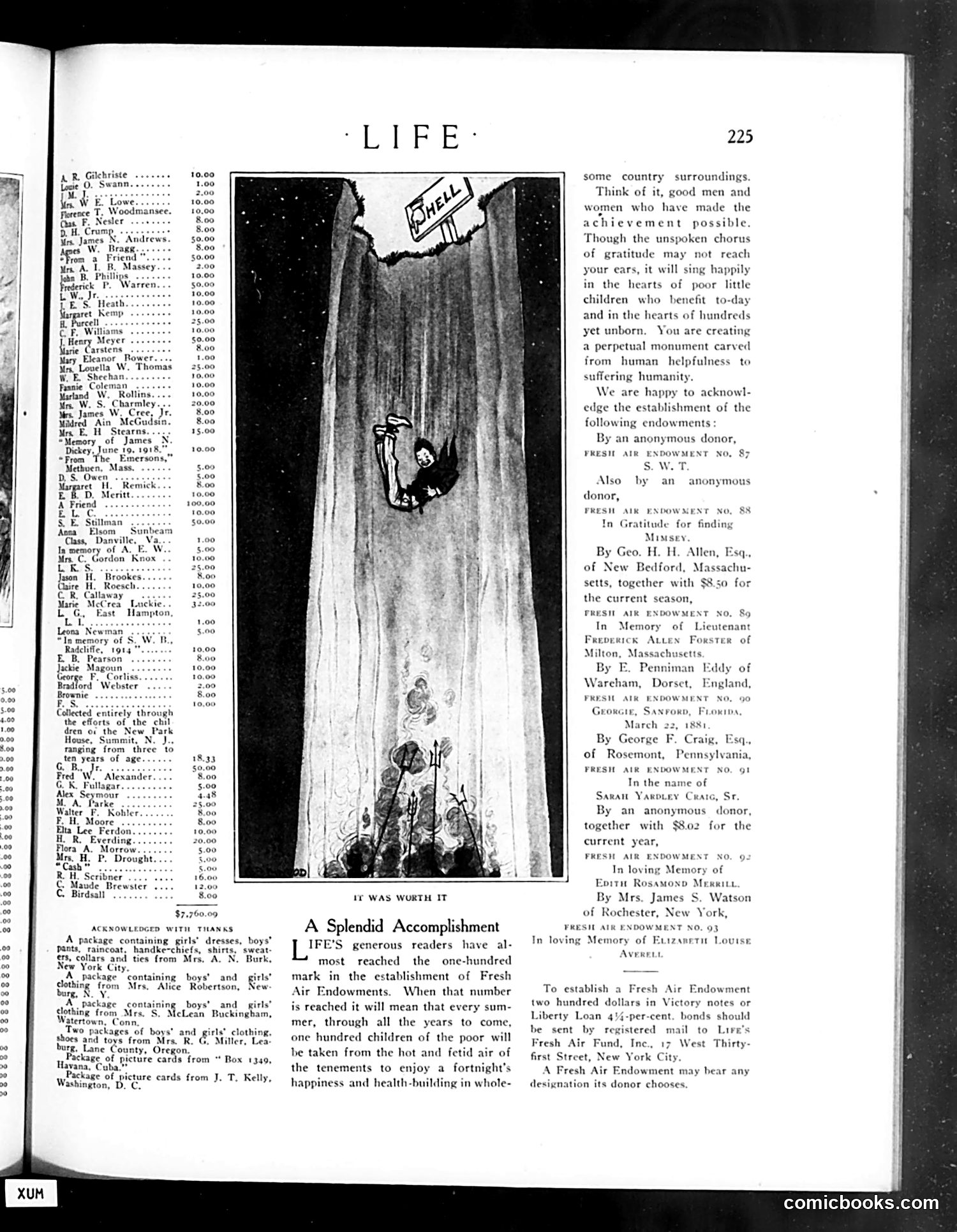
This cartoon depicts a figure suspended in what appears to be a tall structure or shaft, with smaller figures below. The caption "It Was Worth It" suggests commentary on sacrifice or achievement at great cost. The accompanying article, "A Splendid Accomplishment," discusses Life magazine's Fresh Air Endowment reaching one hundred children. This charitable program provides poor children respite from urban tenement conditions through country stays. The cartoon likely illustrates the endowment's purpose: removing children from dangerous, confined city environments (represented by the tall structure) to healthier surroundings. The figure's elevated position and the caption suggest the hardship of urban poverty is "worth" enduring because relief is possible through charitable intervention—a Progressive Era theme celebrating organized philanthropy.
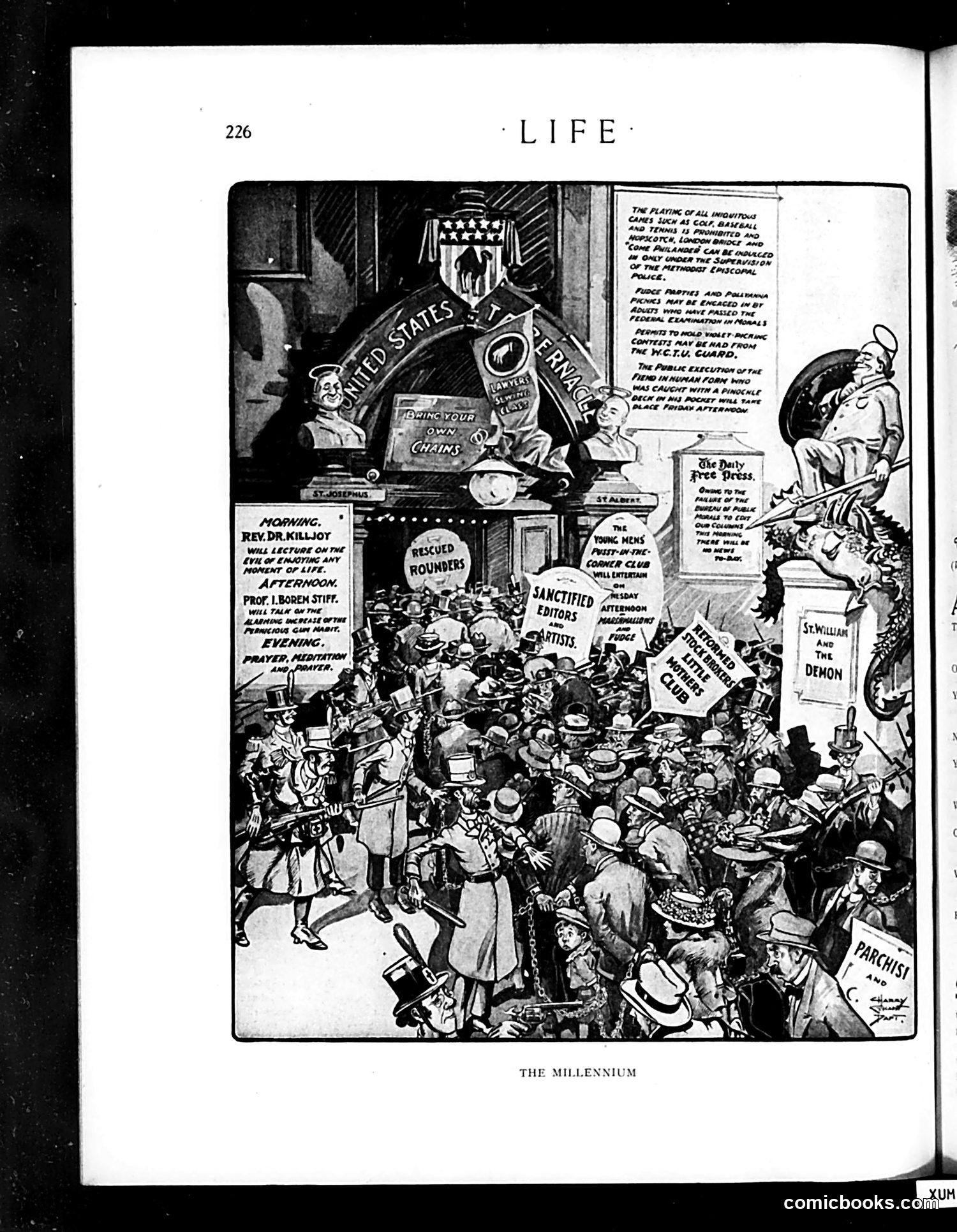
This satirical cartoon depicts a chaotic street scene crowded with competing social movements and reformers of early 20th-century America. The central structure displays the "United States" seal, suggesting government authority overlooking the disorder below. Visible placards and labels reference various reform movements: "Rescued Rounders," "Sanctified Editors," "Young Men's Poultry-on-the-Comer Club," and notably "Panchist" (likely anarchist). Speech bubbles attribute morning and evening quotations to "Rev. Dr. Killot" and "Prof. I. Borem Stiff," mocking pompous reformers. The cartoon satirizes the proliferation of overlapping reform causes and self-appointed moral authorities claiming to improve society, suggesting their competing agendas create chaos rather than progress. The title "The Millennium" ironically references utopian dreams.
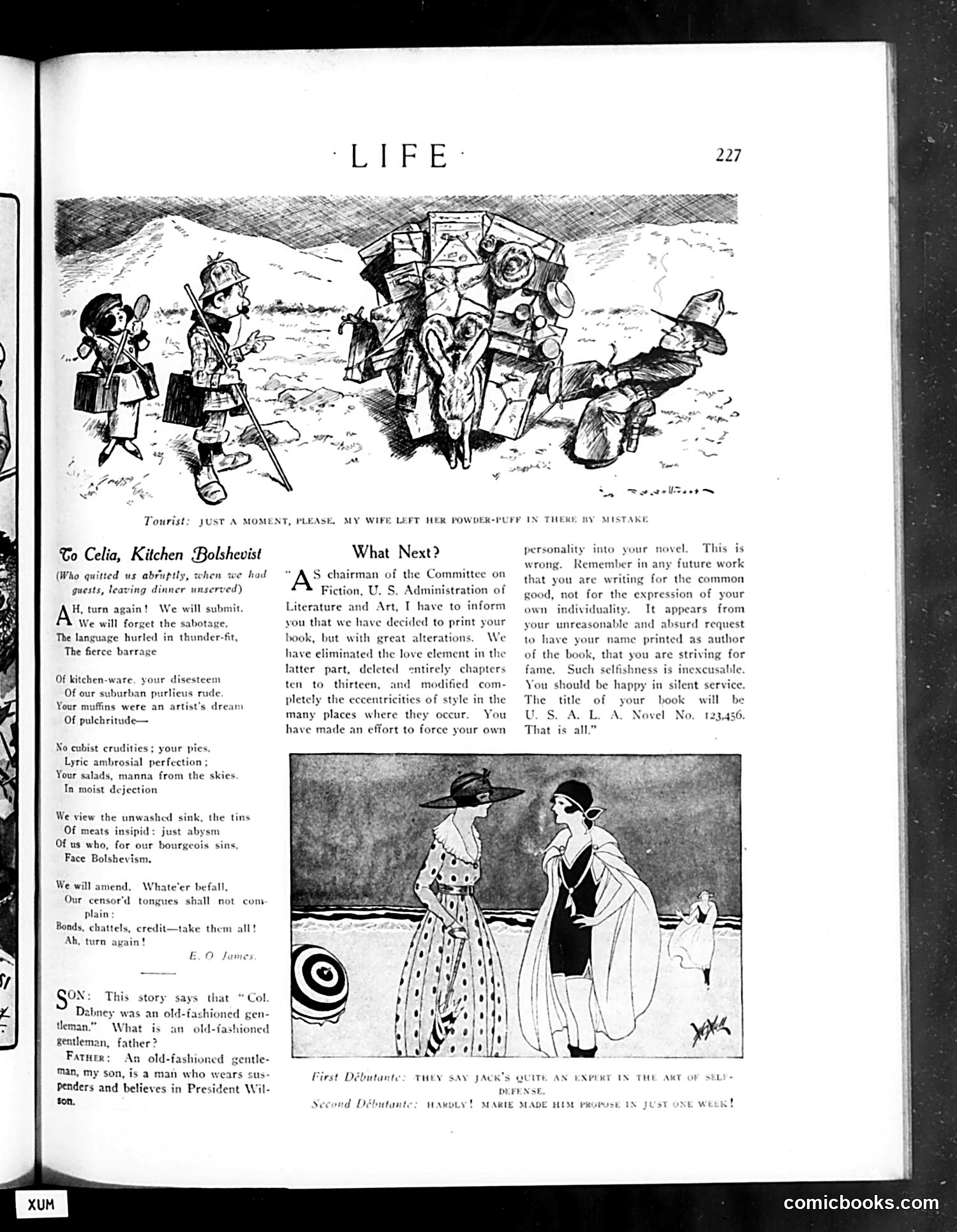
**Top Cartoon:** A tourist couple at what appears to be a desert campsite laden with excessive luggage. The caption reads: "Just a moment, please. My wife left her powder-puff in there by mistake." This satirizes tourists of the era as overpacked and dependent on frivolous luxuries even in remote locations. **Main Text Section:** A letter from a U.S. Government literature committee rejecting an author's manuscript. They demand removal of the "love element," deletion of chapters, and elimination of "eccentricities of style"—satirizing heavy-handed government censorship of literature. **Bottom Cartoon:** Two women discussing a man's sudden expertise in silk defense, with caption implying he learned the skill in just one week—likely mocking either false expertise or improbable quick-learning claims.
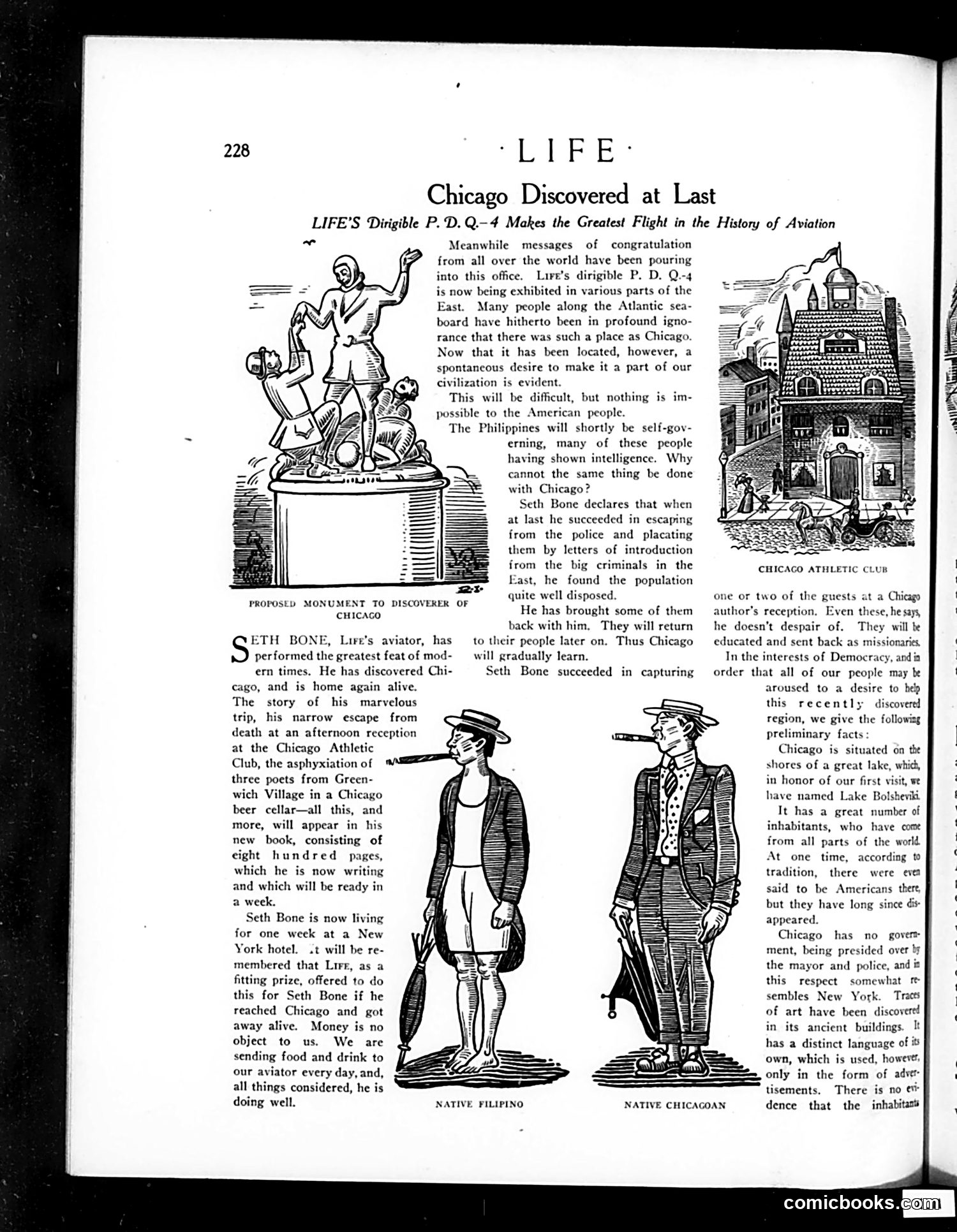
This 1906 *Life* magazine page satirizes aviator Seth Bone's claim to have "discovered" Chicago. The text mocks the absurdity: Bone escaped police, placed himself in the hands of criminals, and conveniently "found" Chicago—a major American city that obviously already existed. The cartoon's central joke: treating an inhabited place as newly "discovered" echoes colonial-era rhetoric. The proposed monument caricatures this pretension. The illustrations labeled "Native Filipino" and "Native Chicagoan" appear to mock Bone's boasting by sarcastically presenting Chicago's inhabitants as exotic "natives"—inverting the colonial "discovery" narrative. The satire critiques both Bone's self-aggrandizement and American imperial attitudes toward newly-acquired territories like the Philippines (then a U.S. possession).
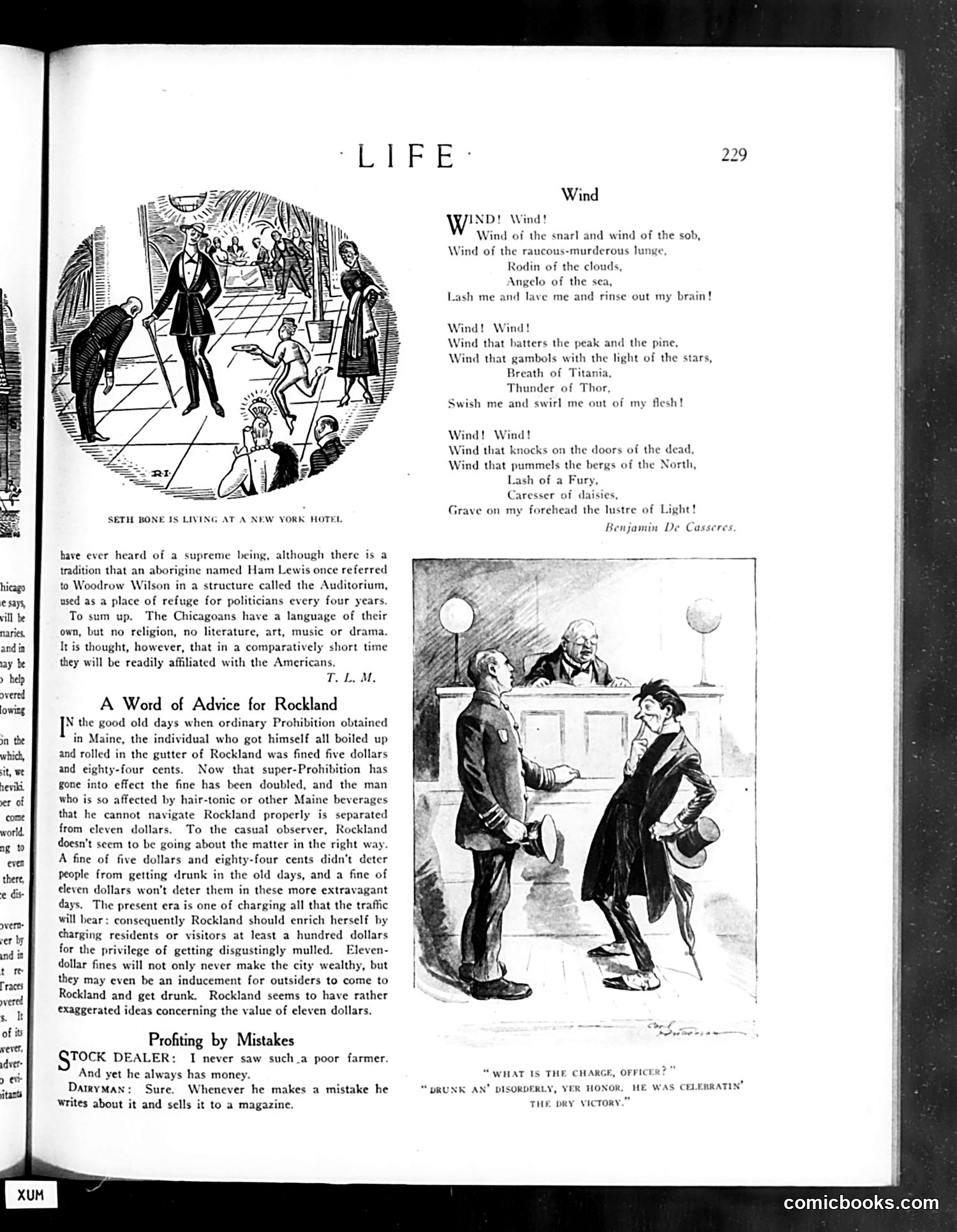
This page contains several satirical pieces about American life and politics: **Top illustration**: "Seth Bone is Living at a New York Hotel" depicts a scene with well-dressed figures, accompanying text about Native Americans' assimilation into American society, referencing their adoption of American customs and language. **"Wind" poem**: A dramatic poem by Benjamin De Casseres using wind as a metaphor for chaos and cleansing force. **"A Word of Advice for Rockland"**: Satirizes Prohibition enforcement in Maine, criticizing the increased fines (from $5 to $10) as ineffective. The piece mocks that this harsher penalty won't deter drinking, only encourage corruption. **Bottom illustrations and jokes**: Include social commentary on financial mistakes and urban behavior, typical of Life's humor column format. The overall tone reflects early 20th-century American anxieties about Prohibition, urbanization, and class distinctions.
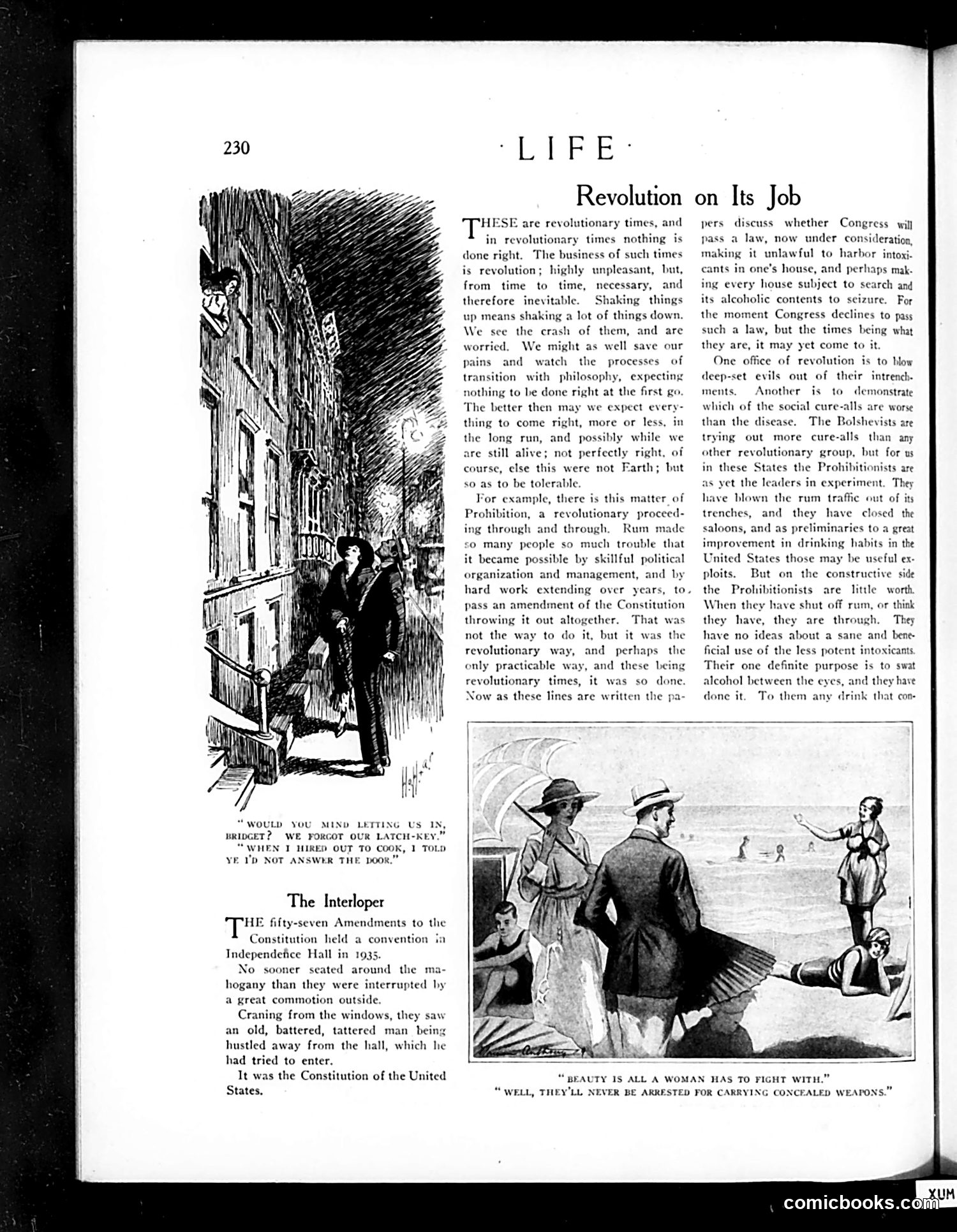
This page critiques radical political movements of the era (likely 1920s, given prohibition references). The main article argues that revolutionary change inevitably causes disruption and suffering, defending this as necessary evil during transitional periods. The upper cartoon shows a man being turned away from his home—captioned with dialogue about hiring a cook, suggesting domestic disruption from social upheaval. The lower cartoon depicts a woman at a beach asserting her physical attractiveness as a weapon, with commentary about women carrying concealed weapons. This satirizes debates over women's rights and safety in revolutionary times. The article specifically references Prohibition as a "revolutionary proceeding" that caused social problems, using it as evidence that radical change often proves impractical despite good intentions.
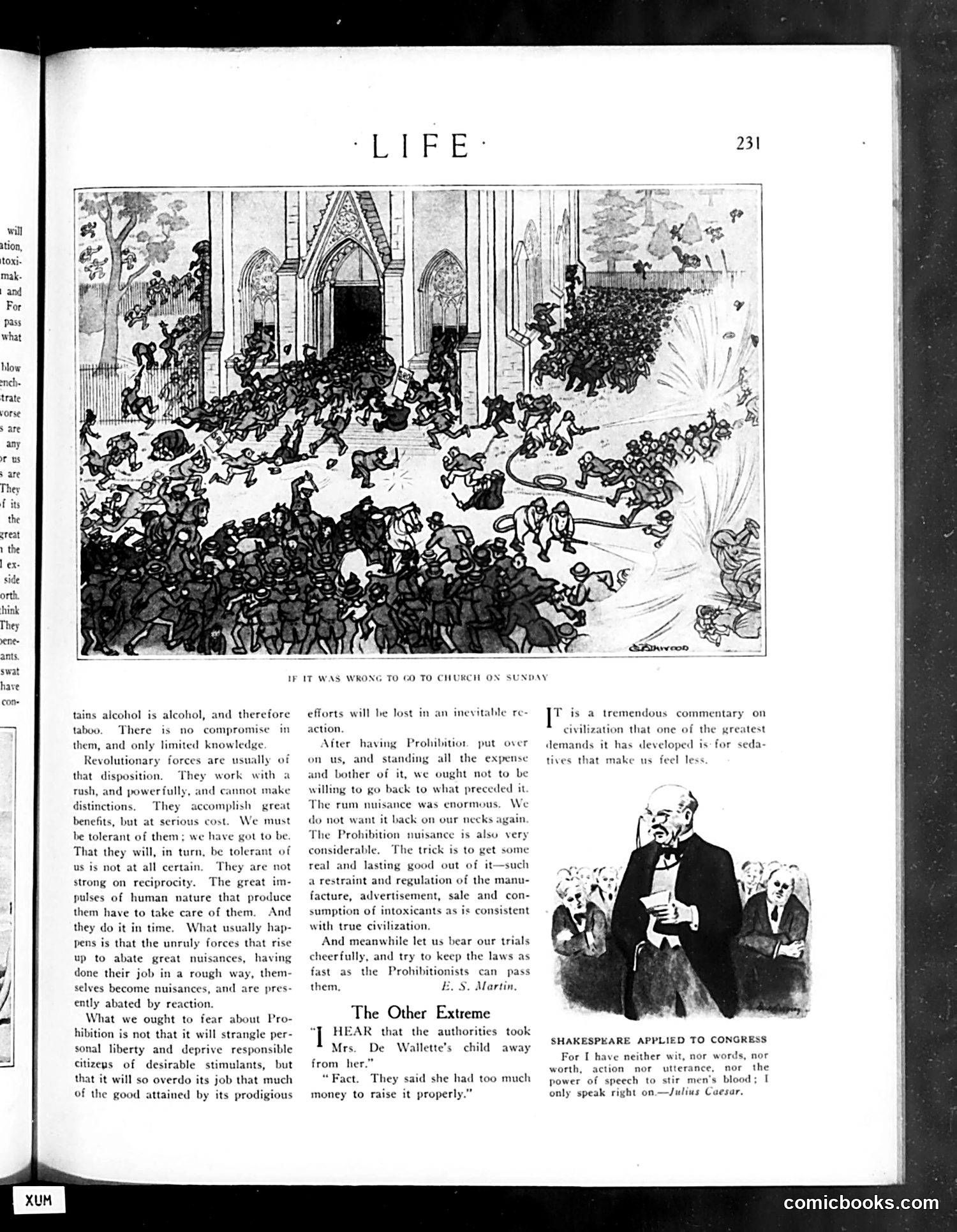
This cartoon satirizes Prohibition enforcement and public hypocrisy. The chaotic street scene depicts crowds of people drinking and carousing outside a church, mocking the contradiction between religious observance and illegal alcohol consumption during Prohibition. The accompanying text argues that Prohibition has become a "nuisance" that generates disrespect for law rather than moral improvement. The author criticizes how ordinary citizens now routinely break the law, suggesting that well-intentioned moral legislation backfires when it conflicts with popular behavior. The cartoon's title appears ironic—implying that if church-going itself were prohibited with the same enforcement vigor as alcohol, we'd see similar public lawlessness. It's a commentary on Prohibition's failure and unintended social consequences in 1920s America.
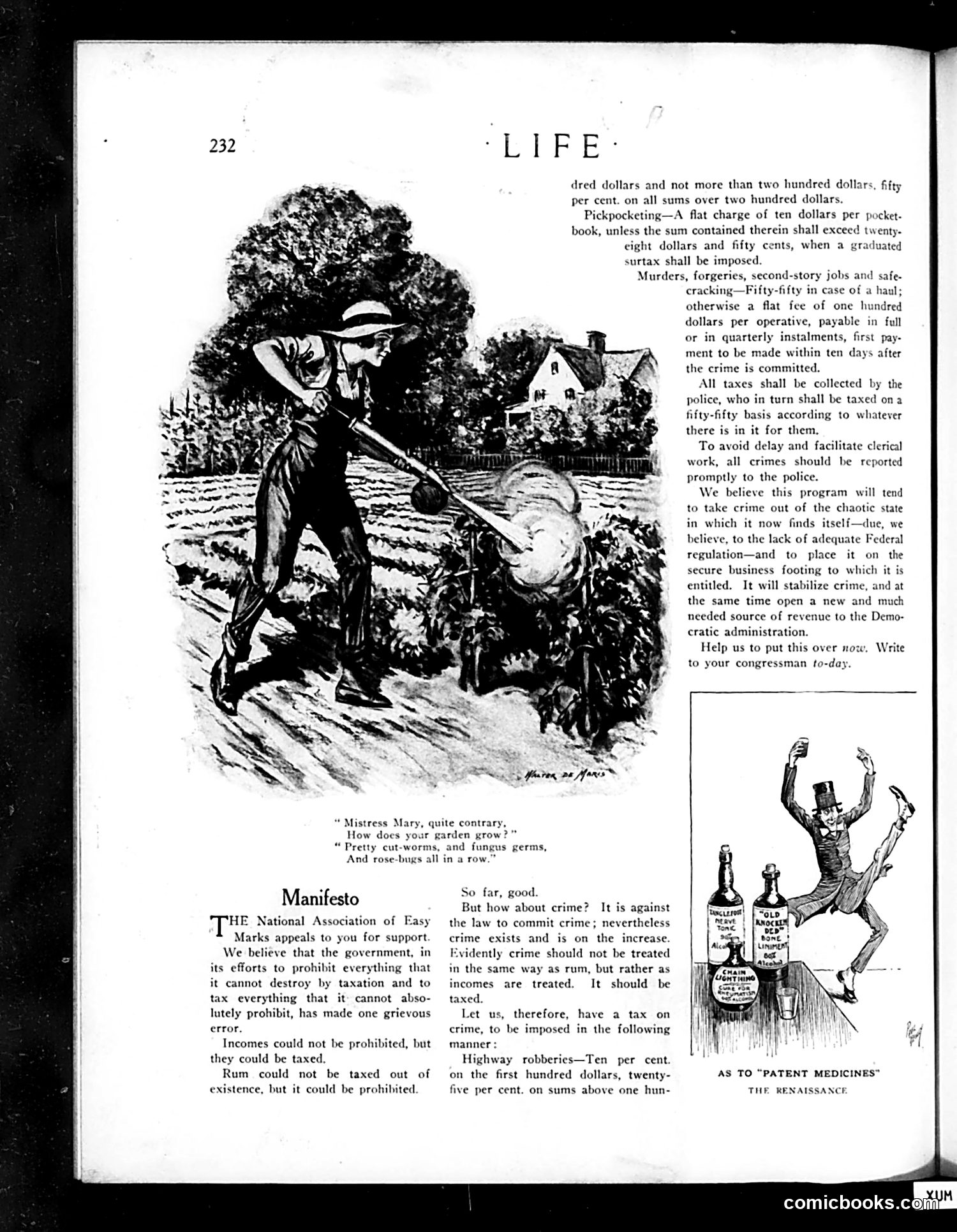
This page satirizes Progressive-era government overreach and taxation policy. The "Manifesto" by the fictional "National Association of Easy Marks" mocks the logic of heavy taxation and prohibition by proposing an absurd extension: taxing *crime itself* rather than prohibiting it. The satire targets the Democratic administration's approach to Prohibition (banning alcohol) while heavily taxing incomes. The manifesto ironically suggests applying income-tax logic to crime—charging criminals fees for murders, robberies, and safecracking, with police collecting taxes on their bribes. The accompanying illustration shows a farmer using a hoe on vegetables, sardonically captioning the nursery rhyme "Mary, Mary, quite contrary"—implying that government regulation of agriculture (crop diseases, pests) is as invasive as taxing crime. The bottom cartoon mocks patent medicines as another regulatory target. The overall point: government is overextending control into absurd domains through taxation rather than genuine prohibition.
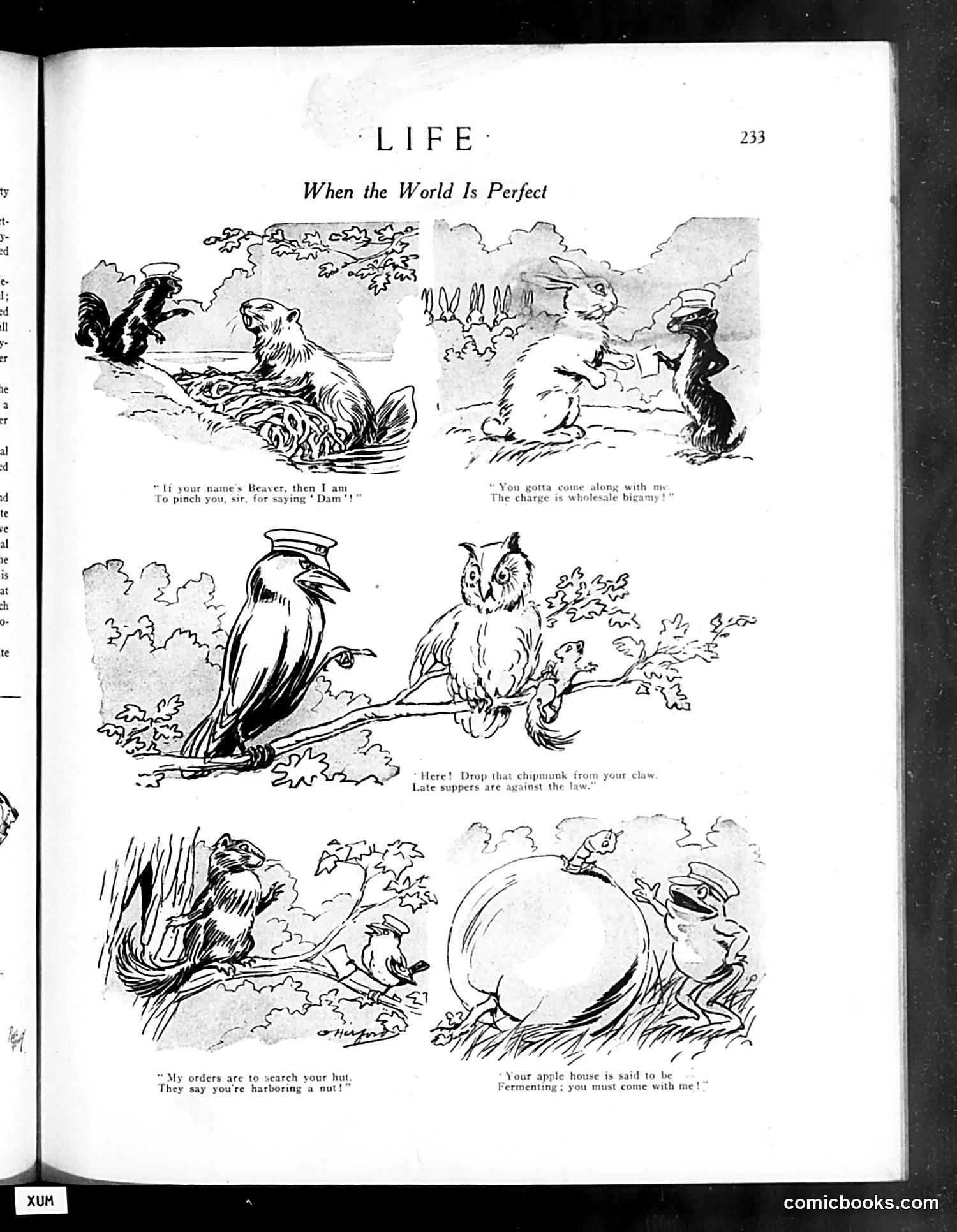
This is a humorous comic strip imagining an absurdly over-regulated animal society where natural animal behavior becomes illegal. Each panel depicts anthropomorphized animals being arrested or confronted by police for ordinary conduct: - A beaver is threatened with arrest for saying "dam" - An owl is told to release a chipmunk (confiscating food) - A squirrel faces search and seizure for "harboring a nut" - An animal must surrender an fermenting apple house The satire mocks **excessive government regulation and bureaucratic overreach**—likely referencing contemporary concerns about expanding laws, Prohibition (note the "fermenting" reference), or general administrative intrusion into daily life. The absurdity of criminalizing animals' natural instincts emphasizes how irrational such regulation becomes. The title "When the World Is Perfect" is deeply ironic, suggesting this regulated dystopia as a dystopian "ideal."
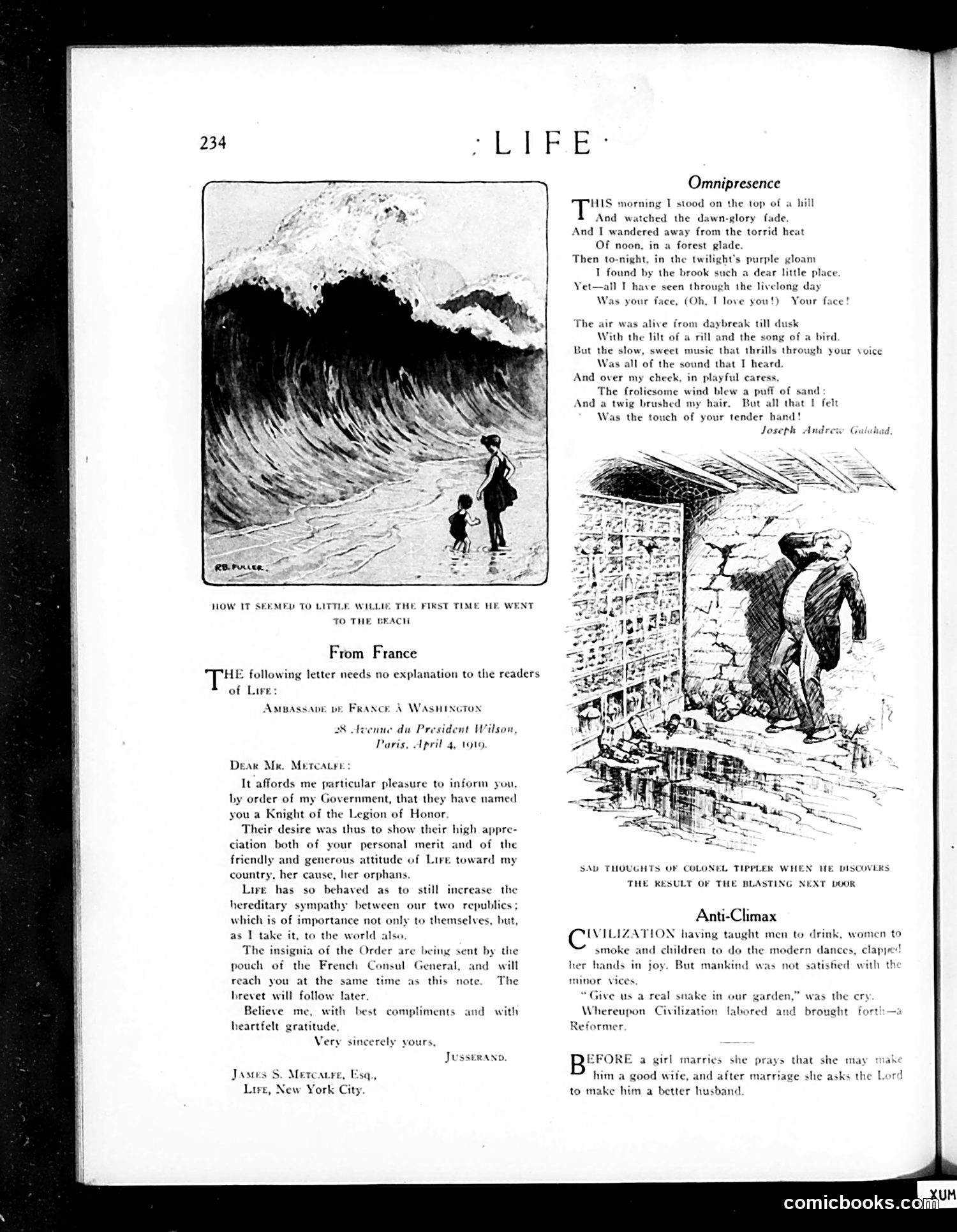
This page contains three distinct items: **Top cartoon:** A humorous illustration of a child's first beach experience, where towering waves appear enormous and terrifying from a small child's perspective—a visual joke about scale and perception. **Middle section:** A formal letter from the French Ambassador to the U.S. (Jusserand) honoring *Life* magazine's editor James Metcalfe with the Legion of Honor. This appears genuine—France was recognizing *Life*'s pro-Allied stance during WWI (note the 1919 date, just after the war ended). The Ambassador praises the magazine's support for France, her "cause," and orphans. **Right side:** Romantic poetry and an unrelated cartoon about "Colonel Tippler" discovering blasting results—appears to be separate satirical content. **Bottom:** Brief social satire: "Anti-Climax" jokes that after civilization provided drinking, smoking, and modern dances, mankind demanded "a real snake in our garden"—Civilization then produced "a Reformer" (social reformers were common targets of *Life*'s satire). The page primarily showcases the magazine's prestige and satirical sensibility circa 1919.
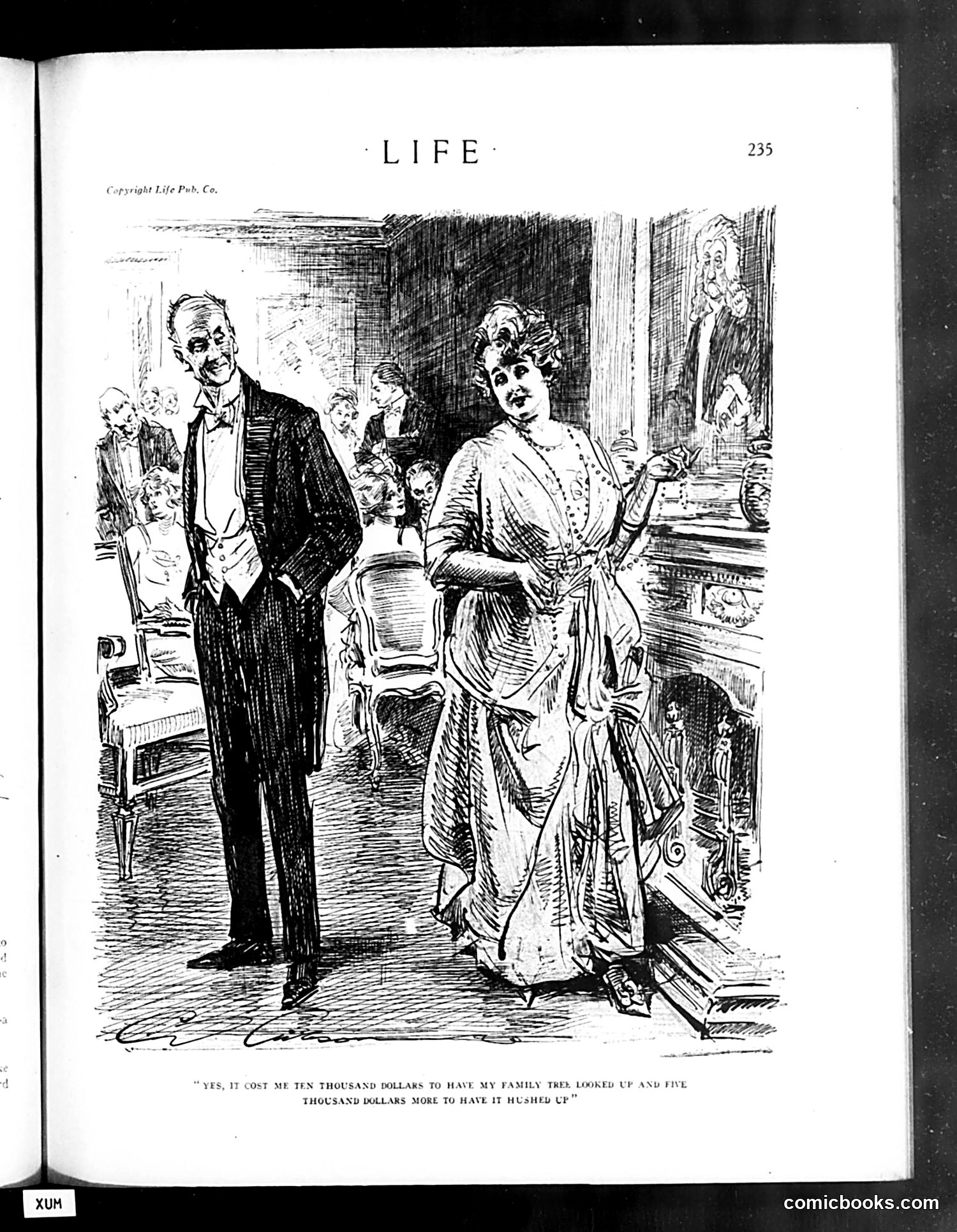
This single-panel cartoon depicts an elegant social gathering, likely from the early 1900s. A well-dressed gentleman and woman are the focal figures in what appears to be a formal parlor scene with other guests visible in the background. The caption reads: "Yes, it cost me ten thousand dollars to have my family tree looked up and five thousand dollars more to have it hushed up." **The satire:** This jokes about wealthy Americans' obsession with establishing aristocratic lineage through genealogical research—a status symbol of the era. The humor lies in the reveal that the investigation uncovered embarrassing ancestry, requiring payment to suppress the findings. **The point:** It mocks both the vanity of the nouveau riche seeking false gentility and the implicit corruption of those willing to conceal unflattering family histories for payment. The joke suggests that authentic blue-blood credentials cannot be manufactured, no matter the expense.
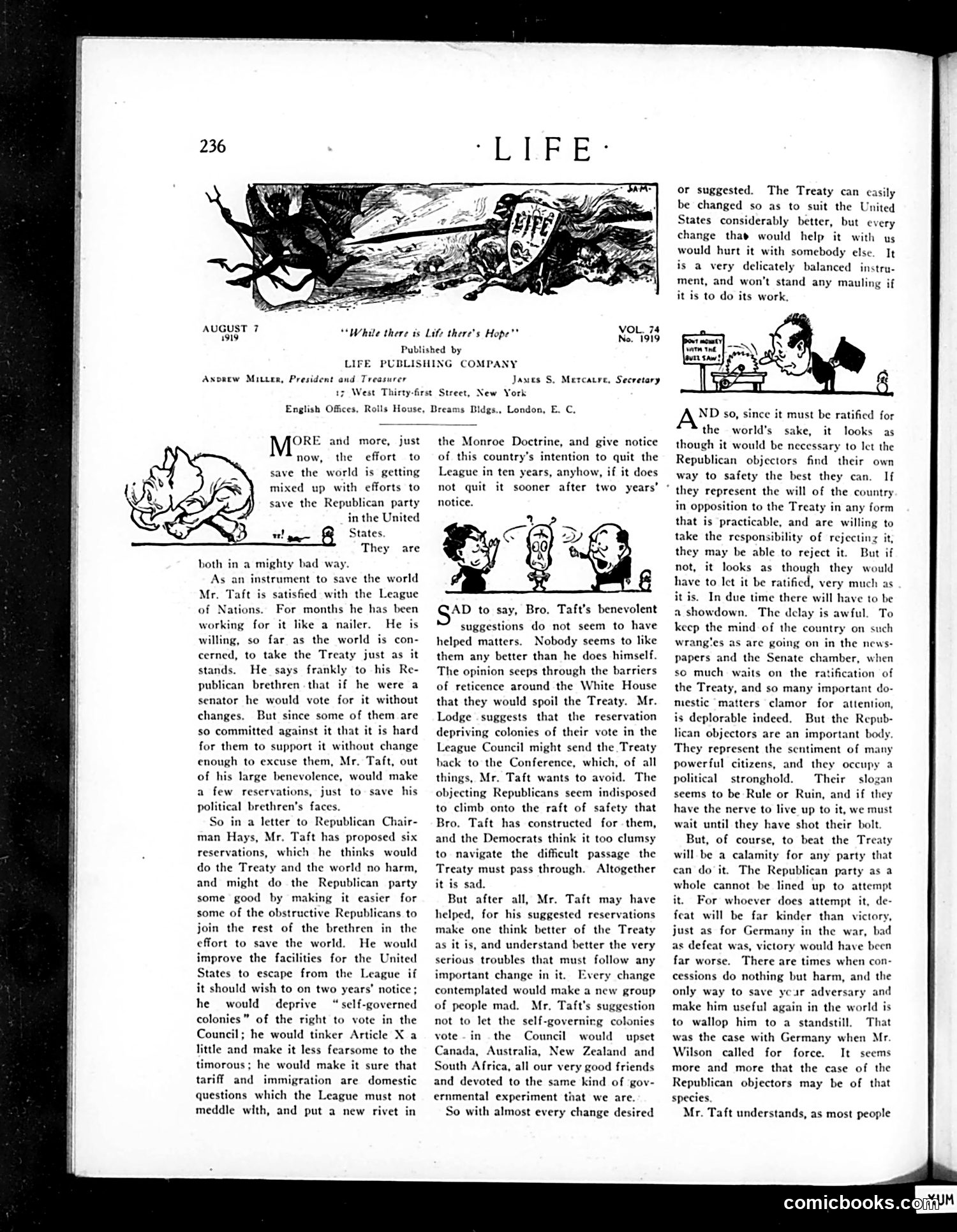
This page satirizes former President William Howard Taft's attempt to broker a compromise on the League of Nations Treaty. The article criticizes Taft's proposal of six reservations designed to win over Republican senators opposing the treaty—a politically motivated compromise dressed up as benevolence. The satire's point: Taft claims to support the treaty while offering changes "to save his political brethren's faces," but every modification he suggests would actually damage the treaty's delicate balance or offend America's allies (Canada, Australia, New Zealand, South Africa). The author argues that Taft's real motive is saving the Republican Party, not the world, and his "help" actually proves how fragile the treaty is. The cartoons likely mock Taft's self-serving generosity masquerading as statesmanship during this heated 1919 Senate ratification debate.
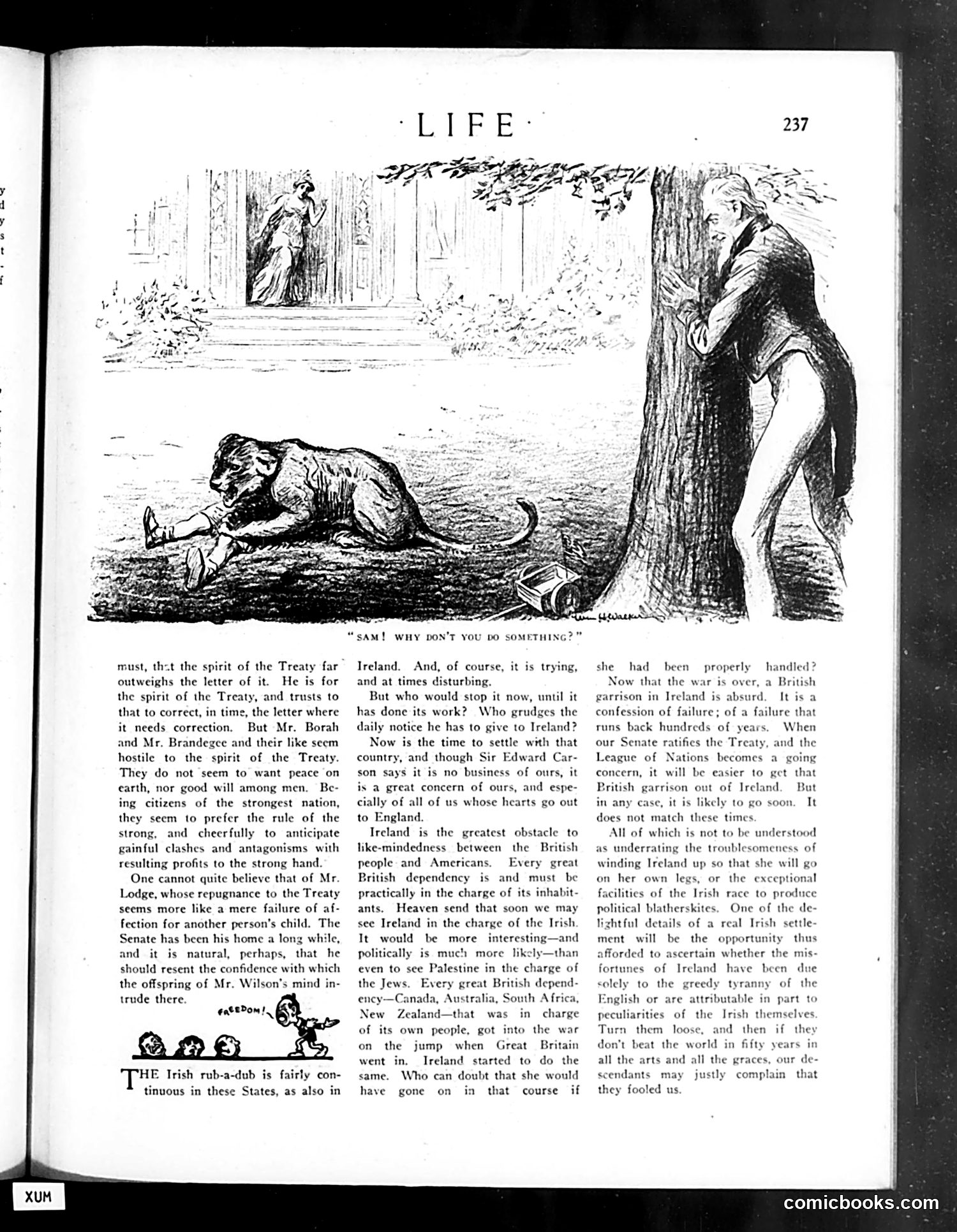
This Life magazine page critiques American senators opposing the League of Nations Treaty (likely post-WWI). The cartoon depicts Ireland as a struggling figure while a man leans against a tree—representing American inaction on Irish independence. The text attacks senators Borah and Brandegee (and implicitly Lodge) who opposed Wilson's Treaty, characterizing them as preferring conflict to peace. The author argues Ireland is the main obstacle to British-American unity, and that granting Irish self-governance (like other British dominions) would be wiser than maintaining a garrison. The cartoon's message: America ("Sam") should use League ratification to pressure Britain into solving the "Irish problem" rather than standing idle. The joke is bitter—it mocks both American passivity and suggests Irish self-rule might finally test whether Irish political failings stem from English oppression or Irish character itself.
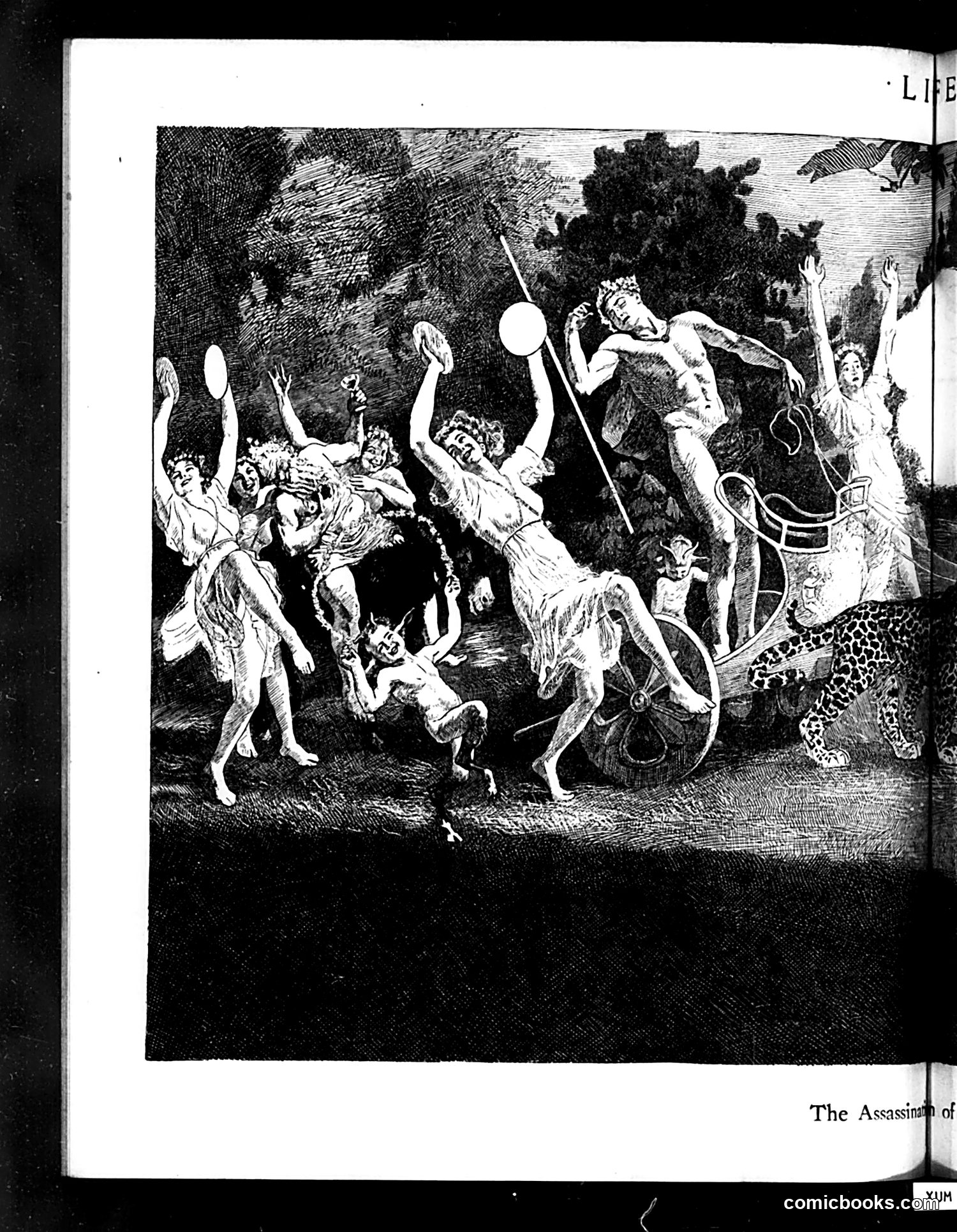
This engraving depicts a chaotic mythological or allegorical scene rather than a political cartoon. Multiple nude or partially-draped figures engage in violent action in a wooded setting, with weapons raised and what appear to be white spherical objects (possibly meant to represent celestial bodies or symbolic orbs) being thrown or held aloft. The caption reads "The Assassin[ation] of" — suggesting this illustrates a specific mythological assassination, though the OCR and image quality prevent certain identification of which event or figures are depicted. Without clearer context about the specific mythological narrative or the magazine's date, the precise satirical point remains unclear. The style suggests 19th-century engraving technique common to *Life* magazine's early period.
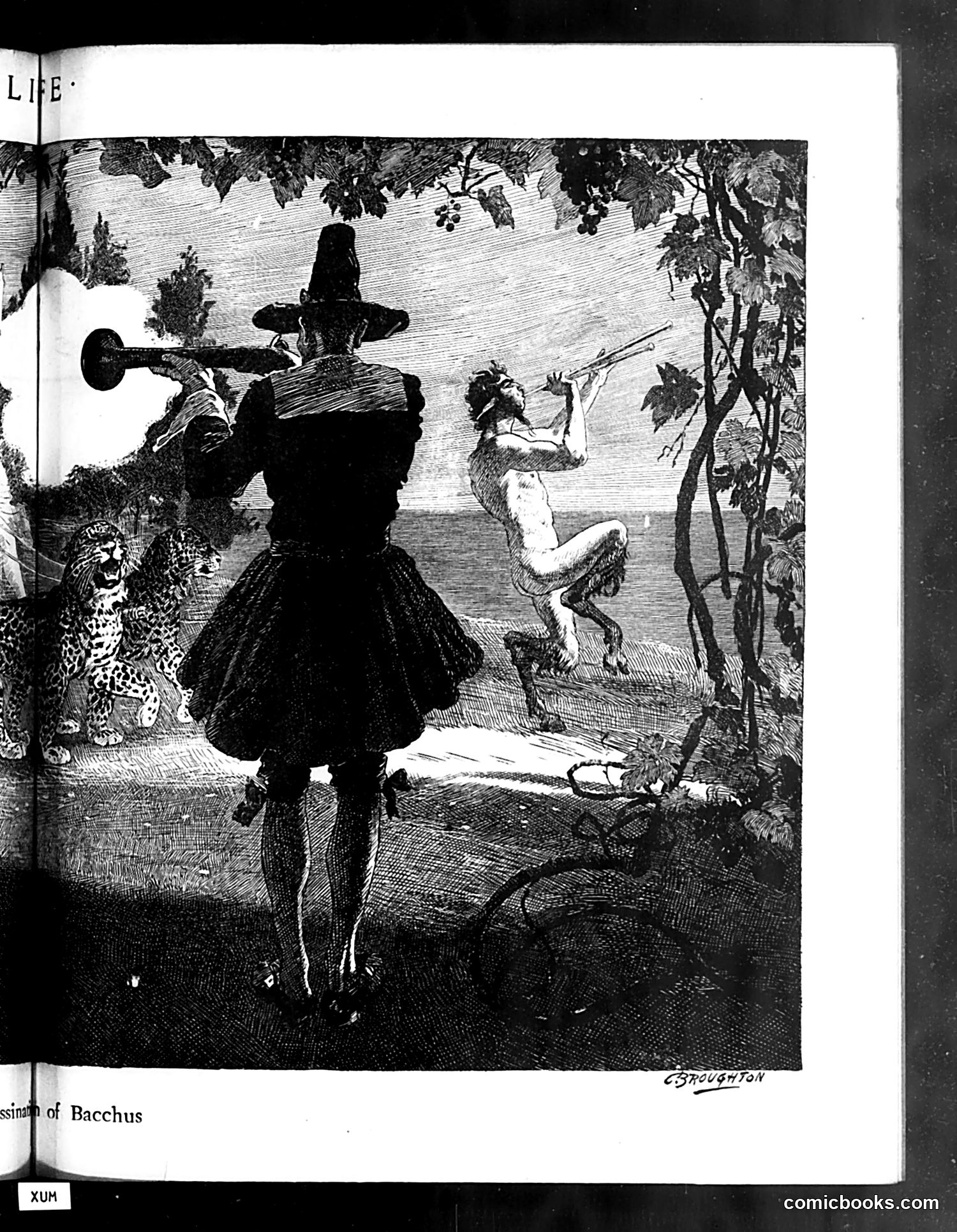
This engraving by Coughton depicts a classical allegorical scene. A robed figure (likely representing Bacchus, the Roman god of wine) stands centrally, holding a trumpet-like instrument, wearing a wide-brimmed hat. To the left, a leopard or spotted cat appears; to the right, a cherubic or satyr-like figure holds a telescope while standing on an urn or vessel. The title "Mission of Bacchus" suggests satirical commentary on wine's cultural "mission" or influence. The classical imagery and symbolic animals (Bacchus's traditional leopard companions) combine with the incongruous telescope and trumpet—likely mocking either pretensions to scientific legitimacy for alcohol consumption or the absurdity of treating wine-drinking as a noble pursuit worthy of fanfare and investigation. The exact satirical target remains unclear without additional context from the magazine issue.
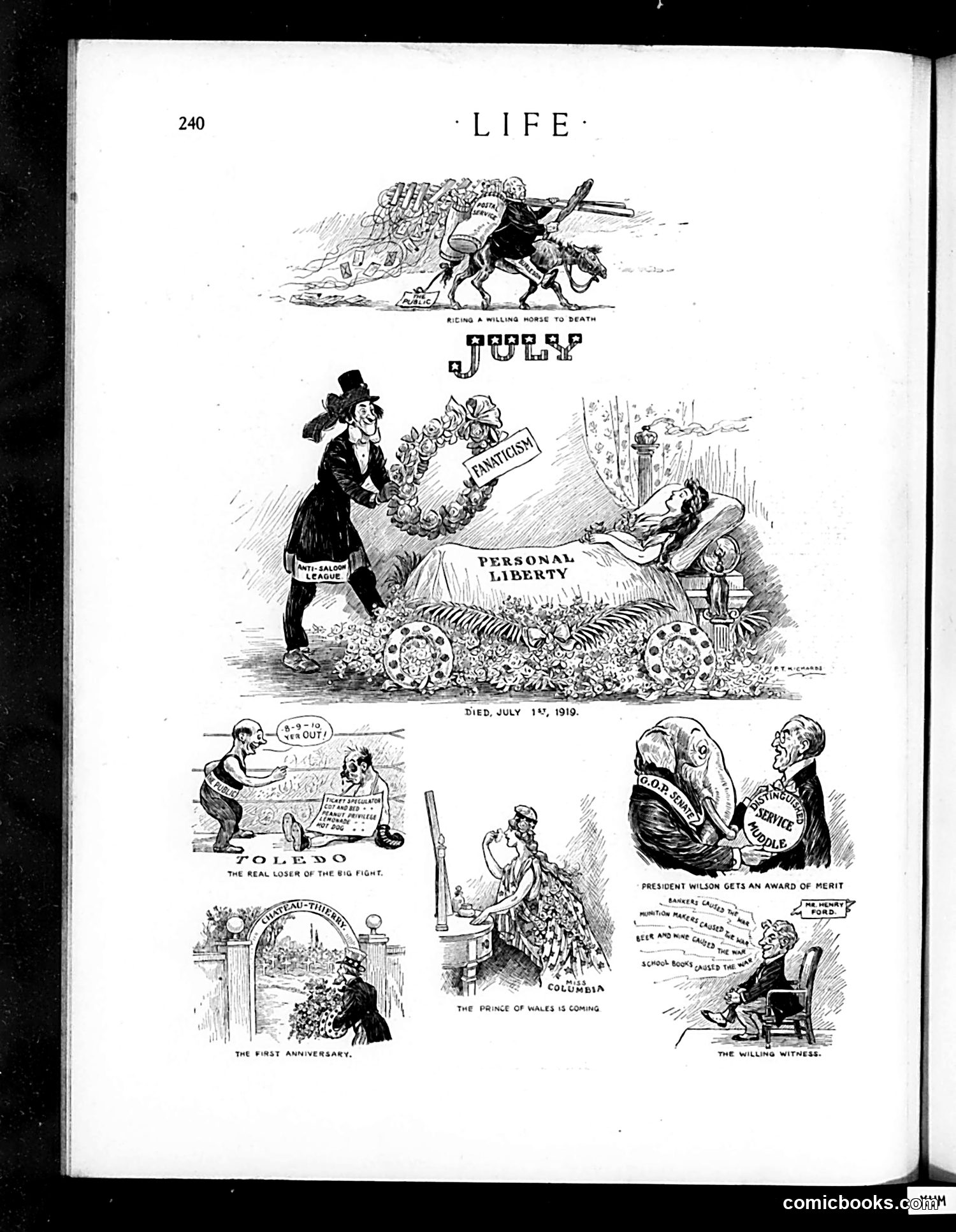
This page commemorates the death of "Personal Liberty" on July 14, 1919, likely referencing wartime restrictions that continued into the post-WWI period. The central cartoon shows Liberty as a deceased figure in a coffin, mourned by a man in formal dress. Surrounding cartoons mock President Wilson and government overreach: - **"Toledo: The Real Loser of the Big Fight"** — appears to reference a local political defeat - **"President Wilson Gets an Award of Merit"** — satirizes Wilson receiving honors while civil liberties declined - **"The Prince of Wales is Coming"** — unclear context, possibly about royal visit preparations - **"The Willing Witness"** — likely criticizes informants or government surveillance The overall theme attacks government restrictions on freedom during and after WWI, suggesting Wilson's administration sacrificed personal liberty for wartime/post-war control. The satire is critical of the administration's policies.
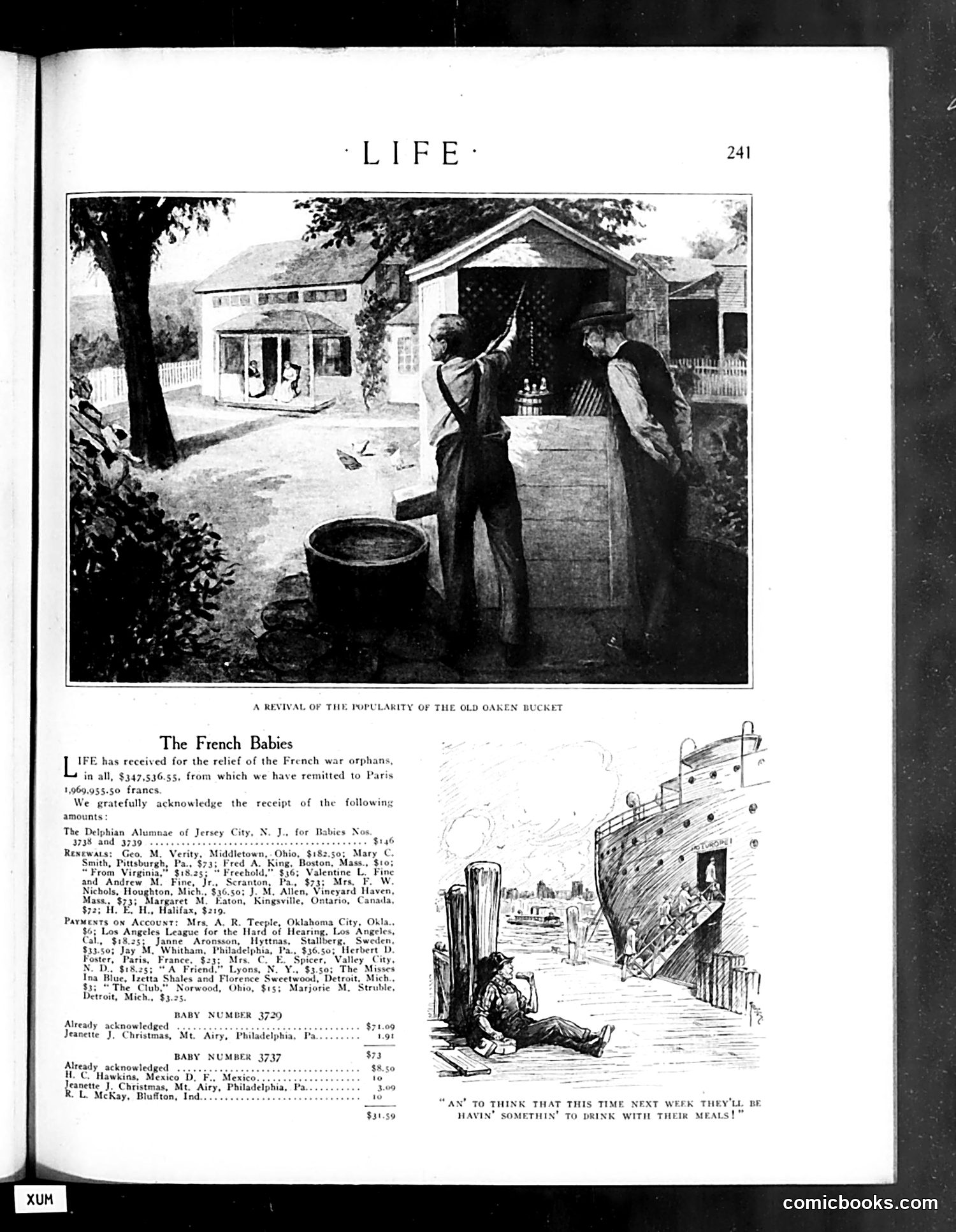
The top photograph shows "A Revival of the Popularity of the Old Oaken Bucket"—two men drawing water from a well bucket, likely satirizing Americans' nostalgic return to old-fashioned practices (perhaps due to Prohibition or wartime rationing). The main content concerns LIFE magazine's charitable fundraising for French war orphans, acknowledging donations totaling $347,536.55 (converted to 1,969,055.50 francs for relief efforts). Donors are listed by name and amount. The cartoon caption at bottom reads: "An' to think that this time next week they'll be havin' somethin' to drink with their meals!"—a joke about improving living conditions, possibly referencing hopes that relief funds would restore normal life in France. The page reflects early 20th-century American charitable culture during or after World War I, when LIFE actively solicited public donations for European humanitarian aid.
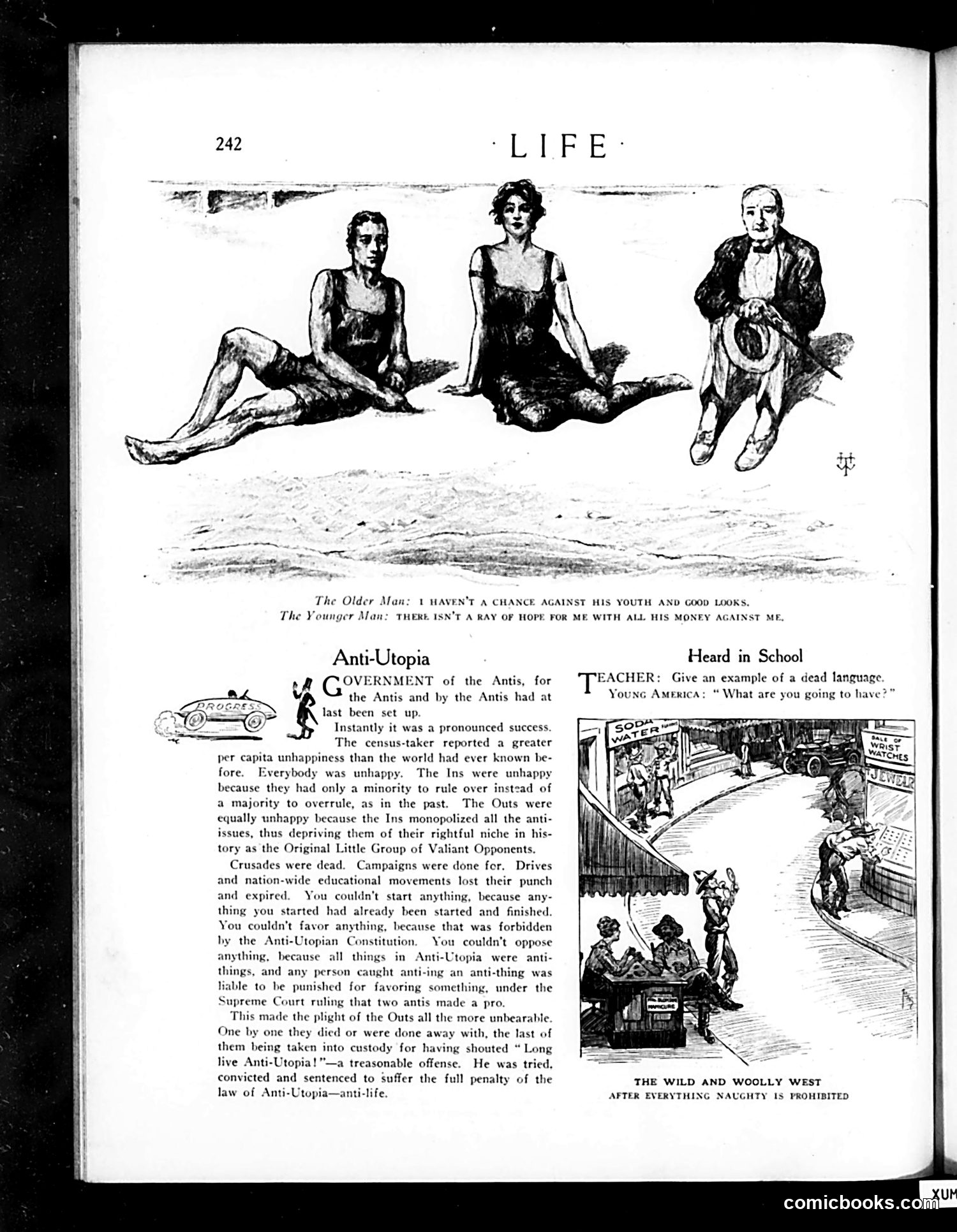
The top cartoon depicts a romantic triangle: two men competing for a woman's affection on a beach. Each man blames his rival's advantages—the older man cites youth and looks; the younger man cites money—a satirical comment on how people rationalize romantic failure by focusing on external factors rather than their own shortcomings. The "Anti-Utopia" story is a political satire mocking ideological extremism. It describes a government run entirely on "anti-" principles, where citizens become universally miserable because opposition and reform movements have been eliminated. The system becomes so absurd that "two antis make a pro," trapping people in logical contradiction. The final irony: the last dissenter is executed for praising the system itself—satire on how totalitarian regimes eliminate even their own supporters. The "Head in School" section shows a teacher asking for a "dead language" example, with a student responding about "the Wild and Woolly West," suggesting that once-vibrant American frontier culture has become obsolete—likely commentary on changing American society.
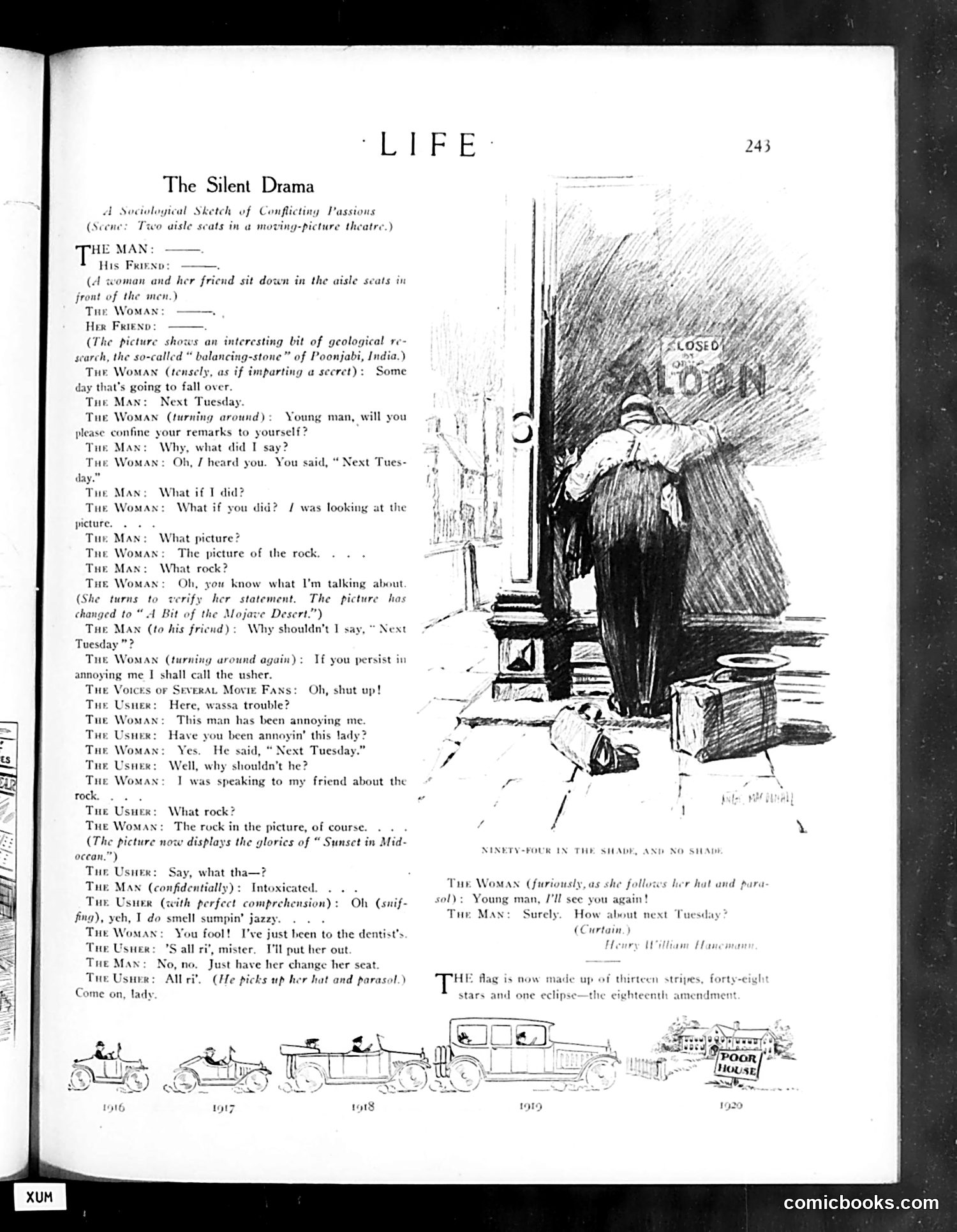
This satirical sketch mocks the chaos of movie theater etiquette during the silent film era. A man makes an offhand remark ("Next Tuesday") about a geological formation on screen, which a woman in front misinterprets as directed at her. What follows is escalating miscommunication: she thinks he's being rude, he's confused about what he said, the picture keeps changing (making her claims unverifiable), and she smells of alcohol/dentist's work—which the usher misattributes to intoxication. The joke hinges on how silent films created absurd social friction: viewers couldn't hear dialogue clearly, misunderstandings multiplied, and theater staff made snap judgments. The woman is ejected after the man's final quip, "How about next Tuesday?"—which finally *was* directed at her as mockery. The bottom timeline shows automobile evolution (1916-1920), possibly commenting on modern progress amid social chaos.
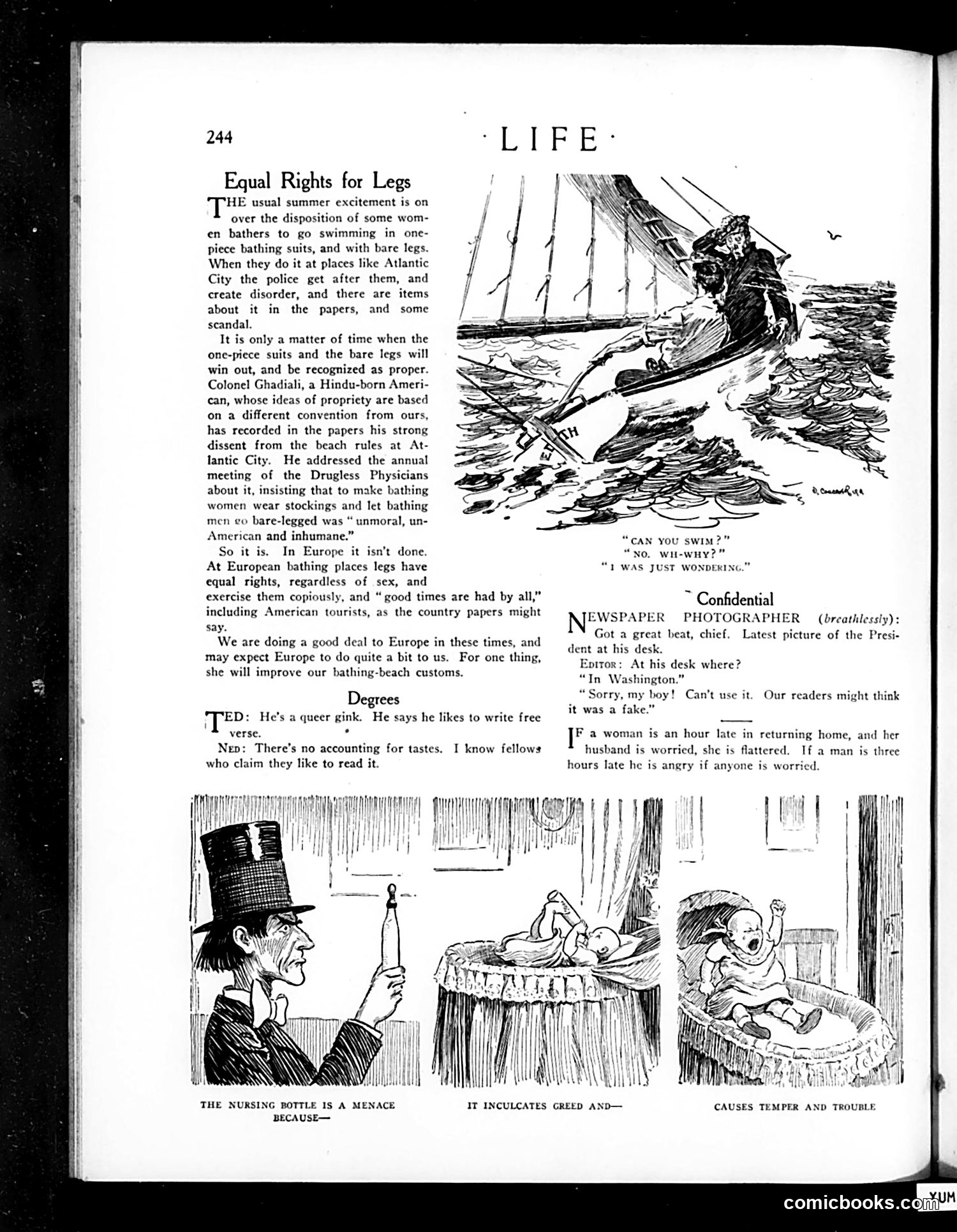
This page satirizes early 20th-century American prudishness about women's bathing attire. The main article mocks the scandal caused when women wore one-piece swimsuits with bare legs at Atlantic City beaches, where police intervened. The satire notes that Colonel Ghadiali (a real Hindu-born American) publicly denounced mandatory stockings for women bathers as "immoral" and "un-American," while men went bare-legged. The author argues this double standard is absurd and that Europe's more relaxed attitudes will eventually improve American customs. The bottom cartoons offer unrelated social commentary: one jokes about "free verse" poetry being as pointless as reading it; another mocks a photographer's fake "scoop" photo of the President at his desk; a third satirizes the nursing bottle as promoting greed in infants. The page reflects period anxieties about women's bodies, American morality, and changing social conventions.
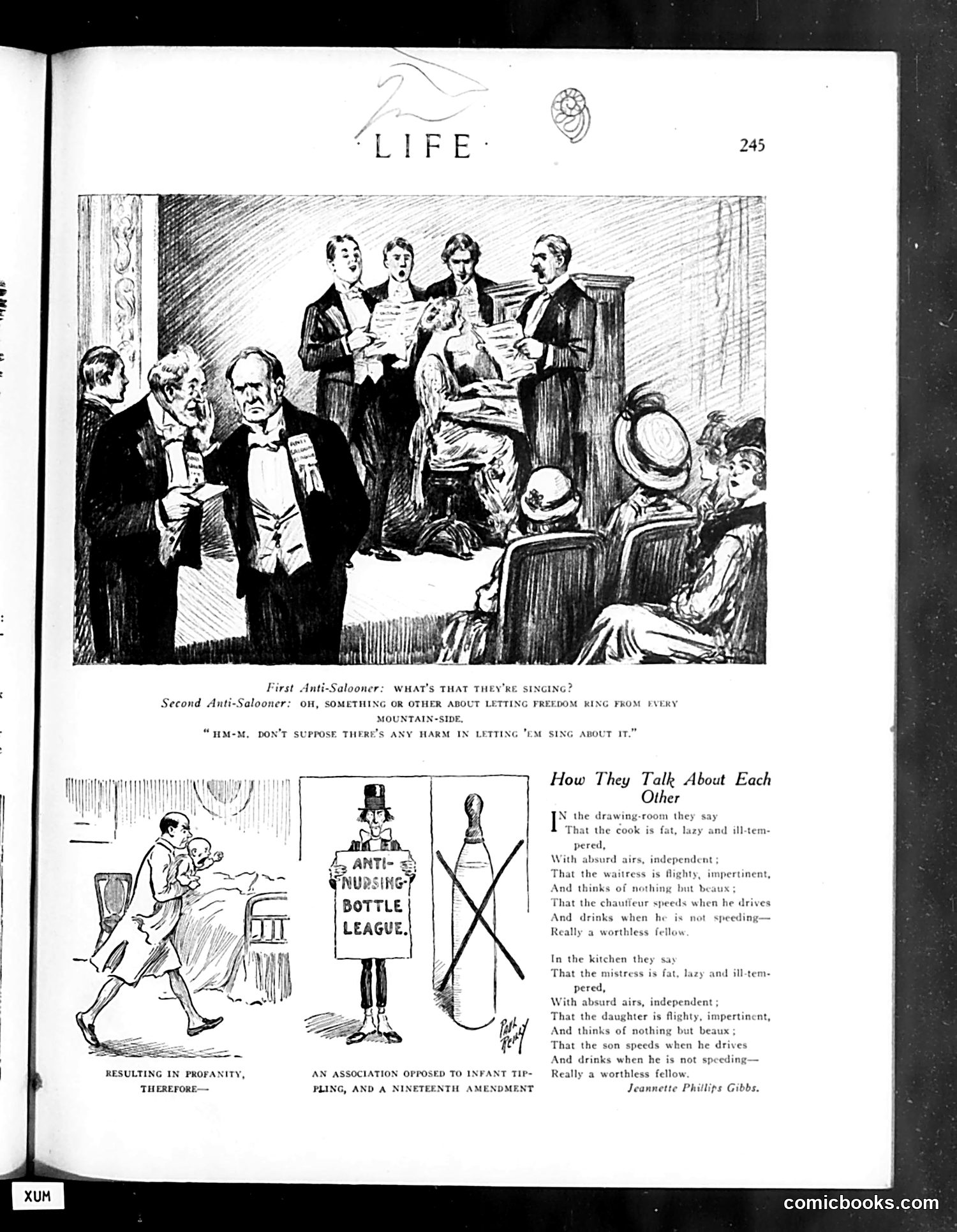
This page satirizes early-20th-century Prohibition and temperance advocacy. **Top cartoon**: Two "Anti-Saloon" activists debate whether singing "The Battle Hymn of the Republic" (referenced by "freedom ring from every mountain-side") promotes drinking. The joke: temperance zealots are so paranoid about alcohol that they see hidden pro-drinking messages in patriotic hymns. **Bottom section**: "How They Talk About Each Other" mocks class hypocrisy. The wealthy in drawing rooms gossip about servants' moral failings (laziness, drinking, inappropriate behavior). Meanwhile, kitchen staff level identical accusations at their employers. The satire exposes how each class judges the other by identical standards while ignoring their own identical flaws—suggesting moral criticism is really about class prejudice, not genuine ethics. The "Anti-Nursing Bottle League" image parodies organizations opposing infant bottle-feeding, linking various reform movements as absurdly restrictive.
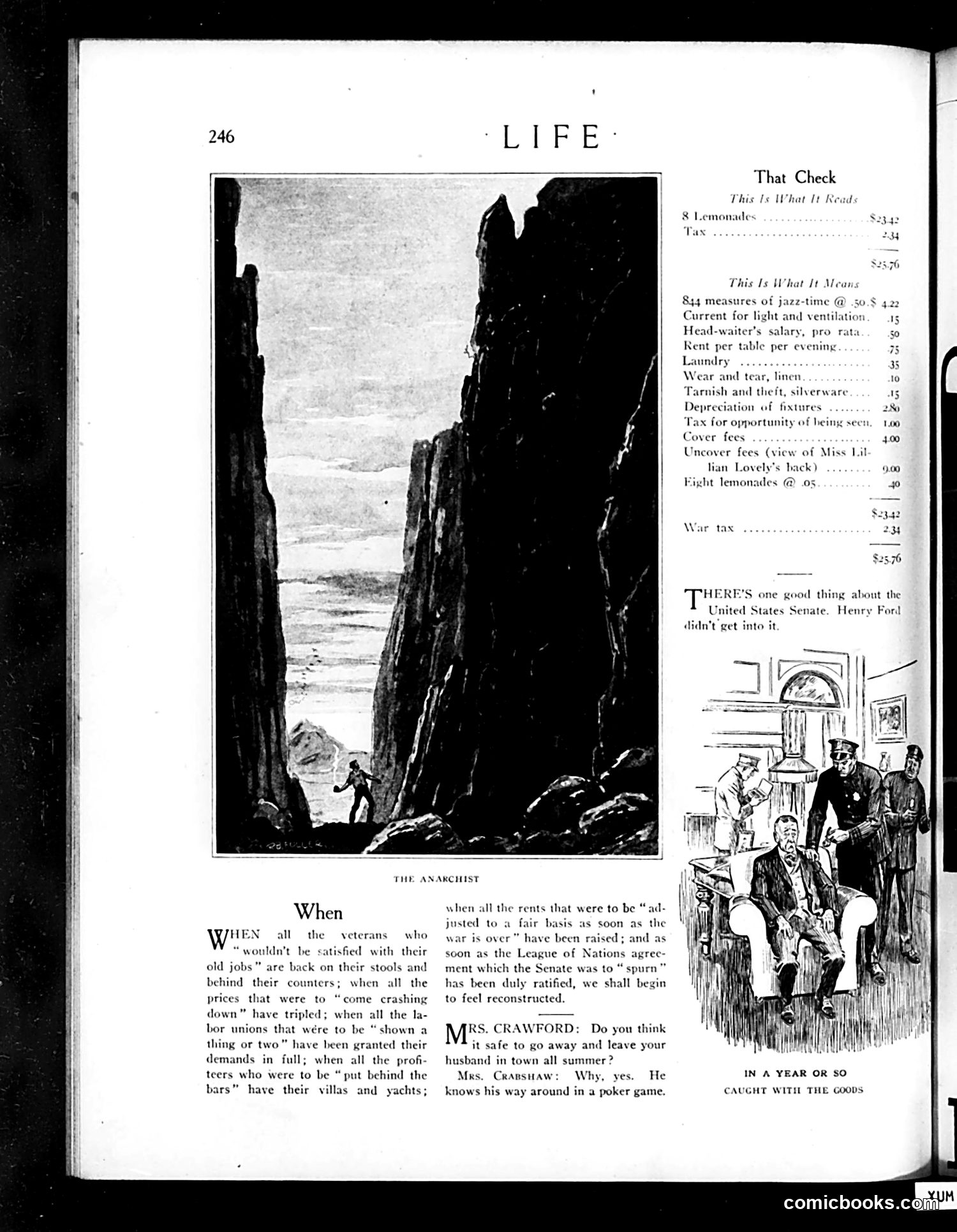
**"The Anarchist"** (large illustration): This darkly ironic piece satirizes post-WWI promises versus reality. The text lists all the optimistic expectations veterans and the public held after the war—prices would drop, profiteers would face justice, unions would win demands, rents would be fairly adjusted, and the Senate would reject the League of Nations. The implication is that *none of these happened*. Instead, prices tripled, profiteers got villas and yachts, and war-promised reforms failed to materialize. The figure labeled "The Anarchist" likely represents the disillusioned citizen—someone who sees the gap between promised reconstruction and actual post-war conditions. **"That Check"**: A restaurant bill satire showing how a simple order of lemonades and tax balloons into absurd line items (rent per table, laundry, depreciation, "tax for opportunity of being seen"). This mocks inflation and hidden costs in the post-war economy. **"In a Year or So"**: A light domestic joke about marital trust in poker games. The page's dominant tone is cynical about post-war economic and political betrayals.
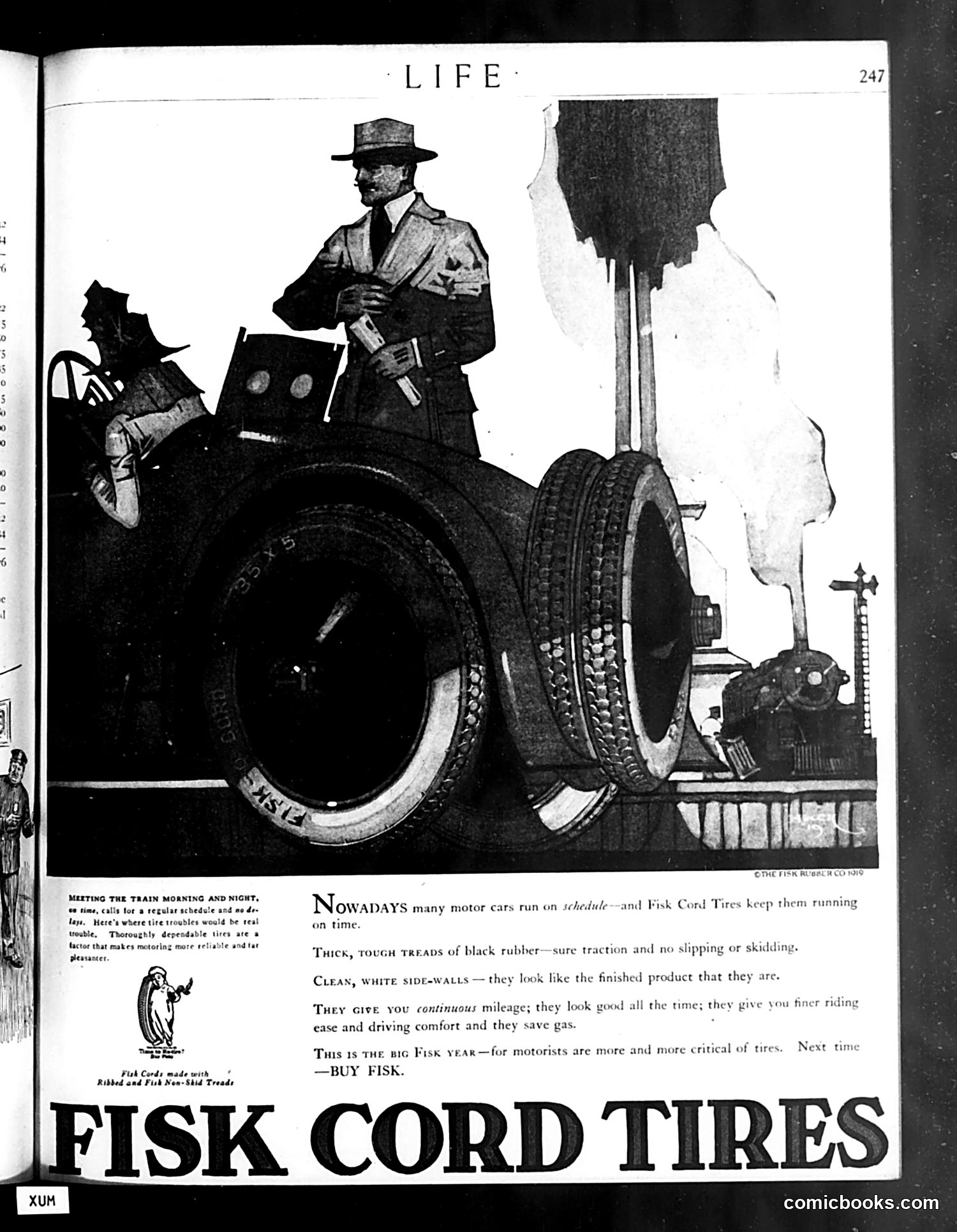
This is a **tire company advertisement**, not political satire. The page promotes Fisk Cord Tires to motorists, emphasizing reliability for meeting train schedules. The illustration depicts a businessman in a hat and coat standing beside an enormous tire, with a train visible in the background—visualizing the ad's central pitch: that dependable tires enable punctual automotive transportation, matching railroad schedules. The text highlights Fisk's product features: tough tread for traction, white sidewalls for appearance, long mileage, and fuel efficiency. The phrase "This is the big Fisk year" suggests increased consumer demand for quality tires, positioning Fisk as the premium choice for drivers who demand reliability. The small Fisk logo (a boy carrying a tire) appears at bottom left—the company's mascot. This represents early automotive-era advertising, when tire quality directly affected driving safety and schedule adherence.
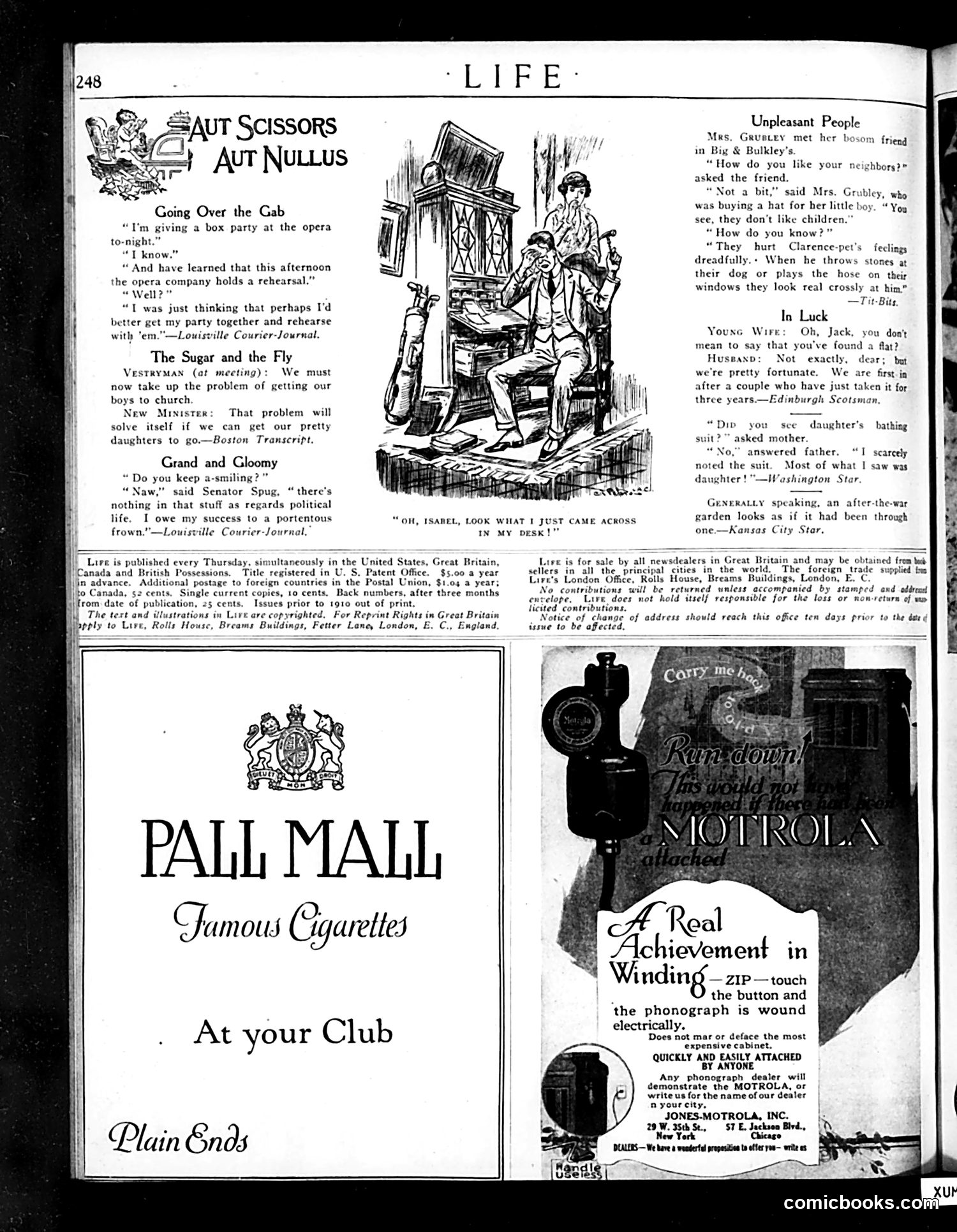
This page contains several short humorous anecdotes typical of Life magazine's satirical format, plus advertisements. The cartoons mock social pretension and hypocrisy: - **"Going Over the Gab"** satirizes someone's attempt to seem cultured by attending opera rehearsals to prepare for a box party—transparently self-improvement posturing. - **"The Sugar and the Fly"** jokes that a clergyman's problem recruiting boys to church will solve itself once pretty daughters are involved—commenting on shallow male motivation. - **"Grand and Gloomy"** has Senator Spug claim his scowling frown (rather than smiling) caused his political success—mocking both political pretension and the absurd logic of politicians' self-assessment. Other brief anecdotes mock unpleasant neighbors and post-war neglect. The page is primarily advertising (Pall Mall cigarettes, Victrola phonograph), which was standard for Life. The satire is light, domestic, and apolitical—typical of the magazine's middlebrow humor appealing to early 20th-century American readers.
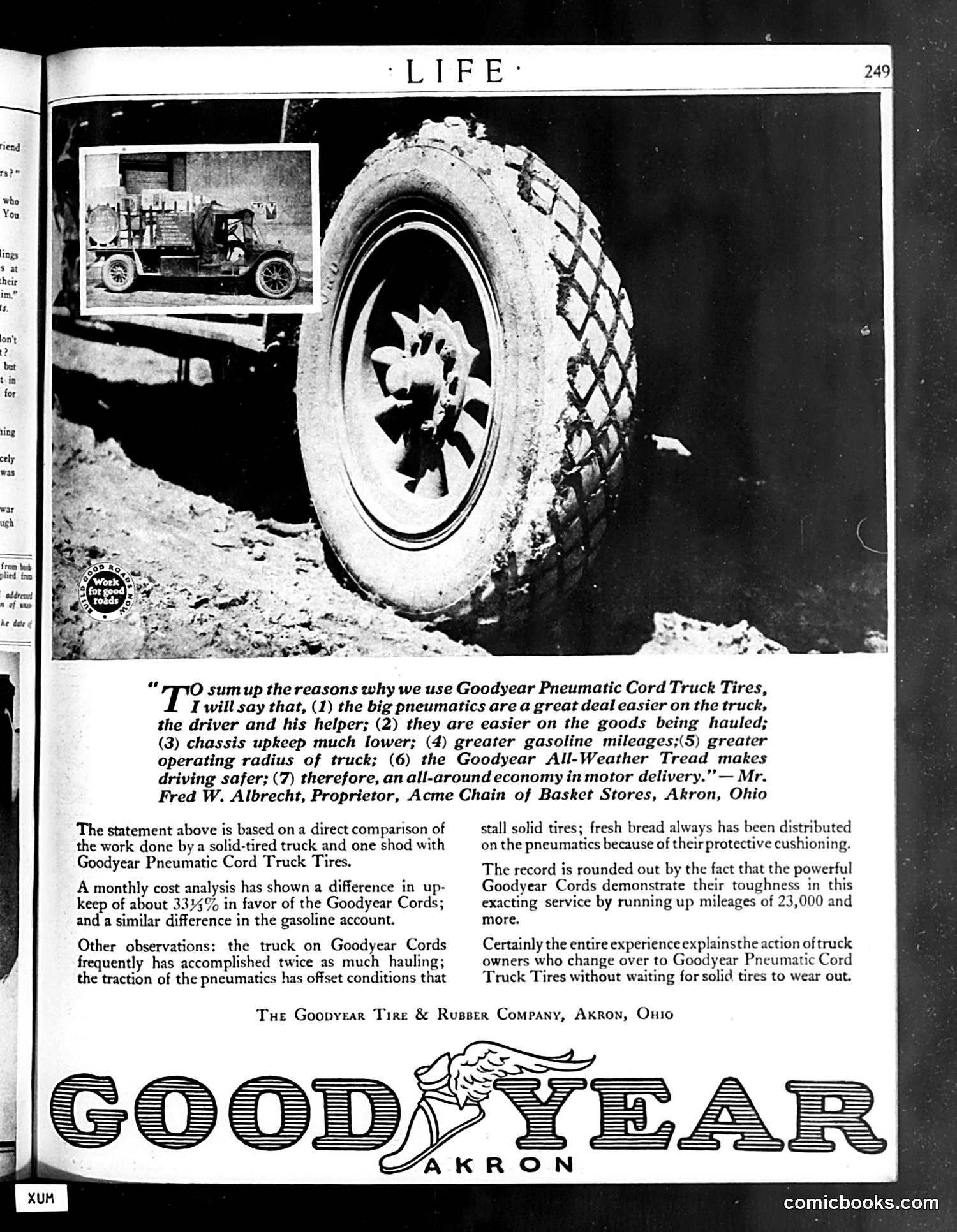
This is a **full-page advertisement**, not satire or cartoon. It promotes Goodyear pneumatic (air-filled) truck tires over solid tires, featuring a testimonial from Fred W. Albrecht, proprietor of Acme Chain of Basket Stores in Akron, Ohio. The ad highlights seven practical advantages: easier on vehicles and goods, lower maintenance, better fuel economy, greater hauling range, improved safety, and overall cost savings (33% reduction in upkeep). A small inset photo shows an early delivery truck; the large image displays a pneumatic tire on mud terrain, emphasizing durability and traction. The message targets truck fleet operators, claiming pneumatic tires enable twice the hauling capacity and eliminate waiting for solid tires to fail before replacement. This reflects early-20th-century industrial competition as pneumatic technology gradually replaced solid rubber tires in commercial transport.
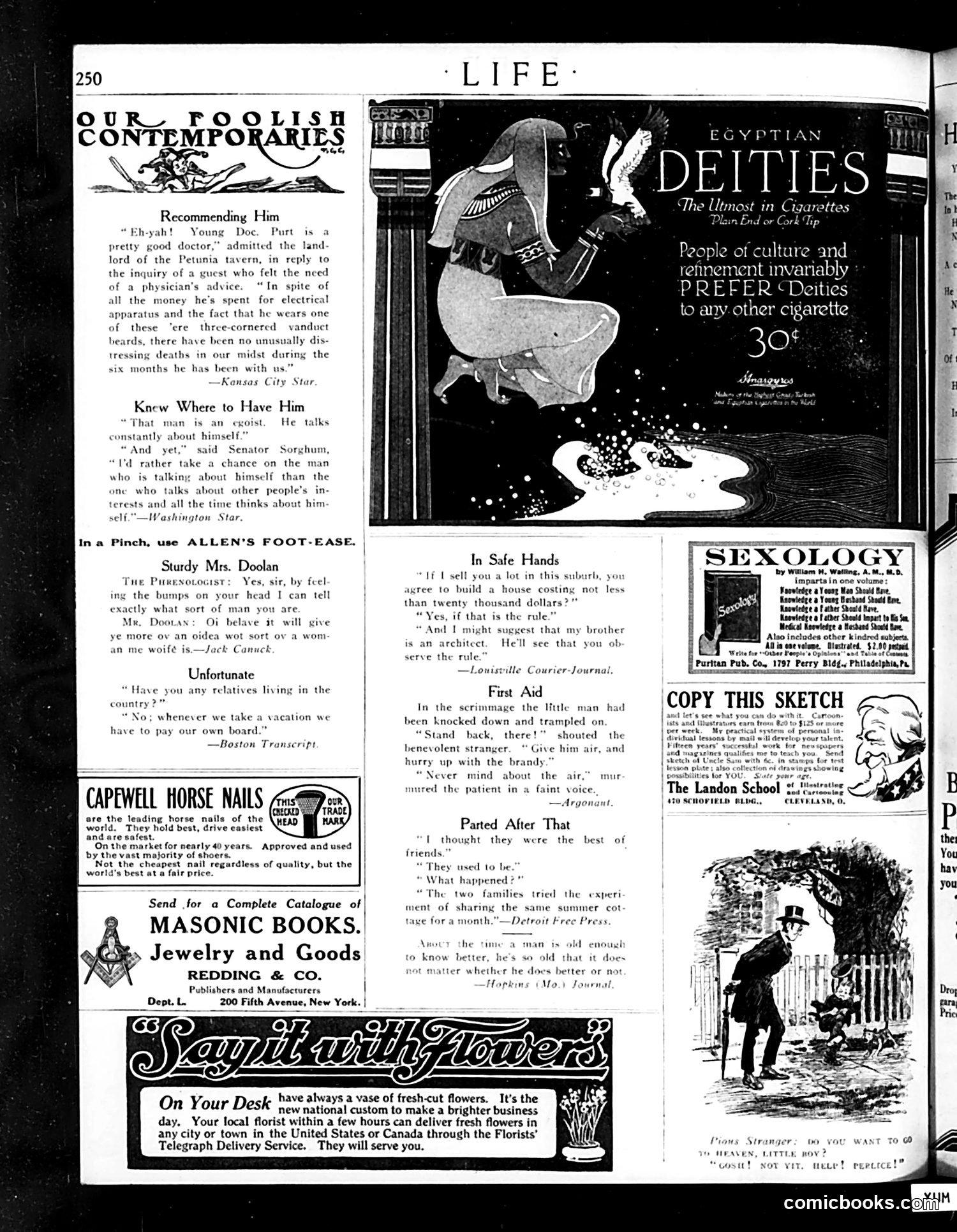
This page from *Life* magazine combines satirical commentary with period advertising. The main content consists of brief humorous anecdotes in the "Our Foolish Contemporaries" section—a recurring feature mocking human folly. The visible cartoons/jokes include: **"Recommending Him"** and **"Knew Where to Have Him"**: These mock vanity and self-absorption through dialogue about a doctor and a senator, suggesting that egotists are sometimes preferable to hypocrites who secretly think only of themselves. **"Sturdy Mrs. Doolan"**: A phrenology joke—the speaker claims to judge character by head bumps, a pseudoscience popular in the early 20th century that *Life* frequently ridiculed. **"Unfortunate," "First Aid," and "Parted After That"**: Brief vignettes satirizing class differences, misguided kindness, and social experimentation (families sharing summer cottages). The bottom cartoon shows a well-dressed man with a child, captioned about "heavens" and "help"—likely satirizing parenting or class anxieties. The page is heavily weighted toward **advertisements** (cigarettes, horse nails, masonic books, sexology guides, florists), typical of *Life*'s revenue model. The satire reflects early 20th-century preoccupations: phrenology, propriety, and social climbing.
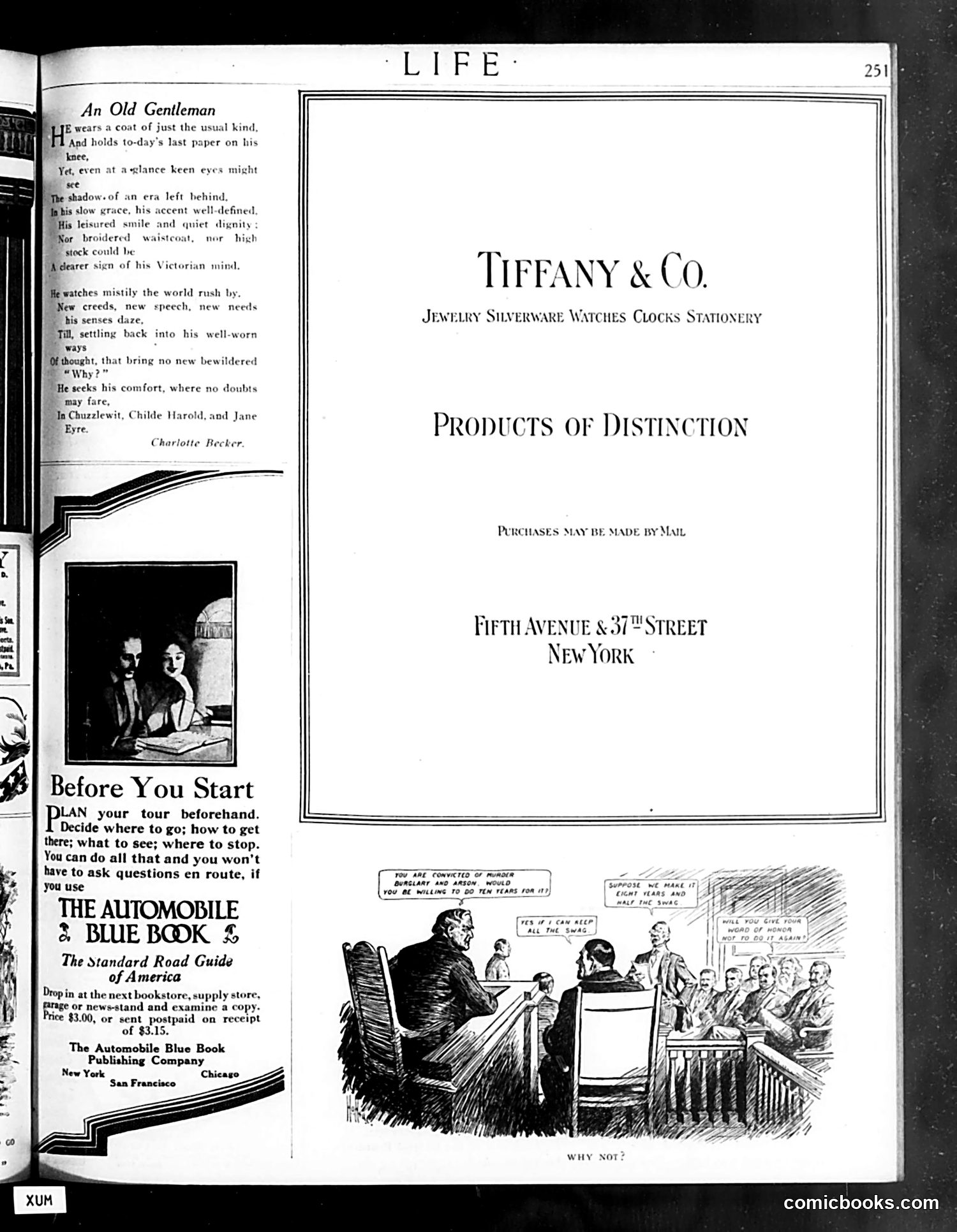
This page mixes editorial content with advertisements. The left side features "An Old Gentleman," a poem by Charlotte Becker depicting an aging Victorian-era man struggling with modernity. He wears outdated clothing, watches the world's new "creeds, speech, needs" with confusion, and retreats into comfort with classic literature (Dickens, Byron, the Brontës). The satire gently mocks elderly resistance to social change and rapid modernization—a common early-20th-century theme. The right side is primarily a **Tiffany & Co. advertisement** (luxury jewelry/silverware), with a cartoon below labeled "Why Not?" showing a courtroom scene. The cartoon's exact satirical point is unclear from the visible text, but appears to reference legal or social judgment. The page also advertises *The Automobile Blue Book*, a travel guide reflecting the era's fascination with automobiles as transformative technology—ironically juxtaposed against the poem about someone clinging to the past.
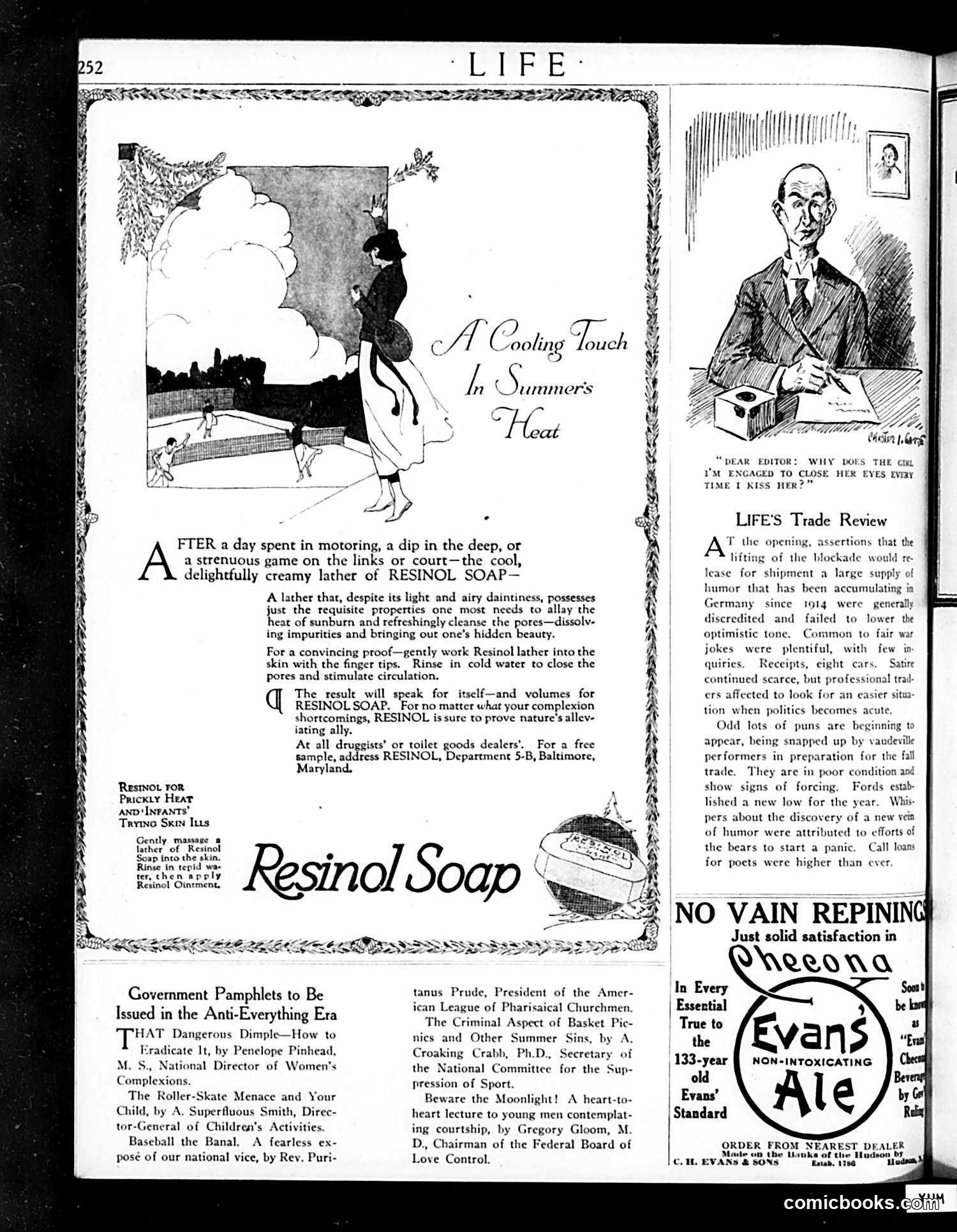
This page satirizes America's "Anti-Everything Era"—likely the 1920s temperance and moral-reform movement. The left features a Resinol Soap advertisement with an illustrated woman enjoying summer leisure. The bottom section mocks overzealous reformers issuing government pamphlets with absurdly puritanical titles by fictional figures (Rev. Purtanus Prude, Gregory Gloom) warning against dancing, roller-skating, baseball, picnics, and courtship itself. "Life's Trade Review" (right) uses mock-economic language to satirize America's humor shortage, blaming Germany's wartime blockade for cutting off comedic imports. It treats jokes as commodities ("Receipts, eight cars") and suggests professional comedians struggle when politics dominates. The small cartoon shows a man asking why his fiancée closes her eyes while kissing—a gentle jab at romantic prudishness. Overall, the page ridicules excessive moral crusading and its dampening effect on American culture and happiness.
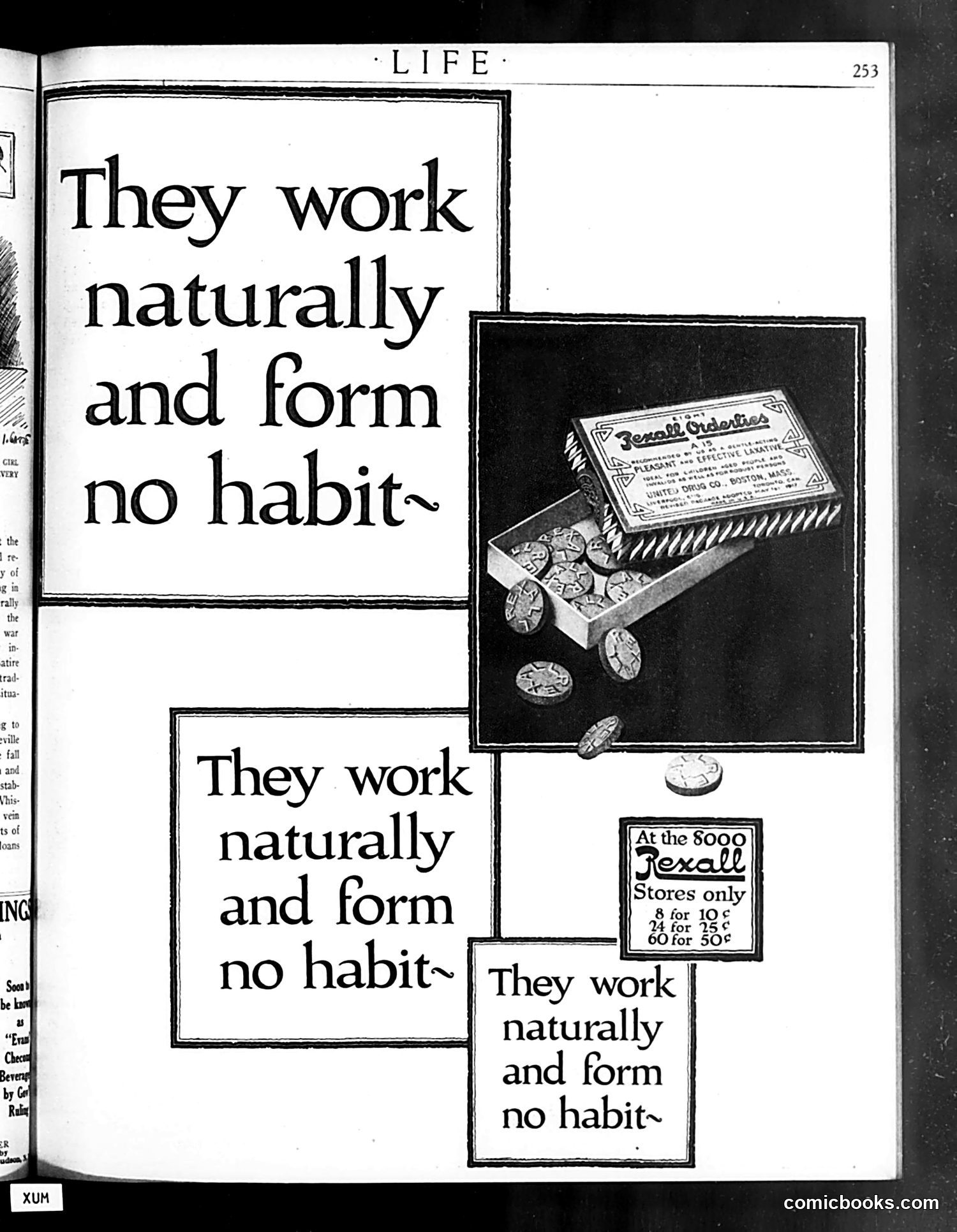
This is a **Rexall drugstore advertisement** from *Life* magazine (page 253). The repeated slogan "They work naturally and form no habit~" emphasizes that Rexall products—likely laxatives or digestive aids—are non-addictive, addressing a contemporary health concern. The central image shows an open box of Rexall candies with pills spilling out. A pricing box indicates availability at "5000 Rexall Stores" at various prices (8 for 10¢, 24 for 25¢, 60 for 50¢). The advertisement's repetition of the habit-forming disclaimer reflects early 20th-century anxieties about medicinal products containing habit-forming substances like opiates. The "natural" and "non-habit-forming" claims were marketing reassurances to wary consumers concerned about dependency.
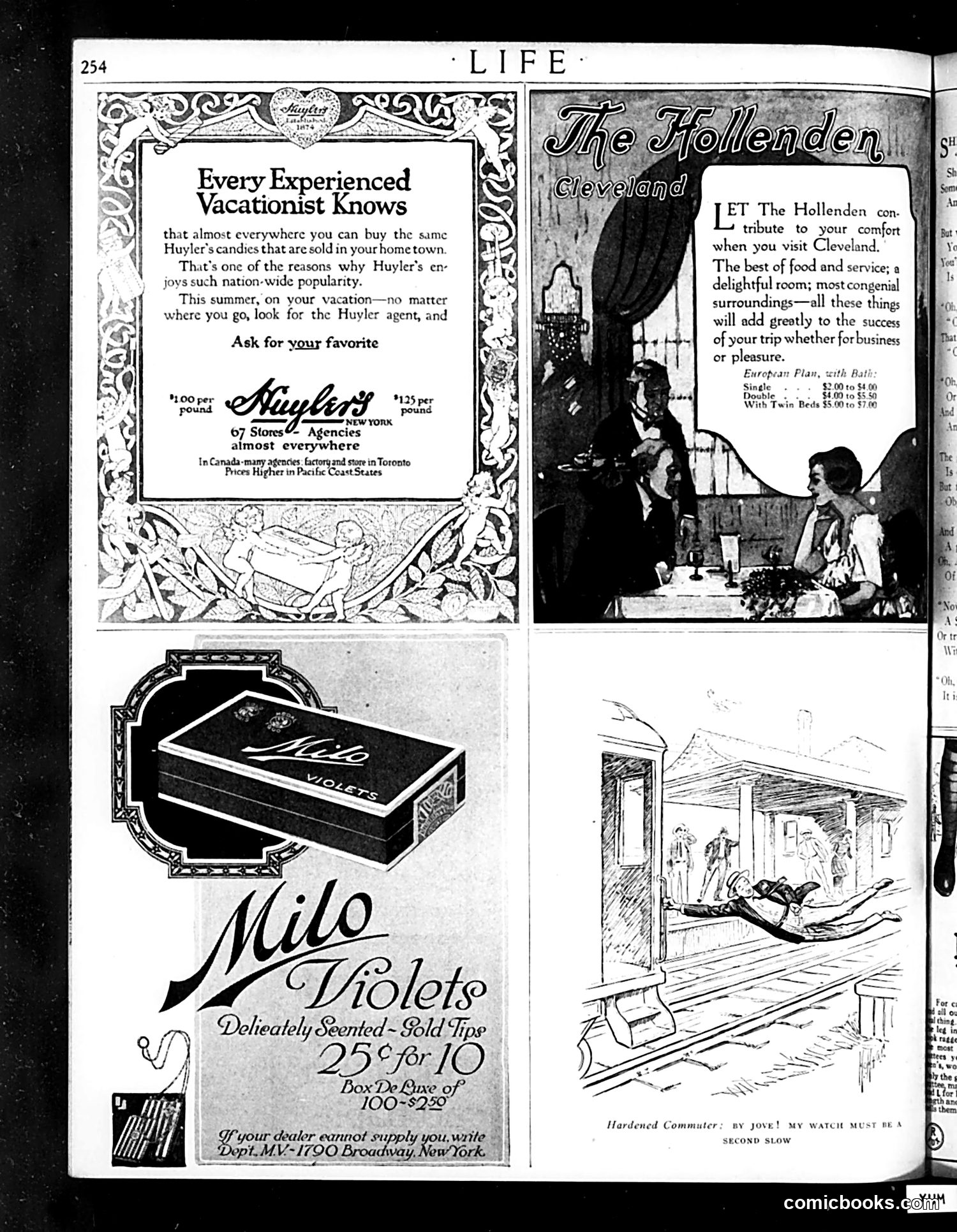
This page is primarily **advertising**, not editorial satire. It contains three commercial ads: 1. **Huyler's Candies** (top left): Appeals to vacationers by noting candy consistency across locations—a selling point for brand reliability during travel. 2. **The Hollenden Hotel** (top right): A Cleveland establishment advertising comfort, food, service, and reasonable rates for business or leisure travelers. 3. **Milo Violets** (bottom left): Scented candies priced at 25¢ for ten. The only cartoon element is the small sketch labeled **"Hardened Commuter"** (bottom right), showing someone reclining, with a caption suggesting their watch runs slow—a mild visual joke about commuter fatigue or the desire to slow time during tedious travel. This reflects 1920s travel culture when vacation planning and hotel comfort were novel luxuries marketed through lifestyle magazines.
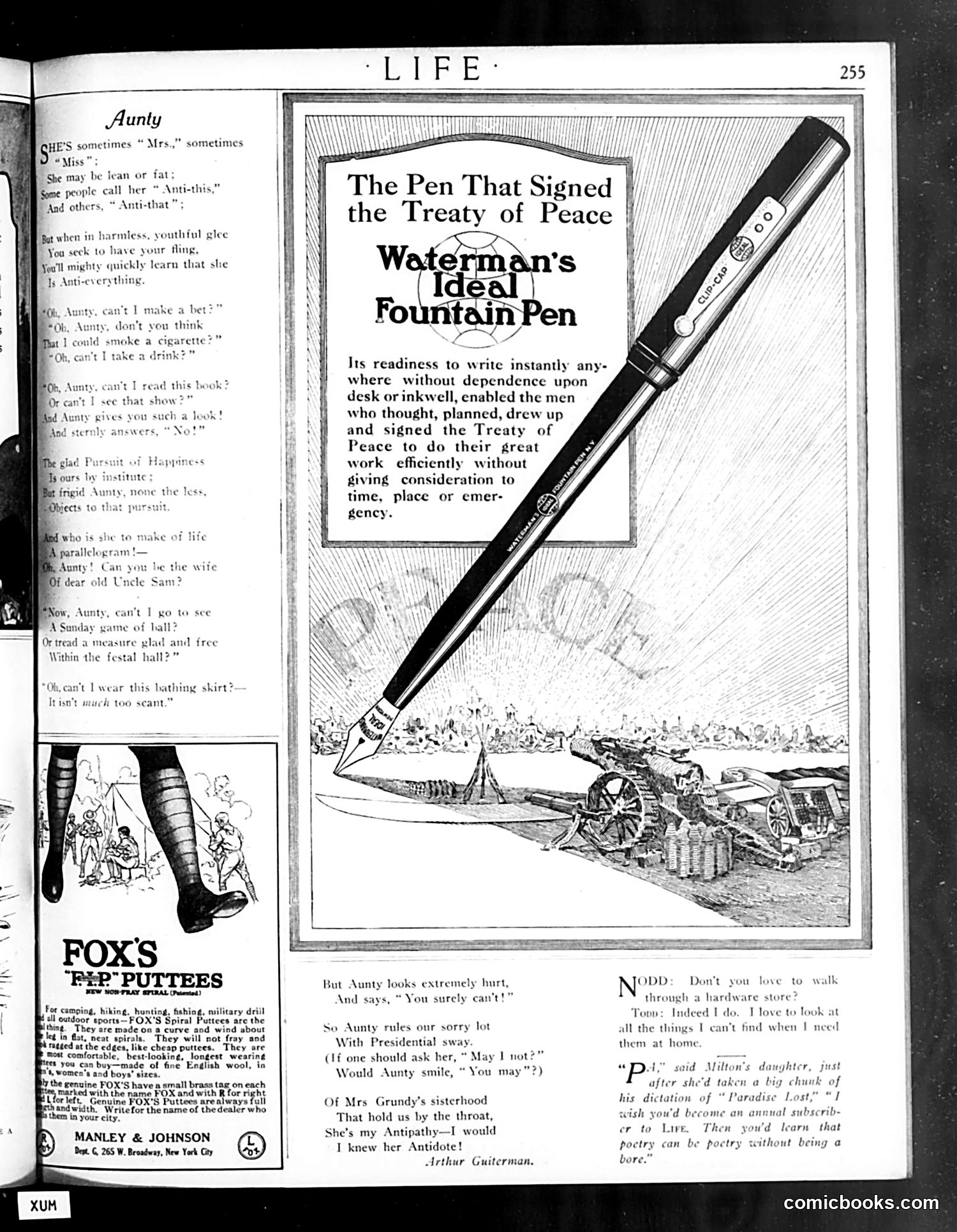
This page combines poetry satire with period advertising. The left column features "Aunty," a humorous poem by Arthur Guiterman personifying social prudishness as a killjoy female authority figure who opposes all youthful pleasures—smoking, drinking, reading, sports, bathing suits. "Aunty" represents the restrictive social conventions (likely Victorian-era moralism) that govern behavior. The main advertisement showcases a Waterman's Ideal Fountain Pen, claiming it enabled officials to sign the Treaty of Peace (likely WWI's Treaty of Versailles, 1919) without logistical delays. This is tongue-in-cheek corporate puffery—crediting a pen for diplomatic efficiency. Below are advertisements for Fox's Puttees (spiral leg wrappings for military/outdoor use) and a joke about hardware stores. The humor relies on period-specific products and social attitudes modern readers wouldn't immediately recognize.
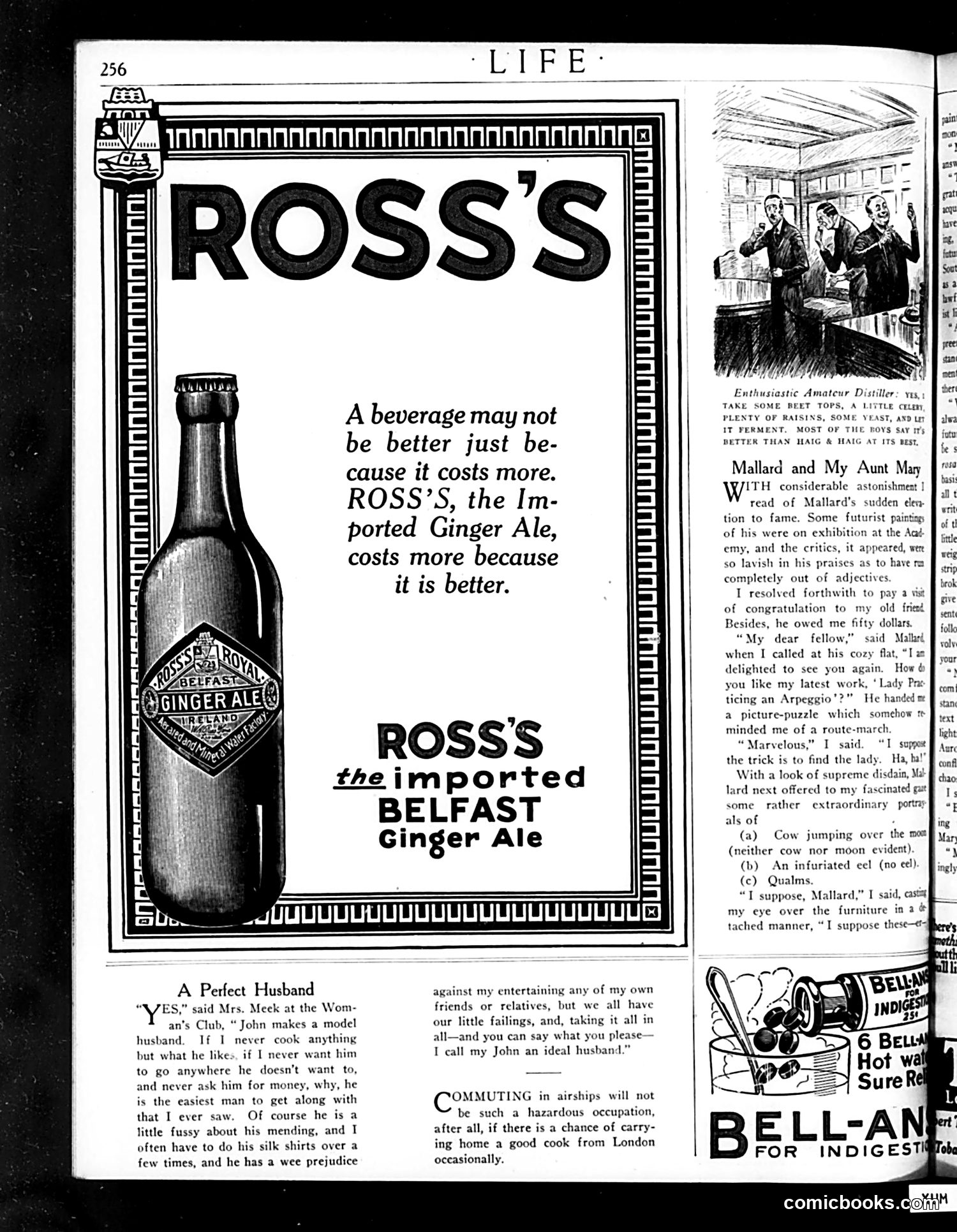
This page contains **advertisements and satirical fiction** rather than political cartoons. The main ad promotes **Ross's Imported Ginger Ale from Belfast**, arguing that higher cost reflects superior quality—a straightforward commercial pitch. The text pieces are humorous social commentary typical of Life's satirical style: 1. **"Mallard and My Aunt May"**: A story mocking modern art pretension, where a painter's abstract work is so obscure the narrator can't identify what it depicts (a lady, an eel, or merely "qualms"). 2. **"A Perfect Husband"**: A satirical portrait of marital submission, where a wife celebrates her husband's "ideal" nature by describing how she accommodates his every whim—the joke being that she's actually describing a controlling, domineering partner while calling it perfection. 3. **"Commuting in airships"**: A brief quip suggesting that if airship travel allowed bringing home London cooks, the danger would be worthwhile—poking fun at both aviation risks and domestic cooking standards. The humor relies on irony and observational satire about 1920s social conventions.
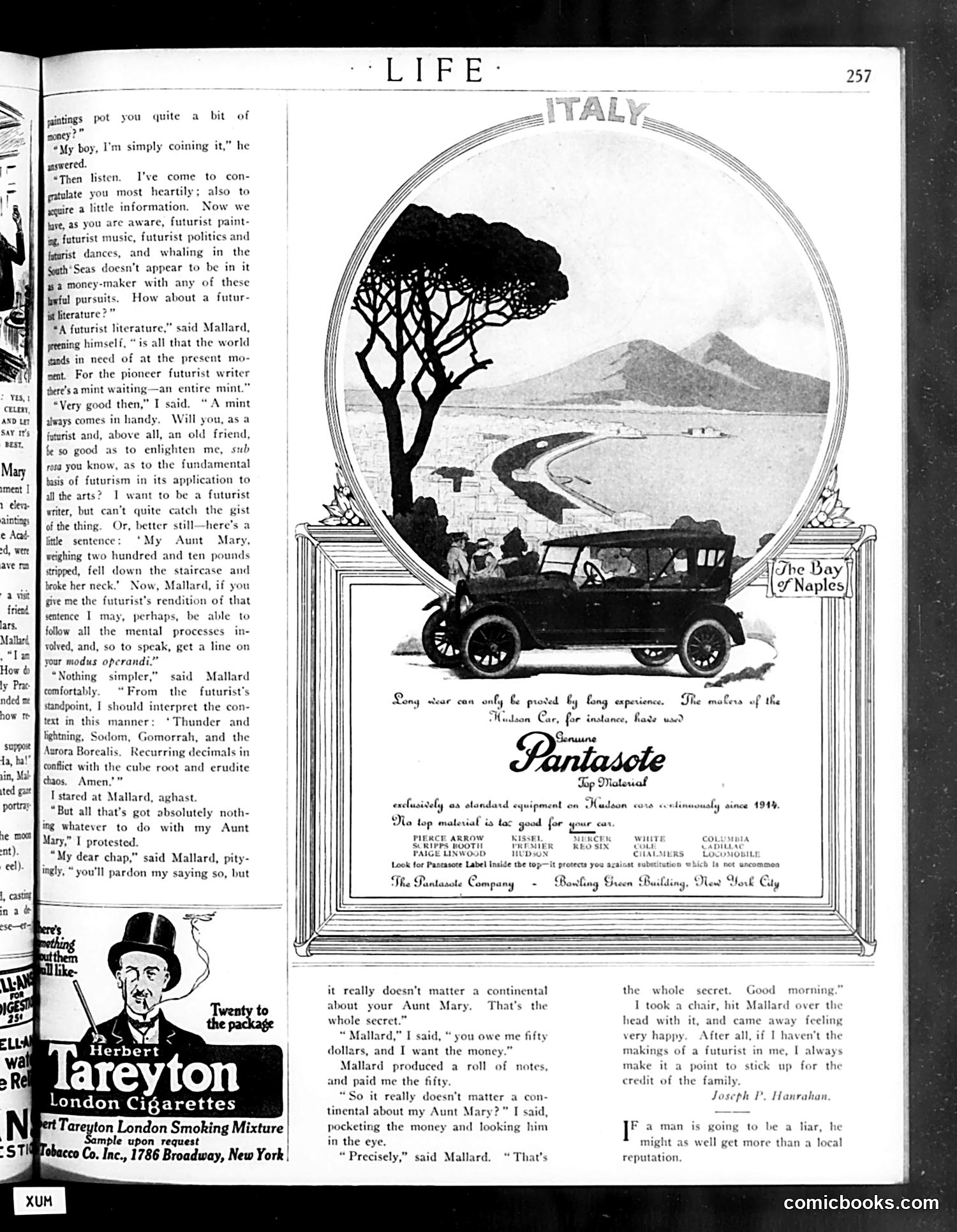
This page satirizes the Futurist art movement through a dialogue between the narrator and a character named Mallard, a self-proclaimed "futurist writer" profiting from the trend. The joke: When asked to demonstrate futurism by rewriting a mundane sentence about his Aunt Mary falling downstairs, Mallard produces complete nonsense—"Thunder and lightning, Sodom, Gomorrah...erudite chaos"—that has nothing to do with the original content. The narrator protests this meaninglessness, but Mallard insists the specifics don't matter. **The satire's point:** Futurism is portrayed as pretentious gibberish masquerading as profound art. Mallard embodies the charlatan artist exploiting public fascination with avant-garde movements by producing unintelligible work while claiming deep artistic principle. The narrator's final resort to violence humorously expresses frustration with this intellectual fraud. The accompanying Pantasote automobile advertisement is unrelated editorial content.
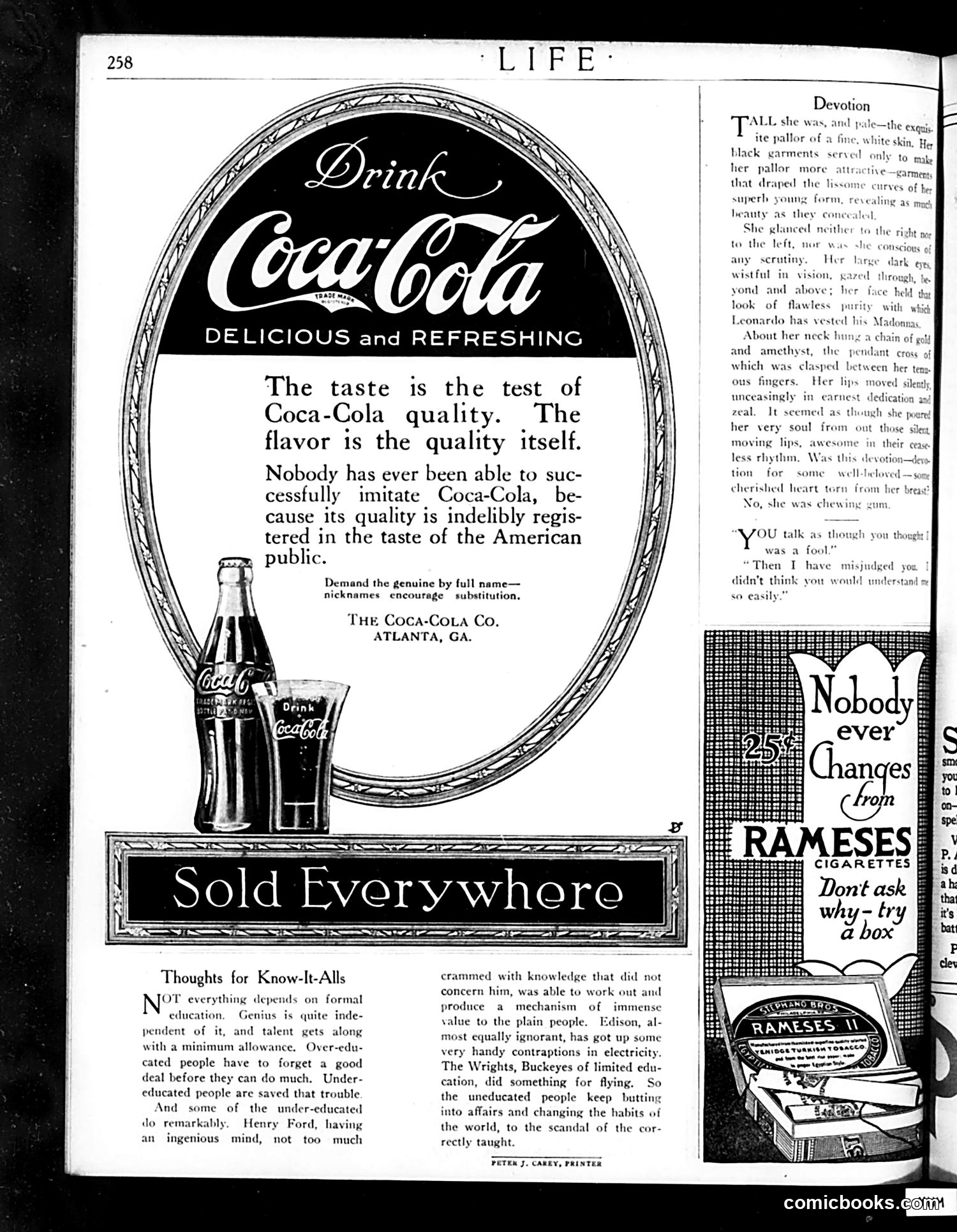
This page contains **primarily advertisements and fiction**, not political satire. The dominant Coca-Cola ad claims the product's taste is inimitable and urges consumers to "demand the genuine by full name" to avoid substitutes—reflecting early 20th-century concerns about patent infringement and counterfeit products. The "Thoughts for Know-It-Alls" column praises practical genius over formal education, citing Henry Ford and Thomas Edison as self-made innovators who succeeded despite limited schooling. This reflects Progressive Era debates about American meritocracy versus traditional credentials. The right column appears to be a serialized romance story titled "Devotion," describing a young woman's appearance and devotion—likely sentimental fiction typical of Life's content mix. The Rameses cigarette ad on the lower right is a simple product promotion. **Overall, this is a mixed-content magazine page blending advertising, light social commentary, and serialized fiction rather than political cartoons or satire.**
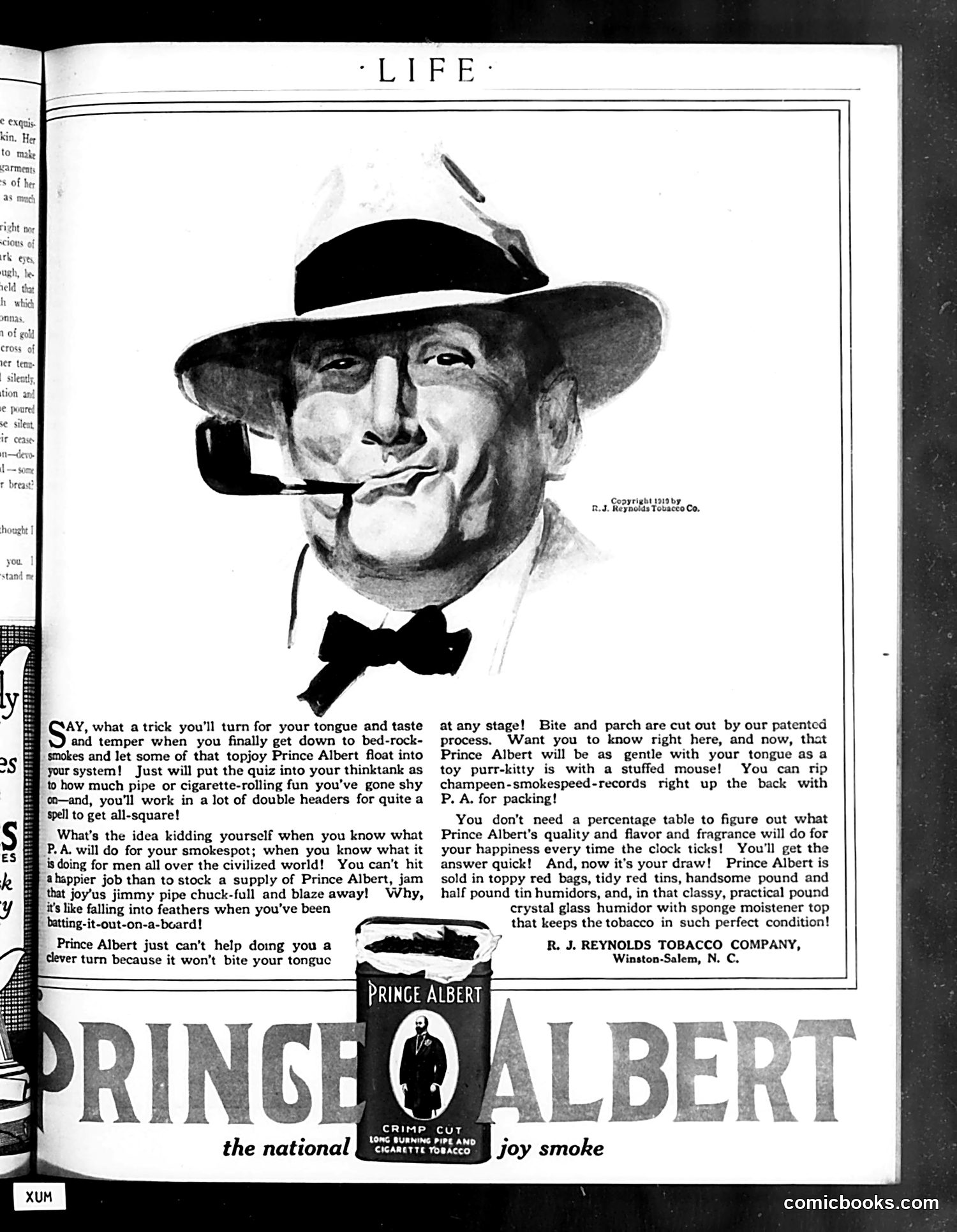
This is a **tobacco advertisement**, not political satire. The page features a caricatured man in a cowboy hat smoking a pipe, promoting Prince Albert tobacco. The illustration uses exaggerated facial features typical of early 20th-century advertising—a prominent nose, sharp features, and a somewhat crude caricature style. The figure appears to be styled as a rugged, masculine "everyman" type designed to appeal to smokers. The ad copy employs colorful slang ("topjoy," "champeen-smokespeed-records") to emphasize the product's quality and pleasure. Key selling points include that the tobacco won't bite the tongue, comes in convenient packaging, and burns slowly for extended smoking. This represents pre-regulation tobacco marketing when health warnings didn't exist and smoking was openly promoted in mainstream publications as a positive lifestyle choice. The cowboy imagery suggests masculinity and frontier independence—common advertising appeals of the era.
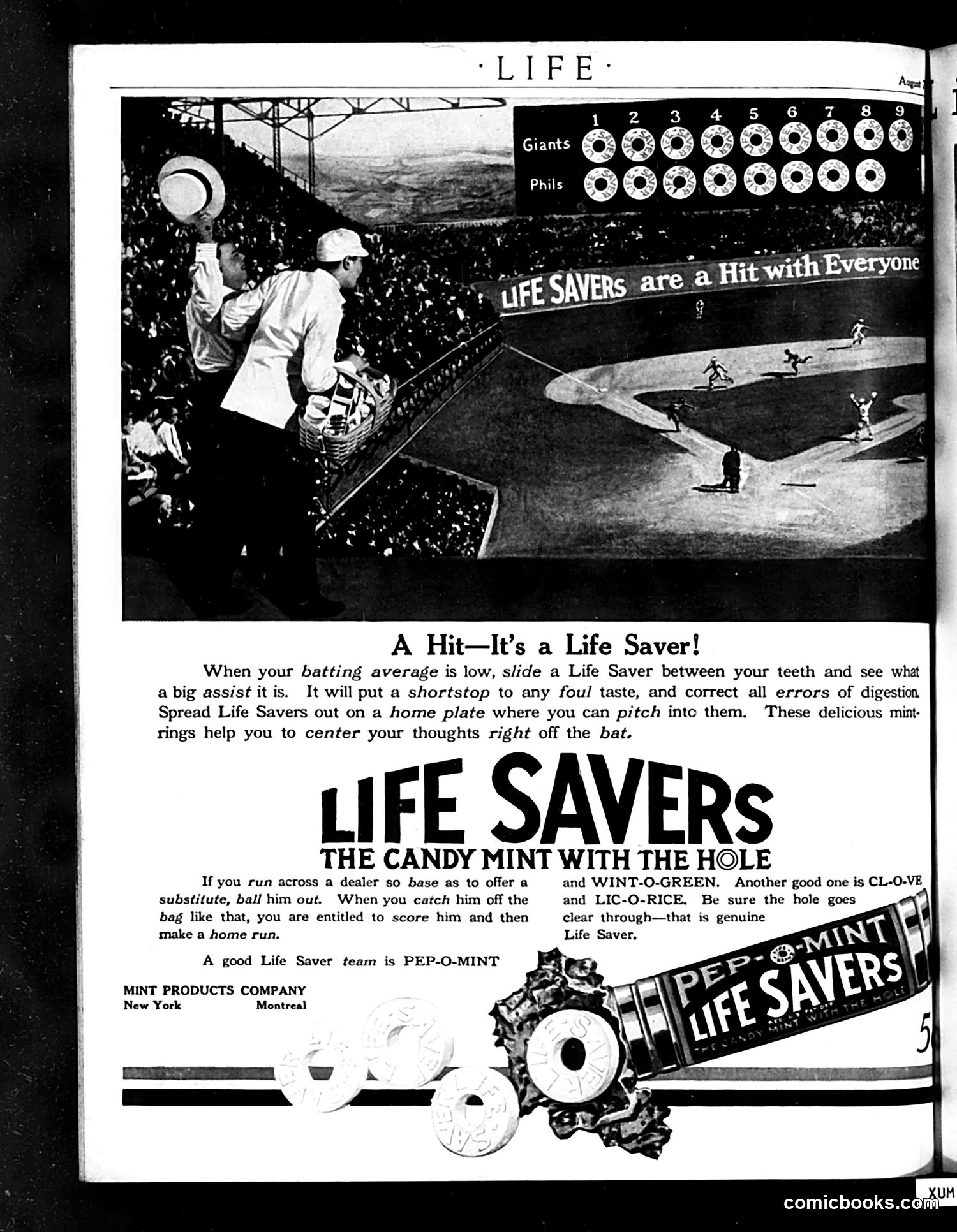
This is a **candy advertisement**, not political satire. The page uses baseball terminology as wordplay to promote Life Savers mints—the candy with a hole in the center. The ad extends a baseball metaphor throughout: "batting average," "shortstop," "home plate," "pitcher," "dealer," "base," "catch him off the bag," and "home run" are all repurposed to describe eating the candy and its digestive benefits. The top image shows a baseball game in progress, establishing the sports context. The scoreboard displays Giants vs. Phils (Philadelphia Phillies). The humor relies on puns: Life Savers will "put a shortstop to any foul taste" and help you "center your thoughts right off the bat." Specific flavors are mentioned: Pep-O-Mint, Wint-O-Green, Cl-O-Ve, and Lic-O-Rice—each name playing on the flavor while maintaining the baseball theme. This reflects early-twentieth-century advertising's playful approach to marketing consumer products through extended metaphors and wordplay.