
Life, 1919-08-07 · page 21 of 44
Life — August 7, 1919 — page 21: what you’re looking at
What you’re looking at
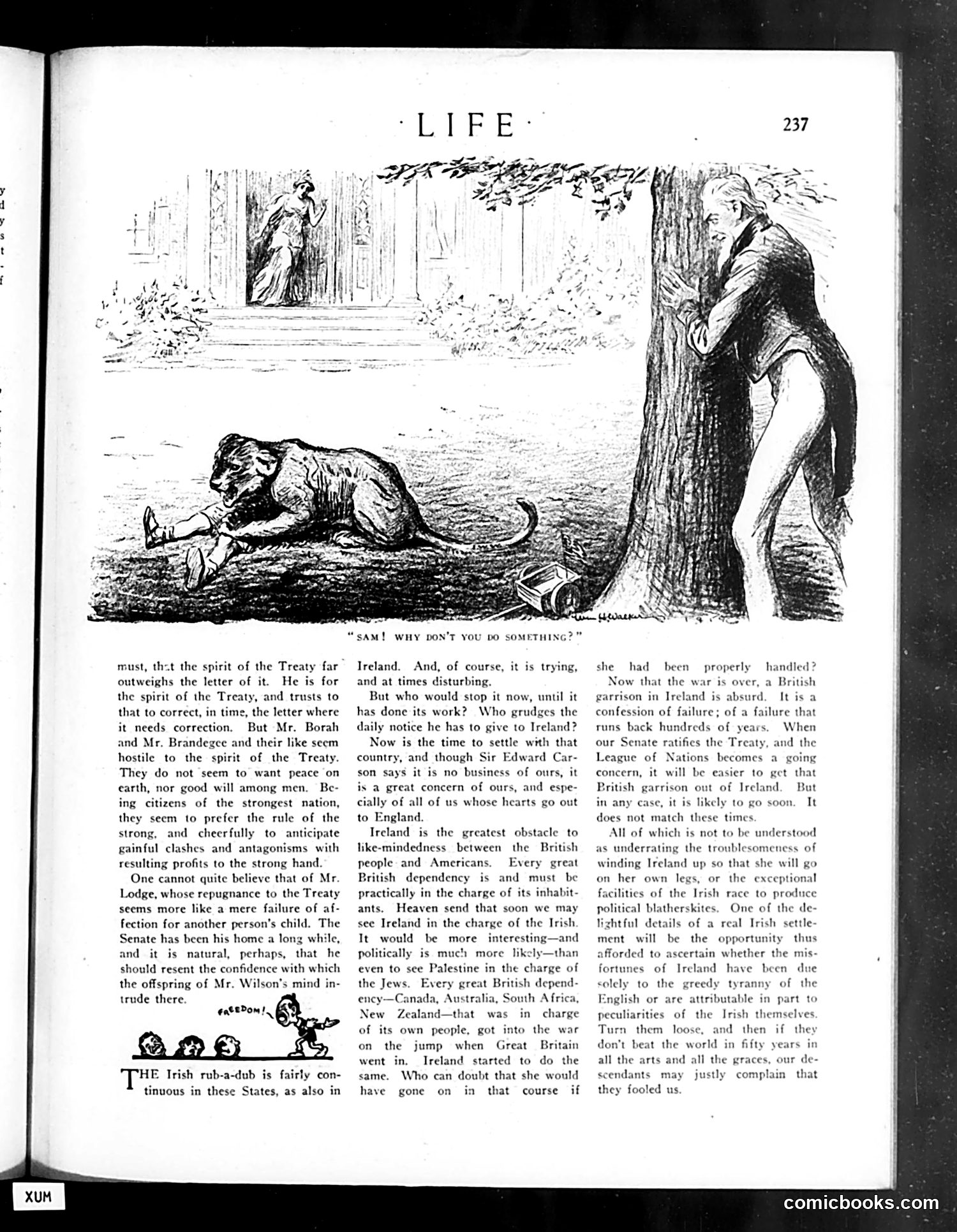
This Life magazine page critiques American senators opposing the League of Nations Treaty (likely post-WWI). The cartoon depicts Ireland as a struggling figure while a man leans against a tree—representing American inaction on Irish independence. The text attacks senators Borah and Brandegee (and implicitly Lodge) who opposed Wilson's Treaty, characterizing them as preferring conflict to peace. The author argues Ireland is the main obstacle to British-American unity, and that granting Irish self-governance (like other British dominions) would be wiser than maintaining a garrison. The cartoon's message: America ("Sam") should use League ratification to pressure Britain into solving the "Irish problem" rather than standing idle. The joke is bitter—it mocks both American passivity and suggests Irish self-rule might finally test whether Irish political failings stem from English oppression or Irish character itself.
📄 Transcribed text from this page (OCR, searchable)
Machine-transcribed from the original scan — historical spelling and the odd misread are preserved.
must, that the spirit of the Treaty far outweighs the letter of it. He is for the spirit of the Treaty, and trusts to that to correct, in time, the letter where it needs correction. But Mr. Borah and Mr. Brandegce and their like seem hostile to the spirit of the Treaty. They do not seem to want peace on earth, nor good will among men. Be- ing citizens of the strongest nation, they seem to prefer the rule of the strong, and cheerfully to anticipate gainful clashes and antagonisms with resulting profits to the strong hand. One cannot quite believe that of Mr. Lodge, whose repugnance to the Treaty seems more like a mere failure of af- fection for another person's child. The Senate has been his home a long while, and it is natural, perhaps, that he should resent the confidence with which the offspring of Mr. Wilson's mind in- trude there. Dom! @at tom! HE Irish rub-a-dub is fairly con- tinuous in these States, as also in “sam! WHY DON'T YOU DO SOMETHING?” Ireland. And, of course, it is trying, and at times disturbing. But who would stop it now, until it has done its work? Who grudges the daily notice he has to give to Ireland? Now is the time to settle with that country, and though Sir Edward Car- son says it is no business of ours, it is a great concern of ours, and espe- cially of all of us whose hearts go out to England. Ireland is the greatest obstacle to like-mindedness between the British people and Americans. Every great British dependency is and must be practically in the charge of its inhabit- ants. Heaven send that soon we may see Ireland in the charge of the Irish It would be more interesting—and politically is much more likely—than even to see Palestine in the charge of the Jews. Every great British depend- ency—Canada, Australi Africa, New Zealand—that charge of its own people, got into the war the jump when Great Britain in. Ireland started to do the Who can doubt that she would gone on in that course if South was in on went same. have ee = she had been properly handle Now that the war is over, a British It is a confession of failure; of a failure that runs back hundreds of years. When our Senate ratifies the Treaty, and the League of Nations becomes garrison in Ireland is absurd a going concern, it will be easier to get that Pritish garrison out of Ireland. But in any case, it is likely to go soon. It does not match these times. All of which is not to be understood as underrating the tr winding Ireland up so that she will go on her own facilities of the Irish race to produce political blatherskites. One of the de- lightful details of a real Irish settle- will be the opportunity afforded to ascertain whether the mis- Ireland greedy lesomeness of legs, or the exceptional thus ment due the fortunes of have been solely to the tyranny of English or are attributable in part to peculiarities of the Irish themselves Turn they don’t beat the world in fifty years in them loose, and then if all the arts and all the graces, our de- scendants justly that they fooled us. may complain comicbooks.com