
Life, 1919-08-07 · page 20 of 44
Life — August 7, 1919 — page 20: what you’re looking at
What you’re looking at
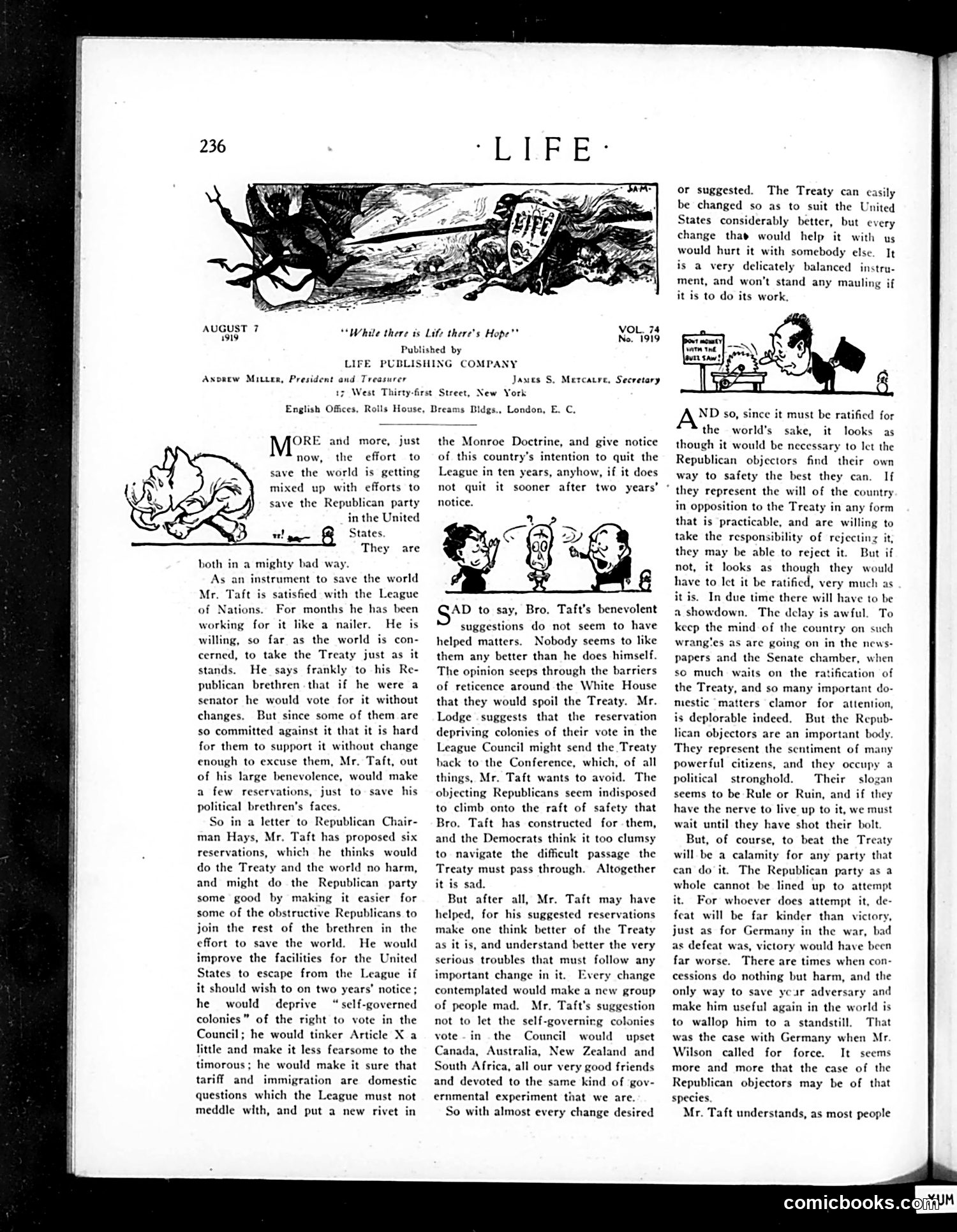
This page satirizes former President William Howard Taft's attempt to broker a compromise on the League of Nations Treaty. The article criticizes Taft's proposal of six reservations designed to win over Republican senators opposing the treaty—a politically motivated compromise dressed up as benevolence. The satire's point: Taft claims to support the treaty while offering changes "to save his political brethren's faces," but every modification he suggests would actually damage the treaty's delicate balance or offend America's allies (Canada, Australia, New Zealand, South Africa). The author argues that Taft's real motive is saving the Republican Party, not the world, and his "help" actually proves how fragile the treaty is. The cartoons likely mock Taft's self-serving generosity masquerading as statesmanship during this heated 1919 Senate ratification debate.
📄 Transcribed text from this page (OCR, searchable)
Machine-transcribed from the original scan — historical spelling and the odd misread are preserved.
AUGUST 1919 “While there ts Life there's Hope"* Published by LIFE PUBLIS Axonew Mutter, President and Treasurer HING COMPANY James S, Mercatre, Secretary tz West Thirty-first Street, New York English Offices, Rolls House, Dreams Bldgs., London, E. C, M°= and more, just now, the effort to save the world is getting mixed up with efforts to save the Republican party in the United States. They are both in a mighty bad way. As an instrument to save the world Mr. Taft is satisfied with the League of Nations. For months he has been working for it like a nailer. He is willing, so far as the world is con- cerned, to take the Treaty just as it stands. He says frankly to his Re- publican brethren that if he were a senator he would vote for it without changes. But since some of them are so committed against it that it is hard for them to support it without change enough to excuse them, Mr. Taft, out of his large benevolence, would make a few reservations, just to save his political brethren’s faces. So in a letter to Republican Chair- man Hays, Mr. Taft has proposed six reservations, which he thinks would do the Treaty and the world no harm, and might do the Republican party some good by making it easier for some of the obstructive Republicans to join the rest of the brethren in the effort to save the world. He would improve the facilities for the United States to escape from the League if it should wish to on two years’ notice; he would deprive“ self-governed colonies” of the right to vote in the Council; he would tinker Article X a little and make it less fearsome to the timorous; he would make it sure that tariff and immigration are domestic questions which the League must not meddle with, and put a new rivet in the Monroe Doctrine, and give notice of this country’s intention to quit the League in ten years, anyhow, if it does not quit it sooner after two years’ notice. Sie to say, Bro. Taft’s benevolent suggestions do not seem to have helped matters. Nobody seems to like them any better than he does himself. The opinion seeps through the barriers of reticence around the White House that they would spoil the Treaty. Mr. Lodge suggests that the reservation depriving colonies of their vote in the League Council might send the Treaty hack to the Conference, which, of all things, Mr. Taft wants to avoid. The objecting Republicans seem indisposed to climb onto the raft of safety that Bro, Taft has constructed for them, and the Democrats think it too clumsy to navigate the difficult passage the Treaty must pass through. Altogether it is sad. But after all, Mr. Taft may have helped, for his suggested reservations make one think better of the Treaty as it is, and understand better the very serious troubles that must follow any important change in it. y change contemplated would make a new group of people mad. Mr, Taft's suggestion not to let the self-governing colonies vote-in the Council would upset Canada, Australia, New Zealand and South Africa, all our very good friends and devoted to the same kind of gov- ernmental experiment that we are. So with almost every change desired Eve or suggested. The Treaty can easily be changed so as to suit the United States considerably better, but every change thae would help it with us would hurt it with somebody else. It is a very delicately balanced instru- ment, and won't stand any mauling if it is to do its work, AX? SO, since it must be ratified for the world’s sake, it looks as though it would be necessary to let the Republican objectors find their own way to safety the best they can. If * they represent the will of the country in opposition to the Treaty in any form that is practicable, and are willing to take the responsibility of rejecting it, they may be able to reject it. But if not, it looks as though they would have to let it be ratified, very much as it is. In due time there will have to be a showdown. The delay is awful. To keep the mind of the country on such wrang'es as are going on in the news- papers and the Senate chamber, when so much waits on the ratific the Treaty, and so many important do- mestic matters clamor for attention, is deplorable indeed, But the Repub- lican objectors are an important body. They represent the sentiment of many powerful citizens, and they occupy a political stronghold. Their slogan seems to be Rule or Ruin, and if they have the nerve to live up to it, we must wait until they have shot their bolt. But, of course, to beat the Tre will be a calamity for any party that can do it. The Republican party as a whole cannot be lined up to attempt it. For whoever does attempt it, de- feat will be far kinder than victory, just as for Germany in the war, bad as defeat was, victory would have been far worse. There are times when con- cessions do nothing but harm, and the only way to save your adversary and make him useful again in the world is to wallop him to a standstill, That was the case with Germany when Mr. Wilson called for force. It seems more and more that the case of the Republican objectors may be of that species, Mr. Taft understands, as most people ion of comicbooks.comnd