
Life, 1919-08-07 · page 16 of 44
Life — August 7, 1919 — page 16: what you’re looking at
What you’re looking at
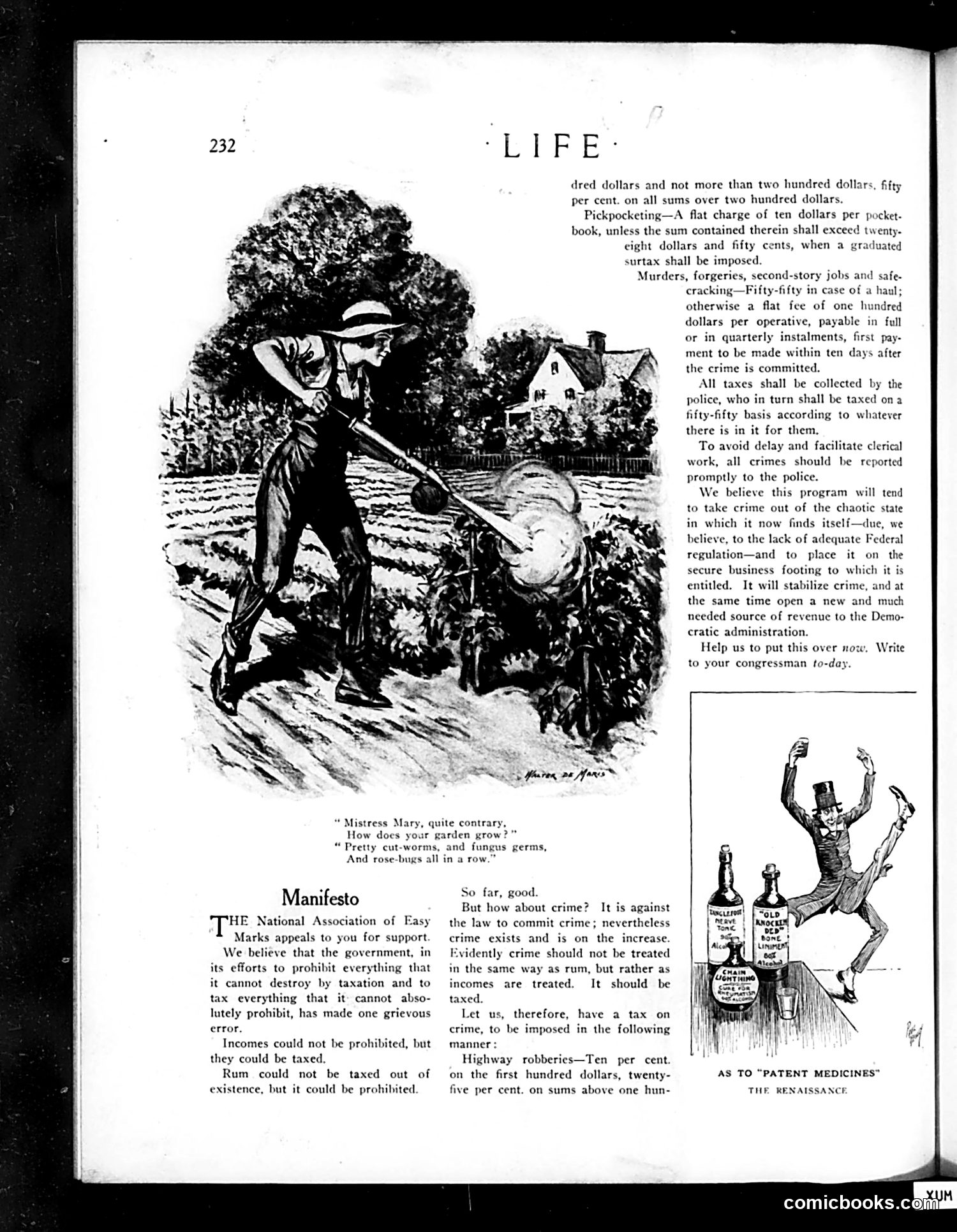
This page satirizes Progressive-era government overreach and taxation policy. The "Manifesto" by the fictional "National Association of Easy Marks" mocks the logic of heavy taxation and prohibition by proposing an absurd extension: taxing *crime itself* rather than prohibiting it. The satire targets the Democratic administration's approach to Prohibition (banning alcohol) while heavily taxing incomes. The manifesto ironically suggests applying income-tax logic to crime—charging criminals fees for murders, robberies, and safecracking, with police collecting taxes on their bribes. The accompanying illustration shows a farmer using a hoe on vegetables, sardonically captioning the nursery rhyme "Mary, Mary, quite contrary"—implying that government regulation of agriculture (crop diseases, pests) is as invasive as taxing crime. The bottom cartoon mocks patent medicines as another regulatory target. The overall point: government is overextending control into absurd domains through taxation rather than genuine prohibition.
📄 Transcribed text from this page (OCR, searchable)
Machine-transcribed from the original scan — historical spelling and the odd misread are preserved.
“LIFE: dred dollars and not more than two hundred dollars, fifty per cent. on all sums over two hundred dollars. Pickpocketing—A flat charge of ten dollars per pocket- book, unless the sum contained therein shall exceed twenty. eight dollars and fifty cents, when a graduated surtax shall be imposed. Murders, forgerie: -y Paton, ae fons™ “ Mistress Mary, quite contrar: How does your garden grow? “Pretty cut-worms, and fungus germs, And rose-bugs all in a row.” Manifesto HE National Association of Easy Marks appeals to you for support. We believe that the government, in its efforts to prohibit everything that it cannot destroy by taxation and to tax everything that it cannot abso- lutely prohibit, has made one grievous error. Incomes could not be prohibited, but they could be taxed, Rum could not be taxed out of existence, but it could be prohibited. So far, good. But how about crime? It is against the law to commit crime; nevertheless crime exists and is on the increase. Evidently crime should not be treated in the same way as rum, but rather as incomes are treated. It should be taxed. Let us, therefore, have a tax on crime, to be imposed in the following manner: Highway robberies—Ten per cent. on the first hundred dollars, twenty- five per cent. on sums above one hun- econd-story jobs and safe- cracking, fty-fifty in case of a haul; otherwise a flat fee of one hundred dollars per operative, payable in full or in quarterly instalments, first pay- ment to be made within ten days after the crime is committed. All taxes shall be collected by the police, who in turn shall be taxed on a fifty-fifty basis according to whatever there is in it for them, To avoid delay and facilitate clerical work, all crimes should be reported promptly to the police. We believe this program will tend to take crime out of the chaotic state in which it now finds itselfi—due, we believe, to the lack of adequate Federal regulation—and to place it on the secure business footing to which it is entitled. It will stabilize crime, and at the same time open a new and much needed source of revenue to the Demo- cratic administration. Help us to put this over now, Write to your congressman to-day. r AS TO “PATENT MEDICINES” THE RENAISSANCE comicbooks.com