
Life, 1919-08-07 · page 15 of 44
Life — August 7, 1919 — page 15: what you’re looking at
What you’re looking at
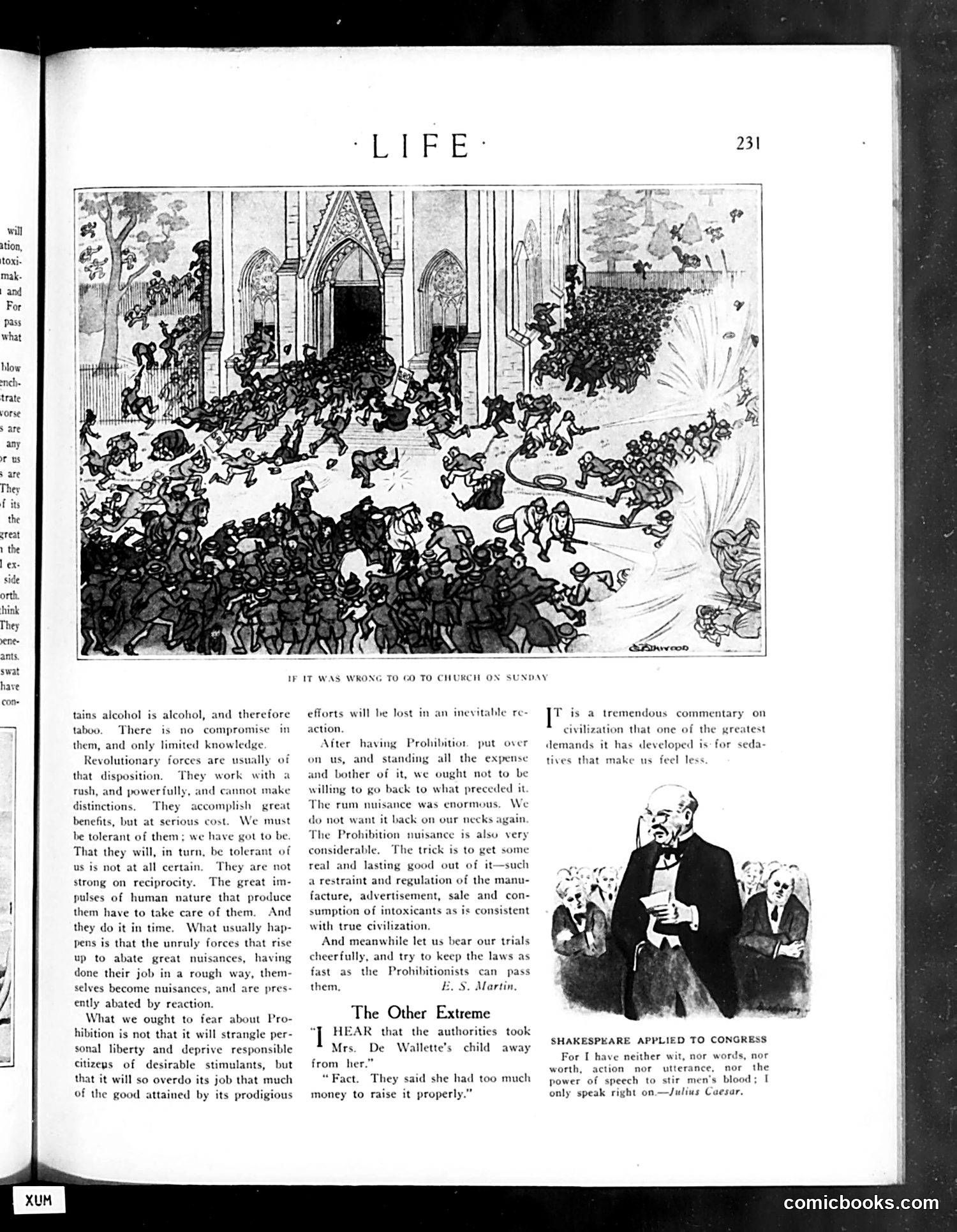
This cartoon satirizes Prohibition enforcement and public hypocrisy. The chaotic street scene depicts crowds of people drinking and carousing outside a church, mocking the contradiction between religious observance and illegal alcohol consumption during Prohibition. The accompanying text argues that Prohibition has become a "nuisance" that generates disrespect for law rather than moral improvement. The author criticizes how ordinary citizens now routinely break the law, suggesting that well-intentioned moral legislation backfires when it conflicts with popular behavior. The cartoon's title appears ironic—implying that if church-going itself were prohibited with the same enforcement vigor as alcohol, we'd see similar public lawlessness. It's a commentary on Prohibition's failure and unintended social consequences in 1920s America.
📄 Transcribed text from this page (OCR, searchable)
Machine-transcribed from the original scan — historical spelling and the odd misread are preserved.
trate vOrse $ are any of Us s are They tains alcohol is alcohol, and therefore taboo. There is no compromise in them, and only limited knowledge Revolutionary forces are usually of that disposition. They work with a rush, and powerfully, and cannot make distinctions, They ymplish great We must be tolerant of them; we have got to be. That they will, in turn, be tolerant of us is not at all certain. benefits, but at serious cost They are not The great im- pulses of human nature that produce them have to take care of them. And they do it in time. What usually hap- pens is that the unruly forces that rise up to abate great nuisances, having done their job in a rough way, them- selves become nuisances, and are pres- ently abated by reaction. What we ought to fear about Pro- hibition is not that it will strangle per- sonal liberty and deprive responsible citizeys of desirable stimulants, but that it will so overdo its job that much of the good attained by its prodigious strong on reciprocity. efforts will be lost in an inevitable re- action. After having Prohibitior. put over on us, and standing all the expense and bother of it, we ought not to be willing to go back to what preceded it The rum nuisance was enormous. We do not want it back on our necks again. The Prohibition nuisance is also very considerable. The trick is to get some real and lasting good out of it—such a restraint and regulation of the manu- facture, advertisement, sale and con- sumption of intoxicants as is consistent with true civilization. And meanwhile let us bear our trials cheerfully, and try to keep the laws as fast as the Prohibitionists can pass them. E. S. Martin. The Other Extreme HEAR that the authorities took Mrs. De Wallette’s child away from her.” “Fact. They said she had too much money to raise it properly.” T is a tremendous commentary on civilization that one of the greatest demands it has developed is: for seda- tives that make us feel less SHAKESPEARE APPLIED TO CONGRESS For [ have neither wit, nor words, nor worth, action nor utterance, nor the power of speech to stir men’s blood; I only speak right on.—Julius Caesar. comicbooks.com