
A complete issue · 50 pages · 1919
Life — July 10, 1919
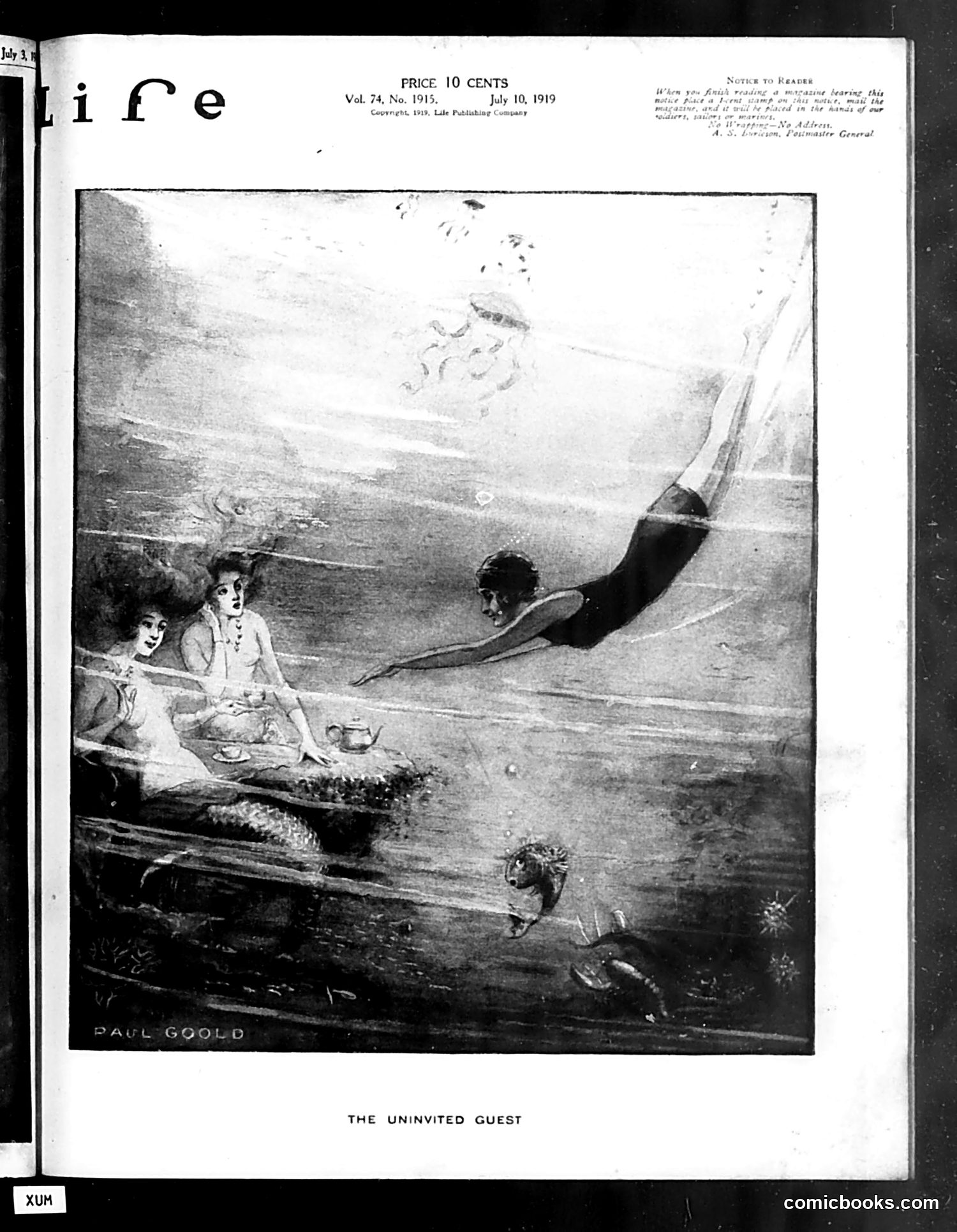
This 1919 Life magazine illustration by Paul Goould depicts an underwater scene with two women seated on the ocean floor, peacefully having tea, when a man in swimming attire suddenly appears above them. The title "The Uninvited Guest" suggests social commentary about unwanted male intrusion into female spaces. Given the 1919 date and artistic style, this likely satirizes post-WWI social anxieties about changing gender relations and women's newly won independence (women gained voting rights in 1920). The cartoon mocks the disruptive nature of male attention interrupting women's autonomous leisure activities. The underwater setting adds whimsical absurdism to the commentary on gender dynamics and social propriety of the era.
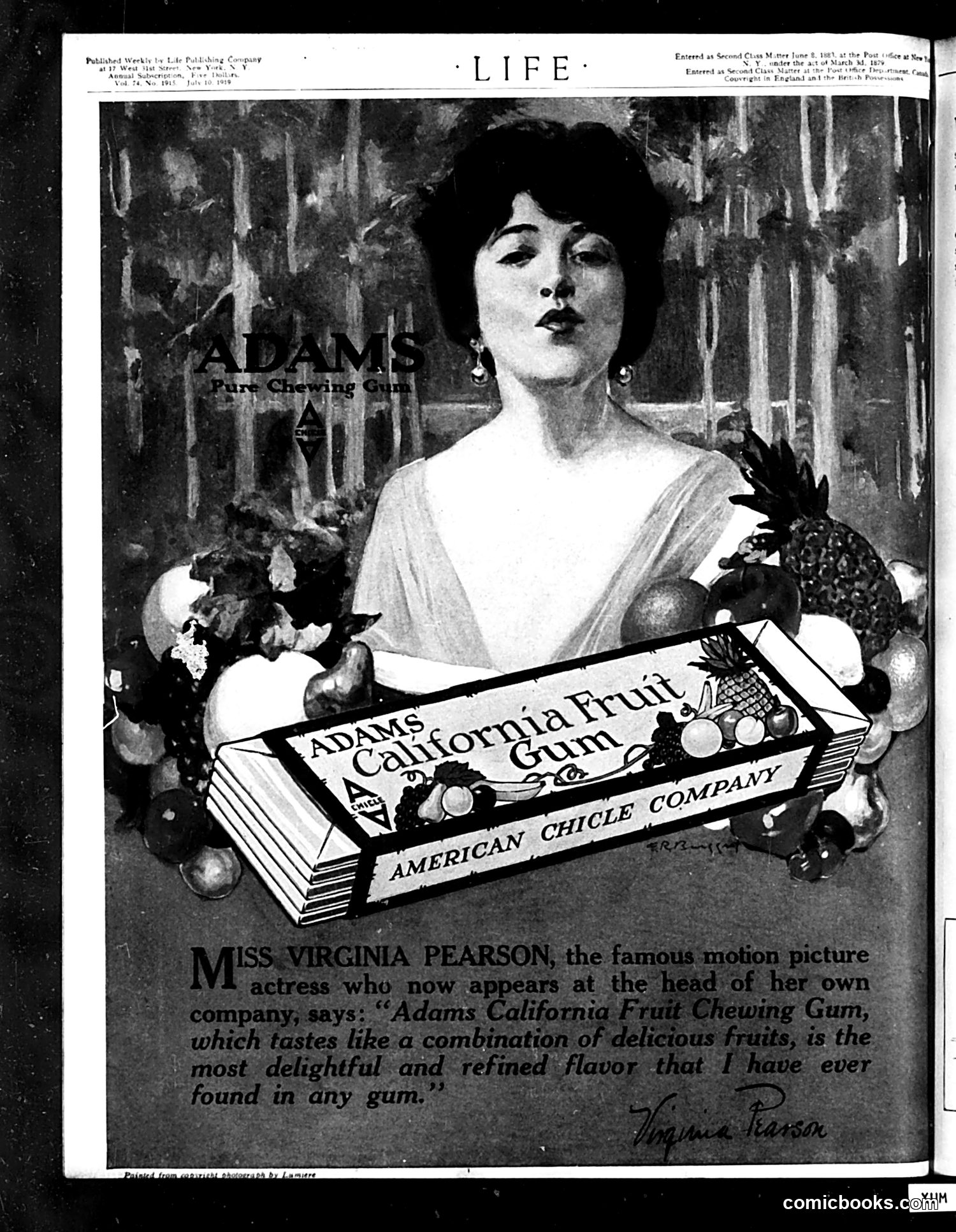
This is not a political cartoon or satire—it's a **celebrity endorsement advertisement** from Life magazine's early 20th century. The page features **Virginia Pearson**, a motion picture actress, endorsing **Adams California Fruit Chewing Gum** (American Chicle Company product). Pearson holds a gum package surrounded by fruit imagery. The advertisement includes a testimonial quote (signed by Pearson) praising the gum's "delicious fruits" flavor as "the most delightful and refined flavor that I have ever found in any gum." This represents a common advertising practice of the era: using celebrities to market consumer products with aspirational appeals to sophistication and taste. The presentation emphasizes Pearson's fame and refinement to legitimize the product.
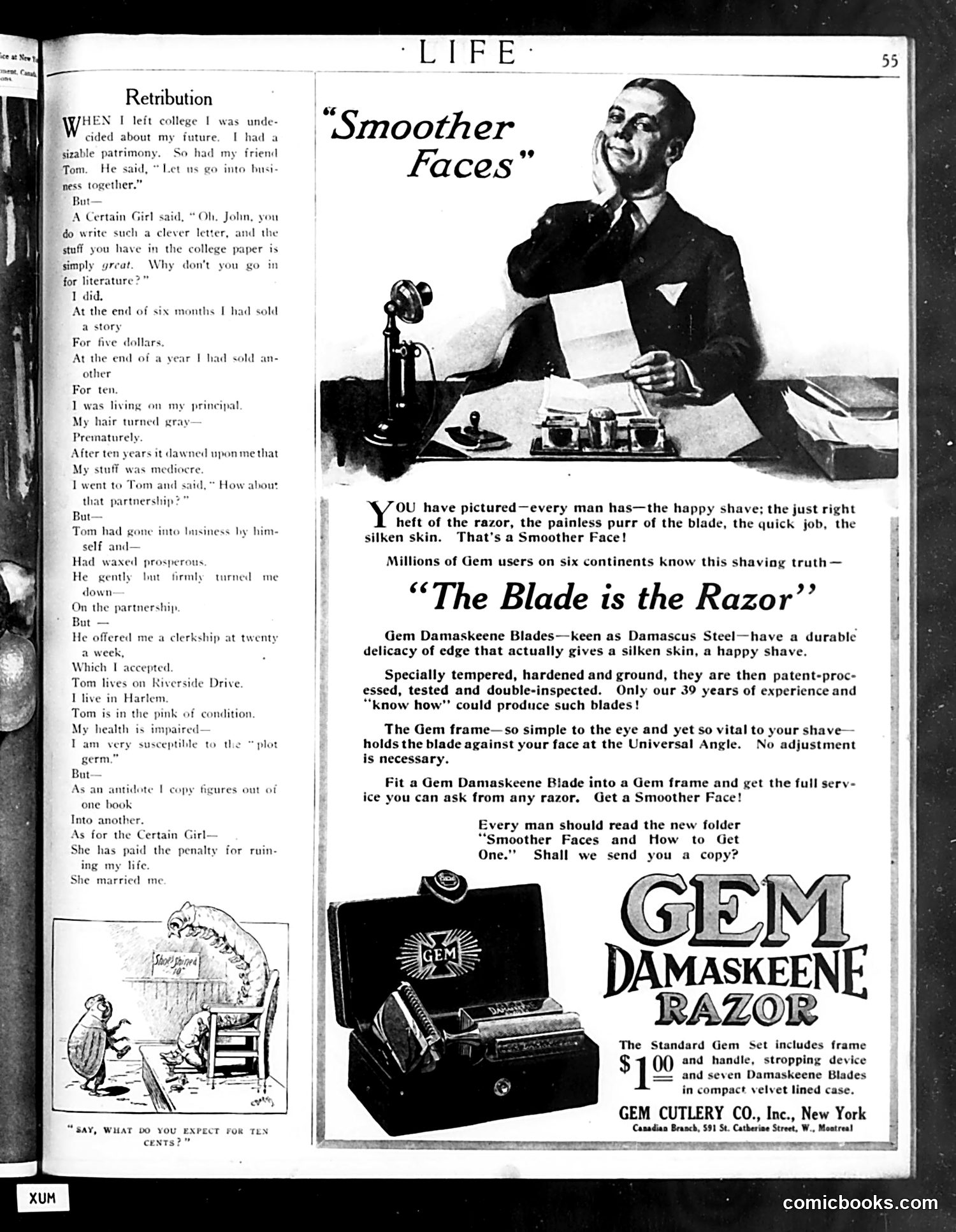
This page is **primarily a Gem Damasceene Razor advertisement** (right half), not political satire. The ad features a smiling man at a desk demonstrating the razor, using the slogan "The Blade is the Razor" to emphasize product quality. The left side contains "Retribution," a personal essay about a college graduate seeking literary success. The author recounts modest writing sales and eventual partnership with a friend named Tom, who becomes prosperous while the author struggles—the "retribution" being that a girl (implied love interest) married the successful Tom instead. At bottom, a small cartoon captioned "Say, what do you expect for ten cents?" shows two figures, likely satirizing cheap expectations, but without clearer context, the specific reference remains unclear. This is primarily **commercial content** rather than political commentary.
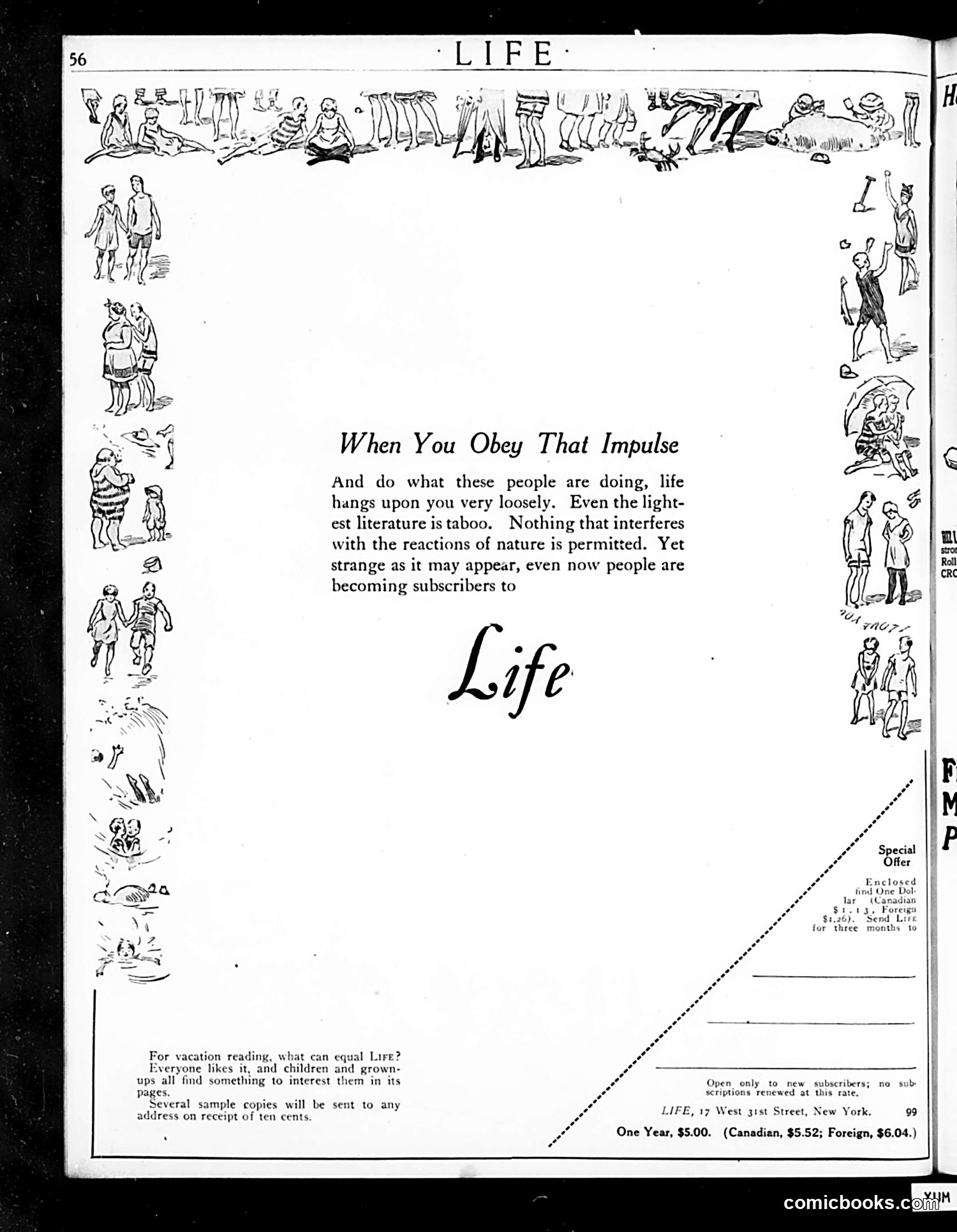
This is primarily a **subscription advertisement** for *Life* magazine rather than political satire. The page promotes the magazine through the heading "When You Obey That Impulse" and claims that reading *Life* is essential leisure activity. The decorative border consists of **small comic vignettes** depicting everyday scenes—people socializing, playing, relaxing—illustrating the magazine's humorous take on ordinary life. These sketches reinforce that *Life* offers entertainment and social commentary on daily human behavior. The text emphasizes that *Life* appeals universally to "children and grown-ups" and promises humor without interfering with "reactions of nature." The subscription rates and promotional offer (sample copies for ten cents) occupy the lower portion, targeting new readers.
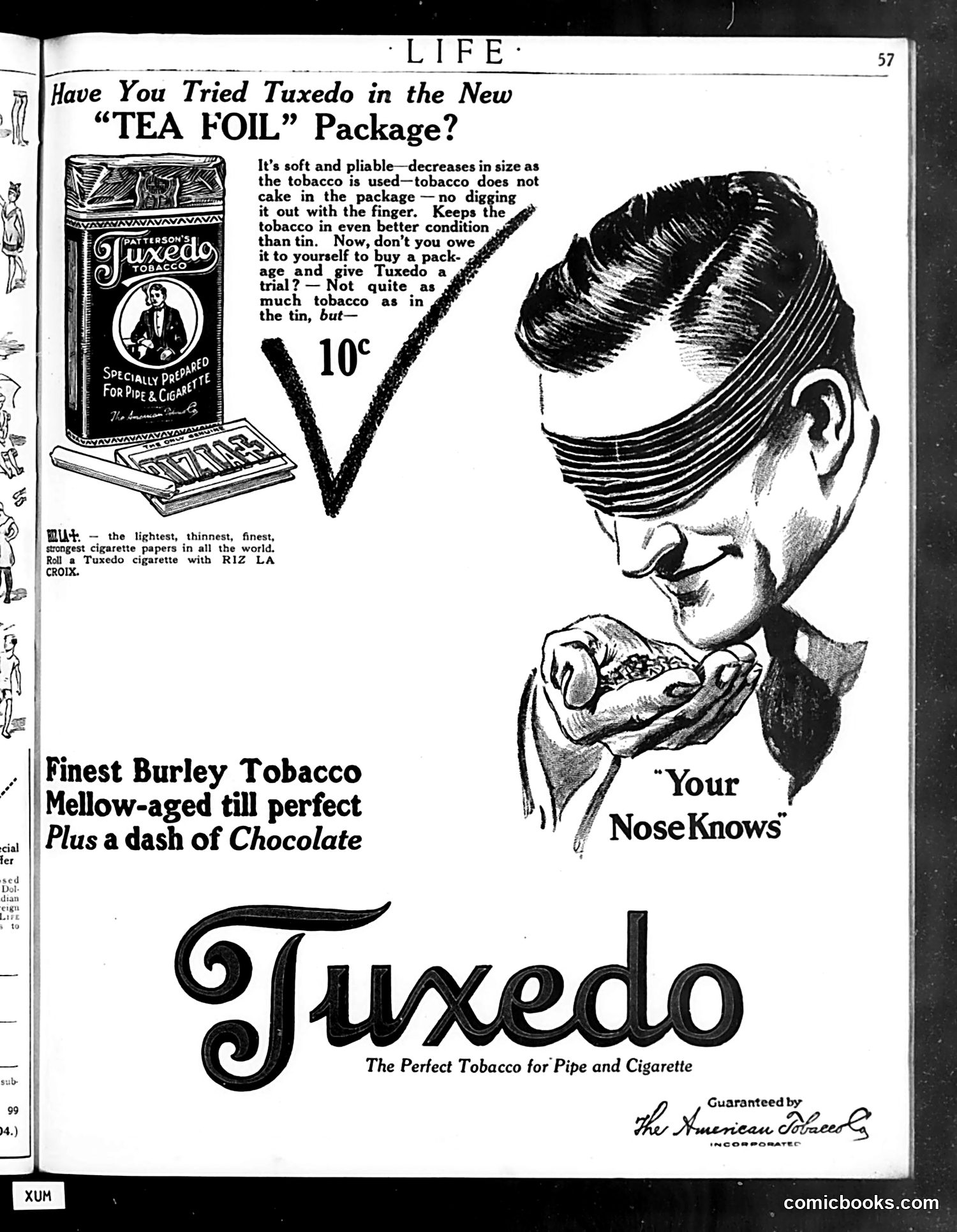
This page is primarily **a cigarette and pipe tobacco advertisement**, not satire or political content. It promotes Tuxedo brand tobacco in two formats: 1. **Top section**: Advertises the new "Tea Foil" package (10 cents), claiming the soft, pliable wrapper keeps tobacco fresher than tin containers. 2. **Bottom section**: Features a caricatured man's face with the slogan "Your Nose Knows," promoting Tuxedo as "Finest Burley Tobacco Mellow-aged till perfect Plus a dash of Chocolate." The appeal is straightforward marketing: convenience of the foil package and the distinctive chocolate-flavored blend. The exaggerated facial caricature and tagline were typical advertising techniques of this era (likely 1920s-1930s), designed to make the product memorable rather than to satirize or critique anything social or political.
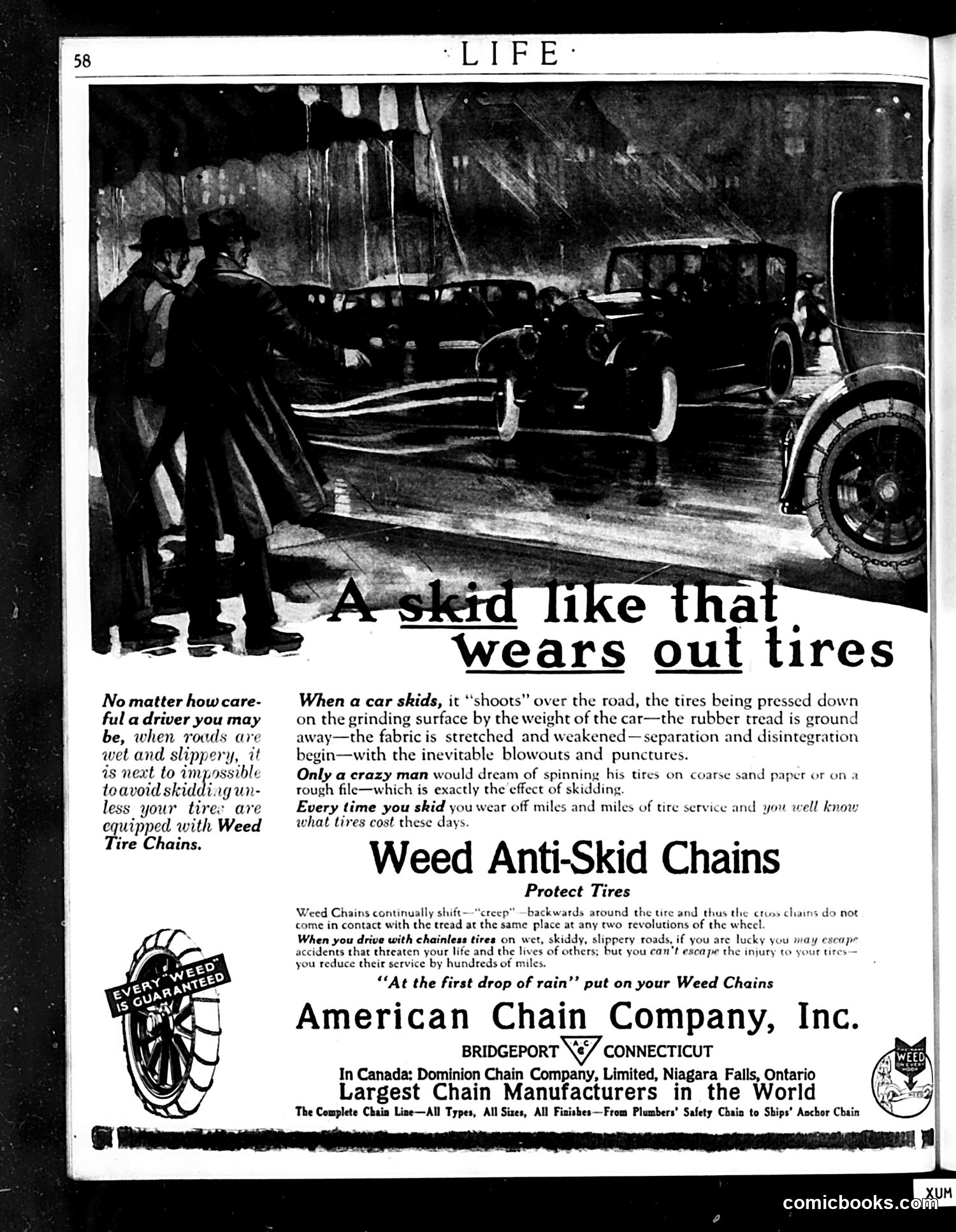
This page is primarily **advertising, not satire or political commentary**. It's a commercial advertisement for Weed Anti-Skid Chains, a tire safety product manufactured by American Chain Company, Inc. (Bridgeport, Connecticut). The advertisement uses a cautionary scenario—a car skidding on wet roads—to market tire chains as essential safety equipment. The headline "A skid like that wears out tires" warns readers of the dangers of skidding on slippery surfaces. The ad emphasizes that chains prevent loss of tire traction and reduce accidents on wet, icy roads. The black-and-white photograph shows a dramatic car skid scenario, while the text educates readers about tire wear and safety. This is straightforward product marketing targeting motorists concerned about winter driving safety, not political satire.
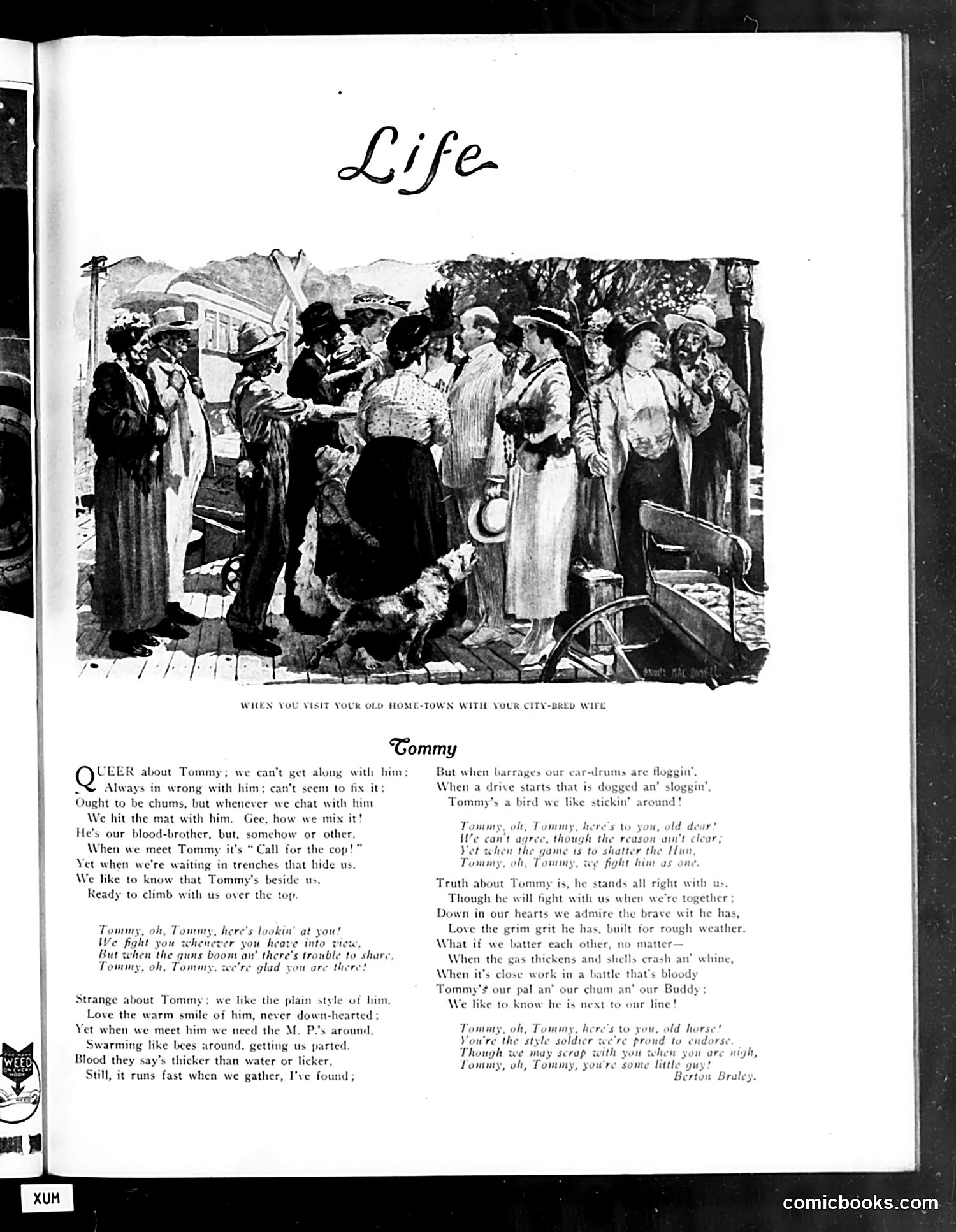
This page features an illustration and poem titled "Tommy," depicting a social encounter between city dwellers visiting their hometown. The scene shows well-dressed urbanites meeting local townspeople, with the caption "WHEN YOU VISIT YOUR OLD HOME-TOWN WITH YOUR CITY-BRED WIFE." The satirical point concerns class tension and social embarrassment: the poem humorously describes "Tommy," apparently a local acquaintance, as rough-mannered and uncouth—he fights, swears, drinks, and behaves poorly. The satire mocks both Tommy's crude behavior and the city visitors' discomfort encountering their old community through their spouse's presumably refined sensibilities. The poem affectionately defends Tommy's "grit" and loyalty despite his roughness, suggesting tension between urban sophistication and rural authenticity—a common early-20th-century American theme.
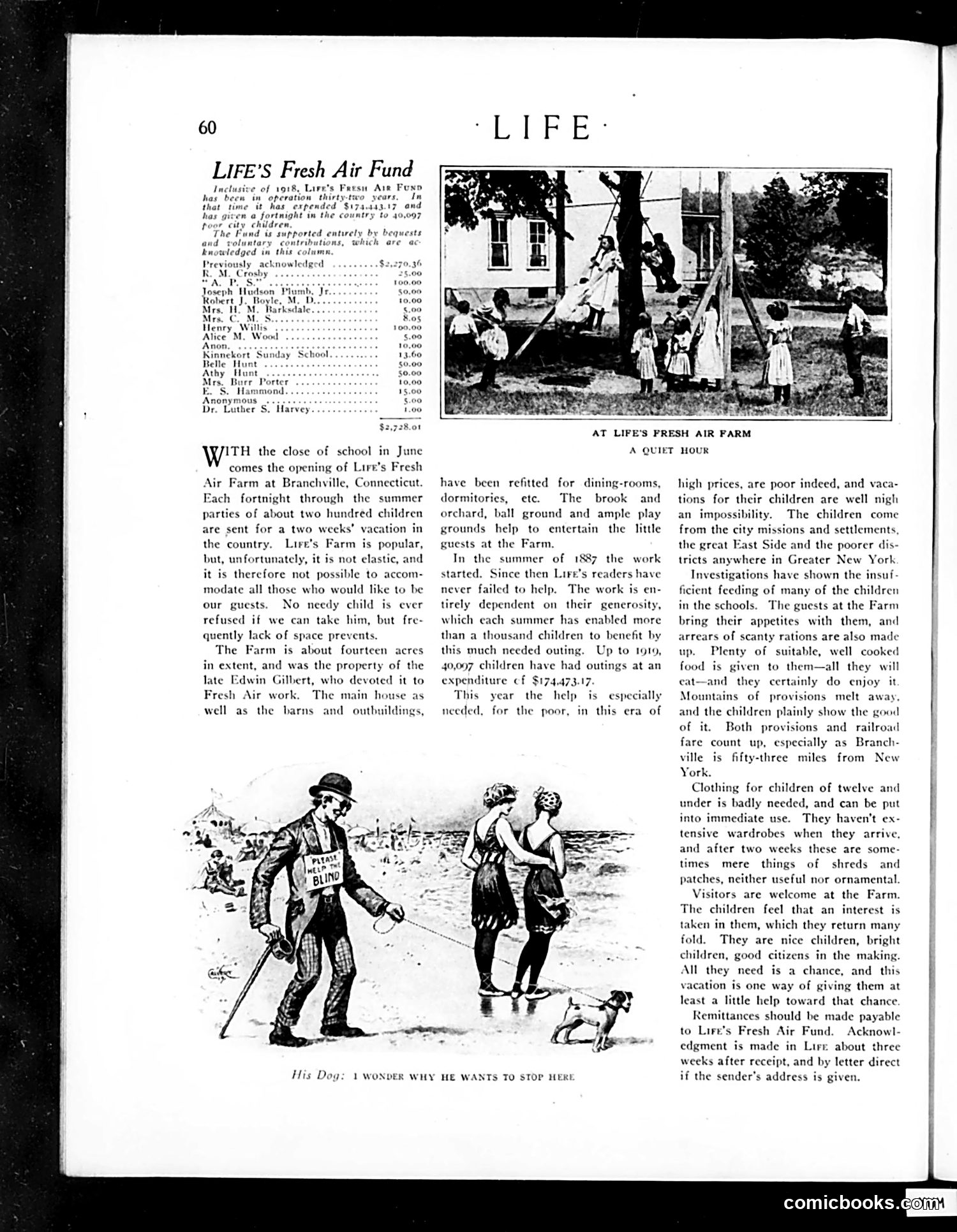
This page describes Life magazine's Fresh Air Fund, a charitable program sending poor urban children to a farm in Branchville, Connecticut for summer vacations. The cartoon captioned "His Dog: I Wonder Why He Wants to Stop Here" depicts a blind beggar with a dog encountering two children at what appears to be the farm. The joke seems to contrast the beggar's circumstances with the rural setting—the dog's confusion about why someone would stop at a peaceful farm location suggests the contrast between city poverty and countryside refuge. The page documents donations totaling $2,228.01 and explains how the fund provides vacations for approximately 40,000 children annually from poor New York City neighborhoods, addressing early 20th-century urban poverty and child welfare concerns.
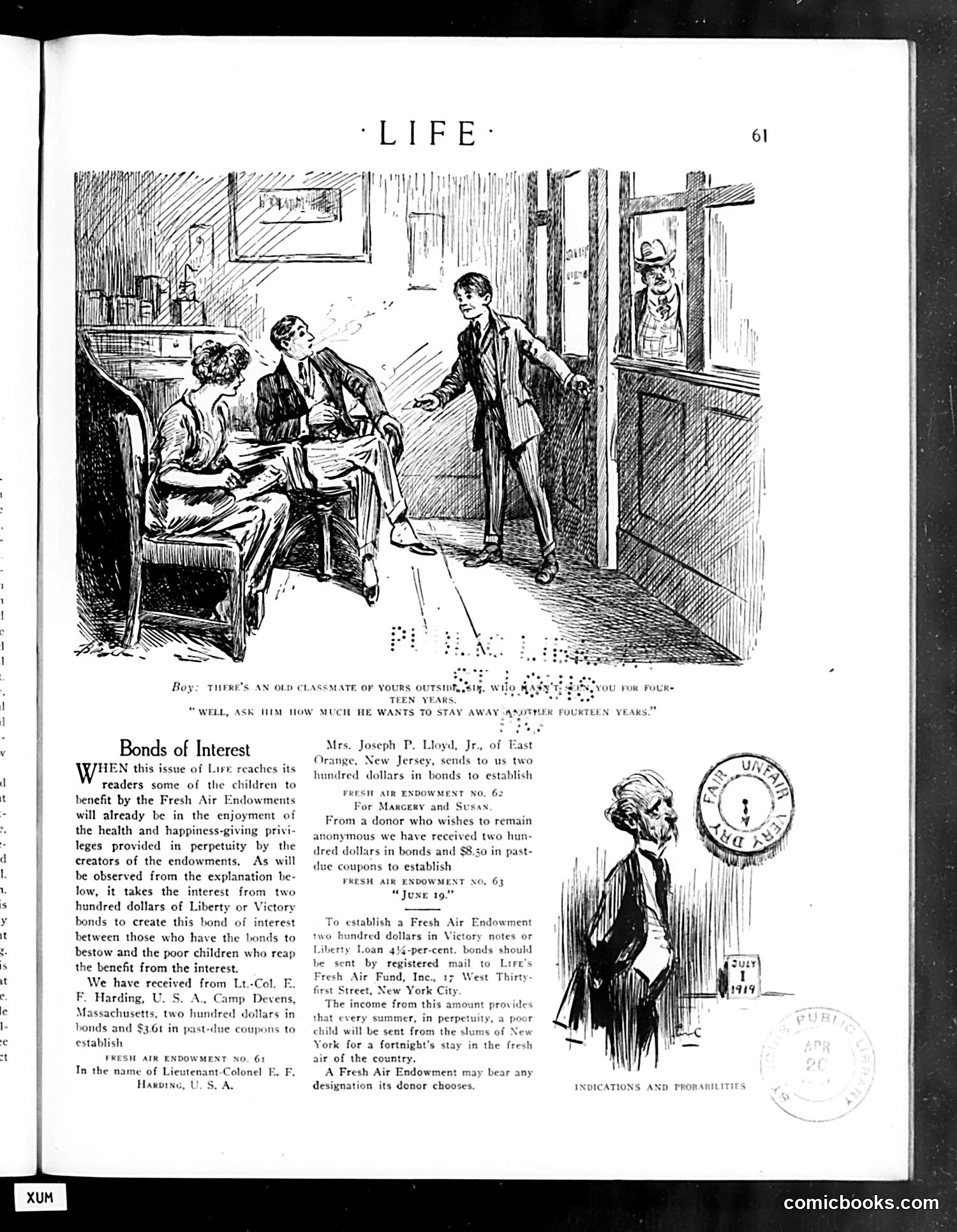
The top cartoon depicts an office scene where a boy announces to two seated men that an old classmate is waiting outside. One man's response—asking how long the visitor wants to stay away—suggests a humorous reluctance to see this person, implying a strained or awkward reunion with someone from their past. Below is an article titled "Bonds of Interest" about Fresh Air Endowment fundraising. This appears to be a charitable initiative providing poor children from urban slums (likely New York City) with summer country vacations. The accompanying illustration shows an elderly, weathered man—possibly representing poverty or hardship—juxtaposed with the endowment's humanitarian mission. The page mixes satirical humor with earnest charitable appeals, typical of Life magazine's editorial approach.
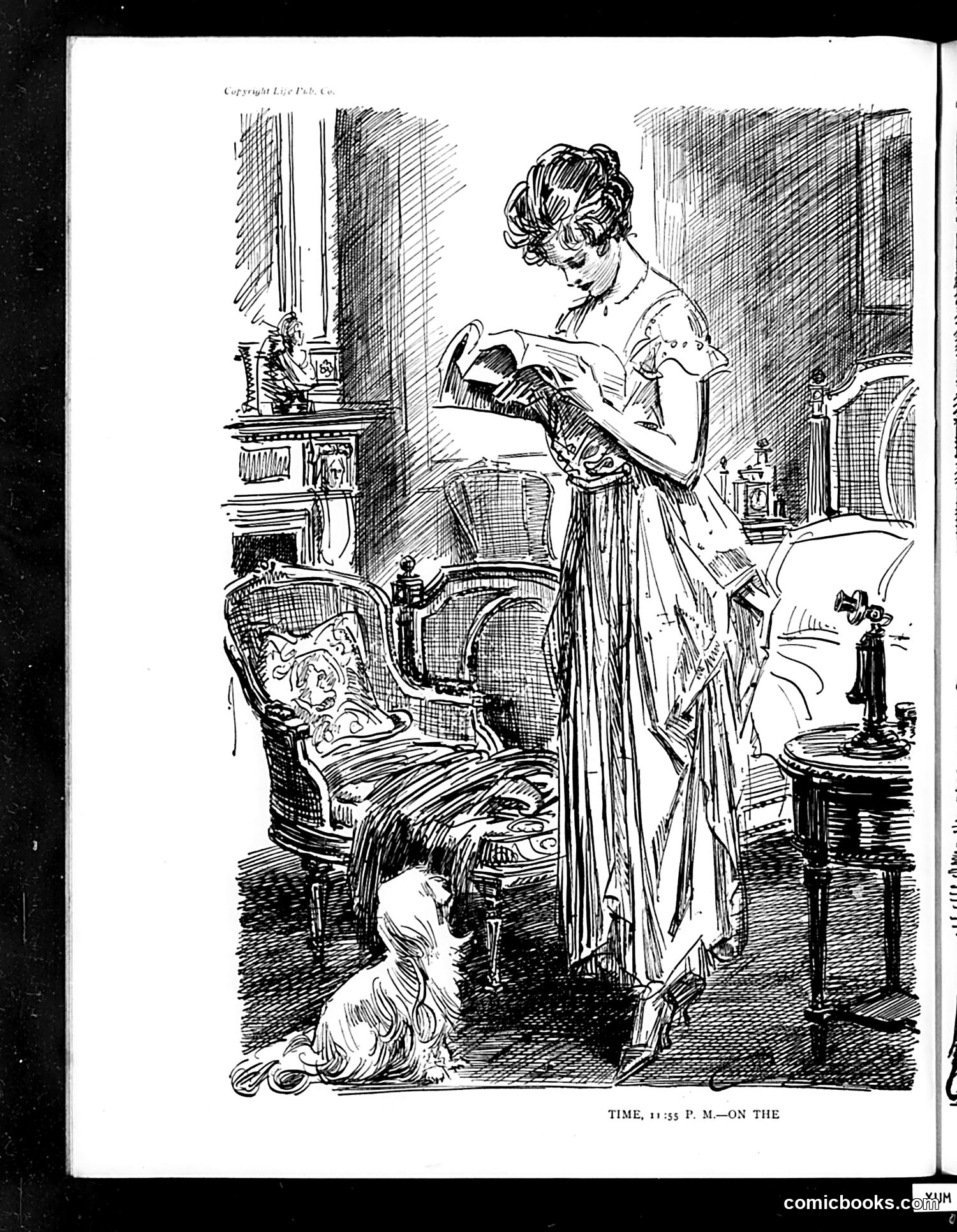
This illustration depicts an elegant woman in an early 20th-century interior, reading what appears to be a magazine or publication to a small dog. The caption reads "TIME 11:55 P.M.—ON THE," though the complete text is cut off. The satire likely comments on **leisure activities and reading habits of wealthy women** of the period. The specific reference to 11:55 P.M. suggests timing—possibly satirizing women who read fashion magazines or society publications late into the evening, or commenting on nighttime social rituals among the upper class. The small dog as audience adds gentle humor, implying the woman is so absorbed in her reading that she's entertaining a pet rather than engaging in more substantial evening activities. This reflects *Life* magazine's typical social satire of upper-class domestic life.
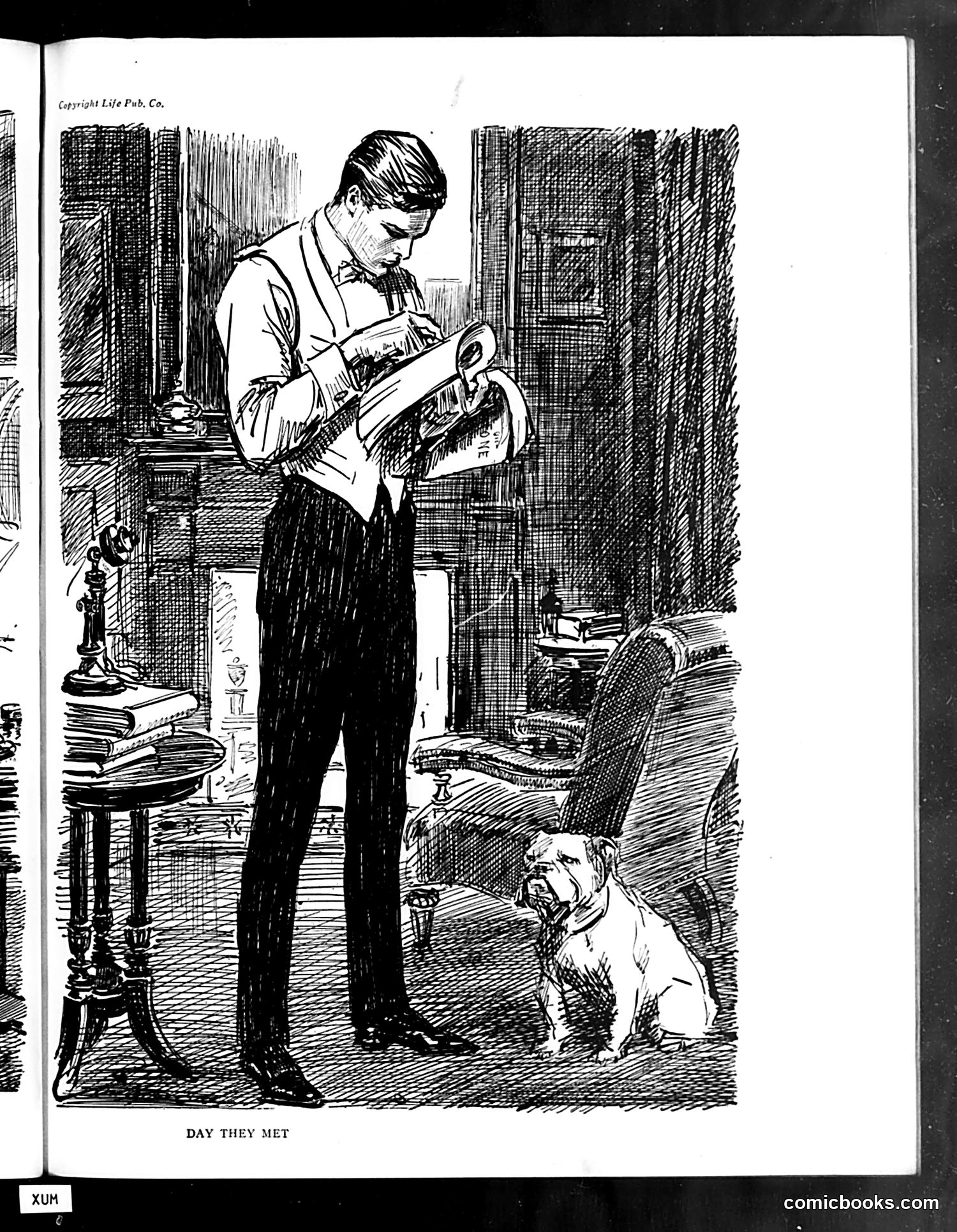
This illustration shows a well-dressed man examining what appears to be a document or agreement while a bulldog sits nearby in a study or office setting. The caption "DAY THEY MET" suggests this depicts a first encounter between two parties. Without additional context from the magazine's text or surrounding pages, the specific political or social reference remains unclear. The formal interior, the man's scrutinous examination of paperwork, and the presence of the dog suggest a business transaction or legal matter, possibly satirizing a notable contemporary agreement or partnership. The bulldog's stern expression may characterize one party's nature. The Life magazine copyright indicates this is early 20th-century satire, but the particular figures or events referenced are not definitively identifiable from the image alone.
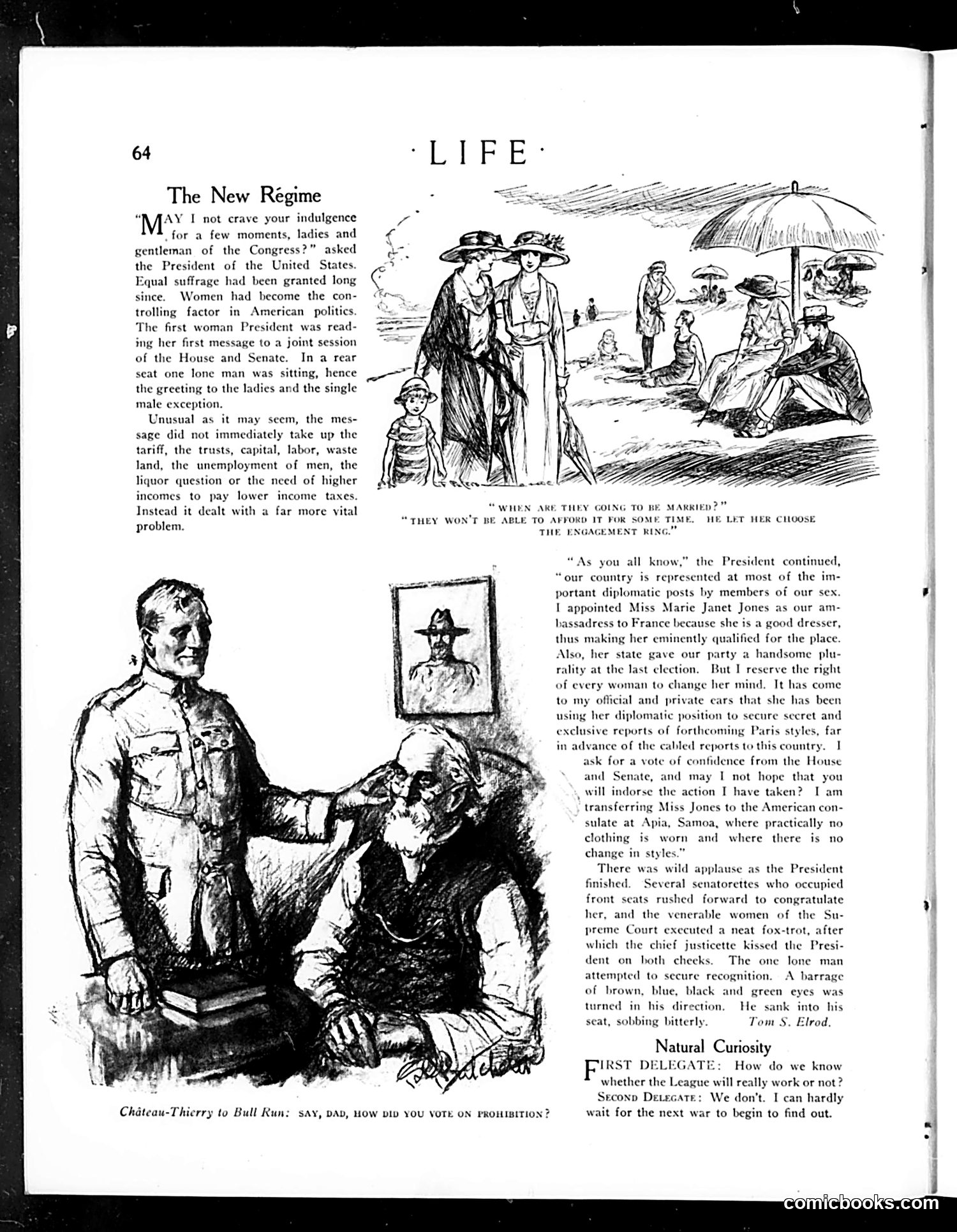
This page satirizes a female U.S. President addressing Congress about women's suffrage. The sketch shows her speaking to a joint session, with the caption noting "one lone man was sitting" — reversing the historical male-dominated legislature. The President proposes appointing female diplomats, specifically Miss Marie Janet Jones as ambassadress to France, justifying it by noting women are skilled dressers and keep current with Paris fashions. She then transfers Jones to Samoa, "where practically no clothing is worn and where there is no change in styles." The satire mocks both female political ambition and the superficiality attributed to women. The bottom cartoon shows a man asking another about voting on prohibition, labeled "Château-Thierry to Bull Run," suggesting confusion in this topsy-turvy world.
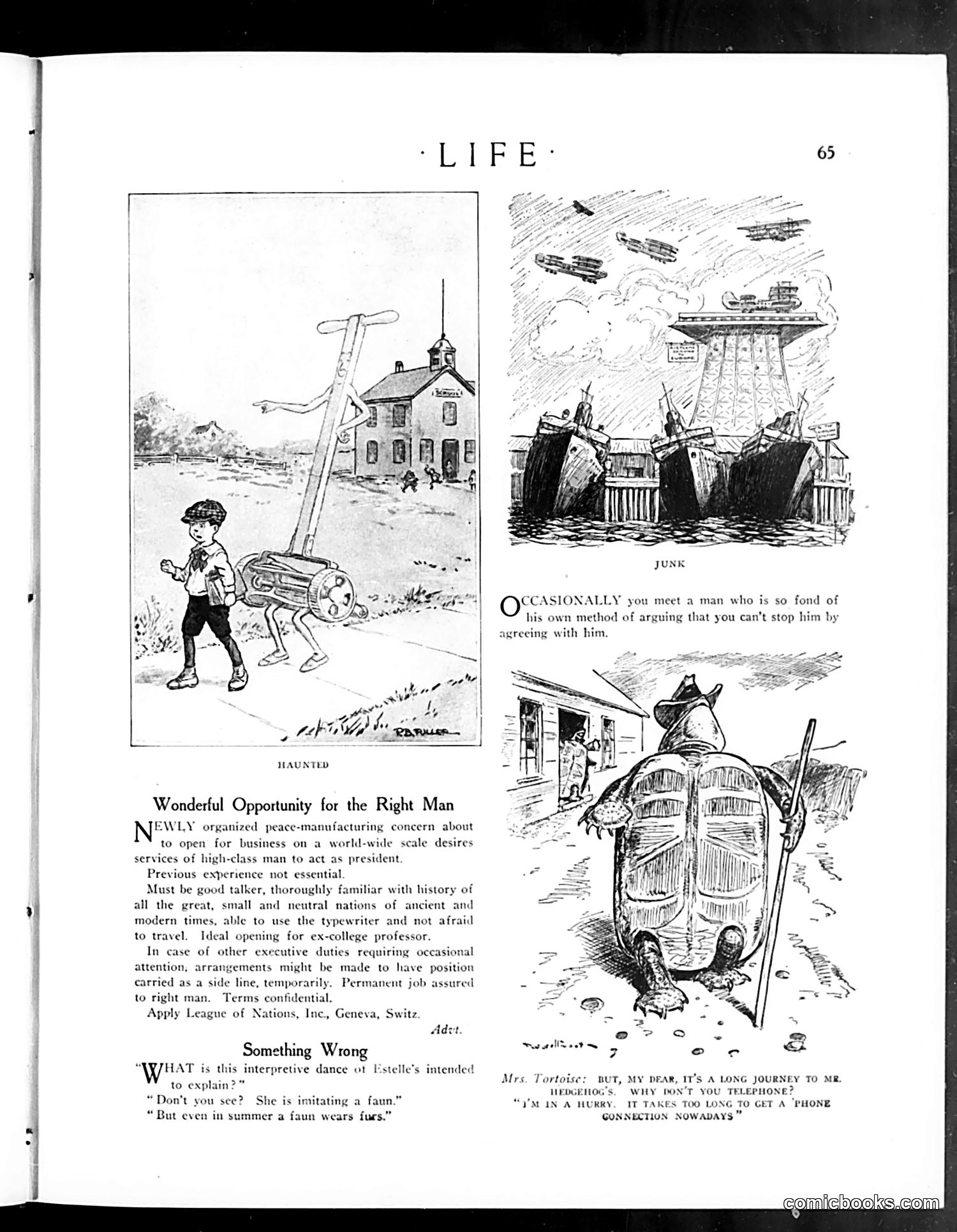
This page contains three distinct satirical pieces: 1. **"Haunted"** (left): A cartoon showing a child being chased by a large mechanical lawn mower, suggesting anxiety about modern technology or domestic hazards. 2. **"Wonderful Opportunity for the Right Man"** (center): A classified ad parody from the "League of Nations" offering a position for someone to manage international peace-making. The joke mocks the League's ineffectiveness—requiring someone willing to travel extensively and handle constant crises as a side job, with confidentiality assured. This satirizes the organization's inability to prevent conflict during the interwar period. 3. **"Something Wrong"** (bottom): A dialogue joke about interpretive dance, where a woman imitating a faun is criticized for wearing fur—the humor relies on the absurdity of theatrical realism. 4. **"Junk"** and **Mrs. Tortoise** (right): A cartoon and caption about argumentative men and slow communication.
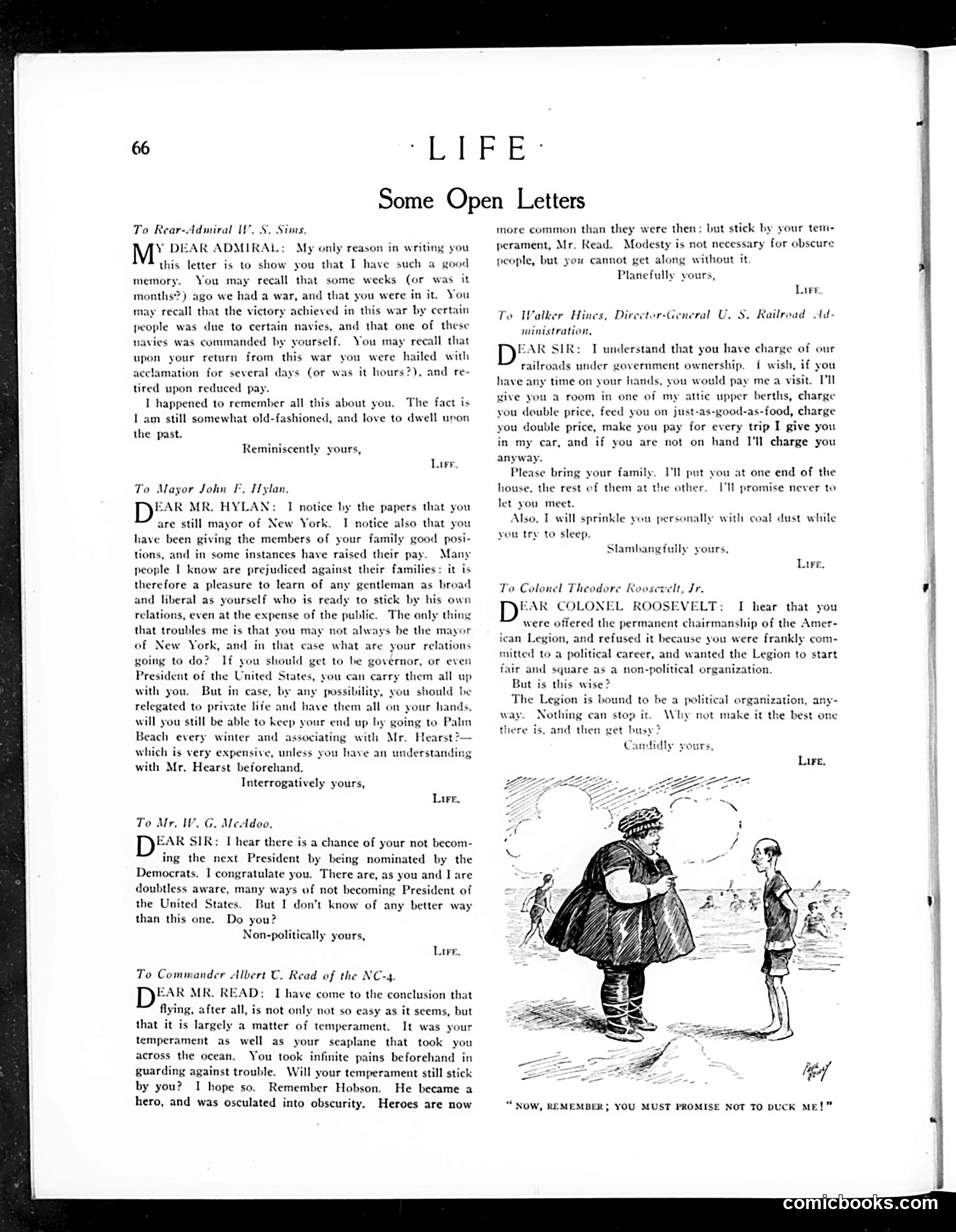
The single illustration at the bottom of the page shows a woman in heavy winter clothing speaking sternly to a small boy at a beach or seaside. The caption reads: "Now, remember; you must promise not to duck me!" This appears to be a humorous domestic scene playing on the contrast between a protective mother's warning and a child's mischievous nature. The joke likely relies on the double meaning of "duck"—both the act of pushing someone underwater and the bird. The woman's serious demeanor and formal instruction suggest she's attempting to impose adult rules on a child who would naturally want to play in the water. The satire captures the eternal struggle between parental caution and childhood impulse at the seaside.
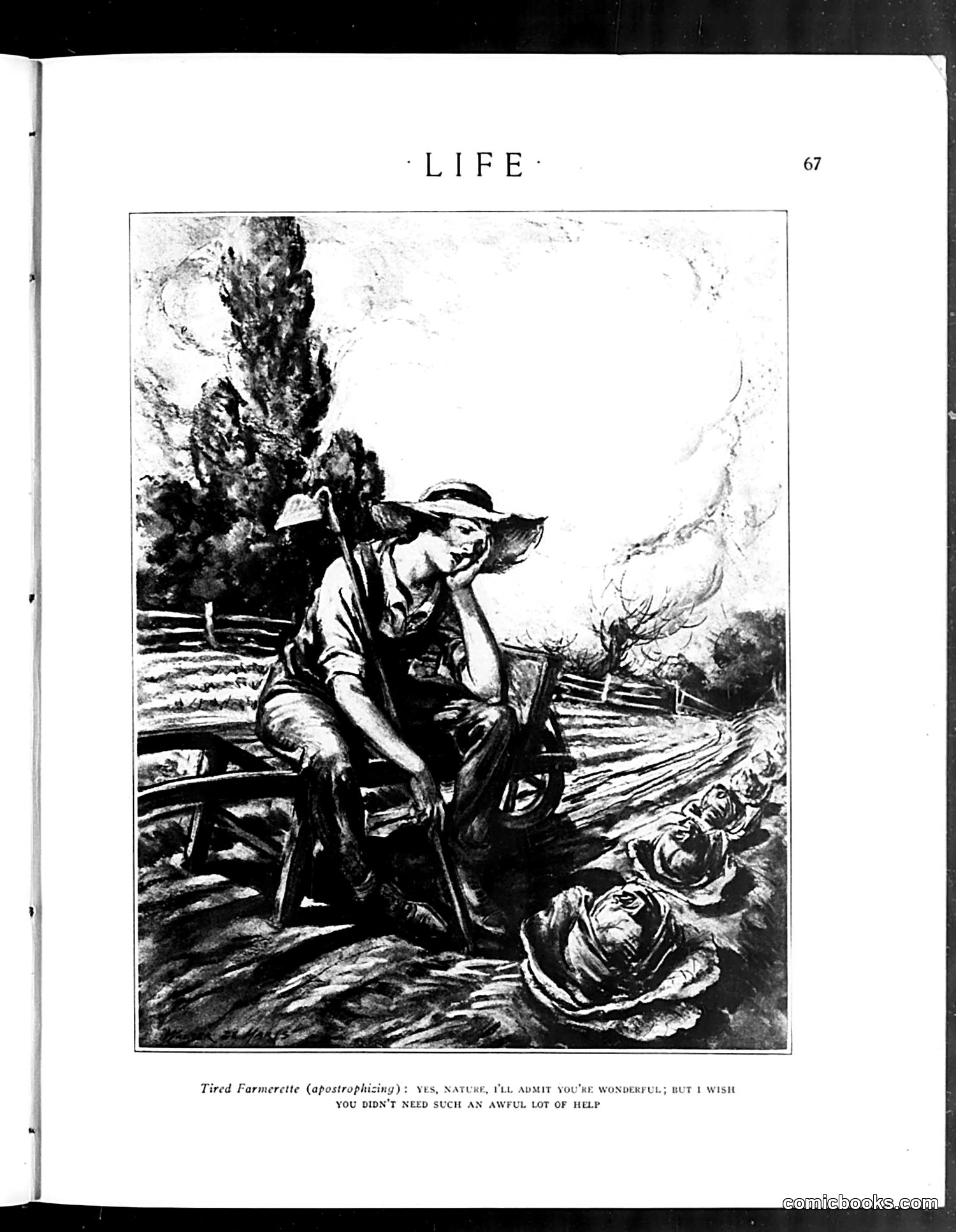
This political cartoon depicts a tired farmer leaning on his hoe, surrounded by large vegetables (appearing to be cabbages or similar crops). The caption reads: "Tired Farmerette (apostrophizing): YES, NATURE, I'LL ADMIT YOU'RE WONDERFUL; BUT I WISH YOU DIDN'T NEED SUCH AN AWFUL LOT OF HELP." The satire targets the contradiction between celebrating nature's bounty and the grueling agricultural labor required to achieve it. The term "Farmerette" likely references female agricultural workers, possibly those who entered farming during World War I when men enlisted. The joke criticizes the romanticization of farming and nature—while nature produces wonderful crops, the actual work is exhausting and requires constant human effort, contradicting pastoral ideals about farming being naturally easy or rewarding.
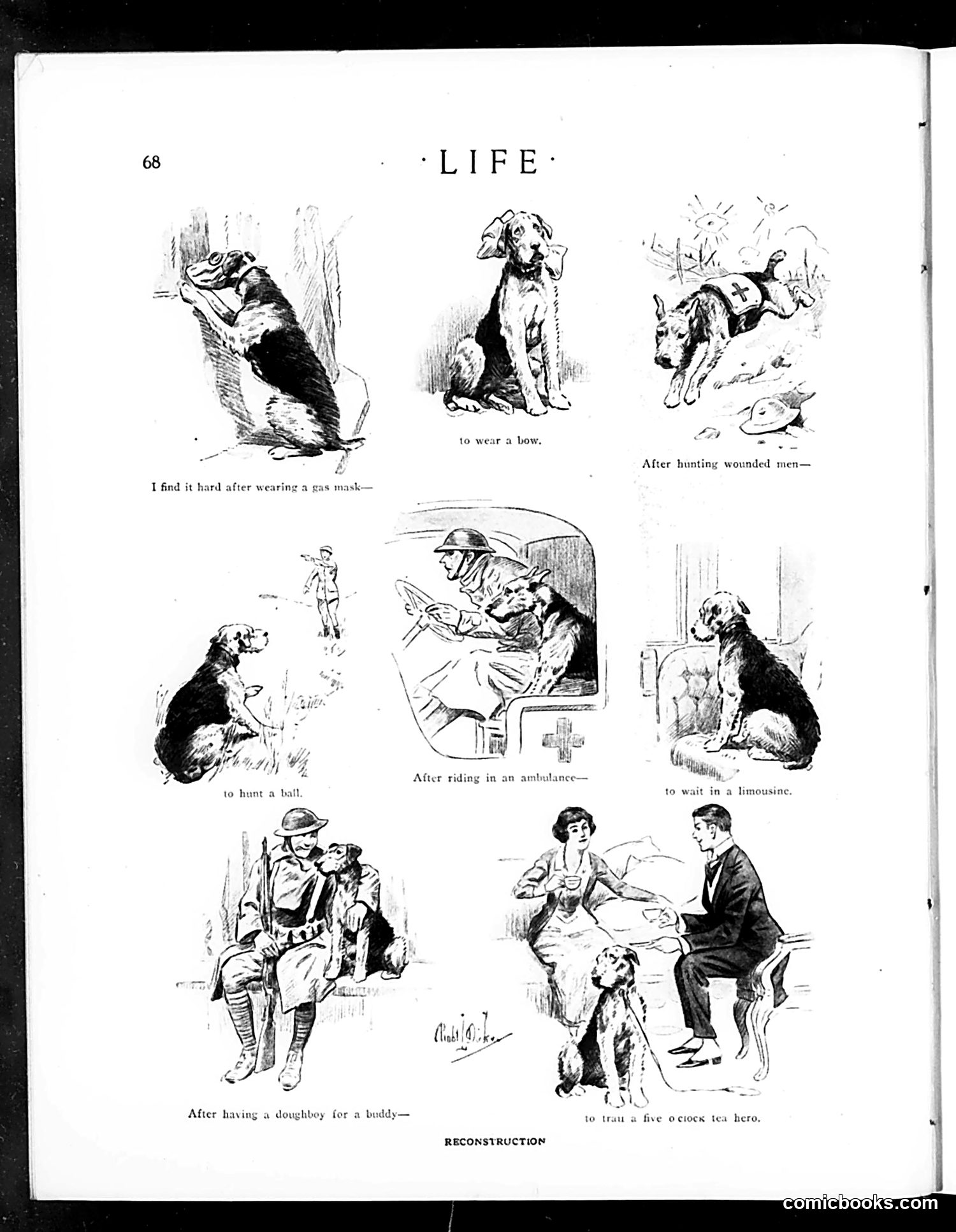
This is a satirical series depicting a dog's wartime experiences and postwar readjustment, titled "Reconstruction." The cartoons show a hunting dog struggling to adapt to civilian life after World War I. The sequence progresses from combat scenes ("After hunting wounded men") through various domestic absurdities: wearing a gas mask, a bow tie, waiting in a limousine, riding in an ambulance. The final panels humorously contrast the dog's military service with upper-class social expectations—having shared a "doughboy for a buddy" (a soldier) versus now attending a "five o'clock tea" with civilians. The satire mocks both the war's psychological toll on soldiers and society's frivolous return to peacetime routines. The dog symbolizes traumatized veterans struggling to readjust to civilian normalcy, unable to transition from wartime brotherhood and purpose to genteel social conventions.
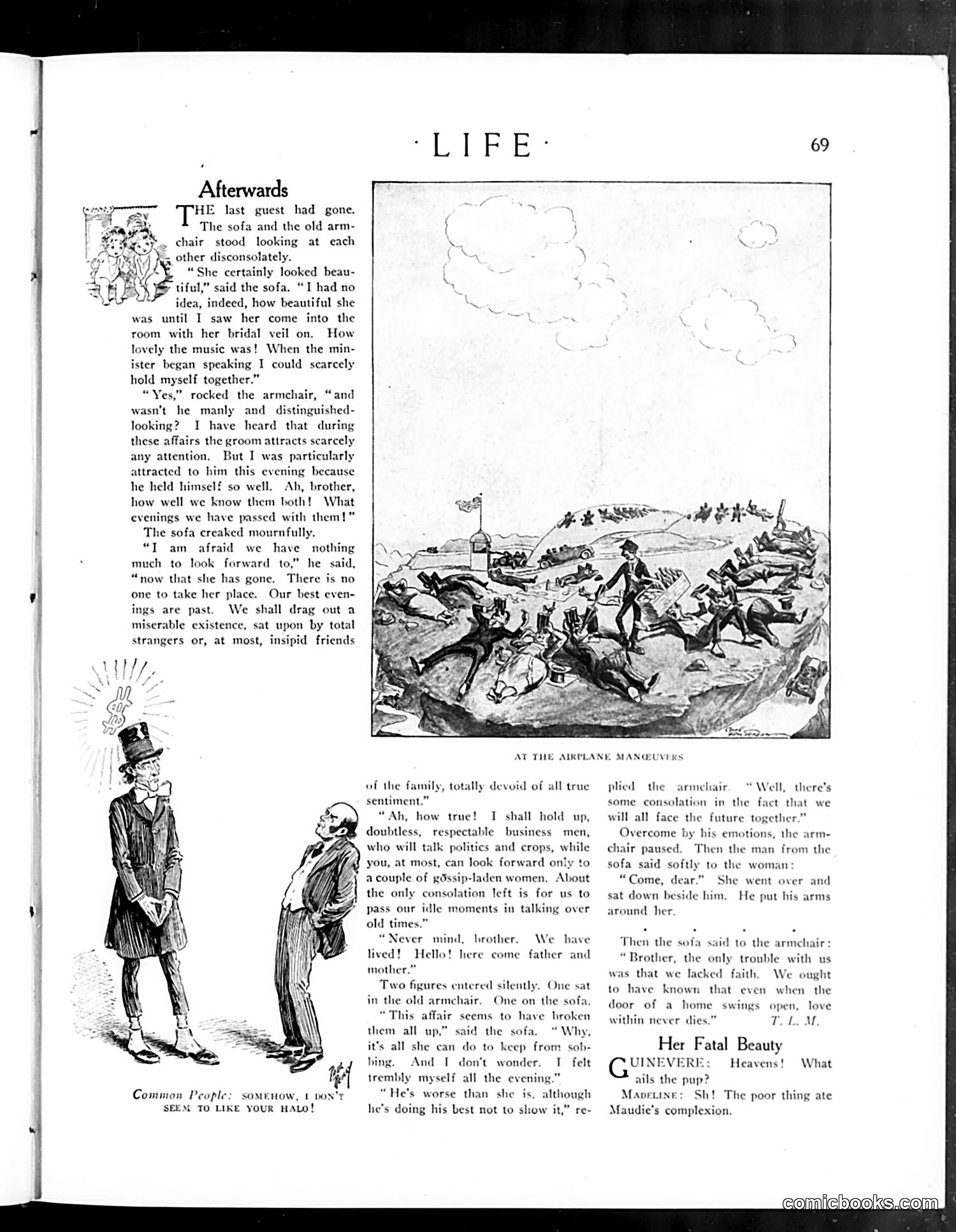
This page contains a sentimental story-poem about furniture mourning a bride's departure after her wedding. The sofa and armchair, which have witnessed her life, lament losing her company and fear a dreary future with "total strangers or insipid friends." When the newlyweds return looking despondent, the furniture initially despairs—but then witnesses the couple reconcile with an embrace, restoring their faith in love's endurance. The cartoon below ("Common People") shows two working-class figures; one comments on the other's "halo," likely satirizing pretension or false respectability among ordinary people. At bottom, "Her Fatal Beauty" is a brief joke: a dog became ill from eating a woman named Maudie's "complexion"—suggesting her makeup or cosmetics were so heavy or poorly applied they poisoned the animal. This mocks exaggerated beauty standards of the era.
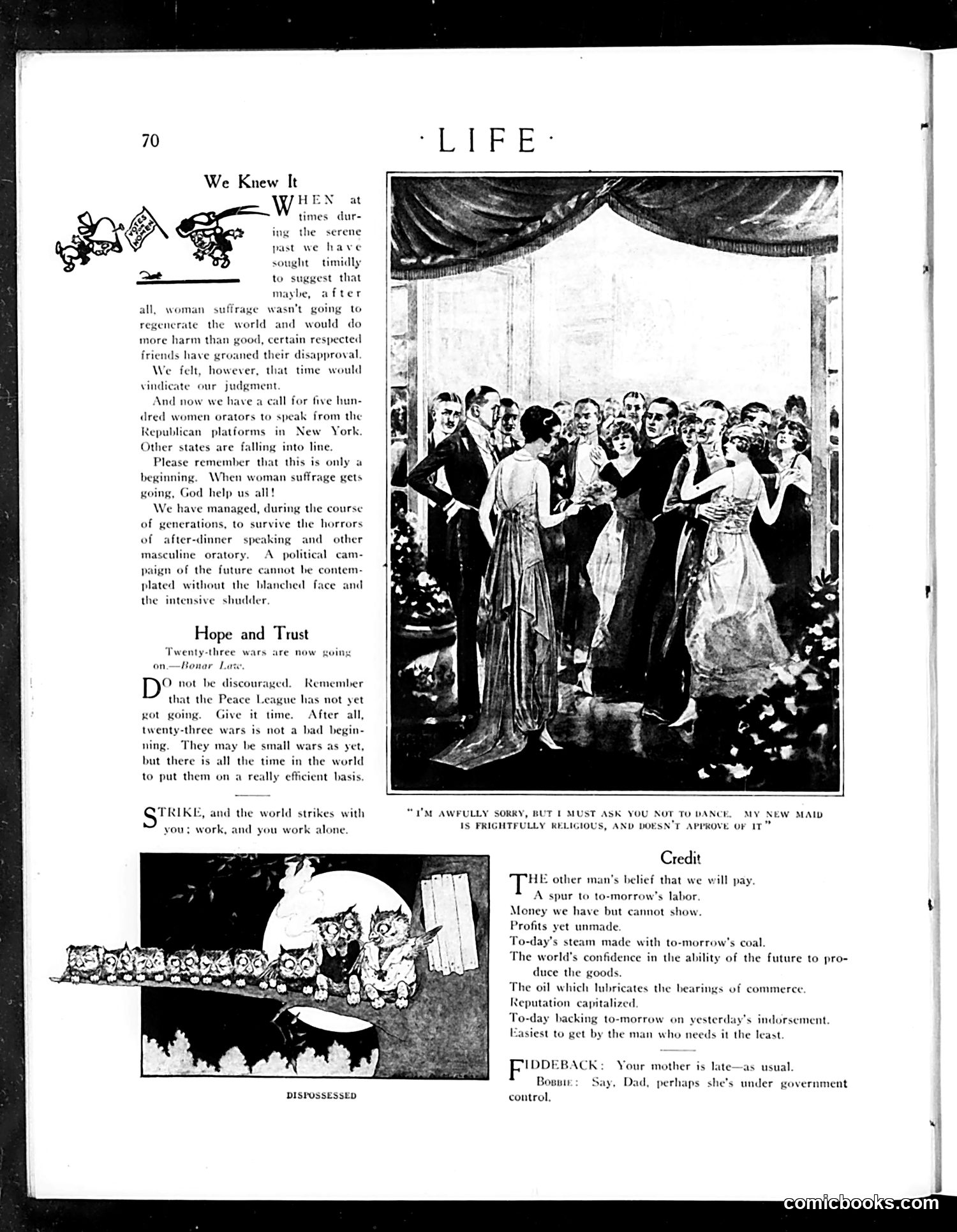
This page contains three satirical pieces mocking early 20th-century American politics and social changes: **"We Knew It"** ridicules women's suffrage. Life claims to have "warned" that voting rights wouldn't improve society, and now predicts five hundred female Republican campaign speakers will inflict "horrors" comparable to bad after-dinner speeches. The satire attacks anti-suffrage pessimism by exaggerating it to absurdity. **"Hope and Trust"** sarcastically dismisses peace efforts. With twenty-three wars ongoing and the Peace League inactive, it mockingly suggests there's "all the time in the world" to escalate conflicts efficiently—implying the League of Nations is useless. **"Credit"** and **"Fiddleback"** offer sardonic observations on economics and government control, the latter joking that government regulation now controls even mothers' schedules. The upper illustration shows a formal social gathering where a maid's religious objections prevent dancing—commentary on servant class influence and shifting social hierarchies.
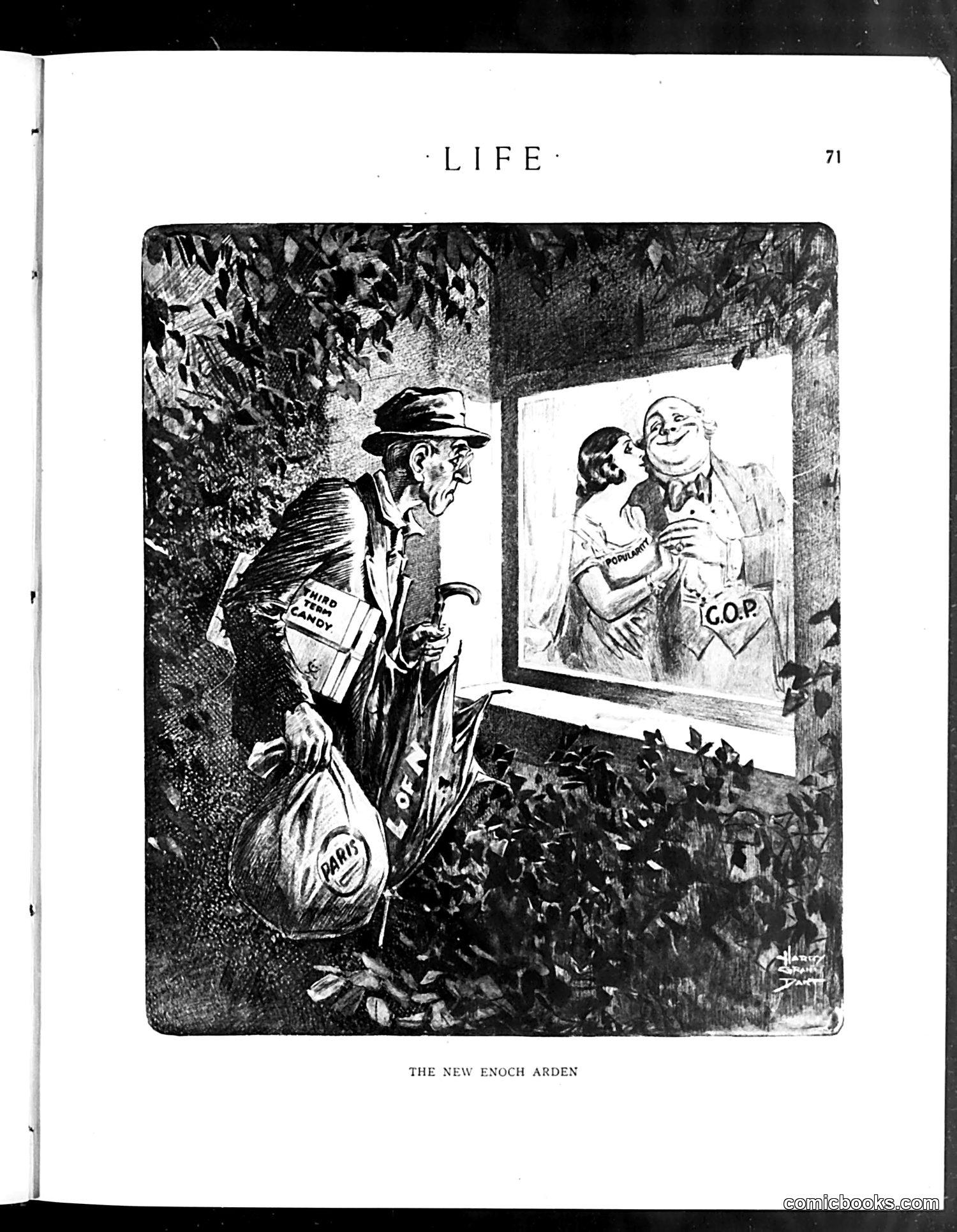
This political cartoon satirizes the Republican Party (G.O.P.) during what appears to be the post-WWI era. On the left, a figure carrying bags labeled "Paris" and "Third Party Candy" peers through a window at a domestic scene. Inside, a woman embraces a rotund man wearing a G.O.P. shirt. The title references "Enoch Arden," a poem about a man who returns home after years away to find his wife remarried. Here, the cartoon suggests the Republican Party has abandoned its previous partner (likely the American electorate or progressive faction) and formed a new alliance—possibly with conservative or business interests. The "third party candy" and Paris references suggest criticisms of Republican foreign policy or financial dealings. The domestic contentment inside contrasts with the outsider's exclusion.
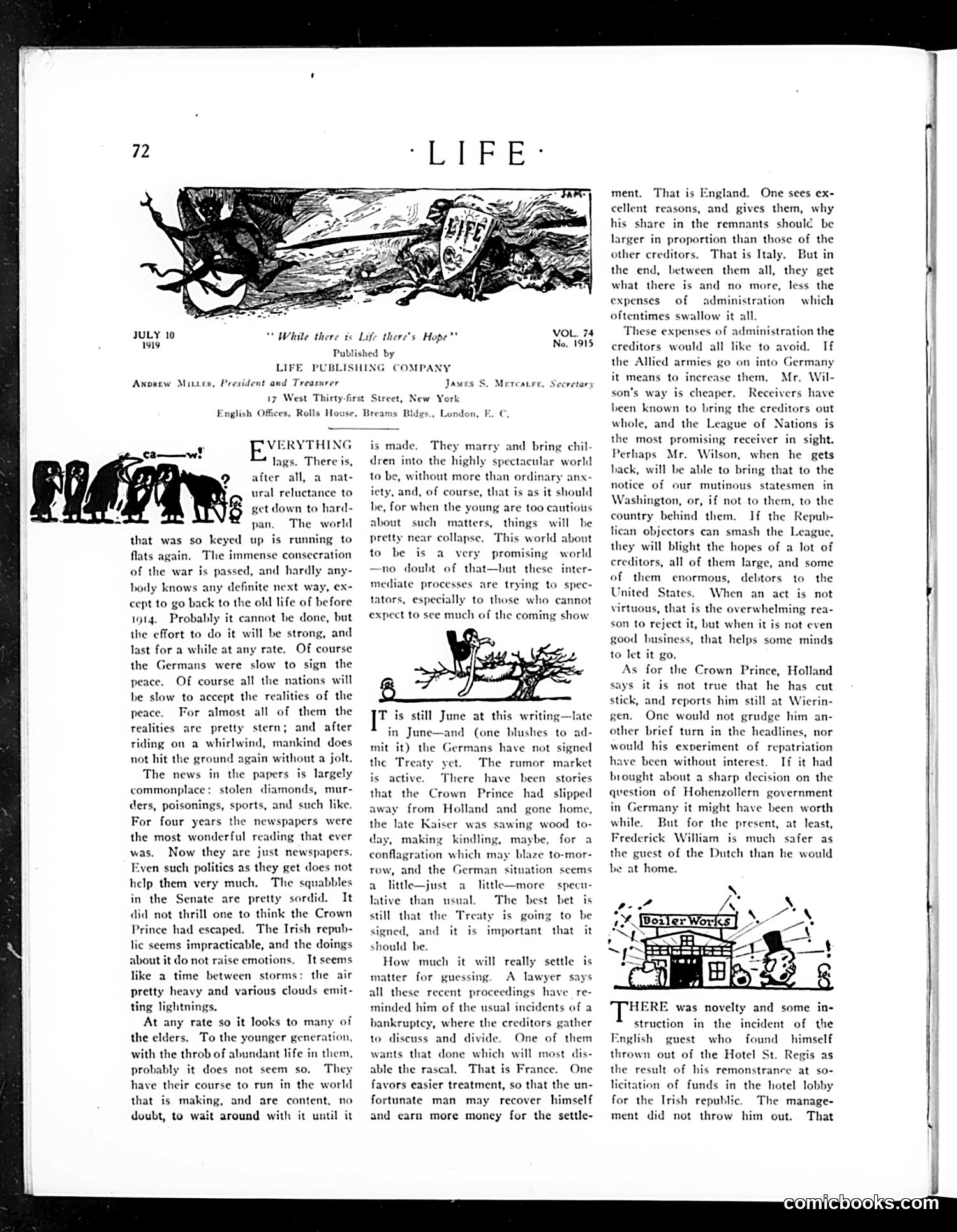
This editorial page reflects America's uncertain mood immediately after World War I's conclusion. The cartoons (visible but small) appear to depict post-war confusion and economic hardship—figures struggling amid the transition from wartime to peacetime. The text discusses how newspapers, once thrilling during four years of war coverage, have returned to mundane crime reporting. The author notes society's exhaustion: people want to return to pre-1914 life, though this may be impossible. The piece uses a bankruptcy metaphor to explain peace negotiations: creditor nations (France, England, Italy) squabble over German reparations like creditors dividing a bankrupt debtor's assets. France wants harsh penalties; England favors recovery (so Germany can pay more); Italy demands its share. The cynical point: administrative costs consume whatever remains. The overall tone suggests post-war letdown—the momentous struggle is over, leaving ordinary corruption and national self-interest exposed.
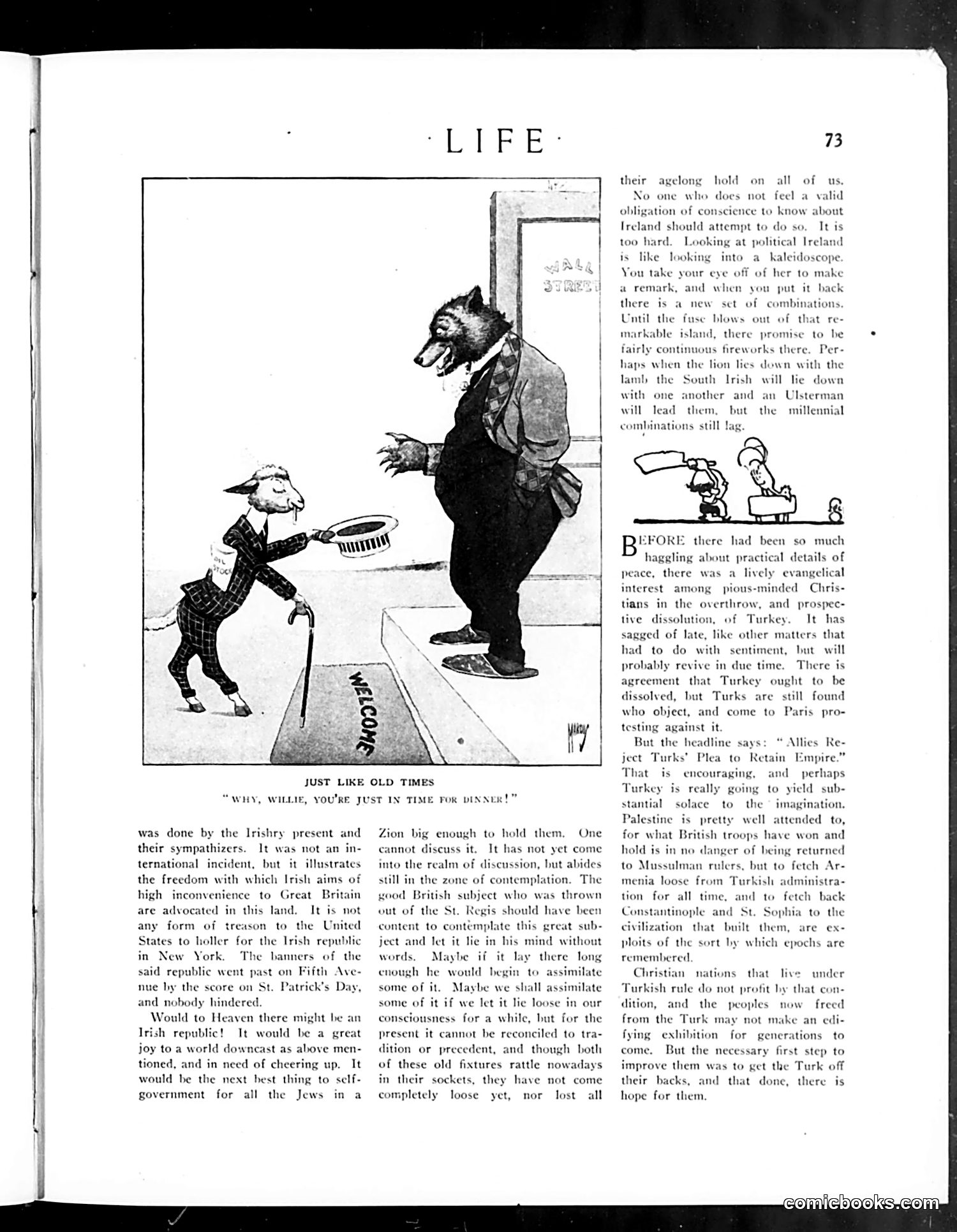
This cartoon depicts a large bear (representing Britain) being served dinner by a small figure labeled "WELCOME" (representing Ireland). The title's ironic reference to "old times" mocks the historical British-Irish relationship. The accompanying text discusses Irish nationalism and self-determination. It notes that Irish republican advocacy occurs freely in America (referencing St. Patrick's Day parades on Fifth Avenue), contrasting this with British discomfort. The author sarcastically suggests Irish politics is too chaotic to comprehend, comparing it to a "kaleidoscope"—constantly shifting combinations. The cartoon satirizes how Ireland, despite its smaller power, must "serve" Britain, while the text explores post-WWI geopolitical questions about Irish independence, Turkish dissolution, and Armenian liberation. The piece reflects American ambivalence toward Irish republicanism and sympathy for various oppressed peoples seeking freedom from empires.
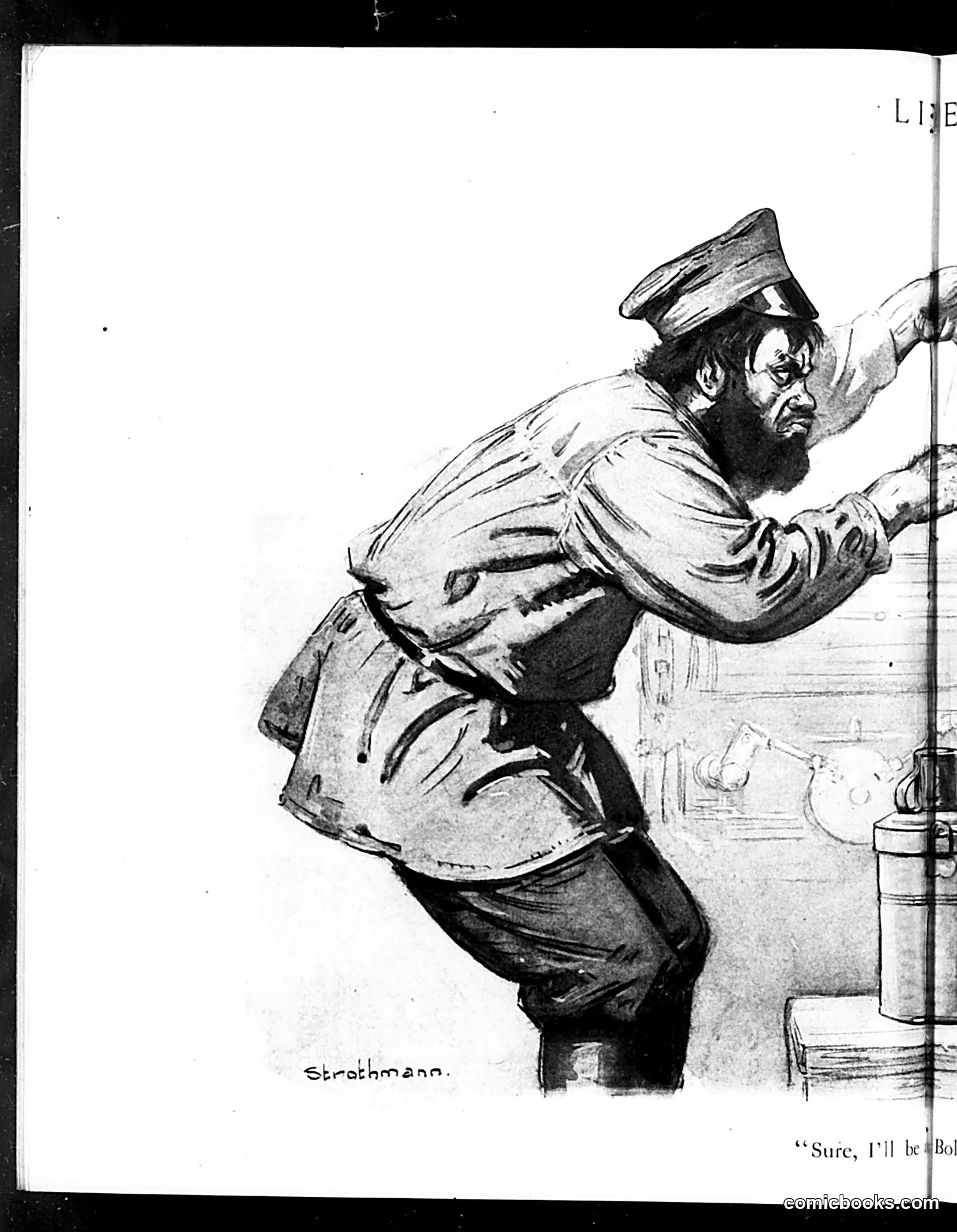
This political cartoon by Strathmano depicts a military or naval officer in uniform peering through what appears to be a periscope or viewing device. The figure is drawn in an exaggerated caricature style with pronounced facial features. The incomplete caption reads "Sure, I'll be Bol" — likely "Sure, I'll be Bolshevik" or similar, suggesting a joke about communist sympathies or infiltration. The cartoon appears to satirize concerns about communist or radical elements within military/government institutions, a common theme in American political satire during the early 20th century. The officer's secretive posture at the viewing device reinforces themes of espionage or hidden allegiances. However, without the complete caption and more context about Life magazine's publication date, the specific target remains unclear.
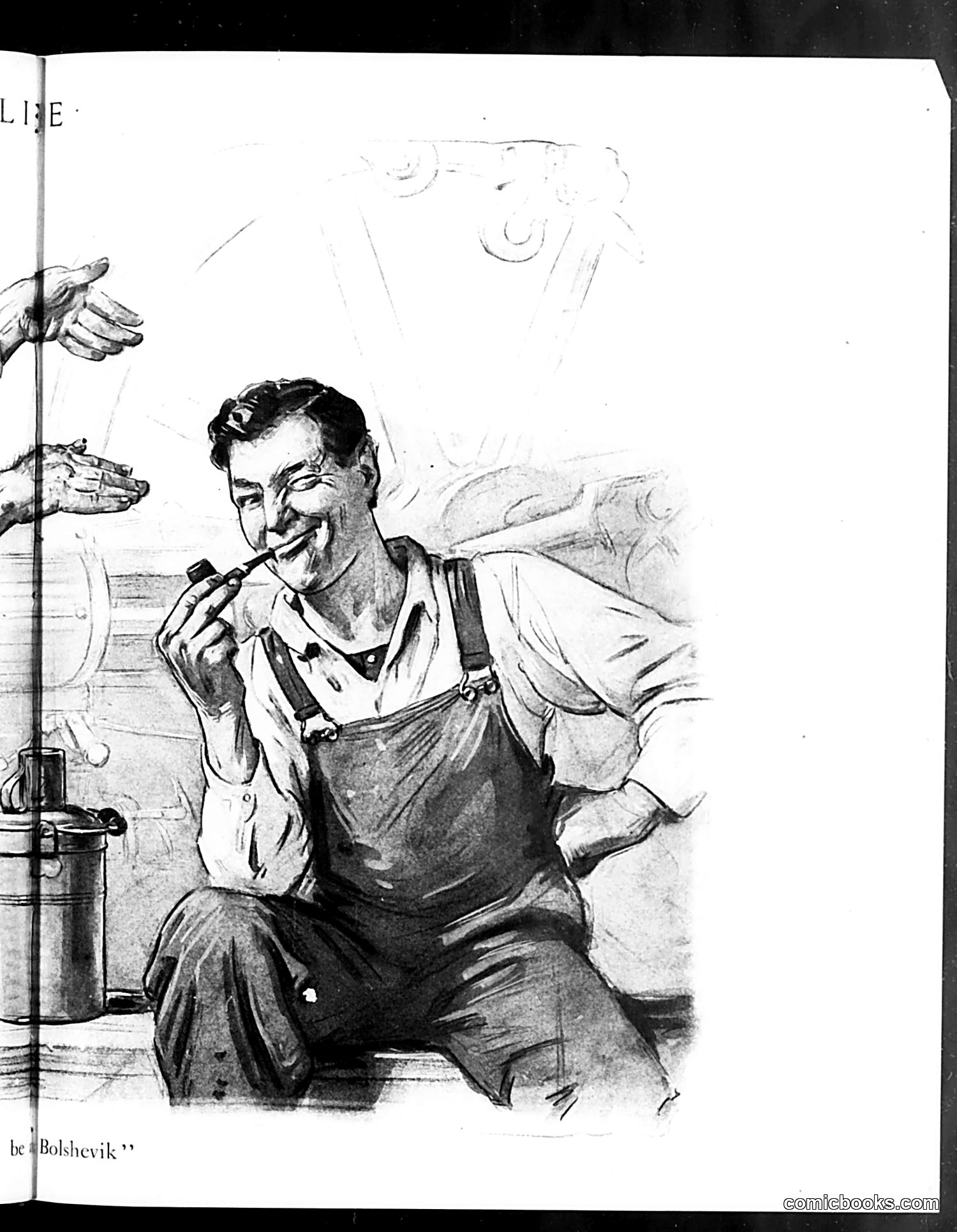
This Life magazine page features a satirical illustration signed by "Bolshevik" (likely the cartoonist's pseudonym or attribution). The drawing depicts a working-class man in overalls, smoking a pipe, appearing content or relaxed. The figure's caricatured features and the styling suggest this is political commentary. The "Bolshevik" signature and the worker imagery indicate this cartoon likely satirizes either Soviet communism or American communist sympathizers during the early 20th century—a period of significant anti-communist sentiment in the U.S. The casual, satisfied demeanor of the worker may mock either communist ideology or American workers perceived as susceptible to communist appeals. The specific political point remains unclear without additional context or caption text that isn't legible in this reproduction.
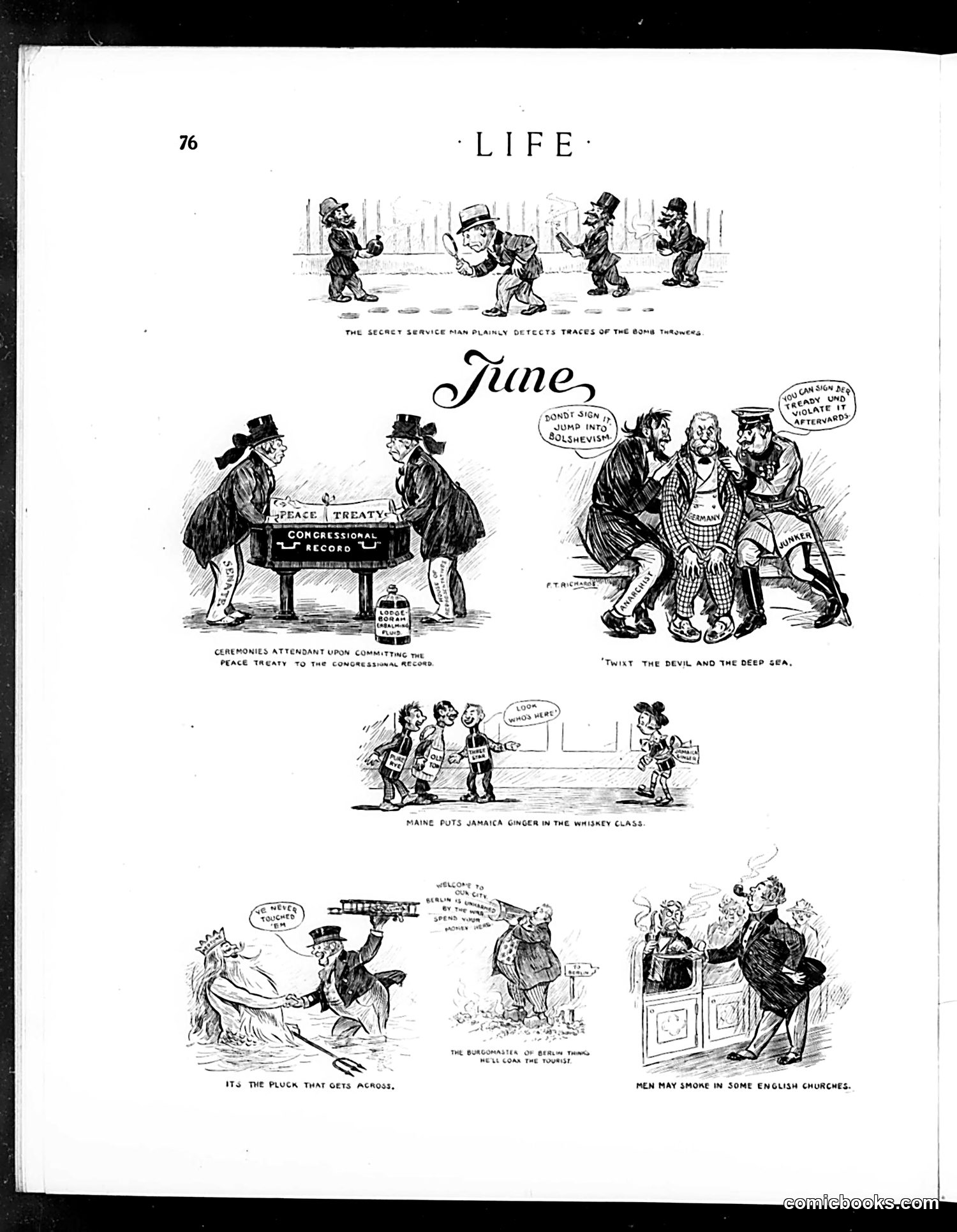
This 1919 satirical page mocks post-WWI events through seven cartoons: **Top row**: References the Peace Treaty being filed in Congressional records, with a "gong thrower" joke about anarchists/radicals. **"'Twxt the Devil and the Deep Sea"**: Depicts someone caught between competing pressures—likely regarding Bolshevism ("jump into Bolshevism") versus conservative opposition. **"Maine Puts Jamaica Ginger in the Whiskey Glass"**: Satirizes Prohibition enforcement, suggesting Maine's strict laws are being evaded. **Bottom cartoons**: Mock German officials ("Burgomaster of Berlin"), international tourism resuming after war, and English church smoking policies. The overall theme appears to be post-war chaos: anarchist threats, Prohibition's difficulties, European reconstruction, and social upheaval. The cartoons present these as humorous absurdities reflecting genuine contemporary anxieties about radicalism, law enforcement, and social order during the turbulent post-war period.
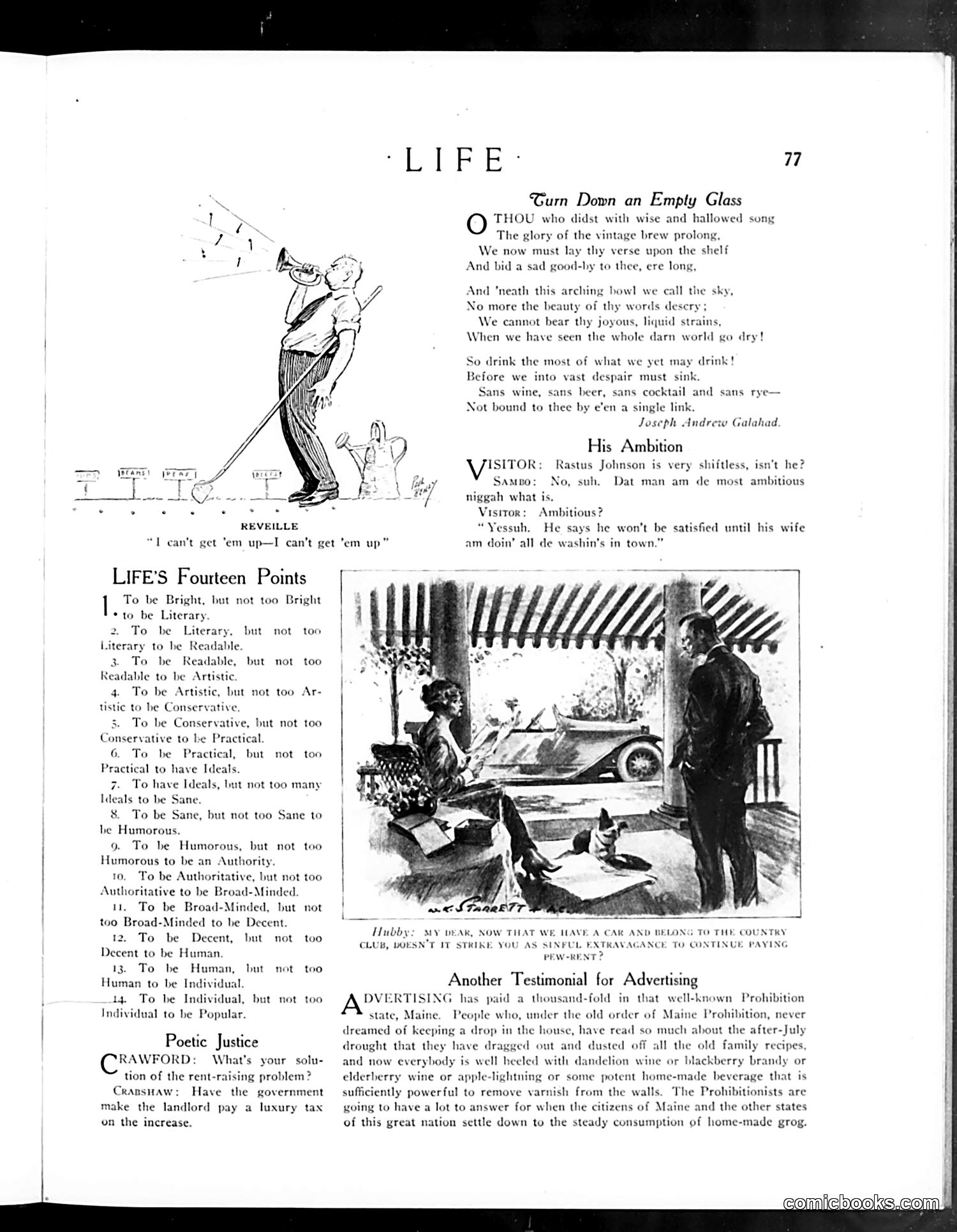
This page satirizes early 1920s American life, centered on **Prohibition's failure**. The "Turn Down an Empty Glass" poem mourns alcohol's legal disappearance, written in mock-tragic verse. The **"His Ambition"** joke mocks both racial stereotypes and marital dynamics: a Black man named Rastus Johnson's "ambition" is merely wanting his wife to monopolize the town's laundry work—presenting laziness disguised as ambition. **"Life's Fourteen Points"** parodies Wilson's post-WWI diplomatic framework by applying it to magazine editorial balance: being "bright but not too bright," "artistic but not too conservative," etc.—satirizing the impossible middle-ground publications must navigate. The **final section attacks Prohibition directly**: advertising's success in Maine inadvertently drove people to home-brewing dangerous substitutes (dandelion wine, apple-lightning) potent enough to "remove varnish from walls." The satire suggests Prohibition creates worse problems than it solves.
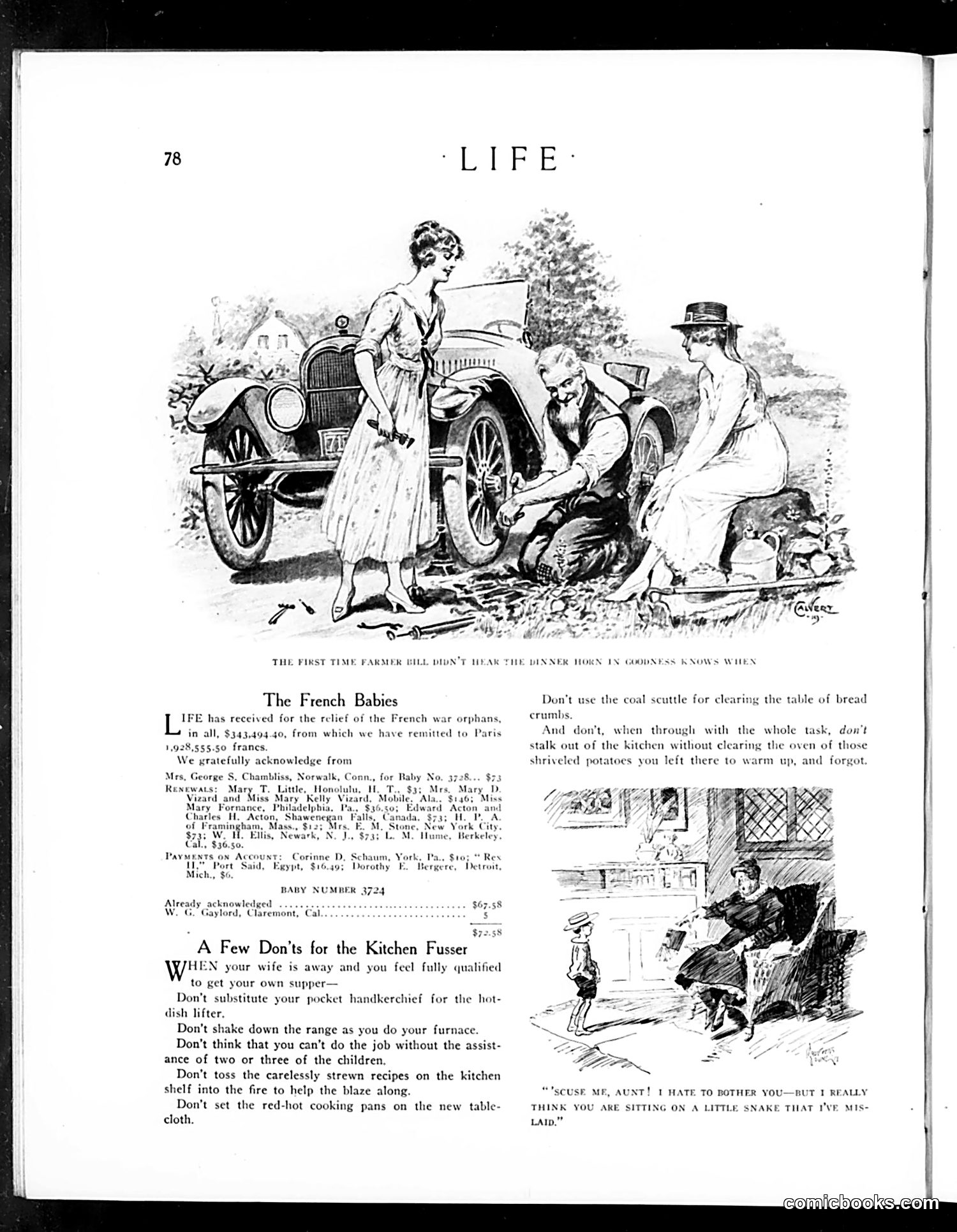
This page contains two satirical pieces from Life magazine: **"The French Babies"** (top): A fundraising announcement for French war orphans relief, presented with dry humor. Life acknowledges receiving $343,494.40 in donations but notes only $55.50 francs were actually remitted to Paris—a joke about administrative overhead or mismanagement of charitable contributions. The accompanying illustration shows a car breakdown, with the caption's pun about "dinner horn" being unheard. **"A Few Don'ts for the Kitchen Fusser"** (bottom): Humorously patronizing advice for husbands attempting to cook while wives are away. The "don'ts" mock men's incompetence in the kitchen—substituting handkerchiefs for pot holders, destroying new tablecloths, involving children as helpers, and leaving burnt food in the oven. The accompanying cartoon shows a woman sitting obliviously while a child warns her about a snake, playing on the theme of domestic chaos. Both pieces reflect early 20th-century gender stereotypes about domestic work and male inadequacy in household tasks.
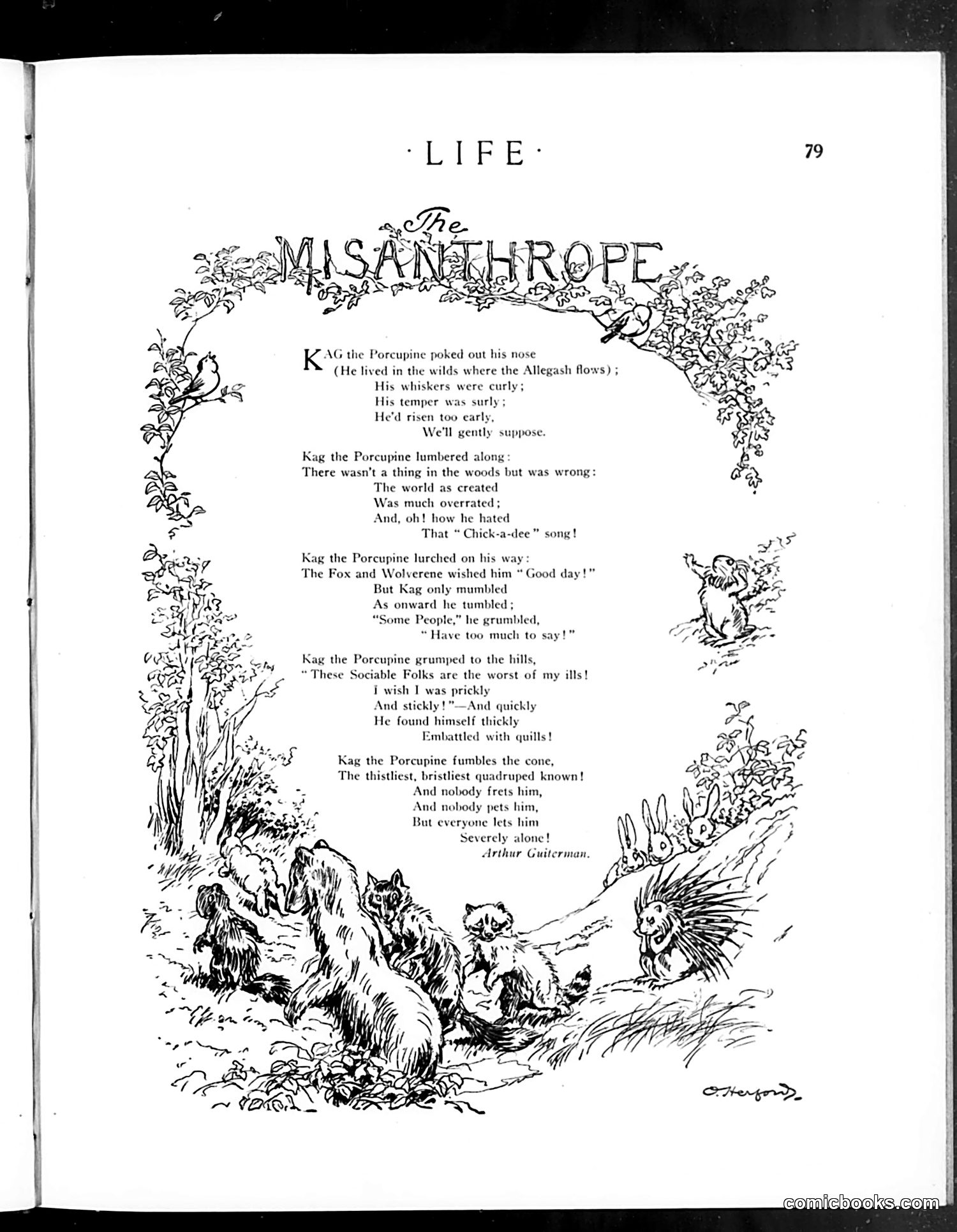
This is a humorous poem about Kag the Porcupine—a grumpy, antisocial creature who complains that the world is wrong and despises talkative animals. He wishes to be left alone, and ironically, his prickly quills ensure he gets exactly what he wants: everyone avoids him completely. The satire targets **misanthropic personalities**—those who withdraw from society while simultaneously resenting social interaction. Kag's wish to be "prickly" and "sticky" is granted literally when he becomes "embattled with quills," yet achieves his goal of isolation. The moral is gentle: the misanthrope's defensive nature guarantees the loneliness he claims to want, but the poem suggests this isolation may be self-inflicted rather than deserved. The accompanying illustration shows woodland animals (raccoons, fox, porcupine) in a forest scene, visualizing the creature's solitary status.
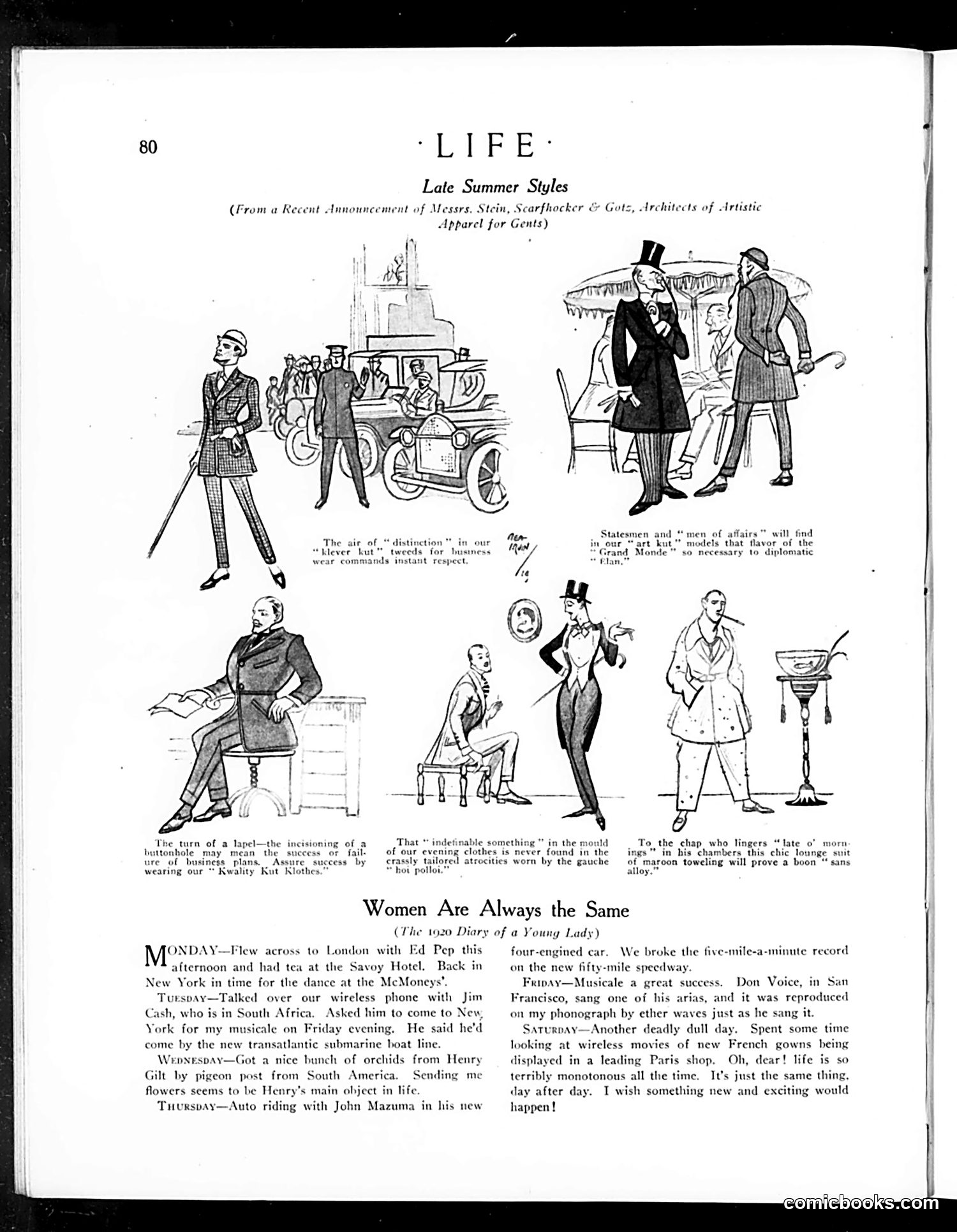
This 1920s *Life* page contains two satirical pieces mocking upper-class society. **"Late Summer Styles"** parodies pretentious menswear advertising. The sketches mock designers claiming that subtle details (lapel turns, buttonholes) signal wealth and social distinction. The satire targets the "Kwality Kut Klothes" pitch—suggesting that expensive tailoring is merely marketing snobbery designed to flatter the wealthy into believing their clothes convey superiority and diplomacy. **"Women Are Always the Same"** presents a wealthy young woman's diary boasting of constant luxury travel and male suitors (London, submarine boats, orchids from South Africa, wireless phones, phonographs). The joke's punchline—"life is so terribly monotonous all the time. It's just the same thing, day after day"—satirizes privileged ennui. Despite extraordinary modern conveniences and romantic attention, she finds life boring, mocking the shallowness and entitlement of the leisure class. Both pieces use exaggeration to critique 1920s materialism and the empty lives of the wealthy.
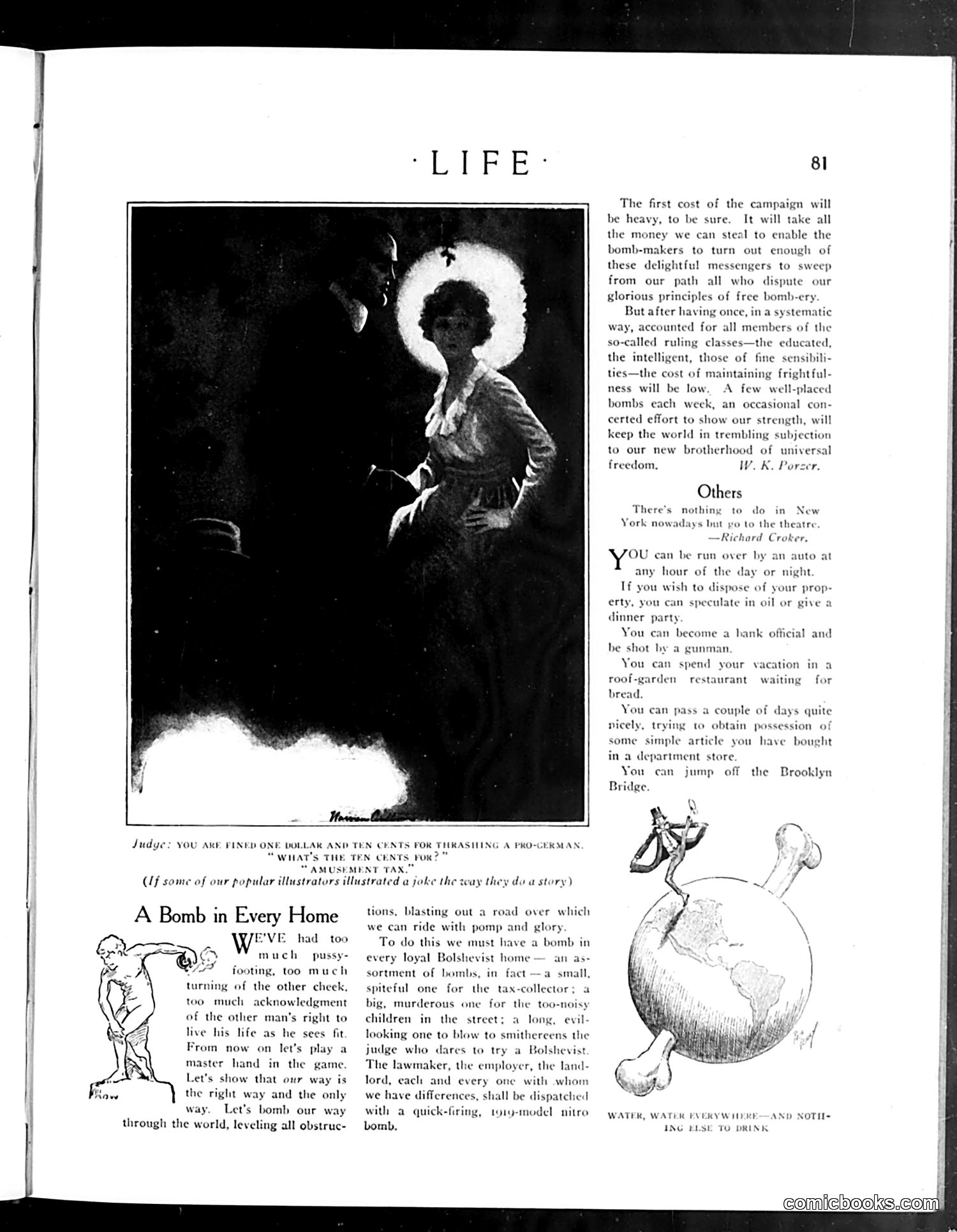
This page satirizes **Bolshevik/anarchist violence** during the Red Scare era (likely 1919-1920s). The main cartoon, "A Bomb in Every Home," mocks revolutionary rhetoric by taking it literally. It presents a Bolshevik manifesto advocating placing bombs in homes—targeting tax collectors, noisy children, judges, lawmakers, and employers. The satire operates by presenting the extremist position without editorial comment, letting the absurdity speak for itself. The accompanying illustrations mock other contemporary urban hazards: auto accidents, financial speculation, being shot by gunmen, and suicide (Brooklyn Bridge jump). These position political violence alongside everyday American dangers. A small judge cartoon jokes about an "amusement tax" fine for hitting a German—referencing post-WWI anti-German sentiment. The attribution to "W.K. Porser" suggests this is satirizing actual anarchist propaganda. The overall message is clear: **Life magazine is mocking revolutionary bomb-throwing as dangerous and absurd**, presenting it as one catastrophe among many afflicting modern American society.
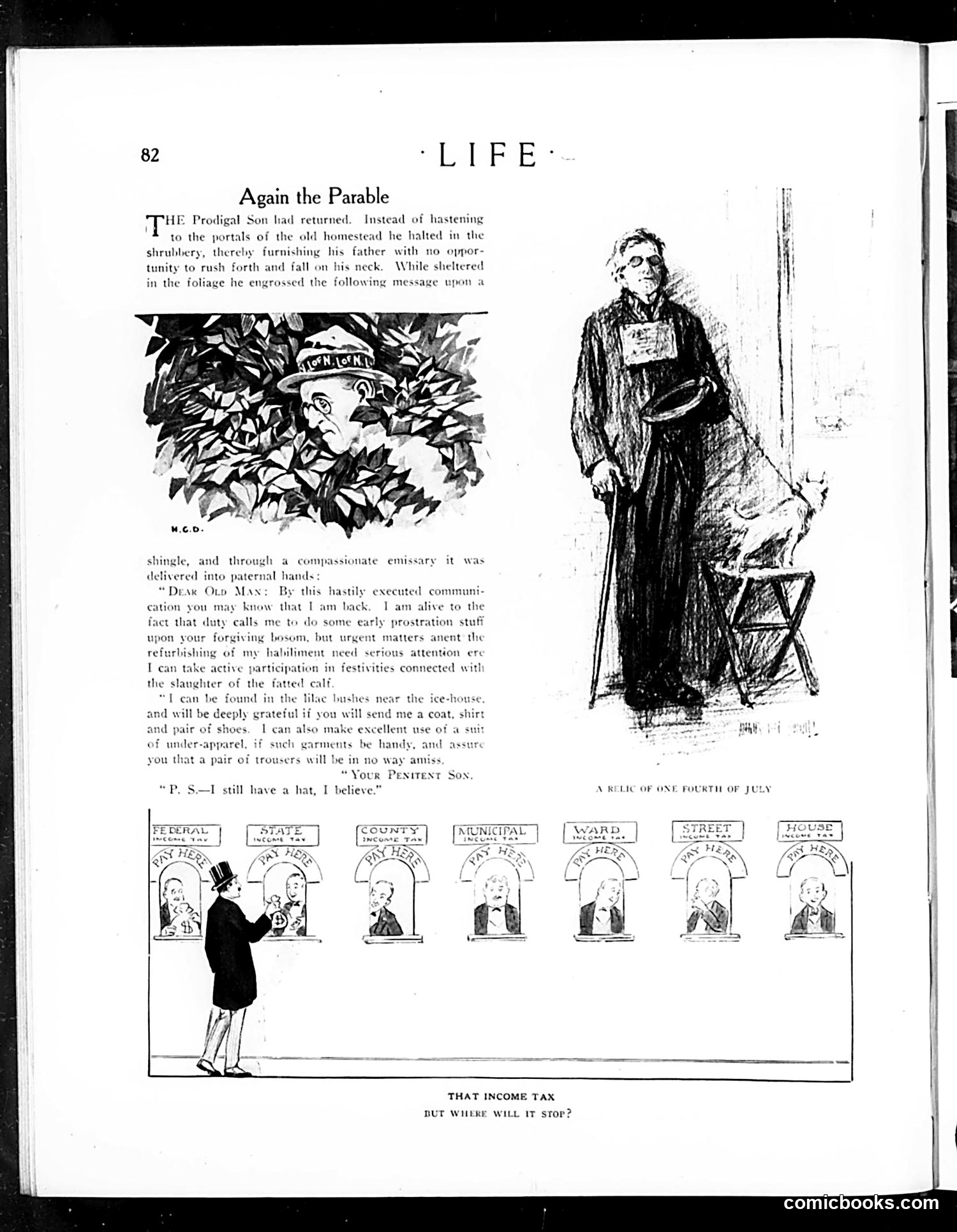
This page contains two satirical pieces from Life magazine: **"Again the Parable"** (top): A modern retelling of the Biblical Prodigal Son story. Instead of rushing to embrace his father, the returning son hides and sends a letter requesting clothes, shoes, and undergarments before facing him. The satire mocks wealthy young men who squander their fortunes and then shamefully return home asking for handouts—treating serious moral redemption as mere inconvenience while prioritizing material needs. **"That Income Tax: But Where Will It Stop?"** (bottom): The cartoon shows a man confronting multiple government tax windows (Federal, State, County, Municipal, Ward, Street, House). Each official demands payment. The satire expresses anxiety about the expanding income tax system—a then-newer form of taxation—suggesting it will proliferate endlessly across government levels, ultimately consuming all income. Both pieces express class anxiety and frustration with institutional systems of the era.
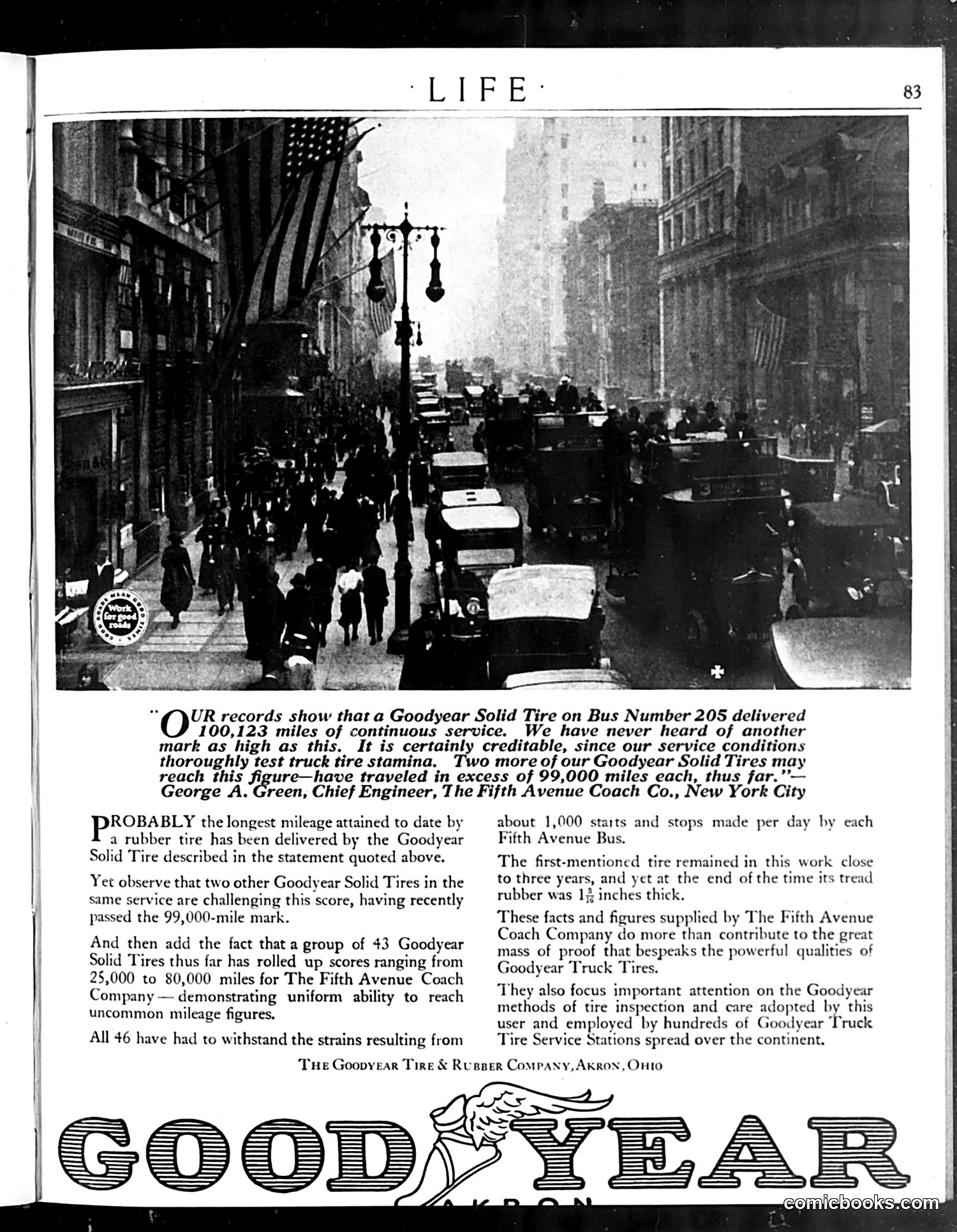
This is a **Goodyear Tire advertisement**, not satire or political commentary. The page features a photograph of a busy Fifth Avenue in New York City with buses and pedestrians, used to showcase real-world conditions. The ad presents testimonial evidence from George A. Green, Chief Engineer of The Fifth Avenue Coach Co., documenting exceptional tire durability: one Goodyear Solid Tire delivered 100,123 miles of continuous service on a city bus enduring approximately 1,000 starts and stops daily. Two additional tires exceeded 99,000 miles. The advertisement's strategy is to prove tire quality through concrete performance data rather than mere claims. By citing a specific, verifiable achievement (a bus tire lasting close to three years while maintaining tread thickness), Goodyear establishes credibility and suggests their products are suitable for the demanding conditions of commercial urban transport. This represents early 20th-century corporate marketing emphasizing documented results and engineering expertise.
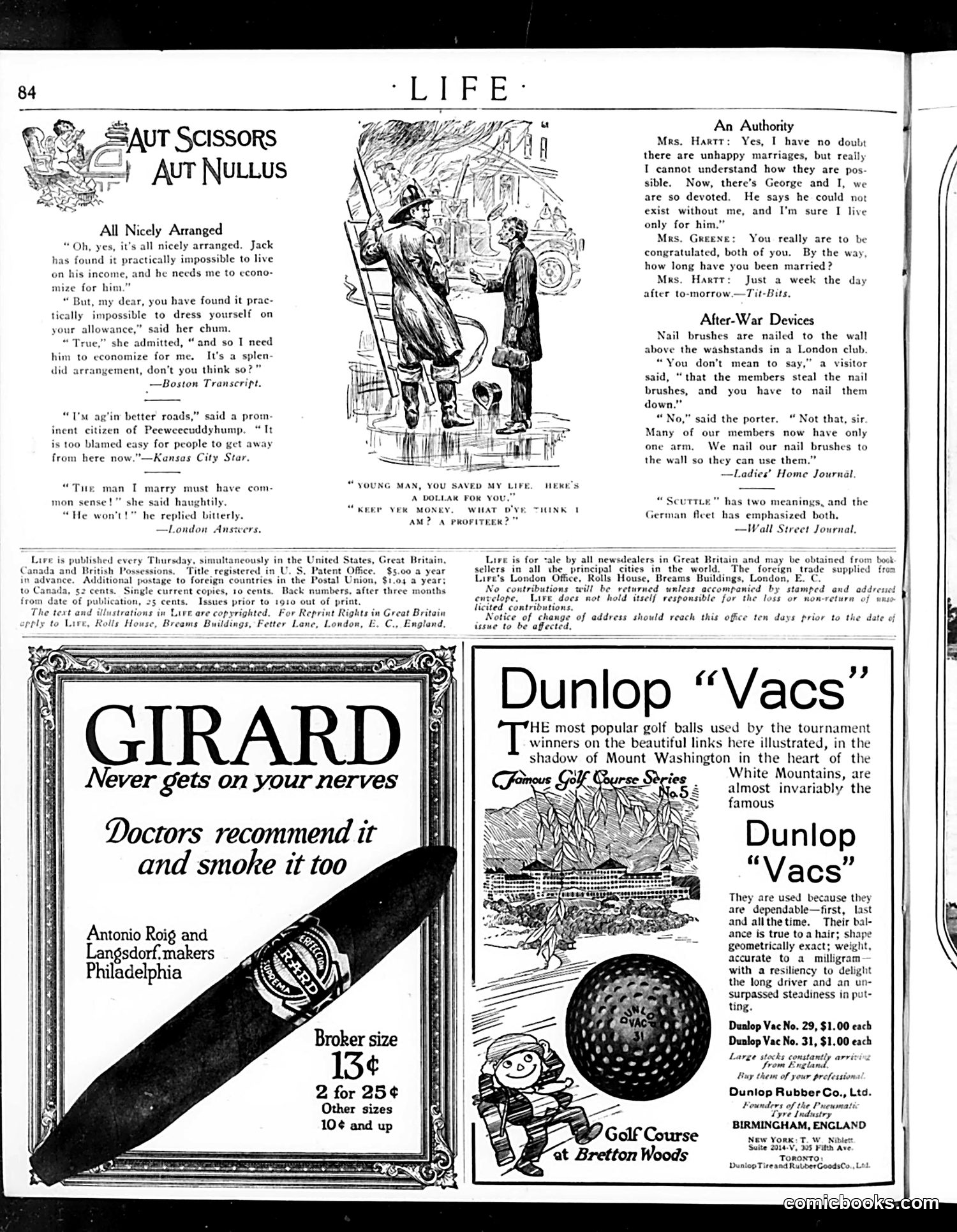
This page primarily contains **advertisements and filler humor** rather than political cartoons. The "Aut Scissors Aut Nullus" section presents three brief satirical jokes about everyday life: 1. A couple's circular financial logic—he can't live on his income, so she must economize; yet she can't dress on her allowance, so he must economize for her. 2. A politician advocating for better roads while opposing the taxes to fund them. 3. A woman demanding a husband with "common sense," which her companion dismissively says won't happen. These are genteel domestic humor typical of early 20th-century Life magazine—poking fun at marriage economics, political hypocrisy, and gender relations without sharp bite. The page also includes an "Authority" advice column and "After-War Devices," plus substantial advertising for Girard cigars and Dunlop golf balls. The cartoons are generic illustrations rather than pointed political satire.
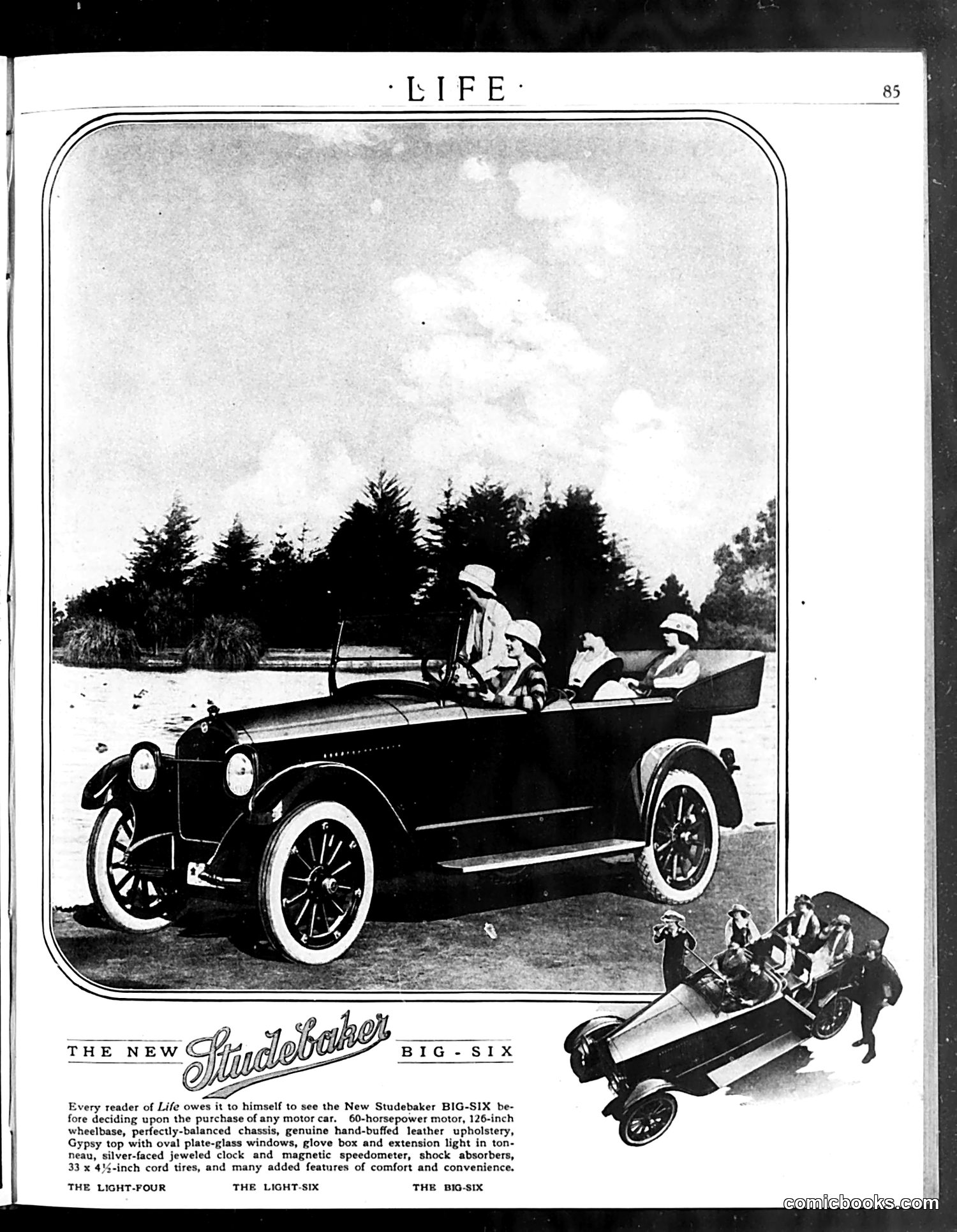
This is **not a cartoon or satire**, but rather a straightforward **automobile advertisement** for the Studebaker Big-Six, placed in *Life* magazine (page 85). The image shows a luxury car of the 1910s-1920s era with several well-dressed passengers, photographed in an idealized outdoor setting. The ad emphasizes technical specifications (60-horsepower motor, 126-inch wheelbase) and luxury features (hand-buffed leather, jeweled clock, plate-glass windows). The bottom shows three Studebaker models available: the Light-Four, Light-Six, and Big-Six. There is no political satire or social commentary here—this is a product advertisement highlighting Studebaker's automobile line to affluent readers. The "satirical" *Life* magazine's editorial content appears elsewhere; this page is purely commercial.
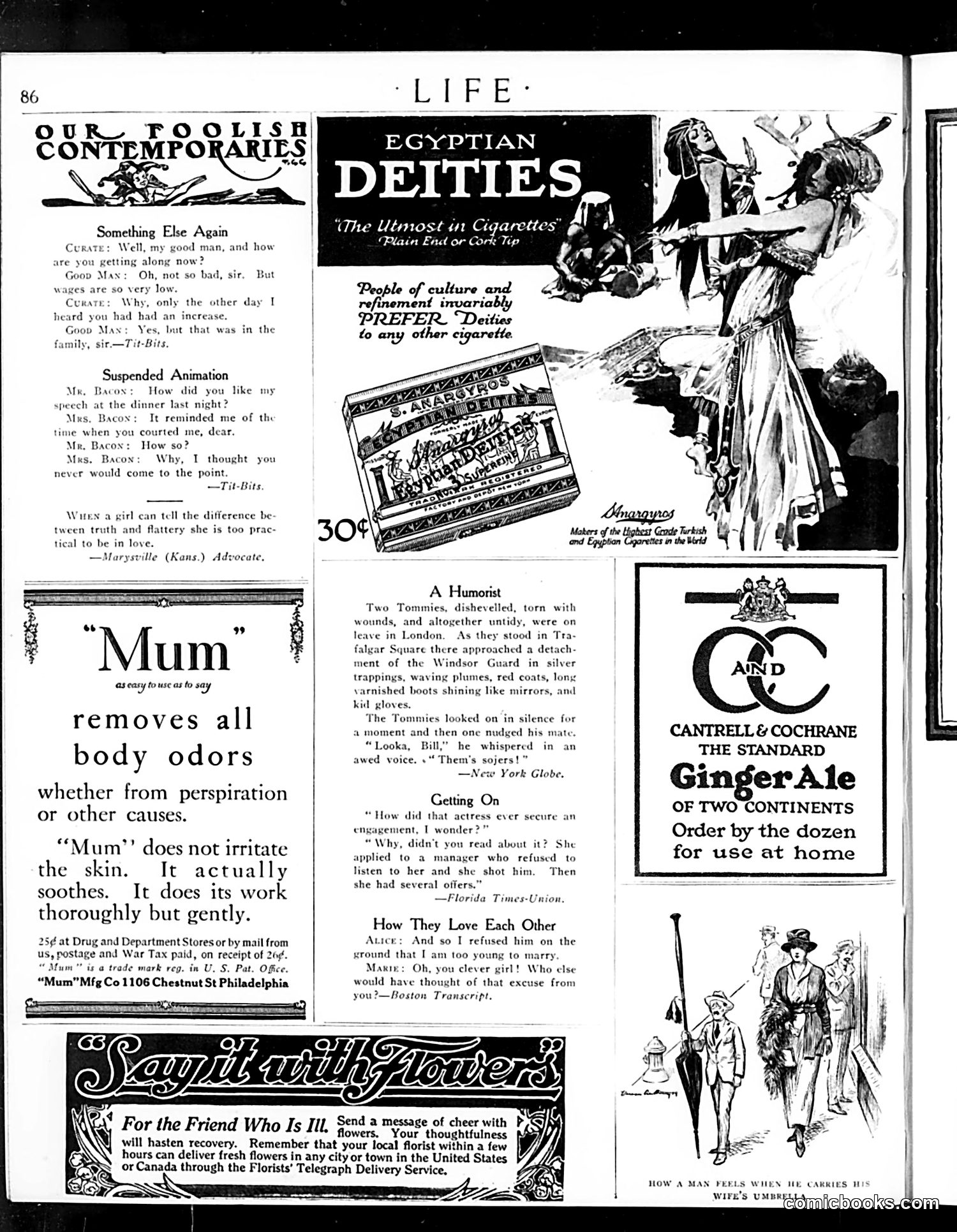
This page contains multiple satirical items and advertisements typical of early 20th-century Life magazine. **"Egyptian Deities" Advertisement**: A cigarette ad cleverly playing on Egyptian imagery and classical allusions. The phrase "Deities" suggests superiority and appeals to aspirational notions of "culture and refinement"—a common advertising strategy of the era. **The Humor Sections**: Three brief jokes reflecting period attitudes: - "Something Else Again" jokes about wage stagnation - "Suspended Animation" contrasts a man's boring speech to his courtship (implying he never "came to the point") - A WWI-era anecdote mocking the contrast between battle-hardened soldiers ("Tommies") and the pristine appearance of the Windsor Guard, suggesting the guards' elaborate uniforms are impractical **Advertisements**: "Mum" deodorant, Gingerade, and floral delivery services dominate the page—standard consumer marketing from this period. The humor and advertising reflect early 1900s sensibilities: class consciousness, gender roles, and post-WWI attitudes toward military display.
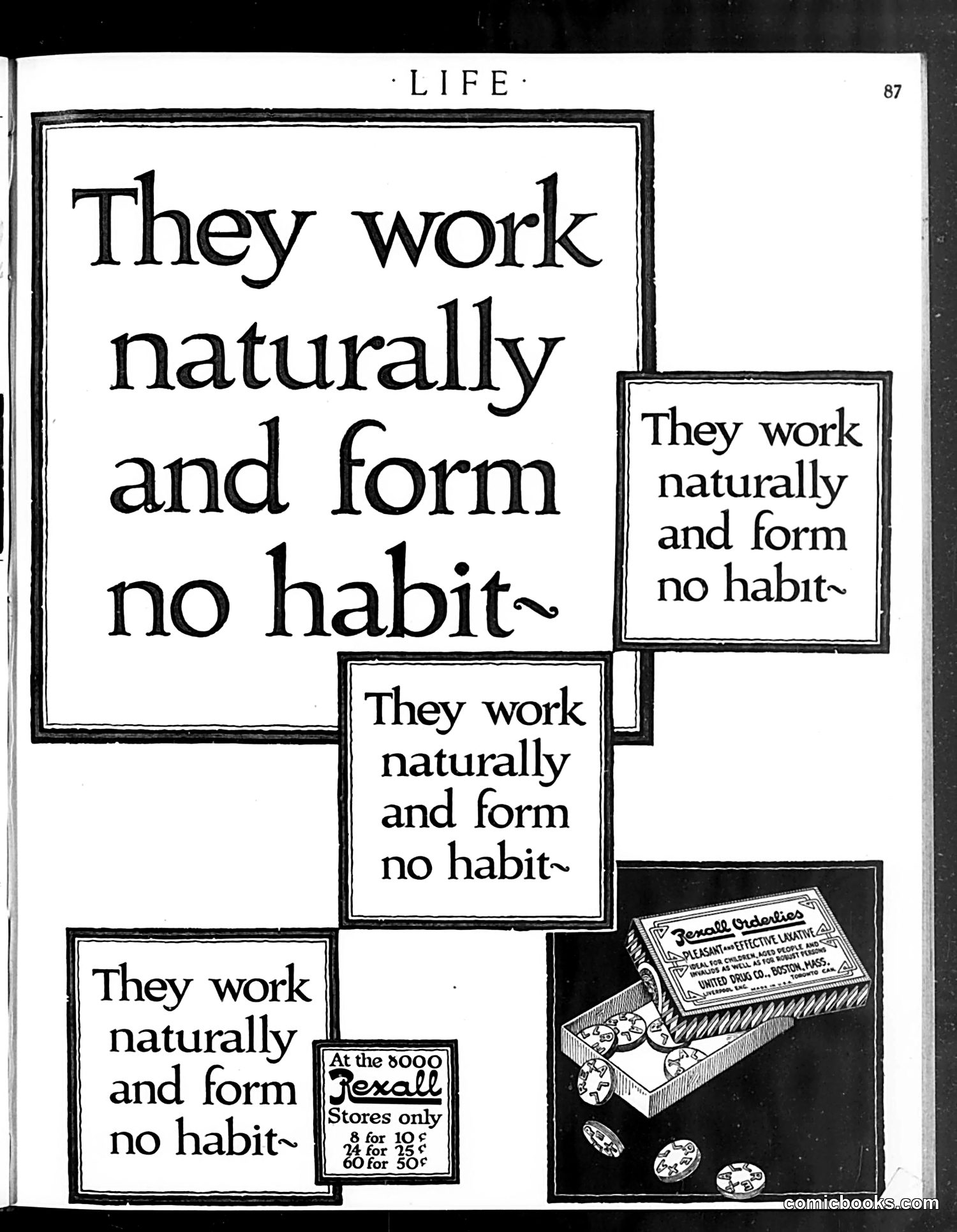
This is primarily an **advertisement for Rexall products**, not political satire. The repeated phrase "They work naturally and form no habit" appears to be a marketing claim emphasizing that Rexall medications or remedies are safe and non-addictive—a significant selling point in the early 20th century when drug addiction and habituation were genuine public health concerns. The visual repetition of the message in decreasing box sizes creates an eye-catching design typical of period advertising. The product image shows what appears to be a Rexall medicine box with several pills or lozenges displayed. The note about "At the 8000 Rexall Stores only / 8¢ for 10¢ / 25¢ for 50¢" indicates widespread availability and pricing. This is **commercial advertising rather than editorial content**.
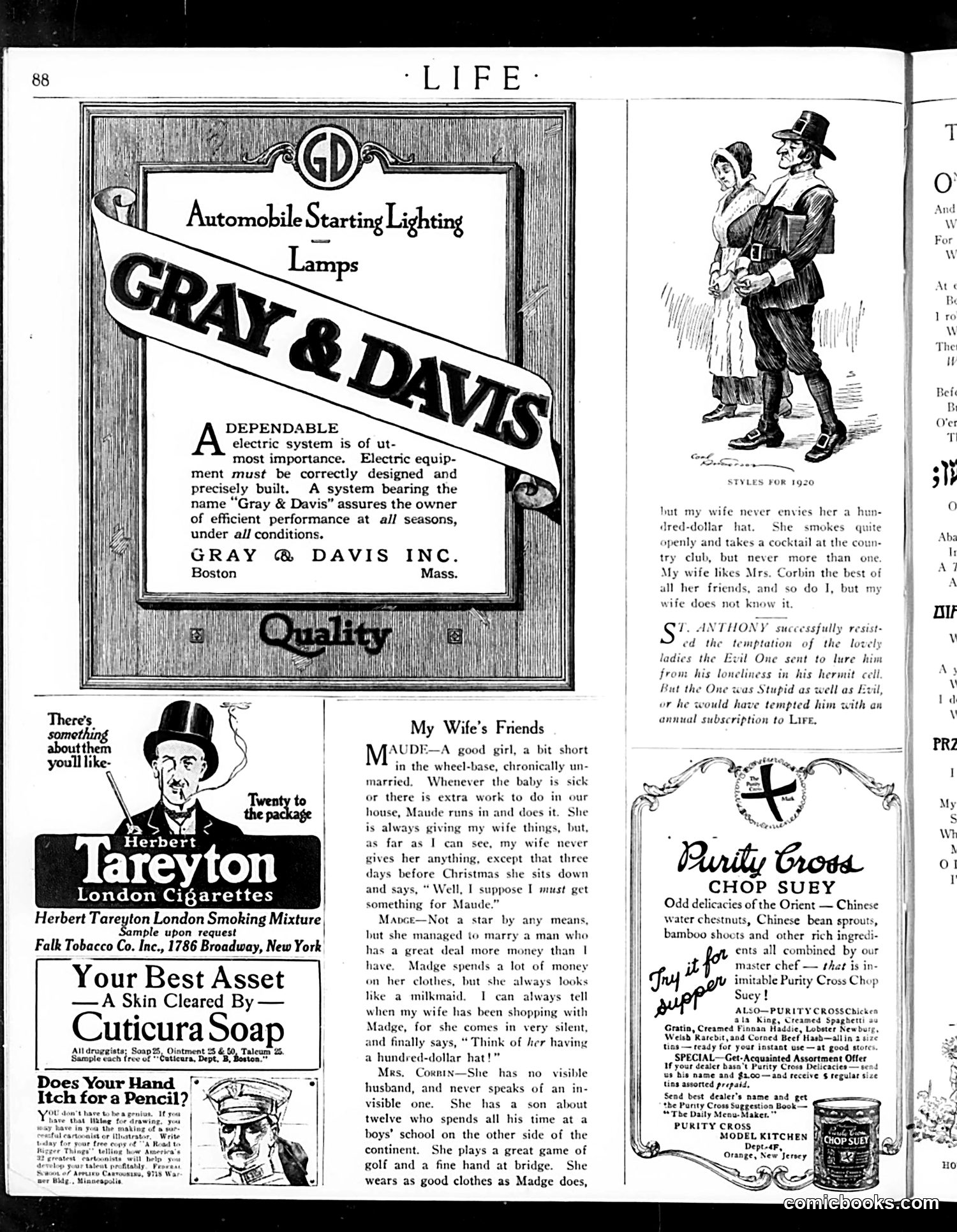
This page features a humorous essay satirizing female social types and class anxiety among wives in the 1920s. The author sketches three of his wife's friends, revealing social anxieties of the period: **Maude** represents the unglamorous, perpetually single working woman who serves as convenient household help—exploited through social obligation rather than genuine friendship. **Madge** embodies nouveau-riche pretension: she marries wealth but lacks elegance, wearing cheap-looking clothes despite expensive shopping sprees that make the author's wife insecure. **Mrs. Corbin** is presented as the ideal—tasteful, independent, financially secure, composed. Notably, she's a divorcée or widow who smokes and drinks cocktails (scandalous by earlier standards) yet commands respect through confidence rather than conspicuous consumption. The satire critiques wives' competitive materialism and status-consciousness, while praising authenticity and restraint. The closing joke equates an annual *Life* subscription to temptation itself—the magazine's ironic self-promotion. The surrounding advertisements (soap, cigarettes, automobile lamps) represent typical 1920 consumer culture contexts.
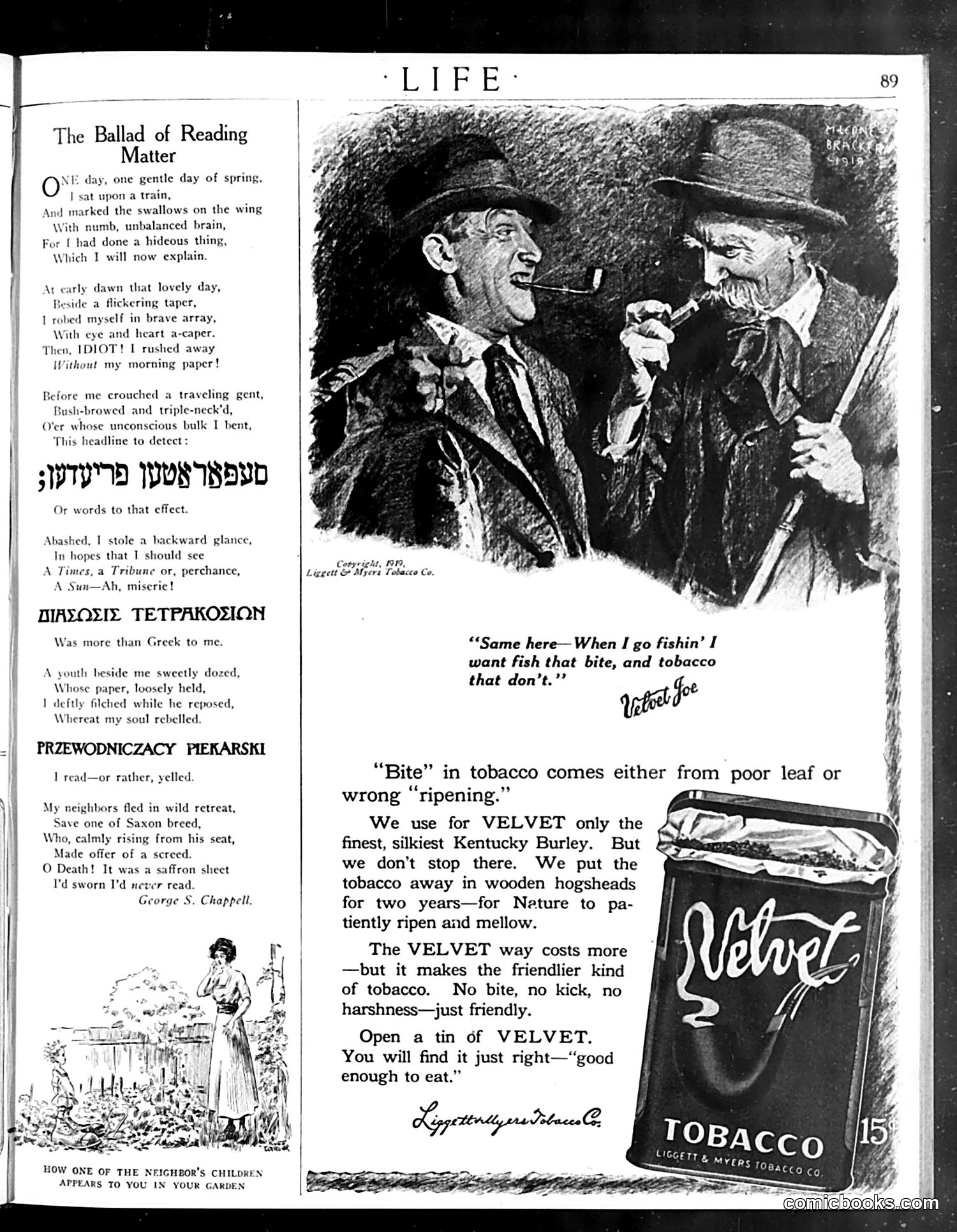
This page combines literary satire with tobacco advertising. "The Ballad of Reading Matter" is a humorous poem parodying Oscar Wilde's "The Ballad of Reading Gaol." The joke: a commuter on a train desperately seeks *any* readable newspaper but encounters only foreign-language publications (Greek, Polish text visible) and eventually a publication so objectionable he'd sworn never to read it—the punchline being that boredom makes even distasteful reading appealing. The accompanying Velvet Tobacco advertisement co-opts this narrative, using a fishing-themed illustration where a man claims he wants fish that "bite" and tobacco that doesn't. The ad explains that Velvet's quality comes from proper aging, eliminating the harsh "bite" inferior tobaccos produce. The integration of literary humor with product messaging was typical of Life magazine's advertising approach—using entertainment to sell products. By modern standards, the casual tobacco promotion to a general audience (including implied younger readers) would be unthinkable.
This page contains **advertisements rather than satire or political cartoons**. The left side advertises **Pall Mall cigarettes** and **The Hollenden hotel in Cleveland**, featuring an illustration of well-dressed guests in a refined setting—appealing to aspirational middle-class consumers concerned with "tone and refinement." The right side advertises **White Rock ginger ale** (10¢) and **G. Washington Coffee** (instant/prepared coffee). The Washington's Coffee ad emphasizes "The First Reason" to buy: quality and taste, highlighting that it's "absolutely pure coffee ready for instant use"—marketing the convenience of this early instant coffee product to busy consumers. All copy reflects early 20th-century consumer culture and pricing typical of the era. There is no political commentary or satirical intent visible on this particular page.
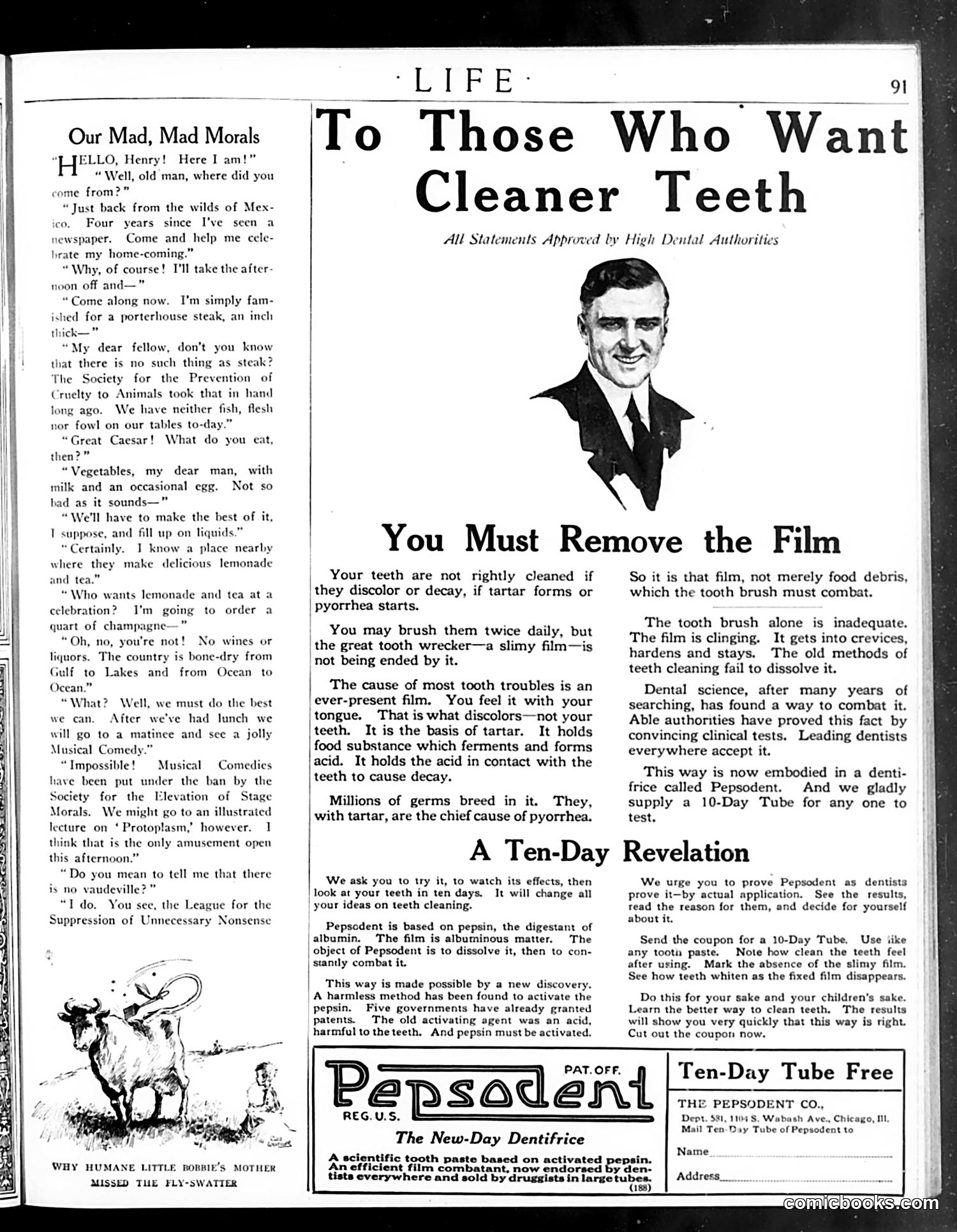
**Left Column — "Our Mad, Mad Morals":** This is satirical dialogue mocking excessive American moral reformism of the Prohibition era (likely 1920s). A man returning from Mexico after four years finds society transformed by activist organizations: the Society for Prevention of Cruelty to Animals has eliminated meat; Prohibition has banned alcohol; the "Society for the Elevation of Stage Morals" has censored entertainment; and a "League for the Suppression of Unnecessary Nonsense" has outlawed vaudeville. The joke is that well-intentioned moral crusades have eliminated all pleasure from civilization—reducing citizens to vegetables, lemonade, and lectures on protoplasm. The cartoon below (showing a mother protecting a fly) darkly extends this: even killing insects now violates "humane" principles. **Right Column — Pepsodent Advertisement:** This is a straightforward early toothpaste ad claiming a new "film-dissolving" technology using pepsin, approved by dental authorities. It occupies most of the page and offers a free 10-day trial tube. The juxtaposition is ironic: amid satire about excessive moral restriction, a commercial promises scientific liberation through better dental hygiene.
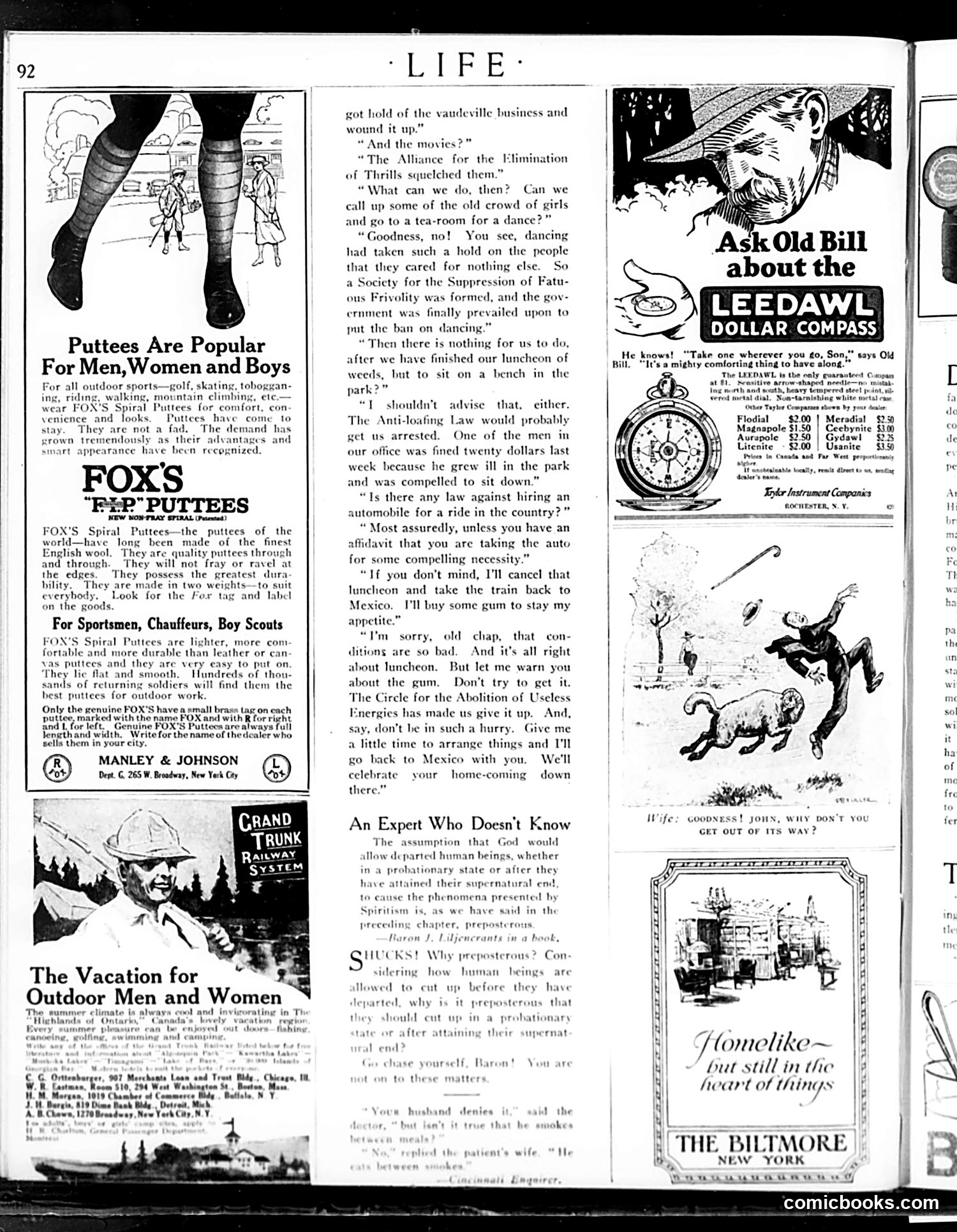
This page satirizes excessive social prohibition and regulation in 1920s America. The central dialogue mocks a society so obsessed with banning "frivolous" activities that virtually all entertainment is outlawed: vaudeville, movies, dancing, loafing in parks, and even chewing gum are all prohibited by various reform societies and laws. The joke's target appears to be moral crusaders and reform movements of the era—groups like the "Society for the Suppression of Fatuous Frivolity" and "Circle for the Abolition of Useless Energies" (invented names reflecting real prohibition-era sentiment). The visiting friend's only escape is to return to Mexico, implying that America has become unbearably restrictive. The surrounding advertisements for puttees, compasses, and the Biltmore Hotel represent normal commercial life, contrasting sharply with the satirized landscape where nearly every pleasure is criminalized.
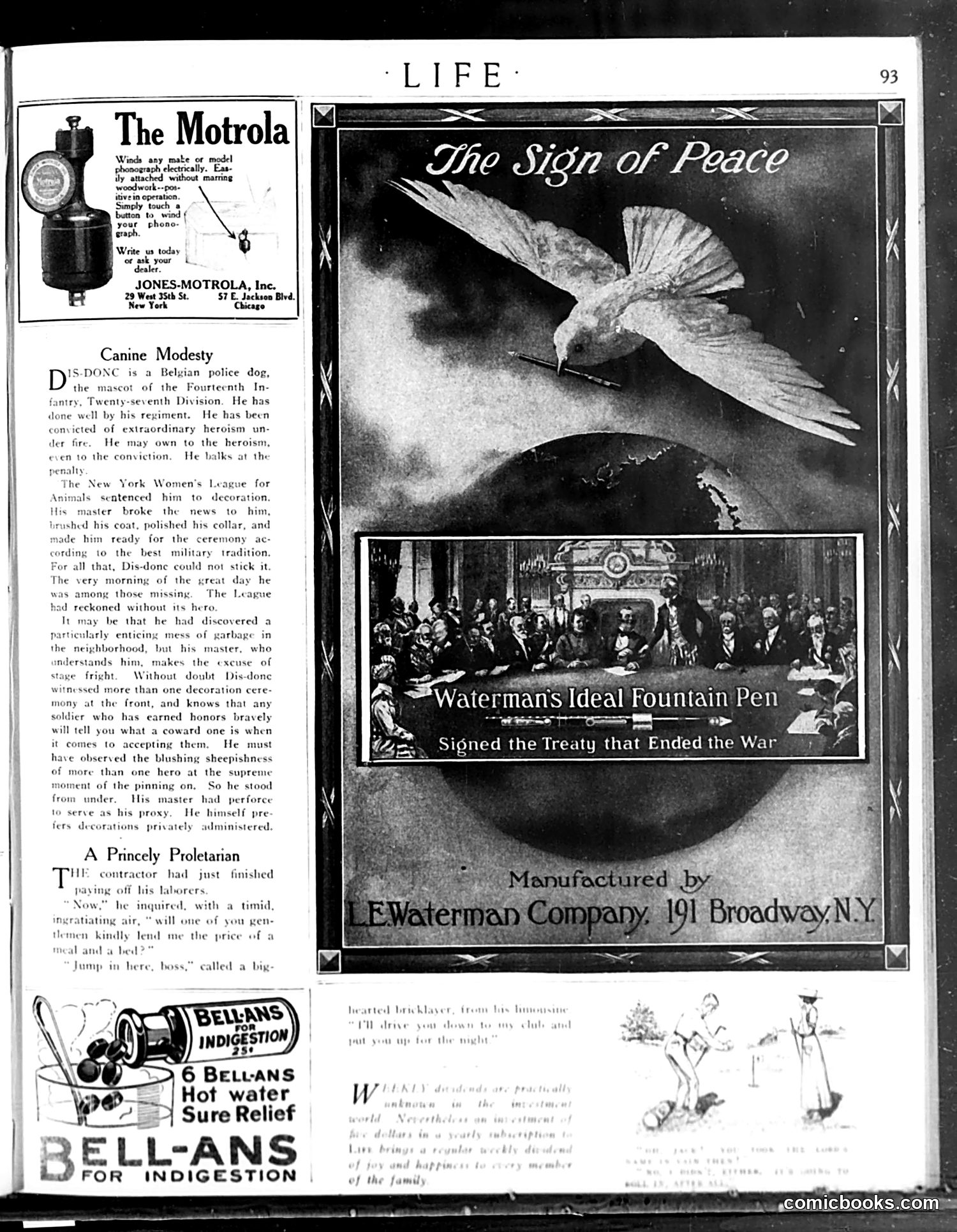
This page contains three distinct pieces of satirical content: **"The Motrola" (top left):** A straightforward advertisement for an early phonograph device with attached horn speaker—not satirical content. **"Canine Modesty":** A humorous anecdote about Dis-Donc, a Belgian police dog and military mascot decorated for WWI heroism. The satire mocks the disconnect between courage in combat and vanity about public recognition. The dog, having witnessed soldiers' embarrassment at medal ceremonies, flees rather than accept a decoration—suggesting that true soldiers/heroes are reluctant to parade their honors. This gently satirizes both military ceremony and human pride. **"A Princely Proletarian":** A brief joke about class reversal: a wealthy contractor, having paid his laborers, must borrow money from one of them—suggesting the working man is paradoxically wealthier or more financially responsible than his boss. This is straightforward social satire about economic inequality and worker dignity. The page also contains period advertisements (Waterman pens, Bellans antacid) unrelated to the editorial content.
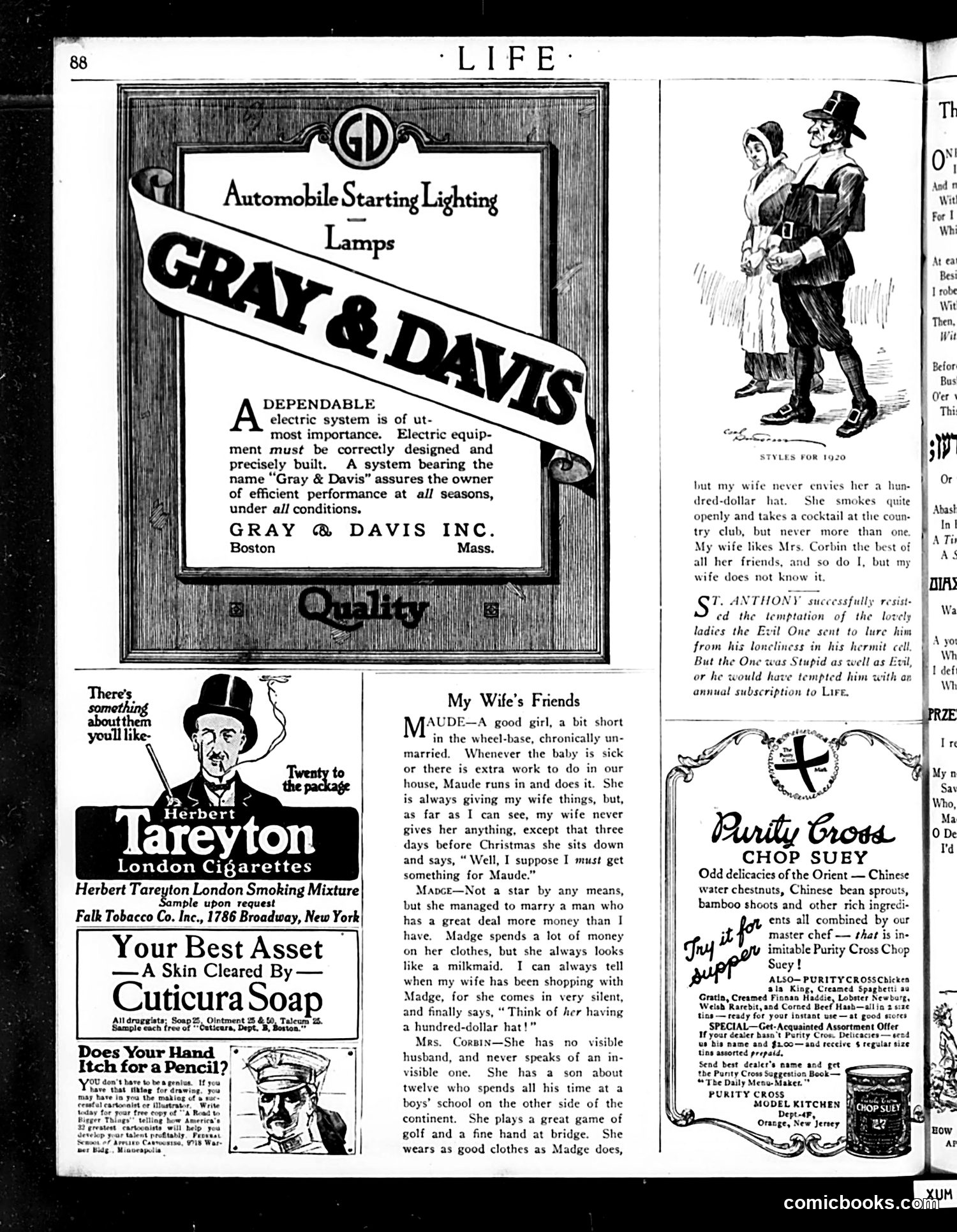
This page is primarily **advertising** with one significant satirical article titled "My Wife's Friends." The main content is a social satire describing three types of women through the narrator's observations of his wife's friendships: 1. **Maude** — an unmarried woman who constantly helps others but receives minimal reciprocation, except obligatory Christmas gifts 2. **Madge** — a wealthy woman with poor fashion sense whom the narrator's wife envies and resents 3. **Mrs. Corbin** — a sophisticated, independent woman (smokes, drinks cocktails, plays bridge and golf) whom the narrator's wife likes most yet won't admit it The satire critiques **gender expectations and social hypocrisy** of the 1920s: wives judge each other on wealth and appearance while secretly resenting successful women, yet most admire those who defy convention. Mrs. Corbin's appeal lies in her refusal to conform to traditional feminine roles. The remaining content consists of period advertisements for automobiles, cigarettes, soap, and prepared foods—typical magazine filler of that era.
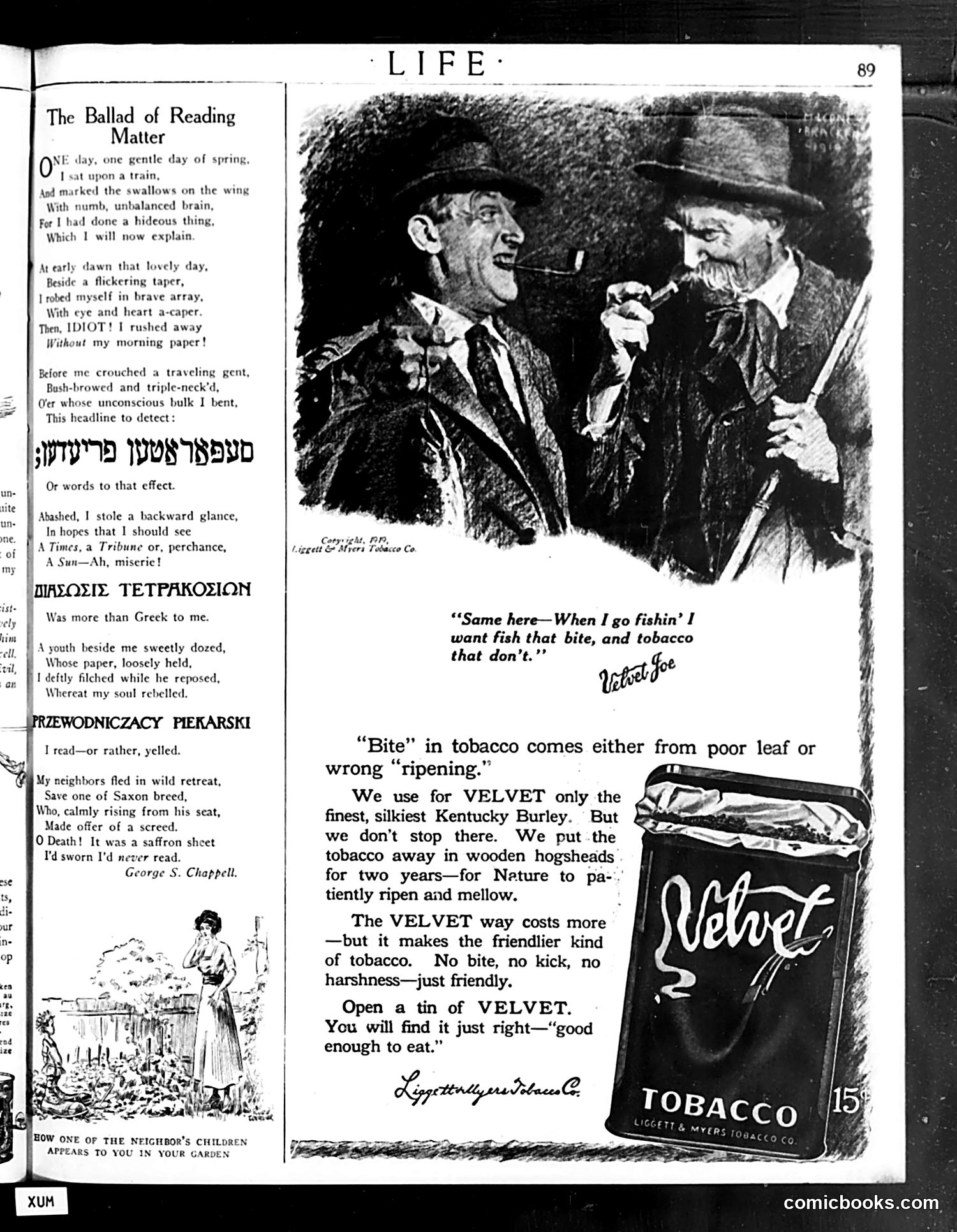
This page combines satirical poetry with a tobacco advertisement. **Left side — "The Ballad of Reading Matter":** A humorous poem by George S. Chappell mocking a commuter's desperation for morning newspapers. The narrator boards a train without his paper and becomes so anxious that he desperately attempts to read other passengers' papers—including stealing one from a sleeping youth and being offered a "saffron sheet" (likely a sensationalist tabloid) by a fellow traveler. The satire targets American newspaper addiction and the social anxiety of missing the daily news, a major concern in early 20th-century urban culture. **Right side — Velvet Tobacco Advertisement:** Features two men discussing fishing and tobacco. The ad emphasizes Velvet's lack of "bite"—positioning smoothness as a selling point against competitor products that caused harsh sensations. The product cost 15 cents and was made by Liggett & Myers Tobacco Co. The juxtaposition is typical of Life's format: satirical editorial content paired with period advertising, both reflecting contemporary American consumer culture and anxieties.
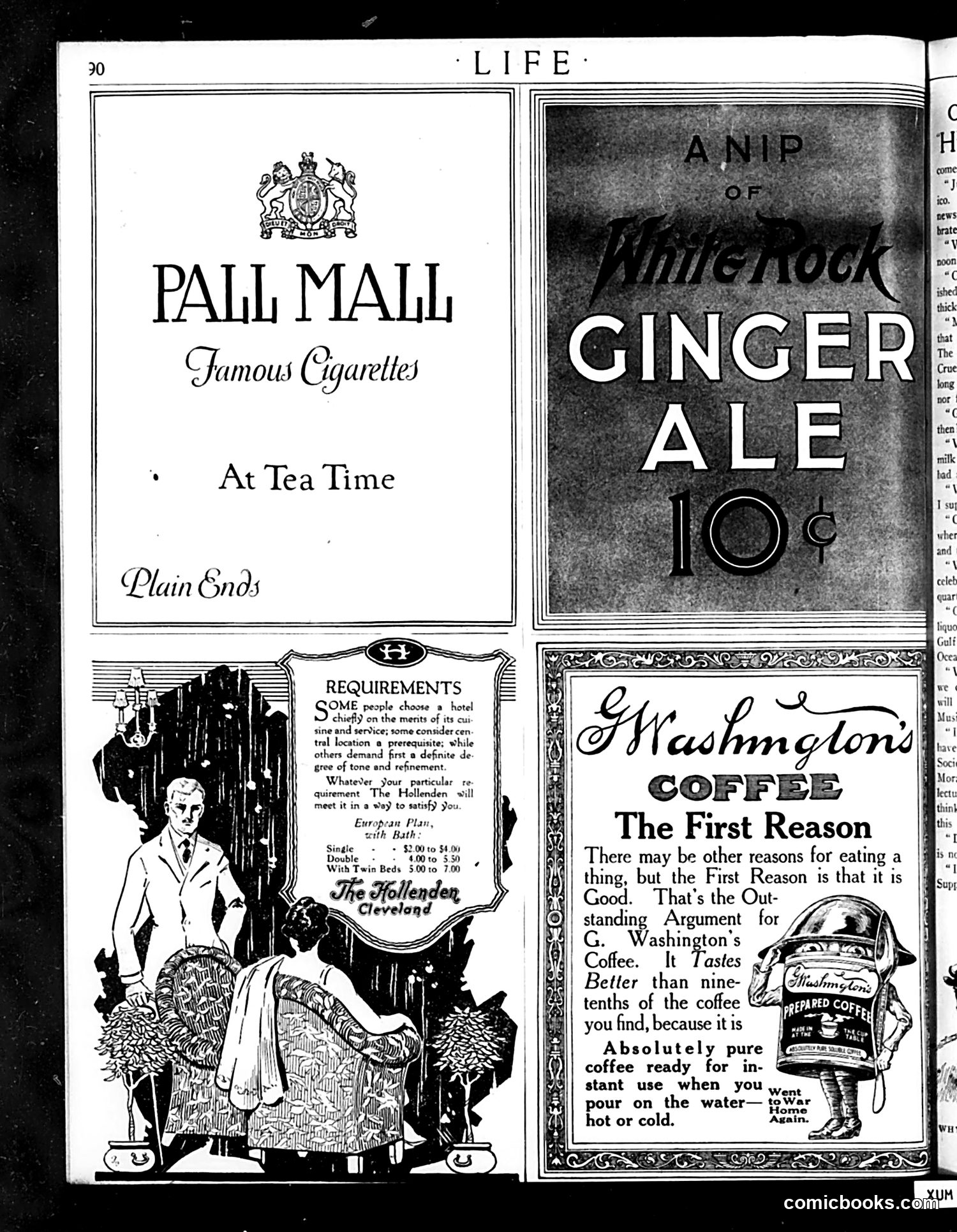
This page contains three advertisements rather than political cartoons. The content reflects early 20th-century consumer culture and social attitudes: **Pall Mall Cigarettes**: Advertises cigarettes for "tea time," positioning smoking as a genteel social activity for refined audiences. **The Hollenden Hotel** (Cleveland): Uses the concept of "requirements" and "tone and refinement" to market luxury hospitality to an elite clientele concerned with social status and proper decorum. **G. Washington Coffee**: Promotes instant coffee as a convenience product, emphasizing purity and ease of preparation ("pour on the water—hot or cold"). The brand name references the first U.S. president, lending patriotic appeal. All three ads target middle-to-upper-class consumers during an era when such products signaled respectability and social standing. The advertising approach assumes readers prioritize elegance and refinement in their purchasing decisions.
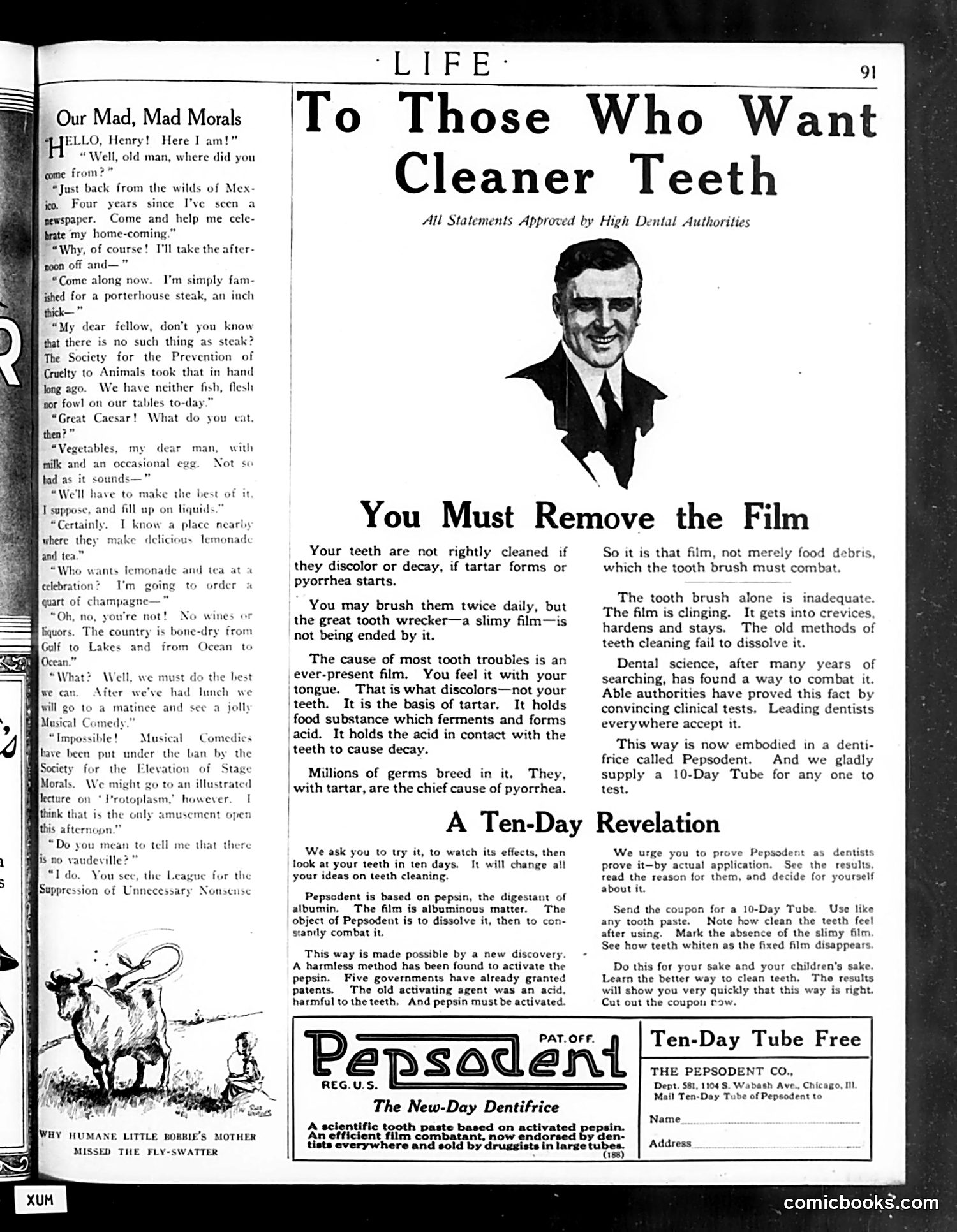
This page contains two distinct elements: a satirical dialogue and a toothpaste advertisement. **The Satire ("Our Mad, Mad Morals"):** The cartoon depicts an exaggerated critique of 1920s American progressivism and moral reform movements. A man returning from four years in Mexico discovers that aggressive civic organizations have eliminated nearly all pleasures: no meat (animal cruelty prevention), no alcohol (Prohibition), no theater (moral uplift societies). The joke targets the era's numerous reform leagues—presented as absurdly overreaching—that sought to eliminate vice and improve public behavior. It's satirizing the tension between reformers' good intentions and citizens' desire for simple enjoyments. **The Advertisement:** The Pepsodent toothpaste ad emphasizes a newly discovered "film" on teeth (plaque) as the real culprit in decay, not just food debris. It promotes activated pepsin as an innovative ingredient and offers a free 10-day trial—a common marketing tactic that era. The "high dental authorities" claim lends scientific credibility. Both elements reflect 1920s consumer culture and anxiety about progress versus tradition.
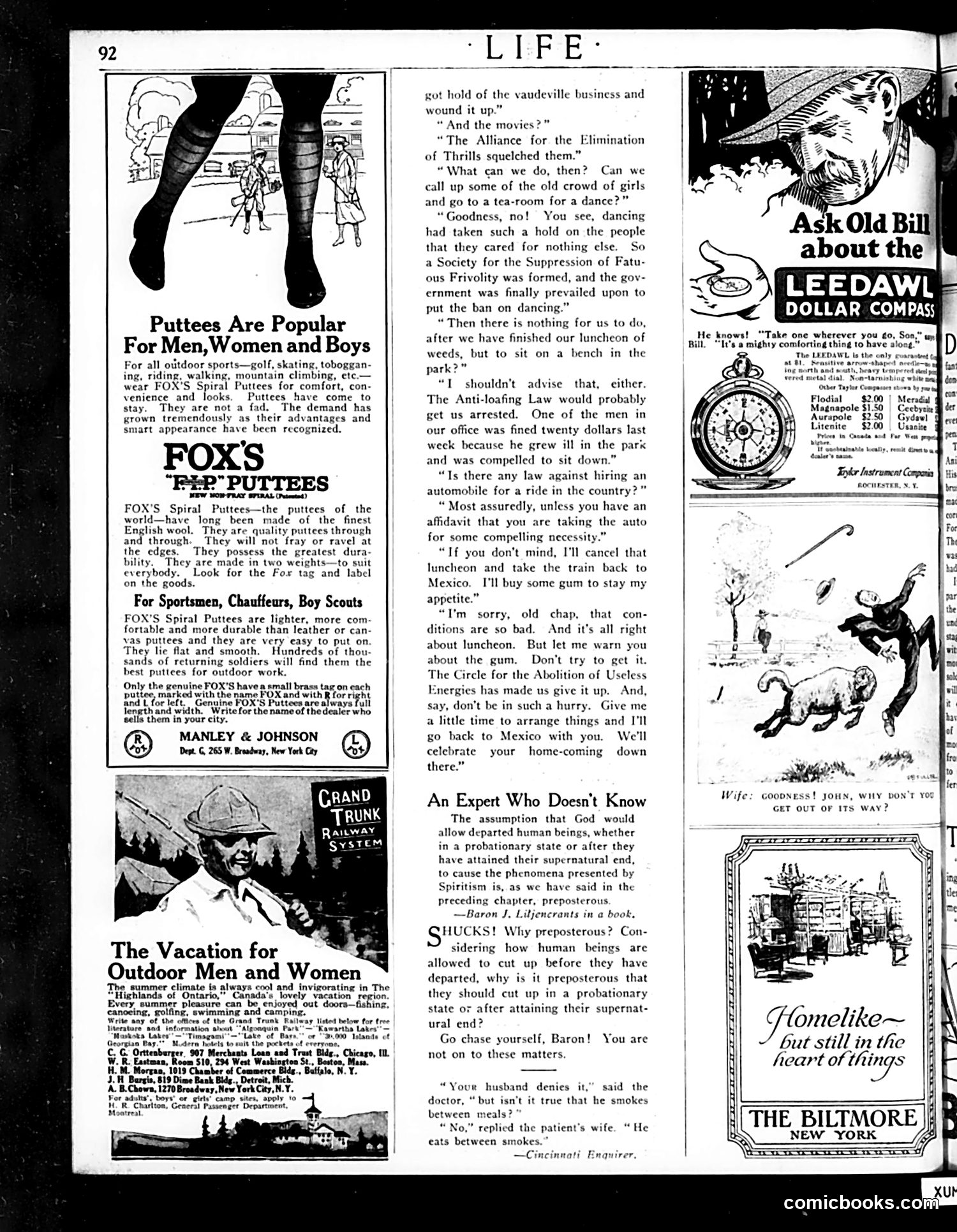
This page is primarily **advertising** for puttees (leg wrappings for outdoor activities) and vacation destinations, with one substantial **satirical article** titled "An Expert Who Doesn't Know." The main satire is a dialogue mocking excessive government regulation and social restriction. Two men discuss their inability to find any legal leisure activity: vaudeville and movies are banned by an "Alliance for the Elimination of Thrills"; dancing is prohibited by a "Society for the Suppression of Fatuous Frivolity"; sitting in parks violates an "Anti-loafing Law"; hiring automobiles requires justifying necessity; and chewing gum is banned by the "Circle for the Abolition of Useless Energies." The punchline: one man abandons plans and returns to Mexico. This likely satirizes American **Prohibition-era** regulatory overreach and reform movements circa 1920s—when government agencies, moral societies, and religious groups genuinely did attempt restricting entertainment, leisure, and "frivolous" behaviors. The exaggeration mocks such movements as absurdly life-denying.
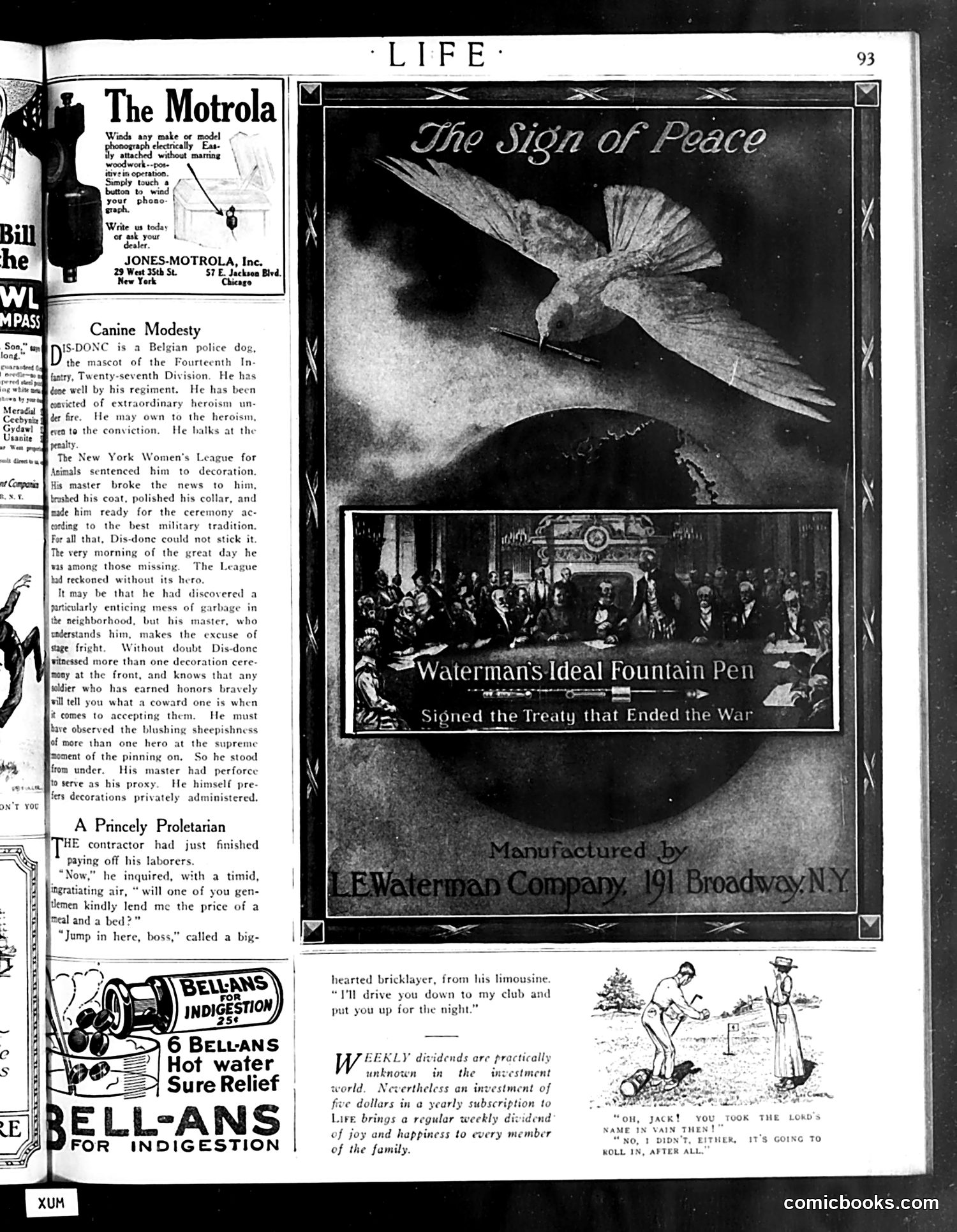
This page contains three distinct pieces: **"Canine Modesty"** is a humorous anecdote about Dis-Done, a Belgian police dog and mascot of the 27th Division, who deserts rather than accept a military decoration from the New York Women's League for Animals. The satire gently mocks soldiers' embarrassment at public recognition—the dog apparently witnessed enough ceremony at the front to know that heroes feel awkward being honored. His master excuses the desertion as "stage fright," suggesting even decorated soldiers would prefer private recognition to public ceremony. **"A Princely Proletarian"** inverts class expectations: a wealthy contractor, down on his luck, must borrow from a working-class bricklayer who now owns a limousine. The joke satirizes economic reversal and suggests post-war wealth redistribution among laborers. The large advertisement for **Waterman's Ideal Fountain Pen** claims it was used to sign "the Treaty that Ended the War" (likely the Treaty of Versailles, 1919), offering aspirational connection between a luxury product and historical significance.
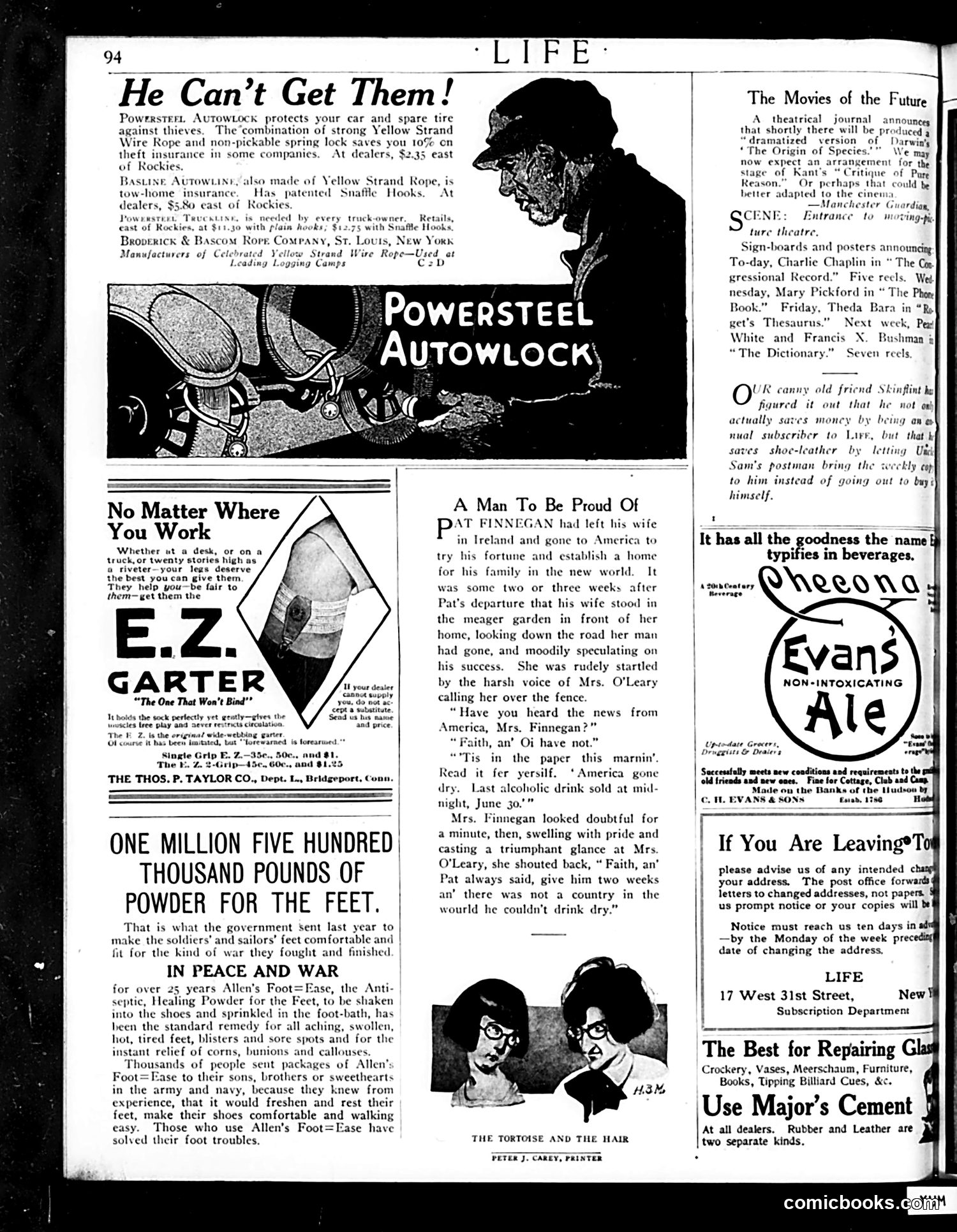
This page is primarily **advertising**, typical of Life's satirical approach to commercialism. The ads use humor and social commentary to sell products. The main cartoon, "He Can't Get Them!," shows a caricatured thief unable to steal a car protected by Powersteel Autowlock—a visual pun on the security device's effectiveness. The fictional anecdote "A Man To Be Proud Of" satirizes Irish-American stereotypes and Prohibition (which went into effect in 1920). Mrs. O'Leary shares newspaper coverage that "America gone dry," and Mrs. Finnegan proudly boasts that her absent husband Pat claimed he could "drink dry" any country—a joke playing on Irish drinking stereotypes and American anxiety about Prohibition's enforcement. The brief note about "Movies of the Future" sarcastically suggests adapting serious philosophical works (Darwin, Kant) to cinema, mocking both academic pretension and Hollywood's appetite for literary adaptation. The page reflects post-WWI American concerns: theft, foot comfort for soldiers, and Prohibition's implementation.
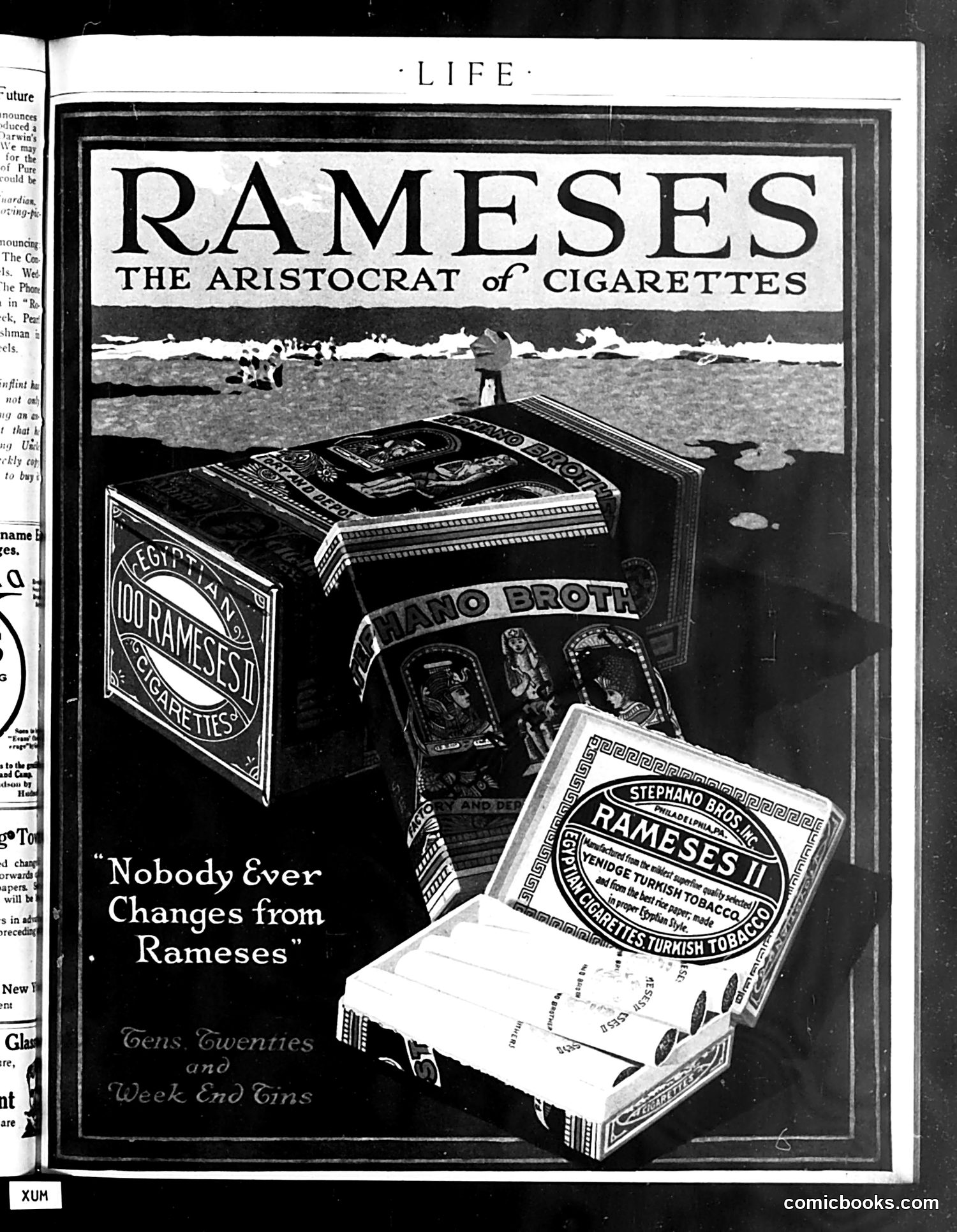
This is a full-page advertisement for Rameses cigarettes, described as "The Aristocrat of Cigarettes." The ad displays product packaging and an open cigarette box against an Egyptian-themed background, likely referencing the pharaoh Rameses. The tagline "Nobody Ever Changes from Rameses" is a marketing claim suggesting customer loyalty to the brand. The phrase "Tens, Twenties and Week End Tins" indicates different package sizes available. This is not political satire but rather a straightforward cigarette advertisement from an era when such ads regularly appeared in mainstream publications like Life magazine. The Egyptian imagery appeals to the "aristocratic" positioning of the product—a common luxury marketing strategy of the early-to-mid 20th century.
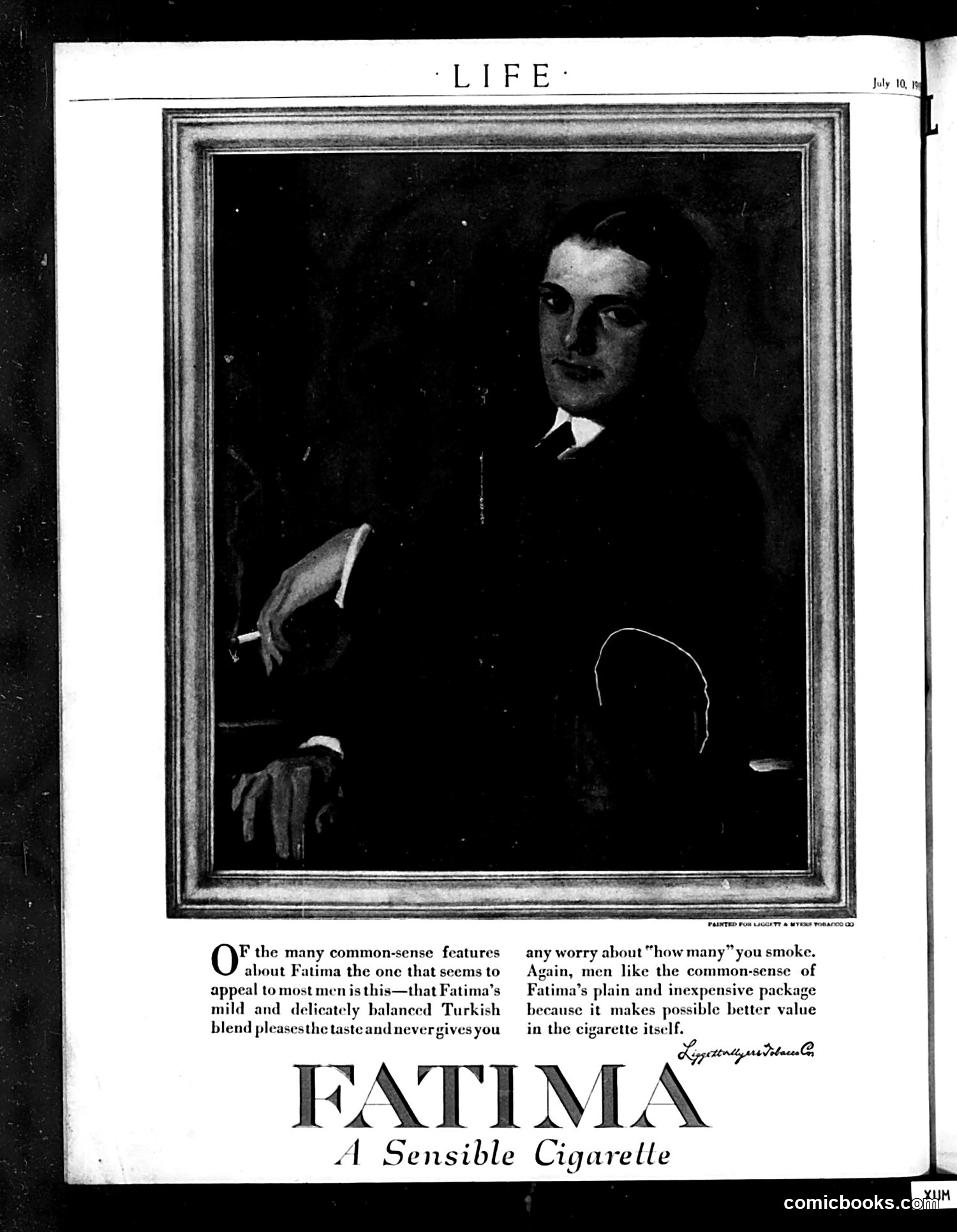
This is **not a cartoon or satire**—it's a **cigarette advertisement** appearing in *Life* magazine (dated July 10, based on the header). The page features a formal portrait photograph of a man in dark clothing with a white shirt collar, presented as an endorsement. The ad copy emphasizes "common-sense features" of Fatima cigarettes, particularly their "mild and delicately balanced Turkish blend" and "plain and inexpensive package." The pitch targets male smokers by appealing to practicality: the product offers good taste without excess, and better value through simple packaging rather than elaborate branding. This represents early-20th-century cigarette marketing before health warnings—when tobacco companies advertised directly in mainstream publications using masculine authority figures and emphasizing product quality as a selling point. The "sensible cigarette" framing suggests positioning Fatima as a rational choice for discerning men.