
Life, 1919-07-10 · page 21 of 50
Life — July 10, 1919 — page 21: what you’re looking at
What you’re looking at
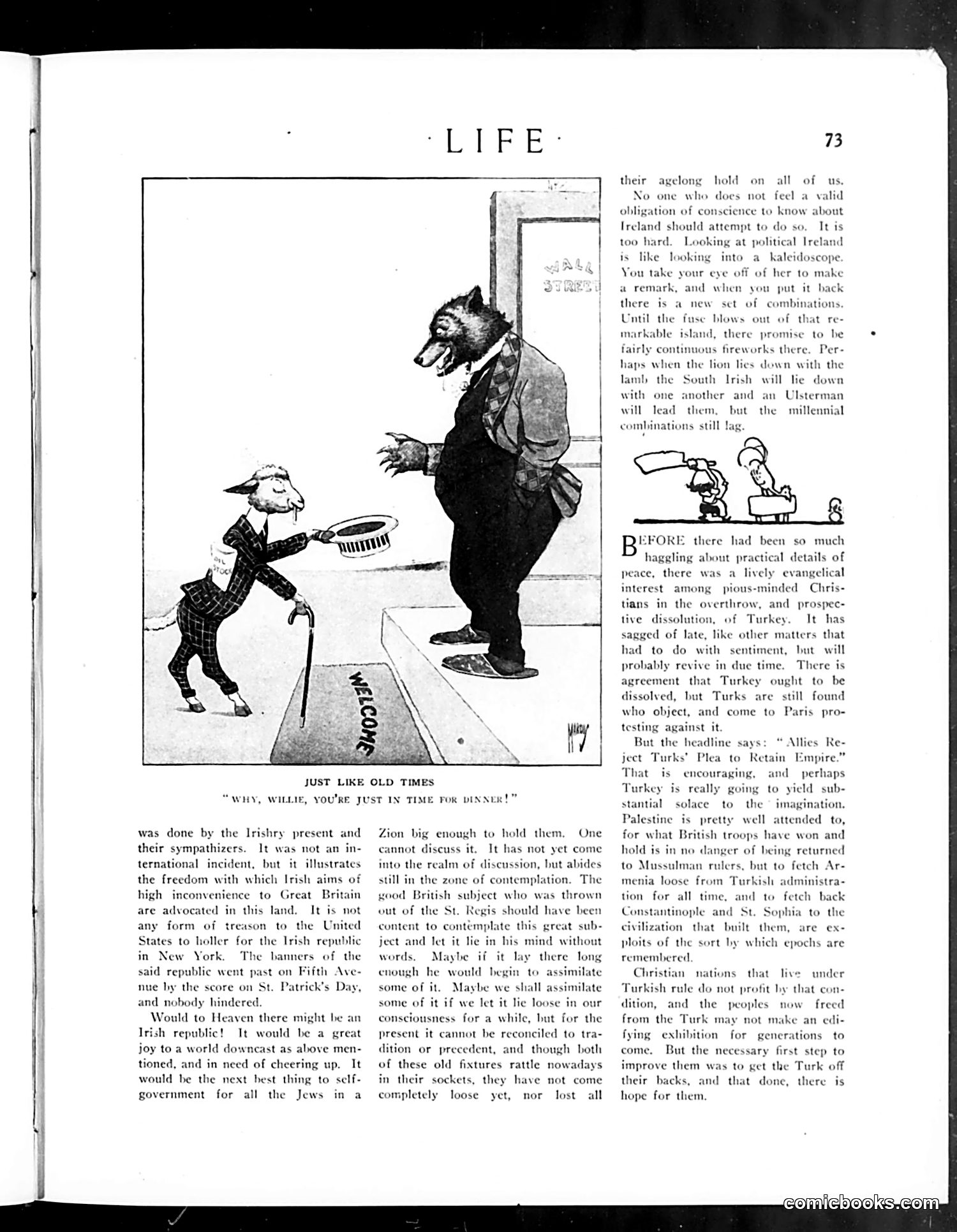
This cartoon depicts a large bear (representing Britain) being served dinner by a small figure labeled "WELCOME" (representing Ireland). The title's ironic reference to "old times" mocks the historical British-Irish relationship. The accompanying text discusses Irish nationalism and self-determination. It notes that Irish republican advocacy occurs freely in America (referencing St. Patrick's Day parades on Fifth Avenue), contrasting this with British discomfort. The author sarcastically suggests Irish politics is too chaotic to comprehend, comparing it to a "kaleidoscope"—constantly shifting combinations. The cartoon satirizes how Ireland, despite its smaller power, must "serve" Britain, while the text explores post-WWI geopolitical questions about Irish independence, Turkish dissolution, and Armenian liberation. The piece reflects American ambivalence toward Irish republicanism and sympathy for various oppressed peoples seeking freedom from empires.
📄 Transcribed text from this page (OCR, searchable)
Machine-transcribed from the original scan — historical spelling and the odd misread are preserved.
ee _ Se (<< JUST LIKE OLD TIMES “WHY, WILLIE, YOU'RE JUST IN TIME FOR DINNEX was done by the Irishry present and their sympathizers. It was not an in- ternational incident, but it illustrates the freedom with which Irish aims of high inconvenience to Great Britain are advocated in this land. It is not any form of treason to the United States to holler for the Irish republic in New York. The banners of the said republic went past on Fifth Ave- nue hy the score on St. Patrick's Day, and nobody hindered. Would to Heaven there might be an h republic! It would be a great joy toa world downeast as above men- tioned, and in need of cheering up. It would be the next best thing to self- government for all the Jews in Zion big enough to hold them, One cannot discuss it, It has not yet come into the realm of discussion, but abides still in the zone of contemplation. The xood British subject who was thrown out of the St. Regis should have been content to contemplate this great sub- ject and let it lie in his mind without words. Maybe if it lay there long enough he would begin to assimilate some of it. Maybe we shall assimilate some of it if we let it lie loose in our consciousness for a while, but for the Present it cannot be reconciled to tra- dition or precedent, and though both of these old fixtures rattle nowac in their sockets, they have not come completely loose yet, nor lost. all ys. 73 their zelong hold on all of us, one who does not feel a valid obligation of conscience to know about Ireland should attempt to do so. It is too hard. Looking at political Ireland is like looking into a kaleidoscope You take your eye off of her to make a remark, and when you put it back there is a new set of combinations. Until the fuse blows out of that re- markable island, there promise to he fairly continuous fireworks there. Per- haps when the lion lies down with the lamb the South Irish will lie down with one another and an Ulsterman will lead them, but) the millennial combinations still lag B' FORE there had been so much peace, there was a lively evangelical interest: among pious-minded Chris- tians in the overthrow, and prospec- tive dissolution, of Turkey. It has sagged of late, like other matters that had to do with sentiment, but will probably revive in due time. There is agreement that Turkey ought to be dissolved, but Turks are still found ing about practical details of who object, and come to Paris pro- testing against it But the headline says: “ Allies Re ject Turks’ Plea to Retain Empire.” That is encouraging, and perhaps Turkey is really going to yield sub- stantial solace to the imagination. Palestine is pretty well attended to, for what British troops have won and hold is in no danger of being returned to Mussulman rulers, but to fetch Ar- menia loose from Turkish administra- tion for all time, and to fetch back Constantinople and St. Sophia to the civilization that built them, are ex- ploits of the sort by which epochs are remembered Christian nations that live under Turkish rule do not profit hy that con- dition, and the peoples now freed from the Turk m not make an edi- fying exhibition for generations to come. But the necessary first step to improve them was to get the Turk off their backs, and that done, there is hope for them.