
Life, 1919-07-10 · page 25 of 50
Life — July 10, 1919 — page 25: what you’re looking at
What you’re looking at
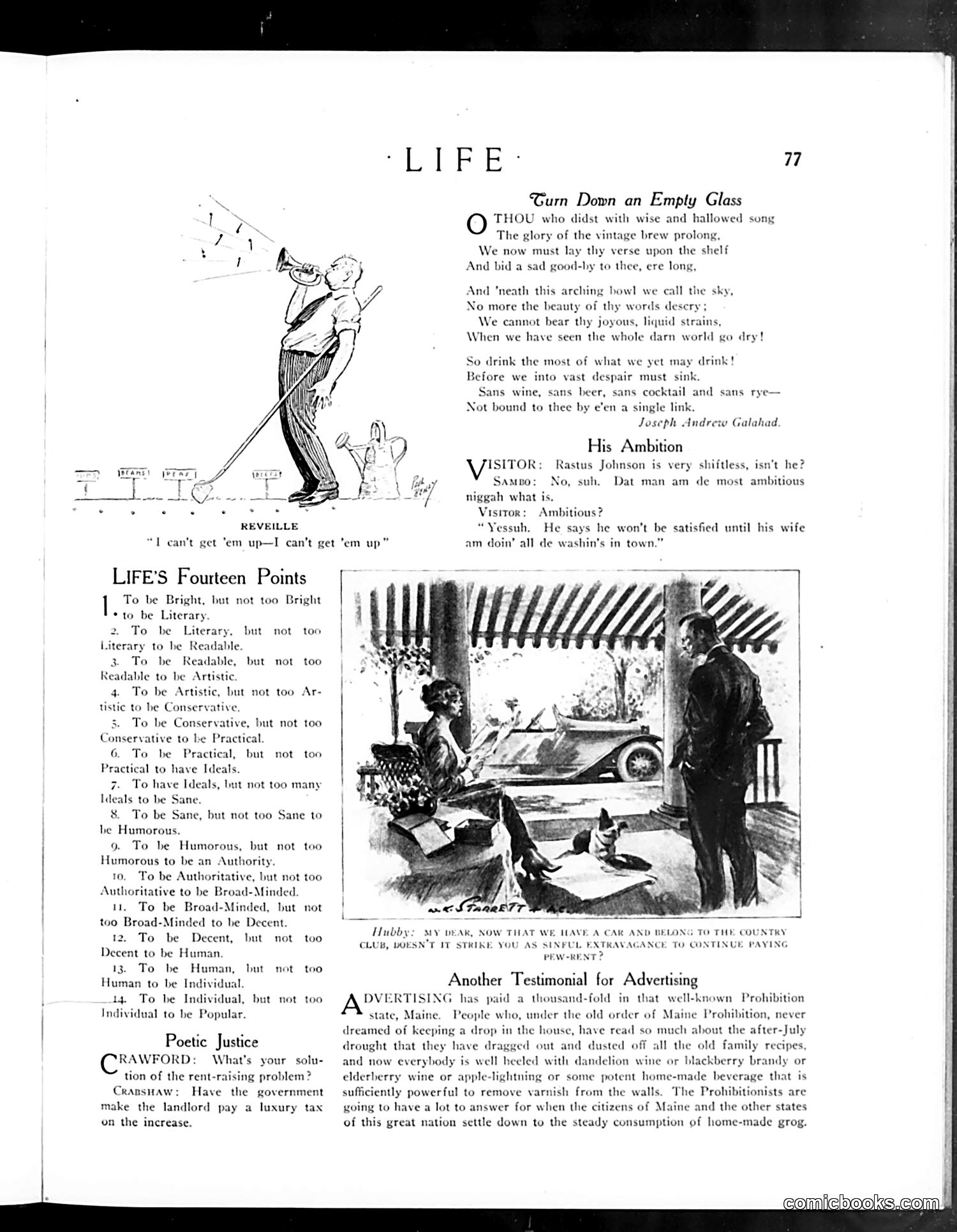
This page satirizes early 1920s American life, centered on **Prohibition's failure**. The "Turn Down an Empty Glass" poem mourns alcohol's legal disappearance, written in mock-tragic verse. The **"His Ambition"** joke mocks both racial stereotypes and marital dynamics: a Black man named Rastus Johnson's "ambition" is merely wanting his wife to monopolize the town's laundry work—presenting laziness disguised as ambition. **"Life's Fourteen Points"** parodies Wilson's post-WWI diplomatic framework by applying it to magazine editorial balance: being "bright but not too bright," "artistic but not too conservative," etc.—satirizing the impossible middle-ground publications must navigate. The **final section attacks Prohibition directly**: advertising's success in Maine inadvertently drove people to home-brewing dangerous substitutes (dandelion wine, apple-lightning) potent enough to "remove varnish from walls." The satire suggests Prohibition creates worse problems than it solves.
📄 Transcribed text from this page (OCR, searchable)
Machine-transcribed from the original scan — historical spelling and the odd misread are preserved.
‘LIFE: 7 Curn Down an Empty Glass THOU who didst with wise and hallowed song The glory of the vintage brew prolong, We now must lay thy verse upon the shelf And bid a sad good-by to thee, ere long, And ‘neath this arching bowl we call the sky, No more the beauty of thy words descry ; We cannot bear thy joyous, liquid strains, When we have seen the whole darn world go dry! So drink the most of what we yet may drink! Before we into vast despair must sink. Sans wine, sans beer, sans cocktail and sans rye— ot bound to thee by e’en a single link. Joseph Andrew Galahad. His Ambition VISITOR: Rastus Johnson is very shiftless, isn’t he? Sampo: No, suh, Dat man am de most ambitious h what is. Visttor: Ambitious? REVEILLE “Yessuh. He says he won't be satisfied until his wife “To can't get ‘em up—I can’t get ‘em up” am doin’ all de washin's in town.” LIFE’S Fourteen Points To be Bright, but not too Bright * to be Literary nij To be Literary, but not too iterary to he Readable. 3. To be Readable, but not too Readable to be Artistic. 4. To be Artistic, but not too Ar- tistic to be Conservative, To be Conservative, but not too Conservative to be Practical 6. To be Practical, but not too Practical to have Ideals. 7. To have Ideals, but not too many Ideals to he Sane. 8. To be Sane, but not too Sane to be Humorous. 9. To be Humorous, but not too Humorous to be an Authority. to. To be Authoritative, but not too Authoritative to be Broad-Minded 11. To be Broad-Minded, but not too Broad-Minded to be Decent. 12, To be Decent, but not too Decent to be Human 13. To be Human, but not too Human tor be Individual. Another Testimonial for Advertising 14. To be Individual, but not too DVERT ‘G has paid a thousand-fold in that well-known Prohibition Individual to he Popular. state, Maine. People who, under the old order of Maine Prohibition, never Hubby: MY DEAR, NOW THAT WE HAVE A CAR AND BELONG TO THE COUNTRY CLUB, DOESN'T IT STRIKE YOU AS SINFUL EXTRAVAGANCE TO CONTINUE PAYING PEW-RENT? . . dreamed of keeping a drop in the house, have read so much about the after-July Poetic Justice drought that they have dragged out and dusted off all the old family recipes RAWFORD: What's your solu- and now everybody is well heeled with dandelion wine or blackberry brandy or tion of the rent-raising problem? —_elderberry wine of apple-lightning or some potent home-made beverage that is Cransuaw: Have the government — sufficiently powerful to remove varnish from the walls. The Prohibitionists are make the landlord pay a luxury tax — going to have a lot to answer for when the citizens of Maine and the other states on the increase. of this great nation settle down to the steady consumption of home-made grog.