
Life, 1919-07-10 · page 20 of 50
Life — July 10, 1919 — page 20: what you’re looking at
What you’re looking at
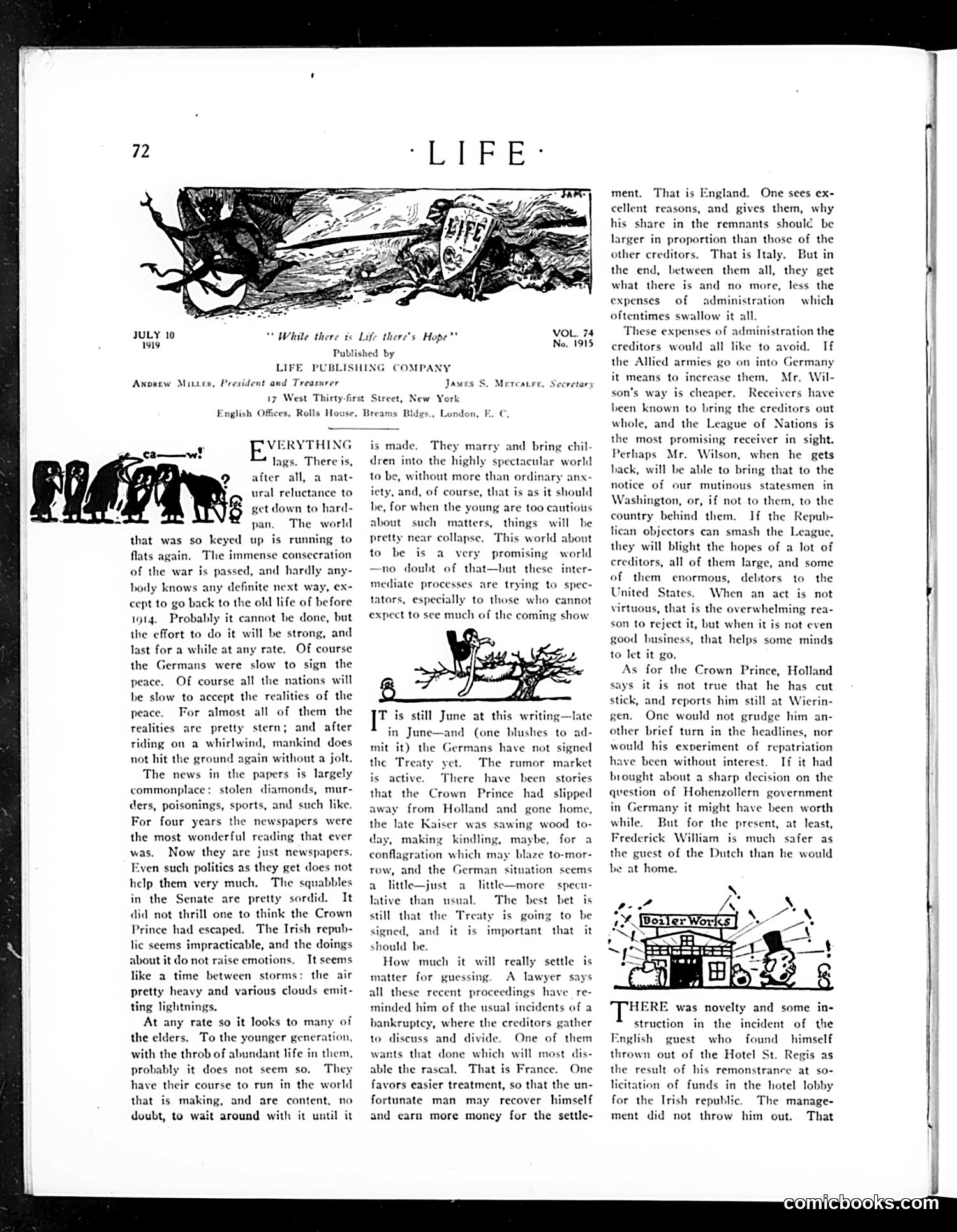
This editorial page reflects America's uncertain mood immediately after World War I's conclusion. The cartoons (visible but small) appear to depict post-war confusion and economic hardship—figures struggling amid the transition from wartime to peacetime. The text discusses how newspapers, once thrilling during four years of war coverage, have returned to mundane crime reporting. The author notes society's exhaustion: people want to return to pre-1914 life, though this may be impossible. The piece uses a bankruptcy metaphor to explain peace negotiations: creditor nations (France, England, Italy) squabble over German reparations like creditors dividing a bankrupt debtor's assets. France wants harsh penalties; England favors recovery (so Germany can pay more); Italy demands its share. The cynical point: administrative costs consume whatever remains. The overall tone suggests post-war letdown—the momentous struggle is over, leaving ordinary corruption and national self-interest exposed.
📄 Transcribed text from this page (OCR, searchable)
Machine-transcribed from the original scan — historical spelling and the odd misread are preserved.
JULY 10 ** While there ts Life there's Hope"’ 1919 Published by LIFE PUBLISHING COMPANY Anpeew Mittee, President and Treasurer Jawes S. Mercatre. 17 West Thirty-first Street, New York English Offices, Rolls Ho VERYTHING lags. There is, after all, a nat- ural reluctance to get down to hard- pan. The world that was so keyed up is running to flats again. The immense consecration of the war is passed, and hardly any- body knows any definite next way, € cept to go back to the old life of before 191g. Probably it cannot be done, but the effort to do it will be strong, and last for a while at any rate. Of course the Germans were slow to sign the peace. Of course all the nations will he slow to accept the realities of the peace. For almost all of them the realities are pretty stern; and after riding on a whirlwind, mankind does not hit the ground again without a jolt. The news in the papers is largely commonplace: stolen diamonds, mur- ders, poisonings, sports, and such like. For four years the newspapers were the most wonderful reading that ever was. Now they are just newspapers. Even such politics as they get does not help them very much, The squabbles in the Senate are pretty sordid. It did not thrill one to think the Crown Prince had escaped. The Irish repub- lic seems impracticable, and the doings about it do not raise emotions, Tt seems like a time between storms: the air pretty heavy and various clouds emit- ting lightnings. At any rate so it looks to many the elders, To the younger gener: with the throb of abundant life in them, probably it does not seem so. They ion, have their course to run in the world that is making, and are content, no doubt, to wait around with it until it ec, Breams Bldgs., London, F. C, is made, They marry and bring chil dren into the highly spectacular world to be, without more than ordinary iety, anx- is as it should he, for when the young are too cautious about such matters, things will be pret r collapse. This world about to be is a very promising world —no doubt of that—but these inter- and, of course, tha ne; mediate processes are tryi ng to spec- y to those who cannot expect to see much of the coming show tators, especial T is still June at this writing—late in June—and (one blushes to ad- mit it) the Germans have 1 the Treat is active t signed The rumor market here have been stori that the Crown Prince had_ slipped away from Holland and gone home, the late Kaiser was sawing wood to- making kindling, maybe, for conflagration which may blaze to-mor- , and the German sit ro} ion seems a little—just a little—more — specu- lative than usual. The best bet is still that the Treaty is going to be signed, and it is important that it should be. How much it will really settle is matter for guessing. A lawyer says all these recent proceedings have re- minded him of the usual incidents of a bankruptcy, where the creditors gather to discuss and divide. One of them wants that done which will most dis- able the rascal. That is France. One favors easier treatment, so that the un- fortunate man may recover himself and earn more money for the settle- VOL. 74 No, 1915, ment. That is England. One sees ex- cellent reasons, and gives them, why his share in the remnants shoulé be larger in proportion than those of the other creditors. That is Italy. But in the end, between them all, they get what there is and no more, less the expenses of administration which oftentimes swallow it all. These expenses of administration the creditors would all like to avoid. If the Allied armies go on into Germany it means to increase them. Mr. Wil- son's way is cheaper. Receivers have been known to bring the creditors out whole, and the League of Nations is the most promising receiver in sight. Perhaps Mr. Wilson, when he gets back, will be able to bring that to the notice of our mutinous statesmen in Washington, or, if not to them, to the country behind them. If the Repub- lican objectors can smash the League, they will blight the hopes of a lot of creditors, all of them large, and some of them enormous, debtors to the United States. When an act is not virtuous, that is the overwhelming rea- son to reject it, but when it is not even good business, that helps some minds to let it go. As for the Crown Prince, Holland s it is not true that he has cut stick, and reports him still at Wierin- gen. One would not grudge him an- other brief turn in the headlines, nor would his experiment of repatriation have been without interest. If it had brought about a sharp decision on the question of Hohenzollern government in Germany it might have been worth while. But for the present, at least, Frederick William is much safer as the guest of the Dutch than he would be at home. HERE was novelty and some in- struction in the incident of the English guest who found himself thrown out of the Hotel St. Regis as the result of his remonstranee at so- li ion of funds in the hotel lobby for the Irish republic. The manage- ment did not throw him out. That —————————————— a