
A complete issue · 46 pages · 1919
Life — June 5, 1919
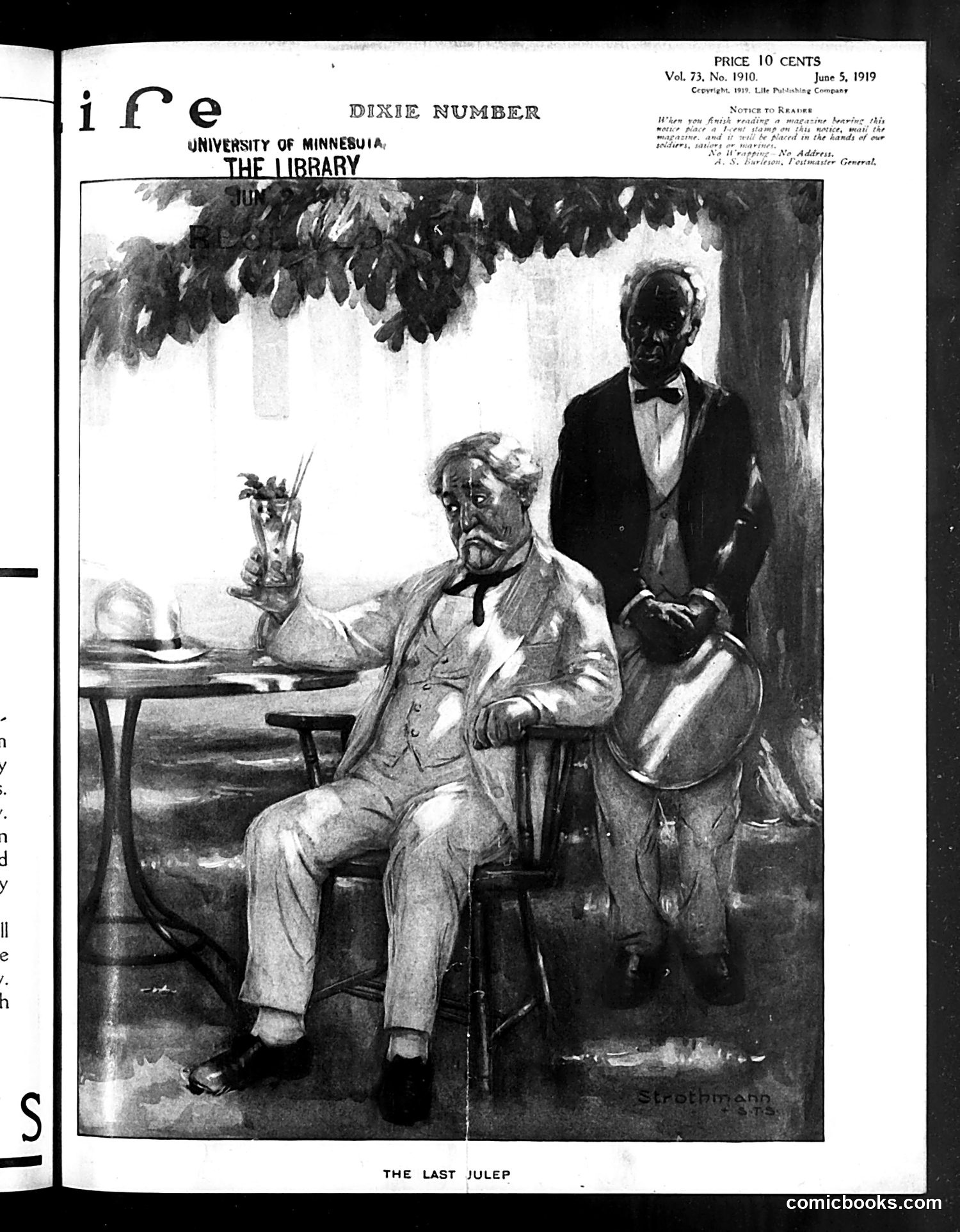
This cartoon, titled "The Last Julep," appears from the June 5, 1919 Life magazine issue and likely depicts a post-Prohibition scene. The seated figure holds a cocktail glass with decorative garnish—the "last julep" before alcohol became illegal. The two standing figures, rendered with caricatured features typical of early 20th-century satire, appear to be either waiters or observers witnessing this final drink. The satire centers on the imminent arrival of Prohibition (which began January 1920), mocking the end of an era of drinking culture. The melancholic tone suggests nostalgia for pre-Prohibition indulgence. The exaggerated facial features and formal dress underscore the cartoon's commentary on social upheaval during this transitional moment in American history.
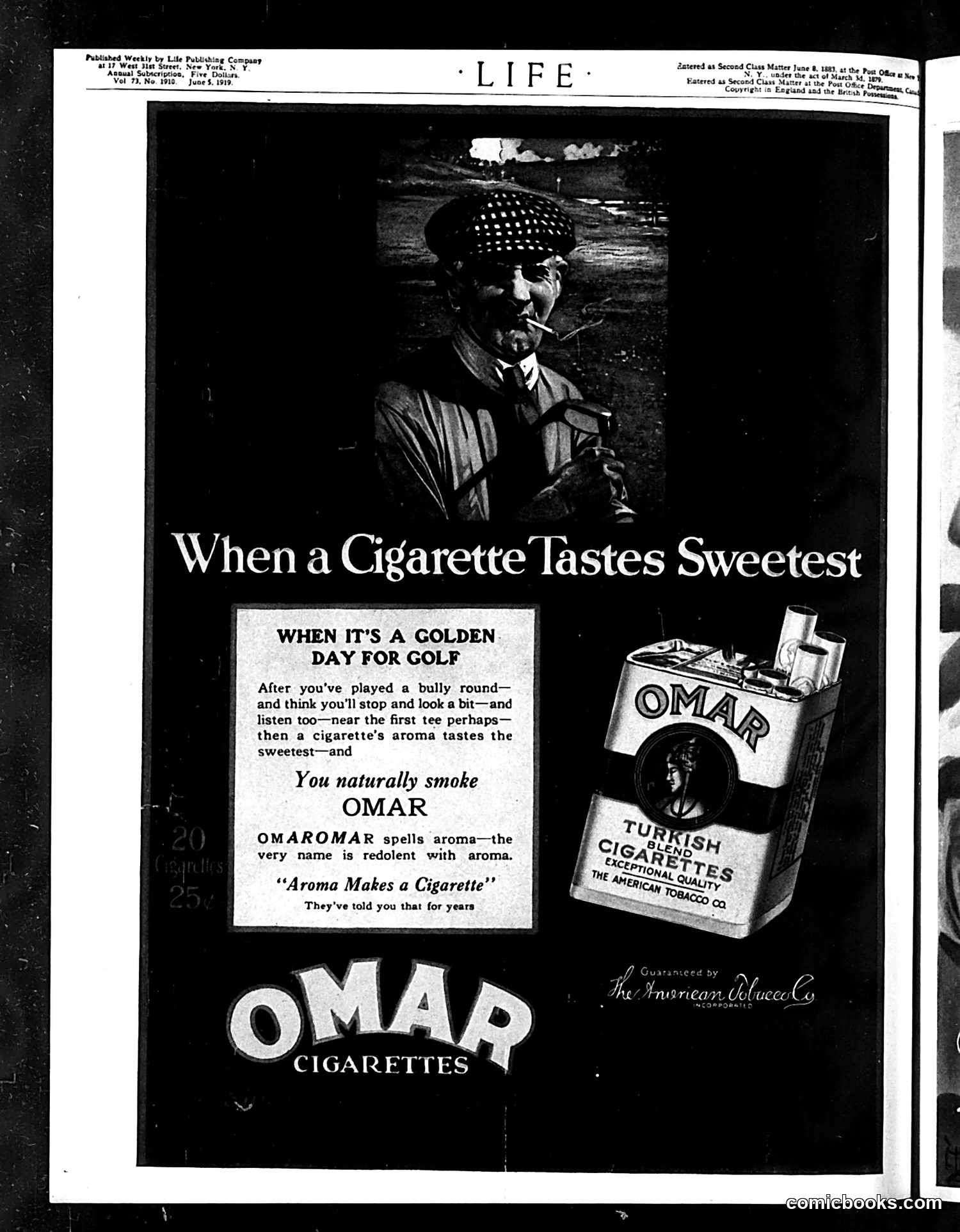
This is a **cigarette advertisement**, not satire or political content. It's a straightforward 1920s-era marketing page for Omar Turkish Blend Cigarettes by the American Tobacco Company. The ad features a golfer smoking after a round, paired with the slogan "When a Cigarette Tastes Sweetest." The accompanying text emphasizes the product's "aroma" and plays on the marketing concept that specific moments enhance cigarette enjoyment. The image shows a man in golf attire (flat cap, period clothing) in a contemplative pose—the lifestyle marketing typical of early tobacco advertising. Omar positioned their product as a premium choice for leisured, affluent consumers. This represents pre-regulation cigarette advertising before health warnings became mandatory.
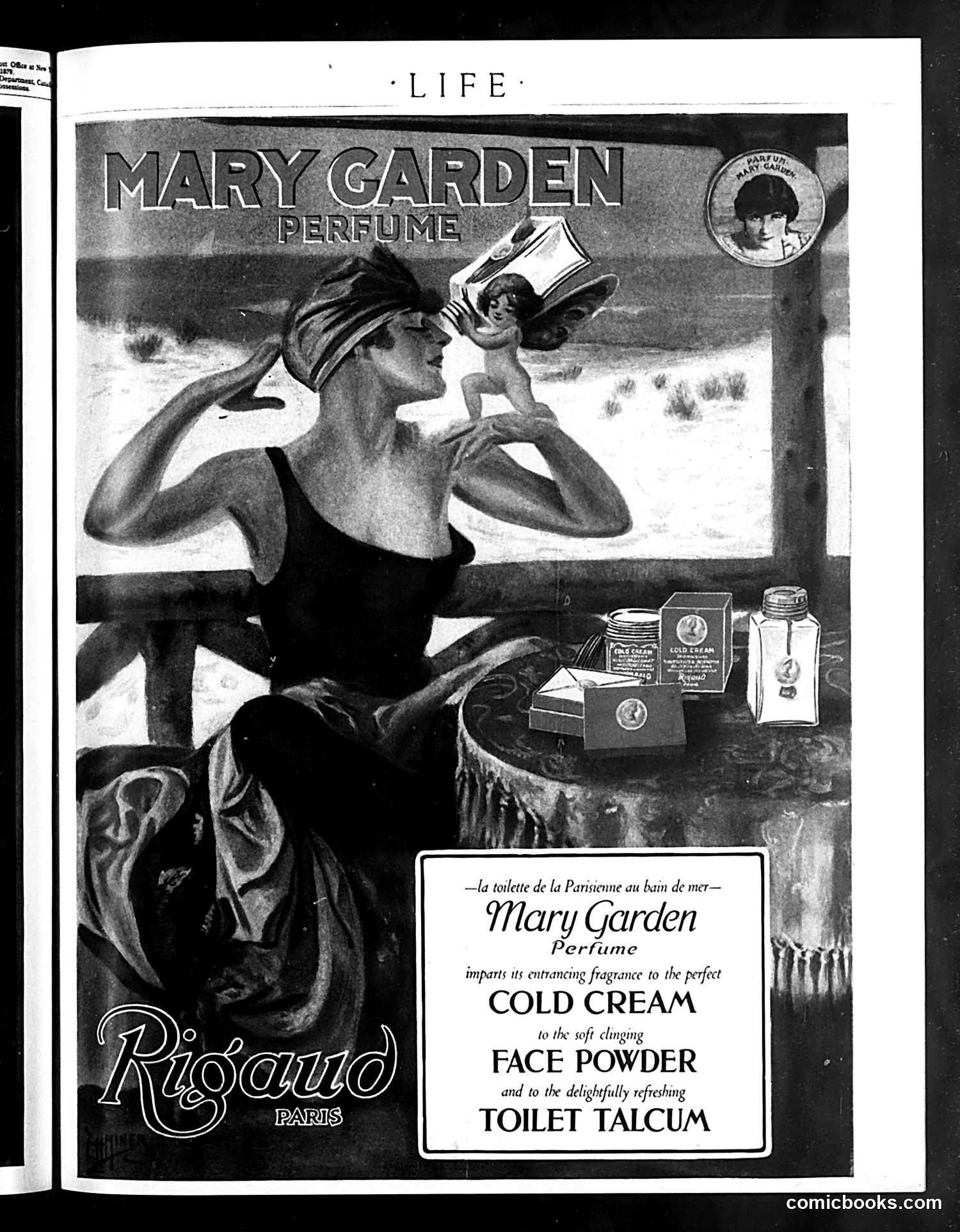
This page is **primarily an advertisement**, not political satire. It promotes Mary Garden Perfume and related beauty products (cold cream, face powder, toilet talcum) by Rigaud of Paris. The ad features an elegant woman in 1920s fashion gazing at a cherub-like figure holding a perfume bottle, set against a seaside landscape. A circular portrait in the upper right shows Mary Garden herself—likely the famous opera singer whose name branded the product line. The tagline describes perfume as "la toilette de la Parisienne au bain de mer" (the Parisian woman's bath-time toilette), positioning the product as sophisticated French cosmetics for affluent American women. There is no political cartoon or satirical content on this page—it's straightforward luxury goods marketing typical of *Life* magazine's advertising sections.
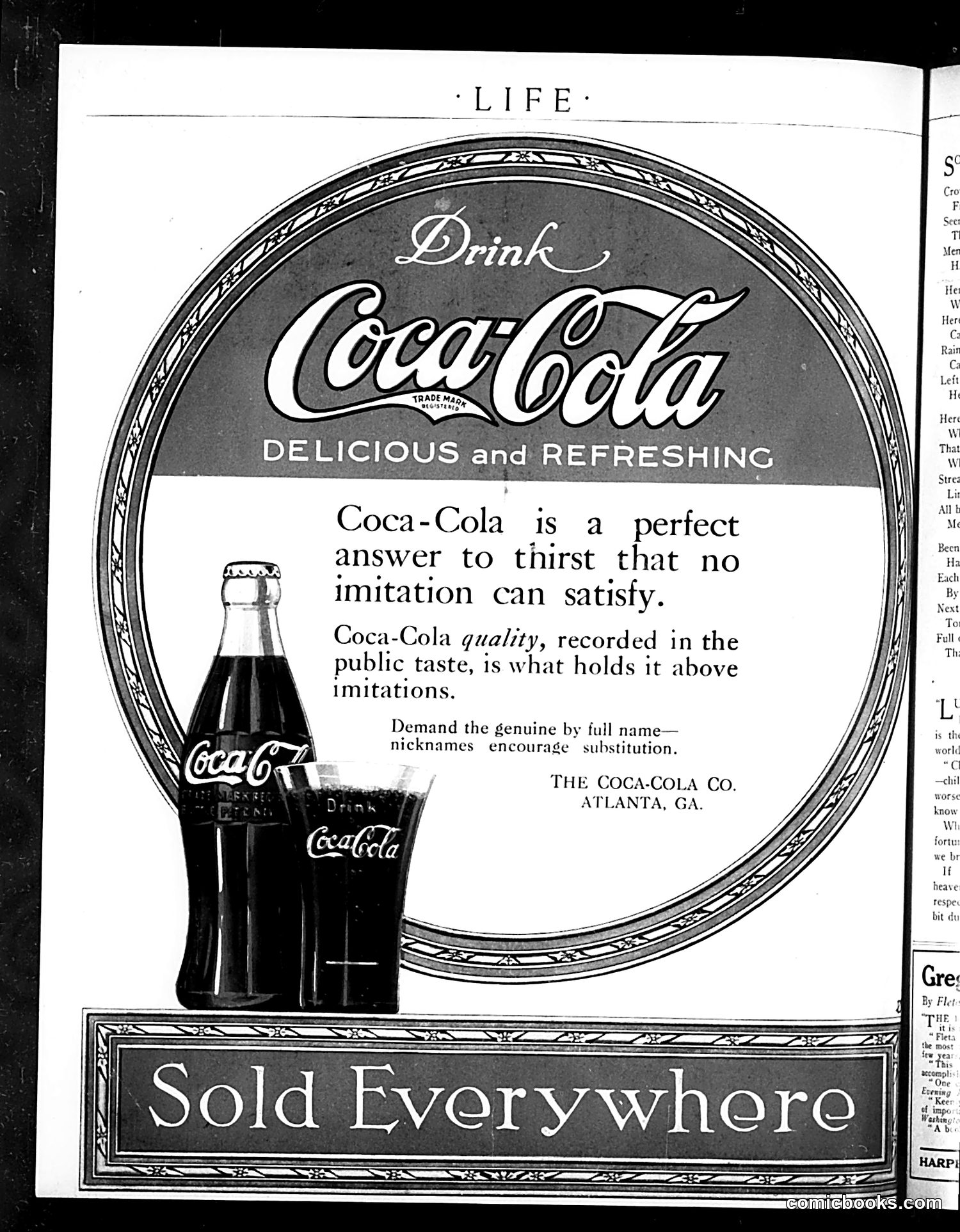
This page is **not a political cartoon or satirical content** — it's a vintage **Coca-Cola advertisement** from Life magazine's pages. The ad emphasizes brand authenticity, warning consumers against imitations: "Coca-Cola is a perfect answer to thirst that no imitation can satisfy." It highlights that Coca-Cola's "quality, recorded in the public taste, is what holds it above imitations." The visual shows a Coca-Cola bottle and glass within an ornate circular frame. The tagline "Sold Everywhere" reinforces mass availability. This reflects early 20th-century marketing concerns about counterfeit or substitute beverages competing in an expanding consumer market. The message targets consumers to "demand the genuine by full name—nicknames encourage substitution," suggesting widespread brand confusion existed at the time.
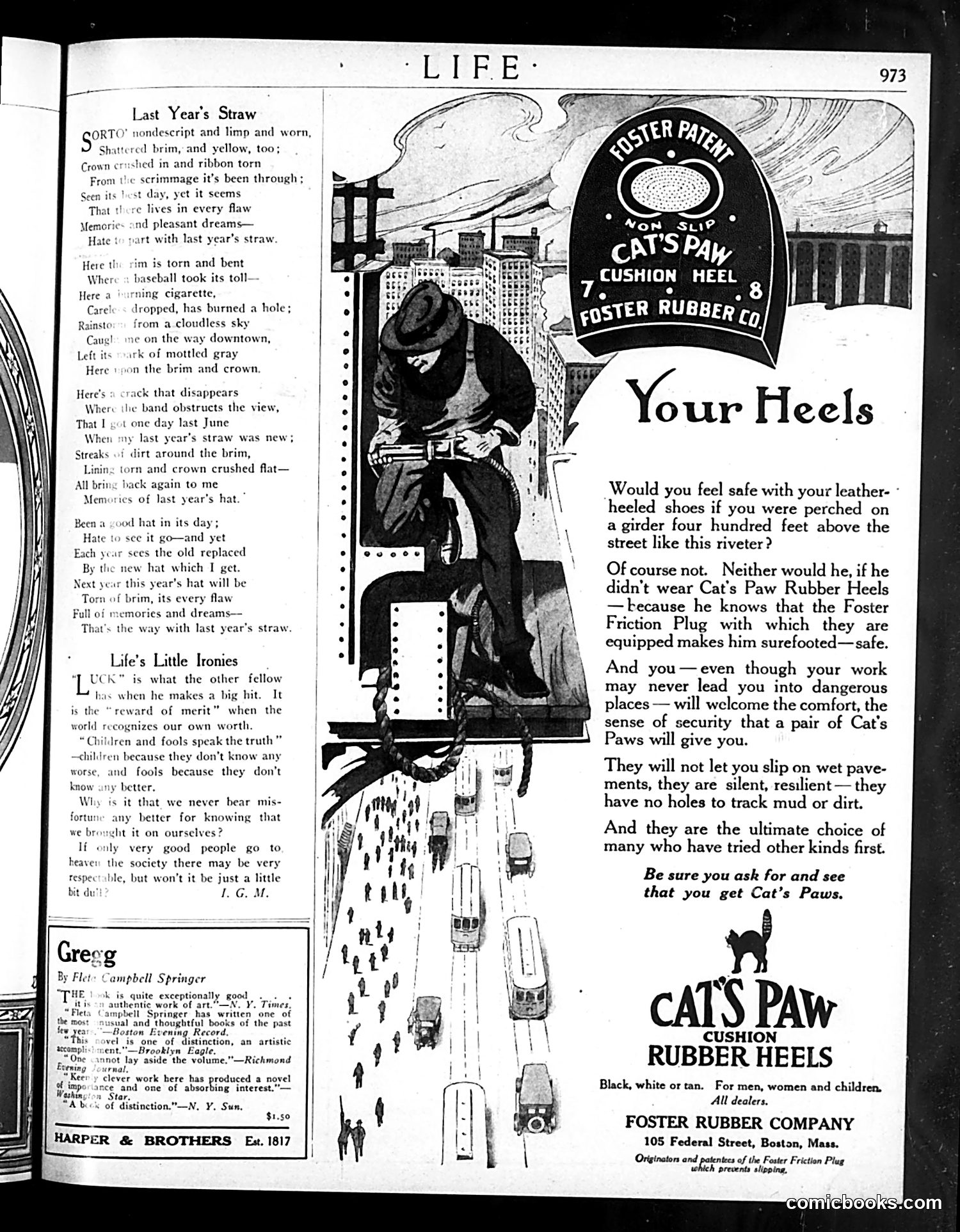
This page contains two unrelated items: poetry and advertising. **"Last Year's Straw"** is a nostalgic poem about a worn straw hat—its brim torn, crown crushed, bearing marks of use (a baseball, cigarette burn, hole from a cane). The poem reflects on memories associated with the hat's deterioration, expressing bittersweet attachment to an object that has "seen it all." **"Life's Little Ironies"** is a brief philosophical note about "luck" and merit. The dominant content is a **Foster Rubber Company advertisement** for "Cat's Paw Cushion Rubber Heels." The ad features an illustration of a roofer precariously perched on a building ledge, arguing that leather heels are unsafe—only Cat's Paw rubber heels with their "Friction Plug" provide security and prevent slipping on wet pavements. It's a practical safety pitch targeting workers.
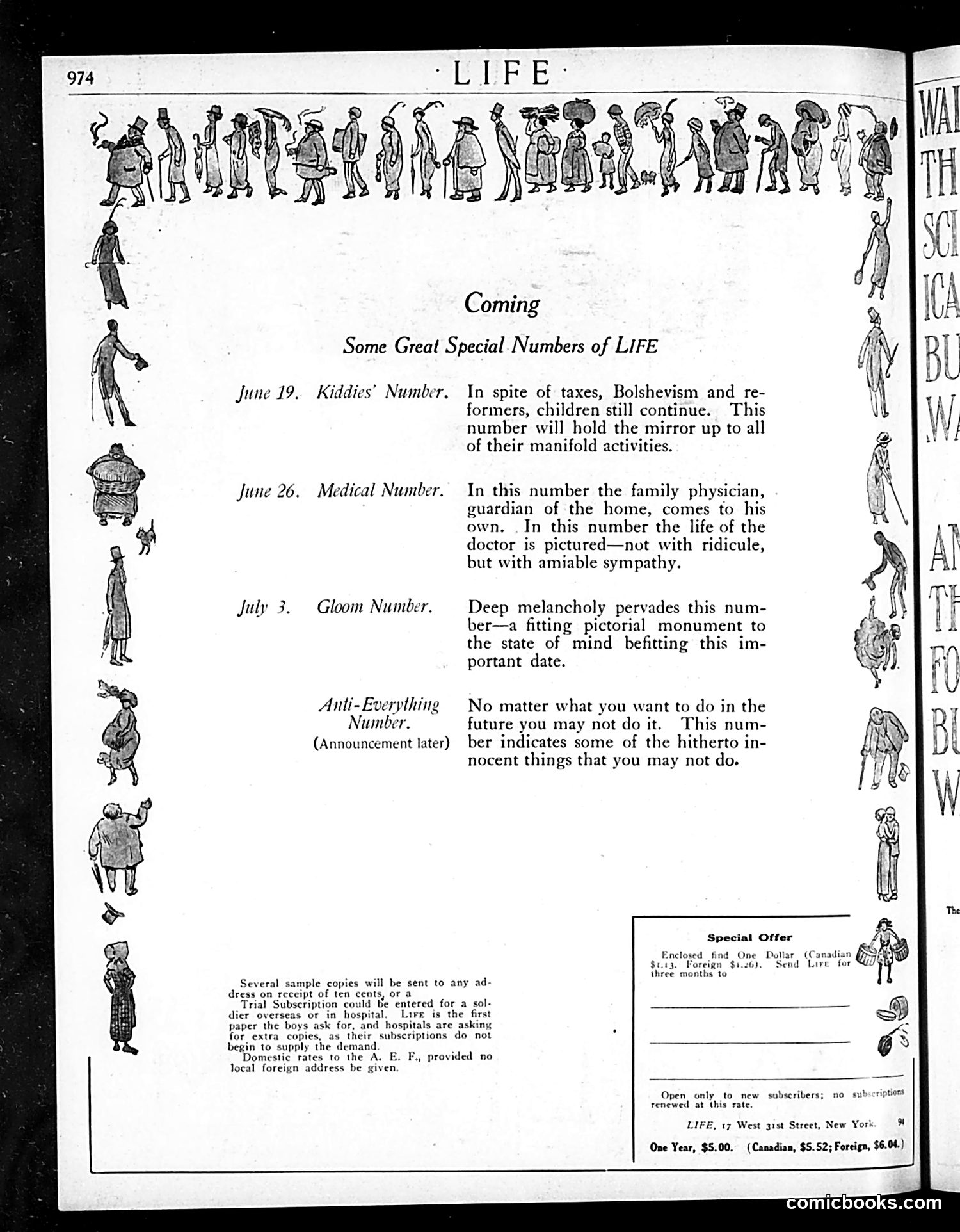
This page promotes upcoming special issues of Life magazine. The text describes four themed editions: - **June 19 "Kiddies' Number"**: Focuses on children's activities despite contemporary social upheaval ("taxes, Bolshevism and reforms") - **June 26 "Medical Number"**: Features family physicians sympathetically rather than mockingly - **July 3 "Gloom Number"**: Described as melancholic, fitting for that date - **"Anti-Everything Number"** (announcement later): Satirizes restrictions on personal freedom The decorative borders show figures in various poses and costumes, appearing to illustrate typical Life magazine satirical content. The page is primarily promotional material rather than standalone satire, advertising subscription rates at the bottom. The reference to "Bolshevism" reflects 1920s American concerns about socialist ideology.
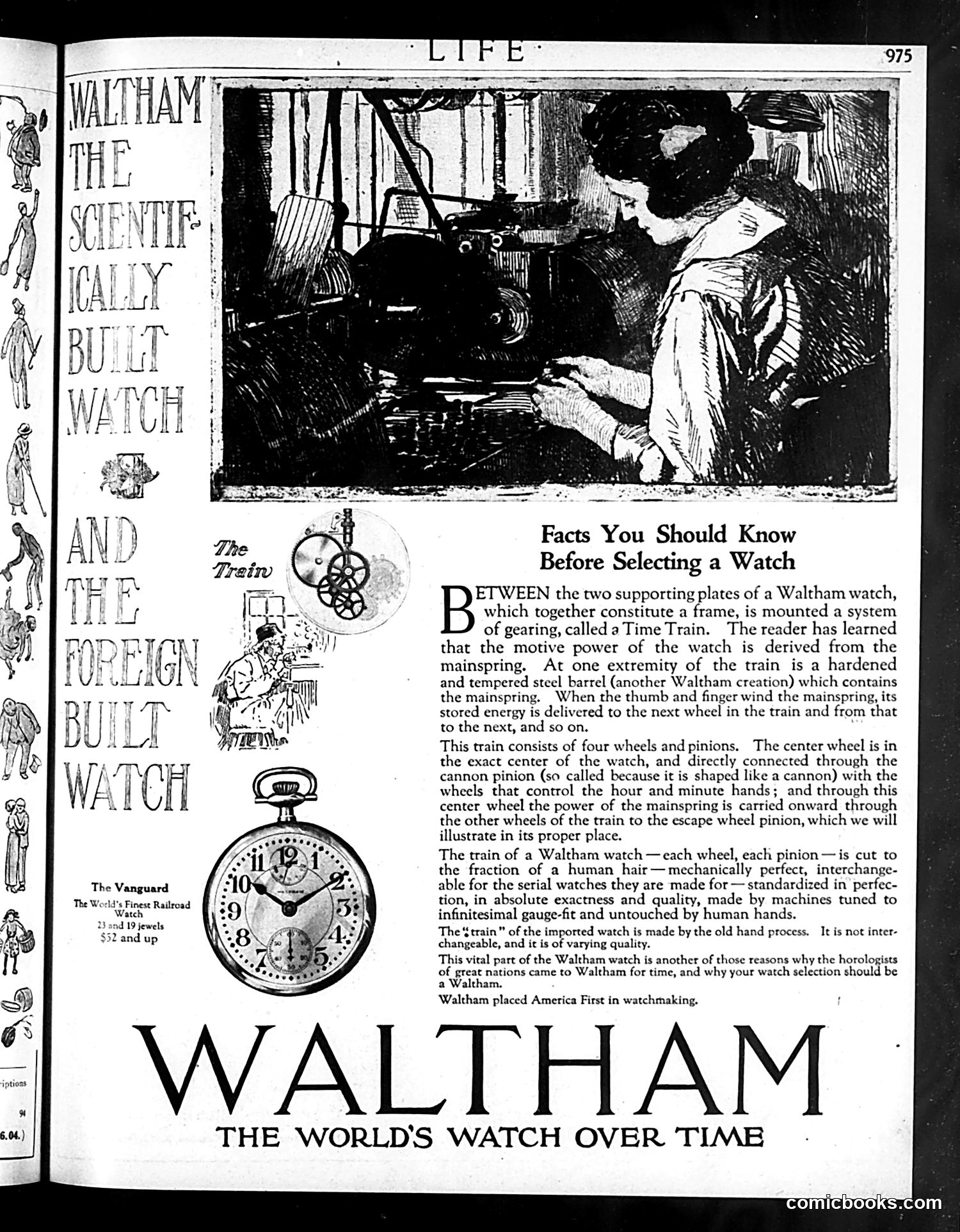
This is primarily a **Waltham Watch advertisement**, not political satire. The page features: **Main content:** An educational advertisement explaining how Waltham watches work. The top illustration shows a woman examining a watch mechanism. Below is technical text describing the "Time Train"—the gear system inside Waltham watches—and emphasizing that Waltham pioneered American watchmaking with mechanically perfect, interchangeable parts made by machines rather than hand. **Visual elements:** A pocket watch face is displayed, along with diagrams of the train mechanism. The left margin contains decorative fashion illustrations typical of Life magazine's design. **Marketing claim:** The ad concludes "Waltham placed America First in watchmaking," positioning the brand as patriotic and technologically superior. This is straightforward early 20th-century product advertising emphasizing manufacturing precision and American industrial innovation.
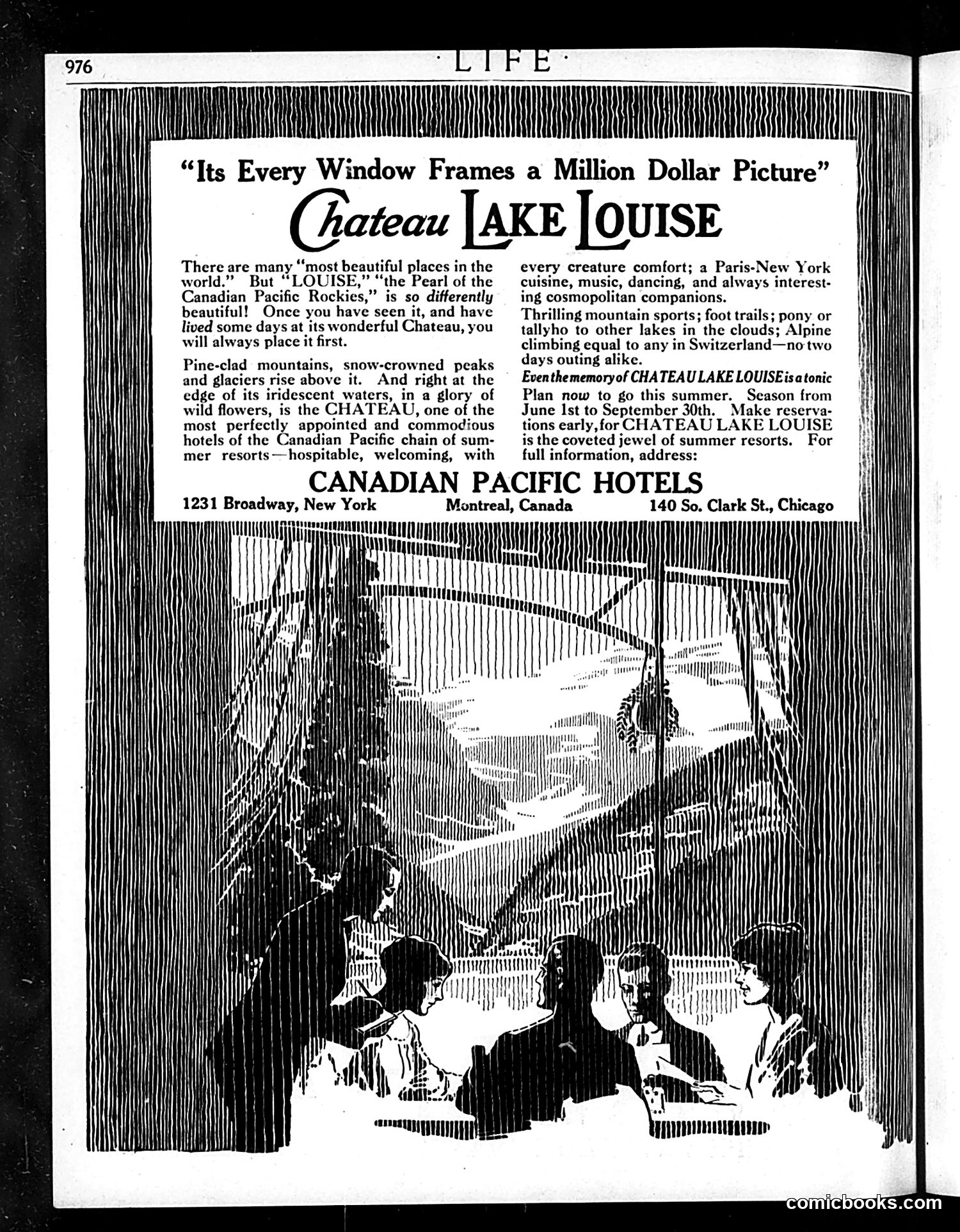
This is a **travel advertisement**, not a political cartoon. It promotes Chateau Lake Louise, a Canadian Pacific hotel resort, to American readers of *Life* magazine. The ad uses the tagline "Its Every Window Frames a Million Dollar Picture" to emphasize the scenic beauty of the location. The illustration shows tourists (appearing to be well-dressed women) gazing out from a dining room or lounge area toward a mountainous alpine landscape with a lake. The copy emphasizes luxury amenities—Paris-New York cuisine, music, dancing—alongside outdoor activities like mountain sports and hiking. This targets affluent American travelers seeking exclusive vacation destinations. The contact information lists offices in New York, Montreal, and Chicago, reflecting the Canadian Pacific Railway's role in promoting tourism to remote Canadian resorts accessible primarily to wealthy travelers of that era.
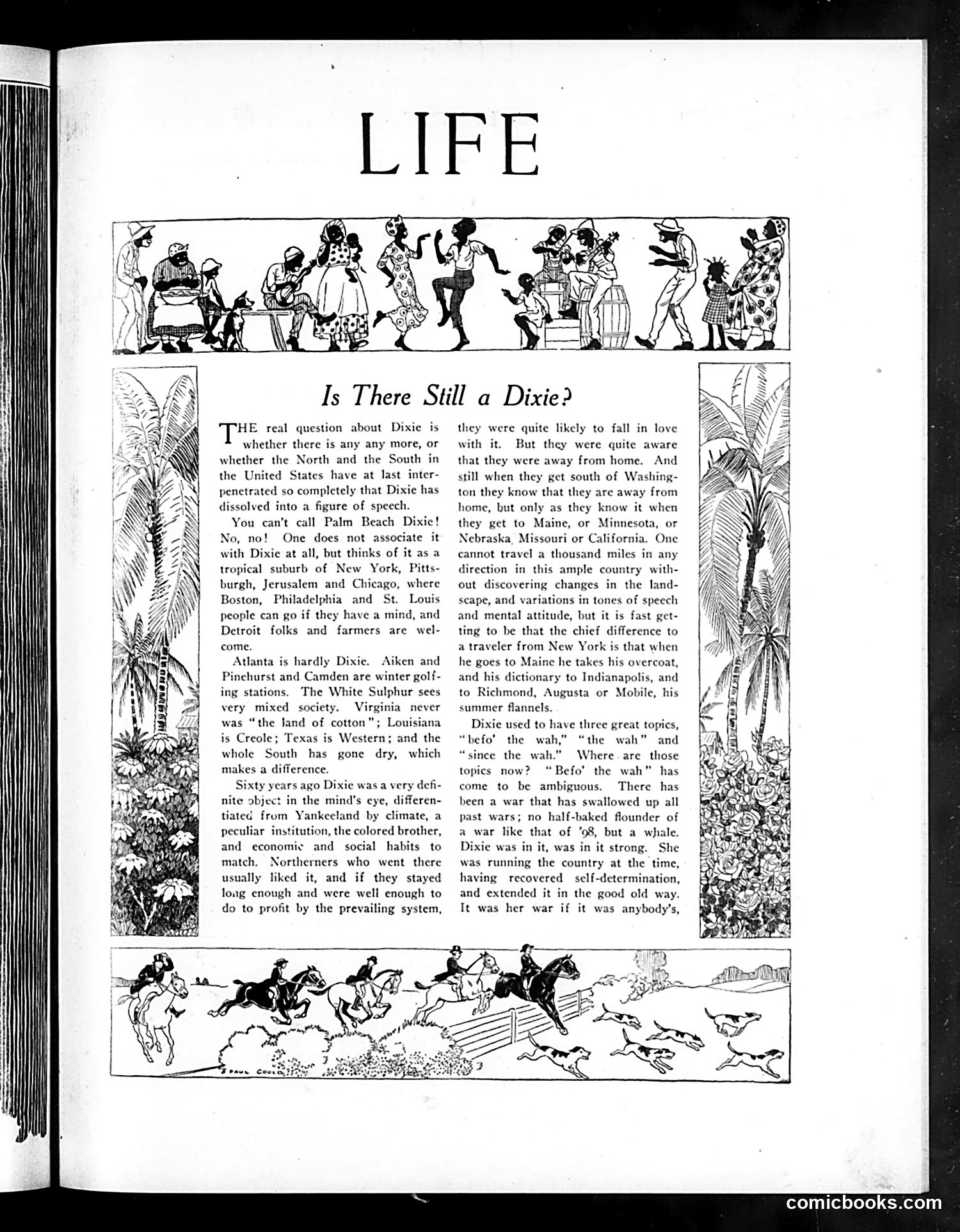
This article examines whether "Dixie" (the American South) still exists as a distinct cultural region. The author argues that while the North and South once had clear differences, modern travel and communication have blurred regional distinctions. The text discusses how Southerners traveling north or to distant regions discover they're "away from home," suggesting weakened regional identity. It references historical Southern characteristics—climate, slavery, economic systems—that once defined Dixie distinctly. The piece notes that Dixie's former three speech markers ("befo' the wah," "the wah," "since the wah") have become ambiguous, implying younger generations no longer emphasize these regional linguistic markers. The decorative illustrations show palm trees and fox hunting scenes, visually evoking Southern imagery while the text questions whether that South still meaningfully exists.
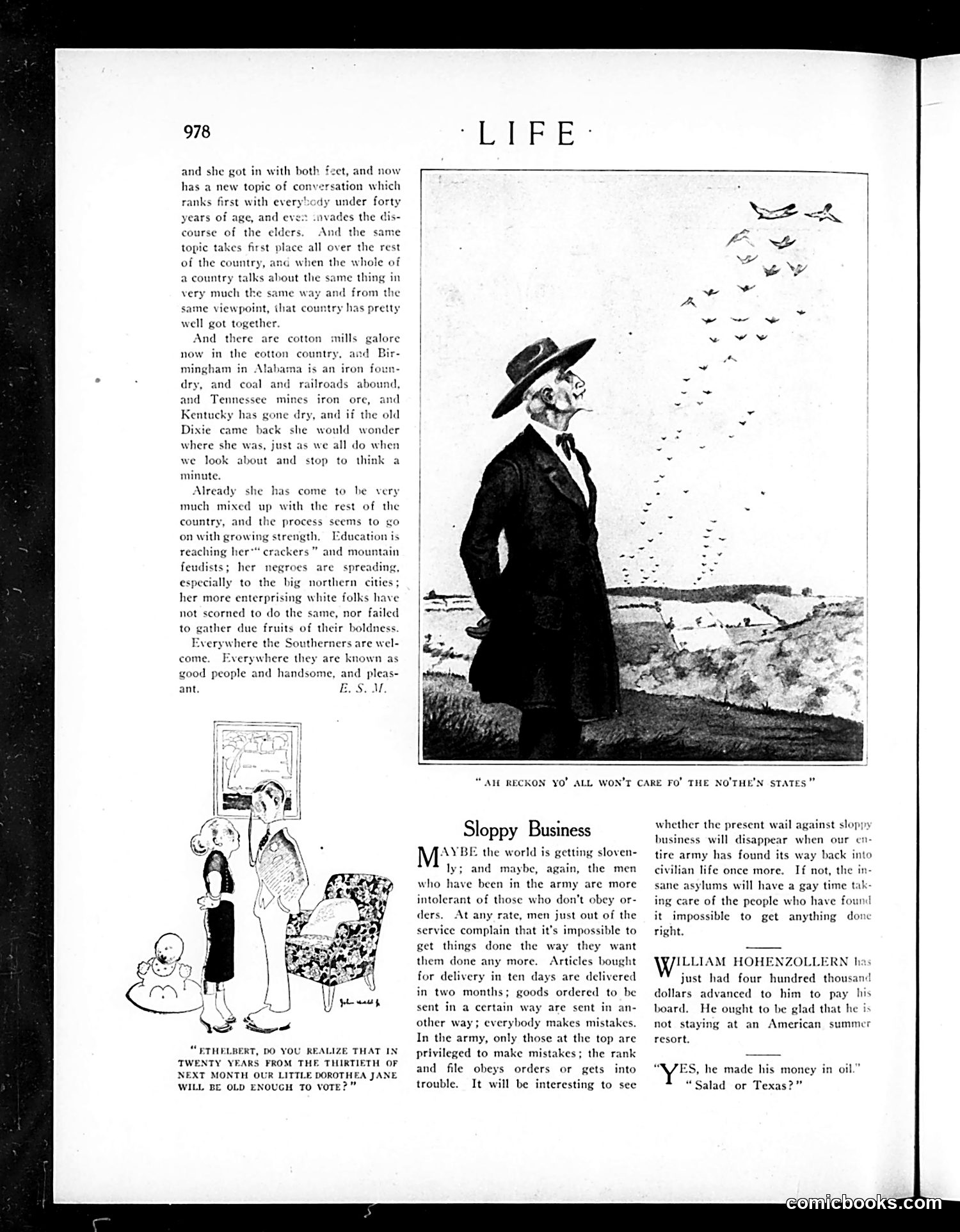
The main illustration depicts a figure in formal attire and hat, gazing skyward at a flock of birds in formation. The caption reads "AH RECKON YO' ALL WON'T CARE FO' THE NO'THEN STATES," employing a Southern dialect. This appears to be commentary on Southern attitudes toward the North during the post-WWI period. The lower cartoon shows a family scene with the caption questioning when a "little brother Jane will be old enough to vote," likely referencing voting rights debates of the era. The "Sloppy Business" article criticizes post-war military demobilization challenges and inefficiency in civilian logistics. The page satirizes regional divisions, military-to-civilian transition problems, and social attitudes of the 1920s American South.
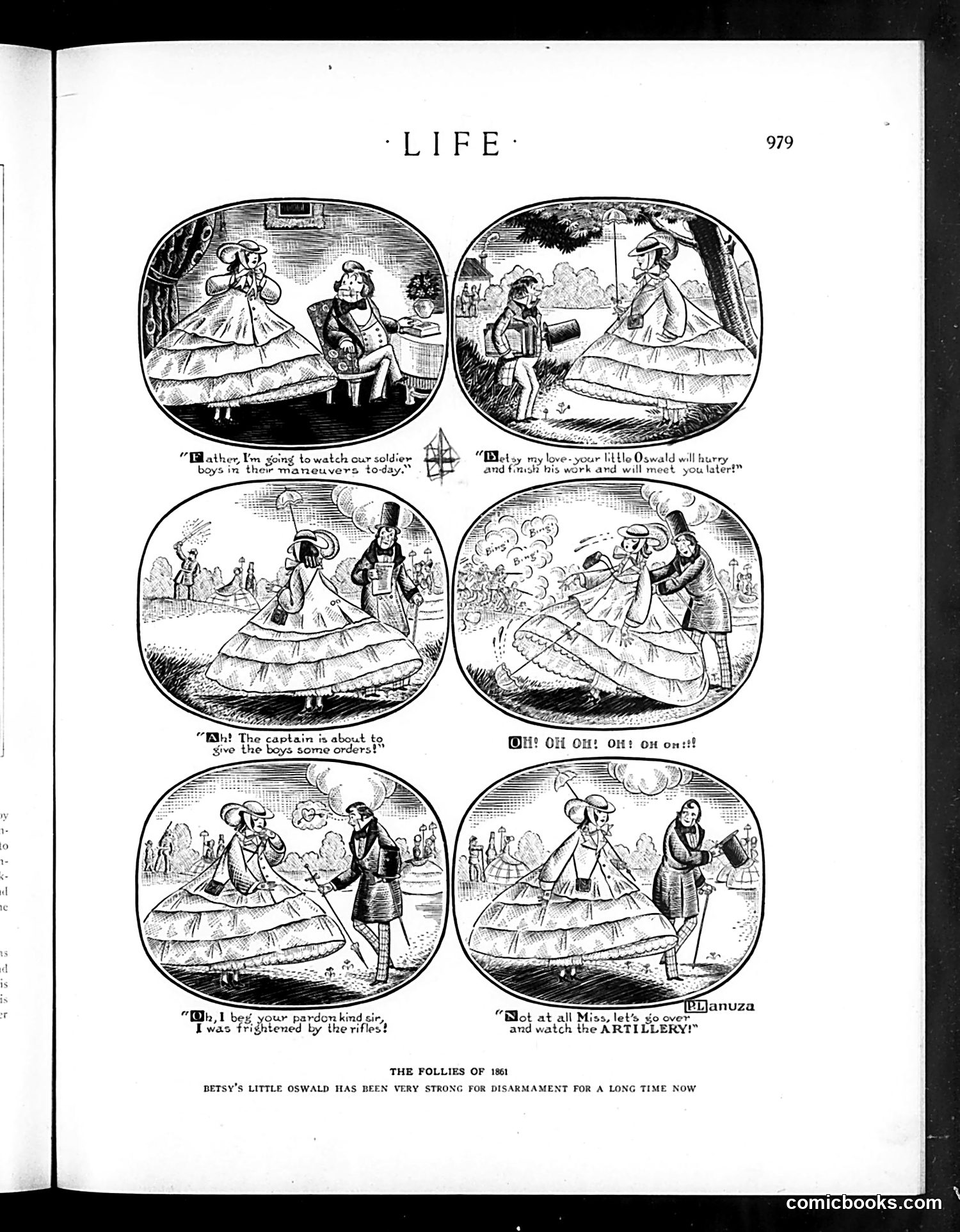
This is a six-panel comic strip satirizing military life during the American Civil War. The narrative follows a soldier's romantic entanglement: a woman asks her father's permission to marry a soldier ("little Oswald"), claiming he'll "hurry and finish his work" in the war. The humor derives from the contrast between her optimistic expectations and military reality. Panels show her excitement about him finishing quickly, followed by increasingly frantic scenes of actual combat ("Oil! Oil! Oh! Oh on!!!"). The final panels show her disappointment when the soldier returns to ask about watching artillery rather than marrying her. The satire mocks both naive civilian assumptions about war's duration and soldiers' distraction from romantic obligations by military duty.
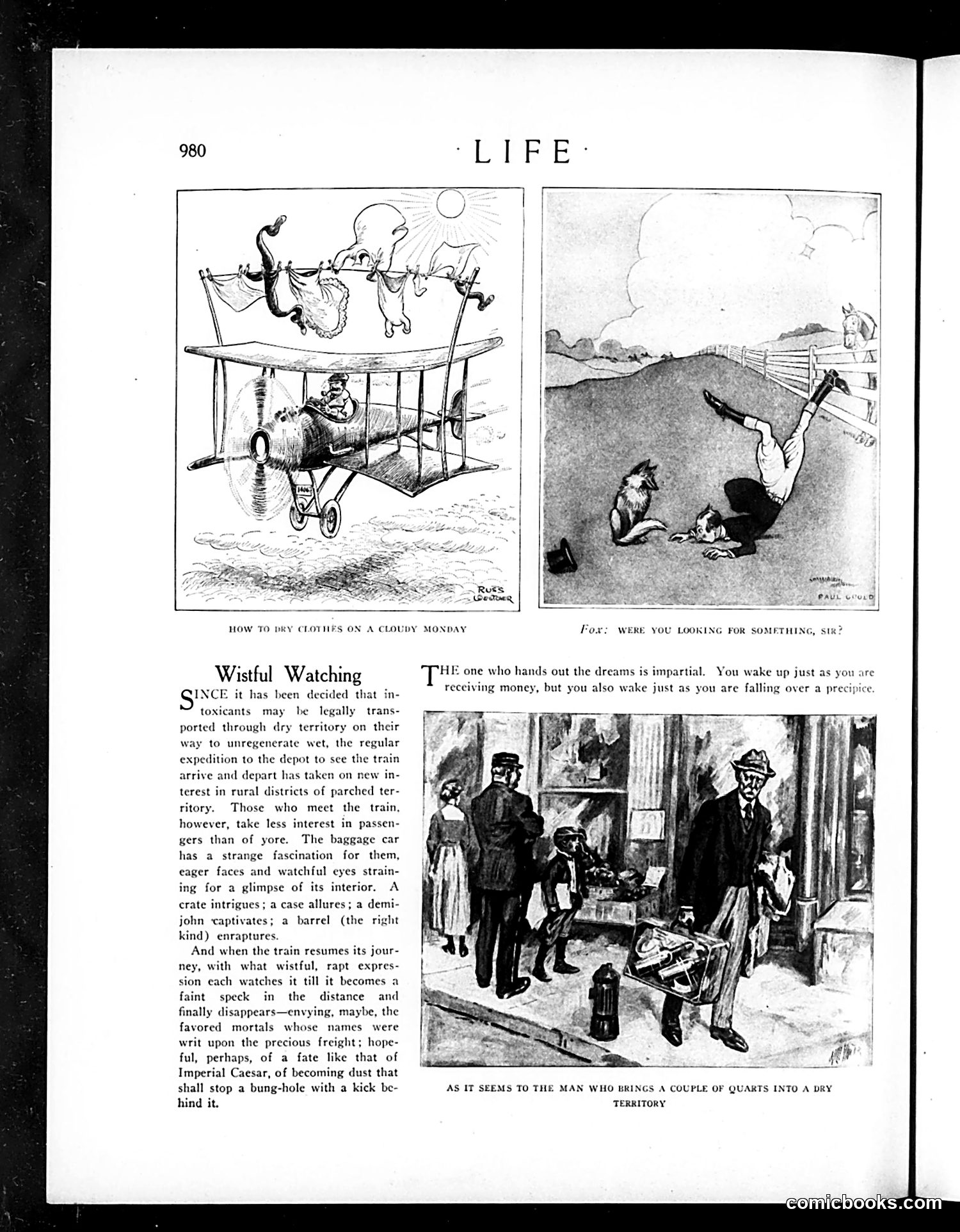
This page contains three satirical cartoons about everyday absurdities: 1. **"How to Dry Clothes on a Cloudy Monday"** (top left): Shows someone using an airplane to dry laundry—mocking the impracticality of doing laundry during bad weather. 2. **"For: Were You Looking for Something, Sir?"** (top right): Depicts someone tumbling from a fence while others watch, a visual gag about embarrassing mishaps. 3. **"Wistful Watching"** (bottom): Accompanied by text about train passengers watching baggage cars with fascination, suggesting curiosity about mysterious cargo. The illustration shows men in coats examining what appears to be smuggled liquor—likely referencing Prohibition-era bootlegging, when transporting alcohol illegally through dry territories was common. The page satirizes mundane human behaviors and contemporary social issues through humor.
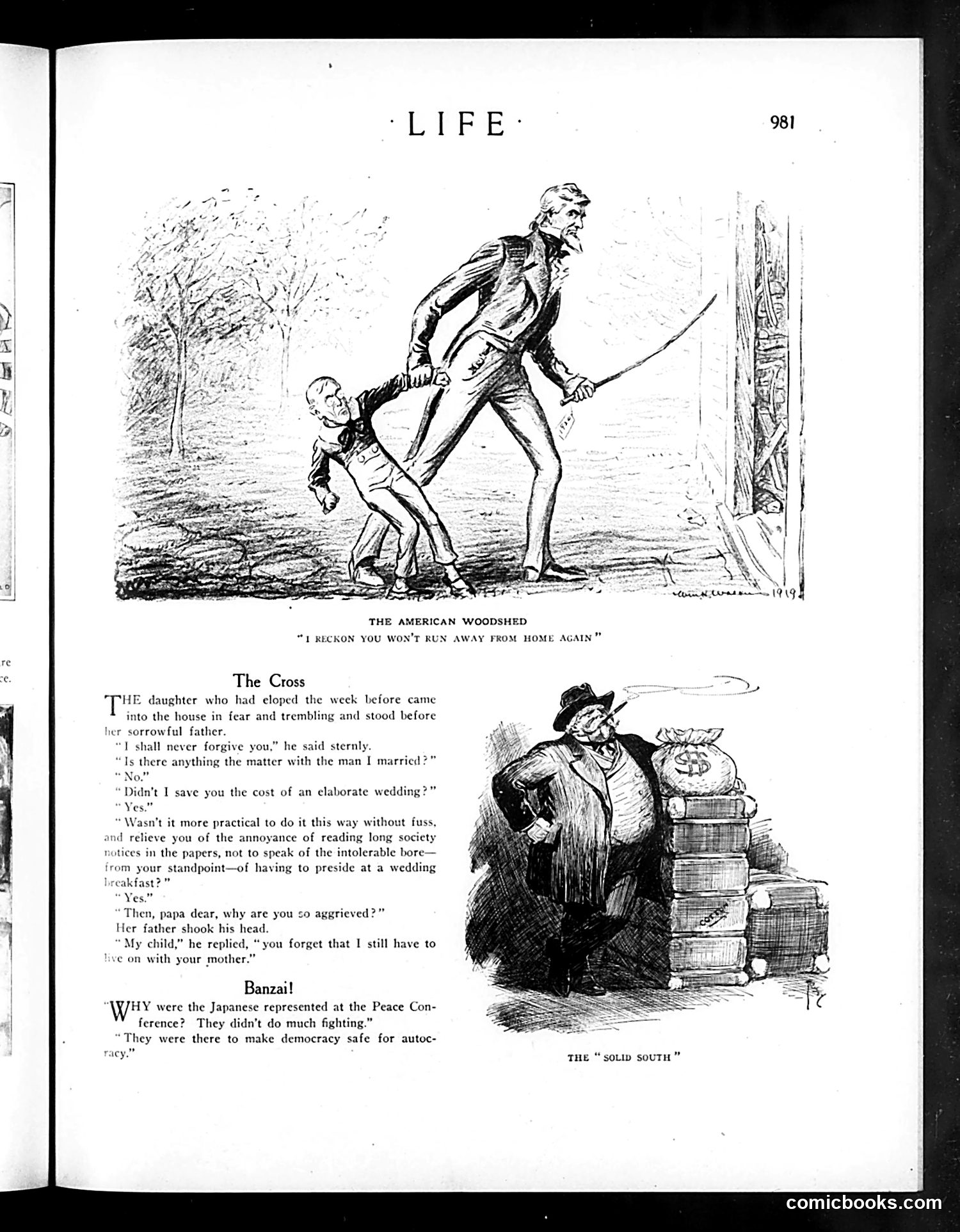
**"The American Woodshed"** (top cartoon): Shows an adult man with a switch disciplining a small boy, captioned "I reckon you won't run away from home again." This satirizes parental authority and the corporal punishment common in early 20th-century child-rearing. **"The Cross"** (middle): A dialogue between a stern father and his eloped daughter. He refuses forgiveness, citing the scandal and expense she caused the family. The satire targets paternal rigidity and society's harsh judgment of women who marry without parental approval. **"Banzai!"** (bottom): A brief commentary questioning Japan's presence at a Peace Conference despite minimal fighting, suggesting their participation was performative—"to make democracy safe for autocracy." This appears to reference post-WWI peace negotiations. **"The Solid South"** (illustration): Depicts someone struggling with stacked luggage or burdens, likely commenting on regional or political weight.
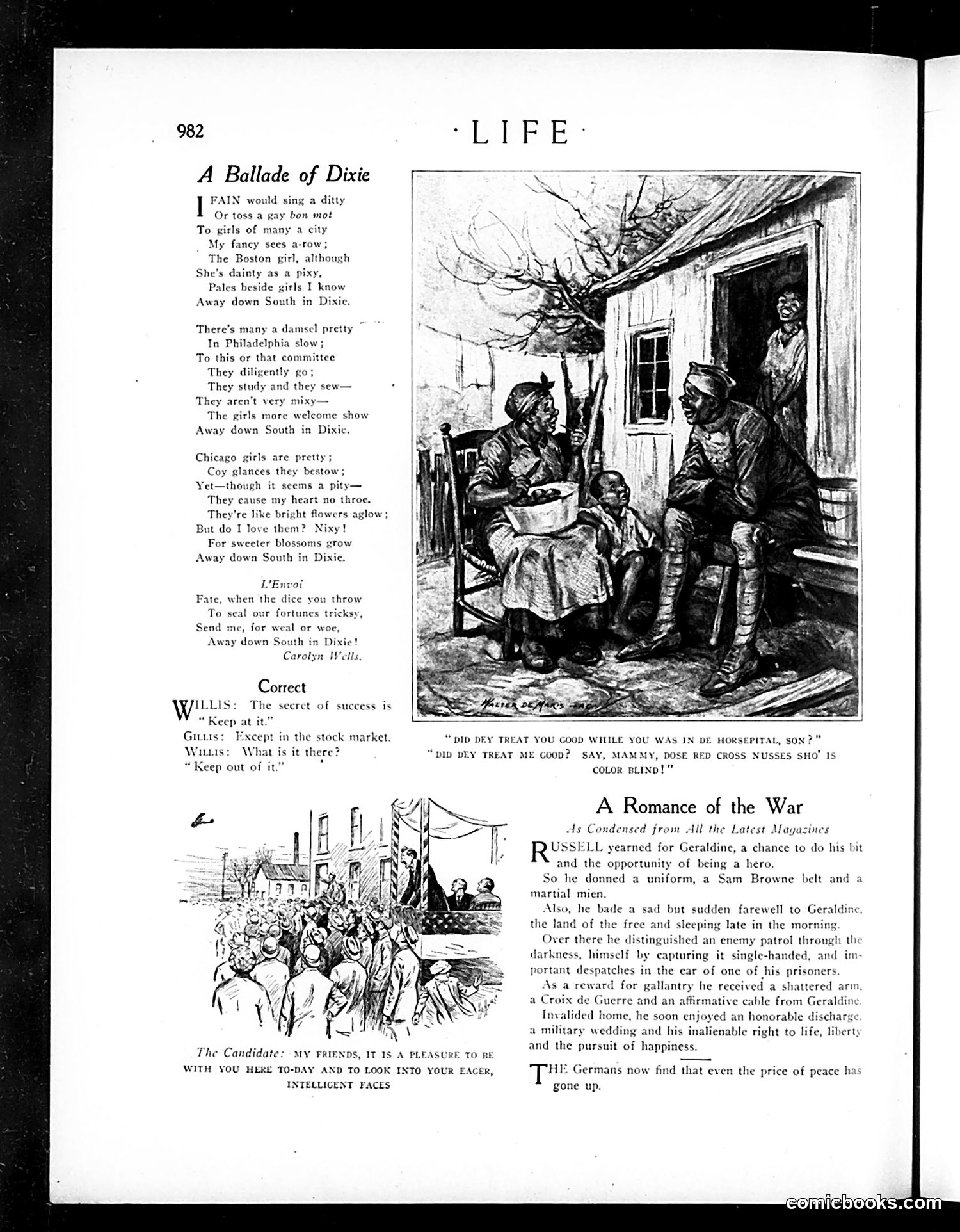
This page contains three distinct pieces: 1. **"A Ballade of Dixie"** by Carolyn Wells: A poem romanticizing Southern women, comparing girls from Boston, Philadelphia, and Chicago unfavorably to those "Away down South in Dixie." This reflects early 20th-century regionalist nostalgia. 2. **"Correct"** dialogue: A brief exchange between Willis and Gillis about stock market success, likely satirizing get-rich-quick schemes popular before the 1929 crash. 3. **"A Romance of the War"**: A WWI narrative about Russell, a soldier who captures enemy dispatches single-handedly, receives decoration, and enjoys an "honorable discharge" with marriage prospects—propagandistic wartime romance typical of Life's patriotic content during or shortly after WWI. The illustrations show period domestic and military scenes.
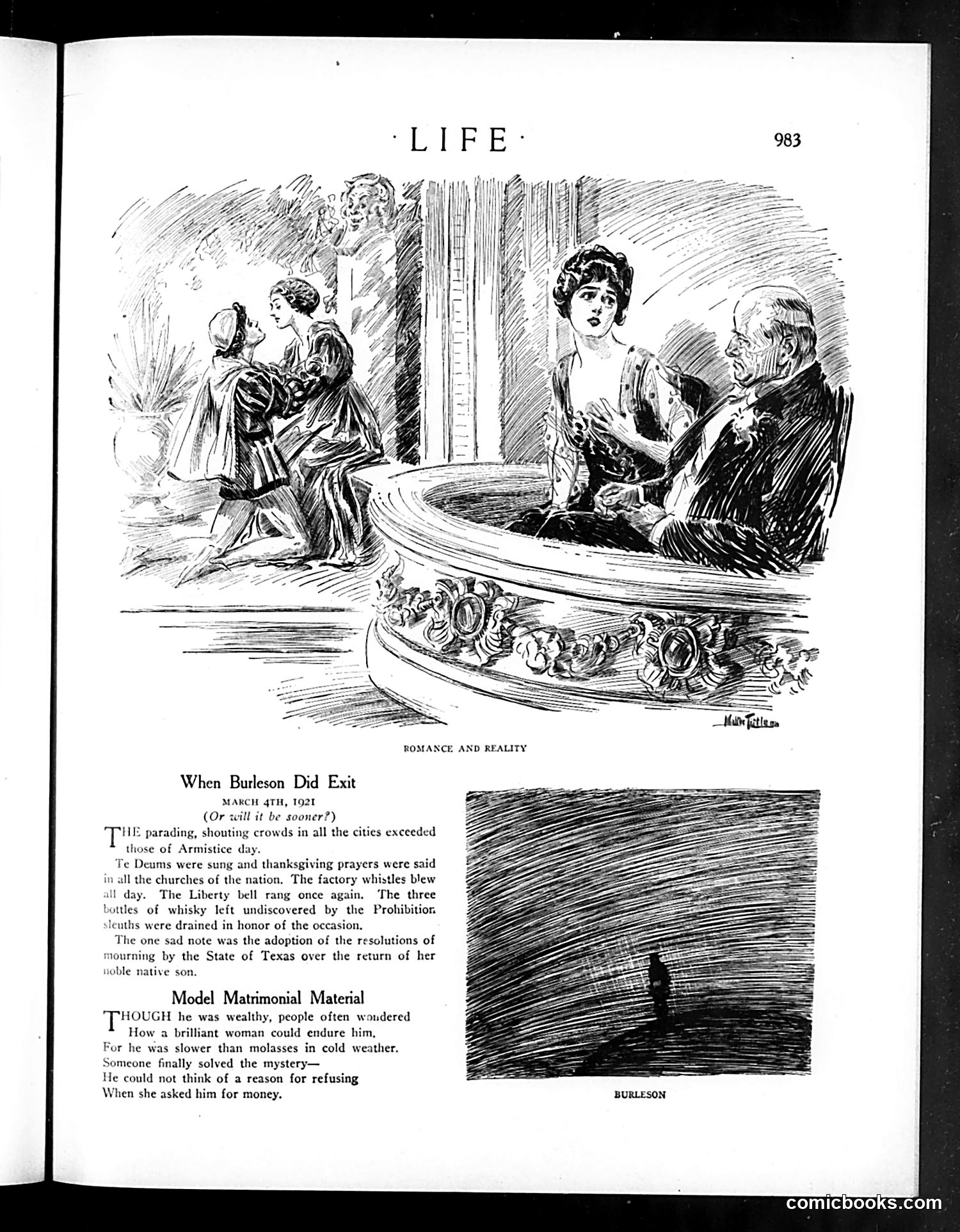
This page contains two distinct pieces: **Top cartoon ("Romance and Reality"):** Shows an interior scene with elegantly dressed figures in what appears to be a drawing room, illustrating the contrast between romantic idealization and practical reality in relationships. **"When Burleson Did Exit" (March 27, 1921):** References Albert Burleson, Postmaster General under Wilson, apparently celebrating his departure from office. The text describes public jubilation—parades, church services, factory whistles—suggesting he was widely unpopular. The satirical tone indicates Burleson was considered a restrictive figure, likely due to his censorship policies during WWI. **"Model Matrimonial Material":** A humorous piece about wealthy men who prove undesirable husbands, with the joke being a woman's practical question about money reveals his true nature. The photograph labeled "Burleson" appears to be a portrait of the departing official.
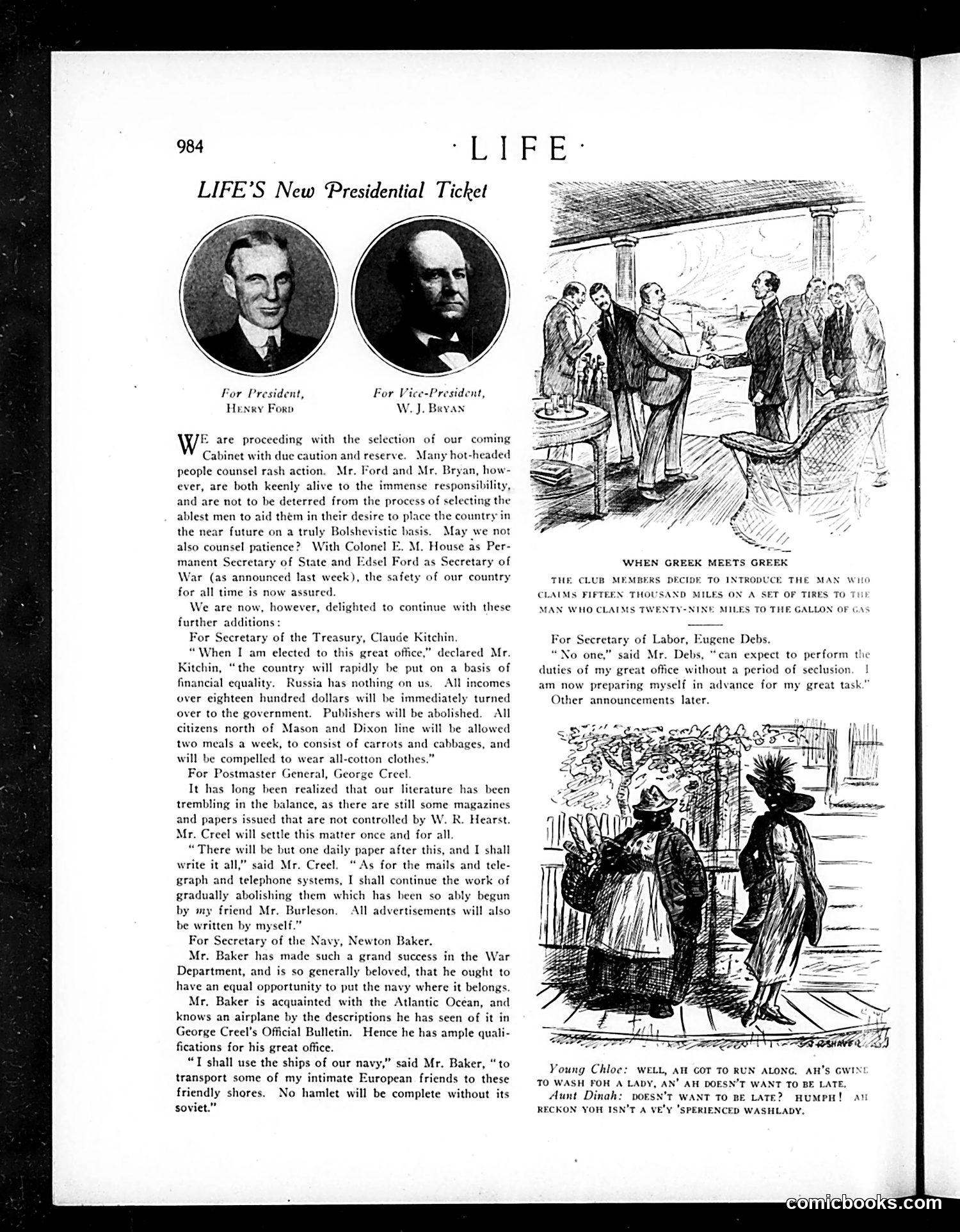
This page satirizes the progressive/socialist political movement of its time through mock cabinet appointments. Life presents a fake "presidential ticket" with Henry Ford for president and W.J. Bryan for vice president, then sarcastically "announces" cabinet positions for real political figures—Claude Kitchin, George Creel, Newton Baker, and Eugene Debs. The satire's point: these appointments would allegedly implement radical socialist policies (wealth redistribution, government control of media, Soviet-style "soviets" in every town). The exaggerated quotes—like Kitchin's plan to limit incomes and rations, or Baker's incompetence managing the Navy—mock both the appointees and the perceived dangers of socialist governance. The cartoons mock contemporary debates about American radicalism post-WWI. Eugene Debs, a real socialist politician, is included as Labor Secretary. The side cartoon about tire mileage claims appears unrelated satire. The piece reflects *establishment anxiety* about leftist movements gaining political traction during this era.
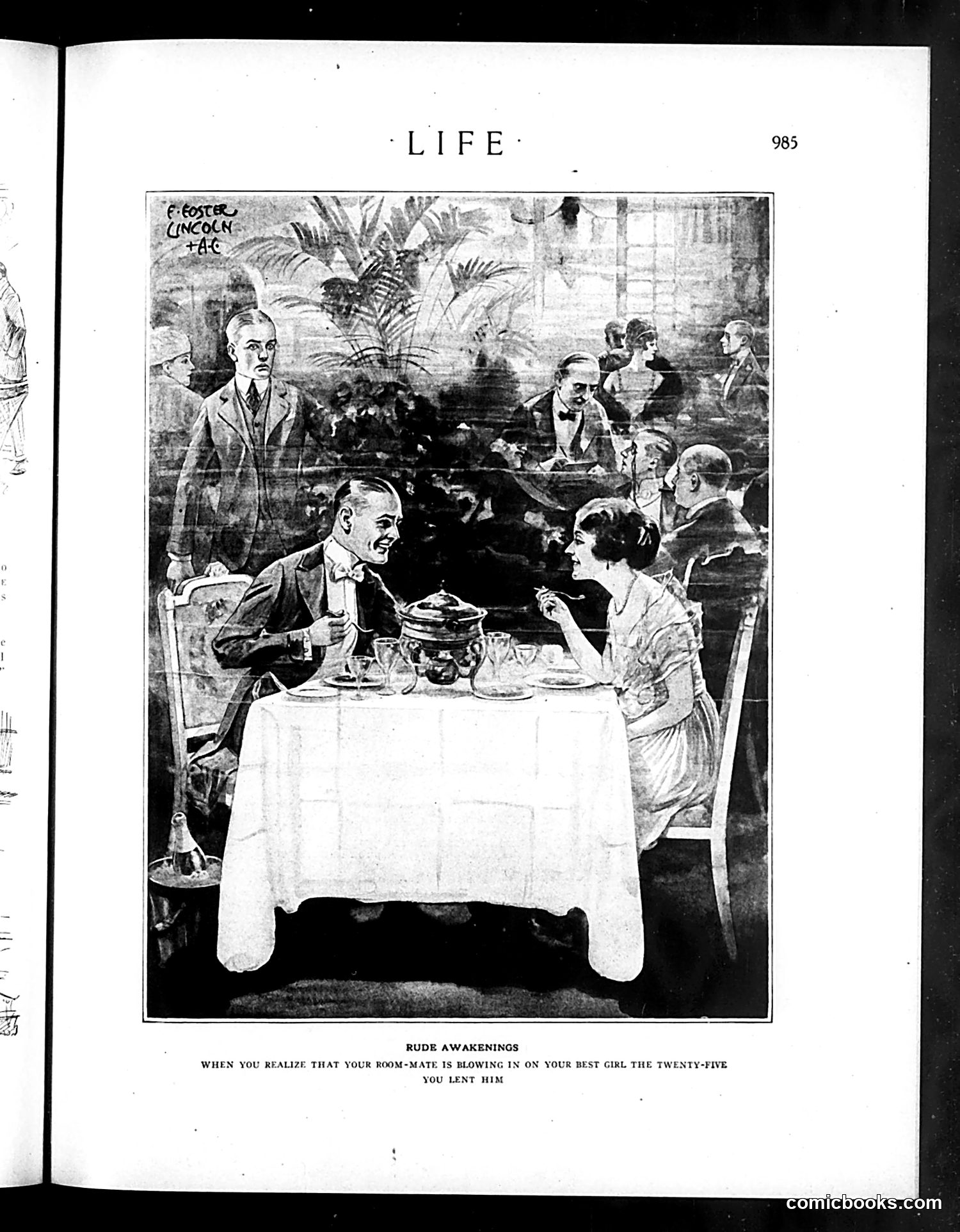
This is a humorous social cartoon depicting an awkward romantic situation. The scene shows a man and woman dining together intimately at a table. The caption's joke centers on a betrayal of trust: the speaker lent his roommate $25 (a significant sum in this era), and now discovers that same roommate is romantically pursuing his girlfriend. The cartoon satirizes male social anxieties of the period—particularly around money lending between friends and romantic rivalry. The "rude awakening" is the moment of realizing one's generosity (the loan) was exploited to win over one's romantic interest. The other figures in the background appear to be additional diners, suggesting this embarrassing realization occurs in public. The humor relies on the audience's recognition of this common social predicament among young men.
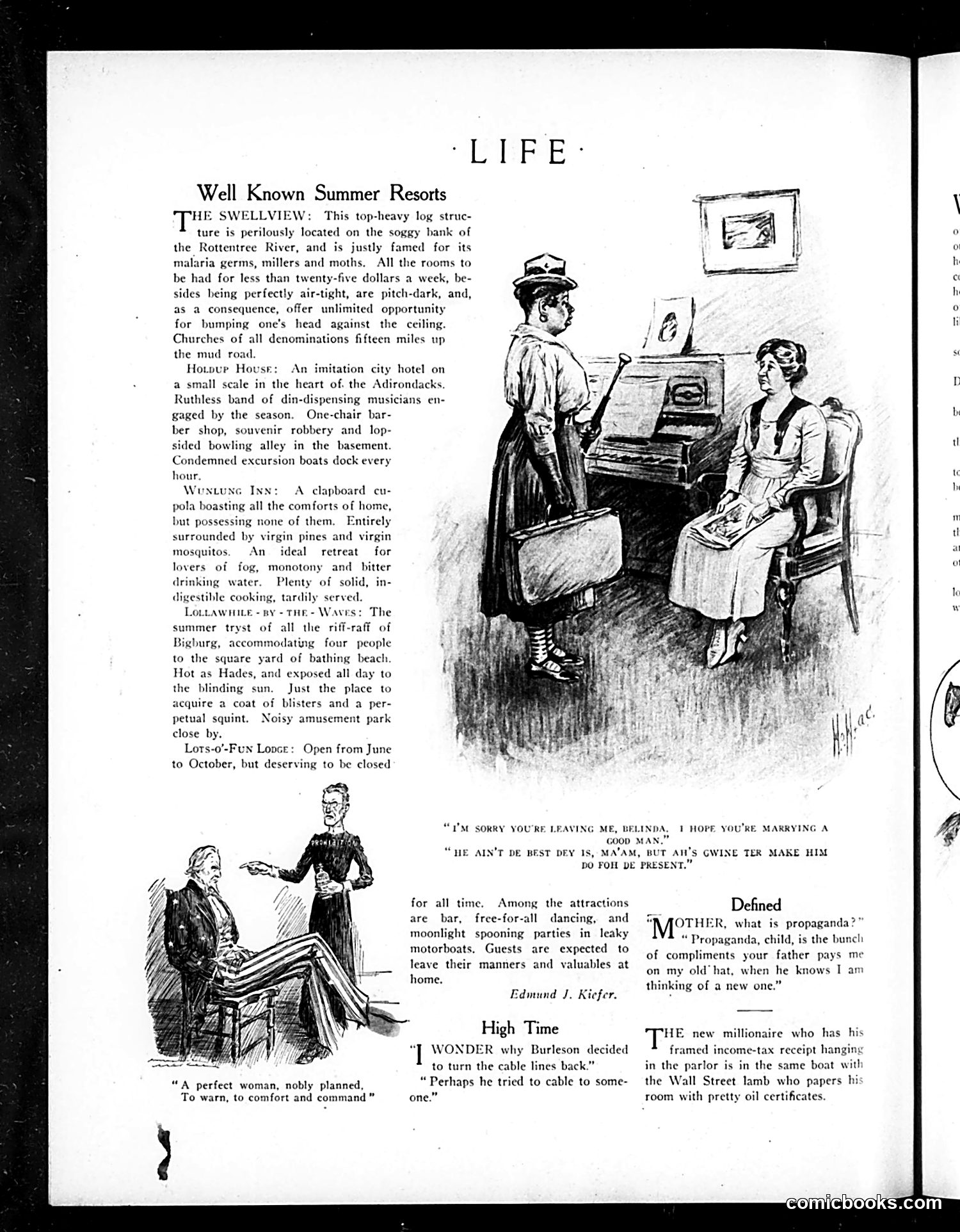
This page from *Life* magazine contains satirical descriptions of five fictional summer resorts, each mocking real vacation destinations of the era. The humor derives from inverting expectations: resorts advertised as luxurious retreats are revealed as uncomfortable, disease-ridden, or otherwise unpleasant. Examples include "The Swellview" (a rickety structure on a malaria-infested river), "Hotour House" (an imitation hotel with corrupt musicians and condemned boats), and "Lots-o'-Fun Lodge" (overcrowded, hot, and morally questionable). The satire targets both the false advertising of resorts and the gullibility of wealthy vacationers willing to pay for substandard accommodations. The page also includes unrelated jokes about politics (Burleson and cable lines), gender dynamics, and wealth display—typical *Life* magazine fare mocking contemporary society and pretension.
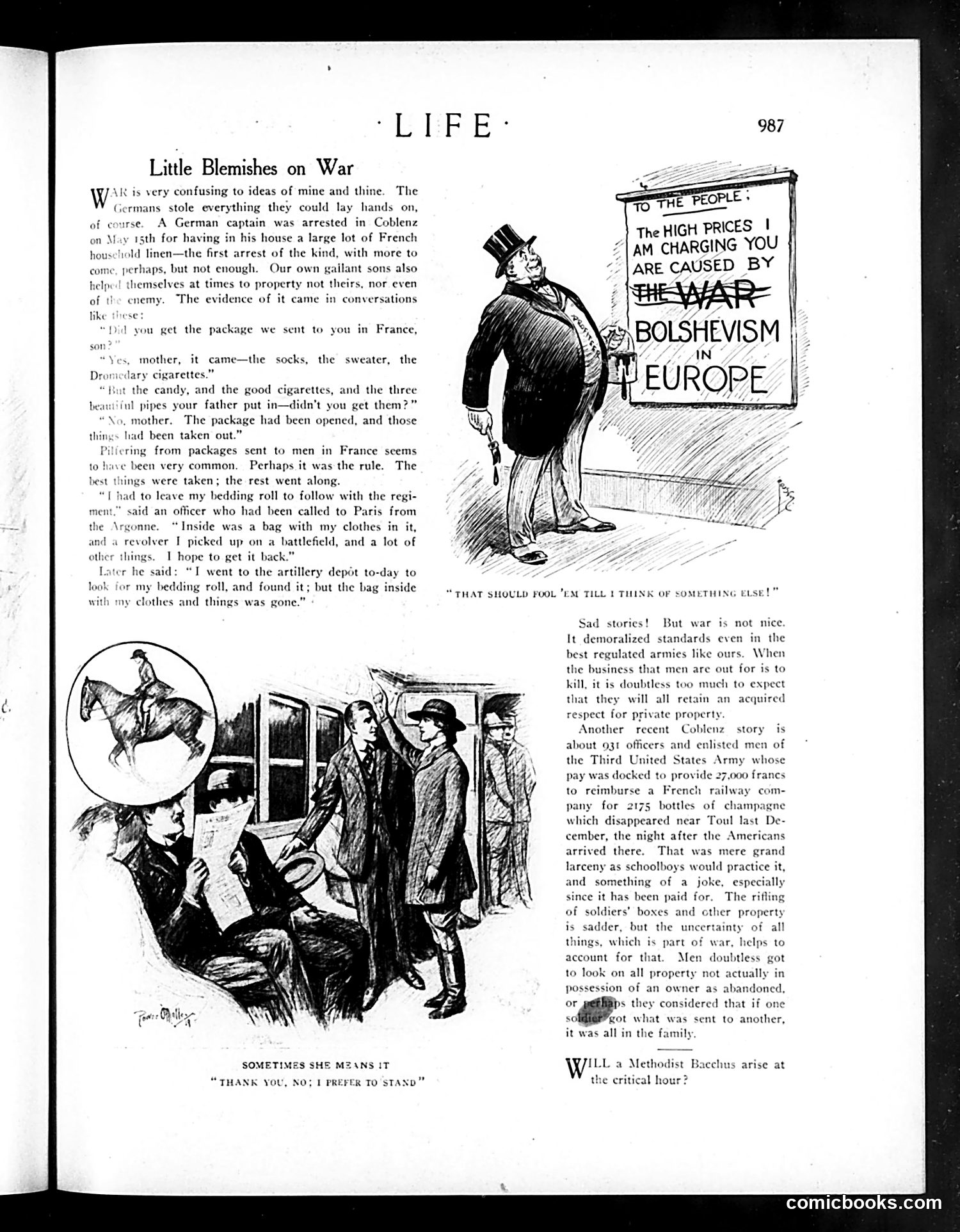
This article criticizes wartime looting and moral decay among Allied soldiers. The main cartoon depicts a profiteer blaming "Bolshevism in Europe" for high prices—a cynical deflection. The satire mocks how merchants use war fears to justify inflation while soldiers themselves steal from packages and property. The text catalogs specific incidents: a German officer arrested for French linens, American soldiers finding opened care packages with valuables removed, and U.S. Army officers docked pay for missing champagne near Toul. The author argues war "demoralized standards" even in disciplined armies, making soldiers view unguarded property as abandoned spoils rather than theft. The piece presents this as inevitable moral compromise during combat, yet clearly satirizes the hypocrisy: profiteers exploit patriotic fears while soldiers loot freely, both justified by wartime chaos. The "blemishes" are systemic corruption dressed as necessity.
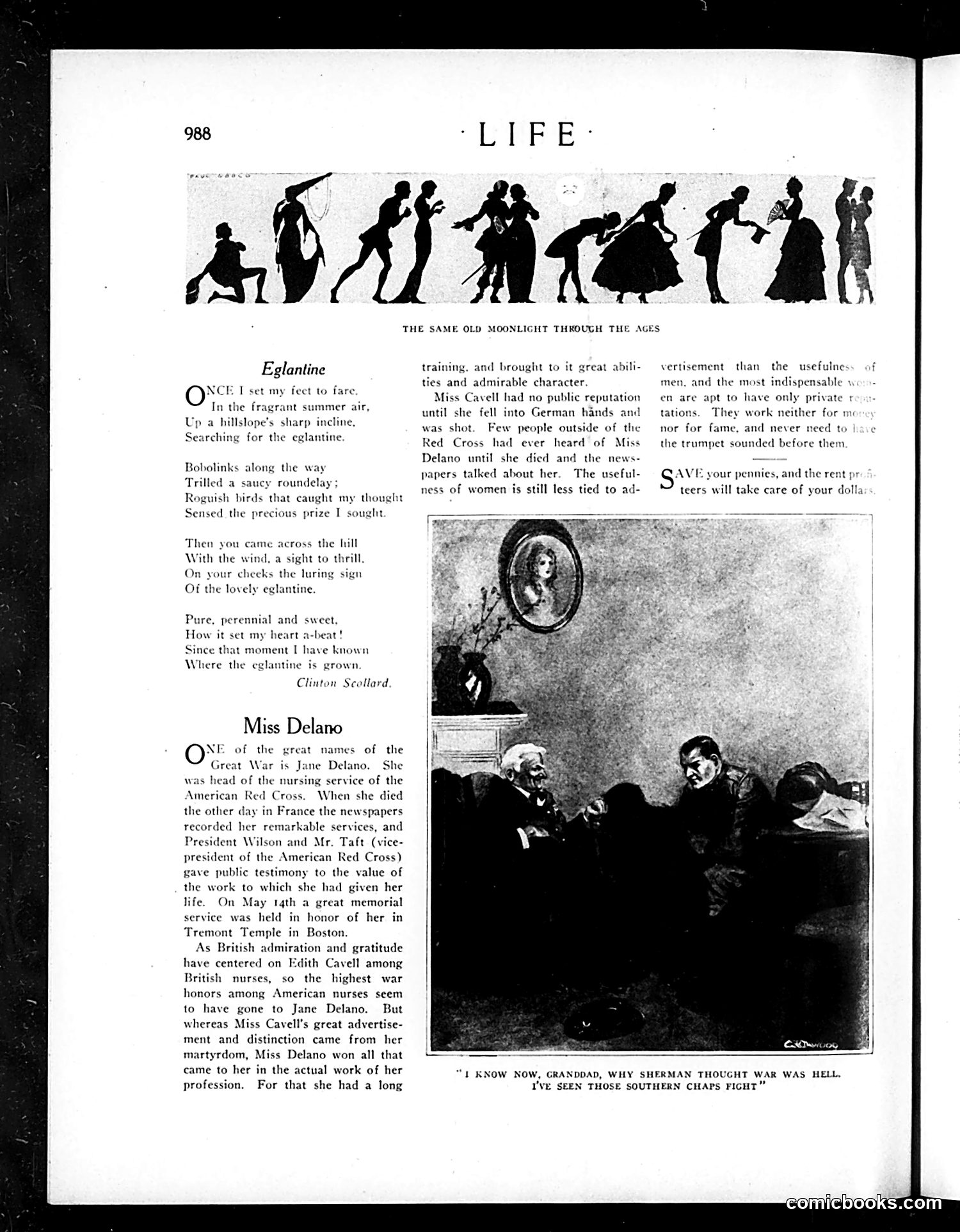
This Life magazine page contains two distinct pieces: **"Eglantine"** is a romantic poem by Clinton Scollard celebrating finding love while searching for wildflowers—sentimental Victorian verse, not satirical. **"Miss Delano"** is a memorial tribute to Jane Delano, head nurse of the American Red Cross who died in France during WWI. The article praises her actual professional accomplishment rather than martyrdom, contrasting her favorably with British nurse Edith Cavell (who gained fame through execution by Germans). The text argues that useful women's work often goes unrecognized compared to men's. The photograph and caption below show what appears to be WWI soldiers or civilians, with a child asking an elderly man why General Sherman called war hell—the child has now seen "southern chaps fight," invoking Sherman's Civil War march through the South. This is a historical reference joke about war's brutality across American generations. The decorative silhouettes at top show "moonlight through the ages," depicting romance across history.
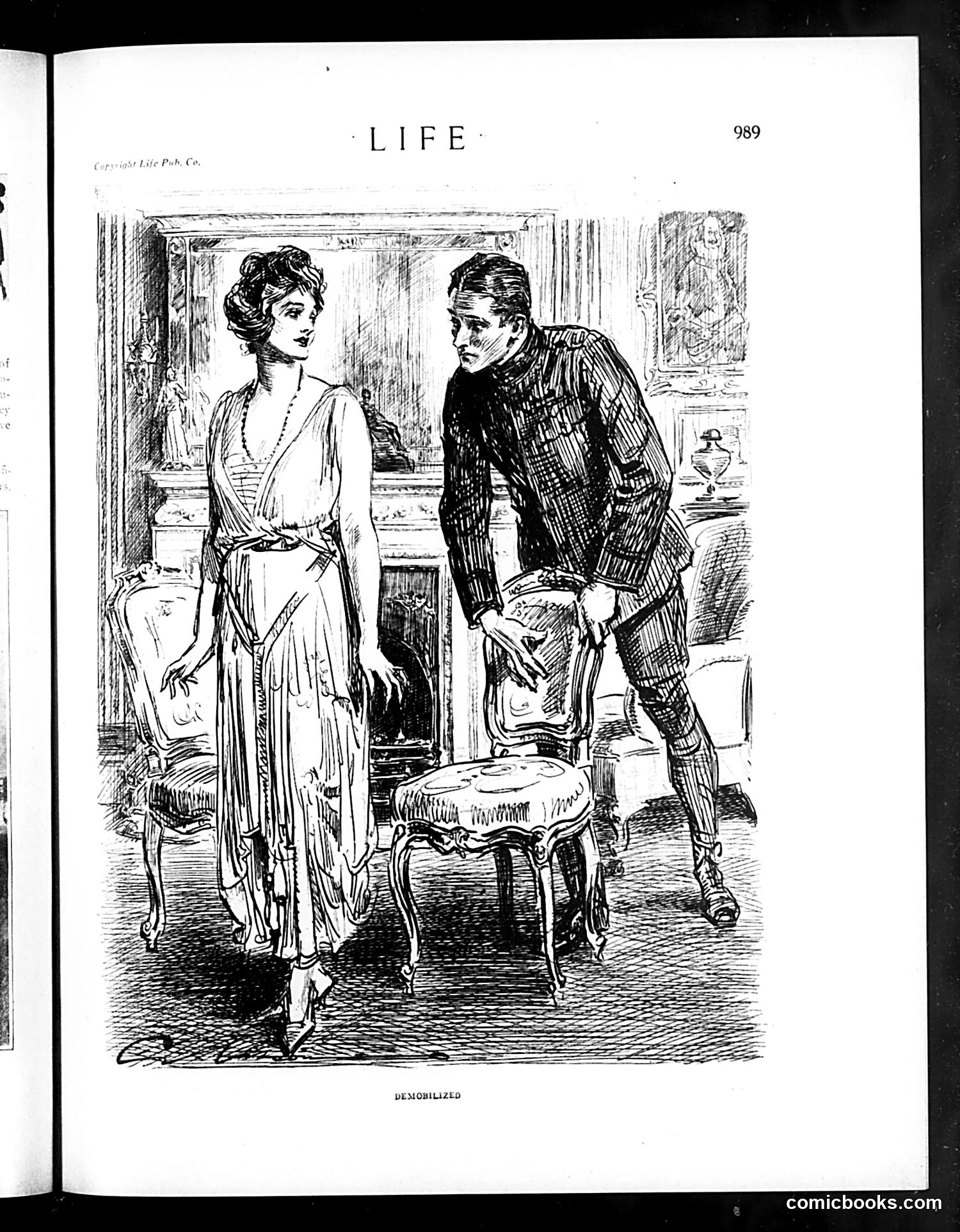
This sketch depicts a military officer in uniform confronting a woman in an elegant interior setting. The title "Demobilized" refers to the discharge of soldiers from military service. The satire likely comments on the social adjustment of demobilized officers returning to civilian life after military service (possibly post-WWI, given Life magazine's era and the uniform style). The woman's composed stance and the officer's somewhat awkward posture suggest the humor centers on the contrast between military bearing and civilian social interaction—perhaps implying the officer struggles with ordinary civilian courtship or domestic situations after military discipline. The domestic interior setting emphasizes this clash between military and civilian worlds. The specific satirical point remains somewhat unclear without additional caption text, but the central joke involves an officer's difficulty adapting to normal social life.
This June 1919 *Life* magazine page satirizes the contentious debate over the Treaty of Versailles following World War I. The main cartoon depicts **President Wilson** struggling against opposing forces—represented by figures labeled "Europe"—while trying to craft a lasting peace. The text mocks the conflict between Wilson's idealistic peace efforts and fierce critics, including: - **William C. Bullitt**, a State Department official who resigned, claiming the treaty was unjust and would spawn future wars - **Progressive publications** (*The Nation*, *The New Republic*) opposing the treaty as too punitive toward Germany - **U.S. Senate members** working to block Wilson's vision The satire's central point: Wilson fought to create peace while opponents—both isolationists wanting America to withdraw and progressives demanding harsher terms—undermined him. The cartoon suggests Wilson is caught in an impossible middle, with success uncertain. The poisoned gas reference mocks the waste of war resources.
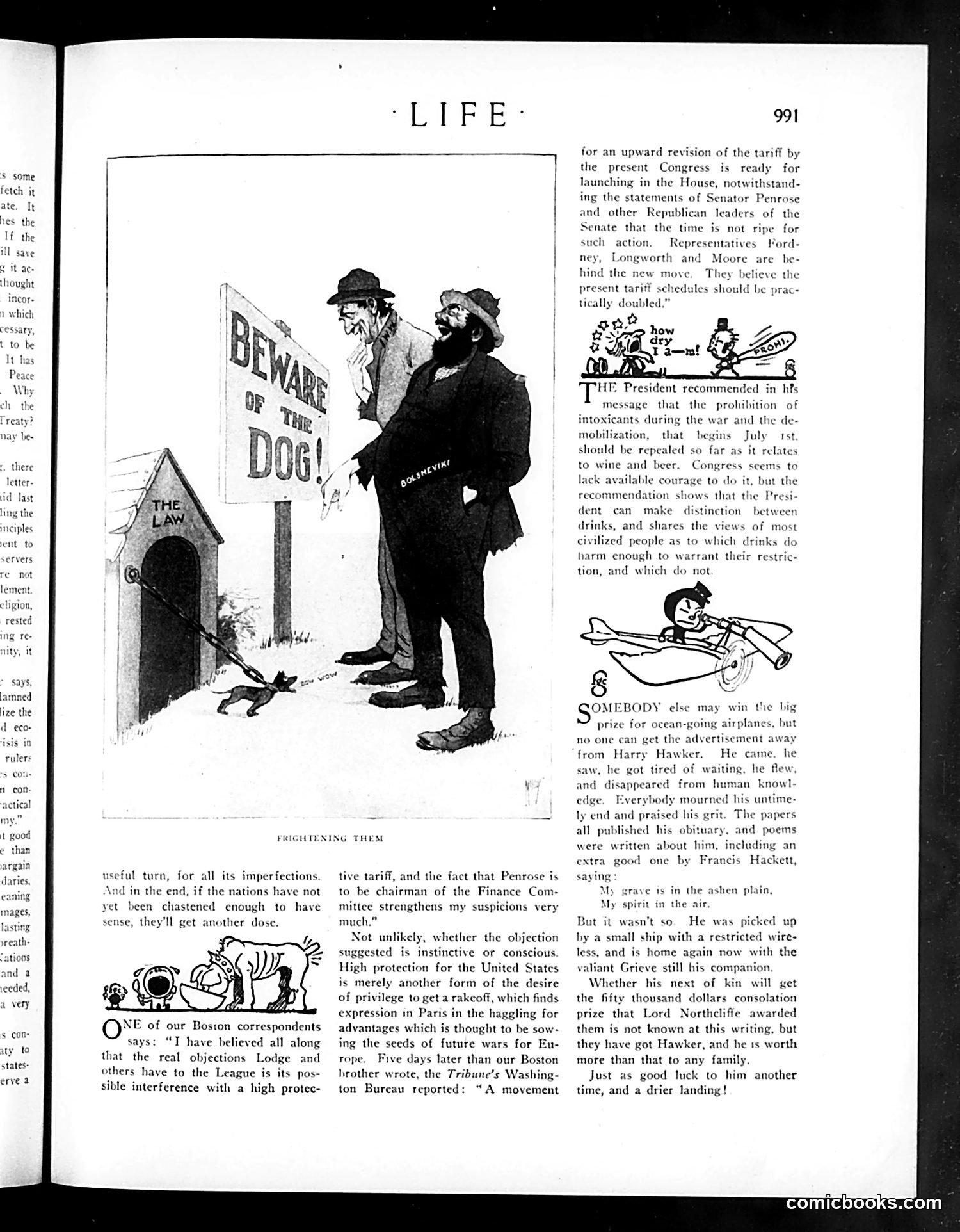
The main cartoon depicts two men in formal dress confronting a small dog near a doghouse labeled "THE LAW," with a sign reading "BEWARE OF THE DOG." The figures appear to represent politicians or business interests being intimidated by weak legal protections. The surrounding text discusses the League of Nations debate and tariff policy. A Boston correspondent suggests Republican opposition to the League stems from protecting high tariffs—senators like Penrose (Finance Committee chairman) and Lodge prioritize protectionist "privilege" over international cooperation. The cartoon satirizes how these powerful figures fear even minimal legal/regulatory constraints, portrayed as a harmless small dog. The satire's point: wealthy interests wielding real power pretend to be threatened by toothless oversight, exaggerating minor legal restrictions to justify blocking reform. The dog represents inadequate enforcement mechanisms, yet they still cower before it—revealing their actual power imbalance.
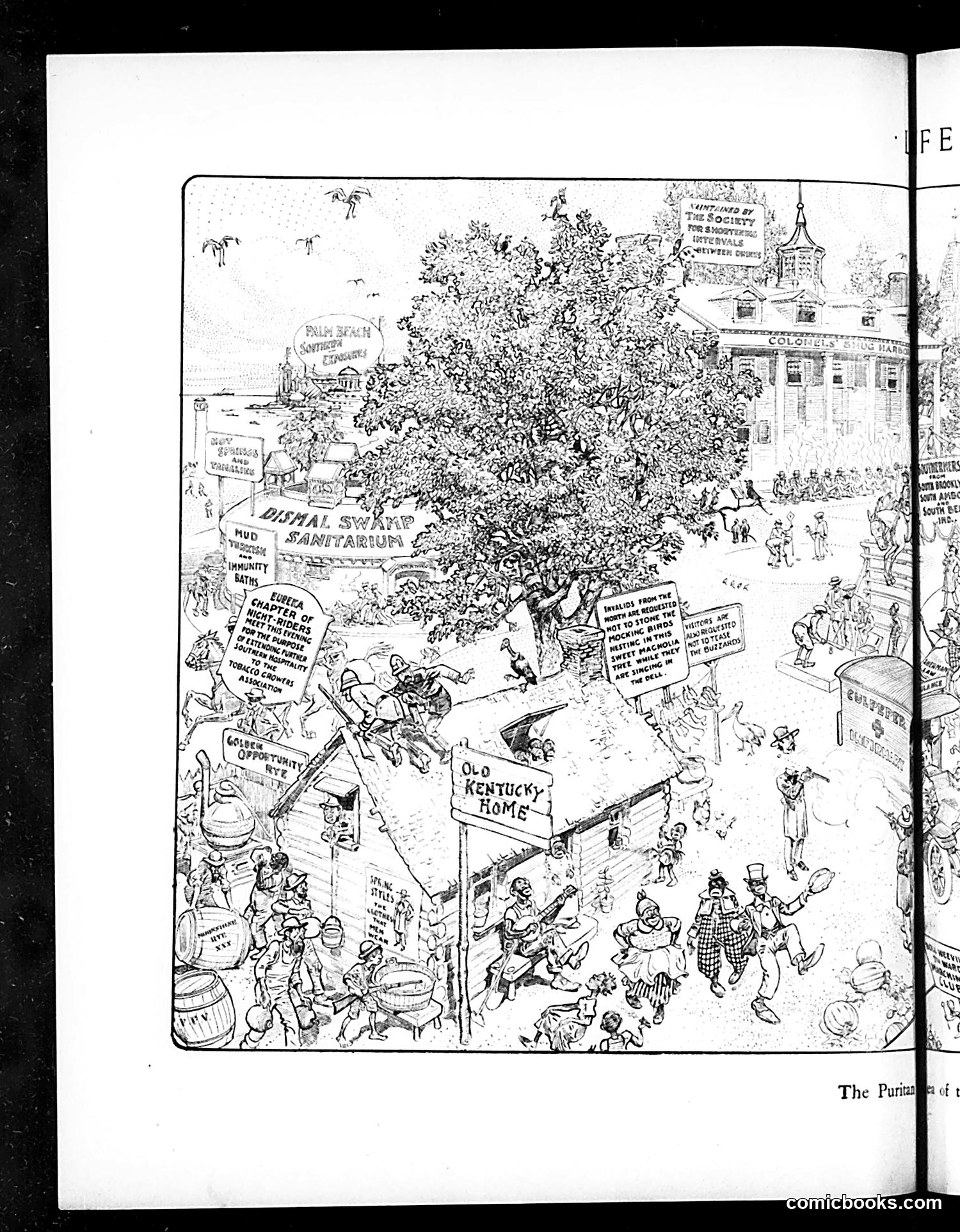
This is a satirical map-style cartoon depicting a Southern fair or exposition, likely from the early 20th century. The illustration shows various attractions and activities labeled with text boxes, including: - "Palm Beach" and "Dismal Swamp Sanitarium" (mocking Southern tourist destinations) - "Old Kentucky Home" (referencing Stephen Foster's famous song) - Multiple barrels and what appears to be alcohol-related references - Various labeled figures engaged in activities throughout the scene The satire appears to mock Southern culture, possibly referencing stereotypes about drinking, poor sanitation, and exploitation. The large tree dominates the composition, with crowds of small figures scattered throughout. Text labels provide specific critiques, though many are difficult to read clearly in this reproduction. The overall tone suggests criticism of Southern conditions or practices during this era.
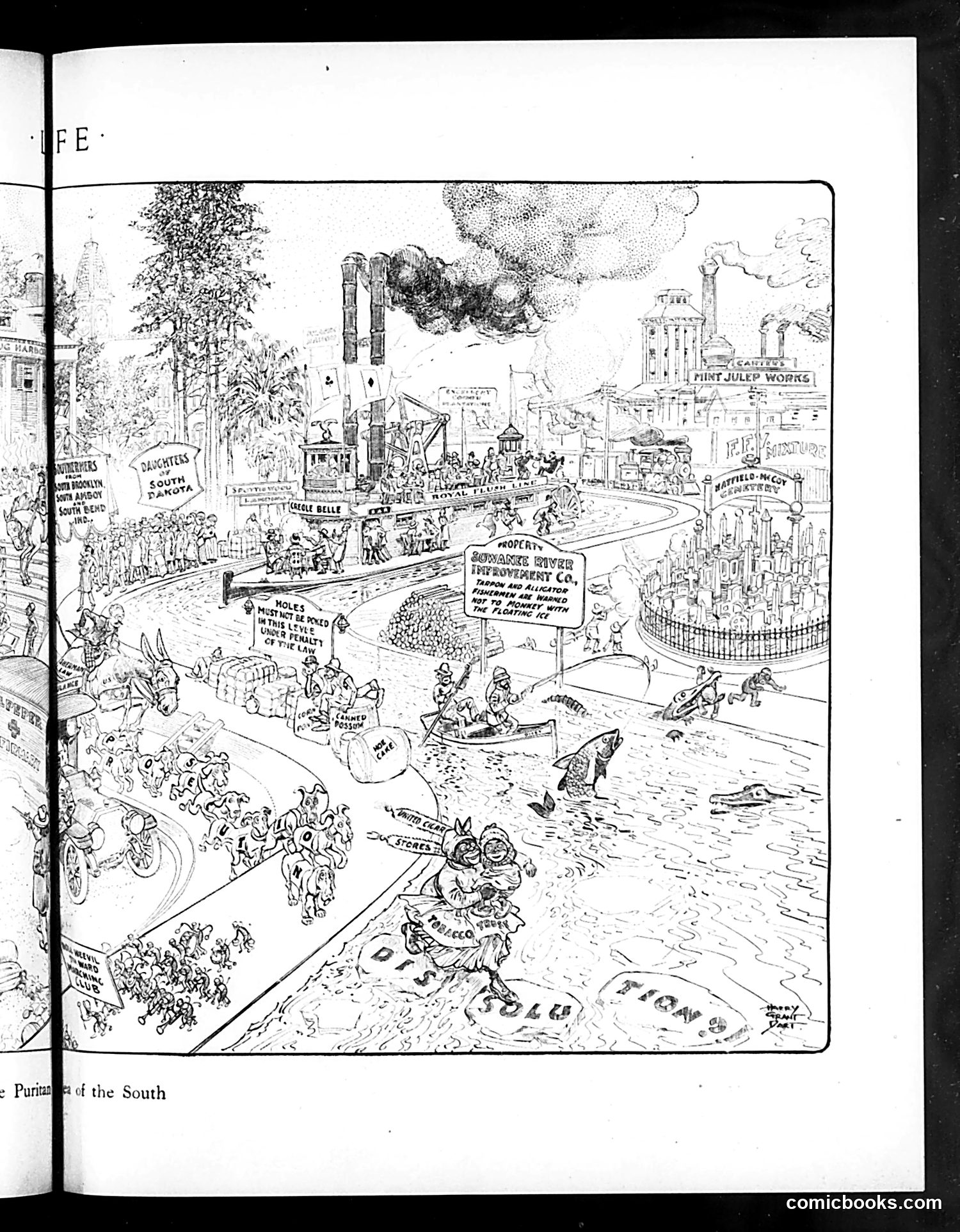
This is a satirical map-style illustration depicting the American South as a carnival or amusement park. The drawing shows various Southern states labeled as attractions ("South Carolina," "Daskatess") with industrial facilities, crowds of people, and exaggerated landscape features. The caption reads "The Puritan of the South," suggesting ironic commentary on Southern moral claims. Property signs advertise improvements and development. The cartoon appears to satirize Southern industrialization, rapid commercialization, and the contradiction between the region's self-image and its actual transformation into a modern, profit-driven landscape. The bustling crowds and carnival-like atmosphere mock what the artist sees as the South's abandonment of traditional values for commercial exploitation. This likely reflects early-20th-century Northern attitudes toward Southern modernization.
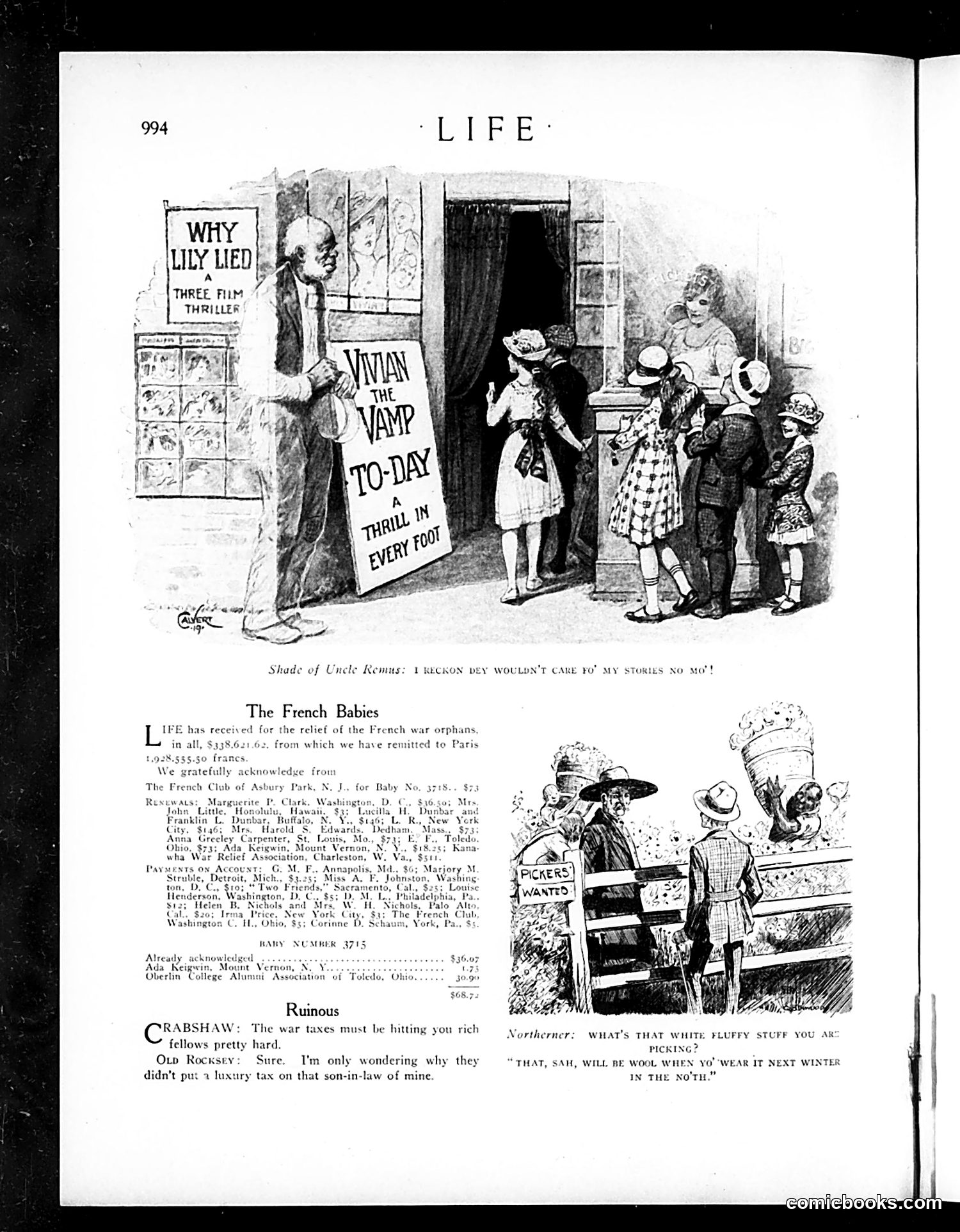
**Top Cartoon:** A movie theater marquee advertises "Why Lily Lied" and "Vivian the Vamp"—silent film thrillers. A skeletal figure (labeled as "Shade of Uncle Remus," evoking Joel Chandler Harris's folklore character) stands beside the poster, lamenting that audiences "wouldn't care fo' my stories no mo'!" This satirizes how sensational silent films have displaced traditional storytelling and literary entertainment. **"The French Babies" Section:** Life magazine announces receipt of $338,621.62 in donations for French war orphans from WWI, remitted to Paris as $1,028,535.30 francs. This documents a charitable relief campaign. **"Ruinous" Dialogue:** A joke about wartime taxation, where a wealthy man (Crabshaw) complains about war taxes, and an older man (Old Rocksey) quips that he wonders why the rich didn't tax "that son-in-law of mine." **Bottom Cartoon:** A "Pickers Wanted" sign leads to a dialogue about cotton picking between a Northerner and Southerner, playing on regional dialect humor and post-war labor discussions.
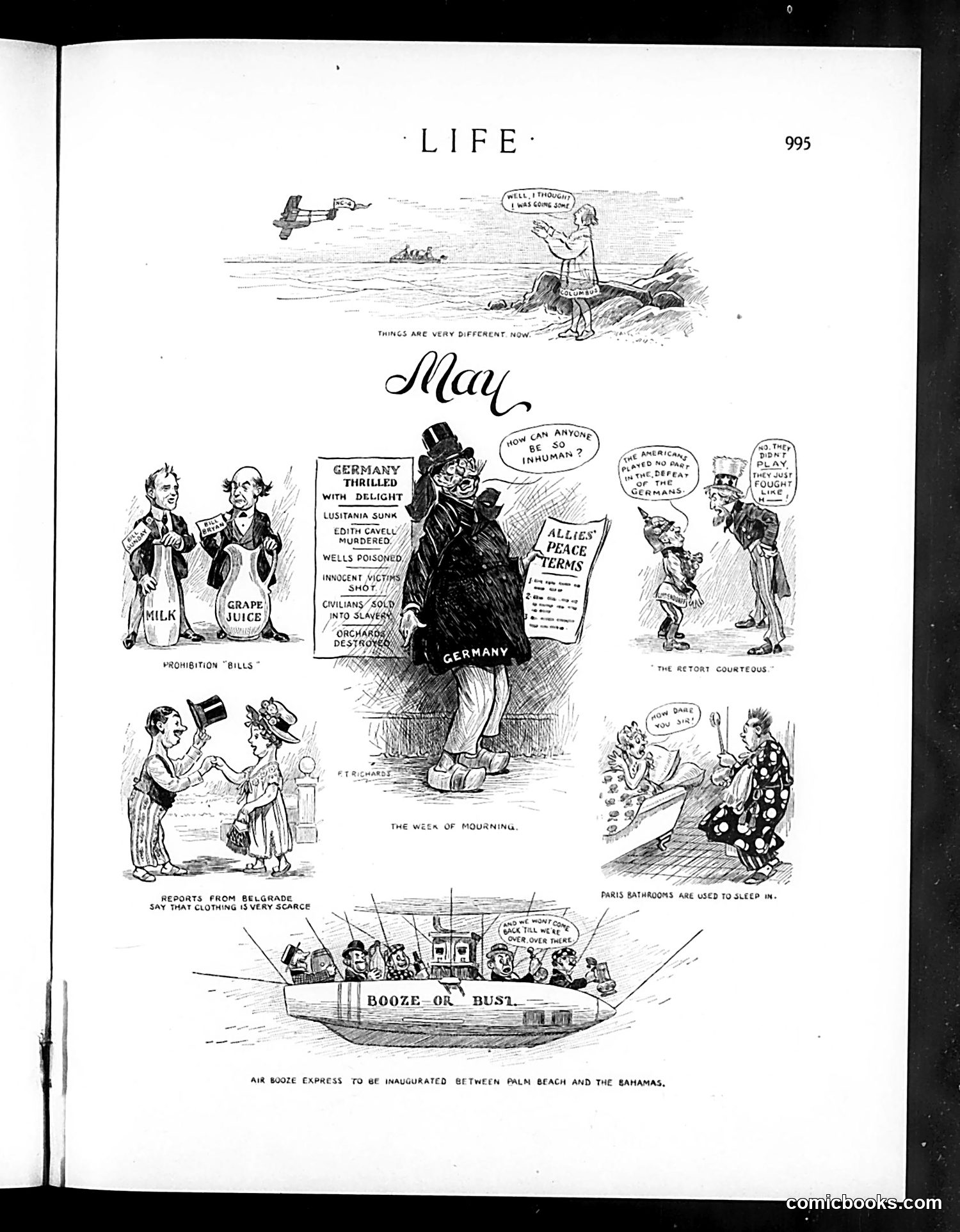
This May 1915 cartoon satirizes Germany's conduct during World War I. The central figure is a caricatured German official holding an "Allies' Peace Terms" document, reacting with horror to Allied demands after German atrocities. The surrounding vignettes mock German hypocrisy: - **"Prohibition Bills"** references American alcohol bans (contemporaneous social issue) - **"The Week of Mourning"** alludes to Germany's response to international outcry over the Lusitania sinking (May 1915) and Edith Cavell's execution - **"The Retort Courteous"** shows American indignation - **"Booze or Bust"** jokes about wealthy Americans escaping to the Bahamas during Prohibition The top cartoon depicts a woman on shore signaling a passing airplane—apparently commentary on rapidly changing wartime conditions ("Things are very different now"). The overall message: Germany commits brutal acts but feigns outrage when facing consequences.
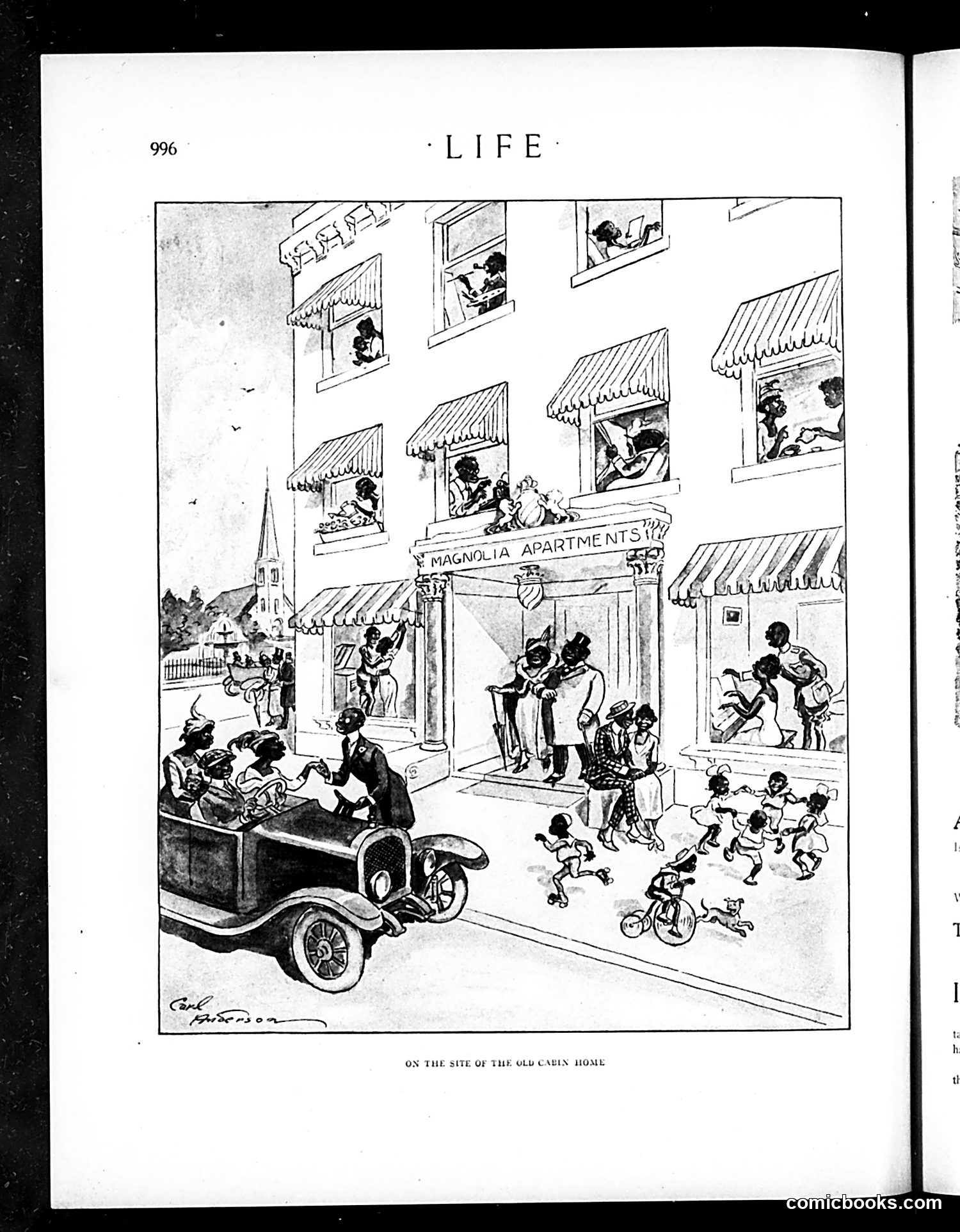
This Life magazine cartoon satirizes urban development and changing American living standards. The image contrasts a modest automobile and modest dress on the left with a modern apartment building ("Magnolia Apartments") on the right, where residents peer from numerous windows above storefronts. The caption's ironic title suggests that a humble original dwelling has been replaced by crowded, stacked apartment living. The cartoon appears to critique either: 1. The loss of traditional American homeownership and space, or 2. Overcrowded urban housing conditions replacing rural simplicity Children play in the street below amid bicycles and activity, emphasizing the density and chaos of apartment-building life versus implied pastoral predecessor. The satire targets early 20th-century urbanization and its social consequences.
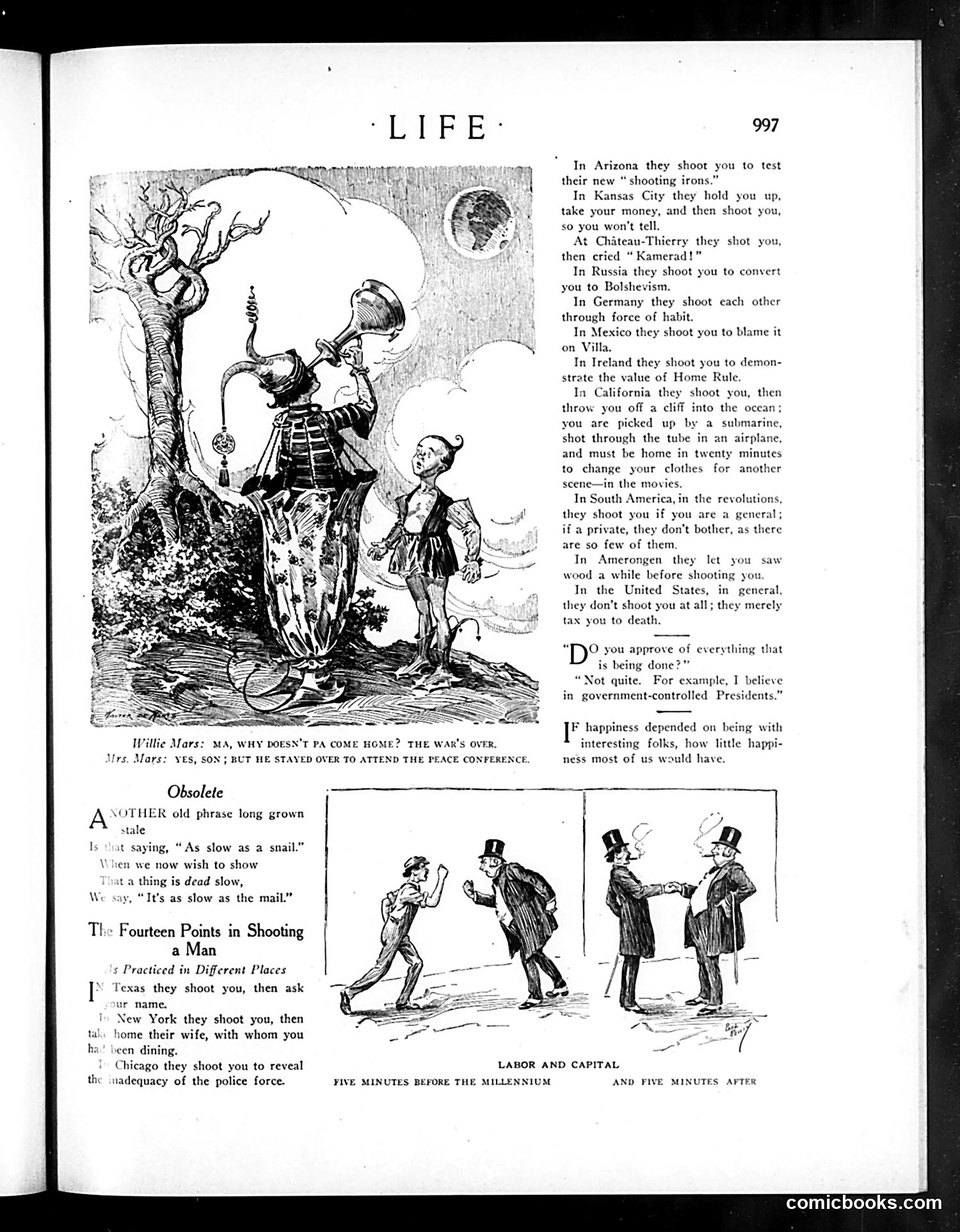
This 1919 *Life* magazine page satirizes post-WWI violence and political dysfunction through dark humor. **"Fourteen Points in Shooting a Man"** mocks how different regions/nations rationalize killing. References include: - **Château-Thierry** (WWI battle where Germans surrendered, shouting "Kamerad!") - **Villa** (Mexican revolutionary Pancho Villa) - **Home Rule** (Irish independence movement) - **Amerongen** (likely the Netherlands, where the German Kaiser fled) The joke: each location has its own absurd *excuse* for murder, culminating in America's grim punchline—taxation as slow death. **"Labor and Capital" cartoons** show pre- and post-"millennium" (likely referring to anticipated social change). The contrast suggests labor-capital conflict persists despite promised transformation. The opening exchange about Willie Mars staying for the Peace Conference satirizes politicians delaying homecoming to attend post-war negotiations—suggesting their involvement is performative rather than essential. Overall: cynical commentary on post-war violence, corruption, and failed peace-building promises.
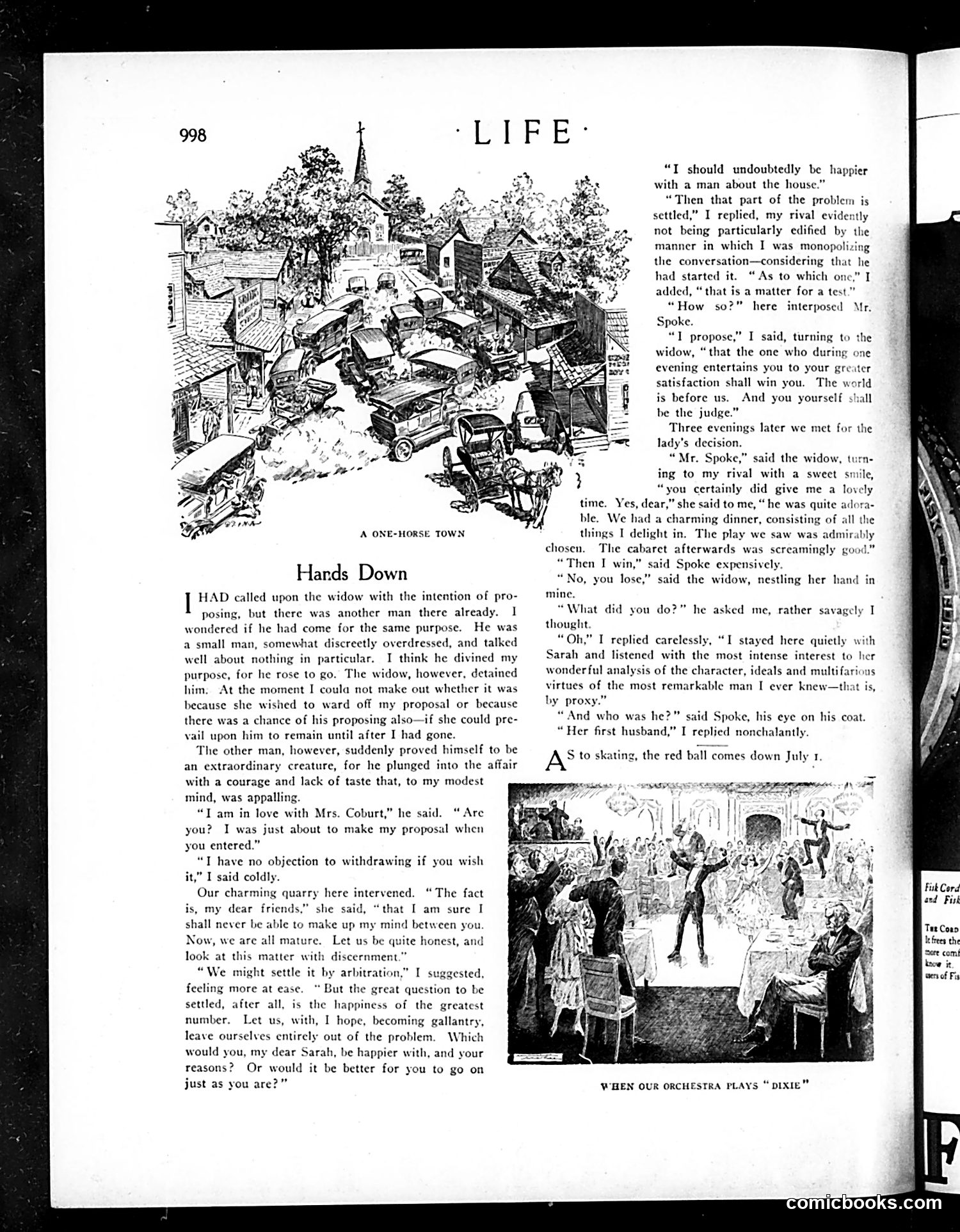
This is a humorous short story with accompanying illustrations satirizing early 20th-century courtship and male competition for a widow's affections. Three men compete to win Mrs. Coburn's hand through an "entertainment contest"—each must entertain her for an evening, and she'll choose her suitor based on who provides the greatest satisfaction. The rival Mr. Spoke spends lavishly on dinner, theater, and cabaret, expecting victory through expensive entertainment. The narrator wins by simply staying home, listening attentively while she discusses her late first husband. The satire mocks masculine assumptions that elaborate spending and spectacle guarantee romantic success, while suggesting that genuine attention and emotional engagement prove far more valuable—a somewhat progressive joke for the era. The widow's preference for meaningful conversation over costly amusement represents quiet subversion of materialistic courtship conventions.
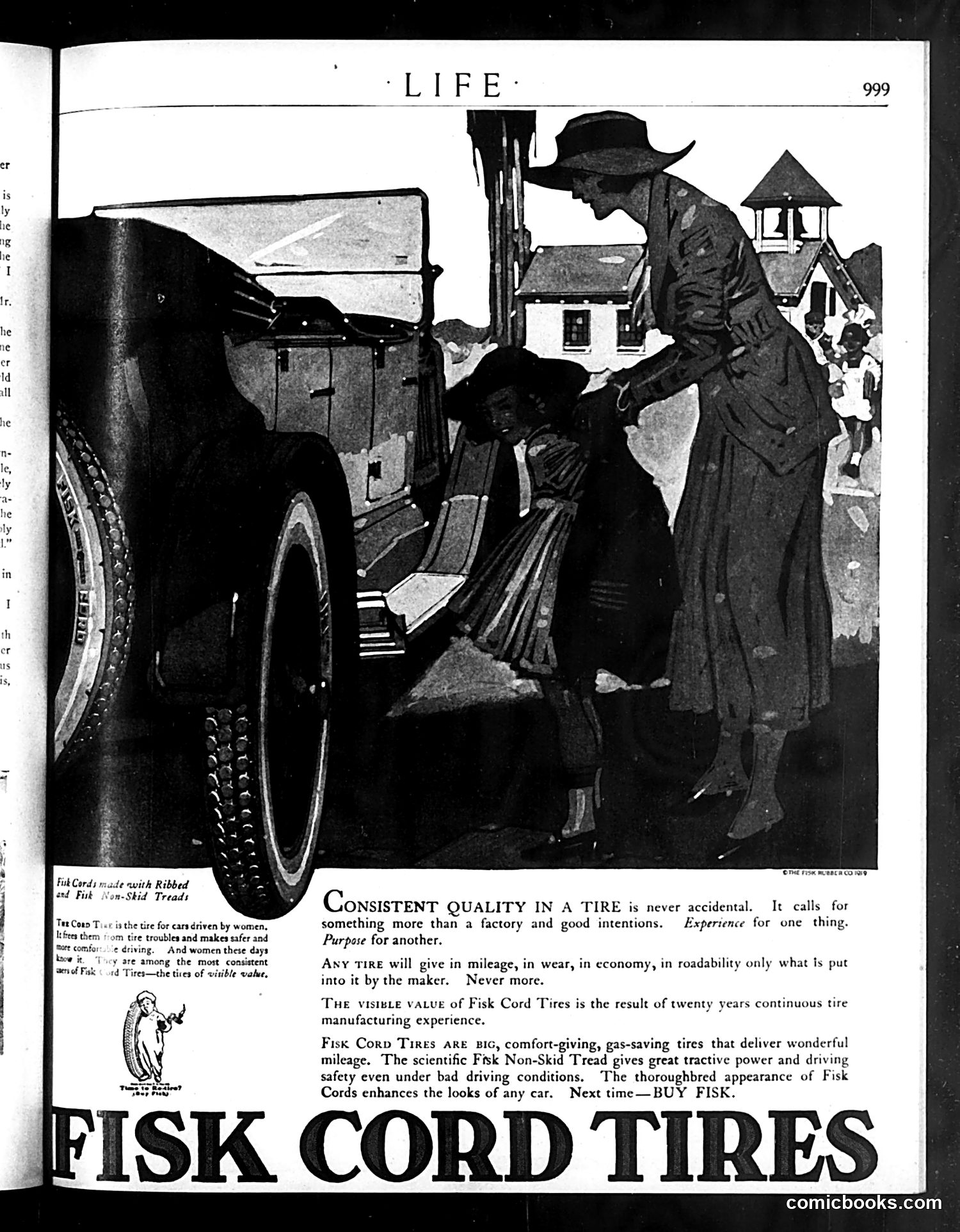
This is a **tire company advertisement**, not political satire. The page shows a tall man in a hat and overcoat helping a woman into a car, with a church visible in the background. A small logo (bottom left) depicts the Fisk Tire mascot, a cherub-like figure. The ad targets **women drivers**—still a relatively novel concept in the early automotive era—emphasizing that Fisk tires are reliable for women handling cars. The text stresses that tire quality depends on manufacturing expertise ("twenty years continuous tire manufacturing experience"), not luck. Key selling points: comfort, gas-saving efficiency, traction ("Non-Skid Tread"), and aesthetic appeal. The ad's closing line, "Next time—BUY FISK," is a direct call to purchase. This reflects an era when automobile advertisements specifically courted female consumers as cars became mainstream transportation.
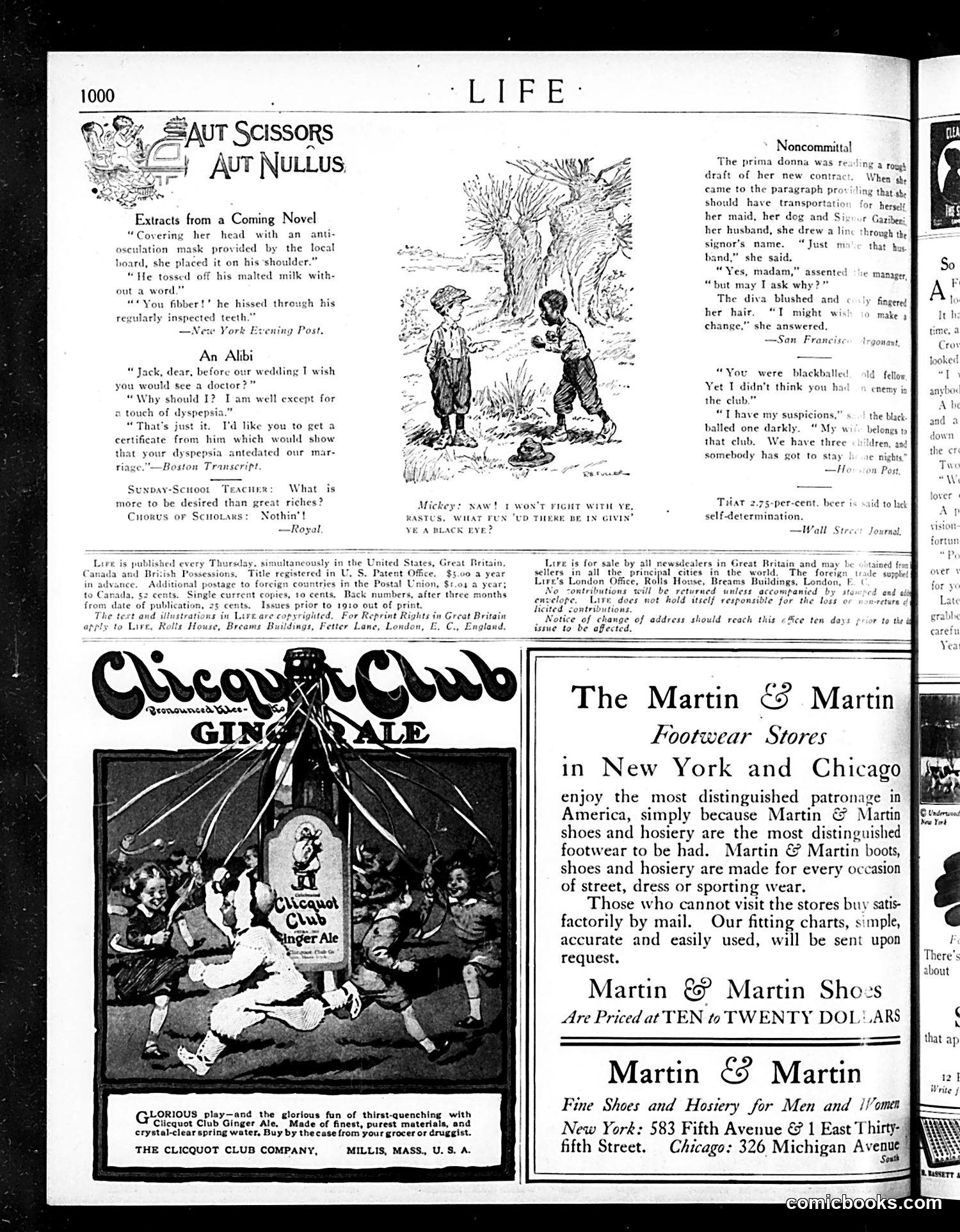
This page contains several short humorous pieces typical of Life's satirical content: **"Aut Scissors Aut Nullus"** presents brief comic extracts mocking social conventions: a woman using an "anti-osculation mask" to prevent kissing, a husband demanding his wife obtain a doctor's certificate proving her dyspepsia predates their marriage (implying he suspects she's using illness as an excuse), and a dialogue between children about fighting. **The main cartoon** depicts two boys under a tree, one appearing to offer reconciliation or friendship after conflict—likely satirizing childhood disputes and resolutions. The page is primarily **advertising-focused**, featuring prominent ads for Clicquot Club Ginger Ale (depicting a festive gathering) and Martin & Martin Footwear Stores in New York and Chicago. The humor targets domestic life, marriage tensions, and social pretense—typical concerns of this era's satirical magazine. The content reflects early 20th-century attitudes toward relationships and propriety that modern readers would find quaint or absurd.
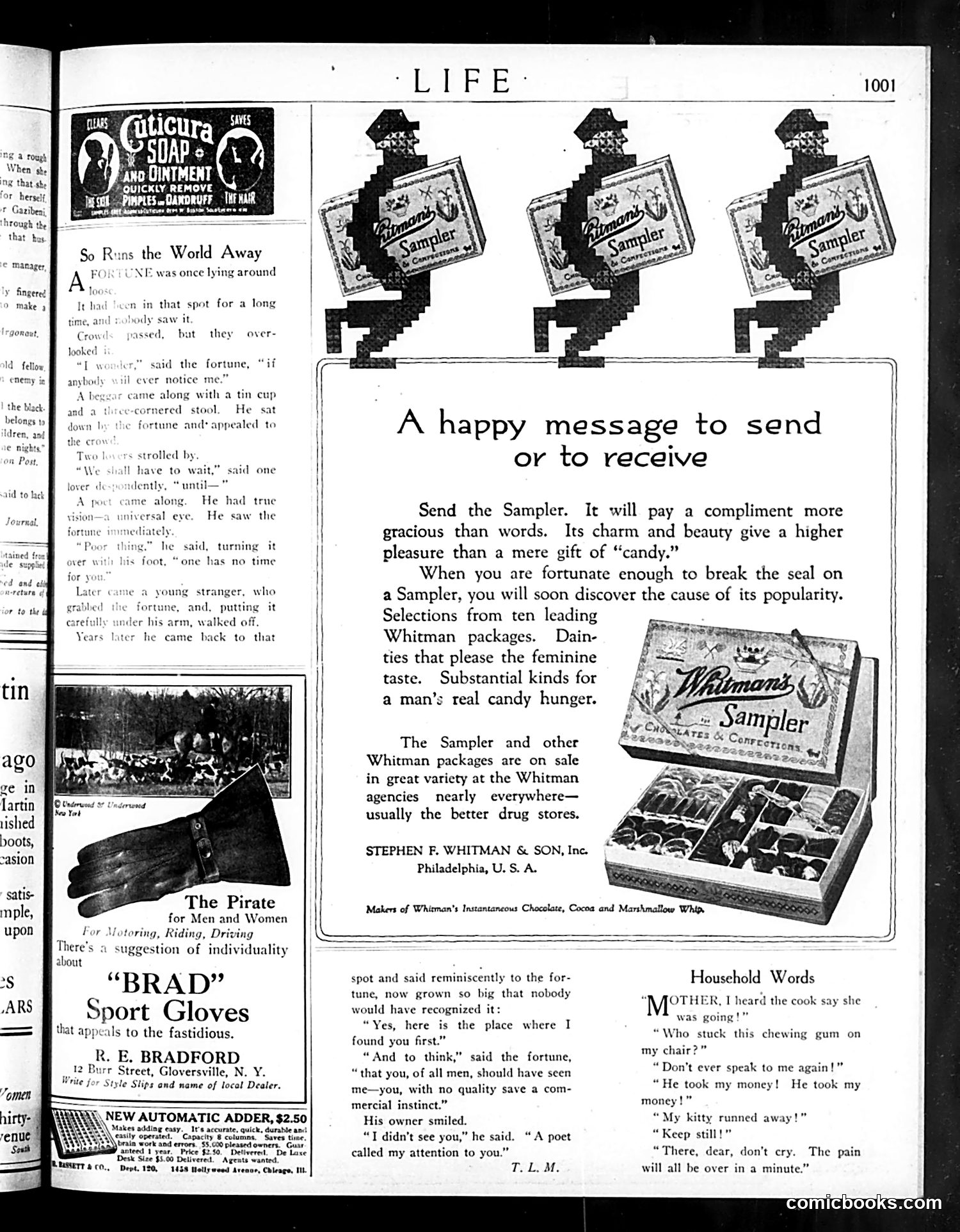
This satirical story concerns a fortune teller's prophecy that comes true in an unexpected way. A beggar finds a fortune teller and asks if anyone will notice him. The fortune cryptically replies "if anybody will ever notice me." Years later, the beggar has become wealthy and returns to the same spot, now a thriving commercial area. The fortune teller—now grown large and prosperous—confronts her former client, noting bitterly that he succeeded despite having "no quality save a commercial instinct." **The satire:** The joke is that the fortune teller's own prediction ruined *her*, not him. By becoming famous through his association with her prophecy, she lost her mystique and became merely another commercial commodity. The moral appears to critique how capitalism and commercialism corrupt even spiritual or mysterious things—turning everything into a business opportunity that destroys the very qualities that made it valuable. The page also contains period advertisements (Whitman's Sampler candy, Brad Sport Gloves) typical of Life magazine's revenue model.
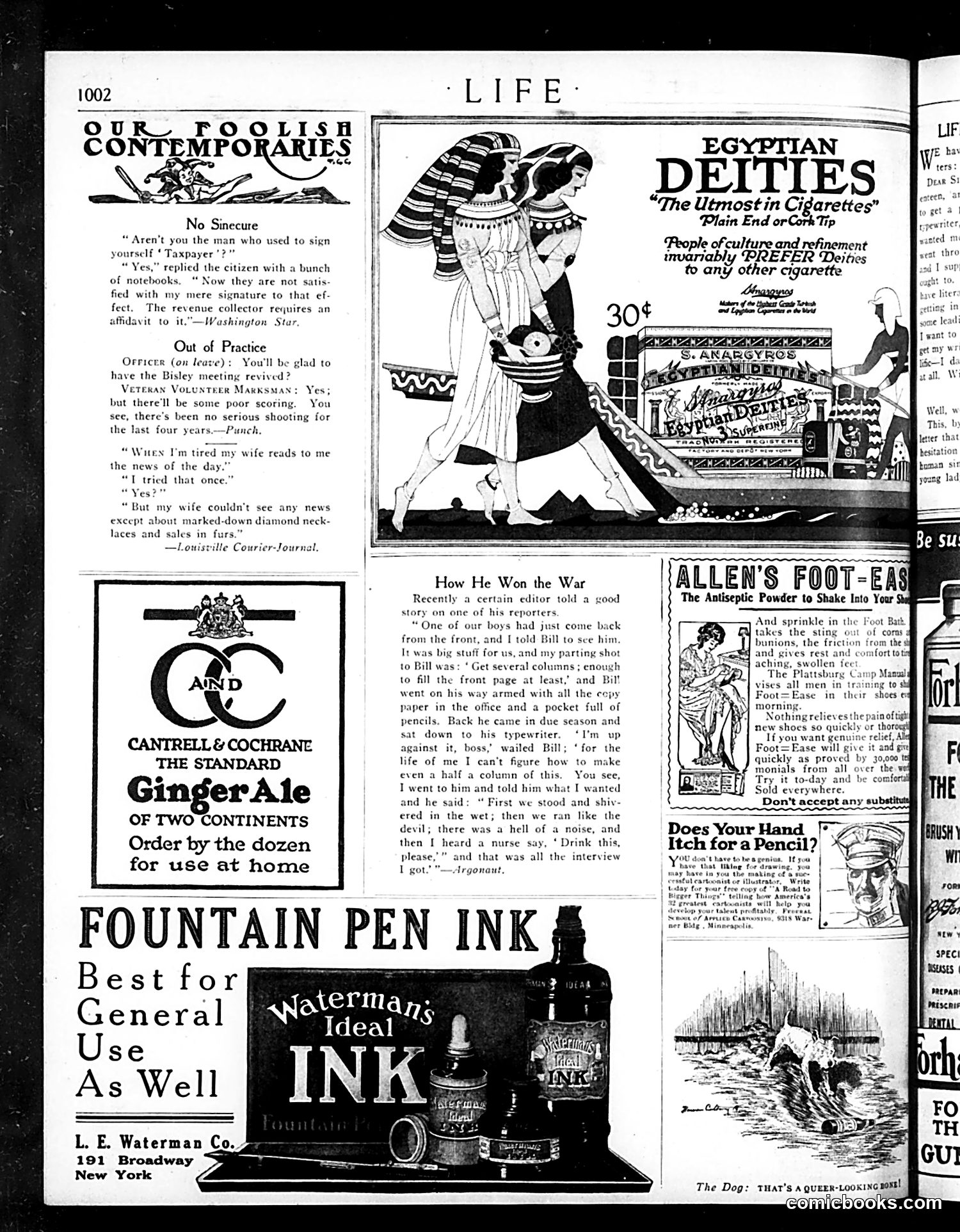
This page is primarily **advertising and humor columns**, not political cartoons. The main content includes: **"Our Foolish Contemporaries"** — satirical short jokes mocking everyday absurdities: a taxpayer harassed by revenue collectors, a soldier whose marksmanship has declined from peacetime idleness, and a husband whose wife ignores news except for shopping sales. **"How He Won the War"** — a humorous anecdote about a newspaper editor assigning a reporter to cover a returning soldier, who returns with minimal material, having gathered only the soldier's brief wartime experiences. **Egyptian Deities Cigarettes advertisement** — featuring Egyptian imagery (Pharaohs, hieroglyphics) to market cigarettes as sophisticated luxury goods. **Product ads** — Ginger Ale, Fountain Pen Ink, Allen's Foot-Ease powder, and pencil products dominate the lower half. The page reflects 1920s consumer culture and period humor focused on domestic inconveniences and modern life's frustrations rather than political satire.
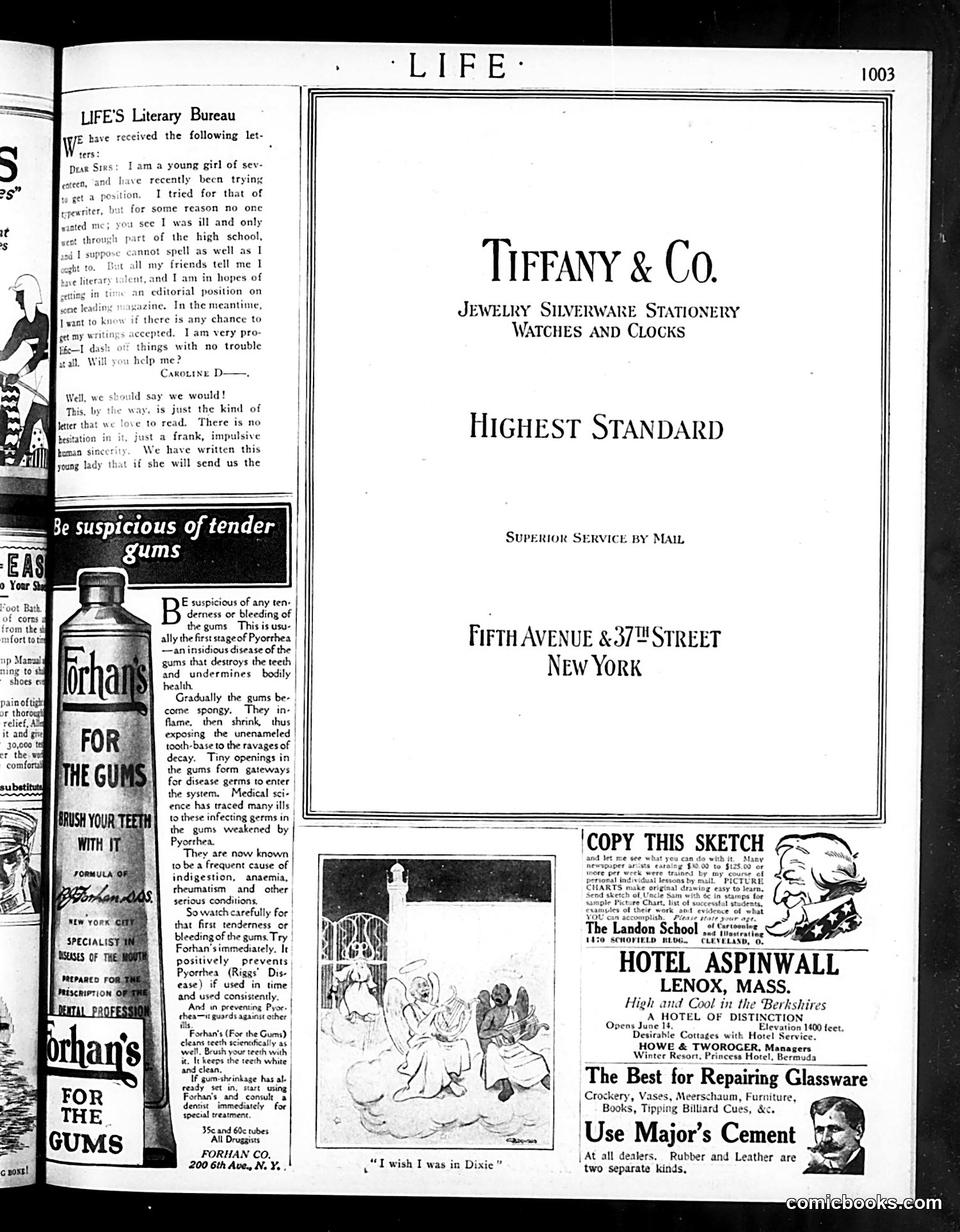
This page mixes editorial content with advertising. The main feature is **"Life's Literary Bureau,"** where the magazine responds to a reader's letter from a young woman seeking career advice in journalism. The cartoon at bottom center, captioned **"I wish I was in Dixie,"** shows a figure dreaming of the American South—likely satirizing Northern nostalgia for pre-Civil War romanticism or expressing frustration with contemporary conditions. The specific meaning is unclear without fuller context. The page is dominated by **luxury advertisements** (Tiffany & Co., Hotel Aspinwall) and **patent medicine ads** (Forhan's toothpaste for "Pyorrhea," Major's Cement). These reflect common early-20th-century marketing: medical claims for products treating gum disease reflect genuine period concerns about dental hygiene. The editorial advice to the aspiring female writer is encouraging but patronizing by modern standards, assuming her gender limits her prospects.
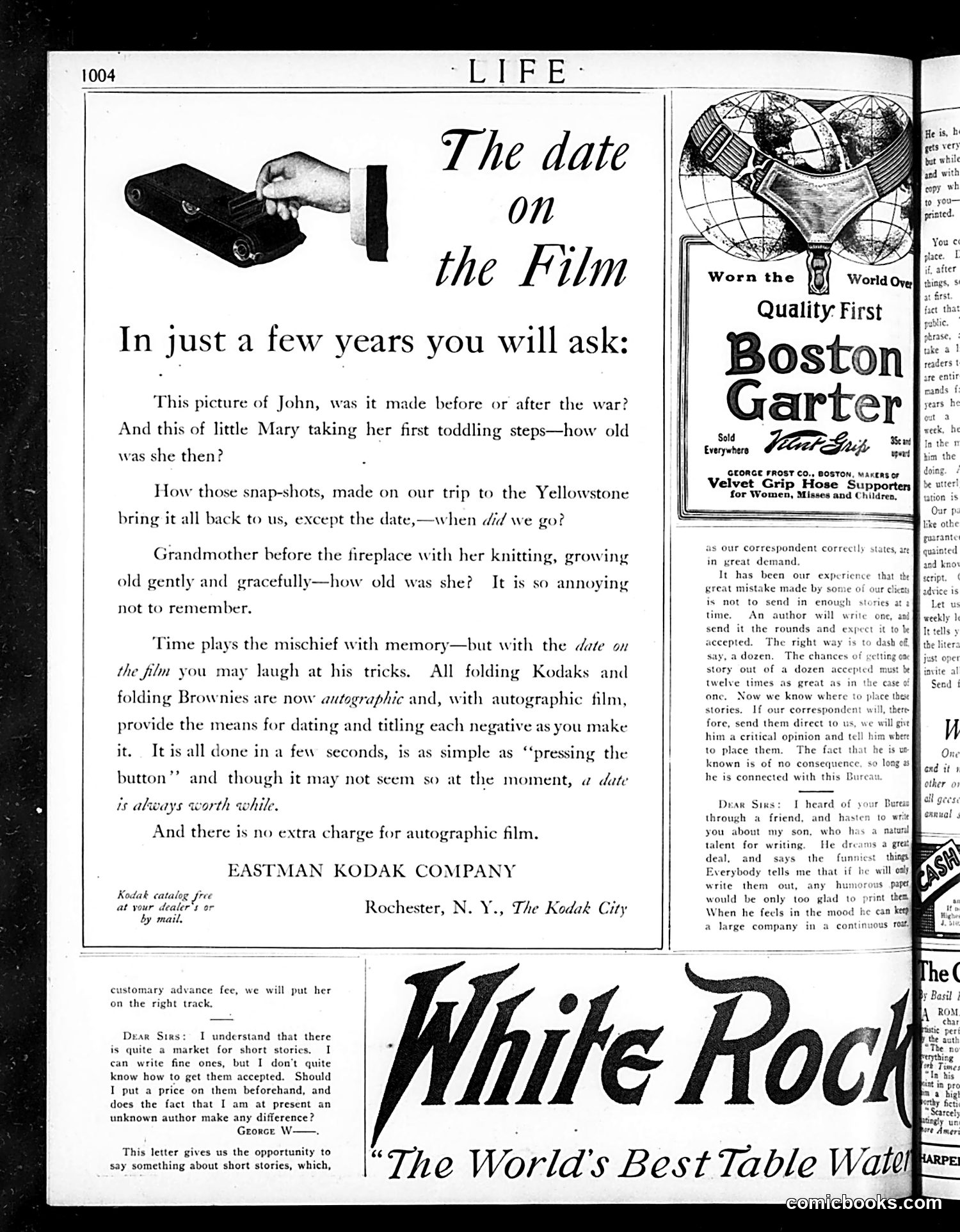
This page primarily contains **advertising and advice columns** rather than political satire or editorial cartoons. The main content is a **Kodak advertisement** promoting their new "autographic" camera feature that allows users to date and caption photographs directly on film negatives. The ad uses relatable domestic scenarios—family photos from trips, children growing up, elderly relatives—to emphasize the practical problem: people forget *when* photos were taken. The solution is presented as simple and free. Below the Kodak ad are two advice columns addressing readers' questions: one about submitting short stories for publication (signed "George W—"), and another about a son with writing talent (signed "Dear Sirs"). These appear to be *Life*'s regular advice/correspondence section, not satirical content. There are also advertisements for **Boston Garter** hose supporters and **White Rock** table water visible on the page. The page contains **no discernible political cartoons or satire**—it's primarily commercial and practical advice content typical of early 20th-century magazine layout.
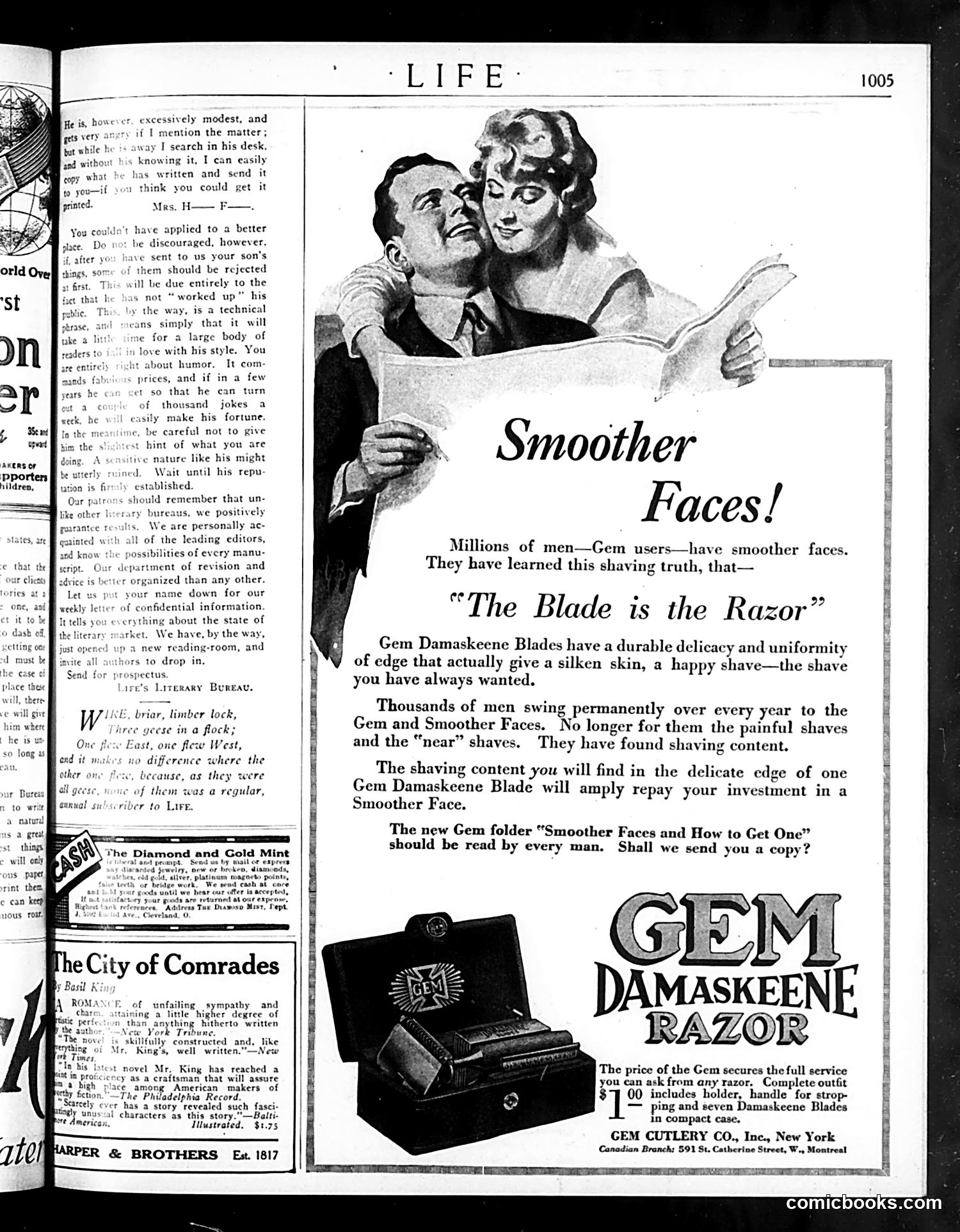
This page is primarily **advertising**, not political satire. The dominant content is a Gem Damaskeene Razor advertisement featuring an illustration of a man and woman with the slogan "Smoother Faces!" **The Advertisement's Appeal:** The ad uses romantic imagery—a couple gazing together—to sell safety razors by promising superior shaving results. The messaging emphasizes that "the blade is the razor," marketing Gem's damascene blades as offering delicate edges and a "silken skin" shave superior to competitors' "painful" alternatives. The complete $1.00 outfit targets male consumers directly. **Historical Context:** This reflects the early 20th-century marketing of safety razors as modern conveniences replacing straight razors. The ad's romantic subtext—linking smooth shaving to masculine appeal and attractiveness—was typical period advertising psychology. The left column contains editorial matter about a literary bureau, unrelated to the advertisement's message. No political satire or cartoon commentary is present on this page.
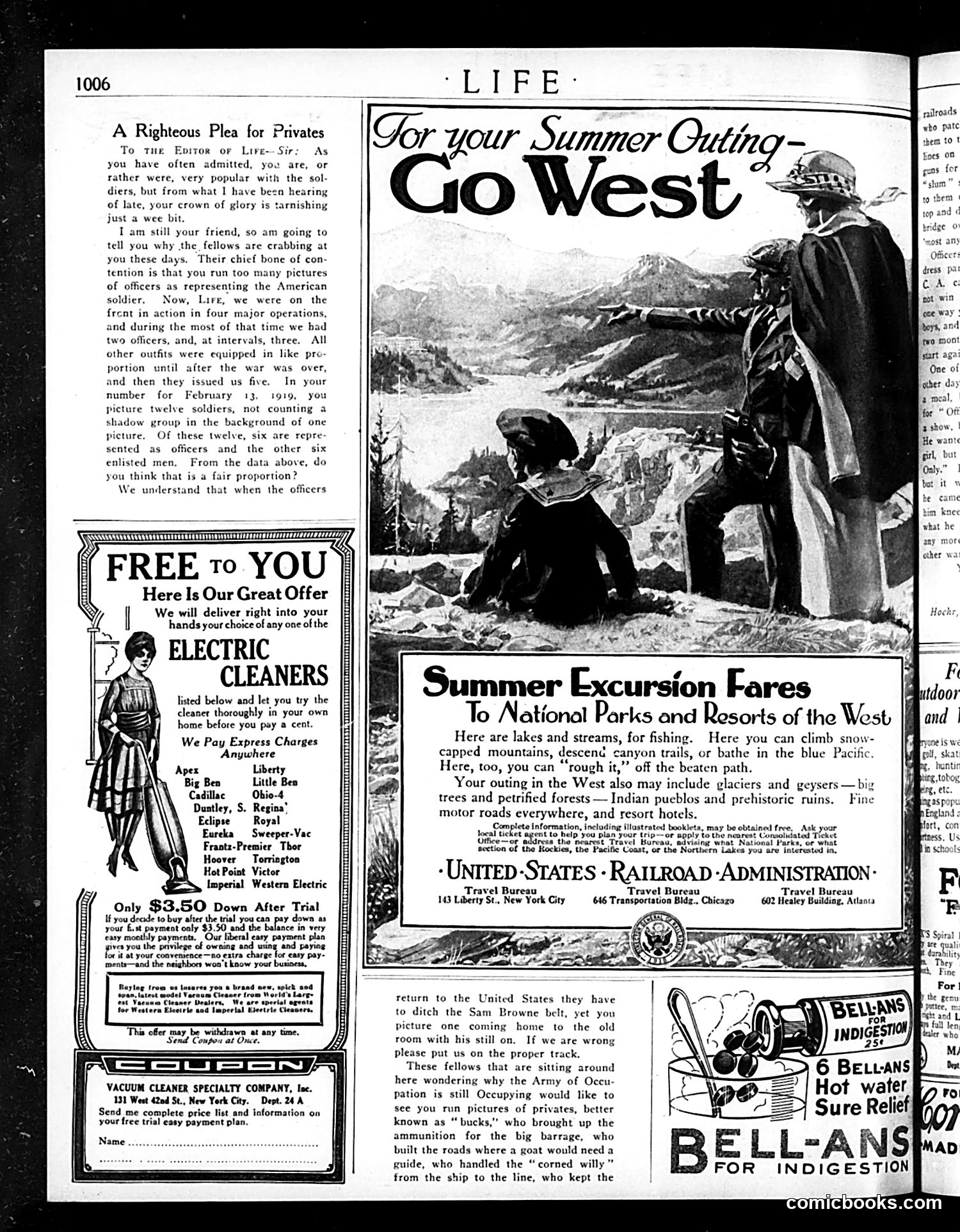
This page is primarily **advertising and public service announcements** rather than political satire or comics. The main content includes: 1. **Letter to the Editor** complaining that Life magazine overrepresents military officers in its coverage of American soldiers. The writer argues that in a February 1919 issue, Life pictured 12 soldiers with 6 shown as officers—disproportionate to actual Army ratios where enlisted men vastly outnumbered officers. This reflects post-WWI tensions between soldiers and the officer class. 2. **Advertisements**: Electric vacuum cleaners (Apex, Hoover, etc.) offered on payment plans; Bellans indigestion remedy; and a railroad promotion encouraging Western tourism to national parks. The criticism reflects genuine soldier resentment toward officer representation—a common post-war sentiment. The letter writer's tone is respectful but pointed, suggesting class consciousness among enlisted veterans regarding how they were depicted in popular media.
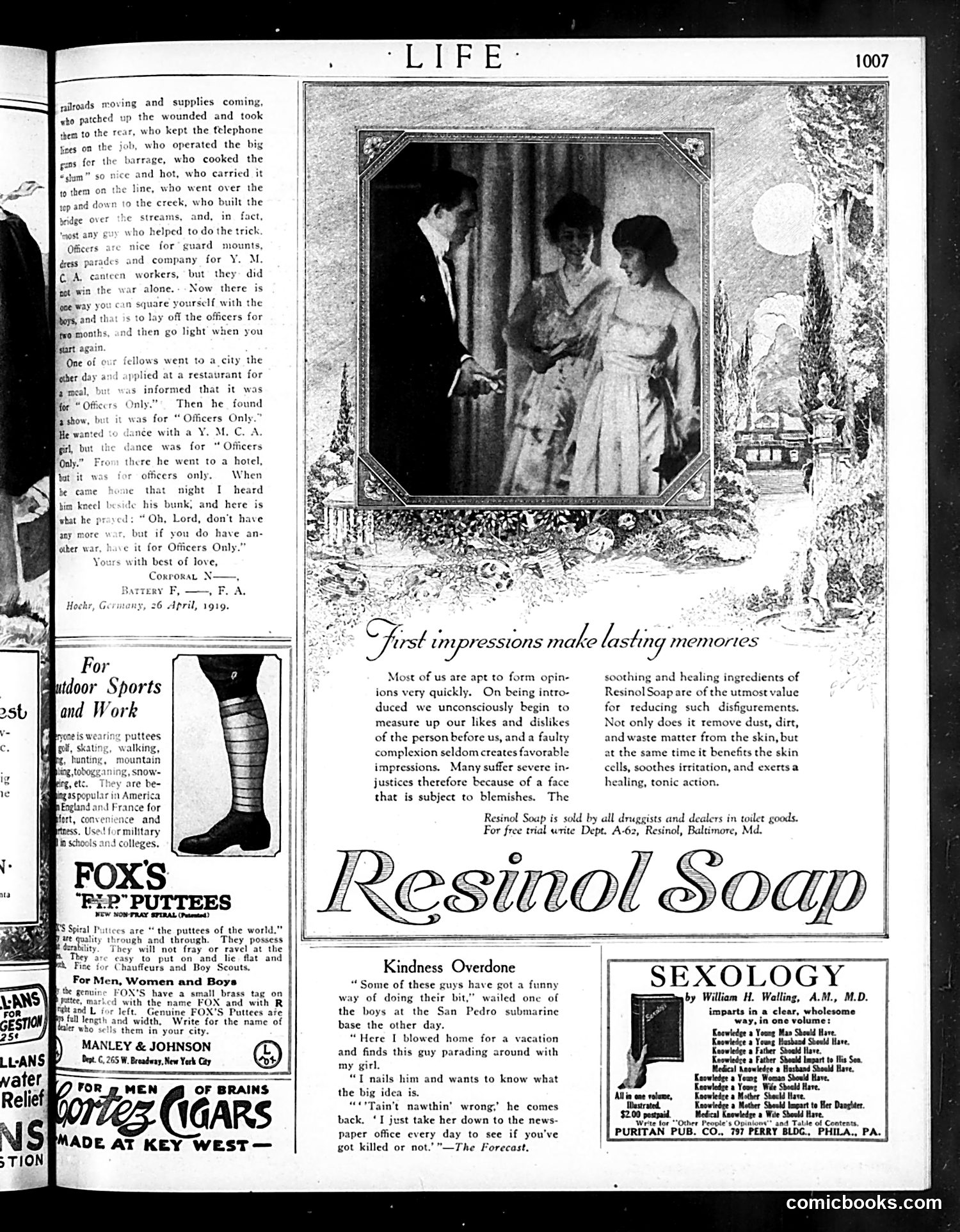
This page contains **wartime humor** from World War I. The main text is a letter from a Colonel describing soldiers' contributions to the war effort—not just combat troops, but cooks, telephone operators, medics, and support staff. The joke concludes with a soldier's plea: if there's another war, "have it for Officers Only," implying enlisted men bear disproportionate burden. The "Kindness Overdone" anecdote below mocks **home-front sentimentality**. A serviceman's friend escorts his girlfriend to the newspaper office daily to check casualty lists—well-intentioned but absurd, as if the girlfriend needs constant reassurance. The humor undercuts overzealous civilian patriotism. The remaining content is advertising: **Fox's Puttees** (leg wraps for military/outdoor wear), **Resinol Soap** (targeting complexion concerns), **Porter Cigars**, and a **sex education book**—typical commercial content interspersed with editorial material characteristic of Life's satirical-advertising format.
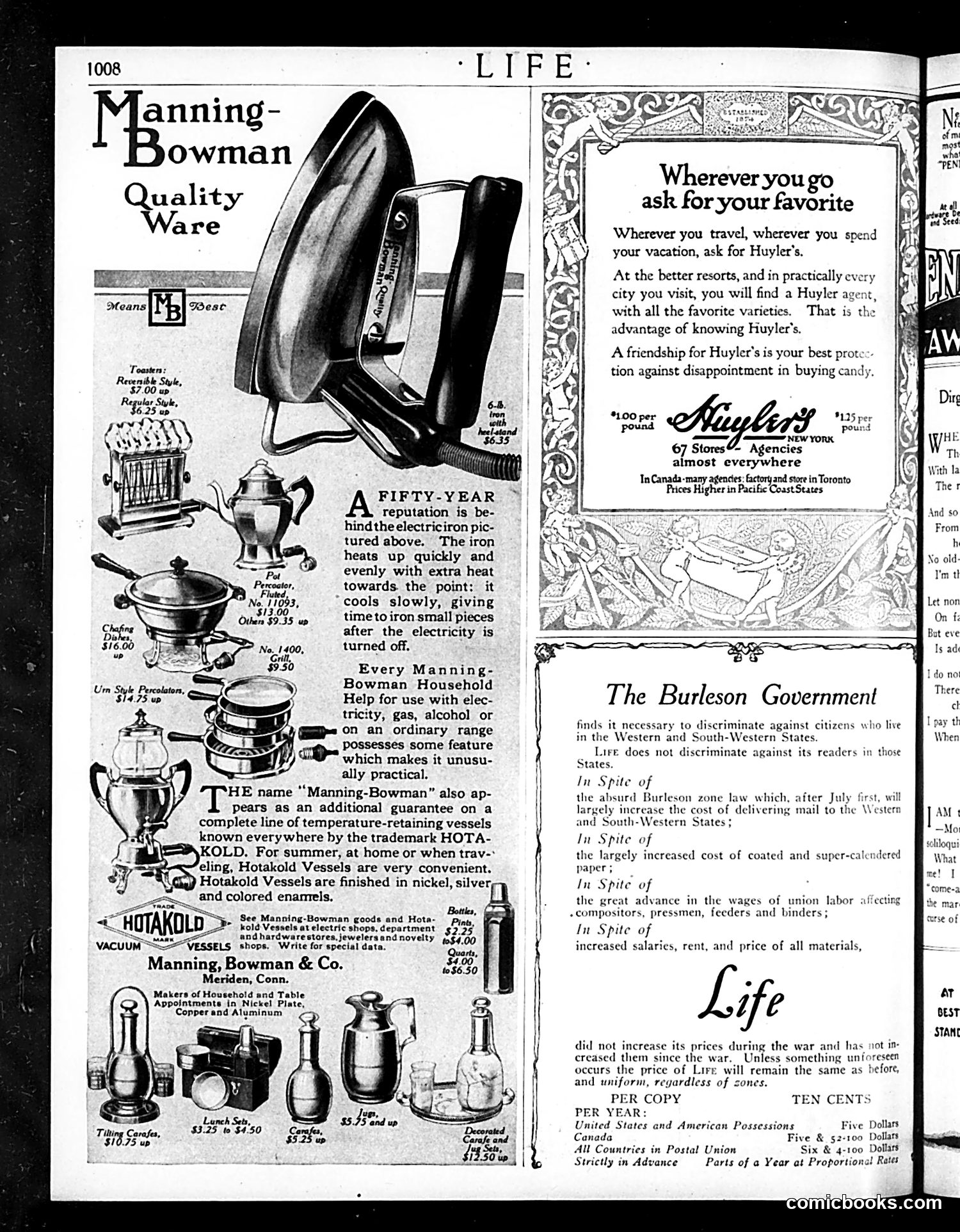
This page contains **primarily advertisements** rather than political cartoons. The left side advertises Manning-Bowman electric household appliances (irons, kettles, vessels). The right features Huyler's candy and Life magazine itself. The notable political content appears in **"The Burleson Government"** section—a critique of Postmaster General Albert Burleson's wartime postal policies. The text sarcastically lists ways the Burleson administration increased mail delivery costs ("In Spite of" repeated grievances: increased labor wages, material costs, paper prices). Life uses this space to argue that **despite these government-imposed expenses, Life magazine did not raise its subscription price during or after World War I**, contrasting its restraint against Burleson's zone-based mail rate increases that allegedly discriminated against Western and Southern readers. This reflects post-war frustration with government regulation and its economic burdens on private enterprise and consumers.
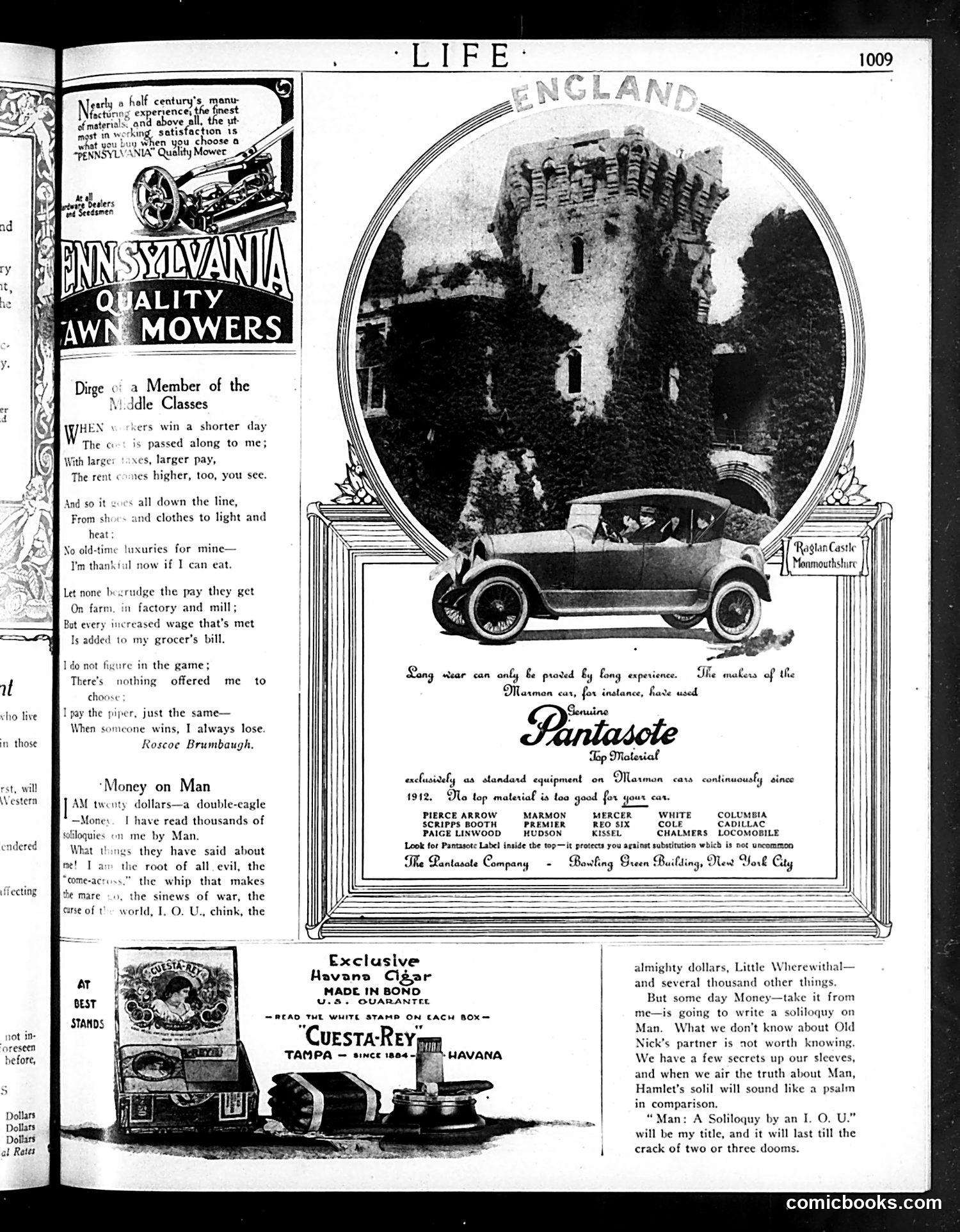
This page mixes advertising with satirical social commentary. The left side features "Money on Man," a poem by Roscoe Brumbaugh criticizing economic inequality. The speaker—appearing to represent the working middle class—complains that while factory and farm workers gain wage increases, those gains cascade upward: higher rents, increased prices, and inflation. He "pays the piper" without benefiting, always losing when "someone wins." The satire targets the illusion of shared prosperity. When workers win wage increases, landlords and merchants capture those gains through raised costs, leaving ordinary people no better off—despite headlines celebrating worker victories. The remainder of the page contains period automobile and cigar advertisements (Pantasote car tops, Cuesta-Rey cigars), typical of Life's business model. The castle image advertises Marmon automobiles as luxury vehicles.
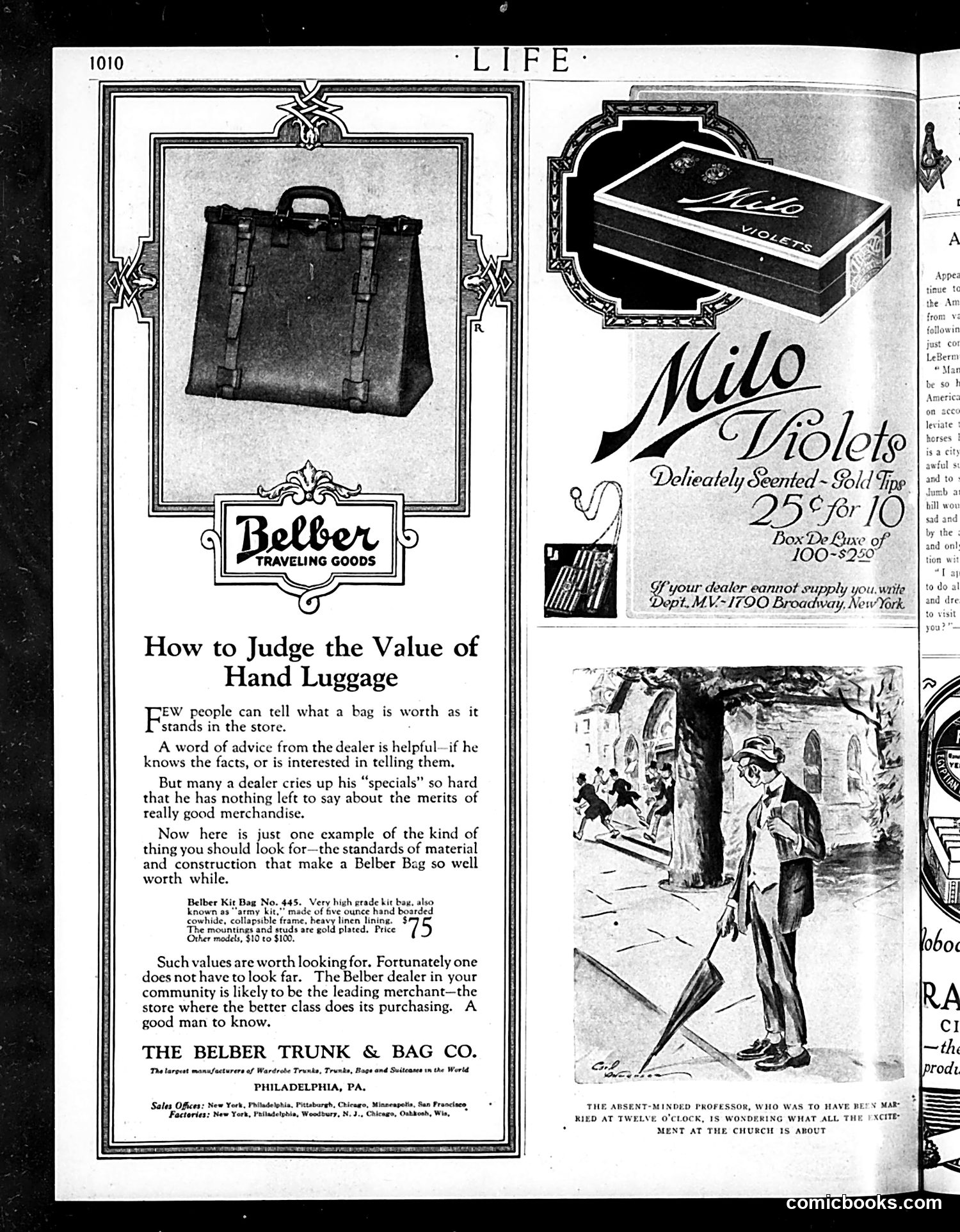
This page is primarily **advertising, not political satire**. It contains two commercial advertisements and one cartoon. The left side advertises **Belber Trunk & Bag Co.** luggage, featuring a kit bag and explaining quality standards to consumers skeptical of dealer claims—a practical pitch about materials and construction. The right side advertises **Milo Violets** perfumed candy (25¢ for a box). The small cartoon at the bottom depicts an **absent-minded professor** arriving late to his own wedding at noon, oblivious to the commotion inside the church. This is a gentle comedic gag playing on the stock character of the scatterbrained academic—a common trope in early 20th-century humor. The joke requires no specific historical context; it's simply wordplay on distraction and social embarrassment, meant to amuse readers between advertisements.
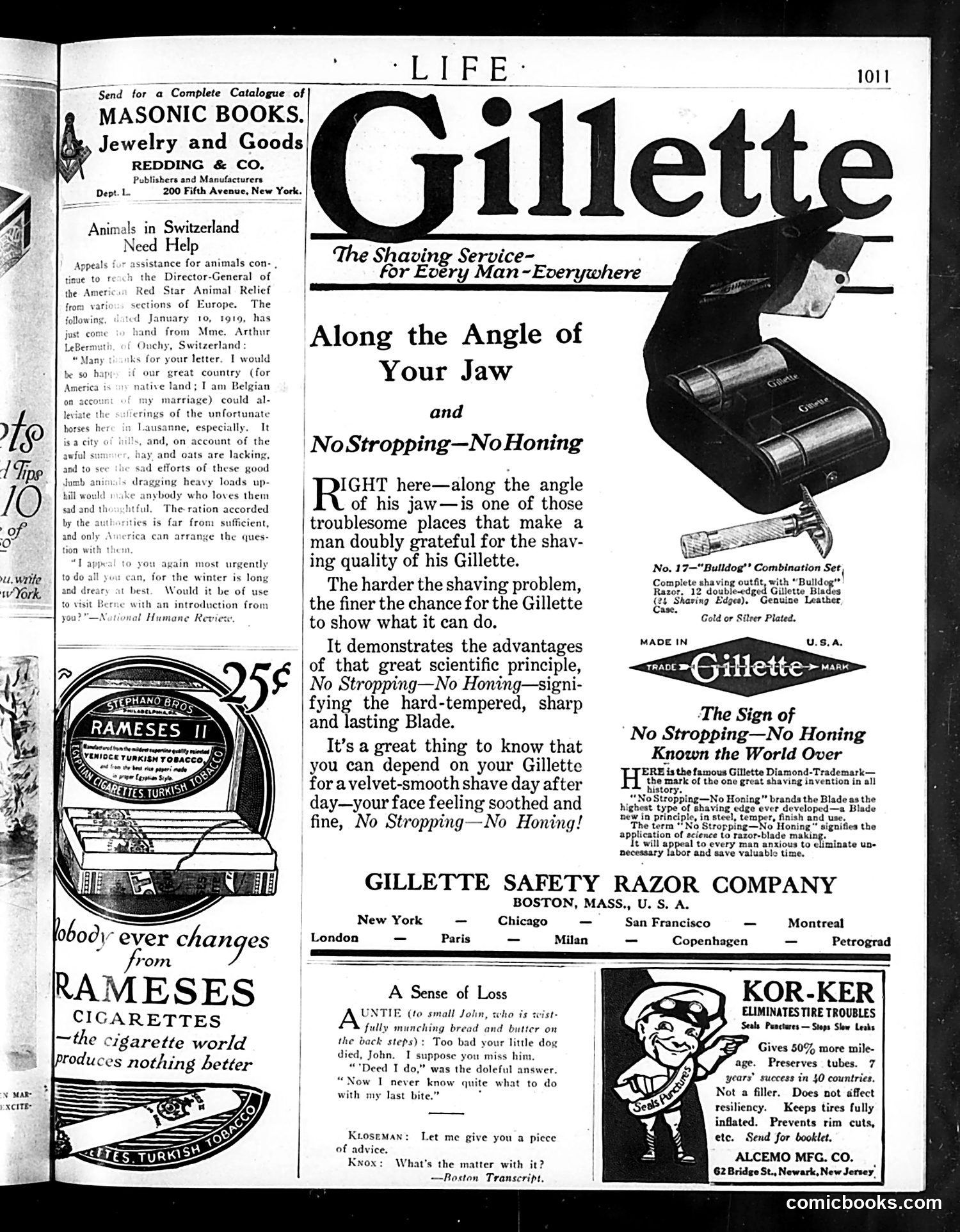
This is primarily an **advertising page** from Life magazine, not a political cartoon. The main content is a Gillette Safety Razor advertisement emphasizing the "No Stropping—No Honing" feature—meaning the blade stays sharp without manual maintenance, a significant selling point for early 20th-century shavers. The page includes minor humor pieces: a brief joke about a boy missing his dead dog's companionship (because the dog ate scraps), and a Knox hat advertisement. There's also an appeal for aid to Swiss farm animals during post-WWI hardship. The satire is minimal and light. The real focus is **consumer marketing**, highlighting how Gillette razors solved a genuine problem—the tedious upkeep previous razors required. This represents early mass-market advertising targeting middle-class men with labor-saving innovations.
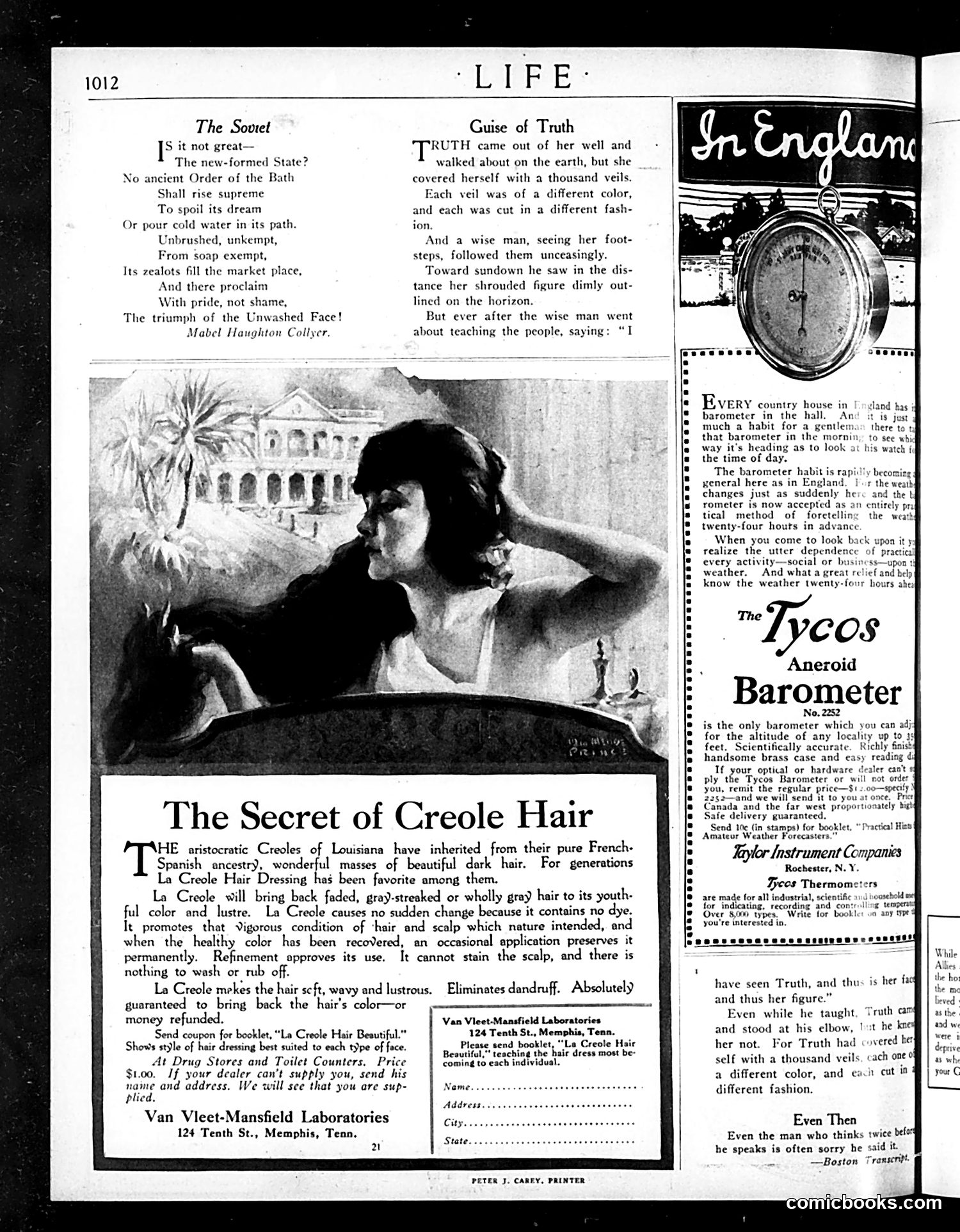
This page contains three distinct pieces: **"The Soviet" poem** (top left): A satirical verse mocking the newly-formed Soviet Union. It celebrates the "triumph of the Unwashed Face"—a jab at Bolsheviks, likely referencing their revolutionary rejection of aristocratic refinement and their perceived lack of civilization or proper conduct. Written by Mabel Haughton Collyer, it's anti-Communist propaganda disguised as witty poetry. **"Guise of Truth" prose poem** (top center): An allegory about Truth hiding behind "a thousand veils" of different colors and fashions, with a wise man pursuing her but never fully grasping her. Likely critiques Soviet propaganda or political deception—the idea that ideological claims obscure reality. **Advertisements** (right and bottom): Including "La Creole Hair Dressing" and "Tycos Barometer"—typical period advertisements claiming scientific/natural benefits. The page's satire targets Soviet communism as fundamentally deceptive and uncivilized, a common American attitude during the Red Scare era.
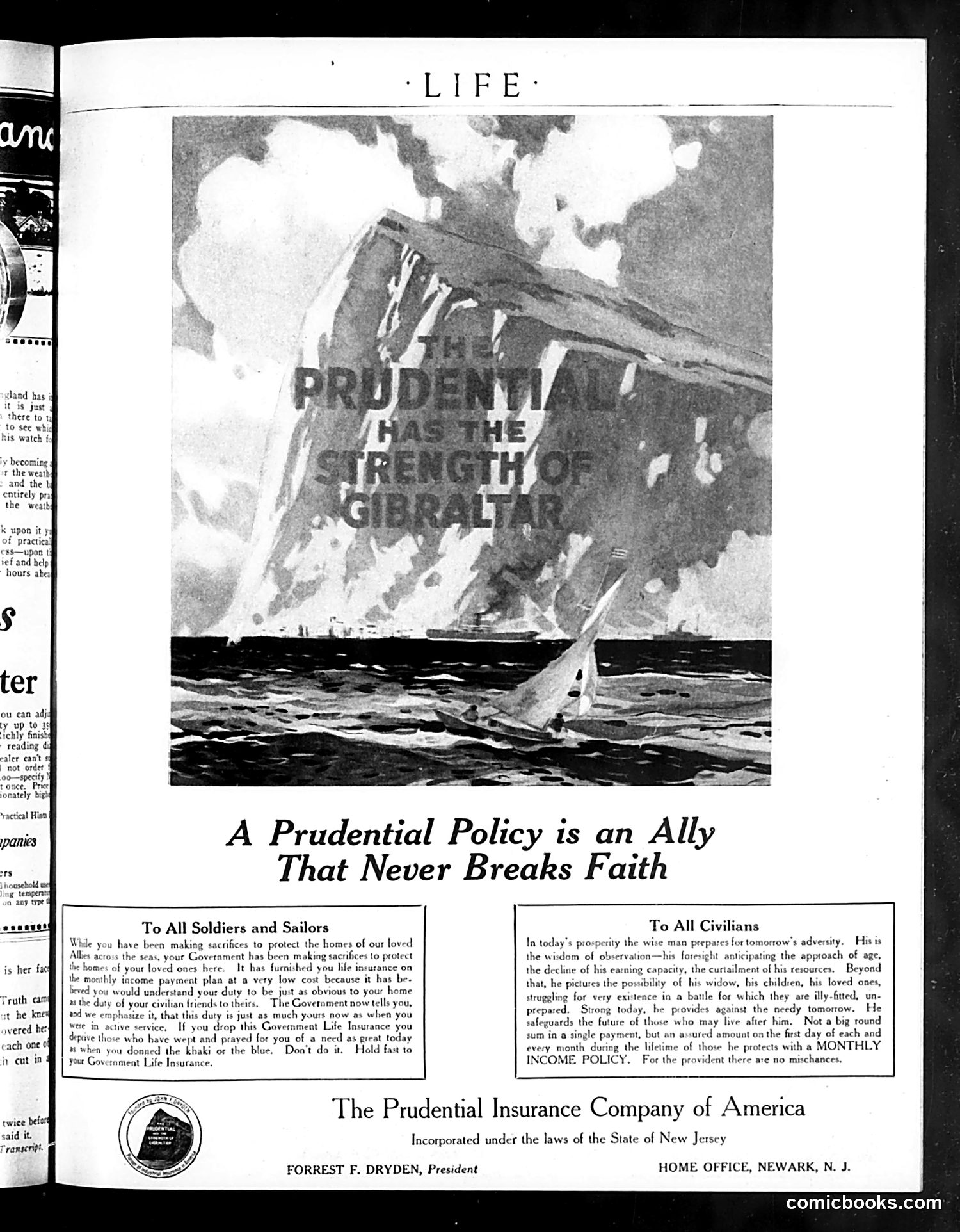
This is primarily a **Prudential Insurance advertisement**, not satire or political commentary. The page appears from a WWI-era *Life* magazine and uses patriotic messaging to sell insurance policies. The image shows a sailboat near Gibraltar with text overlay—likely emphasizing stability and strength ("Prudential has the strength of Gibraltar"). The ad makes dual pitches: **To soldiers/sailors**: Urges them to maintain their Government Life Insurance, framing it as a patriotic duty to their families back home who "have wept and prayed" for them. **To civilians**: Encourages life insurance as prudent preparation against future hardship—protecting widows and children from destitution. The appeal emphasizes foresight and moral responsibility. The rhetoric conflates insurance with patriotism and moral obligation rather than purely financial benefit. The "Monthly Income Policy" is presented as protection against life's uncertainties. This represents typical early-20th-century insurance marketing that wrapped commercial products in appeals to duty, family protection, and social stability.
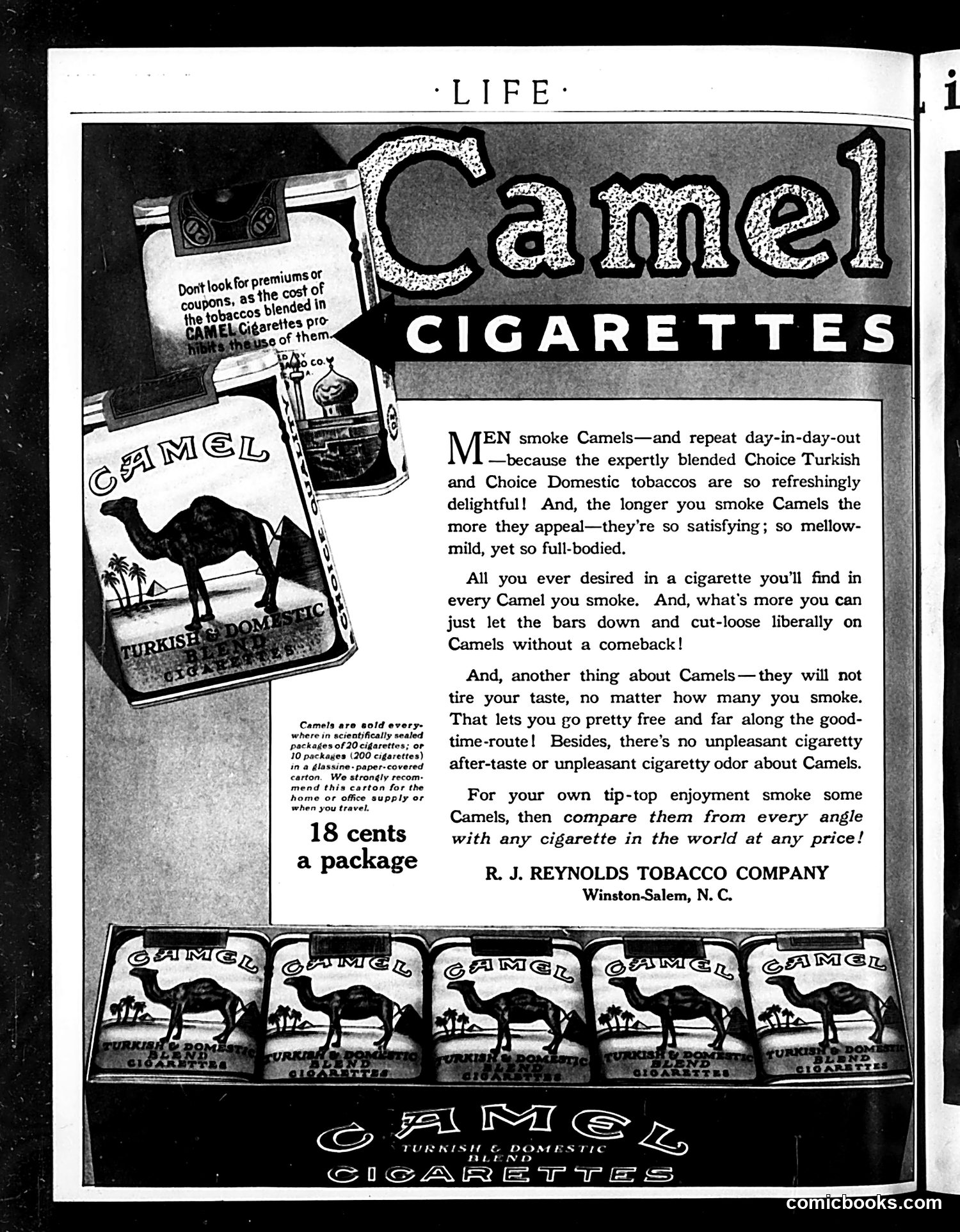
This page is primarily a commercial advertisement, not satire or political commentary. It promotes Camel cigarettes manufactured by R.J. Reynolds Tobacco Company (Winston-Salem, N.C.), priced at 18 cents per package. The ad emphasizes the cigarette's blend of Turkish and Domestic tobaccos, claiming they won't tire the smoker's taste or leave unpleasant odor. The camel imagery—a silhouette of a camel with palm trees—was Camel's trademark branding. Notable to modern readers: the advertisement makes health and safety claims that would be illegal today ("no unpleasant cigarette odor," encouraging heavy smoking). The casual, encouraging tone about consumption reflects the pre-1960s era when tobacco's serious health risks weren't publicly acknowledged in advertising. The price and packaging style date this as mid-20th century.