
Life, 1919-06-05 · page 30 of 46
Life — June 5, 1919 — page 30: what you’re looking at
What you’re looking at
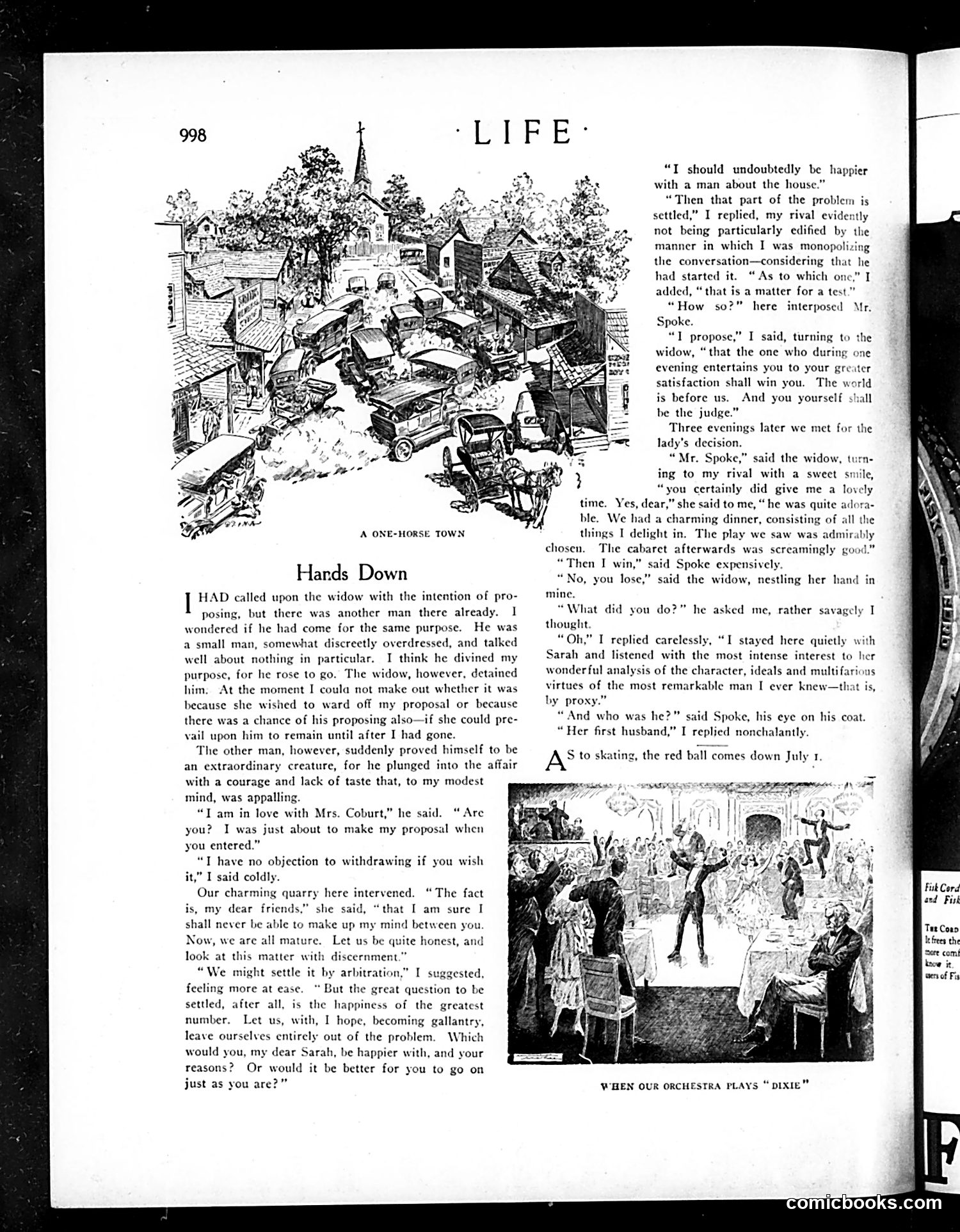
This is a humorous short story with accompanying illustrations satirizing early 20th-century courtship and male competition for a widow's affections. Three men compete to win Mrs. Coburn's hand through an "entertainment contest"—each must entertain her for an evening, and she'll choose her suitor based on who provides the greatest satisfaction. The rival Mr. Spoke spends lavishly on dinner, theater, and cabaret, expecting victory through expensive entertainment. The narrator wins by simply staying home, listening attentively while she discusses her late first husband. The satire mocks masculine assumptions that elaborate spending and spectacle guarantee romantic success, while suggesting that genuine attention and emotional engagement prove far more valuable—a somewhat progressive joke for the era. The widow's preference for meaningful conversation over costly amusement represents quiet subversion of materialistic courtship conventions.
📄 Transcribed text from this page (OCR, searchable)
Machine-transcribed from the original scan — historical spelling and the odd misread are preserved.
A ONE-HORSE TOWN Hards Down HAD called upon the widow with the intention of pro- posing, but there was another man there already. 1 wondered if he had come for the same purpose. He was a small man, somewhat discreetly overdressed, and talked well about nothing in particular. I think he divined my purpose, for he rose to go. The widow, however, detained him. At the moment I coula not make out whether it was. because she wished to ward off my proposal or because there was a chance of his proposing also—if she could pre- vail upon him to remain until after I had gone. The other man, however, suddenly proved himself to be an extraordinary creature, for he plunged into the affair with a courage and lack of taste that, to my modest mind, was appalling. “Iam in love with Mrs. Coburt,” he said. “ Are you? I was just about to make my proposal when you entered.” “T have no objection to withdrawing if you wish it,” I said coldly. Our charming quarry here intervened. “The fact is, my dear friends,” she said, “that I am sure I shall never be able to make up my mind between you Now, we are all mature. Let us be quite honest, and look at this matter with discernment.” “We might settle it by arbitration,” I suggested, feeling more at ease. “But the great question to be settled, after all, is the happiness of the greatest number. Let us, with, I hope, becoming gallant leave ourselves entirely out of the problem. Which would you, my dear Sarah, be happier with, and your reasons? Or would it be better for you to go on just as you are?” “T should undoubtedly be happier with a man about the house.” “Then that part of the problem is settled,” I replied, my rival evidently not being particularly edified by the manner in which I was monopolizing the conversation—considering that he had started it. “As to which one,” I added, “ that is a matter for a test “How so?” here interposed Mr. Spoke. “I propose,” I said, turning to the widow, “that the one who during one evening entertains you to your greater satisfaction shall win you. The world is before us. And you yourself shall be the judge.” Three evenings later we met for the lady's decision. “Mr. Spoke,” said the widow, turn- ing to my rival with a sweet smile, “you certainly did give me a lovely time. Yes, dear,” she said to me, “he was quite adora- ble. We had a charming dinner, consisting of all the things I delight in. The play we saw was admirably chosen. The cabaret afterwards was screamingly good.” “Then I win,” said Spoke expensively. No, you lose,” said the widow, nestling her hand in mine. “What did you do?” he asked me, rather savagely I thought. “Oh,” I replied carelessly, “I stayed here quietly with Sarah and listened with the most intense interest to h wonderful analysis of the character, ideals and multi far virtues of the most remarkable man I ever knew—tha by proxy.” “And who was he?” said Spoke, his eye on his coat. “Her first husband,” I replied nonchalantly. AS stating, the red ball comes down July 1 SOKA YE SOR IRC. pS dat nl WHEN OUR ORCHESTRA PLAYS “ DIXIE” Comicbooks.com