
Life, 1919-06-05 · page 9 of 46
Life — June 5, 1919 — page 9: what you’re looking at
What you’re looking at
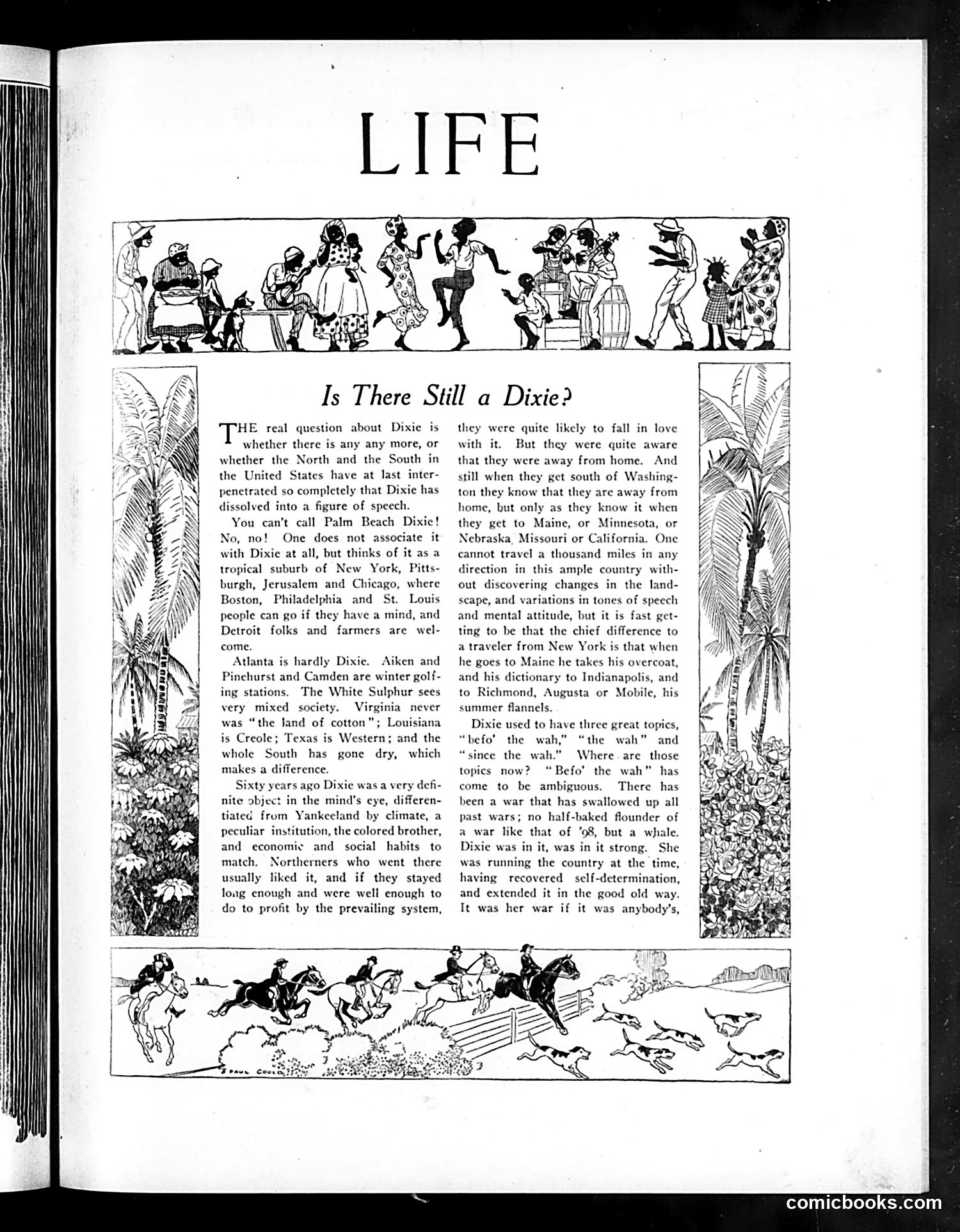
This article examines whether "Dixie" (the American South) still exists as a distinct cultural region. The author argues that while the North and South once had clear differences, modern travel and communication have blurred regional distinctions. The text discusses how Southerners traveling north or to distant regions discover they're "away from home," suggesting weakened regional identity. It references historical Southern characteristics—climate, slavery, economic systems—that once defined Dixie distinctly. The piece notes that Dixie's former three speech markers ("befo' the wah," "the wah," "since the wah") have become ambiguous, implying younger generations no longer emphasize these regional linguistic markers. The decorative illustrations show palm trees and fox hunting scenes, visually evoking Southern imagery while the text questions whether that South still meaningfully exists.
📄 Transcribed text from this page (OCR, searchable)
Machine-transcribed from the original scan — historical spelling and the odd misread are preserved.
Is There Still a Dixie? HE real question about Dixie is whether there is any any more, or whether the North and the South in the United States have at last inter- penctrated so completely that Dixie has dissolved into a figure of speech. You can’t call Palm Beach Dixie! No, no! One does not associate it with Dixie at all, but thinks of it as a tropical suburb of New York, Pitts- burgh, Jerusalem and Chicago, where Boston, Philadelphia and St. Louis people can go if they have a mind, and Detroit folks and farmers are wel- come. Atlanta is hardly Dixie. Aiken and Pinehurst and Camden are winter golf- ing stations. The White Sulphur sees very mixed society. Virginia never was “the land of cotton”; Louisiana is Creole; Texas is Western; and the whole South has gone dry, which makes a difference. Sixty years ago Dixie was a very defi- nite object in the mind's eye, differen- tiated from Yankeeland by climate, a peculiar institution, the colored brother, and economic and social habits to match. Northerners who went there usually liked it, and if they stayed long enough and were well enough to do to profit by the prevailing system, they were quite likely to fall in love with it. But they were quite aware that they were away from home. And still when they get south of Washing- ton they know that they are away from home, but only as they know it when they get to Maine, or Minnesota, or Nebraska, Missouri or California. One cannot travel a thousand miles in any direction in this ample country with- out discovering changes in the land- scape, and variations in tones of speech and mental attitude, but it is fast get- ting to be that the chief difference to a traveler from New York is that when he goes to Mainc he takes his overcoat, and his dictionary to Indianapolis, and to Richmond, Augusta or Mobile, his summer flannels, Dixie used to have three great topics, “befo’ the wah,” “the wah” and “since the wah.” Where are those topics now? “Befo’ the wah” has come to be ambiguous. There has been a war that has swallowed up all past wars; no half-baked flounder of a war like that of ’98, but a whale. Dixie was in it, was in it strong. She was running the country at the time, having recovered _self-determination, and extended it in the good old way. It was her war if it was anybody's, comicbooks.com