
Life, 1919-06-05 · page 19 of 46
Life — June 5, 1919 — page 19: what you’re looking at
What you’re looking at
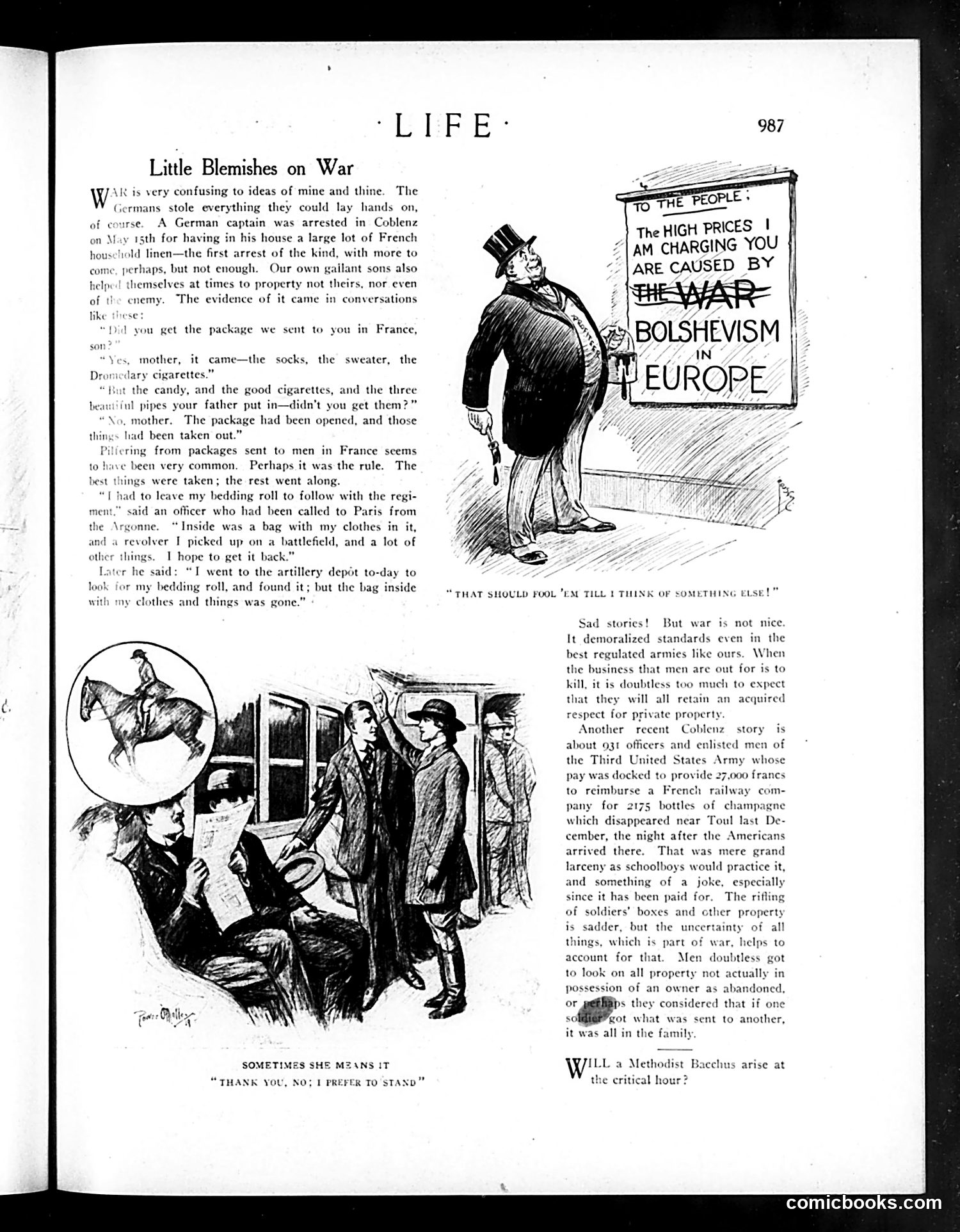
This article criticizes wartime looting and moral decay among Allied soldiers. The main cartoon depicts a profiteer blaming "Bolshevism in Europe" for high prices—a cynical deflection. The satire mocks how merchants use war fears to justify inflation while soldiers themselves steal from packages and property. The text catalogs specific incidents: a German officer arrested for French linens, American soldiers finding opened care packages with valuables removed, and U.S. Army officers docked pay for missing champagne near Toul. The author argues war "demoralized standards" even in disciplined armies, making soldiers view unguarded property as abandoned spoils rather than theft. The piece presents this as inevitable moral compromise during combat, yet clearly satirizes the hypocrisy: profiteers exploit patriotic fears while soldiers loot freely, both justified by wartime chaos. The "blemishes" are systemic corruption dressed as necessity.
📄 Transcribed text from this page (OCR, searchable)
Machine-transcribed from the original scan — historical spelling and the odd misread are preserved.
*LEBE: Little Blemishes on War W \kk is very confusing to ideas of mine and thine. The mans stole everything they could lay hands on, of course. A German captain was arrested in Coblenz on May 15th for having in his house a large lot of French household linen—the first arrest of the kind, with more to come, perhaps, but not enough. Our own gailant sons also helped themselves at times to property not theirs, nor even of tl ‘The evidence of it came in conversations like “tid you get the package we sent to you in France, enemy. . mother, it came—the socks, the sweater, the Dromedary cigarettes.” “But the candy, and the good cigarettes, and the three beautiful pipes your father put in—didn’t you get them?” “No, mother. The package had been opened, and those had been taken out.” ilicring from packages sent to men in France seems to have been very common. Perhaps it was the rule. The best things were taken; the rest went along. ment ad to leave my bedding roll to follow with the regi- said an officer who had been called to Paris from “Inside was a bag with my clothes in it, «revolver I picked up on a battlefield, and a lot of I hope to get it back. er he said: “IT went to the artillery depot to-day to or my bedding roll, and found it; but the bag inside i my clothes and things was gone.” the \rgonne. r things. SOMETIMES SHE M2ANS IT “THANK YOU, NO; 1 PREFER TO STAND” “THAT SHOULD FOOL The HIGH PRICES |! AM CHARGING YOU ARE CAUSED BY WAR- "EM TILL 1 THINK OF SOMETHING ELSE!” Sad stories! But war is not nice. It demoralized standards even in the best regulated armies like ours. When the business that men are out for is to kill, it is doubtless too much to expect that they will all retain an acquired respect for private property. Another Coblenz about 931 officers and enlisted men of the Third United States Army whose pay was docked to provide 27,000 franes to reimburse a French railway com- pany for bottles of champagne which disappeared near Toul last De- cember, the night after the Americans arrived there. That was mere grand larceny as schoolboys would practice it, and something of a joke, especially The rifling of soldiers’ boxes and other property is sadder, but the all things, which is part of war, helps to account for that. Men doubtless got to look on all property not actually in possession of an owner as abandoned, <[£: they considered that if one soldi ot what was sent to another, it was all in the family recent story is 7: 217 since it has been paid for. uncertainty of ILL a Methodist Bac the critical hour? us arise at comicbooks.com