
Life, 1919-06-05 · page 20 of 46
Life — June 5, 1919 — page 20: what you’re looking at
What you’re looking at
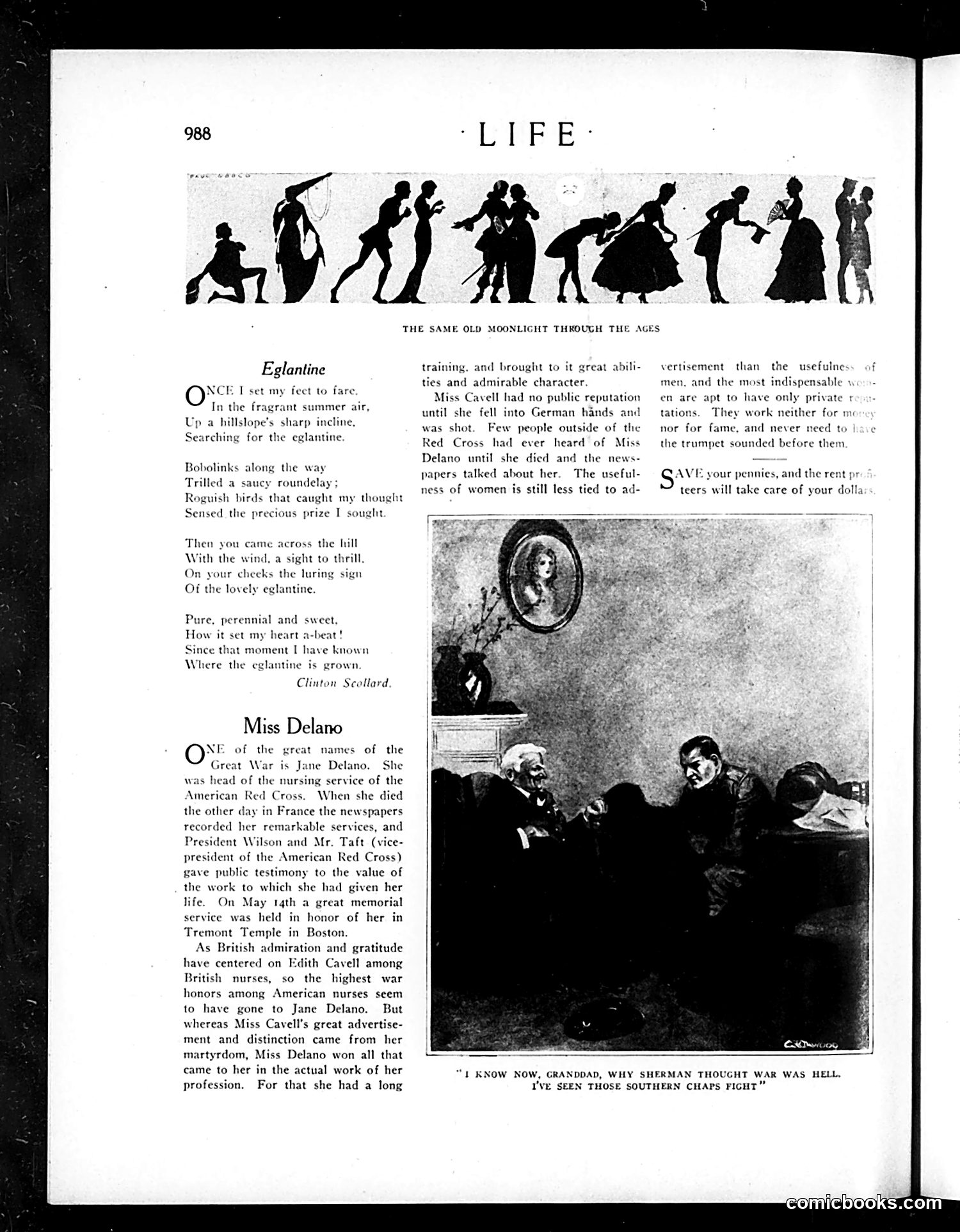
This Life magazine page contains two distinct pieces: **"Eglantine"** is a romantic poem by Clinton Scollard celebrating finding love while searching for wildflowers—sentimental Victorian verse, not satirical. **"Miss Delano"** is a memorial tribute to Jane Delano, head nurse of the American Red Cross who died in France during WWI. The article praises her actual professional accomplishment rather than martyrdom, contrasting her favorably with British nurse Edith Cavell (who gained fame through execution by Germans). The text argues that useful women's work often goes unrecognized compared to men's. The photograph and caption below show what appears to be WWI soldiers or civilians, with a child asking an elderly man why General Sherman called war hell—the child has now seen "southern chaps fight," invoking Sherman's Civil War march through the South. This is a historical reference joke about war's brutality across American generations. The decorative silhouettes at top show "moonlight through the ages," depicting romance across history.
📄 Transcribed text from this page (OCR, searchable)
Machine-transcribed from the original scan — historical spelling and the odd misread are preserved.
Eglantine NCE I set THE SAME y feet to fare, ‘ant summer air, Up a hillslop Searching for the eglantine. 's sharp incline, Bobolinks along the way Trilled a saucy roundelay ; Roguish birds that caught my thought Sensed the precious prize I sought Then you came across the hill With the wind, a sight to thrill, On your cheeks the luring sign Of the lovely eglantine. Pure, perennial and sweet How it set my heart a-beat! Since that moment I have known Where the eglantine is grown: Clinton Scollard. Miss Delano NE of the great Great War is Js was head of the nursing service of the American Red Cross. When she died the other day in France the newspapers recorded her remarkable services, and President Wilson and Mr. Taft (vice- president of the American Red Cross) gave public testimony to the value of the work to which she had given her life. On May 14th service was held in honor of her in Tremont Temple in Boston. As British admiration and gratitude have centered on Edith Cavell among British nurses, so the highest war honors among American nurses seem to have gone to Jane Delano. But whereas Miss Cavell’s great advertise- ment and distinction came from her martyrdom, Miss Delano won all that came to her in the actual work of her profession. For that she had a long great memorial training. and brought to it great abili- ties and admirable character. Miss Cavell had no public reputation until she fell into German hands and was shot. Few people outside of the Red Cross had ever heard of Miss Delano until she died and the news- papers talked about her. The useful- ness of women is still less tied to ad- A Abt al OLD MOONLIGHT THROUGH THE AGES vertisement than the usefulnes men, and the most indispensable t to have only priv They work neither for mr en are tations. nor for fame, and never need to lace the trumpet sounded before them. AVE your pennies, and the rent pr teers will take care of your dolla “1 KNOW NOW, GRANDDAD, WHY SHERMAN THOUGHT WAR WAS HELL. I'VE SEEN THOSE SOUTHERN CHAPS FIGHT”