
Life, 1919-06-05 · page 22 of 46
Life — June 5, 1919 — page 22: what you’re looking at
What you’re looking at
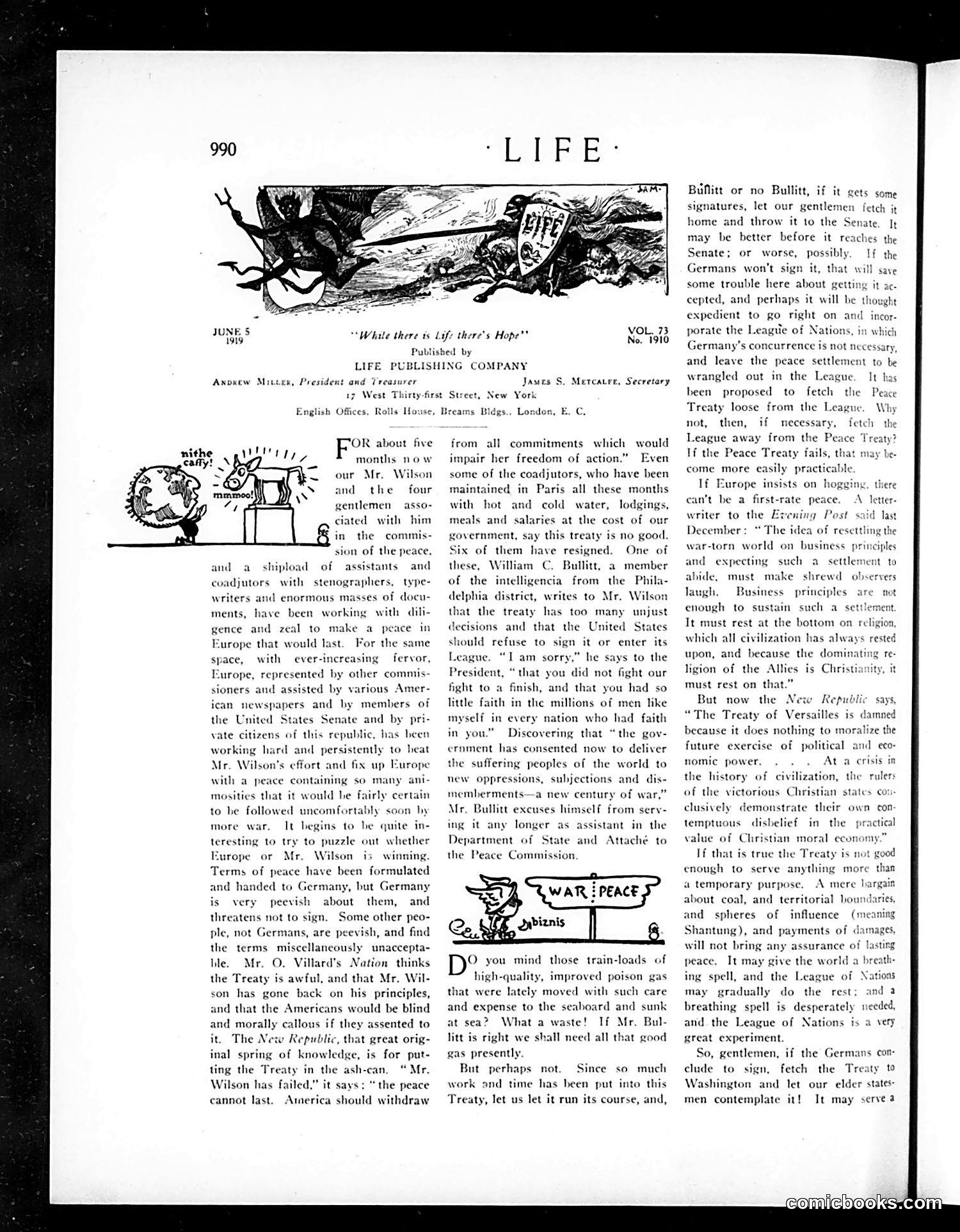
This June 1919 *Life* magazine page satirizes the contentious debate over the Treaty of Versailles following World War I. The main cartoon depicts **President Wilson** struggling against opposing forces—represented by figures labeled "Europe"—while trying to craft a lasting peace. The text mocks the conflict between Wilson's idealistic peace efforts and fierce critics, including: - **William C. Bullitt**, a State Department official who resigned, claiming the treaty was unjust and would spawn future wars - **Progressive publications** (*The Nation*, *The New Republic*) opposing the treaty as too punitive toward Germany - **U.S. Senate members** working to block Wilson's vision The satire's central point: Wilson fought to create peace while opponents—both isolationists wanting America to withdraw and progressives demanding harsher terms—undermined him. The cartoon suggests Wilson is caught in an impossible middle, with success uncertain. The poisoned gas reference mocks the waste of war resources.
📄 Transcribed text from this page (OCR, searchable)
Machine-transcribed from the original scan — historical spelling and the odd misread are preserved.
JUNE 5 1919 “Whale there ts Life there’s Hop. Published by LIFE Awxoxew Mites, President and Treasurer PUBLISHING COMPANY Jaucs S. Metcatre, Secretary tz West Thirty-first Street, New York English Offices. OR about five months now our Mr. Wilson the four gentlemen with commis- and asso- ciated him in the sion of the peace, and shipload of assistants stenographers, type- and a coadjutors with writers and enormous masses of docu- ments, have been working with dili gence and zeal to make a peace in Europe that would last space, with ever-increasing Europe, represented by other commis For the same fervor, sioners and assisted by various Amer- ican newspapers and by members of the United States Senate and by pri vate citizens of this republic, has been working hard and persistently to beat Mr. Wilson’s effort and fix up Europe with a peace containing so many ani mosities that it would be fairly certain to be followed uncomfortably soon by more war. It begins to be quite in- teresting to try to puzzle out whether Mr. Wilson is winning. Terms of peace have been formulated and handed to Germany, but Germany about them, and Some other peo- Europe or is very peevish threatens not to sign. ple, not Germans, are peevish, and find the terms miscellancously unaccepta- lle. Mr, O. Villard’s Nation thinks the Treaty is awful, and that Mr. Wil- son has gone back on his principles, and that the Americans would be blind and morally callous if they assented to it. The New Republic, that great orig- inal spring of knowledge, is for put- ting the Tr “Mr. Wilson has failed,” it says: “the peace cannot last. America should withdraw y in the ash-can Rolls House, Br ams Bidgs.. Lond would Even from all commitments which impair her freedom of action.” some of the coadjutors, who have been maintained in Paris all these months with hot and cold water, lodgings, meals and salaries at the cost of our government, say this treaty is no good. Six of them have resigned. One of these, William C, Bullitt, a member of the intelligencia from the Phil delphia district, writes to Mr. Wilson that the treaty has too many unjust United States should refuse to sign it or enter its Lea . “Tam sorry,” he says to the President, “that you did not fight our fight to a finish, and that you had so little faith in the millions of men like myself in every nation who had faith in you.” that “the gov- ernment has consented now to deliver the suffering peoples of the world to decisions and that the Discoverin new oppressions, subjections and dis- memberments—a new century of war,” Mr. Bullitt excuses himself from ser ing it any longer as assistant in the Department of State and Attaché to the Peace Commission O you mind those train-loads of high-quality, improved poison gas that were lately moved with such care and expense to the seaboard and sunk What a waste! If Mr. Bul- I need all that good at sea? litt is right we s' gas presently. But Since so much work and time has been put into this Treaty, let us let it run its course, and, perhaps not. signatures, let our gentlemen fetch it home and throw it to the Senate. It may be better before it reaches the Senate; or worse, possibly Germans won't sign it, some trouble here about get cepted, and perhaps it will be the expedient to go right on and incor. porate the Leagtle of Nations, in which Germany's concurrence is not necessary, and leave the peace settlement to be wrangled out in the League. It has been proposed to fetch the Peace Treaty loose from the League. Why then, if fetch th League away from the Peace Treaty If the Peace Treaty fails, that may be- not, necessary, come more easily practicable If Europe insists on hogging, there can’t be a first-rate peace. A letter. writer to the Evening Post said last December: “ The idea of resettling th war-torn world on business principles and expecting such a settlement to make shrewd observers abide, must laugh. Business principles ar enough to sustain such a set It must rest at the bottom on religion, which all civilization has always rested upon, and because the dominating re- ligion of the Allies is Christianity, it must rest on that.” But now the New Rep: “The Treaty of Versailles is damned because it does nothing to moralize the future exercise of political and eco- nomic power. » . Ata crisis in the history of civilization, the of the victorious Christian states co’ demonstrate their own con: disbelief in’ the clusively temptuous value of Christian moral econ If that is true the Treaty is not good enough to serve anything more than practical a temporary purpose. A mere bargain about coal, and territorial boundaries, and spheres of influence Shantung), and payments of damages, will not bring any assurance of lasting (meaning may gradually do the res breathing spell is desperately needed, and the League of Nations is a very great experiment. So, gentlemen, if the Germans con- clude fetch the Treaty to Washington and let our elder states men contemplate it! It may serve @ to. sign,