
A complete issue · 38 pages · 1918
Life — October 17, 1918
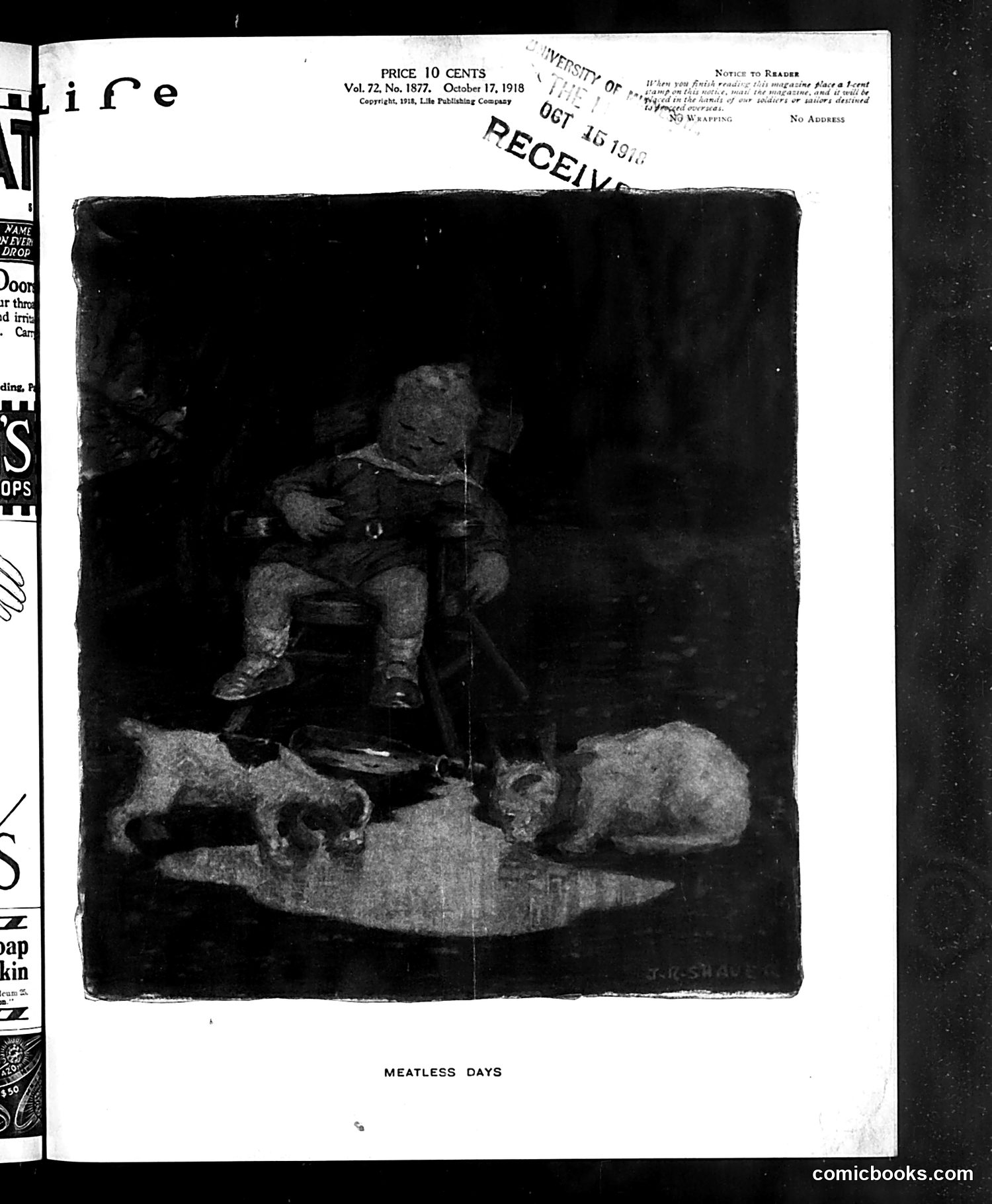
This satirical illustration comments on wartime food rationing during World War I. The image shows a child sitting at a table with what appears to be a cat and dog as companions—suggesting the family has so little food that pets are now fellow "diners" rather than animals to be fed separately. The caption "MEATLESS DAYS" references the U.S. government's voluntary (later mandatory) meat rationing program implemented to preserve supplies for soldiers overseas. The cartoon's dark humor criticizes how severely these restrictions affected American families, depicting the absurd scenario where households must share meager rations with their animals. This reflects genuine public frustration with WWI-era rationing policies.
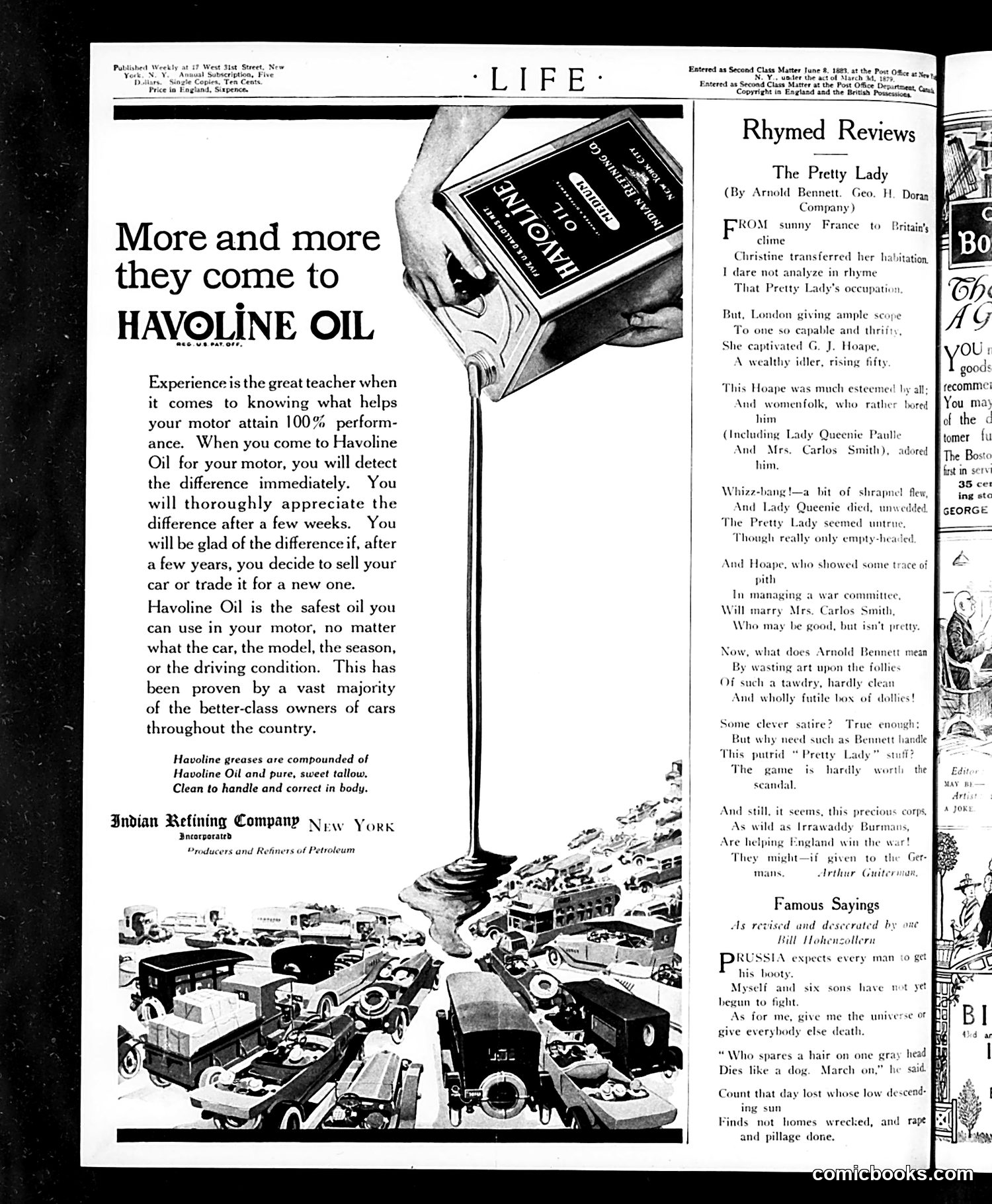
This page is **primarily advertising** for Havoline Oil by the Indian Refining Company, occupying the left two-thirds. The ad features oil being poured over various automobiles, emphasizing that Havoline works with "any car, the model, the season, or the driving condition." The right side contains **"Rhymed Reviews"** critiquing a theatrical production called "The Pretty Lady" by Arnold Bennett. The review is satirical, mocking both the play's thin plot and Bennett's supposed artistic pretensions. It suggests the play lacks substance—characters are shallow, the story "empty-headed," and questions why Bennett bothered creating this "tawdry" work. Below appears a **"Famous Sayings"** section with quotations, unrelated to the main content.
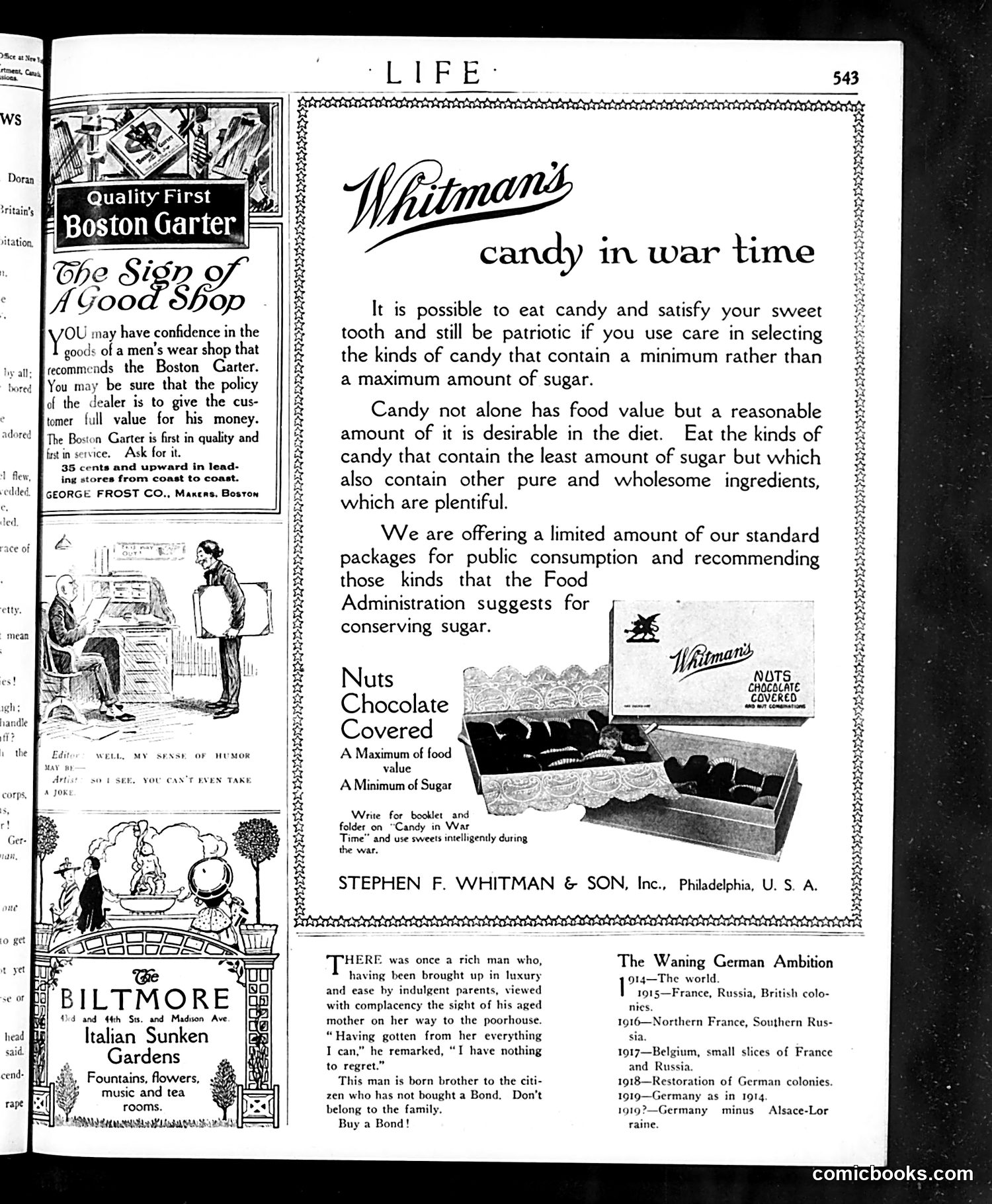
This page is primarily **advertising**, not satire or editorial content. The main feature is a Whitman's candy advertisement titled "candy in war time" that urges patriotic consumption during wartime. The ad argues Americans can satisfy sweet cravings while conserving sugar by choosing candies with minimal sugar content but wholesome ingredients. The surrounding ads include Boston Garter (men's hosiery), Biltmore Italian Sunken Gardens, and a war-bonds appeal ("Buy a Bond!"). The bottom section includes a brief story about a wealthy man and a moral lesson about war bonds—typical patriotic messaging for WWI-era Life magazine. **No political cartoons appear on this page.** The content reflects wartime consumer messaging and bond-promotion campaigns.
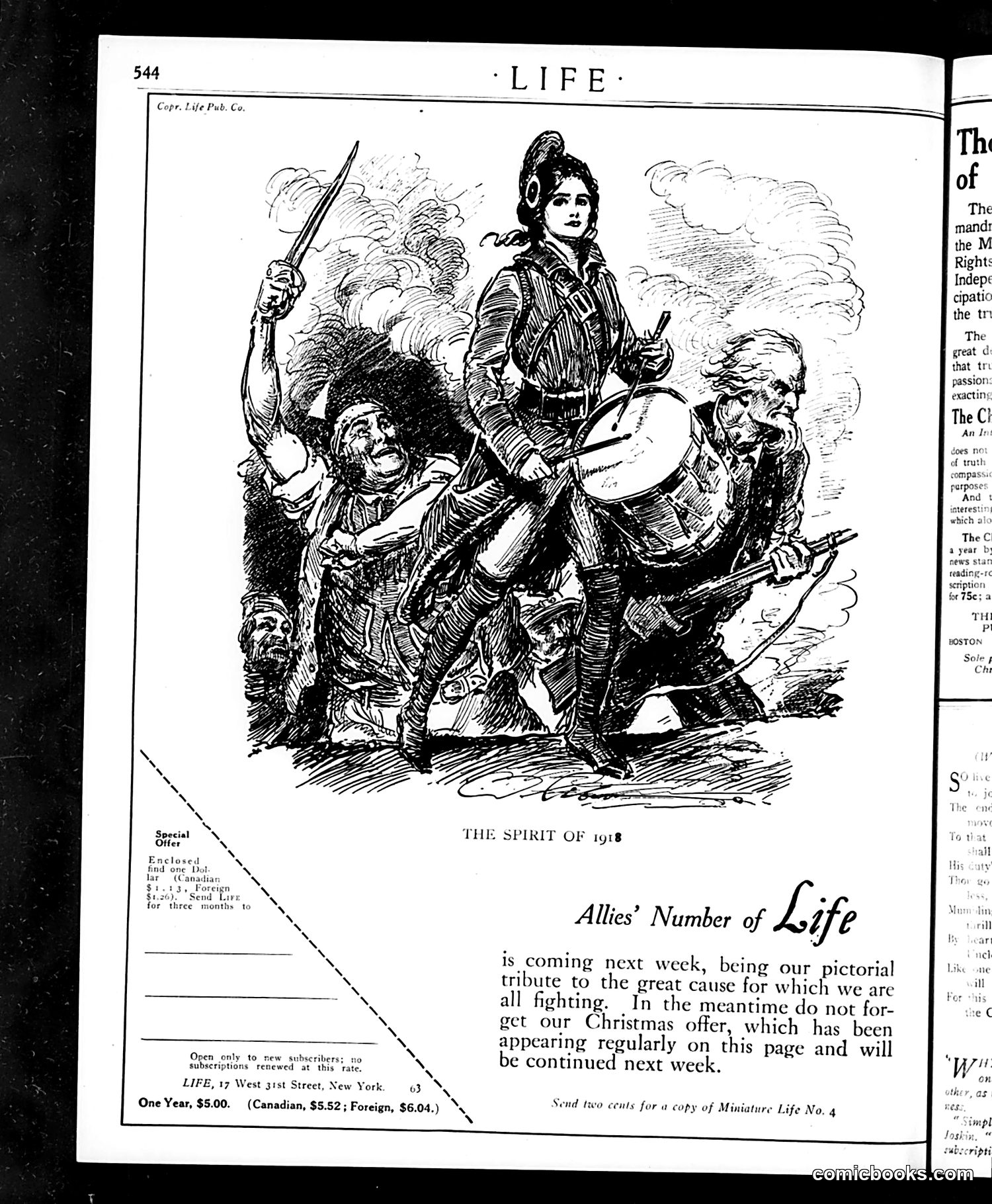
This cartoon depicts three military figures—appearing to represent Allied soldiers—carrying a woman on their shoulders. The woman, dressed in classical allegorical style with a feathered headdress, likely represents "Liberty" or "Victory" personified. The title "The Spirit of 1918" references World War I, which was ongoing when this *Life* magazine issue was published. The image celebrates the Allied cause and military unity during the conflict. Below, text announces an upcoming "Allies' Number of Life"—a special patriotic issue serving as a "pictorial tribute to the great cause" of the war effort. This appears designed to boost American support for the war and Allied nations through inspirational imagery and messaging.
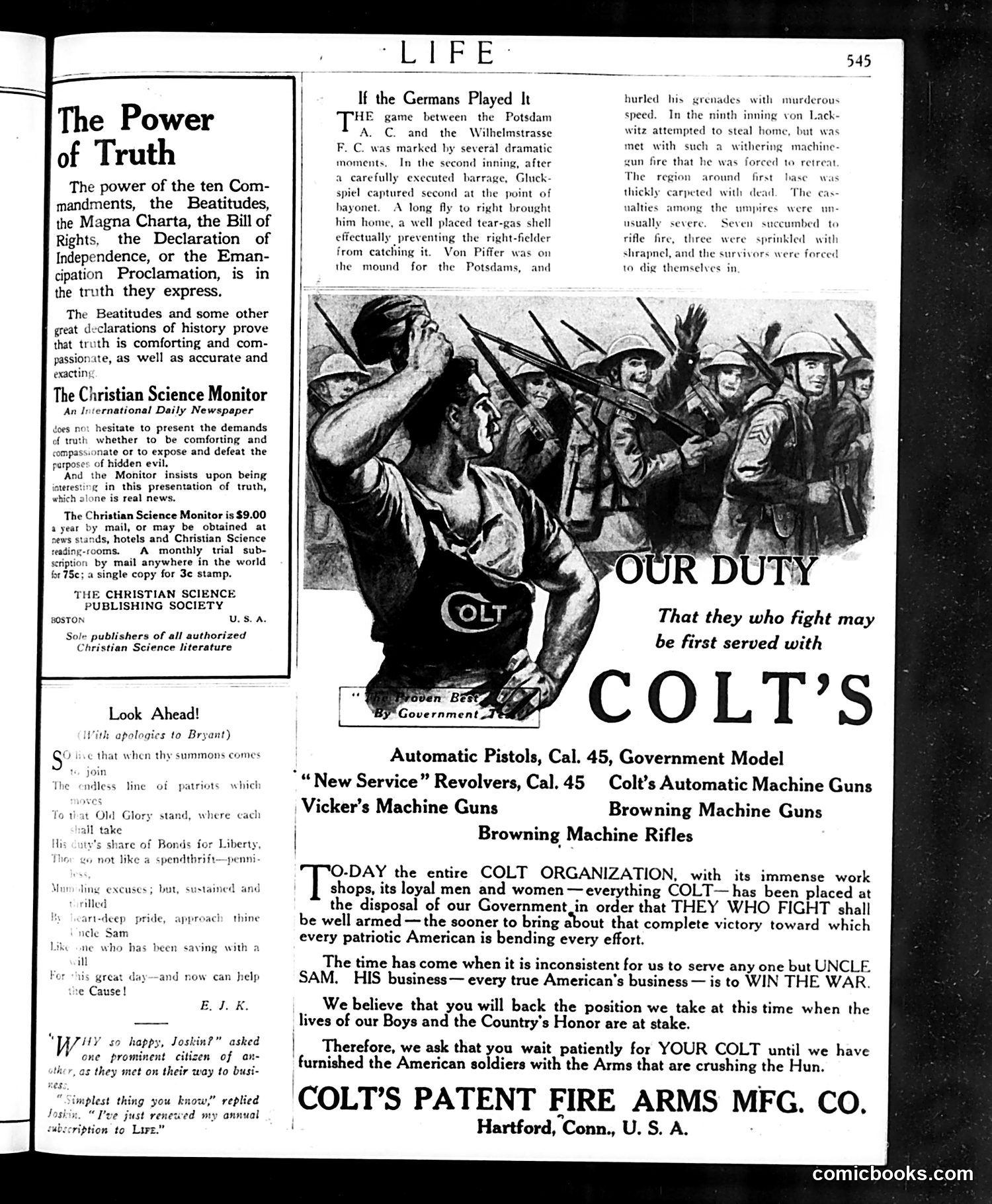
This page is primarily a **wartime advertisement for Colt firearms** (World War I era, based on references to "the Hun" and context). The illustrated scene depicts **soldiers in combat**, with one figure prominently throwing a grenade. The imagery emphasizes military action and urgency. The advertisement's messaging is patriotic propaganda: Colt argues that American soldiers need their weapons to win the war, and civilians should be patient waiting for Colt products rather than demanding them, since "they who fight may be first served with COLT'S" weapons. The left sidebar contains unrelated Christian Science Monitor advertising about "The Power of Truth." The overall message conflates commercial self-interest with patriotic duty—essentially asking Americans to trust that Colt's priority to arm soldiers serves the national interest.
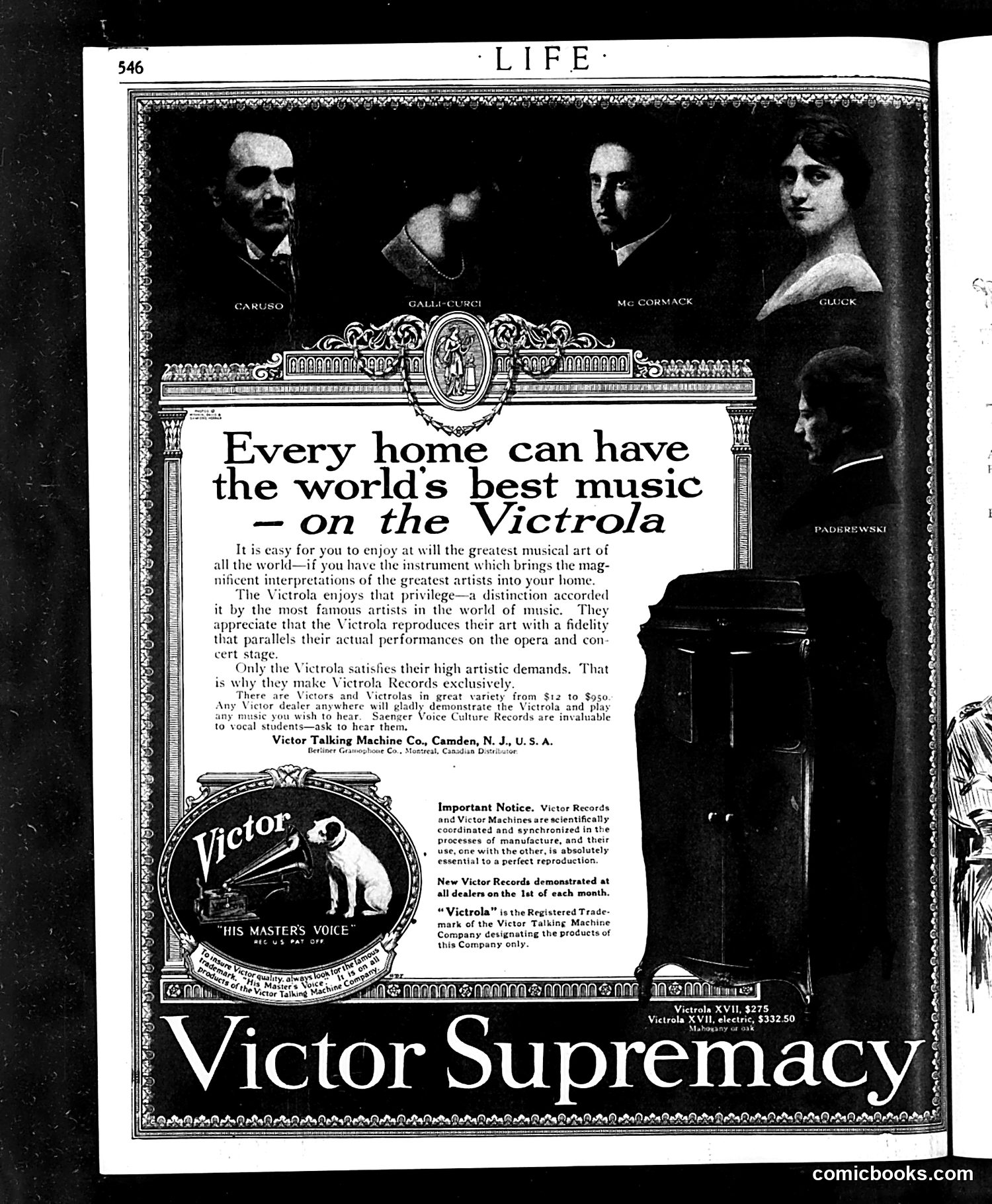
This page is **primarily an advertisement**, not a satirical cartoon. It promotes the Victrola phonograph, manufactured by Victor Talking Machine Co. in Camden, New Jersey. The ad features portraits of four famous opera singers—Caruso, Galli-Curci, McCormack, and Gluck—endorsing the device. The sales pitch claims that the Victrola faithfully reproduces great artists' performances, allowing homes to access "the world's best music." A photograph on the right shows the actual Victrola machine (Model XVII, priced $232.50). The famous "His Master's Voice" dog logo appears at bottom. The implicit message: owning this technology grants access to elite cultural experiences previously available only at concert halls, democratizing high art for middle-class households. This reflects early 20th-century optimism about technology enhancing domestic life.
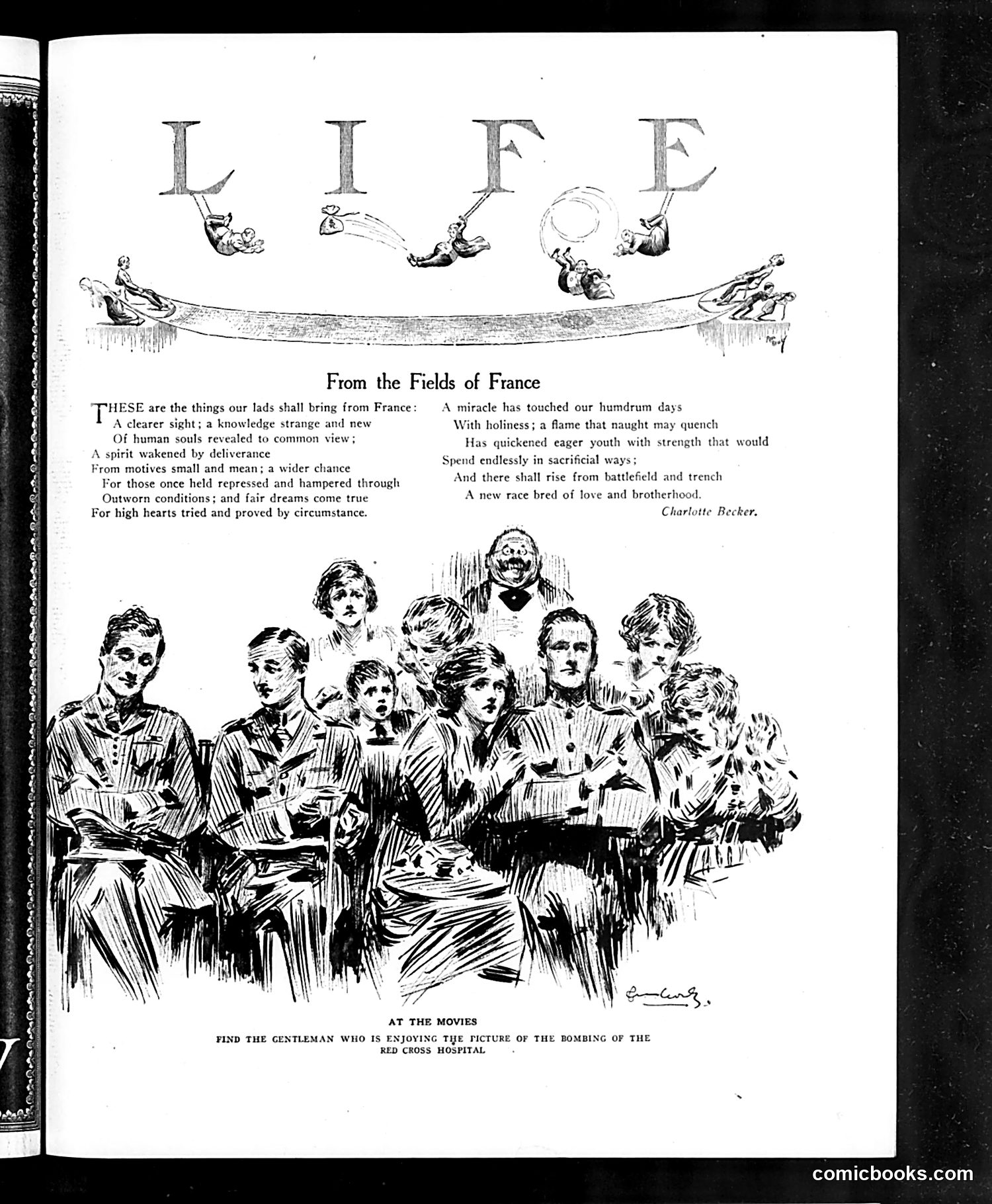
This page satirizes American attitudes toward World War I, specifically criticizing indifference to war atrocities. The decorative header "LIFE" shows figures on a seesaw, suggesting frivolity and imbalance. The poem "From the Fields of France" (attributed to Charlotte Becker) contrasts noble ideals—soldiers gaining wisdom, brotherhood, sacrifice—with the reality below: a sketch titled "AT THE MOVIES" challenges viewers to identify a gentleman enjoying a film depicting "the bombing of the Red Cross Hospital." The satire's point: Americans comfortably consuming entertainment about war crimes while soldiers suffer. It criticizes moral detachment and suggests that enjoying such spectacles reveals character flaws—a damning commentary on American complacency regarding combat and humanitarian violations occurring abroad.
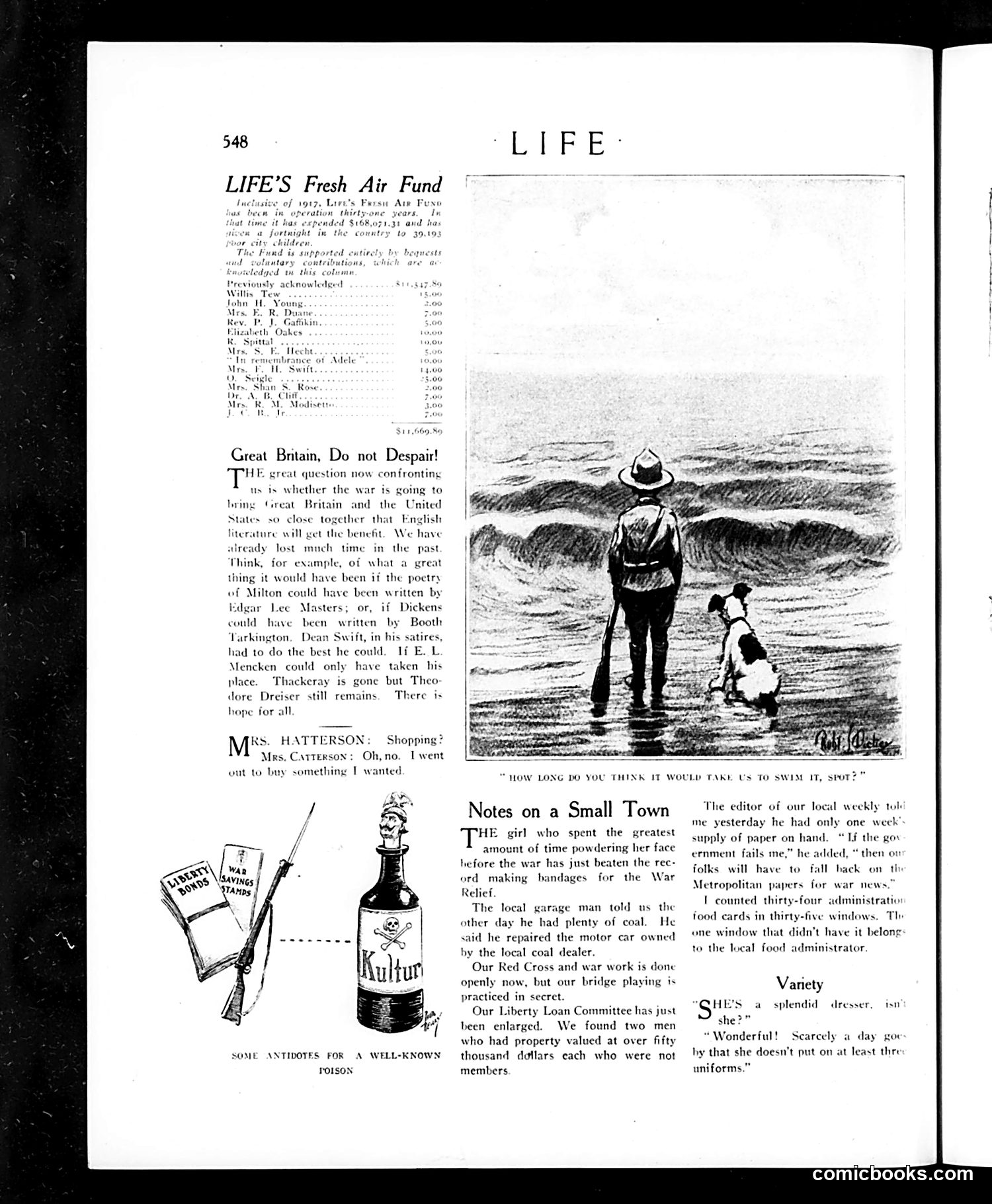
This page contains several satirical pieces about WWI-era British society. The main cartoon depicts two figures wading in water with the caption "HOW LONG DO YOU THINK IT WOULD TAKE US TO SWIM IT, SIR?" — appearing to joke about British resilience or optimism during wartime. Below is a section titled "Some Antidotes for a Well-Known Poison," showing a rifle with labels and a bottle labeled "Kultur" (with a skull symbol), satirizing German militarism as a "poison" needing antidotes — reflecting anti-German sentiment common in WWI American publications. The text sections address morale ("Great Britain, Do not Despair!") and include humorous small-town anecdotes. Overall, the page reflects wartime propaganda themes and civilian life during World War I.
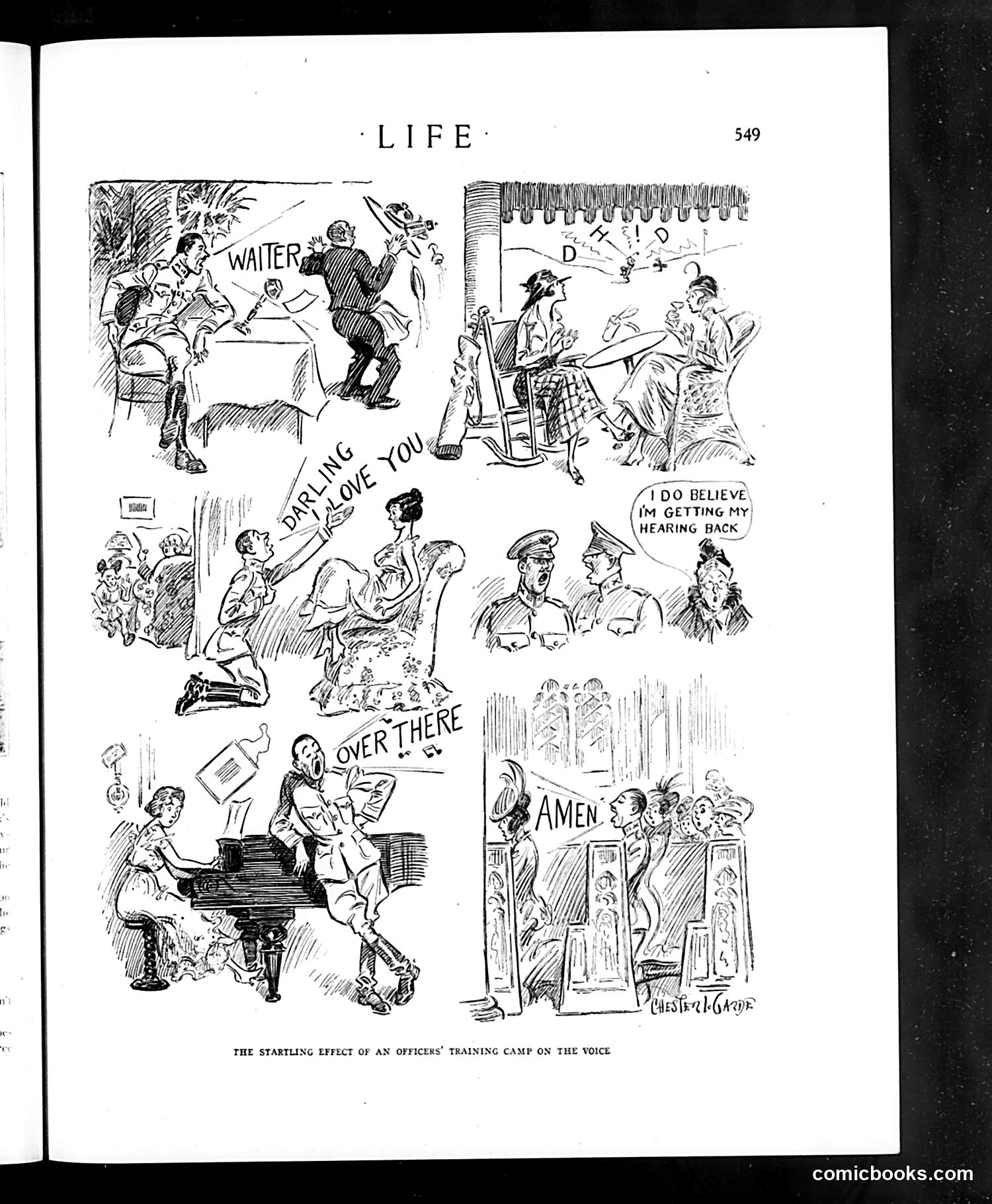
This satirical cartoon series depicts the dramatic transformation of military officers' voices through training camp. The caption indicates the humor centers on how formal military instruction changes how men speak. The panels show: 1. A waiter in a restaurant 2. Officers in military uniform speaking forcefully 3. A man singing "Darling, I Love You" 4. Someone shouting "Over There" (likely referencing the WWI song) 5. A church scene where someone declares "I do believe I'm getting my hearing back" after hearing "Amen" The joke appears to be that military training makes men's voices so loud and commanding that normal civilian activities become comically affected—the trained officer's booming voice has become his permanent state, requiring church attendance to restore normal hearing.
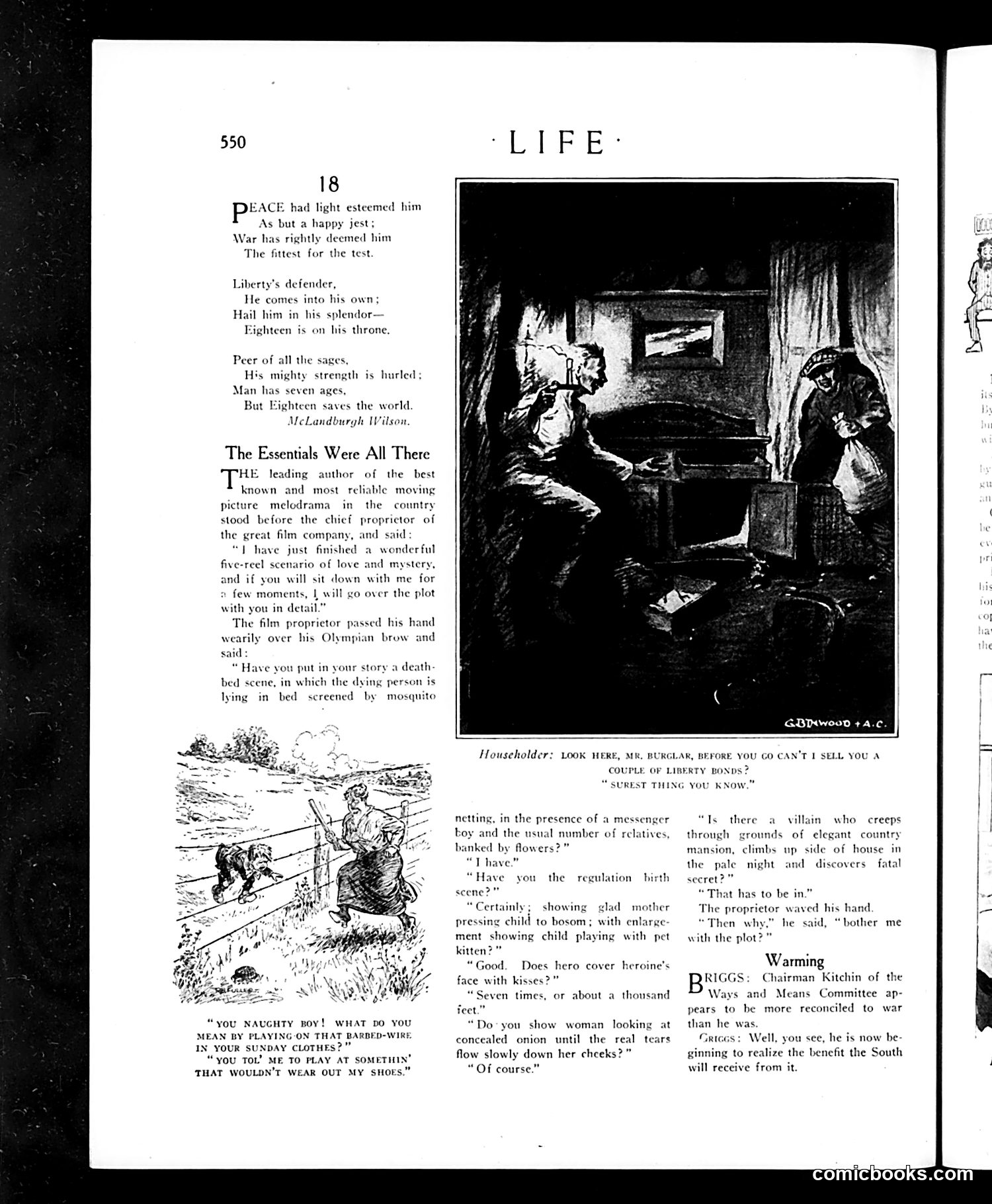
This page contains a poem (section 18) praising "Eighteen" as Liberty's defender, followed by a story excerpt titled "The Essentials Were All There" about a film scenario. The main illustration shows an interior scene with two figures—apparently a man and woman in dramatic conversation or confrontation, likely from the film being discussed in the text. Below is a separate cartoon showing a boy playing on a fence with the caption addressing him as "naughty boy," warning him about playing on a fence in his "Sunday clothes" and threatening his shoes will wear out. Both items appear to be satirical commentary on American life, culture, and behavior, typical of Life magazine's early 20th-century editorial approach, though the specific historical context and references are unclear without additional dating information.
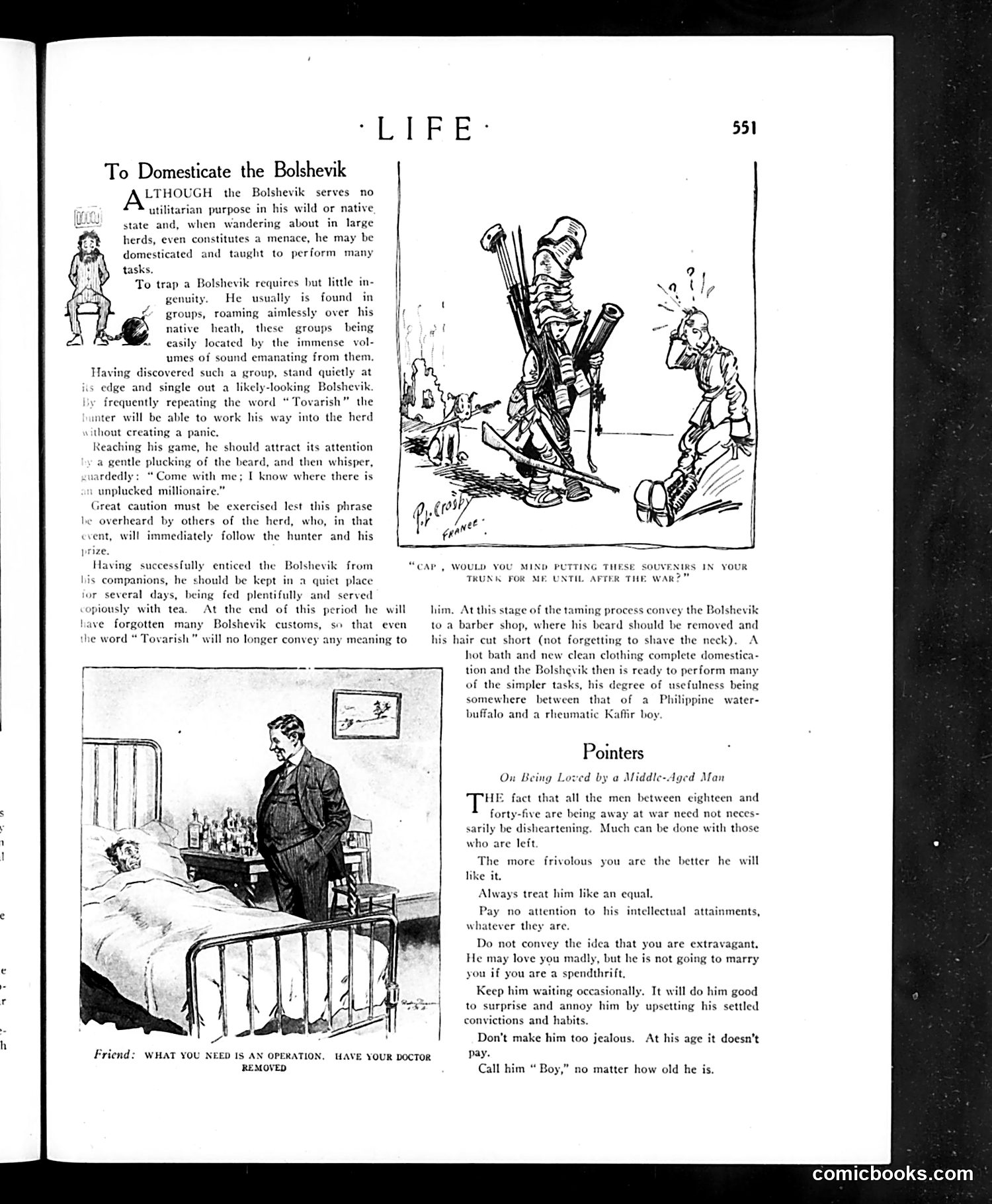
This page satirizes two distinct topics: **"To Domesticate the Bolshevik"** (top): A humorous guide treating Bolsheviks like wild animals to be tamed. The cartoon shows a "hunter" using tricks (repeating "Tovarish," offering food and tea) to lure a dangerous, armed Bolshevik into captivity. Once domesticated, he'll be groomed, bathed, and made "useful" — comparing political adversaries to animals requiring civilizing. This reflects post-Russian Revolution anti-communist sentiment prevalent in 1920s America. **"Pointers on Being Loved by a Middle-Aged Man"** (bottom): Advice for women courting older men — treat him as an equal, don't flaunt wealth, keep him surprised, avoid jealousy, call him "Boy." The cartoon illustrates a doctor's house visit, suggesting wealth and respectability. This offers cynical relationship guidance for navigating romance with established middle-aged suitors.
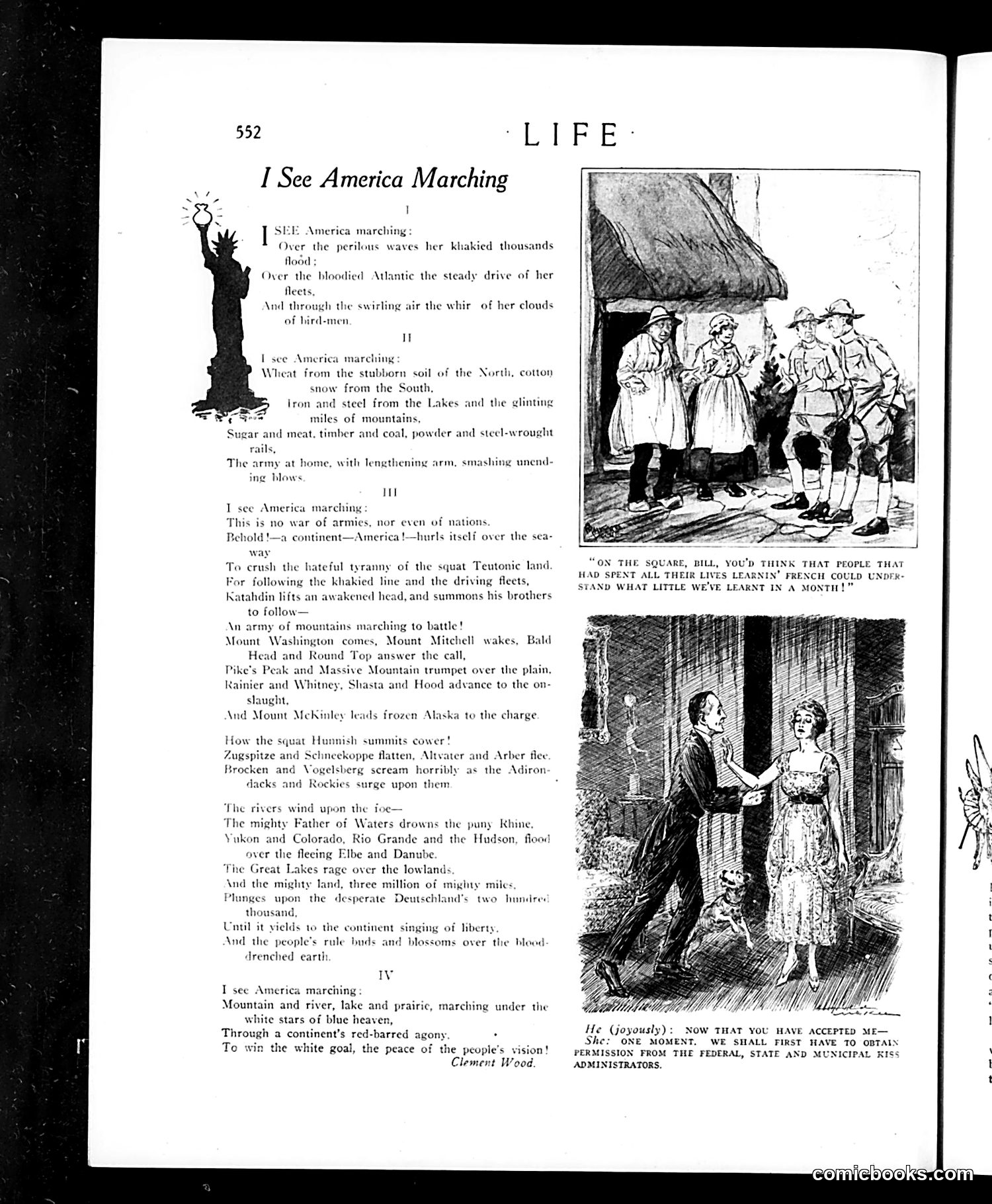
This is a patriotic poem by Clement Wood celebrating American industrial and geographic power during what appears to be the World War I era. The verse invokes the Statue of Liberty and catalogs America's natural resources—wheat, cotton, iron, steel—and geographic features—mountains, rivers, lakes—as forces "marching" toward victory. The accompanying illustrations show domestic scenes: military personnel and civilians in discussion, and a woman in an interior setting. These appear designed to reinforce the poem's message of unified national mobilization, showing both military and civilian commitment to the war effort. The text emphasizes America as a unified continental force, with natural resources and geographic grandeur supporting military strength. It's patriotic propaganda dressed as poetry.
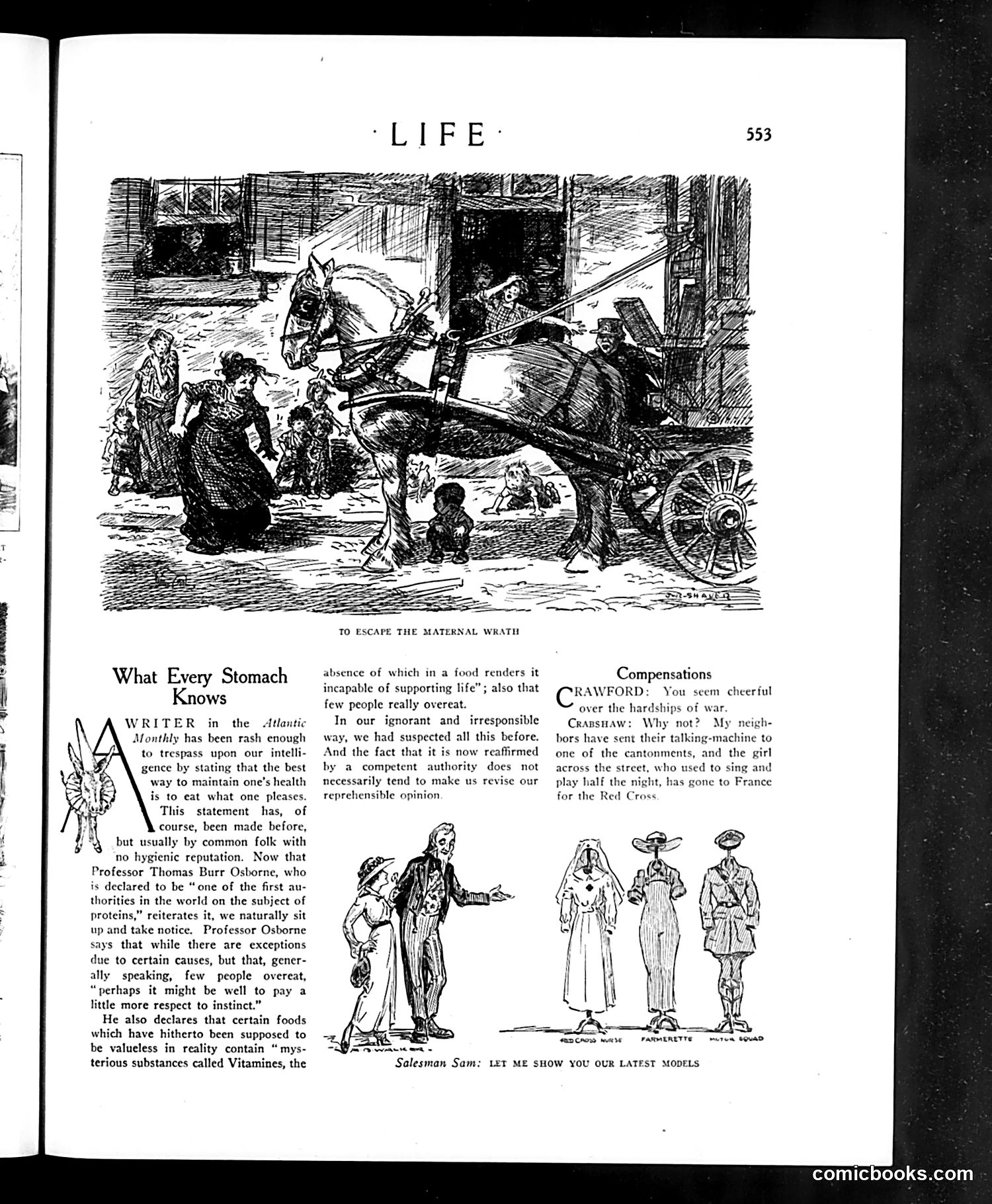
This page from *Life* magazine contains two satirical pieces: **Top illustration** ("To Escape the Maternal Wrath"): A comedic domestic scene showing a woman chasing a man on horseback through a street—a visual joke about marital conflict and the man's desperate escape. **"What Every Stomach Knows"** (left column): A satirical article discussing nutrition science. It references Professor Thomas Burr Osborne, a real authority on proteins, and mocks the public's tendency to accept dubious health claims. The piece skeptically examines whether certain "mysterious substances called Vitamins" have actual nutritional value—reflecting early-20th-century uncertainty about vitamin science. **"Compensations" (right column)**: Brief wartime commentary about homefront sacrifices, mentioning neighbors sending talking machines and someone going to France for the Red Cross. **Bottom illustration**: A salesman showing fashion models, captioned "Salesman Sam: let me show you our latest models."
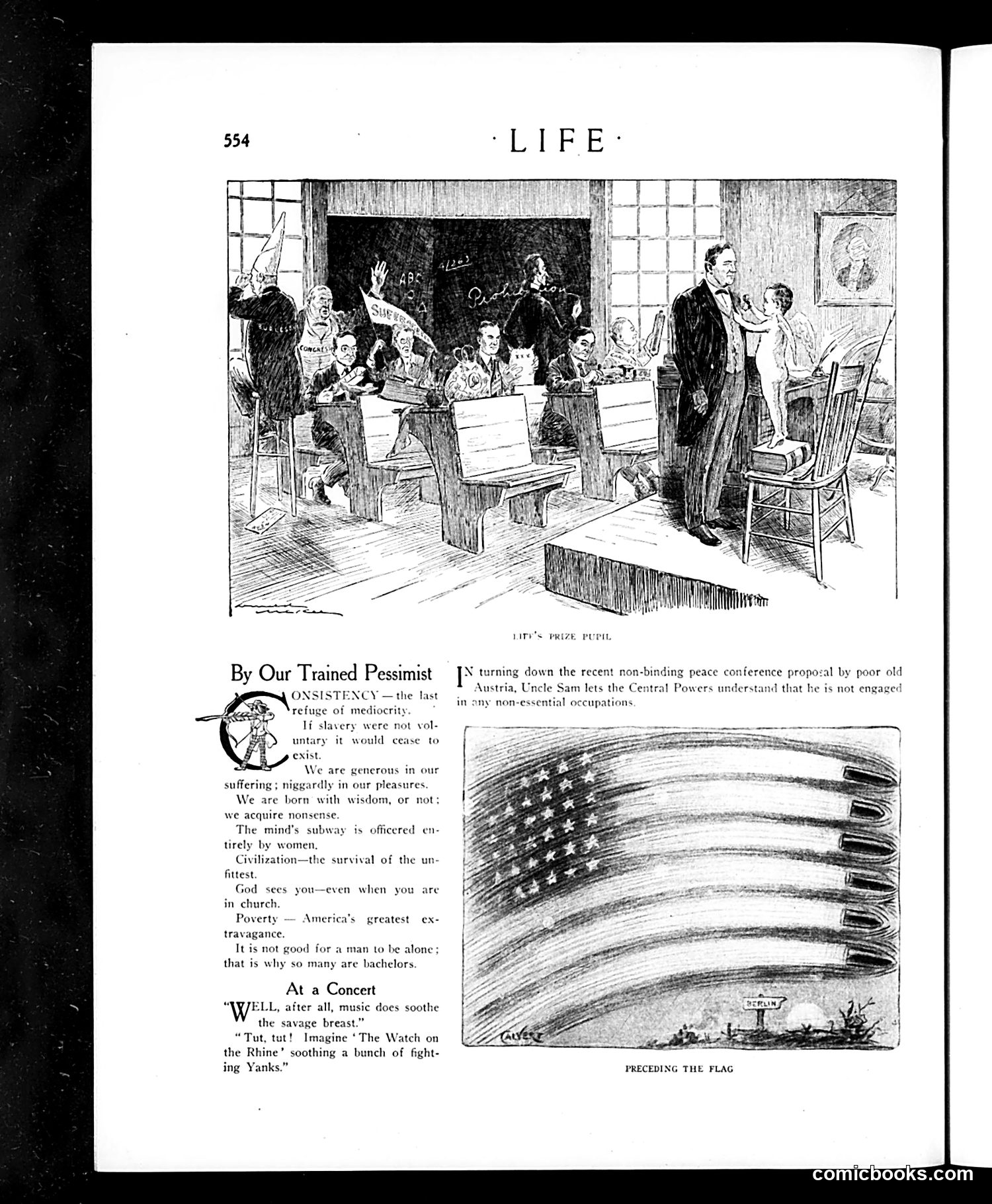
**Top Cartoon ("Life's Prize Pupil"):** Depicts a classroom scene where a teacher presents Uncle Sam to students, identifying him as someone who "lets the Central Powers understand that he is not engaged in any non-essential occupations"—a satirical reference to America's WWI neutrality stance, which the cartoon mocks as inconsistent or hypocritical. **"By Our Trained Pessimist":** A cynical column listing humanity's failings: slavery, generosity offsetting suffering, and the mind being "officered entirely by women." The tone is darkly comic misanthropy. **"At a Concert":** A brief joke about music soothing the "savage breast," juxtaposed with criticism of "The Watch on the Rhine"—likely referencing the famous German patriotic song—as inappropriate for "fighting Yanks." **"Preceding the Flag":** Cartoon showing military ships, unclear exact reference.
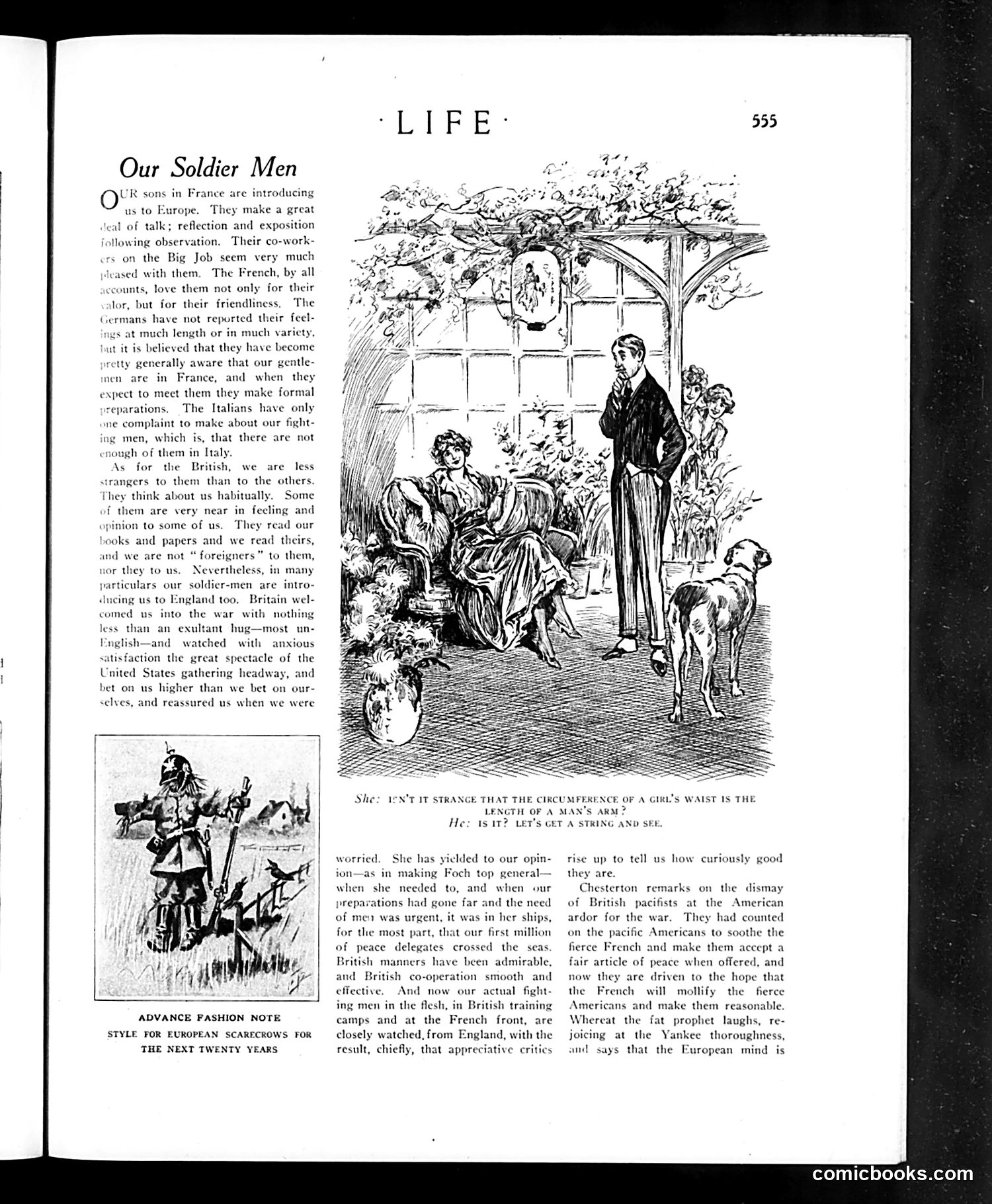
This page contains an article praising American soldiers in France during WWI, contrasting their behavior favorably with other Allied forces. The main illustration depicts a domestic scene: a woman seated indoors with a man standing nearby, a child, and a dog—suggesting American soldiers are genteel and respectful. The caption below the illustration poses a flirtatious riddle about a girl's waist measurement versus a man's arm length, implying American soldiers maintain proper decorum with European women despite wartime proximity. The smaller inset cartoon labeled "Advance Fashion Note" appears to satirize European military fashion, showing an exaggerated soldier figure. The text criticizes German and Italian soldiers while praising British cooperation, ultimately celebrating American soldiers as civilized and well-mannered representatives abroad.
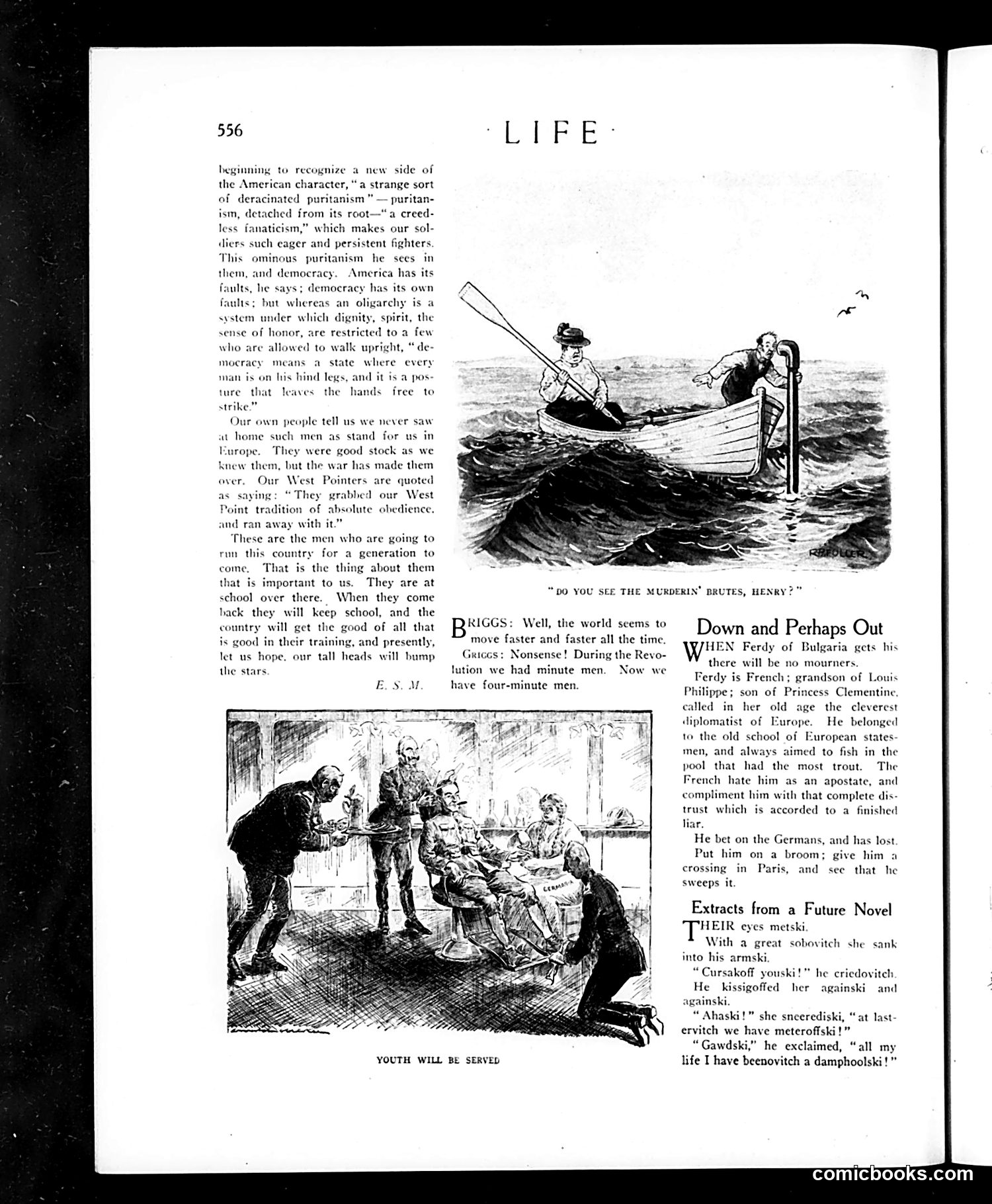
This page contains three separate satirical pieces: **Top cartoon**: Shows American soldiers discussed as a "new type" of fighter—puritanical but detached from religious moorings, making them dangerously zealous. The text contrasts oligarchies (where honor is restricted) with democracy (where everyone can "strike"). The satire critiques American soldier intensity and suggests returning WWI veterans will reshape the nation, implying both promise and concern. **Middle cartoon ("Youth Will Be Served")**: Mocks rapid social change. Griggs jokes about "four-minute men" (fast-acting), referencing Revolutionary War "minute men"—suggesting modern life moves absurdly faster with no actual acceleration in capability. **Bottom piece ("Down and Perhaps Out")**: Satirizes "Ferdy of Bulgaria" (Ferdinand I, who allied with Germany in WWI and lost). The satire mocks him as a French-descended opportunist and failed gambler who should be reduced to sweeping Paris streets. The Russian-sounding parody excerpt mocks Slavic-themed literature, likely post-Revolutionary Russian writing.
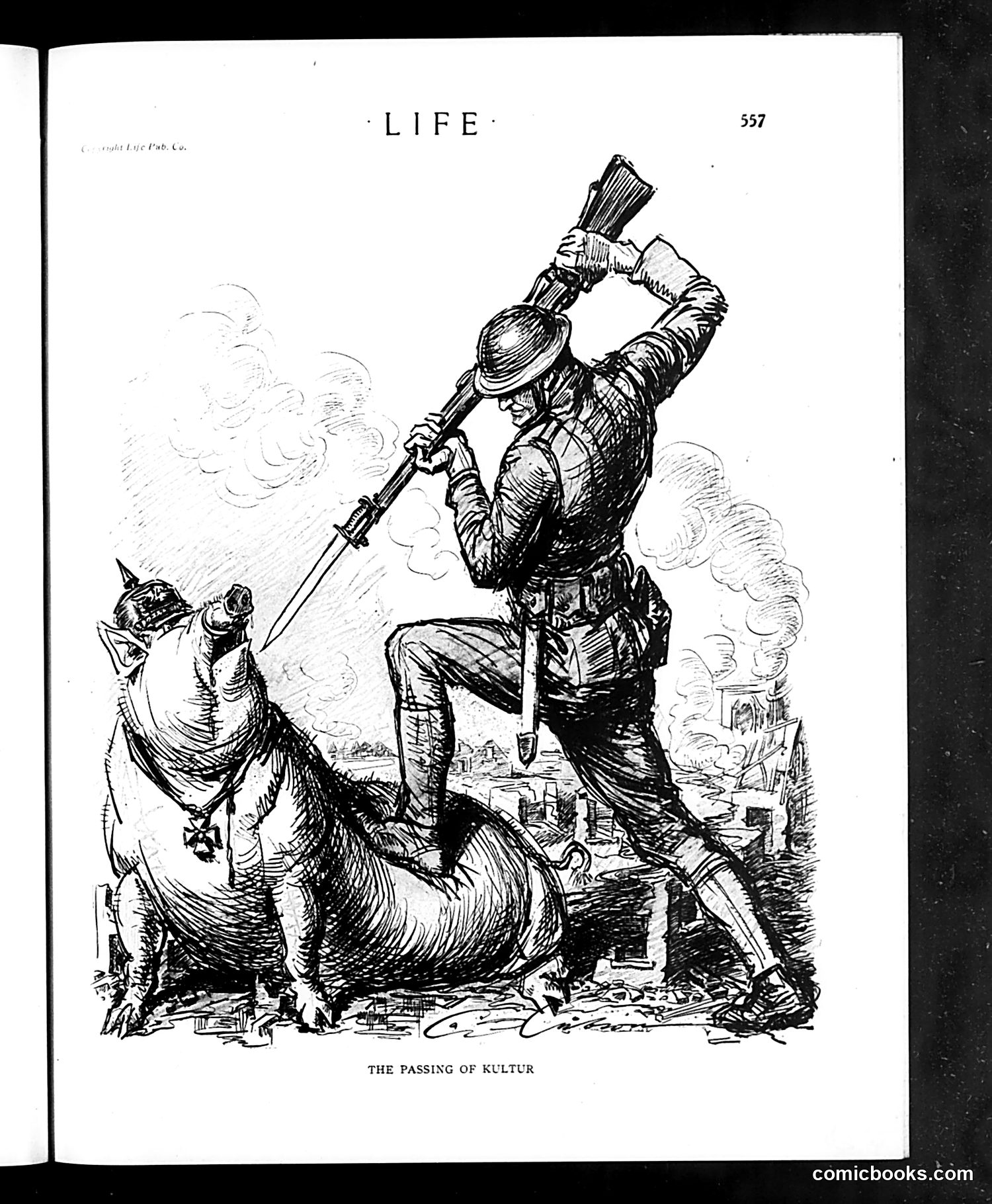
This satirical illustration depicts a German soldier in WWI-era military uniform striking down a pig with a large club. The title references "Kultur"—a German concept of superior civilization that became a target of Allied propaganda during World War I. The cartoon uses the pig as a symbol for German militarism and aggression. The soldier's exaggerated, violent posture and the burning buildings in the background suggest destruction and brutality associated with German conduct in the war. The "passing" of Kultur implies its defeat or elimination—celebrating Allied victory over German imperial ambitions. This reflects American satirical commentary from the WWI period, when such imagery was common in publications like *Life* to rally public support against Germany.
This editorial page appears near World War I's end, when peace negotiations seemed possible. The main cartoon depicts **Germany as a defeated beast** being restrained—likely representing calls for armistice negotiations. The text argues that while peace would be welcome, **Germany should not receive negotiated terms**. The author dismisses German peace overtures as self-serving, claiming Germany lacks the honor to negotiate fairly and must be thoroughly defeated first. The piece references **President Wilson's recent New York speech** (likely October 1918), which is quoted to support this position: Germany has proven itself without honor and justice cannot be compromised with. The article criticizes those suggesting negotiated peace with "the governments of the Central Empires," asserting only unconditional defeat will suffice. It also mocks pacifists like **Max Eastman and John Reed**, who were compelled to testify about their anti-war activities during wartime. The satire targets both German war aims and American anti-war advocates, supporting total victory over negotiated settlement.
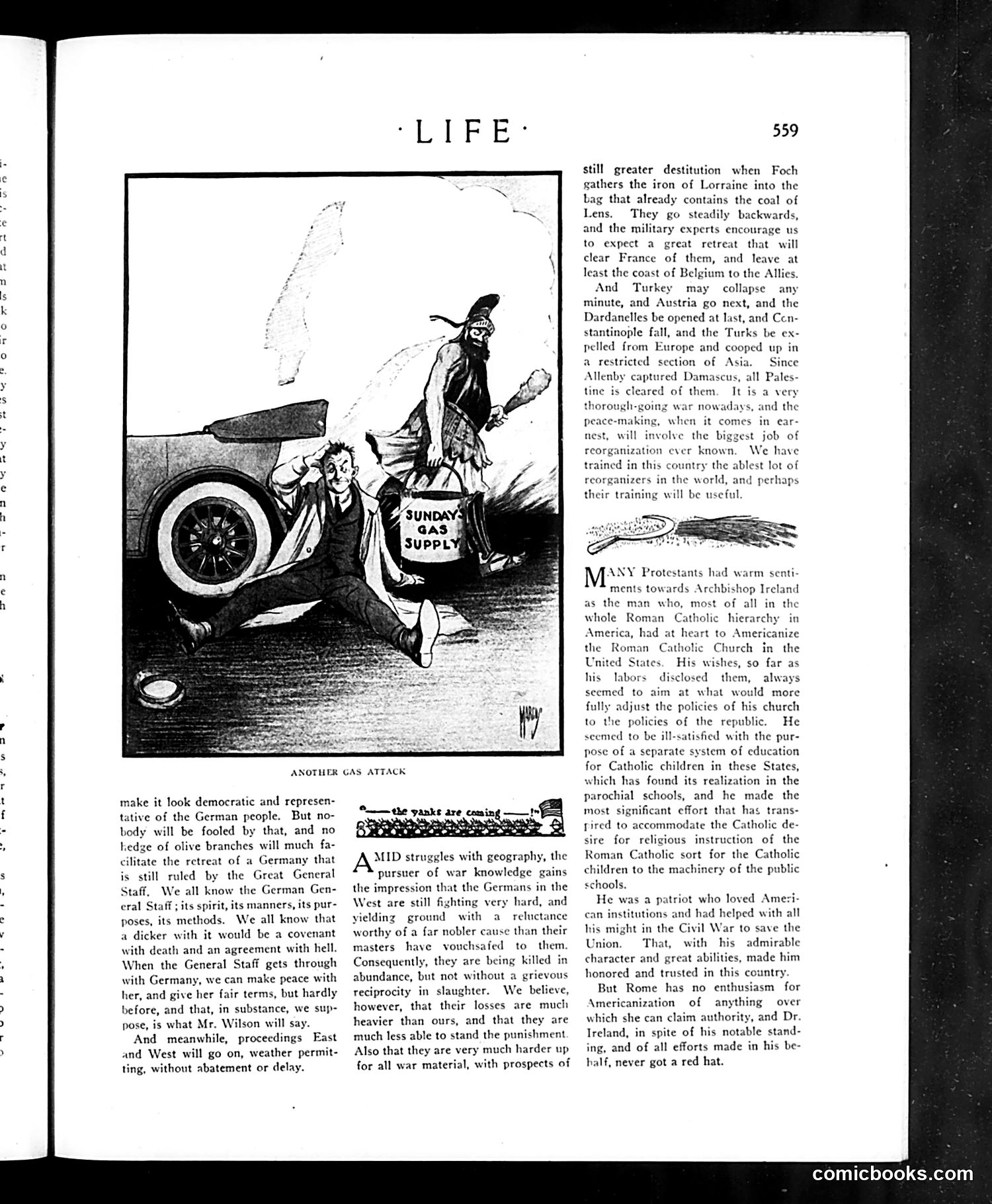
The cartoon depicts a personified Germany (the tall figure in military dress) being struck down by an Allied soldier emerging from a car labeled "Sunday School Supply." The satire targets German military leadership's claims of democratic legitimacy while being controlled by the militaristic General Staff. The accompanying text explains the joke: Germany attempts to appear democratic and representative to facilitate peace negotiations, but the author dismisses this as deception. The "Sunday School Supply" vehicle suggests the hypocrisy of Germany's supposed moral reform—mere propaganda window-dressing concealing the unchanged autocratic military rule beneath. Written during World War I's final stages, this reflects American skepticism toward German peace overtures and confidence in Allied victory. The text references General Foch's advances and anticipated Turkish-Austrian collapse, dating this to 1918.
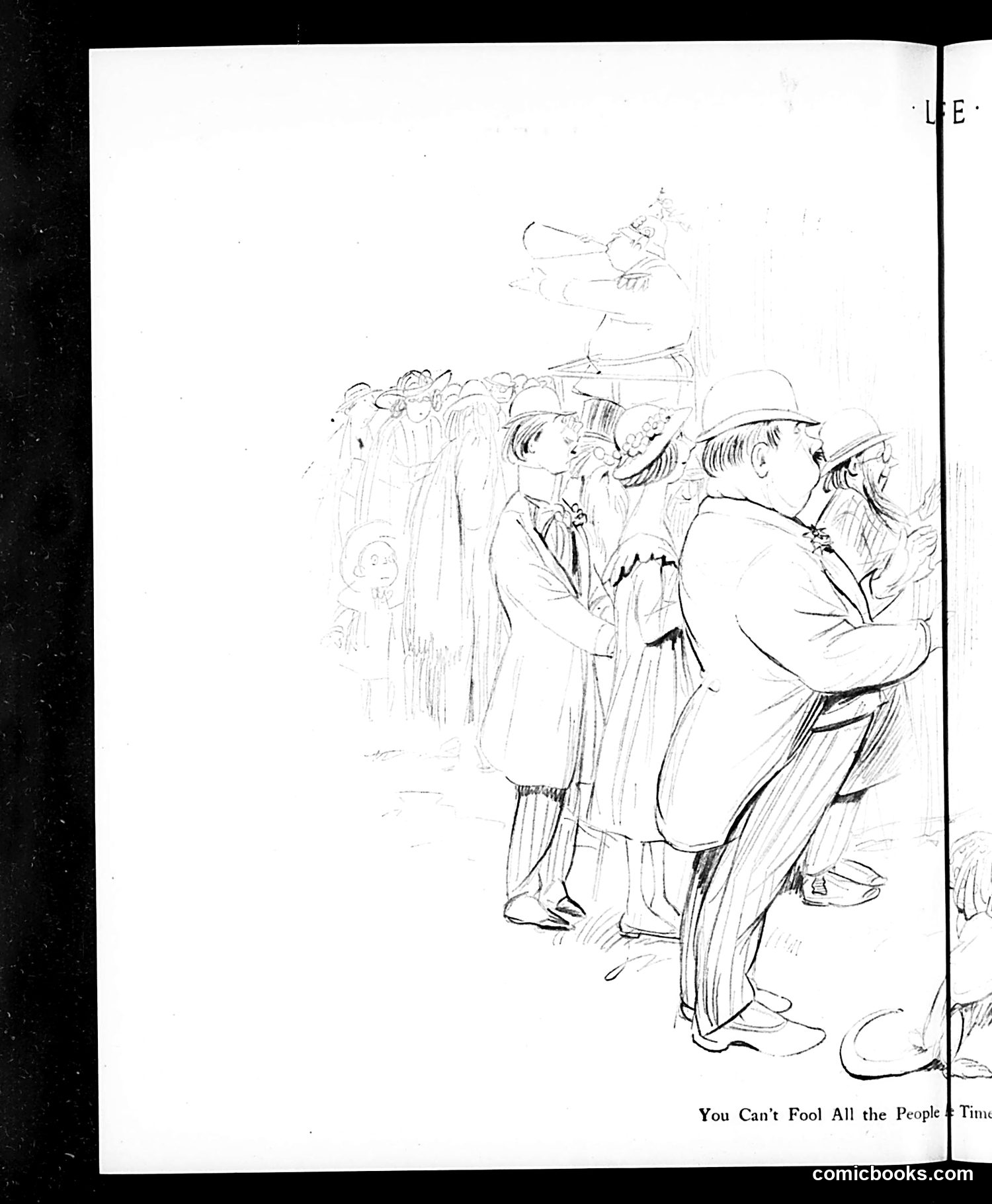
This sketch illustrates the caption "You Can't Fool All the People All the Time." The cartoon depicts several men in early 20th-century dress (suits and bowler hats) gathered around what appears to be a speaker or performer on an elevated platform. The drawing style suggests political satire about deception and public persuasion. The composition implies skepticism about propaganda or misleading rhetoric—showing an audience that may be partially convinced but not entirely taken in by whatever message is being delivered. The quotation itself is a famous Abraham Lincoln phrase about the limits of deception, suggesting this cartoon critiques politicians or public figures attempting to manipulate public opinion through false claims or misleading statements. The specific political context remains unclear without additional publication information.
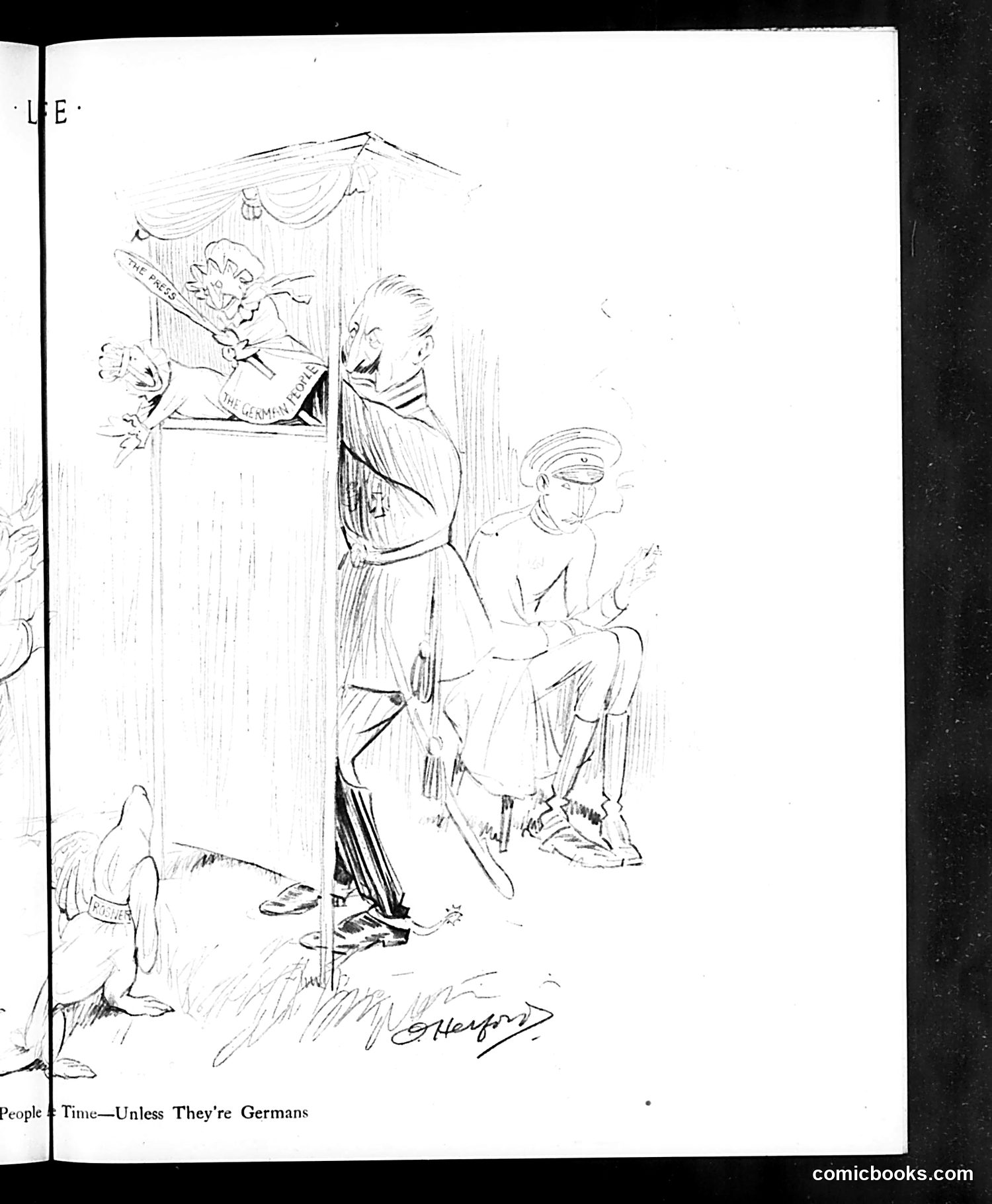
This cartoon's caption reads "People Time—Unless They're Germans," suggesting anti-German sentiment. The sketch shows a military or authority figure (center) displaying what appears to be a caricatured German face in a window or frame to a young uniformed soldier. The exaggerated facial features suggest ethnic stereotyping common to wartime propaganda. The cartoon likely dates from World War I or II era, when Life magazine frequently published satirical content mocking enemy nations. The joke appears to contrast "civilized" treatment of time/punctuality with Germans as exceptions—reinforcing dehumanizing propaganda stereotypes typical of the period. The young soldier's presence suggests targeting military or youth audiences with nationalist messaging.
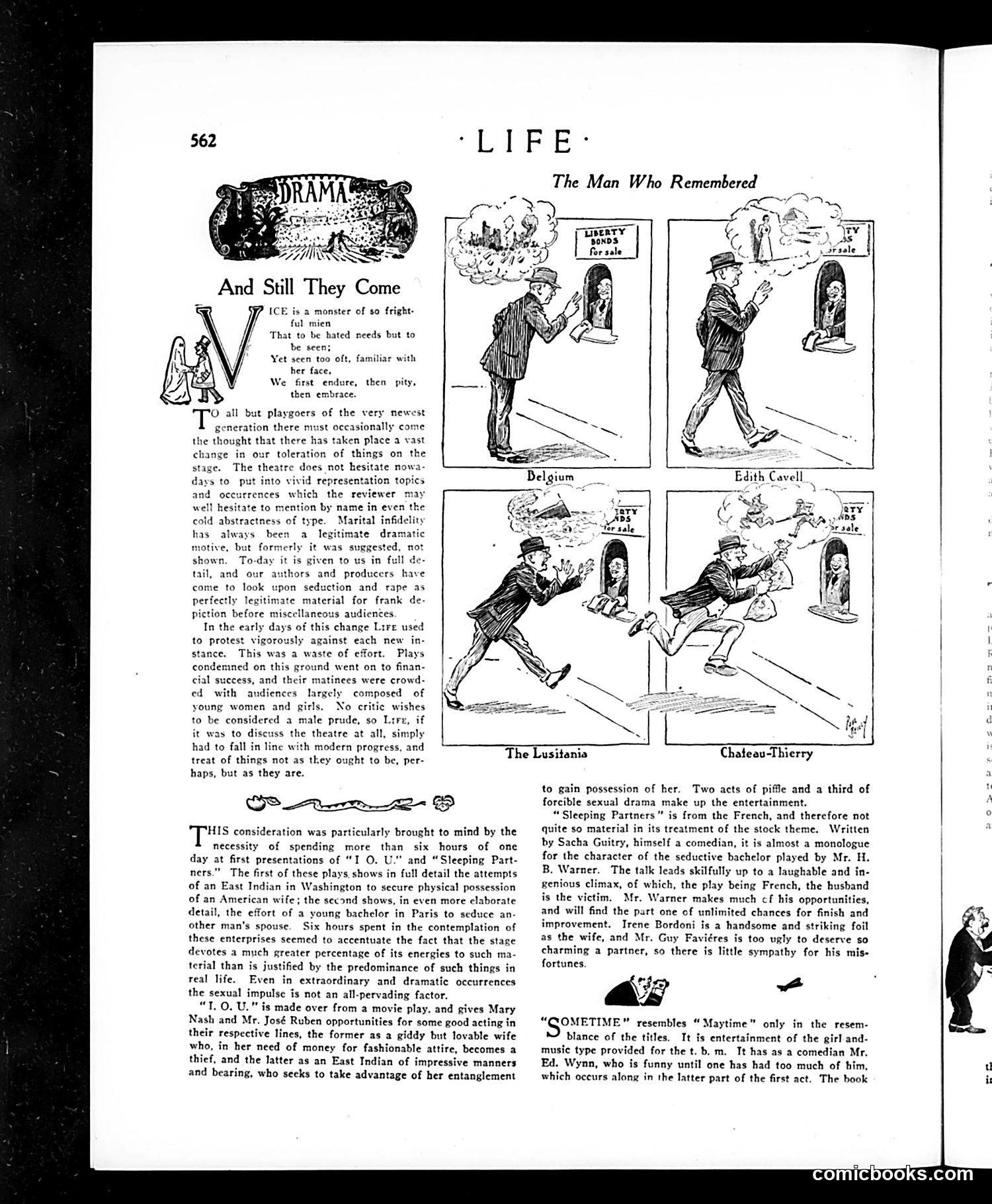
This page critiques contemporary Broadway plays, particularly those depicting sexual content and marital infidelity. The four cartoon panels titled "The Man Who Remembered" appear to satirize the commercialization of patriotic imagery during wartime—figures hawking "Liberty Bonds" and religious icons labeled "for sale," suggesting profit-driven exploitation of national sentiment. The main text reviews plays like "I.O.U." and "Sleeping Partners," which depict seduction and sexual drama. The author argues theaters have gradually normalized explicit content (referencing the progression from suggesting to openly showing adultery), noting that despite critics' protests, audiences—particularly young women—filled matinees of condemned plays. The cartoons likely reference WWI-era Liberty Bond campaigns, with the "remembered" figure selling patriotic symbols. This adds ironic commentary: just as theaters exploit sexual themes for profit, wartime marketing exploits patriotism. The titles reference recognizable figures like Edith Cavell (executed nurse) and actual battles (Lusitania, Château-Thierry), though specific identities of the cartoon figures remain unclear.
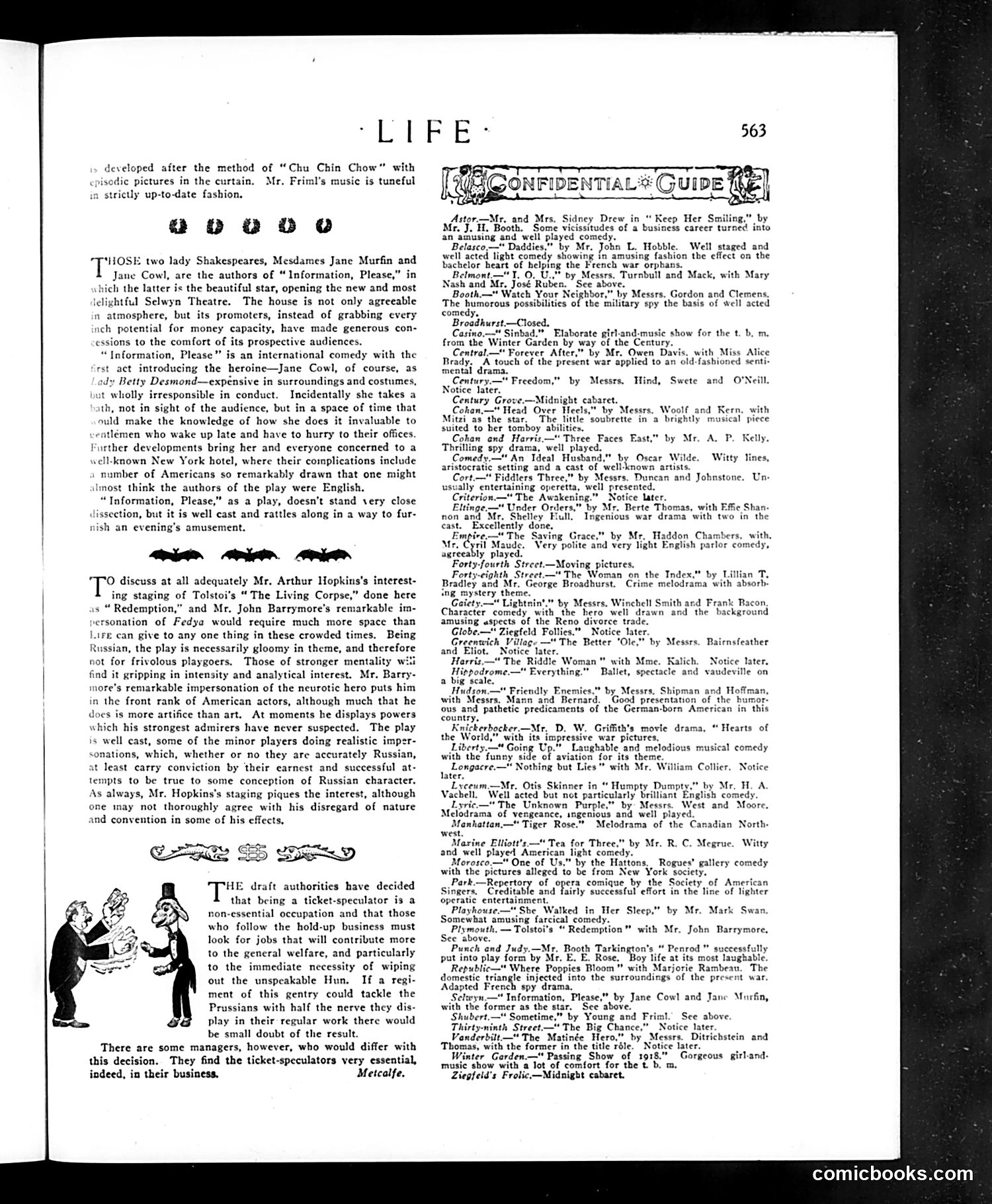
This page from Life magazine (circa 1918, based on WWI references) contains theater reviews and a political cartoon by Metcalfe about ticket speculation. **The Cartoon:** Metcalfe's illustration depicts a ticket scalper—a figure engaged in illegal resale of theater tickets at inflated prices. The cartoon satirizes the U.S. draft authorities' decision to reclassify ticket speculators as "non-essential" workers, forcing them into military service. The accompanying text ironically suggests that if these men applied their nerve and cunning to fighting Germans ("the unspeakable Hun"), they'd be valuable soldiers. However, some theater managers disagreed with this classification, considering scalpers essential to their profits. **The Context:** During WWI, labor was redirected toward the war effort. The cartoon mocks both the speculators' dubious business practices and the irony that the government was drafting them while some business interests found them economically useful.
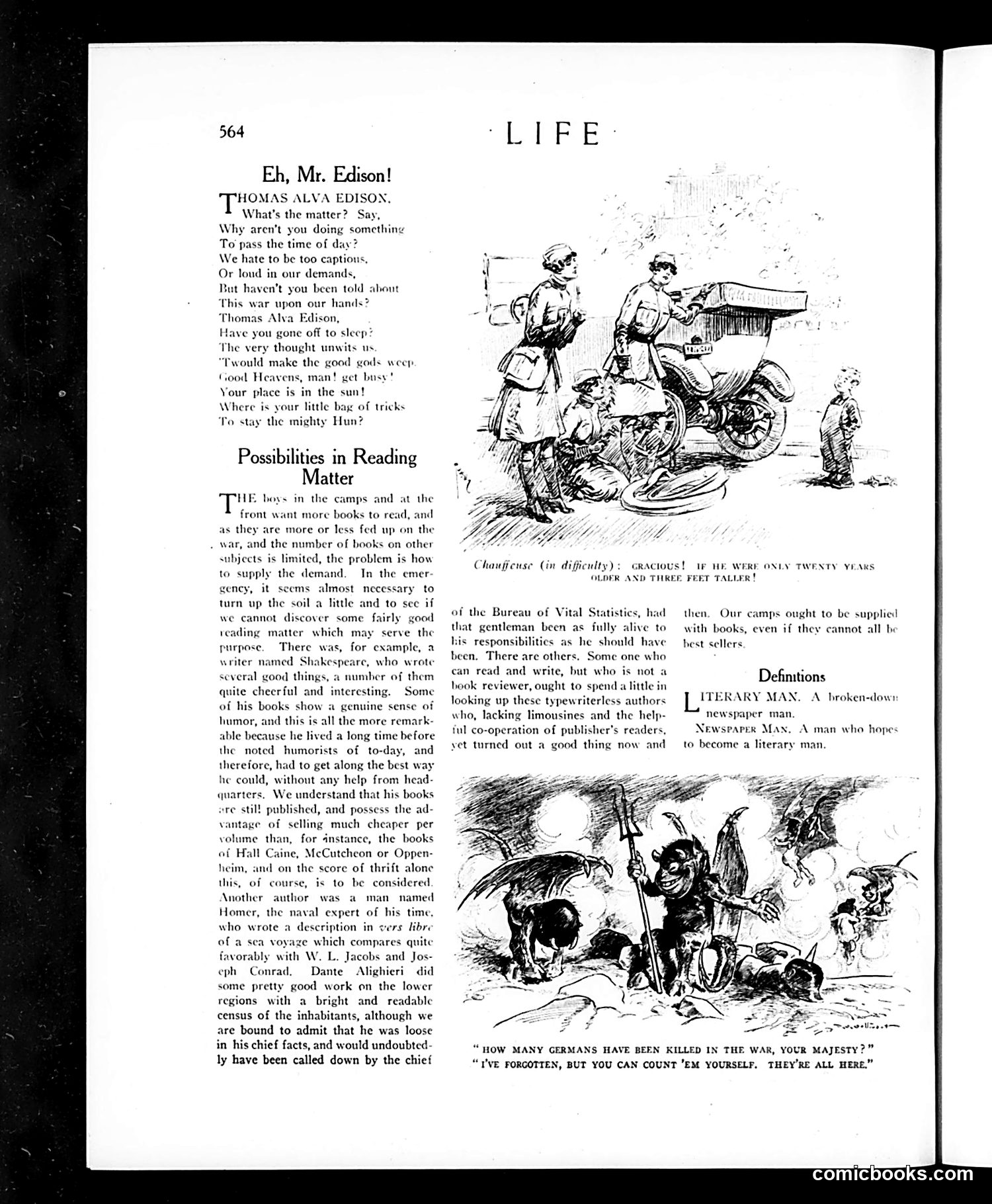
**Top Cartoon ("Eh, Mr. Edison!")**: A satirical jab at inventor Thomas Alva Edison during World War I, accusing him of inactivity. The poem mockingly demands Edison contribute his "bag of tricks" (inventions) to fight "the mighty Hun" (Germans). This reflects wartime pressure on prominent Americans to support the war effort—Edison was expected to use his genius for military innovation rather than sitting idle. **Bottom Cartoon**: A darkly cynical war joke. A military figure claims to have forgotten how many Germans were killed, then gestures to a pile of corpses, saying "count 'em yourself—they're all here." This satirizes the horrifying scale of WWI casualties and the callous indifference of military leadership to human death—they've killed so many soldiers the actual numbers become meaningless. Both cartoons critique American responses to WWI: one demanding more contributions, the other condemning the war's brutal toll.
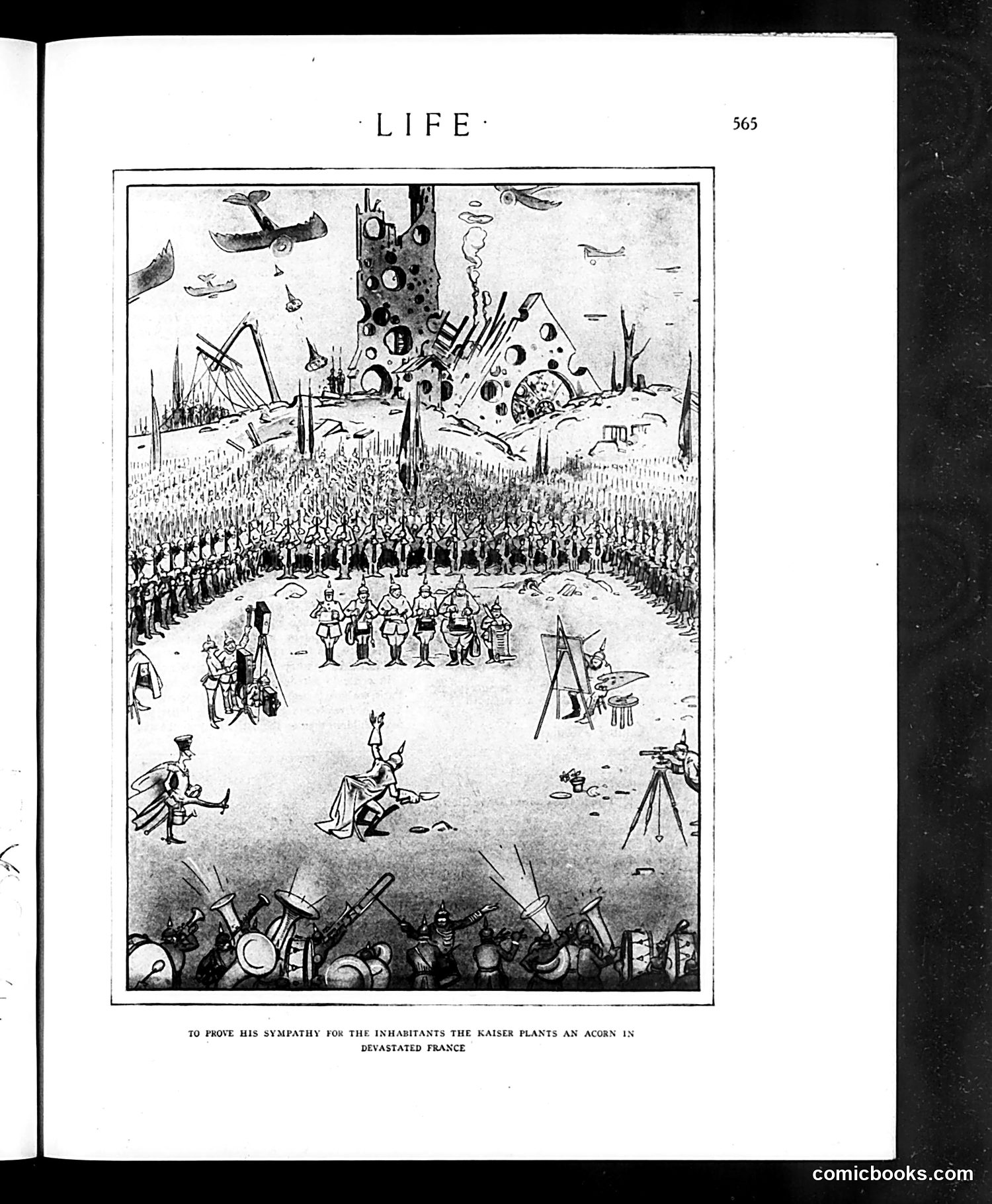
This is a satirical cartoon mocking Kaiser Wilhelm II of Germany during World War I. The caption's irony is the key: the Kaiser "plants an acorn" (a trivial, meaningless gesture) to demonstrate sympathy for French civilians whose land has been devastated by German warfare. The illustration depicts a surreal, apocalyptic landscape of destroyed France—with ruined buildings, strange alien-like structures, and flying objects overhead. Crowds of French inhabitants watch as the Kaiser performs this absurdly inadequate symbolic act. The satire is biting: the cartoon suggests the Kaiser's gesture is worthless compared to the massive destruction Germany inflicted. Planting one acorn cannot possibly compensate for or demonstrate genuine concern about widespread devastation. It's a critique of performative sympathy and the inadequacy of token gestures in response to war crimes.
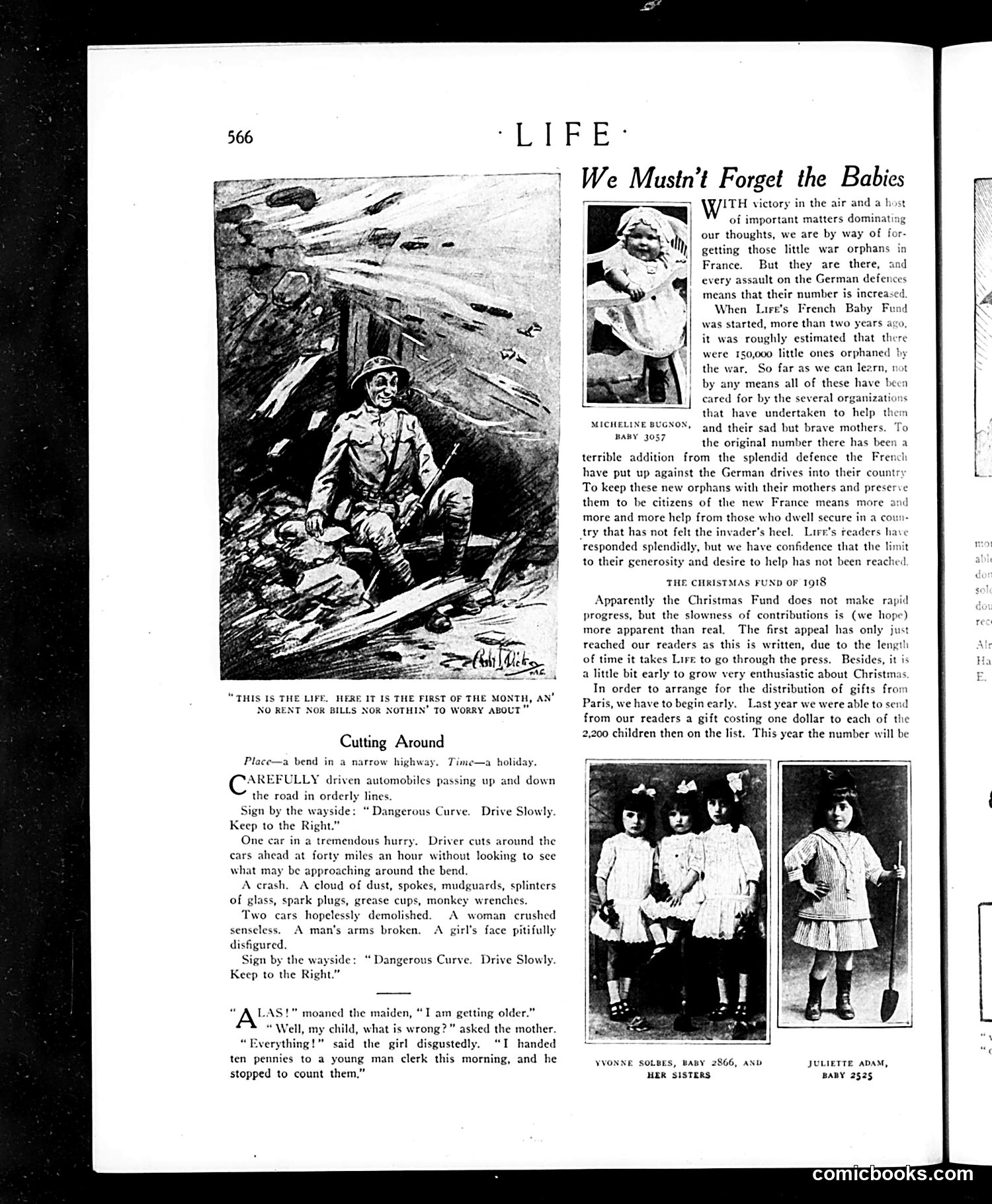
This page contains three distinct pieces of content: **"Cutting Around"** is a cautionary tale about reckless driving. It depicts a car speeding around a dangerous curve despite warning signs, resulting in a crash that injures or kills occupants of other vehicles. The narrative emphasizes the consequences of ignoring safety warnings—a timely message during the automobile era when traffic safety was an emerging concern. **"We Mustn't Forget the Babies"** is a fundraising appeal for French war orphans. Written during WWI (references to "German defences" and "defence the French have put up"), it notes that an estimated 150,000 French children were orphaned by the war, with numbers continuing to rise. The piece urges Life's readers to contribute to the Christmas Fund to support these children and their mothers, emphasizing that American readers in a secure country have a moral obligation to help. Photos show named French orphans (Micheline Bugnon, Yvonne Solbes, Juliette Adam) to personalize the appeal. The page reflects early-20th-century concerns: automobile safety and wartime humanitarian aid.
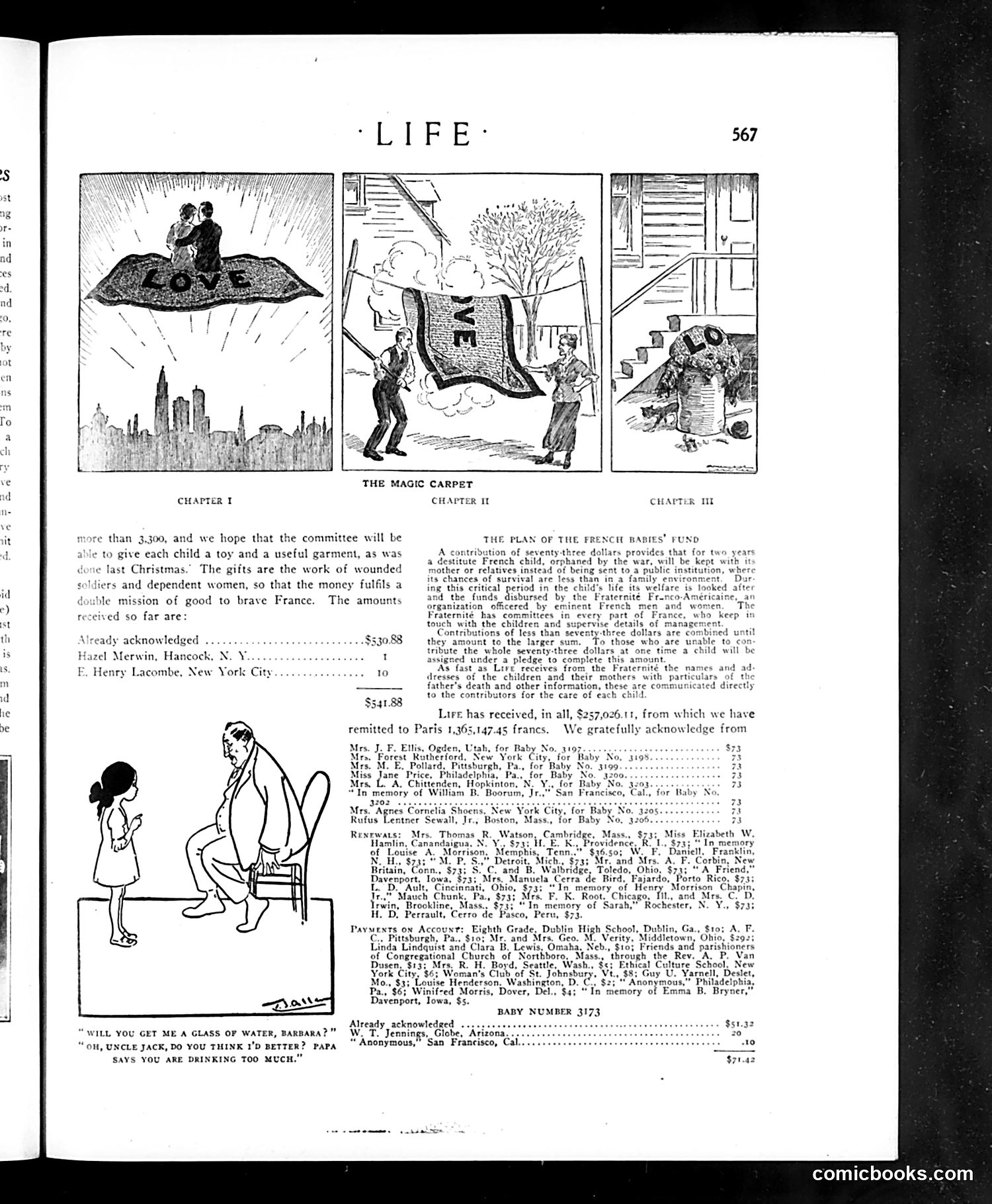
This page combines fundraising announcements for French war relief with satirical cartoons. The three-panel "Magic Carpet" sequence (Chapters I-III) depicts an imaginative child's fantasy: children ride a magical carpet above a city skyline, then the carpet transforms into a large banner labeled "ME," with adults attempting to catch it, before landing at a house with a "LO" sign. The cartoon likely satirizes childhood imagination and desires, possibly commenting on self-centeredness or the gap between children's fantasies and reality. The accompanying text details the "French Babies' Fund"—a charitable initiative providing support for French war orphans during or after World War I. The page lists donors and amounts contributed (typically $73 per child), documenting how contributions funded two years of care for orphaned children placed with families rather than institutions. The bottom cartoon shows a domestic scene with the caption "Will you get me a glass of water, Barbara?" and "Oh, Uncle Jack, do you think I'd better? Papa says you are drinking too much"—humor at an adult's expense regarding alcohol consumption during Prohibition era.
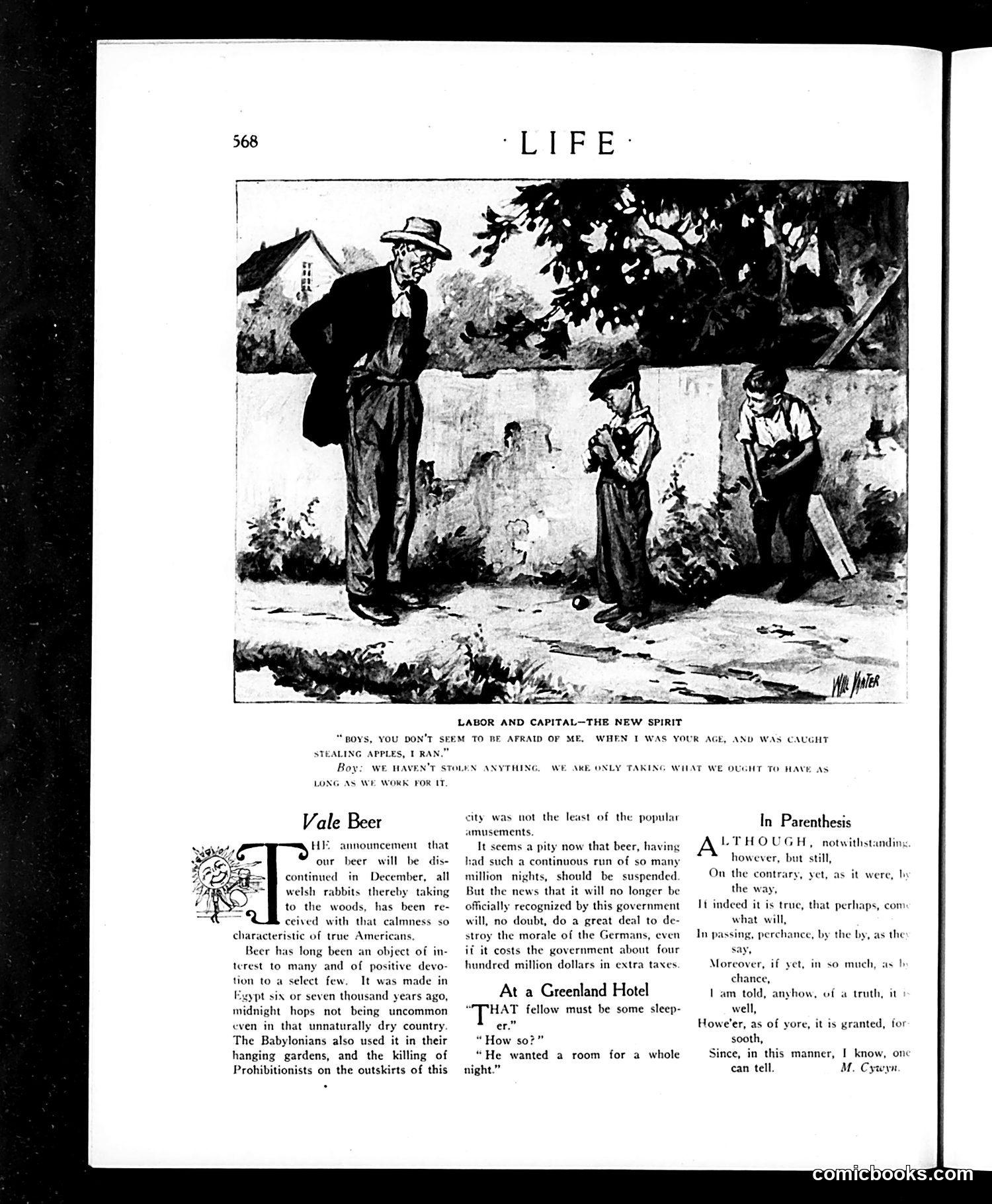
This cartoon satirizes changing class relations during Prohibition era America. An adult man (representing Capital/authority) confronts three working-class boys (representing Labor) who've been caught stealing apples. The irony is sharp: the man admits *he* stole apples as a youth without consequence, yet now threatens these boys. Their response—"we haven't stolen anything, we are only taking what we ought to have as long as we work for it"—represents labor's new assertiveness about fair compensation and rights. The cartoon's title suggests this represents a "new spirit" in labor-capital relations: workers now openly claim entitlement to fair wages rather than accepting crumbs. The juxtaposition of the man's hypocrisy against the boys' principled stand mocks outdated authority and suggests growing worker consciousness and demands for equity during the post-WWI period.
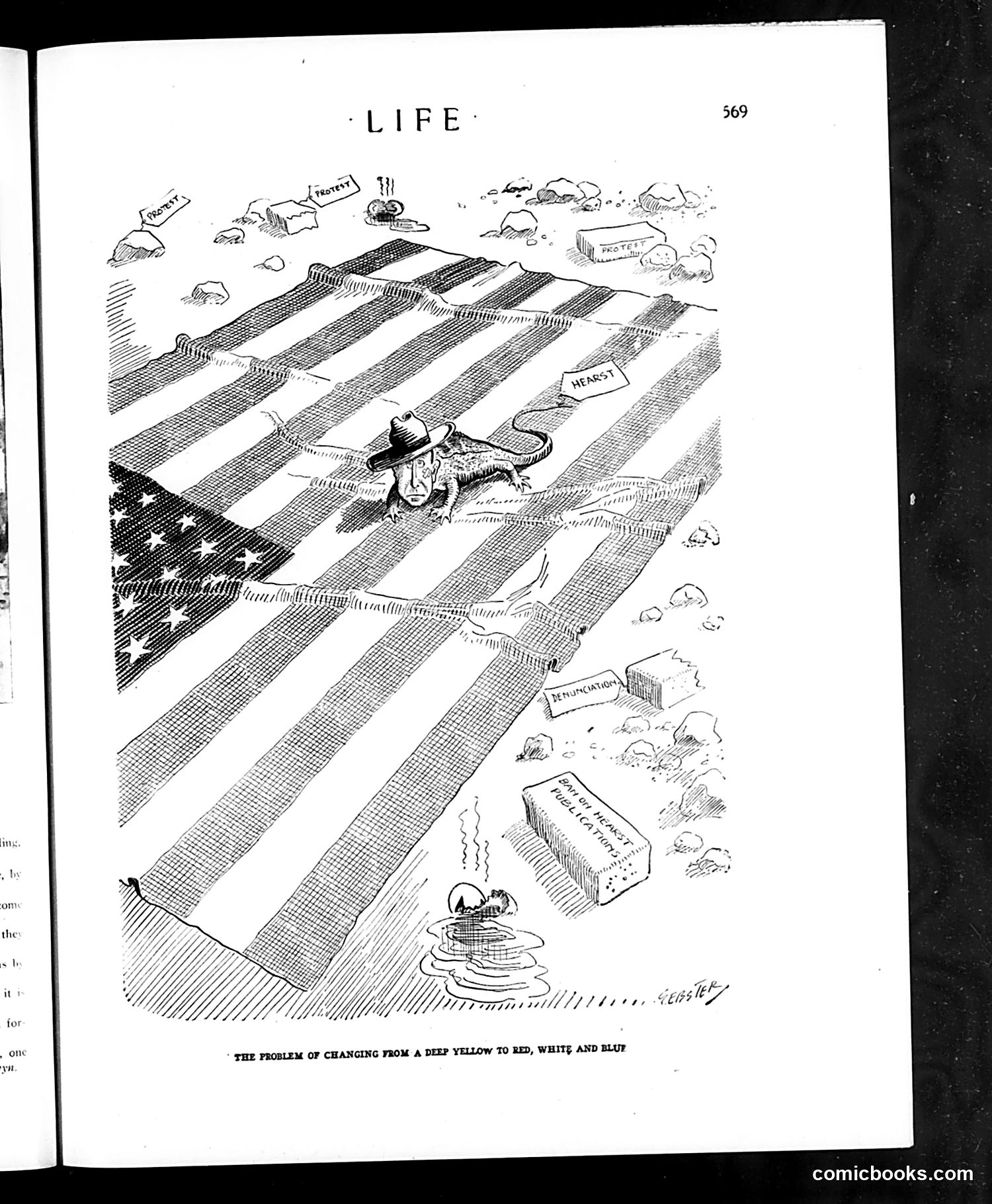
This cartoon satirizes a figure (depicted as a lizard or chameleon wearing a hat) attempting to change colors from "deep yellow" to "red, white and blue"—a metaphor for shifting political allegiances or ideology. The creature navigates a challenging landscape of labeled obstacles including "Hearst," "Demoralization," and "Manipulation," suggesting the difficulties of political transformation or conversion. The yellow-to-patriotic-colors transition likely references someone abandoning one political position (yellow possibly implying cowardice or a specific political faction) to adopt American patriotic credentials. The chameleon imagery emphasizes opportunism and insincerity in political realignment. Without the publication date, the specific figure and historical context remain unclear, though this appears to mock political hypocrisy or calculated reinvention during a period of significant ideological conflict.
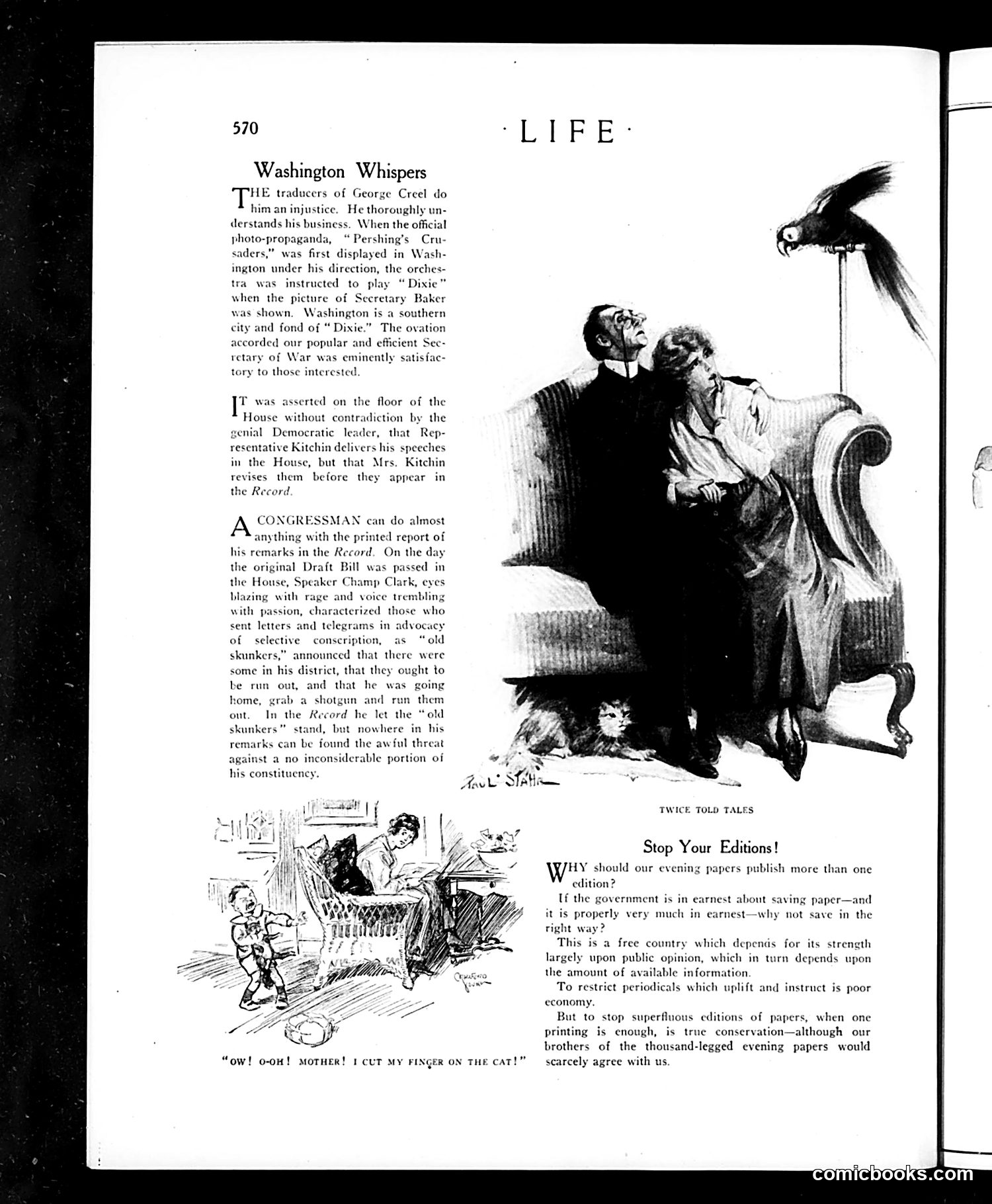
This page contains three satirical pieces about American government during World War I: **"Washington Whispers"** mocks George Creel (head of wartime propaganda) for orchestrating emotional responses to the film "Pershing's Crusaders" by having orchestras play "Dixie" when Secretary of War Baker appeared onscreen. The second item ridicules Representative Kitchin, suggesting his wife edits his speeches before they're published in the Congressional Record—implying he says things he shouldn't. The third criticizes Speaker Champ Clark, claiming he made inflammatory threats (grabbing a shotgun to run out "old skunkers" opposing selective conscription) during a House speech, but these remarks mysteriously disappeared from the official Record. This exposes how congressmen could alter their recorded statements. **"Stop Your Editions"** argues against newspaper chains publishing multiple daily editions, framing it as paper conservation—though the cartoons suggest the real issue is chaos and unnecessary duplication. The page satirizes government propaganda, congressional dishonesty, and media excess during wartime.

This is a **product advertisement, not satire or political commentary**—a full-page ad for Resinol Soap from Life magazine (page 571). The image shows two women in an elegantly furnished bedroom: one seated at a vanity, the other standing behind her, apparently applying soap or cosmetics. The art deco styling and intimate domestic scene were typical advertising aesthetics of the early 20th century, emphasizing luxury and personal care. The ad's pitch centers on soap as a medical-grade product ("compounded as carefully as any medicine"), claiming it clears pores and improves complexion without harsh chemicals. It promises users can be "proud of your complexion"—tapping into vanity and social status concerns of the era. The mention of "Resinol Shaving Stick" at bottom indicates the brand marketed to both men and women, unusual for cosmetics advertising at the time.
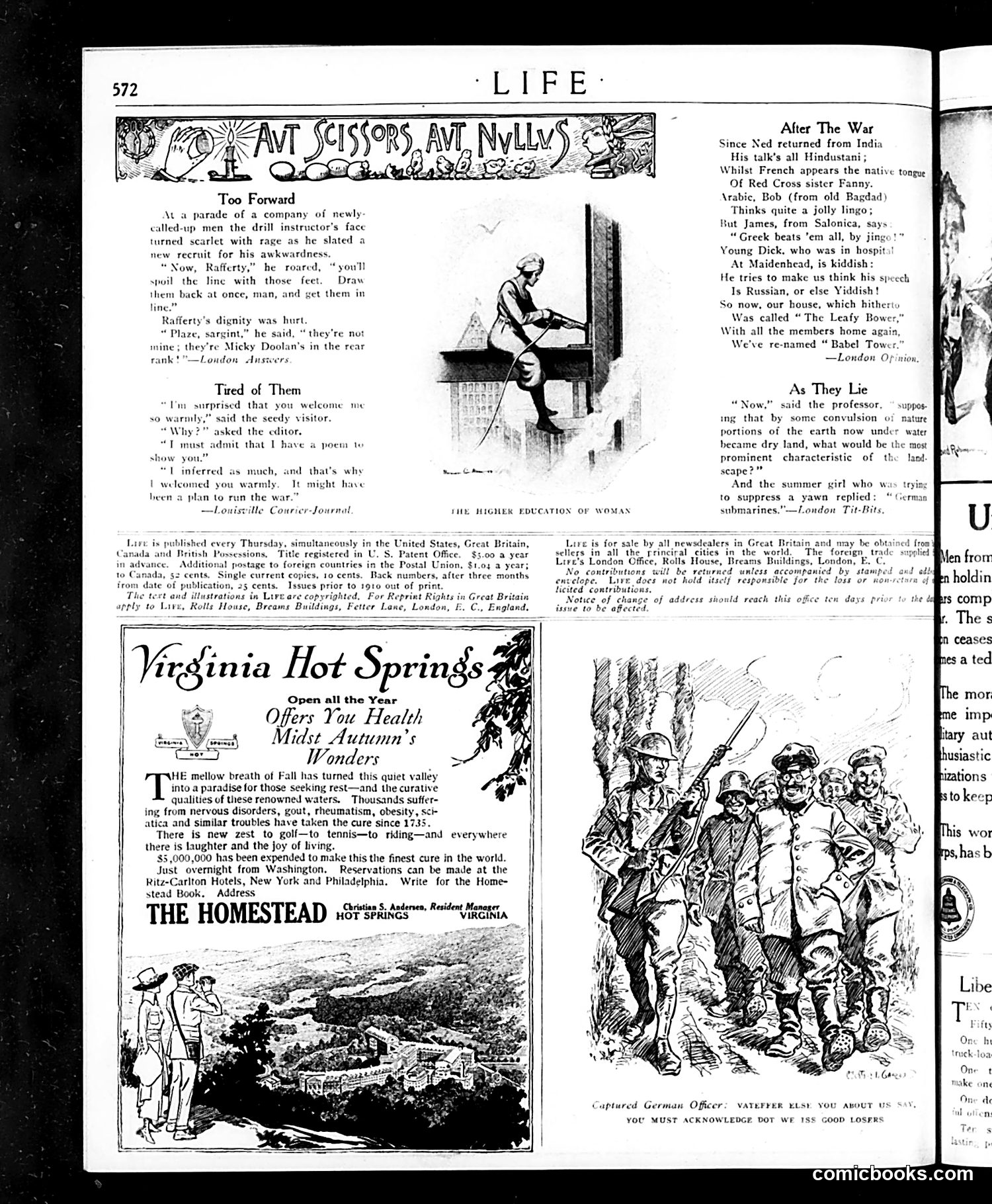
This page contains several short satirical pieces typical of Life's post-WWI humor: **"Too Forward"** mocks Irish military recruits, playing on the stereotype of Irish soldiers named "Rafferty" and "Micky Doolan" who struggle with drill commands—standard ethnic humor of the era. **"Tired of Them"** jokes about an editor welcoming a visitor, then revealing he'd warned the man away to avoid hearing about the war—reflecting widespread exhaustion with war talk upon soldiers' return. **"After the War"** satirizes returning servicemen who adopt foreign languages/accents from their postings (India, France, the Balkans), creating a "Babel Tower" of linguistic affectation in their household. **"As They Lie"** presents a professor asking what would dominate Earth if underwater land surfaced; a flippant girl answers "submarines"—mocking both pedantic education and women's supposed superficiality. The page also contains a Virginia Hot Springs resort advertisement and illustrations. The overall tone reflects 1920s Life magazine's mix of gentle social satire and commercial content.
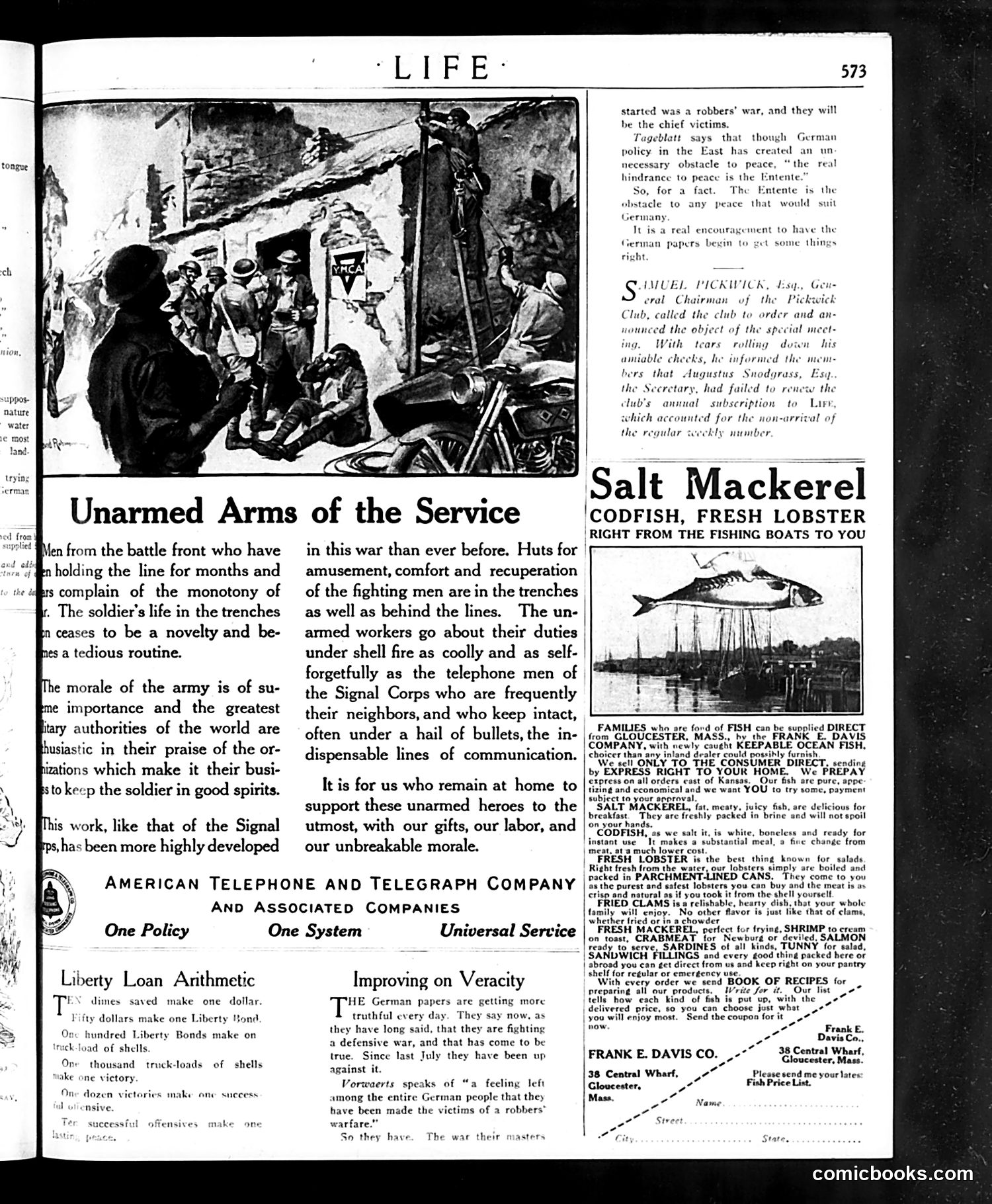
This page's main cartoon illustrates a WWI-era article praising non-combat workers—specifically Signal Corps telephone operators—who maintain communication lines under fire. The article argues these "unarmed" workers are heroic, performing dangerous duties as courageously as frontline soldiers. The accompanying text includes German newspaper quotes (appearing to mock German claims of fighting a "defensive war" and being "victims of robbers' warfare"). Life's editors sarcastically suggest Germans are finally becoming truthful by admitting they've been "fighting defensively" since July—implying they're actually the aggressors. A separate item mocks the *Pickwick Club* for missing their *Life* magazine subscription, treating this as absurdly tragic. The page also contains extensive advertising for fresh fish, unrelated to the editorial content—typical of 1910s magazine layouts mixing editorial and commercial material.
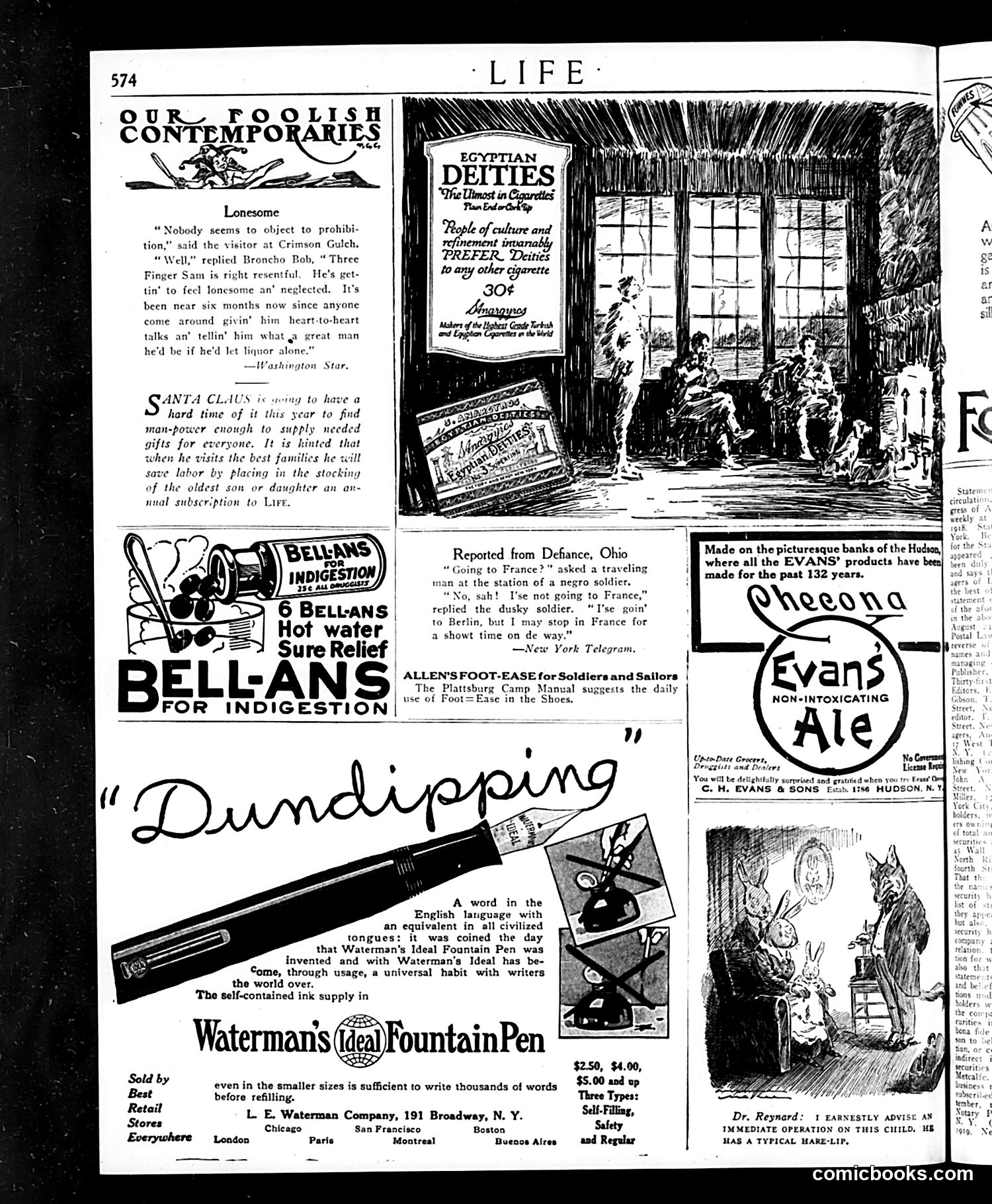
This page mixes humor with advertisements from circa WWI era. The main content includes: **"Lonesome"** — A brief joke about Prohibition's effects, where a neglected outlaw misses visitors who previously tried to reform him through temperance lectures. **Santa Claus item** — A tongue-in-cheek suggestion that Life magazine subscriptions make ideal gifts for wealthy families' eldest children, implying subscription costs rival luxury items. **"Reported from Defiance, Ohio"** — A racial stereotype joke about a Black soldier, playing on dialect humor common to the period. The soldier jokes about avoiding France but potentially stopping in Berlin—the reference to WWI military movements. **Advertisements** dominate the lower portion: Bellans indigestion remedy, Waterman's Ideal Fountain Pen, Evans Ale, and Allen's Foot-Ease for soldiers. The medical illustration at bottom appears to advertise corrective surgery for cleft palate ("hare-lip"), using period medical terminology. The page reflects early 20th-century advertising aesthetics and attitudes, including casual racial caricature now considered offensive.
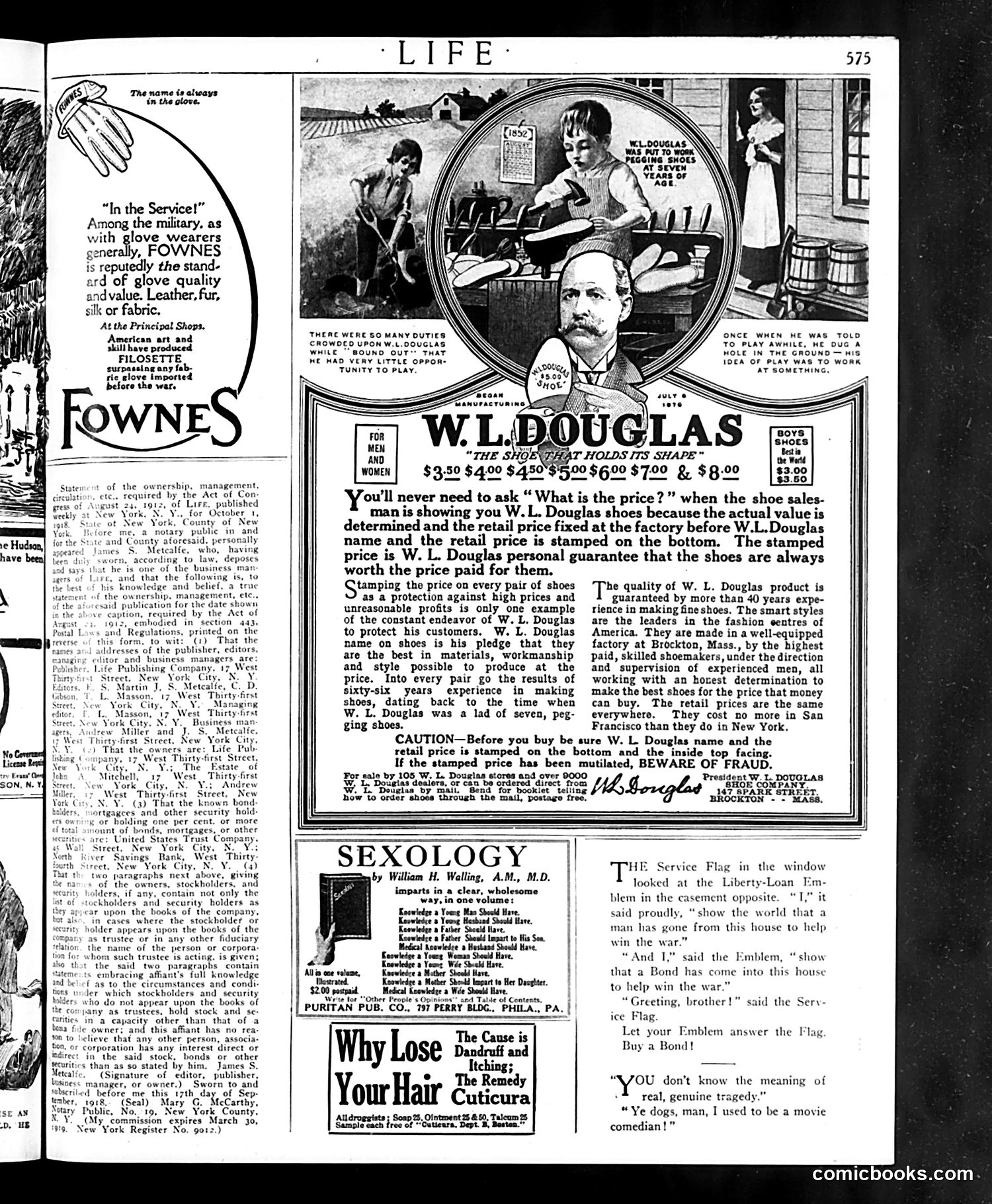
This page is primarily **advertising and editorial content**, not political satire. The dominant feature is a large **W.L. Douglas shoe advertisement** emphasizing that the retail price is stamped on the bottom—a consumer protection guarantee against markup fraud and "unreasonable profits." This suggests early 20th-century concerns about price transparency. There's a smaller **Fownes gloves advertisement** on the left, and at the bottom, ads for a sexology book, an anti-dandruff remedy (Cuticura), and a Liberty Loan Bond appeal with a brief patriotic dialogue about service flags. The **Service Flag illustration** references WWI—flags displayed to indicate household members in military service. The overall tone reflects wartime patriotic messaging rather than satire.
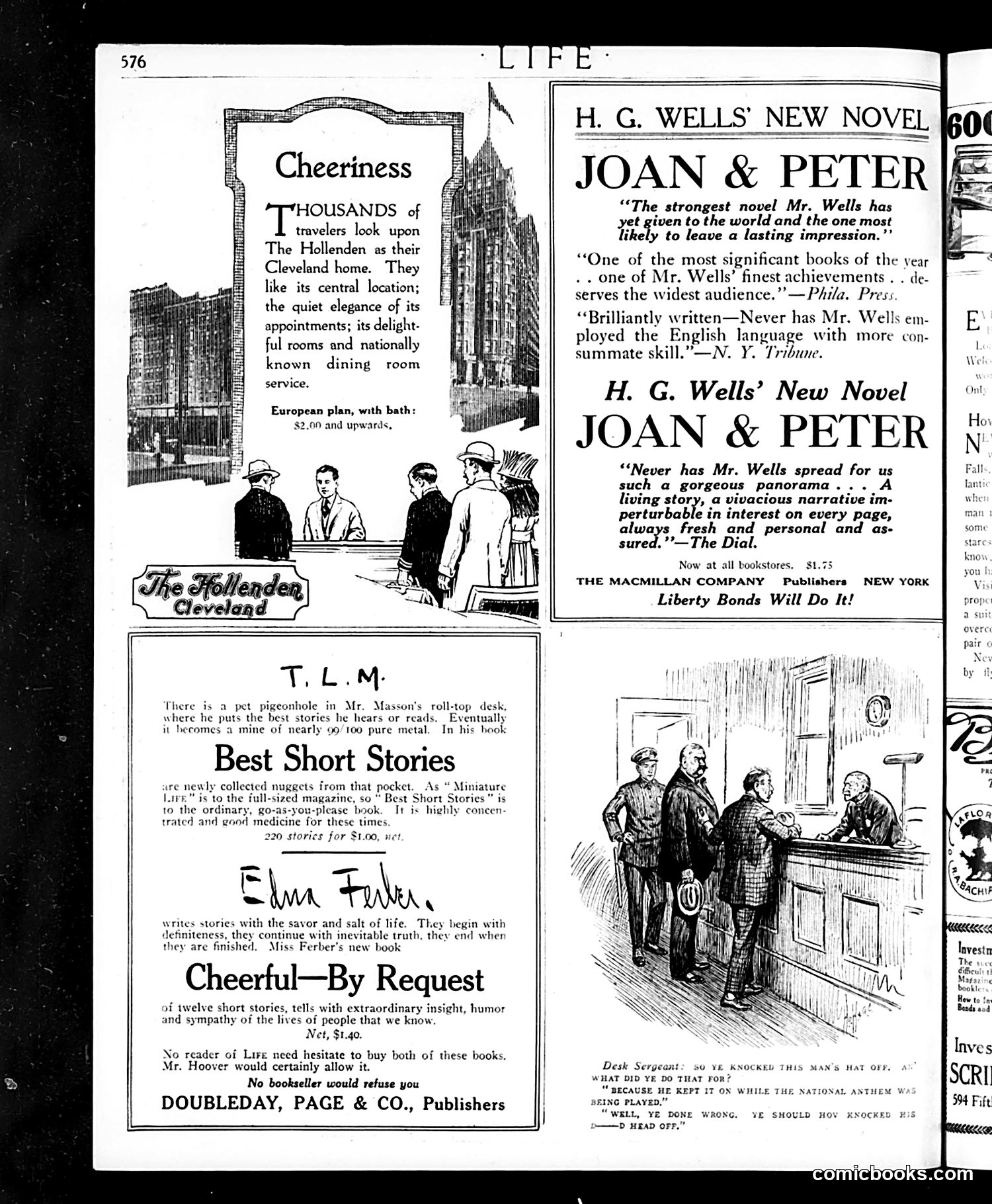
This is primarily a **book advertisement page** from Life magazine, likely from World War I era (suggested by the "Liberty Bonds Will Do It!" phrase and reference to Mr. Hoover). The page features ads for three books: H.G. Wells' novel *Joan & Peter*, T.L.M.'s *Best Short Stories*, and Edna Ferber's *Cheerful—By Request*, plus a hotel advertisement for the Hollenden in Cleveland. The only cartoon is a small sketch at bottom right: a desk sergeant and civilians in what appears to be a police station. The joke concerns patriotic etiquette—a man kept his hat on during the national anthem, and the sergeant knocked it off as punishment. The humor comes from the sergeant's exaggerated sense of propriety regarding patriotic conduct during wartime, when such displays of respect were heavily emphasized. The page otherwise consists of book advertisements and publisher endorsements, typical of Life's commercial content.
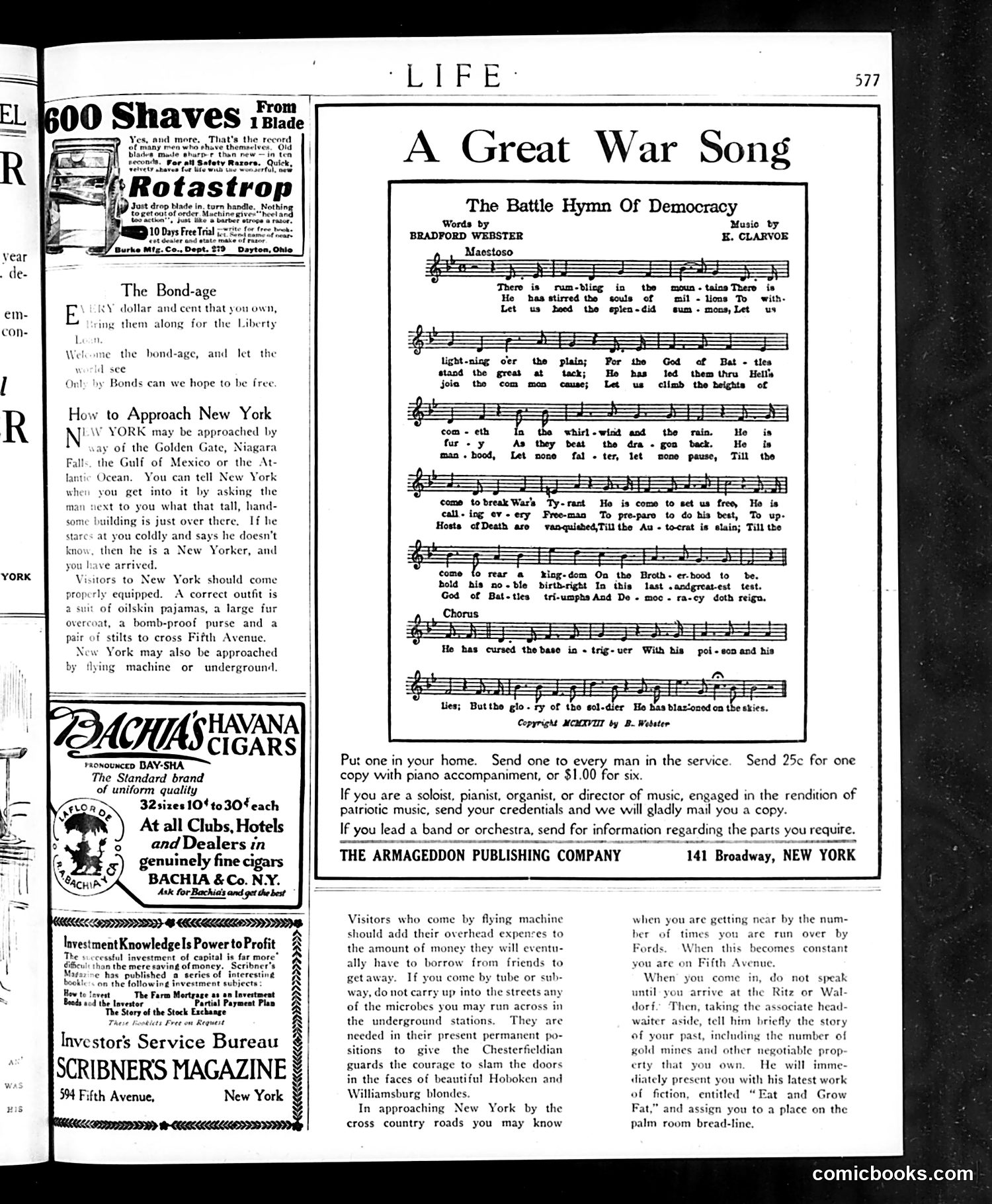
This page primarily features a patriotic war song titled "The Battle Hymn of Democracy," with words by Bradford Webster and music by E. Clavoe. The sheet music occupies the center and right portion of the page. The song's lyrics reference World War I themes: it invokes democracy, calls citizens to arms against tyranny ("the Au-tocrat"), and uses religious language ("God of Battles") to sanctify the war effort. Phrases like "come to break War's Ty-rant" and "till De-moc-ra-cy doth reign" position the conflict as a struggle for democratic values. The page encourages distribution: "Put one in your home. Send one to every man in the service." The surrounding content includes advertisements (Rotastro razors, Bachia cigars) and practical guides about visiting New York, which seem incongruous with the patriotic messaging—likely reflecting how Life magazine mixed satire, commerce, and propaganda during the WWI period. This represents American wartime mobilization efforts using popular song and mass distribution to maintain public support.
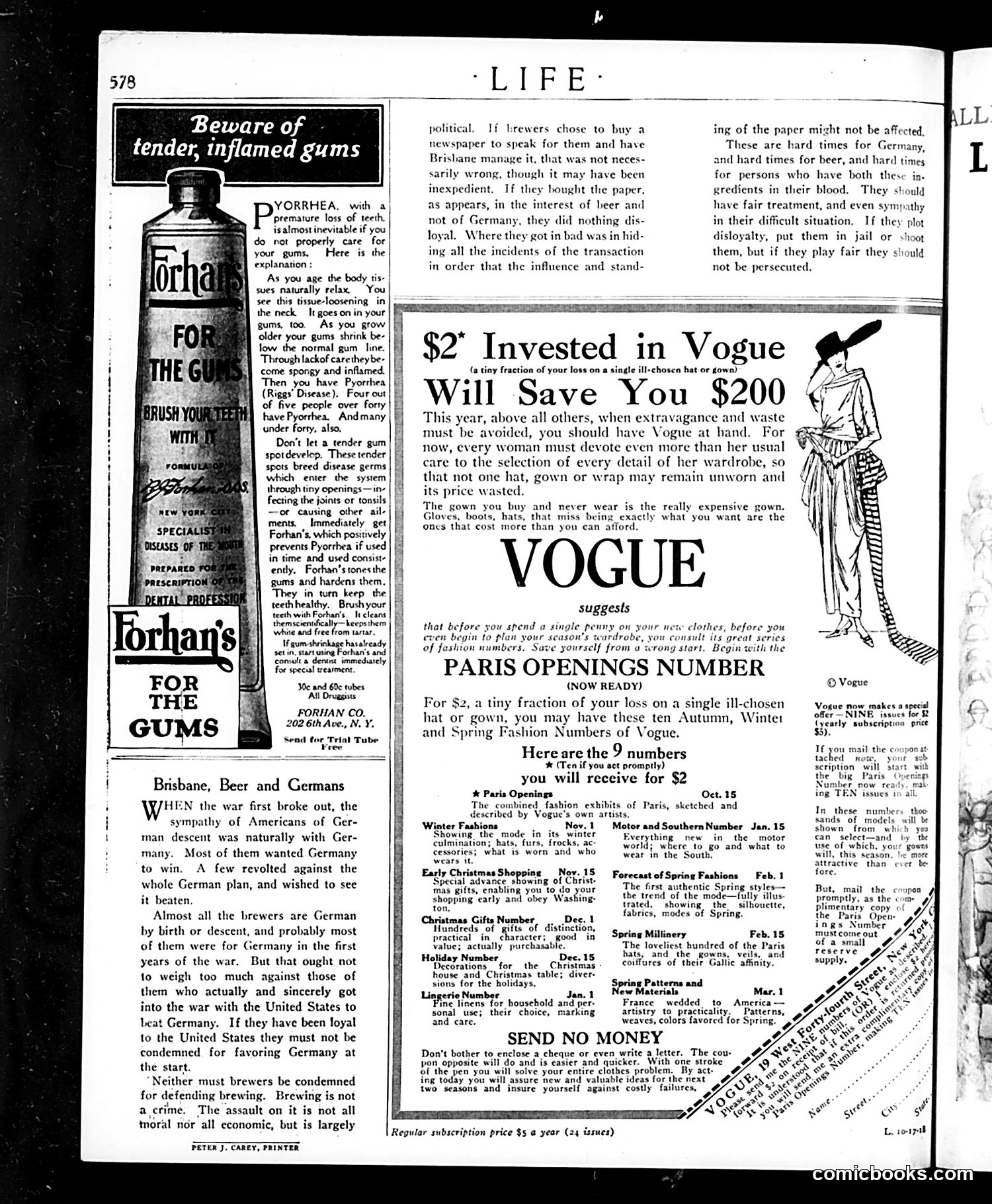
This page contains two distinct elements: political commentary and fashion advertising. **The Political Article** ("Brisbane, Beer and Germans") defends German-American brewers who initially sympathized with Germany during WWI but later supported the United States. The author argues they shouldn't be condemned for their initial stance—only for *hiding* their pro-Germany activities. The piece suggests some brewers bought newspapers to promote beer interests (likely referencing William Randolph Hearst or similar figures) while concealing their true influence. This reflects post-WWI American tensions around German-American loyalty and the eventual Prohibition movement targeting brewers. **The Advertisements** include Forhan's toothpaste (emphasizing dental health as you age) and a Vogue magazine subscription pitch promoting fashion economy during wartime—suggesting women carefully plan wardrobes rather than waste money on ill-chosen garments. The juxtaposition reflects Life's satirical nature: serious political discussion alongside consumer culture messaging.