
Life, 1918-10-17 · page 24 of 38
Life — October 17, 1918 — page 24: what you’re looking at
What you’re looking at
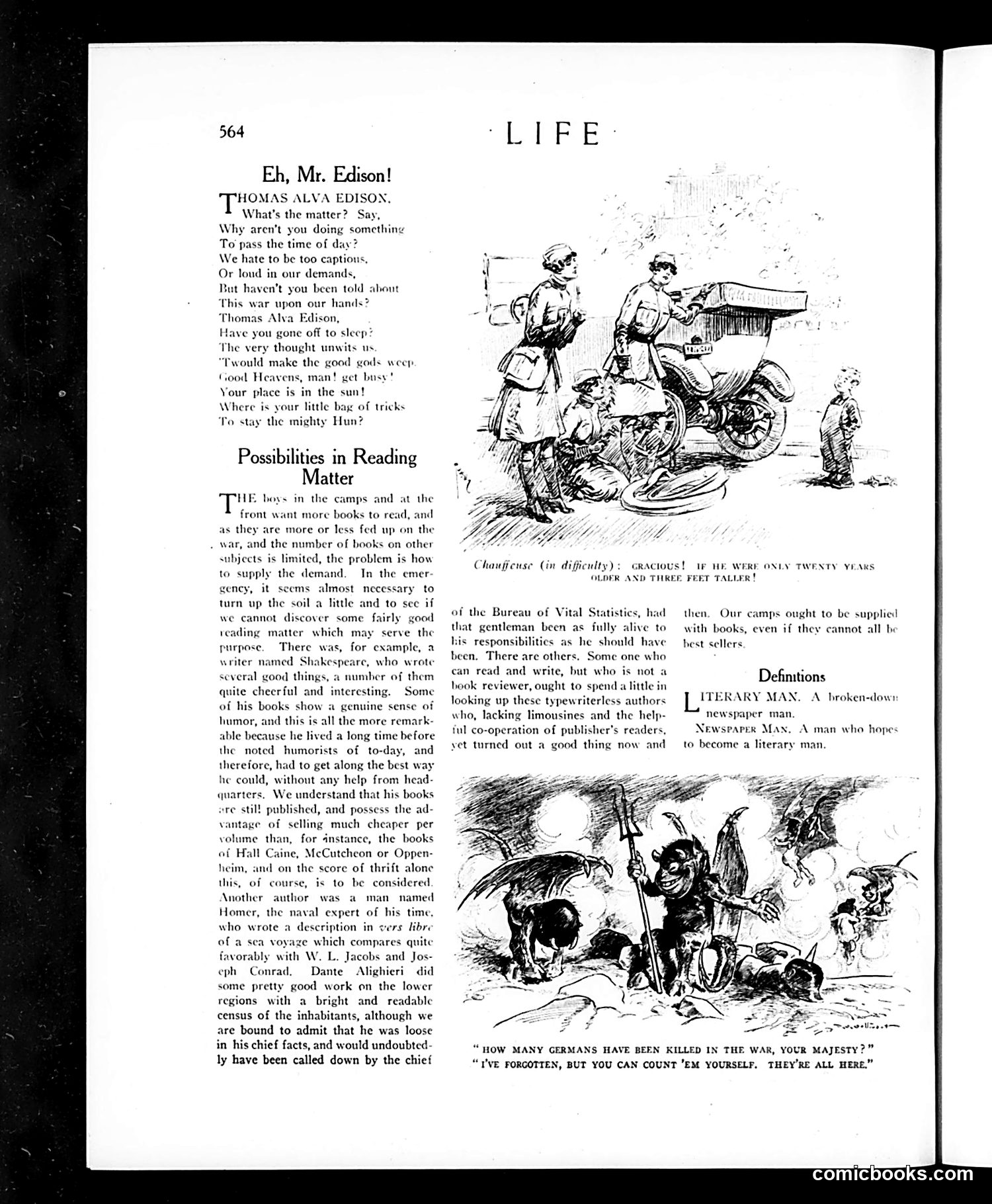
**Top Cartoon ("Eh, Mr. Edison!")**: A satirical jab at inventor Thomas Alva Edison during World War I, accusing him of inactivity. The poem mockingly demands Edison contribute his "bag of tricks" (inventions) to fight "the mighty Hun" (Germans). This reflects wartime pressure on prominent Americans to support the war effort—Edison was expected to use his genius for military innovation rather than sitting idle. **Bottom Cartoon**: A darkly cynical war joke. A military figure claims to have forgotten how many Germans were killed, then gestures to a pile of corpses, saying "count 'em yourself—they're all here." This satirizes the horrifying scale of WWI casualties and the callous indifference of military leadership to human death—they've killed so many soldiers the actual numbers become meaningless. Both cartoons critique American responses to WWI: one demanding more contributions, the other condemning the war's brutal toll.
📄 Transcribed text from this page (OCR, searchable)
Machine-transcribed from the original scan — historical spelling and the odd misread are preserved.
Eh, Mr. Edison! HOMAS ALVA EDISON, What's the matter? Say, Why aren't you doing something To pass the time of day? We hate to be too captions, Or loud in our demands, But haven't you been told about This war upon our hands? Thomas Alva E Have you gone off to sleep? The very thought unwits us. “Twould make the good gods weep ood Hea Your place is in the sun! Where is your little bag of tricks To stay the mighty Hun? ison, ns, man! get busy! Possibilities in Reading Matter HE. boys in the camps and at the front want more books to read, and as they are more or less fed up on the . War, and the number of books on other subjects is limited, the problem is how to supply the demand, In the emer gency, it seems almost necessary to turn up the soil a little and to see if we cannot discover some fairly good veading matter which may serve the purpose. There was, for example, a writer named Shakespeare, who wrote several good things, a number of them quite cheerful and interesting. Some of his books show a genuine sense of humor, and this is all the more remark- able because he lived a long time before the noted humorists of to-day, and therefore, had to get along the best way he could, without any help from head- quarters, We understand that his books are stil! published, and possess the ad- vantage of selling much cheaper per volume than, for instance, the books of Hall Caine, McCutcheon or Oppen- heim, and on the score of thrift alone this, of to be considered Another author was a man named Homer, the naval expert of his time, who wrote a description in vers libre of a sea voyaze which compares quite favorably with W. L. Jacobs and Jos- eph Conrad, Dante Alighieri did some pretty good work on the lower regions with a bright and readable census of the inhabitants, although we are bound to admit that he was loose in his chief facts, and would undoubted- ly have been called down by the chief course, is Chauficnse (in difficulty) + GRACIOU! IP HE WERE ONLY TWENTY YEARS. OLDER AND THREE FERT TALLER! of the Bureau of Vital Statistics, had that gentleman been as fully alive to his responsibilitics as he should have been. There are others, Some one who can read and write, but who is not a hook reviewer, ought to spend a little in looking up these typewriterless authors who, lacking limousines and the help- tul co-operation of publisher's readers, yet turned out a good thing now and then, Our camps ought to be supplied with books, even if they cannot all be hest sellers, Definttions ITERARY MAN. A hewspaper man, Newspaper Max. A man who hopes to become a literary: man. broken-dow? “HOW MANY GERMANS HAVE BEEN KILLED IN THE WAR, YOUR MAJESTY?” “I'VE FORGOTTEN, BUT YOU CAN COUNT 'EM YOURSELF. THEY'RE ALL HERE.” comicbooks.com