
Life, 1918-10-17 · page 22 of 38
Life — October 17, 1918 — page 22: what you’re looking at
What you’re looking at
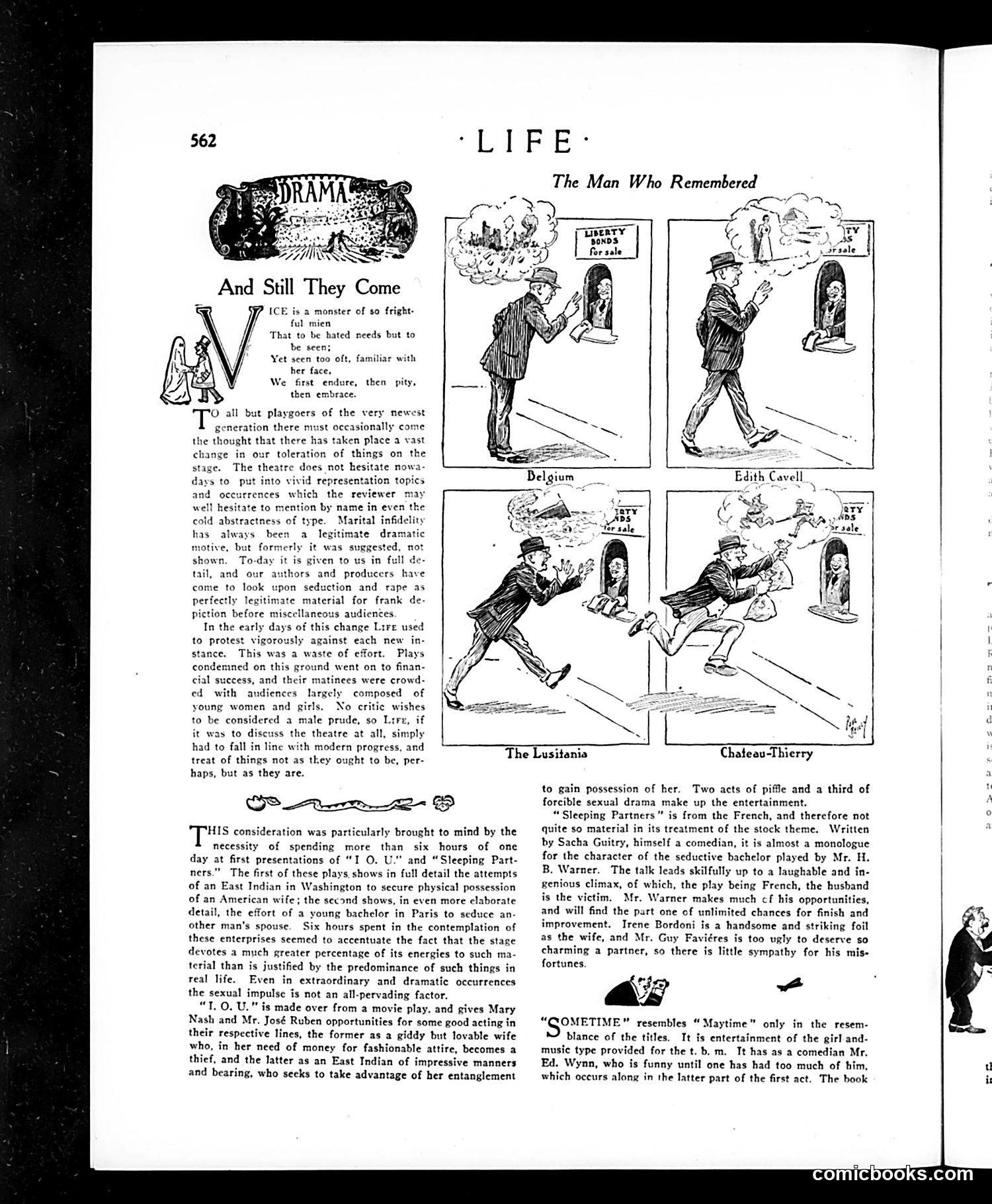
This page critiques contemporary Broadway plays, particularly those depicting sexual content and marital infidelity. The four cartoon panels titled "The Man Who Remembered" appear to satirize the commercialization of patriotic imagery during wartime—figures hawking "Liberty Bonds" and religious icons labeled "for sale," suggesting profit-driven exploitation of national sentiment. The main text reviews plays like "I.O.U." and "Sleeping Partners," which depict seduction and sexual drama. The author argues theaters have gradually normalized explicit content (referencing the progression from suggesting to openly showing adultery), noting that despite critics' protests, audiences—particularly young women—filled matinees of condemned plays. The cartoons likely reference WWI-era Liberty Bond campaigns, with the "remembered" figure selling patriotic symbols. This adds ironic commentary: just as theaters exploit sexual themes for profit, wartime marketing exploits patriotism. The titles reference recognizable figures like Edith Cavell (executed nurse) and actual battles (Lusitania, Château-Thierry), though specific identities of the cartoon figures remain unclear.
📄 Transcribed text from this page (OCR, searchable)
Machine-transcribed from the original scan — historical spelling and the odd misread are preserved.
And Still They Come ICE sa monster of so fright: ful mien That to be hated needs but to be seen; Yet seen too oft, familiar with her face, We first endure, then pity, then embrace. © all but playgoers of the very newest eration there must occasionally come ought that there has taken place a vast ge in our toleration of things on the LS BHE * The Man Who Remembered jueeety ‘BONDS: for sale stage. The theatre does not hesitate nowa- days to put into vivid representation topics and occurrences which the reviewer may well hesitate to mention by name in even the cold abstractness of type. Marital infidelity has always been a legitimate dramatic motive, ly it was suggested, not shown. To-day it is given to us in full de- tail, and our authors and producers have come to look upon seduction and rape as perfectly legitimate material for frank de- piction before miscellaneous audiences In the early days of this change Lire used to protest vigorously against each new in- stance. This was a waste of effort. Plays condemned on this ground went on to finan- cial success, and their matinees were crowd- ed with audiences largely composed of young women and girls. No critic wishes to be considered a male prude, so Lire, if it was to discuss the theatre at all, simply Edith Cavell had to fall in line with modern progress, and treat of things not as they ought to be, per- haps, but as they are. CPt RS D HIS consideration was particularly brought to mind by the necessity of spending more than six hours of one day at first presentations of “I O. U.” and “Sleeping Part- ners.” The first of these plays, shows in full detail the attempts of an East Indian in Washington to secure physical possession of an American wife; the second shows, in even more elaborate detail, the effort of a young bachelor in Paris to seduce an- other man's spouse. Six hours spent in the contemplation of these enterprises seemed to accentuate the fact that the stage devotes a much greater percentage of its energies to such ma- terial than is justified by the predominance of such things in real life. Even in extraordinary and dramatic occurrences the sexual impulse is not an all-pervading factor. “T. 0. U." is made over from a movie play, and gives Mary Nash and Mr. José Ruben opportunities for some good acting in their respective lines, the former as a giddy but lovable wife who, in her need of money for fashionable attire, becomes a thief, and the latter as an East Indian of impressive manners and bearing, who secks to take advantage of her entanglement The Lusitania Chateau-Thierry to gain possession of her. Two acts of piffle and a third of forcible sexual drama make up the entertainment. “Sleeping Partners” is from the French, and therefore not quite so material in its treatment of the stock theme. Written by Sacha Guitry, himself a comedian, it is almost a monologue for the character of the seductive bachelor played by Mr. H. B. Warner. The talk leads skilfully up to a laughable and in- genious climax, of which, the play being French, the husband is the victim. Mr. Warner makes much cf his opportunities, and will find the part one of unlimited chances for finish and improvement. Irene Bordoni is a handsome and striking foil as the wife, and Mr. Guy Faviéres is too ugly to deserve so charming a partner, so there is little sympathy for his mis+ fortunes. ae “QOMETIME” resembles “ Maytime” only in the resem- blance of the titles. It is entertainment of the girl and- music type provided for the t.b. m. It has as a comedian Mr. Ed. Wynn, who is funny until one has had too much of him, which occurs along in the latter part of the first act. The book u