
Life, 1918-10-17 · page 18 of 38
Life — October 17, 1918 — page 18: what you’re looking at
What you’re looking at
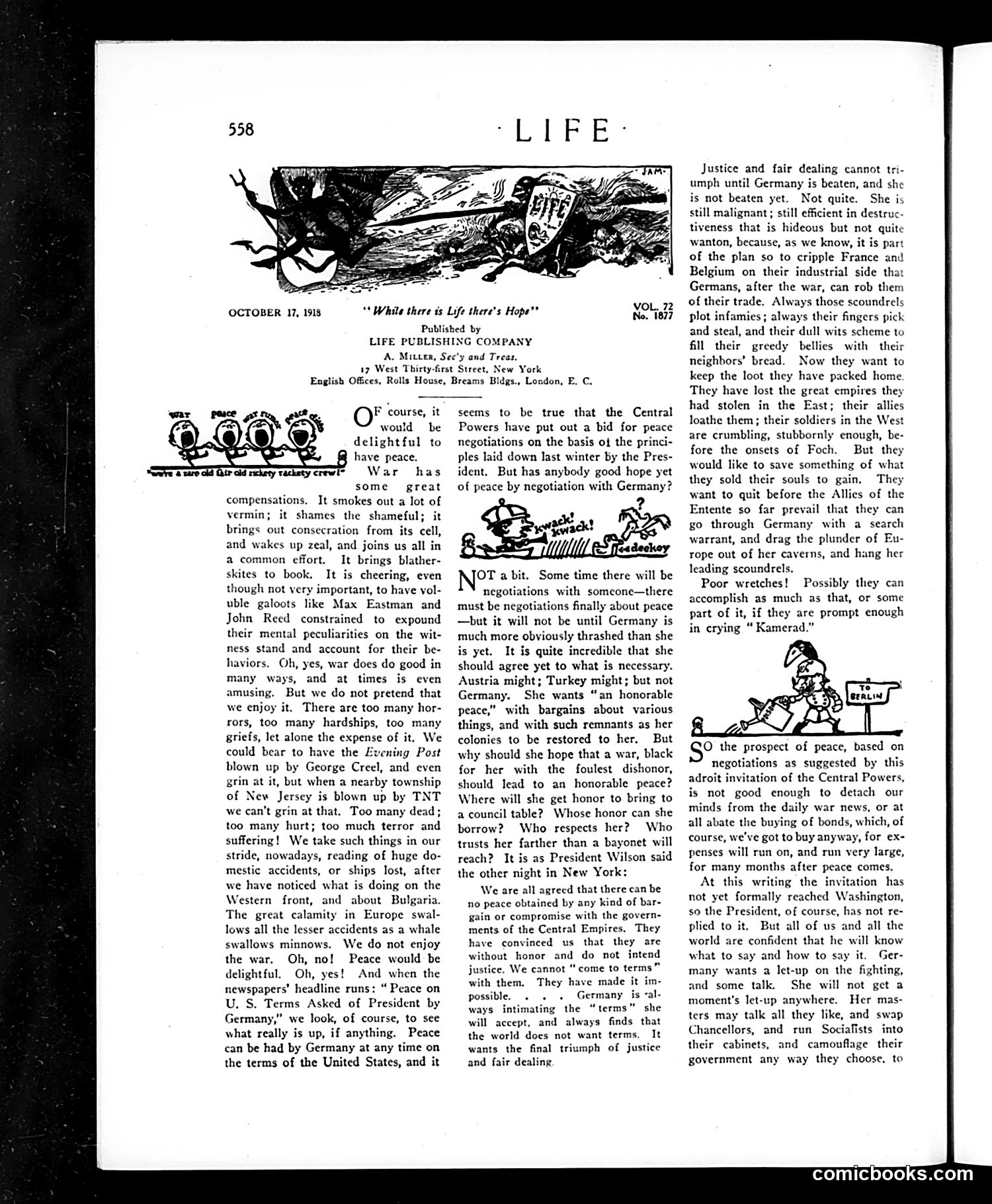
This editorial page appears near World War I's end, when peace negotiations seemed possible. The main cartoon depicts **Germany as a defeated beast** being restrained—likely representing calls for armistice negotiations. The text argues that while peace would be welcome, **Germany should not receive negotiated terms**. The author dismisses German peace overtures as self-serving, claiming Germany lacks the honor to negotiate fairly and must be thoroughly defeated first. The piece references **President Wilson's recent New York speech** (likely October 1918), which is quoted to support this position: Germany has proven itself without honor and justice cannot be compromised with. The article criticizes those suggesting negotiated peace with "the governments of the Central Empires," asserting only unconditional defeat will suffice. It also mocks pacifists like **Max Eastman and John Reed**, who were compelled to testify about their anti-war activities during wartime. The satire targets both German war aims and American anti-war advocates, supporting total victory over negotiated settlement.
📄 Transcribed text from this page (OCR, searchable)
Machine-transcribed from the original scan — historical spelling and the odd misread are preserved.
OCTOBER 17, 1918 ** While there ts Life there’s Hope”* Published by LIFE PUBLISHING COMPANY A. Mitten, Sec'y and Treas, 17 West Thirty-first Street, New York English Offices, Rolls House, Breams Bldgs., London, E. C. F course, it would be delightful to War has some great compensations. It smokes out a lot of vermin; it shames the shameful; it brings out consecration from its cell, and wakes up zeal, and joins us all in a common effort. It brings blather- skites to book. It is cheering, even though not very important, to have vol- uble galoots like Max Eastman and John Reed constrained to expound their mental peculiarities on the wit- ness stand and account for their be- haviors. Oh, yes, war does do good in many ways, and at times is even amusing. But we do not pretend that we enjoy it. There are too many hor- rors, too many hardships, too many griefs, let alone the expense of it. We could bear to have the Evening Post blown up by George Creel, and even grin at it, but when a nearby township of New Jersey is blown up by TNT we can’t grin at that. Too many dead; too many hurt; too much terror and suffering! We take such things in our stride, nowadays, reading of huge do- mestic accidents, or ships lost, after we have noticed what is doing on the Western front, and about Bulgaria. The great calamity in Europe swal- lows all the lesser accidents as a whale swallows minnows. We do not enjoy the war. Oh, no! Peace would be delightful. Oh, yes! And when the newspapers’ headline runs: “Peace on U. S. Terms Asked of President by Germany,” we look, of course, to see what really is up, if anything. Peace can be had by Germany at any time on the terms of the United States, and it seems to be true that the Central Powers have put out a bid for peace negotiations on the basis of the princi- ples laid down last winter by the Pres- ident. But has anybody good hope yet of peace by negotiation with Germany? OT a bit. Some time there will be negotiations with somcone—there must be negotiations finally about peace —but it will not be until Germany is much more obviously thrashed than she is yet. It is quite incredible that she should agree yet to what is necessary. Austria might; Turkey might; but not Germany. She wants “an honorable peace,” with bargains about various things, and with such remnants as her colonies to be restored to her. But why should she hope that a war, black for her with the foulest dishonor, should lead to an honorable peace? Where will she get honor to bring to a council table? Whose honor can she borrow? Who respects her? Who trusts her farther than a bayonet will reach? It is as President Wilson said the other night in New York: We are all agreed that there can be no peace obtained by any kind of bar- gain or compromise with the govern- ments of the Central Empires, They have convinced us that they are without honor and do not intend justice. We cannot “come to terms” with them, They have made it im- possible. . . . Germany is -al- ways intimating the “terms” she will accept, and always finds that the world does not want terms. It wants the final triumph of justice and fair dealing. Justice and fair dealing cannot tri- umph until Germany is beaten, and she is not beaten yet. Not quite. She is still malignant ; still efficient in destruc- tiveness that is hideous but not quite wanton, because, as we know, it is part of the plan so to cripple France and Belgium on their industrial side that Germans, after the war, can rob them of their trade. Always those scoundrels plot infamies; always their fingers pick and steal, and their dull wits scheme to fill their greedy bellies with their neighbors’ bread. Now they want to keep the loot they have packed home. They have lost the great empires they had stolen in the East; their allies loathe them; their soldiers in the West are crumbling, stubbornly enough, be- fore the onsets of Foch. But they would like to save something of what they sold their souls to gain, They want to quit before the Allies of the Entente so far prevail that they can go through Germany with a search warrant, and drag the plunder of Eu- rope out of her caverns, and hang her leading scoundrels. Poor wretches! Possibly they can accomplish as much as that, or some part of it, if they are prompt enough in crying “ Kamerad.” ‘a Ss the prospect of peace, based on negotiations as suggested by this adroit invitation of the Central Powers, is not good enough to detach our minds from the daily war news, or at all abate the buying of bonds, which, of course, we've got to buy anyway, for ex- penses will run on, and run very large, for many months after peace comes. At this writing the invitation has not yet formally reached Washington, so the President, of course, has not re- plied to it. But all of us and all the world are confident that he will know what to say and how to say it. Ger- many wants a let-up on the fighting, and some talk. She will not get a moment's let-up anywhere. Her mas- ters may talk all they like, and swap Chancellors, and run Socialists into their cabinets, and camouflage their government any way they choose, to comicbooks.com