
Life, 1918-10-17 · page 23 of 38
Life — October 17, 1918 — page 23: what you’re looking at
What you’re looking at
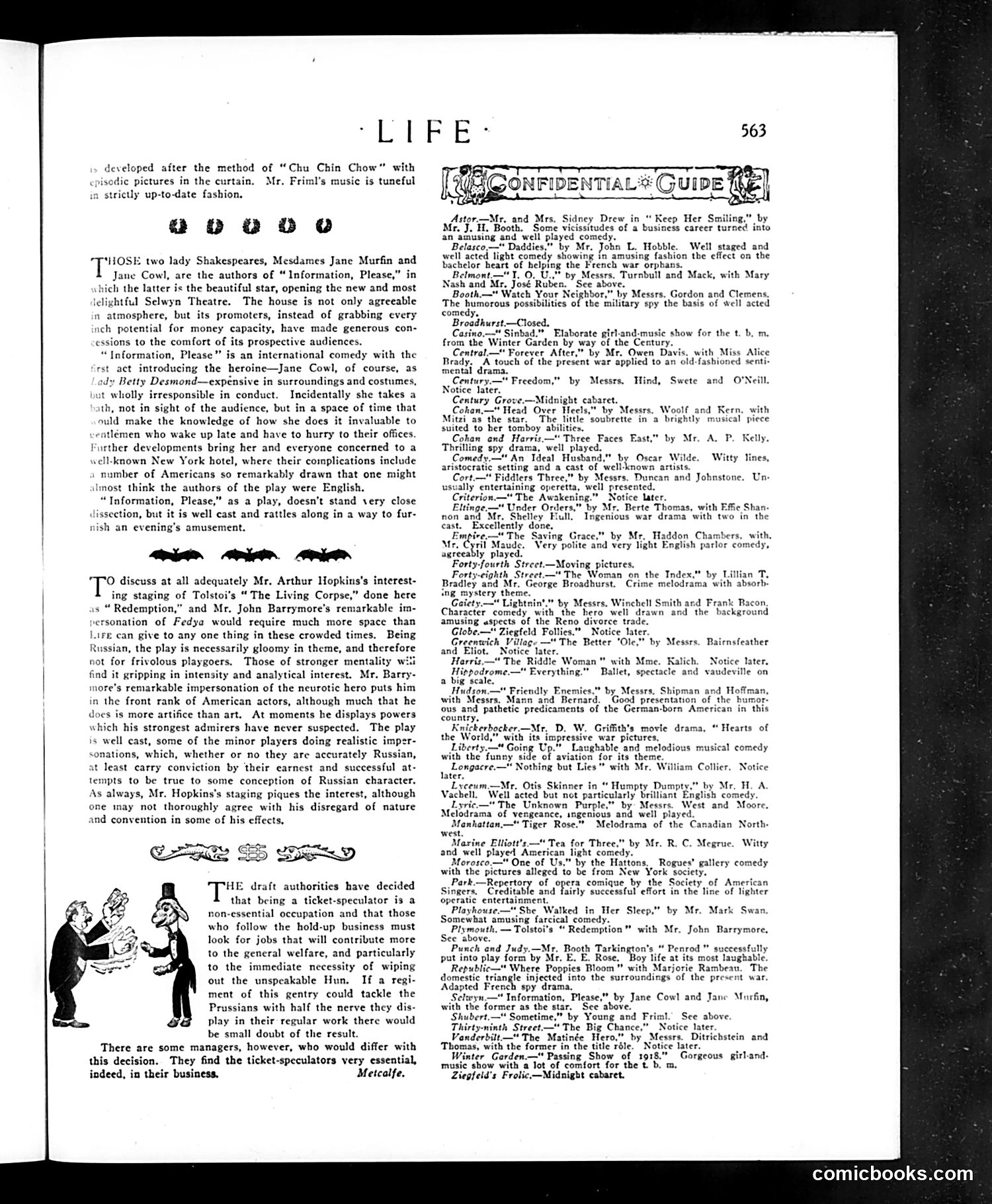
This page from Life magazine (circa 1918, based on WWI references) contains theater reviews and a political cartoon by Metcalfe about ticket speculation. **The Cartoon:** Metcalfe's illustration depicts a ticket scalper—a figure engaged in illegal resale of theater tickets at inflated prices. The cartoon satirizes the U.S. draft authorities' decision to reclassify ticket speculators as "non-essential" workers, forcing them into military service. The accompanying text ironically suggests that if these men applied their nerve and cunning to fighting Germans ("the unspeakable Hun"), they'd be valuable soldiers. However, some theater managers disagreed with this classification, considering scalpers essential to their profits. **The Context:** During WWI, labor was redirected toward the war effort. The cartoon mocks both the speculators' dubious business practices and the irony that the government was drafting them while some business interests found them economically useful.
📄 Transcribed text from this page (OCR, searchable)
Machine-transcribed from the original scan — historical spelling and the odd misread are preserved.
developed after the method of “Chu Chin Chow” with sodic pictures in the curtain, Mr. Friml’s music is tuneful strictly up-to-date fashion, @o 8 0 @ JOSE two lady Shakespeares, Mesdames Jane Murfin and Jane Cowl, are the authors of “Information, Please,” in hh the latter is the beautiful star, opening the new and most lelightful Selwyn Theatre. The house is not only agreeable n atmosphere, but its promoters, instead of grabbing every nch potential for money capacity, have made generous con- essions to the comfort of its prospective audiences. “Information, Please” is an international comedy with the rst_act introducing the heroine—Jane Cowl, of course, as dy Betty Desmond—expénsive in surroundings and costumes, ut wholly irresponsible in conduct. Incidentally she takes a th, not in sight of the audience, but in a space of time that ould make the knowledge of how she does it invaluable to centlémen who wake up late and have to hurry to their offices. Further developments bring her and everyone concerned to a well-known New York hotel, where their complications include | number of Americans so remarkably drawn that one might most think the authors of the play were English. “Information, Please,” as a play, doesn’t stand very close isscction, but it is well cast and rattles along in a way to fur- nish an evening's amusement. Re Ce ie 'O discuss at all adequately Mr. Arthur Hopkins's interest- ing staging of Tolstoi’s “ The Living Corpse,” done here 1s “ Redemption,” and Mr. John Barrymore's remarkable im- versonation of Fedya would require much more space than \.ire can give to any one thing in these crowded times. Being Russian, the play is necessarily gloomy in theme, and therefore not for frivolous playgoers. Those of stronger mentality witi find it gripping in intensity and analytical interest. Mr. Barry- more’s remarkable impersonation of the neurotic hero puts him in the front rank of American actors, although much that he does is more artifice than art, At moments he displays powers which his strongest admirers have never suspected. The play s well cast, some of the minor players doing realistic imper- sonations, which, whether or no they are accurately Russian, at least carry conviction by their earnest and successful at- tempts to be true to some conception of Russian character. As always, Mr. Hopkins’s staging piques the interest, although one imay not thoroughly agree with his disregard of nature and convention in some of his effects, HE draft authorities have decided t being a ticket-speculator is a non-essential occupation and that those who follow the hold-up business must look for jobs that will contribute more to the general welfare, and particularly to the immediate necessity of wiping out the unspeakable Hun. If a regi- ment of this gentry could tackle the Prussians with half the nerve they dis- play in their regular work there would be small doubt of the result. There are some managers, however, who would differ with this decision. They find the ticket-speculators very essential, indeed, in their business, Metcalfe. *LIFE- Astor—Mr. and Mrs, Sidney Drew in ‘Keep Her Sm iby Mr. J. H. Booth. Some vicissitudes of a business career turned into an aiusing and well played comedy. Belasco—" Daddies,” by Mr. John L. Hobble. Well staged and well acted light comedy showing in amusing fashion the effect on the bachelor heart of helping the French war orphans. Belmont—"T, 0. U..!" by Messrs, Turnbull and Mack, with Mary Nash and Mr, José Ruben. See above. Booth.—" Watch Your Neighbor,” by Messrs. Gordon and Clemens, The humorous possibilities of the military spy the basis of well acted comedy, Broadhurst,—Closed. Casino,—" Sinbad.” Elaborate gitl-and-music show for the t. b, m. from the Winter Garden by way of the Century, Central—" Forever After,” by Mr. Owen Davis, with Miss Alic Brady, A touch of the present war applied to an old-fashioned senti mental drama, Century, Notice later, Century Grove.—Midnight cabaret. Cohan,—" Head Over Heels," by Messrs. Woolf and Kern, with Mitzi_as the star, The little soubrette in a brightly musical piece suited to her tomboy abilit “Three Faces East,” by Mr. A. P. Kelly. y drama, well played. Comedy.—" An Ideal Husband,” by Oscar Wilde. aristocratic setting and a cast of well-known artists. Cort—" Fiddlers Three,” by Messrs, Duncan and Johnstone. Un- usually entertaining operetta, well presented, Criterion.—" The Awakening.” Notice later. Eltinge.—" Under Orders,” by Mr. Berte Thomas, with Efic Sha non and Mr. Shelley Hull. Ingenious war drama with two in the cast, Excellently done, Empire.—* The Saving Grace,” by Mr. Haddon Chai Mr. Cyril Maude, Very polite and very light English parle agreeably played. Forty-fourth Street.—Moving pictures. Forty-eighth Strect.—"* The Woman on the Index." by I Bradley and Mr. George Broadhurst. Crime melodrama wit ing mystery theme. Gaiety.—" Lightnin’.” by Messrs. Winchell Smith and Frank Racon Character comedy with the hero well drawn and the background amusing aspects of the Reno divorce trade. Globe.—" Ziegfeld Follies.” Notice later. Greenwich Village —" The Better ‘Ole,” by Messrs, Bairnsfeather and Eliot. Notice later. Harrit—" The Riddle Woman" with Mme. Kalich, Notice later. Hippodrome.—" Everything.” Ballet, spectacle and vaudeville on a big scale, Hudson.—" Friendly Enemies,” by, Messrs, Shipman and Hof with Messrs, Mann and Bernard. Good presentation of the humor: ous and pathetic predicaments of the German-born American in this country, Knickerbocker —Mr. D, W. Griffith's movie dram: the World,” with its impressive war pictures, Liberty." Going Up.” Laughable and melodious musical comedy with the funny side of aviation for its theme. aeenancre—" Nothing but Lies” with Mr. William Collie. ater. Lyceum —Mr. Otis Skinner in by Messrs, Hind, Swete and O'Neill. Witty lines, rs, with, comedy, nT. absorb: “Hearts of Notice Humpty Dumpty,” by Mr. H. A Vachell. Well acted but not particularly brilliant English comedy. Lyric.—" The Unknown Purple,” by: Messrs. West and Moore. Melodrama of vengeance, ingenious and well played. Manhattan." Tiger Rose.” Melodrama of the C: west, Marine Elliott's —" Tea for Three,” by Mr. R. C. Megruc. Witty and well played American light comedy. Morosco.—" One of Us.” by the Hattons, Rogues’ gallery comedy with the pictures alleged to be from New York society. Park—Repertory of opera comique, by the Society of American Singers. Creditable and fairly successful effort in the line of lighter operatic entertainment. Playhouse-—" She Walked in Her Sleep," by Mr. Mark Swan, Somewhat amusing farcical comedy. Plymouth, —Tolstoi’s “ Redemption" with Mr. John Barrymore, See ‘above. Punch ond Judy.—Mr. Booth Tarkington's Penrod" successfully put into play form by Mr. E. E. Rose, Boy life at its most laughable. Republic—* Where Poppies Bloom" with Marjorie Rambeau. The domestic triangle injected into the surroundings of the present war, Adapted French spy drama, Selwyn. —" Information, Please,” by Jane Cowl and Jane Murfin, with the former as the star. See above. Shubert,— Sometime,” by Young and Friml.’ See above. Thirty-ninth Street.—" The Big Chance,” Notice later. Vanderbilt —" The Matinée Hero,” by Messrs. Ditrichstein and Thomas, with the former in the title réle. Notice later. . Winter Garden" Passing Show of 1918." Gorgeous girl-and- music show with a lot of comfort for the tb. m. Ziegfeld's Frolic.—Midnight cabaret. nadian North: comicbooks.com