
Life, 1918-10-17 · page 19 of 38
Life — October 17, 1918 — page 19: what you’re looking at
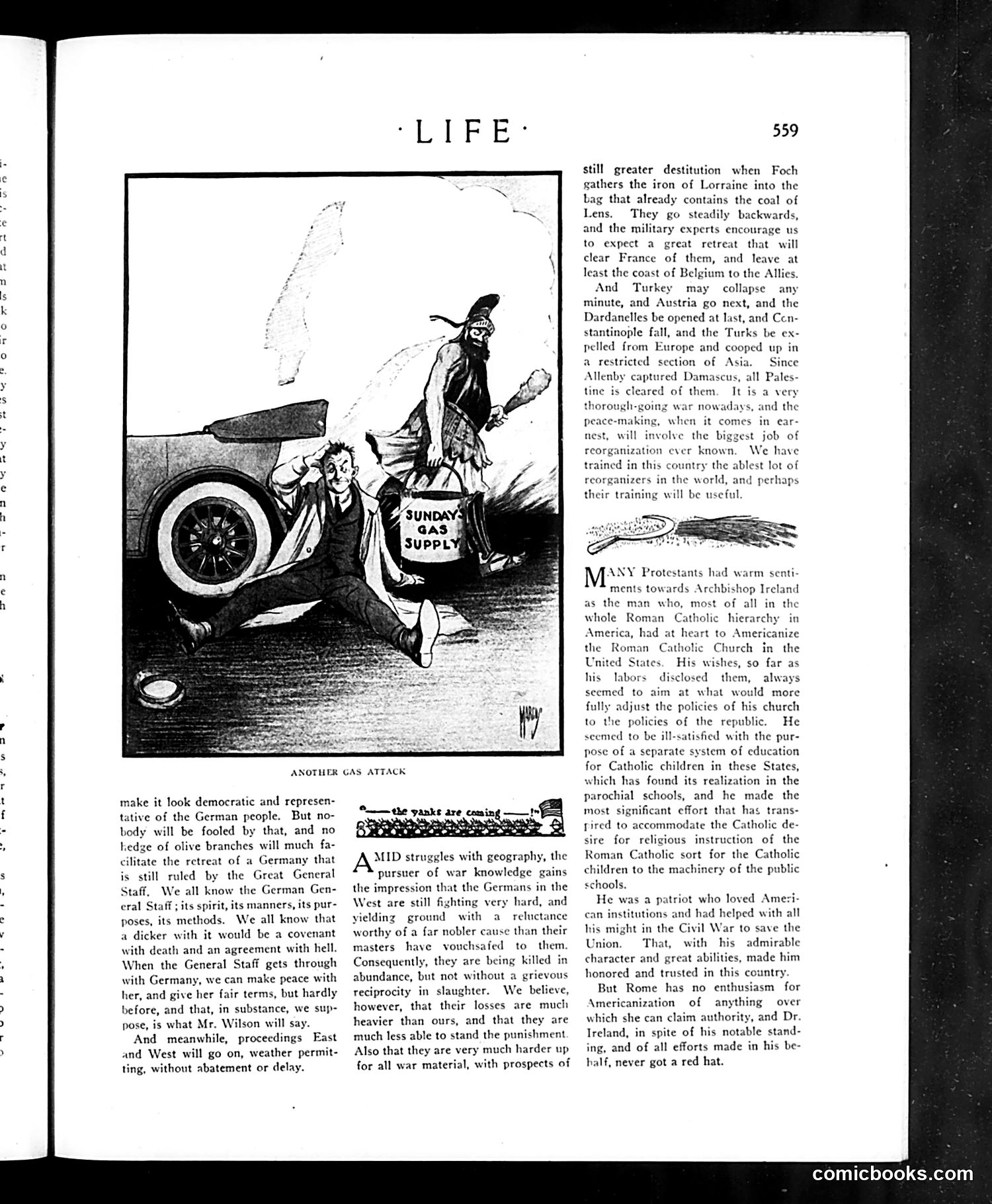
What you’re looking at
The cartoon depicts a personified Germany (the tall figure in military dress) being struck down by an Allied soldier emerging from a car labeled "Sunday School Supply." The satire targets German military leadership's claims of democratic legitimacy while being controlled by the militaristic General Staff. The accompanying text explains the joke: Germany attempts to appear democratic and representative to facilitate peace negotiations, but the author dismisses this as deception. The "Sunday School Supply" vehicle suggests the hypocrisy of Germany's supposed moral reform—mere propaganda window-dressing concealing the unchanged autocratic military rule beneath. Written during World War I's final stages, this reflects American skepticism toward German peace overtures and confidence in Allied victory. The text references General Foch's advances and anticipated Turkish-Austrian collapse, dating this to 1918.
📄 Transcribed text from this page (OCR, searchable)
Machine-transcribed from the original scan — historical spelling and the odd misread are preserved.
oe” r t f ANOTHER make it look democratic and represen- tative of the German people. But no- body will be fooled by that, and no kedge of olive branches will much fa- cilitate the retreat of a Germany that is still ruled by the Great General Staff, We all know the German Gen- eral Staff ; its spirit, its manners, its pur- poses, its methods. We all know that a dicker with it would be a covenant with death and an agreement with hell. When the General Staff gets through with Germany, we can make peace with her, and give her fair terms, but hardly before, and that, in substance, we sup- pose, is what Mr. Wilson will say. And meanwhile, proceedings East and West will go on, weather permit- ting, without abatement or delay. GAS ATTACK Oo AM struggles with geography, the pursuer of war knowledge gains the impression that the Germans in the W are still fighting very hard, and yielding ground with a reluctance worthy of a far nobler cause than their masters have vouchsafed to them. Consequently, they are being killed in abundance, but not without a grievous reciprocity in slaughter. We believe, however, that their losses are much heavier than ours, and that they are much less able to stand the punishment Also that they are very much harder up for all war material, with prospects of 559 still greater destitution when Foch gathers the iron of Lorraine into the bag that already contains the coal of Lens. They go steadily backwards, and the military experts encourage us to expect a great retreat that will clear France of them, and leave at least the coast of Belgium to the Allies, And Turkey may collapse any minute, and Austria go next, and the Dardanelles be opened at last, and Cen- stantinople fall, and the Turks be ex- pelled from Europe and cooped up in a restricted section of Asia. Since Allenby captured Damascus, all Pales- tine is cleared of them. It is a very thorough-going war nowadays, and the peace-making, when it comes in ear- nest, will involve the biggest job of reorganization ever known. We have ined in this country the ablest lot of anizers in the world, and perhaps — M ANY Protestants had warm senti- ments towards Archbishop Ircland as the man who, most of all in the whole Roman Catholic hierarchy in America, heart to Americanize the Roman Catholic Church in the United es. His wishes, so far as his labors disclosed them, always seemed to aim at what would more fully adjust the policies of his church to the policies of the republic. He scemed to be ill-satisfied with the pur- pose of a separate system of education for Catholic children in these States, which has found its realization in the parochial schools, and he made the most significant effort that has trans- fired to accommodate the Catholic de- sire for religious instruction of the Roman Catholic sort for the Catholic children to the machinery of the public schools. He was a patriot who loved Amezi- can institutions and had helped with all his might in the Civil War to save the Union. That, with his admirable character and great abilities, made him honored and trusted in this country. But Rome has no enthusiasm for Americanization of anything over which she can claim authority, and Dr. Ireland, in spite of his notable stand- ing, and of all efforts made in his be- half, never got a red hat. comicbooks.com