
A complete issue · 36 pages · 1918
Life — August 1, 1918
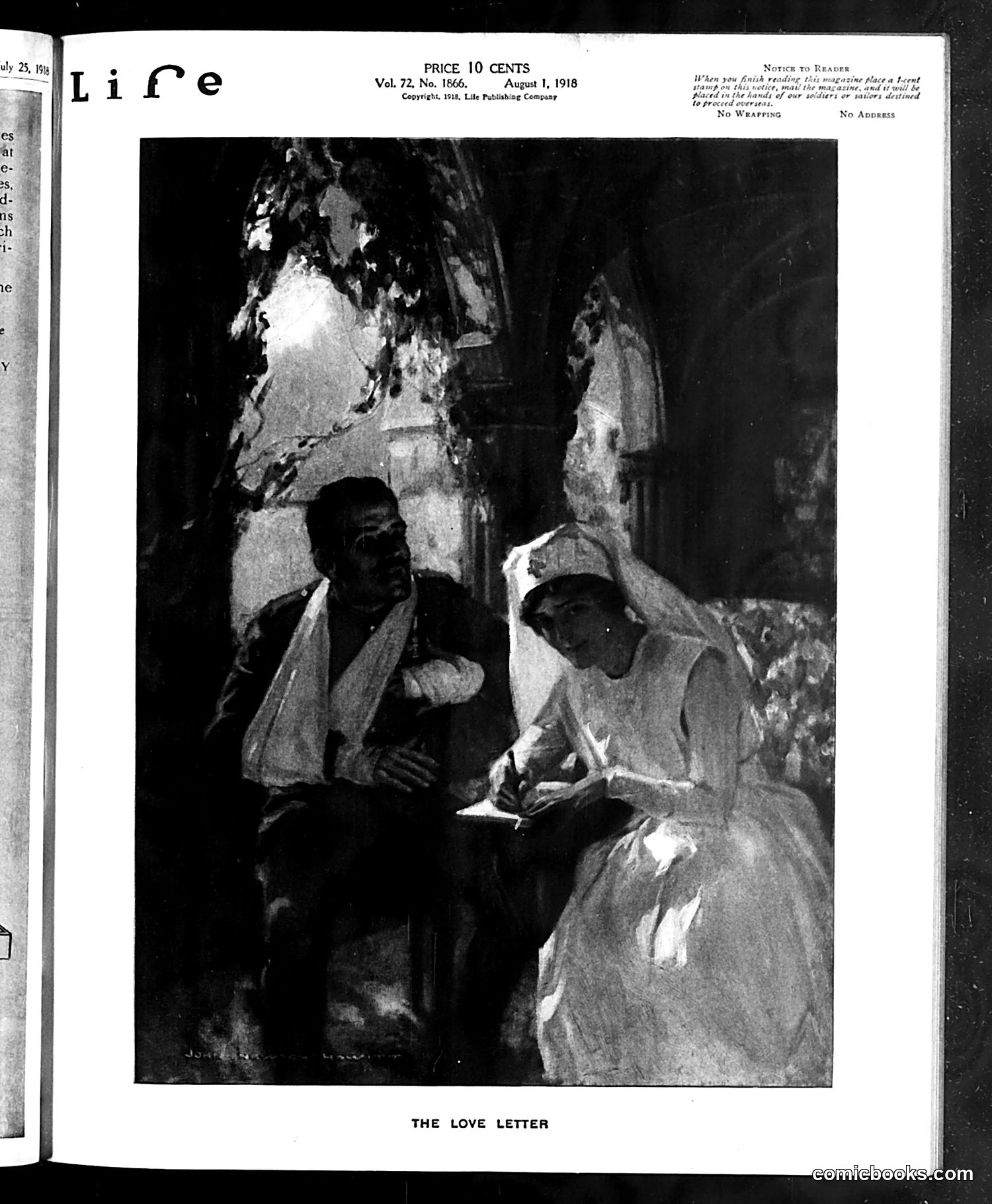
This appears to be a dramatic scene rather than political satire. The caption reads "THE LOVE LETTER," suggesting this is an illustration or still from a theatrical production depicting an intimate moment between two figures in what appears to be a rustic or dimly-lit interior setting. Given the publication date (August 1918, during World War I), this could reference wartime romantic themes common in contemporary entertainment—soldiers writing letters home, romantic separations, or emotional farewells. However, without additional context or identifying information visible in the image itself, I cannot definitively state what specific production, story, or social commentary this represents. The image quality and theatrical composition suggest this is editorial illustration rather than political commentary.
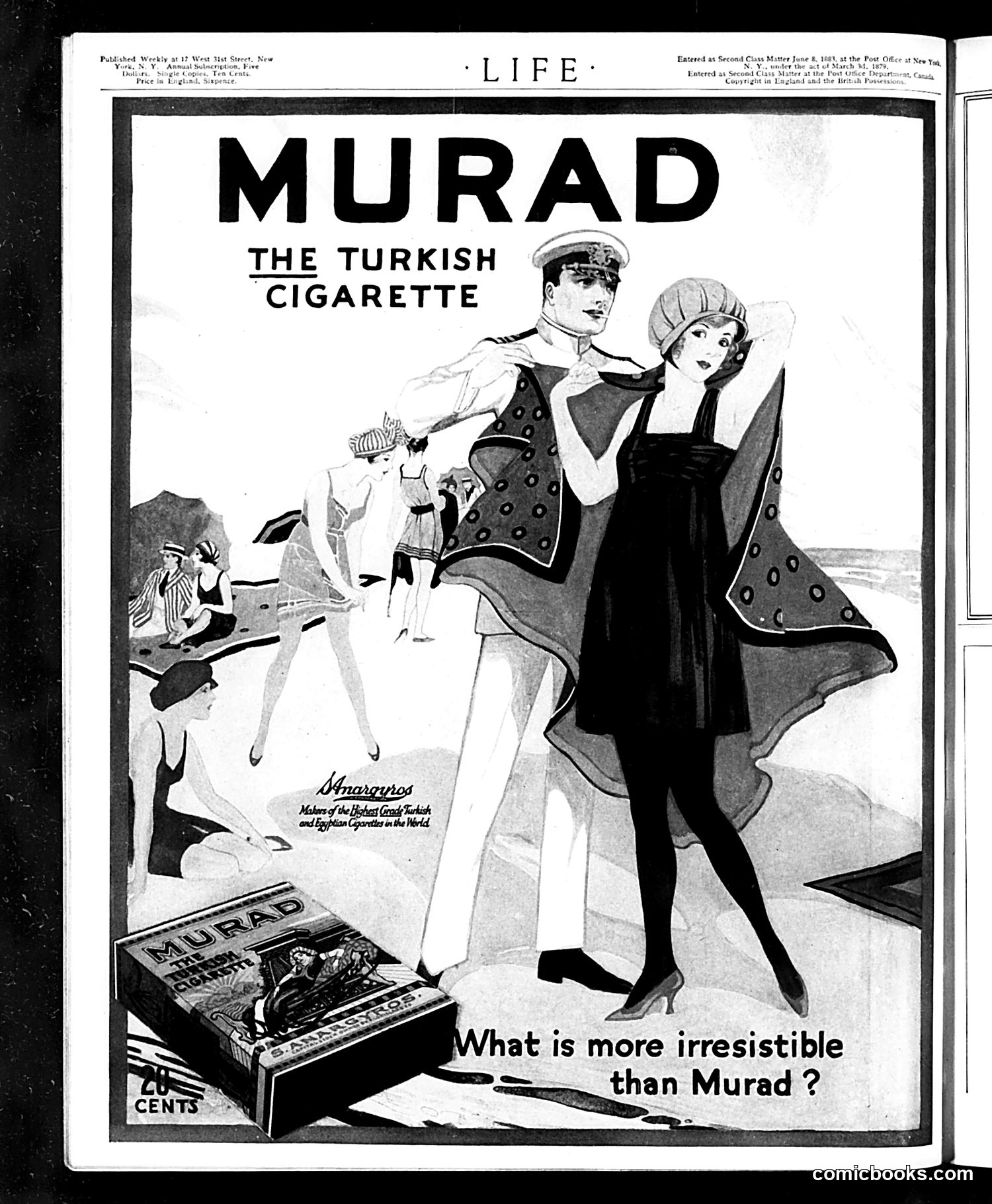
This is a cigarette advertisement disguised as a satirical magazine page. The ad depicts an orientalist fantasy scene on a beach, featuring fashionably dressed figures in 1920s style alongside what appear to be exotic dancers or performers. A turbaned man in military dress and a woman in fashionable Western clothing are central figures. The tagline "What is more irresistible than Murad?" plays on the advertisement's appeal. The imagery exploits contemporary stereotypes about Turkish exoticism and sensuality to market the cigarettes, combining "Turkish" authenticity with modern Western glamour and implied eroticism. This represents typical early 20th-century advertising tactics that combined orientalism with aspirational lifestyle marketing.
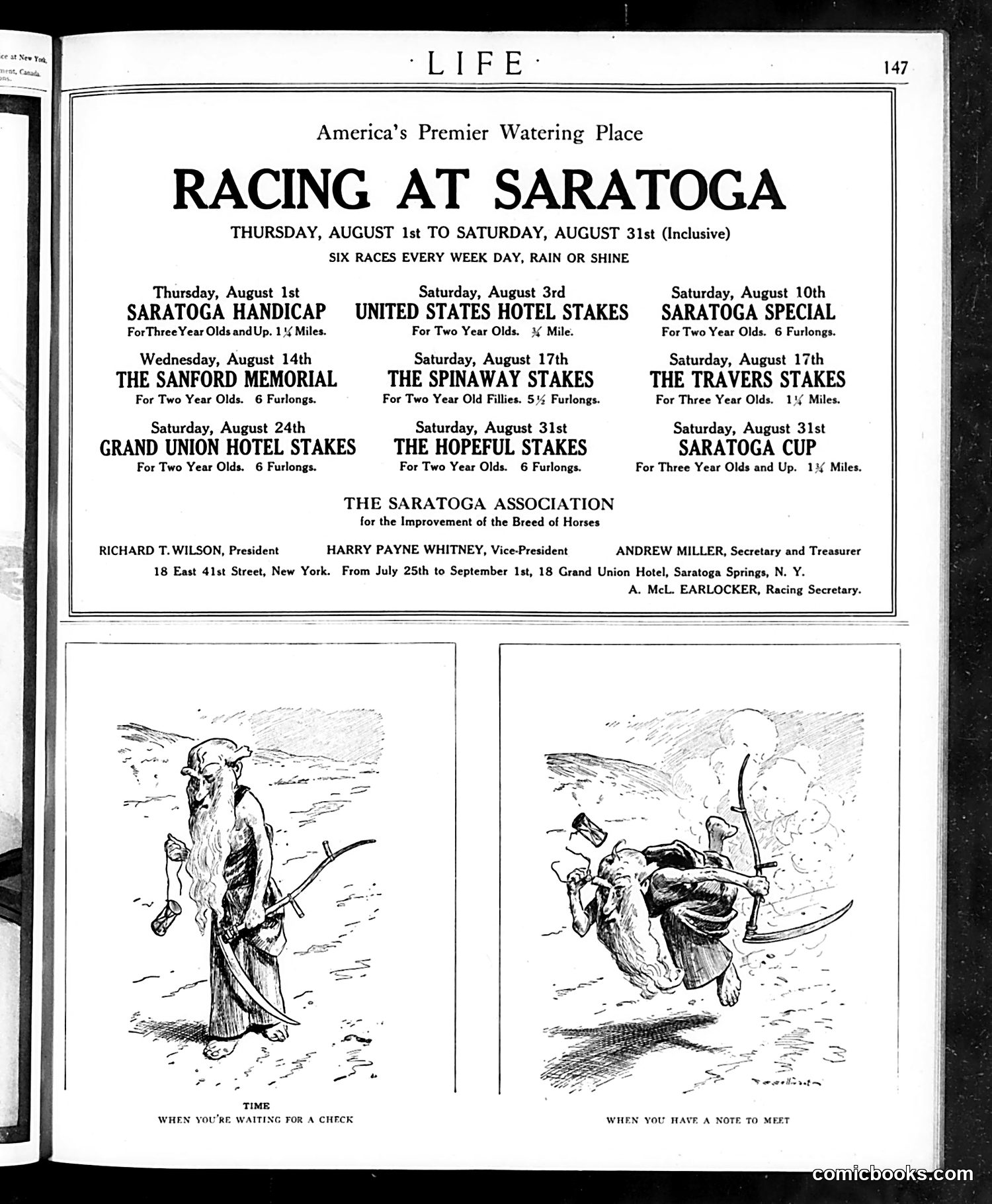
This page is primarily **advertising** for the Saratoga racing season (August 1-31), promoting horse races and the Saratoga Association for breed improvement. The two cartoons at the bottom appear to be **humorous vignettes** unrelated to the racing content: - **Left cartoon** ("Time: When You're Waiting for a Check"): depicts a skeletal figure with a scythe—likely **Death or Father Time**—suggesting the tedious, seemingly endless wait for payment. - **Right cartoon** ("When You Have a Note to Meet"): shows a similarly skeletal figure struggling with financial obligations, suggesting financial hardship and the stress of meeting debt payments. Both cartoons use **memento mori imagery** (skeletal figures) to satirize the frustrations of waiting for money and managing financial obligations—common complaints among the magazine's readers during this era.
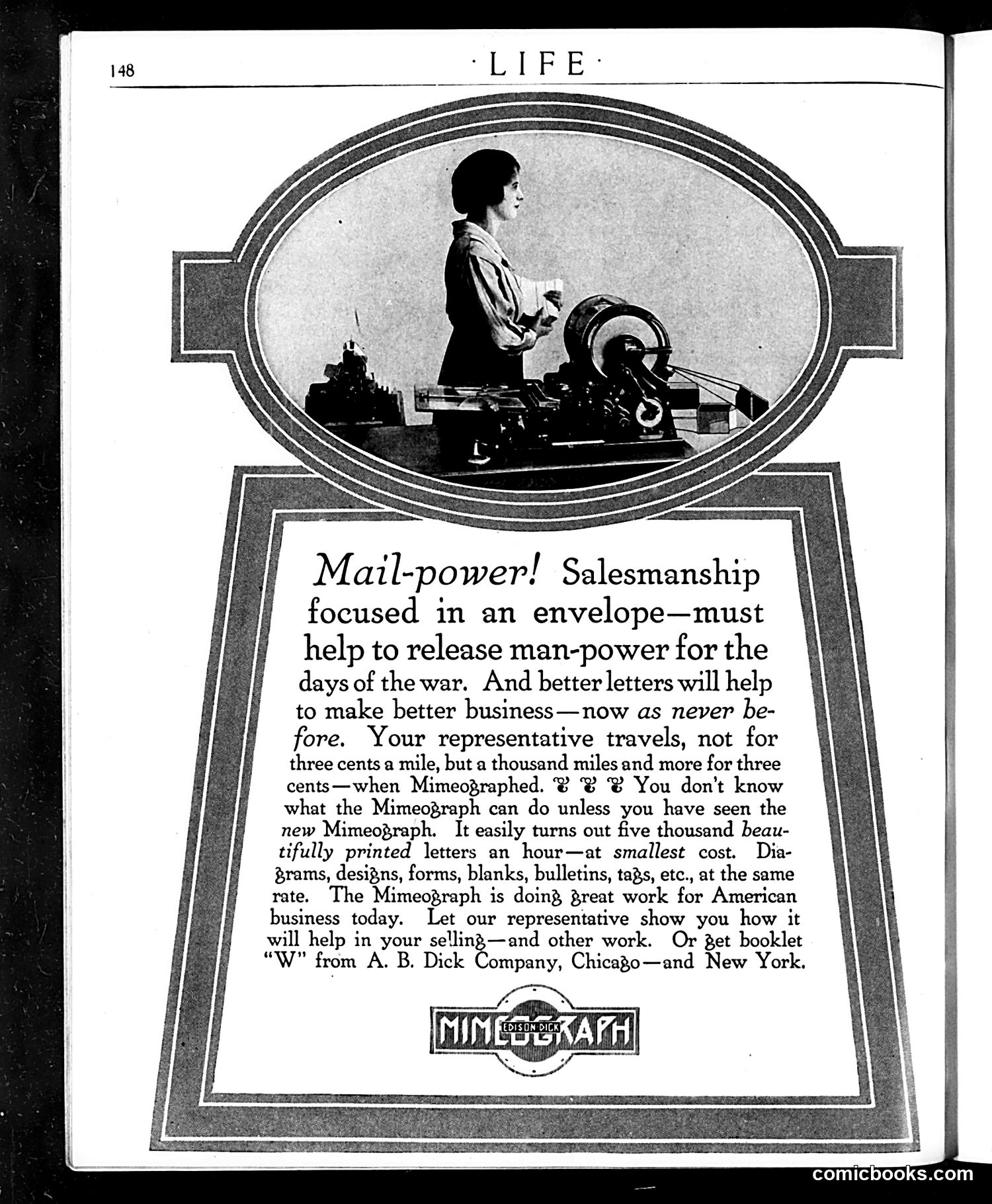
This is a **commercial advertisement**, not a political cartoon. It promotes the Mimeograph machine by A.B. Dick Company, positioned as a wartime business solution. The ad uses patriotic framing—"days of the war"—to appeal to businessmen. It argues that mimeographs enable salesmen to distribute five thousand printed letters hourly at minimal cost, thereby "releasing man-power" for military service during what appears to be **World War I era** (based on language about "the war"). The illustration shows a woman operating the mimeograph, reflecting wartime workforce shifts as men enlisted. The ad emphasizes efficiency and cost-effectiveness as patriotic contributions to the war effort while promoting a business machine.
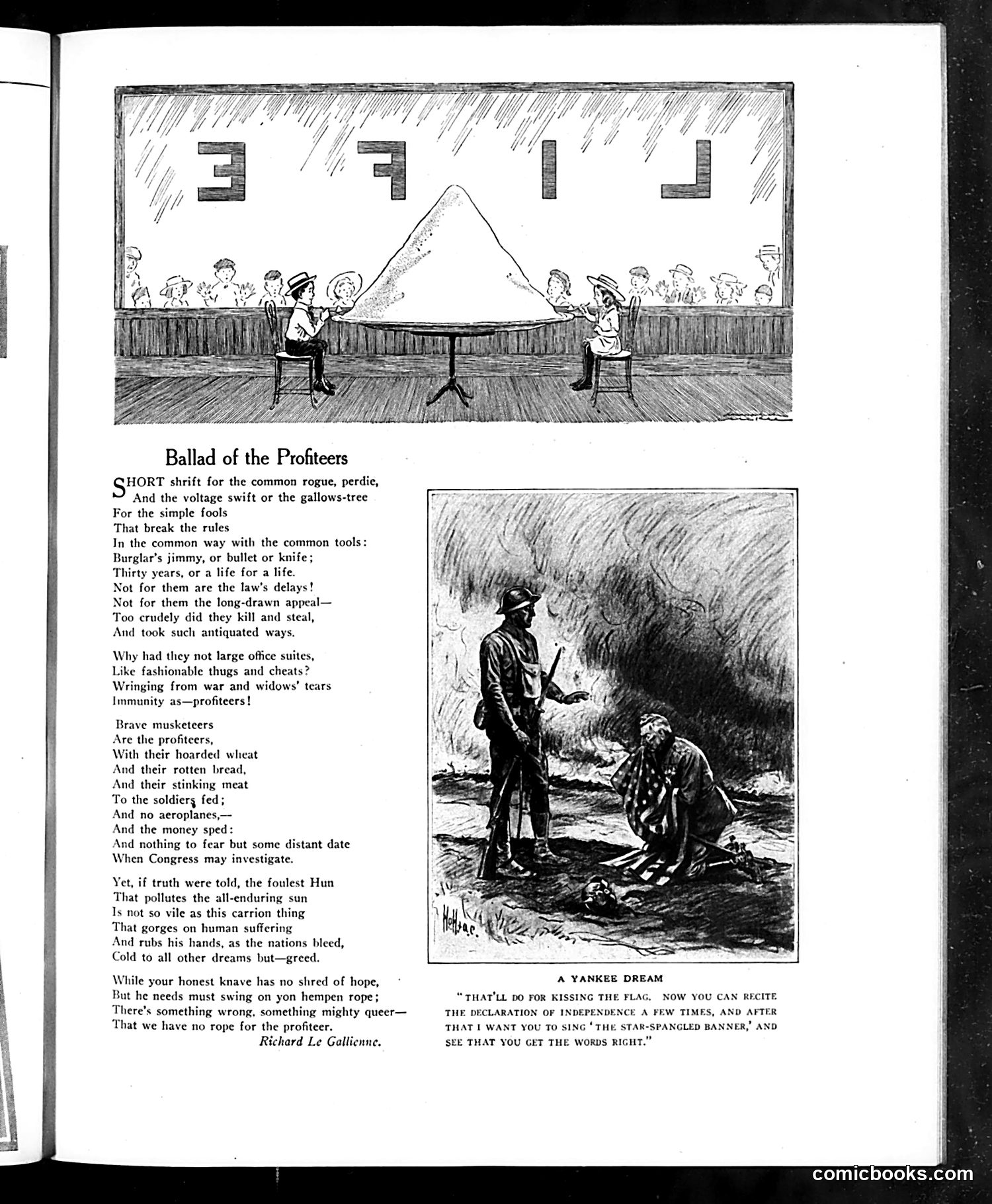
This page satirizes war profiteers during World War I. The poem by Richard Le Gallienne criticizes businessmen who grew wealthy supplying the military while soldiers suffered and died. Key targets include: - Those hoarding wheat and meat meant for soldiers - Profiteers with "large office suites" avoiding military service - "Greed" prioritized over soldiers' welfare The illustration "A Yankee Dream" depicts a soldier confronting a profiteer, with the caption sarcastically suggesting the profiteer recite the Declaration of Independence and national anthem—implying such patriotic words ring hollow from someone enriching themselves while others fight. The satire attacks the moral hypocrisy of war profiteering: commercial gain justified by patriotic rhetoric.
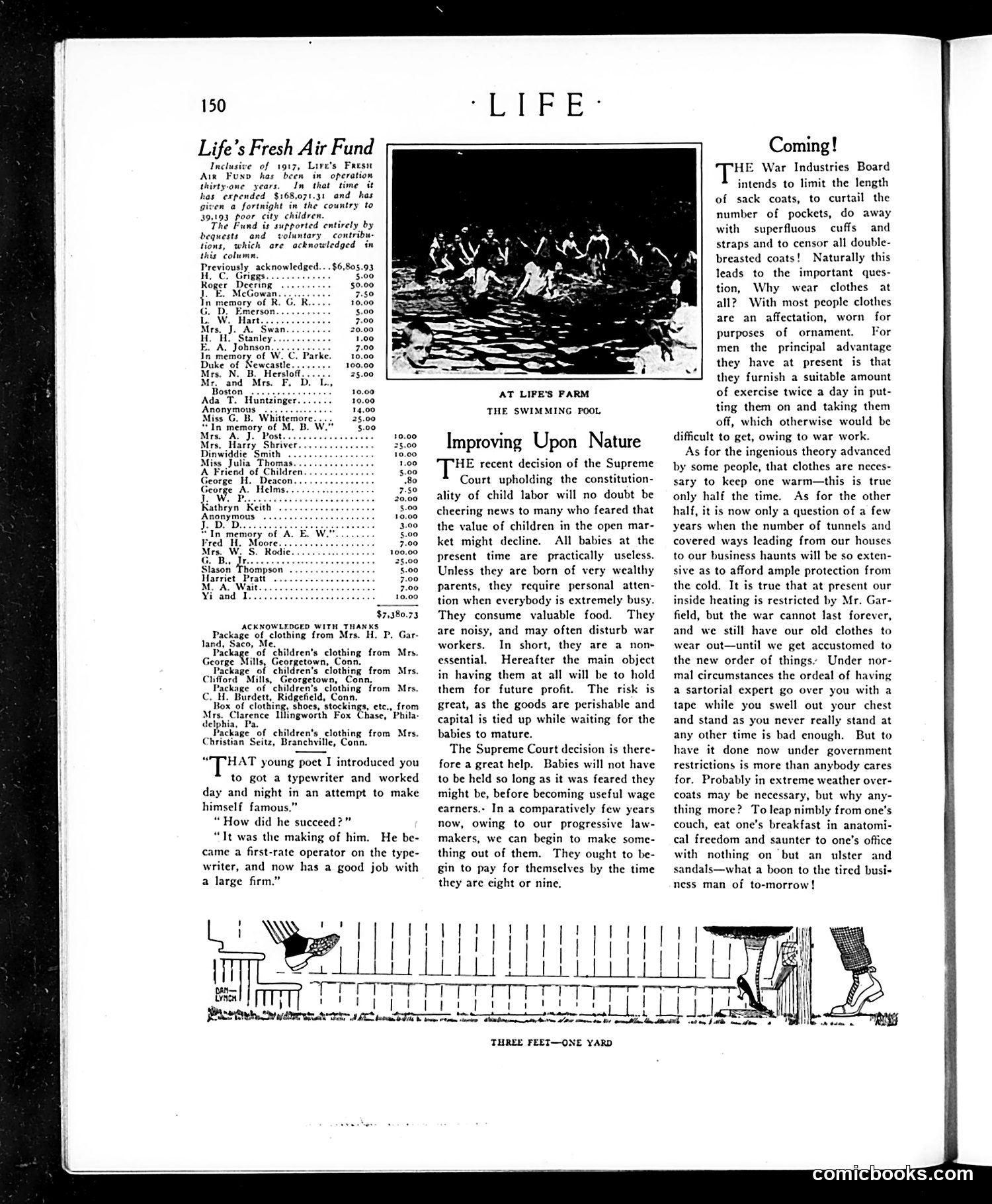
This page contains two distinct sections: **Left side:** A fundraising list for "Life's Fresh Air Fund," which has operated for 31 years providing poor city children access to countryside experiences. The extensive donor list with amounts suggests this was a significant charitable initiative. **Right side:** An article titled "Improving Upon Nature" discusses the War Industries Board's anticipated clothing restrictions—limiting sack coats, pockets, and double-breasted designs. The author satirizes the practical absurdity: if clothes are merely "affectation" for "ornament," why restrict them during wartime? The piece mocks proposed austerity measures as both unnecessary and condescending to workers needing functional garments. The tone is skeptical of government overreach disguised as wartime necessity. The page reflects WWI-era concerns about rationing, government control, and class attitudes toward working people's clothing needs.
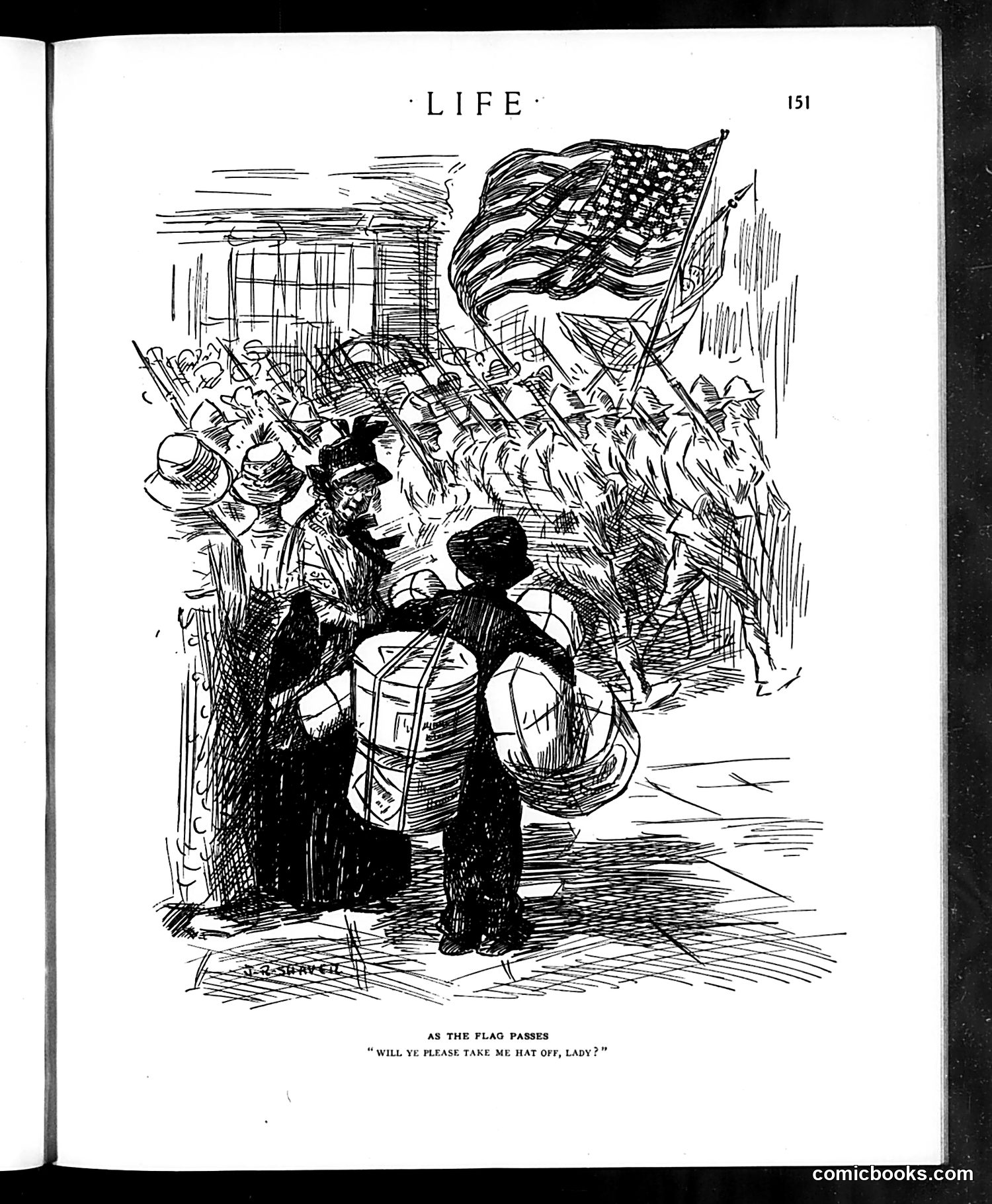
This editorial cartoon depicts a patriotic scene with an American flag being paraded through a crowded street. Two figures in the foreground—appearing to be a well-dressed man in a top hat and a woman—are shown with the man requesting "Will ye please take me hat off, lady?" as the flag passes. The satire plays on the social convention that men should remove their hats as a sign of respect when the flag passes. The humor lies in the absurdity of the situation: the man cannot remove his hat because the woman is blocking him or holding it. This appears to be commentary on etiquette, patriotic respect, and perhaps the complications created by crowded public gatherings or social interactions during patriotic occasions.
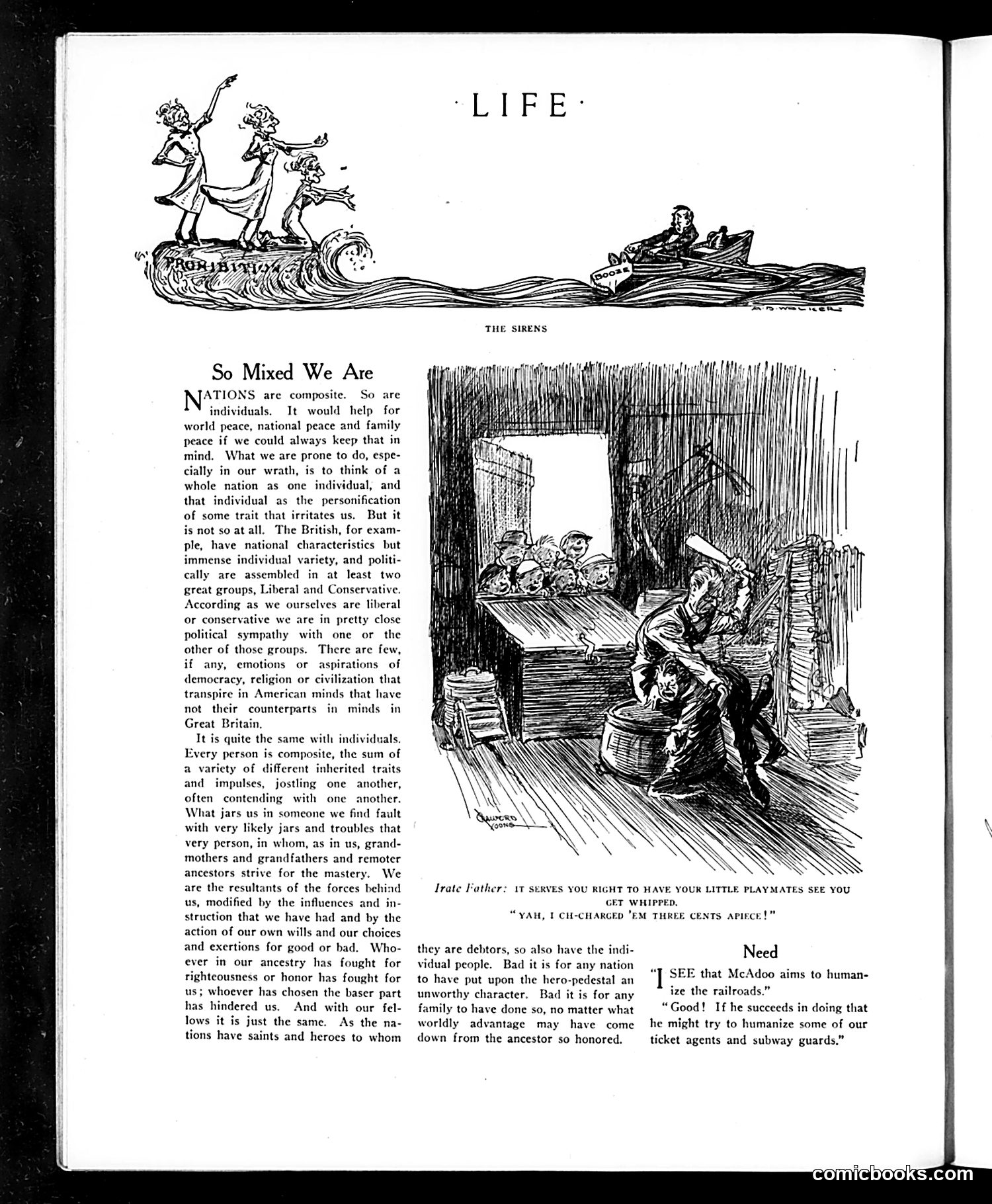
**Top illustration ("The Sirens"):** Shows mythological sirens on a wave luring a sailor in a boat toward danger—a classical allusion to temptation and poor judgment. **Main article "So Mixed We Are":** Discusses how nations and individuals are composites of conflicting traits and inheritances. The text argues British people embody diverse political sympathies (Liberal and Conservative) without this creating national instability, unlike supposedly more homogeneous societies. It suggests this internal diversity—inherited from ancestors—is actually a strength, not weakness. **Bottom cartoon ("Irate Father"):** Depicts a working-class father threatening to whip his son's playmates. The accompanying dialogue about "humanizing the railroads" and hiring "ticket agents and subway guards" appears to satirize naive social reform proposals that miss economic realities. The page advocates accepting human complexity over seeking impossible uniformity.
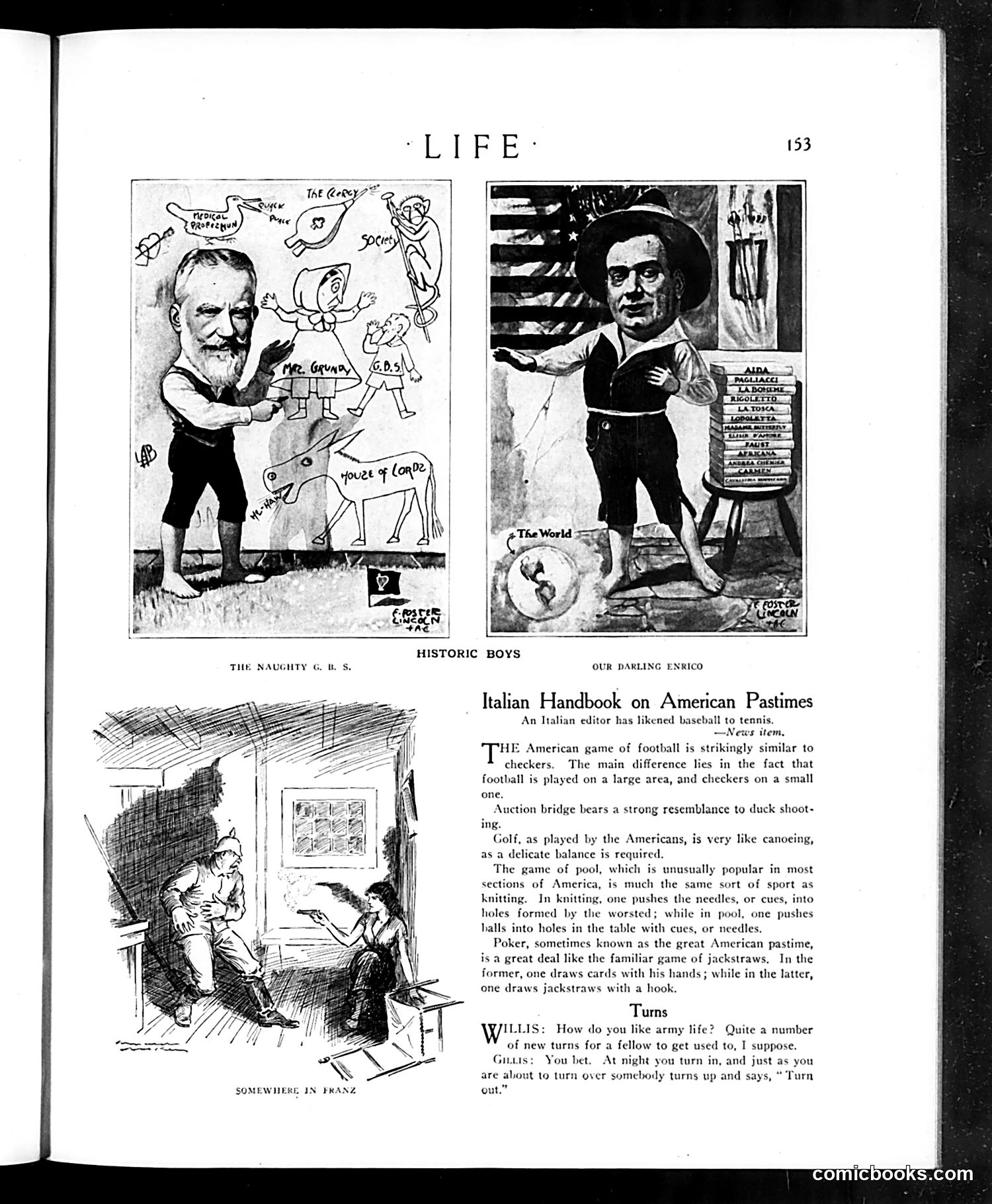
This page features two satirical cartoons labeled "HISTORIC BOYS": **Left cartoon ("The Naughty G.B.S.")**: Depicts a bearded man (likely George Bernard Shaw, the Irish playwright, given the "G.B.S." initials) as a mischievous child-figure, surrounded by crude drawings and labeled concepts like "Mr. Grundy" and "House of Compo," suggesting his provocative, rule-breaking approach to theater and social commentary. **Right cartoon ("Our Darling Enrico")**: Shows a man (appears to be Enrico Caruso, the famous Italian tenor) posing proudly next to a list of operas, positioned with "The World" beneath him—mocking his celebrity status and perhaps his self-importance. The page also includes an article about American pastimes as explained to Italians, with a sketch labeled "Somewhere in Franz" showing domestic life. The humor targets famous cultural figures and transatlantic misunderstandings.
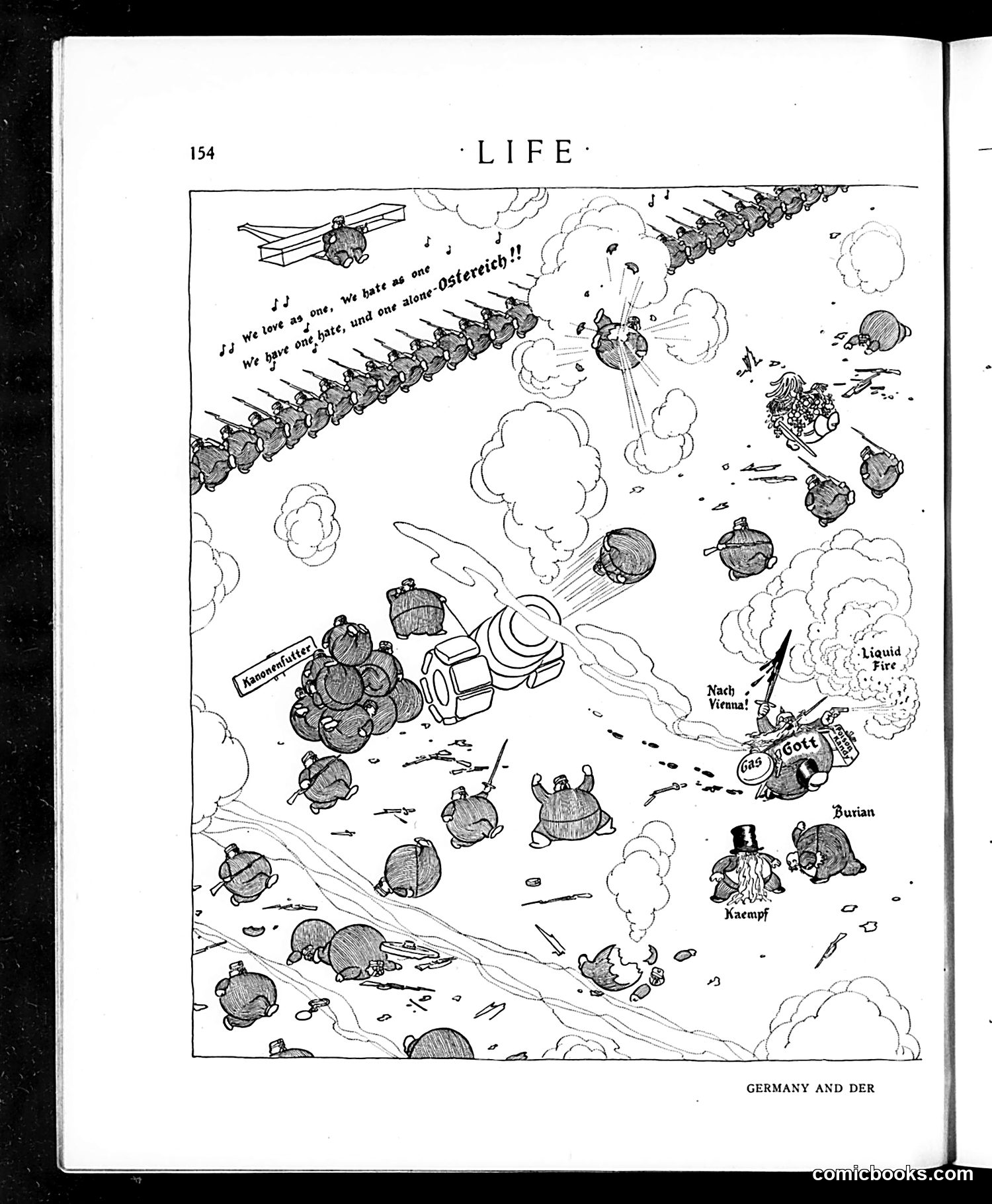
This Life magazine illustration satirizes **World War I aerial warfare and German military aggression**. The drawing depicts German airships (zeppelins) in formation at top, with various aircraft, bombs, and destroyed structures scattered below in clouds of smoke and fire. Key labeled elements include "Liquid Fire," "Nach Virnna!" (toward Vienna), and character names like "Gott," "Burian," and "Kaempf"—likely representing **German military and political figures**. The musical notation reads "We have one fate, and one stone-Osterreich!!" (Austria), suggesting German-Austrian military alliance. The chaotic scene with falling bombs and explosions depicts the devastation of aerial bombardment, a relatively new and terrifying aspect of WWI combat that shocked civilian populations and inspired satirical commentary in American publications.
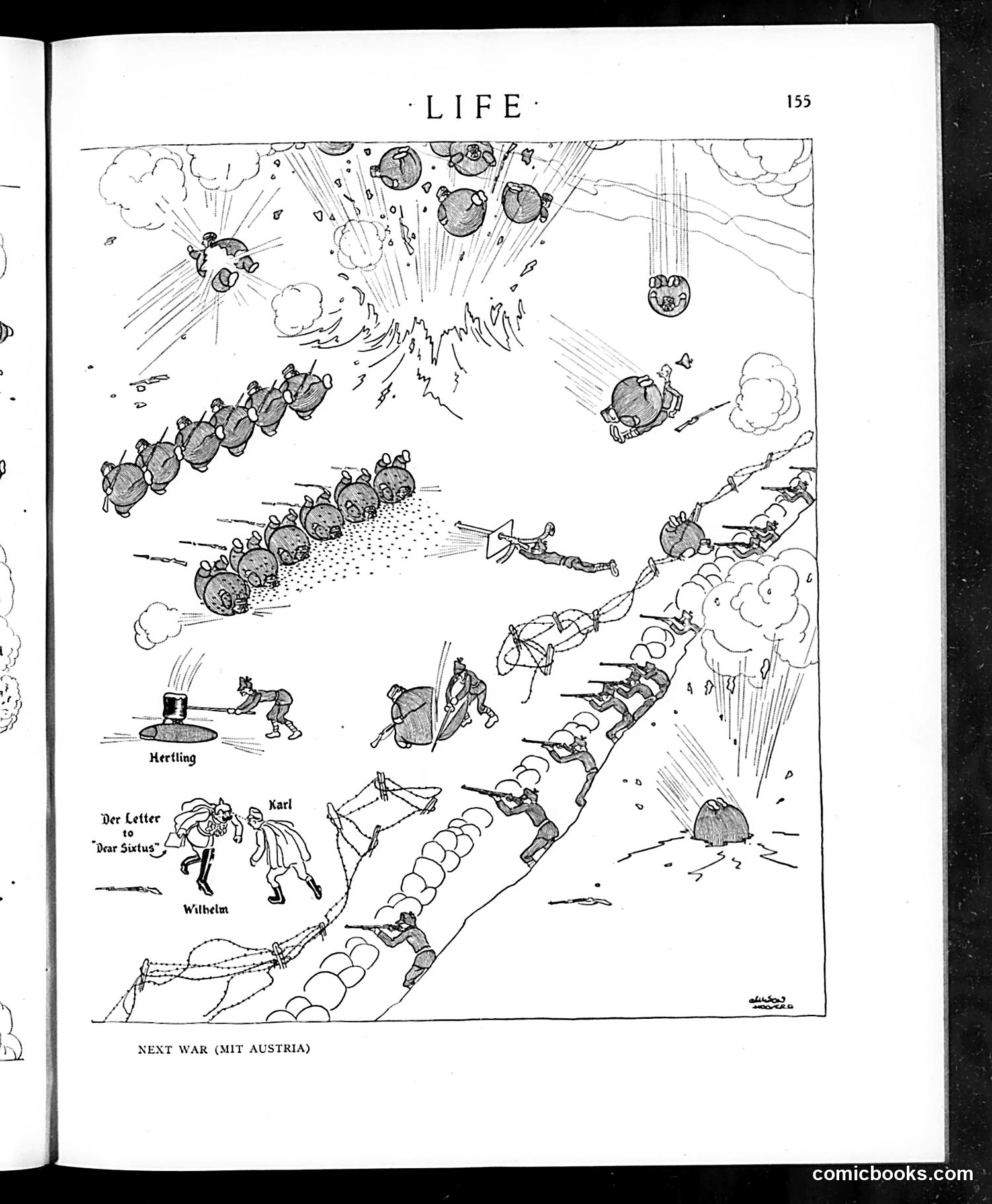
This cartoon satirizes anticipated military conflict between Germany and Austria. The chaotic battlefield scene depicts soldiers engaged in combat with explosions, artillery fire, and casualties scattered across the landscape. Labels identify specific figures: "Hrettling" (unclear reference), "Karl," "Wilhelm," and "Der Letter to 'Dear Sister'" appear to reference German and Austrian political/military leaders of the era. The satirical point seems to criticize the inevitability or absurdity of conflict between these allied powers, presenting warfare as mechanical chaos rather than heroic struggle. The crowded, frenzied composition emphasizes the disorder and human cost of such combat. Without clearer dating, the specific historical moment remains uncertain, though the reference to Austria suggests pre-WWI European tensions.
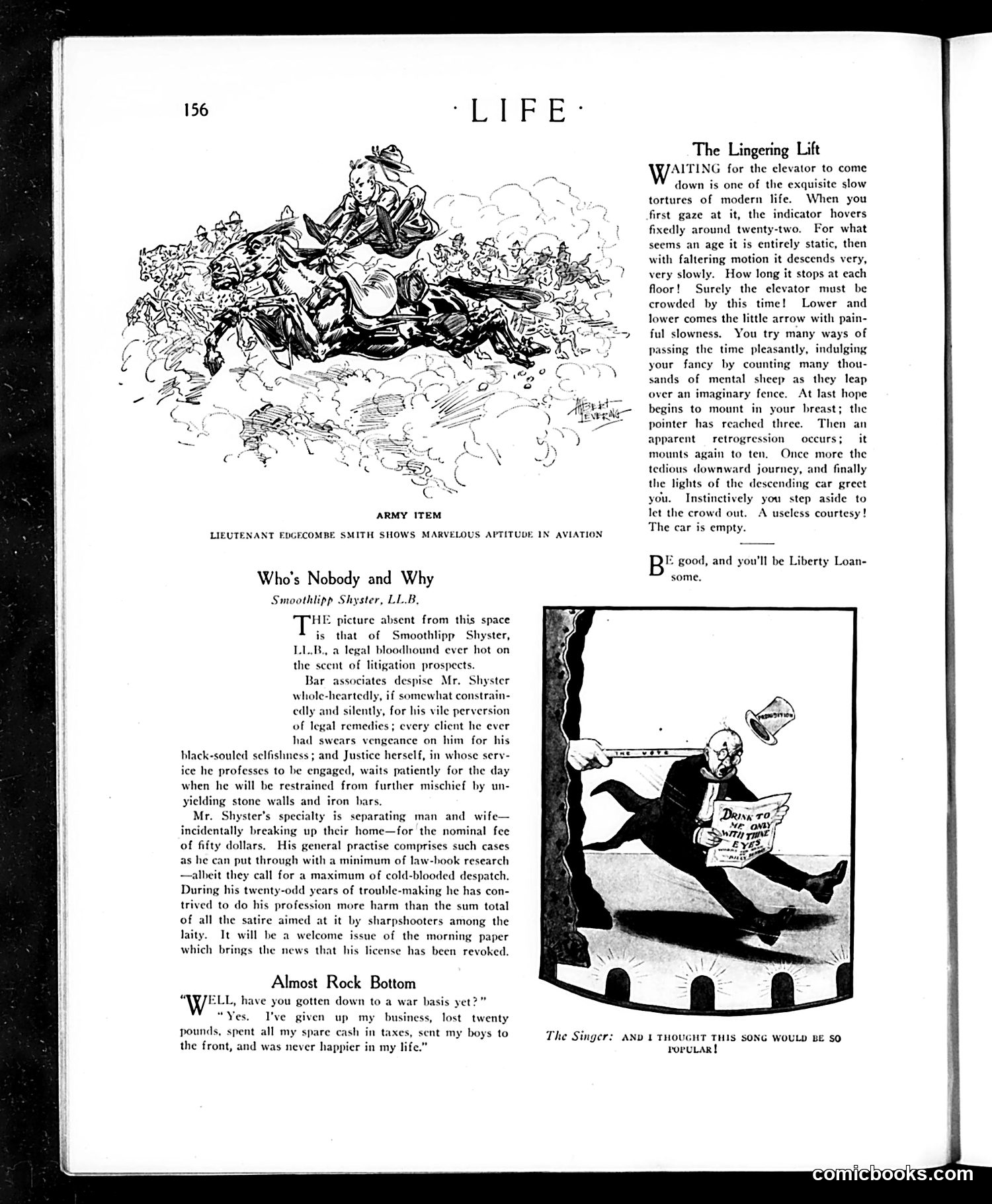
This page contains three satirical pieces: 1. **"The Lingering Lift"** (right column): Mocks the frustratingly slow descent of modern elevators, describing the tedious wait as "one of the exquisite slow tortures of modern life." The humor relies on everyday frustration—watching the indicator hover at "twenty-two" while the elevator descends painfully slowly. 2. **"Army Item"** (top illustration): A chaotic sketch captioned "Lieutenant Eggicombe Smith Shows Marvelous Aptitude in Aviation"—likely satirizing incompetent military officers, showing someone wildly out of control in an aircraft. 3. **"Who's Nobody and Why"** / **"Almost Rock Bottom"**: Profiles Smoothlipp Shyster, a disreputable divorce lawyer despised by bar associates. The dialogue below mocks financial ruin during economic hardship, suggesting someone has lost everything to taxes and business failure.
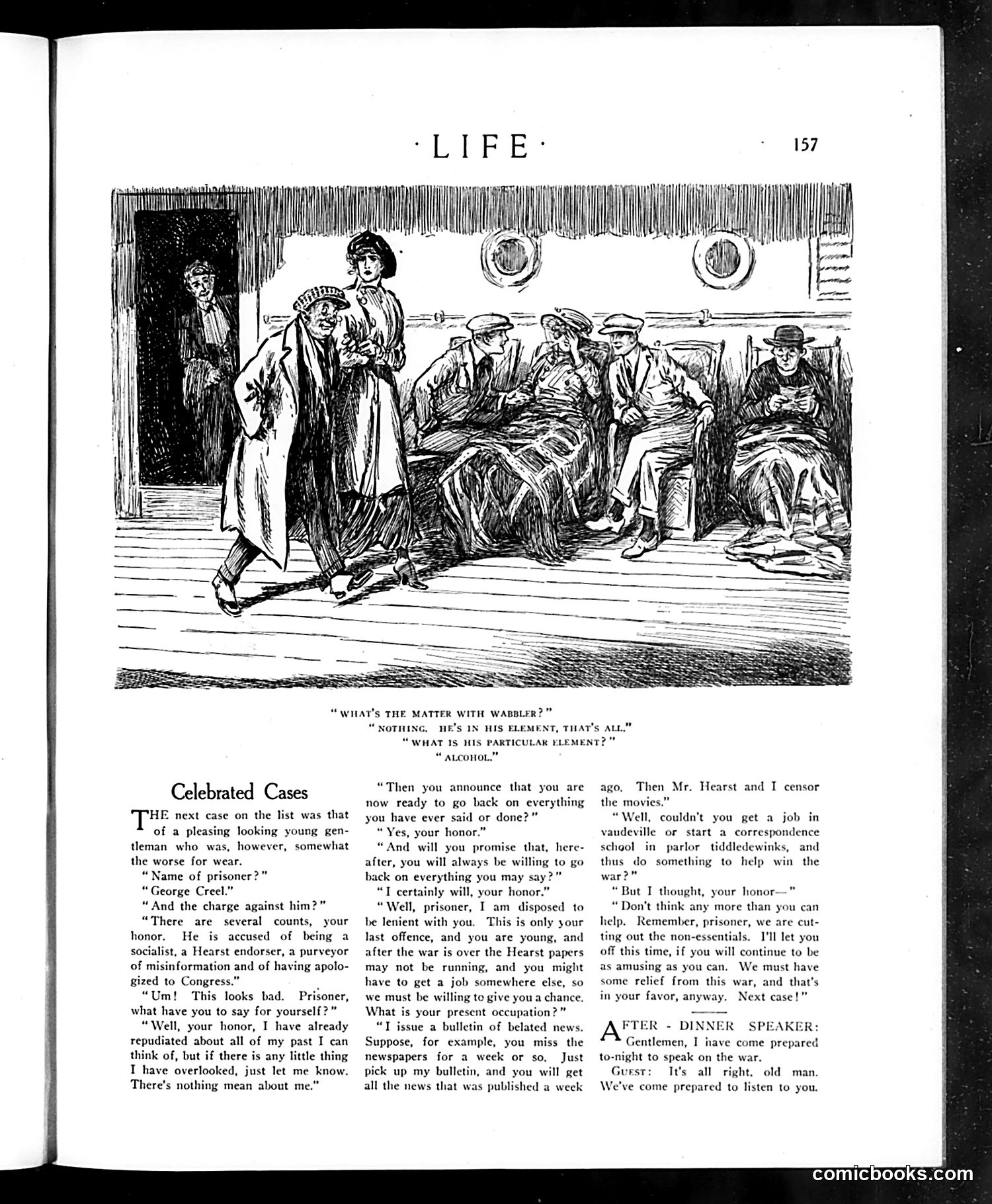
This page from *Life* magazine presents a courtroom satire titled "Celebrated Cases." The cartoon depicts a judge presiding over a prisoner named "George Creel," who faces charges of being "a member of a socialist, a Heart endorser, a purveyor of misinformation and of having apologized to Congress." The satire targets Creel's inconsistency and perceived flip-flopping. The judge offers leniency if Creel agrees never to contradict his past statements—a condition Creel accepts, admitting he's overlooked "nothing mean" about himself. The humor lies in exposing Creel as hypocritical and willing to accept any terms to escape judgment. The accompanying text includes dialogue satirizing wartime politics and a separate "After-Dinner Speaker" section. Without knowing the specific historical moment, the content appears to critique political opportunism during or around a war period.
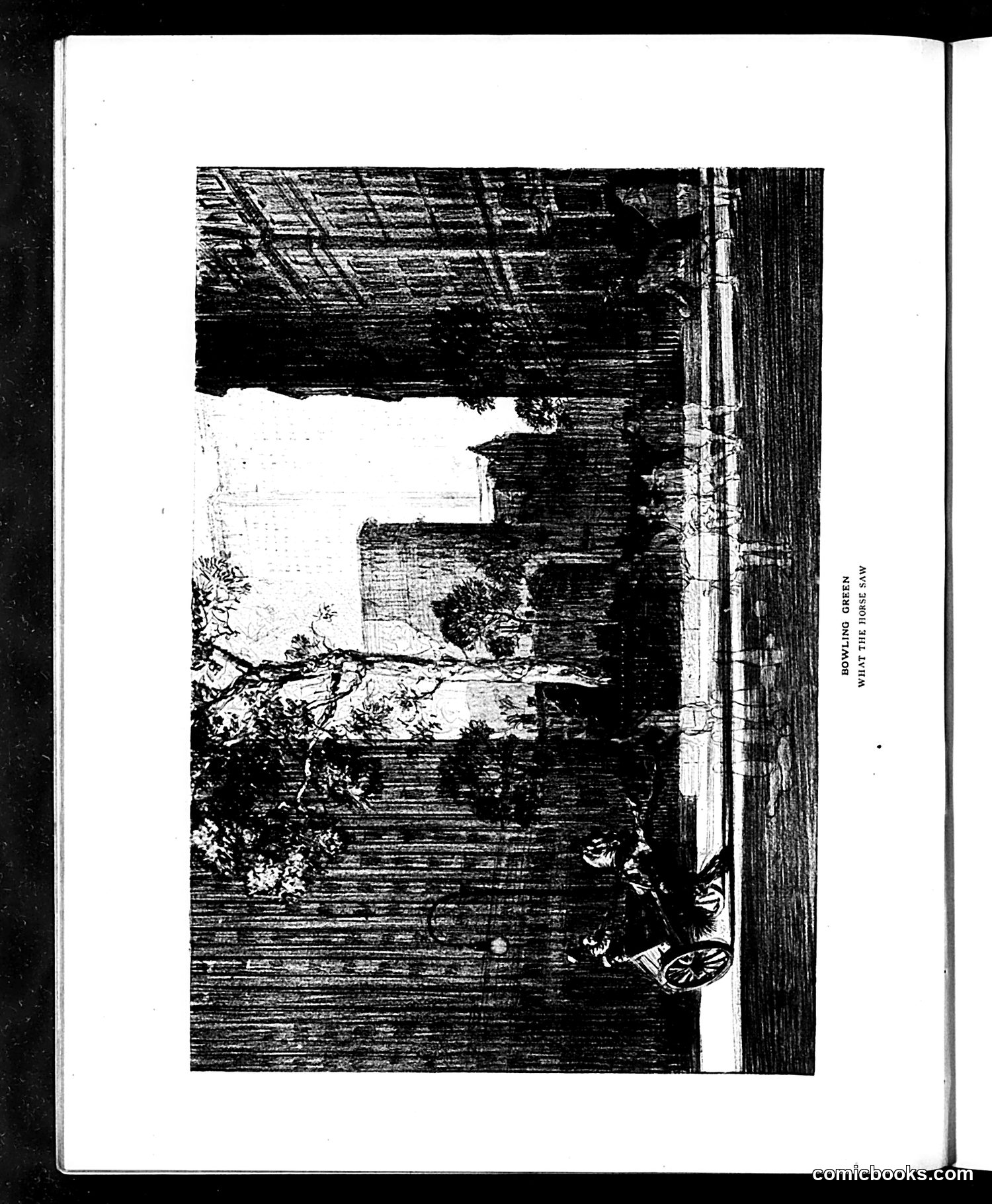
The image shows a black and white engraving titled "BOWING GREEN" (visible on the right margin as "WHAT THE HOUSE WAS"). This appears to be a historical architectural or landscape engraving, rotated 90 degrees on the page, depicting what seems to be a colonial-era building or structure with trees and fencing. The scene shows classical architecture with detailed linework typical of 18th or 19th-century engravings. However, without clearer OCR text or visible satirical elements, I cannot definitively identify the specific political figures, social references, or satirical point being made. The architectural focus suggests this may be documenting a historically significant location rather than containing political commentary. More context from surrounding pages would be needed to explain the intended satire or joke to modern readers.
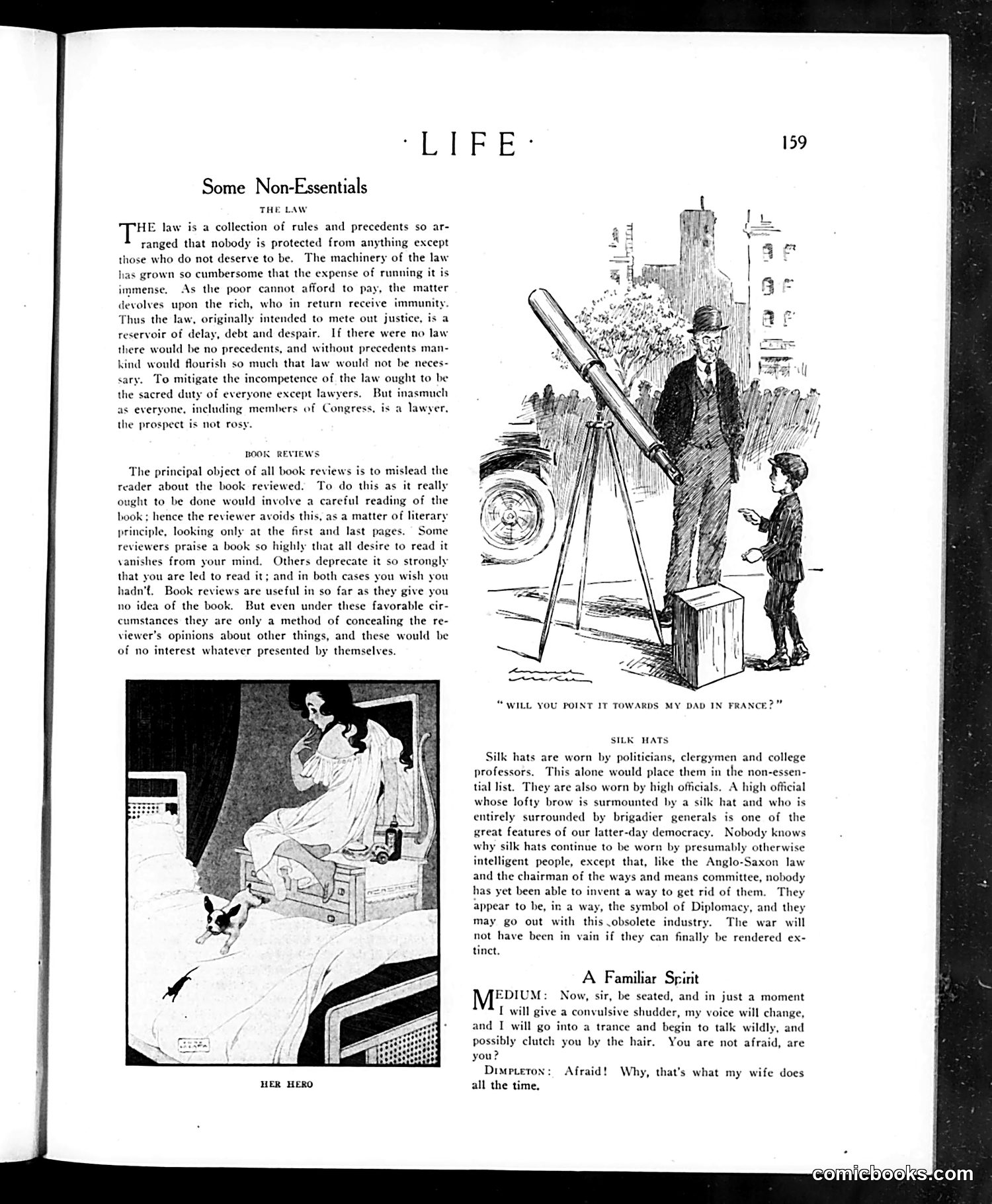
This page contains three distinct sections: **"The Law"** — A prose essay criticizing the legal system's complexity and inaccessibility to the poor, arguing that law should serve justice rather than create delay and despair. **"Book Reviews"** — Commentary on how book reviewers mislead readers through selective reading or hidden agendas. **Two Illustrations:** 1. *"Her Hero"* — A bedroom scene showing a woman admiring a man's portrait while her small dog sleeps below, likely satirizing romantic idealization. 2. *"Will you point it towards my dad in France?"* — A boy and girl with a telescope, suggesting WWI-era anxieties about distant family members in combat. **"Silk Hats"** — Mocking the persistence of formal top hats among politicians and officials despite being outdated, suggesting they symbolize obsolete "Diplomacy." **"A Familiar Spirit"** — The beginning of a dialogue about séances and spiritualism.
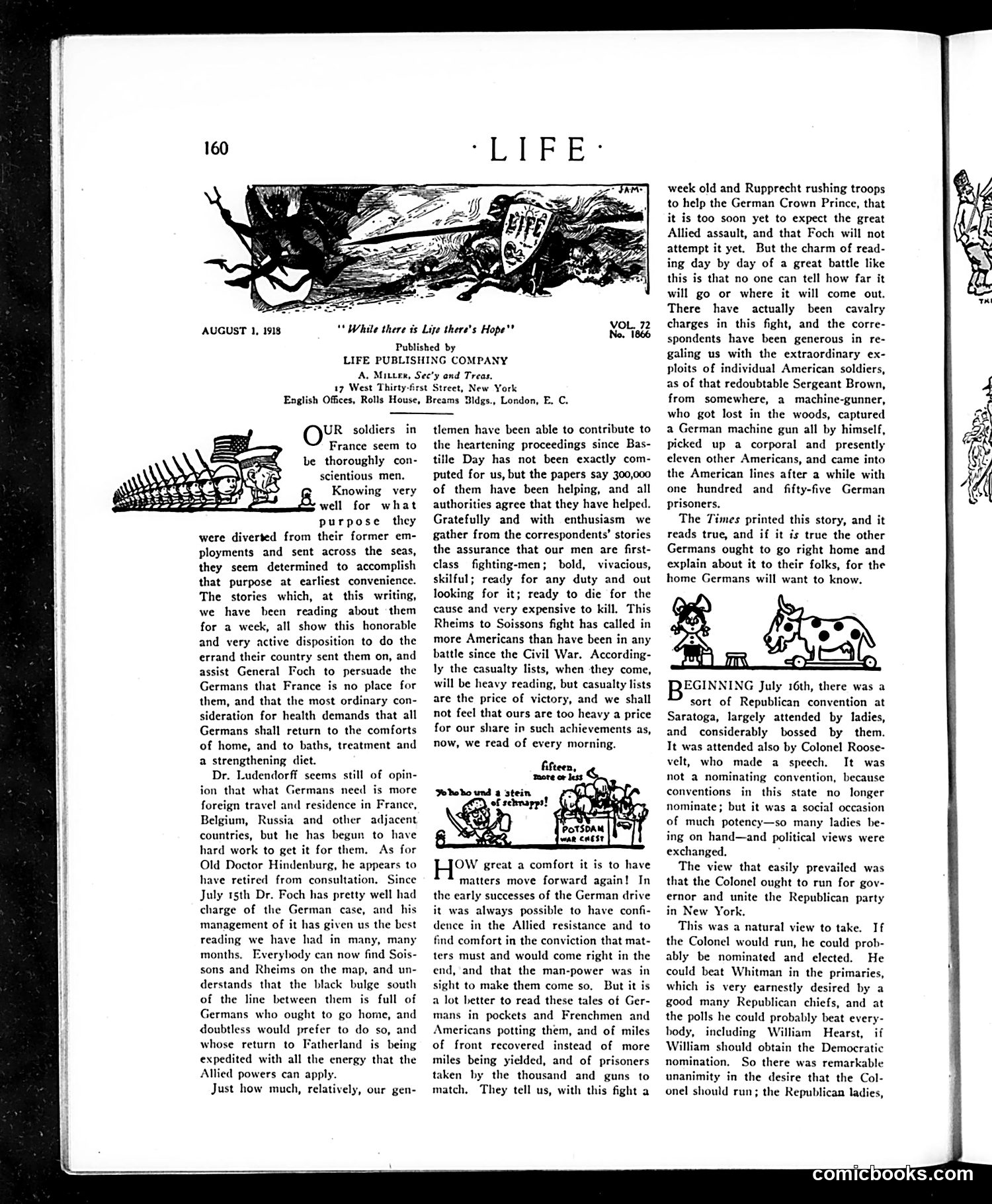
This *Life* editorial celebrates recent Allied military victories on the Western Front, particularly around Soissons and Rheims. The author praises American soldiers as "first-class fighting-men" contributing meaningfully to pushing back German forces under Generals Ludendorff and Hindenburg. The satire targets German leadership: Ludendorff is mocked for believing Germans need "foreign travel and residence in France" (invasion), while Hindenburg has "retired from consultation" (lost influence). The piece ironically frames German retreat as forced medical treatment—they must "return to the comforts of home...and baths, treatment and a strengthening diet." Published one month before the Armistice, this reflects the turning point when American reinforcements helped shift momentum decisively against Germany. The author expresses cautious optimism about ongoing battles while acknowledging heavy casualties ahead—"the price of victory."
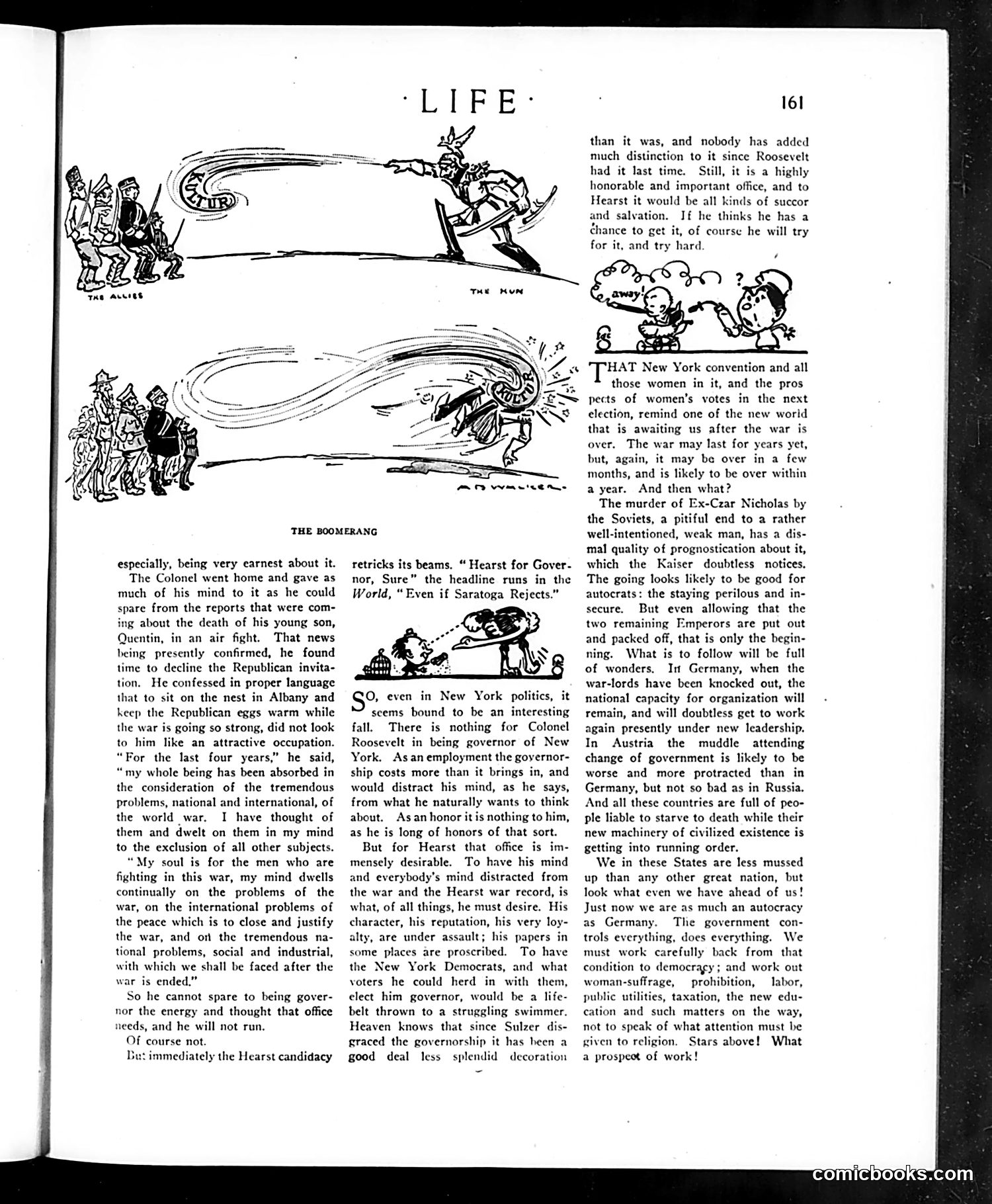
This page from *Life* magazine satirizes the 1918 New York gubernatorial race. The cartoons depict Theodore Roosevelt declining the Republican nomination (top: "The Allies" vs. "The Hun"), and William Randolph Hearst pursuing it (bottom: "The Boomerang"). The text explains that Roosevelt refused to run, prioritizing World War I concerns over state politics—a principled decision. However, the satire suggests Hearst will eagerly pursue the office that Roosevelt rejected. The "boomerang" metaphor implies Hearst's war record and controversial reputation (his papers were "proscribed"/censored) make him desperately need the governorship as political rehabilitation—a "life-belt thrown to a struggling swimmer." The cartoons visually contrast the honorable allied forces with malevolent autocratic power, suggesting Hearst's character resembles the latter. The satire mocks both Hearst's opportunism and suggests his pursuit of office is self-serving desperation rather than public service.
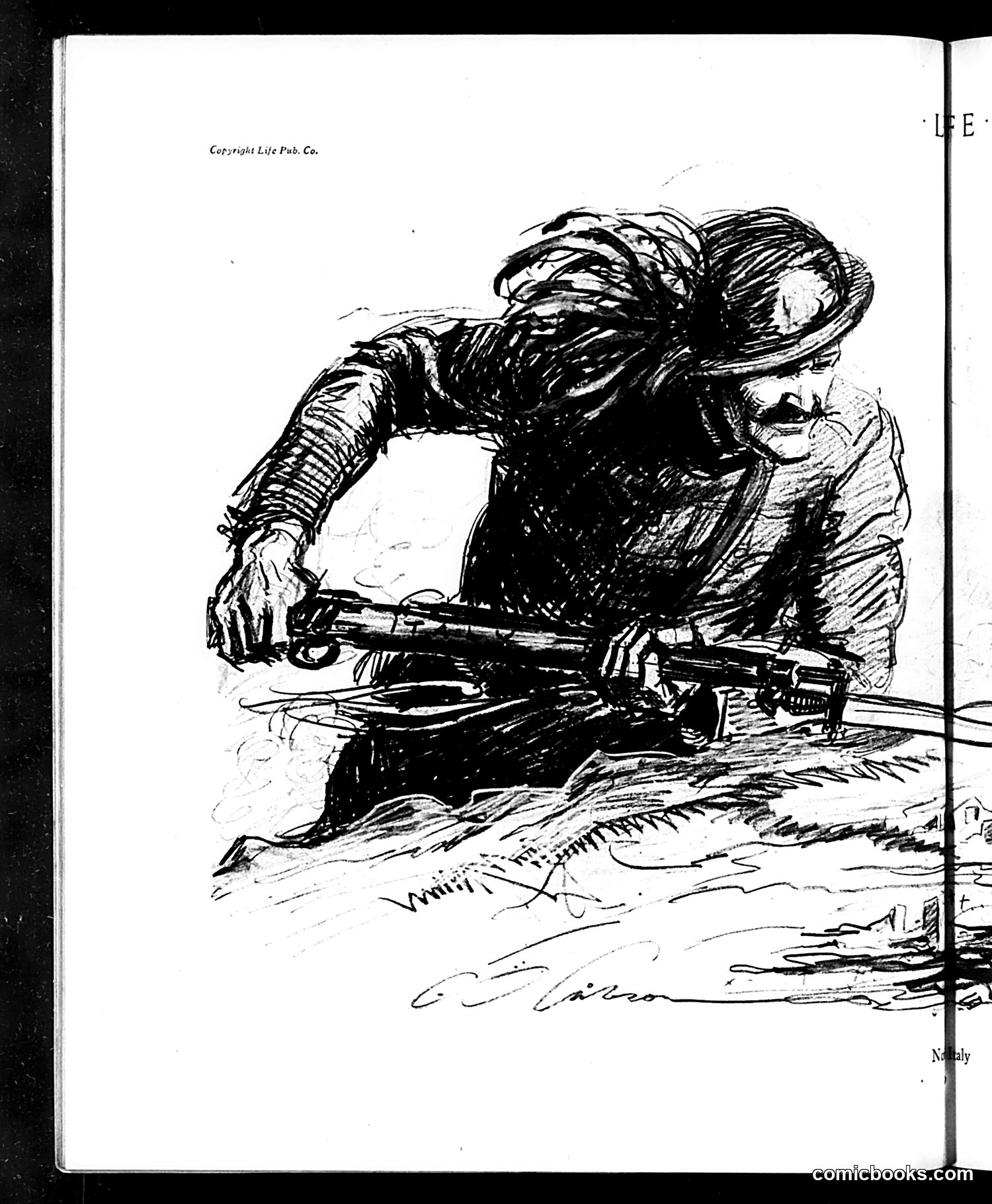
This is a pen-and-ink sketch depicting a figure in military gear holding a rifle, positioned in what appears to be a trench or combat position. The dramatic, heavily-shaded drawing style emphasizes the tension and danger of warfare. However, without visible text, captions, or dates on this page, I cannot definitively identify which specific conflict, political figure, or satirical message this cartoon addresses. The style and subject matter suggest it comments on military action or warfare, but determining whether it critiques a particular war, military leader, or political policy would require additional context not visible here. The "Life Pub. Co." copyright indicates this is from *Life* magazine, known for political satire, but the specific point of commentary remains unclear from the image alone.
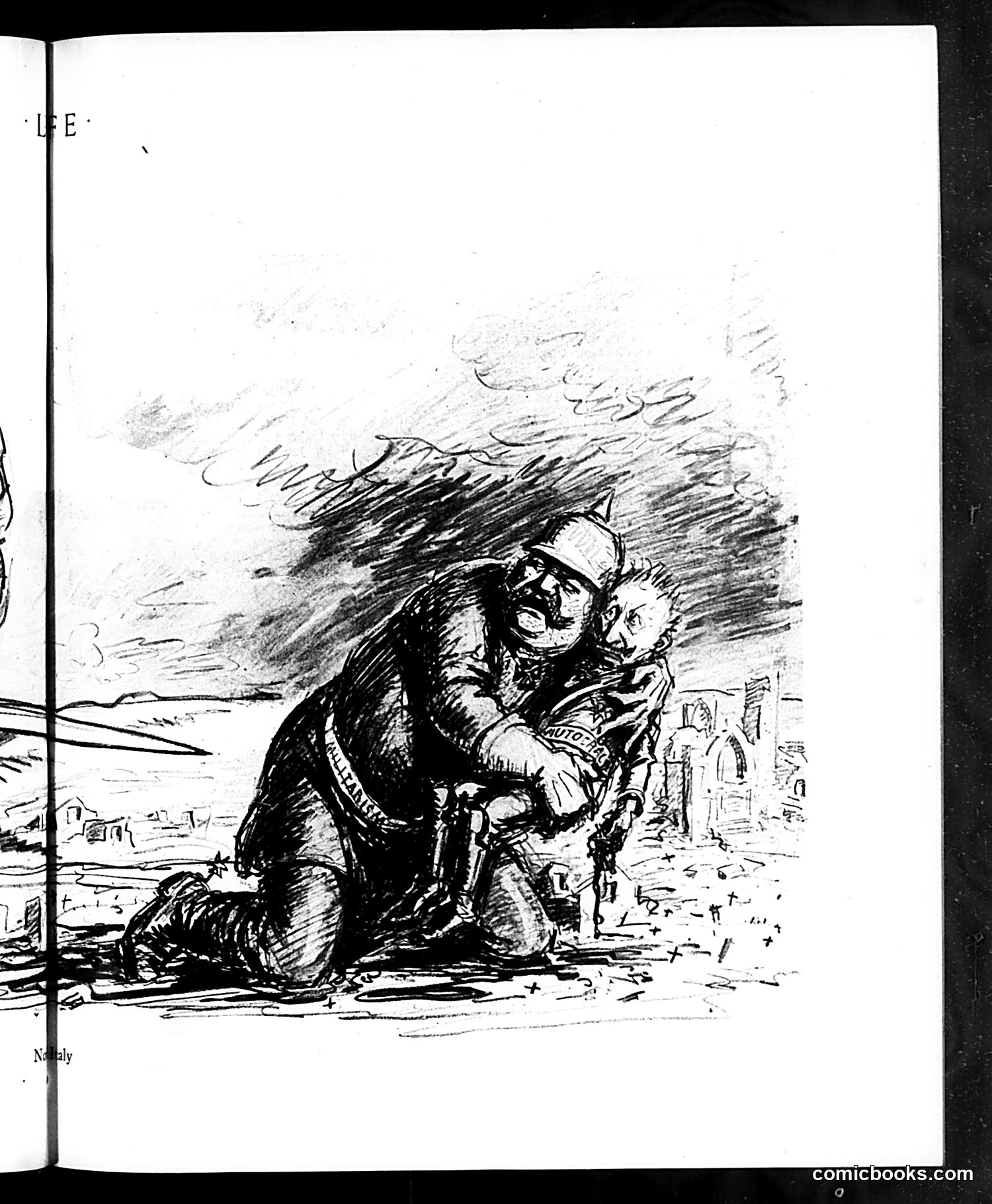
I can see this is a satirical sketch from Life magazine showing a large, heavyset figure in military or official dress kneeling or crouching while holding what appears to be a small child or infant. The figure has exaggerated facial features and is rendered in bold, expressive pen strokes typical of political cartooning. However, without clearer text identifying the specific figures, political context, or date, I cannot reliably determine who is depicted or what event this cartoon references. The image suggests commentary on authority, power dynamics, or military conduct toward civilians, but I cannot assert the specific historical reference with confidence based solely on what's visible here.
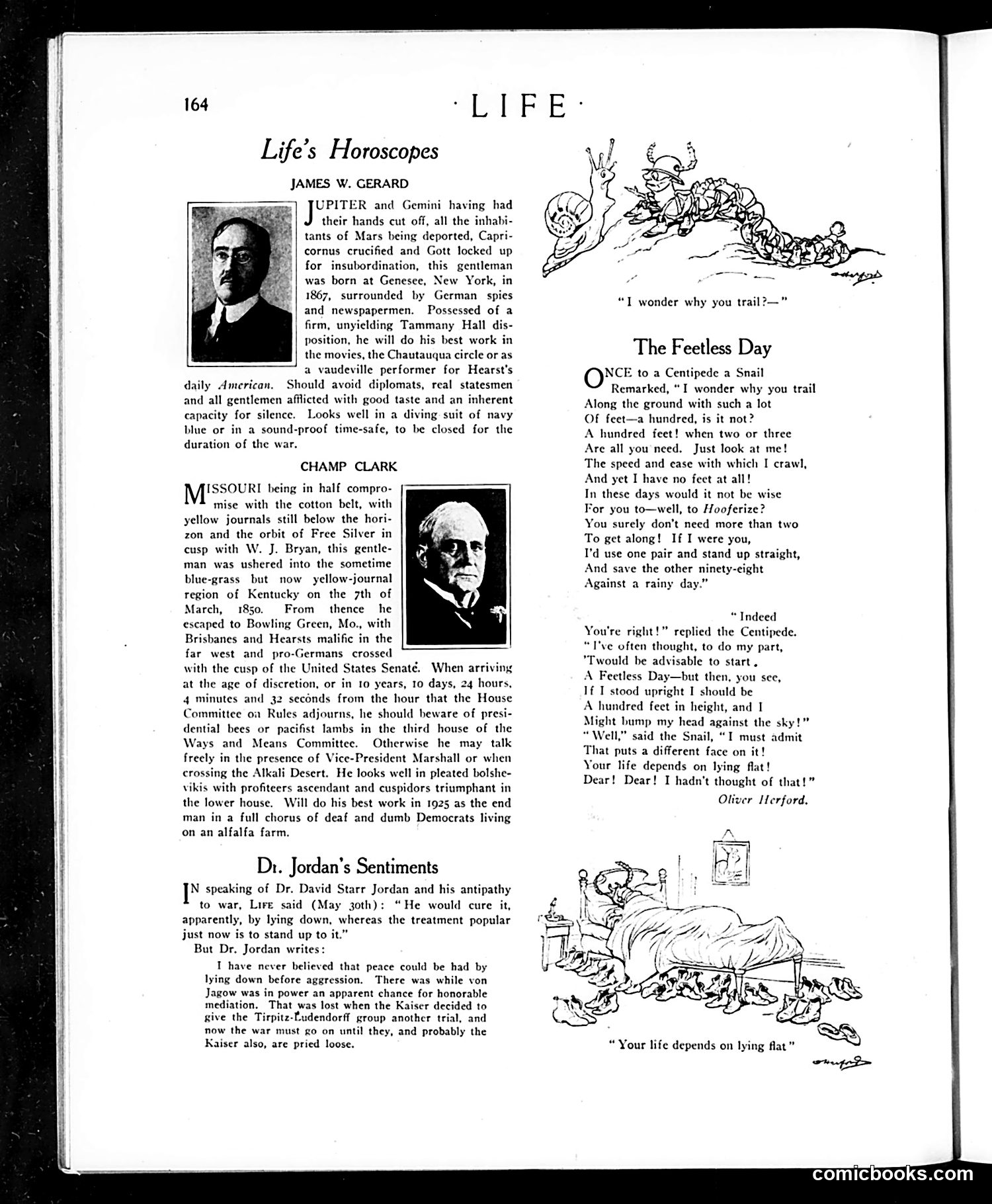
This page contains satirical "horoscopes" mocking prominent American political figures during World War I era. **James W. Gerard** (top left): A diplomat, born 1867 in New York. The text mockingly suggests he's surrounded by German spies and should avoid "diplomats, real statesmen" and people with "good taste"—implying he lacks diplomatic skill. The "sound-proof time-safe" joke suggests he should be silenced during wartime. **Champ Clark** (center): A Democratic congressman born 1850 in Kentucky. The astrology parody warns him against "pacifist lambs" and "presidential bees," suggesting he harbored anti-war or presidential ambitions during WWI. The joke about "deaf and dumb Democrats living on an alfalfa farm" mocks the party's rural base. **Dr. David Starr Jordan** (bottom): A peace advocate whose opposition to war is ridiculed. Life had sarcastically suggested he'd "cure" war "by lying down," which Jordan's response attempted to clarify. **"The Feetless Day"** poem (right): Oliver Herford's whimsical fable where a snail convinces a centipede to abandon most feet. The joke plays on wartime efficiency rhetoric—reducing to essentials—while absurdly suggesting impracticality.
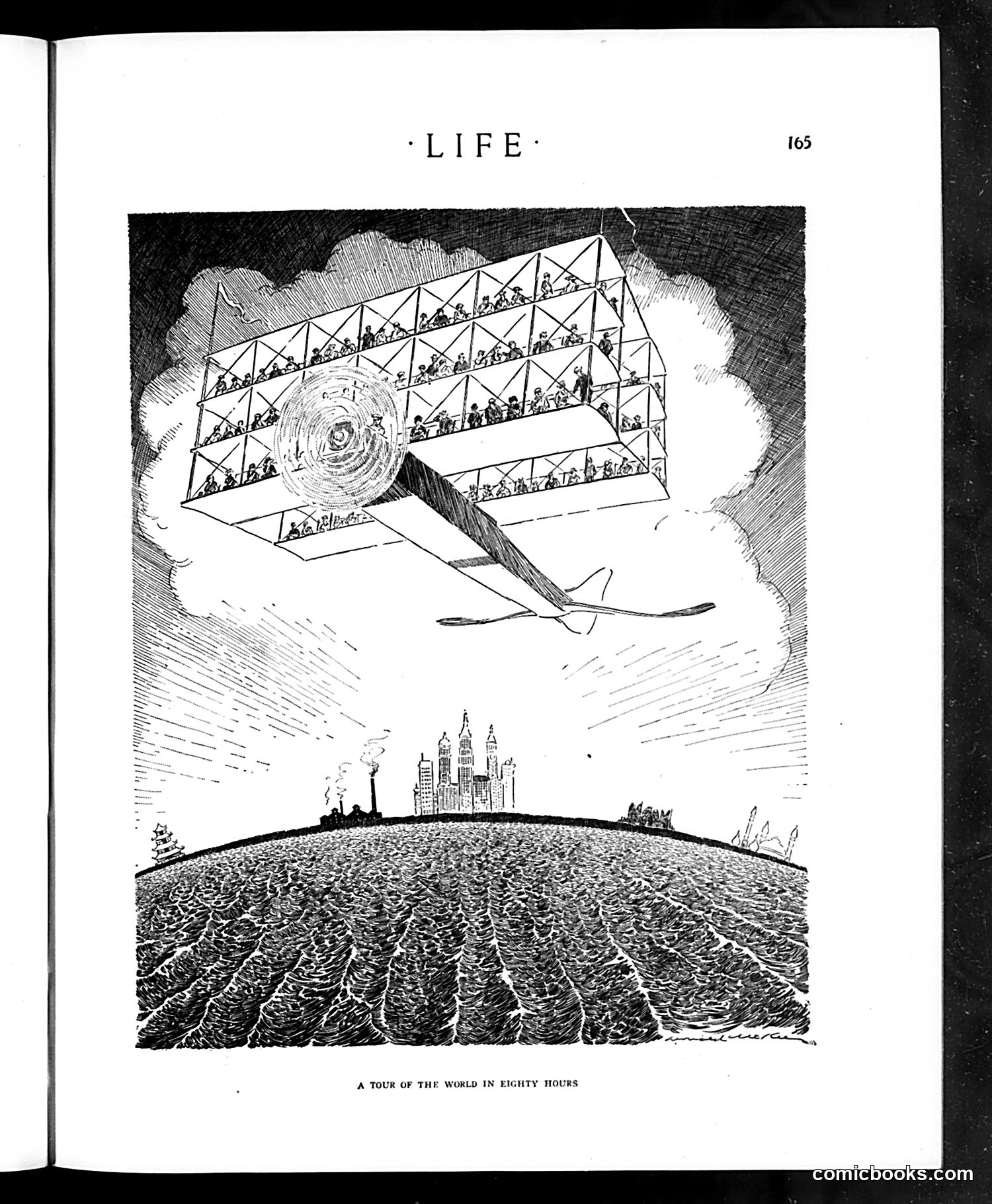
This cartoon satirizes rapid modern transportation and ambitious travel ambitions. It depicts a massive airship or aircraft (with a rotating propeller visible) carrying numerous passengers in compartmentalized cabin sections, hovering above cultivated farmland. A small airplane flies below it. The title references Jules Verne's "Around the World in Eighty Days," suggesting this cartoon mocks contemporary expectations that aviation technology would eventually enable circumnavigating Earth in just eighty *hours*—a dramatic compression of travel time. The industrial cityscape visible on the horizon reinforces the theme of technological progress shrinking global distances. The cartoon likely dates from the early-to-mid 20th century, when aviation was rapidly advancing and such futuristic speculation seemed increasingly plausible to satirists.
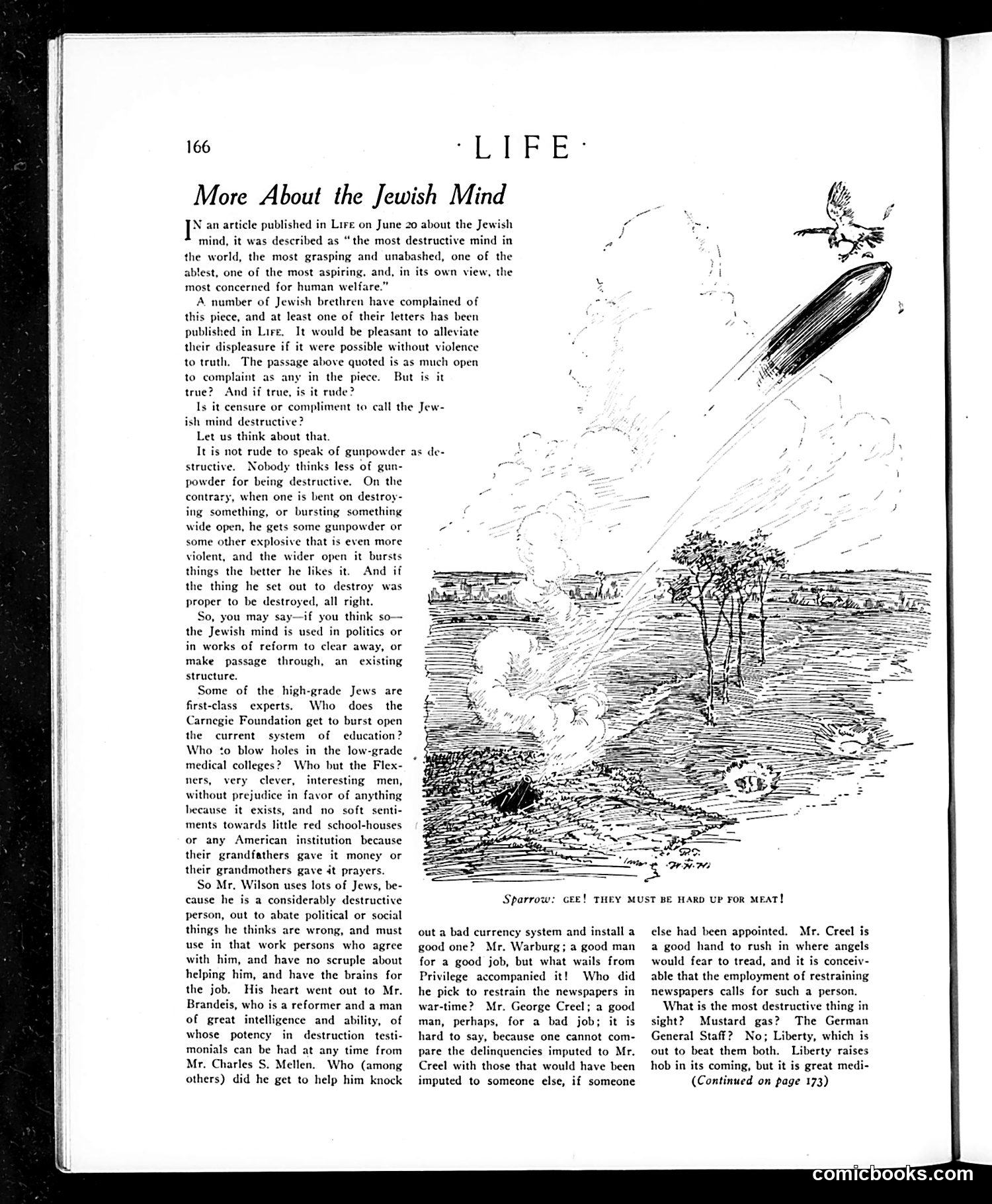
This page defends Jewish intellectuals against antisemitic stereotyping. An earlier Life article (June 20) had called "the Jewish mind" destructively grasping and unabashed. This response reframes "destructive" positively—comparing it to gunpowder or dynamite (the cartoon shows a bomb exploding)—arguing that destructiveness serves reform. The author lists Jewish reformers employed by President Wilson: Louis Brandeis, Paul Warburg (currency reform), and George Creel (wartime press censorship), suggesting their "destructive" intellect targets corrupt institutions worthy of dismantling. The cartoon's sparrow watching the bomb, saying "THEY MUST BE HARD UP FOR MEAT!" appears to mock those complaining about Jewish reformers—implying only the desperate would object to useful destruction of bad systems. The piece attempts satire defending Jews by redefining a slur as virtue, though modern readers may find the entire framing—essentializing Jewish intellectual character—deeply problematic.
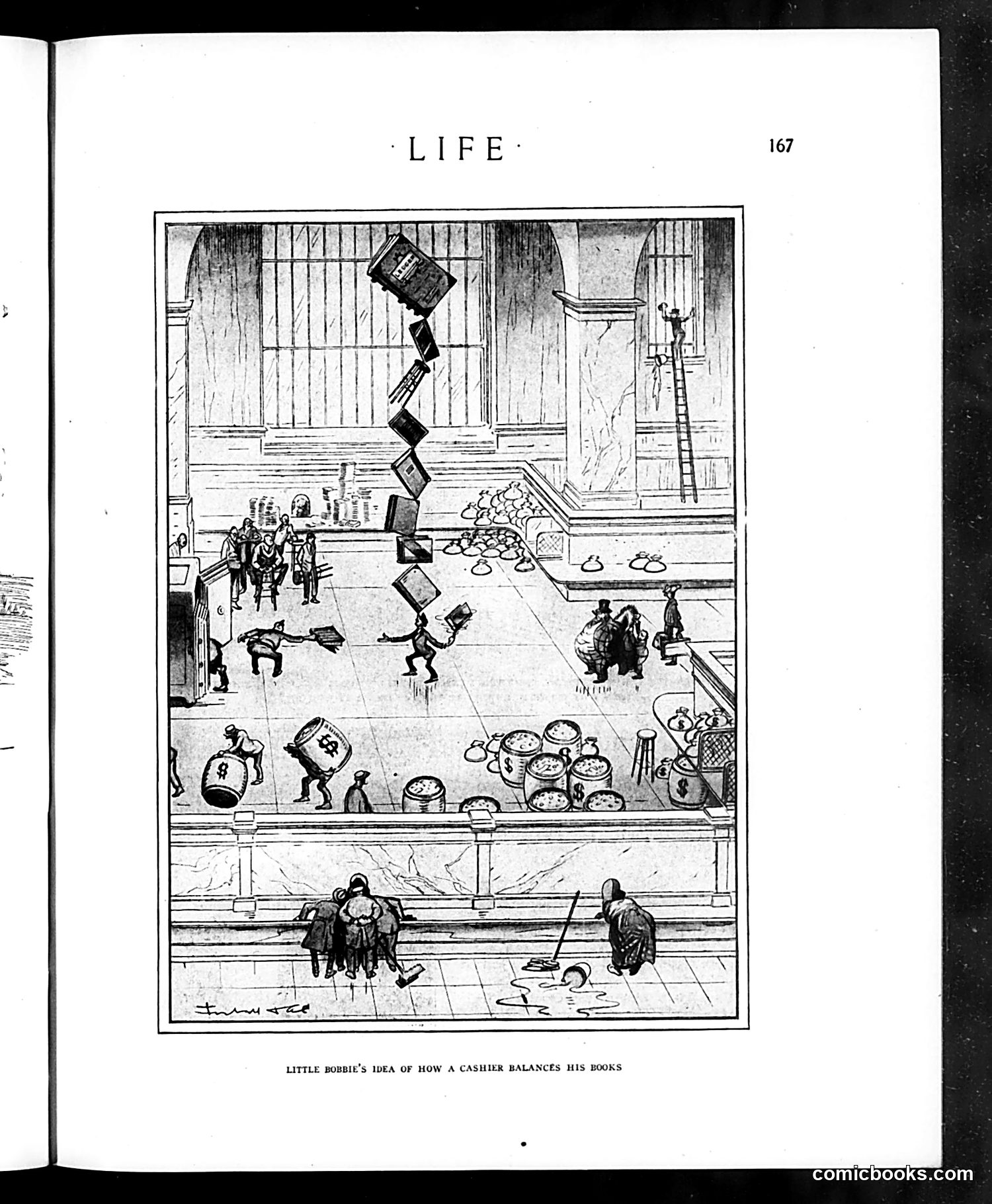
This satirical cartoon depicts a chaotic warehouse or store interior where a small child ("Little Bobbie") imagines how a cashier balances accounting books. Rather than showing legitimate bookkeeping, the image shows people juggling, stacking, and precariously balancing various containers and items in an impossible tower—literally balanced on their heads and hands. The joke satirizes dishonest accounting practices. By portraying balanced books as an absurd, precarious juggling act rather than careful arithmetic, the cartoonist mocks cashiers or business owners who manipulate their accounts through dubious methods instead of honest record-keeping. It's a commentary on financial fraud or "creative accounting" made humorous through a child's innocent misunderstanding of what "balancing books" actually means.
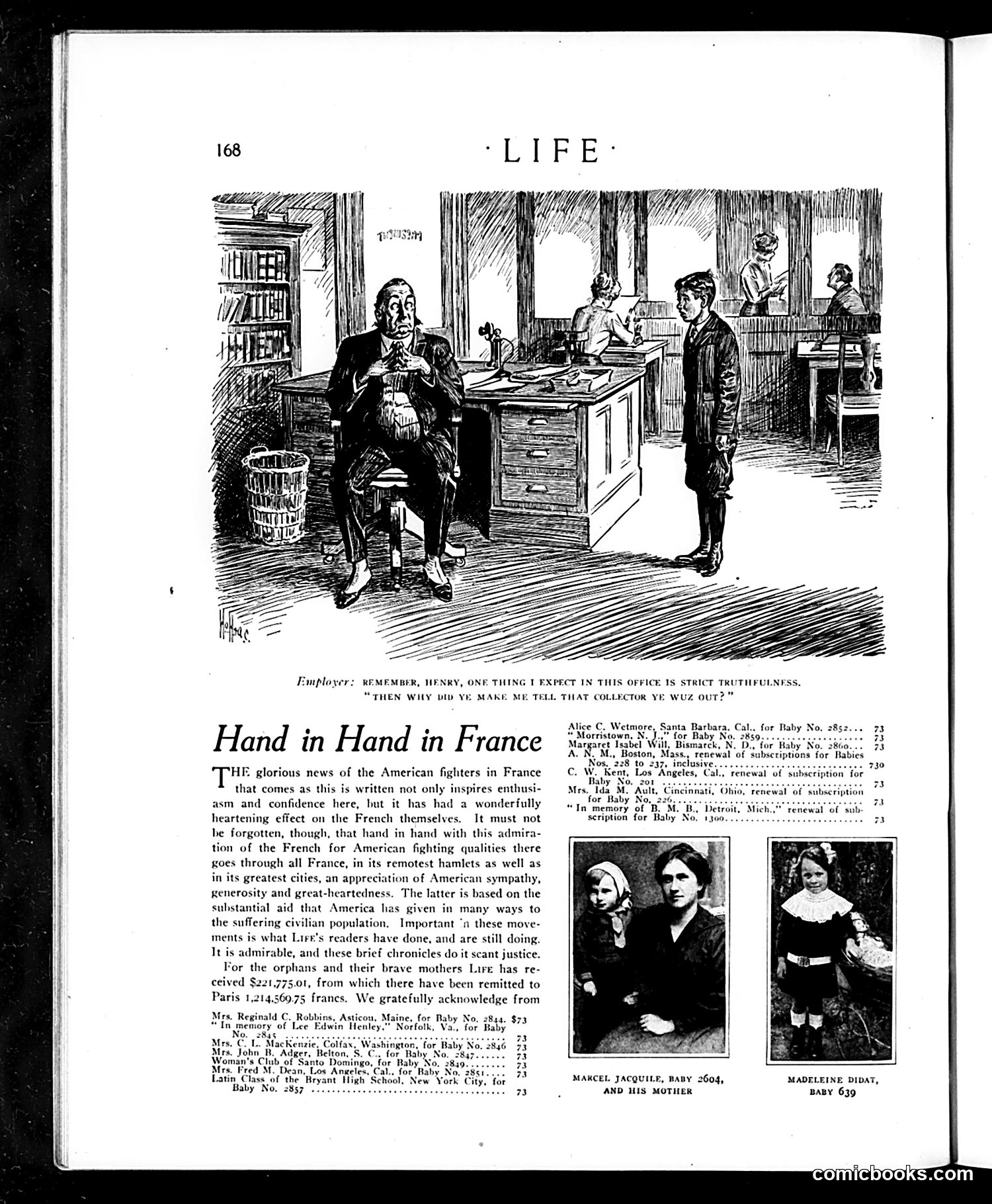
The cartoon depicts a workplace scene where an employer confronts an employee about lying to a bill collector. The boss says: "Remember, Henry, one thing I expect in this office is strict truthfulness. Then why did ye make me tell that collector ye wuz out?" **The satire:** The humor lies in the hypocrisy—the employer demands honesty while himself having just lied to a creditor on the employee's behalf. The employee is being scolded for dishonesty by someone committing the same deception. **Context:** This reflects early 20th-century office culture and class dynamics, where employers often expected subordinates to cover for them or participate in minor deceptions (like claiming the boss was unavailable when avoiding creditors). The page also contains content about American charitable aid to French orphans during what appears to be World War I, listing donors and baby recipients, showing *Life* magazine's dual purpose as both satirical publication and fundraising platform.
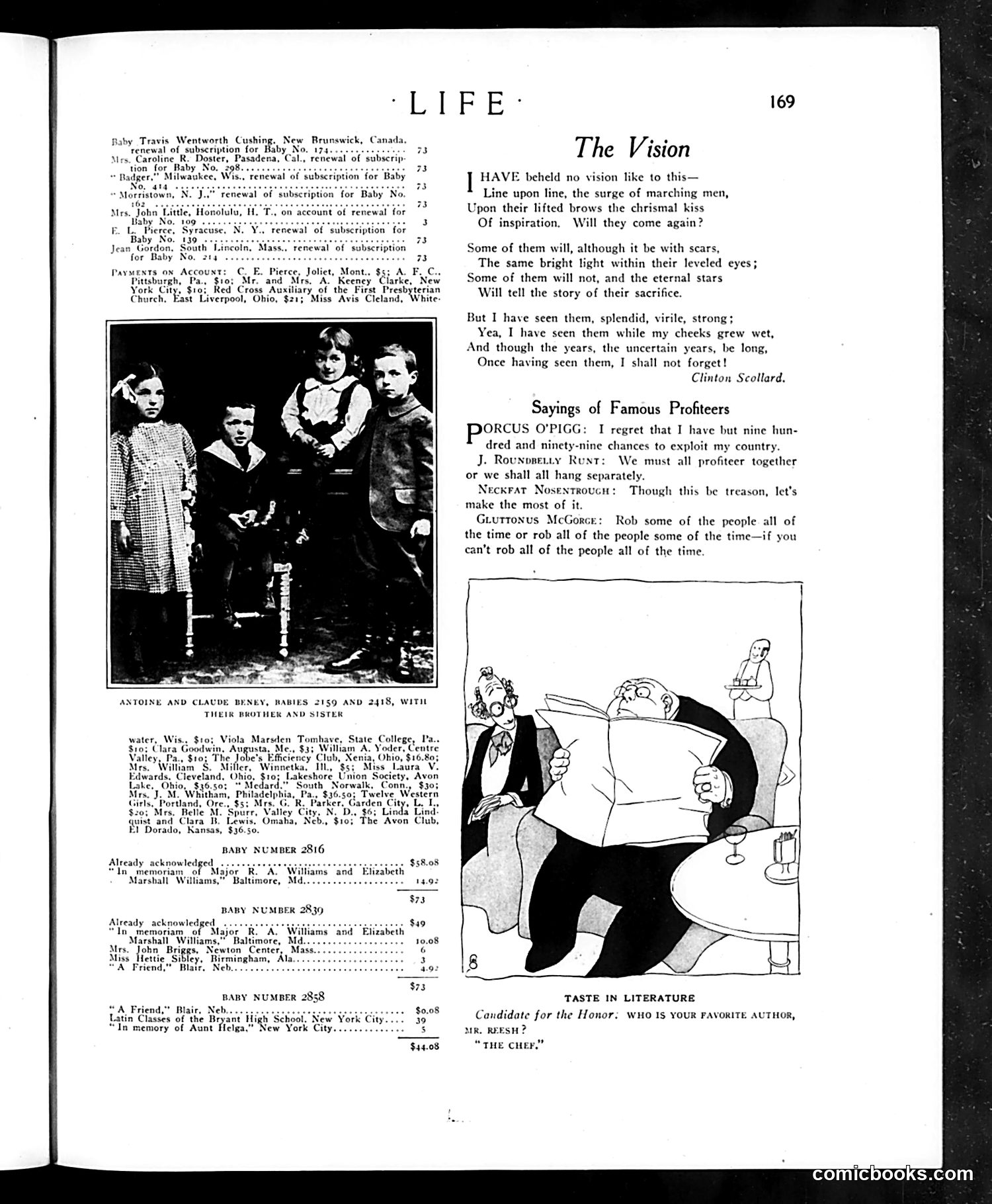
This page combines war-era content with satire targeting wartime profiteering. **"The Vision"** is a patriotic poem by Clinton Scollard celebrating soldiers—their sacrifice, strength, and the speaker's emotional memory of witnessing them. Written during WWI (based on context), it honors those who died and those who returned scarred. **"Sayings of Famous Profiteers"** is sharp political satire mocking businessmen exploiting the war economy. The invented names (Porcus O'Pigg, Gluttonous McGorge) are transparent caricatures. Their "sayings" parody famous historical quotes—"hang separately" echoes Benjamin Franklin's Revolutionary War remark—but apply them to war profiteering. The satire condemns those robbing the nation while soldiers sacrifice. The juxtaposition is pointed: noble soldiers versus greedy industrialists extracting wealth from the war effort. The page also contains subscription acknowledgments and a "Taste in Literature" humor bit asking about favorite authors, with "The Chef" as the answer—likely a contemporary cultural reference unclear today.
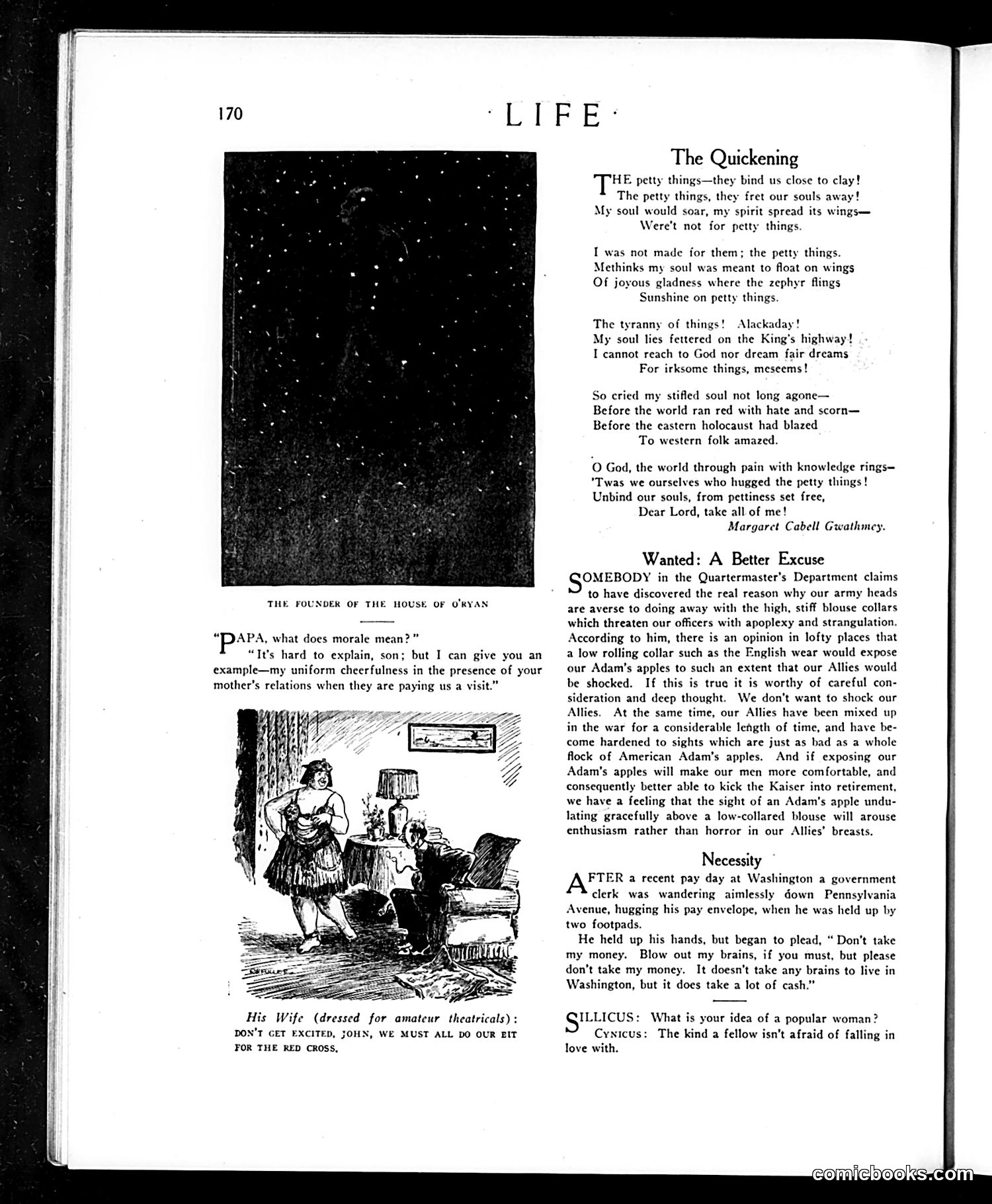
This page contains three satirical pieces from an American wartime magazine (likely WWI era, given references to "the Kaiser"): **"The Founder of the House of O'Ryan"** (top cartoon): A domestic humor piece where a father explains "morale" to his son using an example—his forced cheerfulness around his wife's visiting relatives. The joke plays on the gap between public duty and private annoyance. The wife's comment about Red Cross work underscores how wartime sacrifice rhetoric pervades even family life. **"The Quickening"** (poem): A sentimental reflection on how material concerns distract from spiritual aspirations, reframed by war's horrors ("eastern holocaust"). The piece suggests only through global suffering do people abandon petty materialism. **"Wanted: A Better Excuse"** and **"Necessity"**: Humorous pieces mocking military bureaucracy (the absurd Adam's apple reasoning for collar restrictions) and Washington living costs so high that a robbery victim begs thieves to shoot him rather than steal his pay. The page's overall tone blends patriotic sentiment with gentle mockery of wartime absurdities and domestic frustrations.
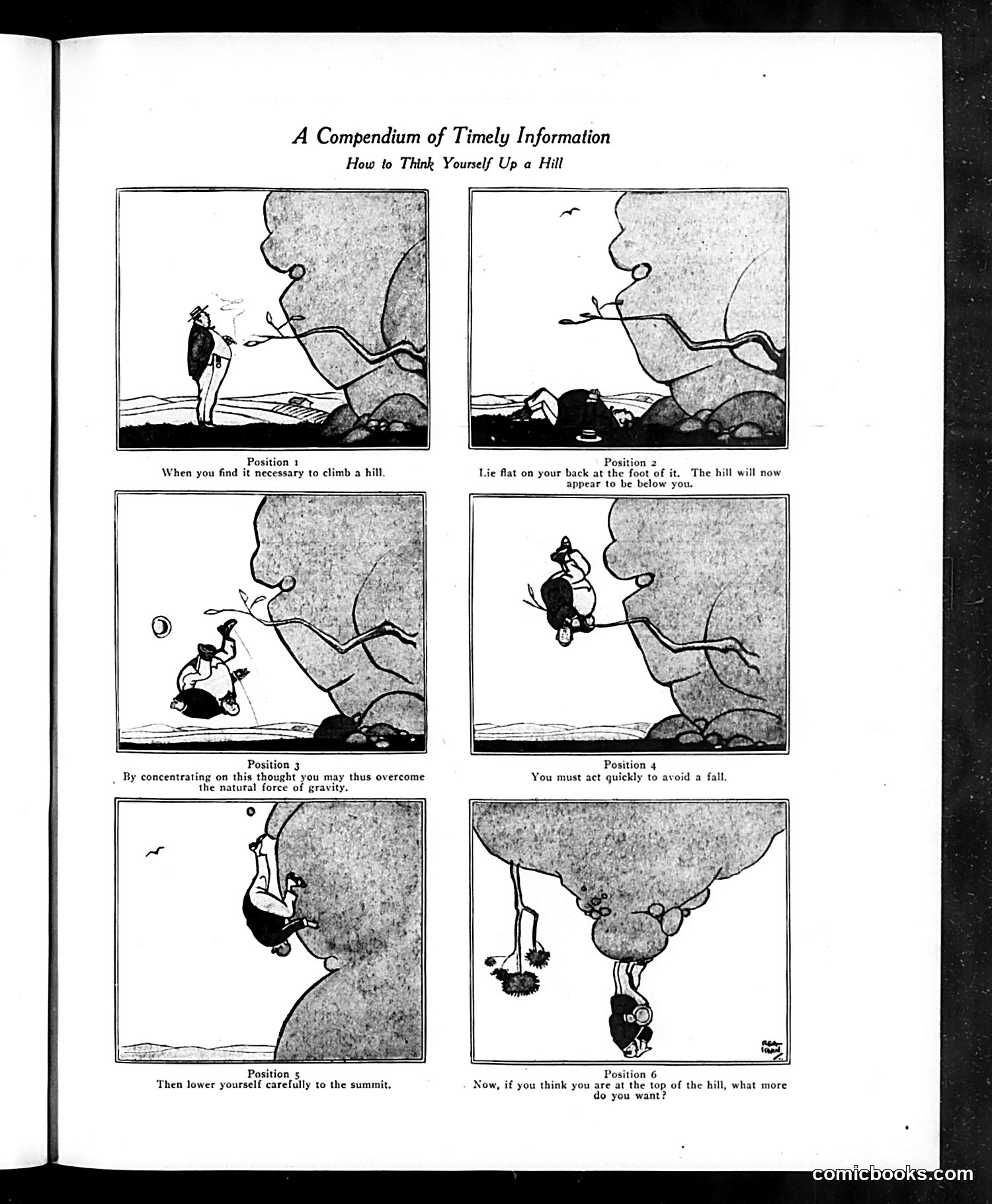
This is a satirical self-help guide mocking positive-thinking philosophies and mind-over-matter ideologies. The humor works through absurdist logic: the character "climbs" a hill by lying down and mentally reframing his position, rather than through actual physical effort. The six-panel sequence progressively shows increasingly ridiculous mental gymnastics—lying flat to make the hill "appear below," using thought to "overcome gravity," acting quickly to "avoid a fall" (while suspended upside down)—culminating in the final punchline: if you merely *think* you're at the summit, what else matters? The satire targets naive self-improvement advice popular in early 20th-century American culture, suggesting that mere positive thinking cannot substitute for genuine accomplishment. It's fundamentally about the gap between wishful thinking and reality, rendered through deliberately foolish physical contortions that make the absurdity literal and visual.
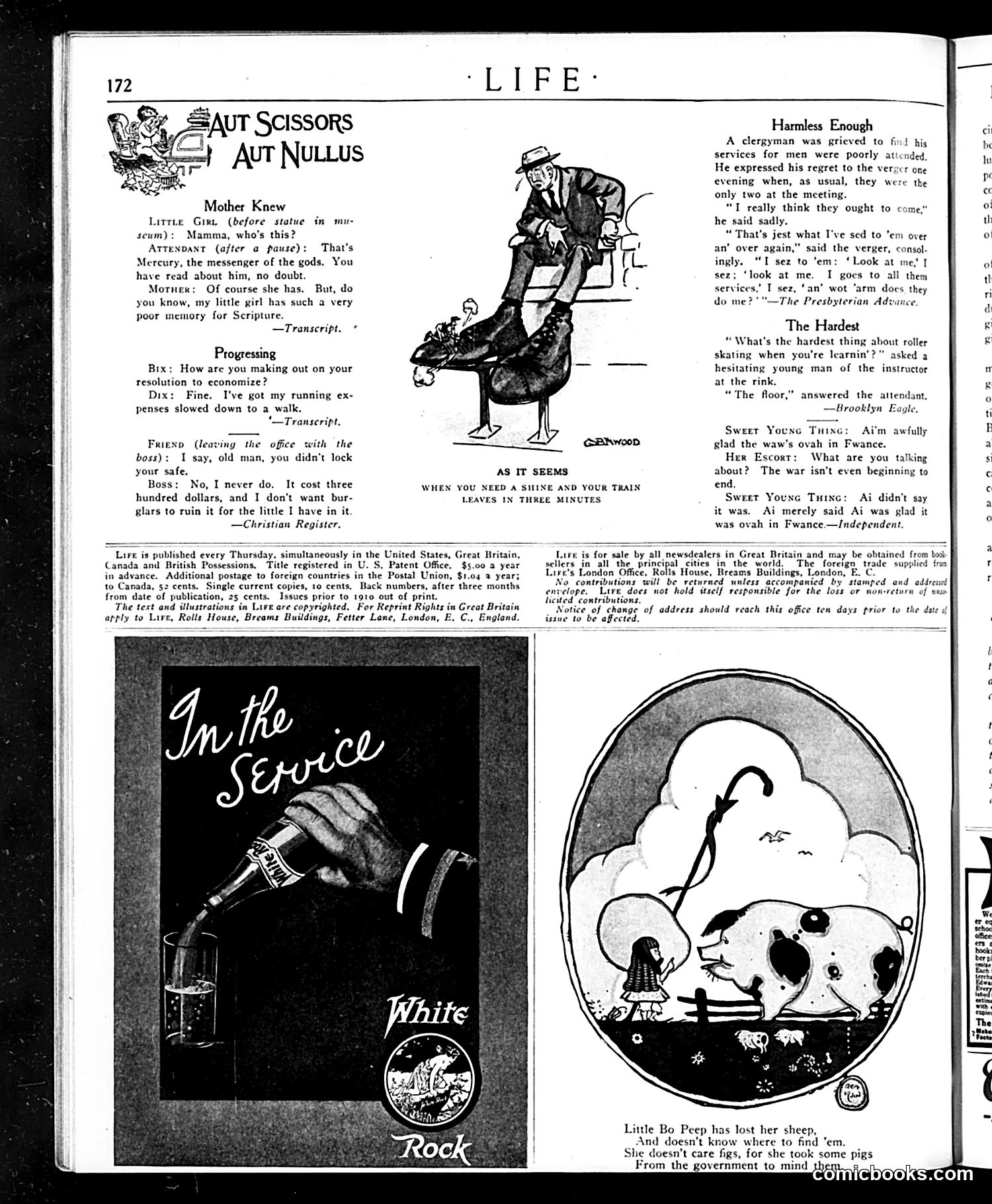
This page contains several brief humorous anecdotes typical of early 20th-century American satire: **"Mother Knew"**: A museum attendant mistakes a child's poor scripture knowledge for ignorance, when the mother suggests her daughter simply has a bad memory for religious details—a gentle jab at religious education. **"Progressing"**: A man claims to economize by reducing expenses, but only manages a trivial slowdown—satirizing hollow New Year's resolutions. **"As It Seems"**: Dark humor about a businessman who refuses to lock his safe because burglars might damage it—mocking illogical penny-pinching. **"The Hardest"**: A roller-skating instructor's deadpan reply that "the floor" is hardest—absurdist humor. The page also includes vintage advertisements and a nursery rhyme adaptation about "Little Bo Peep," reinterpreting the character as having lost sheep but carelessly substituted government pigs—likely satirizing wartime resource management or bureaucratic inefficiency, though the specific historical context remains unclear.
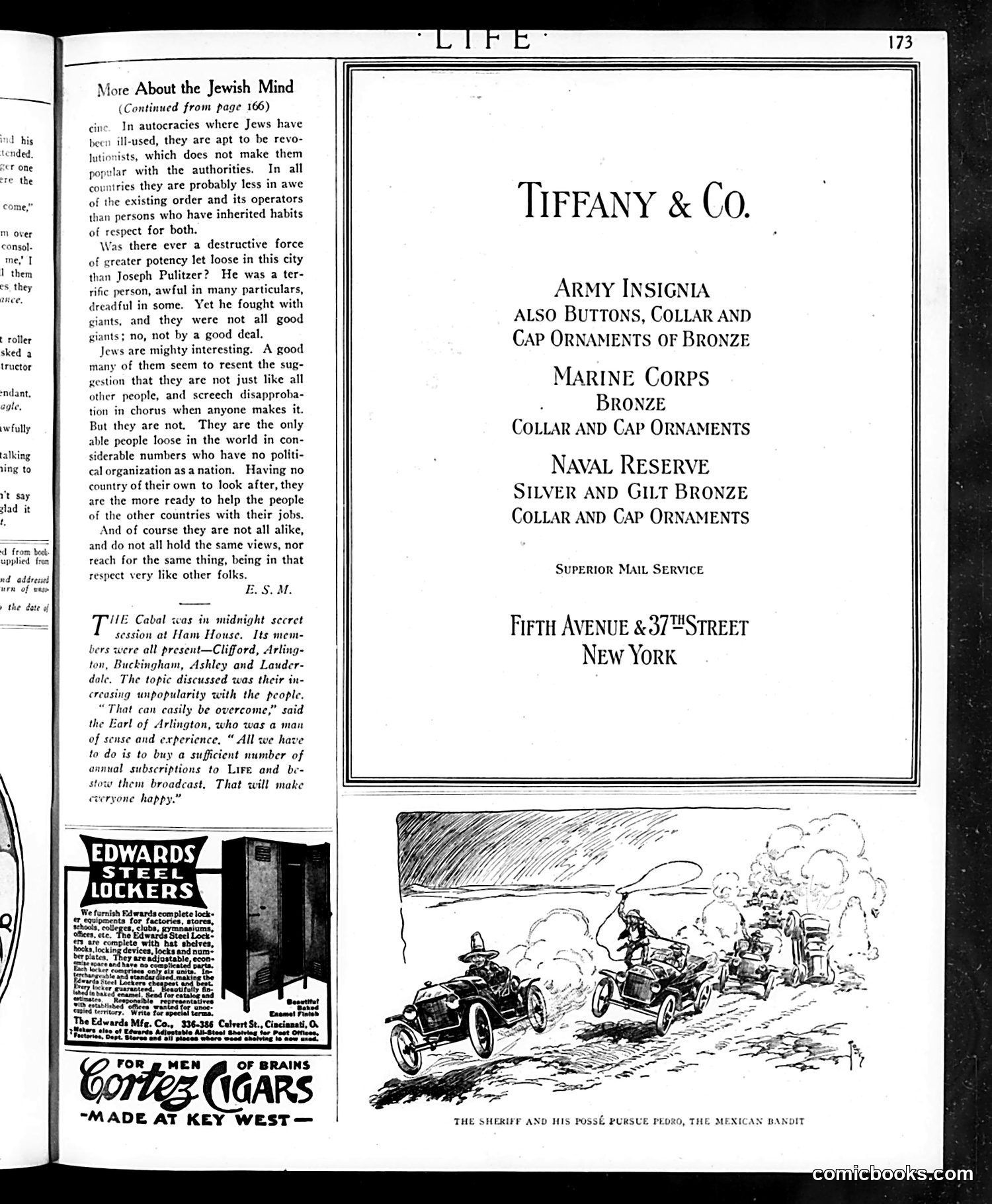
This page mixes editorial content, advertising, and a satirical anecdote. The main text continues an essay titled "More About the Jewish Mind," discussing Jewish identity, political engagement, and notable figures like Joseph Pulitzer—presented as serious cultural commentary typical of the era. The satirical section labeled "THE CABAL" appears to reference the English Restoration-era Cabal ministry (Clifford, Arlington, Buckingham, Ashley, Lauderdale), using historical figures as a vehicle for contemporary satire. The joke suggests that unpopular leaders can simply buy Life magazine subscriptions and distribute them to make themselves popular—a tongue-in-cheek jab at both the magazine's importance and corrupt political tactics. The lower illustration shows a sherif pursuing a Mexican bandit in automobiles, likely illustrating a serialized story or advertisement. The page is otherwise dominated by ads for Tiffany & Co., Edwards Steel Lockers, and Cortes Cigars.
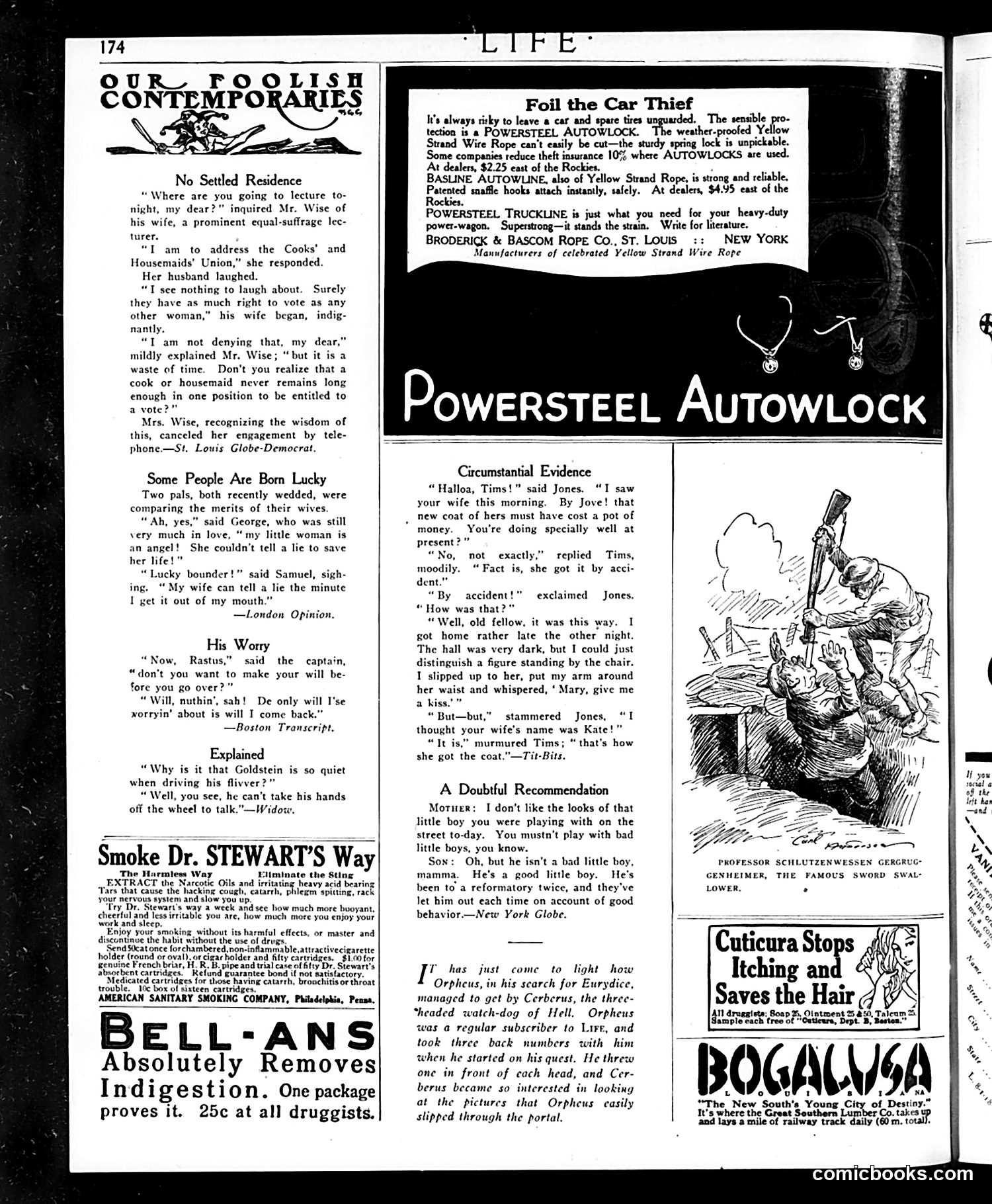
This page contains primarily **humorous anecdotes and advertisements** rather than political cartoons. The humor pieces satirize early 20th-century social attitudes: 1. **"No Settled Residence"** mocks women's suffrage advocates by suggesting working-class women (cooks, housemaids) shouldn't vote because they change jobs frequently—implying their transience disqualifies them from citizenship rights. 2. **"Some People Are Born Lucky"** plays on gender stereotypes, contrasting a wife who "couldn't tell a lie" with one who lies effortlessly. 3. **"His Worry"** uses racial dialect humor (common then, offensive now) depicting an African American soldier's reluctance to make a will before deployment. 4. **"Circumstantial Evidence"** begins a joke about a man mistaking his wife for another woman in the dark—likely building toward an infidelity innuendo. The page is dominated by **product advertisements** (Powersteel Autolock, Dr. Stewart's cigarette filters, Bell-Ans indigestion remedy, Cuticura products) typical of Life's revenue model. The cartoonish illustrations are advertisement art, not editorial commentary.
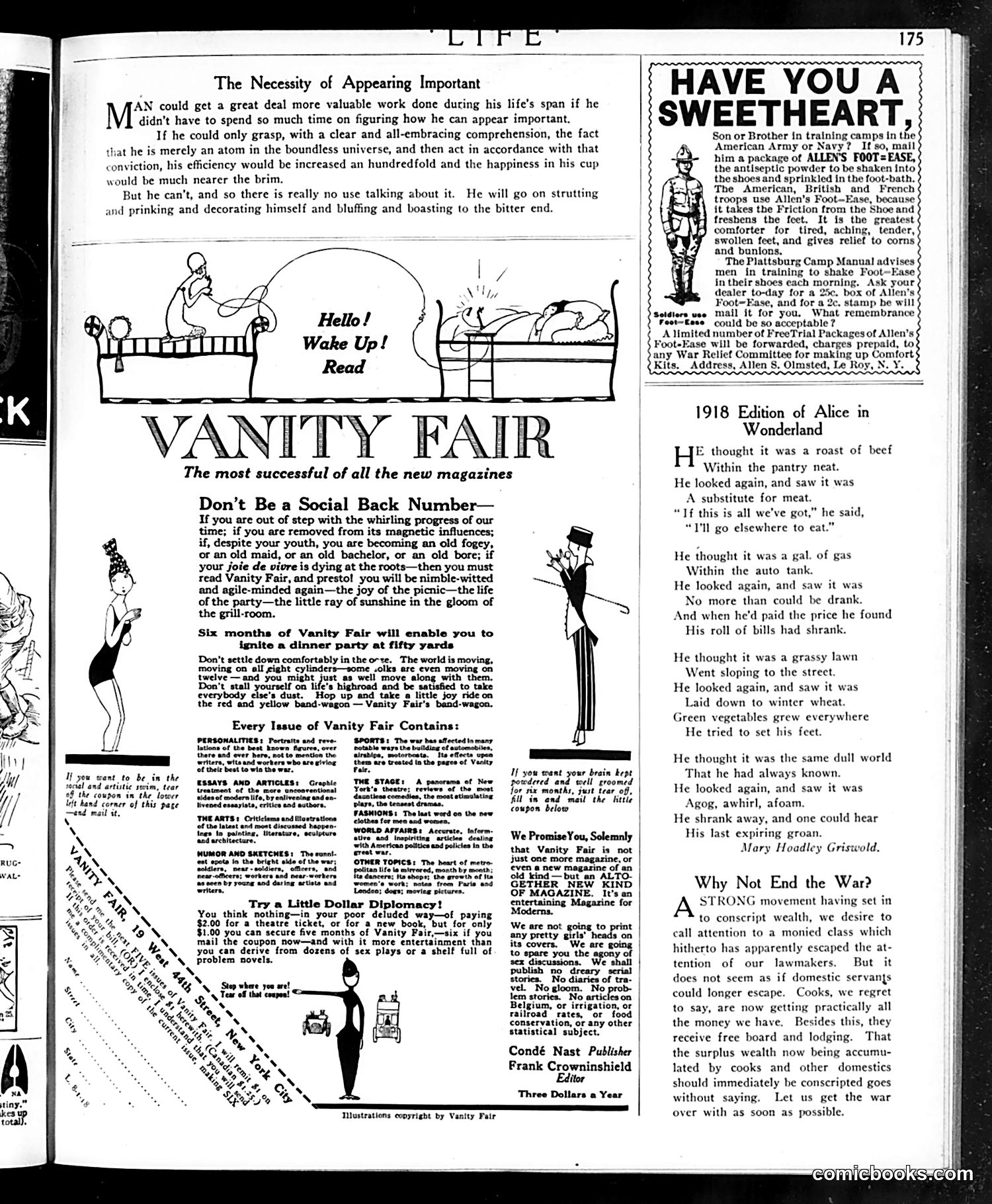
This page combines editorial commentary with advertisements and promotional material. The opening essay, "The Necessity of Appearing Important," satirizes human vanity—the ironic observation that people waste enormous energy trying to seem significant, when they'd be more productive if they recognized their cosmic insignificance. The cartoon illustrates this: a figure preening in bed while declaring "Hello! Wake Up! Read," suggesting self-absorption even upon waking. The bulk of the page promotes *Vanity Fair* magazine itself, using self-aware humor: the magazine promises to make readers socially relevant and witty—addressing those in danger of becoming "social back numbers" or "old fogies." This is ironic marketing that acknowledges its own appeal to vanity. A wartime advertisement for Allen's Foot-Ease (an antiseptic powder) targets soldiers' families, framing the product as a patriotic gift for troops. The page reflects 1918 concerns: World War I ("troops use Allen's Foot-Ease"), modern life's pace, and anxiety about social obsolescence—typical of *Life* magazine's satirical approach to contemporary anxieties.
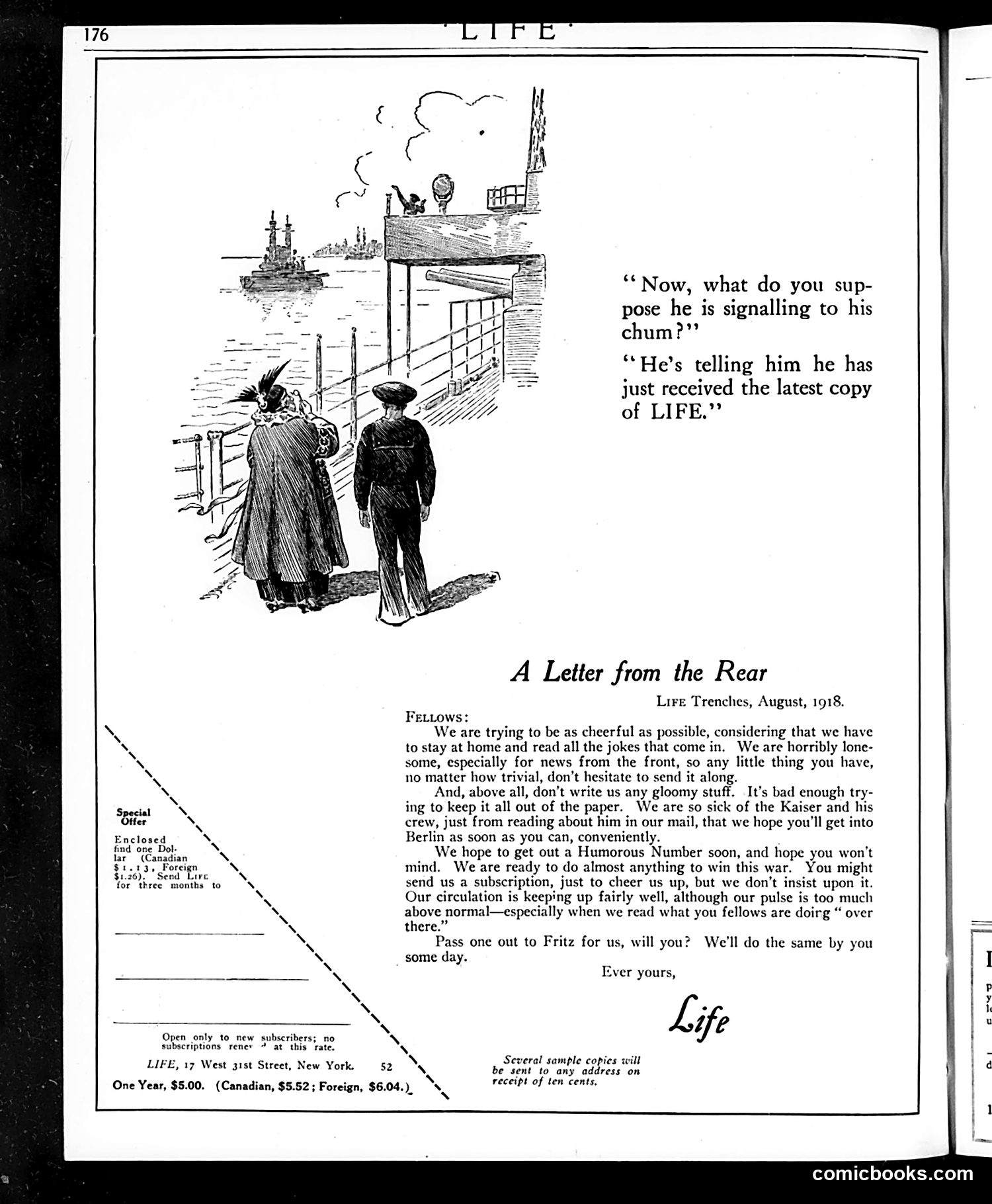
This is a satirical cartoon and letter from *Life* magazine (August 1918), during World War I's final months. **The Cartoon:** Two civilians on a dock signal to a battleship using a copy of *Life* magazine. The joke: they're announcing the magazine's arrival as if it's major news worthy of military signaling—poking fun at the magazine's self-importance. **"A Letter from the Rear":** The editors humorously address soldiers at the front, claiming to be stuck "at home" reading submitted jokes while longing for combat news. They're exhausted hearing about "the Kaiser and his crew," express readiness for anything to "win this war," and cheekily offer to deliver *Life* copies to "Fritz" (slang for German soldiers) if the troops will reciprocate. **The Point:** Self-deprecating wartime humor. The magazine presents itself as desperate to contribute to the war effort while acknowledging its actual limitation—providing morale-boosting entertainment rather than military action. It's also a subscription pitch disguised as patriotic appeal.
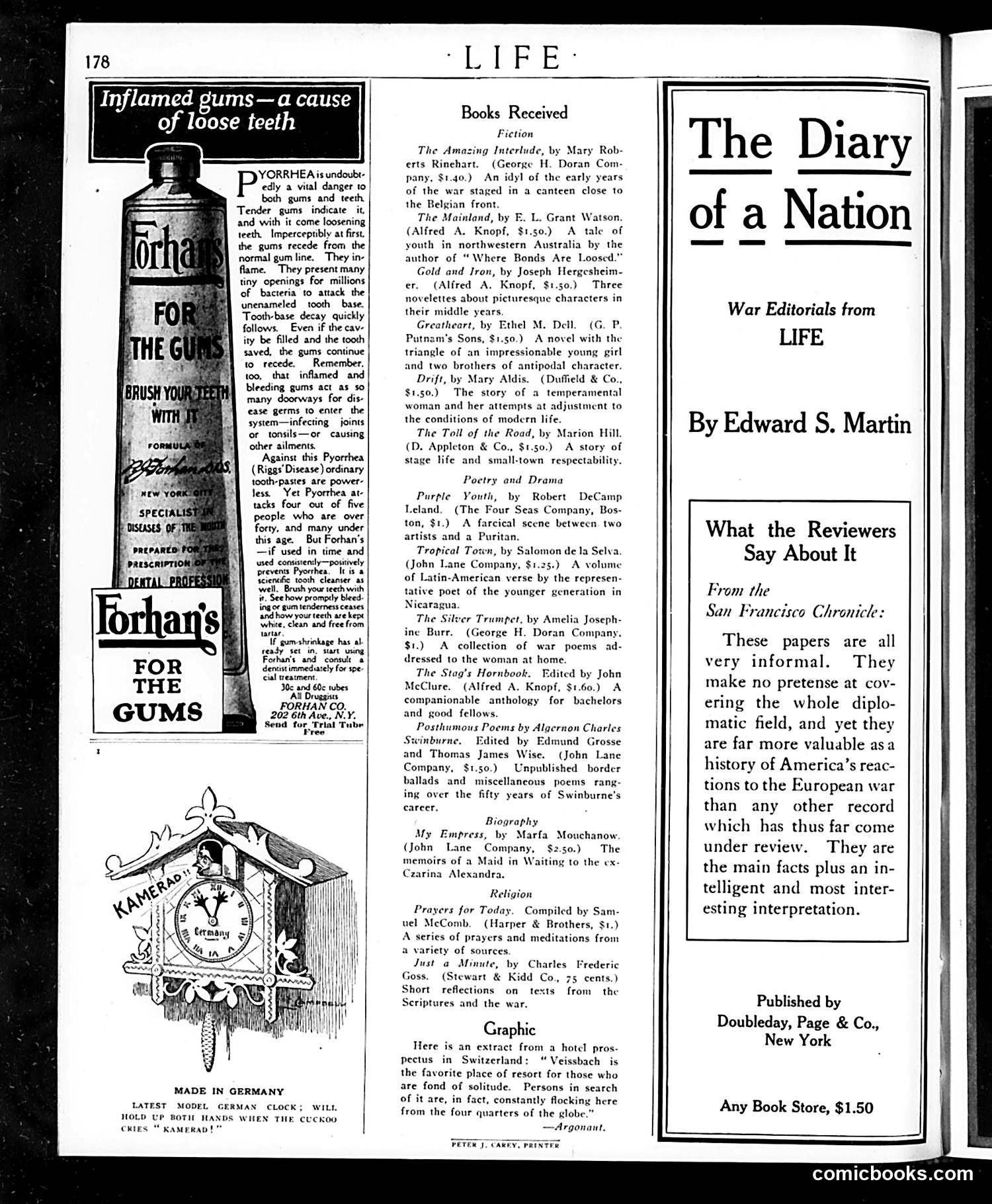
This page contains **primarily advertisements and book reviews**, not political cartoons requiring historical interpretation. The main visual element is a **Forhan's toothpaste ad** (left side) depicting a dental hygiene product, with accompanying medical claims about pyorrhea treatment. Below it sits a **German cuckoo clock cartoon**—a satirical jab at Germany itself. The caption reads: "Latest model German clock; will hold up both hands when the cuckoo cries 'Kamerad!'" **The joke**: "Kamerad" (comrade) was the German word soldiers used when surrendering. The cartoon mocks Germany by suggesting their clocks surrender—a direct reference to German military defeat in World War I. This reflects American post-war triumphalism and mockery of the defeated enemy. The remainder of the page lists recently published fiction, poetry, biography, and religious works from 1918-1920, typical of Life's literary coverage during this period.
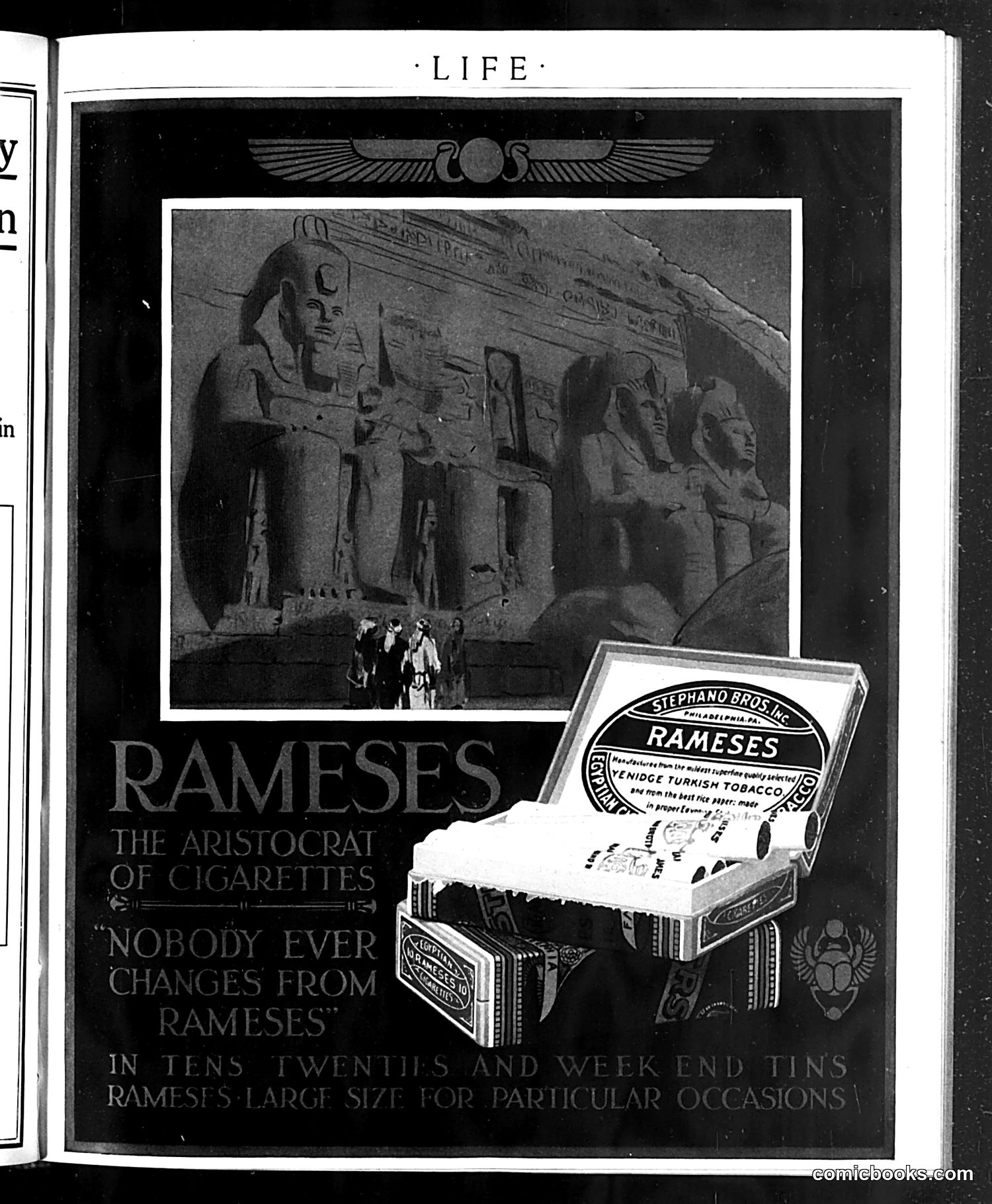
This page is primarily a **cigarette advertisement** for Rameses brand, manufactured by Stephano Bros. Inc. of Philadelphia, rather than political satire. The ad exploits Egyptian imagery, featuring a photograph of colossal statues (likely the Abu Simbel temples or similar monuments). The slogan "NOBODY EVER CHANGES FROM RAMESES" suggests the product's supposedly timeless quality and customer loyalty. The advertisement uses grandiose language—"THE ARISTOCRAT OF CIGARETTES"—and emphasizes packaging options ("TENS," "TWENTIETHS," and "WEEK END TINS"), positioning the product as luxury goods for various social occasions. The Egyptian pharaoh imagery appears chosen purely for exotic appeal and prestige association, not political commentary. This represents typical early-20th-century advertising strategies leveraging classical/ancient imagery for product cachet.
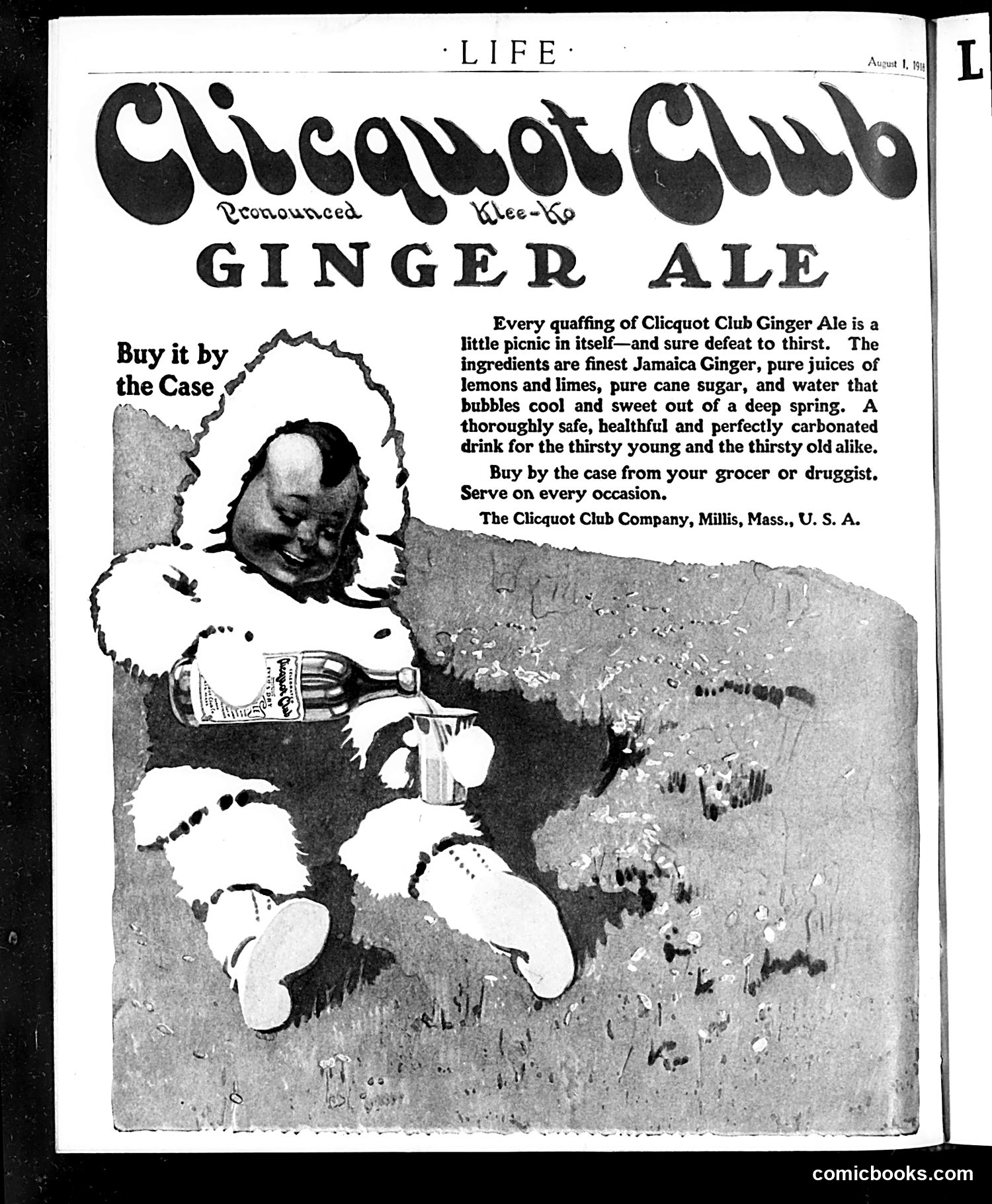
This is a straightforward product advertisement, not political satire. It promotes Clicquot Club Ginger Ale, made by a Massachusetts company. The ad features an illustration of a baby or cherub in white clothing holding a bottle of the product in an outdoor setting. The appeal emphasizes the drink's ingredients—Jamaica ginger, lemon, lime, cane sugar, and spring water—and markets it as "safe, healthful and perfectly carbonated" for consumers of all ages. The stylized text at top (pronounced "klee-ko") reflects the French brand name. The ad encourages bulk purchasing ("buy by the case") and suggests serving the beverage for various occasions. This appears to be early 20th-century advertising using innocent imagery and health-conscious messaging typical of the era.