
Life, 1918-08-01 · page 8 of 36
Life — August 1, 1918 — page 8: what you’re looking at
What you’re looking at
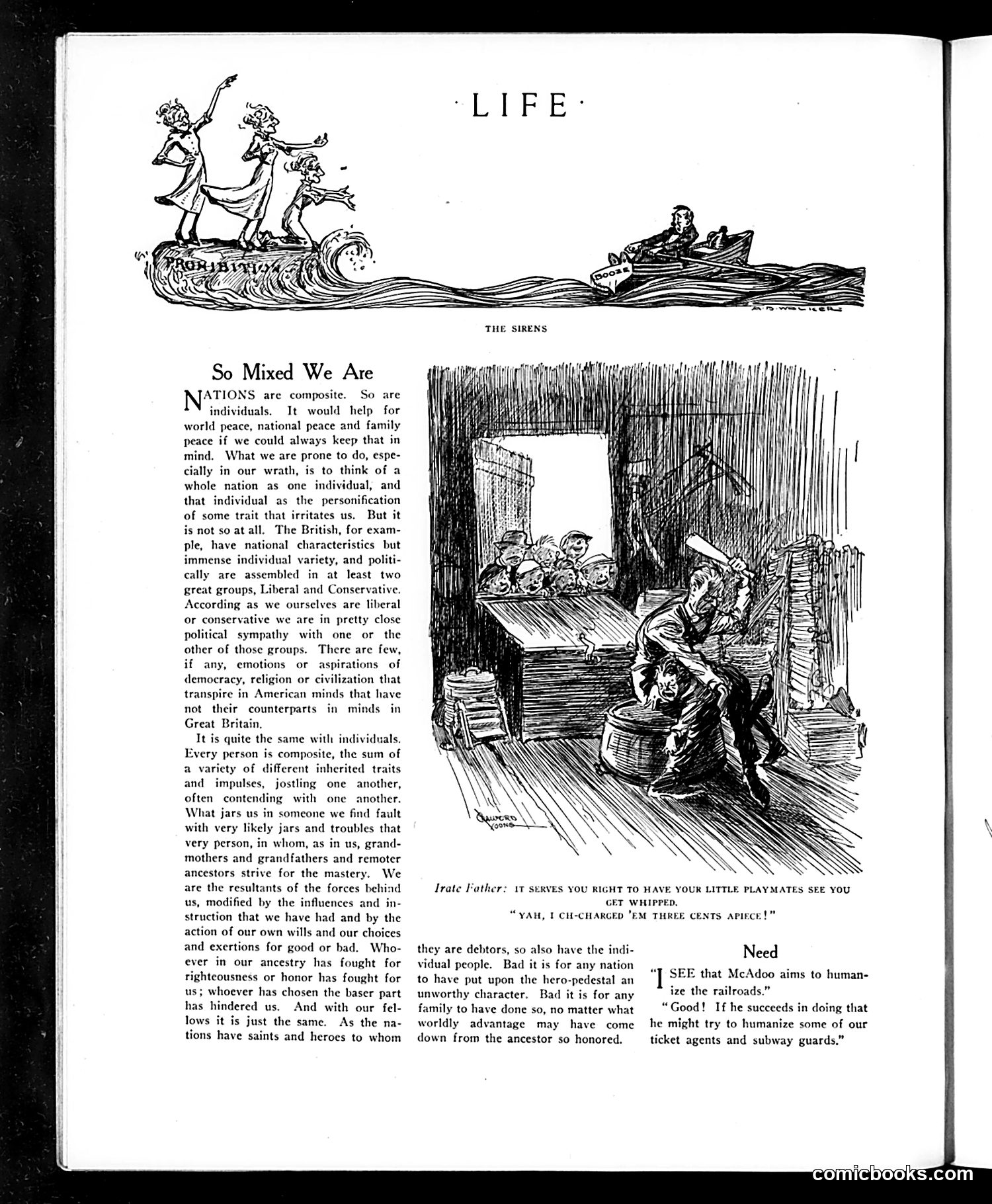
**Top illustration ("The Sirens"):** Shows mythological sirens on a wave luring a sailor in a boat toward danger—a classical allusion to temptation and poor judgment. **Main article "So Mixed We Are":** Discusses how nations and individuals are composites of conflicting traits and inheritances. The text argues British people embody diverse political sympathies (Liberal and Conservative) without this creating national instability, unlike supposedly more homogeneous societies. It suggests this internal diversity—inherited from ancestors—is actually a strength, not weakness. **Bottom cartoon ("Irate Father"):** Depicts a working-class father threatening to whip his son's playmates. The accompanying dialogue about "humanizing the railroads" and hiring "ticket agents and subway guards" appears to satirize naive social reform proposals that miss economic realities. The page advocates accepting human complexity over seeking impossible uniformity.
📄 Transcribed text from this page (OCR, searchable)
Machine-transcribed from the original scan — historical spelling and the odd misread are preserved.
So Mixed We Are ATIONS are composite. individuals. It would help for world peace, national peace and family peace if we could always keep that in mind. What we are prone to do, espe- cially in our wrath, is to think of a whole nation as one individual, and that individual as the personification of some trait that irritates us. But it is not so atall. The British, for exam- ple, have national characteristics but immense individual variety, and _politi- cally are assembled in at least two great groups, Liberal and Conservative. According as we ourselves are liberal or conservative we are in pretty close political sympathy with one or the other of those groups. There are few, if any, emotions or aspirations of democracy, religion or jon that transpire in American minds that have not their counterparts in minds in Great Britain, It is quite the same with individuals. Every person is composite, the sum of a variety of different inherited traits and impulses, jostling one another, often contending with one another. What jars us in someone we find fault with very likely jars and troubles that very person, in whom, as in us, grand- mothers and grandfathers and remoter ancestors strive for the mastery. We are the resultants of the forces behind us, modified by the influences and in- struction that we have had and by the action of our own wills and our choices and exertions for good or bad. Who- ever in our ancestry has fought for righteousness or honor has fought for us; whoever has chosen the baser part has hindered us. And with our fel- lows it is just the same. As the na- tions have saints and heroes to whom So are ABET Fanta Irate Father: 17 se VES YOU RIGHT TO HAV YOUR LITTLE PLAYMATES SEE YOU GET WHIPPE “YAH, I CH-CHARGED 'EM THREE CENTS APIECE!” they are debtors, so also have the indi- vidual people. Bad it is for any nation to have put upon the hero-pedestal an unworthy character. Bad it is for any family to have done so, no matter what worldly advantage may have come down from the ancestor so honored. Need SEE that McAdoo aims to human- ize the railroads.” “Good! If he succeeds in doing that he might try to humanize some of our ticket agents and subway guards,”