
Life, 1918-08-01 · page 6 of 36
Life — August 1, 1918 — page 6: what you’re looking at
What you’re looking at
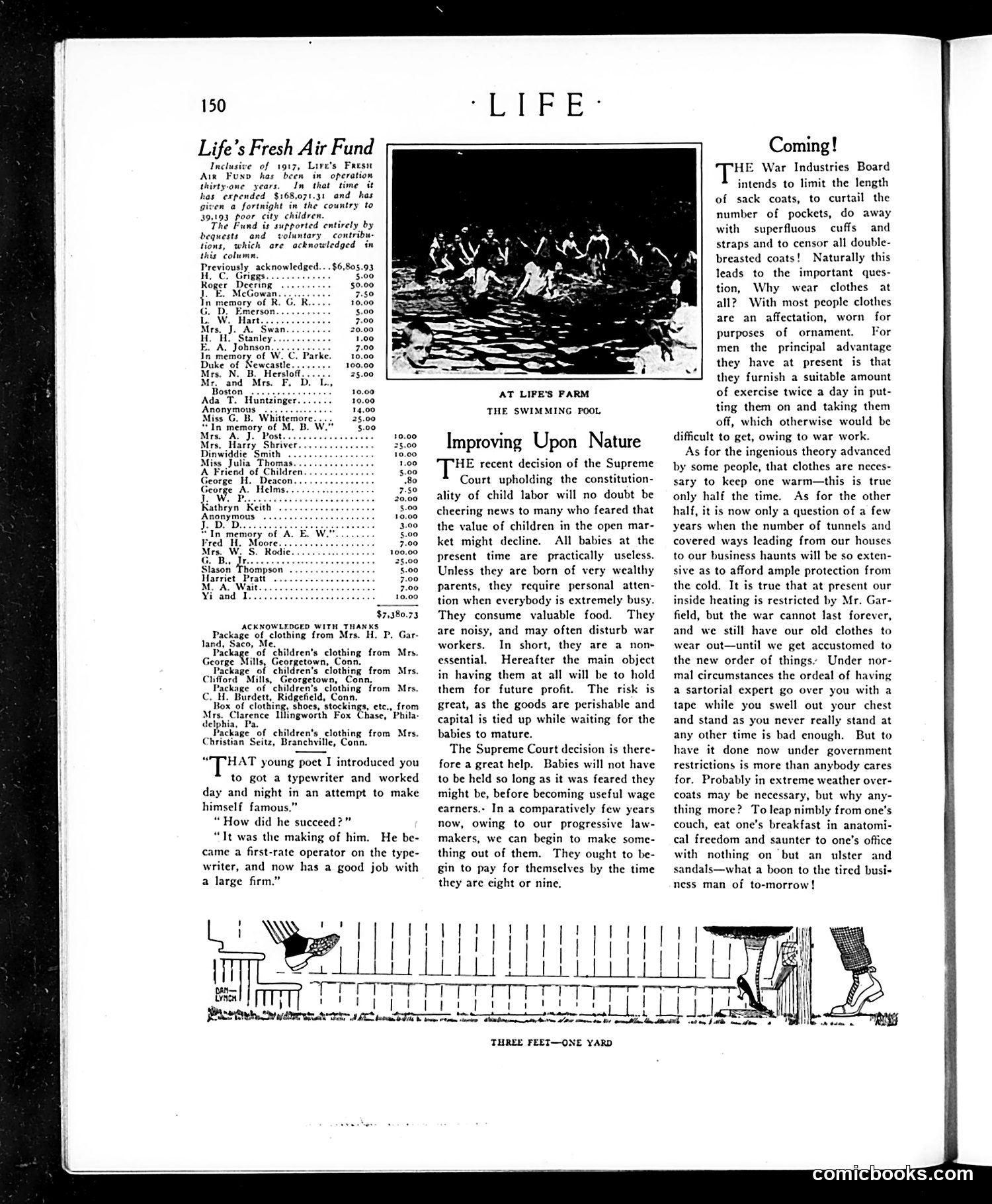
This page contains two distinct sections: **Left side:** A fundraising list for "Life's Fresh Air Fund," which has operated for 31 years providing poor city children access to countryside experiences. The extensive donor list with amounts suggests this was a significant charitable initiative. **Right side:** An article titled "Improving Upon Nature" discusses the War Industries Board's anticipated clothing restrictions—limiting sack coats, pockets, and double-breasted designs. The author satirizes the practical absurdity: if clothes are merely "affectation" for "ornament," why restrict them during wartime? The piece mocks proposed austerity measures as both unnecessary and condescending to workers needing functional garments. The tone is skeptical of government overreach disguised as wartime necessity. The page reflects WWI-era concerns about rationing, government control, and class attitudes toward working people's clothing needs.
📄 Transcribed text from this page (OCR, searchable)
Machine-transcribed from the original scan — historical spelling and the odd misread are preserved.
150 Life’s Fresh Air Fund Inclusive of 1917, Live's Fresut Aix Fuxp has been in operation thirty-one years. In that time it has expended $168,071.31 and has given a fortnight in the country to 39:193 poor city children. The Fund is supported entirely by bequests and voluntary contribu tions, which ere acknowledged in this column: $6,803.93 . C, Griggs. 5.00 Roger Deering 59.00 . E. McGowan 7:50 10.00 $.00 : 7.00 A. Swan’ 20.00 Stanley. ... + 100 E. A. Johnson 7.00 Im memory of W. C. Parke. 10.00 Duke of Newcastle. 100.00 Mrs. N. B. Hersloff. 25.00 acknowledged. Coming! HE War Industries Board intends to limit the length of sack coats, to curtail the number of pockets, do away with superfluous cuffs and straps and to censor all double- breasted coats! Naturally this leads to the important ques- tion, Why wear clothes at all? With most people clothes are an affectation, worn for purposes of ornament. For men the principal advantage they have at present is that Mr. and Mrs. F. DLT Boston ai Ada T. Huntzinger Anonymous 14.00 Miss G. B. Whittemore 25.00 “In memory of M. B. W. 5.00 Mrs. A. J. Pos 3 Mrs, Harry. Shriver: .: Dinwiddie Smith Miss Julia Thomas. A Friend of Children George H. Deacon George A. Helms. ke P thryn Anonymous . 10,00 10.00 in memory of A. E,W . Moore. . Mrs WS. Rodie.. B., Jr. Slason Thompson Harriet, Pratt. A. Wait and I. $7,380.73 ACKNOWLEDGED WITH THANKS Package of clothing from Mrs. H. P. Gar- land, Saco, Me, Package’ of children's clothing from Mrs George Mills, Georgetown, Conn. Package of children’s clothing from Mrs. Chifford” Mills, Georgetown, Conn. Package of children’s clothing from Mrs. H. Burdett, Ridgefield, Conn, Box of clothing, shoes, stockings, etc., from Mrs; Clarence Illingworth Fox Chase, "Phila: delphia, Pa. Package of children's clothing from Mrs. Christian Seitz, Branchville, Conn. pee young poet I introduced you to got a typewriter and worked day and night in an attempt to make himself famous.” “How did he succeed?” “Tt was the making of him. He be- came a first-rate operator on the type- writer, and now has a good job with a large firm.” AT LIFE’S FARM THE SWIMMING POOL Improving Upon Nature 'HE recent decision of the Supreme Court upholding the constitution- ality of child labor will no doubt be cheering news to many who feared that the value of children in the open mar- ket might decline. All babies at the present time are practically useless. Unless they are born of very wealthy parents, they require personal atten- tion when everybody is extremely busy. They consume valuable food. They are noisy, and may often disturb war workers. In short, they are a non+ essential. Hereafter the main object in having them at all will be to hold them for future profit. The risk is great, as the goods are perishable and capital is tied up while waiting for the babies to mature. The Supreme Court decision is there- fore a great help. Babies will not have to be held so long as it was feared they might be, before becoming useful wage earners.- In a comparatively few years now, owing to our progressive law- makers, we can begin to make some- thing out of them. They ought to be- gin to pay for themselves by the time they are eight or nine. they furnish a suitable amount of exercise twice a day in put- ting them on and taking them off, which otherwise would be difficult to get, owing to war work. As for the ingenious theory advanced by some people, that clothes are neces- sary to keep one warm—this is true only half the time. As for the other half, it is now only a question of a few years when the number of tunnels and covered ways leading from our houses to our business haunts will be so exten- sive as to afford ample protection from the cold. It is true that at present our inside heating is restricted by Mr. Gar- field, but the war cannot last forever, and we still have our old clothes to wear out—until we get accustomed to the new order of things: Under nor- mal circumstances the ordeal of having a sartorial expert go over you with a tape while you swell out your chest and stand as you never really stand at any other time is bad enough. But to have it done now under government restrictions is more than anybody cares for. Probably in extreme weather over- coats may be necessary, but why any- thing more? To leap nimbly from one’s couch, eat one’s breakfast in anatomi- cal freedom and saunter to one’s office with nothing on but an ulster and sandals—what a boon to the tired busi- ness man of to-morrow! \ Prete adr scen te At eoaT THREE FEET—ONE YARD Comicbooks.com