
Life, 1918-08-01 · page 17 of 36
Life — August 1, 1918 — page 17: what you’re looking at
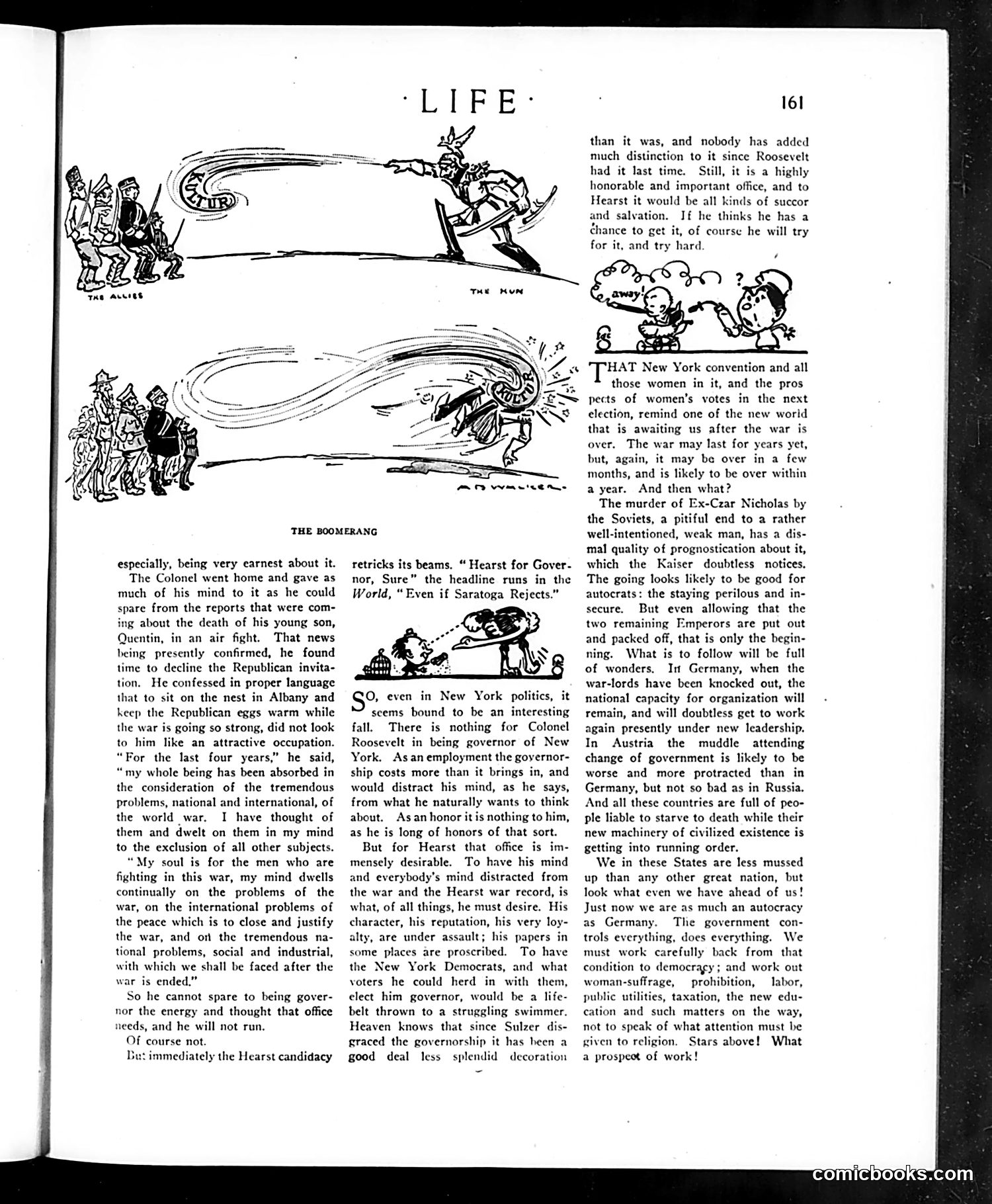
What you’re looking at
This page from *Life* magazine satirizes the 1918 New York gubernatorial race. The cartoons depict Theodore Roosevelt declining the Republican nomination (top: "The Allies" vs. "The Hun"), and William Randolph Hearst pursuing it (bottom: "The Boomerang"). The text explains that Roosevelt refused to run, prioritizing World War I concerns over state politics—a principled decision. However, the satire suggests Hearst will eagerly pursue the office that Roosevelt rejected. The "boomerang" metaphor implies Hearst's war record and controversial reputation (his papers were "proscribed"/censored) make him desperately need the governorship as political rehabilitation—a "life-belt thrown to a struggling swimmer." The cartoons visually contrast the honorable allied forces with malevolent autocratic power, suggesting Hearst's character resembles the latter. The satire mocks both Hearst's opportunism and suggests his pursuit of office is self-serving desperation rather than public service.
📄 Transcribed text from this page (OCR, searchable)
Machine-transcribed from the original scan — historical spelling and the odd misread are preserved.
THE BOOMERANG especially, being very earnest about it. The Colonel went home and gave as much of his mind to it as he could spare from the reports that were com- ing about the death of his young son, Quentin, in an air fight. That news being presently confirmed, he found time to decline the Republican invita- tion. He confessed in proper language that to sit on the nest in Albany and keep the Republican eggs warm while the war is going so strong, did not look to him like an attractive occupation. “For the last four years,” he said, “my whole being has been absorbed in the consideration of the tremendous problems, national and international, of the world war. I have thought of them and dwelt on them in my mind to the exclusion of all other subjects. “My soul is for the men who are fighting in this war, my mind dwells continually on the problems of the war, on the international problems of the peace which is to close and justify the war, and on the tremendous na- tional problems, social and industrial, with which we shall be faced after the war is ended.” So he cannot spare to being gover- nor the energy and thought that office needs, and he will not run. Of course not. But immediately the Hearst candidacy retricks its beams. “ Hearst for Gover- nor, Sure” the headline runs in the World, “Even if Saratoga Rejects.” O, even in New York politics, it seems bound to be an interesting fall. There is nothing for Colonel Roosevelt in being governor of New York. Asan employment the goyernor- ship costs more than it brings in, and would distract his mind, as he says, from what he naturally wants to think about. Asan honor itis nothing to him, as he is long of honors of that sort. But for Hearst that office is im- mensely desirable. To have his mind and everybody's mind distracted from the war and the Hearst war record, is what, of all things, he must desire. His character, his reputation, his very loy- alty, are under assault; his papers in some places are proscribed. To have the New York Democrats, and what voters he could herd in with them, elect him governor, would be a life- belt thrown to a struggling swimmer. Heaven knows that since Sulzer dis- graced the governorship it has heen a good deal splendid decoration less 161 than it was, and nobody has added much distinction to it since Roosevelt had it last time. Still, it is a highly honorable and important office, and to Hearst it would be all kinds of succor and salvation. If he thinks he has a chance to get it, of course he will try for it, and try hard. HAT New York convention and all those women in it, and the pros pects of women’s votes in the next election, remind one of the new world that is awaiting us after the war is over. The war may last for years yet, but, again, it may be over in a few months, and is likely to be over within a year. And then what? The murder of Ex-Czar Nicholas by the Soviets, a pitiful end to a rather well-intentioned, weak man, has a dis- mal quality of prognostication about it, which the Kaiser doubtless notices, The going looks likely to be good for autocrats: the staying perilous and in- secure. But even allowing that the two remaining Emperors are put out and packed off, that is only the begin- ning. What is to follow will be full of wonders. In Germany, when the war-lords have been knocked out, the national capacity for organization will remain, and will doubtless get to work again presently under new leadership. In Austria the muddle attending change of government is likely to be worse and more protracted than in Germany, but not so bad as in Russia. And all these countries are full of peo- ple liable to starve to death while their new machinery of civilized existence is getting into running order. We in these States are less mussed up than any other great nation, but look what even we have ahead of us! Just now we are as much an autocracy as Germany. The government con- trols everything, does everything. We must work carefully back from that condition to democracy ; and work out woman-suffrage, prohibition, labor, public utilities, taxation, the new edu- cation and such matters on the way, not to speak of what attention must be given to religion. Stars above! What a prospeot of work!