
A complete issue · 36 pages · 1918
Life — June 13, 1918
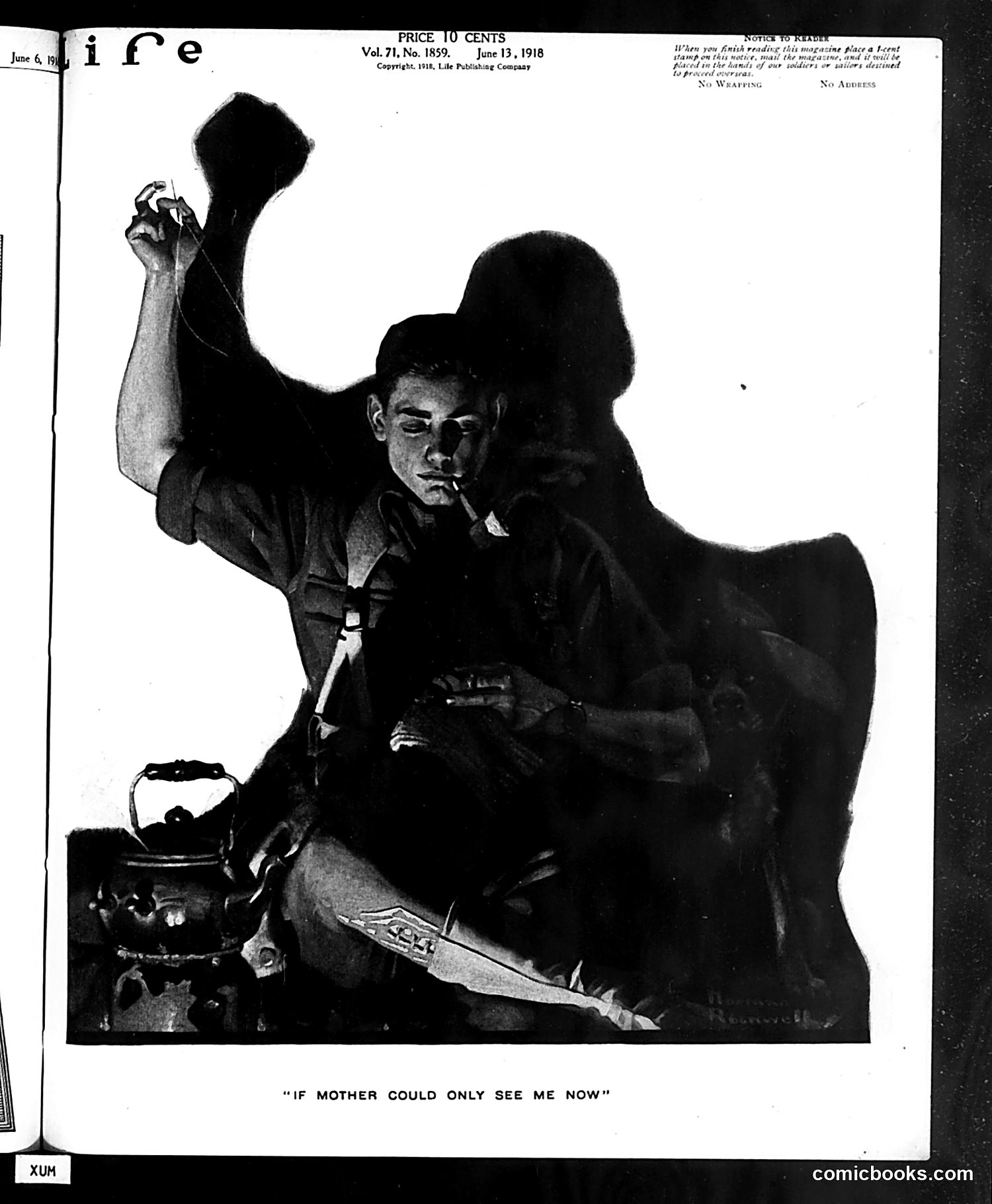
This is a WWI-era satirical illustration from *Life* magazine (June 13, 1918). The image shows a young soldier in military uniform with a shadowy figure looming behind him—likely representing Death or the Grim Reaper. The soldier raises his fist defiantly while holding a weapon. The caption reads: "IF MOTHER COULD ONLY SEE ME NOW." The satire cuts multiple ways: it mocks both the soldier's false bravado and the jingoistic sentiment that young men were expected to display about combat. The looming dark figure suggests the grim reality of warfare—that mothers' sons faced death, not glory. Published late in WWI, this reflects growing American disillusionment with the war's human cost and challenges the romanticized notion of military service.
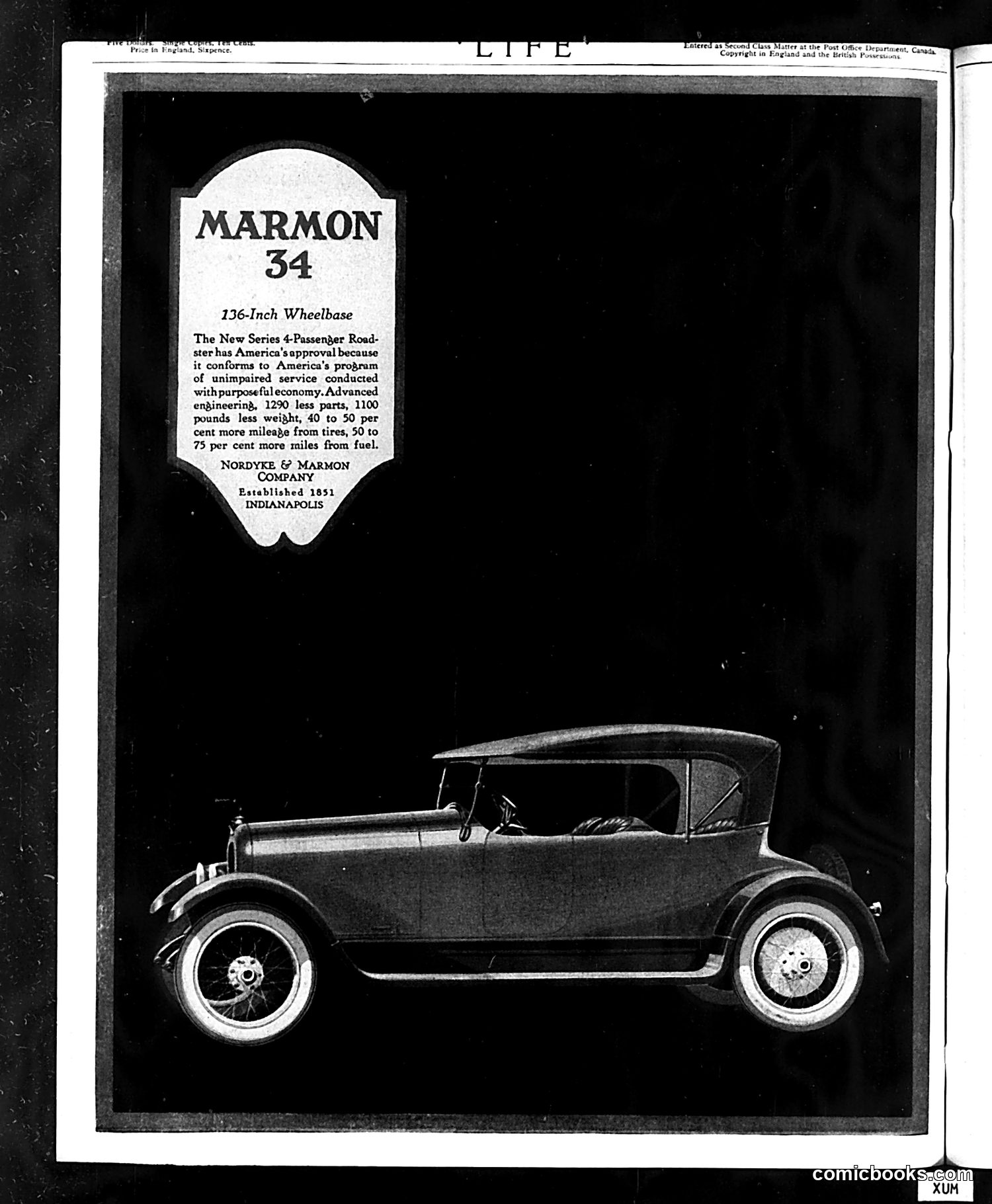
This is **not a cartoon or satire page** — it's a straightforward advertisement for the Marmon 34 automobile, published in *Life* magazine. The ad highlights the car's 136-inch wheelbase and 4-passenger roadster design. The text emphasizes engineering improvements: 1,290 fewer parts, 1,100 pounds less weight, better fuel and tire efficiency (40-50% more mileage). These specifics reflect 1920s automotive marketing focused on mechanical reliability and economy — practical selling points for early mass-market cars. The Nordyke & Marmon Company, established 1851 in Indianapolis, positions the vehicle as meeting "America's approval" through efficiency-driven design. The elegant side-profile illustration was typical period advertising aesthetic for luxury automobiles. This represents genuine commercial content, not editorial satire.
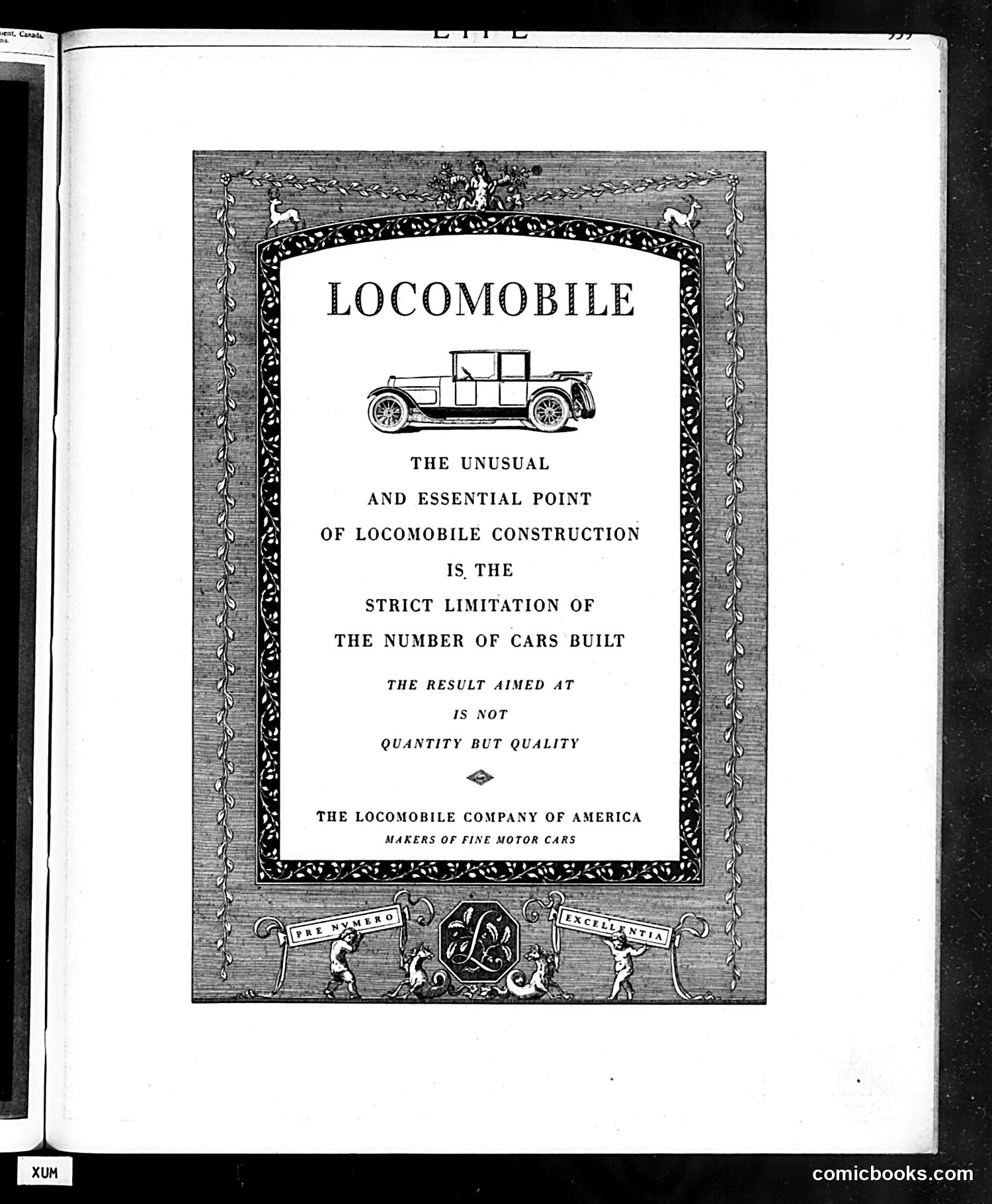
This page is **entirely an advertisement**, not satire or cartoon content. It's a full-page ad for the Locomobile Company of America, featuring an ornate decorative border typical of early 20th-century luxury marketing. The ad's key message emphasizes that Locomobile distinguishes itself through **quality over quantity**—deliberately limiting production numbers rather than mass-manufacturing vehicles. This positioning reflects the company's identity as a maker of expensive, exclusive automobiles for wealthy customers, contrasting with mass-production competitors like Ford. The elegant Art Deco-style border, classical figures, and formal typography reinforce the brand's association with luxury and exclusivity. There is no political commentary or satire present on this page.
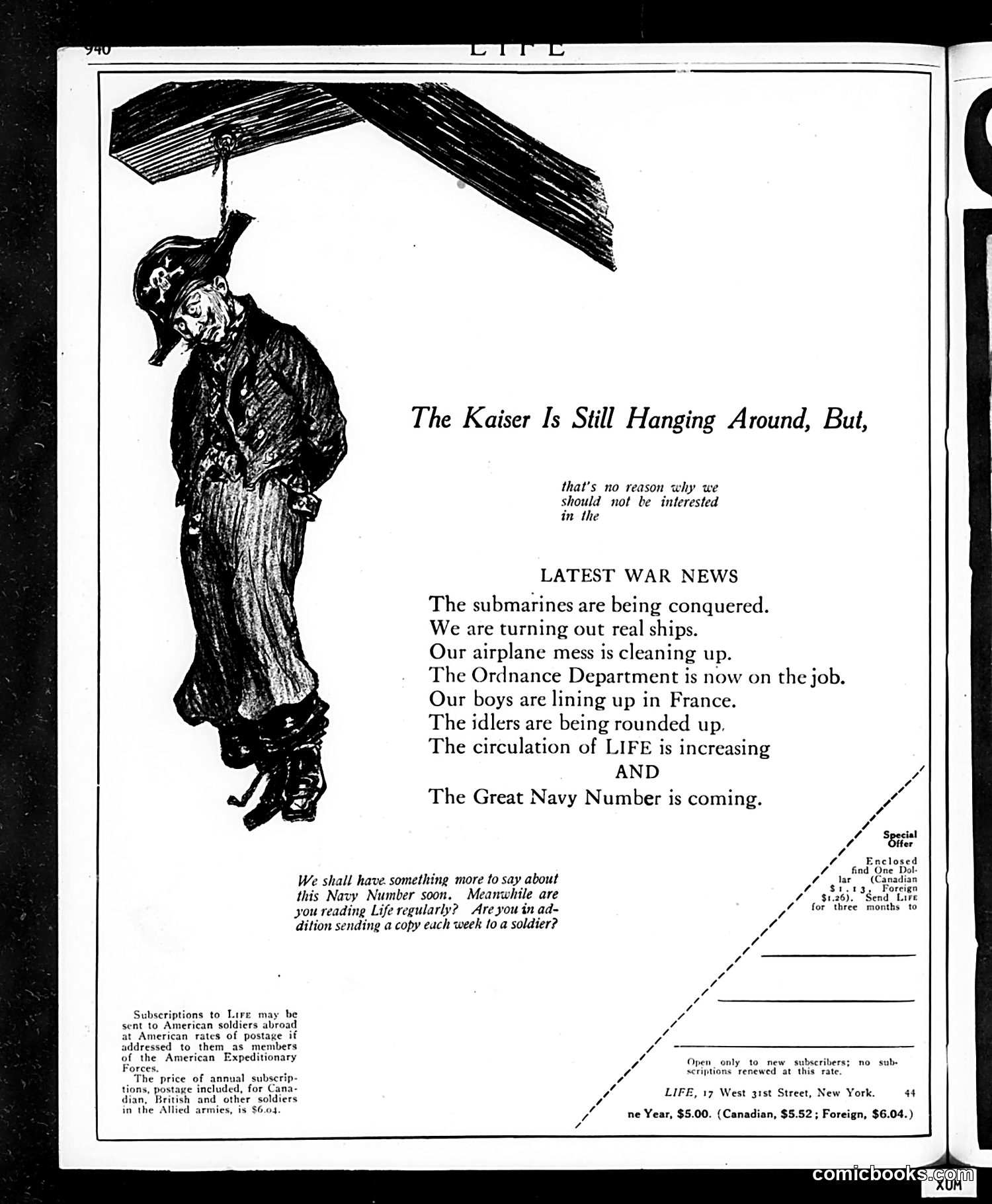
This page combines a political cartoon with promotional content. The illustration shows a hanging figure in military dress, labeled "The Kaiser," referencing German Emperor Wilhelm II. The cartoon mocks him as obsolete—still "hanging around" despite being defeated in World War I (which ended November 1918). The "Latest War News" section lists American military achievements: submarine victories, ship production, aircraft improvements, and troop deployment in France. These represent ongoing Allied superiority during the final stages of WWI. The satire suggests America should remain engaged with war news rather than lose interest now that victory appears assured. The page also advertises LIFE subscriptions for soldiers abroad, encouraging home support for troops.
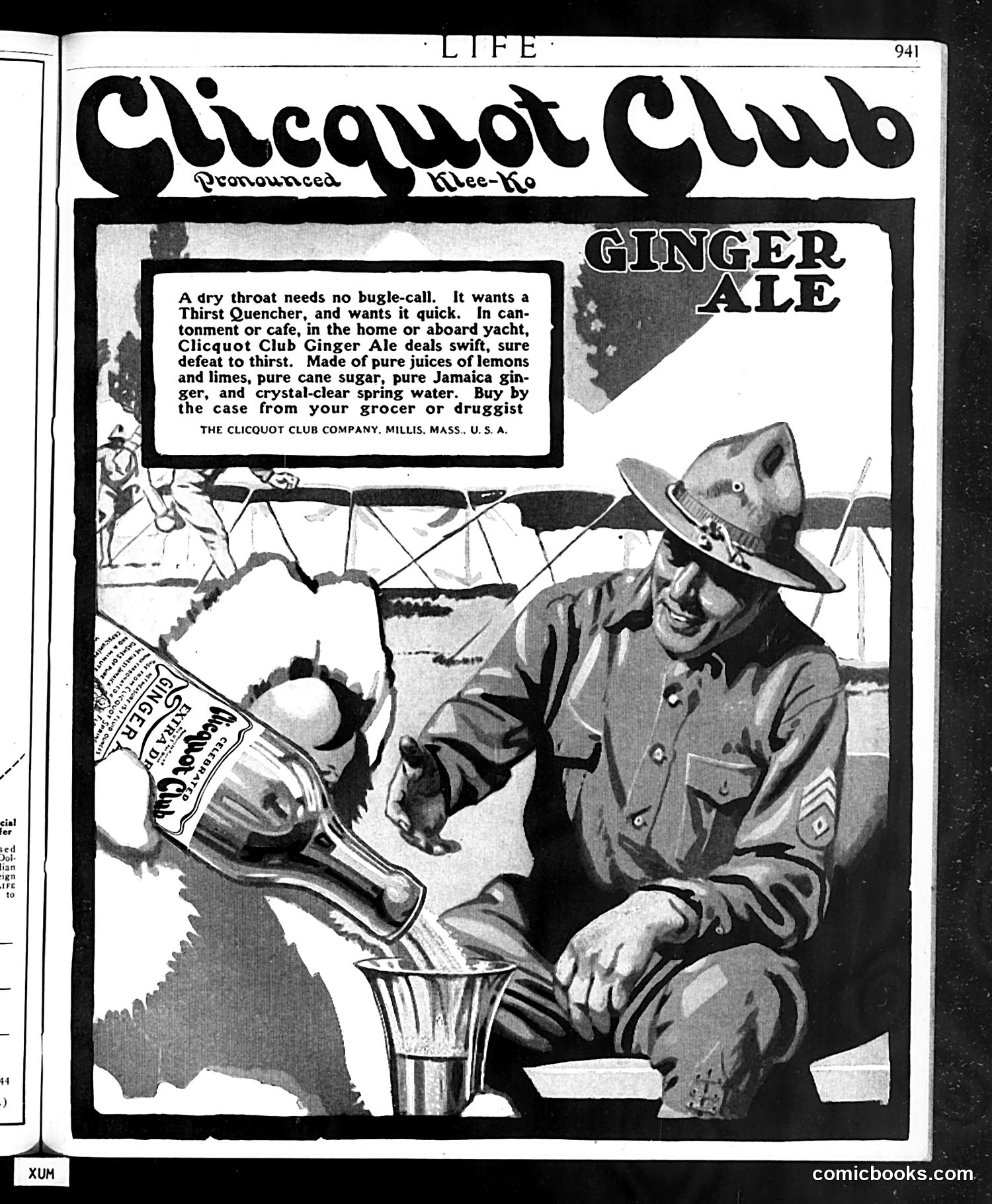
This is a product advertisement rather than political satire. It depicts a soldier on what appears to be a military vessel or ship, pouring Clicquot Club Ginger Ale into a glass. The ad emphasizes the drink as a "Thirst Quencher" suitable for various settings—"in the home or aboard yacht." The military context suggests this advertisement targets soldiers, likely during World War I (based on the uniform style and vessel depicted). The marketing appeal combines patriotism with refreshment, positioning the beverage as ideal for servicemen. The product is described as made from "pure juices of lemons and limes, pure cane sugar, pure Jamaica ginger, and crystal-clear spring water," manufactured in Millis, Massachusetts. This represents commercial exploitation of wartime imagery for sales purposes.
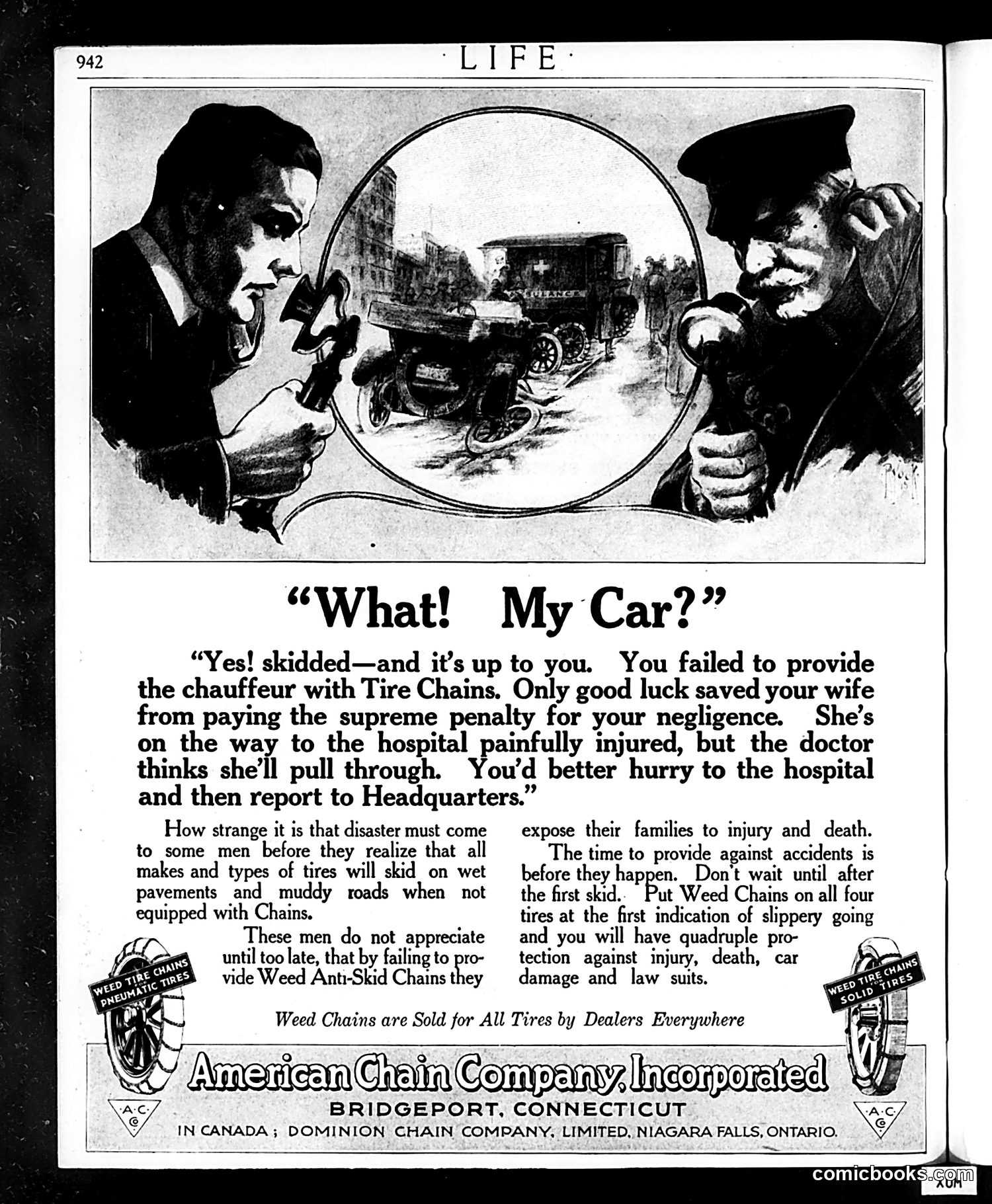
This is primarily a **product advertisement**, not political satire. The American Chain Company promotes "Weed Anti-Skid Tire Chains" through a cautionary narrative. **The scenario:** Two men discuss a car accident. One reports that the driver's wife was injured because the chauffeur lacked tire chains on wet roads—implying the car owner's negligence caused the disaster. **The message:** The ad argues that failing to equip vehicles with tire chains is dangerously irresponsible, potentially exposing families to "injury and death." It emphasizes preventive safety: "The time to provide against accidents is before they happen." **Historical context:** This reflects early-20th-century automobile safety concerns when tire chains were essential winter equipment for traction on icy or muddy roads. The ad uses fear-based marketing—threatening legal liability and family tragedy—to encourage purchase.
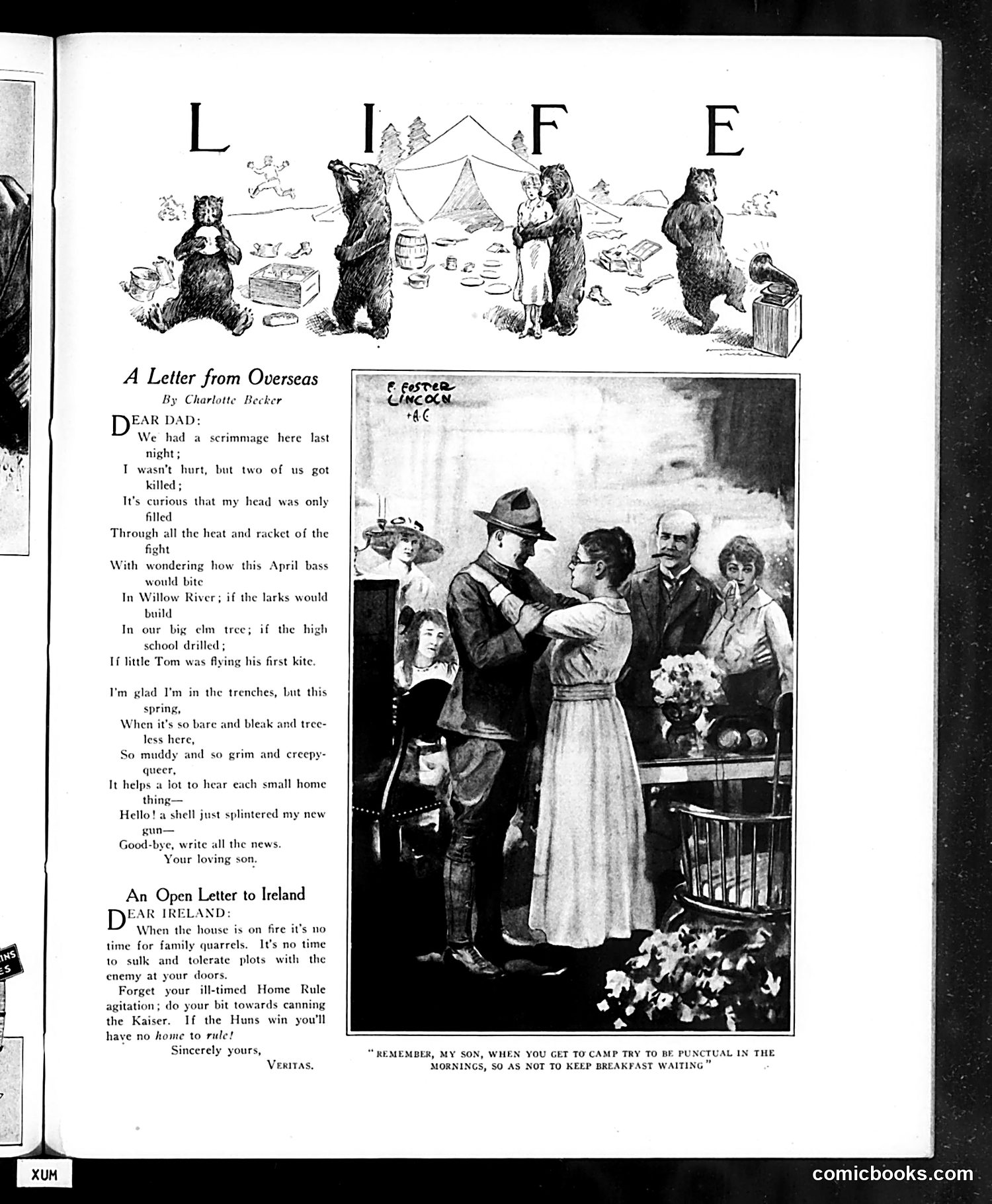
This page contains two wartime letters from 1918 (indicated by references to trenches and the Kaiser). **"A Letter from Overseas"** by Charlotte Becker depicts a soldier writing home about combat conditions—describing a scrimmage, heat, and racket of battle, mixed with homesick reflections on peaceful American life (bass fishing, larks, elm trees, school drills). **"An Open Letter to Ireland"** signed "Veritas" addresses Irish-American tensions during WWI, urging Irish immigrants to unite against Germany rather than pursue "Home Rule agitation" or "plots with the enemy." It's propaganda encouraging Irish-Americans' loyalty to the American war effort rather than prioritizing Irish independence. The bear illustration at top ("LIFE") is the magazine's mascot. The photograph shows a military figure with civilians, likely illustrating domestic wartime scenes.
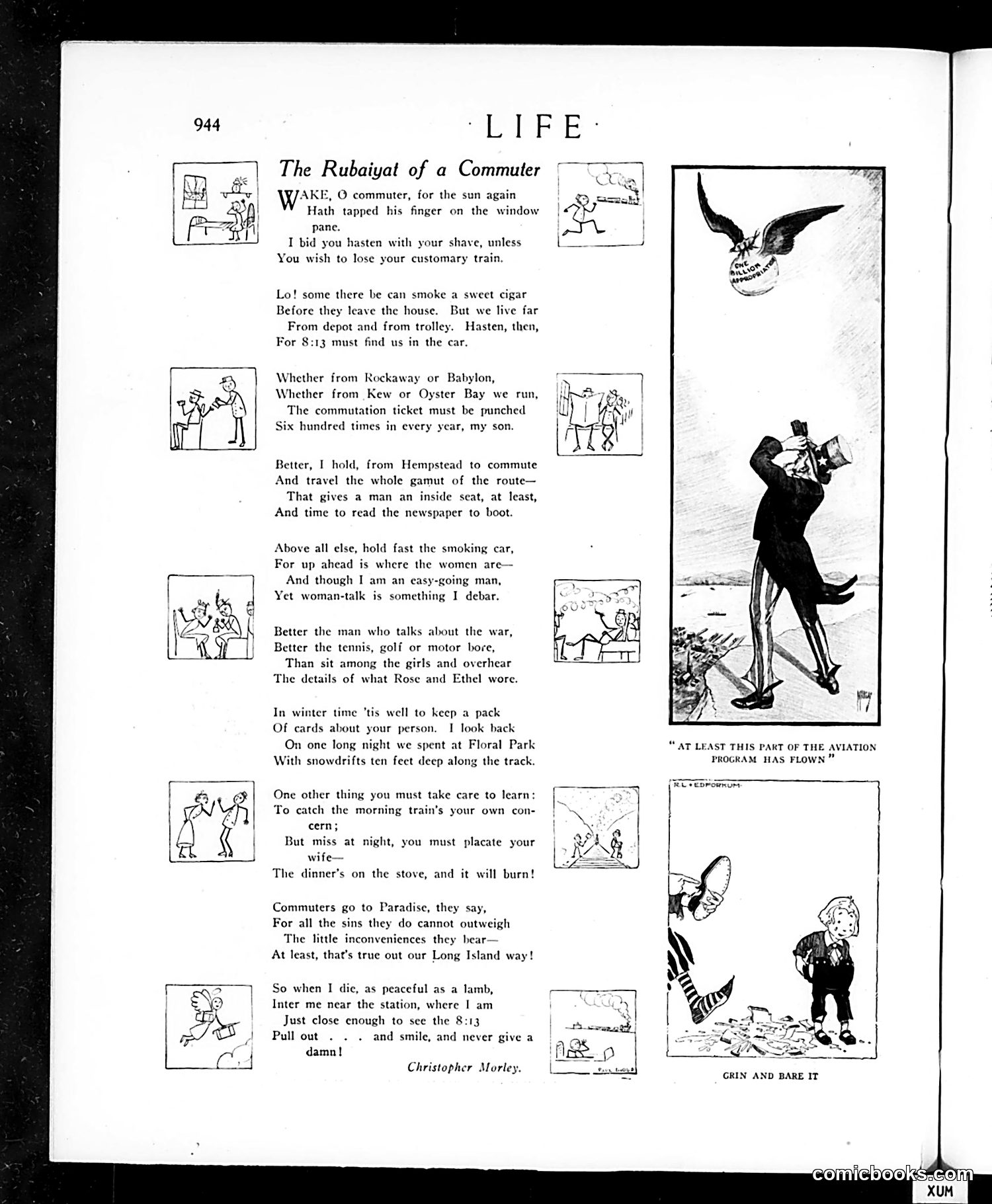
This satirical poem mocks the daily frustrations of commuters (likely from Long Island or similar suburbs into New York City). The verses humorously detail: - Rushing to catch early trains while sacrificing personal grooming - The tedium of commutation tickets punched repeatedly yearly - The social hierarchy of train cars, with smoking cars preferred to escape women's conversation - Missing dinners and leaving wives to manage burnt food - The moral compromises of suburban commuting The accompanying small illustrations show domestic chaos—rushed mornings, neglected families, harried travelers. The larger right-side cartoon depicts an idealized aviator, with the caption "At Least This Part of the Aviation Program Has Flown"—suggesting aviation offers escape from commuter drudgery. The era appears to be post-WWI, when aviation symbolized modernity and freedom.
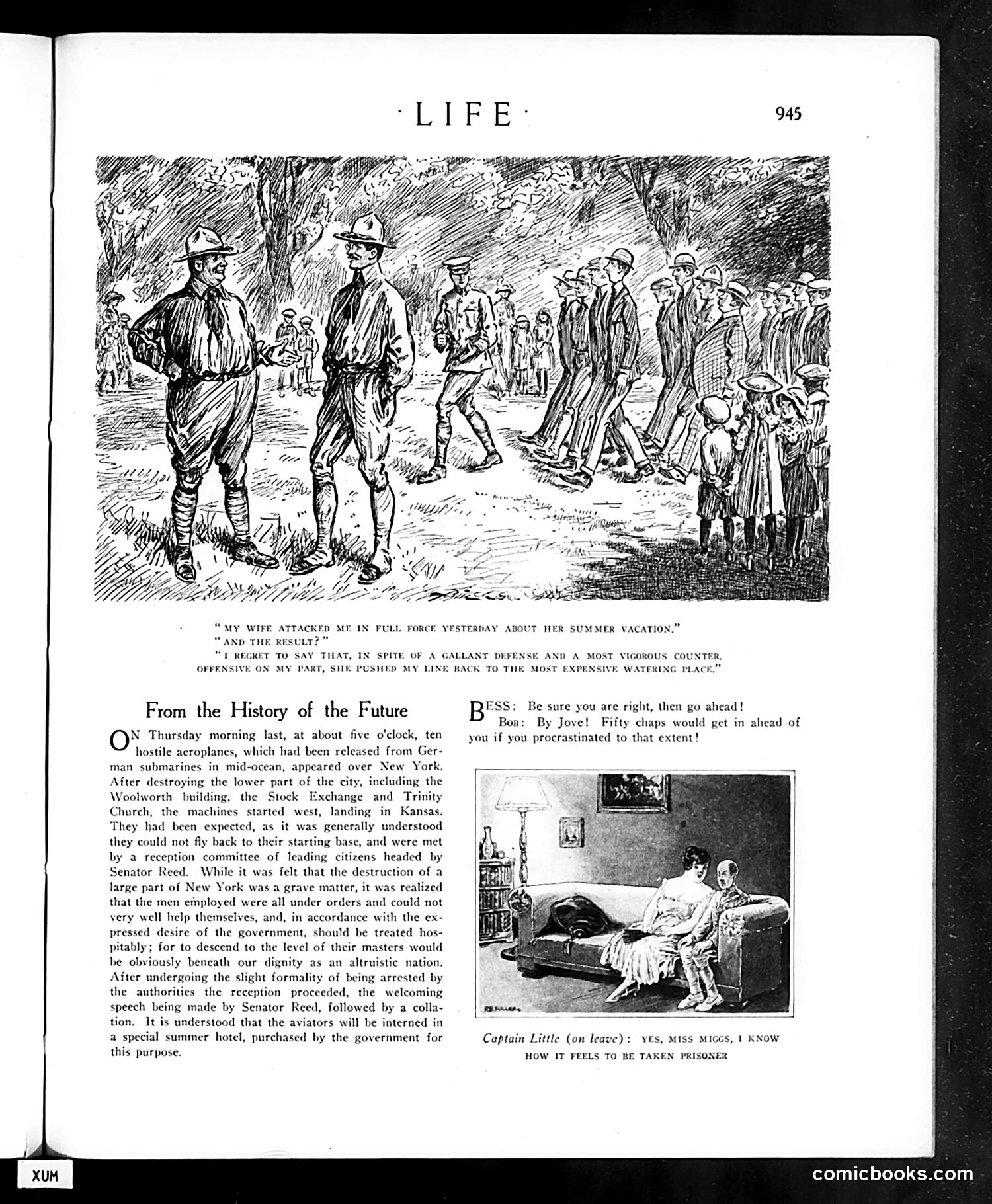
This page from *Life* magazine presents two satirical pieces: **Top cartoon**: Shows military officers confronting civilians in what appears to be a wartime or occupation scenario. The caption references a wife's attack on her husband regarding "summer vacations" and an "expensive watering place"—suggesting domestic conflict masked as military affairs. The satire likely mocks how serious national crises (the text mentions German submarines destroying New York) are deflected by petty domestic squabbles. **Bottom story "From the History of the Future"**: Describes a fictional future attack on New York by German submarines. It satirizes American preparedness and government response, depicting how captured enemy combatants would be treated as prisoners. The accompanying cartoon shows "Captain Little" discussing prisoner treatment, suggesting satirical commentary on military protocols and American values during wartime (appears to reference WWI-era concerns). The overall theme: civilian-military disconnect and satirical speculation about future warfare.
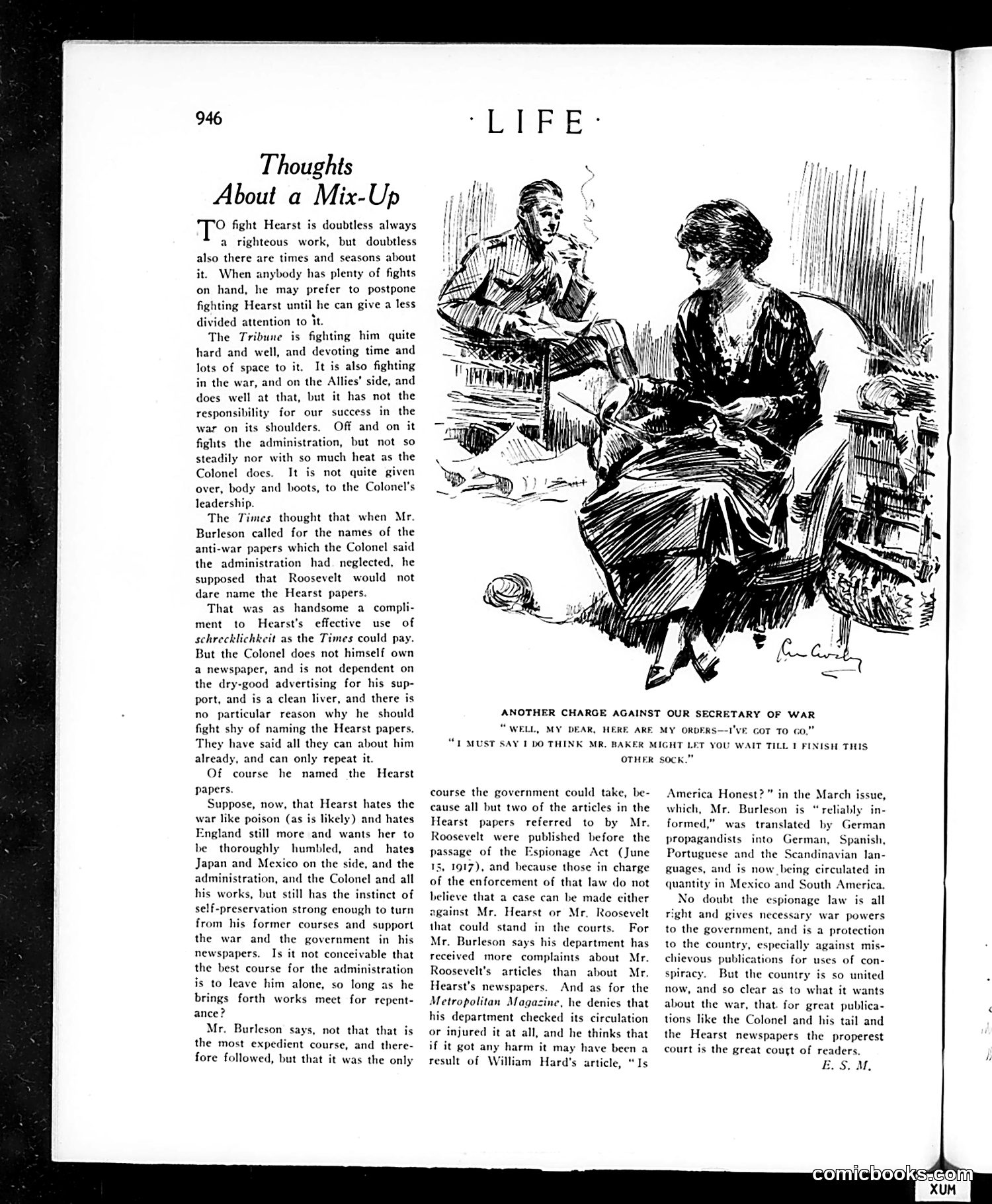
This satirical cartoon comments on accusations against the U.S. Secretary of War during World War I. The illustration shows two men in conversation, with the caption "I must say I do think Mr. Baker might let you wait till I finish this other sock." The text discusses a dispute between Colonel Roosevelt (Theodore Roosevelt) and the *Tribune* newspaper over "anti-war papers" allegedly suppressed by the administration. The article defends the Secretary of War (appears to be Newton D. Baker), arguing he lacks motive to target the *Hearst* newspapers, and that Roosevelt's publications have complained more than *Hearst's*. The cartoon mocks the trivial nature of accusations against the Secretary of War by depicting domestic wartime rationing (sock-knitting), suggesting critics are making mountains out of molehills.
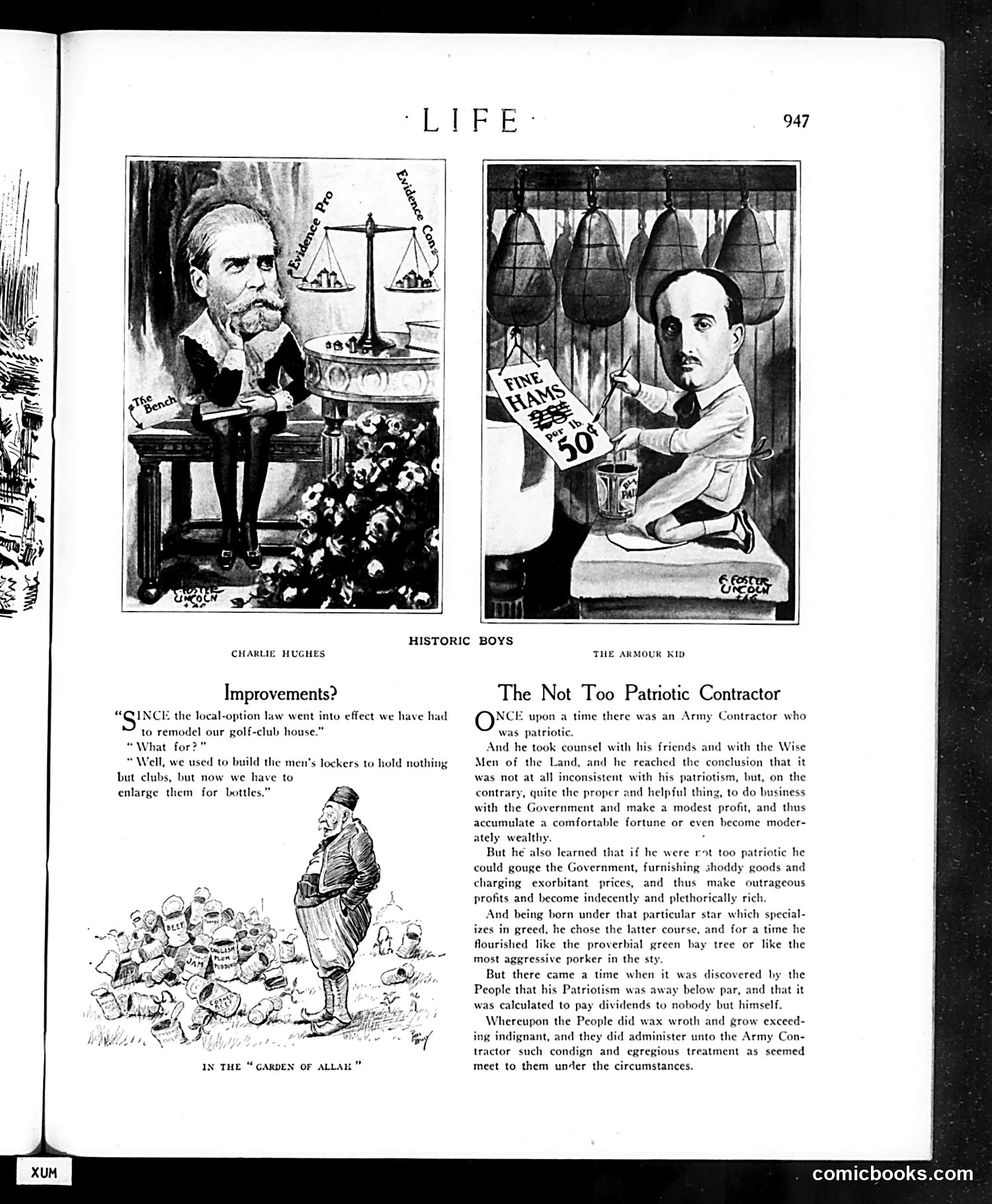
This page contains two distinct cartoons labeled "Historic Boys": **Left cartoon ("Charlie Hughes"):** Shows a caricatured man at scales of justice, with text mentioning remodeling a golf clubhouse by enlarging lockers "for bottles." This appears to satirize prohibition-era hypocrisy—the subject claims civic improvement while actually accommodating alcohol storage, mocking those who flouted liquor laws. **Right cartoon ("The Armour Kid"):** Depicts a man with hanging meat carcasses labeled "Fine Hams," holding a price tag marked "50." **"The Not Too Patriotic Contractor" story:** Criticizes an Army contractor who profiteered during wartime by charging inflated prices for substandard goods rather than serving the government faithfully—satirizing wartime corruption and unpatriotic greed.
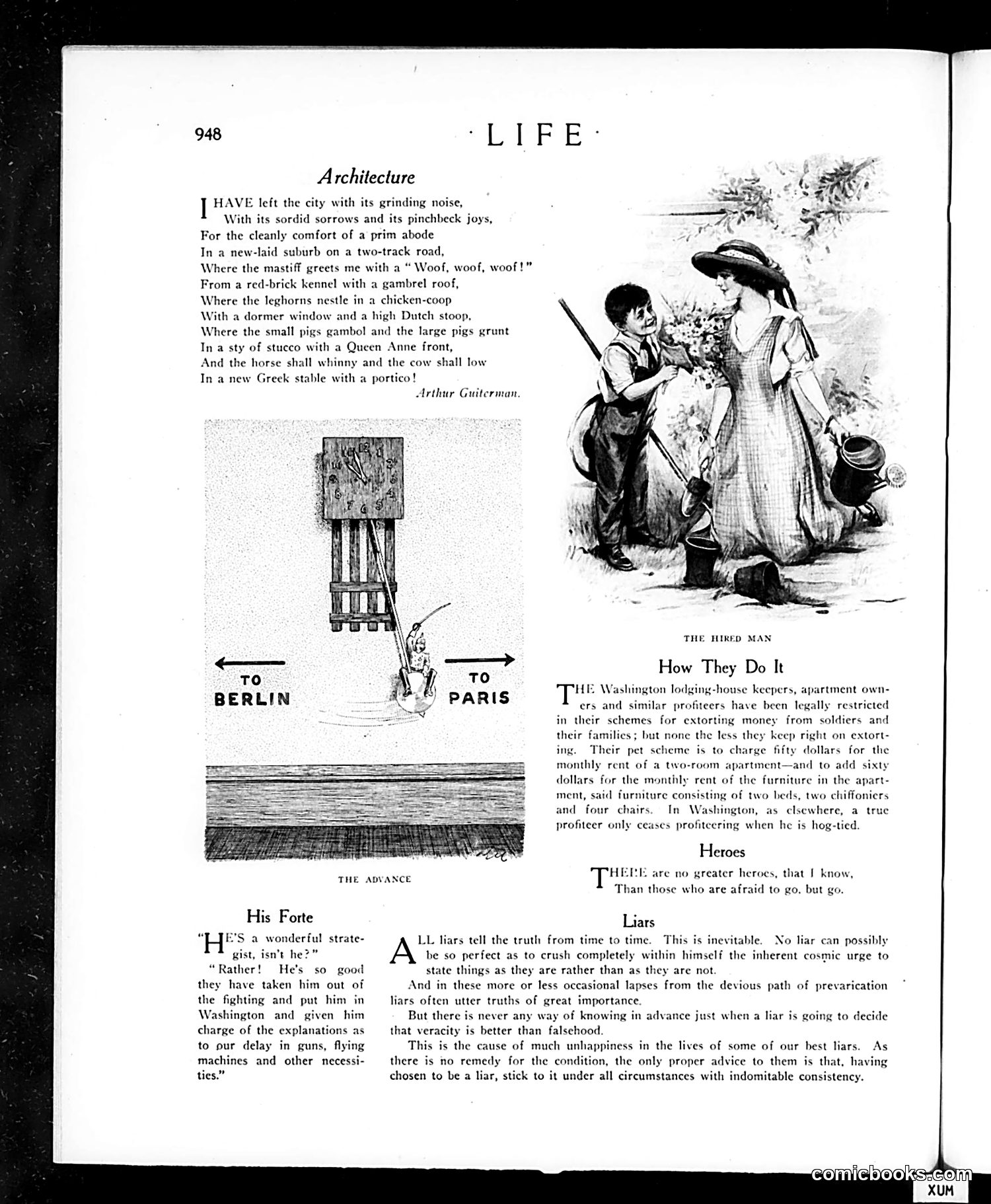
This page contains three separate pieces of satirical content: **"Architecture"** (top left): A poem by Arthur Guiterman satirizing suburban development, mocking the idealized pastoral imagery ("Woof, woof!") contrasted with the actual commercialized housing ("red-brick kennel," "Queen Anne front") being sold to the middle class. **"The Advance"** (center): A cartoon showing directional signs pointing "TO BERLIN" and "TO PARIS," with a military figure. This appears to reference World War I military movements and strategy, though specific context is unclear without dating. **"The Hired Man" section** (right): Includes commentary on lodging-house profiteering schemes targeting soldiers and their families, plus brief pieces on "Heroes" and "Liars"—likely moral commentary on wartime rhetoric and behavior. The overall theme criticizes commercialization and exploitation during the war period.
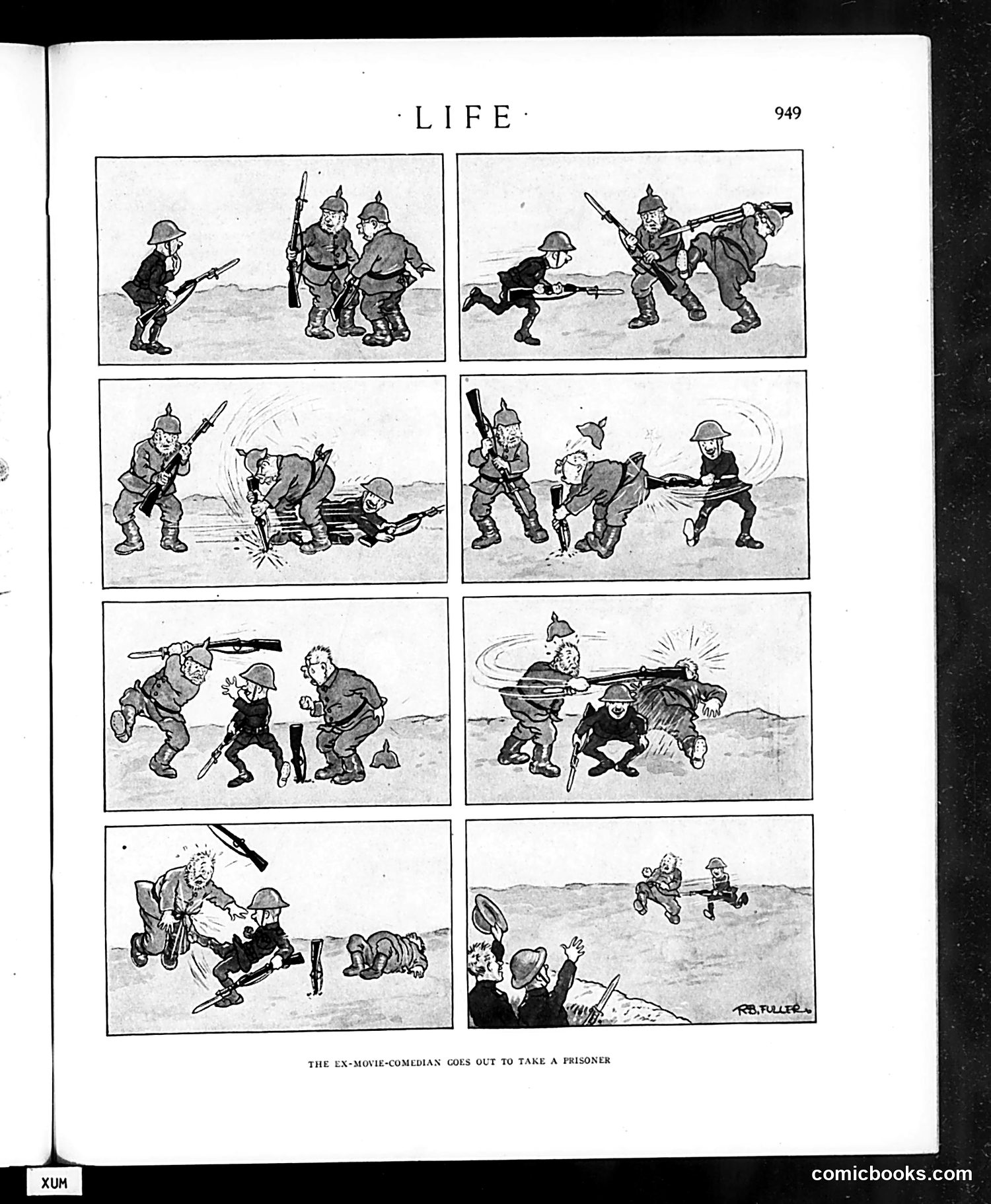
This is a comic strip titled "The Ex-Movie-Comedian Goes Out to Take a Prisoner." The eight-panel sequence depicts soldiers in WWI-style uniforms (spiked Prussian helmets) attempting to capture an enemy soldier through increasingly chaotic and comedic means. The humor derives from slapstick warfare: the soldiers repeatedly fail, tumble, and bungle their capture attempt across successive panels. The "ex-movie-comedian" appears to be a reference to Charlie Chaplin or similar silent-film comedians who performed in military-themed comedies. The satire contrasts the absurdity of actual combat with entertainment portrayals of war—suggesting that real warfare is messier and less controlled than Hollywood depictions, while also mocking the glorification of military action through comedy.
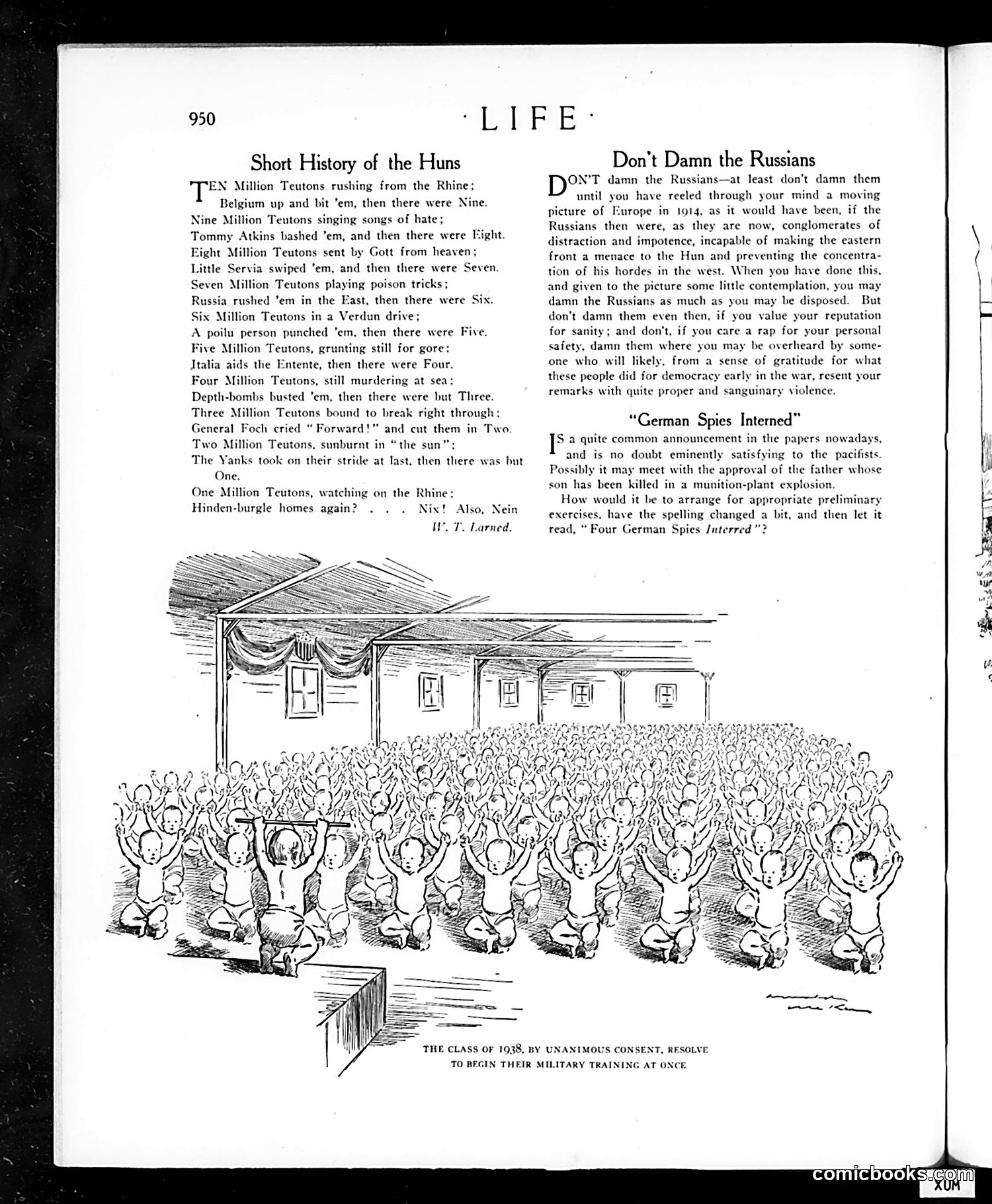
This page contains WWI-era satire (circa 1918, based on the caption). **"Short History of the Huns"** is a darkly comic countdown poem mocking German military losses, using "Huns" as a derogatory term for Germans. It catalogs diminishing Teutonic forces through battles, ending with a single survivor watching the Rhine—a bitter joke about German defeat. **"Don't Damn the Russians"** argues against blaming Russians for early war failures, contextualizing Russian struggles as products of systemic dysfunction rather than inherent inferiority. It reflects Allied frustration with Russia's early performance. **"German Spies Interned"** is a brief note about captured German operatives. The large cartoon depicts recruits in 1918 beginning military training—likely commenting on American mobilization or conscription at the war's final stage.
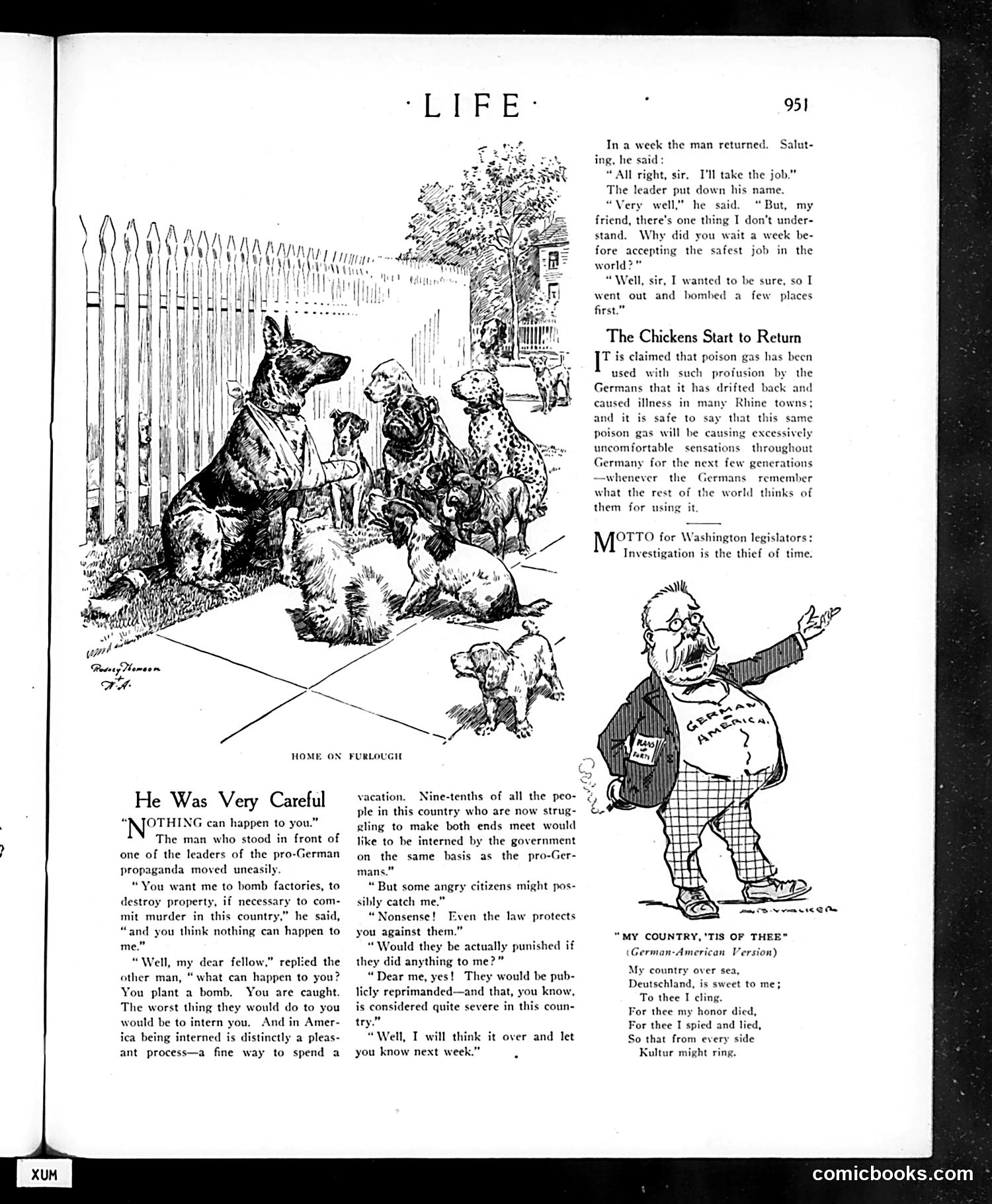
This page satirizes German propaganda and anti-German sentiment during World War I. The main cartoon "Home on Furlough" depicts a large German soldier surrounded by smaller dogs, mocking German militarism and suggesting Germans are beast-like or animalistic. The text story "He Was Very Careful" presents a dialogue between a German propagandist and another man, discussing threats and property destruction—likely referencing German sabotage activities or propaganda tactics in America during WWI. "The Chickens Start to Return" discusses poison gas warfare, blaming Germany for its widespread use and predicting long-term consequences for German civilians. The final cartoon depicts a German-American figure ("My Country, 'Tis of Thee" parody), satirizing divided loyalties during wartime. This reflects American suspicion of German-American citizens' patriotism during the war.
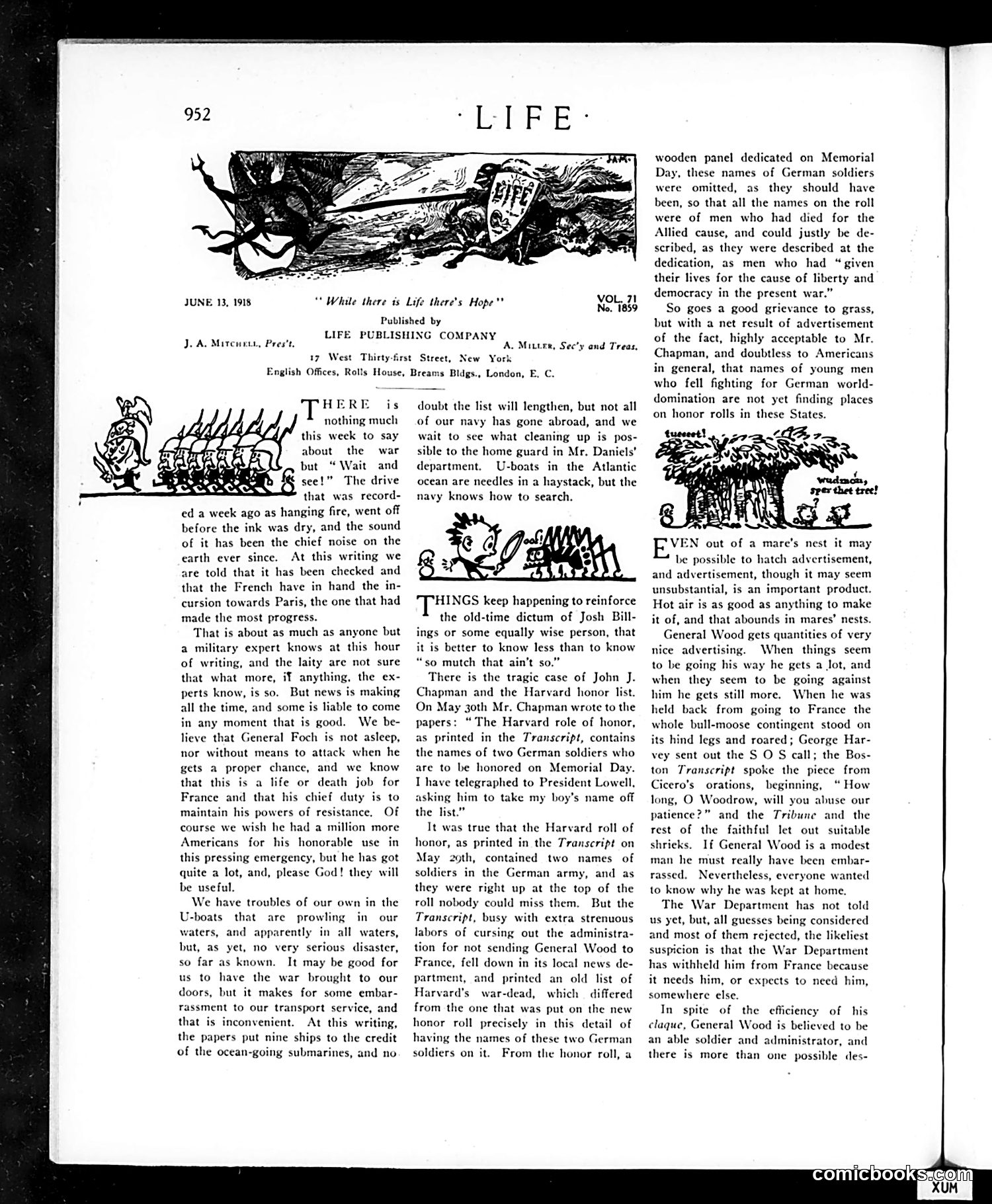
This June 1918 *Life* magazine editorial discusses a controversy involving John J. Chapman and Harvard University's Memorial Day honor roll. Chapman discovered that the printed *Transcript* version of Harvard's honor list accidentally included two German soldiers among the names to be honored—likely from an outdated roster. Chapman protested by telegram to President Lowell, demanding his own son's name be removed rather than appear alongside German names. The editorial notes the error was caught before the actual wooden dedication panel was unveiled on Memorial Day, where only Allied soldiers were listed. The author treats this as a tempest-in-teapot: Chapman's grievance was technically valid but ultimately resolved correctly. The piece gently mocks the situation while acknowledging Chapman's patriotic concern during wartime—when honoring German soldiers would have been genuinely offensive to American sensibilities in 1918. The cartoons appear decorative/thematic rather than directly satirizing specific figures.
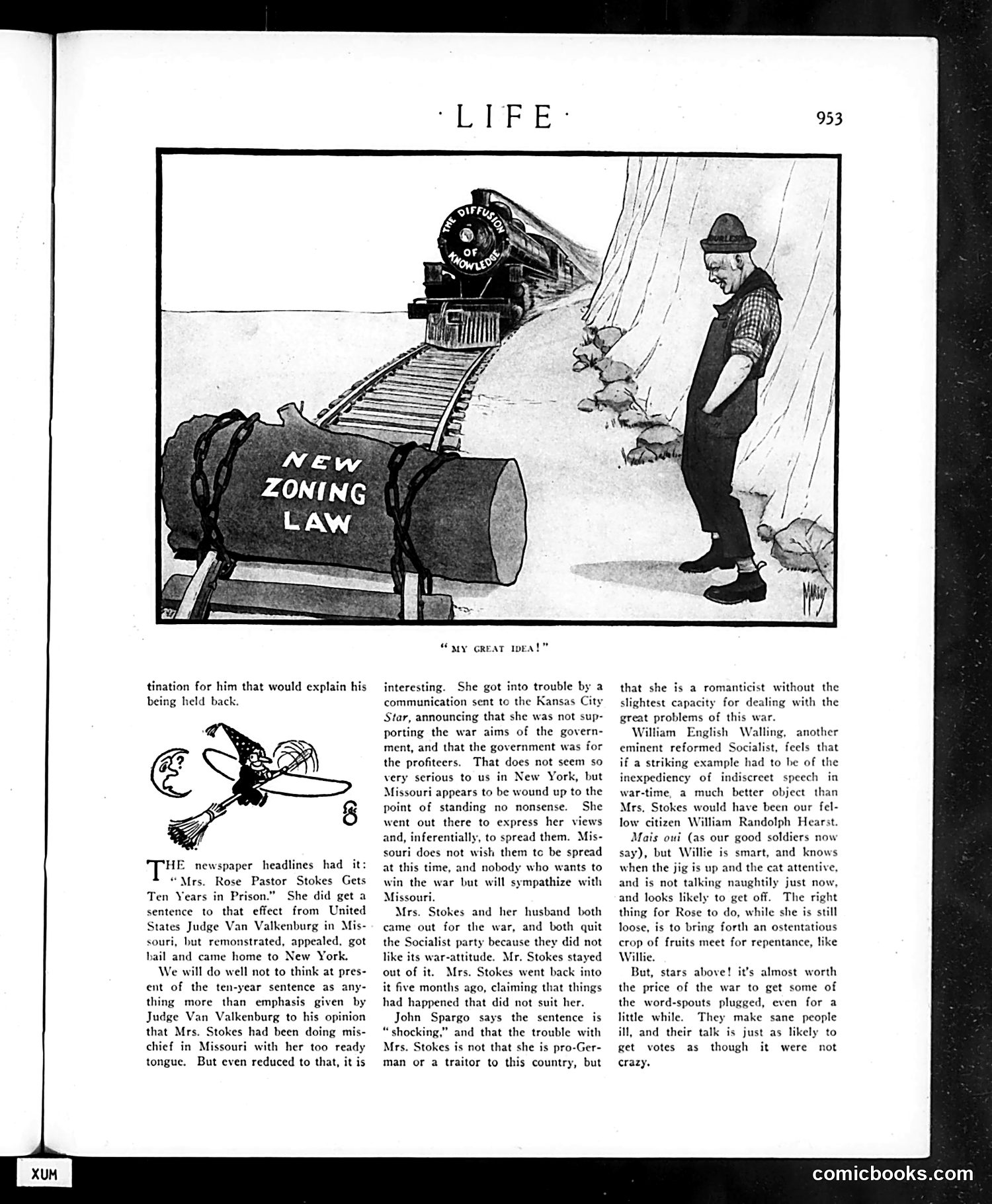
**The Main Cartoon:** The top illustration depicts a train labeled "New Zoning Law" approaching a worker, representing satire of local regulatory efforts. The caption "My Great Idea!" suggests ironic commentary on what authorities considered progressive policy. **The Text Commentary:** The page discusses Rose Pastor Stokes, a Socialist activist sentenced to ten years in prison by a Missouri judge for publicly opposing U.S. war profiteering during World War I. The article presents various reformist perspectives on her case: some call the sentence "shocking," while others argue her real flaw is romantic idealism divorced from practical thinking. **The Satire's Point:** Life mocks both Stokes's impractical activism and selective enforcement of wartime censorship—notably suggesting media mogul William Randolph Hearst escaped consequences through shrewdness. The final paragraph cynically suggests that silencing "word-spouts" (loud speakers) might be worth wartime's cost, implying the magazine's ambivalence about free speech restrictions during war.
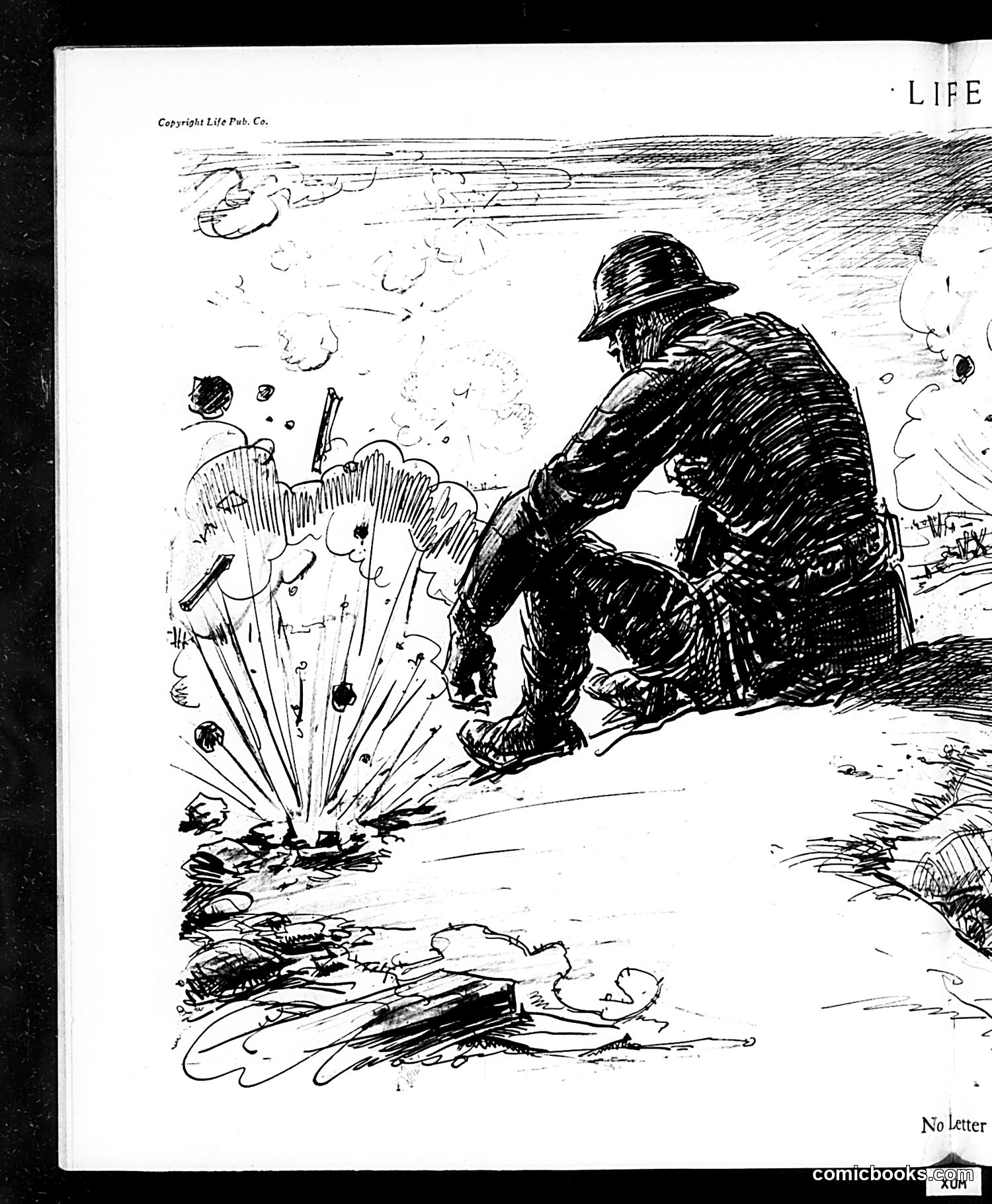
This appears to be a World War I-era military cartoon from *Life* magazine. It depicts a soldier in a military helmet and uniform detonating what looks like a land mine or explosive device. The radiating blast lines and scattered debris emphasize the violent explosion. The cartoon's title, "No letter," suggests a dark joke about wartime casualties—specifically, that a soldier killed in combat would send no letters home to loved ones. This reflects the satirical tone *Life* often used to comment on the grim realities of WWI, particularly regarding soldiers' deaths and the communication (or lack thereof) with their families. The stark, bold linework emphasizes the brutality being depicted.
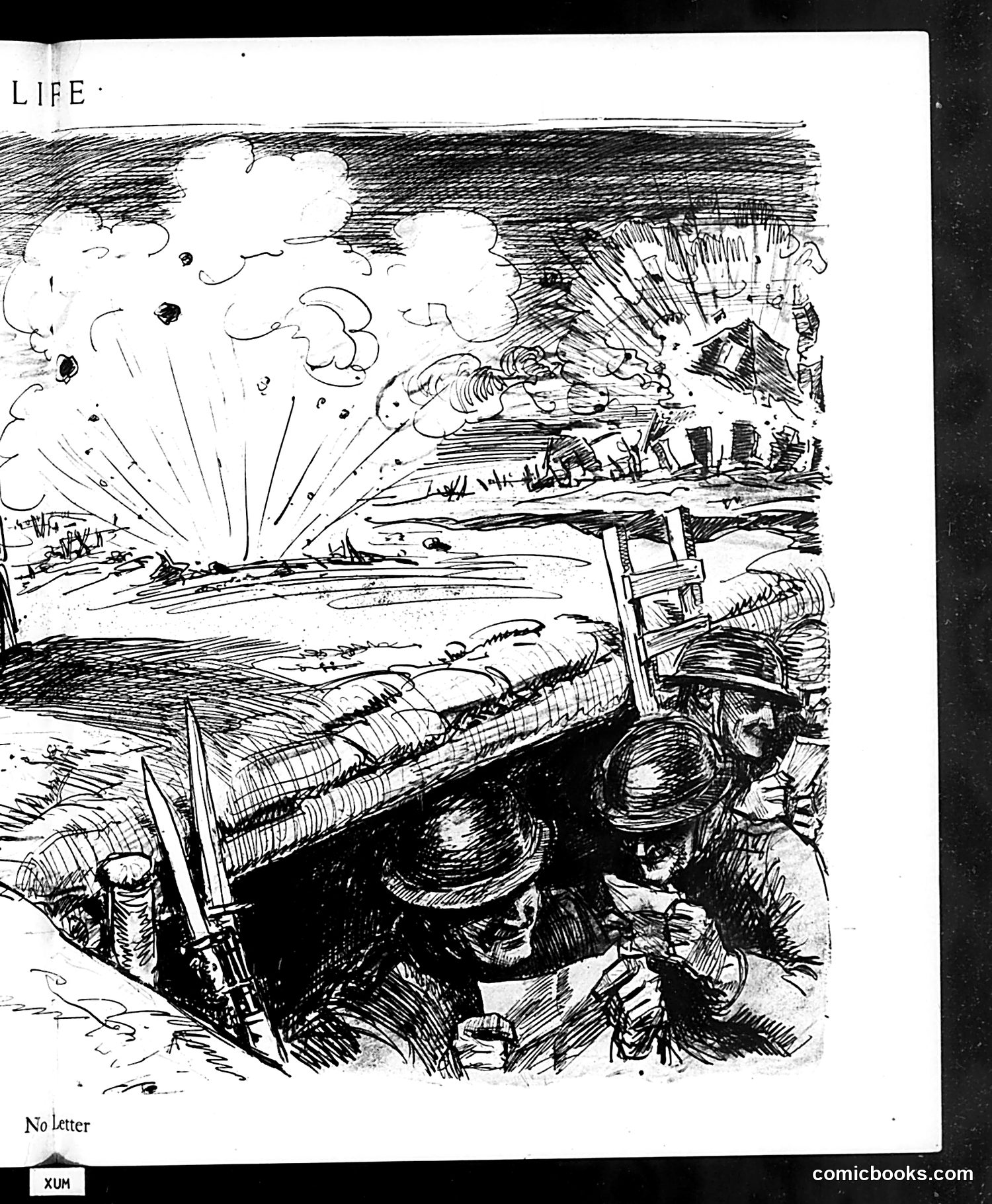
This editorial cartoon depicts soldiers in a frontline trench during World War I, facing an exploding artillery barrage. The title "LIFE" at the top appears ironic—the composition emphasizes the soldiers' precarious position under heavy bombardment, with clouds of smoke and destruction visible across the landscape. The soldiers wear military helmets and appear grim, huddled in their defensive position. The stark contrast between the bright explosive bursts and the heavily-inked soldiers creates visual impact emphasizing danger and mortality. The notation "No letter" likely refers to correspondence or communication—suggesting soldiers receiving no messages from home, or possibly commenting on the absence of meaningful communication from military leadership about their fates. This appears to be anti-war commentary critiquing the brutal realities soldiers faced.
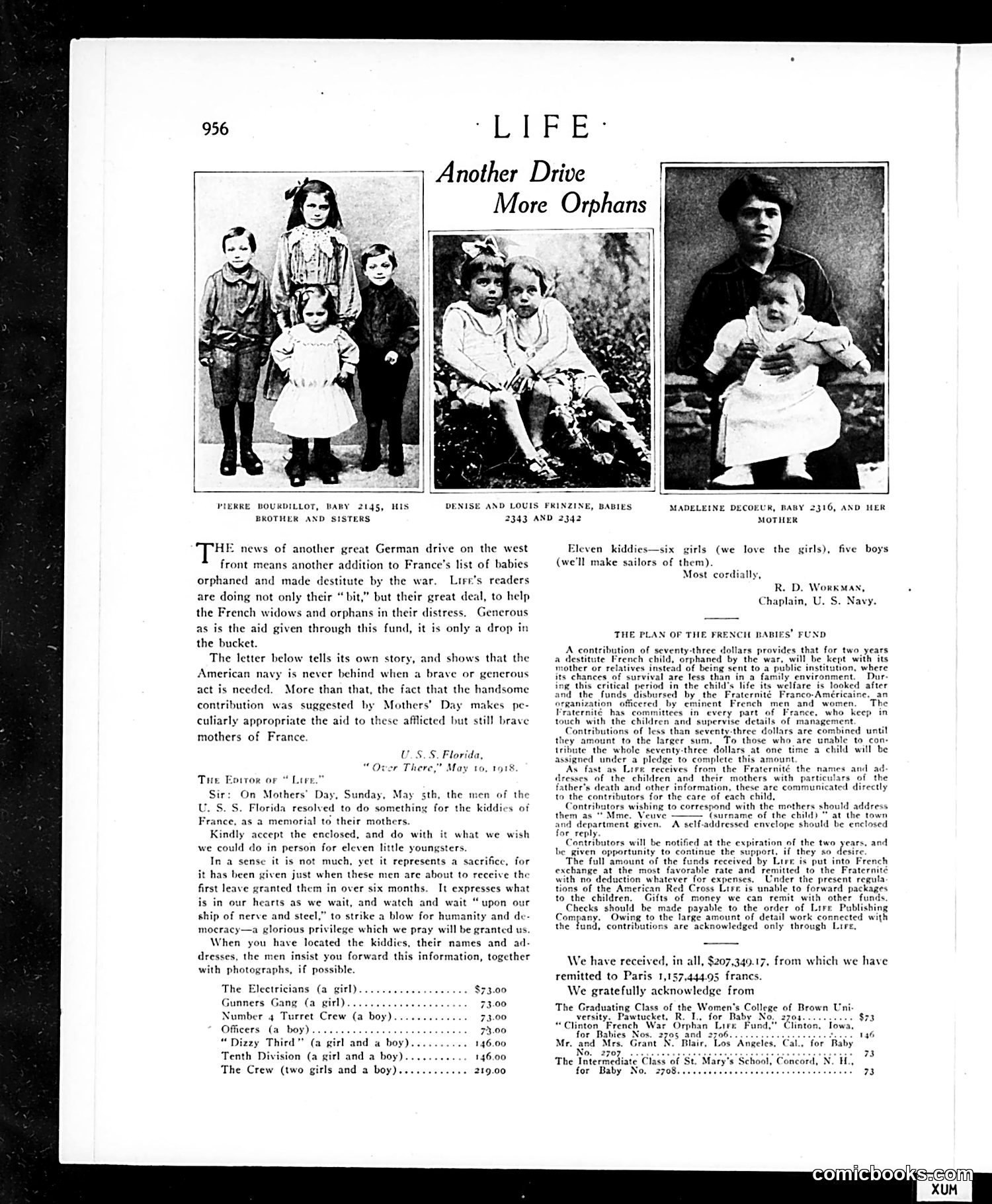
This page documents a **WWI charitable campaign** supporting French war orphans. The three photographs show specific children being aided—Pierre Bourdillot and siblings, the Prinzine babies, and Madeleine Decoeur—representing France's civilian casualties from German military offensives. The core content is a letter from the USS Florida's chaplain describing how American sailors collectively donated money on Mother's Day 1918 as a memorial gesture. The donation (divided among ship units like "The Electricians" and "Dizzy Third") would support eleven French orphans for two years under the "Fraternité Franco-Américaine," keeping children with relatives rather than institutions. This represents **American public support for Allied France**—positioning U.S. military personnel as humanitarian actors. The appeal connects patriotic duty ("strike a blow for humanity") with domestic sentiment (Mother's Day), making war sacrifice personally meaningful. For 1918 readers, this normalized both military engagement and charitable obligation to civilian war victims.
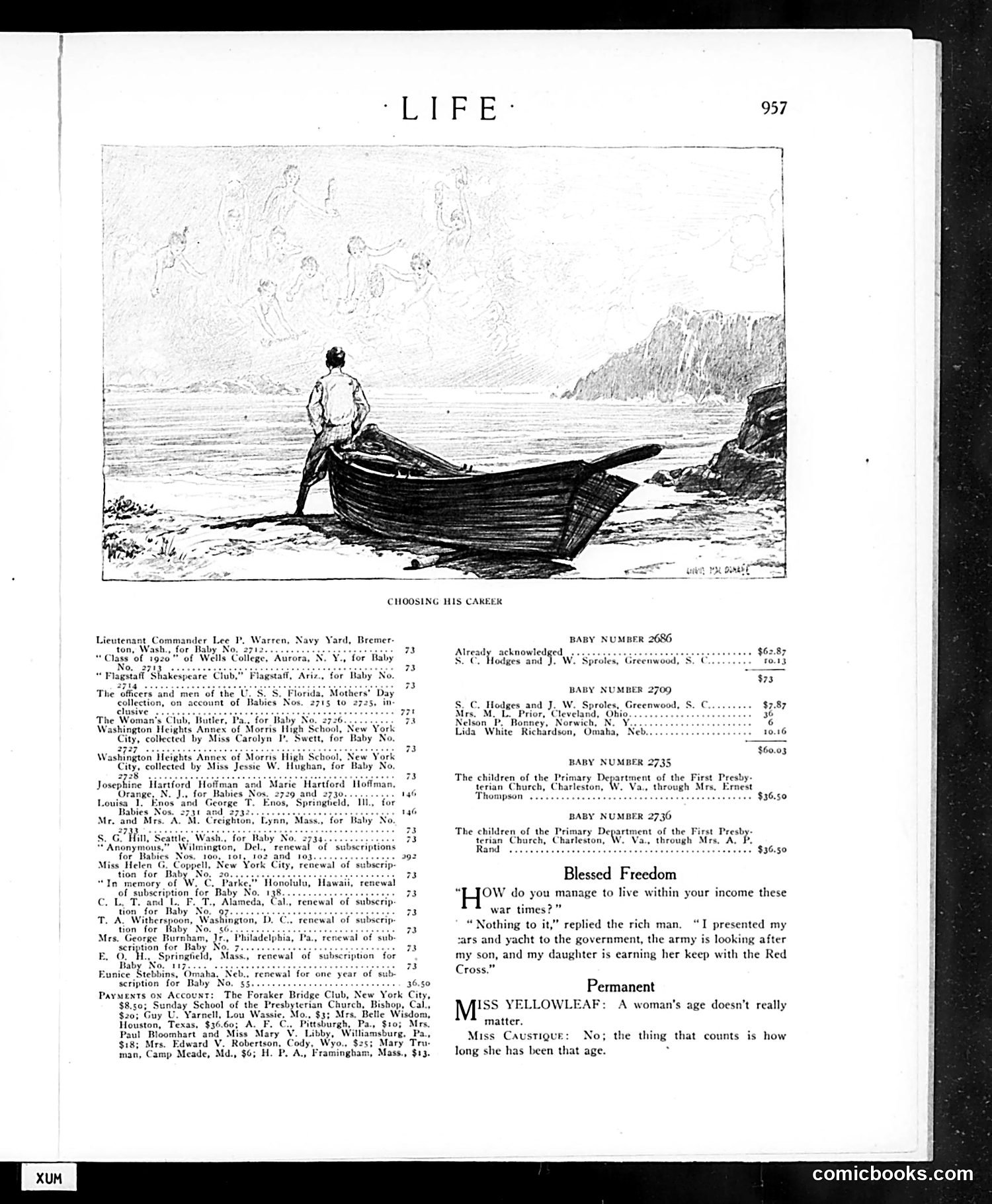
The main illustration depicts a man standing contemplatively beside a beached boat, gazing toward distant figures in the sky—likely representing angels or his aspirations. The caption "Choosing His Career" suggests this is about life direction or calling. The page primarily consists of acknowledgments for "Life" magazine's charitable baby fund contributions, listing donors' names and amounts. This reflects the magazine's practice of soliciting reader donations for worthy causes. Below the main illustration are two brief comedic dialogues. "Blessed Freedom" presents a wealthy man's wartime solution to living within his income: he's donated his cars and yacht to the government and relies on family members' earnings—a satirical commentary on how the rich used patriotic duty to reduce personal expenses during wartime (likely WWI era, given the Red Cross reference). "Permanent" offers a short exchange mocking women's age-consciousness, a standard period joke about feminine vanity. The overall page blends charitable solicitation with light social satire typical of Life magazine's editorial approach.
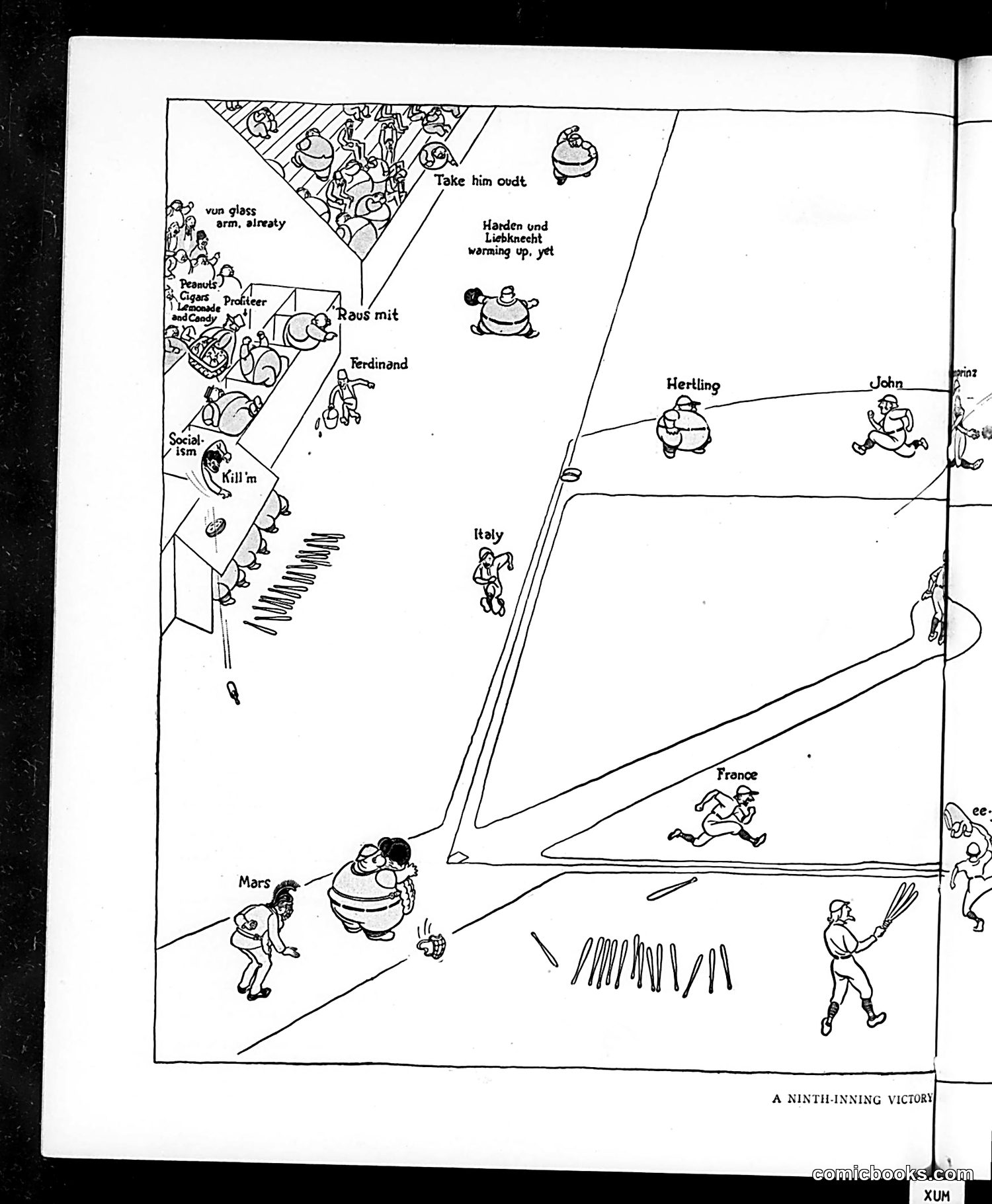
This appears to be a sports-themed political satire cartoon titled "A Ninth-Inning Victory." The image uses a baseball game as metaphor, with labeled figures representing different nations or political entities: France, Italy, Mars, and others like "Hertling" and "John." The cartoon depicts a baseball diamond where various characters are positioned as if playing. The left side shows crowded stands with figures labeled with social commentary ("Socialism," "Kill'm," references to peanuts, cigars, and candy). Without being able to definitively date this or identify all figures, the structure suggests this comments on international relations or warfare using baseball as an organizing metaphor—likely from the World War I era, given the European nation labels and apparent military context. The "ninth-inning" title suggests a late-stage victory or outcome.
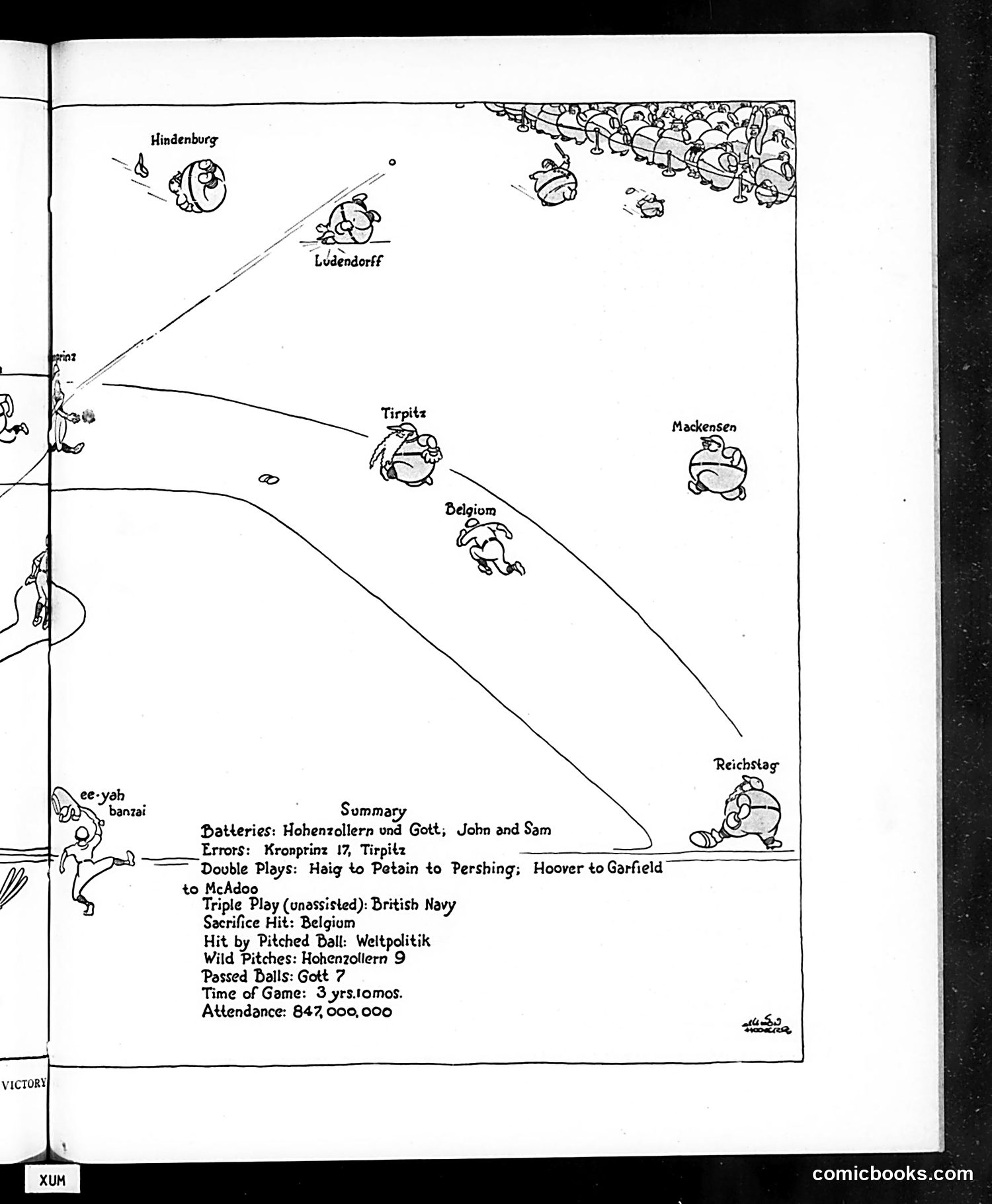
This is a satirical baseball "box score" of World War I, treating the conflict as a game. The illustrated map shows major military figures and nations as players positioned across a field: **The teams** appear to be the Central Powers (Germany, Austria-Hungary) versus the Allies (Britain, France, America, Belgium). Named figures include German military leaders (Hindenburg, Tirpitz, Kronprinz, Mackensen) and Allied commanders (Haig, Pershing, Hoover). **The satire** mocks the war by using baseball terminology: "Batteries" (pitchers/catchers) are nations, "errors" are military blunders, "sacrifice hits" references Belgium's devastation, and "wild pitches" suggest chaotic strategy. The three-year duration and enormous "attendance" (847,000,000—suggesting casualties or population affected) emphasize the war's massive scale. The page suggests Life magazine's skepticism toward the conflict's rationality and those directing it, presenting this deadly competition as an absurd game with quantifiable "plays."
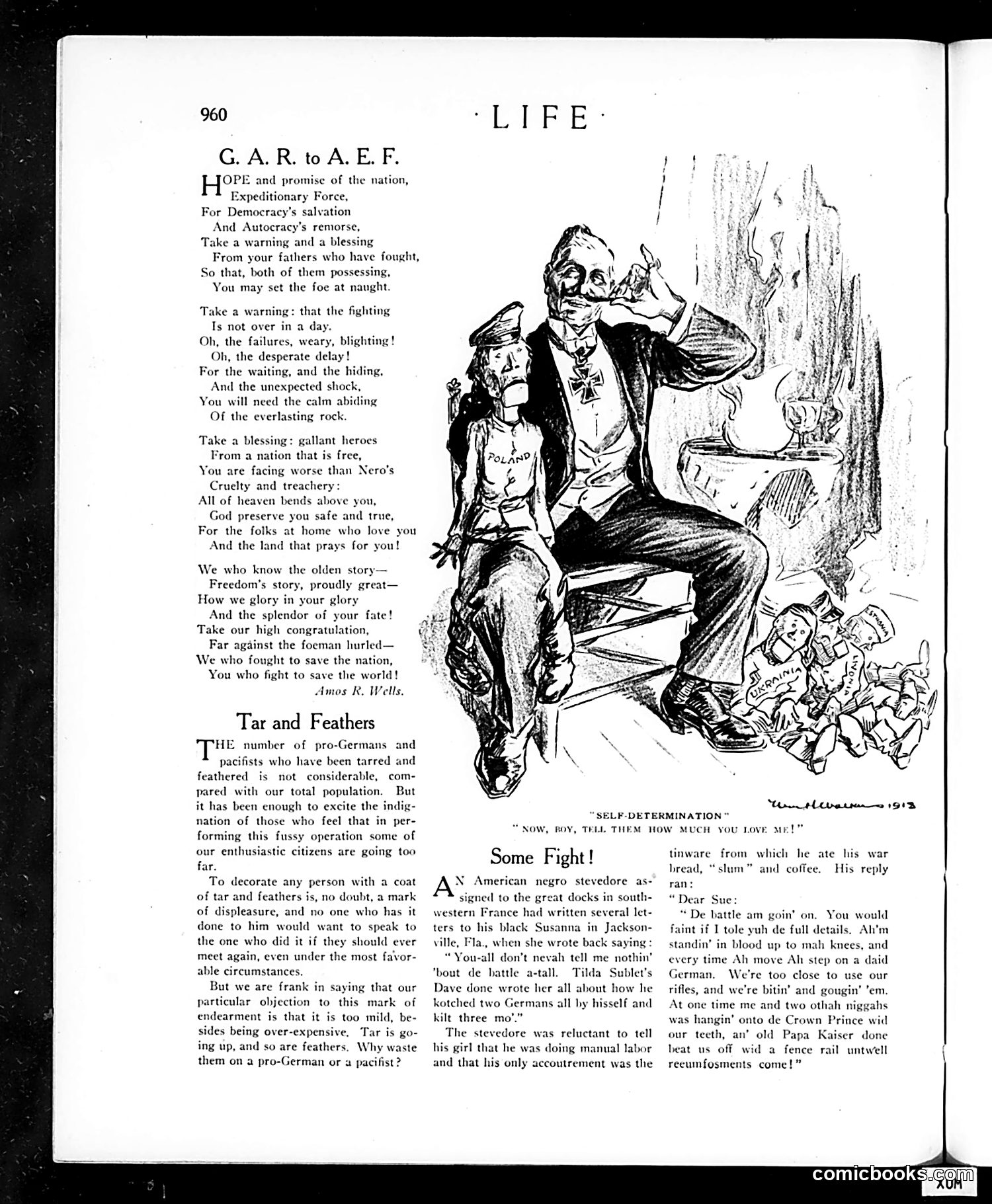
This page contains WWI propaganda and commentary circa 1917-1918. **Main Cartoon ("Self-Determination"):** An older German military officer (likely representing Kaiser Wilhelm or German autocracy) sits with a young child labeled "Poland," illustrating the ironic contrast between Germany's claimed defense of "self-determination" and its actual imperial domination of occupied territories. **"G.A.R. to A.E.F." Poem:** A message from Civil War veterans (Grand Army of the Republic) to American Expeditionary Forces in France, urging young soldiers to fight for democracy against "autocracy." **"Tar and Feathers" Article:** Satirizes mob justice against pro-German pacifists, arguing the practice is insufficiently harsh—a darkly humorous defense of vigilante patriotism. **"Some Fight!" Story:** A humorous dialect narrative about a Black stevedore's exaggerated war letter to his girlfriend, mixing period racism with working-class humor about actual combat versus manual labor assignments. The page reflects American wartime propagandizing and the era's casual racial stereotyping.
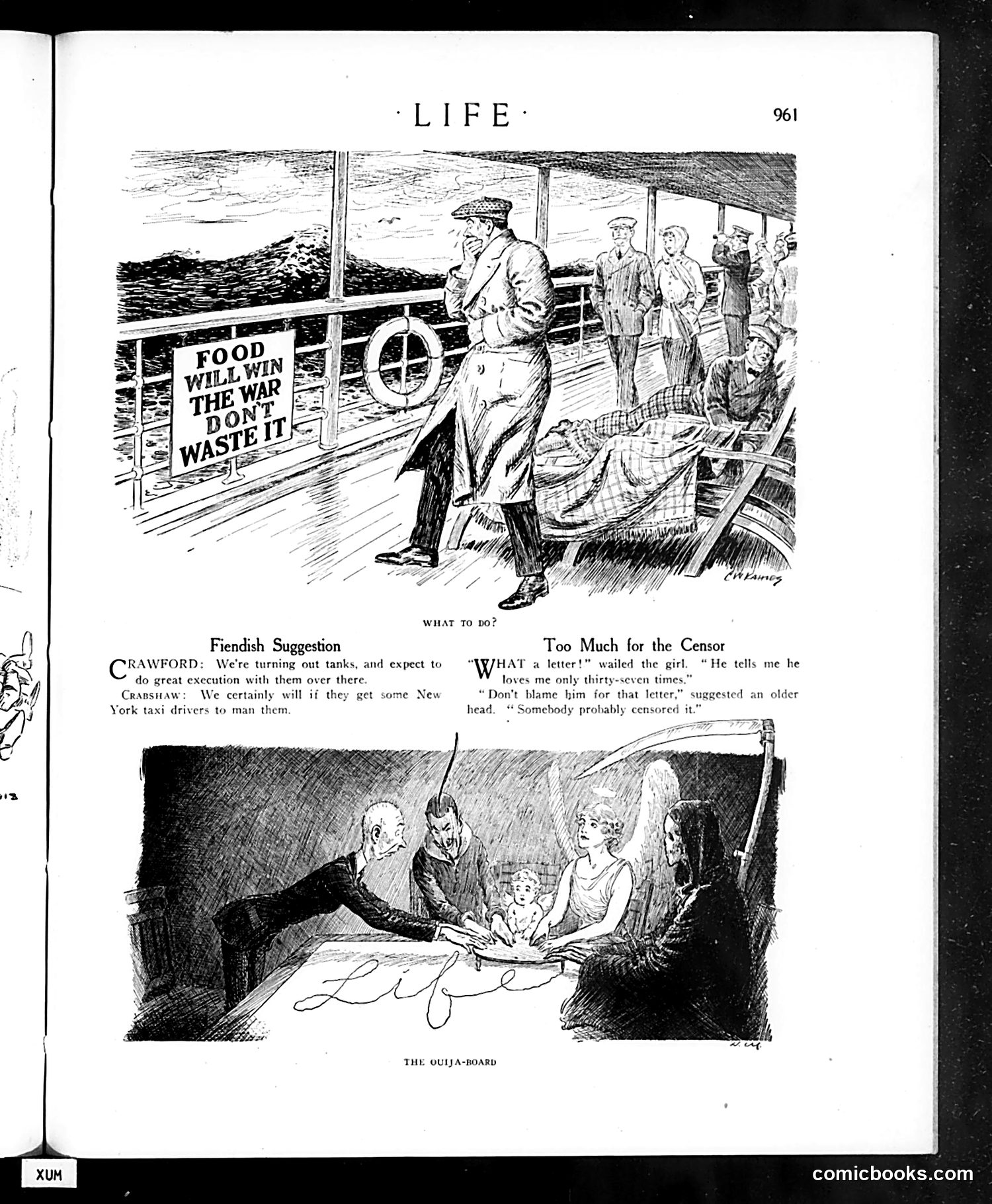
**Top Cartoon - "Fiendish Suggestion":** This WWI-era cartoon depicts two men discussing military tanks. One suggests recruiting New York taxi drivers to operate them, implying taxi drivers are recklessly aggressive drivers. The joke plays on stereotypes of New York taxi drivers as dangerous and skilled at aggressive maneuvering—qualities that might translate to effective tank warfare. **Bottom Cartoon - "Too Much for the Censor" / "The Ouija-Board":** A young woman complains that her love letter says he loves her "only thirty-seven times." Older observers suggest the letter was censored—implying military censors removed more romantic declarations. The satire mocks wartime mail censorship, suggesting censors deleted so many expressions of love that the remaining count seems absurdly low. The ouija board reference unclear from context alone, though the séance-like gathering suggests supernatural divination. Both cartoons mock aspects of WWI: military inefficiency and invasive censorship of personal correspondence.
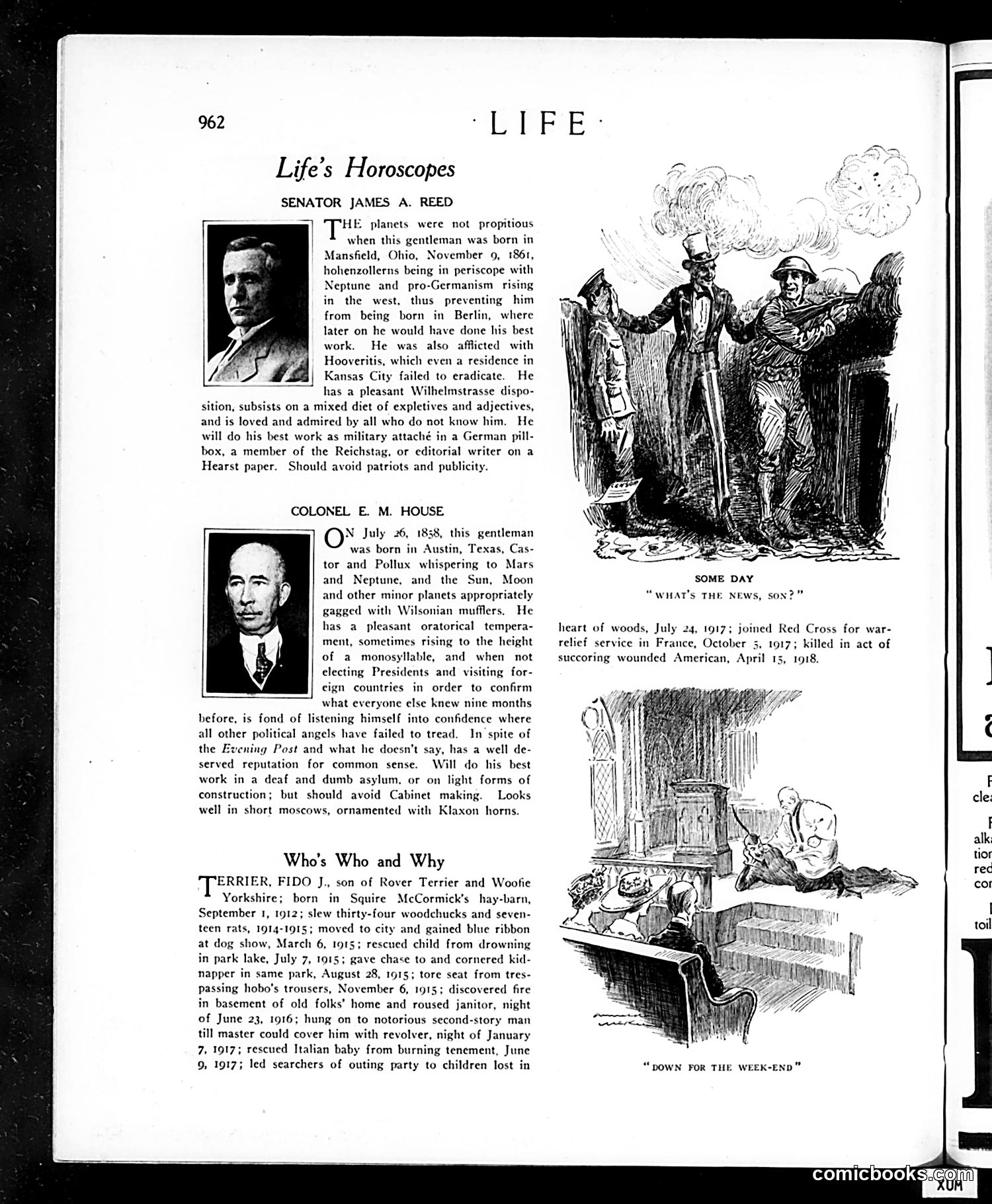
This page satirizes prominent American political figures through mock "horoscopes" — a popular divination format used mockingly to skewer their characters and predicted fates. **Senator James A. Reed**: Portrayed as pro-German and incompetent, afflicted with "Hooveritis" (likely criticism of Herbert Hoover's policies). The satire suggests he should work for Germany rather than America, mocking his alleged sympathies during WWI. **Colonel E. M. House**: President Wilson's close advisor, ridiculed as verbose yet influential, manipulating foreign policy while pretending ignorance. The barb about "electing Presidents" suggests puppet-master behavior. **Fido the Terrier**: A heroic dog's biography contrasts sharply with the politicians above—a dog accomplishes more for humanity (rescuing people, joining Red Cross relief) before dying honorably in WWI service than these men manage through their careers. The satire's point: a dog has more integrity and patriotism than these politicians.
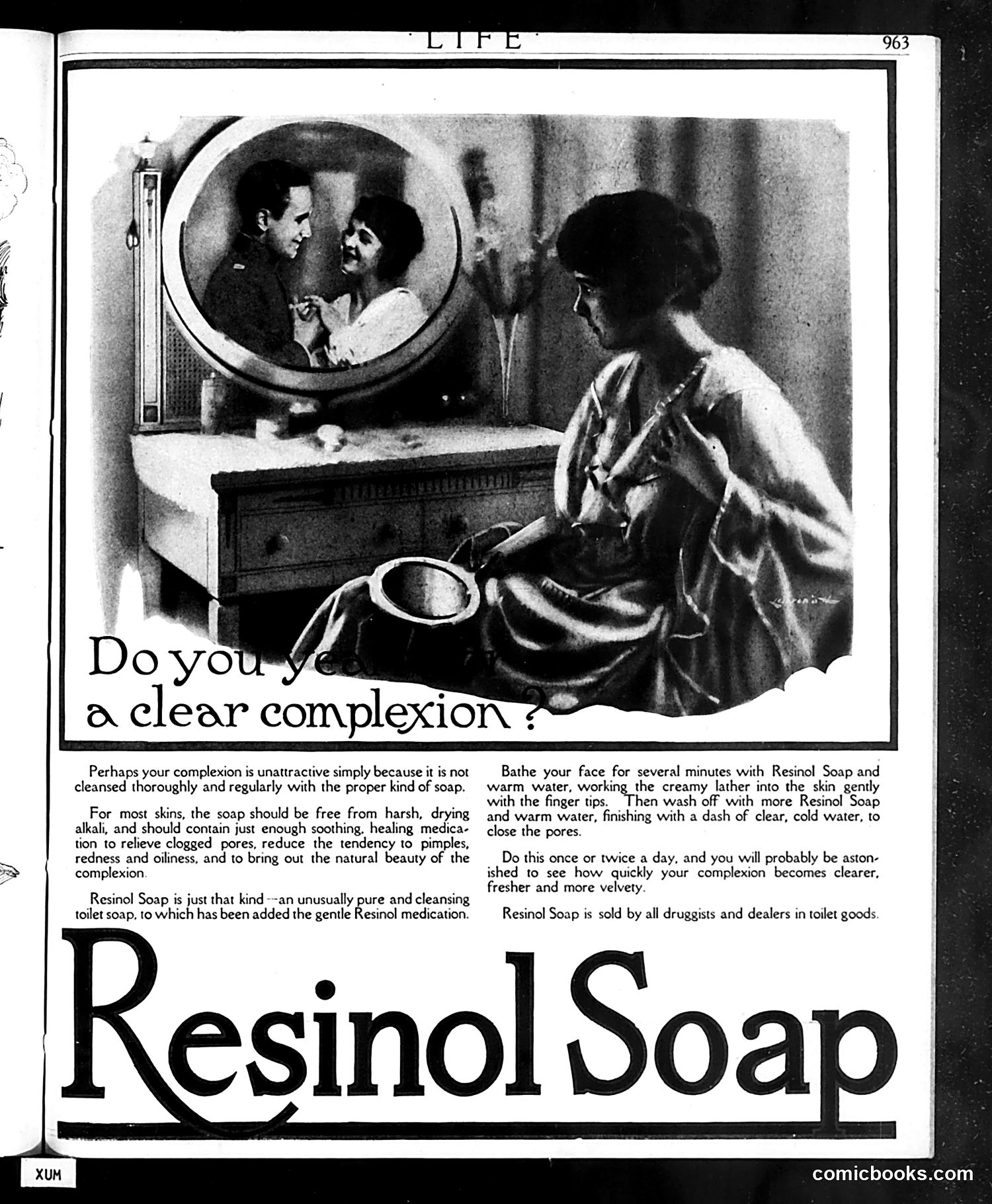
This is a **Resinol Soap advertisement**, not political satire. The page uses a domestic scene to promote skincare: a woman sits at her vanity mirror while a man and woman embrace in the mirror's reflection behind her. The setup implies the woman's clear complexion—achieved through proper washing with Resinol Soap—has made her attractive enough to secure romantic attention. The advertisement reflects early 20th-century beauty marketing that linked personal hygiene and appearance to social success, particularly for women. It promises that regular use of this medicated soap will eliminate skin problems (pimples, redness, clogged pores) and reveal "natural beauty." The text prescribes a specific twice-daily washing routine using warm water and the product. This represents typical period advertising that sold self-improvement through consumer products rather than containing any political commentary or satire.
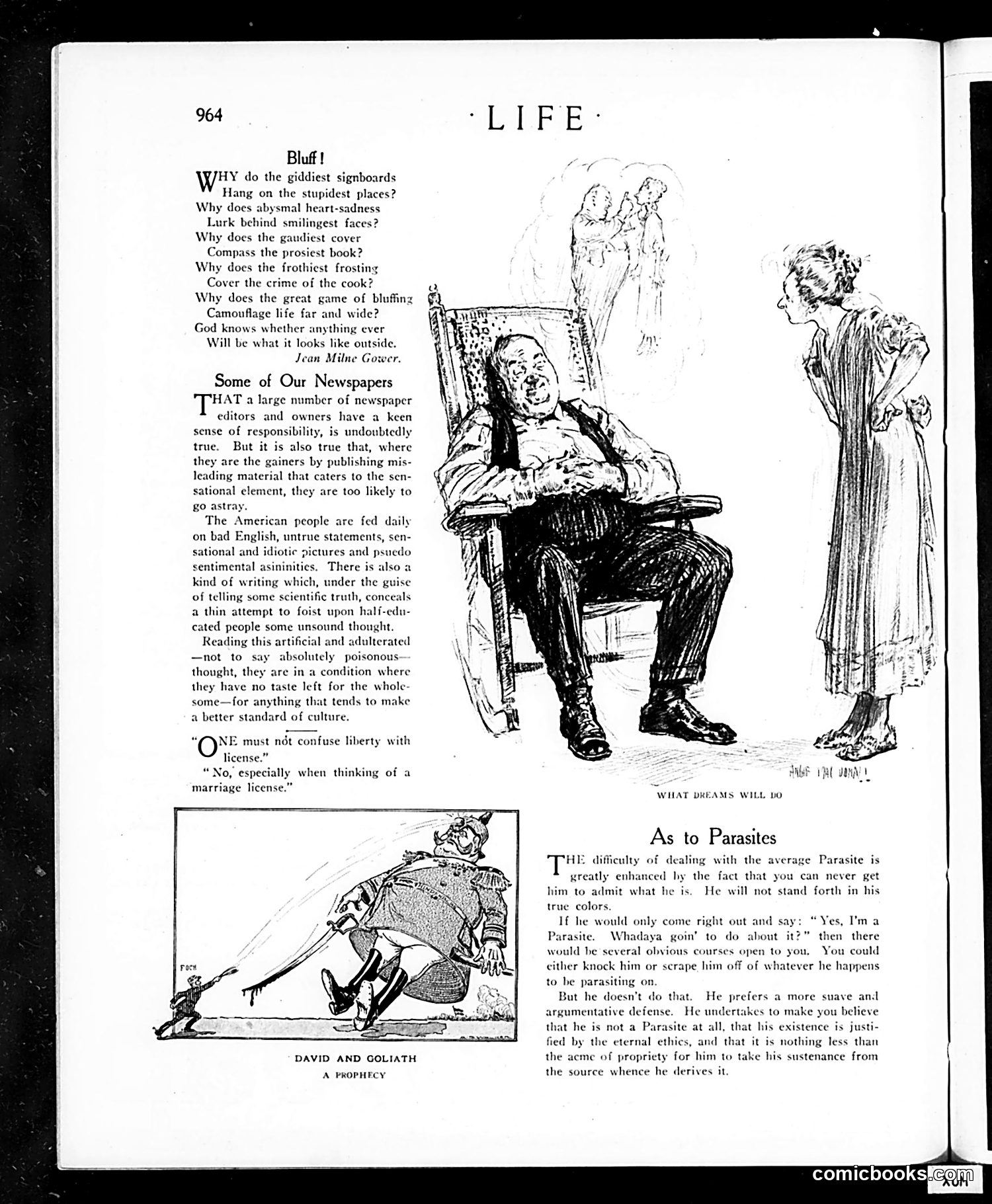
This page contains satirical commentary on American society circa early 20th century. The poem "Bluff!" critiques widespread deception in everyday life—false advertising, misleading appearances, and hypocrisy hidden behind pleasant facades. "Some of Our Newspapers" attacks sensationalist journalism. The text accuses newspapers of publishing false, inflammatory, and pseudo-scientific material to boost sales, feeding the public "bad English, untrue statements" and "idiotic pictures." This poisons public discourse and prevents citizens from developing sound judgment. "As to Parasites" uses parasitism as metaphor for social freeloaders—people who extract resources from society while denying their true nature. Rather than admit dependency, parasites employ rationalization and ethical arguments to justify their existence. The cartoon "David and Goliath—A Prophecy" (bottom) appears to reference biblical underdog narrative, though its specific political meaning is unclear without additional context. Overall, the page satirizes deception across media, society, and individual behavior.
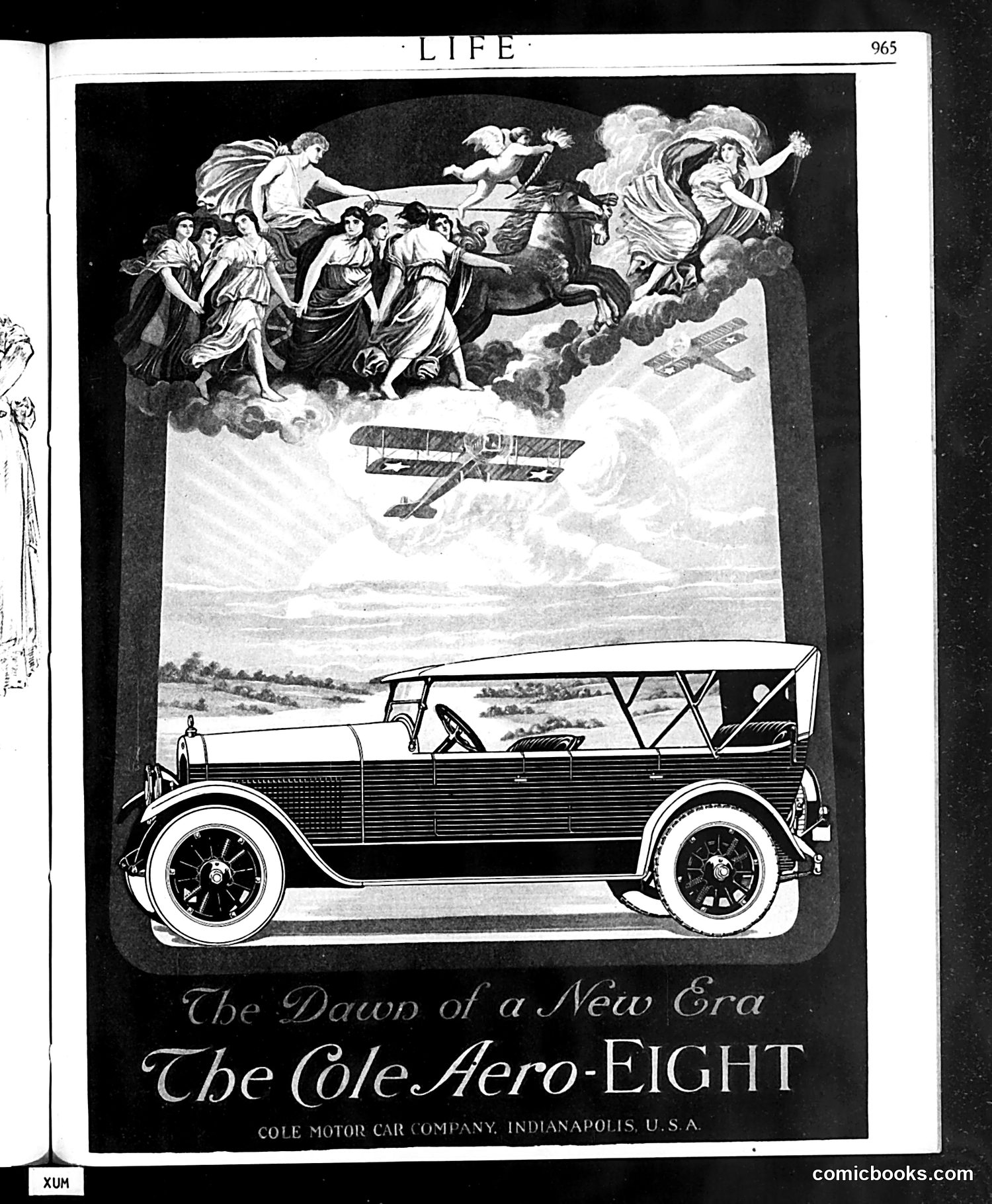
This is an advertisement for the Cole Aero-Eight automobile, manufactured by the Cole Motor Car Company in Indianapolis. The ad presents the car as heralding "The Dawn of a New Era." The imagery combines classical and modern symbolism: allegorical figures (muses or goddesses) in the clouds above represent progress and enlightenment, while an early airplane flies overhead—contemporary symbols of technological advancement. The car itself is positioned as the earthly manifestation of this new age. This is straightforward advertising rather than political satire. It reflects early 20th-century marketing that linked automobiles to progress, modernity, and aspiration. The classical artistic style lends gravitas to the product, appealing to consumers' desires to be part of an advancing civilization.
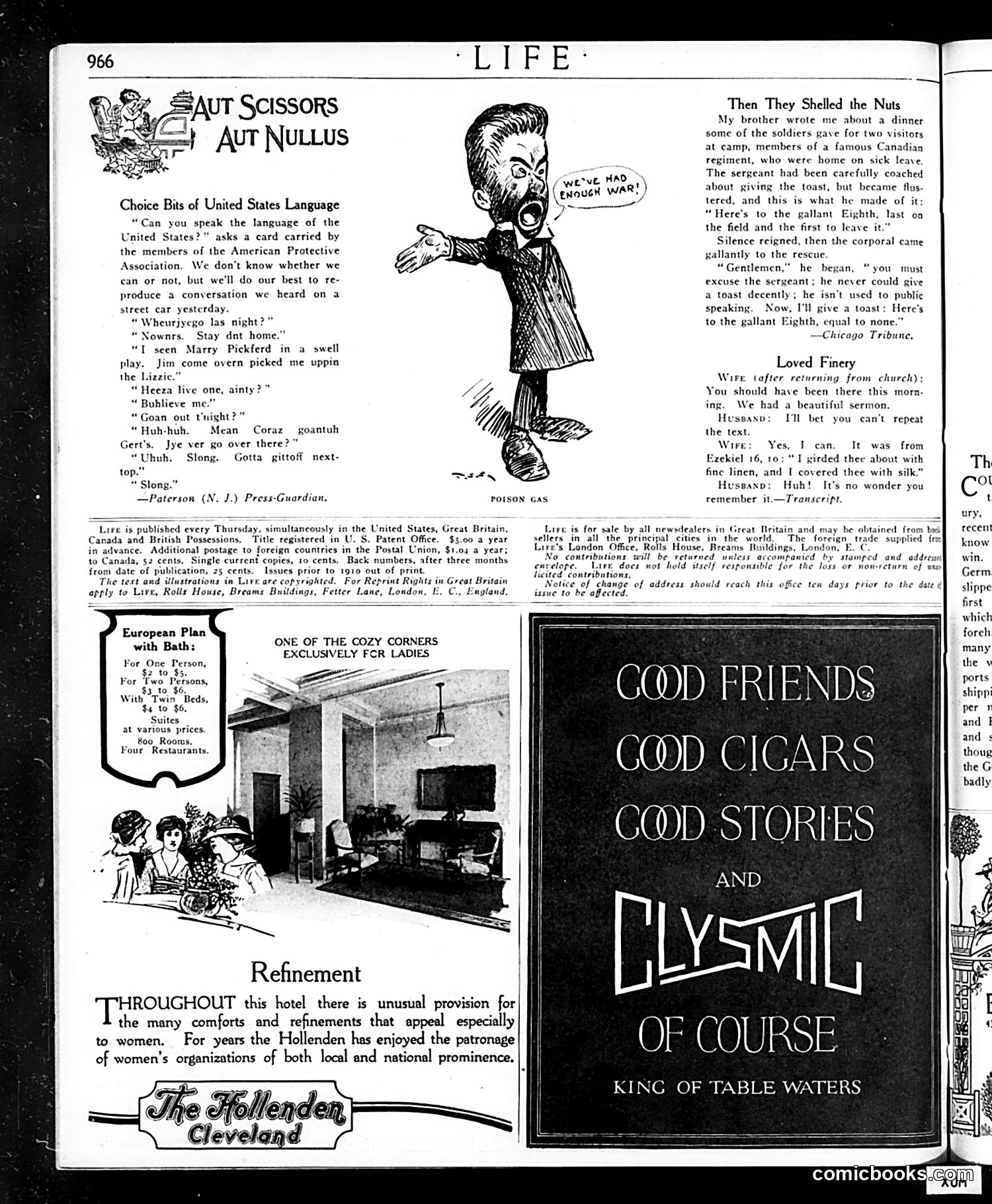
This page contains three distinct humor pieces satirizing American speech and social conventions circa 1910s: **"Aut Scissors Aut Nullus"** (top left): A cartoon mocking immigrant or working-class American English. The dialogue reproduces mangled street-car conversation ("Wheurjyego las night?" / "Nownrs. Stay dnt home"), satirizing non-standard speech patterns. This reflects contemporary anxieties about immigration and "proper" American language, likely targeting the American Protective Association's nativist concerns about who could "speak the language." **"Then They Shelled the Nuts"** (top right): A humorous anecdote about a Canadian soldier's toast going awry. The sergeant accidentally insults his regiment by saying they were "last on the field and first to leave it"—implying cowardice. The joke relies on the officers' embarrassment and the corporal's quick diplomatic recovery. **"Loved Finery"** (bottom right): A domestic joke where a wife quotes scripture (Ezekiel 16:10) to her husband to prove she paid attention at church—but he suspects she merely memorized fashionable descriptions of fine fabrics from the passage. The page is primarily humorous content with period advertisements for hotels and cigars.
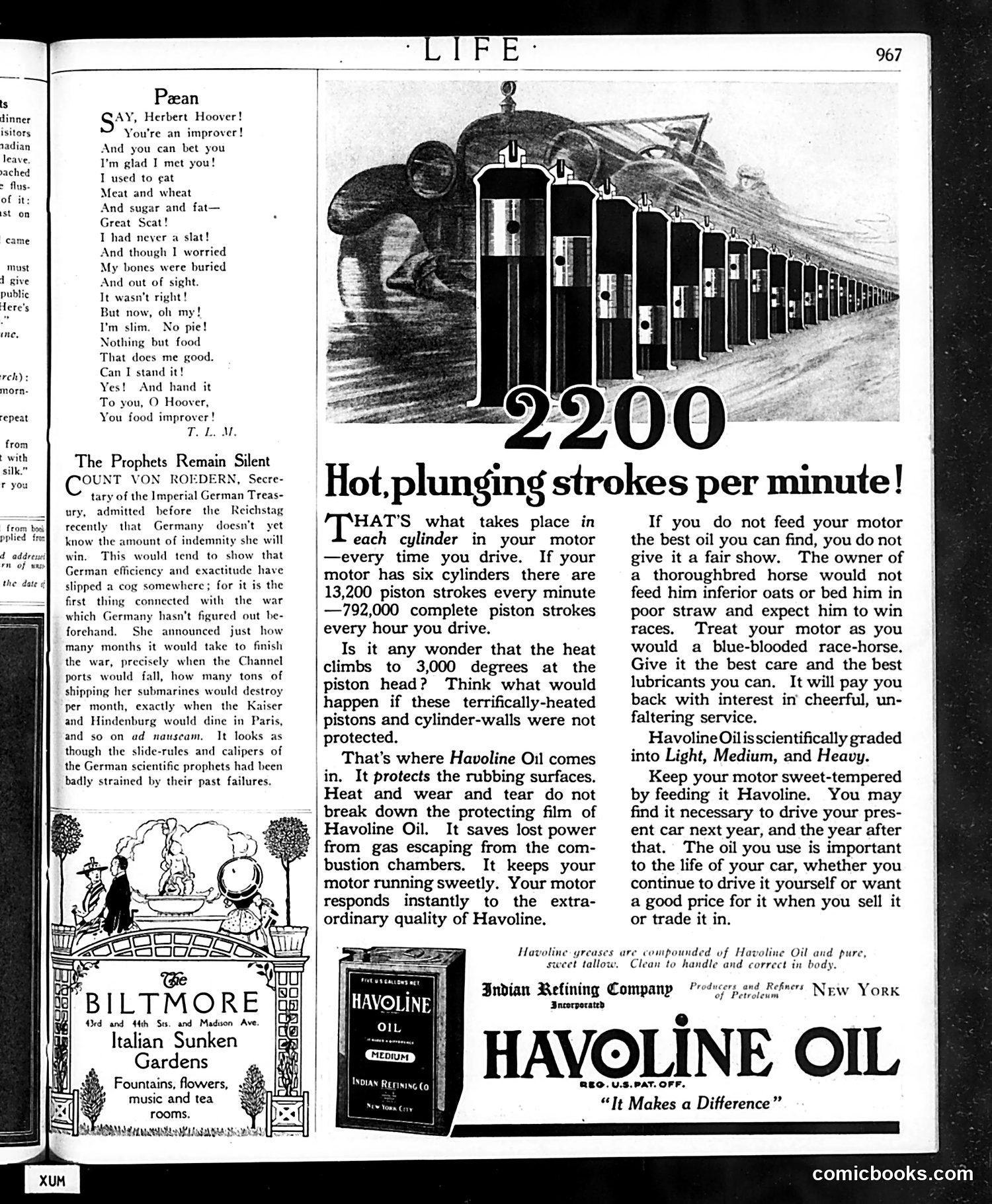
This page contains two distinct pieces: **The "Pean" poem** (left) is satirical praise for Herbert Hoover, likely referencing his role as Food Administrator during WWI. The speaker, apparently malnourished before, now celebrates being "slim" on rationed food—the irony being that Hoover's food conservation program forced Americans into scarcity diets. The poem mocks both Hoover's policies and public relations, presenting deprivation as improvement. **"The Prophets Remain Silent"** (center-left) critiques German war predictions. It notes that Germany—which confidently predicted war duration, military victories, and submarine kills—cannot calculate WWI indemnity payments. The piece sarcastically suggests German "scientific" efficiency has failed, as their wartime prophecies proved wildly inaccurate. **The Havoline Oil advertisement** (right) is a straightforward product pitch comparing motor care to horse care, unrelated to satire. The page reflects American WWI-era politics: skepticism of Hoover's unpopular rationing and mockery of defeated German military competence.
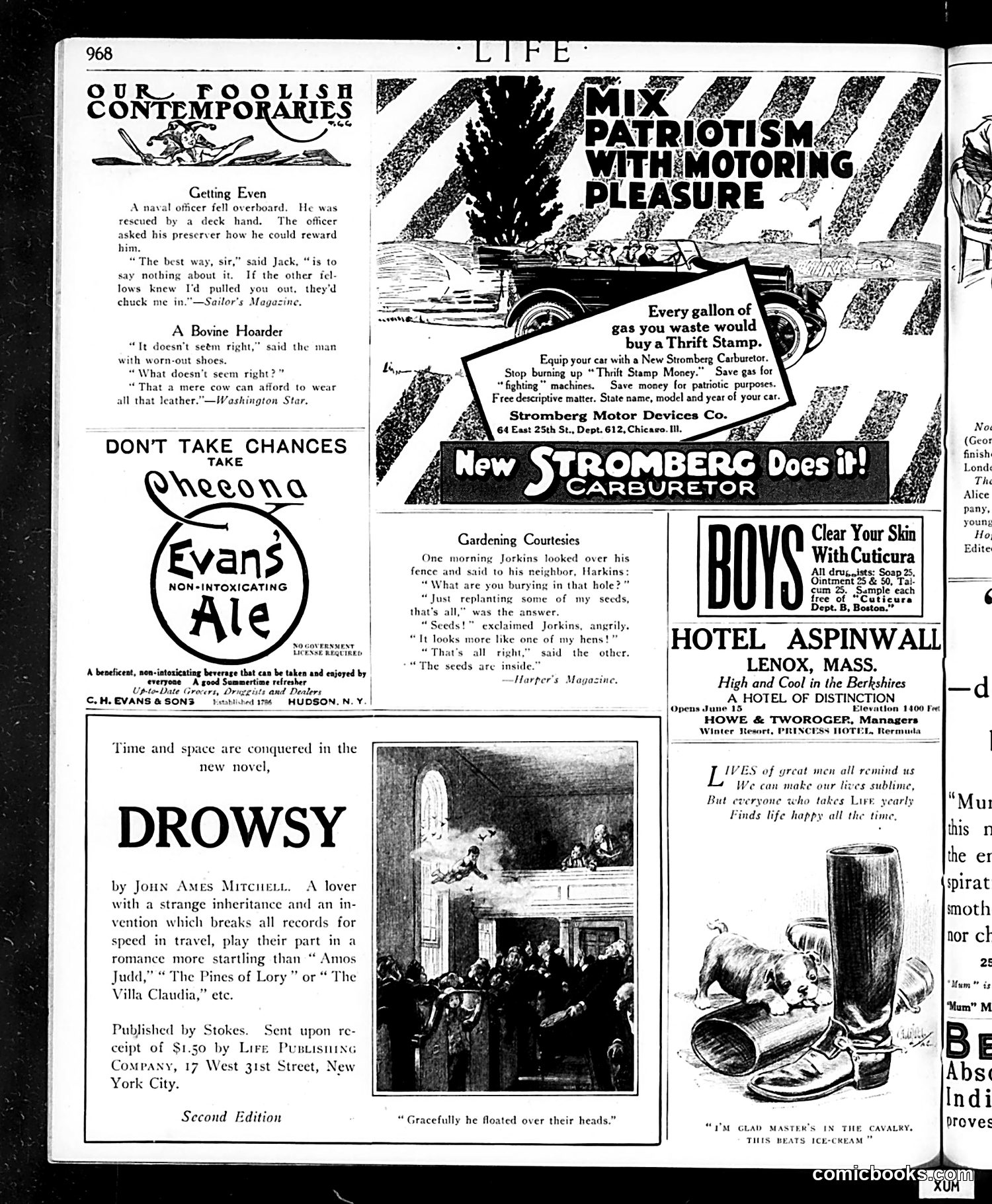
This page is primarily **advertising and light humor** rather than political satire. The content includes: **Humorous anecdotes** ("Our Foolish Contemporaries" section): Brief jokes about naval officers, cows, and gardening mishaps—gentle satire of everyday absurdities with no specific political targets. **WWI-era patriotic advertising**: The prominent Stromberg Carburetor ad appeals to wartime sacrifice, urging readers to conserve gasoline for "fighting machines" and purchase "Thrift Stamps" (government war bonds). This reflects the civilian conservation effort during World War I. **Product advertisements**: Evans Ale, Cuticura skin products, Hotel Aspinwall, and a book promotion for "Drowsy" by John Ames Mitchell occupy most space. **The cartoon imagery** (lower section) appears to show a religious or institutional scene labeled "Gracefully he floated over their heads," though its specific reference remains unclear without additional context. The page reflects 1918-era consumer culture intertwined with wartime messaging.
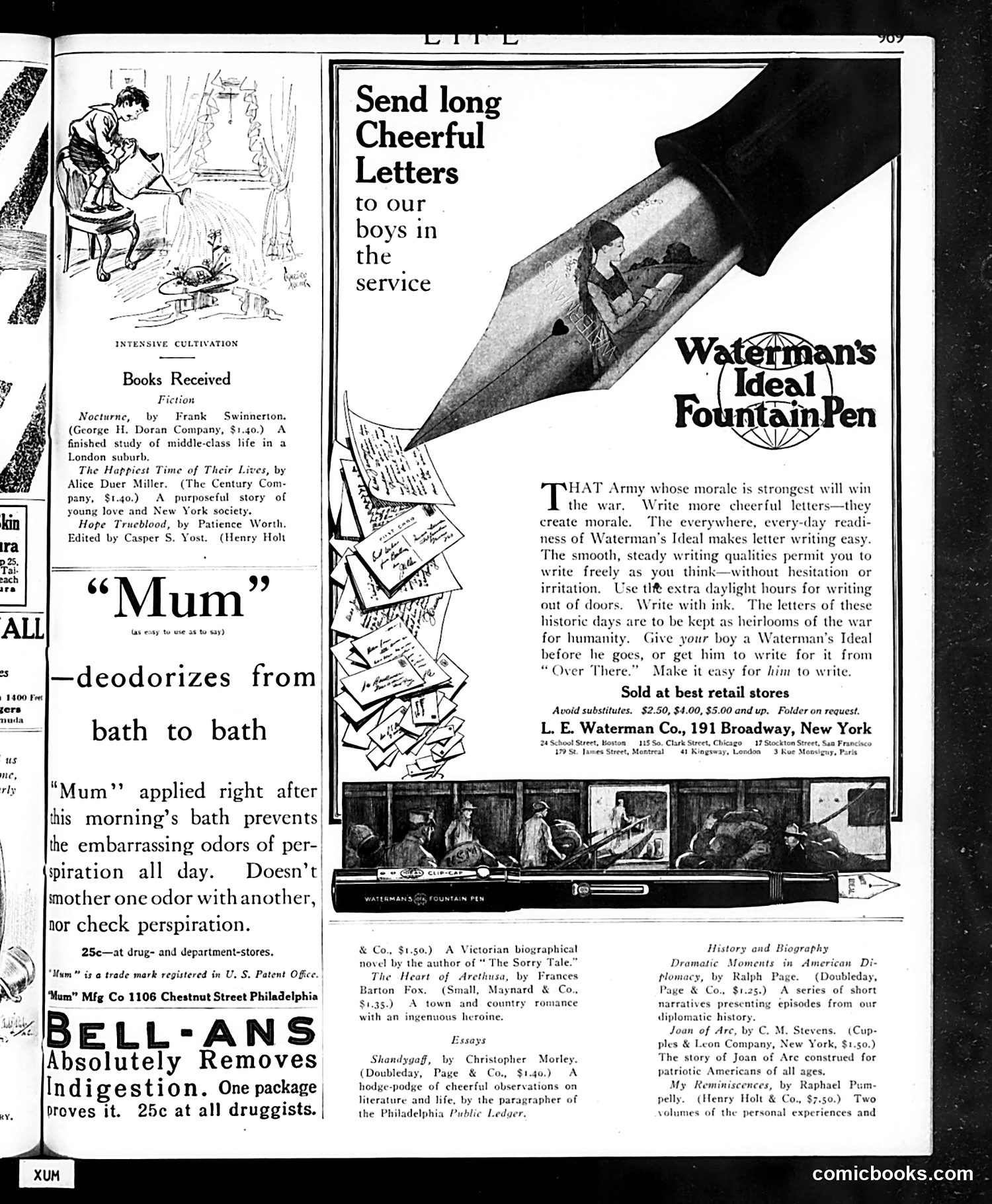
This is primarily an **advertising and book review page** from Life during World War I (indicated by "boys in the service" messaging). The dominant advertisement is **Waterman's Ideal Fountain Pen**, which uses patriotic wartime messaging: soldiers' morale depends on cheerful letters from home, and the pen makes letter-writing easy. The imagery shows a giant hand holding a pen with soldiers inside it—a metaphor for how writing connects soldiers to loved ones and boosts military morale. Supporting ads include **"Mum" deodorant** and **Bell-Ans antacid**, using typical early 20th-century marketing language about bodily embarrassment and digestive problems. The page includes book reviews of contemporary fiction and essays. There's no political satire here—rather, this reflects the **homefront mobilization of WWI**, where even consumer goods were marketed through patriotic appeals to support troops emotionally and practically.
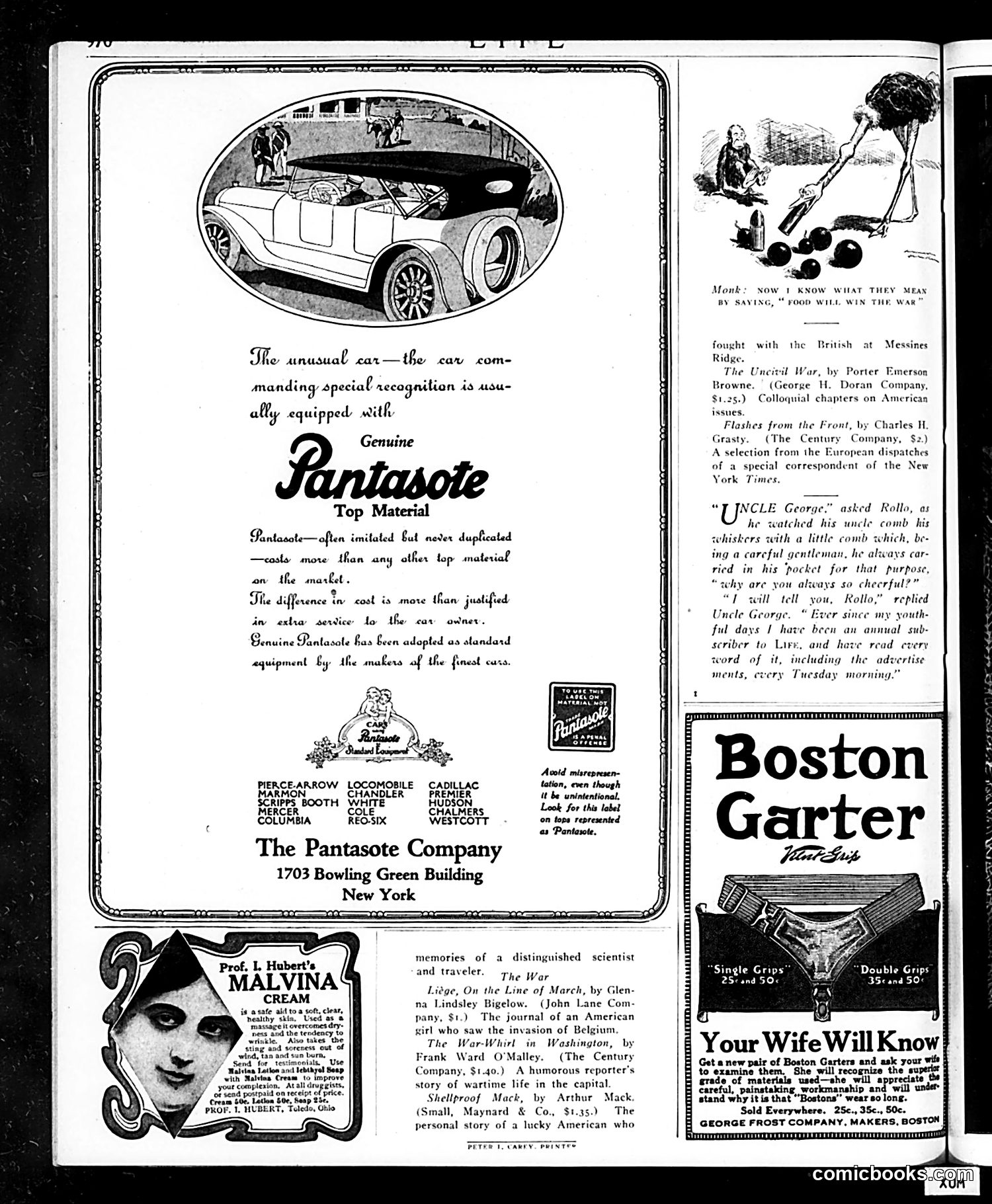
This page is primarily **advertising**, with one small cartoon at top right. ## The Cartoon The sketch shows "Monk" watching children play with toy soldiers, saying he now understands the phrase "food will win the war." The joke references **WWI food rationing and conservation campaigns**—the implication being that well-fed children (representing the home front's prosperity through food) will grow into strong soldiers, or that feeding the population sustains the war effort. It's a light commentary on wartime propaganda messaging. ## The Advertisements The page features major car manufacturers (Pierce-Arrow, Cadillac, Marmon) advertising **Pantasote top material**—a car roof covering. Below are ads for Prof. Hubert's Malvina Cream (a skincare product) and **Boston Garter** suspenders, marketed with the selling point that wives will recognize quality. These ads reflect early 20th-century consumer culture and gender-targeted marketing (beauty for women, practical goods for men). The book reviews listed are WWI-era titles about the war and invasion of Belgium.
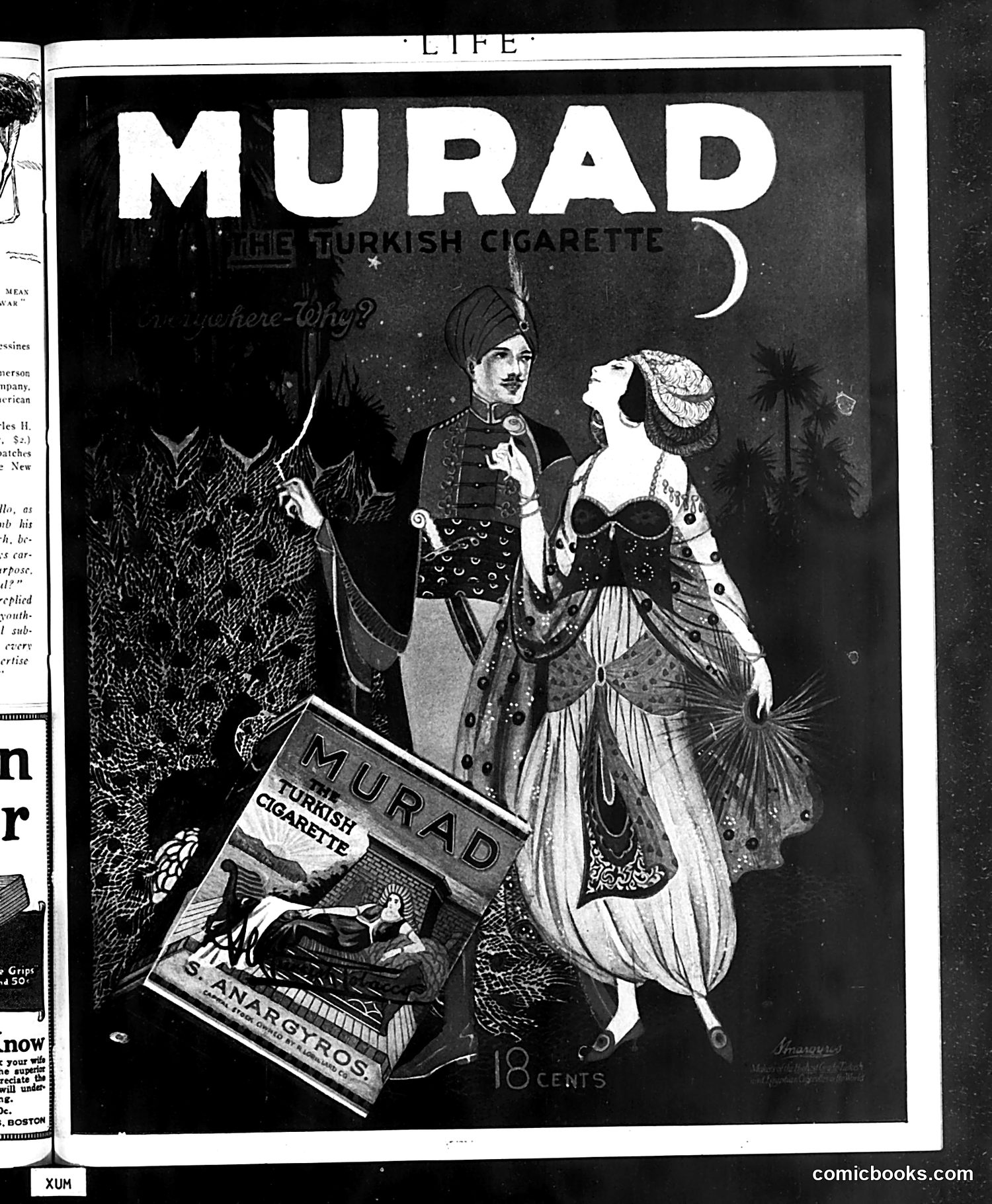
This is a commercial advertisement for Murad Turkish cigarettes, priced at 18 cents. The image depicts an orientalist fantasy scene featuring a man in Turkish military dress (turban, ornate jacket) and a woman in harem-style costume with peacock-feather wings, set against a starry night with palm trees and a crescent moon. The advertisement exploits early 20th-century Western fascination with "exotic" Turkish culture to market the product. The romantic, sensual imagery—combining military exoticism with seductive female figures—was typical marketing strategy for tobacco companies of this era. The peacock-feather costume particularly emphasizes the "foreign luxury" appeal designed to attract male consumers.
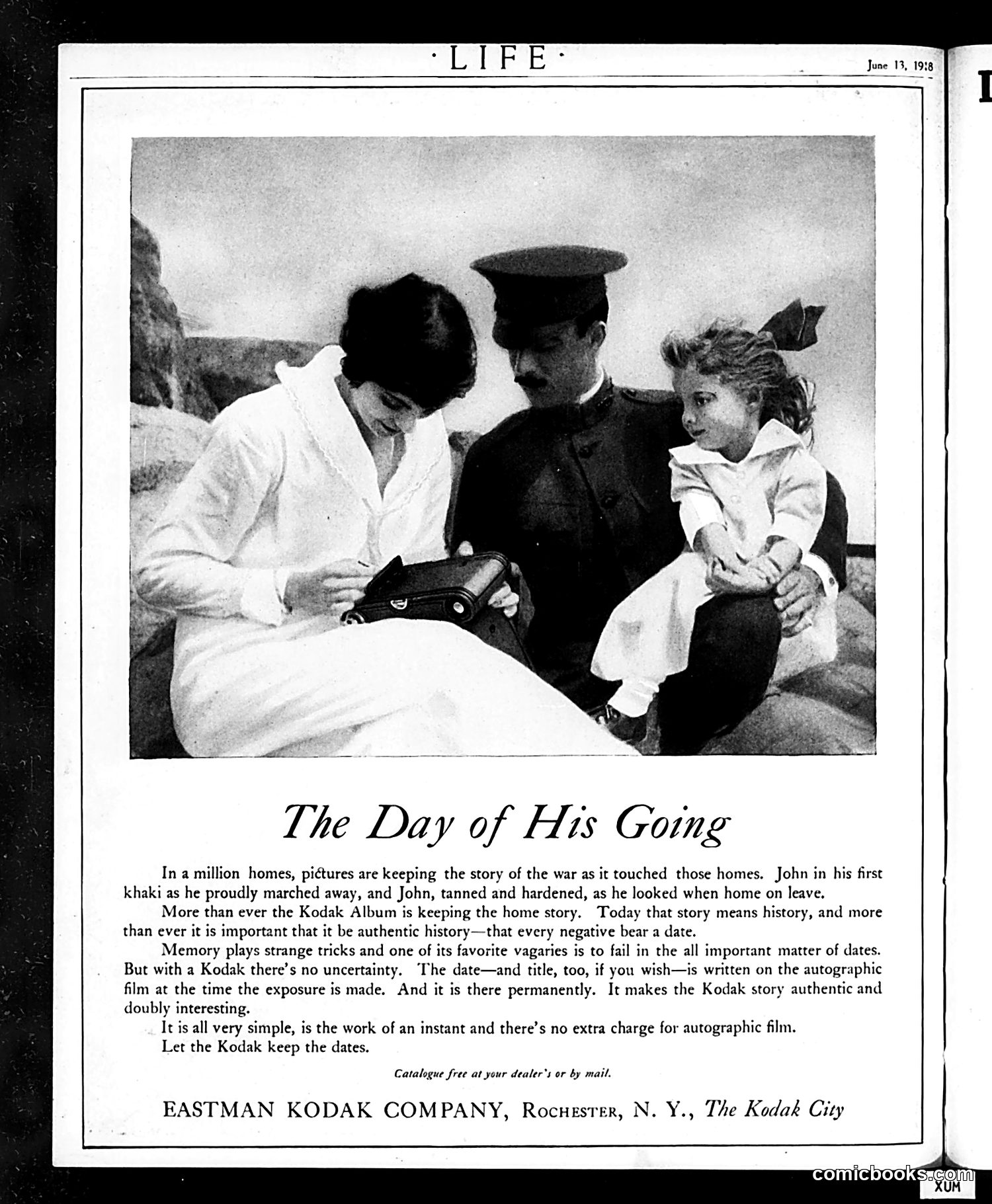
This is a **Kodak advertisement**, not satire or political content. Published June 13, 1918 (during World War I), it uses an emotionally resonant wartime scene to market photography products. The image shows a soldier in uniform saying goodbye to his family—a woman (likely his wife), a man in military dress, and a young child. The advertisement's message: families should photograph soldiers "the day of his going" to preserve accurate historical records with dated negatives. The "point" is marketing, not commentary. By framing photography as a patriotic duty to document the war's "home story," Kodak positioned its autographic film feature (which printed dates directly on negatives) as essential for preserving authentic family wartime memories. This conflates commercial product benefits with emotional wartime separation—a common advertising strategy of the era. For modern readers: this represents how corporations leveraged WWI anxiety and separation to promote consumer goods while appearing to serve a higher purpose.