
Life, 1918-06-13 · page 17 of 36
Life — June 13, 1918 — page 17: what you’re looking at
What you’re looking at
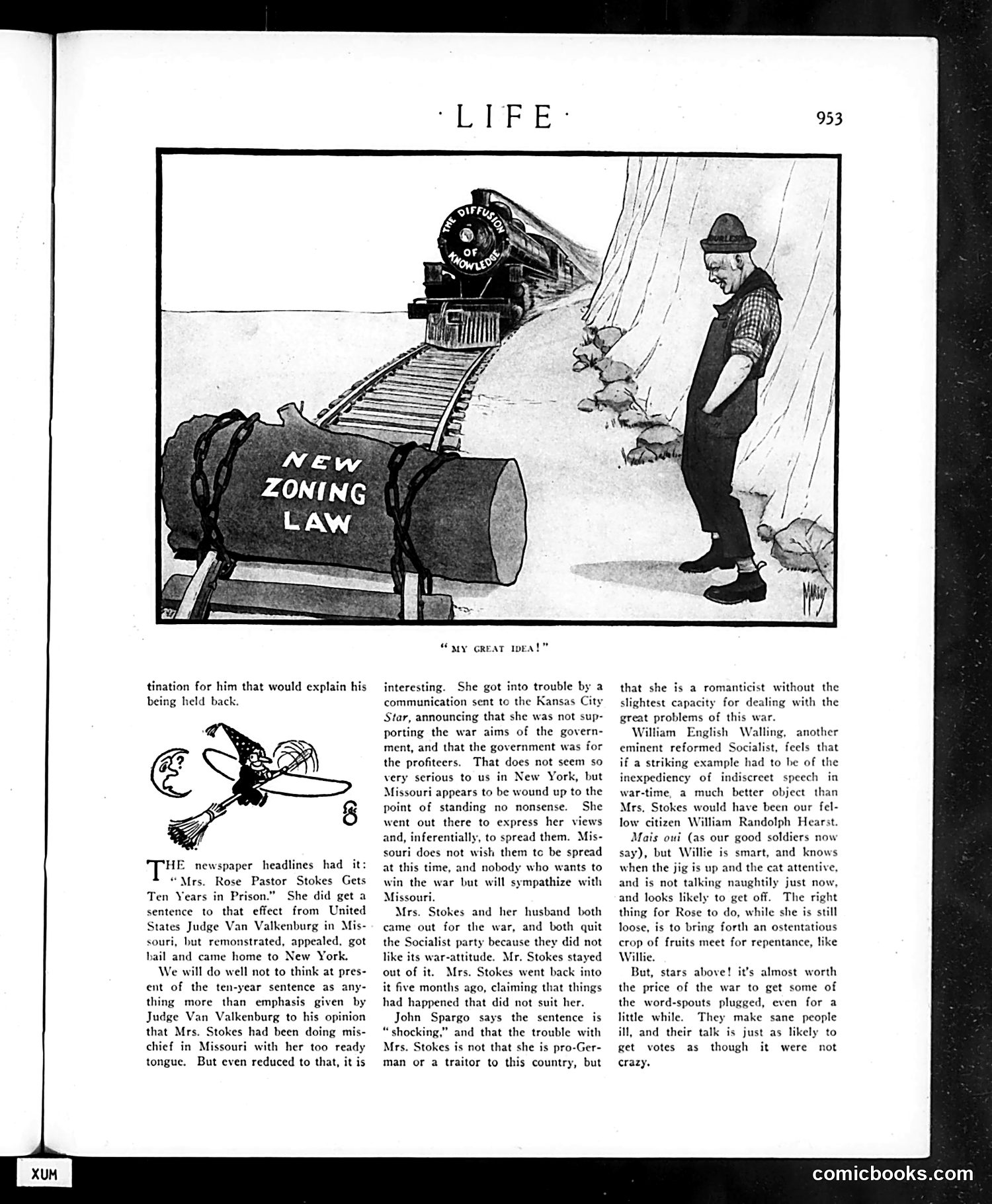
**The Main Cartoon:** The top illustration depicts a train labeled "New Zoning Law" approaching a worker, representing satire of local regulatory efforts. The caption "My Great Idea!" suggests ironic commentary on what authorities considered progressive policy. **The Text Commentary:** The page discusses Rose Pastor Stokes, a Socialist activist sentenced to ten years in prison by a Missouri judge for publicly opposing U.S. war profiteering during World War I. The article presents various reformist perspectives on her case: some call the sentence "shocking," while others argue her real flaw is romantic idealism divorced from practical thinking. **The Satire's Point:** Life mocks both Stokes's impractical activism and selective enforcement of wartime censorship—notably suggesting media mogul William Randolph Hearst escaped consequences through shrewdness. The final paragraph cynically suggests that silencing "word-spouts" (loud speakers) might be worth wartime's cost, implying the magazine's ambivalence about free speech restrictions during war.
📄 Transcribed text from this page (OCR, searchable)
Machine-transcribed from the original scan — historical spelling and the odd misread are preserved.
tination for him that would explain his being held back. HE newspaper headlines had it: “Mrs. Rose Pastor Stokes Gets Ten Years in Prison.” She did get a sentence to that effect from United States Judge Van Valkenburg in Mis- souri, but remonstrated, appealed, got hail and came home to New York. We will do well not to think at pres- ent of the ten-year sentence as any- thing more than emphasis given by Judge Van Valkenburg to his opinion that Mrs. Stokes had been doing mis- chief in Missouri with her too ready tongue. But even reduced to that, it is “My GREAT weal” interesting. She got into trouble by a communication sent to the Kansas City Star, announcing that she was not sup- porting the war aims of the govern- ment, and that the government was for the profiteers. That does not seem so very serious to us in New York, but Missouri appears to be wound up to the point of standing no nonsense. She went out there to express her views and, inferentially, to spread them. Mis- souri does not wish them to be spread at this time, and nobody who wants to win the war but will sympathize with Mrs. Stokes and her husband both came out for the war, and both quit the Socialist party because they did not like its war-attitude. Mr. Stokes stayed out of it. Mrs. Stokes went back into it five months ago, claiming that things had happened that did not suit her. John Spargo says the sentence is “shocking,” and that the trouble with Mrs. Stokes is not that she is pro-Ger- man or a traitor to this country, but that she is a romanticist without the slightest capacity for dealing with the great problems of this war. William English Walling, eminent reformed Socialist, feels that if a striking example had to be of the inexpediency of indiscreet speech in war-time, a much better object than Mrs, Stokes would have been our fel- low citizen William Randolph Hearst. Mais oui (as our good soldiers now say), but Willie is smart, and knows when the jig is up and the cat attentive, and is not talking naughtily just now, and looks likely to get off. The right thing for Rose to do, while she is still loose, is to bring forth an ostentatious crop of fruits meet for repentance, like Willie. But, stars above! it’s almost worth the price of the war to get some of the word-spouts plugged, even for a little while. They make sane people ill, and their talk is just as likely to get votes as though it were not crazy. another comicbooks.com