
Life, 1918-06-13 · page 28 of 36
Life — June 13, 1918 — page 28: what you’re looking at
What you’re looking at
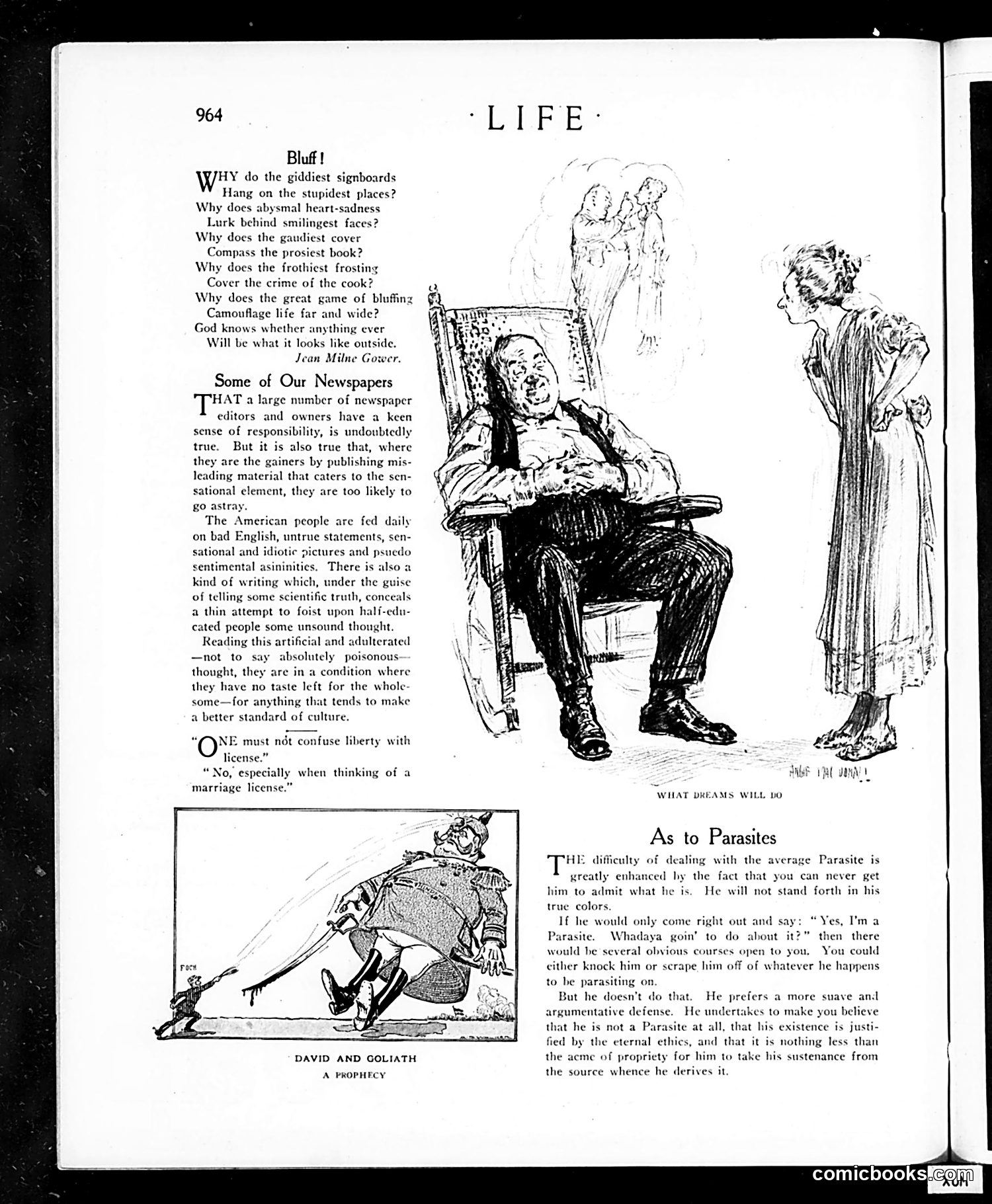
This page contains satirical commentary on American society circa early 20th century. The poem "Bluff!" critiques widespread deception in everyday life—false advertising, misleading appearances, and hypocrisy hidden behind pleasant facades. "Some of Our Newspapers" attacks sensationalist journalism. The text accuses newspapers of publishing false, inflammatory, and pseudo-scientific material to boost sales, feeding the public "bad English, untrue statements" and "idiotic pictures." This poisons public discourse and prevents citizens from developing sound judgment. "As to Parasites" uses parasitism as metaphor for social freeloaders—people who extract resources from society while denying their true nature. Rather than admit dependency, parasites employ rationalization and ethical arguments to justify their existence. The cartoon "David and Goliath—A Prophecy" (bottom) appears to reference biblical underdog narrative, though its specific political meaning is unclear without additional context. Overall, the page satirizes deception across media, society, and individual behavior.
📄 Transcribed text from this page (OCR, searchable)
Machine-transcribed from the original scan — historical spelling and the odd misread are preserved.
964 Bluff! HY do the giddiest signboards Hang on the stupidest places? Why does abysmal heart-sadness Lurk behind smilingest faces? Why does the gaudiest cover Compass the prosiest book? Why does the frothiest frosting Cover the crime of the cook? Why does the great game of bluffing Camouflage life far and wide? God knows whether anything ever Will be what it looks like outside. Jean Milne G Some of Our Newspapers Ake AT a large number of newspaper tors and owners have a keen sense of responsibility, is undoubtedly true. But it is also true that, where they are the gainers by publishing mis- leading material that caters to the sen- sational element, they are too likely to go astray. The American people are fed daily on bad English, untrue statements, sen- sational and idiotic pictures and psuedo sentimental asininiti There is also a kind of writing which, under the guise of telling some scientific truth, conc a thin attempt to foist upon hali-edu- cated people some unsound thought. Reading this artificial and adulterated —not to absolutely poisonous thought, they are in a condition where they have no ta left for the whole- some—for anything that tends to make a better standard of culture. “CYNE must not confuse liberty with license.” “No, especially when thinking of a ABE VC UAL marriage, license. WHAT DREAMS WILL DO As to Parasites HIE difficulty of dealing with the average Parasite is greatly enhanced by the fact that you can never get him to admit what he is. He will not stand forth in his true colors, If he would only come right out and say: “Yes, I'ma Parasite. WI a goin’ to do about it?” then there would he several obvious courses open to you, You could cither knock him or scrape him off of whatever he happens to he parasiting on. But he doesn’t do that. He fers a more suave and argumentative defense. He undertakes to make you believe that he is not a Parasite at all, that his existence is justi- 1 by the eternal ethics, and that it is nothing less than DAVID AND GOLIATH t acme of propriety for him to take his sustenance from A PROPHECY the source whence he derives it comicbooksergy