
Life, 1918-06-13 · page 10 of 36
Life — June 13, 1918 — page 10: what you’re looking at
What you’re looking at
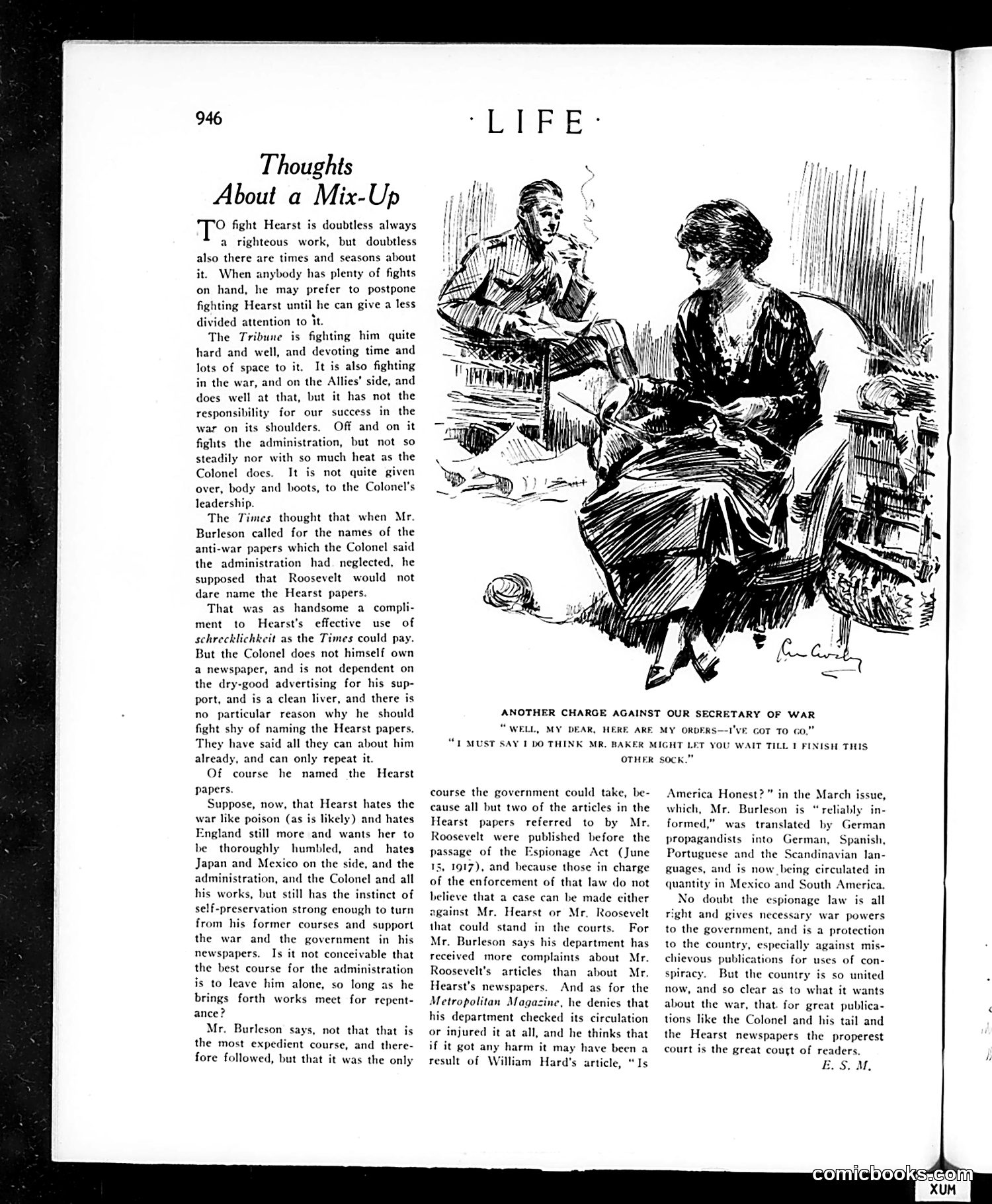
This satirical cartoon comments on accusations against the U.S. Secretary of War during World War I. The illustration shows two men in conversation, with the caption "I must say I do think Mr. Baker might let you wait till I finish this other sock." The text discusses a dispute between Colonel Roosevelt (Theodore Roosevelt) and the *Tribune* newspaper over "anti-war papers" allegedly suppressed by the administration. The article defends the Secretary of War (appears to be Newton D. Baker), arguing he lacks motive to target the *Hearst* newspapers, and that Roosevelt's publications have complained more than *Hearst's*. The cartoon mocks the trivial nature of accusations against the Secretary of War by depicting domestic wartime rationing (sock-knitting), suggesting critics are making mountains out of molehills.
📄 Transcribed text from this page (OCR, searchable)
Machine-transcribed from the original scan — historical spelling and the odd misread are preserved.
Thoughts About a Mix-Up 'O fight Hearst is doubtless always righteous work, but doubtless also there are times and seasons about it. When anybody has plenty of fights on hand, he may prefer to postpone fighting Hearst until he can give a less divided attention to it. The Tribune is fighting him quite hard and well, and devoting time and lots of space to it. It is also fighting in the war, and on the Allies’ side, and does well at that, but it has not the responsibility for our success in the war on its shoulde: Off and on it fights the administration, but not so steadily nor with so much heat as the Colonel does. It is not quite given over, body and hoots, to the Colonel's leadership. The Times thought that when Mr. Burleson called for the names of the anti-war papers which the Colonel said the administration had_ neglected, he supposed that Roosevelt would not dare name the Hearst papers. That was as handsome a compli- ment to Hearst's effective use of schrecklichkeit as the Times could pay. But the Colonel does not himself own a newspaper, and is not dependent on the dry-good advertising for his sup- port, and is a clean liver, and there is no particular reason why he should fight shy of naming the Hearst papers. They have said all they can about him already, and can only repeat it. Of course he named the Hearst papers. Suppose, now, that Hearst hates the war like poison (as is likely) and hates ingland still more and wants her to be thoroughly humbled, and hates Japan and Mexico on the side, and the administration, and the Colonel and all his works, but still has the instinct of self-preservation strong enough to turn from his former courses and support the war and the government in his newspapers. Is it not conceivable that the best course for the administration is to leave him alone, so long as he brings forth works meet for repent- ance? Mr. Burleson says, not that that is the most expedient course, and there- fore followed, but that it was the only ANOTHER CHARGE AGAINST OUR SECRETARY OF WAR “WELL, MY DEAR, HERE ARE MY ORDERS— MR. BAKER MIG T SAY 1 DO THI & GOT TO GO.” T LET YOU WAIT TILL 1 FINISH THIS, OTHER sock.” course the government could take, be- cause all but two of the articles in the Hearst papers referred to by Mr. Roosevelt were published before the passage of the Espionage Act (June 15, 1917), and hecause those in charge of the enforcement of that law do not believe that a case can be made either ainst Mr. Hearst or Mr. Roosevelt that could stand in the courts. For Mr. Burleson says his department has received more complaints about Mr. Roosevelt's articles than about Mr. Hearst’s newspapers. And as for the Metropolitan Magazine, he denies that his department checked its circulation or injured it at all, and he thinks that if it got any harm it may have been a result of William Hard's article, “Is America Honest?” in the March issue, which, Mr. Burleson is “reliably in- formed,” was translated by German propagandists into German, Spanish, Portuguese and the Scandinavian lan- guages, and is now being circulated in quantity in Mexico and South America. No doubt the espionage law is all right and gives necessary war powers to the government, and is a protection to the country, especially against mis- chievous publications for uses of con- spira But the country is so united now, and so clear as to what it wants about the war, that. for great publica- tions like the Colonel and his tail and the Hearst newspapers the properest court is the great cougt of readers, \ So