
Life, 1918-06-13 · page 16 of 36
Life — June 13, 1918 — page 16: what you’re looking at
What you’re looking at
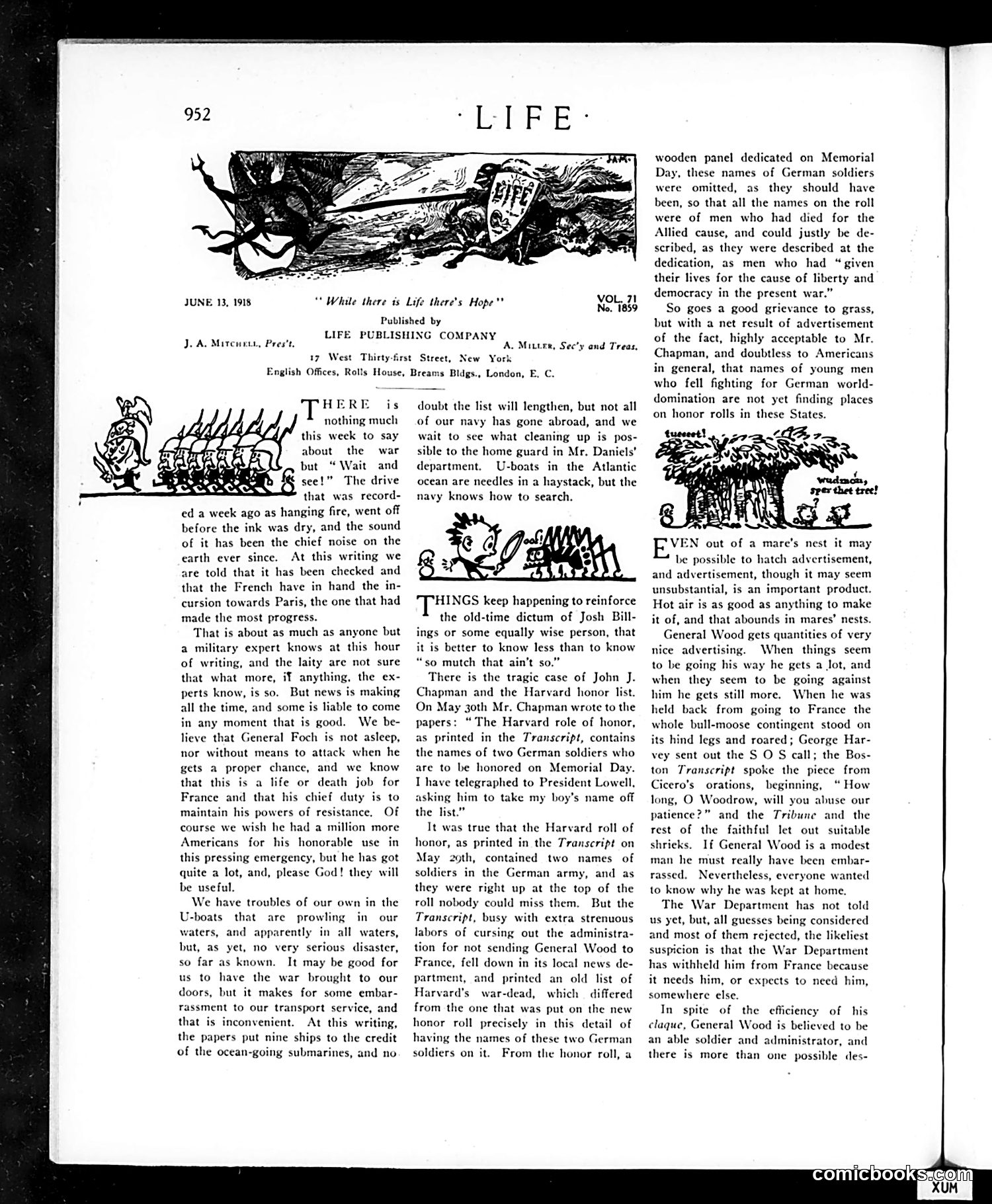
This June 1918 *Life* magazine editorial discusses a controversy involving John J. Chapman and Harvard University's Memorial Day honor roll. Chapman discovered that the printed *Transcript* version of Harvard's honor list accidentally included two German soldiers among the names to be honored—likely from an outdated roster. Chapman protested by telegram to President Lowell, demanding his own son's name be removed rather than appear alongside German names. The editorial notes the error was caught before the actual wooden dedication panel was unveiled on Memorial Day, where only Allied soldiers were listed. The author treats this as a tempest-in-teapot: Chapman's grievance was technically valid but ultimately resolved correctly. The piece gently mocks the situation while acknowledging Chapman's patriotic concern during wartime—when honoring German soldiers would have been genuinely offensive to American sensibilities in 1918. The cartoons appear decorative/thematic rather than directly satirizing specific figures.
📄 Transcribed text from this page (OCR, searchable)
Machine-transcribed from the original scan — historical spelling and the odd misread are preserved.
JUNE 13, 1918 “Whale there ts Life there's Hope" Published by LIFE Jo A. Marcus, Pres’t, 17 West Thirty-first English Offices, Rolls House, Brean HERE is nothing much this week to say about the war but “Wait and see!” The drive that was record- ed a week ago as hanging fire, went off before the ink was dry, and the sound of it has been the chief noise on the earth ever since. At this writing we are told that it has been checked and that the French have in hand the in- cursion towards Paris, the one that had made the most progress. That is about as much as anyone but 'y expert knows at this hour of writing, and the laity are not sure that what more, if anything, the ex- a mil perts know, is so. But news is making all the time, and some is liable to come in any moment that is good. We be- lieve that General Foch is not asleep, nor without means to attack when he gets a proper chance, and we know that this is a life or death job for France and that his chief duty is to maintain his powers of resistance, Of course we wish he had a million more Americans for his honorable use in this pressing emergency, but he has got quite a lot, and, please God! they will be useful. We have troubles of our own in the U-boats that are prowling in our ters, and apparently in all waters, but, as yet, no very serious disaster, so far as known. It may be good for us to have the war brought to our doors, but it makes for some embar- rassment to our transport service, and that is inconvenient. At this writing, the papers put nine ships to the credit of the ocean-going submarines, and no PUBLISHING COMPANY A. Mitte, Sec'y and Treas, Street, New York Bldgs., London, E, C. doubt the list will lengthen, but not all of our navy has gone abroad, and we wait to sce what cleaning up is pos- sible to the home guard in Mr. Daniels’ department. U-boats in the Atlantic ocean are needles in a haystack, but the navy knows how to search. HINGS keep happening to reinforce the old-time dictum of Josh Bill- ings or some equally wise person, that it is better to know less than to know o mutch that ain't sc There is the tragic case of John J. Chapman and the Harvard honor list. On May 3oth Mr. Chapman wrote to the papers: “The Harvard role of honor, as printed in the Transcript, contains the names of two German soldiers who are to be honored on Memorial Day. I have telegraphed to President Lowell, asking him to take my boy’s name off the list.” It was true that the Harvard roll of honor, as printed in the Transcript on May 20th, contained two names of soldiers in the German army, and as they were right up at the top of the roll nobody could miss them. But the Transcript, busy with extra strenuous labors of cursing out the administra- tion for not sending General Wood to France, fell down in its local news de- partment, and printed an old list of Harvard's war-dead, which differed from the one that was put on the new honor roll precisely in this detail of having the names of these two German soldiers on it. From the honor roll, a wooden panel dedicated on Memorial Day, these names of German soldiers were omitted, as they should have been, so that all the names on the roll were of men who had died for the Allied cause, and could justly be de- scribed, as they were described at the dedication, as men who had “given their lives for the cause of liberty and democracy in the present war.” So goes a good grievance to grass, but with a net result of advertisement of the fact, highly acceptable to Mr. Chapman, and doubtless to Americans in general, that names of young men who fell fighting for German world- domination are not yet finding places on honor rolls in these States. out of a mare's nest it may be possible to hatch advertisement, and advertisement, though it may seem unsubstantial, is an important product. Hot air is as good as anything to mal it of, and that abounds in mares’ nests. General Wood gets quantities of very nice advertising. When things seem to be going way he gets a lot, and when they seem to be going against him he gets still more. When he was held back from going to France the whole bull-moose contingent stood on its hind legs and roared; George Har- vey sent out the S O S call; the Bos- ton Transcript spoke the piece from Cicero’s orations, beginning, “ How long, O Woodrow, will you abuse our patience?” and the Tribune and the rest of the faithful let out suitable shrieks. If General Wood is a modest man he must really have been embar- rassed. Nevertheless, everyone wanted to know why he was kept at home. The War Department has not told us yet, but, all guesses being considered and most of them rejected, the likeliest suspicion is that the War Department withheld him from France because it needs him, or expects to need him, somewhere else. In spite of the efficiency of his claque, General Wood is believed to be an able soldier and administrator, and there is more than one possible des-