
A complete issue · 40 pages · 1918
Life — May 2, 1918
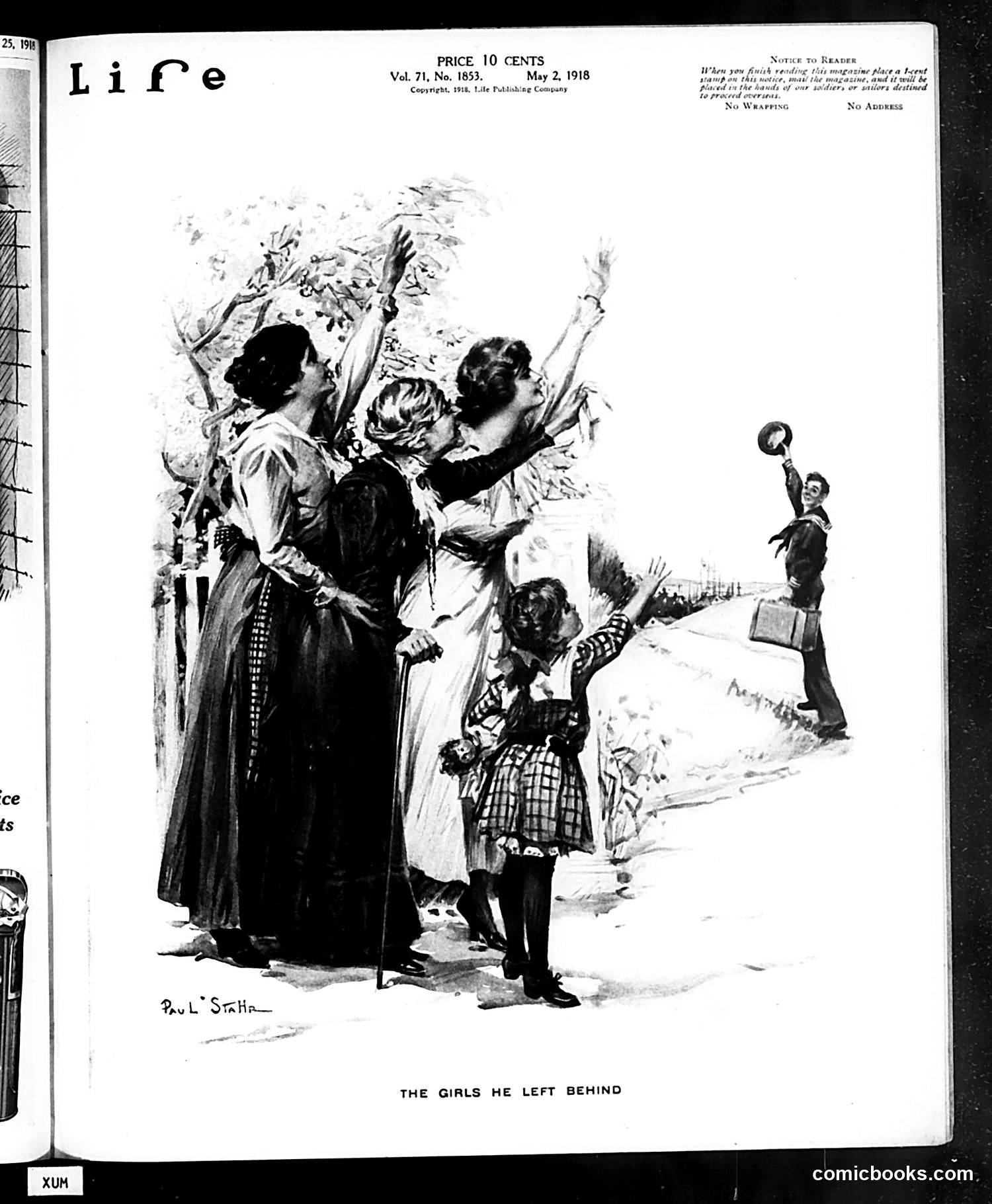
This May 2, 1918 Life magazine cartoon by Paul Statin depicts women and children waving goodbye to a departing soldier—likely a father or husband leaving for World War I combat in Europe. The illustration appears sentimental on its surface, showing domestic figures celebrating the soldier's departure with raised arms and apparent enthusiasm. However, the title "The Girls He Left Behind" carries ironic weight. During WWI, this phrase often referenced both the emotional toll on families and anxieties about soldiers' fidelity abroad. The cartoon likely satirizes either the forced cheerfulness expected of women during wartime separation, or broader social anxieties about relationships disrupted by military conscription. The emotional subtext beneath the outward patriotic display is the cartoon's central point.
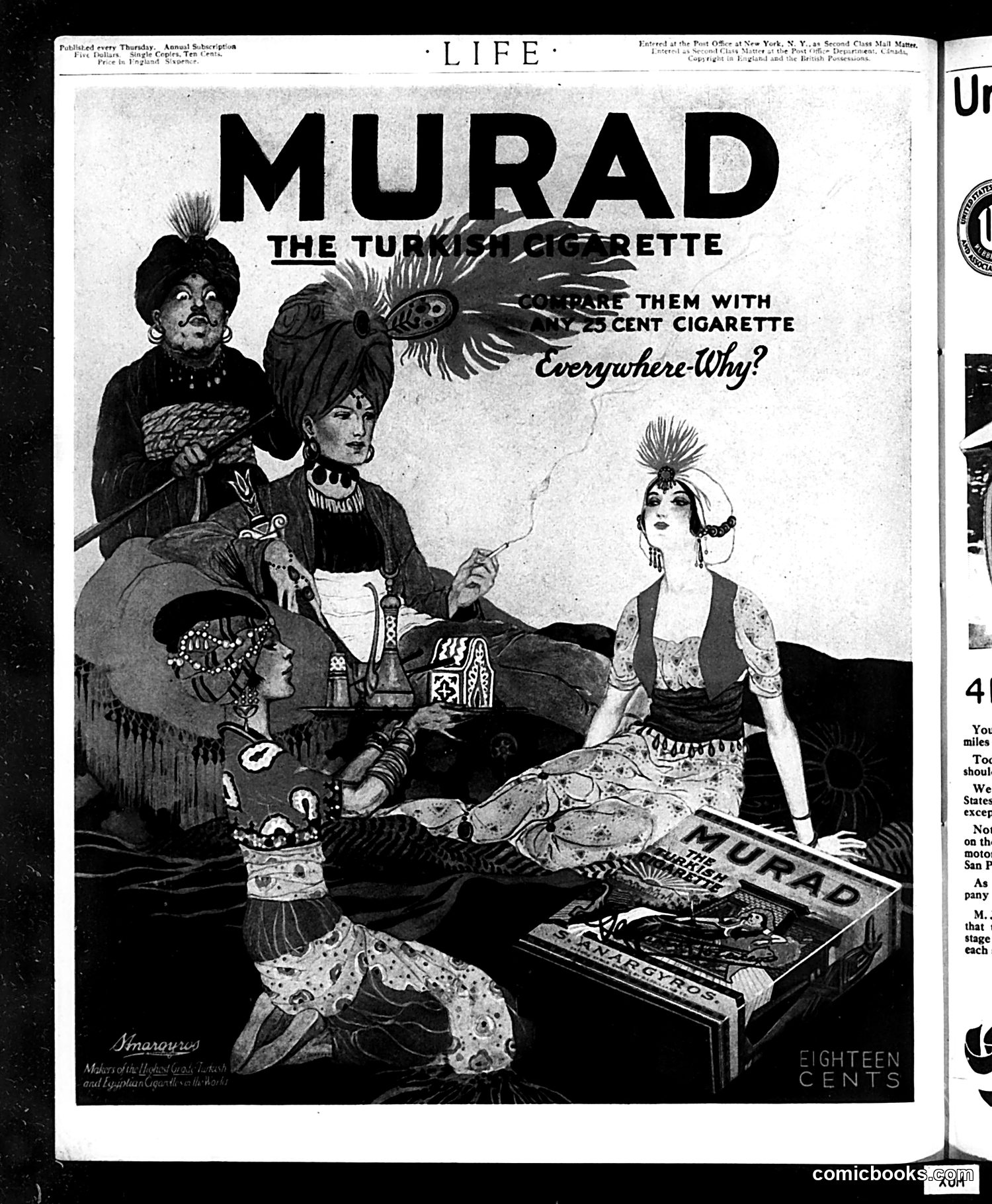
This is a **cigarette advertisement**, not political satire. It promotes Murad Turkish cigarettes at 15 cents per package, using an Orientalist fantasy scene. The ad depicts a harem-style setting with figures in exoticized "Turkish" costumes—turbans, elaborate robes, and jewelry—arranged around a woman smoking. The accompanying man appears menacing or predatory (the figure behind). A peacock and decorative props reinforce the "Oriental" theme. The copy asks "Everywhere—Why?" suggesting these cigarettes' widespread popularity. This reflects early 20th-century advertising that exploited Orientalist stereotypes and exoticized imagery to market luxury goods. The implicit appeal combines cigarette consumption with sexual fantasy and imperial imagery—common tactics in period advertising that modern readers would recognize as deeply problematic in its racial and gender stereotyping.
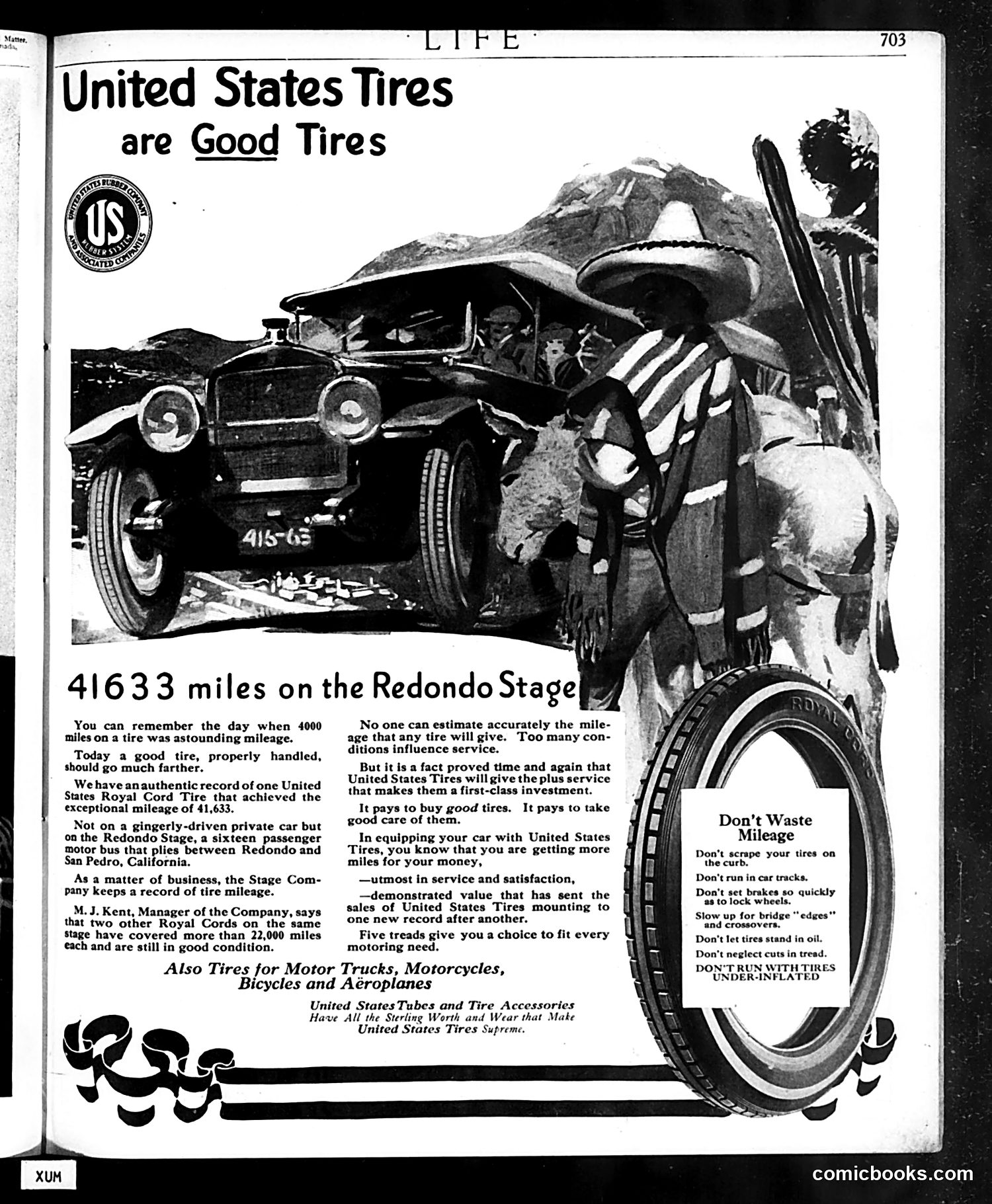
This is primarily a **product advertisement** for United States Tires, not political satire. The page promotes tire durability through a specific claim: a US Tire achieved 41,633 miles on the Redondo Stage route (a stagecoach line running between San Pedro, California and Redondo). The image shows a vintage automobile with passengers alongside what appears to be a Mexican figure in traditional dress and sombrero, positioned against a desert landscape with a saguaro cactus. This likely reflects the Redondo Stage's Southwestern route. The right panel offers practical tire care advice ("Don't Waste Mileage"), emphasizing proper maintenance. Rather than satire, this is straightforward early-20th-century automobile advertising using a real-world driving record to establish product reliability.
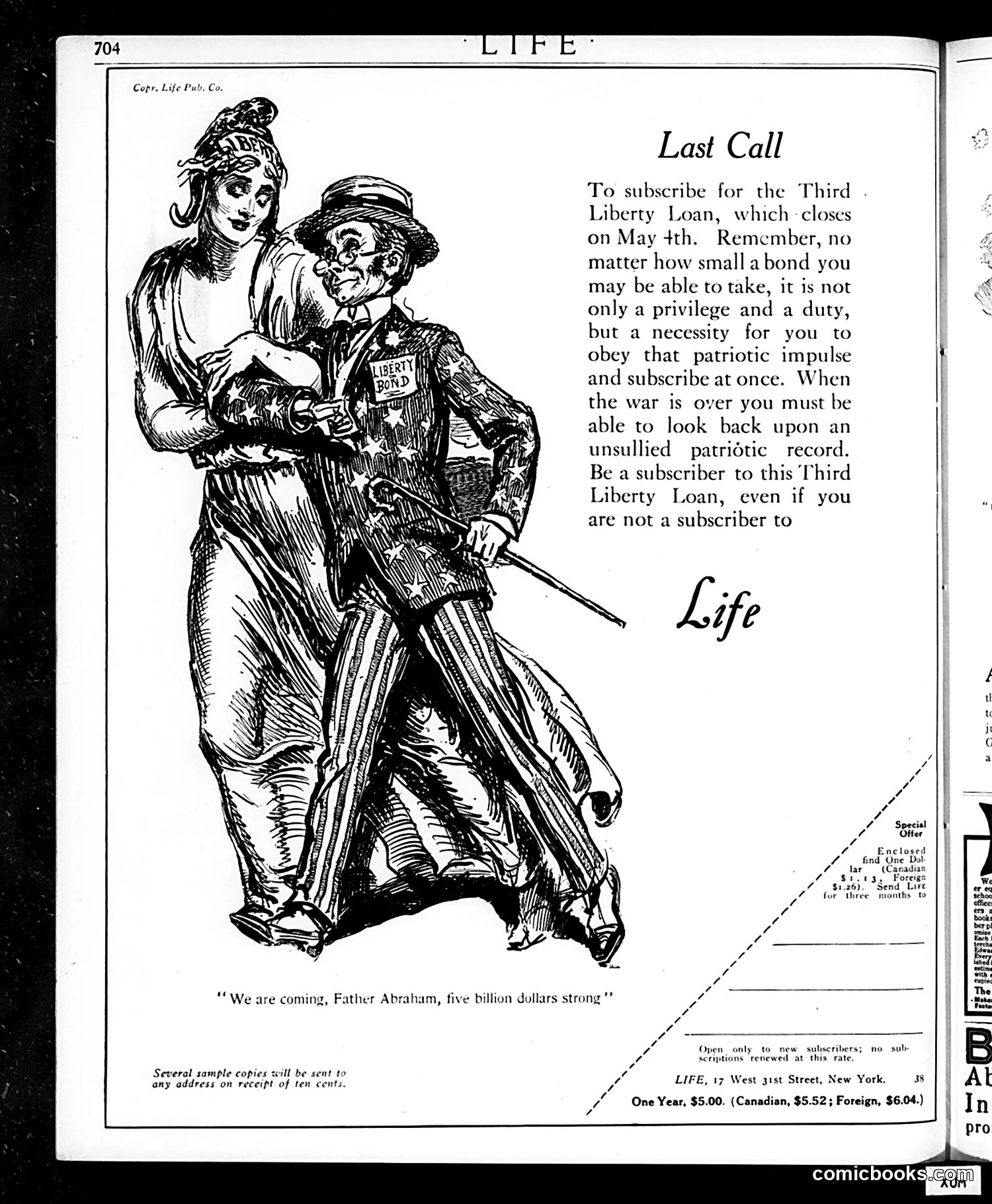
This is a Liberty Loan advertisement from Life magazine, likely from 1918 (Third Liberty Loan). The illustration shows a soldier in military uniform beside Lady Liberty (depicted as a woman in classical dress holding a "Liberty" bond). The caption reads "We are coming, Father Abraham, five billion dollars strong"—a reference to Lincoln and a call for patriotic financial support. The "Last Call" text urges Americans to subscribe to war bonds before the May 4th deadline, framing it as a patriotic duty and moral obligation. The advertisement suggests that subscribing, regardless of amount, ensures an "unsullied patriotic record" after the war ends. This represents WWI-era propaganda using emotional appeals and patriotic rhetoric to encourage civilian financial investment in the war effort.
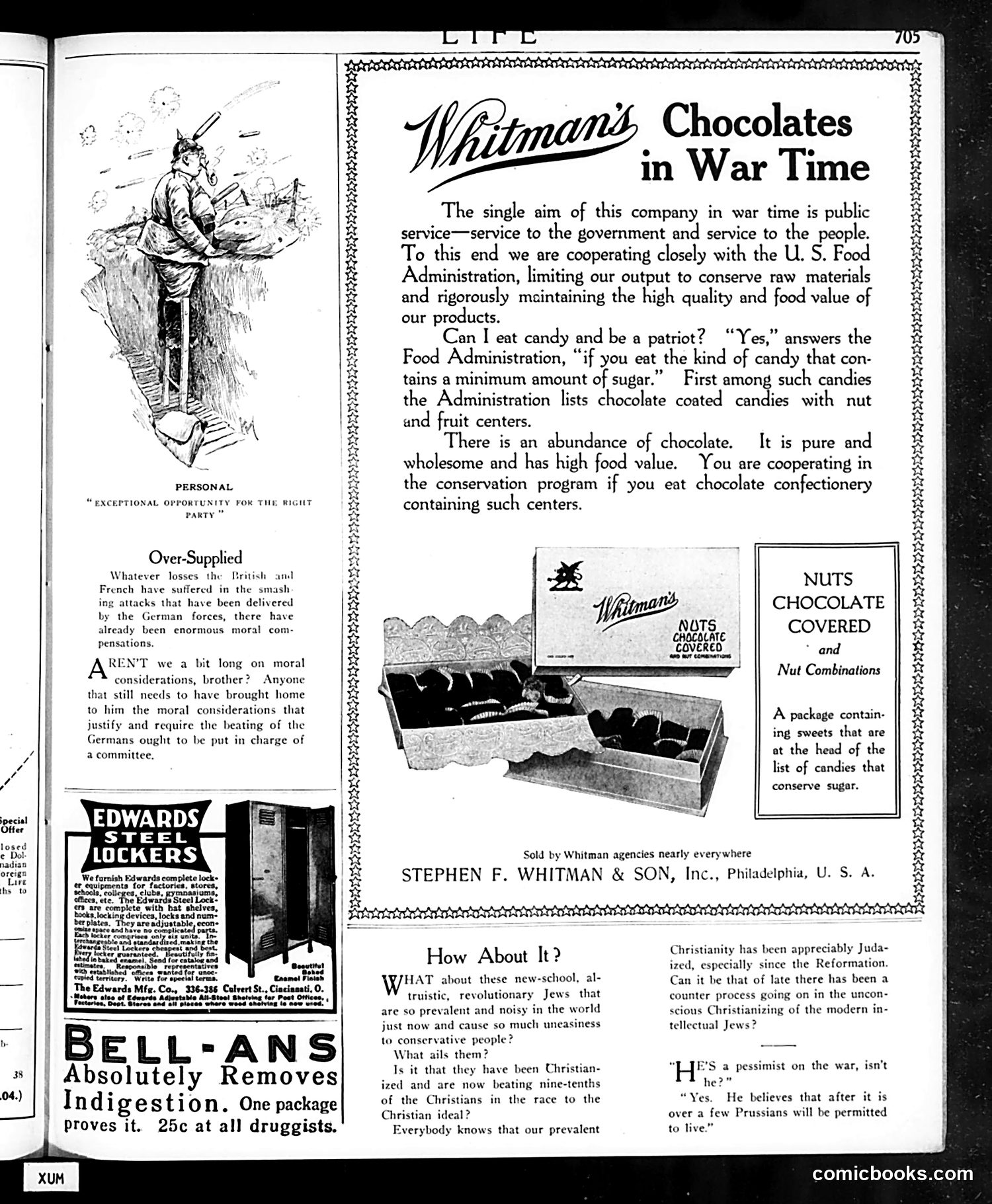
This Life magazine page (705) is primarily **advertising and public relations content**, not editorial satire. The main feature is a Whitman's Chocolates wartime advertisement explaining how eating their candy serves the national interest—specifically chocolate-covered nuts conserve sugar rationing. This reflects WWII-era messaging about civilian consumption supporting government conservation efforts. Below are unrelated ads: Edwards Steel Lockers and Bell-Ans antacid. The left-side cartoon ("Personal: Exceptional Opportunity for the Right Party") and the "Over-Supplied" text fragment appear to be editorial content addressing wartime moral questions about German aggression, but they're incomplete in this image. The page reflects 1940s wartime consumer culture where advertisers framed purchases as patriotic duty.
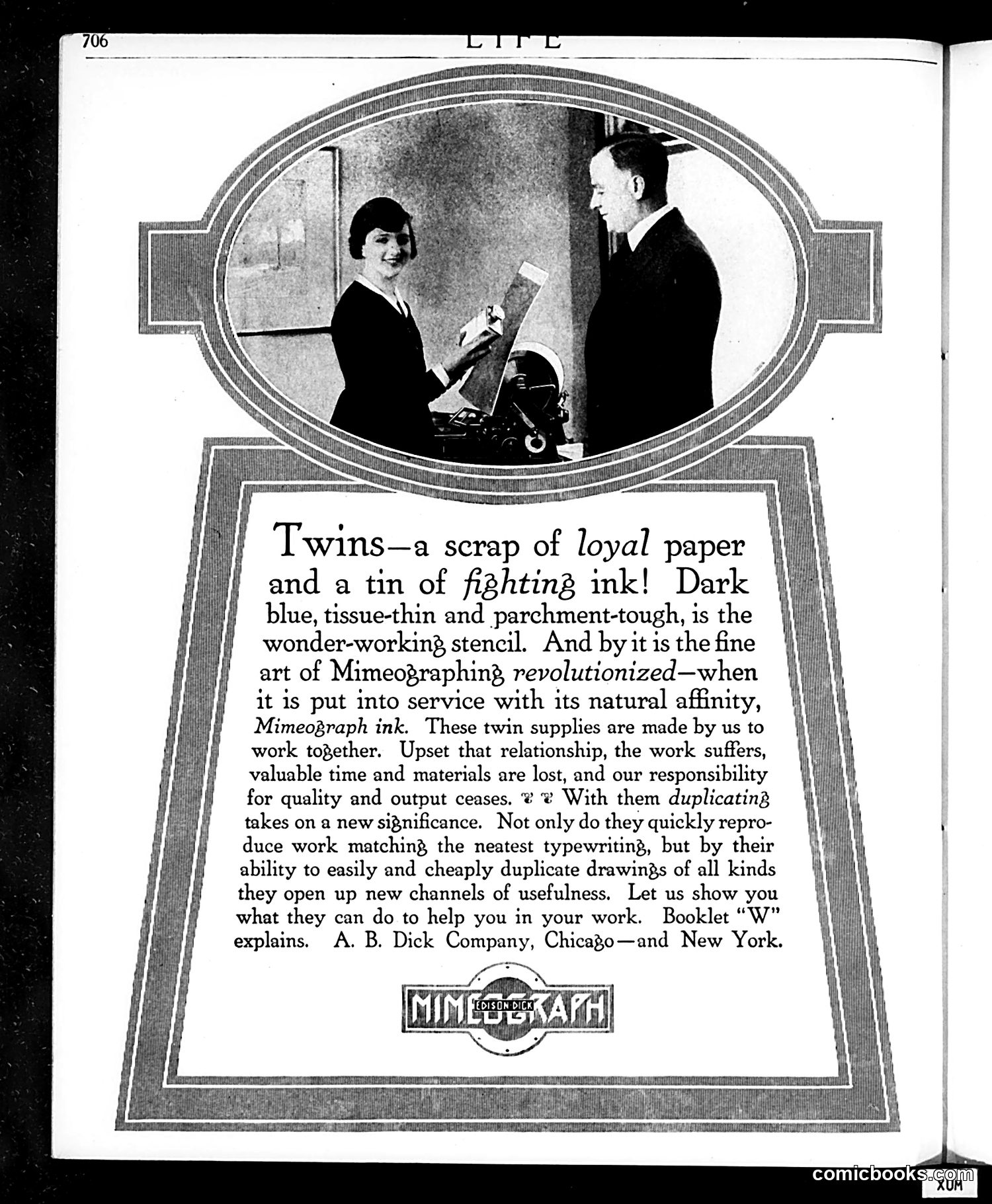
This is an **advertisement**, not political satire. It promotes the "Mimeograph" duplicating system by A.B. Dick Company (Chicago and New York). The ad uses the metaphor of "Twins" to describe the complementary products: special stencil paper and mimeograph ink. The circular image shows two office workers—a woman seated at a desk examining materials and a man standing beside her—representing a professional workplace setting. The copy emphasizes how these two supplies work together to "revolutionize" document duplication, enabling quick, cheap reproduction of drawings and typed work. The ad promises efficiency gains and cost savings for businesses. This reflects early-twentieth-century office technology marketing, targeting companies seeking modern reproduction methods before photocopiers existed.
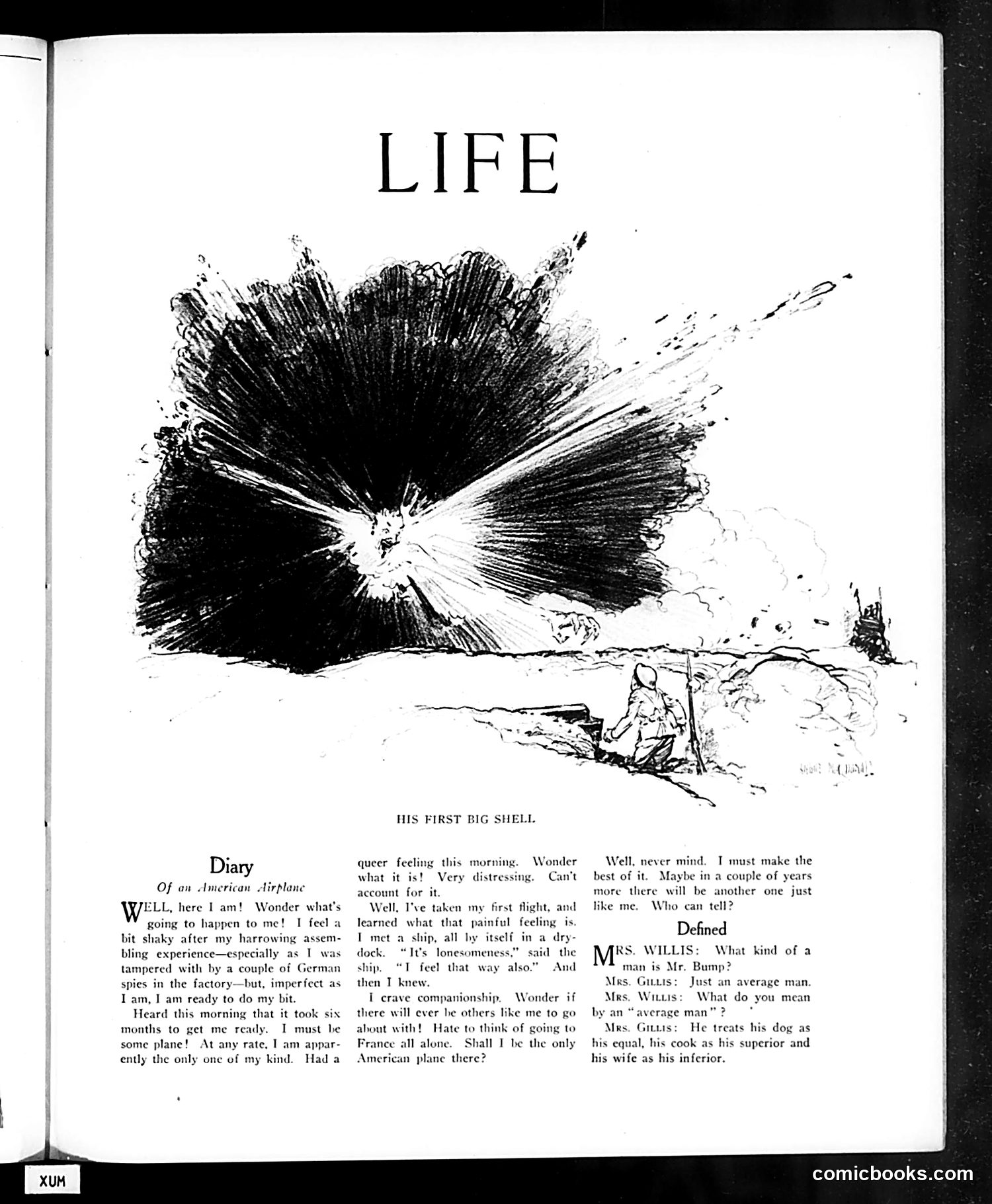
This page from *Life* magazine features a WWI-themed illustration titled "His First Big Shell" showing a soldier in a trench witnessing an explosion. The accompanying text includes a "Diary" entry from "an American Airplane" expressing anxiety about being sent to France as "apparently the only one of my kind," and a brief comic dialogue titled "Defined" between Mrs. Willis and Mrs. Gillis about what constitutes an "average man." The content satirizes American involvement in World War I—specifically the fear and uncertainty soldiers faced, and the absurdity of wartime definitions. The illustration depicts the terrifying reality of modern warfare, while the diary entry captures the isolation of early American military aviation. The "Defined" section uses domestic humor to mock social pretensions during wartime.
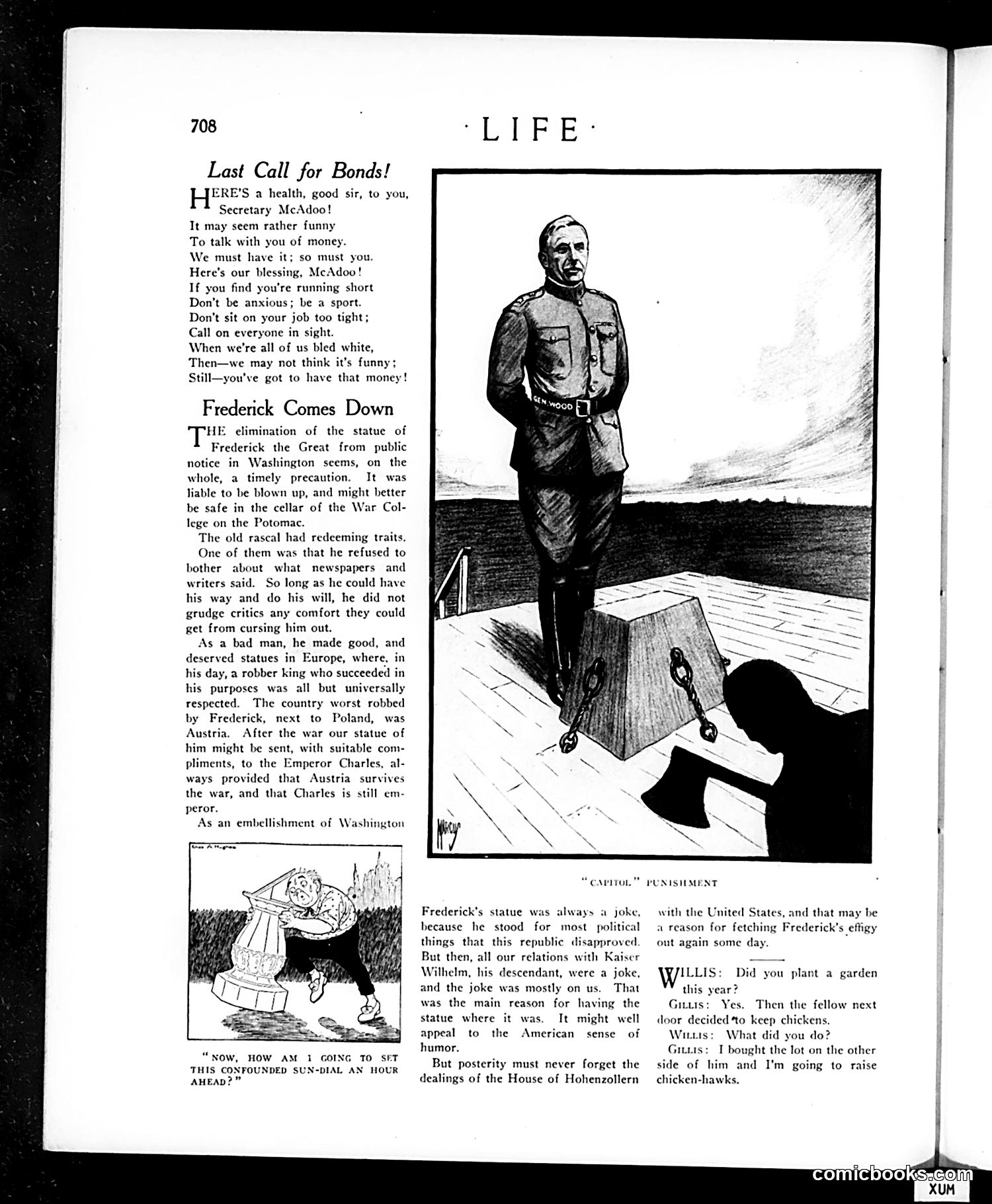
This page contains WWI-era American satire mocking Frederick the Great of Prussia. The main illustration shows a soldier standing over an axe—a visual pun on "Frederick comes down" (losing status/being humiliated). The text explains that Frederick's statue was removed from public view in Washington, D.C. as a precaution during wartime, since America was fighting Germany. The article treats this humorously, noting Frederick was historically a "robber king" who plundered neighboring territories, yet America still maintained diplomatic pretense with Austria (ruled by his descendant Emperor Charles). The cartoon below depicts a figure struggling with a sundial, likely satirizing German incompetence or confusion. A brief joke about gardening and chickens follows, apparently unrelated contemporary humor.
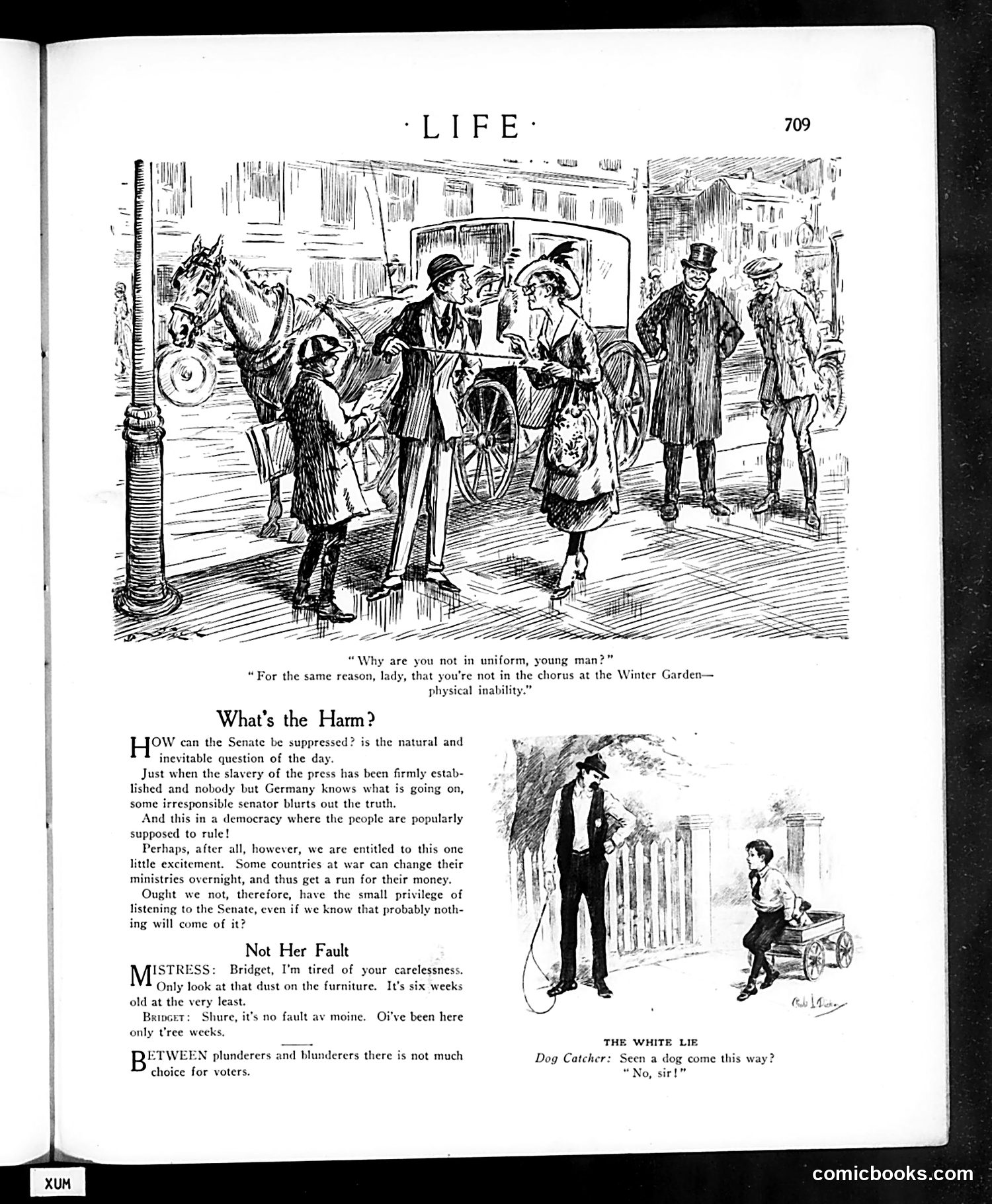
**Top Cartoon:** A street scene shows a young man in civilian clothes being questioned by a uniformed soldier about why he's not in uniform. His response—that he lacks "physical inability" like chorus dancers at the Winter Garden—is a sarcastic deflection blaming entertainment venues for hiring unfit performers rather than admitting his own reasons for avoiding military service. This satirizes young men's excuses for not enlisting, likely during or around World War I. **"What's the Harm?"** and **"Not Her Fault"** sections contain brief satirical commentary on political suppression of the Senate and domestic negligence, respectively. **"The White Lie"** cartoon shows a man lying to a dog catcher about a stray dog, illustrating everyday dishonesty. The page satirizes social hypocrisy and avoidance of civic responsibility.
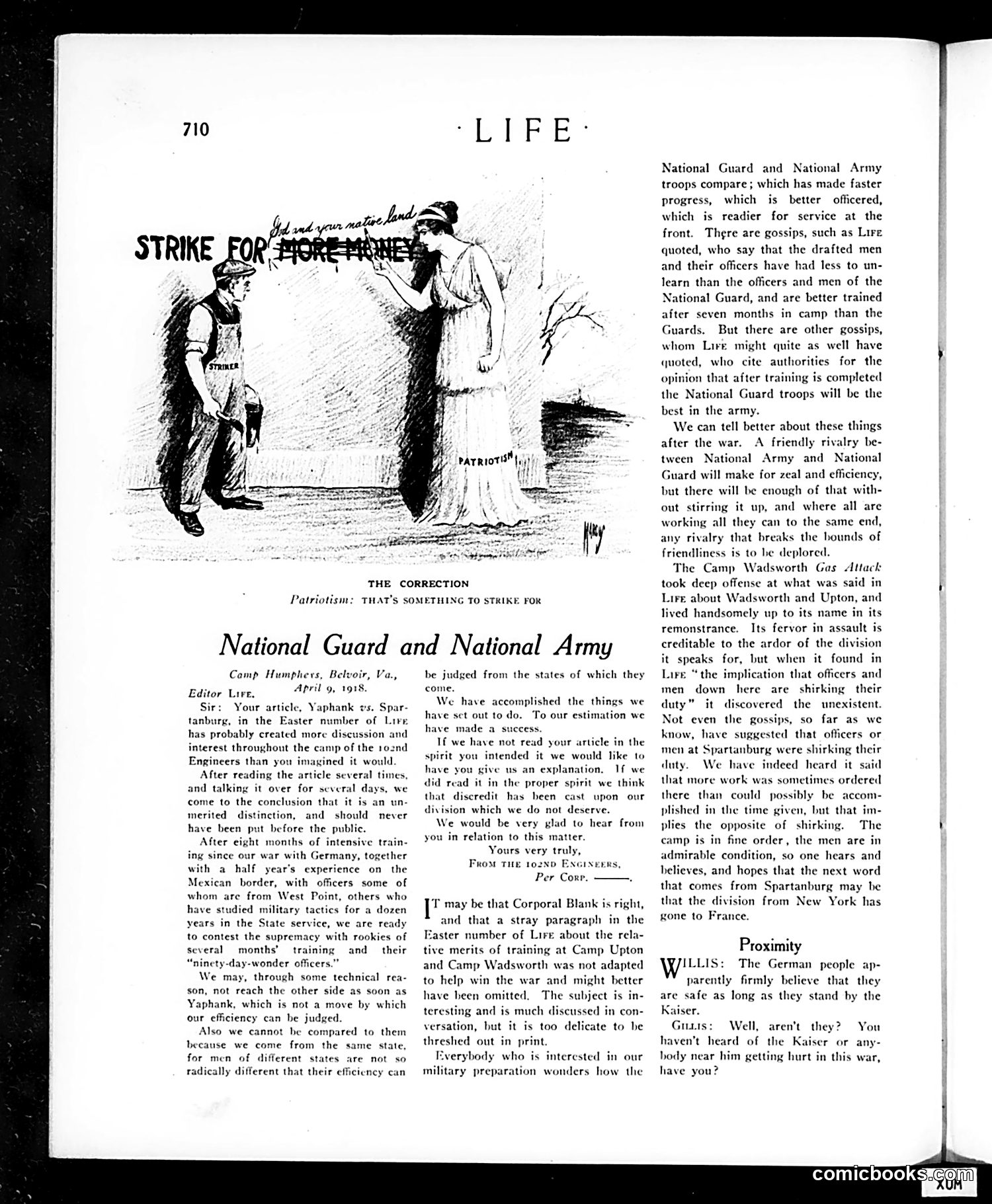
This cartoon critiques a *Life* magazine article by Meredith Nicholson about National Guard versus National Army training. The image shows "Patriotism" (a classical female figure) striking a striker labeled "Strike for Higher Pay" with a rod, while saying "that's SOMETHING to strike for." The satire targets labor unrest during military mobilization: the cartoon suggests that striking for higher wages during wartime is unpatriotic, positioning patriotic duty as opposed to workers' economic demands. The classical "Patriotism" figure represents idealized national values being weaponized against labor organizing. The accompanying letter defends National Guard training quality against claims of inferiority, suggesting contemporary debate over military preparedness and unit effectiveness during America's World War I involvement.
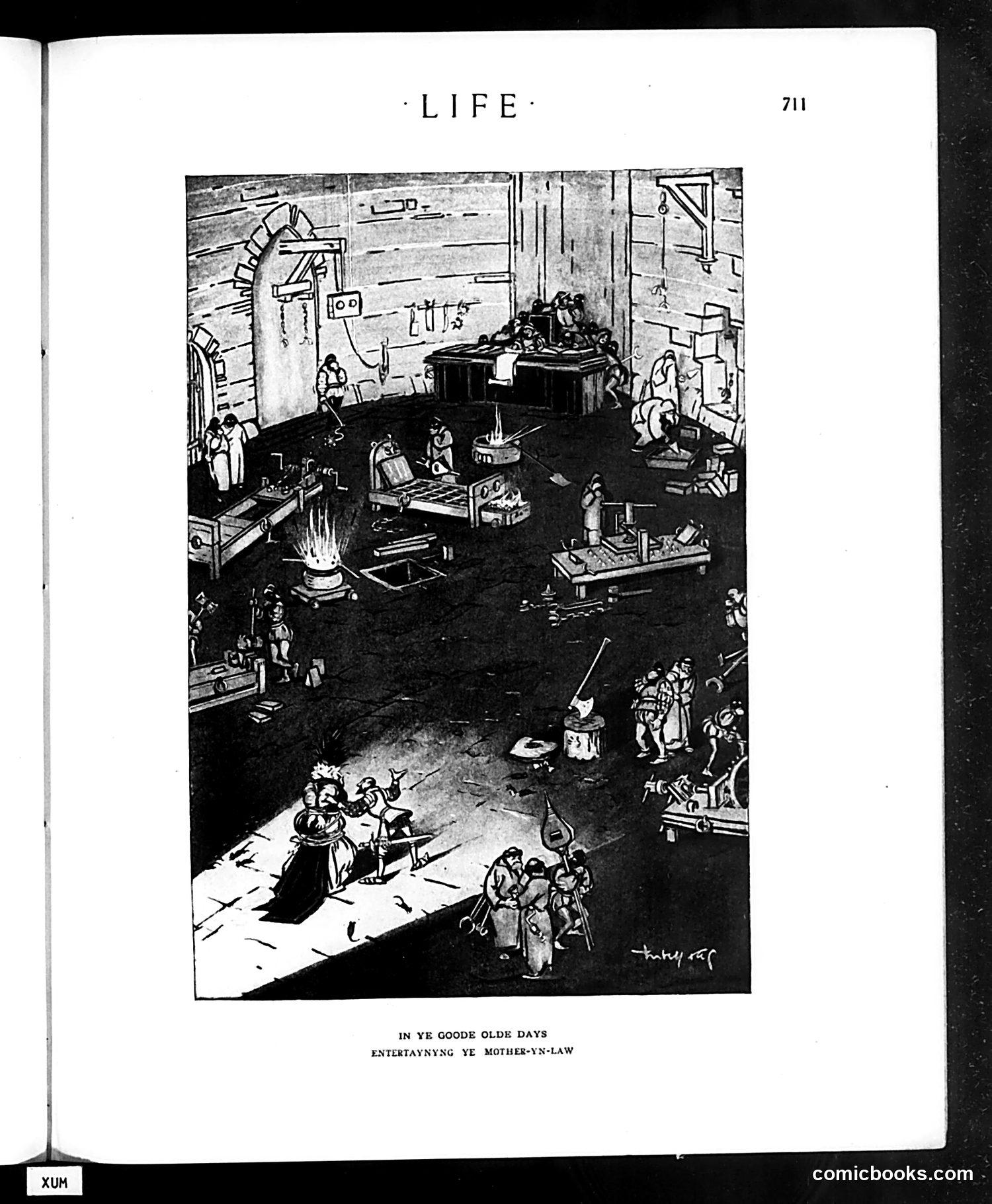
This is a single satirical illustration titled "In Ye Goode Olde Days: Entertaining Ye Mother-In-Law," showing a chaotic medieval or Tudor-era household scene. The joke appears to be a domestic comedy about in-laws. The image depicts a noblewoman (the mother-in-law, appearing to be the central seated figure) being entertained in what looks like a great hall, with various servants, entertainers, and family members attending to her. The elaborate setup—with musicians, performers, and numerous attendants—suggests the household is going to great, somewhat absurd lengths to entertain and manage this difficult guest. The humor relies on the timeless, universal complaint about difficult mothers-in-law, suggesting that even in "ye goode olde days," this family relationship was challenging and required elaborate effort to manage. The period setting adds comic distance to what remains a recognizable domestic frustration.
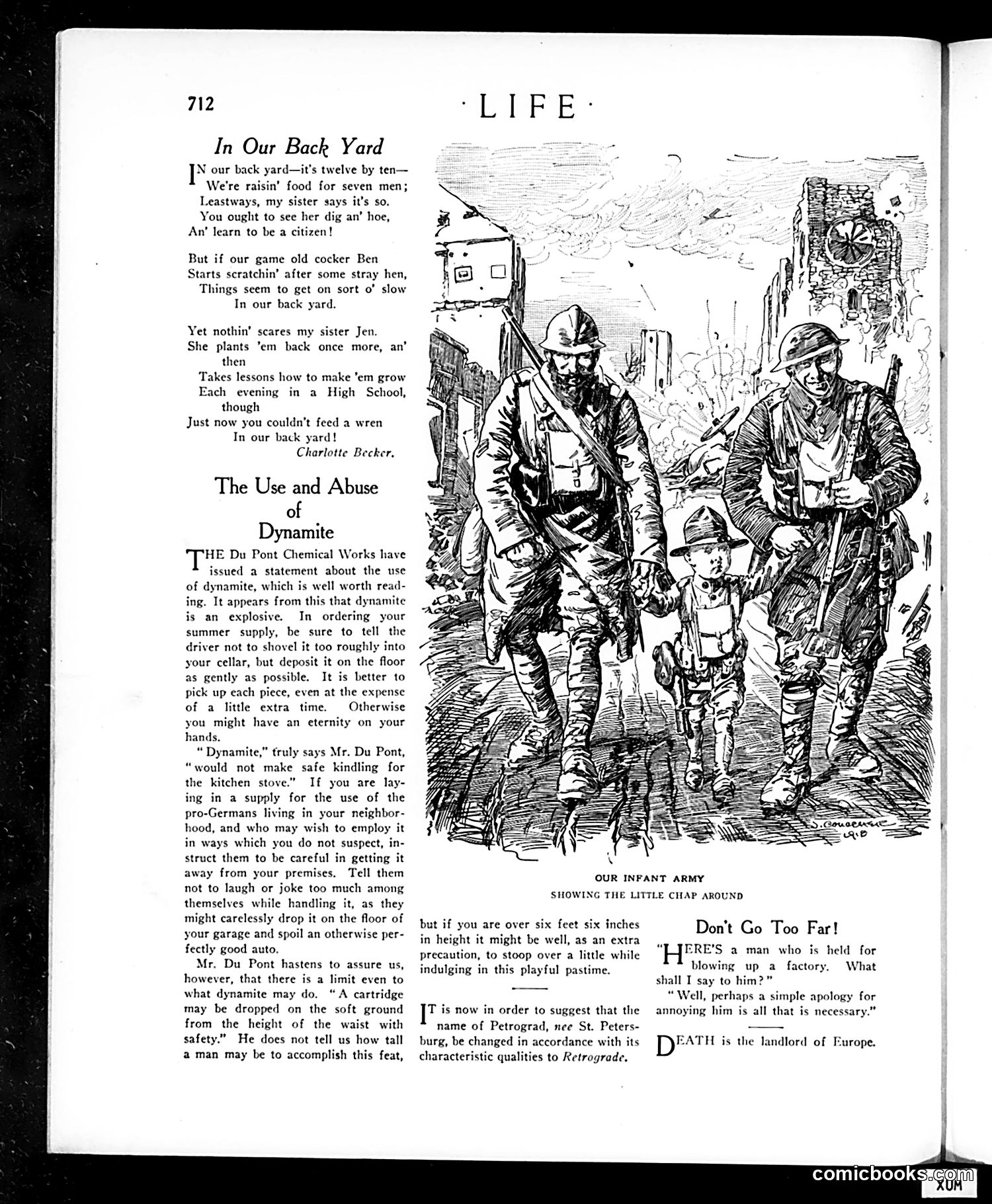
This page contains three distinct pieces: 1. **"In Our Back Yard"** — A poem by Charlotte Becker about children playing in a backyard, mentioning a rooster named Ben and sister Jen planting vegetables and attending high school. 2. **"The Use and Abuse of Dynamite"** — A safety advisory from Du Pont Chemical Works warning against improper handling of dynamite as an explosive, particularly for those storing it at home. Given WWI-era concerns about sabotage, the text specifically warns against pro-German neighbors potentially misusing supplies. 3. **"Our Infant Army"** — An illustration captioned "Showing the Little Chap Around" depicting soldiers with a small child, accompanying a piece titled **"Don't Go Too Far!"** about a man held for blowing up a factory, suggesting capital punishment ("Death is the landlord of Europe"). The page reflects wartime anxieties about safety, sabotage, and military service circa 1917-1918.
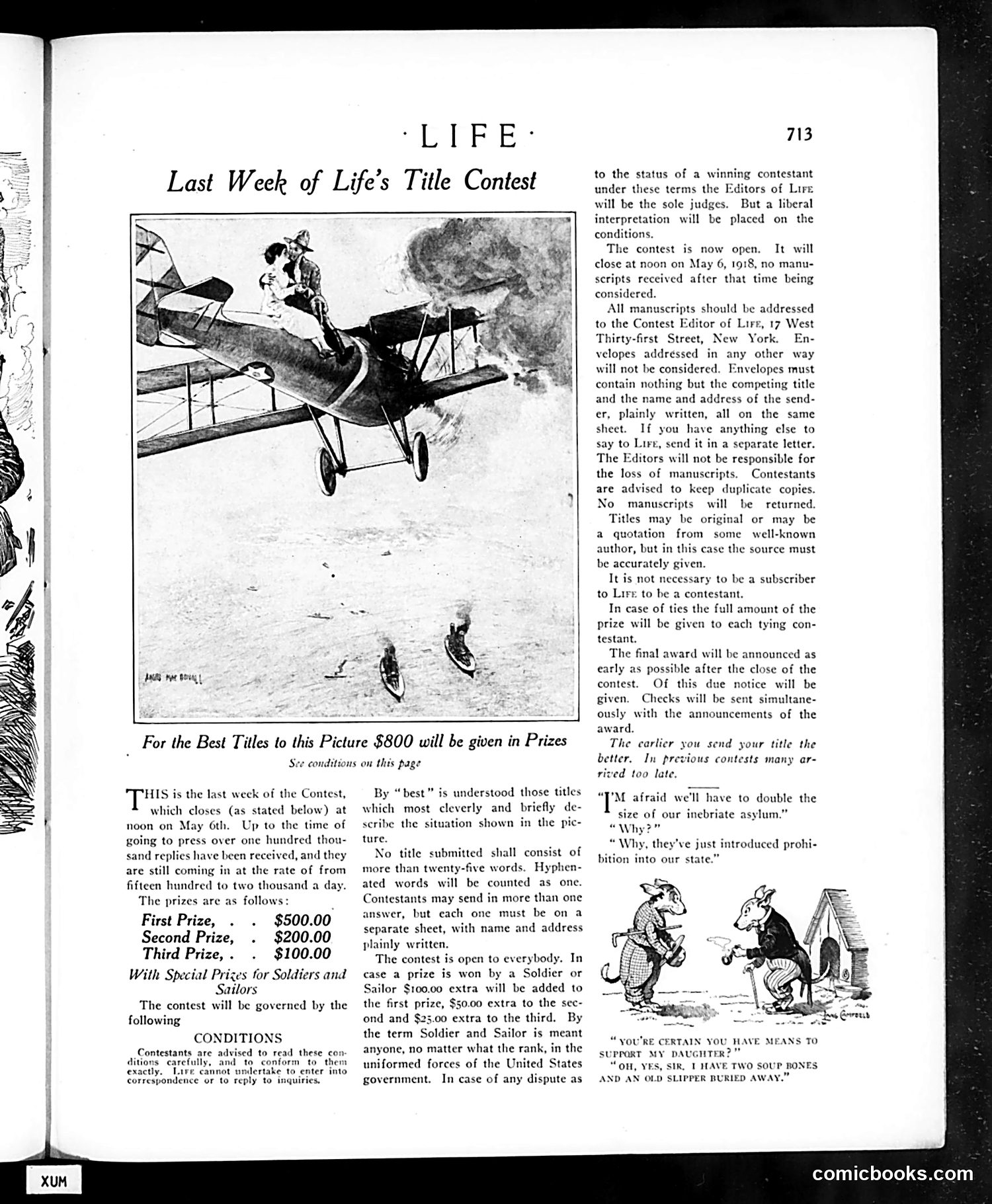
The main illustration shows an **airplane in flight with a pilot and passenger**, with figures on the ground below. This is a **title-contest submission for prizes** ($500 total offered). The bottom cartoon depicts two anthropomorphic animals in conversation. One says "I'M AFRAID WE'LL HAVE TO DOUBLE THE SIZE OF OUR INEBRIATE ASYLUM" and the other responds "'Why?'" The first replies: "WHY, THEY'VE JUST INTRODUCED PROHIBITION INTO OUR STATE" and "'OH, YES, SIR. I HAVE TWO SOUP BONES AND AN OLD SLIPPER BURIED AWAY.'" This cartoon **satirizes Prohibition**, the newly-implemented alcohol ban. The joke suggests that banning alcohol will create more drunkenness/madness, so asylums must expand—a common anti-Prohibition argument of the era. The response about burying "soup bones" plays on hiding supplies before the ban.
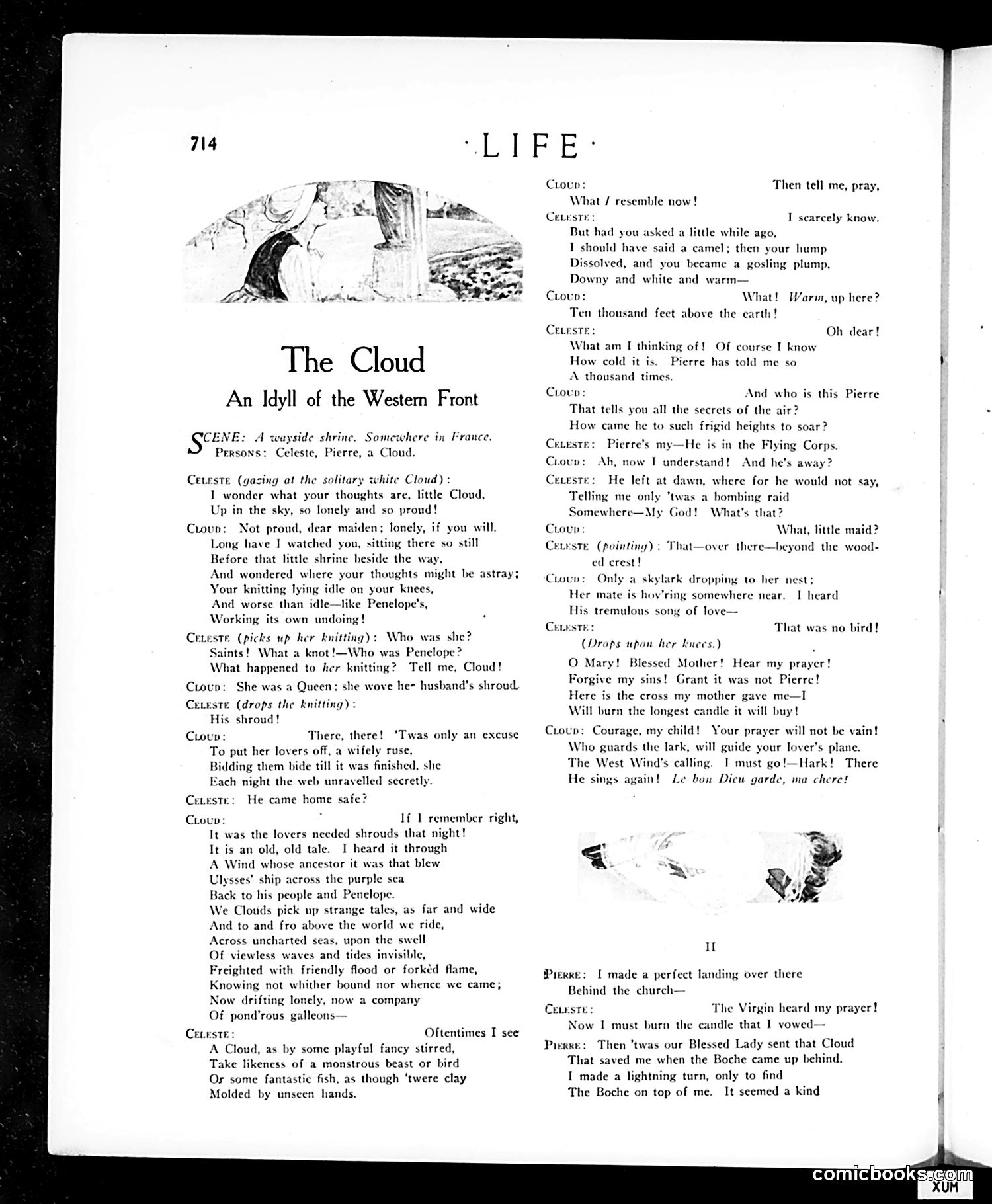
This is a dramatic poem/playlet, not a political cartoon. Set at a wayside shrine in France during World War I, it depicts a dialogue between **Celeste** (a French woman), **Pierre** (a soldier in the Flying Corps), and a personified **Cloud**. The piece uses the cloud as a metaphorical observer of war's chaos. Celeste awaits Pierre's return; he's mentioned as being away on a bombing raid. The cloud recounts ancient tales (Penelope and Ulysses) while watching modern warfare unfold below—"across uncharted seas, upon the swell / Of viewless waves." The satire appears gentle: contrasting timeless human longing and mythological suffering with contemporary mechanized warfare, suggesting WWI's horrors fit into humanity's eternal cycle of loss and separation.
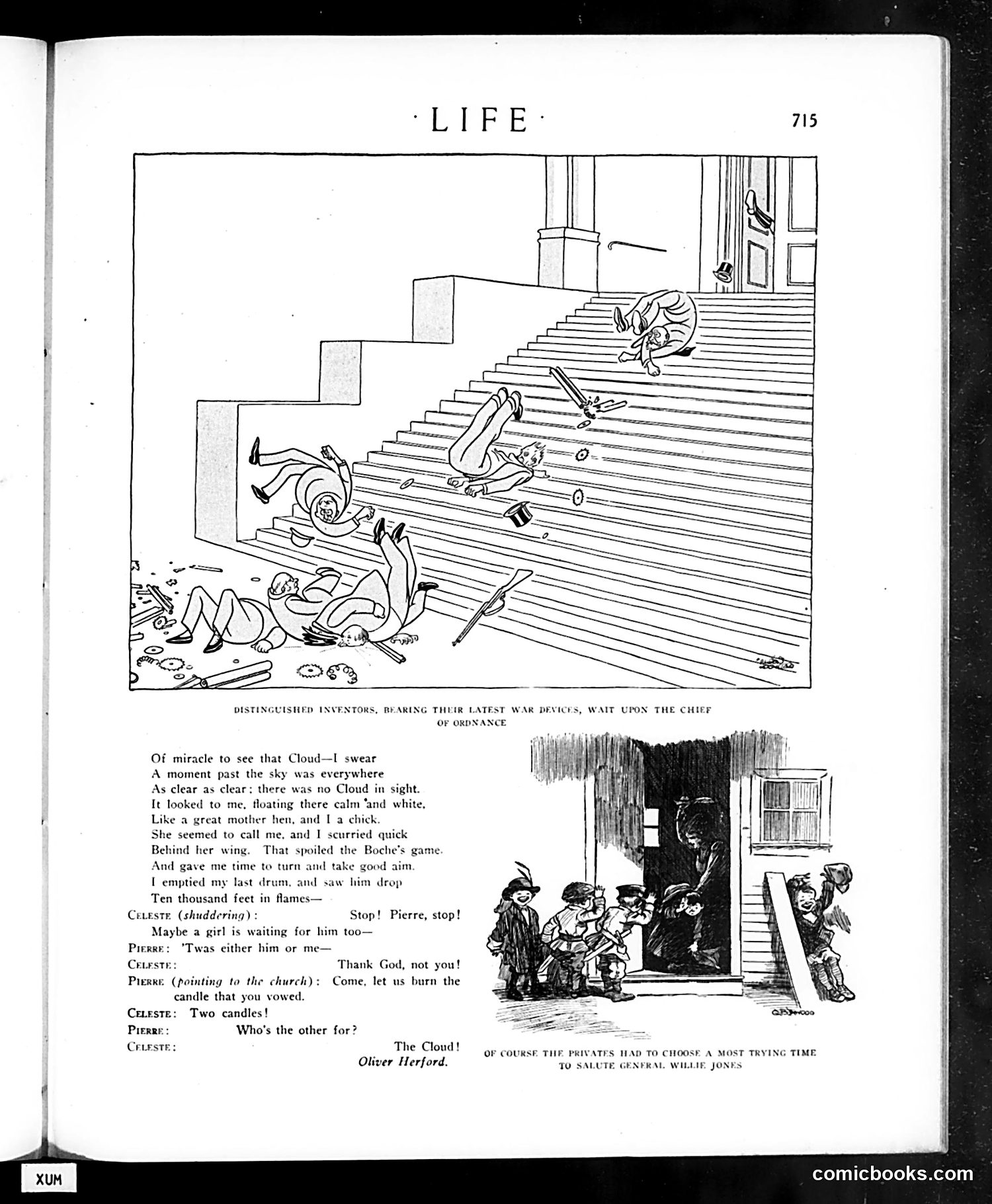
This page contains two cartoons satirizing military incompetence during wartime. **Top cartoon**: Shows "Distinguished Inventors, Bearing Their Latest War Devices, Wait Upon the Chief of Ordnance." Multiple figures tumble down grand steps carrying absurd contraptions, clearly mocking inventors pitching impractical weapons to military officials. The visual joke emphasizes their desperation and the ridiculousness of their proposals. **Bottom cartoon**: Titled "Of Course the Private's Had to Choose a Most Trying Time to Salute General Willie Jones," depicts soldiers awkwardly saluting a general in a doorway while civilians watch. The satire suggests military protocol creates awkward, impractical situations—soldiers must maintain formality even when circumstances are inconvenient. Both cartoons mock military bureaucracy and rigid procedures as obstacles to practical wartime effectiveness.
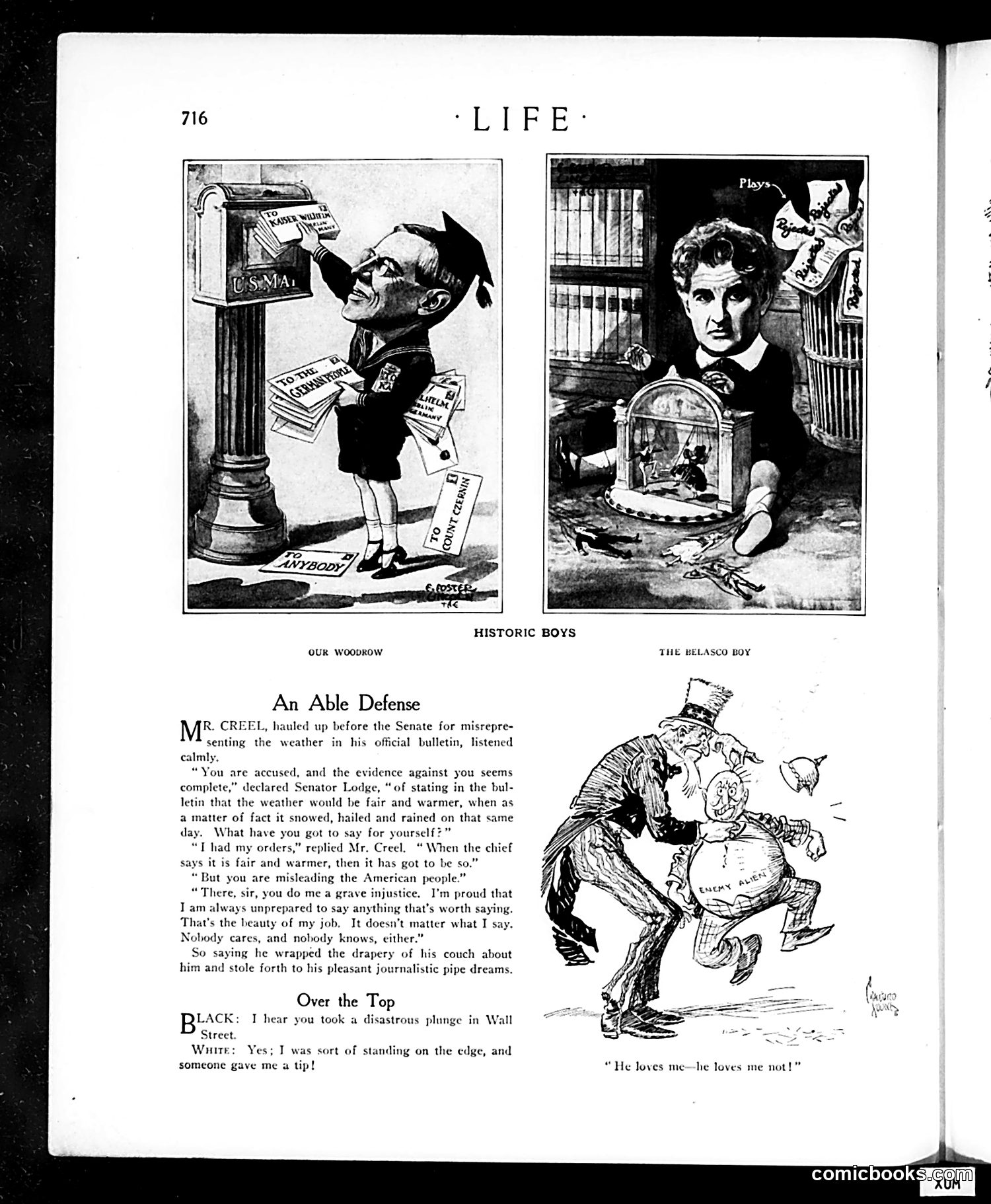
This page satirizes **George Creel**, head of the Committee on Public Information during World War I, famous for managing wartime propaganda and official bulletins. **"An Able Defense"** mocks Creel's credibility by depicting him hauled before Senator Lodge for issuing false weather forecasts. The joke is that Creel—who controlled official messaging—follows orders uncritically ("When the chief says it is fair and warmer, then it has got to be so"). His admission that "Nobody cares, and nobody knows, either" sarcastically exposes government indifference to misleading the public. The cartoon attacks Creel's reputation for propaganda by suggesting his entire operation prioritizes official narratives over truth. The "Historic Boys" header compares Creel's behavior to famous historical figures. **"Over the Top"** is an unrelated brief joke about Wall Street losses (topical to the era's financial concerns). The left illustration shows "Our Woodrow" (President Wilson) at a mailbox; the right shows "The Belasco Boy" (unclear reference without more context).
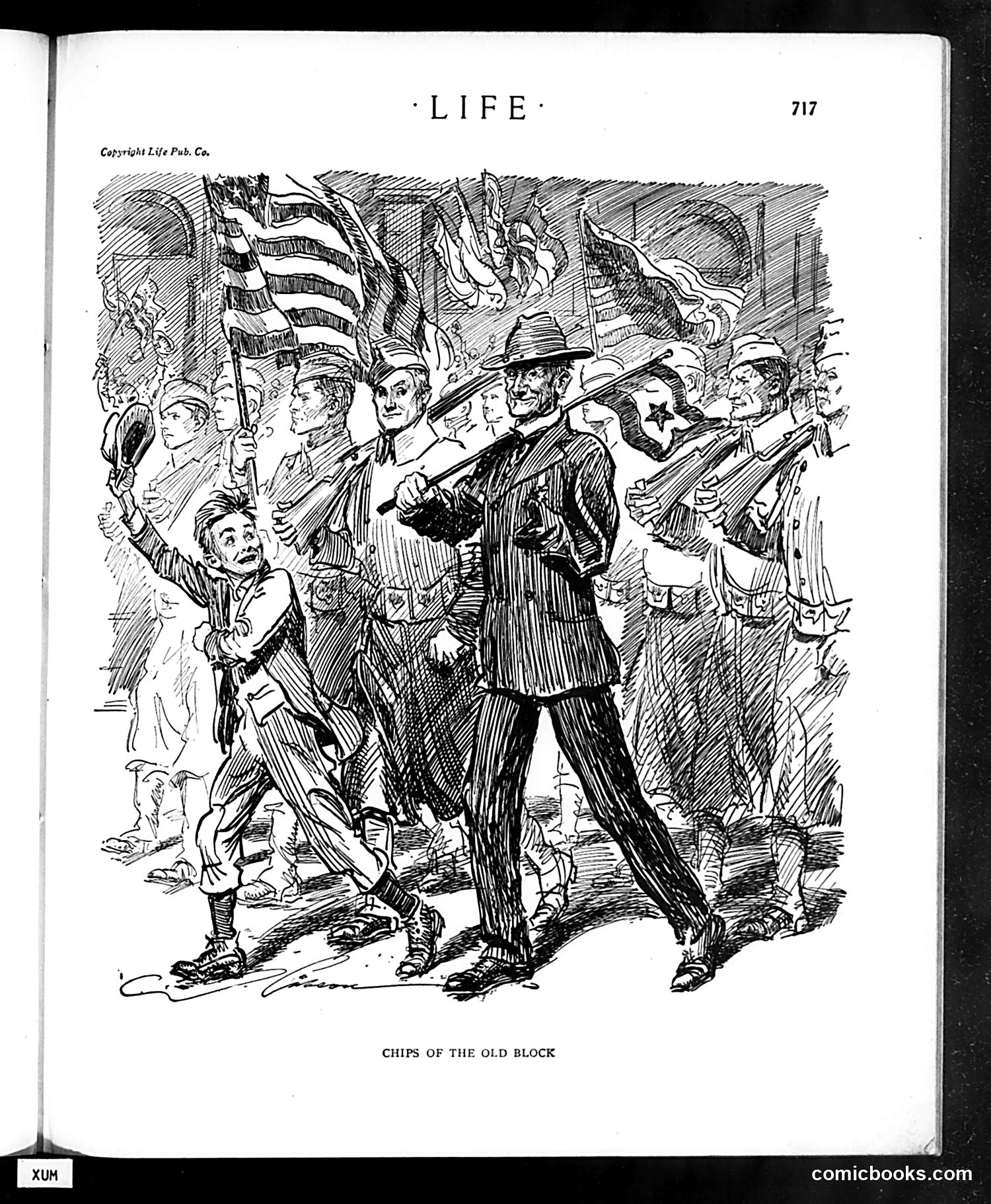
This satirical cartoon depicts a group of military or political figures marching with flags and weapons, apparently representing authority or power. The title "Chips of the Old Block" suggests these are younger versions or successors following in the footsteps of established predecessors—a commentary on generational continuity or imitation of power structures. The sketch style and militaristic imagery suggest this likely critiques early 20th-century militarism, imperialism, or political succession. The figures' stern expressions and formal dress, combined with the flags and weapons they carry, imply satirical commentary on warmongering or the perpetuation of aggressive policies by new leaders copying their predecessors' methods. Without specific identifying details visible, the exact political figures or event remain unclear, but the satire targets institutional power and its cyclical nature.
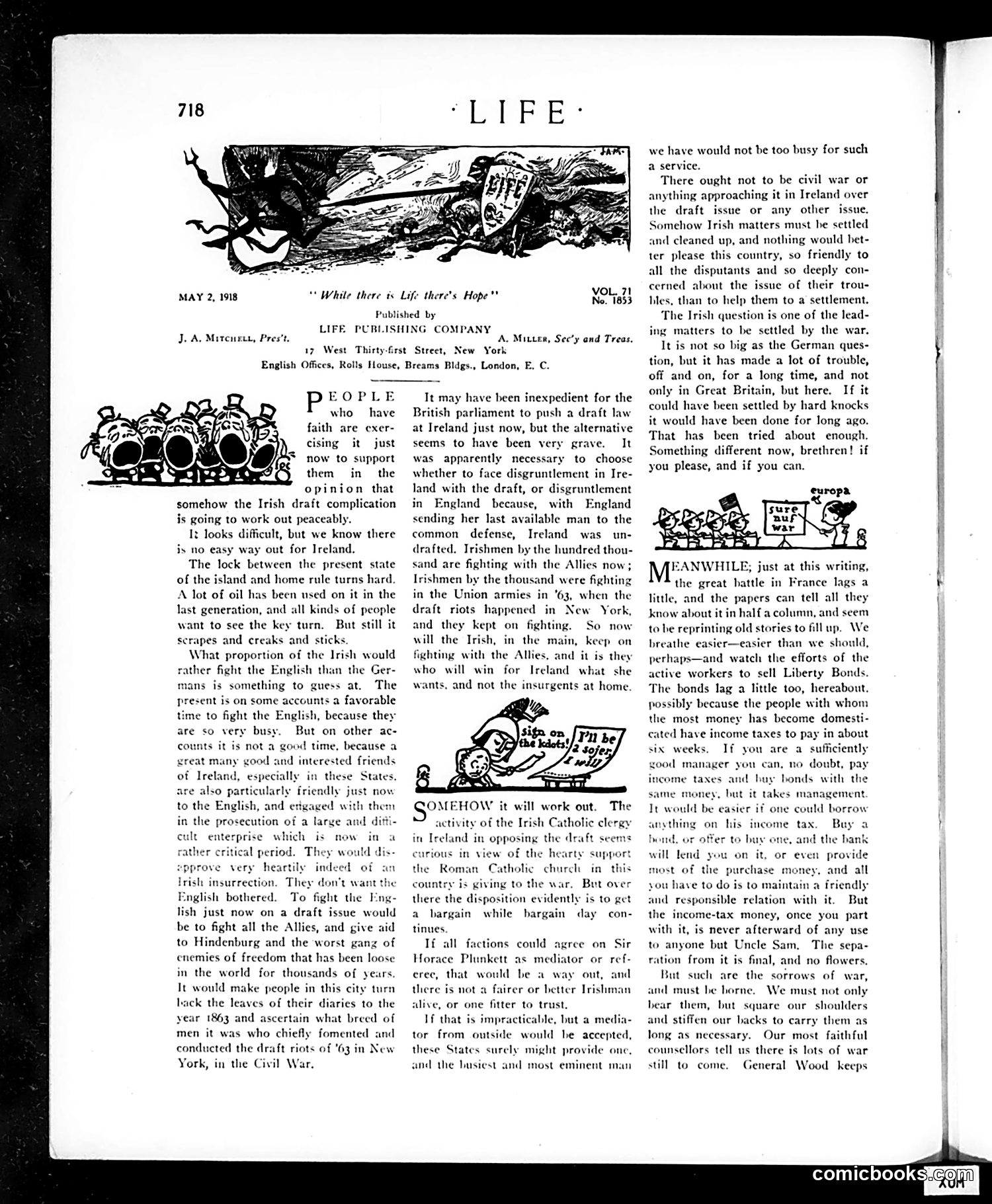
This page addresses the contentious Irish draft issue during World War I. The main article argues that while Irish conscription creates domestic tension, Ireland should support the Allied war effort rather than risk civil unrest. The editorial references the **1863 New York draft riots** (Civil War era) as a cautionary parallel—suggesting that opposing conscription could spark similar violence. It notes that many Irish already fight alongside the Allies, and that insurgents at home, not soldiers, threaten Irish interests. The cartoons (unclear in detail but visible) appear satirical—the left shows tangled figures representing the "Irish draft complication," while the right depicts European chaos, contrasting peaceful resolution with wartime disorder. The piece proposes **Sir Horace Plunkett** as a neutral mediator, or suggests an American mediator could help settle the dispute peacefully. The underlying message: Ireland's real liberation comes through Allied victory, not domestic rebellion during wartime.
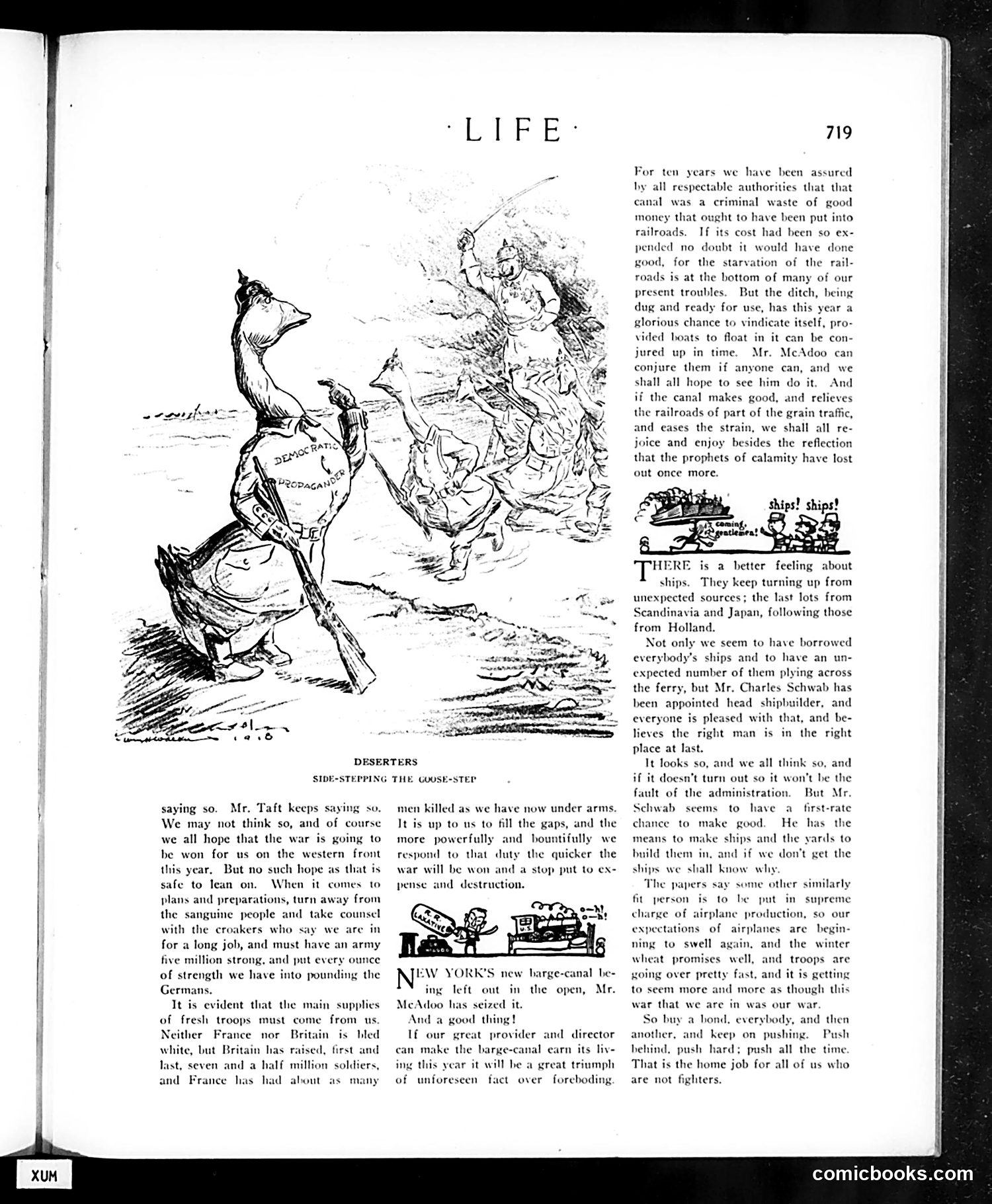
The main cartoon, titled "Deserters: Side-Stepping the Goose-Step," depicts a figure labeled with what appears to be military/governmental insignia fleeing from marching soldiers (the "goose-step" reference suggests German militarism). The satire mocks American hesitation or reluctance regarding war commitment. The accompanying text criticizes insufficient U.S. military preparation for World War I. The author argues Americans must commit five million troops and maximum resources, noting that Britain and France are exhausted. The passage references President Taft and Treasury Secretary McAdoo, discussing canal and railroad logistics for wartime supply. A secondary item praises McAdoo's seizure of New York's barge canal for military transport, previously dismissed as wasteful. The page also celebrates improved ship production under newly-appointed shipbuilder Charles Schwab, noting unexpected vessels from Scandinavia and Japan. Overall, the page urges American mobilization and confidence in wartime leadership while cautioning against optimistic underestimation of the conflict's duration.
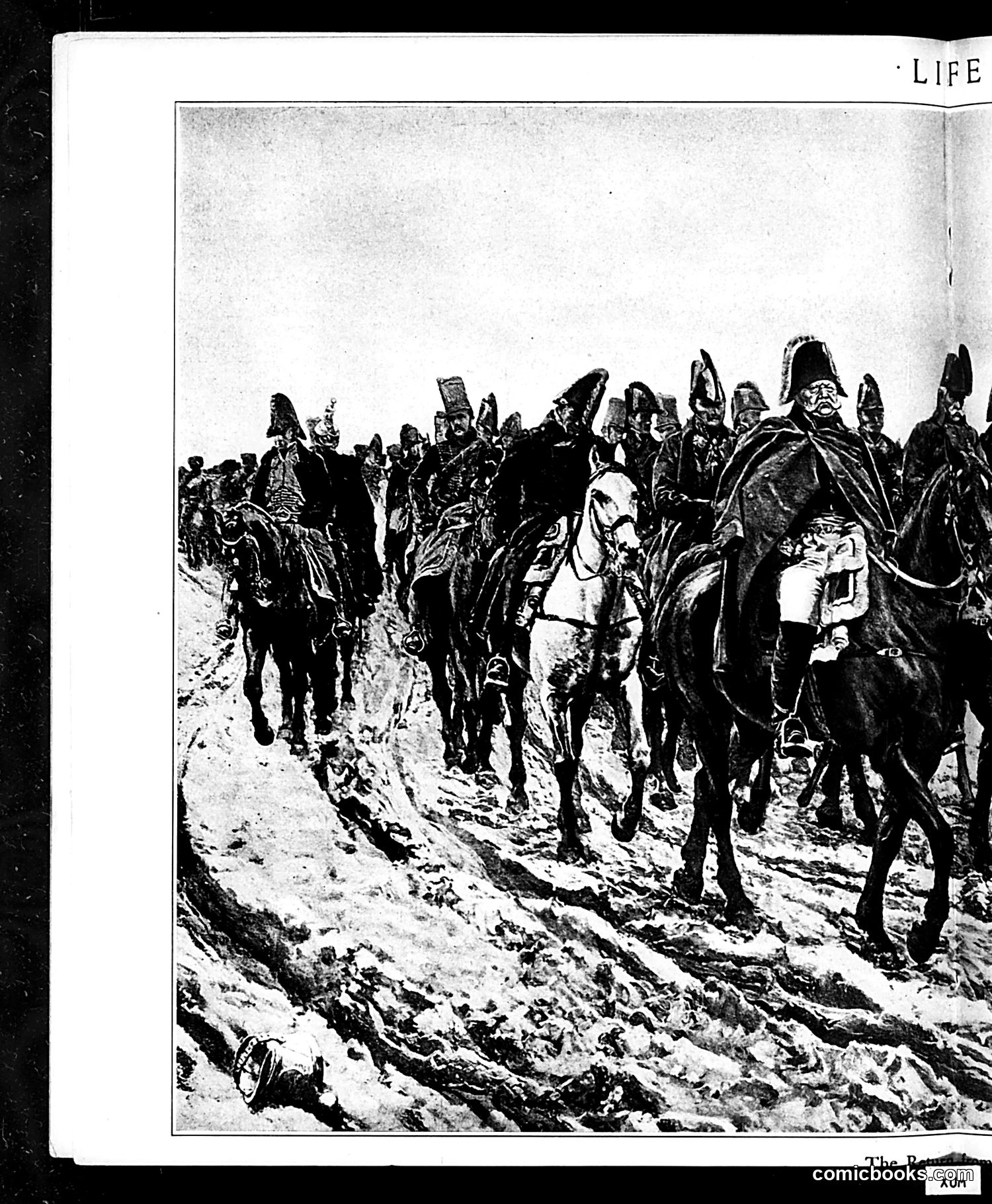
I can see this is a black and white illustration from Life magazine showing a military procession of mounted soldiers in elaborate uniforms and tall hats, traveling along a muddy road. The soldiers appear to be from a European army, likely from the 19th century based on their ornate dress uniforms and styling. However, without visible caption text or clearer OCR data beyond "comicbookseemiy" (which appears to be a scanning artifact), I cannot definitively identify which specific historical event, military campaign, or political situation this satirizes, nor can I identify which particular figures are being caricatured. To properly explain the satire's point to a modern reader, I would need the accompanying caption or title that originally accompanied this illustration.
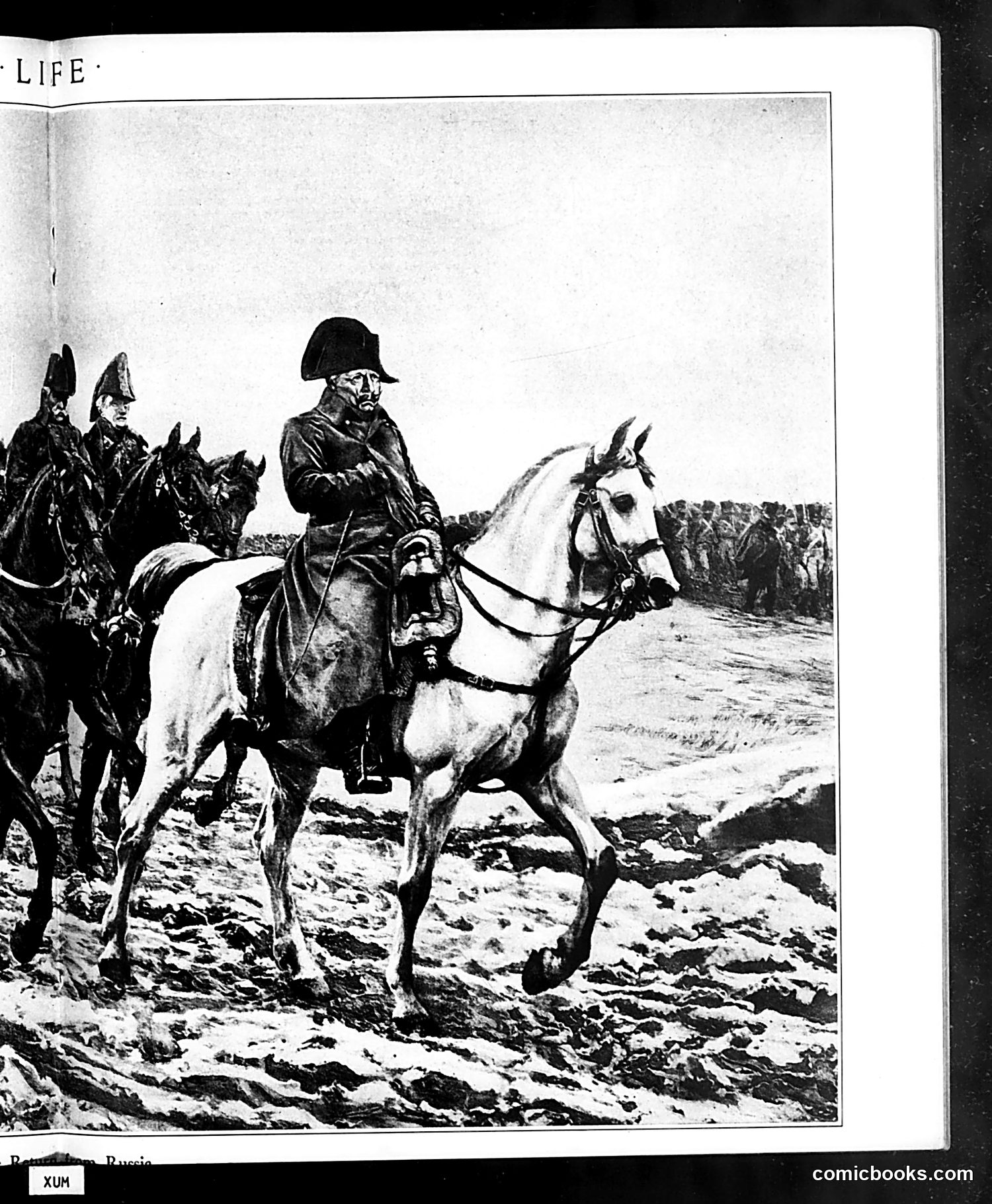
This appears to be a historical illustration from *Life* magazine showing a mounted military figure in a bicorne hat (suggesting Napoleonic era dress) on a white horse, accompanied by officers on dark horses in the background. The scene depicts a barren, rocky landscape with what appears to be fortifications or troops visible in the distance. Without clearer OCR text or caption information visible on this page, I cannot definitively identify which historical figure or event is being satirized. The Napoleonic imagery suggests commentary on military leadership or imperial ambition, but the specific political satire intended remains unclear from the image alone. The page number and complete caption would be necessary for accurate interpretation.
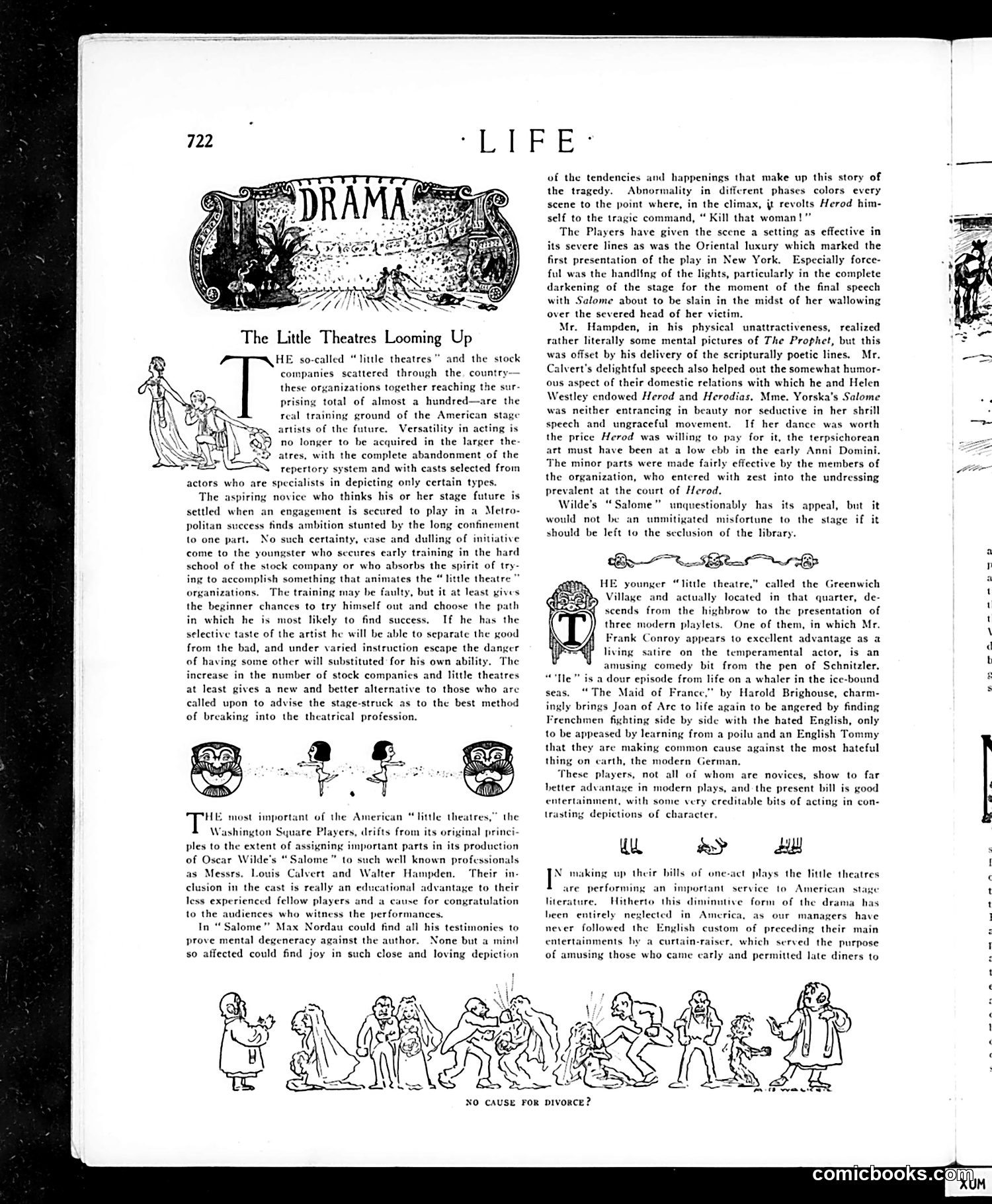
This page discusses the emerging "little theatre" movement in early 20th-century American drama—small, independent theater companies offering an alternative to Broadway's commercial stock system. **Main Points:** The article argues these ~100 little theatres serve as valuable training grounds where young actors develop versatility through repertory work, rather than typecast roles in commercial productions. **Specific Reference:** The text critiques the Washington Square Players' production of Oscar Wilde's "Salome," noting that while it featured established professionals (Louis Calvert and Walter Hampden), the play itself depicts moral degeneracy. The reviewer invokes Max Nordau's theory of artistic degeneracy to explain the play's disturbing content, while acknowledging the production's technical merit. **The Bottom Cartoon:** The illustration titled "NO CAUSE FOR DIVORCE?" shows a chaotic domestic scene—unclear what specific satirical point this makes without additional context. The piece represents contemporary debate about theatrical legitimacy and the tension between commercial entertainment and artistic training.
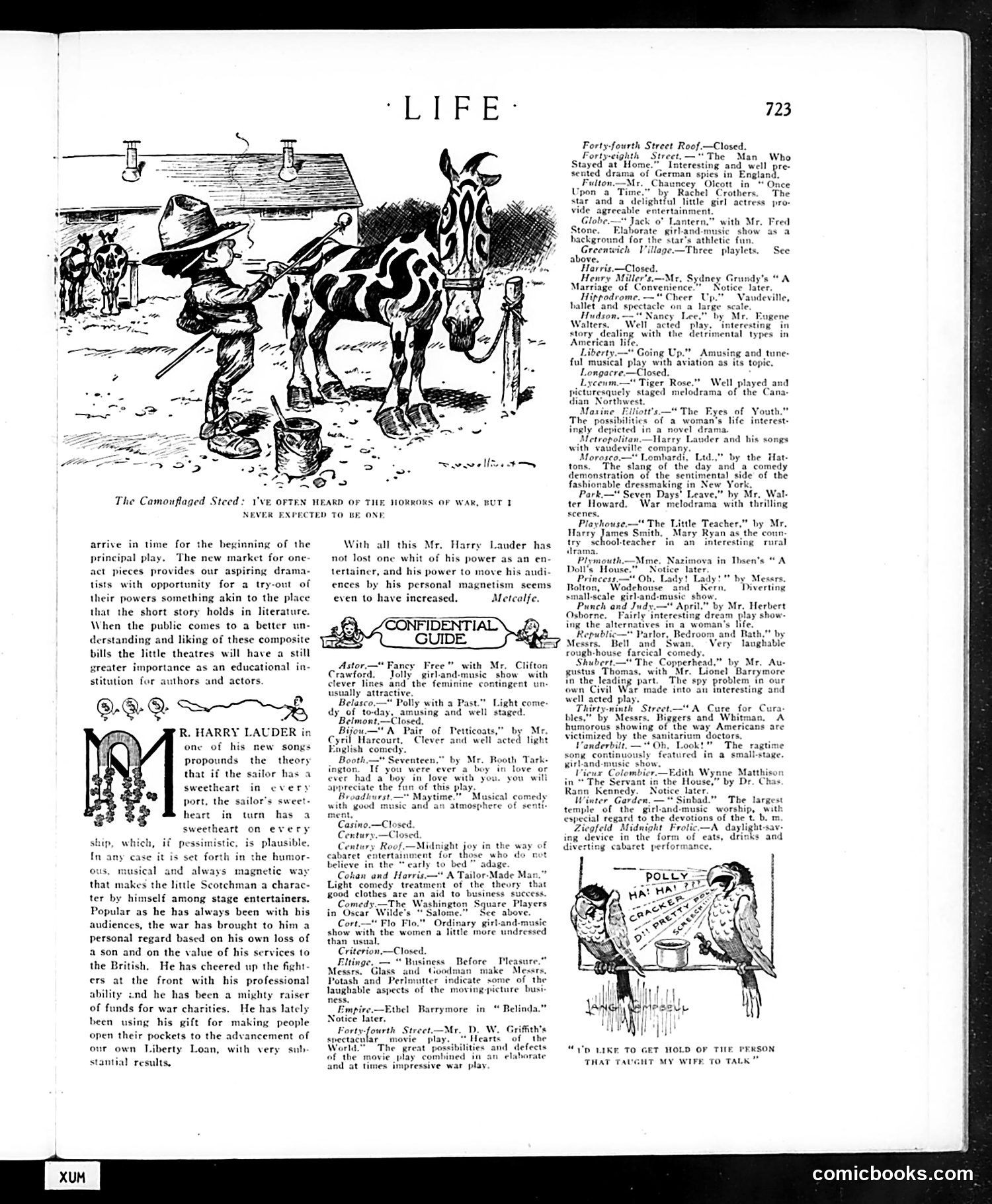
## The Main Cartoon The illustration depicts a soldier encountering a decorated goat, captioned "I've often heard of the horrors of war, but I never expected to be one." The joke plays on the goat's absurd appearance—camouflaged or decorated in an elaborate, ridiculous pattern—suggesting the animal itself has become a horror or monstrosity of warfare. It's a visual pun: the soldier expected horrors of combat, but instead finds this comical, bizarre creature. ## Context This appears to be a World War I-era Life magazine. The surrounding text extensively discusses R. Harry Lauder, a Scottish entertainer who lost his son in the war and raised funds for British war efforts and Liberty Loans. The goat cartoon likely satirizes the absurdities and unexpected oddities soldiers encounter in wartime, using dark humor typical of wartime satire. The page is primarily theater reviews, with the cartoon providing comic relief on a content-heavy page.
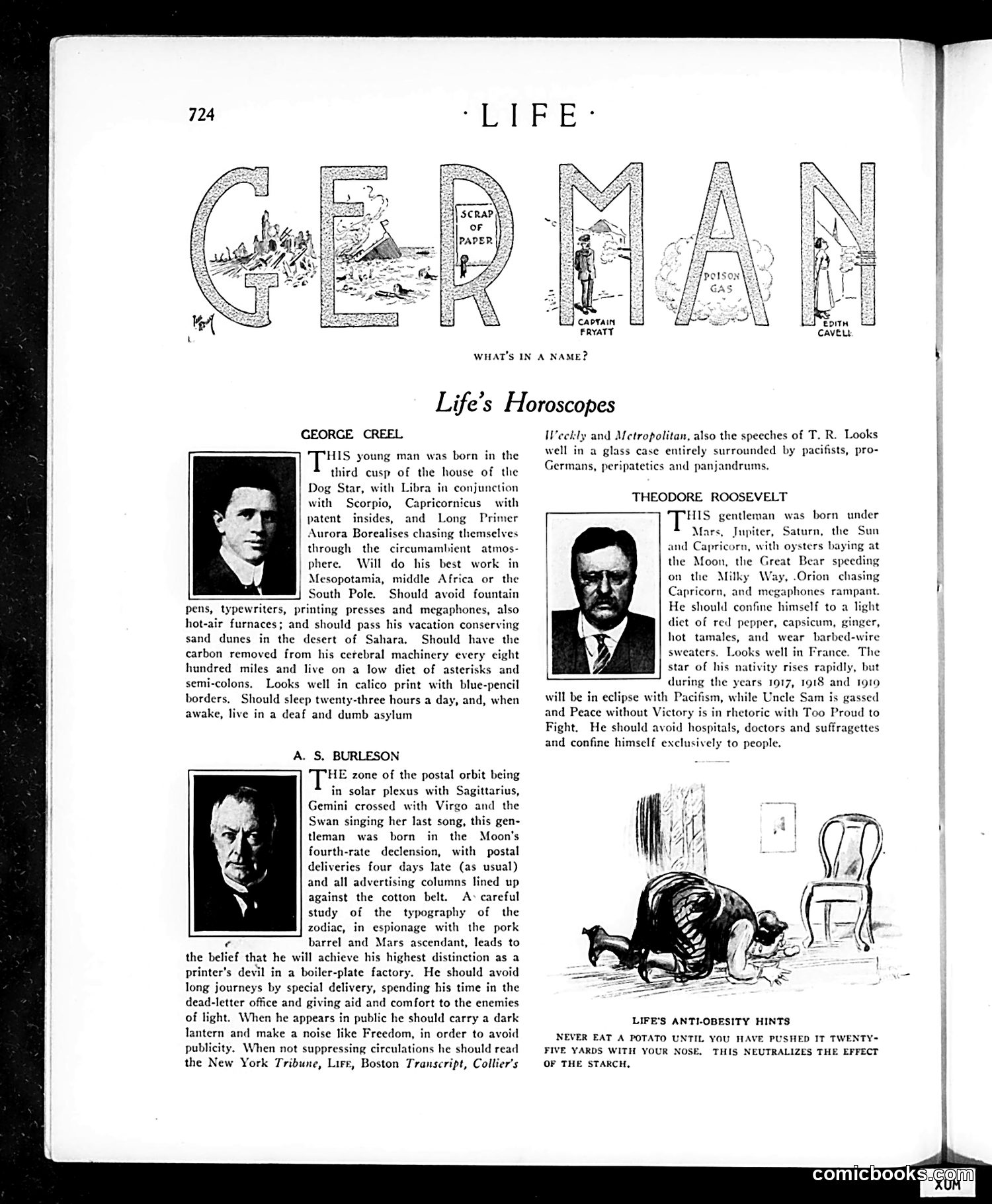
This page presents "Life's Horoscopes"—mock astrological readings of three prominent WWI-era figures, using absurdist humor to criticize them. **George Creel** was President Wilson's propaganda chief. The satire mocks his work by suggesting he should avoid "printing presses and megaphones" and live in remote deserts—ironic given his actual role spreading government messages. **A. S. Burleson** was the Postmaster General, criticized for suppressing anti-war publications and controlling mail. The horoscope jabs at postal delays, "dead-letter offices," and his censorship by sarcastically praising his "distinction as a printer's devil." **Theodore Roosevelt** is skewered for his hawkish stance on WWI. References to him being "in eclipse with Pacifism" while "Uncle Sam is gassed" mock his interventionist position versus Wilson's "Too Proud to Fight" neutrality stance (1916-1917). The absurdist zodiac language amplifies the satire—treating serious political figures as cosmic oddities deserving ridicule. This reflects Life's anti-government-overreach editorial stance during wartime censorship debates.
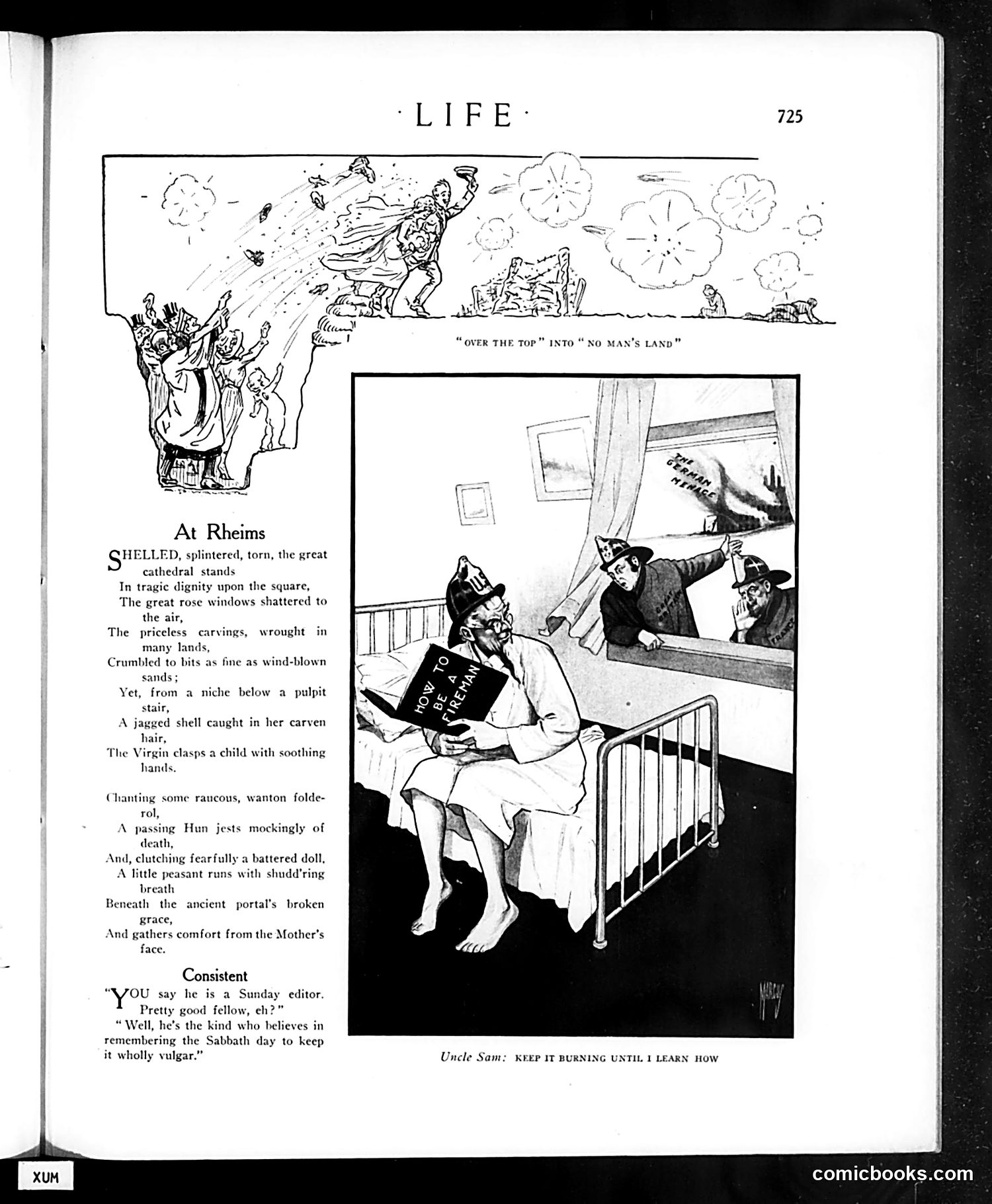
This Life magazine page contains two distinct items: **"At Rheims"** is a WWI-era poem about the bombing of Reims Cathedral in France. It contrasts the cathedral's destruction with a poignant image: a carved Virgin Mary still cradling a child amid the rubble, offering spiritual comfort to a frightened peasant girl clutching a doll. A German soldier ("Hun") mocks nearby. The satire is implicit—the poem juxtaposes German barbarism against Christian mercy and resilience. **"Consistent"** is a brief joke about a Sunday newspaper editor who interprets the Sabbath commandment to keep the day "holy" as meaning to keep it "wholly vulgar"—a pun suggesting the editor publishes sensationalist, crude content on Sundays while claiming moral respectability. **"Uncle Sam"** cartoon shows Uncle Sam in bed, apparently ill, holding a document labeled "KEEP IT BURNING UNTIL I LEARN HOW"—likely referring to maintaining American industrial/military production or war effort, though the specific context is unclear from this page alone.
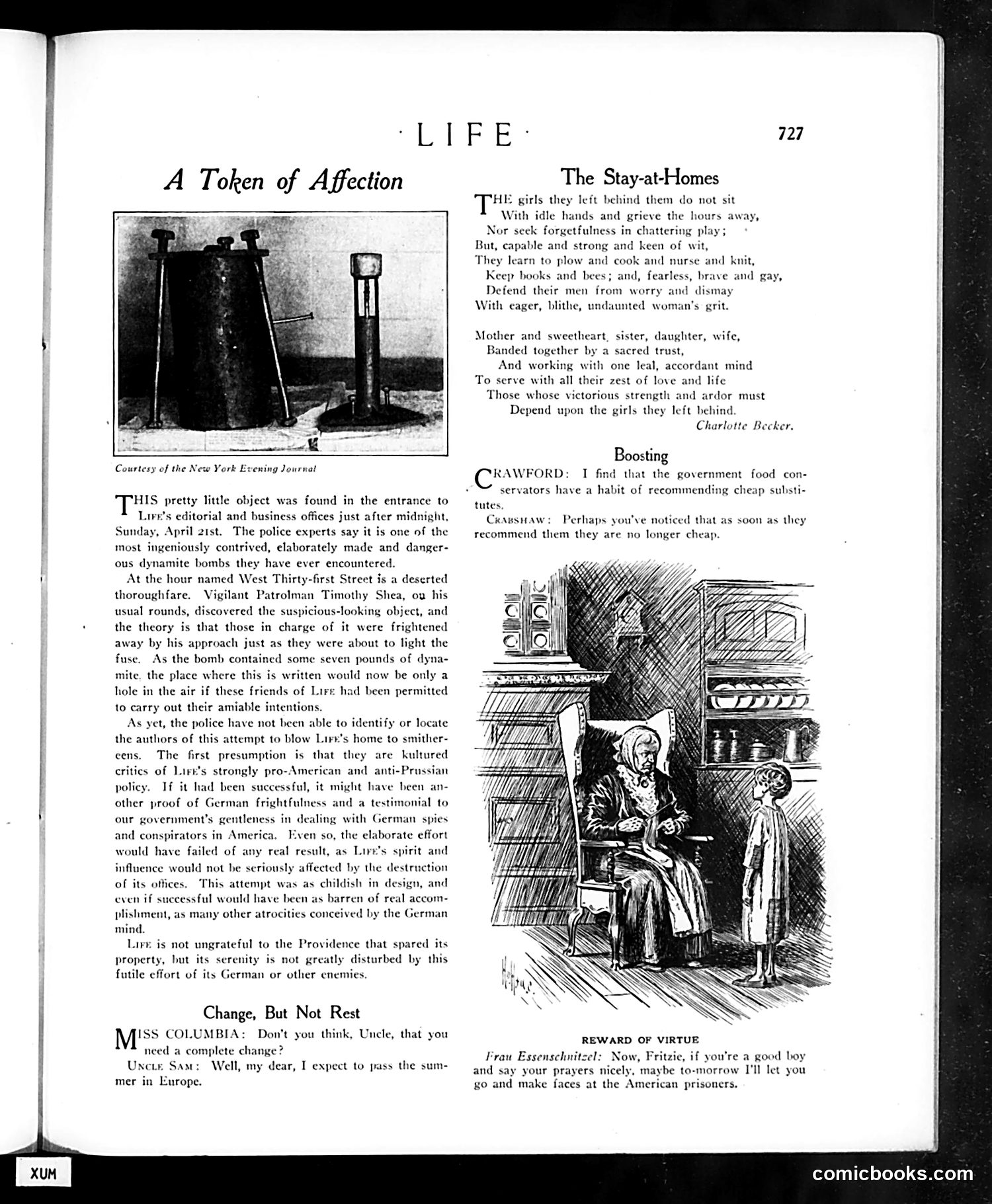
This page contains multiple pieces of anti-German propaganda from what appears to be 1918 (April 21st mentioned). **"A Token of Affection"** describes a dynamite bomb discovered at Life's offices, attributed to German agents or sympathizers. The piece argues that even if successful, it would fail to suppress Life's spirit—portraying the attempt as both dangerous and contemptible. **"The Stay-at-Homes"** is a patriotic poem celebrating American women supporting the war effort through domestic work and morale maintenance. **"Boosting"** is a brief satirical dialogue mocking government food conservators' recommendations—once endorsed, prices rise anyway. **"Reward of Virtue"** is the harshest cartoon: a German mother promises her son he can mock American prisoners if he behaves—depicting Germans as inherently cruel and anti-American, reinforcing wartime prejudices. The page reflects American anxiety about German sabotage on home soil and uses satire to mock both enemy actions and domestic inconsistencies.
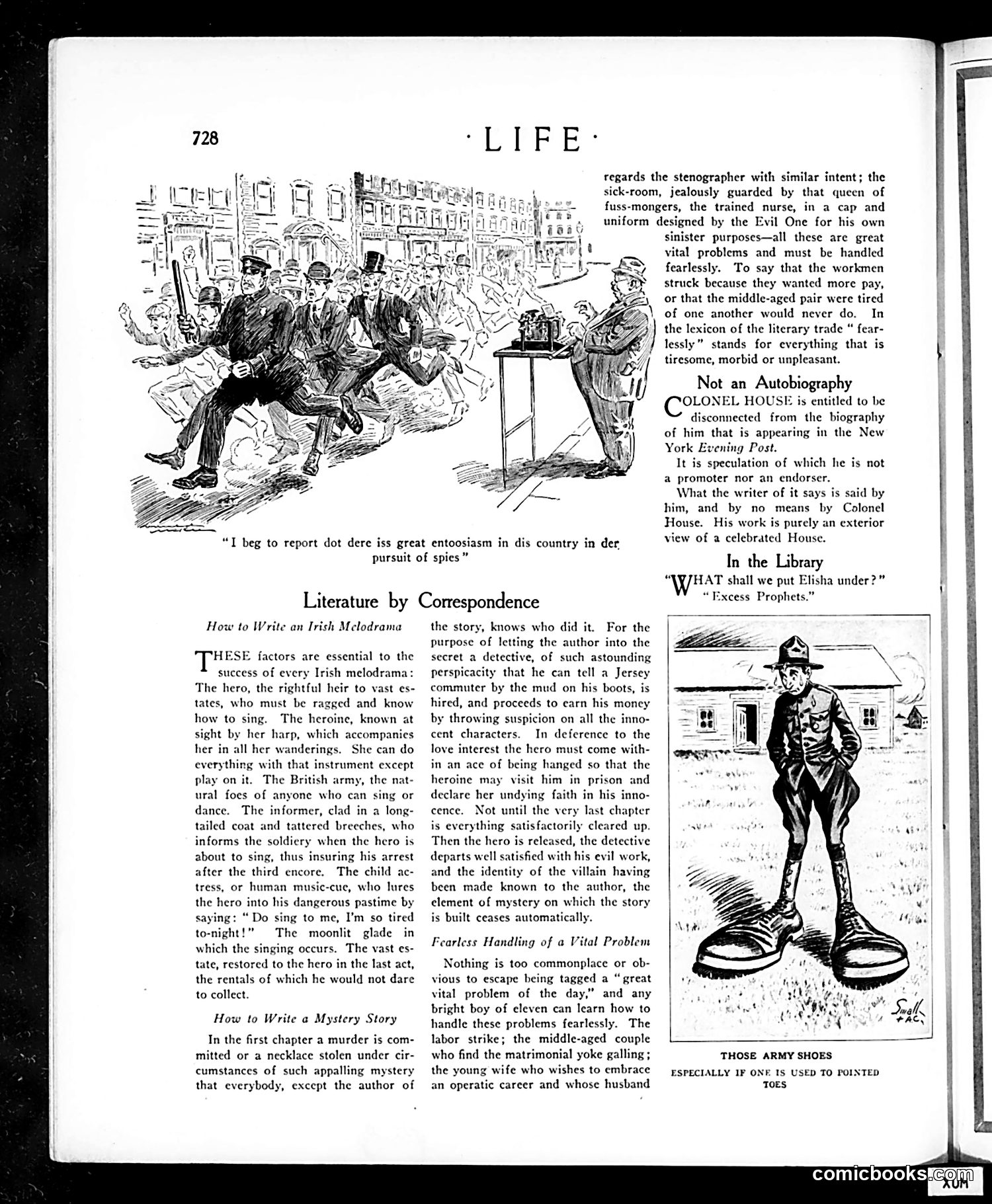
This page contains satirical commentary on popular literary genres and contemporary figures, typical of Life's editorial style. **Main Cartoon (top left):** A figure labeled as pursuing "spies" with exaggerated enthusiasm—likely satirizing post-WWI spy-mania and paranoia about foreign agents in America. The broken English ("dot dere iss") suggests mockery of both the spy-hunter's incompetence and possible German immigrant speech patterns. **Literary Parodies:** Three sections mock melodramatic writing conventions—Irish melodramas (with stock characters like informers and moonlit estates), mystery stories (where readers guess the culprit immediately), and "vital problem" dramas (that treat mundane issues as profound social commentary). The satire targets formulaic, overwrought storytelling. **Colonel House Note:** A brief disclaimer distinguishing Colonel House (Woodrow Wilson's advisor) from his biography appearing in the *New York Evening Post*—suggesting controversy around biographical accuracy. **"Army Shoes" Cartoon:** Mocks military footwear by noting soldiers accustomed to pointed-toe civilian shoes suffer in army-issue boots—gentle satire of military discomfort. The page exemplifies Life's intellectual humor targeting popular culture and literary pretension.
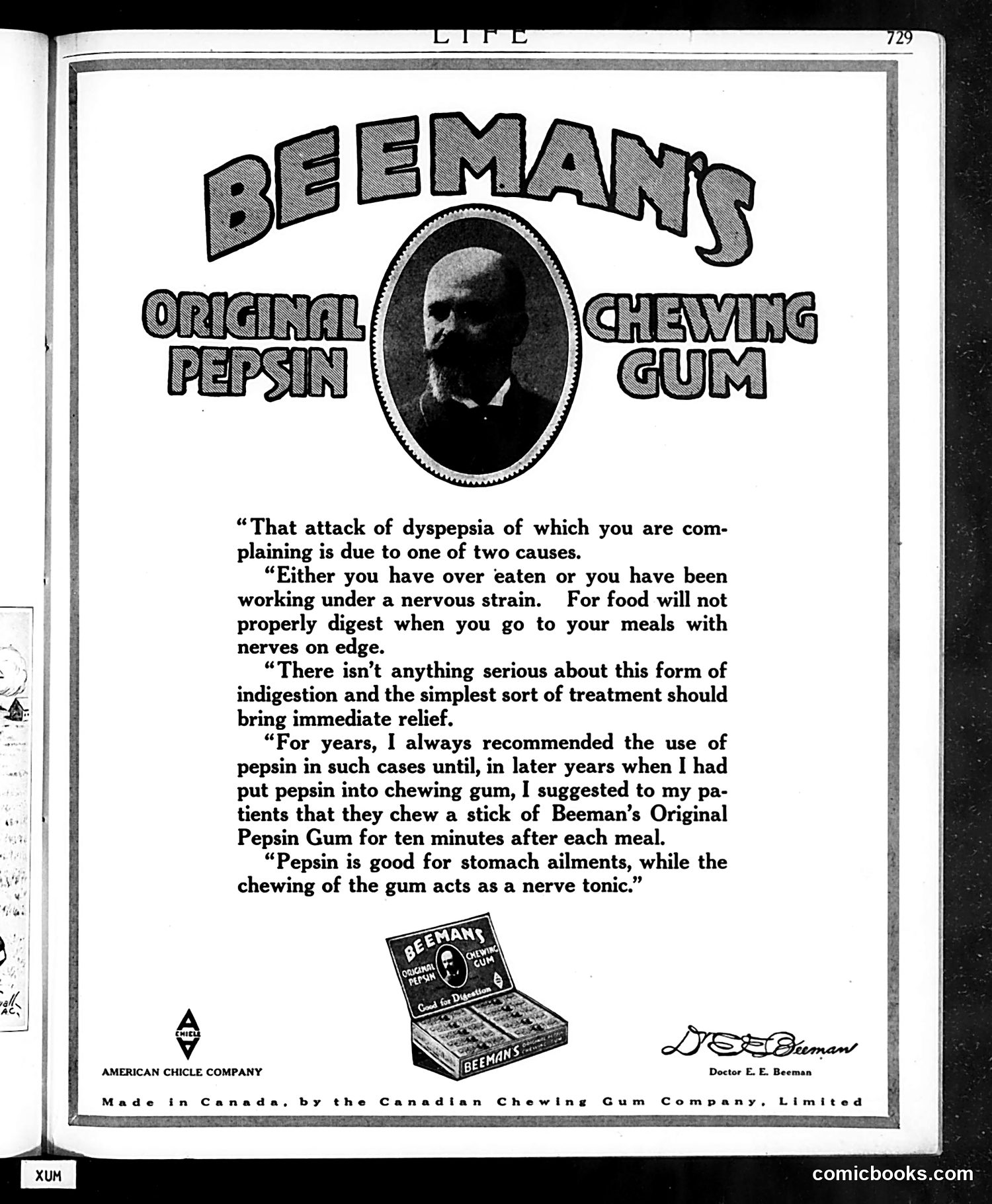
This is not satire or a political cartoon—it's a **pharmaceutical advertisement** disguised as medical advice, typical of early 20th-century marketing. The page features a testimonial from "Doctor E. E. Beeman" (the actual product inventor), who endorses his pepsin chewing gum as a cure for dyspepsia (indigestion). The doctor claims pepsin aids digestion while chewing provides "nerve tonic" benefits—reflecting period anxieties about modern "nervous strain." The pitch conflates two problems: overeating and stress-induced indigestion. By framing pepsin gum as therapeutic rather than merely a candy product, Beeman's exploited contemporary medical authority and consumer trust to market a commercial good as health treatment. For modern readers, this exemplifies how early advertising used doctor endorsements and pseudoscientific claims—practices later restricted by food and drug regulations.
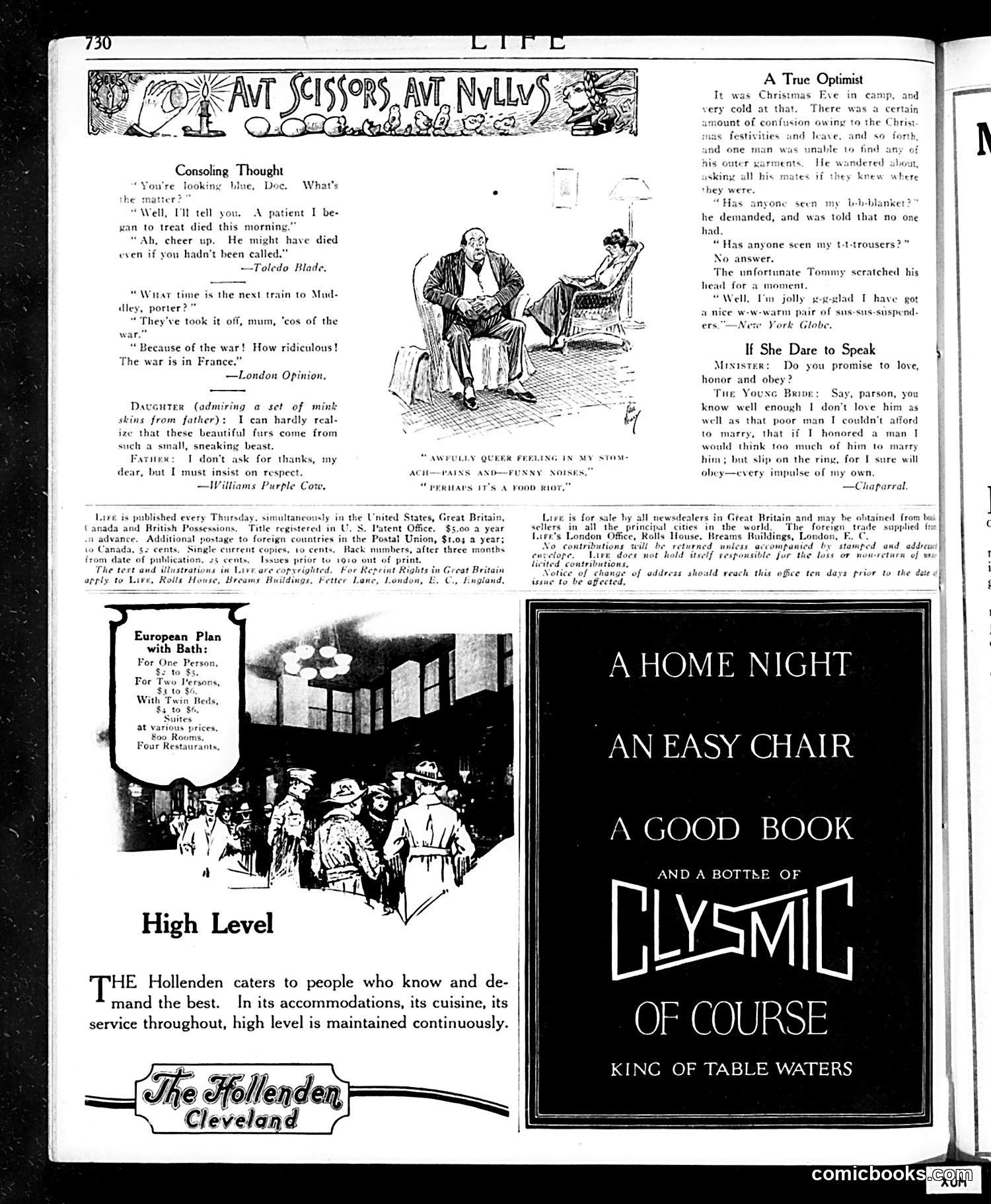
This page from *Life* magazine contains several brief satirical jokes typical of early 20th-century humor, plus advertisements. **The cartoons/jokes** mock: 1. **Doctors during wartime** — A physician is reassured that his patient might have died anyway, satirizing medical incompetence or wartime casualties. 2. **Wartime disruptions** — A porter explains trains are canceled "because of the war" in France, mocking how the war becomes an absurd excuse for everything, even when the conflict is geographically distant. 3. **Christmas deprivation** — A soldier optimistically accepts losing his possessions (blanket, trousers) on Christmas Eve, finding humor in military hardship. 4. **Women and marriage vows** — A bride humorously refuses to promise love or honor but agrees to obey, satirizing traditional gender expectations in marriage. The **advertisements** promote *Clysmic* mineral water and the Hollenden hotel, emphasizing luxury and class distinction ("high level is maintained continuously"). The overall tone reflects WWI-era British and American magazine satire—irreverent about authority, war, and social conventions.
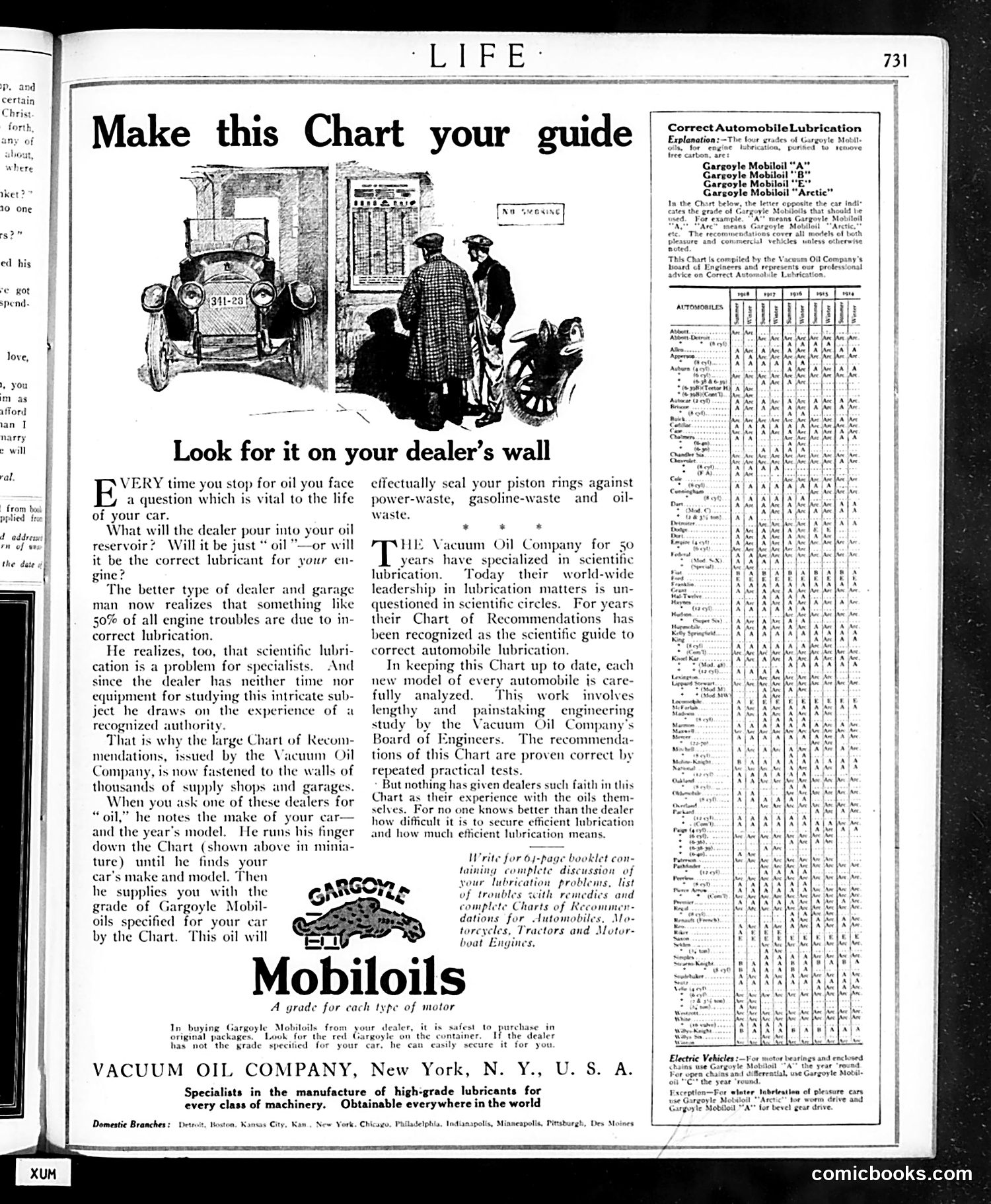
This is primarily **a full-page advertisement for Gargoyle Mobiloils**, not satirical content. The page promotes the Vacuum Oil Company's lubrication chart as a solution to automobile maintenance problems. ## Key Elements: **The Cartoon/Illustration**: Shows a vintage car (front view) and three figures (a dealer and customers) examining a wall chart—depicting the advertisement's central message. **The Pitch**: The ad argues that 50% of engine troubles stem from incorrect lubrication. It positions the Vacuum Oil Company's "Chart of Recommendations" as the scientific solution, endorsed by their Board of Engineers and tested across thousands of dealers nationwide. **Social Context**: This reflects early-to-mid 20th century consumer anxiety about new technology. Cars were still relatively complex and mysterious to owners; dealers couldn't be trusted to use correct lubricants. The chart promises to democratize automotive knowledge. **No Satire**: This is straightforward marketing dressed in the language of scientific authority and expertise—not parody or political commentary. It represents period advertising's appeal to technical credibility and professional standards.
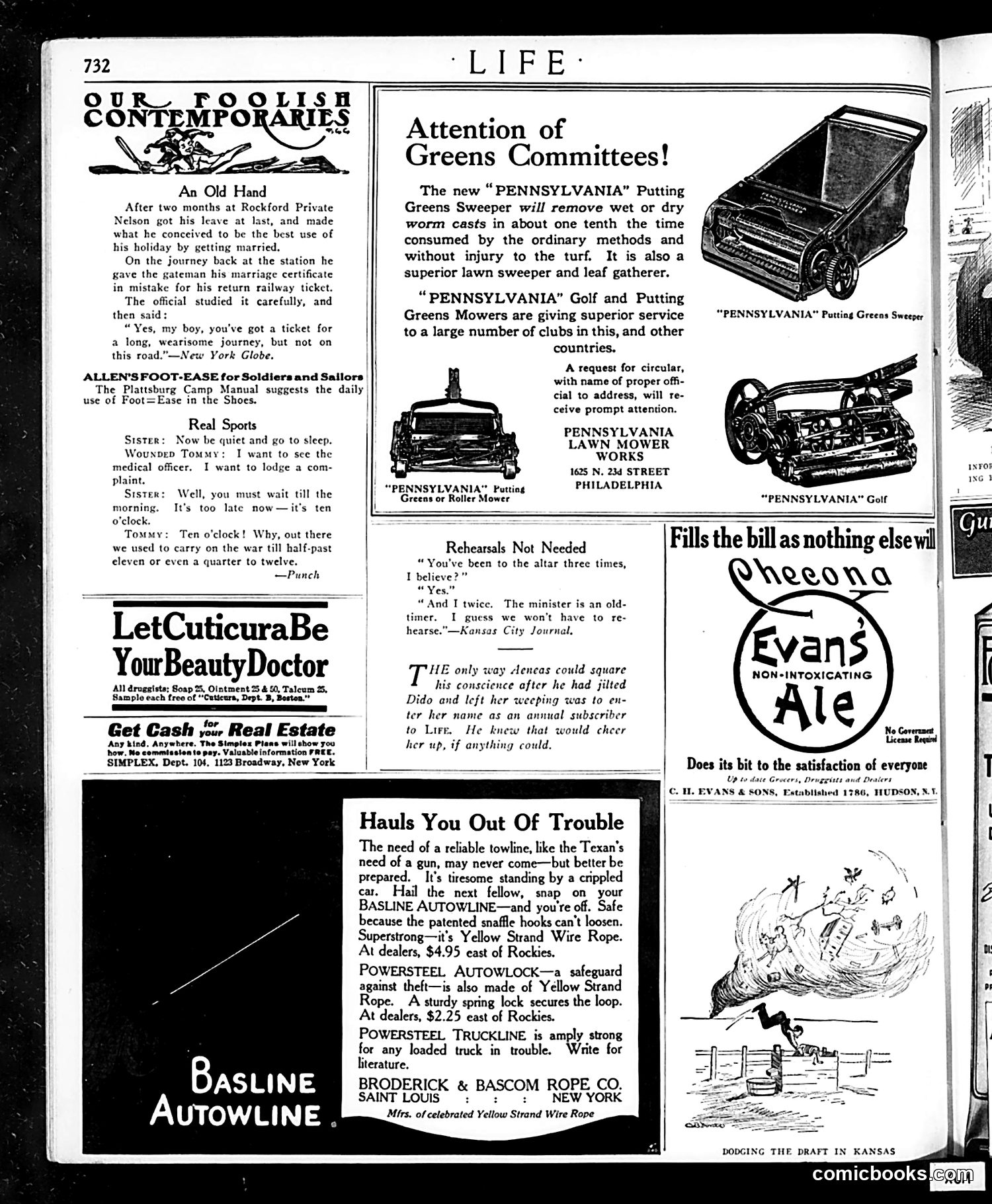
This page from *Life* magazine contains mostly **advertisements and brief humor items**, typical of the era's satirical publications. The main cartoon at bottom ("Dodging the Draft in Kansas") depicts a figure evading military conscription—likely referencing **World War I draft resistance**. The image shows someone avoiding authorities, a topical concern during wartime conscription. The humor sections include: - "An Old Hand": A marriage joke where a soldier mistakes his marriage certificate for a railway ticket - "Real Sports": A brief *Punch* reprint about a wounded soldier complaining that wartime operations occurred later than expected (dark humor about military inefficiency) - "Rehearsals Not Needed": A joke about a man remarrying, implying the minister is experienced enough not to need practice The remaining content is product advertising (lawn equipment, beauty products, rope/towing equipment), which dominated *Life*'s pages. No specific political figures or detailed satire of identifiable events appears here—it's general-interest humor reflecting wartime concerns and everyday topics.
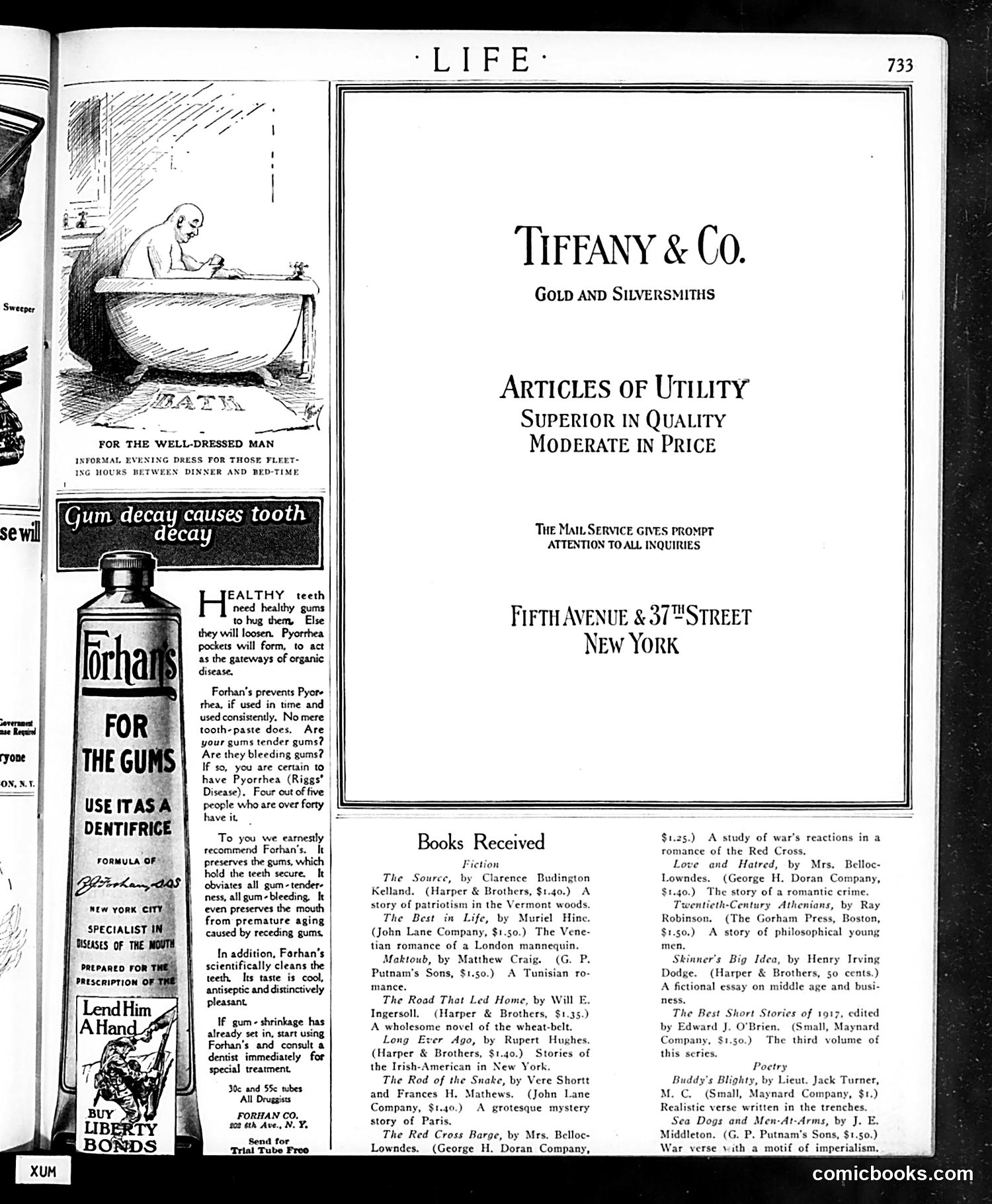
This page is primarily **advertising and book reviews** rather than political satire. The left side features a **Forhan's toothpaste advertisement** warning about gum disease (pyorrhea), with medical claims typical of early-20th-century patent medicine marketing. The small sketch shows a man in a bathtub, illustrating grooming habits for the "well-dressed man." The main content is a **Tiffany & Co. luxury goods advertisement** and a **"Books Received" review section** listing contemporary fiction and poetry, mostly from 1917-1918. Notable is the inclusion of war-related poetry like "Buddy's Blighty" and "Sea Dogs and Men-At-Arms," reflecting America's engagement in World War I. There is **no political cartoon** on this page. It represents typical Life magazine filler: high-end retail advertising, product promotions making dubious health claims, and book notices—standard magazine content of the era.
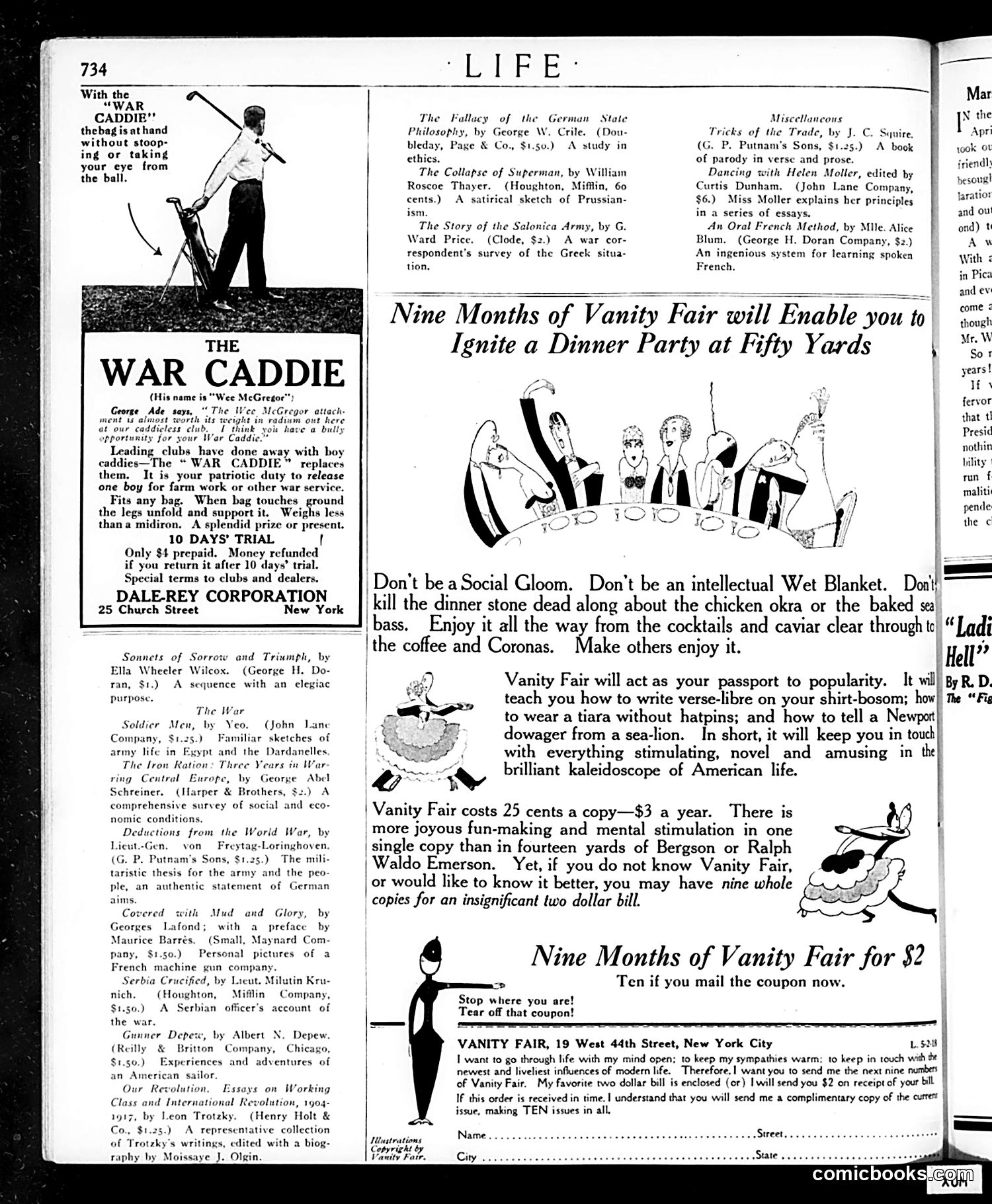
This is a wartime advertisement (likely WWI era, given references to farm work and war service) for a mechanical golf bag stand called the "War Caddie." **The pitch:** The device allows golfers to play without bending down, supposedly releasing young caddies for military or farm work—framing golf equipment as a patriotic duty. The illustration shows a golfer with an upright bag supported by mechanical legs. **The satire/irony:** Life magazine, a humor publication, is running this ad that earnestly appeals to patriotism to sell a convenience item. The juxtaposition of leisure (golf) with wartime sacrifice creates unintentional comedy—suggesting that buying a gadget constitutes patriotic contribution. The $4 price and "10 days' trial" make it a commercial pitch dressed in patriotic language, which Life's satirical audience would recognize as absurd. The rest of the page contains book reviews and a Vanity Fair magazine advertisement.
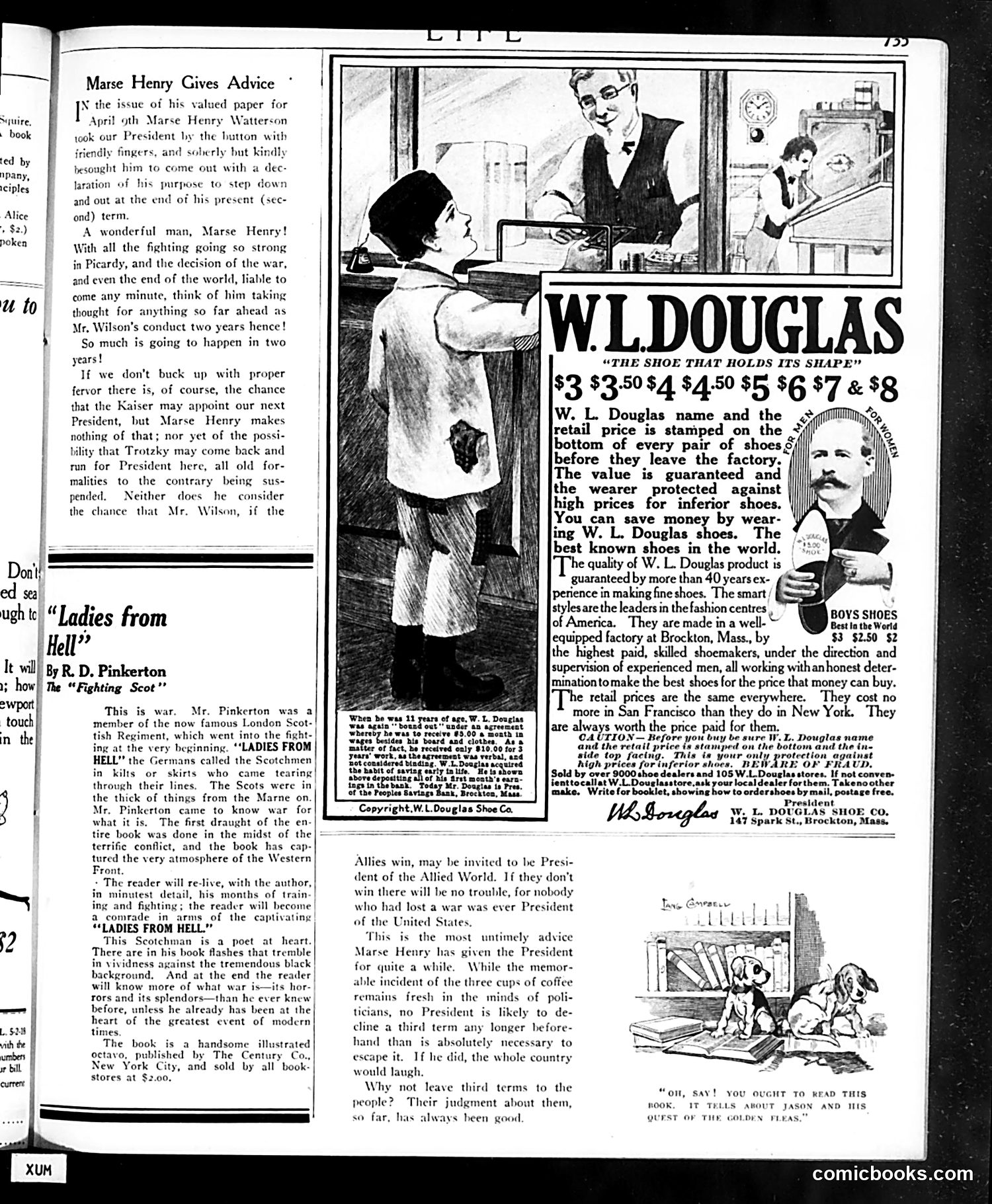
This page combines political satire with shoe advertising. The main editorial piece, "Marse Henry Gives Advice," mocks Henry Watterson (a prominent newspaper editor) for urging President Wilson to announce he won't seek a third term—absurd advice given America's uncertain war situation in 1918. The satire is that Watterson obsesses over distant political succession while immediate wartime crises demand attention. The piece sarcastically suggests Trotsky might run for U.S. President, reflecting anxieties about Bolshevism. A secondary piece reviews "Ladies from Hell," a memoir by R.D. Pinkerton about Scottish regiment soldiers in World War I. "Ladies from Hell" was the Germans' nickname for Scottish troops in kilts, reflecting both their fearsome reputation and the unusual sight of their uniforms. The large W.L. Douglas shoe advertisement emphasizes guaranteed quality and fair pricing—typical early-20th-century consumer messaging about honest manufacturing.
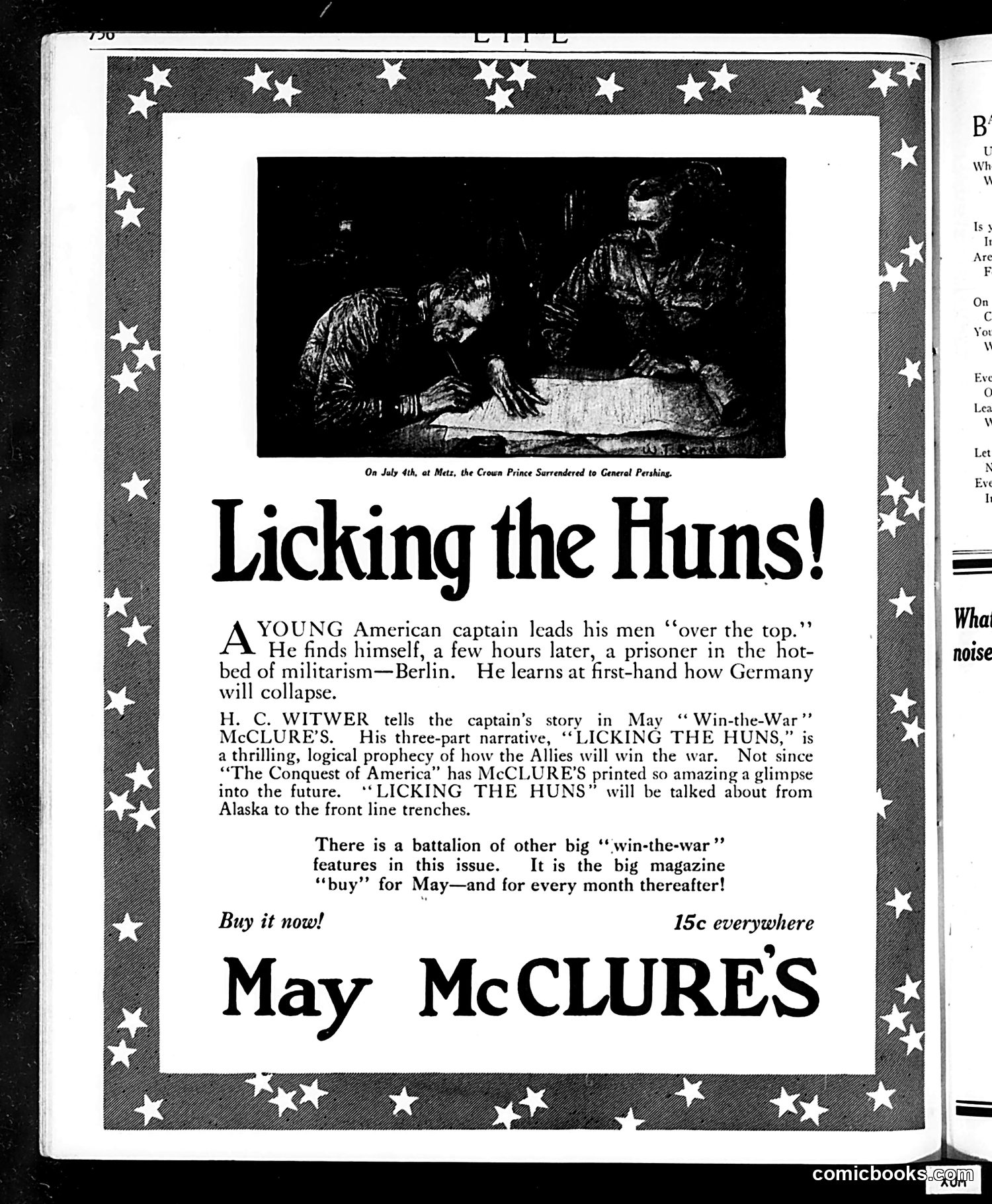
This is a **WWI-era advertisement** for *McClure's Magazine* (May issue), not a political cartoon. It promotes a serialized story called "Licking the Huns" by H.C. Witwer. **Context for modern readers:** The image shows what appears to be a military surrender scene. The caption references July 4th at Metz with the "Crown Prince" surrendering to General Pershing—this is **speculative fiction**, a "prophecy" of Allied victory that hadn't yet occurred when published. "The Huns" was a dehumanizing WWI-era slur for Germans. The story promises American readers a thrilling narrative: a young U.S. captain goes "over the top" (into combat), gets captured in Berlin, and witnesses Germany's imminent collapse from inside enemy territory. **The satire's appeal:** The ad markets patriotic escapism and reassurance about American victory during the ongoing war, positioning the magazine as essential reading ("big 'buy' for May"). The star-bordered frame emphasizes nationalist sentiment. This reflects 1918 American war propaganda and popular entertainment designed to boost morale and magazine sales simultaneously.
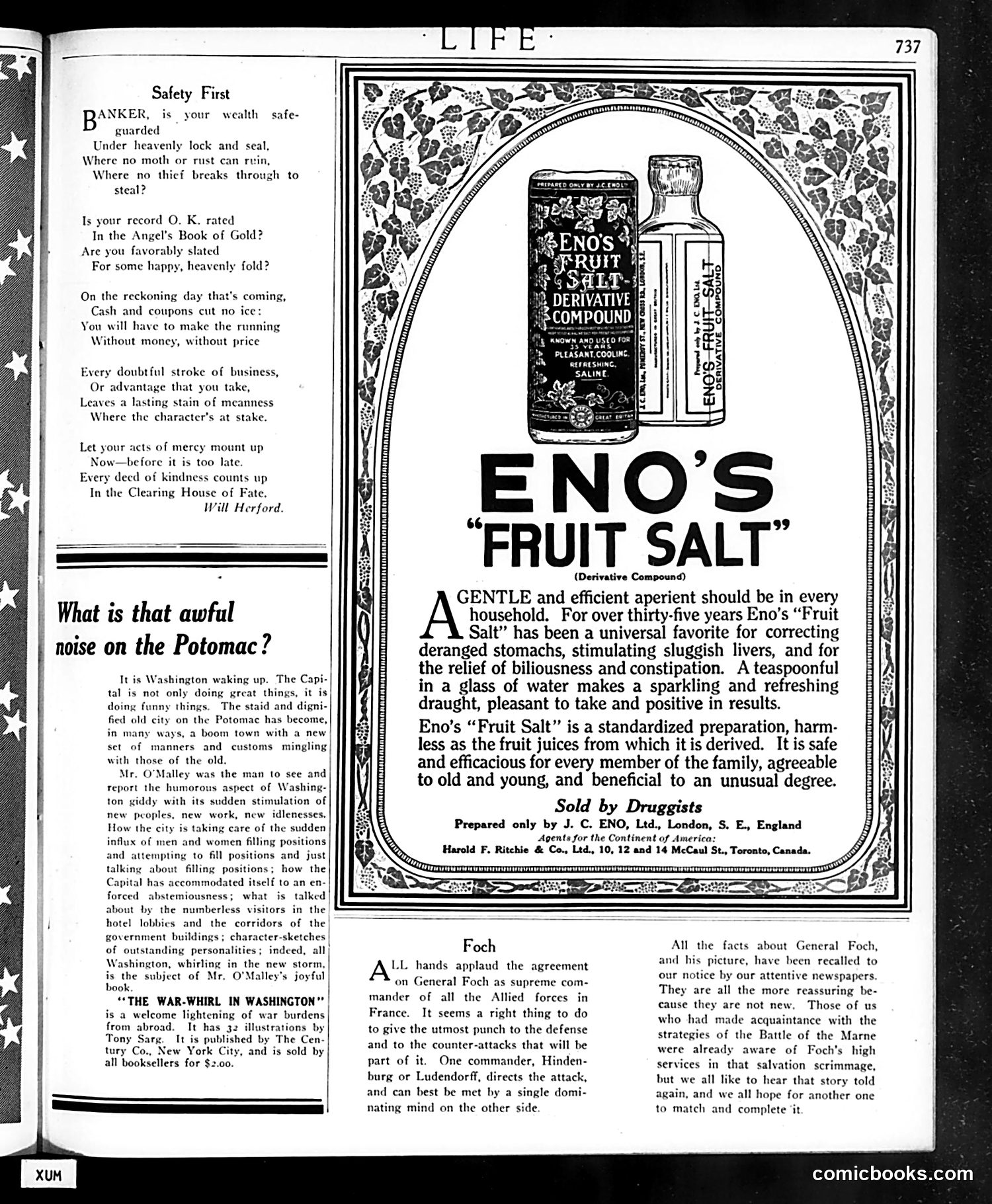
This page mixes editorial content with advertising, reflecting Life's satirical voice during World War I. **The Poetry ("Safety First")** by Will Herford offers moral instruction about character and honesty, suggesting that in the afterlife, ethical conduct matters more than wealth—a pointed critique of materialism. **"What is that awful noise on the Potomac?"** discusses Washington, D.C. becoming a "boom town" due to wartime activity. It promotes O'Malley's book about the city's transformation, satirizing how the capital's traditional dignity has been disrupted by sudden wartime mobilization and the influx of new workers and visitors. **Foch Section** celebrates the appointment of French General Ferdinand Foch as supreme Allied commander in France, treating this as reassuring leadership for the war effort. **The Eno's Fruit Salt Advertisement** is a period product endorsement for a digestive laxative, typical of early 20th-century magazine advertising making broad health claims. The page captures wartime America's mixture of patriotic support, social observation, and commercial messaging.
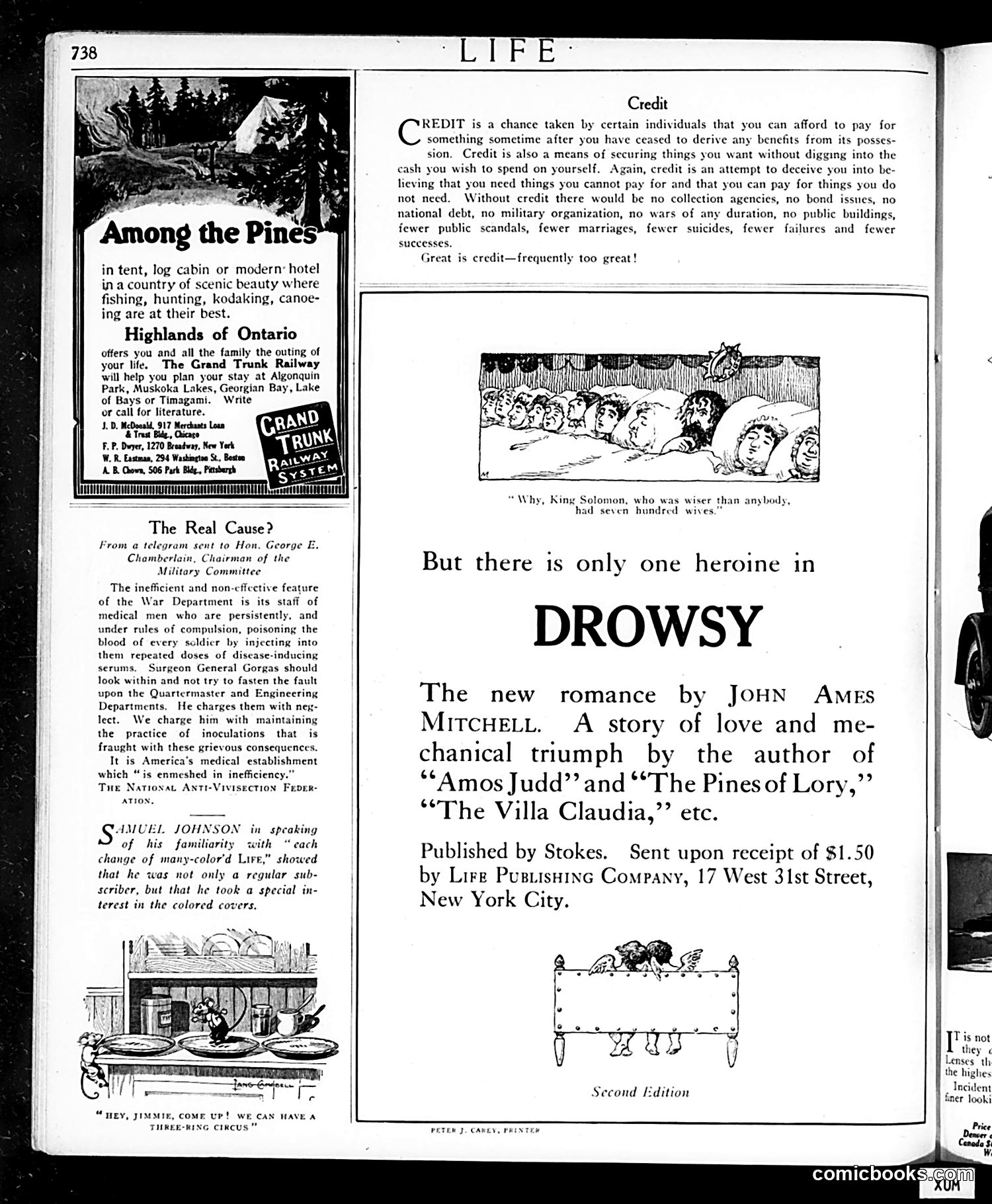
This page contains several distinct pieces: **The Cartoon**: Shows King Solomon surrounded by his wives in bed, commenting on his legendary 700 marriages—a biblical reference suggesting marital excess and its complications. **"The Real Cause?"**: A reprinted telegram criticizing the U.S. War Department's medical practices, specifically attacking Surgeon General Gorgas for requiring soldiers to undergo inoculations. The sender (the National Anti-Vivisection Federation) views mandatory vaccinations as "poisoning" soldiers' blood rather than protecting them. This reflects early 20th-century vaccine skepticism and anti-government medical conspiracy thinking that remained common even during wartime. **The "Credit" Essay**: A satirical definition mocking consumer credit culture, arguing that credit enables poor financial decisions and societal problems (wars, scandals, suicides, national debt). **Advertisement**: For "Drowsy," a new romance novel by John Ames Mitchell. The page reflects Progressive Era anxieties about modern institutions—military medicine, consumer capitalism, and marital relations—presented through satire typical of *Life* magazine's social commentary.
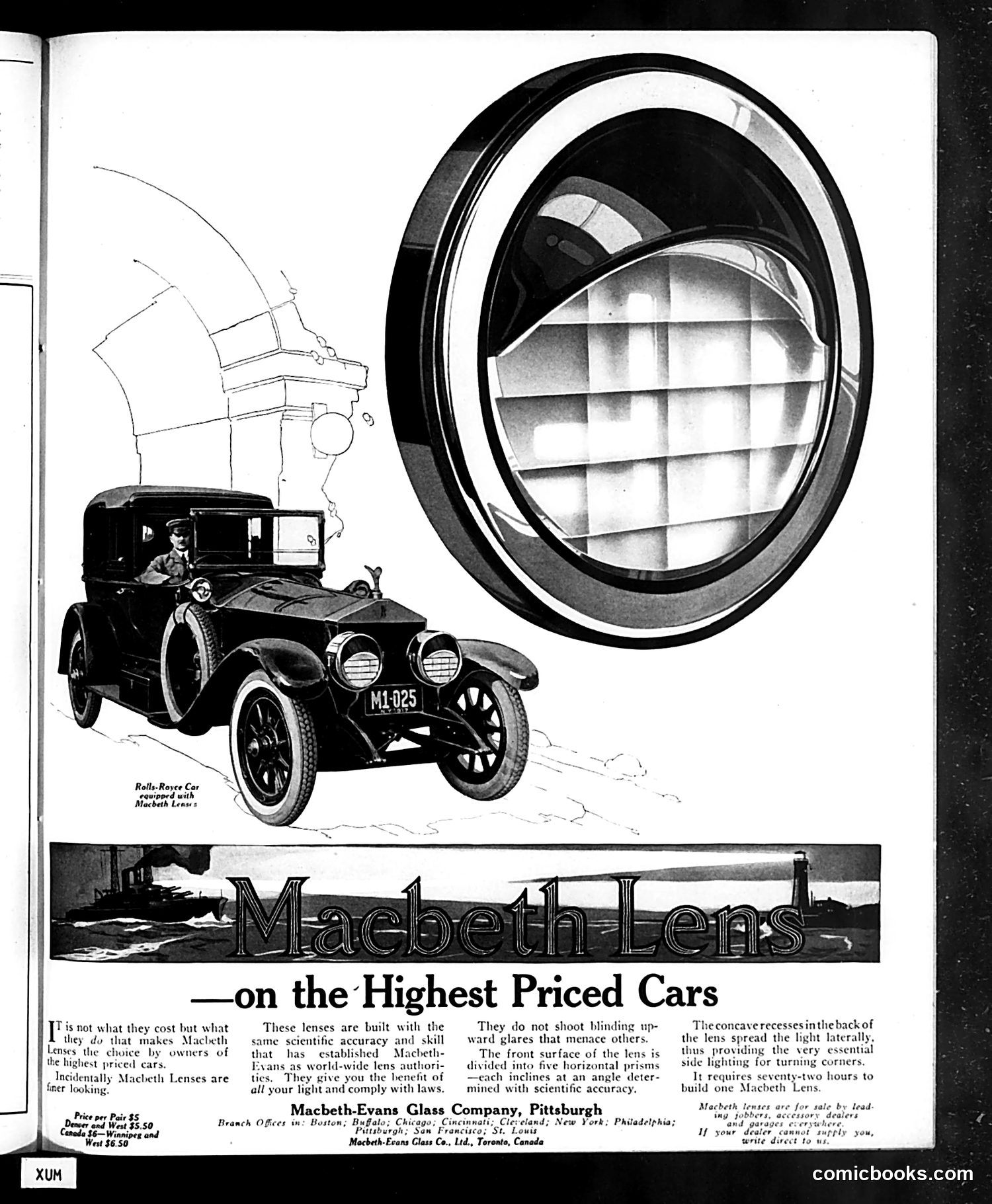
This is not satire or political content—it's a **straightforward advertisement** for automotive headlight lenses by Macbeth-Evans Glass Company, likely from the 1920s. The image shows a Rolls-Royce automobile equipped with a Macbeth lens (the large circular headlight shown enlarged on the right). The ad emphasizes that quality matters more than cost ("it is not what they cost but what they **do**"). The sales pitch highlights technical features: the lens's concave design spreads light laterally without producing blinding glares, and it complies with traffic laws. The ad notes that such lenses are chosen by owners of the highest-priced cars, positioning Macbeth as a premium product for luxury vehicles. This appears in *Life* magazine as a paid advertisement rather than editorial content.
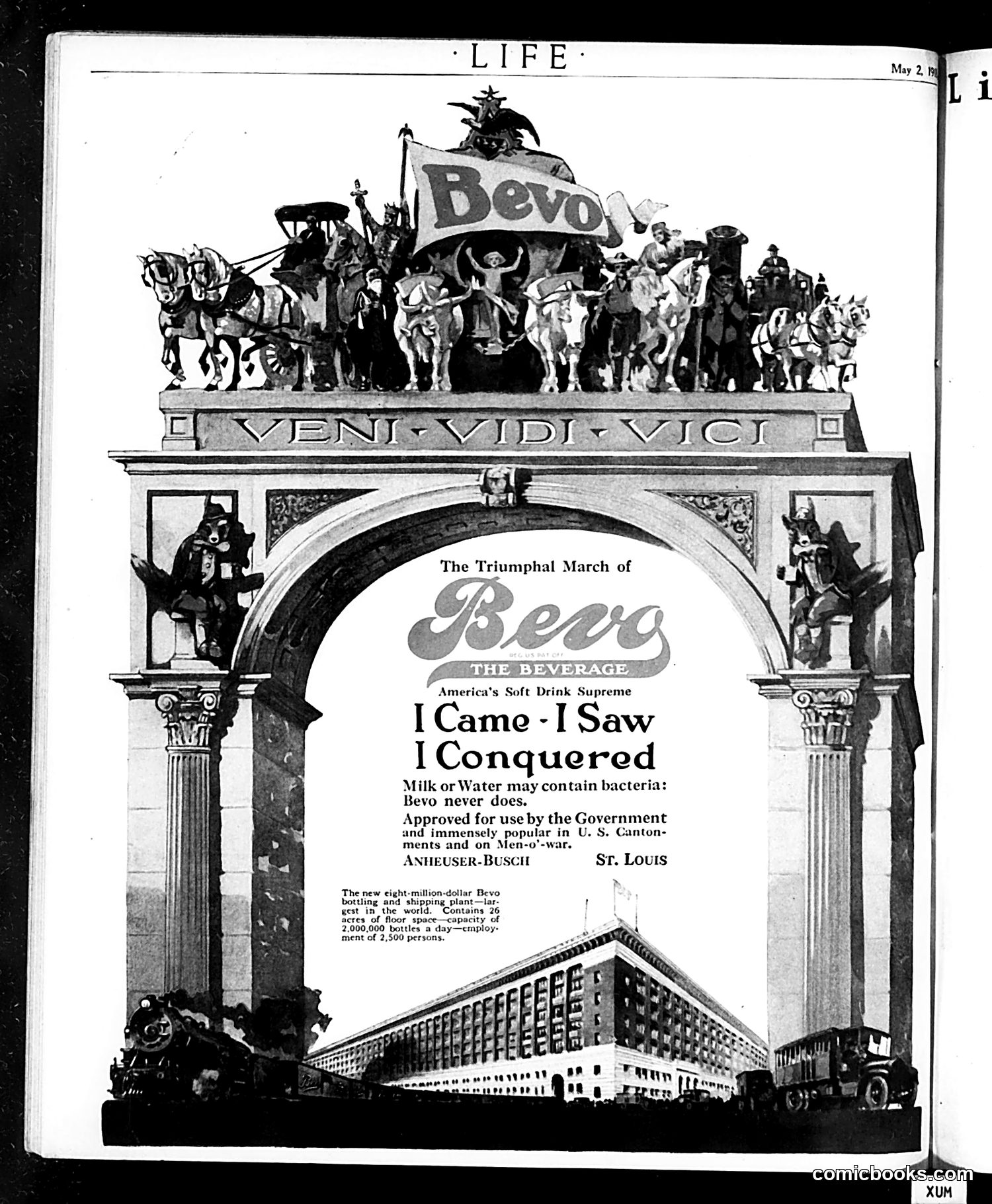
This is primarily an **advertisement**, not satire. It promotes Bevo, a non-alcoholic malt beverage made by Anheuser-Busch during Prohibition era. The ad uses grandiose Roman triumphal imagery—an elaborate arch with "Veni, Vidi, Vici" (Caesar's famous phrase: "I came, I saw, I conquered")—to claim Bevo's dominance in the soft drink market. Key selling points emphasized: - **Safety claim**: Unlike milk or water, Bevo "never" contains bacteria - **Government approval**: Sanctioned for military cantonments and naval use - **Scale/prestige**: Boasts of an 8-million-dollar plant, 26 acres, producing 2 million bottles daily The Roman triumph aesthetic inflates a beverage into a conquering force, reflecting early-20th-century marketing's grandiosity. The military endorsement was likely crucial during WWI, when troops needed safe drinking options. This represents straightforward commercial promotion rather than political commentary.