
Life, 1918-05-02 · page 10 of 40
Life — May 2, 1918 — page 10: what you’re looking at
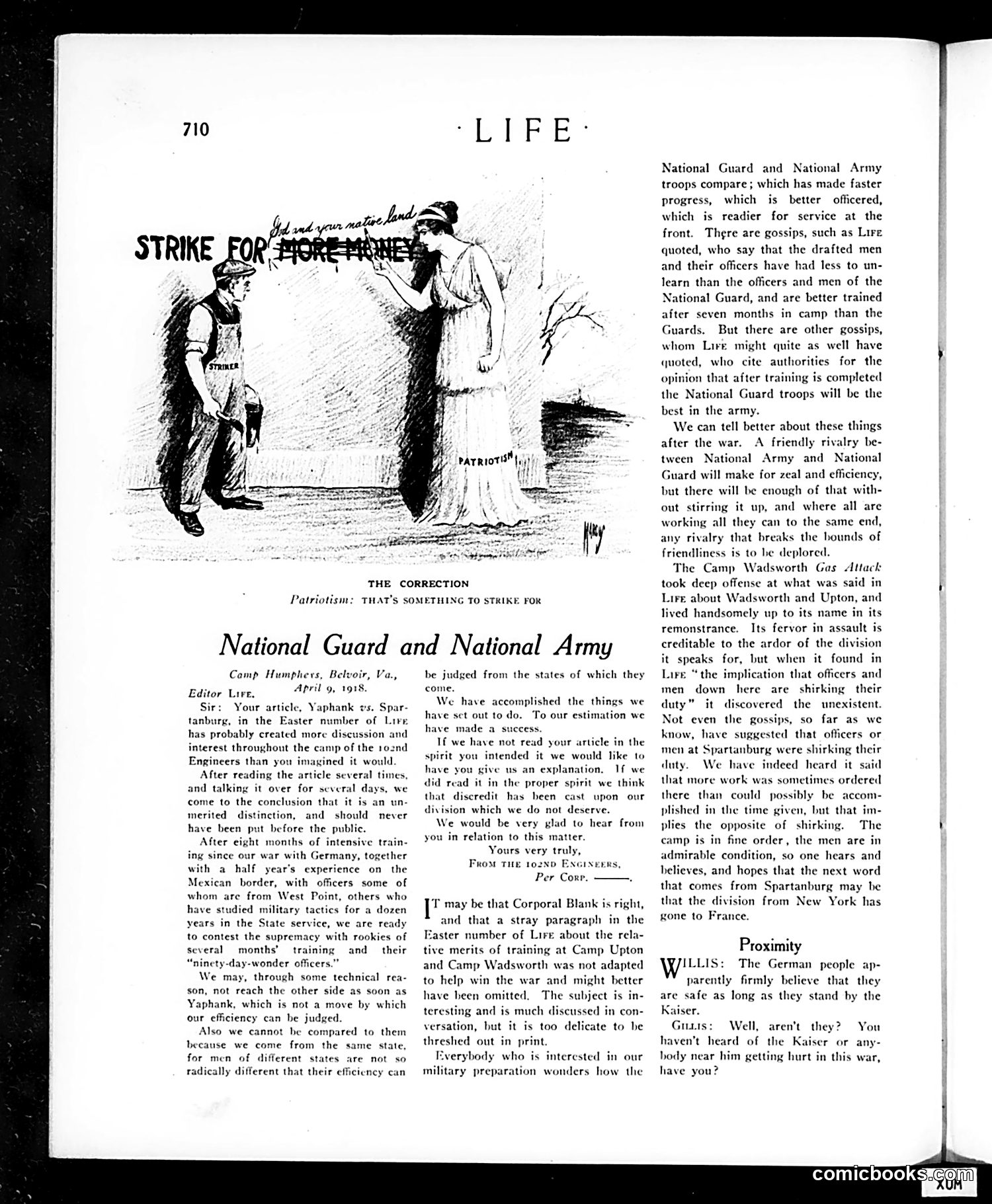
What you’re looking at
This cartoon critiques a *Life* magazine article by Meredith Nicholson about National Guard versus National Army training. The image shows "Patriotism" (a classical female figure) striking a striker labeled "Strike for Higher Pay" with a rod, while saying "that's SOMETHING to strike for." The satire targets labor unrest during military mobilization: the cartoon suggests that striking for higher wages during wartime is unpatriotic, positioning patriotic duty as opposed to workers' economic demands. The classical "Patriotism" figure represents idealized national values being weaponized against labor organizing. The accompanying letter defends National Guard training quality against claims of inferiority, suggesting contemporary debate over military preparedness and unit effectiveness during America's World War I involvement.
📄 Transcribed text from this page (OCR, searchable)
Machine-transcribed from the original scan — historical spelling and the odd misread are preserved.
Parrot}, i (nt THE CORRECTION Patriotism: THAT'S SOMETHING TO STRIKE FOR National Guard and National Army Camp Humphers, Belvoir, Va., Editor Live. April: 9,:1918. Sir: Your article, Yaphank vs. Spar- tanburg, in the Easter number of Lire has probably created more discussion and interest throughout the camp of the roznd Engineers t ined it would After reading the article several times, and talking it over for several day come to the conclusion that it is an un- merited distinction, and should never have been put before the public. After eight months of intensive train- ing since our war with Germany, together with a half year's experience on the Mexican border, with officers some of whom are from West Point, others who have studied military tactics for a dozen years in the State service, we are ready to contest the supremacy with rookies of several months’ training and their “nincty-day-wonder officers.” We may, through some technical rea- son, not reach the other side as soon as Yaphank, which is not a move by which our efficiency can be judged Also we cannot be compared to them because we come from the same state, for men of different states are not so you im we radically different that their efficiency can be judged from the states of which they come. We have accomplished the things we have set out to do. To our estimation we have made a success If we have not read your article in the spirit you intended it we would like to have you give us an explanation, If we did read it in the proper spirit we think that discredit has been cast upon our division which we do not deserve. We would be very glad to hear from you in relation to this matter. Yours very truly, From THE 102ND INEERS, Per Corr. T may be that Corporal Blank is right, and that a stray paragraph in the Easter number of Lire about the rela- tive merits of training at Camp Upton and Camp Wadsworth was not adapted to help win the war and might better have heen omitted. The subject is in- teresting and is much discussed in con- versation, but it is too delicate to be threshed out in print Everybody who is interested in our military preparation wonders how the National Guard and National Army troops compare; which has made faster progress, which is better officered, which readier for service at the front. There are gossips, such as Lire quoted, who say that the drafted men and their officers have had less to un- learn than the officers and men of the tional Guard, and are better trained after seven months in camp than the Guards. But there are other gossips, whom Lire might quite as well have quoted, who cite authorities for the opinion that after training is completed the National Guard troops will be the best in the army. We can tell better about these things after the war. A friendly rivalry be- tween National Army and National Guard will make for zeal and efficiency, but there will be enough of that with- out stirring it up, and where all are working all they can to the same end, any rivalry that breaks the bounds of friendliness is to he deplored. The Camp Wadsworth Gas Attack took deep offense at what was said in Lire about Wadsworth and Upton, and lived handsomely up to its name in its remonstrance. Its fervor in assault is creditable to the ardor of the division it speaks for, but when it found in Lire “the implication that officers and men down here are shirking their duty” it discovered the unexistent. Not even the gossips, so far as we know, have suggested that officers or men at Spartanburg were shirking their duty. We have indeed heard it said that more work was sometimes ordered there than could possibly be accom- plished in the time given, but that im- plies the opposite of shirking. The camp is in fine order, the men are in admirable condition, so one hears and helieves, and hopes that the next word that comes from Spartanburg may be that the division from New York has gone to France. Proximity ILLIS: The German people ap- parently firmly believe that they are safe as long as they stand by the Kaiser. Gusis: Well, aren't they You haven't heard of the Kaiser or any- body near him getting hurt in this war, have you? comicbook