
Life, 1918-05-02 · page 28 of 40
Life — May 2, 1918 — page 28: what you’re looking at
What you’re looking at
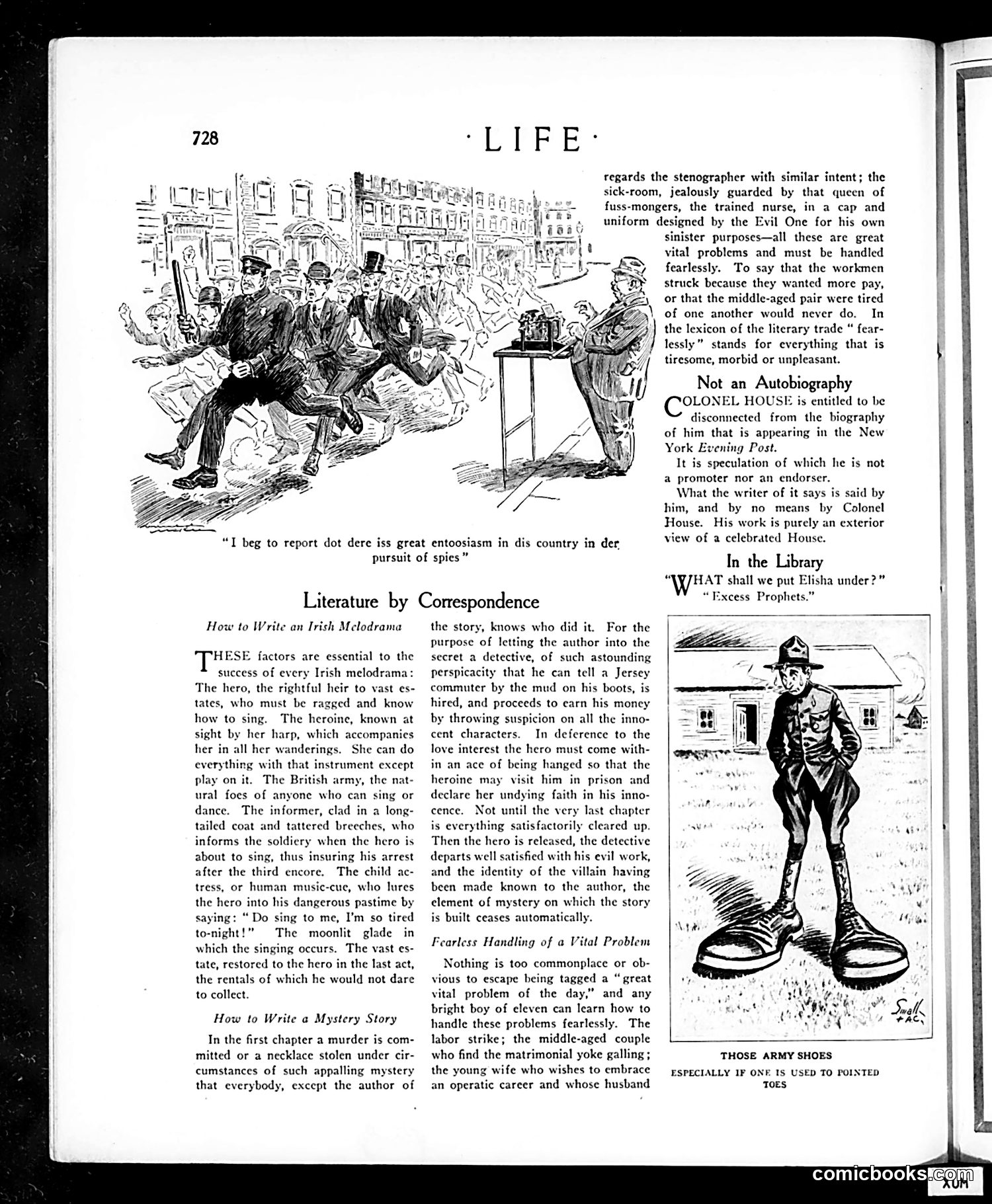
This page contains satirical commentary on popular literary genres and contemporary figures, typical of Life's editorial style. **Main Cartoon (top left):** A figure labeled as pursuing "spies" with exaggerated enthusiasm—likely satirizing post-WWI spy-mania and paranoia about foreign agents in America. The broken English ("dot dere iss") suggests mockery of both the spy-hunter's incompetence and possible German immigrant speech patterns. **Literary Parodies:** Three sections mock melodramatic writing conventions—Irish melodramas (with stock characters like informers and moonlit estates), mystery stories (where readers guess the culprit immediately), and "vital problem" dramas (that treat mundane issues as profound social commentary). The satire targets formulaic, overwrought storytelling. **Colonel House Note:** A brief disclaimer distinguishing Colonel House (Woodrow Wilson's advisor) from his biography appearing in the *New York Evening Post*—suggesting controversy around biographical accuracy. **"Army Shoes" Cartoon:** Mocks military footwear by noting soldiers accustomed to pointed-toe civilian shoes suffer in army-issue boots—gentle satire of military discomfort. The page exemplifies Life's intellectual humor targeting popular culture and literary pretension.
📄 Transcribed text from this page (OCR, searchable)
Machine-transcribed from the original scan — historical spelling and the odd misread are preserved.
regards the stenographer with similar intent; the sick-room, jealously guarded by that queen of fuss-mongers, the trained nurse, in a cap and uniform designed by the “TI beg to report dot dere iss great entoosiasm in dis country in der pursuit of spies” Literature by Correspondence How to Write an Irish Melodrama Te SSE factors are essential to the success of every Irish melodram: The hero, the rightful heir to vast es- tates, who must be ragged and know how to sing. The heroine, known at sight by her harp, which accompanies her in all her wanderings. She can do everything with that instrument except play on it. The British army, the nat- ural foes of anyone who can sing or dance. The informer, clad in a long- tailed coat and tattered breeches, who informs the soldiery when the hero is about to sing, thus insuring his arrest after the third encore. The child ac- tress, or human music-cuc, who lures the hero into his dangerous pastime by saying: “Do sing to me, I’m so tired to-night!” The moonlit glade in which the singing occurs. The vast es- tate, restored to the hero in the last act, the rentals of which he would not dare to collect. How to Write a Mystery Story In the first chapter a murder is com- mitted or a necklace stolen under cir- cumstances of such appalling mystery that everybody, except the author of the story, knows who did it. For the purpose of letting the author into the secret a detective, of such astounding perspicacity that he can tell a Jersey commuter by the mud on his boots, is hired, and proceeds to earn his money by throwing suspicion on all the inno- cent characters. In deference to the love interest the hero must come with- in an ace of being hanged so that the heroine may visit him in prison and declare her undying faith in his inno- cence. Not until the very last chapter is everything satisfactorily cleared up. Then the hero is released, the detective departs well satisfied with his evil work, and the identity of the villain having been made known to the author, the element of mystery on which the story is built ceases automatically. Fearless Handling of a Vital Problem Nothing is too commonplace or ob- vious to escape being tagged a “great vital problem of the day,” and any bright boy of eleven can learn how to handle these problems fearlessly. The labor strike; the middle-aged couple who find the matrimonial yoke galling ; the young wife who wishes to embrace an operatic career and whose husband il One for his own sinister purposes—all these are great vital problems and must be handled fearlessly. To say that the workmen struck because they wanted more pay, or that the middle-aged pair were tired of one another would never do. In the lexicon of the literary trade “ fear- lessly” stands for everything that is tiresome, morbid or unpleasant. Not an Autobiography OLONEL HOUSE is entitled to be disconnected from the biography of him that is appearing in the New York Evening Post. It is speculation of which he is not a promoter nor an endorser. What the writer of it says is said by him, and by no means by Colonel House. His work is purely an exterior view of a celebrated House. In the Library “WHat shall we put Elisha under?” “Excess Prophets.” THOSE ARMY SHOES ESPECIALLY IF ONE IS USED TO POINTED TOES comicbooksieemiy