
Life, 1918-05-02 · page 22 of 40
Life — May 2, 1918 — page 22: what you’re looking at
What you’re looking at
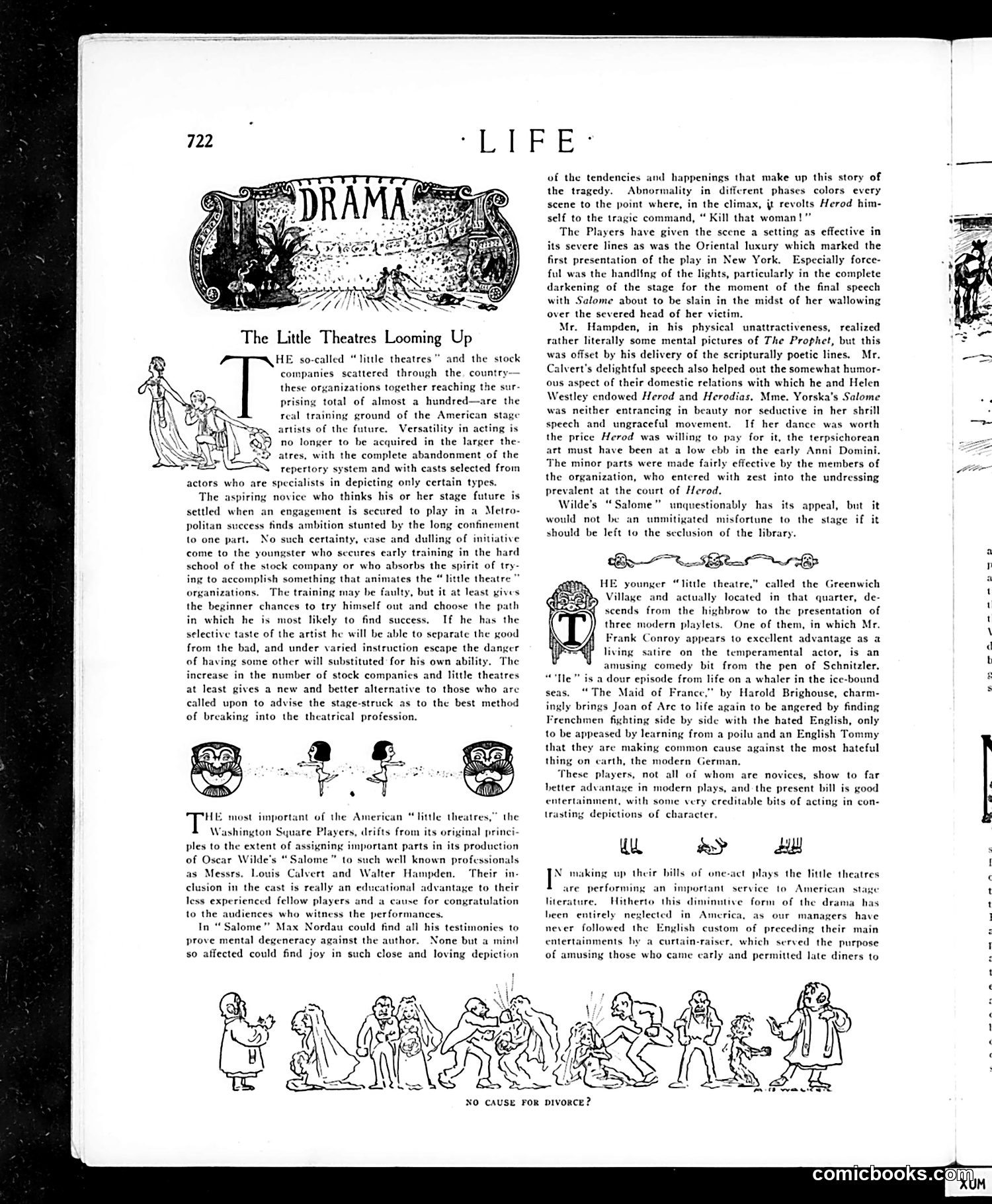
This page discusses the emerging "little theatre" movement in early 20th-century American drama—small, independent theater companies offering an alternative to Broadway's commercial stock system. **Main Points:** The article argues these ~100 little theatres serve as valuable training grounds where young actors develop versatility through repertory work, rather than typecast roles in commercial productions. **Specific Reference:** The text critiques the Washington Square Players' production of Oscar Wilde's "Salome," noting that while it featured established professionals (Louis Calvert and Walter Hampden), the play itself depicts moral degeneracy. The reviewer invokes Max Nordau's theory of artistic degeneracy to explain the play's disturbing content, while acknowledging the production's technical merit. **The Bottom Cartoon:** The illustration titled "NO CAUSE FOR DIVORCE?" shows a chaotic domestic scene—unclear what specific satirical point this makes without additional context. The piece represents contemporary debate about theatrical legitimacy and the tension between commercial entertainment and artistic training.
📄 Transcribed text from this page (OCR, searchable)
Machine-transcribed from the original scan — historical spelling and the odd misread are preserved.
722 ‘“LIFE-: See ooaIN The Little Theatres Looming Up HE so-called “little theatres” and the stock companies scattered through the. country— these organizations together reaching the sur- prising total of almost a hundred—are the real training ground of the American stage artists of the future. Versatility in acting is no longer to be acquired in the larger the atres, with the complete abandonment of the repertory system and with casts selected from actors who are specialists in depicting only certain types. c who thinks his or her stage future is Metro- The aspiring nov settled when an engagement is secured to play in politan success finds ambition stunted by the long confinement art. No such certainty, case and dulling of initiative come to the youngster who sccures early training in the hard school of the stock company or who absorbs the spirit of try- ing to accomplish something tha nimates the “little theatre ” organizations, The training m faulty, but it at the beginner chances to try himself out and choose the path in which he is most likely to find success, If he has the selective taste of the artist he will be able to separate the good from the bad, and under varied instruction escape the danger of having some other will substituted for his own ability. The increase in the number of stock companies and little theatres at least gives a new and better alternative to those who are called upon to advise the stage-struck as to the best method of breaking into the theatrical profession. to one ay be least yives res,” the HE most important of the American “little the: Washington Square Players, drifts from its original prin ples to the extent of assigning important parts in its produc! of Oscar Wilde's “Salome” to such well known professionals as Messrs. Louis Calvert and Walter Hampde: Their in- clusion in the cast is really onal advantage to their less experienced fellow players and a cause for congratulation ion to the audiences who witness the performances. In “Salome” Max Nordatt could find all hi prove mental degeneracy against the author. None but a mind so affected could find joy in such close and loving depiction testimonies to of the tendencies and happenings that make up this story of the tragedy. Abnormality in different phases colors every scene to the point where, in the climax, jt revolts Herod him- self to the tragic command, “ Kill that woman!" The Players have given the scene a setting as effective in its severe lines as was the Oriental luxury which marked the first presentation of the play in New York. Especially force- ful was the handling of the lights, particularly in the complete darkening of the stage for the moment of the final speech with Salome about to be slain in the midst of her wallowing over the severed head of her victim. Mr. Hampden, in his physical unattractiveness, realized rather literally some mental pictures of The Prophet, but this was offset by his delivery of the scripturally poetic lines. Mr. Calvert's delightful speech also helped out the somewhat humor- ous aspect of their domestic relations with which he and Helen Westley endowed Herod and Herodias, Mme. Yorska’s Salome was neither entrancing in beauty nor seductive in her shrill speech and ungraceful movement. If her dance was worth the price Herod was willing to pay for it, the terpsichorean art must have been at a low ebb in the early Anni Domini. The minor parts were made fairly effective by the members of the organization, who entered with zest into the undressing prevalent at the court of Herod. Wilde's “Salome” unquestionably has its appeal, but it would not be an unmitigated misfortune to the stage if it should be left to the seclusion of the library. ee HE younger “little theatre,” called the Greenwich Village and actually located in that quarter, de- scends from the highbrow to the presentation of three modern playlets. One of them, in which Mr. Frank Conroy appears to exccllent advantage as a living satire on the temperamental actor, is an amusing comedy bit from the pen of Schnitzler. “He” is a dour episode from life on a whaler in the ice-bound seas. “The Maid of France,” by Harold Brighouse, charm- ingly brings Joan of Arc to life again to be angered by finding Frenchmen fighting side by side with the hated English, only to be appeased by learning from a poilu and an English Tommy that they are making common cause against the most hateful thing on earth, the modern German, These players, not all of whom are novices, show to far better advantaye in modern plays, and the present bill is good entertainment, with some very creditable bits of acting in con- trasting depictions of character. cs ey ay I act plays the Tittle theatres are performing an important service to Ameri literature. Hithert been entirely neglee making up their bills of one- un stage this diminutive form of the drama has in America, as our managers have never followed the English custom of preceding their main in-raiser, which served the purpose of amusing those who came carly and permitted late diners to entertainments hy a curt NO CAUSE FOR DIVORCE? comicbooks.com