
Life, 1918-05-02 · page 18 of 40
Life — May 2, 1918 — page 18: what you’re looking at
What you’re looking at
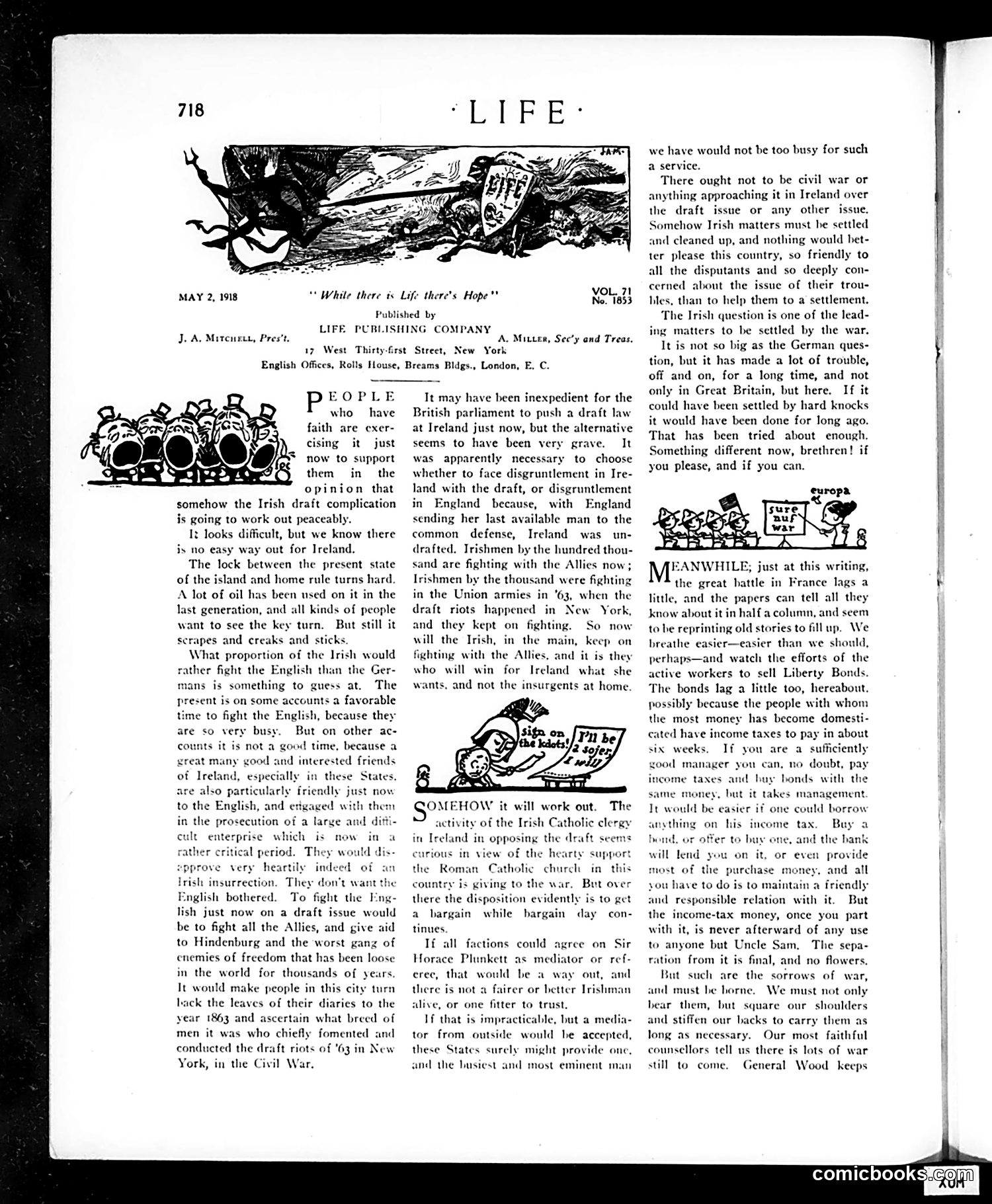
This page addresses the contentious Irish draft issue during World War I. The main article argues that while Irish conscription creates domestic tension, Ireland should support the Allied war effort rather than risk civil unrest. The editorial references the **1863 New York draft riots** (Civil War era) as a cautionary parallel—suggesting that opposing conscription could spark similar violence. It notes that many Irish already fight alongside the Allies, and that insurgents at home, not soldiers, threaten Irish interests. The cartoons (unclear in detail but visible) appear satirical—the left shows tangled figures representing the "Irish draft complication," while the right depicts European chaos, contrasting peaceful resolution with wartime disorder. The piece proposes **Sir Horace Plunkett** as a neutral mediator, or suggests an American mediator could help settle the dispute peacefully. The underlying message: Ireland's real liberation comes through Allied victory, not domestic rebellion during wartime.
📄 Transcribed text from this page (OCR, searchable)
Machine-transcribed from the original scan — historical spelling and the odd misread are preserved.
MAY 2, 1918 “ ife there’: ” VOL. 71 While there is Life there's: Hope Novrr4) Published by LIFE PUBLISHING COMPANY J. A. Mitcurun, Pres’t. 17 West Thi English Offices, Rolls Hous EOPLE who have faith are exer- cising it just now to support them in the opinion that somehow the Irish draft complication is going to work out peaceably. It looks difficult, but we know there is no easy way out for Ireland. The lock between the present state of the island and home rule turns hard. A lot of oil has been used on it in the last generation, and all kinds of people want to see the key turn. But still it scrapes and creaks and sticks What proportion of the Irish would her fight the English than the Ger- mans is something to guess at. The present is on some accounts a favorable time to fight the English, because they are so very busy. But on other ac- counts it is nota good time, because a ted friends of Ireland, especially in these States. also particularly friendly just now to the English, and erigaged with ther in the prosecution of a large and d cult enterprise which is now in a r critical period. They would tily indeed of Irish insurrection. They don’t want English bothered. To fight the Eng- lish just now on a draft issue would be to fight all the Allies, and give aid to Hindenburg and the worst gang of cnemies of freedom that has been loose in the world for thousands of years. It would make people in this city turn k the leaves of their diaries to the year 1863 and ascertain what breed of men it was who chiefly fomented and conducted the draft riots of '63 in New York, in the Civil War. great many good and inter opprove very hea A. Minter, Sec’y and Treas. y-first Street, New York . Breams Bldgs., London, E. C. It may have been inexpedient for the British parliament to push a draft law at Ireland just now, but the alternative seems to have been very grave. It was apparently necessary to choose whether to face disgruntlement in Ire- land with the draft, or disgruntlement in England because, with England sending her last available man to the common defense, Ireland was un- drafted. Irishmen by the hundred thou- nd are fighting with the Allies now; Irishmen by the thousand were fighting in the Union armies in '63, when the draft riots happened in New York, and they kept on fighting. will the Trish, in the main, keep on fighting with the Allies, and it is they who will win for Ireland what she wants, and not the insurgents at home. oO now OMEHOW it will work out. The activity of the Irish Catholic clergy in Ireland in opposing the draft seen curious in view of the hearty supp the Roman Catholic church in thi country is giving to the war, But over there the disposition evidently is to get a bargain while bargain day con- tinues. If all factions could agree on Sir Horace Plunkett as mediator or ref- out, and there is not a fairer or better Irishman alive, or one fitter to trust. If that is impracticable, but a media- cree, that would be a wa tor from outside would he accepted, these States surely might provide one, and the busiest and most eminent man we have would not be too busy for such a service. There ought not to be civil war or anything approaching it in Ireland over the draft issue or any other issue. Somehow Irish matters must he settled and cleaned up, and nothing would bet- ter please this country, so friendly to all the disputants and so deeply con- cerned about the issue of their trou- Iles, than to help them to a settlement. The Irish question is one of the lead- ing matters to be settled by the war. It is not so big as the German ques- tion, but it has made a lot of trouble, off and on, for a long time, and not only in Great Britain, but here. If it could have been settled by hard knocks it would have been done for long ago. That has been tried about enough Something different now, brethren you please, and if you can. EANWHILE; just at this writing, the great battle in France lags a little, and the papers can tell all they know about it in half a column, and seem to be reprinting old stories to fill up. We breathe easier—easier than we should, perhaps—and watch the efforts of the active workers to sell Liberty Bonds. The bonds lag a little too, hereabout. possibly because the people with whom the most money has become domesti- cated have income t: to pay in about six weeks. If you are a sufficiently dou manager you can, no doubt, pay and buy bonds with the but it takes management. It would be easier if one could borrow income taxe same money wything on his income tax. Buy a rt to buy one, and the bank will lend you on it, or even provide the purchase me nd all you have to do is to maintain a friendly and responsible relation with it. But the income-tax money, once you part with it, is never afterward of any use to anyone but Uncle Sam, The sepa- ration from it is final, and no flowers. hand.or most o ney, But such are the sorrows of war, and must be borne. We must not only bear them, but square our shoulders and stiffen our backs to carry them as long as necessary. Our most faithful counsellors tell us there is lots of war still to come. General Wood keeps comichookseera