
A complete issue · 41 pages · 1917
Life — December 27, 1917
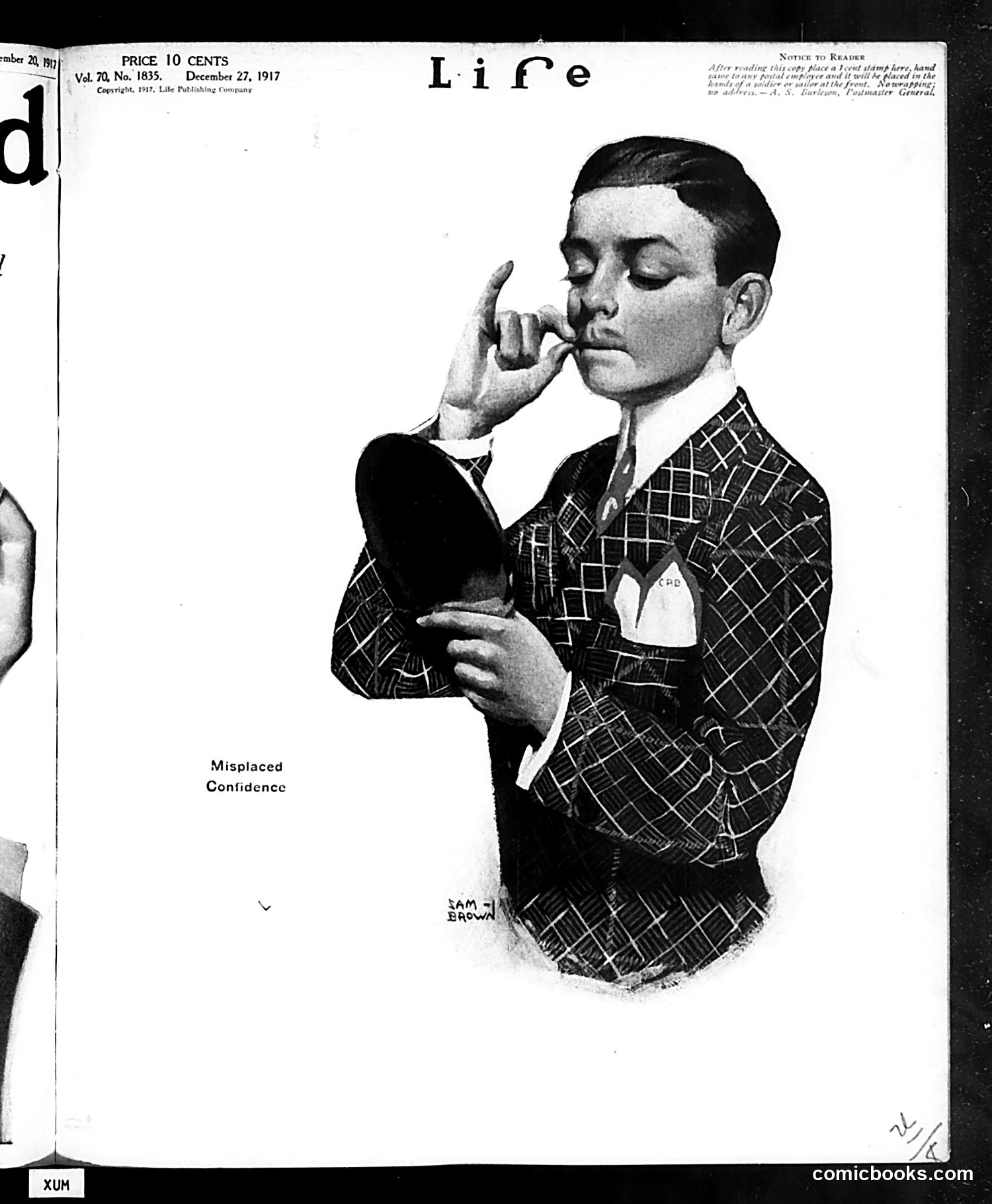
This December 1917 *Life* magazine cover by Sam Brown depicts a well-dressed man in a checkered suit examining his reflection in a hand mirror with apparent satisfaction, while touching his finger to his lips in a self-congratulatory pose. The caption "Misplaced Confidence" suggests satire of unwarranted self-regard—the figure's smugness appears unjustified or foolish. Given the 1917 date (during World War I), this likely comments on a public figure or political leader displaying excessive confidence despite circumstances that don't warrant it. The specific identity remains unclear from the image alone, though the satirical intent—mocking overconfidence—is evident.
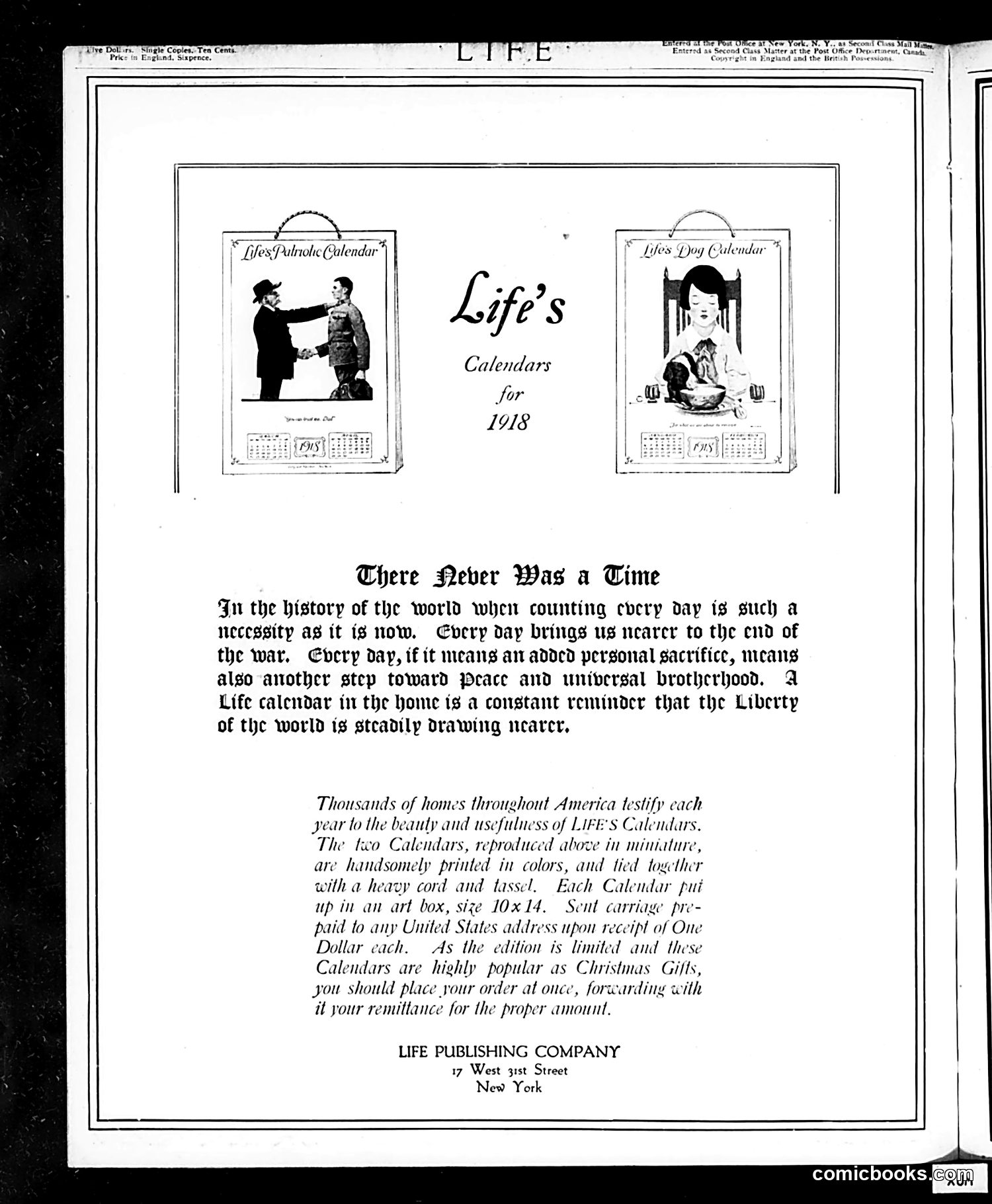
This is primarily an **advertisement** for Life Publishing Company's 1918 calendars rather than political satire. The page features two decorative calendar designs: "Life's Patriotic Calendar" (left, showing two men shaking hands in military context) and "Life's Day Calendar" (right, depicting domestic/family imagery). The accompanying text frames calendar-keeping as a patriotic duty during World War I, stating that "counting every day" aids the war effort and promotes "peace and universal brotherhood." This reflects 1918 American WWI messaging—civilians are encouraged to view daily activities as contributing to military victory. The calendars cost one dollar each and were marketed as Christmas gifts. The appeal combines **wartime morale-building** with commercial product promotion, typical of American home-front messaging during the final year of WWI.
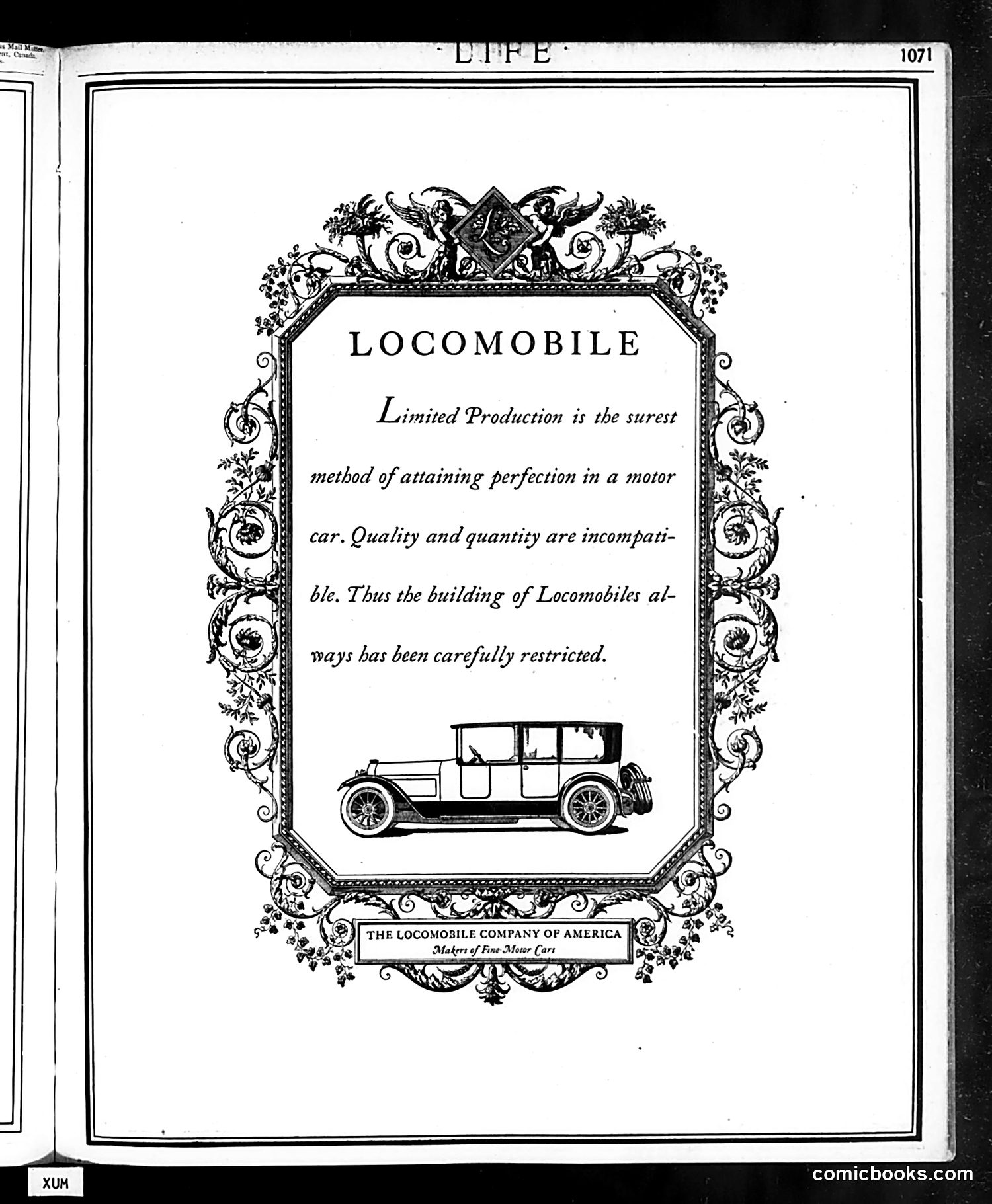
This page is primarily **advertising, not satire**. It's a full-page ad for the Locomobile Company of America, promoting their automobiles. The ad makes a straightforward business argument: "Limited Production is the surest method of attaining perfection in a motor car." The copywriter claims that quality and quantity are incompatible, therefore Locomobile restricts production to maintain high standards. The ornate decorative border and the illustration of a five-seat touring car are typical of early automotive advertising. The tagline "Makers of Fine Motor Cars" reinforces the premium positioning. There is **no political satire or social commentary** here—it's a luxury car manufacturer using exclusivity as a marketing strategy, a common approach in high-end automotive advertising then and now.
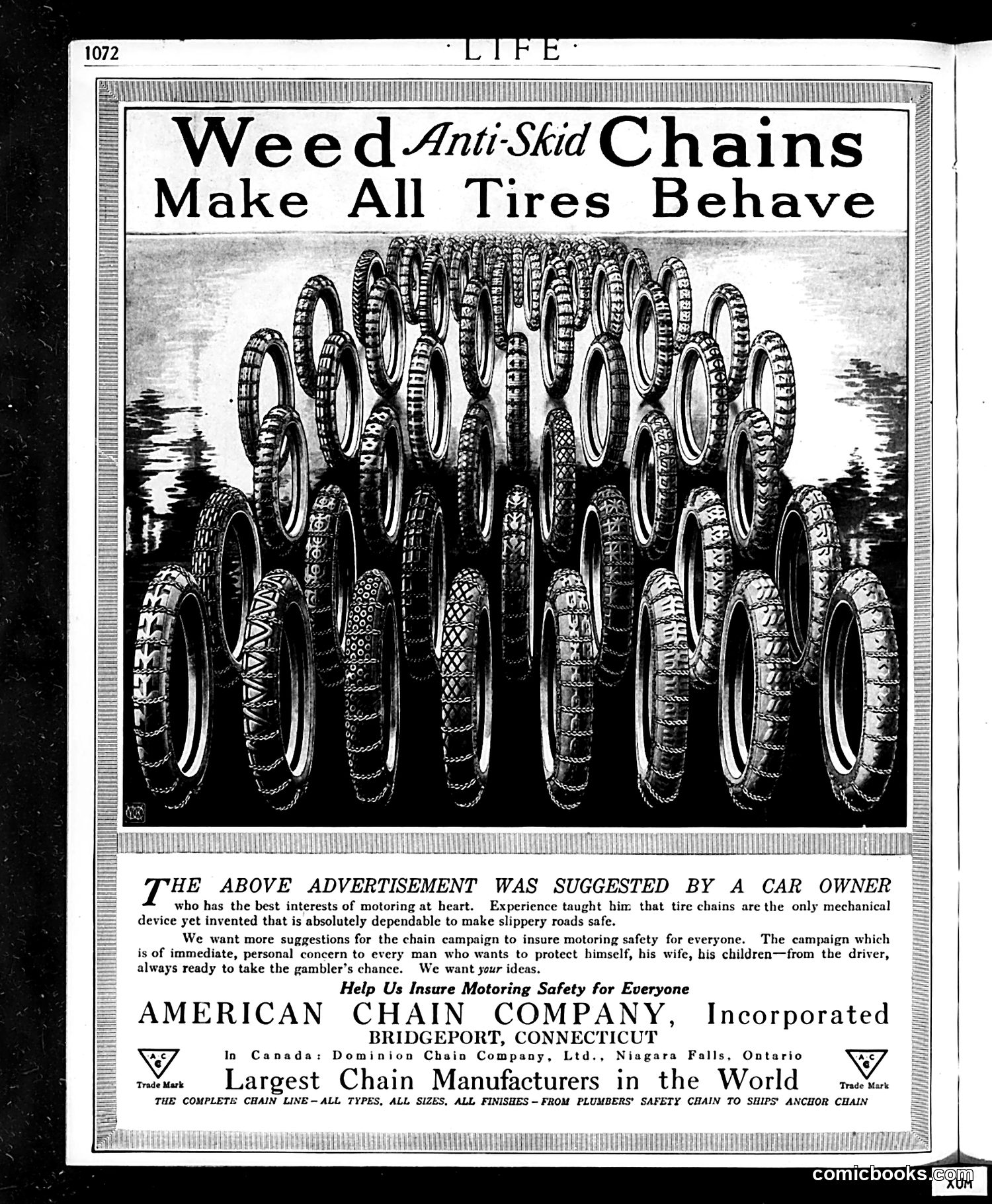
This page is **primarily an advertisement**, not satire or political commentary. It's a full-page ad by the American Chain Company promoting Weed Anti-Skid Chains for vehicle tires. The ad features a large illustration of tires equipped with chains stacked in rows, emphasizing their availability and variety. The text claims chains are "the only mechanical device yet invented that is absolutely dependable to make slippery roads safe." The advertisement attributes the campaign idea to "a car owner" concerned with "motoring safety for everyone," framing tire chains as essential safety equipment for winter driving. The company positions itself as the world's largest chain manufacturer, based in Bridgeport, Connecticut, with Canadian operations. This reflects early 20th-century winter driving concerns before modern tire technology.
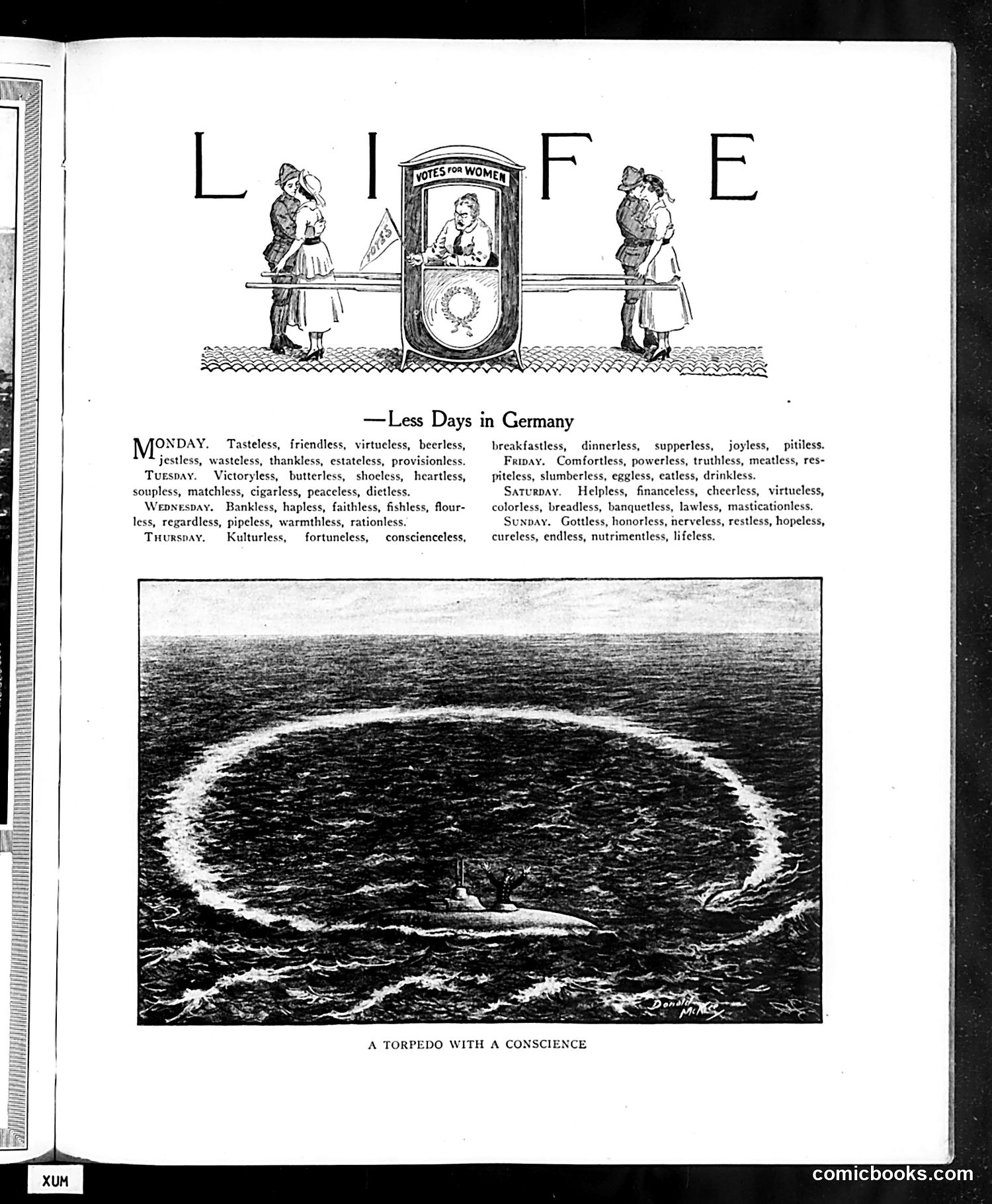
This page from *Life* magazine contains two distinct elements: **Top section ("LIFE"):** An illustration showing two women operating a seesaw/lever mechanism labeled "VOTES FOR WOMEN," with a ballot box at the center. This references the women's suffrage movement, depicting women gaining political power and balance through voting rights. **Bottom section ("Less Days in Germany"):** A satirical daily listing of deprivations (tasteless, friendless, joyless food and conditions for each weekday), accompanied by an illustration captioned "A TORPEDO WITH A CONSCIENCE." This appears to be WWI-era propaganda mocking Germany, suggesting German submarines killing civilians while supposedly having moral qualms—a dark satire on the contradiction between warfare's brutality and claimed conscience. The page combines suffrage advocacy with anti-German wartime sentiment, typical of American *Life* magazine's political humor.
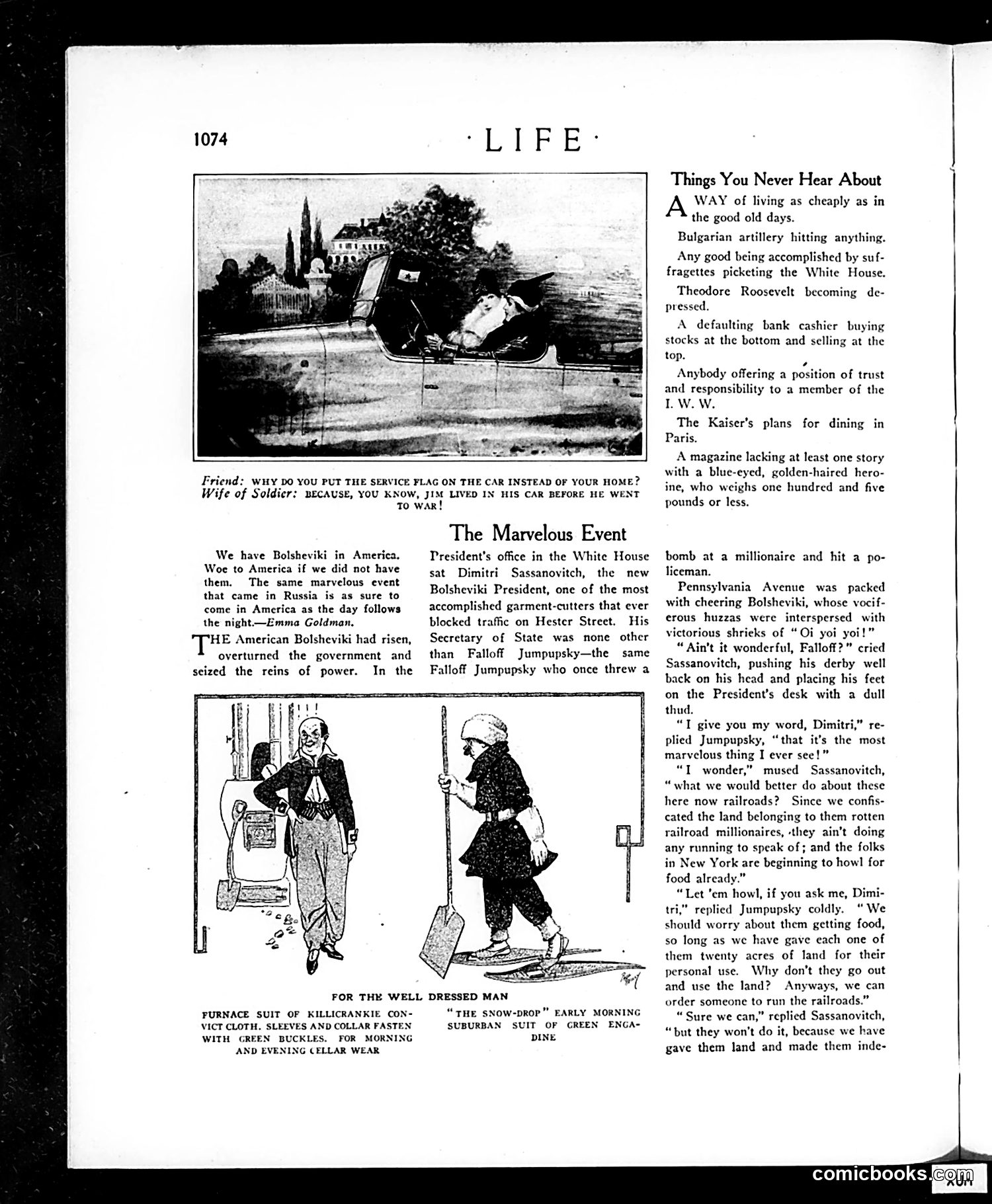
This page satirizes the Russian Bolshevik Revolution's American supporters. The top cartoon jokes about a soldier's wife displaying a service flag (indicating a family member in WWI) on her car instead of at home—suggesting she prioritizes appearances over genuine patriotism. "The Marvelous Event" article mocks American Bolsheviks, using a dialogue between Dimitri Sassanovitch (the new Bolshevik President) and Falloff Jumpupsky. The satire critiques how Bolsheviks seized power in Russia, then were celebrated by some Americans. The cartoon illustrations show figures in Russian-style clothing, likely caricaturing these ideological sympathizers. The piece ridicules both the Bolshevik revolution and Americans who admired it during the post-WWI period.
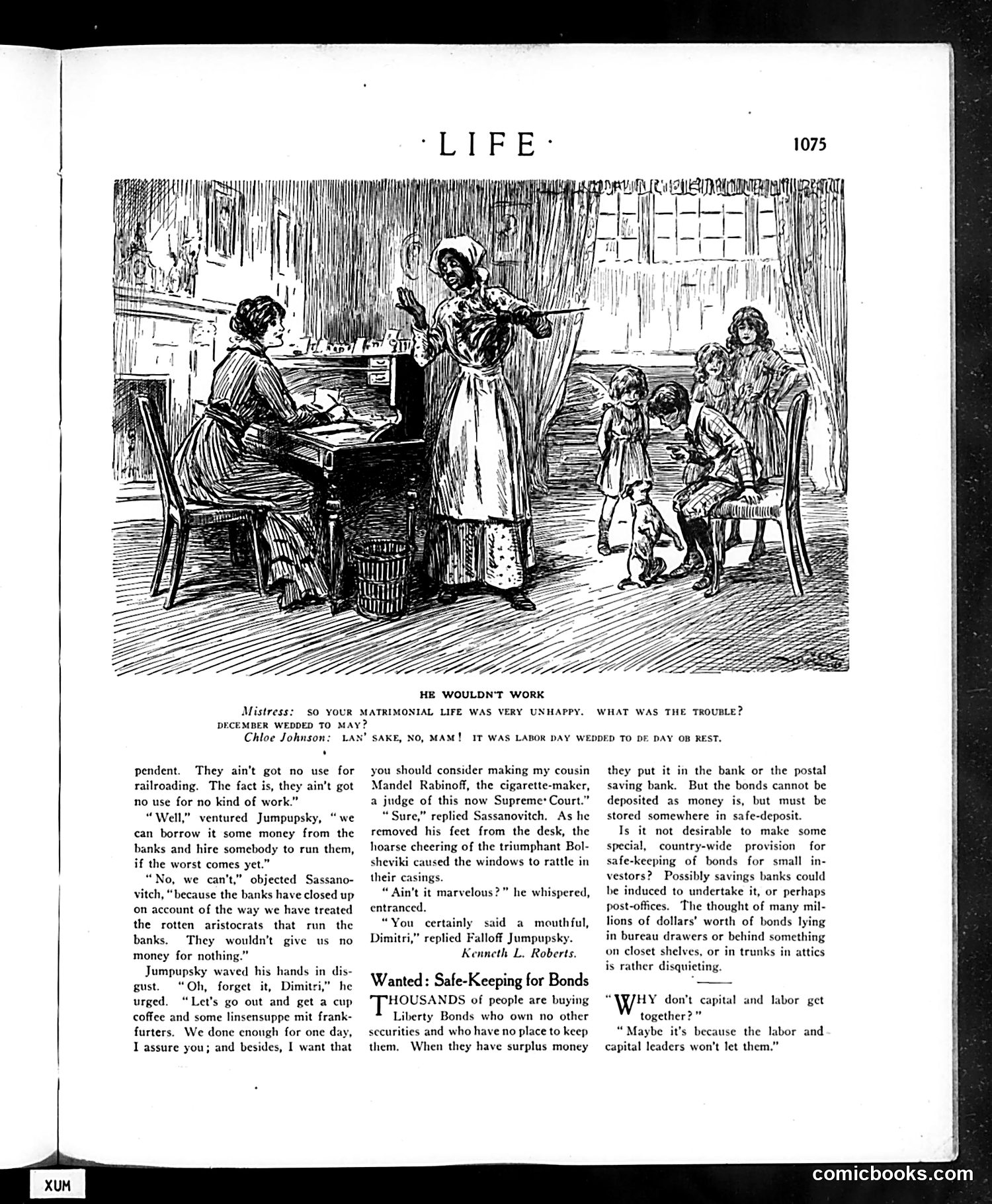
This cartoon depicts a domestic scene where a mistress questions a discharged worker (Chloe Johnson) about his unhappy marriage. Johnson explains he was laid off on Labor Day because he "wouldn't work." The surrounding text discusses banking and bond-keeping, suggesting satirical commentary on post-WWI economic issues. A piece titled "Wanted: Safe-Keeping for Bonds" addresses thousands buying Liberty Bonds but lacking secure storage—referencing concerns about where citizens should keep war bonds and securities. The cartoon's joke plays on "wouldn't work" as both literal unemployment and marital discord, while the accompanying financial discussion critiques economic anxieties of the era regarding bond safety and capital-labor relations.
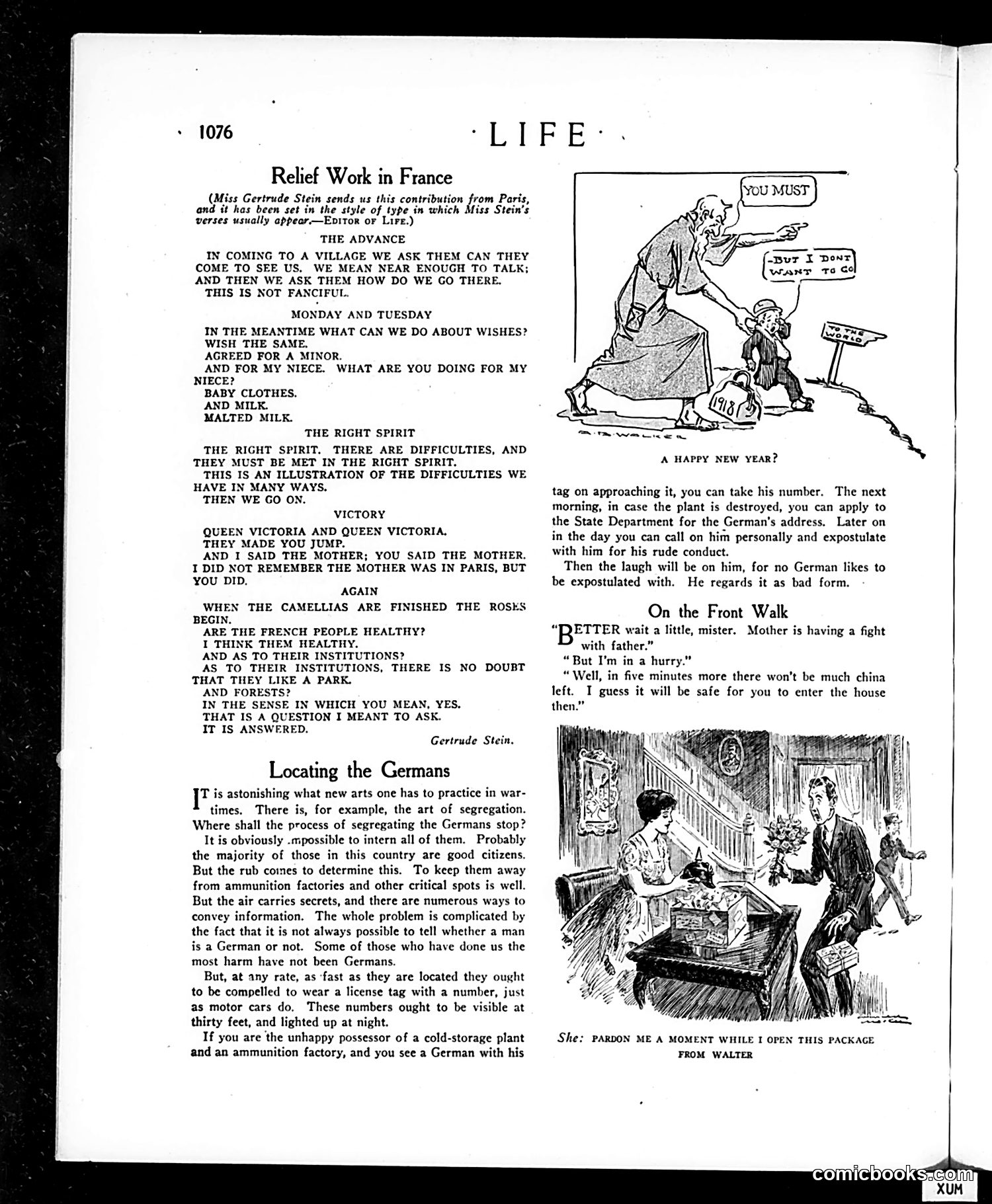
This cartoon depicts an adult (likely representing an Allied nation or authority figure) coercing a small child (representing a defeated or occupied nation, possibly Germany or an occupied territory) toward an unwanted destination. The child resists ("But I don't want to go"), while the adult insists ("You must"). The caption "A Happy New Year?" uses bitter irony—the forced march promises no happiness. This reflects post-WWI tensions: the forced compliance of defeated nations with peace treaty terms, reparations, and occupation conditions that were deeply unpopular. The image critiques the coercive nature of post-war settlements, suggesting that imposed solutions lacking genuine consent breed resentment rather than lasting peace.
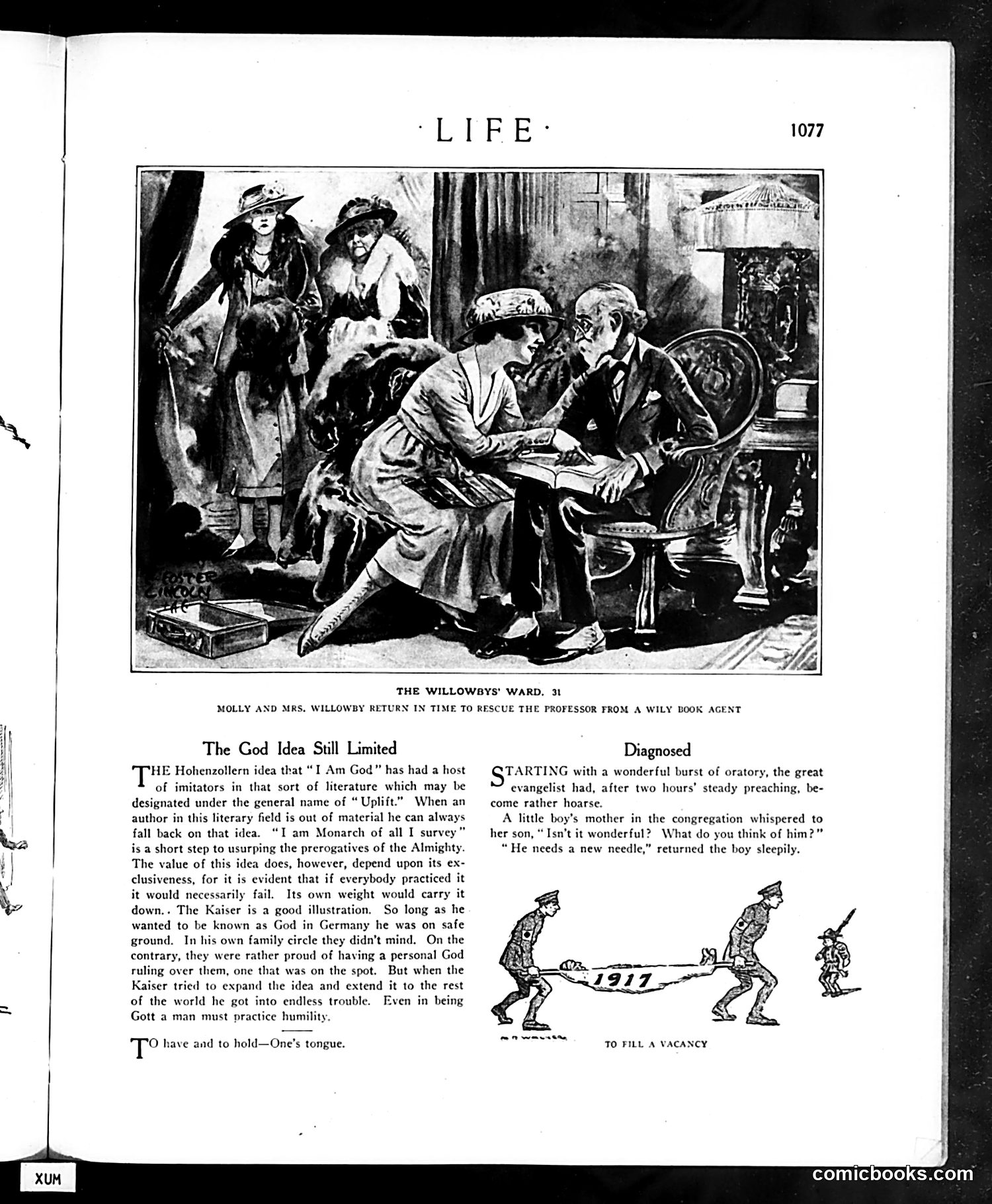
**Top Illustration:** "The Willowbys' Ward" depicts a domestic comedy scene where Molly and Mrs. Willowby rescue Professor Willowby from "a wily book agent"—suggesting satirical commentary on aggressive sales tactics of the era. **Main Articles:** "The God Idea Still Limited" critiques the German Kaiser's claim to represent God's will nationally. The text argues that while the Kaiser wanted personal divine authority, extending this concept globally caused "endless trouble," implying criticism of German imperial ideology and World War I ambitions. "Diagnosed" humorously depicts a mother concerned her son needs "a new needle" after a lengthy sermon, satirizing both evangelical preaching and parental anxiety. **Bottom Cartoon:** "To Fill a Vacancy" (unclear reference) shows figures with "1917," likely WWI-related commentary.
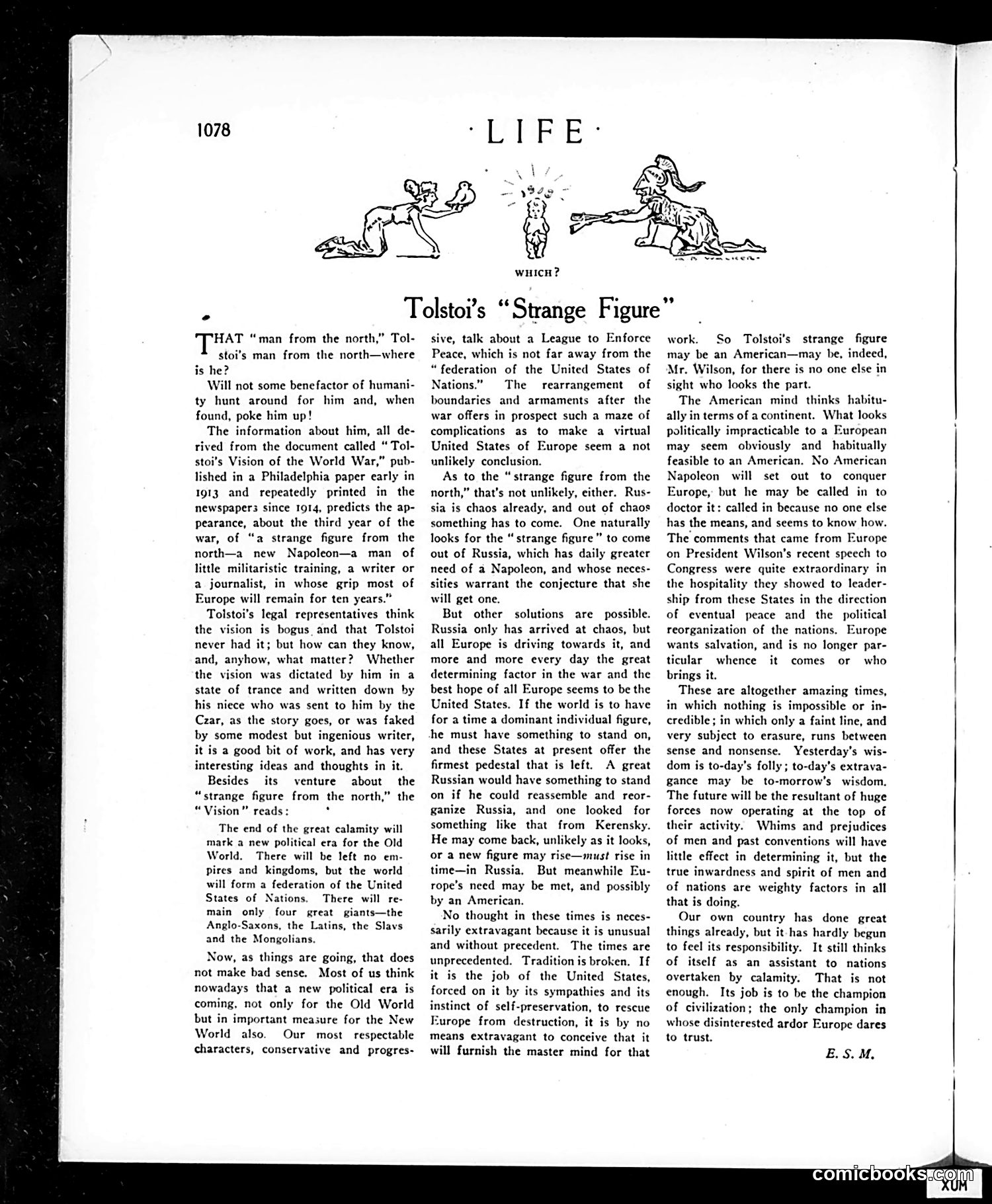
This 1913 *Life* magazine article discusses Leo Tolstoy's alleged "Vision of the World War," a document predicting European chaos and calling for a "League to Enforce Peace" and a "United States of Europe." The cartoon depicts three figures: a crawling man (labeled "man from the north"—likely representing Russia or a Russian leader), a small figure in the center marked "WHICH?" (the mysterious "strange figure"), and a third figure on the right (possibly representing America or Western powers). The satire mocks Tolstoy's vision as unrealistic speculation about who might emerge as Europe's dominant leader during coming chaos. The article's author (E.S.M.) skeptically suggests such prophecies, while intriguing, are ultimately impractical—though the author does credit America's potential role in European reorganization.
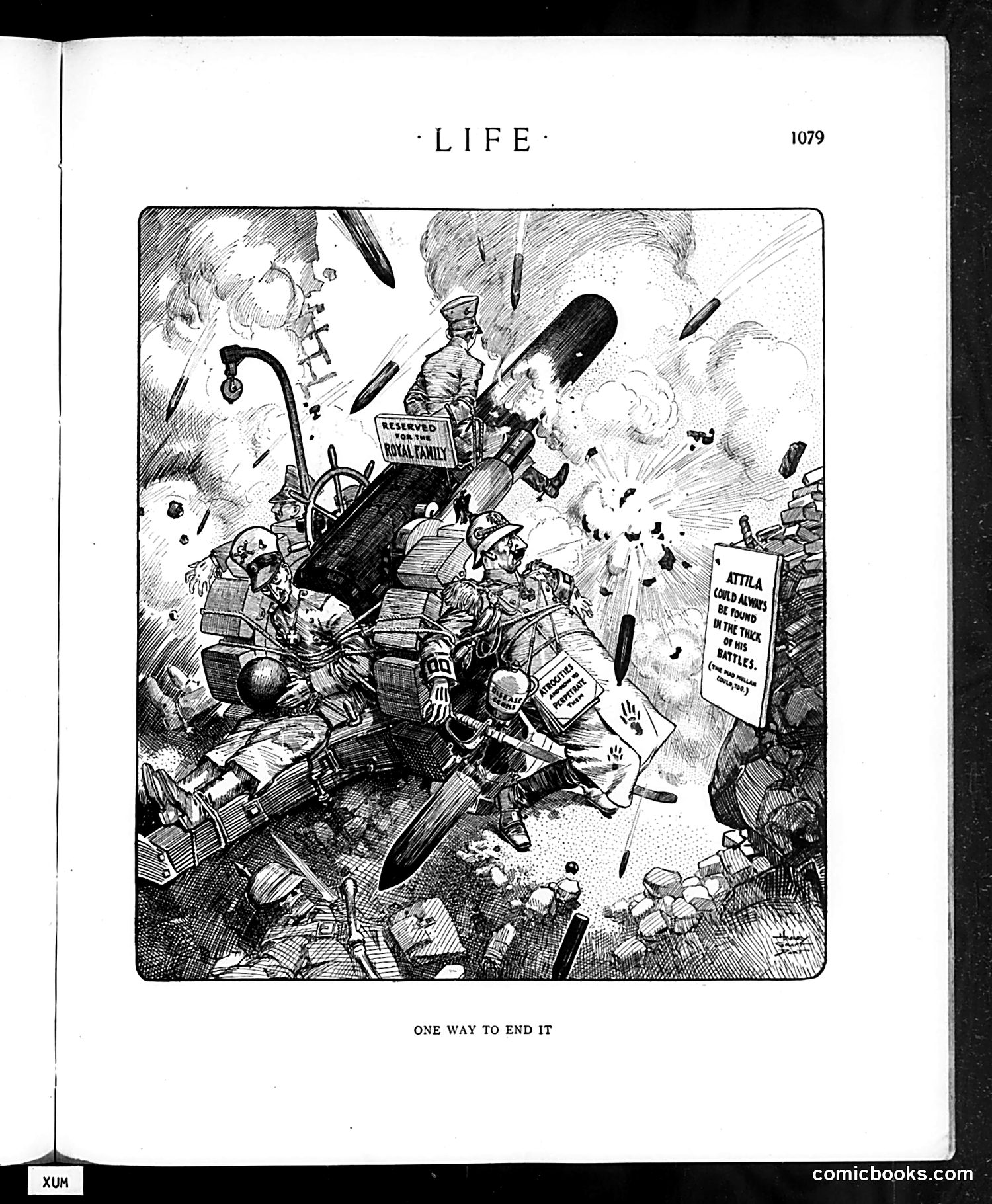
This political cartoon from *Life* magazine (page 1079) depicts a chaotic military scene titled "One Way to End It," appearing to comment on World War I. The central figure is a military officer standing atop an explosion of weapons, ammunition, and destruction. Visible text includes "Reserved for the Royal Family" and "Attila could always be found in the thick of battle," suggesting comparisons between modern warfare and historical barbarism. The cartoon satirizes the futility and brutality of WWI—showing how mechanized warfare creates only devastation rather than resolution. The ironic title and the "Attila" reference mock the notion that militaristic approaches could productively "end" the conflict, instead presenting only endless carnage and destruction.
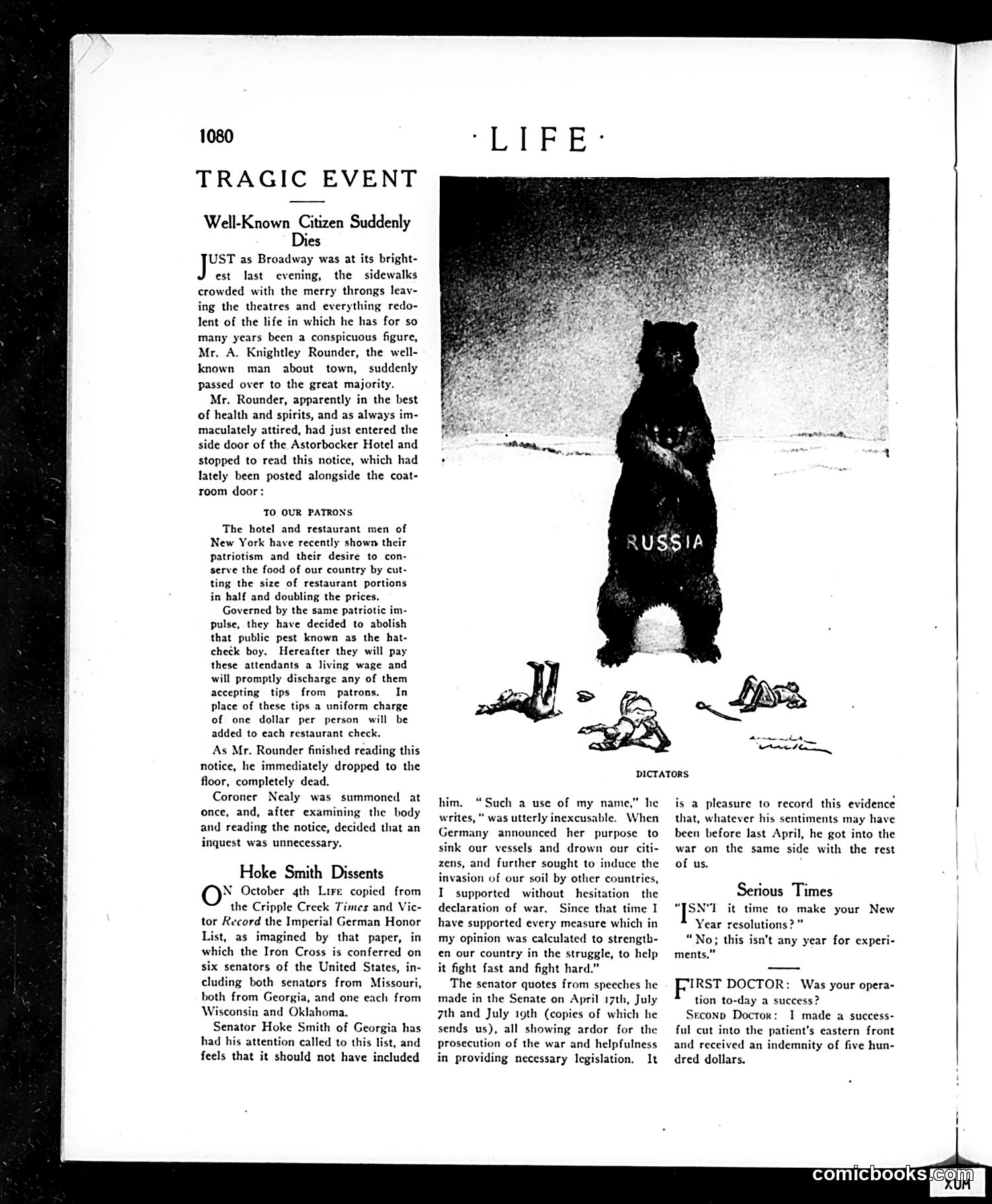
This political cartoon depicts a Russian bear labeled "RUSSIA" standing over fallen figures labeled "DICTATORS." The bear appears triumphant, suggesting Russia's military success against fascist regimes during World War II. The cartoon's context emerges from the accompanying text: Senator Hoke Smith dissented from an Imperial German Honor List that included six U.S. senators. The broader article discusses American patriotism during wartime, including restaurant workers' efforts to conserve food. The cartoon's message appears to be anti-fascist propaganda celebrating the Soviet Union's role in defeating dictatorial regimes—a stance reflecting American-Soviet alliance during WWII, before Cold War tensions emerged. The visual equation of "dictators" with fallen enemies under Russian dominance reinforces wartime messaging about good versus evil powers.
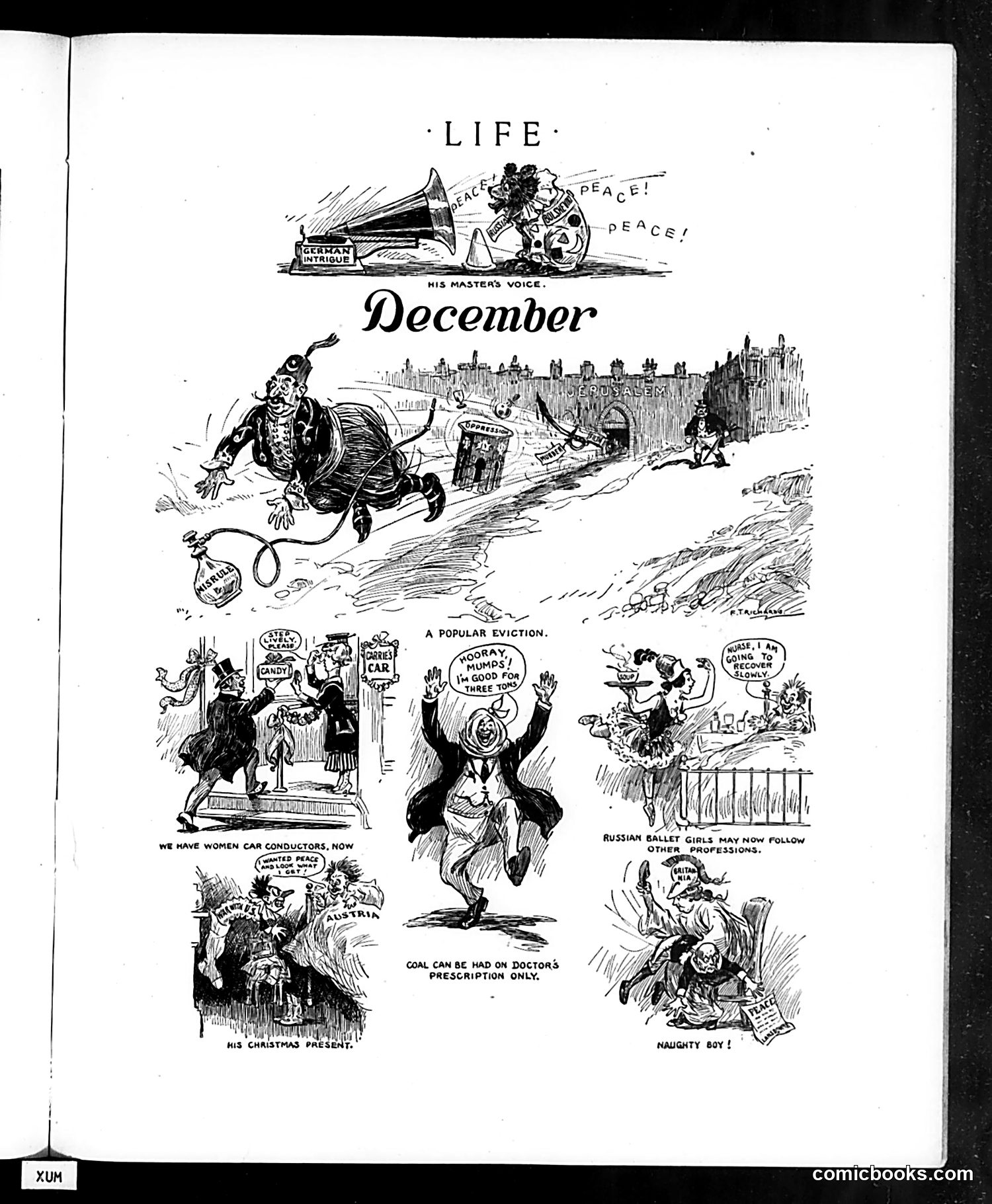
This satirical page depicts post-World War I social changes and anxieties. The top illustration shows "His Master's Voice" gramophone broadcasting "Peace! Peace!" — referencing the recent armistice. The central cartoon titled "A Popular Eviction" shows a rotund figure being ejected from a city, likely representing an unpopular political or military leader being removed from power after the war's end. Surrounding vignettes satirize wartime and post-war developments: women becoming streetcar conductors (addressing labor shortages), Russians potentially following "other professions" (likely referencing Bolshevism), coal rationing by "doctor's prescription" (wartime scarcity), and Christmas presents being scarce. The cartoons collectively mock domestic disruptions caused by war, social upheaval, and the transition to peacetime conditions in 1918 America.
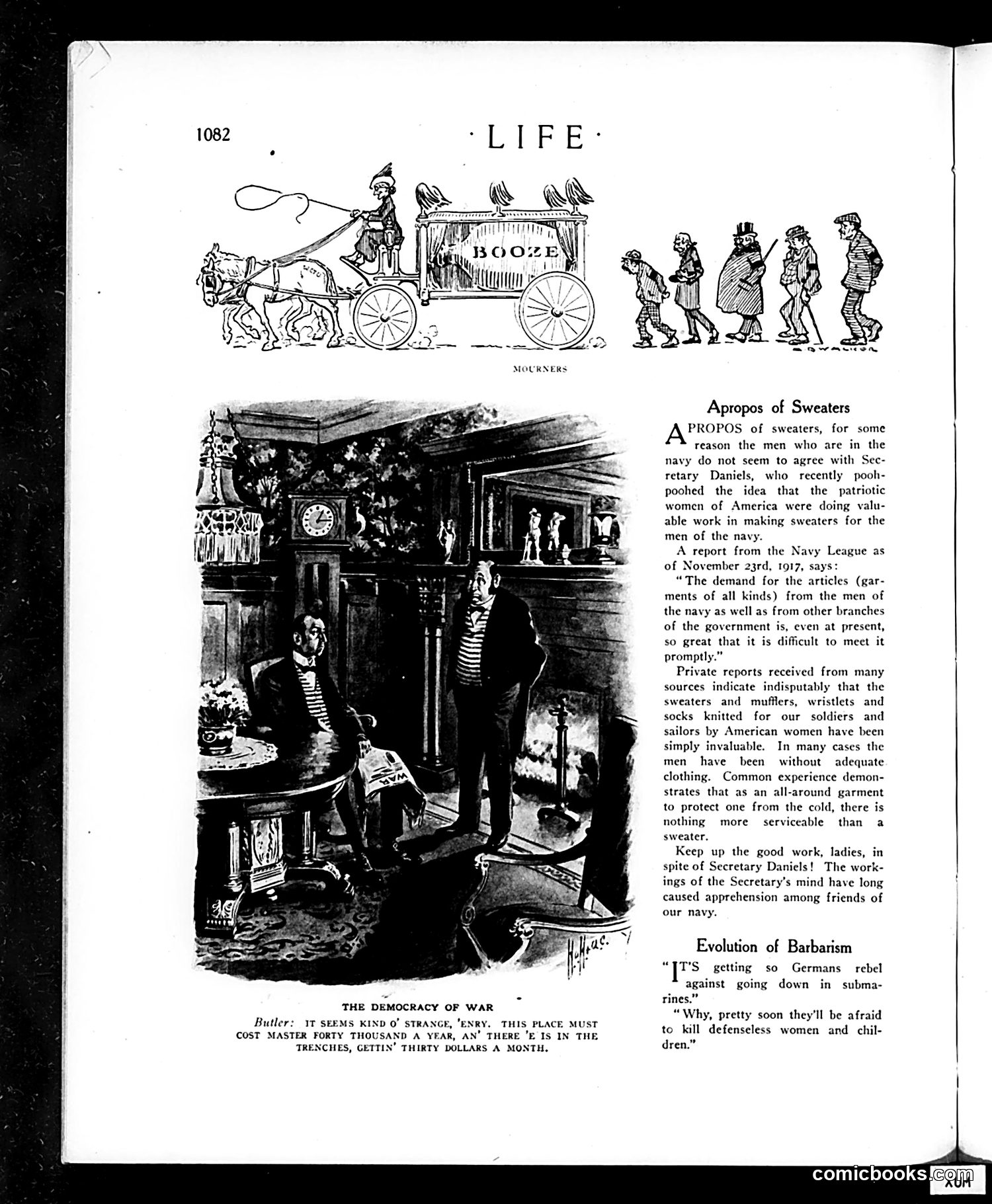
This 1917 cartoon satirizes Secretary of the Navy Daniels' cost-cutting policies during WWI. The sketch shows what appears to be a naval officer (likely representing Daniels) in an ornate interior discussing expenses with subordinates. The caption reads: "It seems kind o' strange, Ensign, this place must cost master forty thousand a year, an' there's is in the trenches, gettin' thirty dollars a month." The satire critiques the disparity between lavish naval administrative spending and meager soldier compensation. The cartoon's title, "The Democracy of War," ironically comments on how America's supposedly egalitarian war effort maintained stark inequalities in resource allocation—officers enjoyed luxury while enlisted men suffered on inadequate pay.
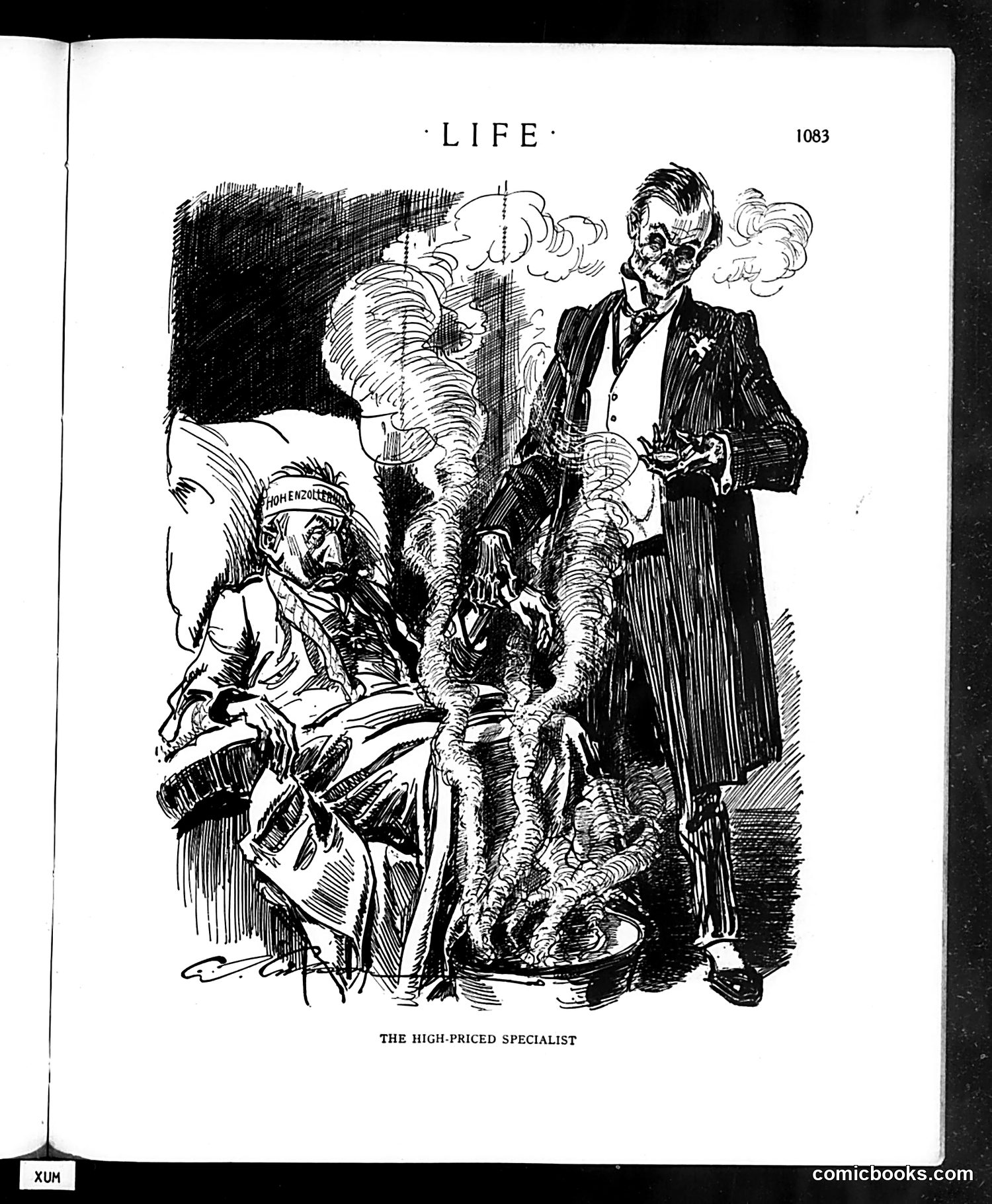
This political cartoon satirizes an expensive medical consultant. The image shows a well-dressed, skull-faced doctor smoking a cigar, standing beside what appears to be a wealthy, poorly patient seated in a chair. A small, military-uniformed figure (possibly representing a nurse or attendant) stands nearby. The satire targets the pretension and greed of high-fee medical specialists who provided minimal actual care while charging exorbitant rates. The skull-face suggests the doctor is essentially a "quack" or charlatan—profiting from patients' suffering without delivering real help. The wealthy patient's apparent distress contrasts with the doctor's confident, self-satisfied demeanor, emphasizing the exploitation inherent in expensive specialist medicine during this era.
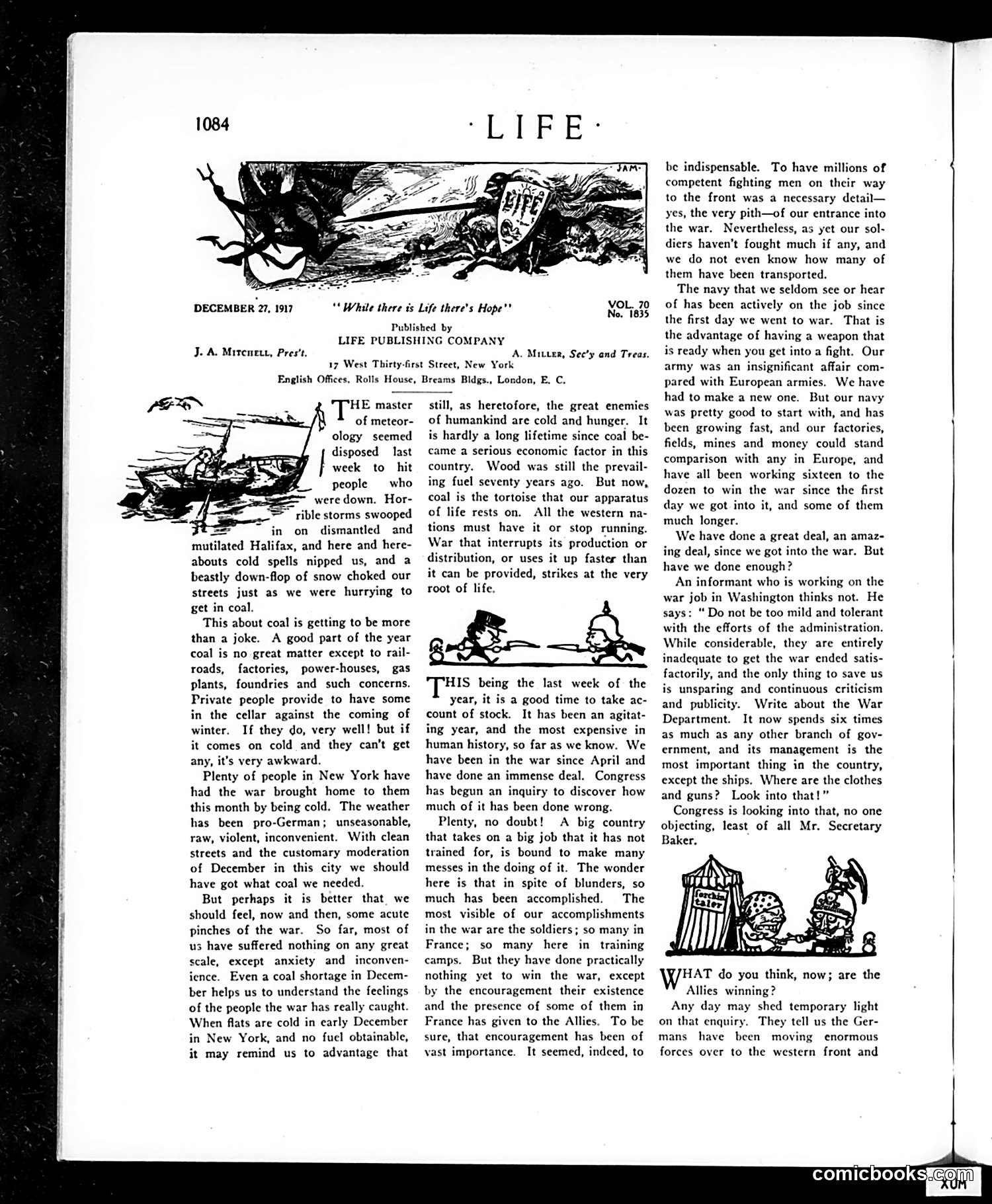
This editorial page addresses American home-front conditions during World War I (U.S. entered April 1917). The main cartoon depicts harsh winter weather personified as "pro-German"—a satirical way of saying the cold and coal shortages hurt American morale and resources. The text discusses two key wartime frustrations: severe coal shortages freezing New York apartments, and an apparent lack of visible military progress. The author argues that while soldier mobilization is impressive, the army "hasn't fought much if any," whereas the Navy has been "actively on the job" since America's war declaration. The piece critiques congressional investigations into war management as inevitable given rapid, large-scale mobilization by an unprepared nation. It acknowledges inefficiency while defending overall accomplishment. The tone balances patriotism with realistic frustration about civilian suffering and unclear military results after eight months of war involvement.
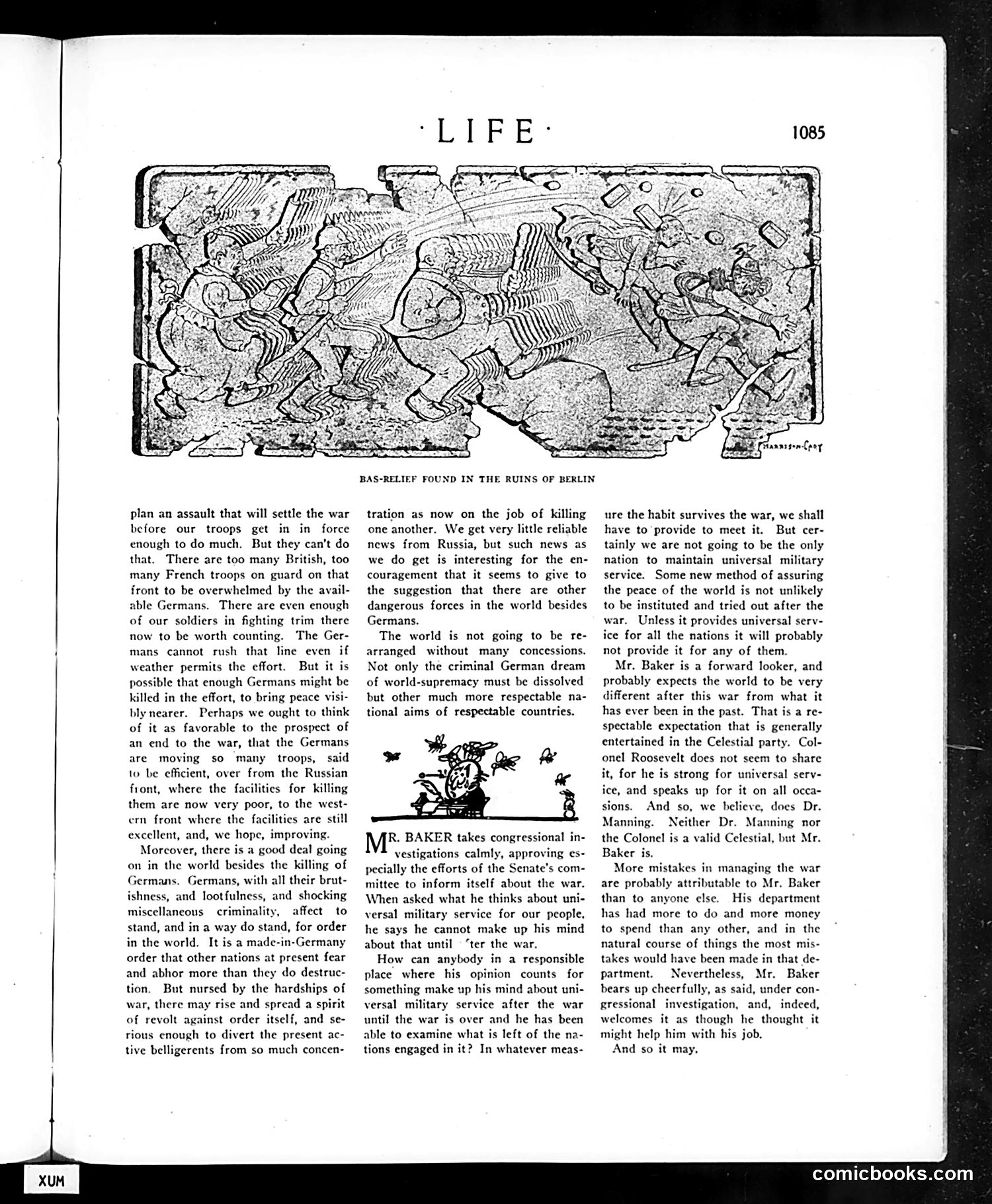
The top image is a bas-relief depicting what appears to be ancient warfare or conflict—soldiers in combat with weapons and bodies. The caption "BAS-RELIEF FOUND IN THE RUINS OF BERLIN" is satirical, suggesting that future archaeologists will find this WWI-era relief in Berlin's ruins, implying Germany's inevitable destruction. The text discusses Secretary of War Newton Baker, who apparently belongs to the "Celestial party" (likely a reference to progressive reformers). The article criticizes Baker for deferring judgment on universal military service until "after the war"—the satire being that one cannot properly plan post-war policy without knowing what remains after the current conflict. The piece also mocks Colonel Roosevelt (likely Theodore Roosevelt) and Dr. Manning for advocating universal military service, while suggesting Baker, though forward-thinking, bears responsibility for numerous wartime management errors despite his department's vast resources and scope. The overall tone is critical commentary on American WWI leadership and planning.
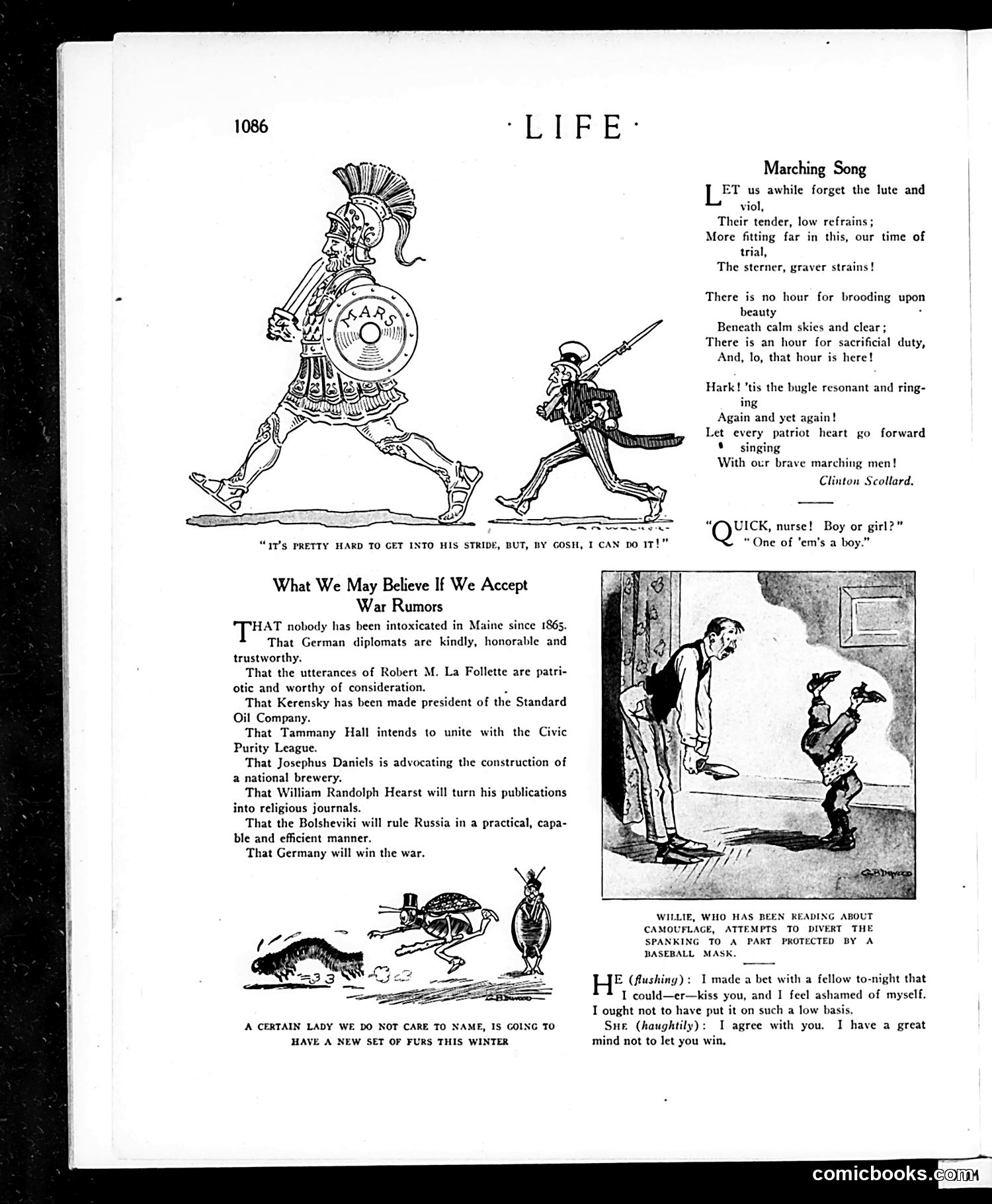
This page from Life magazine (likely WWI-era, given references to Germany winning the war and the Bolsheviki) mixes patriotic content with political satire. The "Marching Song" poem celebrates military duty during wartime. The main satire, "What We May Believe If We Accept War Rumors," mockingly lists absurd claims—many targeting American political figures and policies. It suggests accepting war rumors requires believing impossible things: that prohibition works in Maine, that German diplomats are trustworthy, that anti-war politician La Follette is patriotic, that William Randolph Hearst (a sensationalist publisher) would become religious, and that Germany will win. The final item about "a certain lady" getting new furs sarcastically implies war profiteering or indifference to sacrifice. The bottom comics are lighter humor: a child using a baseball mask to avoid spanking, and flirtation dialogue. The page uses satire to critique those spreading unfounded war rumors and perceived hypocrisy among public figures.
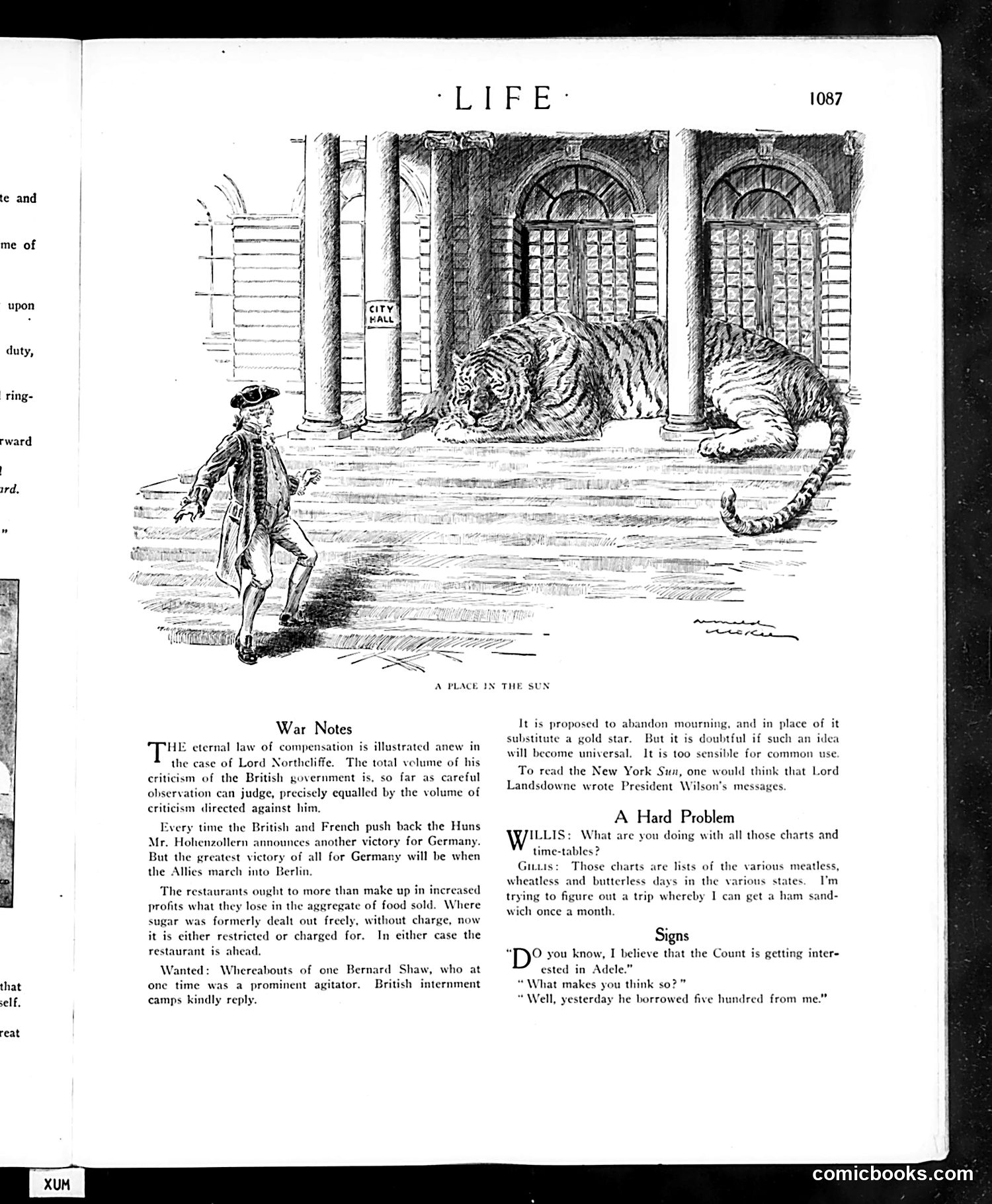
The main cartoon depicts a small man in formal dress approaching large tigers lounging outside ornate city buildings. The title references Germany's imperial ambitions (Kaiser Wilhelm II famously declared Germany's right to "a place in the sun" in global affairs). **The satire**: The man represents either an Allied diplomat or Britain, while the tigers represent German military power. The cartoon mocks Germany's aggressive territorial claims and military posturing during WWI. The tigers' comfortable lounging suggests Germany's confidence despite military setbacks mentioned in the accompanying text. **Context**: The "War Notes" section references Lord Northcliffe (British press magnate), German propaganda claims of victories, wartime food rationing, and Bernard Shaw's controversial pacifist stance. The humor relies on readers' familiarity with WWI tensions, German imperial rhetoric, and contemporary political figures. The page's other jokes address domestic wartime hardships: rationing confusion and economic uncertainty during the conflict.
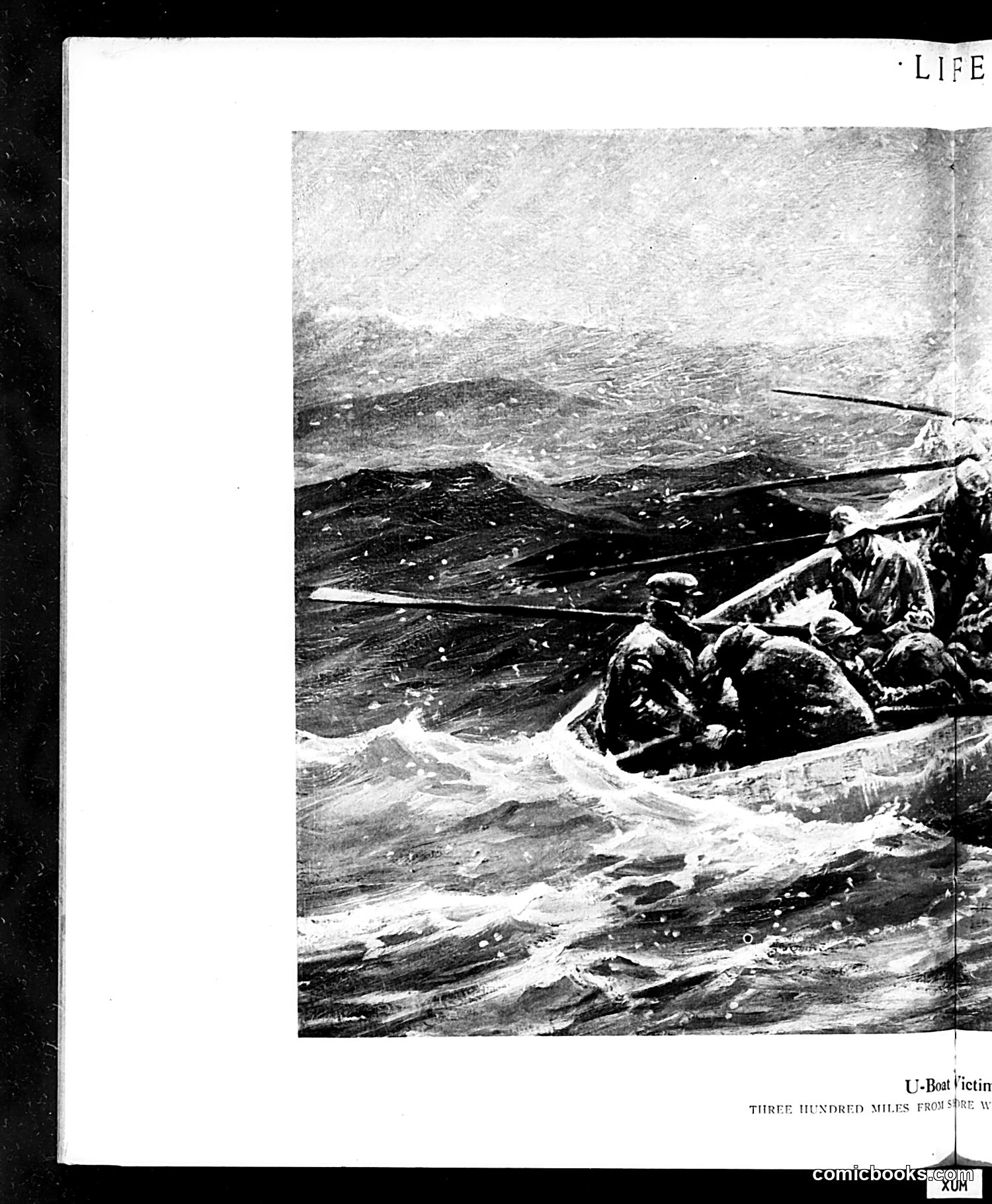
This appears to be a wartime photograph rather than a cartoon. The image shows survivors in a lifeboat, apparently rescued from a torpedoed ship. The caption references "U-Boat Victim" and mentions "Three Hundred Miles From [Shore]" (OCR unclear on final word). This is documentary war photography, likely from World War I or II, published in *Life* magazine to illustrate the dangers of submarine warfare. The image serves as factual reporting on naval combat casualties rather than satire or political commentary. It appears designed to convey the human toll of maritime warfare to American readers, showing the harsh reality of survival at sea after enemy attack.
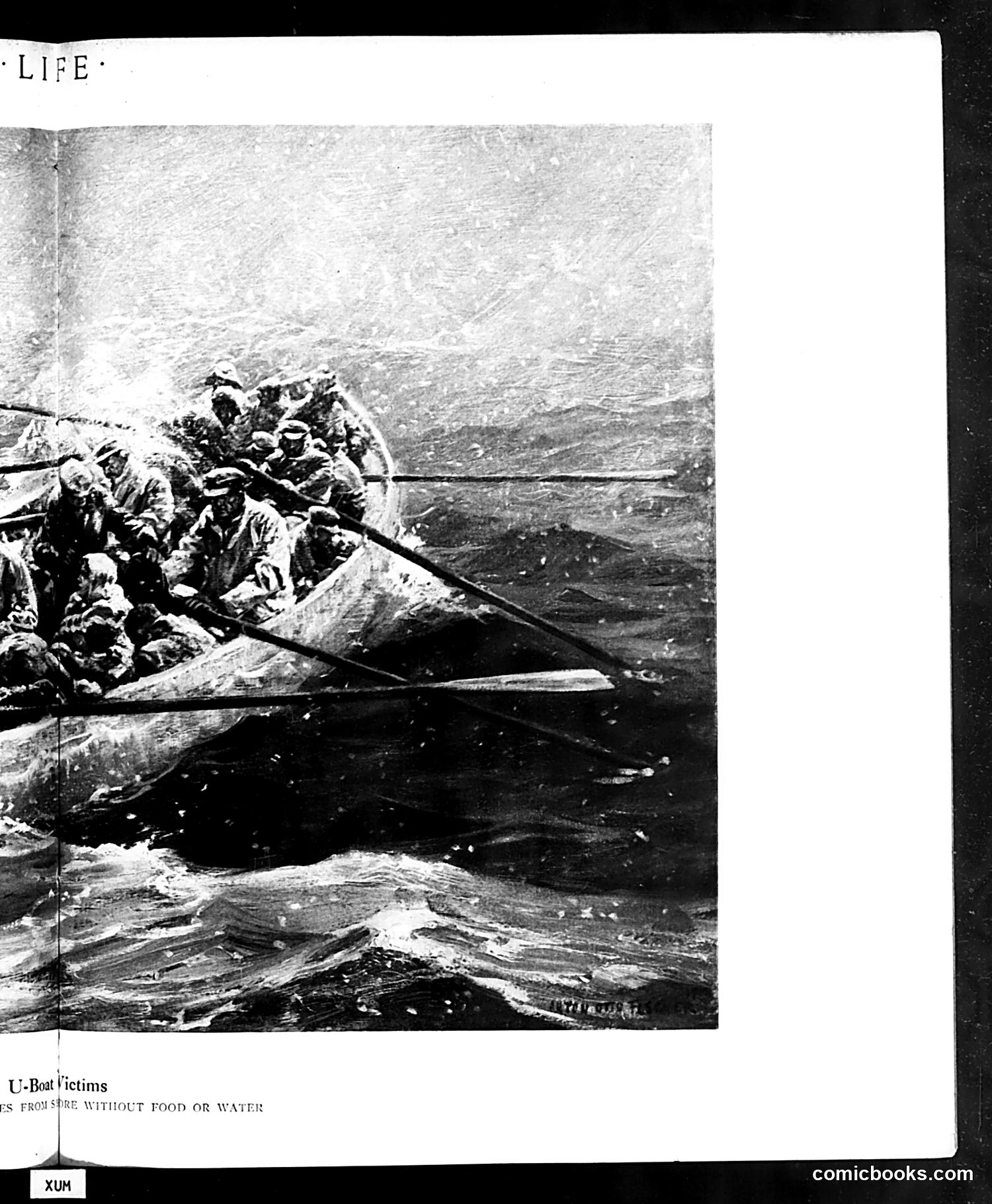
This appears to be a wartime photograph rather than a cartoon, showing what the caption identifies as victims of German U-boat (submarine) attacks. The image depicts bodies in or near water, likely depicting casualties from submarine warfare. The caption's reference to victims "without food or water" suggests this documents the aftermath of a ship sinking, emphasizing the suffering of those lost at sea. Published in *Life* magazine (a major American publication), this would have been presented as documentary evidence of German military brutality during either World War I or II, serving to build public support for the war effort by graphically illustrating the human cost of enemy action. The context and exact date remain unclear from this page alone.
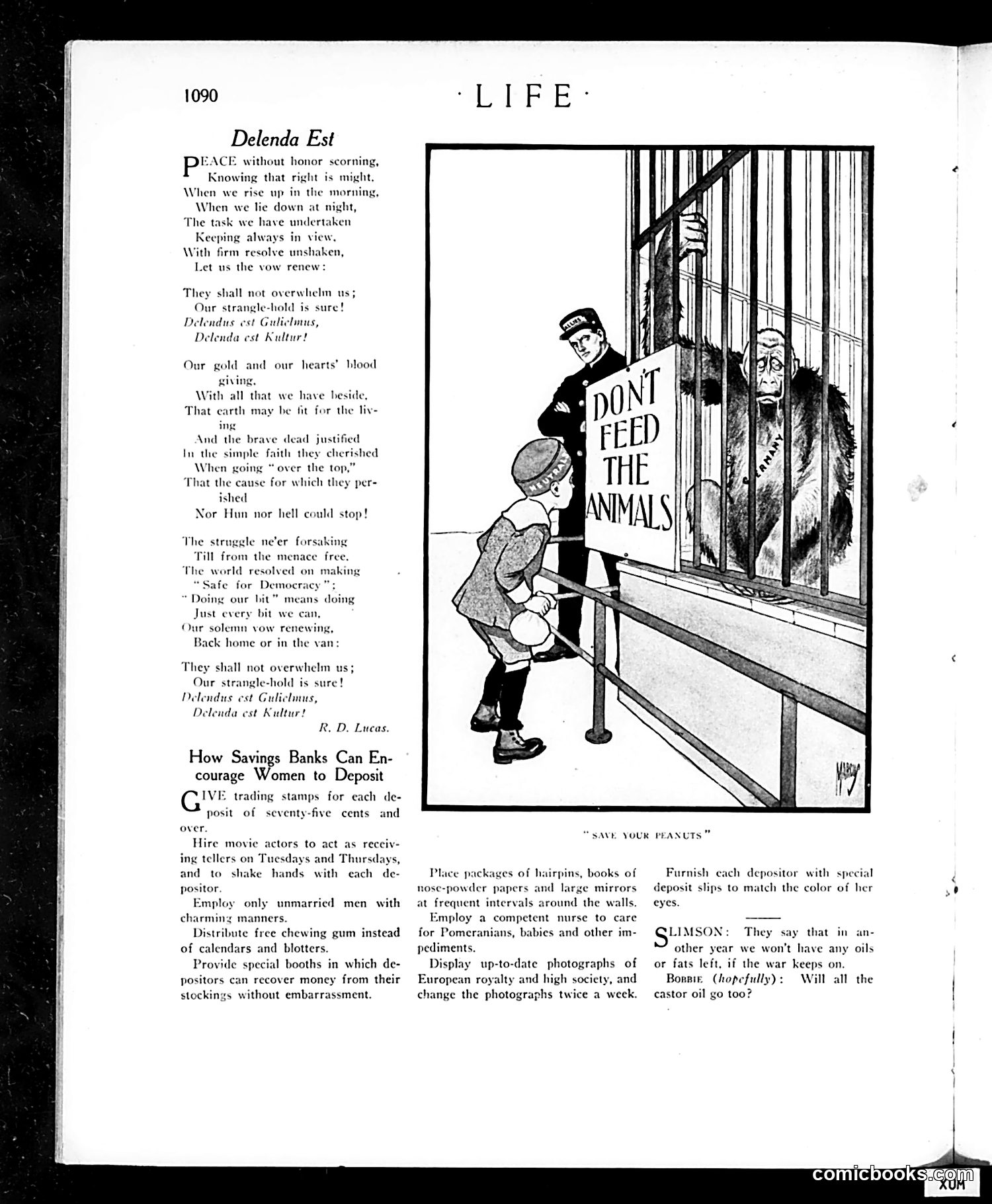
This page contains two distinct items from a WWI-era *Life* magazine: **The Poem "Delenda Est"** (top left): A patriotic wartime poem urging Americans to maintain resolve against Germany ("the Hun"). "Delenda est Kultur" parodies the Latin phrase "Delenda est Carthago" (Carthage must be destroyed), applying it to German culture. The poem references soldiers going "over the top" (trench warfare) and frames the war as a moral struggle for democracy. **The Cartoon "Save Your Peanuts"** (center): Shows two people at what appears to be a zoo or animal enclosure with a sign reading "DON'T FEED THE ANIMALS." The joke satirizes wartime food rationing by suggesting that peanuts—a common snack—should be preserved rather than fed to animals, given scarcity concerns during WWI. **The Bank Advice Section** (bottom): Satirizes how savings banks might market to women depositors, with tongue-in-cheek suggestions like hiring attractive male tellers and providing special amenities—poking fun at patronizing attitudes toward female customers. The page reflects WWI home-front concerns: patriotic fervor, resource conservation, and evolving consumer culture.
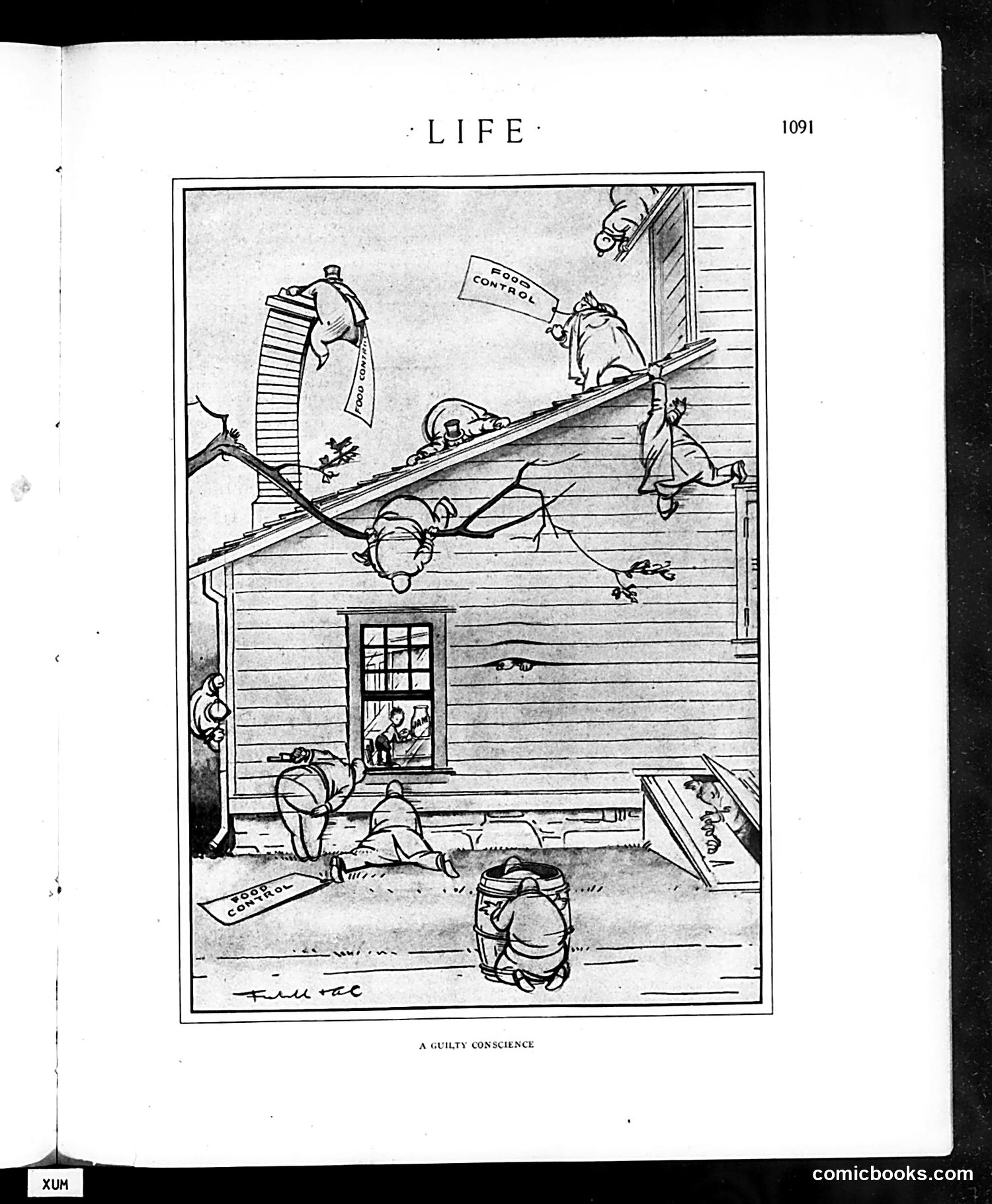
This Life magazine cartoon satirizes parental anxiety about children's behavior and safety. The scene shows a house where multiple children are engaged in various mischievous or dangerous activities—climbing on the roof, jumping, playing roughly—while parents appear to be monitoring or responding anxiously. The caption "A Guilty Conscience" suggests the humor targets parents' guilt about supervising their children, or perhaps their worry that their offspring's behavior reflects poorly on them. The chaotic domestic scene contrasts with the orderly house structure, emphasizing the disorder children create. The cartoon likely resonated with early-20th-century audiences concerned with proper child-rearing and parental responsibility—common themes in Life's satirical commentary on American domestic life.
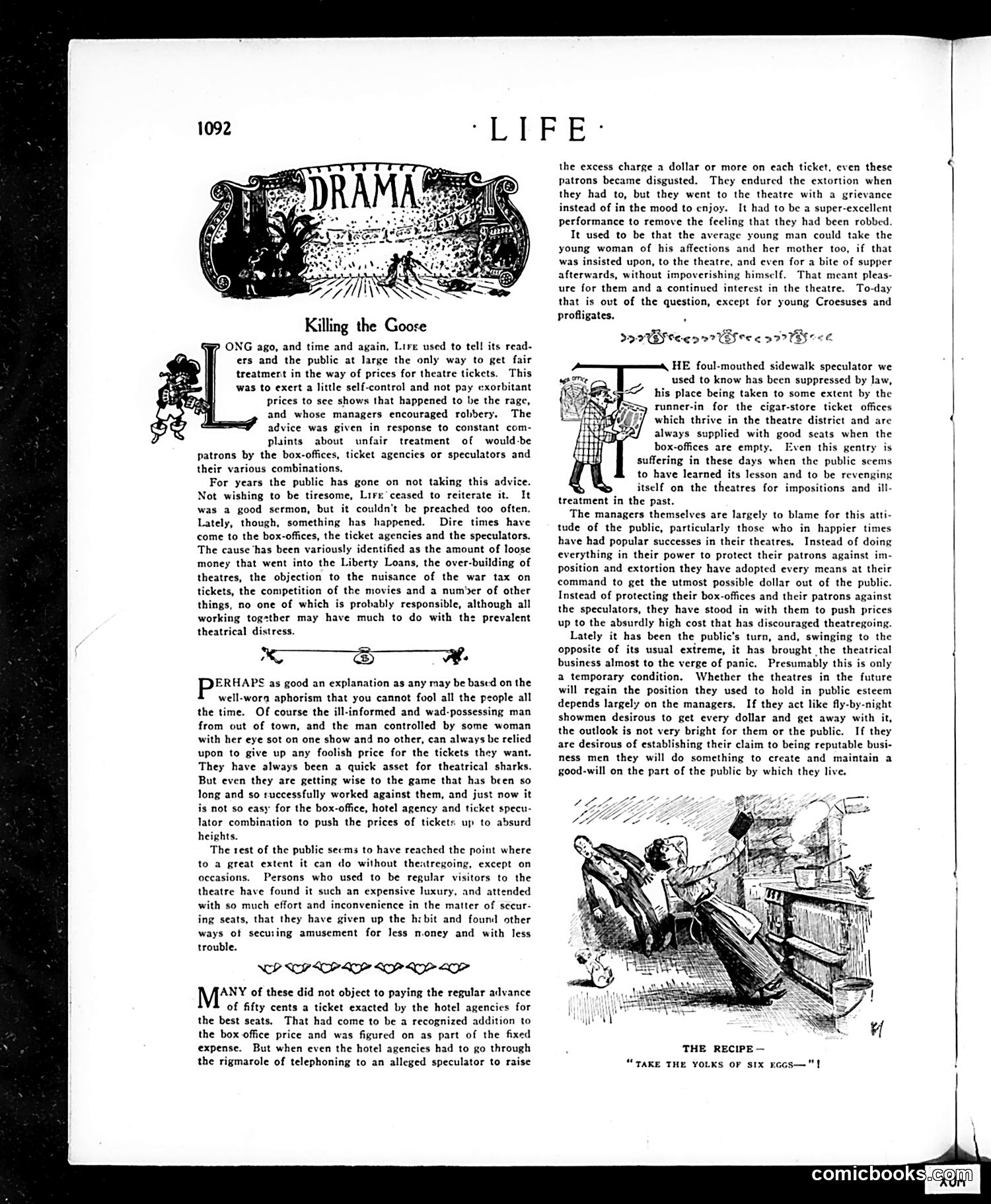
This article satirizes ticket scalpers and theater pricing practices in the post-WWI era. Life argues that speculators and box offices have exploited theatergoers so aggressively—charging inflated prices through various schemes—that they've destroyed their own market. The "goose" metaphor suggests they've killed the source of their profits. The piece identifies the problem: ticket agencies, speculators, and hotels were adding excessive surcharges (fifty cents to a dollar or more per ticket) on top of already high prices. Even wealthy patrons grew disgusted. The public responded by simply avoiding theaters, turning instead to cheaper entertainments like movies. Life's irony is bitter: theater managers' greed to extract maximum revenue per ticket has backfired, reducing attendance to near-ruinous levels. The accompanying illustration shows a man literally knocked down by theatrical ticket-buying expenses—visual proof of how punitive the system had become for ordinary audiences.
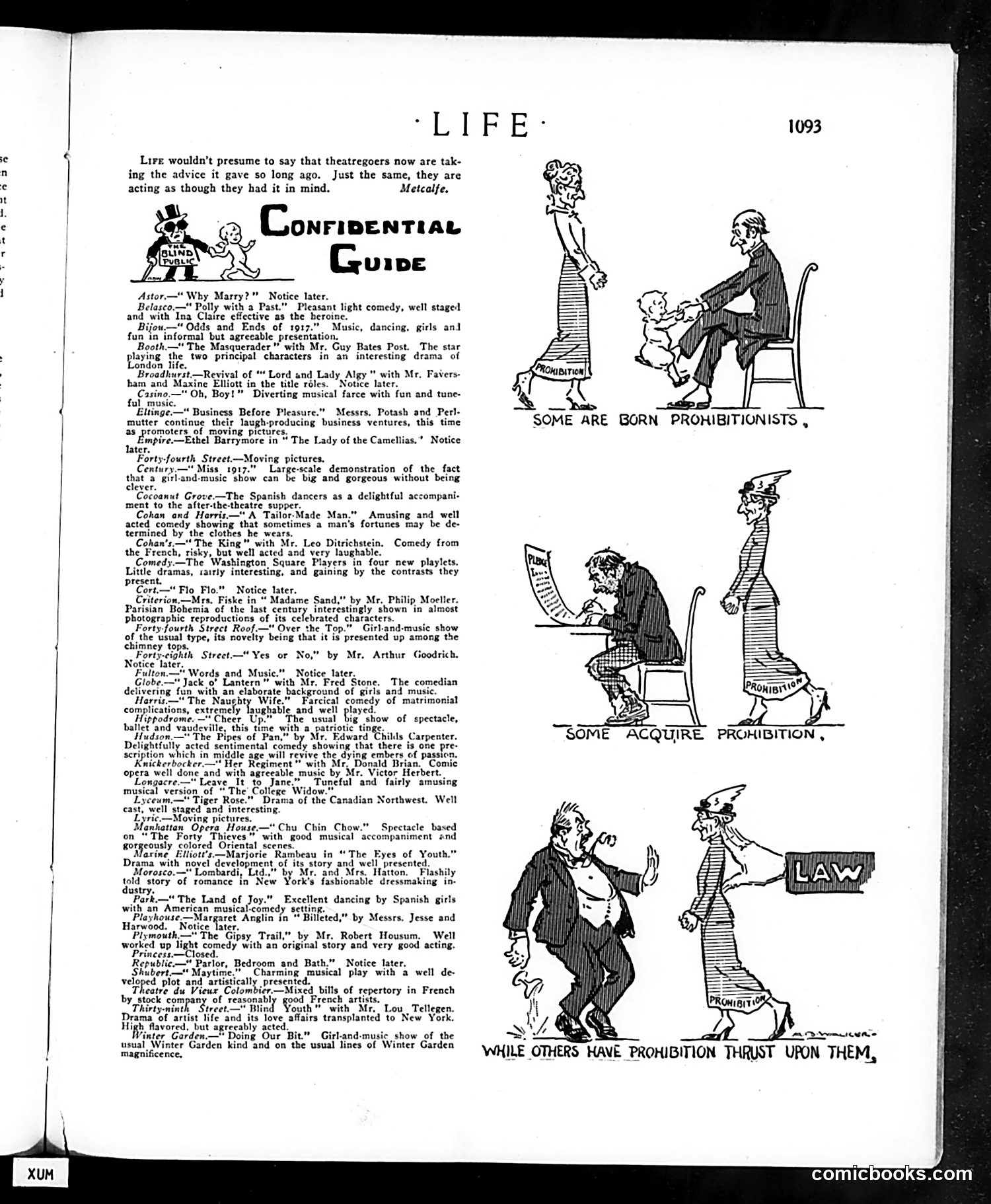
This 1917 Life magazine page satirizes American attitudes toward Prohibition through a series of cartoon vignettes. The cartoons depict three scenarios showing different responses to impending Prohibition laws: **"Some Are Born Prohibitionists"** shows a man naturally avoiding alcohol. **"Some Acquire Prohibition"** depicts someone reluctantly accepting it. **"While Others Have Prohibition Thrust Upon Them"** shows a man being forced into compliance by the law itself—personified as a stern figure labeled "LAW" and "PROHIBITION." The satire suggests that Prohibition enforcement affects people unequally: some abstain willingly, others adapt gradually, while still others resist and must be compelled. The cartoonist (Metcalfe) implies that forcing prohibition on an unwilling population creates conflict rather than genuine moral reform. This reflects pre-ratification debate (the 18th Amendment passed in 1919) about whether Prohibition could succeed against popular resistance.
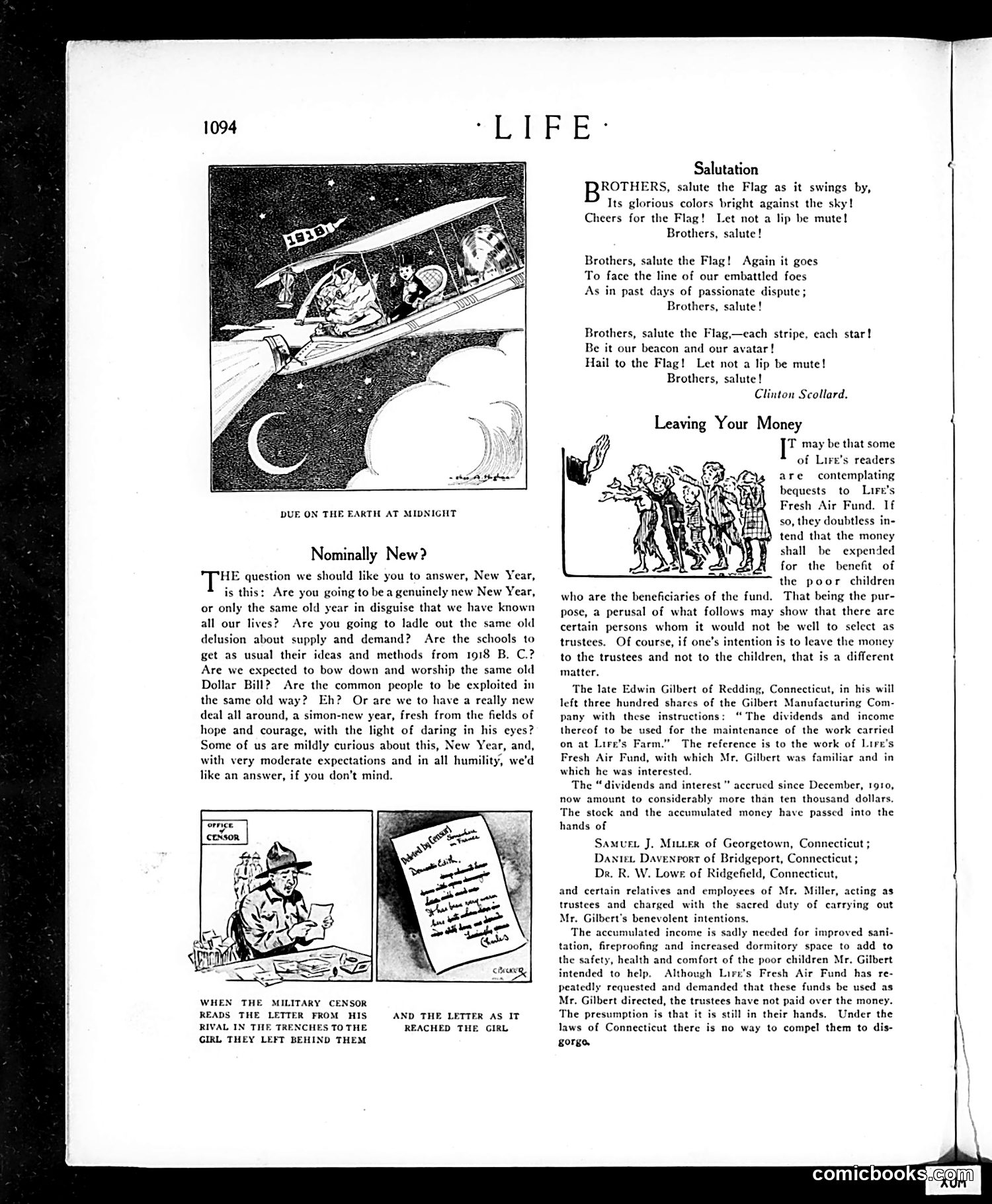
This page contains three distinct pieces of social commentary from the WWI era: **"Due on the Earth at Midnight"** (top): An illustration of an airplane approaching Earth at New Year's—likely depicting the "new year" arriving—paired with editorial questioning whether 1919 will genuinely represent change or merely repeat old failures (exploitation, outdated education systems, worship of money). **"When the Military Censor Reads the Letter"** (bottom left): A cartoon satirizing wartime censorship. The contrast shows how military censors would redact soldiers' personal letters to their sweethearts, leaving only sanitized patriotic content—a commentary on government control of information and soldiers' lost autonomy. **"Leaving Your Money"** (right): An expose piece about trustees misappropriating charitable donations. Edwin Gilbert bequeathed stock dividends to Life's Fresh Air Fund (a children's charity), but trustees allegedly refused to distribute funds. This appears to be public pressure journalism calling out financial malfeasance by named individuals. The page reflects WWI-era concerns: social reform hopes, government overreach, and institutional corruption.
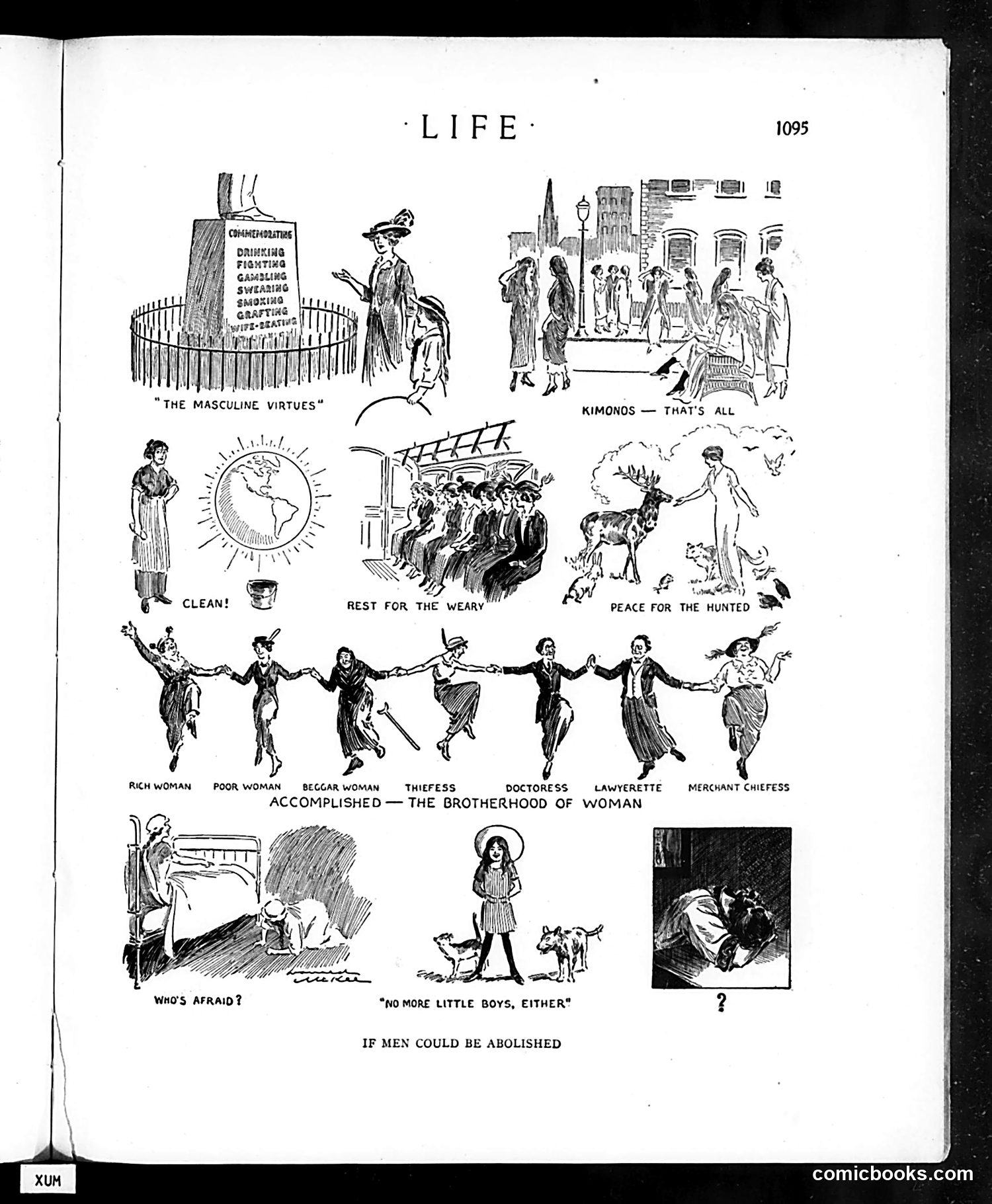
This Life magazine cartoon satirizes early 20th-century feminist ambitions through a fantasy scenario. The page imagines a world without men, depicting women occupying all social roles—rich woman, beggar, thief, doctor, lawyer, merchant—suggesting women could perform any function men did. The satire operates on multiple levels: "The Masculine Virtues" section mocks stereotypical male behavior (drinking, fighting, swearing). Other panels show women in traditionally male professions ("Lawyerette," "Doctoress"). The final images—a woman confidently stating "No More Little Boys, Either" and a questioning "?"—suggest the cartoon's punch: radical feminists allegedly wanted complete male elimination, even reproduction without men. This reflects contemporary anxieties about women's suffrage and workplace equality, portraying feminist goals as absurdly extreme rather than legitimate. The tone mocks both women's ambitions and male fears of female independence.
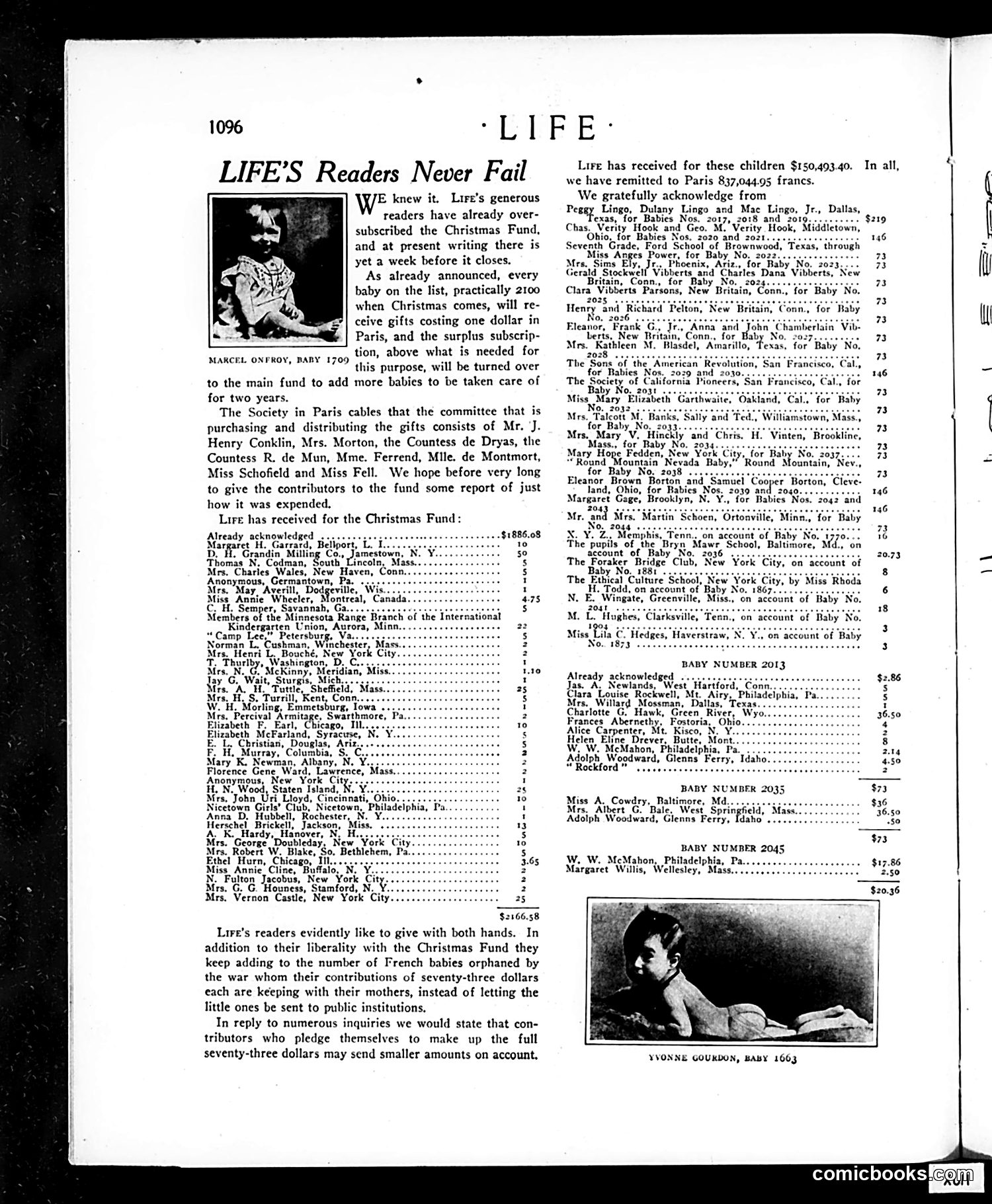
This page documents **LIFE magazine's Christmas charity campaign for French war orphans** during or after World War I. The upper section reports on donations to a "Christmas Fund" that provides $1 gifts to approximately 2,100 orphaned Parisian children, with surplus funds supporting their care for two years. The left image shows **Marcel Onfroy, Baby 1709**, one of the beneficiary children. The page lists hundreds of donors—individuals, clubs, and groups across America—demonstrating grassroots support for French relief efforts. The lower section acknowledges contributors specifically sponsoring individual children at $73 each, keeping them with their mothers rather than in institutions. **The satire's point**: The headline "LIFE's Readers Never Fail" celebrates American generosity and moral virtue. The detailed donor lists and photographs serve as both gratitude and subtle social pressure—showcasing which readers contributed, implicitly encouraging others to give. This reflects post-WWI American charity movements and LIFE's role in mobilizing middle-class philanthropy toward European relief.
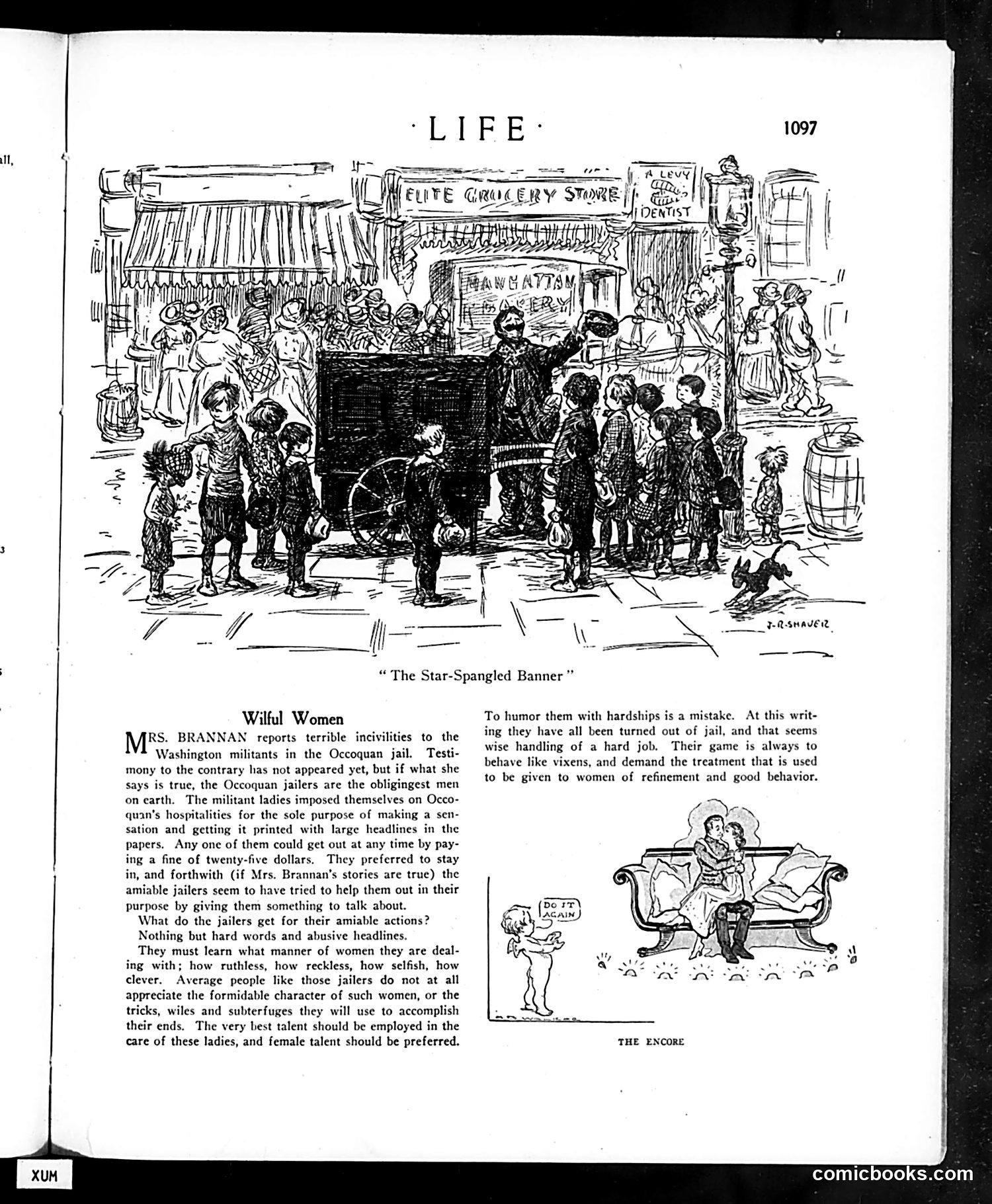
This page mocks women's suffrage activists, specifically those imprisoned at Occoquan jail in Washington. The top sketch shows a street scene with the caption "The Star-Spangled Banner," likely referencing patriotic rhetoric used by suffragists. The article sarcastically defends jailers accused by Mrs. Brannan of mistreating "militant ladies" (suffragists). Life's position: these women deliberately got arrested for publicity, then complained about conditions to generate newspaper headlines. The piece characterizes them as manipulative—using "tricks, wiles and subterfuges"—and suggests they demand special treatment while being ungrateful and abusive to staff. "The Encore" cartoon (bottom right) appears to show women making demands or complaints. The satire dismisses suffragists as calculating publicity-seekers rather than serious activists, a common anti-suffrage argument of the era. Modern readers should note this represents *opposition* to women's voting rights.
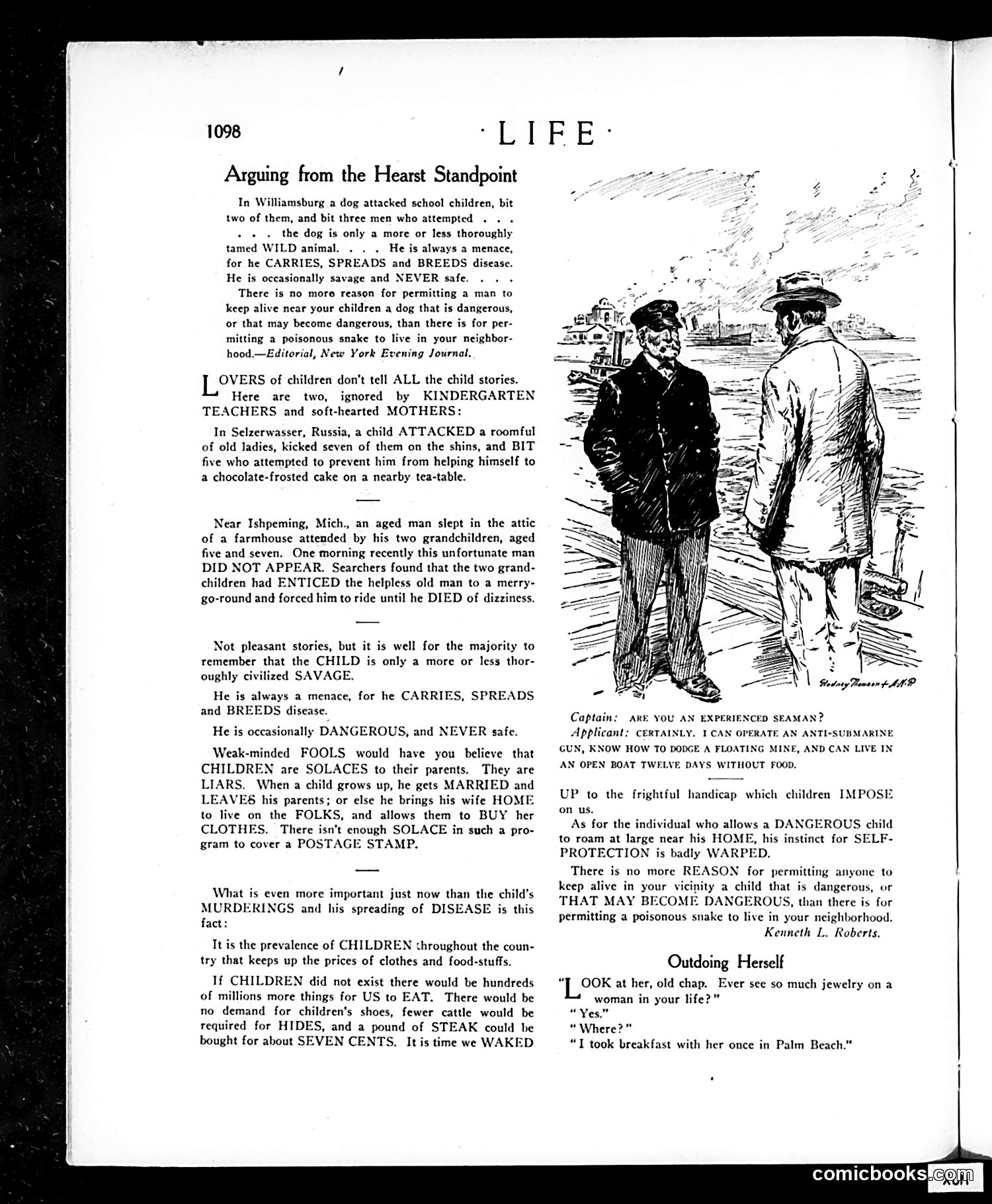
This page satirizes **William Randolph Hearst's sensationalist journalism** by turning his inflammatory editorial logic against children. Hearst's *New York Evening Journal* ran an extreme piece about a dangerous dog, using alarmist language to justify eliminating the animal. Life's satire mimics this rhetoric exactly—using Hearst's own capitalized keywords and dramatic tone—but applies it to *children* instead. The article invents absurd, cruel anecdotes (a child attacking elderly women; grandchildren killing an old man) and argues children are "savages," disease-spreaders, and economic drains, concluding we should eliminate them. The joke is **reductio ad absurdum**: if Hearst's reasoning about dogs is valid, why not apply it to children? The satire exposes how dangerous his editorial sensationalism becomes when its logic is followed consistently. The casual seaman and jewelry jokes are unrelated filler typical of the magazine's format.
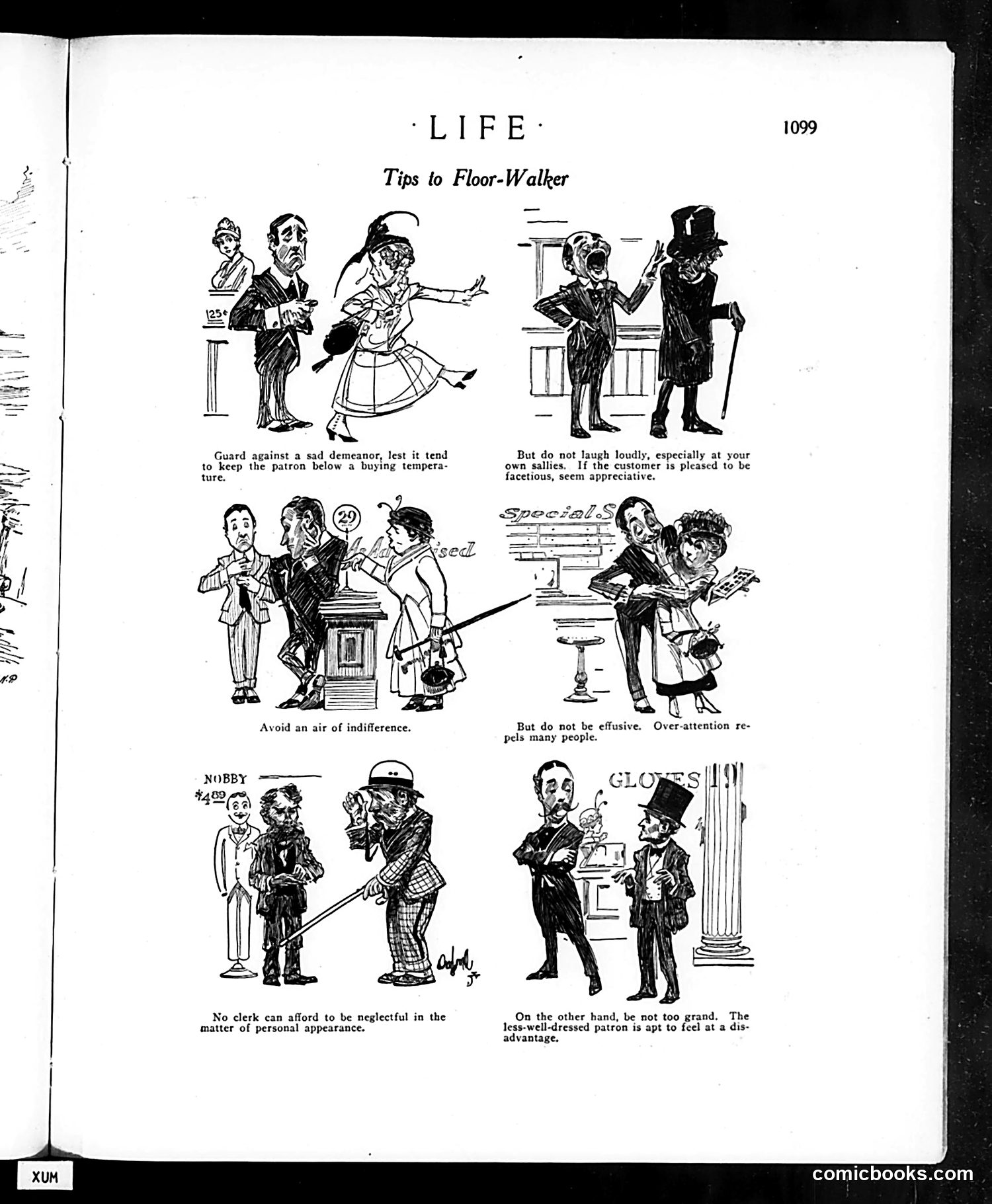
This page offers satirical advice for retail clerks (floor-walkers—salespeople who assisted customers on shop floors). The cartoons mock the contradictory expectations placed on service workers through exaggerated situations: - **The tension**: Clerks must balance multiple opposing demands—appearing cheerful without being too familiar, attentive without being pushy, well-dressed without intimidating poorer customers - **The satire**: Each vignette illustrates an impossible middle ground (avoid sadness but don't laugh too loud; don't be indifferent but don't over-attend) - **Social commentary**: The piece critiques both retail management's unrealistic standards and class-conscious customer behavior—particularly the anxiety less-wealthy patrons felt around well-dressed staff The humor derives from the absurdity of these contradictions, which early 20th-century retail workers genuinely faced. It's a commentary on customer service's emotional labor and social pretense in department stores.
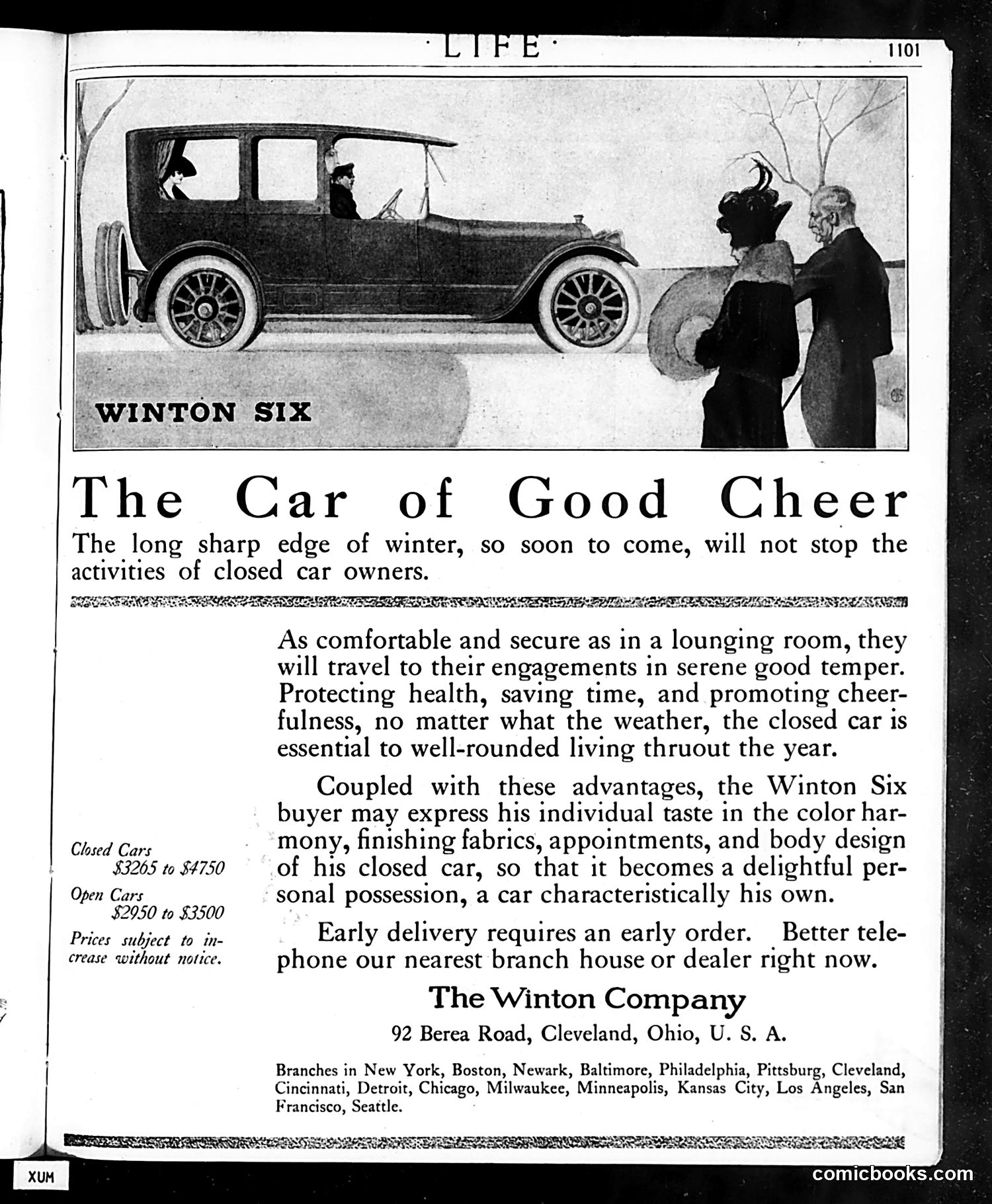
This is a **Winton automobile advertisement**, not satire or political commentary. The image shows a closed-car (sedan) automobile with two well-dressed figures examining it outdoors. The "satire" or humor, if any, is subtle advertising rhetoric: the ad uses genteel language to market a luxury automobile as essential to civilized living. It claims a closed car provides comfort "as comfortable and secure as in a lounging room" and promotes "cheerfulness" and "well-rounded living"—inflating a consumer product into a lifestyle necessity. The figures appear to be prosperous customers; one wears a hat and fur stole, suggesting affluence. The ad emphasizes customization ("color harmony," "finishing fabrics") to appeal to individual taste. The pricing ($2950–$4750 for closed cars) and multiple branch locations indicate this targets an upper-middle-class audience. The framing as protection against winter and enabler of social engagements reflects early automotive marketing that linked cars to modernity and status. This reflects 1920s consumer culture more than satire.
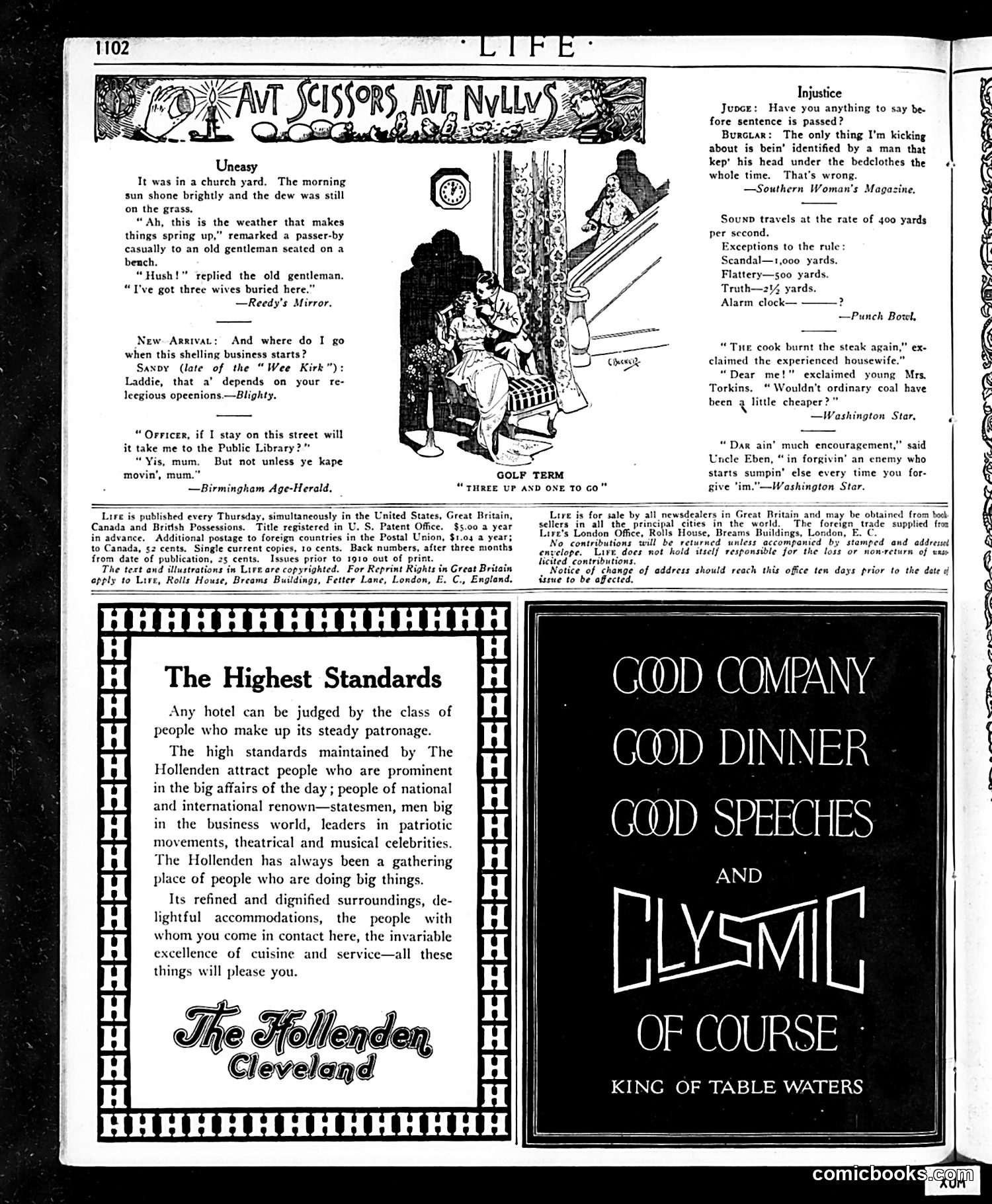
This page contains several short humorous anecdotes typical of early 20th-century American satirical humor, plus advertisements. The jokes mock human nature and social conventions: an old man's dark humor about his three deceased wives; Scottish dialect humor about religious belief determining bomb shelter access (likely WWI-era); a joke about Irish policemen giving vague directions; and golf terminology. The "Injustice" section satirizes legal absurdity—a burglar complains that his identification came from a witness who hid under bedclothes, making it unreliable. Other snippets mock domestic incompetence (a burnt steak), sound travel physics, and the difficulty of truly forgiving enemies. The advertisements promote The Hollenden hotel in Cleveland and Lysol water, emphasizing class and refinement as selling points. The cartoons and text are entirely domestic humor with no clear political references—this appears to be a standard humor/advertising issue rather than political satire.
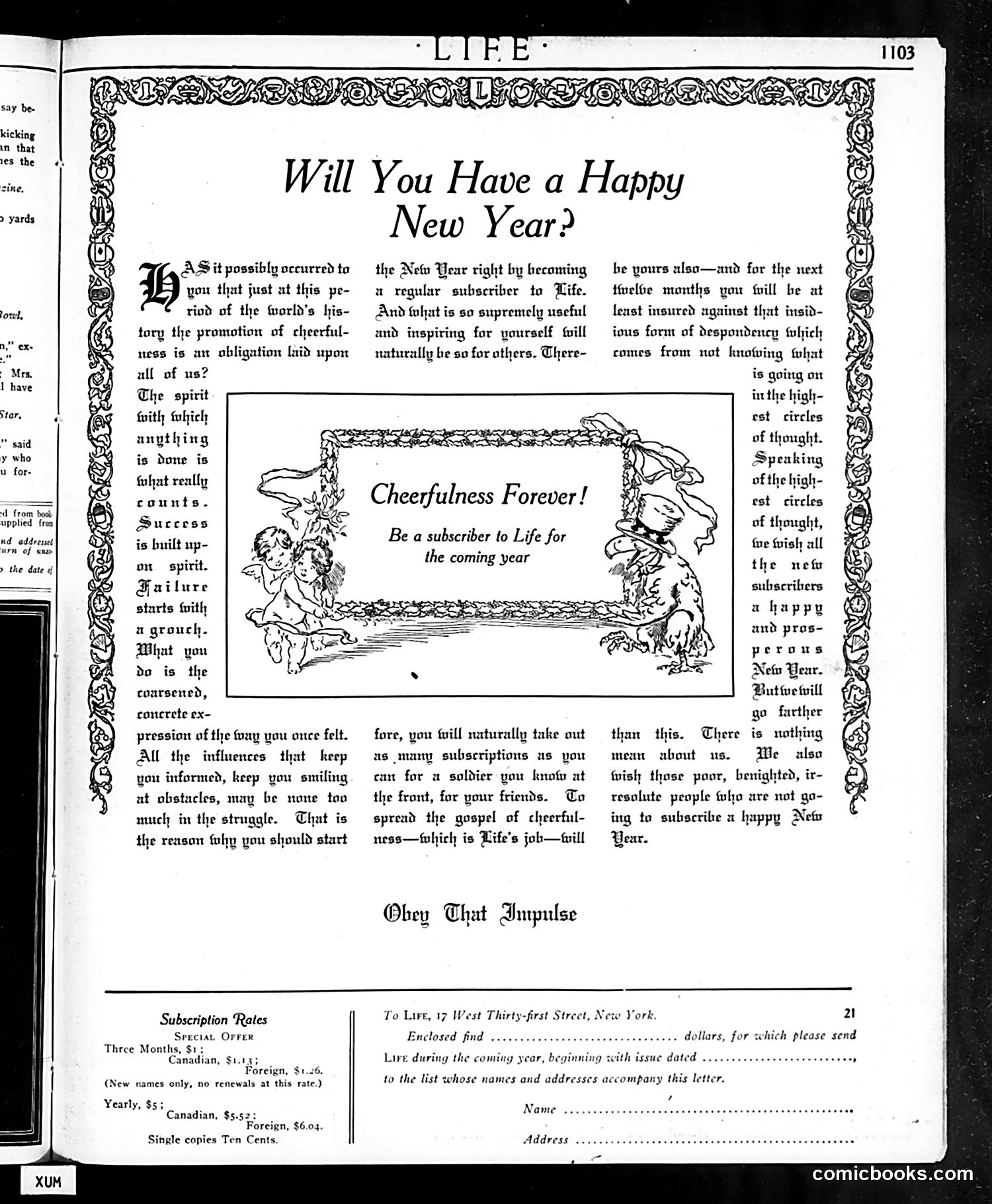
This is a **subscription drive**, not a political cartoon. Life magazine uses the New Year season to recruit subscribers by framing magazine readership as a moral obligation. The page argues that during this "period of the world's history" (likely WWI era, given reference to "soldiers you know at the front"), promoting cheerfulness is a civic duty. The logic: spirit determines success; Life magazine spreads cheerfulness; therefore subscribing—and gifting subscriptions to soldiers and friends—is patriotic duty disguised as gift-giving. The decorative border and classical figures labeled "Cheerfulness Forever!" provide ornamental appeal. The actual "impulse" readers should obey is commercial: purchase multiple subscriptions as New Year gifts. **Modern parallel**: This resembles contemporary feel-good marketing that frames consumption as solving social problems—here, wartime morale.
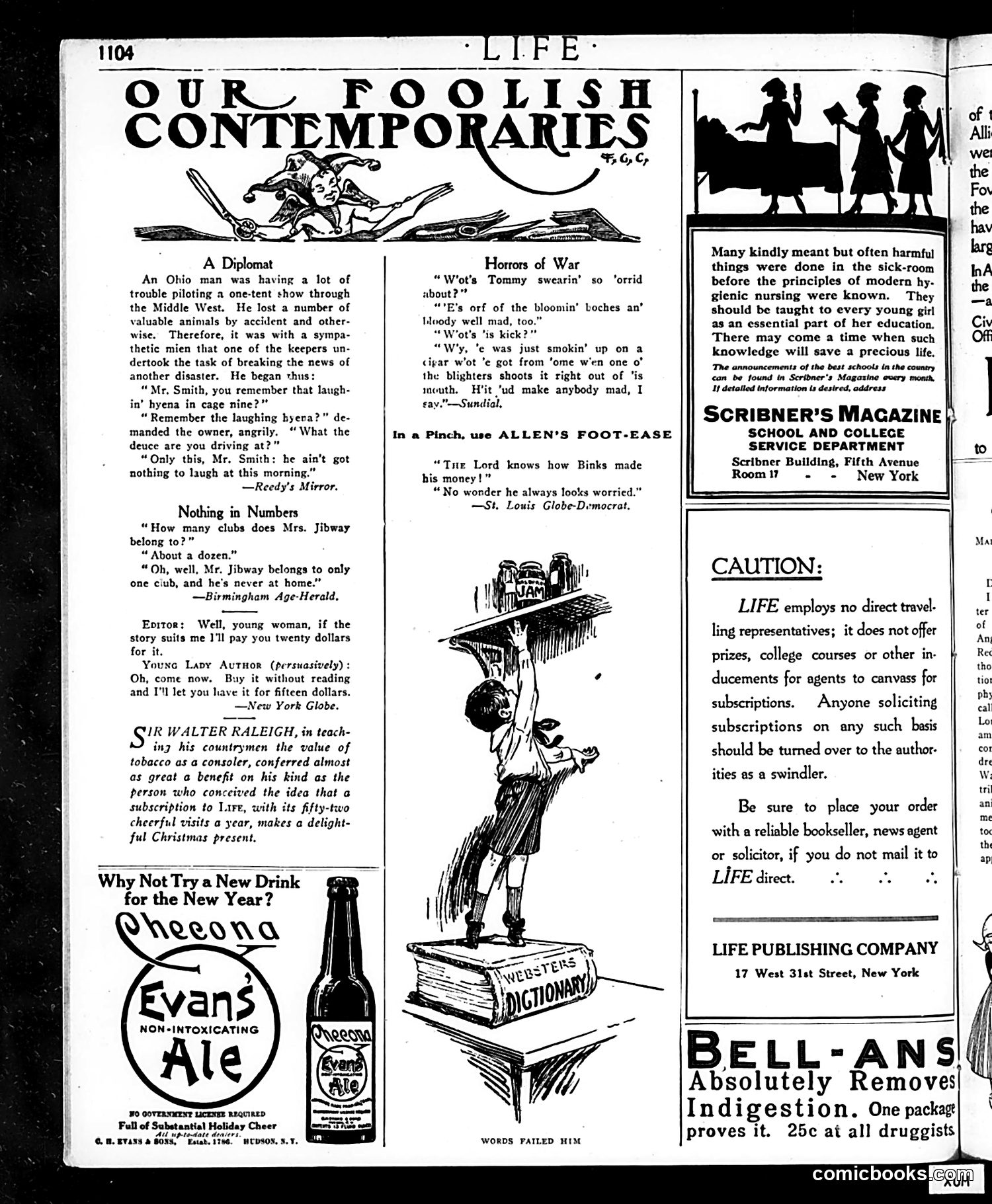
This page from Life magazine collects humorous anecdotes and jokes mocking contemporary absurdities. The main cartoon, "Words Failed Him," depicts a man standing on a dictionary while struggling with an oversized cigar, satirizing those who resort to profanity when language fails them—likely a WWI-era reference to soldiers' colorful language. The "Horrors of War" joke uses British military dialect to mock soldiers' trivial complaints: a soldier is furious that enemy fire destroyed his smuggled cigar from home, treating this minor loss as a major grievance. The humor plays on the contrast between actual wartime dangers and petty personal annoyances. Other jokes mock marital discord, theatrical mishaps, and overeager writers. The section exemplifies Life's satirical purpose: exposing foolishness in contemporary behavior, attitudes, and speech through brief comedic vignettes.
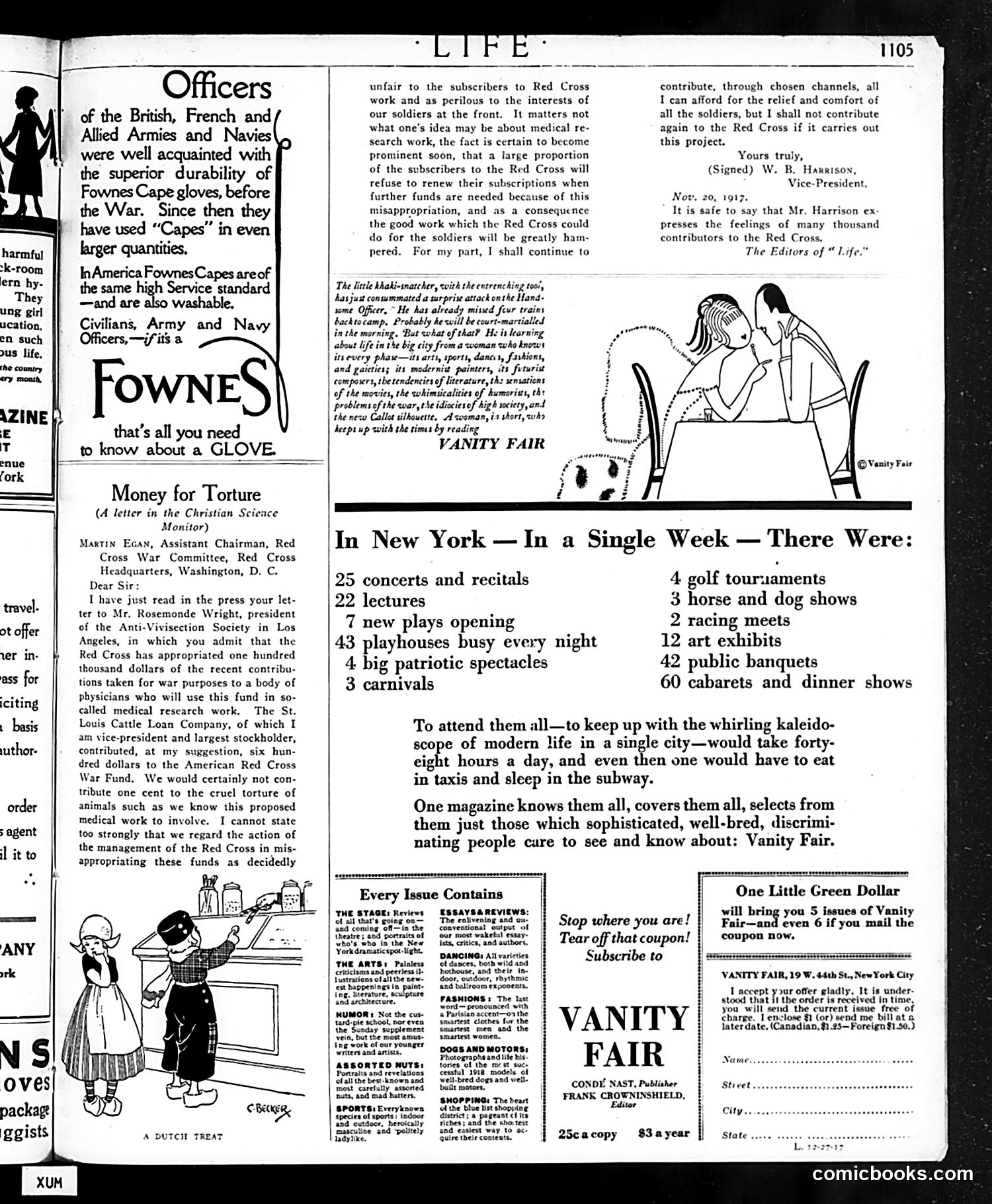
This page mixes advertising with editorial content from November 1917, during World War I. **The cartoon** (lower left, titled "A Dutch Treat") depicts a flirtatious scenario: a young soldier in khaki has apparently "attacked" an elegant woman. The joke, explained in accompanying text, is that he's learning about modern urban life—fashion, theater, literature, society—from a sophisticated woman. The satire targets naive servicemen seduced by city culture while away from military duty. **The "Money for Torture" letter** documents a genuine Red Cross controversy: the organization diverted war contributions to fund animal medical research, angering donors who specifically gave for soldier relief. The letter-writer protests this misappropriation, noting donors will refuse future contributions. **The Vanity Fair advertisement** uses contrasting imagery: New York's exhausting social whirl (42 banquets, 60 cabarets weekly) versus the magazine's curated sophistication for "well-bred, discriminating people." The page overall reflects WWI-era tensions between patriotic duty, consumer culture, and organizational trust.
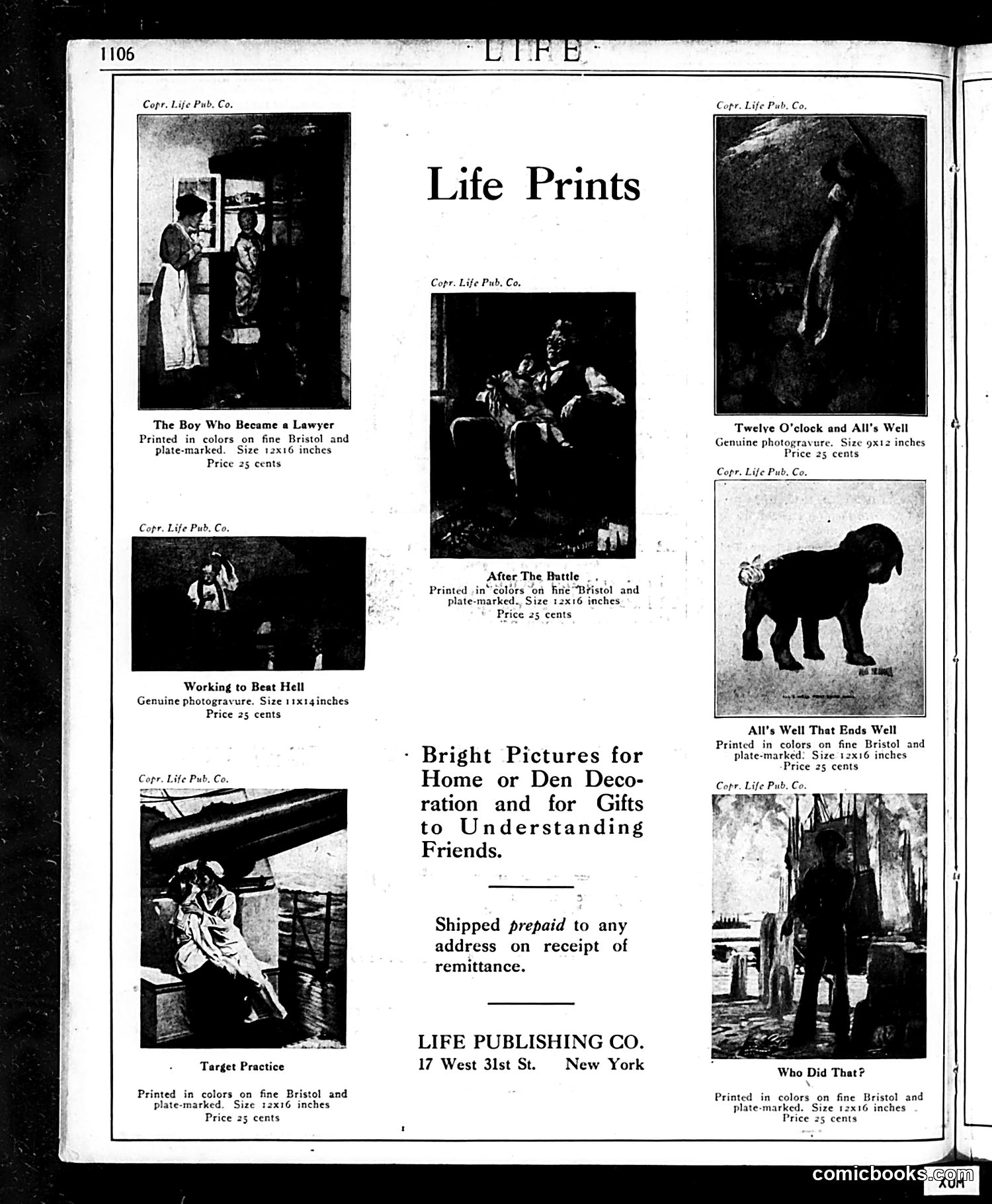
This is a catalog page advertising decorative prints sold by Life Publishing Company (25 cents each). The prints appear to be sentimental or narrative scenes typical of early 20th-century home décor—titles like "The Boy Who Became a Lawyer," "After The Battle," and "All's Well That Ends Well" suggest uplifting, moralistic stories. The imagery shows domestic and dramatic scenes: a lawyer consultation, battle aftermath, target practice, and a dog. These were marketed as affordable "Bright Pictures for Home or Den Decoration and for Gifts to Understanding Friends," shipped prepaid nationwide. This reflects a common commercial practice of the era: selling mass-produced prints as accessible art for middle-class homes. Rather than political satire, this page demonstrates Life's role as both satirical magazine and commercial publisher offering sentimental Americana to ordinary Americans.
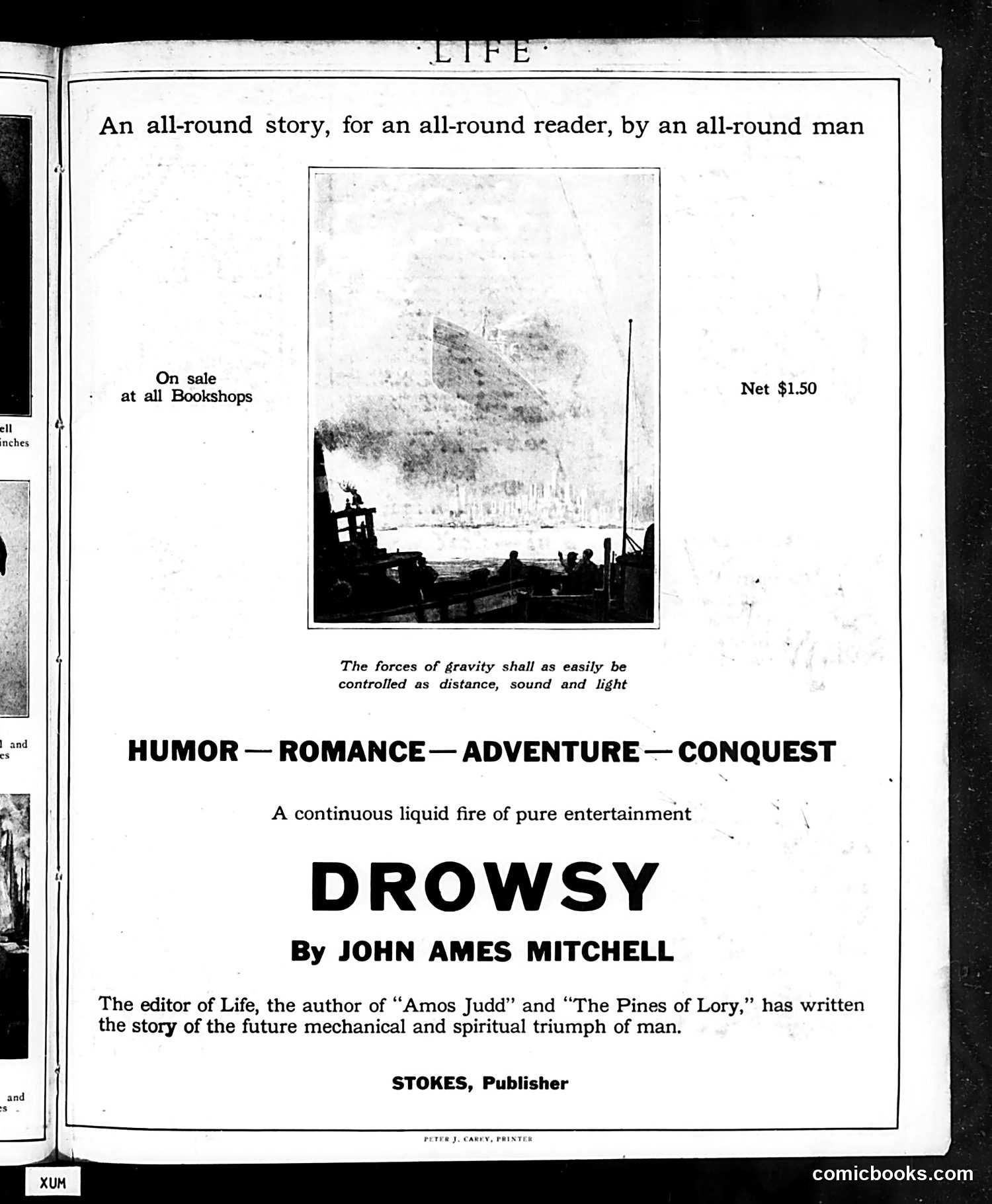
This is a book advertisement, not a political cartoon. It promotes a science fiction novel by John Ames Mitchell, editor of *Life* magazine, published by Stokes. The advertisement emphasizes the book's themes: "Humor—Romance—Adventure—Conquest" and promises "a continuous liquid fire of pure entertainment." The tagline claims the story depicts "the future mechanical and spiritual triumph of man," with the cryptic subtitle "The forces of gravity shall as easily be controlled as distance, sound and light"—suggesting futuristic technological mastery. The dark illustration shows an industrial or mechanical scene, likely representing the "future" setting. The $1.50 price and "on sale at all Bookshops" indicate this was a mass-market publication, typical of early-to-mid 20th century American fiction marketing.
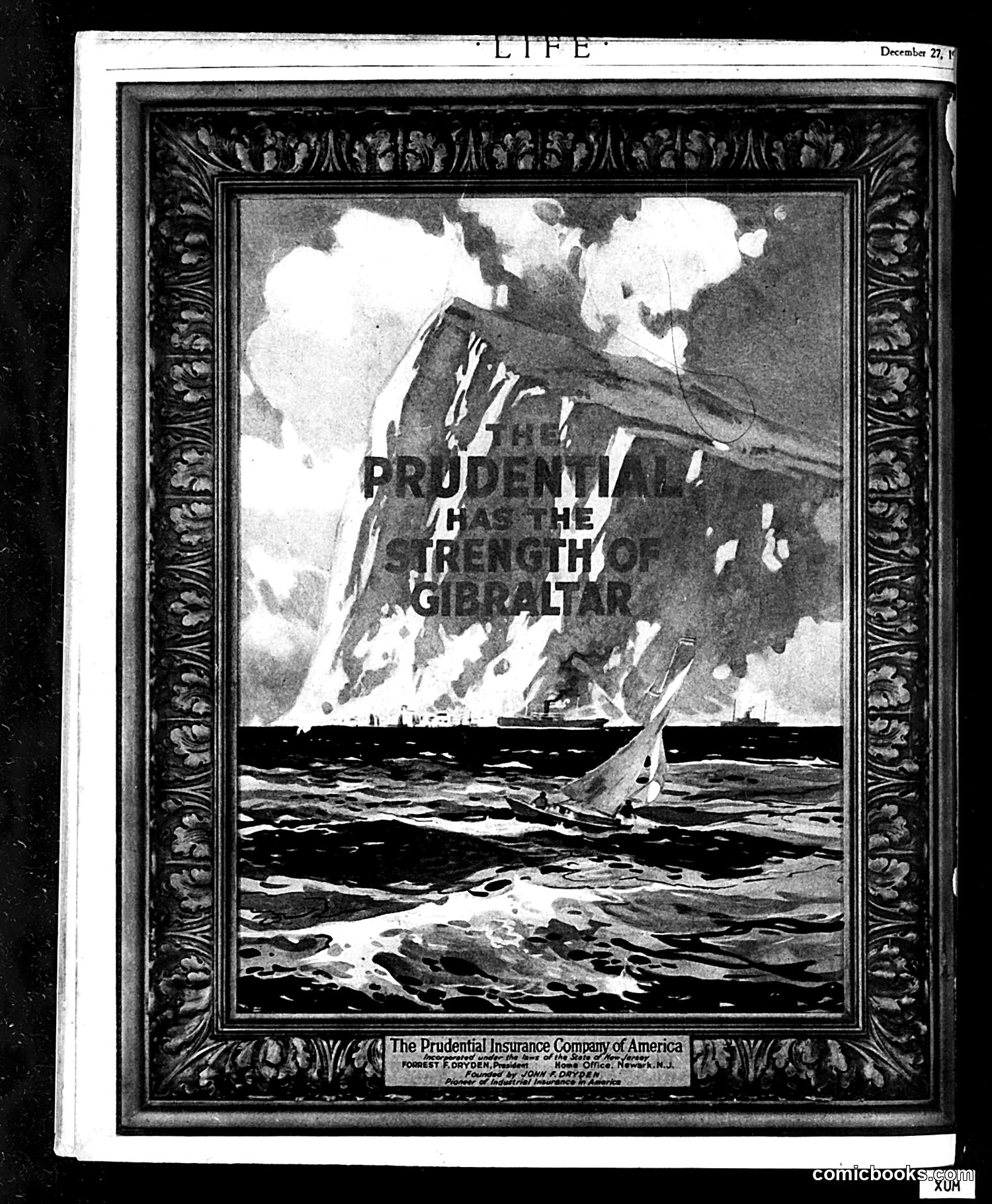
This appears to be a **Prudential Insurance advertisement** rather than political satire. The image shows a sailing ship navigating rocky waters near Gibraltar, with text overlay reading "THE PRUDENTIAL HAS THE STRENGTH OF GIBRALTAR." The advertisement uses Gibraltar—a famous, seemingly immovable rock formation—as a metaphor for Prudential's reliability and stability. The ship successfully navigating treacherous seas symbolizes how the insurance company provides secure protection through life's difficulties. This is corporate branding, not political commentary. The OCR text is largely illegible, but the footer clearly identifies this as promotional material from The Prudential Insurance Company of America, using a classical image metaphor common in early 20th-century advertising.

I can see this is a page from Life magazine, but the image quality is too poor for me to make out specific details of any cartoon(s) or text content with confidence. The page appears very dark with some circular patterns or designs visible, and there's a decorative border on the left side, but I cannot reliably identify: - Any figures or caricatures - Specific political or social references - The intended satirical point or joke - The date or context To provide an accurate historical analysis as requested, I would need a clearer, higher-contrast version of this page. I cannot responsibly invent details to fill in what I cannot see.