
Life, 1917-12-27 · page 16 of 41
Life — December 27, 1917 — page 16: what you’re looking at
What you’re looking at
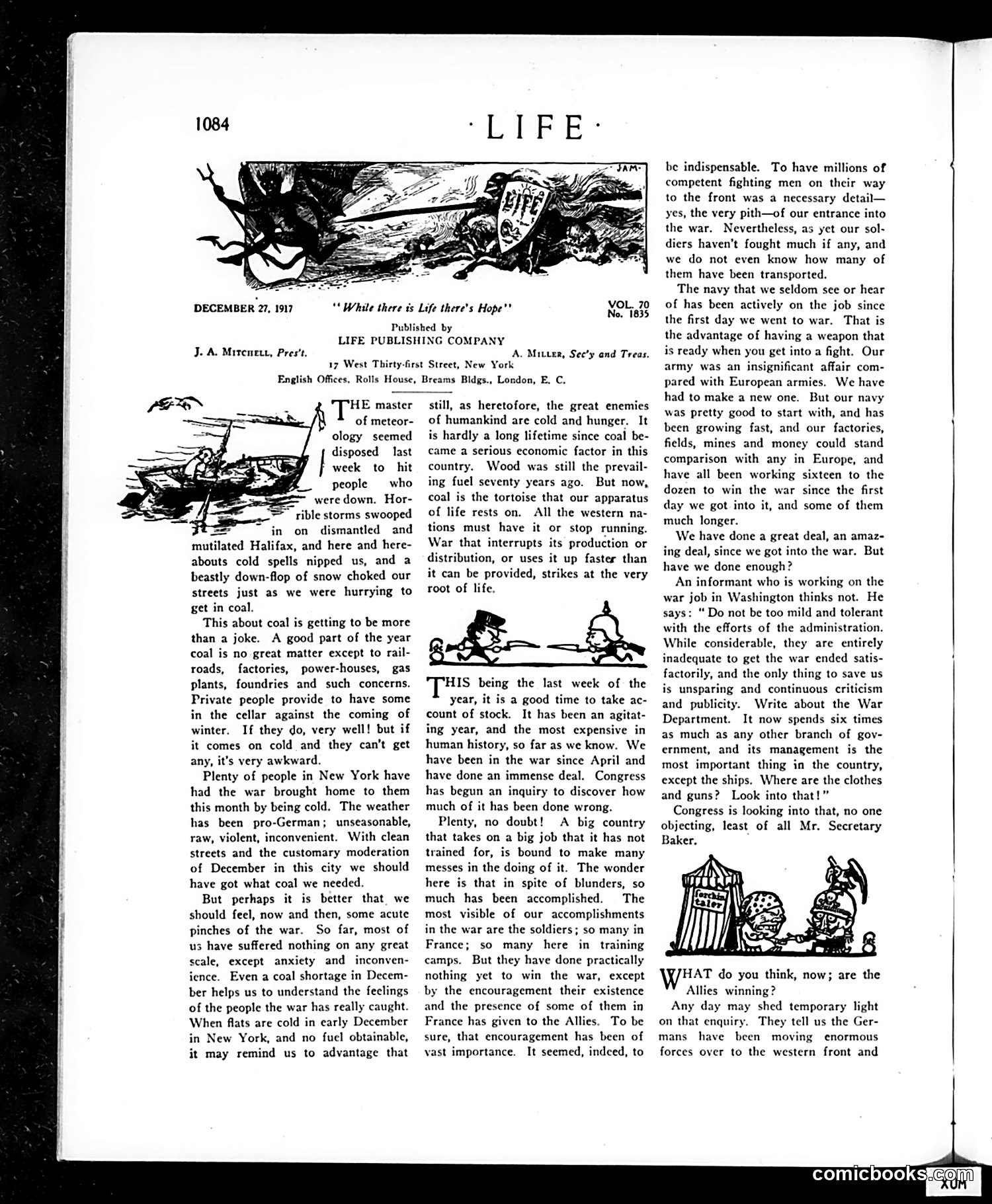
This editorial page addresses American home-front conditions during World War I (U.S. entered April 1917). The main cartoon depicts harsh winter weather personified as "pro-German"—a satirical way of saying the cold and coal shortages hurt American morale and resources. The text discusses two key wartime frustrations: severe coal shortages freezing New York apartments, and an apparent lack of visible military progress. The author argues that while soldier mobilization is impressive, the army "hasn't fought much if any," whereas the Navy has been "actively on the job" since America's war declaration. The piece critiques congressional investigations into war management as inevitable given rapid, large-scale mobilization by an unprepared nation. It acknowledges inefficiency while defending overall accomplishment. The tone balances patriotism with realistic frustration about civilian suffering and unclear military results after eight months of war involvement.
📄 Transcribed text from this page (OCR, searchable)
Machine-transcribed from the original scan — historical spelling and the odd misread are preserved.
DECEMBER 27, 1917 "While there ts Life there's Hope'" VOL. 70 No. 1635 Published by LIFE PUBLISHING COMPANY J. A. Mitcnent, Pres’t. A. Mutter, Sec’y and Treas. 17 West Thirty-first Street, New York English Offices, Rolls House, Breams Bldgs., London, E. C. HE master of meteor- ology seemed disposed last | week to hit people who were down. Hor- ible storms swooped = in on dismantled and mutilated Halifax, and here and here- abouts cold spells nipped us, and a beastly down-flop of snow choked our streets just as we were hurrying to get in coal. This about coal is getting to be more than a joke. A good part of the year coal is no great matter except to rail- roads, factories, power-houses, gas plants, foundries and such concerns. Private people provide to have some in the cellar against the coming of winter. If they do, very well! but if it comes on cold and they can’t get any, it’s very awkward. Plenty of people in New York have had the war brought home to them this month by being cold. The weather has been pro-German; unseasonable, raw, violent, inconvenient. With clean streets and the customary moderation of December in this city we should have got what coal we needed. But perhaps it is better that. we should feel, now and then, some acute pinches of the war. So far, most of us have suffered nothing on any great scale, except anxiety and inconven- ience. Even a coal shortage in Decem- ber helps us to understand the feelings of the people the war has really caught. When flats are cold in early December in New York, and no fuel obtainable, it may remind us to advantage that still, as heretofore, the great enemies of humankind are cold and hunger. It is hardly a long lifetime since coal be- came a serious economic factor in this country. Wood was still the prevail- ing fuel seventy years ago. But now, coal is the tortoise that our apparatus of life rests on. All the western na- tions must have it or stop running. War that interrupts its production or distribution, or uses it up faster than it can be provided, strikes at the very root of life. THs being the last week of the year, it is a good time to take ac- count of stock. It has been an agitat- ing year, and the most expensive in human history, so far as we know. We have been in the war since April and have done an immense deal. Congress has begun an inquiry to discover how much of it has been done wrong. Plenty, no doubt! A big country that takes on a big job that it has not trained for, is bound to make many messes in the doing of it. The wonder here is that in spite of blunders, so much has been accomplished. The most visible of our accomplishments in the war are the soldiers; so many in France; so many here in training camps. But they have done practically nothing yet to win the war, except by the encouragement their existence and the presence of some of them in France has given to the Allies. To be sure, that encouragement has been of vast importance. It seemed, indeed, to be indispensable. To have millions of competent fighting men on their way to the front was a necessary detail— yes, the very pith—of our entrance into the war. Nevertheless, as yet our sol- diers haven't fought much if any, and we do not even know how many of them have been transported. The navy that we seldom see or hear of has been actively on the job since the first day we went to war. That is the advantage of having a weapon that is ready when you get into a fight. Our army was an insignificant affair com- pared with European armies. We have had to make a new one. But our navy was pretty good to start with, and has been growing fast, and our factories, fields, mines and money could stand comparison with any in Europe, and have all been working sixteen to the dozen to win the war since the first day we got into it, and some of them much longer. We have done a great deal, an amaz- ing deal, since we got into the war. But have we done enough? An informant who is working on the war job in Washington thinks not. He says: “ Do not be too mild and tolerant with the efforts of the administration. While considerable, they are entirely inadequate to get the war ended satis- factorily, and the only thing to save us is unsparing and continuous criticism and publicity. Write about the War Department. It now spends six times as much as any other branch of gov- ernment, and its management is the most important thing in the country, except the ships. Where are the clothes and guns? Look into that!” Congress is looking into that, no one objecting, least of all Mr. Secretary Baker. HAT do you think, now; are the Allies winning? Any day may shed temporary light on that enquiry, They tell us the Ger- mans ha been moving enormous forces over to the western front and comicbook