
Life, 1917-12-27 · page 17 of 41
Life — December 27, 1917 — page 17: what you’re looking at
What you’re looking at
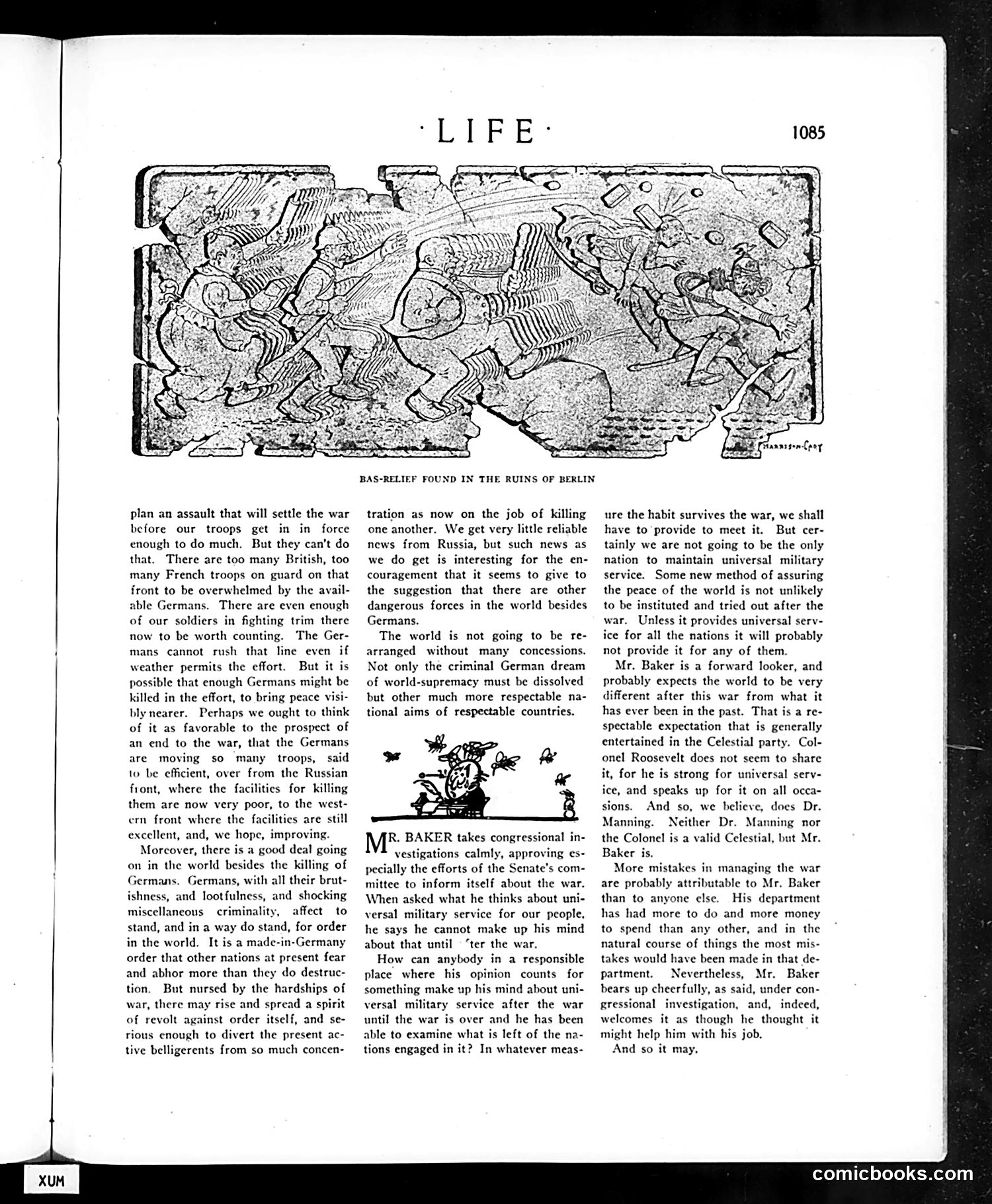
The top image is a bas-relief depicting what appears to be ancient warfare or conflict—soldiers in combat with weapons and bodies. The caption "BAS-RELIEF FOUND IN THE RUINS OF BERLIN" is satirical, suggesting that future archaeologists will find this WWI-era relief in Berlin's ruins, implying Germany's inevitable destruction. The text discusses Secretary of War Newton Baker, who apparently belongs to the "Celestial party" (likely a reference to progressive reformers). The article criticizes Baker for deferring judgment on universal military service until "after the war"—the satire being that one cannot properly plan post-war policy without knowing what remains after the current conflict. The piece also mocks Colonel Roosevelt (likely Theodore Roosevelt) and Dr. Manning for advocating universal military service, while suggesting Baker, though forward-thinking, bears responsibility for numerous wartime management errors despite his department's vast resources and scope. The overall tone is critical commentary on American WWI leadership and planning.
📄 Transcribed text from this page (OCR, searchable)
Machine-transcribed from the original scan — historical spelling and the odd misread are preserved.
plan an assault that will settle the war before our troops get in in force enough to do much. But they can’t do that. There are too many British, too many French troops on guard on that front to be overwhelmed by the avail- able Germans. There are even enough of our soldiers in fighting trim there now to be worth counting. The Ger- mans cannot rush that line even if weather permits the effort. But it is possible that enough Germans might be killed in the effort, to bring peace visi- bly nearer. Perhaps we ought to think of it as favorable to the prospect of an end to the war, that the Germans are moving so many troops, said to be efficient, over from the Russian front, where the facilities for killing them are now very poor, to the west- ern front where the facilities are still excellent, and, we hope, improving. Morcover, there is a good deal going on in the world besides the killing of Germans. Germans, with all their brut- ishness, and lootfulness, and shocking miscellaneous criminality, affect to stand, and in a way do stand, for order in the world. It is a made-in-Germany order that other nations at present fear and abhor more than they do destruc- tion. But nursed by the hardships of war, there may rise and spread a spirit of revolt against order itself, and se- rious enough to divert the present ac- tive belligerents from so much concen- BAS-RELIEF FOUND IN THE RUINS OF BERLIN tration as now on the job of killing one another. We get very little reliable news from Russia, but such news as we do get is interesting for the en- couragement that it seems to give to the suggestion that there are other dangerous forces in the world besides Germans. The world is not going to be re- arranged without many concessions. Not only the criminal German dream of world-supremacy must be dissolved but other much more respectable na- tional aims of respectable countries. M® BAKER takes congressional in- vestigations calmly, approving e¢s- pecially the efforts of the Senate's com- mittee to inform itself about the war. When asked what he thinks about uni- versal military service for our people, he says he cannot make up his mind about that until “ter the war. How can anybody in a responsible place where his opinion counts for something make up his mind about uni- versal military service after the war until the war is over and he has been able to examine what is left of the na- tions engaged in it? In whatever meas- Manassen ley ure the habit survives the war, we shall have to provide to meet it. But cer- tainly we are not going to be the only nation to maintain universal military service. Some new method of assuring the peace of the world is not unlikely to be instituted and tried out after the war. Unless it provides universal serv- ice for all the nations it will probably not provide it for any of them. Mr. Baker is a forward looker, and probably expects the world to be very different after this war from what it has ever been in the past. That is a re- spectable expectation that is generally entertained in the Celestial party. Col- onel Roosevelt does not seem to share it, for he is strong for universal serv- ice, and speaks up for it on all occa- sions. And so, we believe, does Dr. Manning. Neither Dr. Manning nor the Colonel is a valid Celestial, but Mr. Baker is, More mistakes in managing the war are probably attributable to Mr. Baker than to anyone else. His department has had more to do and more money to spend than any other, and in the natural course of things the most mis- takes would have been made in that de- partment. Nevertheless, Mr. Baker bears up cheerfully, as said, under con- gressional investigation, and, indeed, welcomes it as though he thought it might help him with his job. And so it may. comicbooks.com