
Life, 1917-12-27 · page 6 of 41
Life — December 27, 1917 — page 6: what you’re looking at
What you’re looking at
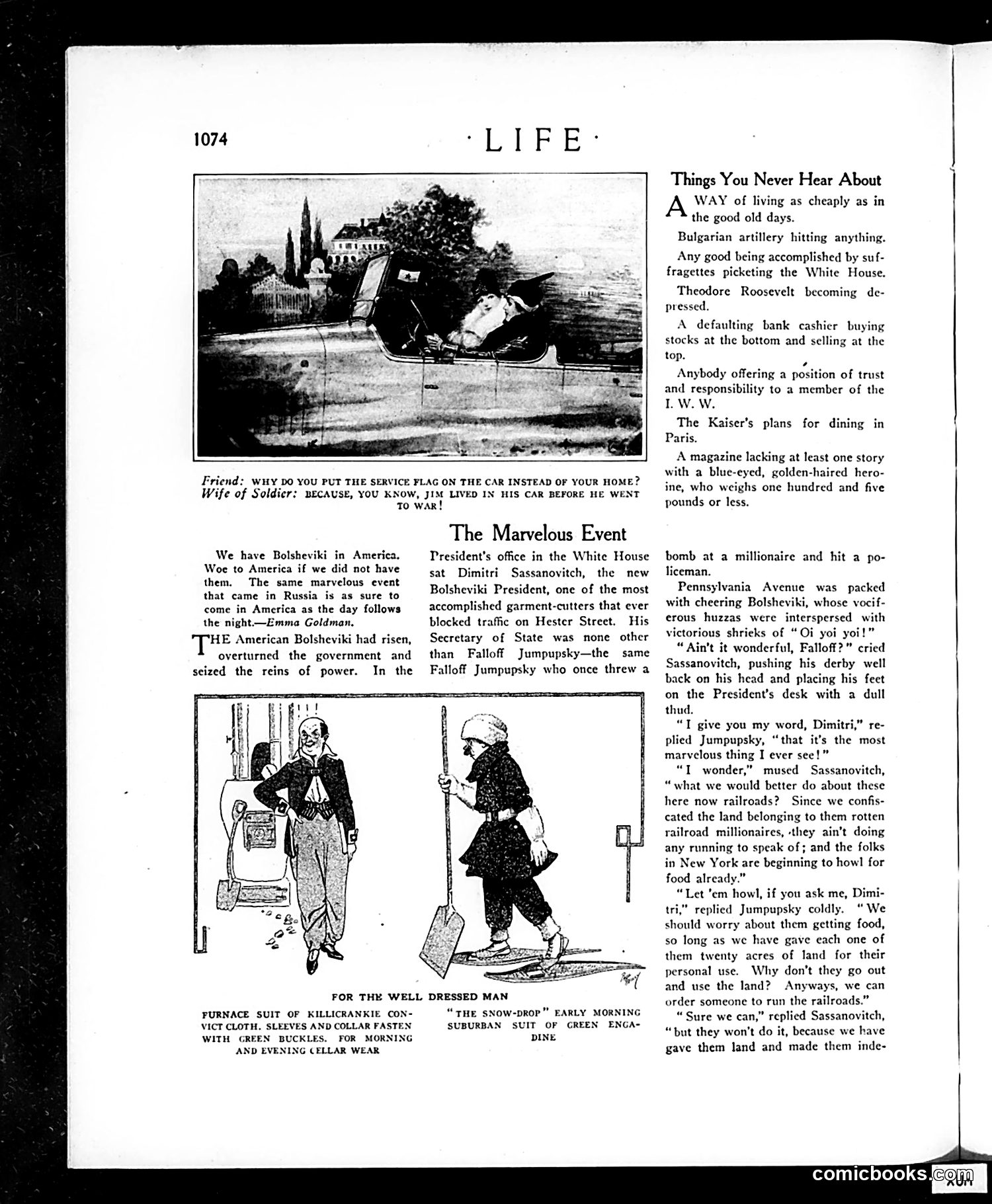
This page satirizes the Russian Bolshevik Revolution's American supporters. The top cartoon jokes about a soldier's wife displaying a service flag (indicating a family member in WWI) on her car instead of at home—suggesting she prioritizes appearances over genuine patriotism. "The Marvelous Event" article mocks American Bolsheviks, using a dialogue between Dimitri Sassanovitch (the new Bolshevik President) and Falloff Jumpupsky. The satire critiques how Bolsheviks seized power in Russia, then were celebrated by some Americans. The cartoon illustrations show figures in Russian-style clothing, likely caricaturing these ideological sympathizers. The piece ridicules both the Bolshevik revolution and Americans who admired it during the post-WWI period.
📄 Transcribed text from this page (OCR, searchable)
Machine-transcribed from the original scan — historical spelling and the odd misread are preserved.
1074 Friend: WHY DO YOU PUT THE SERVICE FLAG ON THE CAR INSTEAD OF YOUR HOME? Wife of Soldier: secause, you know, yim LIVED IN HIS CAR BEFORE HE WENT To war! We have Bolsheviki in America, Woe to America if we did not have them. The same marvelous event that came in Russia is as sure to come in America as the day follows the night.—Emma Goldman, HE American Bolsheviki had risen, overturned the government and seized the reins of power. In the The Marvelous Event President's office in the White House sat Dimitri Sassanovitch, the new Bolsheviki President, one of the most accomplished garment-cutters that ever blocked traffic on Hester Street. His Secretary of State was none other than Falloff Jumpupsky—the same Falloff Jumpupsky who once threw a gt Hef FOR THE WELL DRESSED MAN FURNACE SUIT OF KILLICRANKIE CON- VICT CLOTH. SLEEVES AND COLLAR FASTEN WITH GR BUCK FOR MOR’ AND EVENING CELLAR WEAR “THE SNOW-DROP” EARLY MORNING SUBURBAN SUIT OF GREEN ENGA- DINE Things You Never Hear About WAY of living as cheaply as in the good old days. Bulgarian artillery hitting anything. Any good being accomplished by suf- fragettes picketing the White House. Theodore Roosevelt becoming de- pressed. A defaulting bank cashier buying stocks at the bottom and selling at the top. Anybody offering a position of trust and responsibility to a member of the IW. W. The Kaiser’s plans for dining in Paris. A magazine lacking at least one story with a blue-eyed, golden-haired hero- ine, who weighs one hundred and five pounds or less. bomb at a millionaire and hit a po- liceman. Pennsylvania Avenue was packed with cheering Bolsheviki, whose vocif- erous huzzas were interspersed with victorious shrieks of “Oi yoi yoi!” “ Ain't it wonderful, Falloff?” cried Sassanovitch, pushing his derby well back on his head and placing his feet on the President’s desk with a dull thud. “T give you my word, Dimitri,” re- plied Jumpupsky, “that it’s the most marvelous thing I ever see!” “I wonder,” mused Sassanovitch, “what we would better do about these here now railroads? Since we confis- cated the land belonging to them rotten railroad millionaires, ‘they ain't doing any running to speak of; and the folks in New York are beginning to howl for food already.” “Let ‘em howl, if you ask me, Dimi- tri,” replied Jumpupsky coldly. “ We should worry about them getting food, so long as we have gave each one of them twenty acres of land for their personal use. Why don't they go out and use the land? Anyways, we can order someone to run the railroads.” “Sure we can,” replied Sassanovitch, “but they won't do it, because we have gave them land and made them inde- comicbooks