
Life, 1917-12-27 · page 10 of 41
Life — December 27, 1917 — page 10: what you’re looking at
What you’re looking at
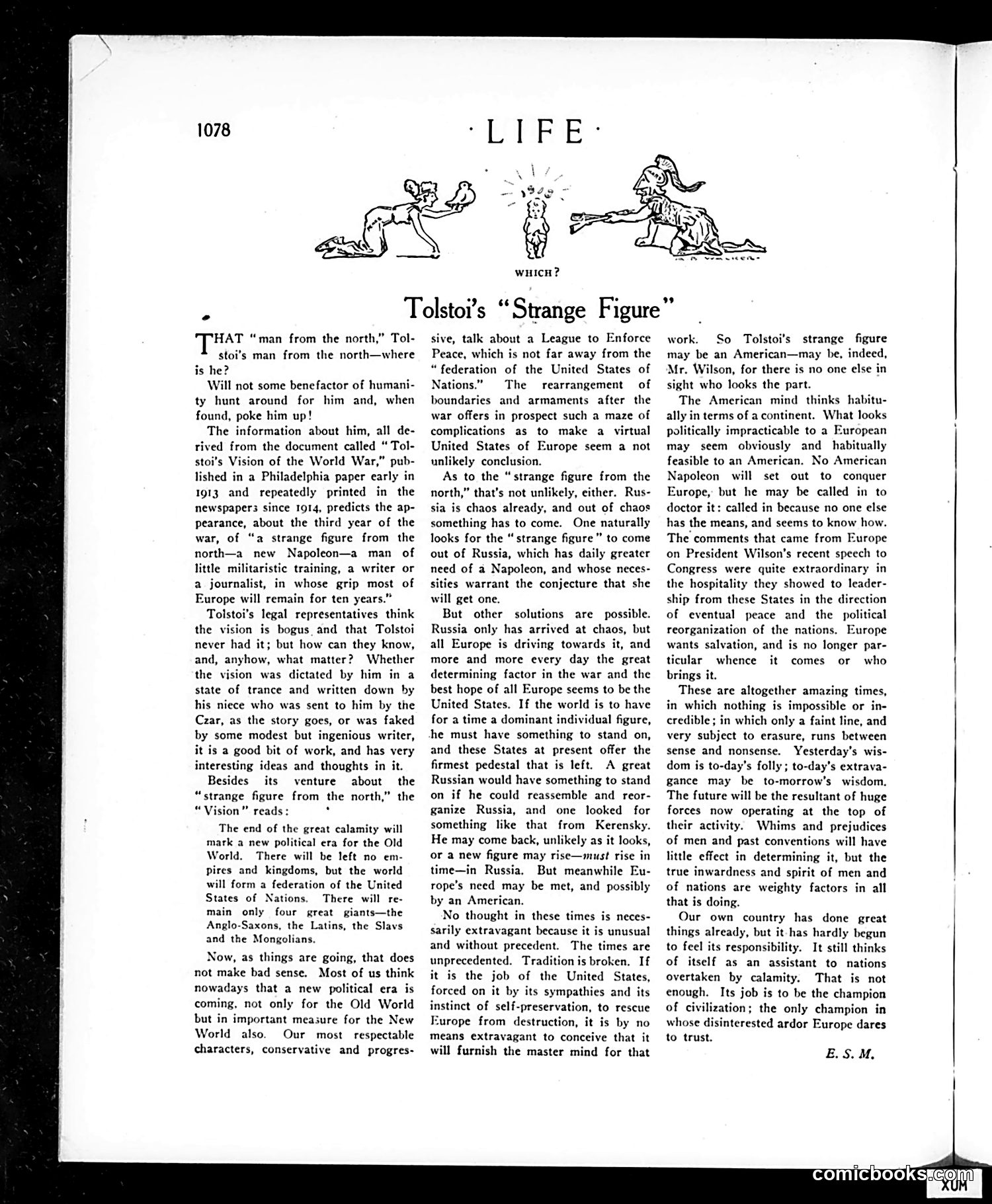
This 1913 *Life* magazine article discusses Leo Tolstoy's alleged "Vision of the World War," a document predicting European chaos and calling for a "League to Enforce Peace" and a "United States of Europe." The cartoon depicts three figures: a crawling man (labeled "man from the north"—likely representing Russia or a Russian leader), a small figure in the center marked "WHICH?" (the mysterious "strange figure"), and a third figure on the right (possibly representing America or Western powers). The satire mocks Tolstoy's vision as unrealistic speculation about who might emerge as Europe's dominant leader during coming chaos. The article's author (E.S.M.) skeptically suggests such prophecies, while intriguing, are ultimately impractical—though the author does credit America's potential role in European reorganization.
📄 Transcribed text from this page (OCR, searchable)
Machine-transcribed from the original scan — historical spelling and the odd misread are preserved.
'HAT “man from the north,” Tol- stoi’s man from the north—where is he? Will not some benefactor of humani- ty hunt around for him and, when found, poke him up! The information about him, all de- rived from the document called “ Tol- stoi’s Vision of the World War,” pub- lished in a Philadelphia paper early in 1913 and repeatedly printed in the newspapers since 1914, predicts the ap- pearance, about the third year of the war, of “a strange figure from the north—a new Napoleon—a man of little militaristic training, a writer or a journalist, in whose grip most of Europe will remain for ten years.” Tolstoi’s legal representatives think the vision is bogus and that Tolstoi never had it; but how can they know, and, anyhow, what matter? Whether the vision was dictated by him in a state of trance and written down by his niece who was sent to him by the Czar, as the story goes, or was faked by some modest but ingenious writer, it is a good bit of work, and has very interesting ideas and thoughts in it. Besides its venture about the “strange figure from the north,” the “Vision” reads: * The end of the great calamity will mark a new political era for the Old World. There will be left no em- Pires and kingdoms, but the world will form a federation of the United States of Nations. There will re- main only four great giants—the Anglo-Saxons, the Latins, the Slavs and the Mongolians. Now, as things are going, that does not make bad sense. Most of us think nowadays that a new political era is coming, not only for the Old World but in important measure for the New World also. Our most respectable characters, conservative and progres- WHICH? Tolstoi’s “Strange Figure” sive, talk about a League to Enforce Peace, which is not far away from the “federation of the United States of Nations.” The rearrangement of boundaries and armaments after the war offers in prospect such a maze of complications as to make a virtual United States of Europe seem a not unlikely conclusion. As to the “strange figure from the north,” that’s not unlikely, either. Rus- sia is chaos already, and out of chaos something has to come. One naturally looks for the “ strange figure” to come out of Russia, which has daily greater need of a Napoleon, and whose neces- sities warrant the conjecture that she will get one. But other solutions are possible. Russia only has arrived at chaos, but all Europe is driving towards it, and more and more every day the great determining factor in the war and the best hope of all Europe seems to be the United States. If the world is to have for a time a dominant individual figure, he must have something to stand on, and these States at present offer the firmest pedestal that is left. A great Russian would have something to stand on if he could reassemble and reor- ganize Russia, and one looked for something like that from Kerensky. He may come back, unlikely as it looks, or a new figure may rise—must rise in time—in Russia, But meanwhile Eu- rope’s need may be met, and possibly by an American. No thought in these times is neces- sarily extravagant because it is unusual and without precedent. The times are unprecedented. Tradition is broken. If it is the job of the United States, forced on it by its sympathies and its instinct of self-preservation, to rescue Europe from destruction, it is by no means extravagant to conceive that it will furnish the master mind for that work. So Tolstoi’s strange figure may be an American—may be, indeed, Mr. Wilson, for there is no one else in sight who looks the part. The American mind thinks habitu- ally in terms of a continent. What looks politically impracticable to a European may seem obviously and habitually feasible to an American. No American Napoleon will set out to conquer Europe, but he may be called in to doctor it: called in because no one else has the means, and seems to know how. The comments that came from Europe on President Wilson's recent speech to Congress were quite extraordinary in the hospitality they showed to leader- ship from these States in the direction of eventual peace and the political reorganization of the nations. Europe wants salvation, and is no longer par- ticular whence it comes or brings it. These are altogether amazing times, in which nothing is impossible or in- credible; in which only a faint line, and very subject to erasure, runs between sense and nonsense. Yesterday's wis- dom is to-day’s folly; to-day’s extrava- gance may be to-morrow’s wisdom, The future will be the resultant of huge forces now operating at the top of their activity. Whims and prejudices of men and past conventions will have little effect in determining it, but the true inwardness and spirit of men and of nations are weighty factors in all that is doing. Our own country has done great things already, but it-has hardly begun to feel its responsibility. It still thinks of itself as an assistant to nations overtaken by calamity. That is not enough. Its job is to be the champion of civilization; the only champion in whose disinterested ardor Europe dares to trust. who E.S.M. Ccomicbook: SUN |