
A complete issue · 44 pages · 1917
Life — October 4, 1917
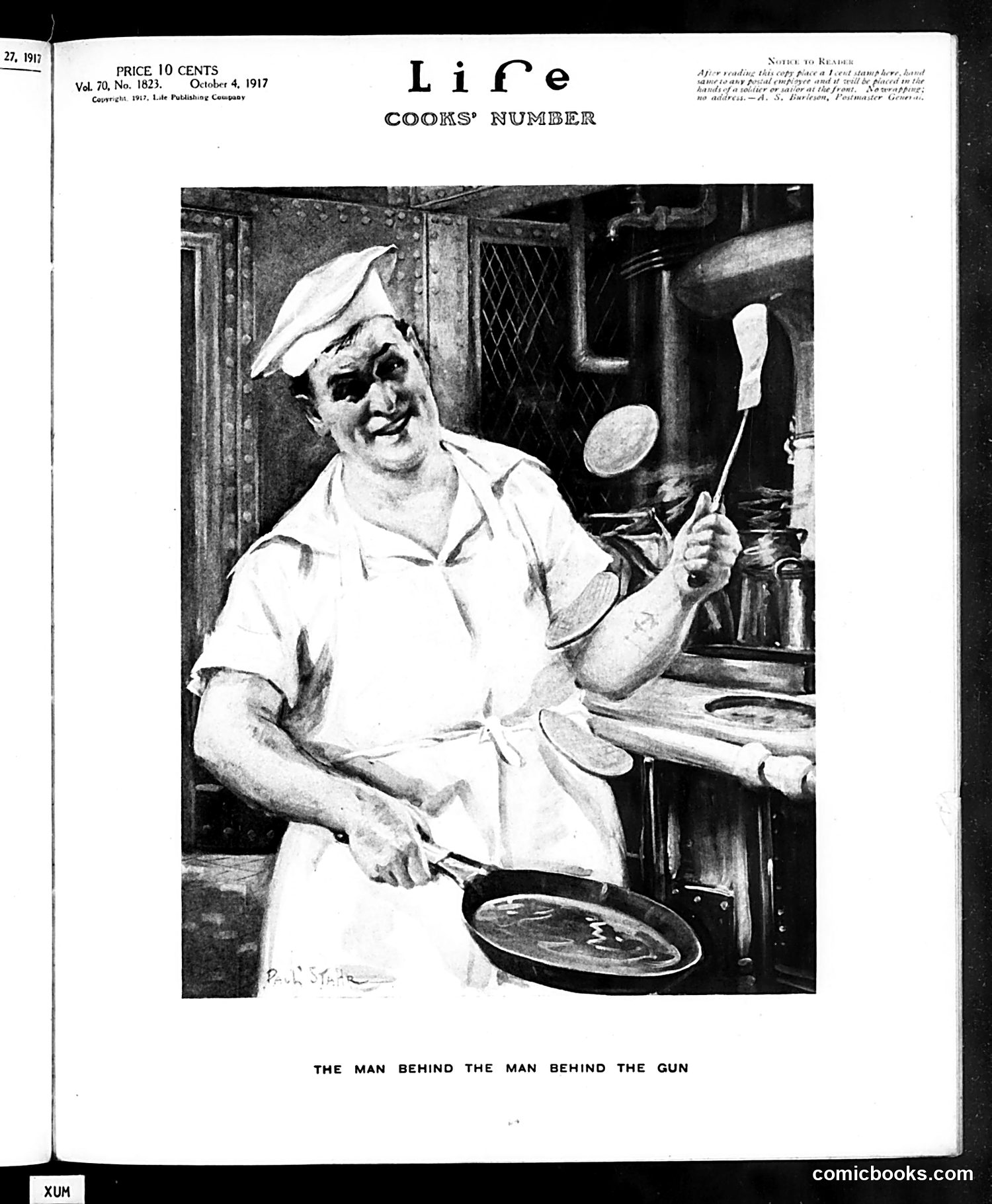
This is the cover of *Life* magazine's "Cooks' Number" from October 4, 1917. The cartoon depicts a jovial cook in a kitchen, juggling frying pans with the caption "THE MAN BEHIND THE MAN BEHIND THE GUN." The phrase "man behind the gun" was WWI-era slang referencing soldiers. This satirical inversion—focusing on the cook who feeds soldiers—humorously elevates the cook's role as essential to military readiness. The timing (1917, when America entered WWI) suggests the joke celebrates home-front workers, particularly food providers, as crucial to the war effort. The exaggerated, caricatured expression and domestic kitchen setting emphasize how ordinary civilians contributed indirectly to military success through their labor, especially food production and supply.

This is **not a cartoon or satire** — it's a straightforward tire advertisement from *Life* magazine. The page promotes Fisk Non-Skid Tires, emphasizing their safety benefits on various road conditions (brick, snow, mud, asphalt, macadam). The advertisement uses cross-sectional diagrams of tire treads to explain the mechanical principle behind the non-skid design. The illustrations on the left show how the tire performs across different surfaces, while the text argues that Fisk tires provide superior grip and prevent skidding year-round. This appears to be early-to-mid 20th century automotive advertising, when tire safety was a developing concern and manufacturers competed on technical innovation rather than brand prestige.
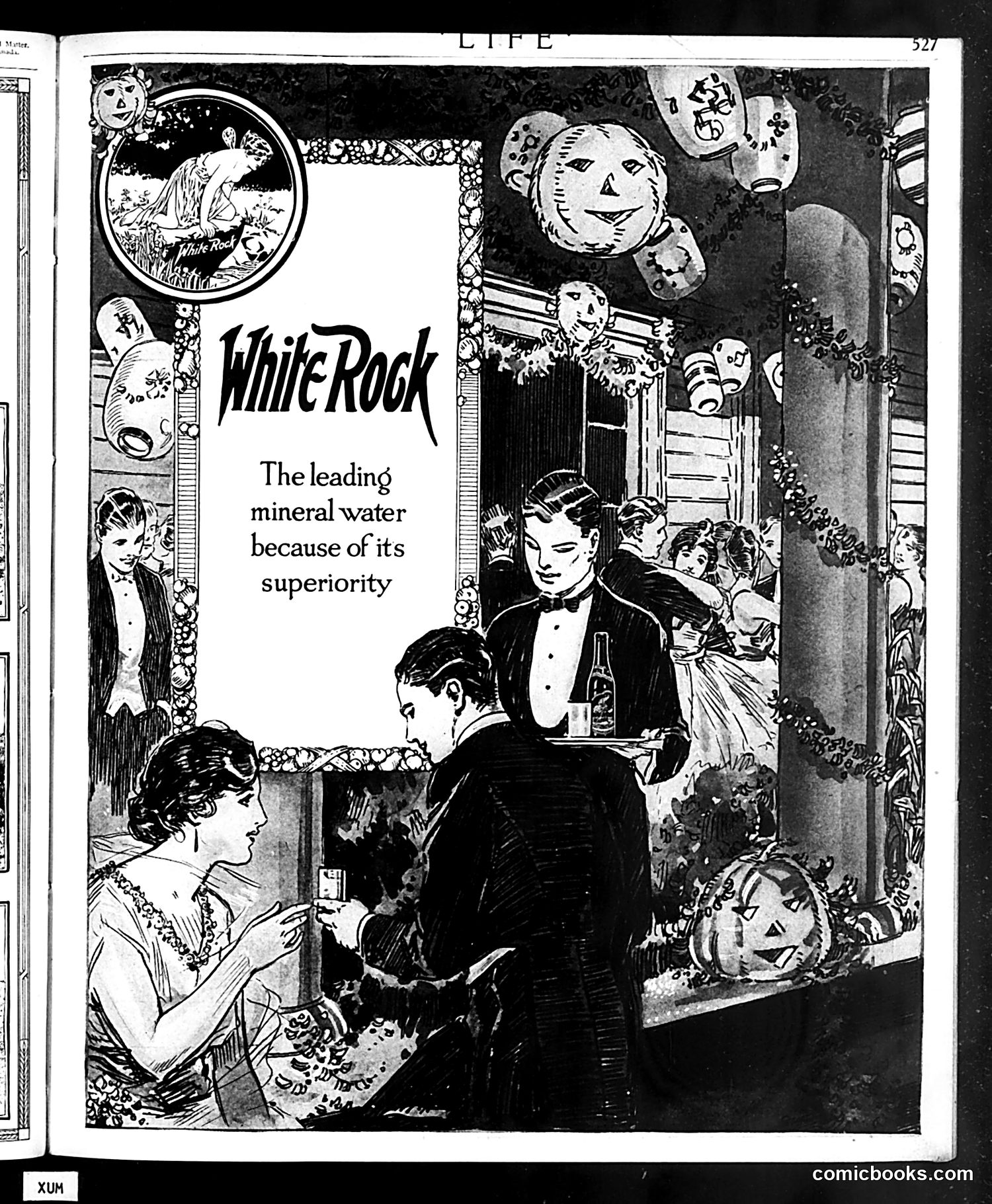
This is a straightforward **product advertisement**, not political satire. It depicts an elegant evening party or formal event, with well-dressed guests in tuxedos and evening wear. A waiter serves White Rock mineral water to attendees, emphasizing the product's association with sophistication and high-class social occasions. The decorative border features whimsical face designs (appearing to be nymphs or sprites), which was a common branding element for White Rock at the time. The tagline claims White Rock is "the leading mineral water because of its superiority." The advertisement uses aspirational imagery—linking the product to refined social status and elegance—a typical marketing strategy for premium beverages in early-to-mid 20th century magazines. There is no apparent political or social commentary; this is pure commercial promotion.
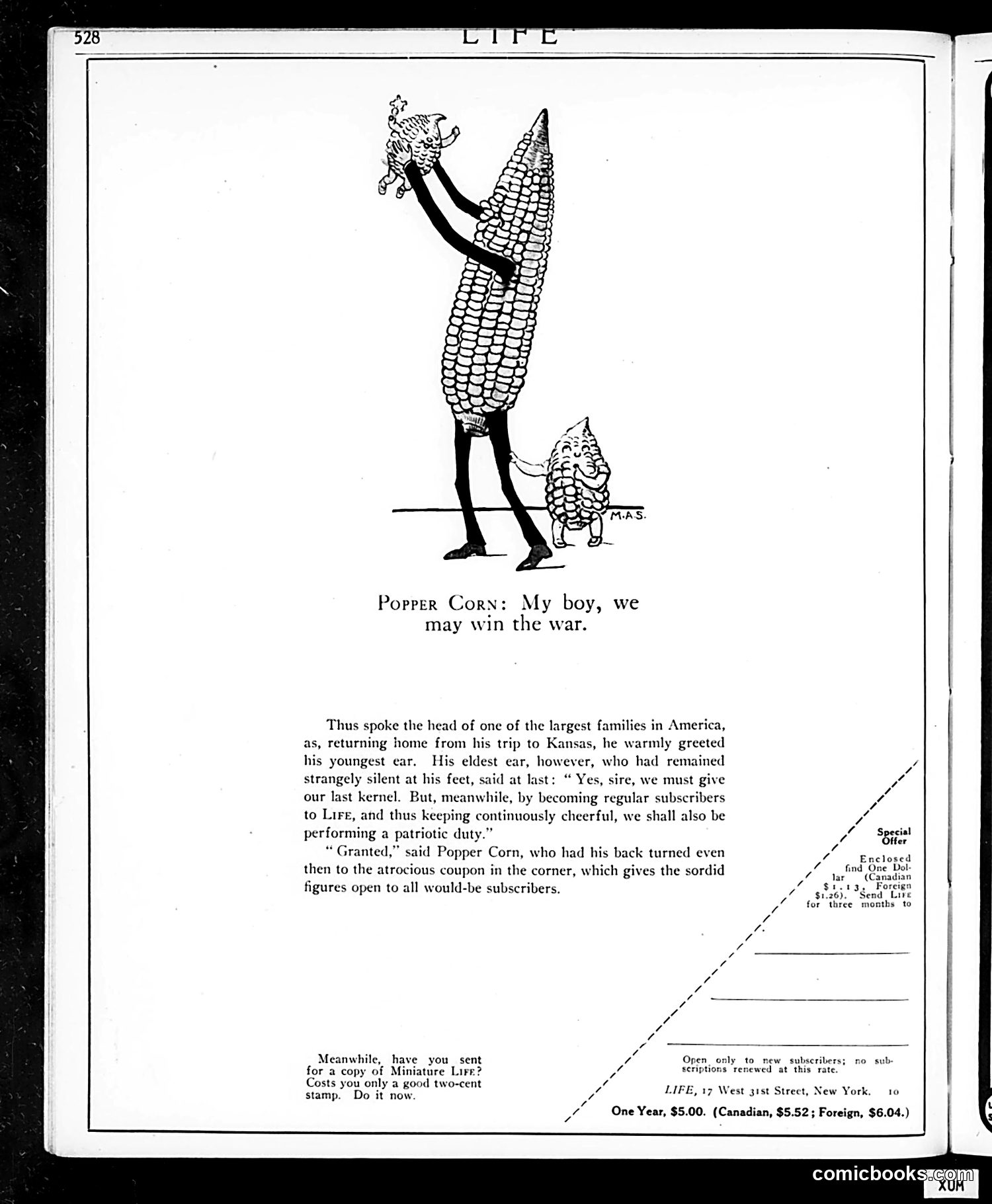
This satirical cartoon depicts "Popper Corn"—a personified ear of corn with human limbs—holding an even smaller ear of corn (presumably representing his "son"). The figure addresses his child with optimistic war rhetoric: "My boy, we may win the war." The satire targets American agricultural families' patriotic rhetoric during wartime (likely WWI, given the context). The joke operates on multiple levels: the anthropomorphized corn is ironically promoting patriotic duty while the accompanying text mocks this sentiment, suggesting that even agricultural producers are caught up in wartime propaganda and jingoism. The cartoon suggests that ordinary citizens—symbolized by farming families—are being manipulated into supporting the war effort through appeals to patriotism.
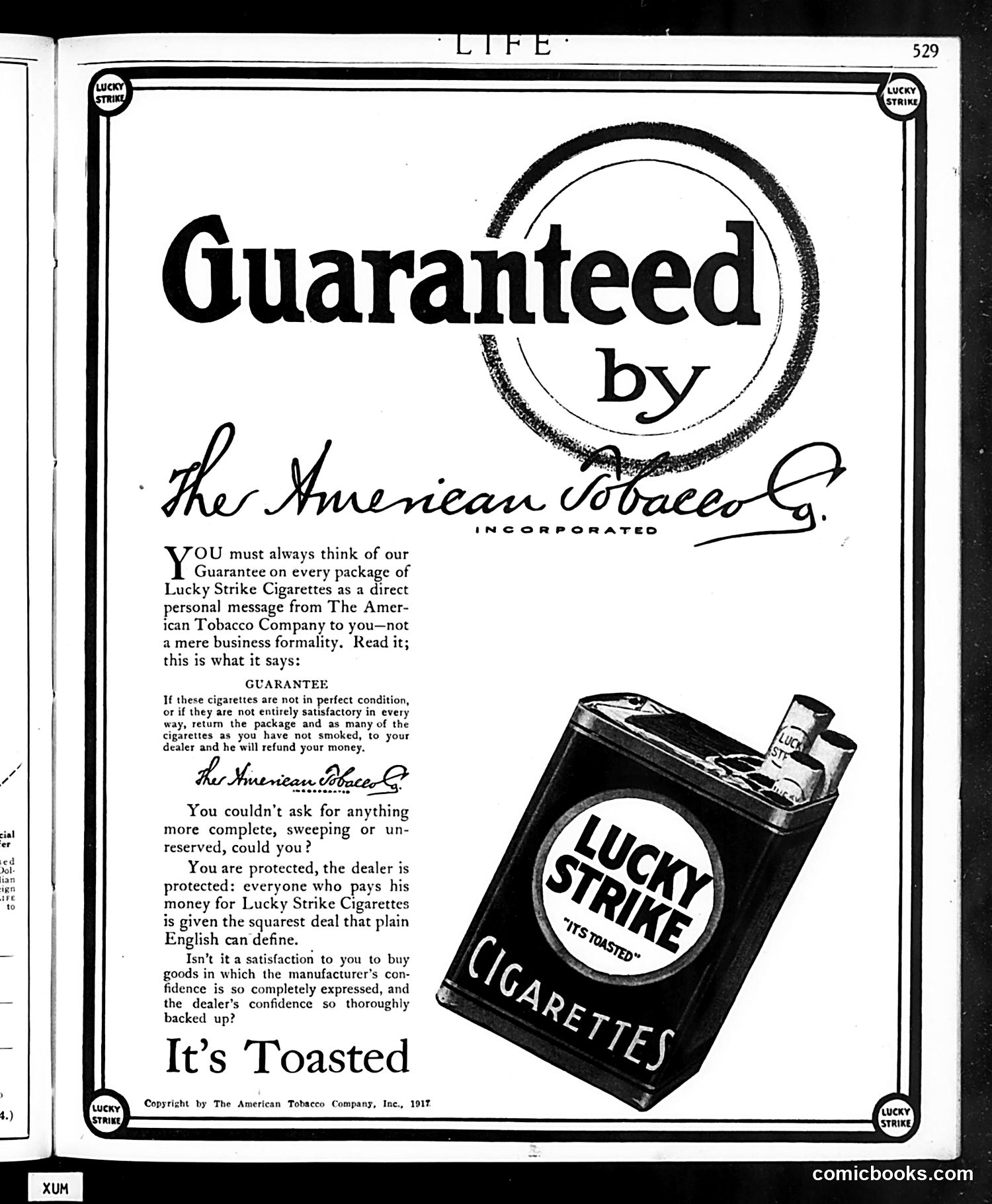
This is a **cigarette advertisement**, not satire or political commentary. The American Tobacco Company guarantees Lucky Strike cigarettes through an elaborate warranty: if the product isn't "perfect condition" or "entirely satisfactory," smokers can return unused cigarettes for a refund. The ad emphasizes consumer protection and "the squarest deal that plain English can define"—marketing language suggesting honesty and fair dealing. The phrase "It's Toasted" became Lucky Strike's signature slogan. By modern standards, this is notable mainly for advertising cigarettes in a major magazine without health warnings—a practice that would become illegal decades later. The formal guarantee structure is an early example of corporate marketing attempting to build consumer confidence through warranty promises.
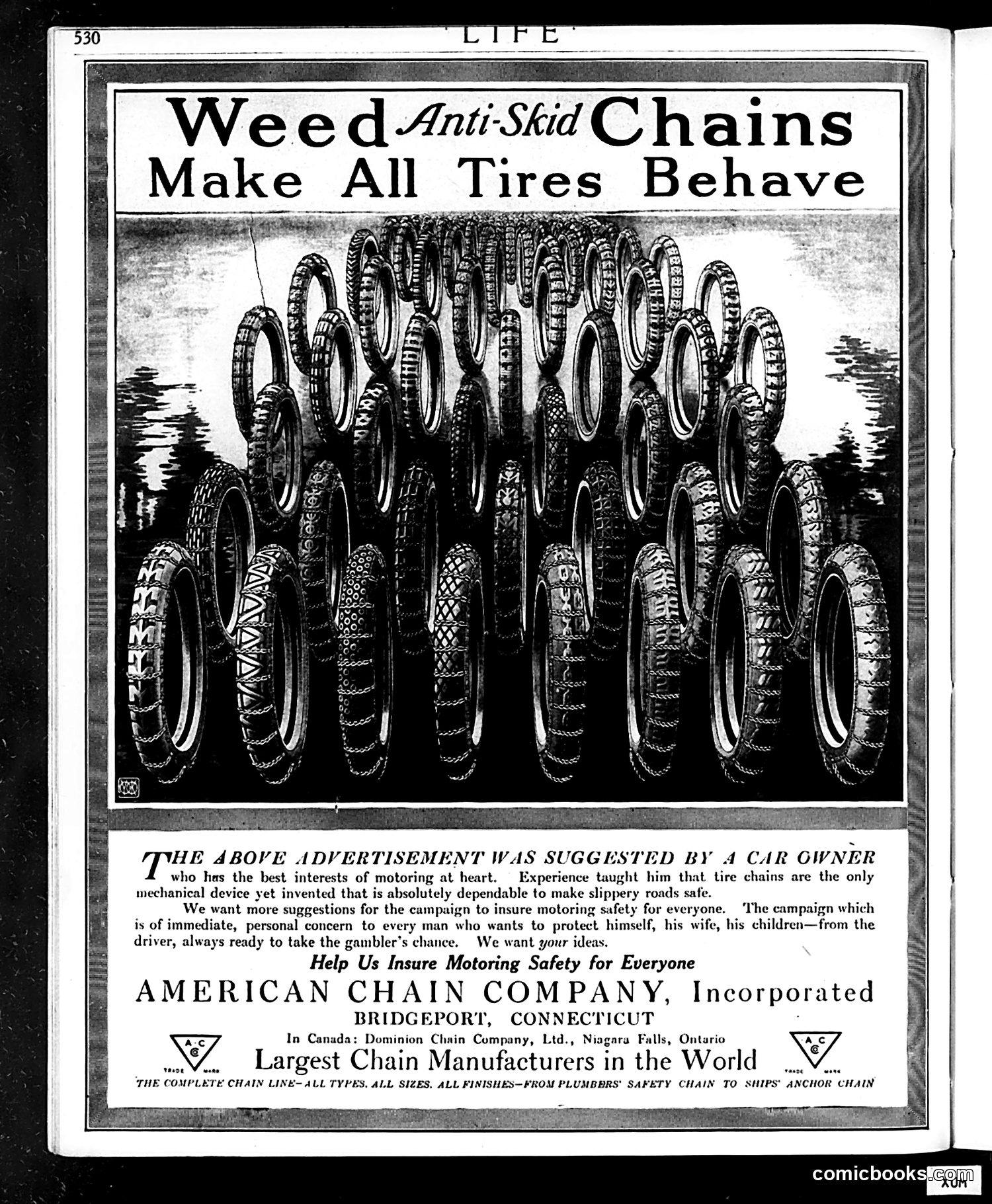
This page is **not a cartoon or satire**—it is a straightforward advertisement for Weed Anti-Skid Chains, placed in *Life* magazine. The ad features a large display of tires equipped with tire chains, emphasizing their safety benefit on slippery roads. The headline claims these chains "Make All Tires Behave." The text below explains that a car owner submitted this advertisement, motivated by genuine safety concerns for motorists. The American Chain Company (based in Bridgeport, Connecticut, with Canadian operations) positions itself as "Largest Chain Manufacturers in the World." The appeal is practical rather than humorous: tire chains were essential winter equipment when this was published, and the ad promotes them as a safety measure for drivers, passengers, and families.
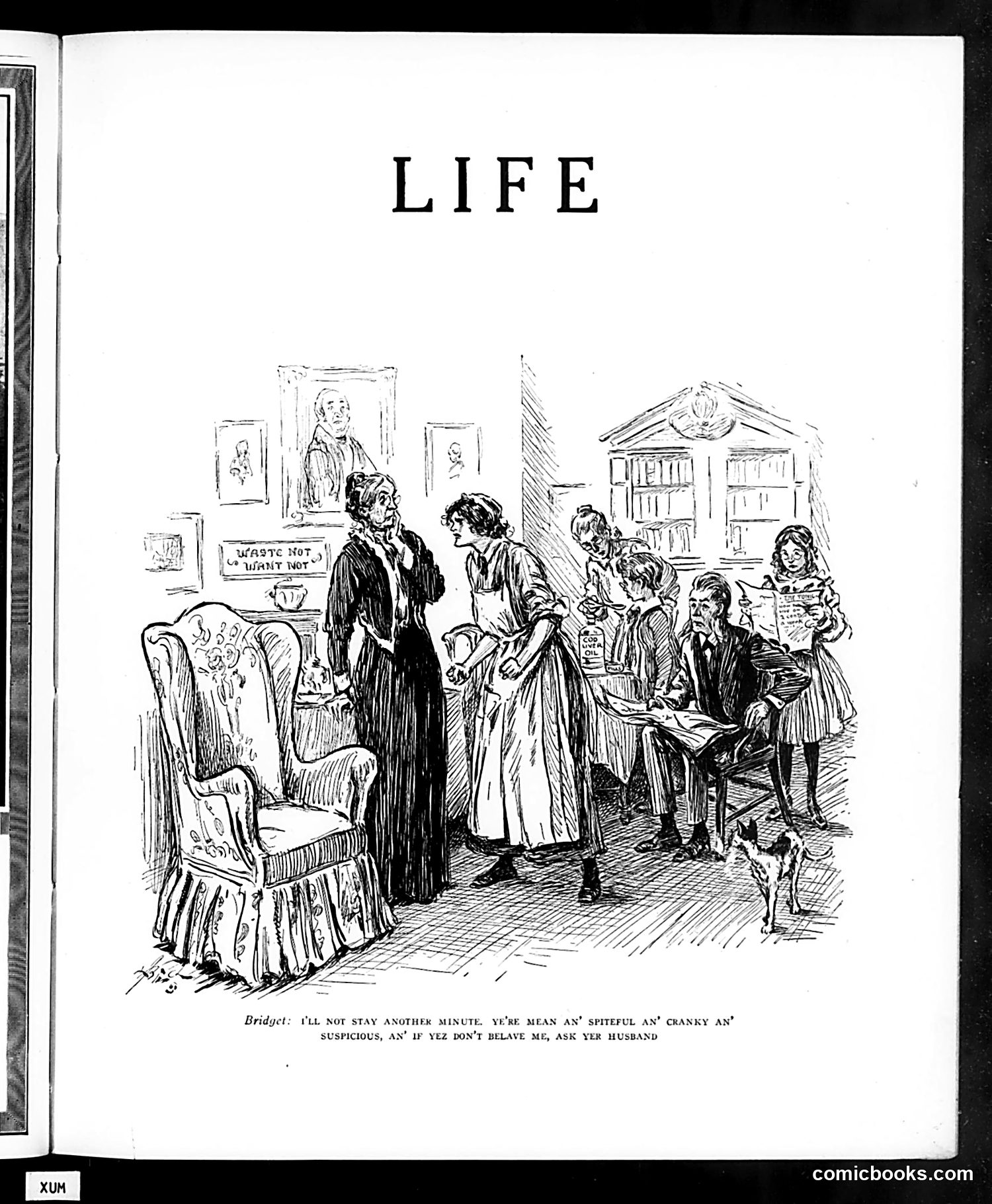
This is a title page for a section called "LIFE" featuring a Victorian-era domestic scene. A character named Bridget (indicated by the caption) stands confronting what appears to be her employer or the household's mistress, with various family members present. Bridget's quoted speech—"I'LL NOT STAY ANOTHER MINUTE. YE'RE MEAN AN' SPITEFUL AN' CRANKY AN' SUSPICIOUS, AN' IF YEZ DON'T BEHAVE ME, ASK YER HUSBAND"—is rendered in an exaggerated Irish accent and dialect, common in late 19th/early 20th-century American satire. The satire likely targets servant-employer tensions, particularly mocking Irish domestic workers and their supposed boldness in confronting their "betters." The humor relies on ethnic stereotype and class dynamics typical of the period's comedic conventions.
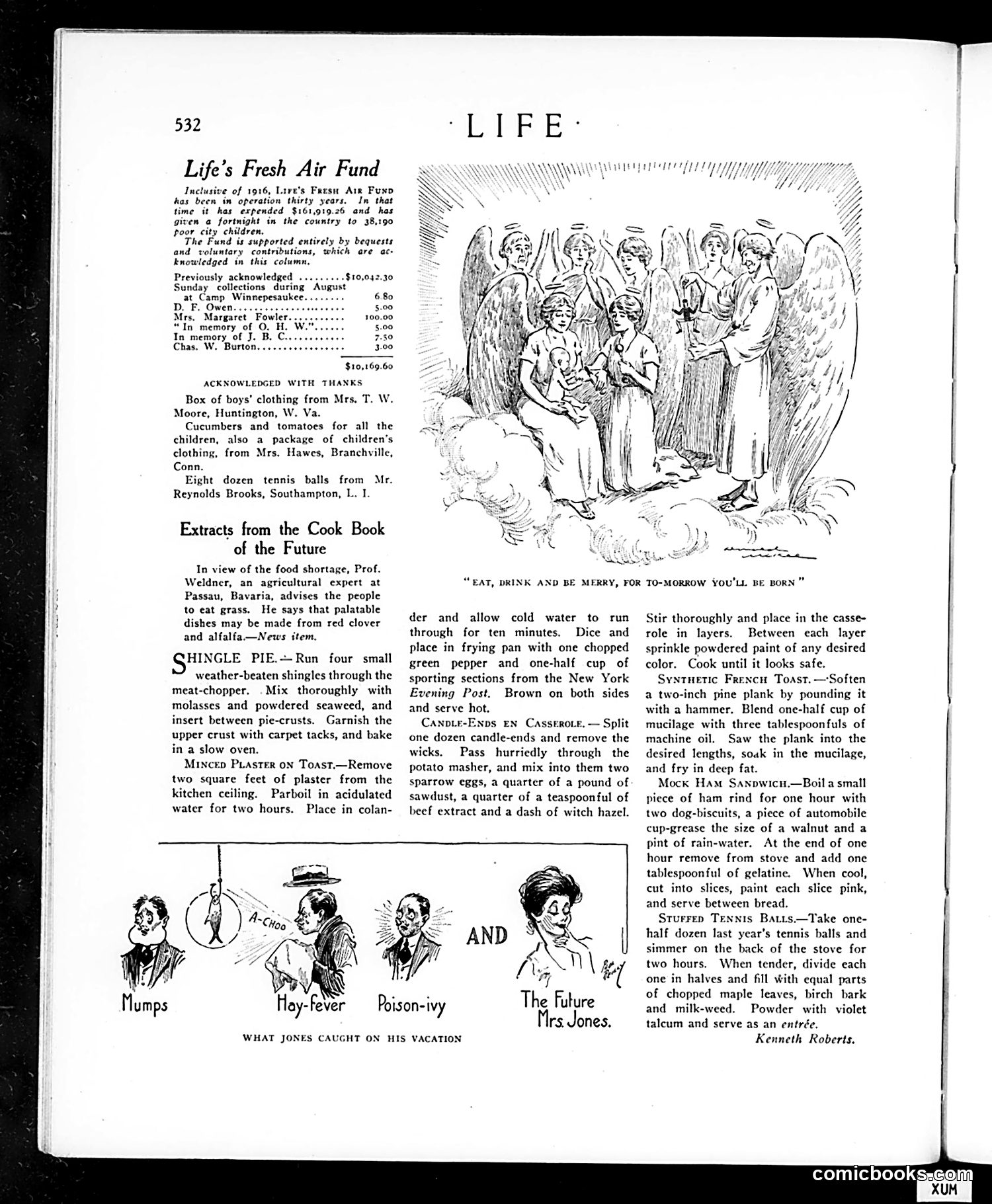
This page combines a charitable appeal ("Life's Fresh Air Fund") with satirical content mocking wartime food shortages. The main cartoon at bottom, titled "What Jones Caught on His Vacation," depicts four figures labeled "Mumps," "Hay-fever," "Poison-ivy," and "The Future Mrs Jones"—a joke about a man's unfortunate vacation experiences rather than romantic conquests. The "Extracts from the Cook Book of the Future" section satirizes food rationing during World War I by proposing absurd recipes using grass, clover, and even tennis balls. This dark humor reflects genuine civilian food scarcity. The illustration above shows angels, possibly referencing heavenly sustenance as ironic commentary on earthly deprivation.
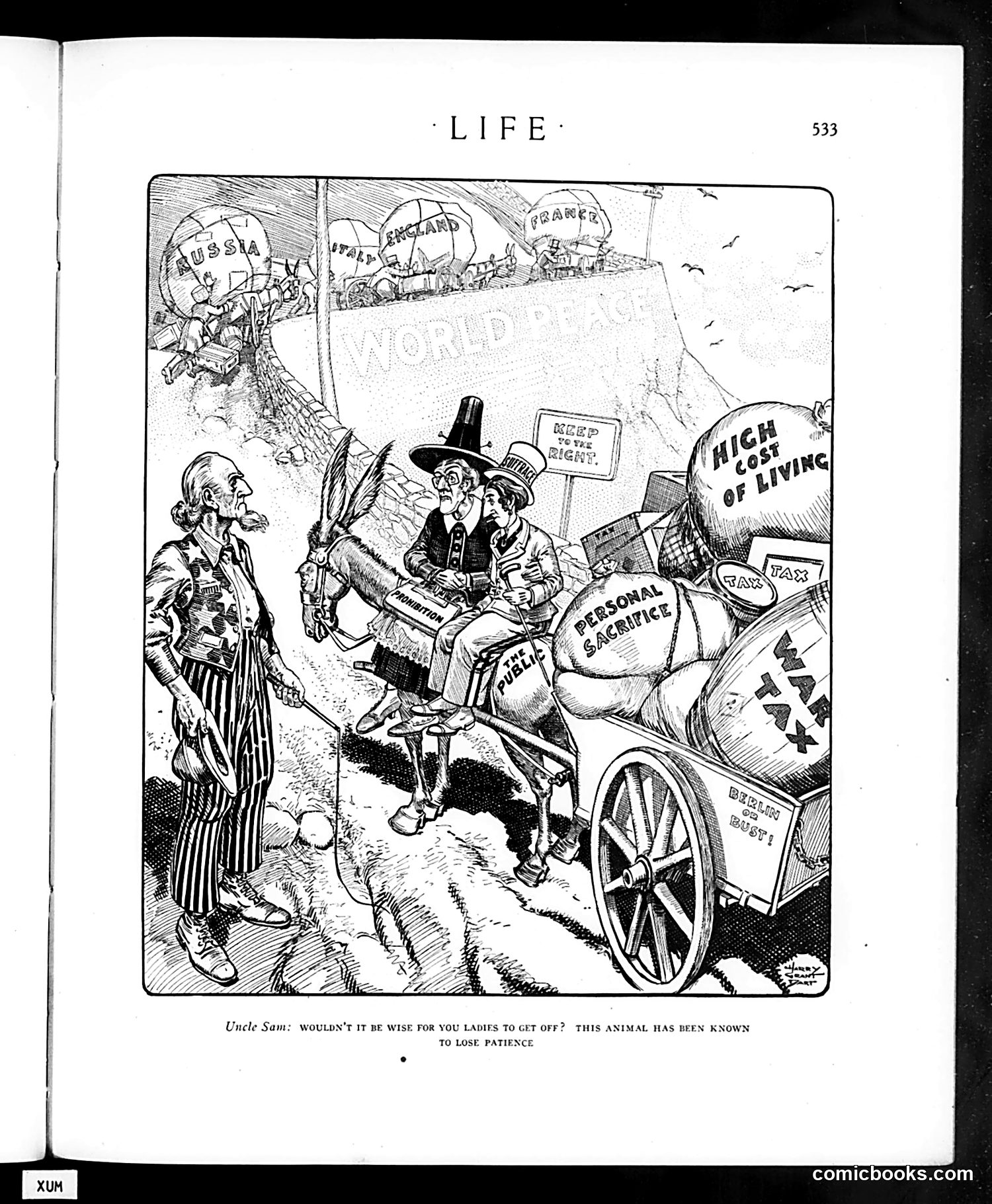
This is a satirical cartoon from *Life* magazine (page 533) depicting Uncle Sam confronting what appears to be a donkey labeled with various economic burdens. The cart behind the donkey is piled high with labeled barrels representing post-WWI problems: "HIGH COST OF LIVING," "PERSONAL SACRIFICE," "TAXES," and what appear to be international debts ("RUSSIA," "FRANCE," "ENGLAND" visible in balloons above). Uncle Sam warns ladies to "get off" the overburdened donkey, which "has been known to lose patience." The satire critiques the cumulative weight of post-war economic hardships—inflation, taxation, and international debt obligations—threatening to exhaust American patience and stability. The cartoon reflects 1920s anxieties about economic burden and war-related financial chaos affecting civilians.
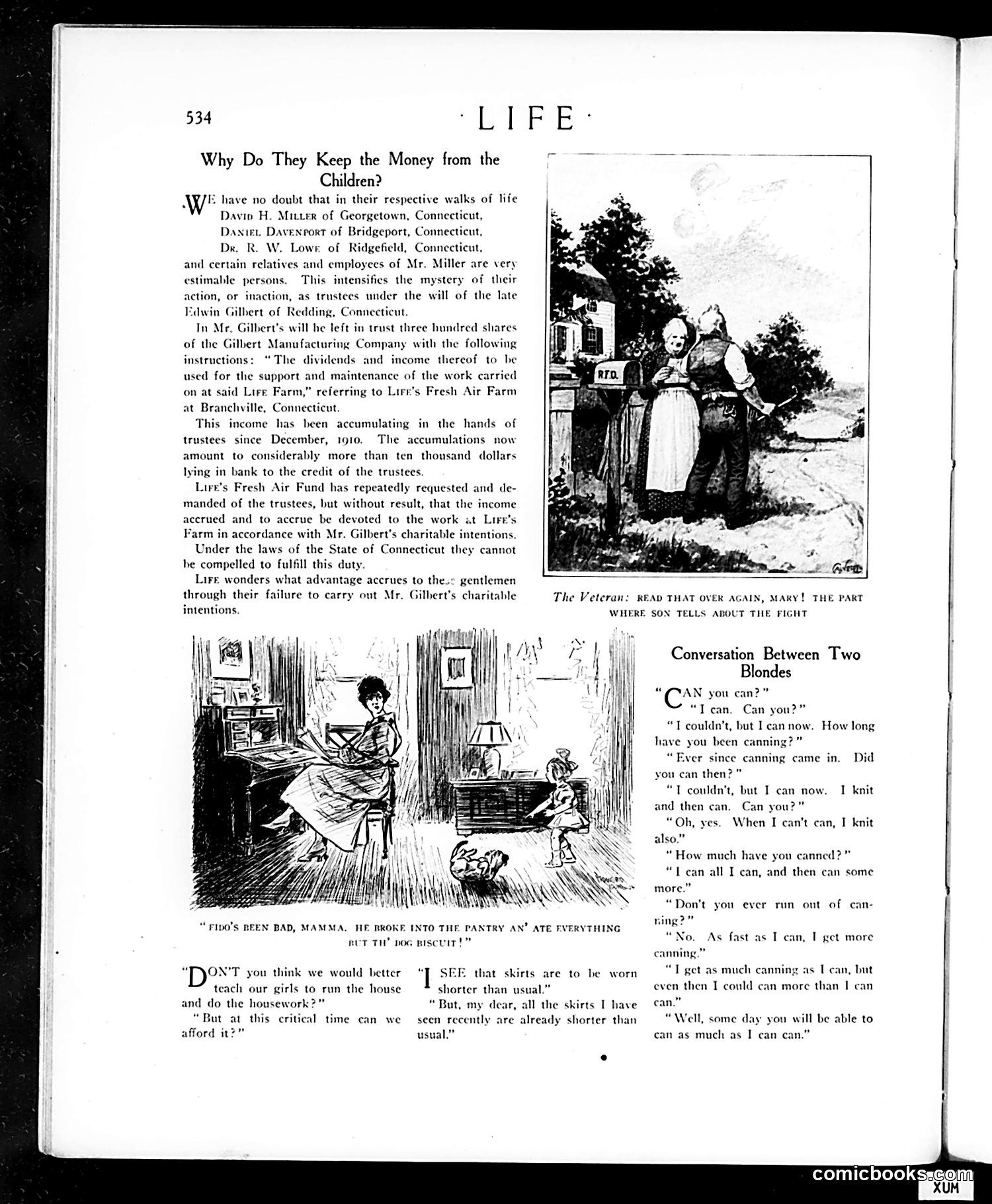
**Top Article: "Why Do They Keep the Money from the Children?"** This piece critiques trustees of a Connecticut estate (Edwin Gilbert's will) who are withholding farm income from the intended beneficiaries. The photograph shows elderly women at "Lirr's Fresh Air Farm," illustrating the charitable work the money was meant to support. The satire targets the trustees' legal loopholes that allow them to retain over $1,000 accumulated since 1916, defying Gilbert's charitable intentions. **Lower Cartoons & "Conversation Between Two Blondes"** The domestic sketches humorously depict household management during wartime rationing—canning, shortened skirts, and housework efficiency. The dialogue between two women jokes about canning capabilities ("I can all I can, and then can some more"), reflecting 1940s-era food preservation necessity and women's domestic productivity rhetoric.
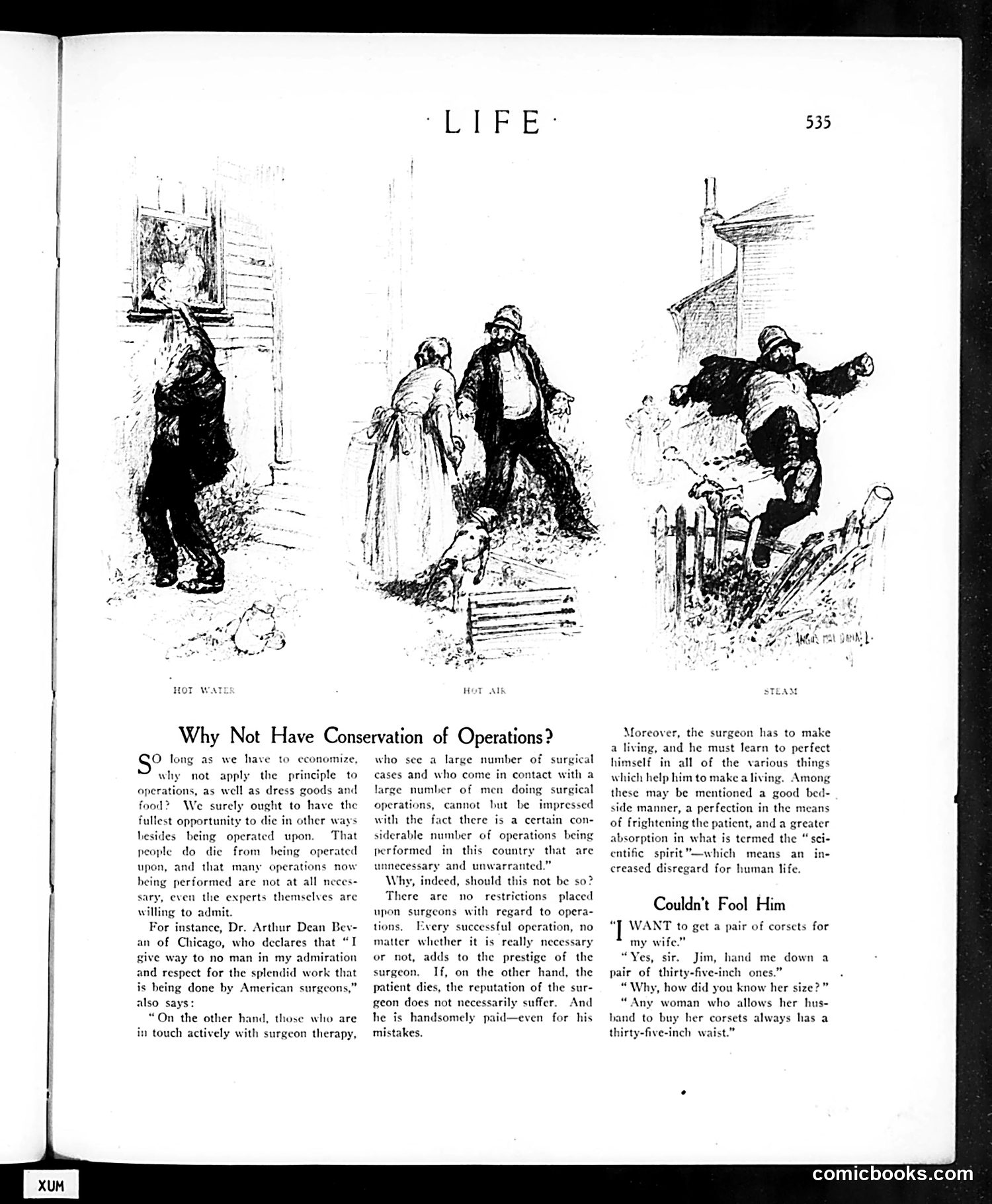
**The Three Cartoons (Top):** Three sketches labeled "Hot Water," "Hot Air," and "Steam" depict figures in uncomfortable or chaotic situations—likely visual metaphors for different types of trouble or pressure. **"Why Not Have Conservation of Operations?"** This article critiques unnecessary surgical procedures. Dr. Arthur Dean Bevan of Chicago is quoted arguing that many operations performed in America are "unnecessary and unwarranted." The piece advocates for surgical restraint, noting that surgeons perform procedures without medical necessity, potentially harming patients and their reputations unfairly. The satire targets the medical profession's financial incentives to over-operate. **"Couldn't Fool Him"** A brief humorous anecdote about a man buying corsets, mocking women's fashion constraints and assumptions about dress sizing.
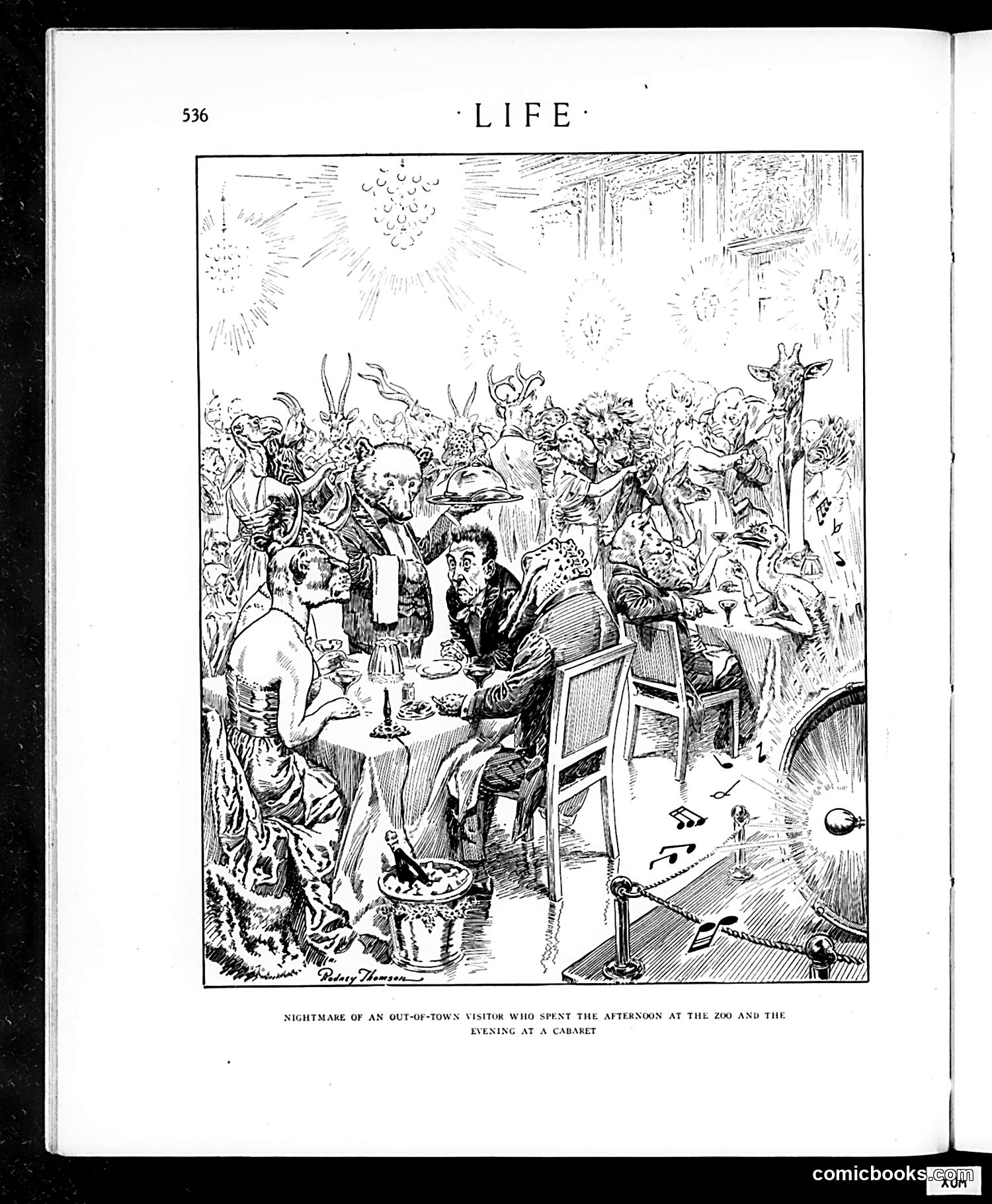
This satirical illustration depicts a surreal nightmare scene titled "Nightmare of an Out-of-Town Visitor Who Spent the Afternoon at the Zoo and the Evening at a Cabaret." The cartoon shows a formal dinner where the human diner is surrounded by grotesque, anthropomorphized zoo animals—giraffes, antelopes, monkeys, and other creatures—who have become his dinner companions at what appears to be a nightclub or cabaret setting. The animals are depicted as fashionably dressed, socializing and dining alongside the bewildered human guest. The satire mocks the artificiality and absurdity of upscale evening entertainment venues, suggesting that cabaret society is as strange and unnatural as finding oneself dining with actual zoo animals. It's a commentary on the pretentiousness or surreal quality of urban nightlife culture.
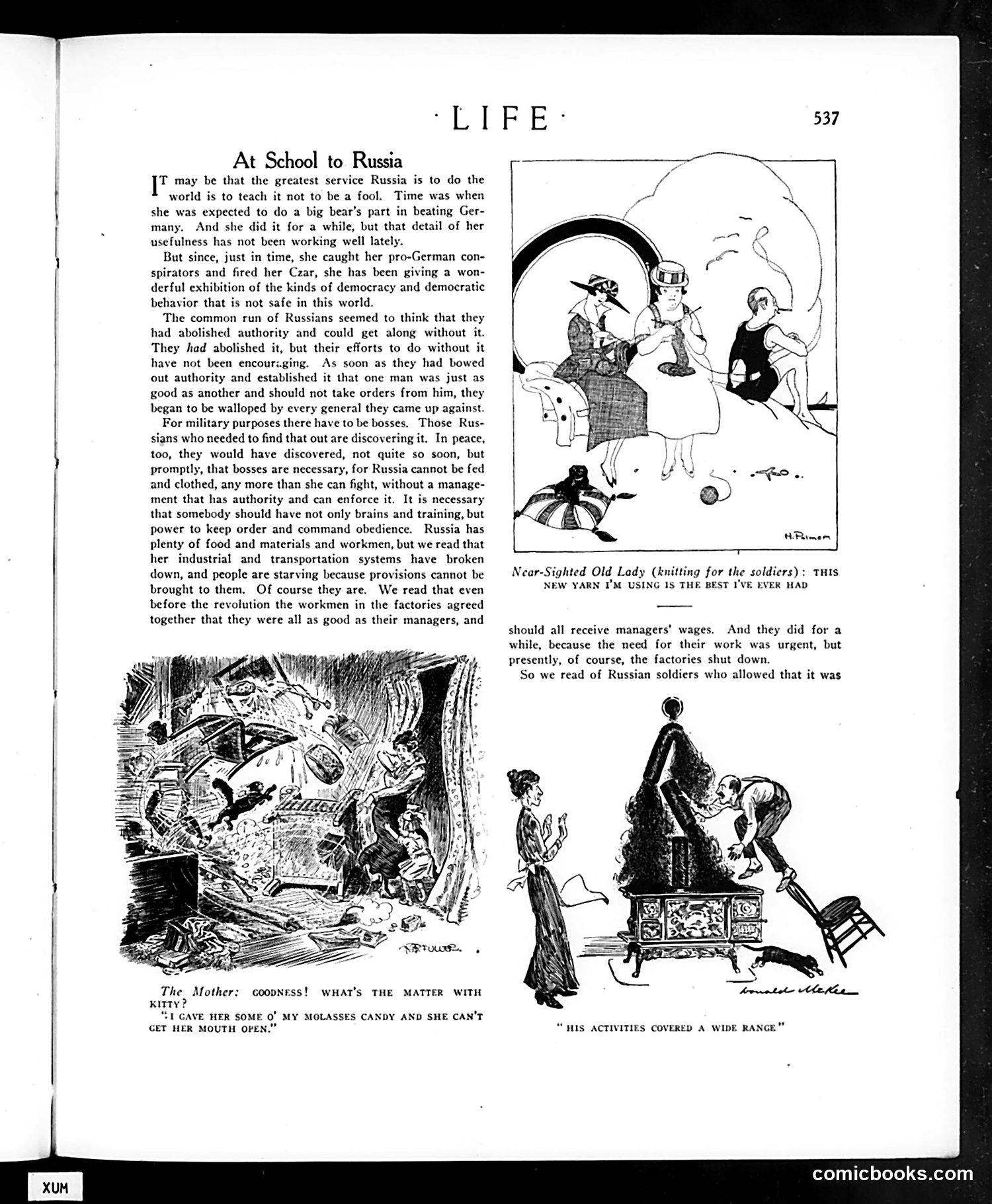
This page satirizes post-revolutionary Russia's struggle to establish order and discipline. The main text argues that despite abolishing authority, Russians discovered they couldn't function without hierarchical management—soldiers needed commanders, factories needed managers. The cartoons mock Russian incompetence: 1. **Top cartoon**: A near-sighted old lady (Russia) knitting for soldiers, using yarn described as "the best I've ever had"—suggesting Russia is oblivious to its own failures. 2. **Bottom cartoon**: A mother can't get her cat to open its mouth after giving it molasses candy—a domestic analogy for Russia's inability to control its population. The satire suggests Russia's revolutionary ideals collided with practical necessity.
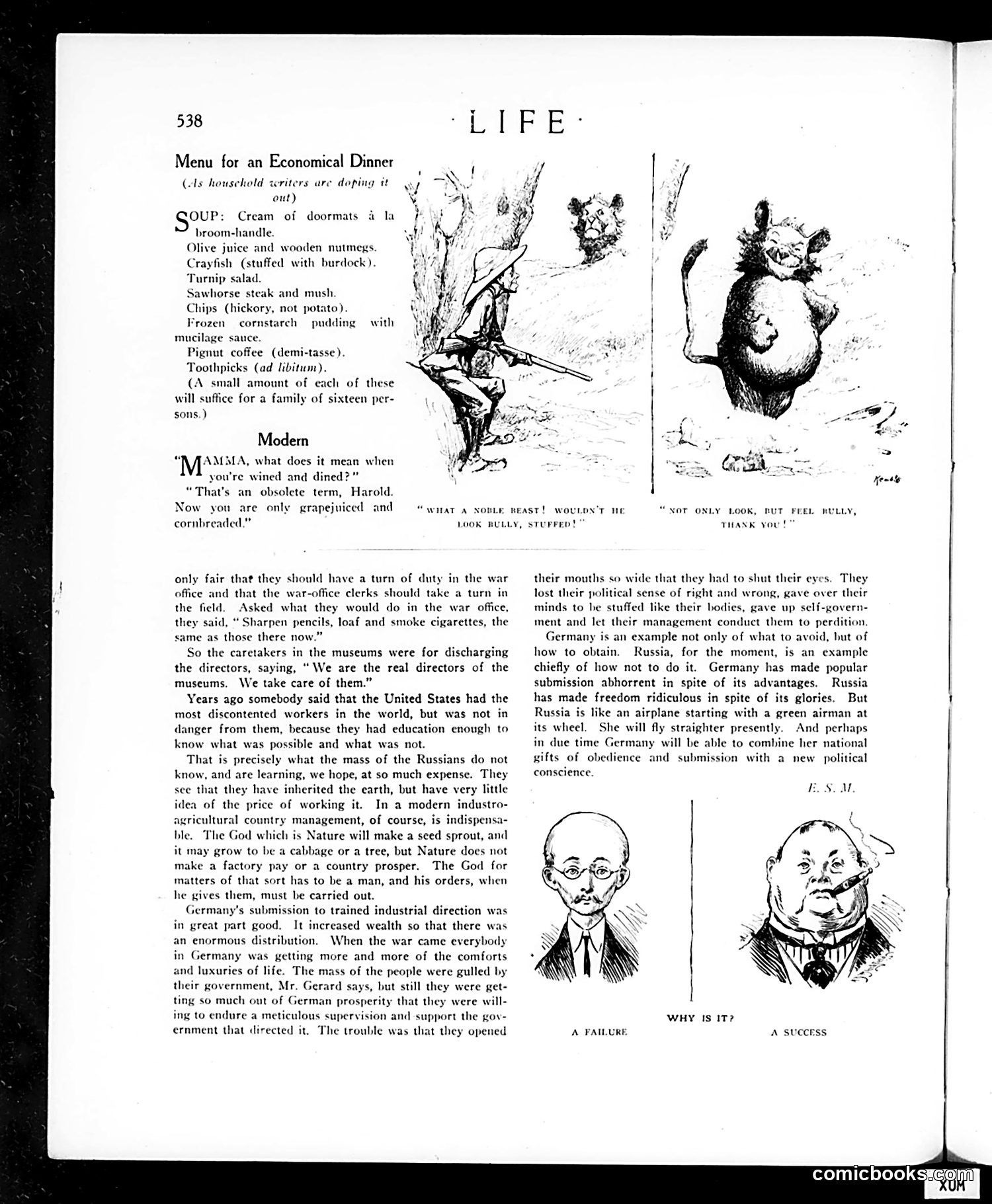
The page features political commentary on post-WWI governance. The text criticizes Russia and Germany's approaches to freedom and industrial management. A key passage argues that Russia made "freedom ridiculous" despite its revolutionary ideals, while Germany's submission to industrial direction created prosperity but also dangerous public compliance with government control. The two portrait sketches at bottom are labeled "A FAILURE" and "A SUCCESS," appearing to contrast political outcomes, though the specific individuals depicted are unclear from the image alone. The upper illustrations show figures in period dress with captions about appearing "bully" and "stuffed"—likely satirizing the physical appearance or pomposity of particular leaders, though identities cannot be definitively established from the visual alone.
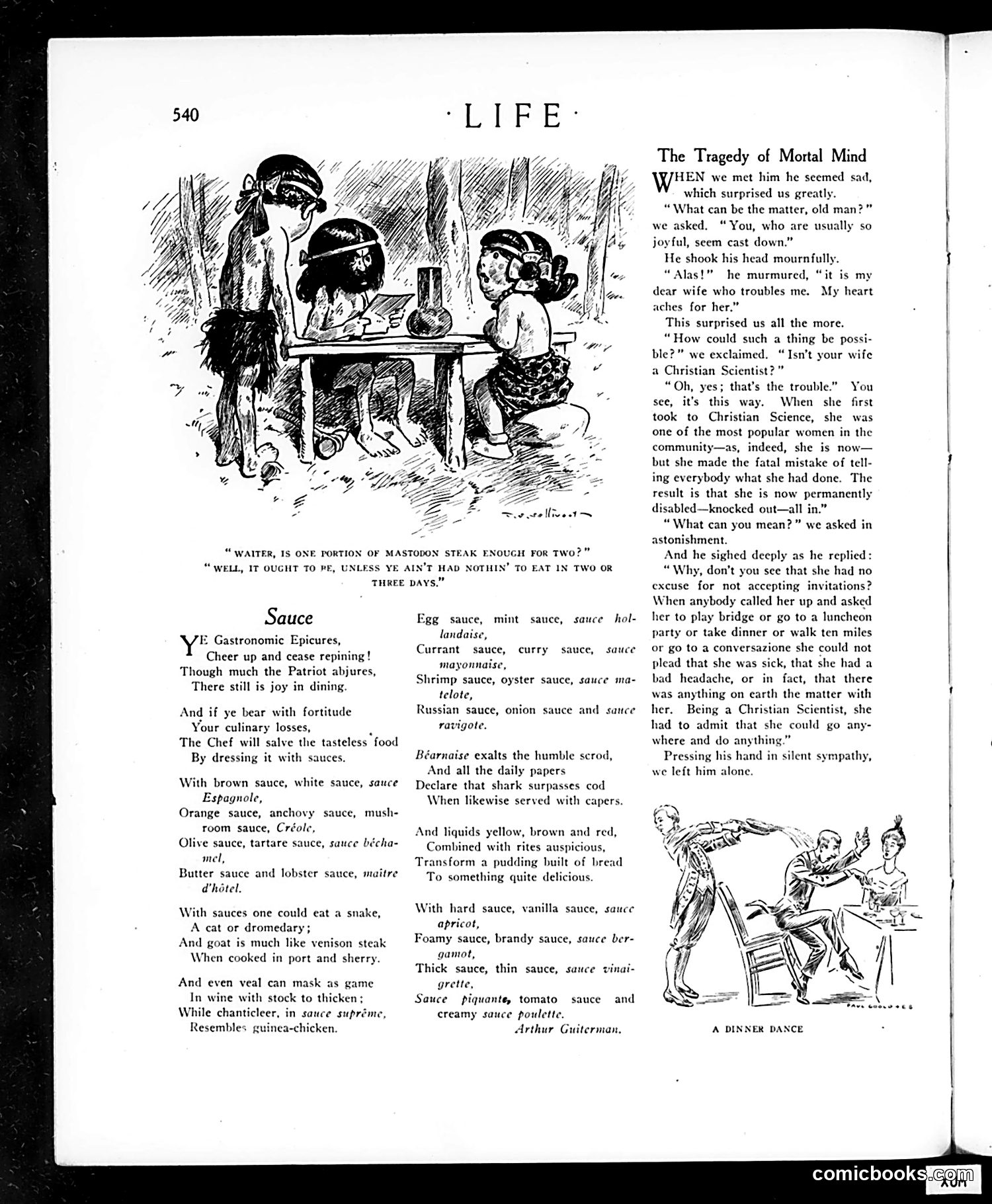
This page contains two satirical pieces from *Life* magazine, likely from the early 1900s: **"Sauce" (left):** A humorous poem by Arthur Guiterman celebrates culinary sauces as solutions to wartime food shortages. The cartoon shows people dining on meager rations—apparently mastodon steak—starving for days. The satire suggests that elaborate French sauces can mask or elevate poor-quality or scarce food. This likely reflects WWI-era rationing concerns, where ordinary ingredients required creative disguise. **"The Tragedy of Mortal Mind" (right):** This satirizes Christian Science by presenting a supposed paradox: a Christian Scientist woman who healed herself through faith lost her social excuse for declining invitations (illness, headaches). The joke is that her "cure" became burdensome—she could no longer avoid social obligations she previously dodged by claiming ailments. The satire mocks both Christian Science practitioners and their hypocritical use of health claims for convenience.
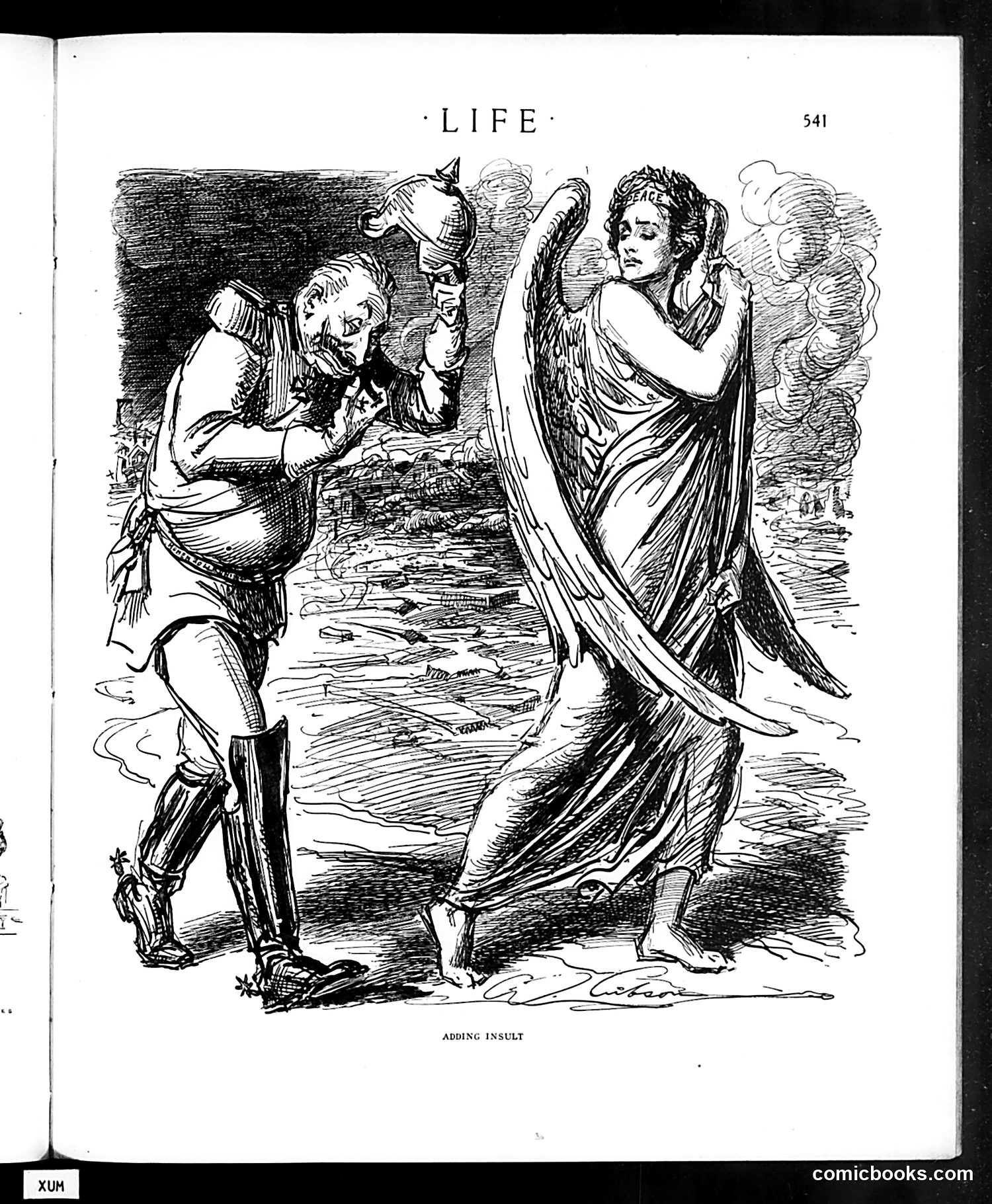
This satirical cartoon depicts a military officer (left, in uniform with helmet) confronting a winged female figure representing "Peace" (right). The officer appears aggressive or dismissive toward the allegorical Peace figure, who holds what looks like an olive branch or similar symbol of peace. The title "Adding Insult" suggests the cartoon critiques military aggression or warmongering as literally insulting to the concept of peace itself. The composition shows the military actively rejecting or threatening peaceful resolution. Without a visible date, the specific historical context remains unclear, but this reflects *Life* magazine's typical satirical commentary on military policy and international relations during periods of conflict or tension in American history.
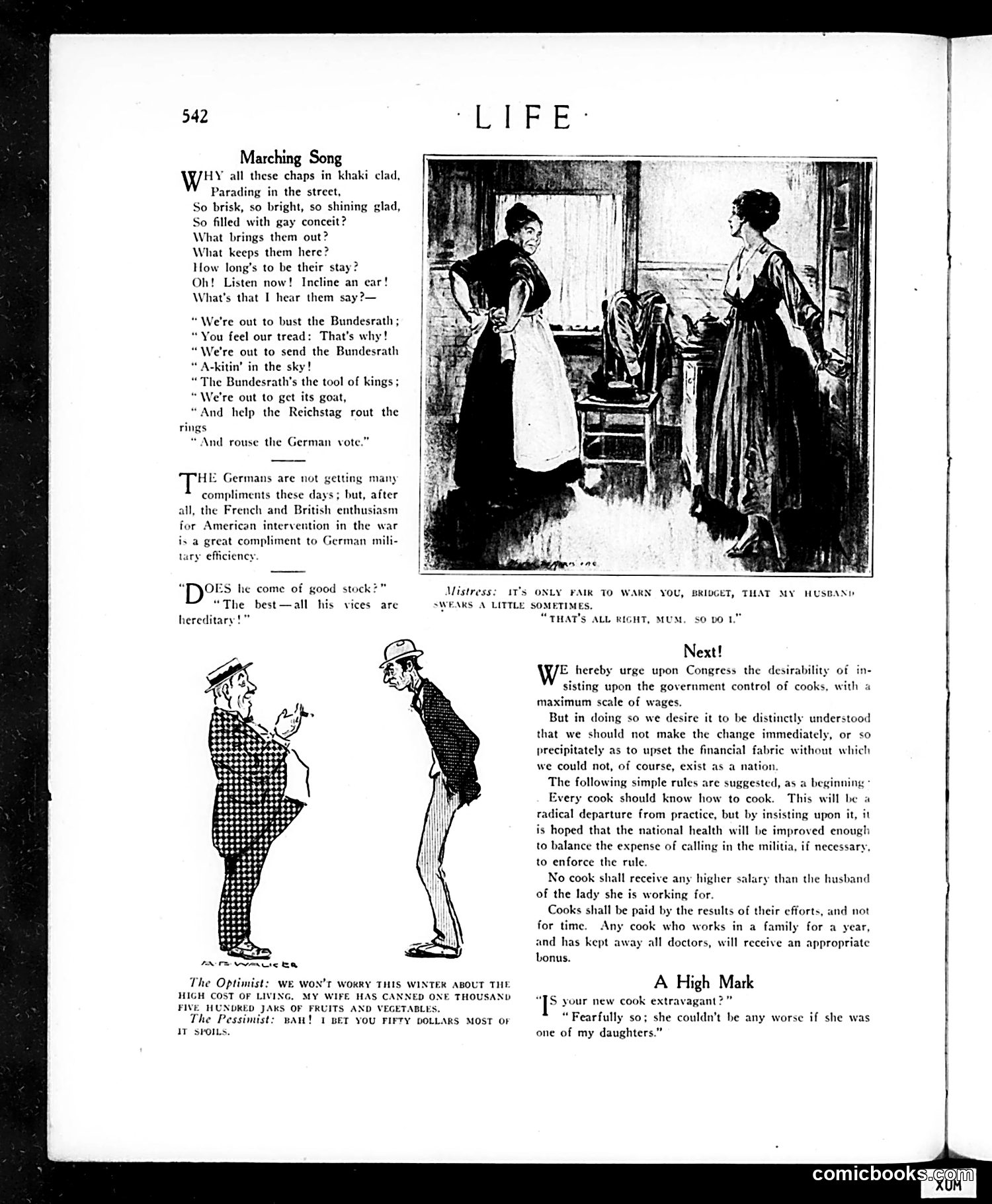
This WWI-era satirical page contains three distinct items: **"Marching Song"** (top left): A poem mocking German military ambitions, featuring soldiers in khaki singing about destroying the Bundesrath (the upper house of the German parliament). The satire ridicules German pride and imperial structure, suggesting their military goals are internally contradictory—attacking their own governmental institutions. **Two cartoons** (bottom left): An "Optimist" and "Pessimist" debate war-time food costs and preservation. The humor plays on class anxieties about inflation and domestic management during wartime rationing. **"Next!" section** (right): Satirical commentary proposing Congress regulate cooks with wage controls and performance standards. This absurdist piece mocks both labor regulation debates and the "servant problem"—the era's widespread complaints about domestic help quality and cost. The closing anecdote jokes that good cooks are as rare as good daughters, poking fun at middle-class domestic frustrations during wartime economic strain. The page reflects American attitudes toward the war, German politics, and homefront economic anxieties circa 1917-1918.
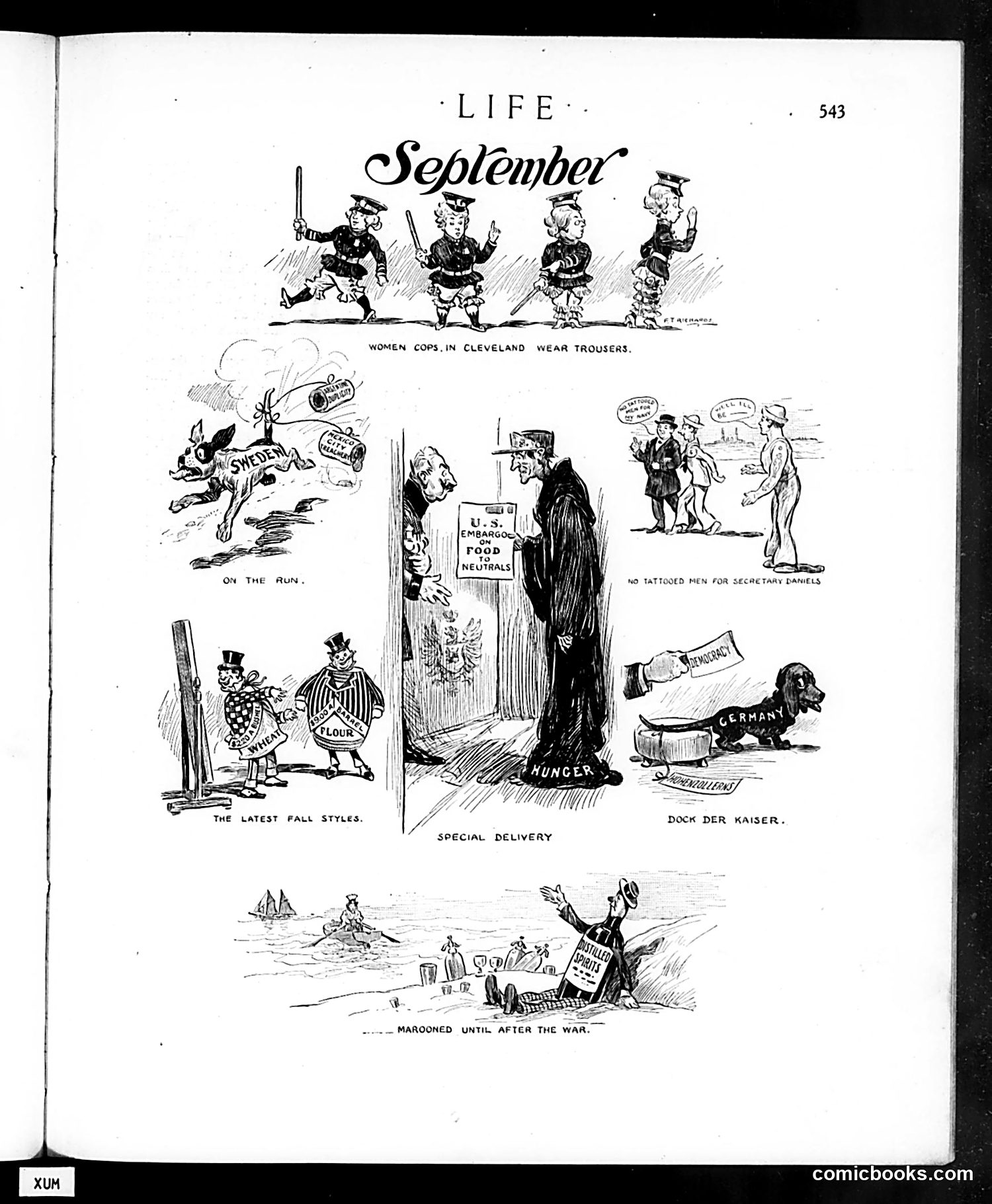
This page contains World War I-era satirical cartoons mocking Germany and its Kaiser (Emperor Wilhelm II). Key cartoons include: - **"On the Run"**: A caricatured Swedish figure fleeing, likely referencing Sweden's neutral status during WWI - **"Special Delivery"**: Depicts "Hunger" as a skeletal figure delivering a U.S. embargo on food to neutrals - **"Dock Der Kaiser"**: Shows Germany as a dachshund being force-fed, satirizing the naval blockade's effects - **"Marooned Until After the War"**: A ship sinking, suggesting Germany's isolation from sea trade The cartoons mock the effectiveness of Allied blockades on Germany and mock neutral nations' positions. The top strip references "Women Cops in Cleveland Wear Trousers"—a lighter domestic joke amid wartime commentary.
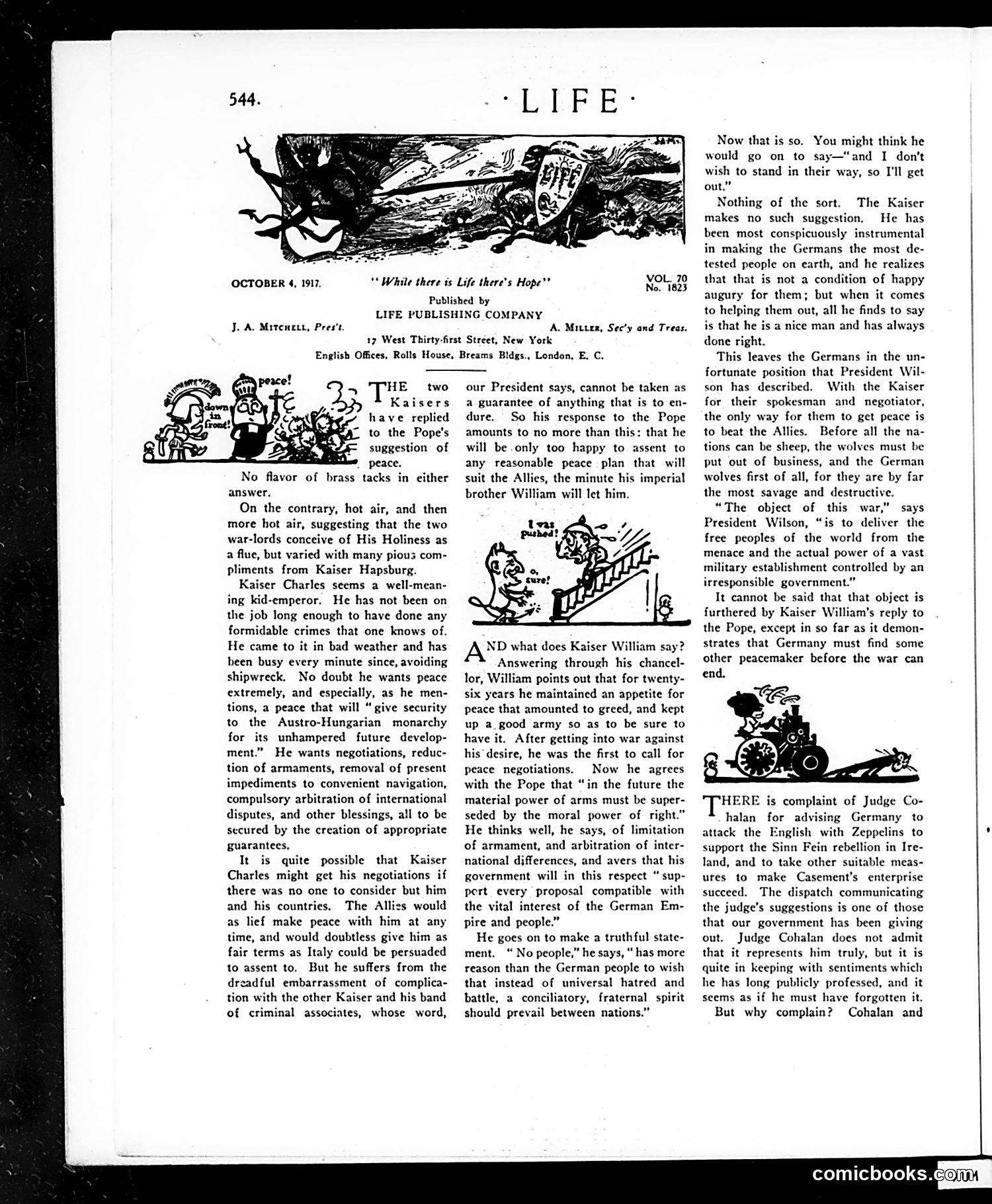
This page satirizes peace proposals submitted to Pope Benedict XV by Austria-Hungary's Kaiser Charles and Germany's Kaiser Wilhelm II during World War I. The satire's point: both emperors offer flowery rhetoric about peace while refusing actual concessions. Kaiser Charles essentially says he'd accept peace—if his ally Wilhelm allows it. Wilhelm claims to desire peace and moral righteousness, yet provides no genuine path to it, merely asserting Germany's vital interests must be protected. The cartoons (visible as small illustrations) mock their hypocrisy and evasiveness. The text sarcastically notes Wilhelm "has always done right"—obviously false given America's view of German war conduct. The broader context: America entered WWI in April 1917. Life, as a patriotic satirical magazine, ridicules Central Powers' peace overtures as insincere propaganda, reinforcing American commitment to defeating them militarily rather than negotiating.
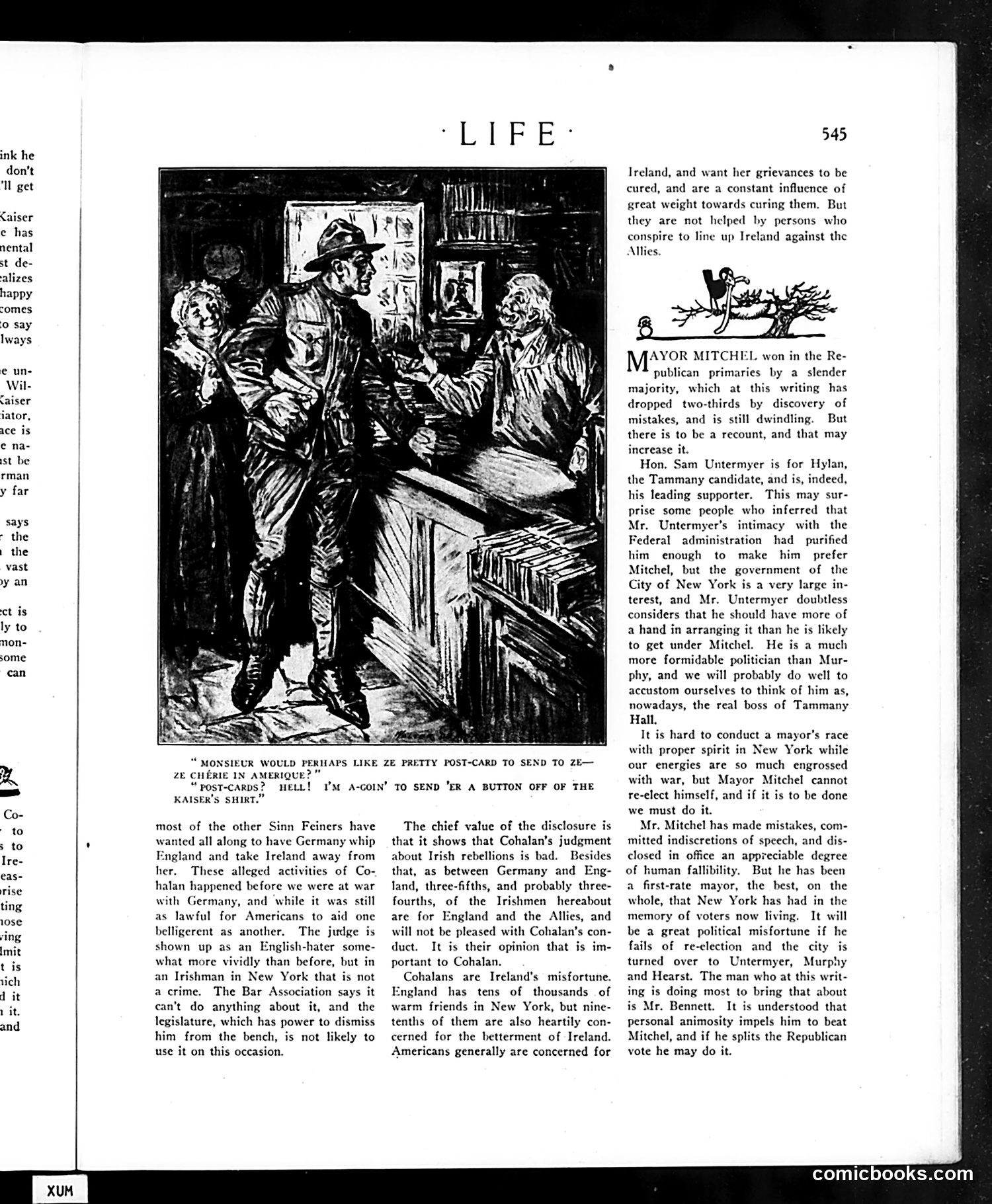
This page contains satirical commentary on New York City politics during WWI. The cartoon depicts a German officer requesting a postcard to send home, with an American soldier offering "a button off of the Kaiser's shirt"—mocking German militarism and expressing American support for the Allies. The text discusses Judge Daniel Cohalan, an Irish-American politician whose pro-Irish independence activities are criticized as potentially sympathetic to Germany. The author argues that while Irish-Americans have legitimate grievances, Cohalan's actions undermine American war effort support and alienate the majority of Irish-Americans who actually support England and the Allies. The piece also covers NYC mayoral politics: Mayor Mitchel's narrow Republican primary victory and concerns that other political figures (Untermyer, Murphy, Hearst, Bennett) may prevent his re-election, which the author views as detrimental to the city. The satire attacks both German militarism and perceived disloyalty among certain Irish-American leaders during wartime.
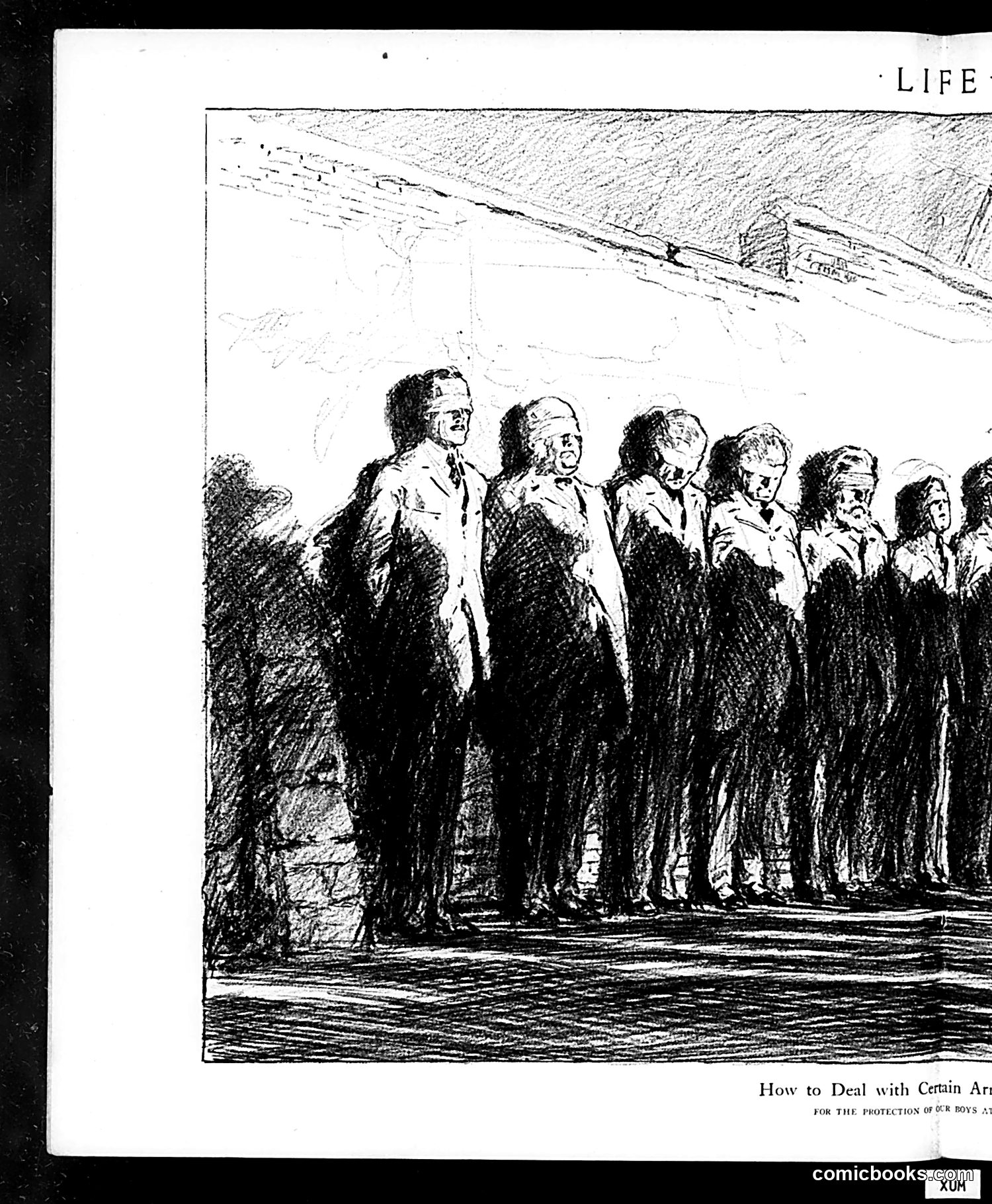
This appears to be a satirical illustration showing a line of young boys standing against a wall, with the headline "How to Deal with Certain Ari[ticles]" and subtitle "FOR THE PROTECTION OF OUR BOYS." The cartoon likely critiques moral panic or social anxiety about corrupting influences on youth—possibly referencing obscene literature, inappropriate materials, or other perceived threats to childhood morality. The stark, serious artistic style and formal lineup of figures suggests the cartoon is mocking overly dramatic or heavy-handed protective measures. Without the complete headline text or publication date visible, the specific "articles" being referenced remain unclear, but the overall message appears satirical commentary on adult anxieties about youth corruption and censorship debates of the era.
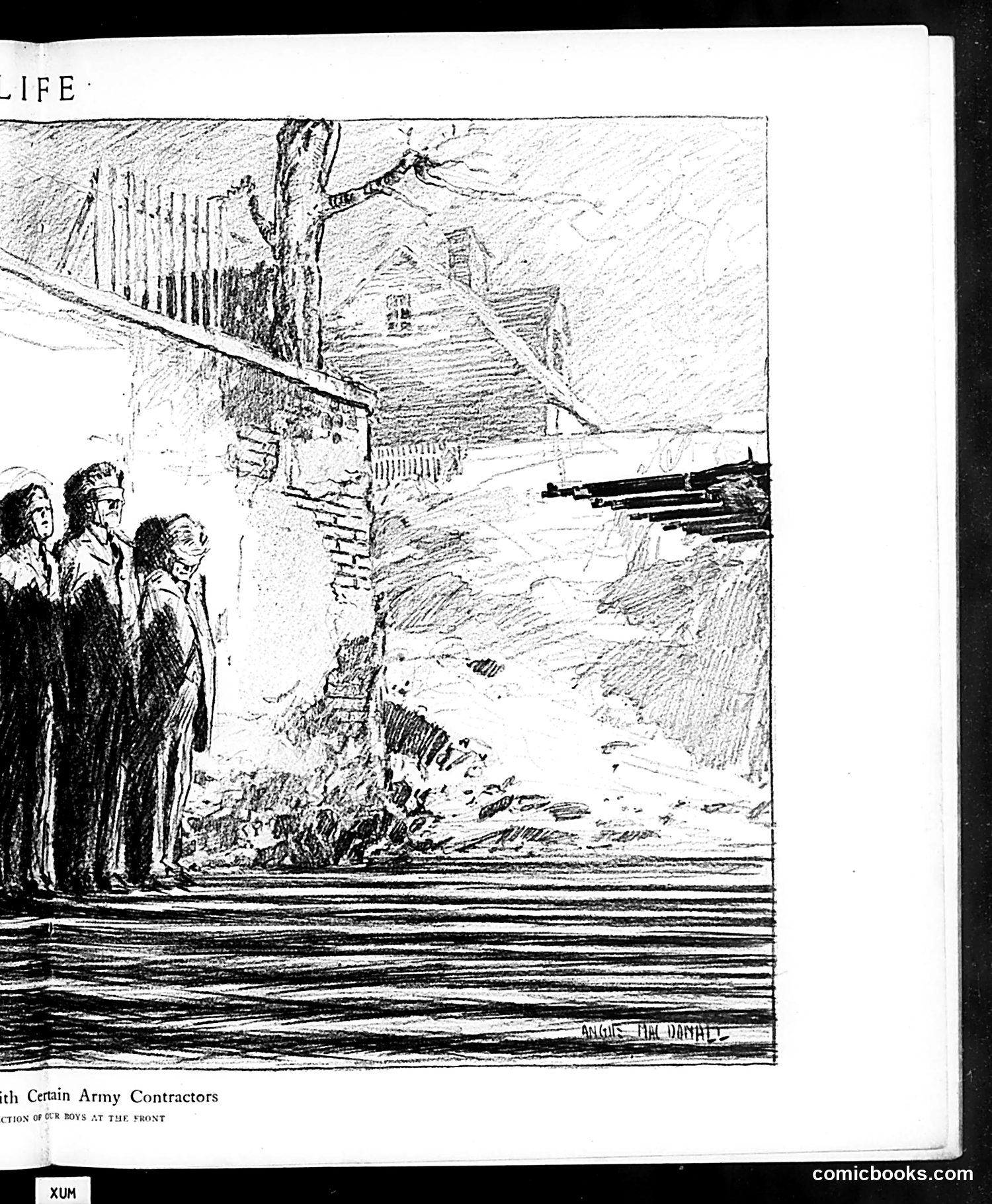
This appears to be a satirical cartoon critiquing **army contractors during wartime**. The image shows three figures (likely government officials or contractors) standing safely on shore, observing soldiers in combat across water—suggested by the military equipment visible and the dramatic landscape. The satire targets the disconnect between **profiteers and those fighting**: contractors grow wealthy from military contracts while young soldiers ("our boys at the front") face actual danger and death. The figures' formal dress and comfortable distance emphasize how removed decision-makers were from combat's human cost. This likely dates from **WWI or WWII**, when public concern about war profiteering was high. The cartoon's point: contractors benefit financially from war while soldiers bear the sacrifice.
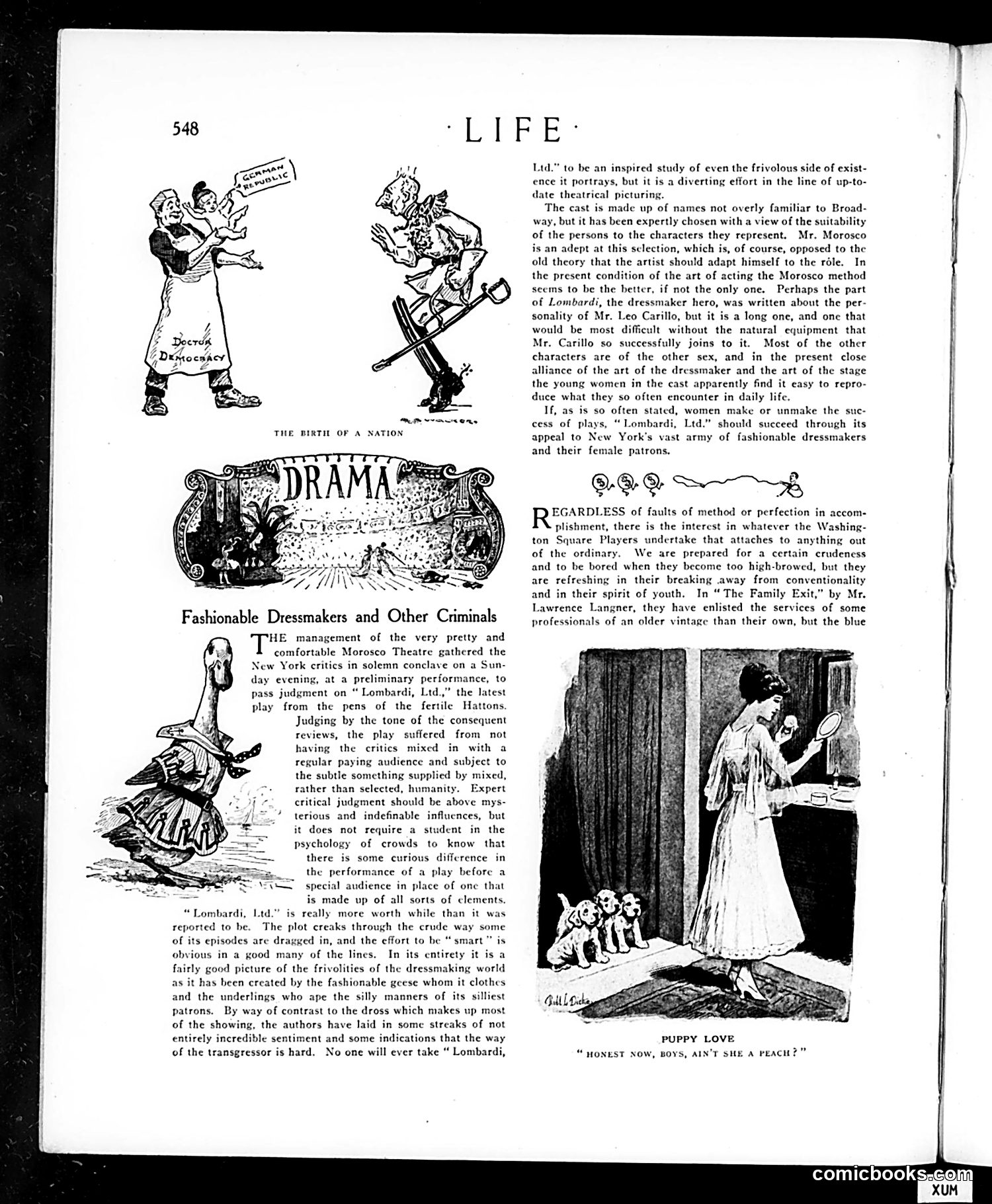
This *Life* magazine page satirizes the theatrical world of its era, particularly the play "Lombardi, Ltd." about the fashion industry. The cartoons labeled "The Birth of a Nation" appear to mock dramatic overreactions—figures are drawn in exaggerated, theatrical poses, likely poking fun at pretentious stage acting or critics' overwrought responses to plays. The main article reviews "Lombardi, Ltd.," a comedy about fashionable dressmakers. The satire targets the frivolous world of high fashion and its patrons, whom the reviewer calls "fashionable geese." The play's humor relies on depicting the dressmaking industry's pretensions and the silly behavior of wealthy clients and their servants who imitate their manners. The "Puppy Love" illustration shows a sentimental domestic scene—a woman with children and a dog—likely contrasting with the superficiality of fashion world satire above it. The underlying message: fashionable society and the dressmaking trade deserve mockery for their vanity and affectation.
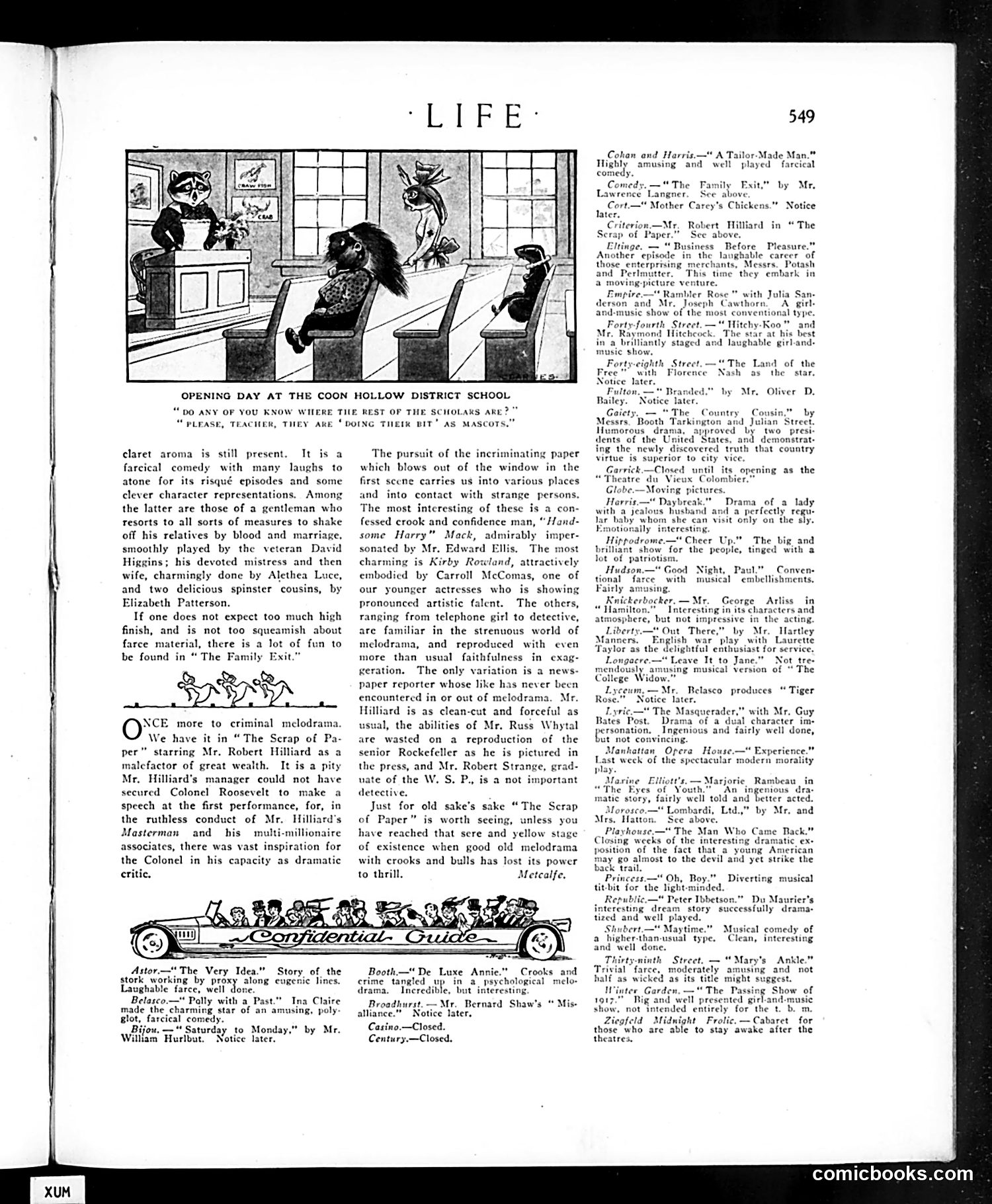
This page from Life magazine (page 549) contains theater reviews and a cartoon satirizing rural American education. The cartoon, titled "Opening Day at the Coon Hollow District School," depicts a one-room schoolhouse where the teacher asks students where their classmates are. A student responds they're "doing their bit" as their mothers requested—a reference to wartime service contributions during World War I. The cartoon mocks rural communities by using the derogatory term "Coon Hollow" and suggesting backwoods priorities conflict with education. The image shows stereotypical rural children and crude classroom conditions, reinforcing urban prejudices about rural Americans. The page primarily reviews contemporary Broadway plays, mentioning stars like Robert Hilliard and Ina Claire in productions at various theaters (Astor, Booth, Cort, Empire, etc.). Most reviews are brief, focusing on entertainment value rather than artistic merit.
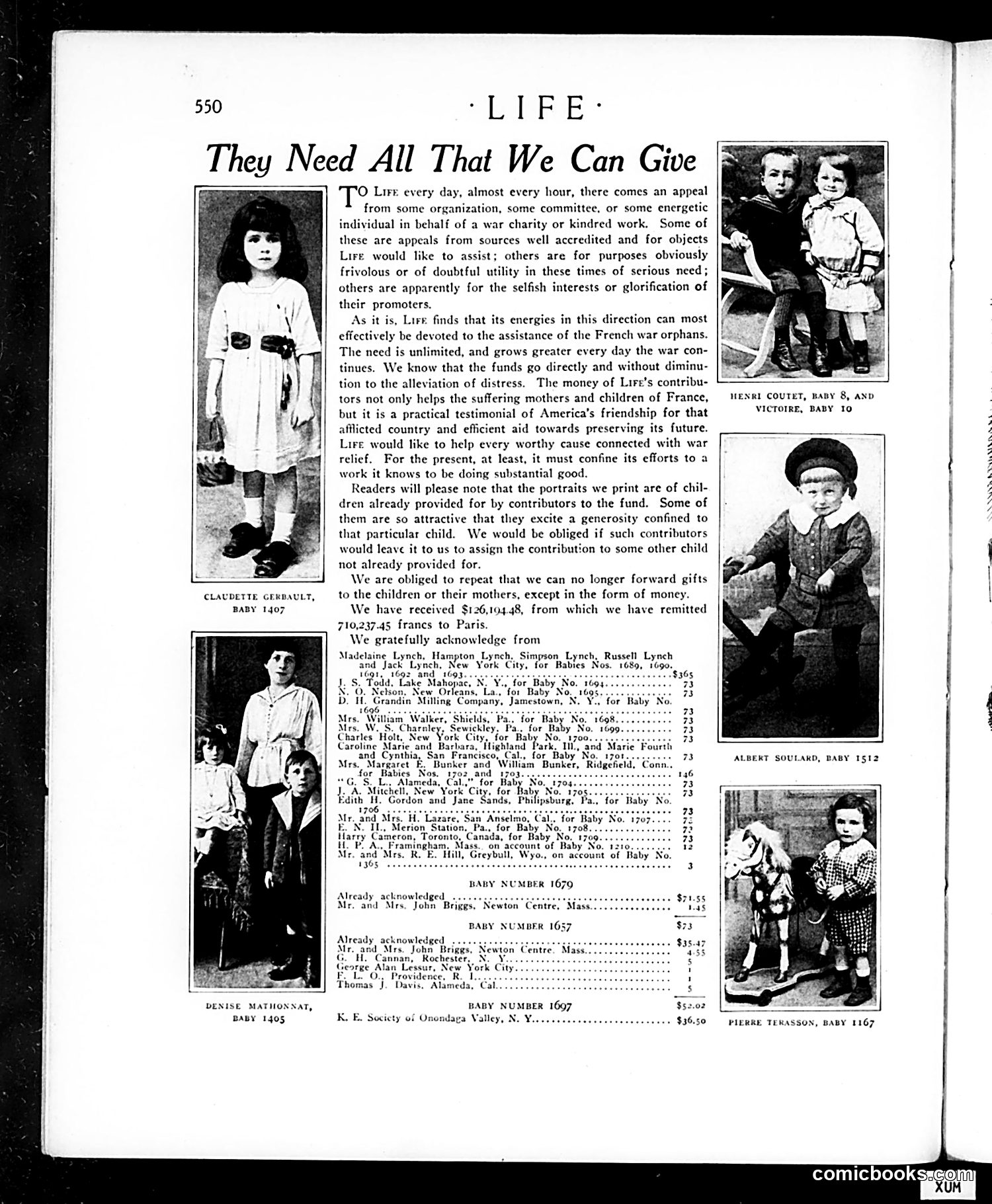
This page documents Life magazine's charitable fundraising for French war orphans during World War I. The text announces that Life will concentrate its relief efforts exclusively on assisting French orphans, as "the need is unlimited, and grows greater every day the war continues." The photographs show individual French children (identified by number) already supported by contributors. Life clarifies that while donors sometimes wish to sponsor specific attractive children, the magazine will redistribute funds as needed rather than leaving some orphans unsupported. The bulk of the page lists acknowledgments of donations received, with amounts contributed for specific baby numbers. The stated purpose is transparently patriotic—portraying aid to French children as both humanitarian relief and "a practical testimonial of America's friendship for that afflicted country." This represents early 20th-century American charitable campaigning using emotional appeals and photographic documentation of beneficiaries to encourage continued donations.
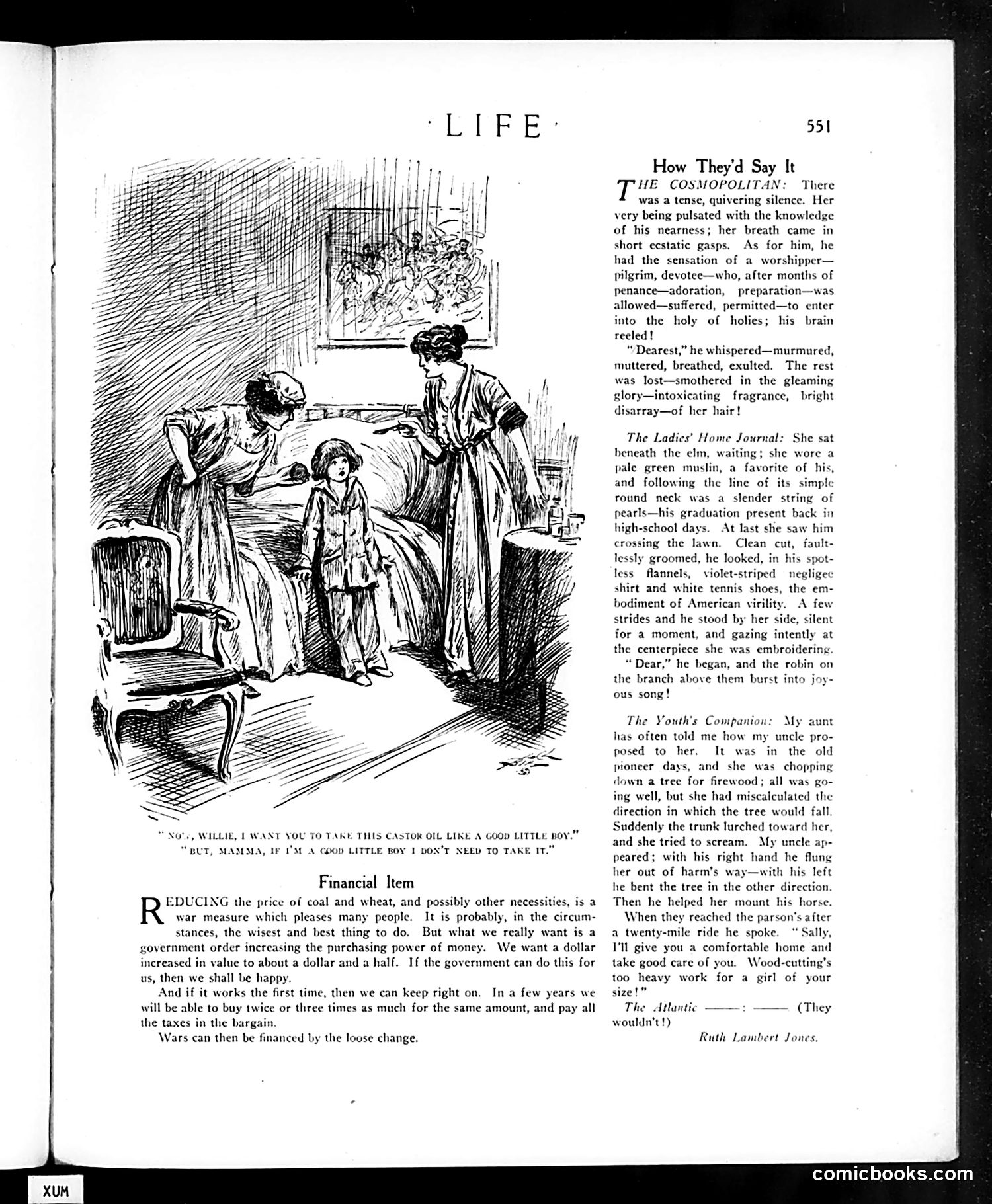
The main cartoon depicts a mother forcing castor oil on a reluctant child named Willie. His protest—"if I'm a good little boy I don't need to take it"—is a humorous logical argument against the unpleasant medicine. The joke relies on childhood reasoning and parental exasperation. Below, "Financial Item" satirizes wartime economic policy, proposing absurdly that the government increase a dollar's value to $1.50, then repeat indefinitely so citizens could "finance wars with loose change"—mocking the contradiction between reducing prices (a war measure) and needing actual purchasing power growth. The "How They'd Say It" section parodies how different 1910s-1920s magazines describe the same romantic moment—from *Cosmopolitan's* breathless, flowery prose to *Ladies' Home Journal's* genteel sentimentality to *Youth's Companion's* practical frontier story. It satirizes each publication's distinct voice and target audience.
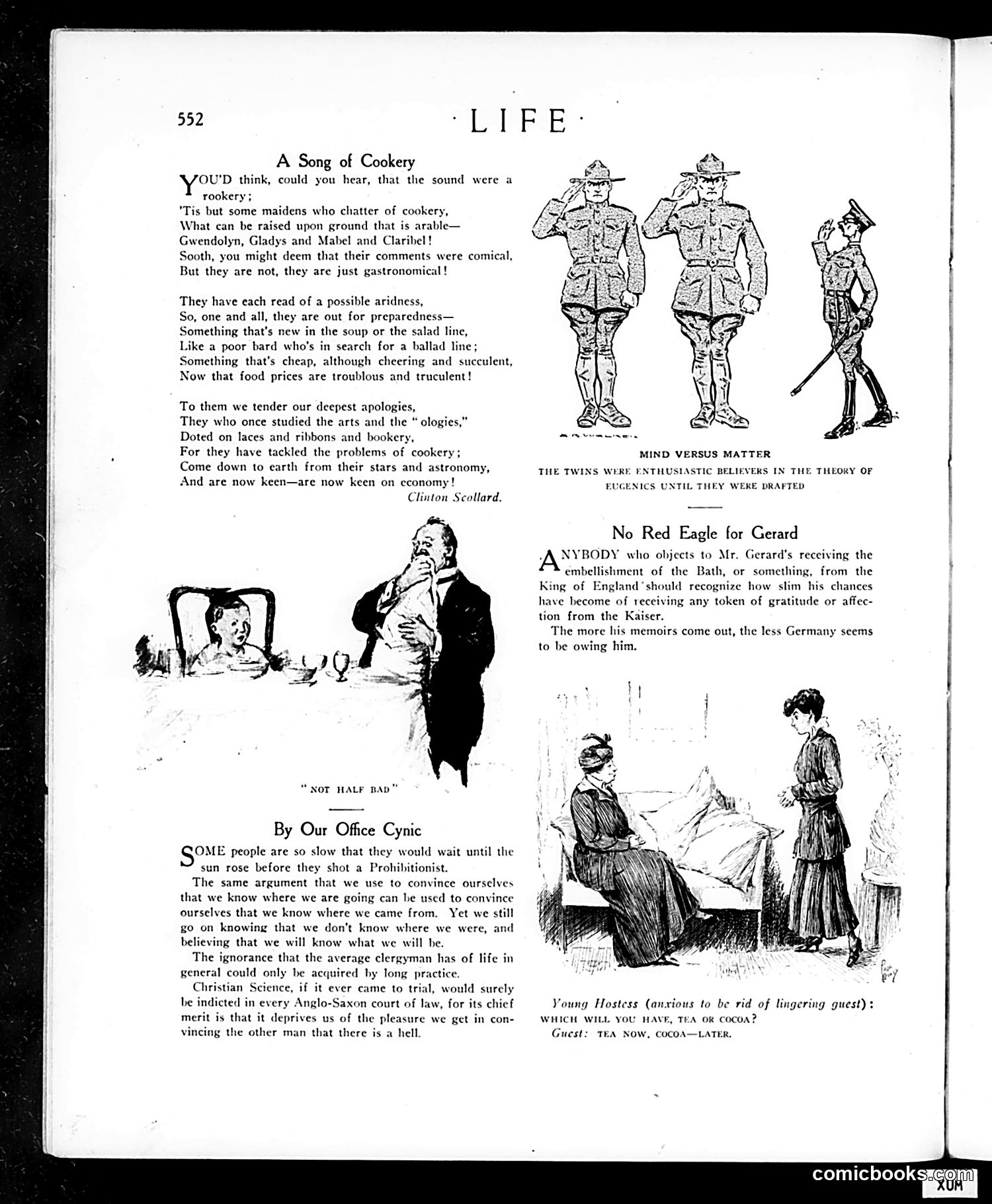
This page contains multiple satirical pieces reflecting WWI-era concerns: **"A Song of Cookery"** (Clinton Scollard poem): Mocks young women ("Gwendolyn, Gladys and Mabel") who once studied arts and humanities but now obsess over cooking and food economy during wartime rationing. The satire captures the shift from peacetime leisure to domestic preparedness. **"Mind Versus Matter"** (cartoon): Two identical soldiers representing twins who believed in eugenics theory until drafted into military service—mocking the gap between intellectual ideology and lived experience. **"No Red Eagle for Gerard"**: References James W. Gerard (U.S. Ambassador to Germany), sardonically noting Germany won't honor him since he's receiving British honors instead. Reflects post-war diplomatic tensions. **"By Our Office Cynic"**: Cynical observations including a dark joke about Prohibitionists and critiques of clergy ignorance and Christian Science. **"Young Hostess" cartoon**: A guest's reply ("tea now, cocoa—later") to the hostess's attempt to end his visit suggests he's outstaying his welcome—a social humor piece.
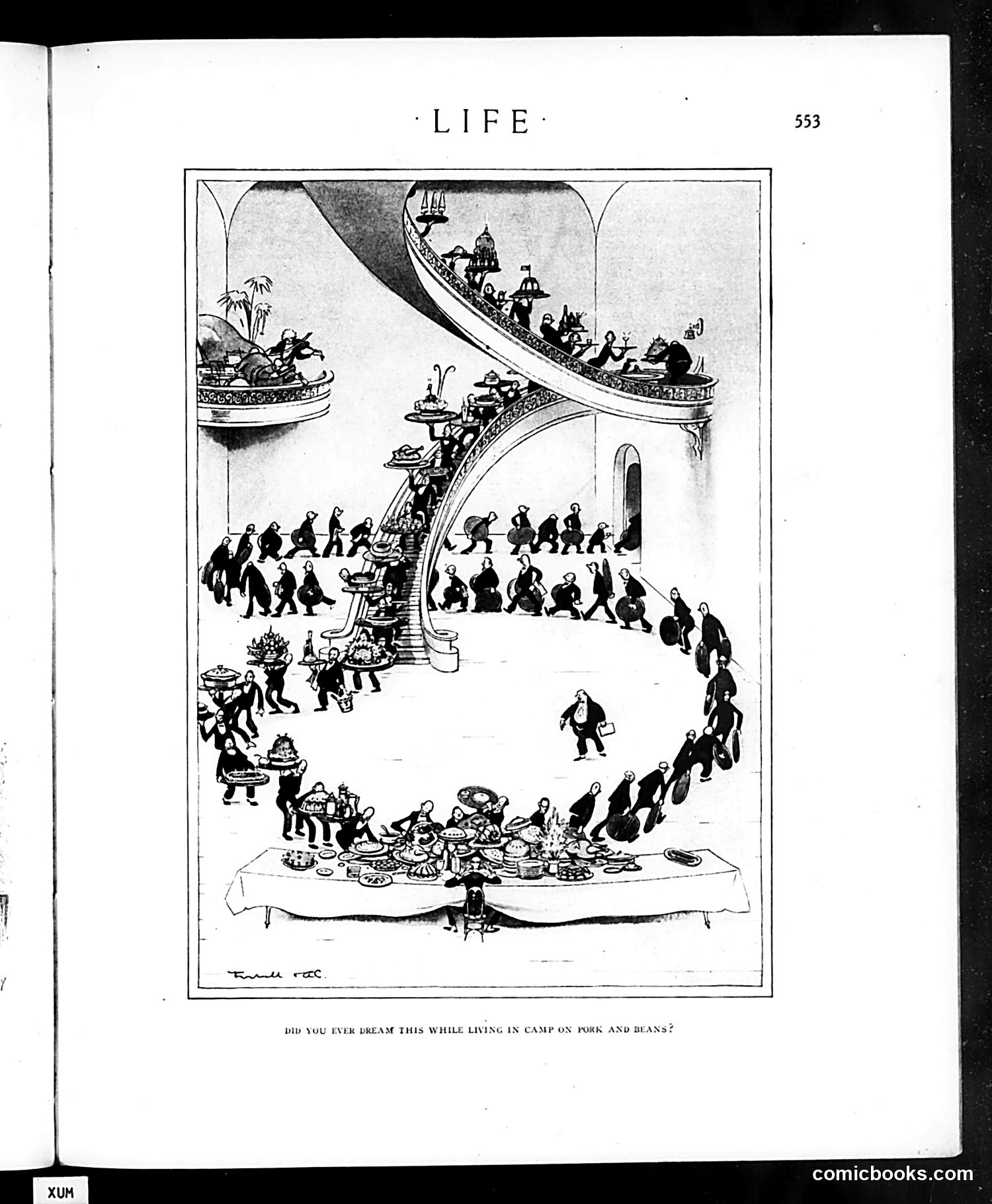
This is a satirical cartoon depicting an elaborate fantasy or dream sequence. The image shows a surreal architectural space with multiple levels connected by curved ramps and stairs. Figures in dark suits stream through the structure toward an abundant feast table laden with elaborate dishes and food. The caption—"Did you ever dream this while living in camp on pork and beans?"—suggests the cartoon mocks the monotonous, meager diet of soldiers or workers confined to camps. The fantasy depicts an opulent banquet as a daydream contrast to their actual rations. The lush details of the ornate palace-like setting and the procession of formally-dressed men emphasize the comic exaggeration of their aspirations, poking fun at how dramatically people fantasize about luxury when experiencing deprivation. The overall tone is lighthearted social commentary on working-class yearning.
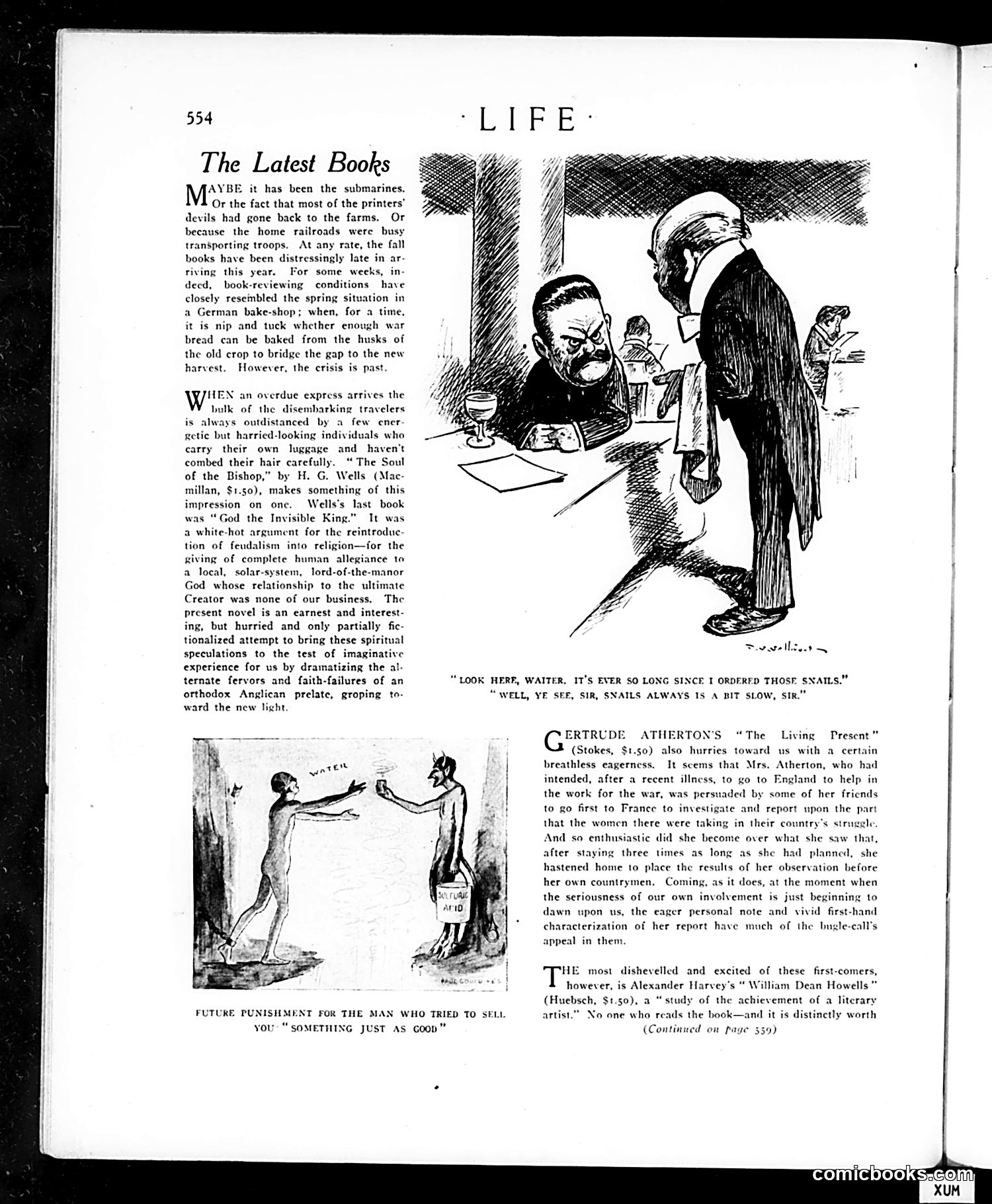
This page reviews newly arrived wartime publications. The top cartoon depicts a waiter and impatient customer—a satirical jab at delayed book deliveries during World War I. The author blames submarines, printer shortages, and railroads commandeered for troop transport for the backlog, comparing the scarcity to a German bakery struggling to bridge supply gaps. The reviews discuss H.G. Wells' *The Soul of the Bishop*, criticized as hastily written spiritual speculation, and Gertrude Atherton's *The Living Present*, praised for its enthusiastic firsthand account of French women's wartime efforts. The lower cartoon (captioned "Future Punishment") appears to satirize commercial deception—punishing someone who sold inferior goods as quality merchandise. The page reflects WWI-era publishing disruptions and American engagement with European conflict narratives.
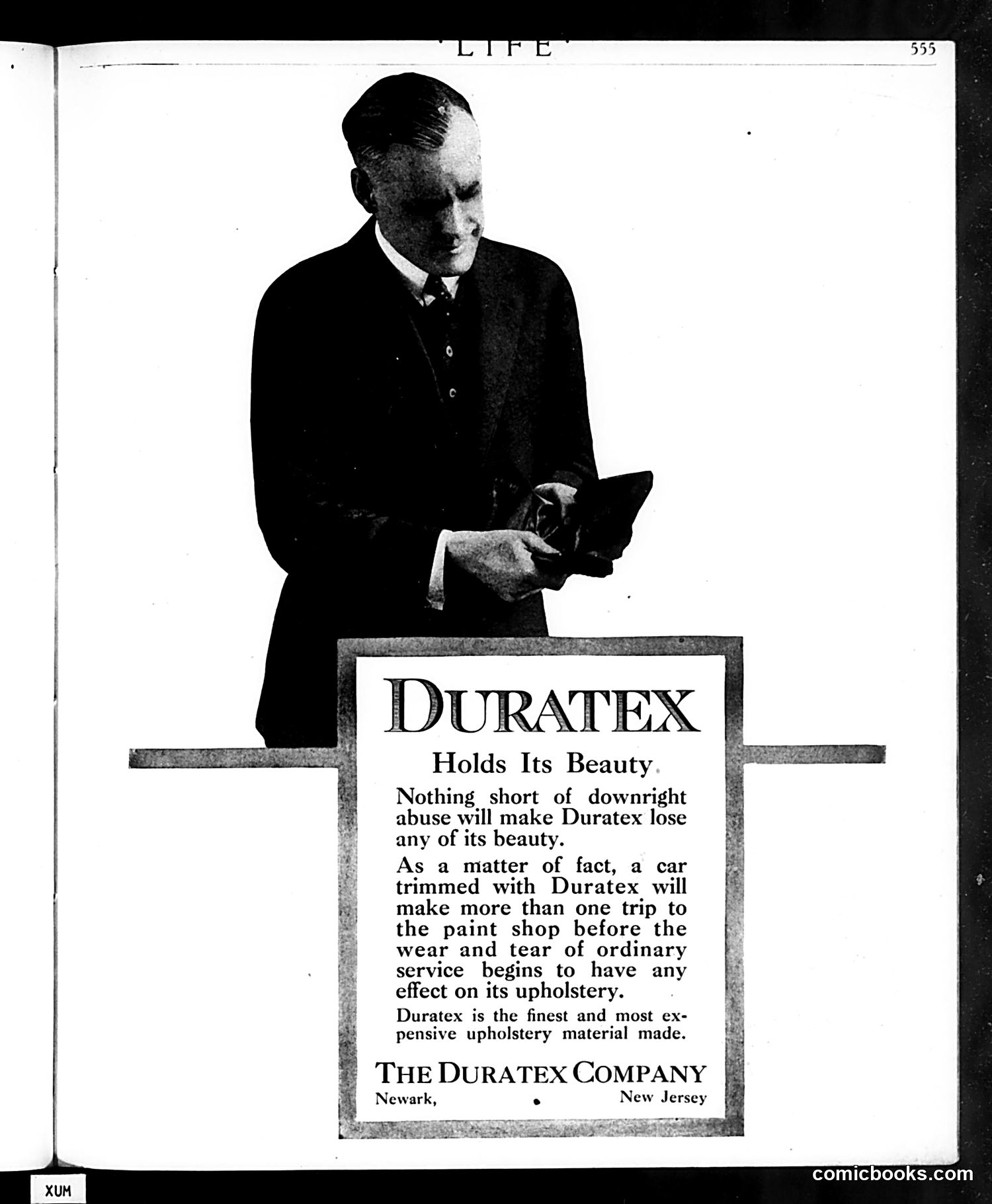
This is **a full-page advertisement**, not satire or editorial content. It advertises Duratex, an upholstery material for automobile interiors, made by The Duratex Company of Newark, New Jersey. The image shows a well-dressed businessman examining an empty wallet, which creates an unintentional ironic juxtaposition with the ad's claims about durability and expense. The text boasts that Duratex is so durable it "will make more than one trip to the paint shop before...ordinary service begins to have any effect," and claims it's "the finest and most expensive upholstery material made." For modern readers: this appears to be vintage automotive advertising emphasizing product quality through claims of superior durability—a common marketing tactic. The businessman's empty wallet may have been intended to suggest the material's premium price point, though the effect reads somewhat comically today.
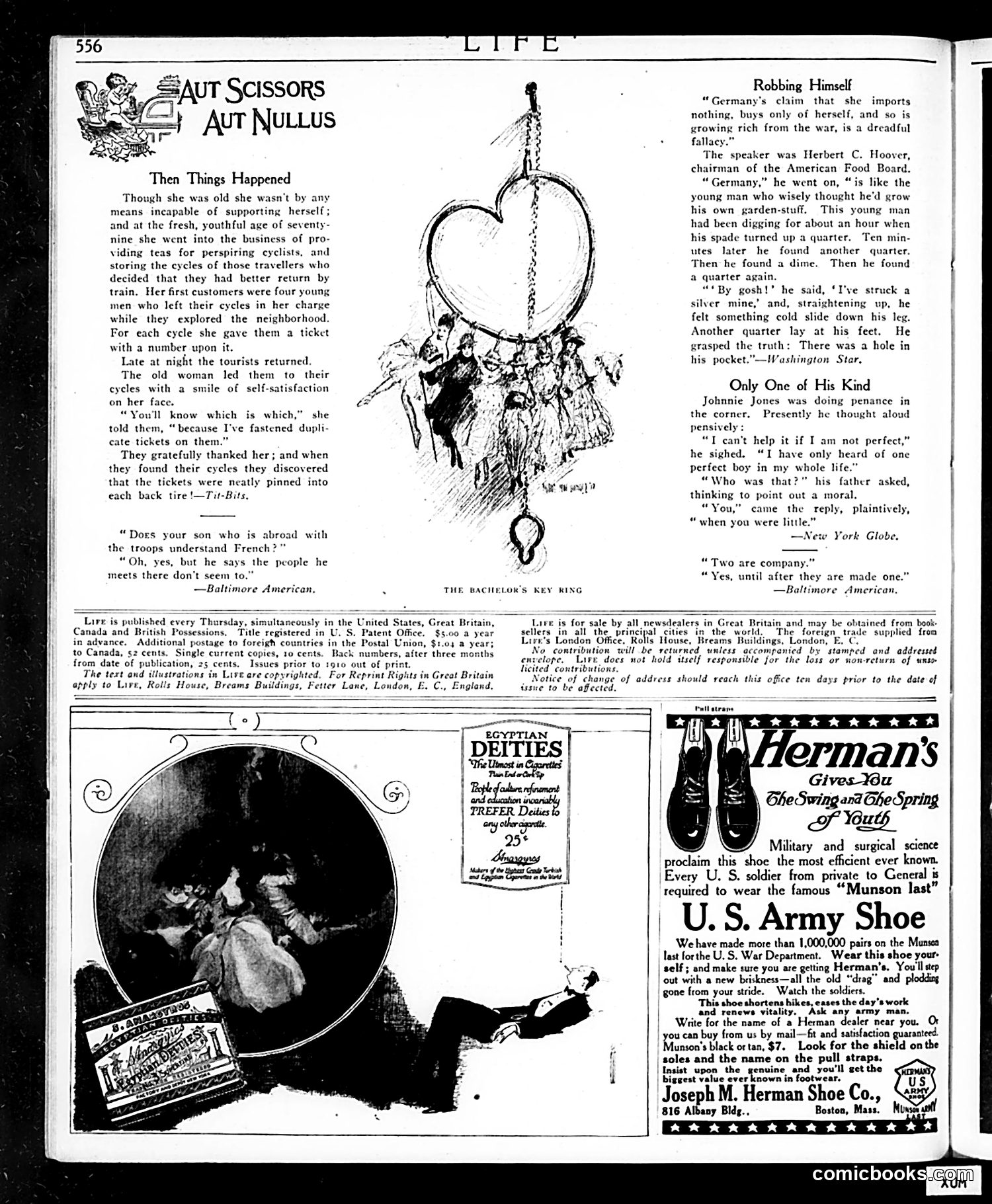
This page contains several humorous anecdotes and advertisements typical of Life's satirical format. **Main Content:** The page features short jokes and stories. One notable piece quotes Herbert C. Hoover (chairman of the American Food Board) using an analogy about Germany's war economy—comparing it to a man who finds money while digging but has a hole in his pocket, suggesting Germany is "robbing itself" despite claims of economic self-sufficiency during WWI. **The Cartoon:** "The Bachelor's Key Ring" (center) depicts a man holding a large key ring with an enormous ring at the bottom—a visual pun about bachelor life, though the specific meaning isn't entirely clear from the image alone. **Historical Context:** This appears to be from WWI-era Life, evidenced by the Hoover reference and mentions of troops abroad. The page mixes gentle domestic humor (anecdotes about cyclists, children) with wartime commentary. **Advertising:** The bottom features a Herman's U.S. Army Shoe advertisement, emphasizing the "Munson last" shoe supplied to American soldiers.
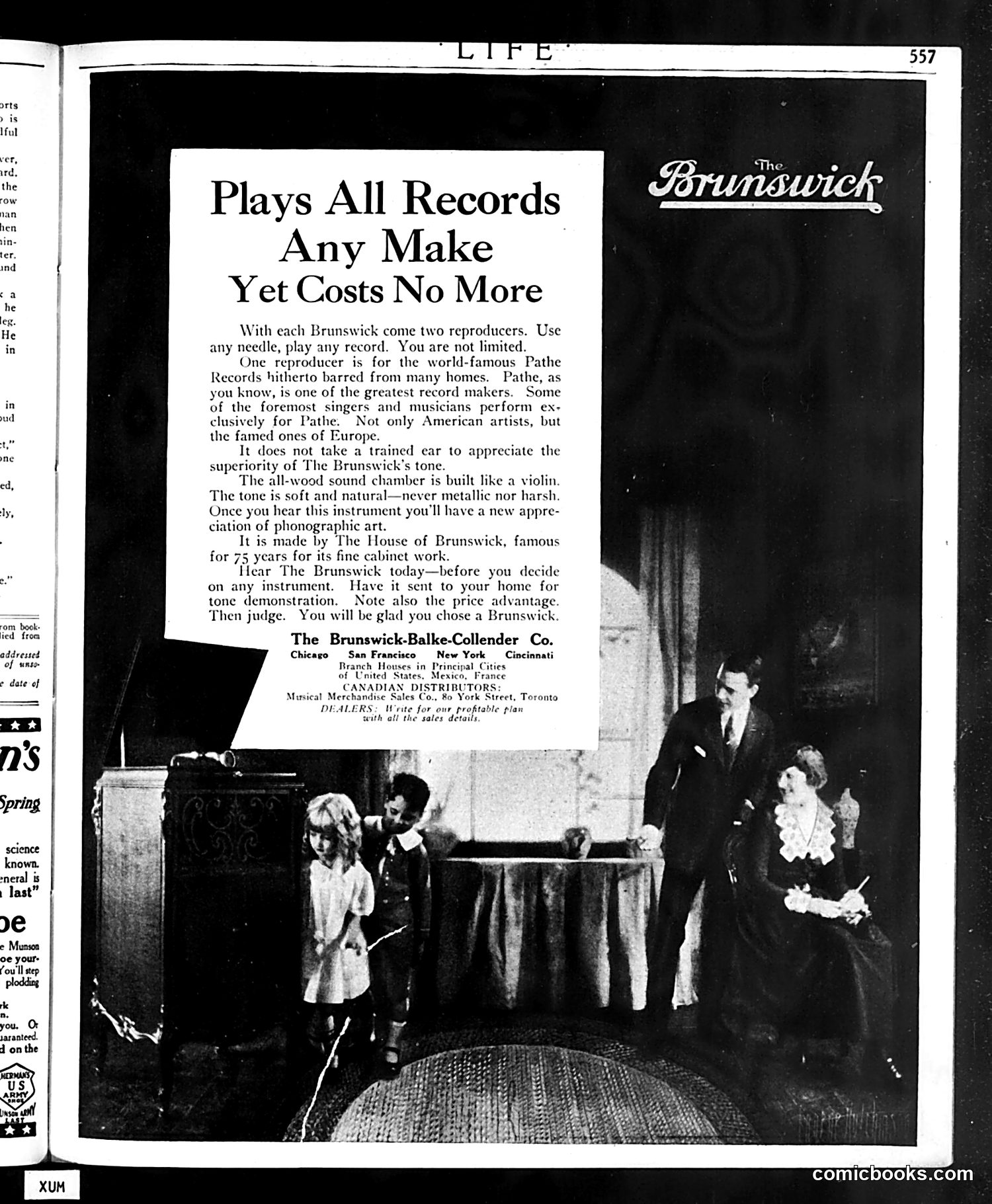
This is primarily a **phonograph advertisement**, not political satire. The page promotes Brunswick phonographs in Life magazine (circa 1920s, based on styling). **The pitch:** Brunswick phonographs play records from any manufacturer—a significant selling point when record players were format-specific. The ad emphasizes that Brunswick includes two reproducers (needles/cartridges), allowing compatibility with both standard records and Pathé Records, which were previously incompatible with many home players. **Key marketing claims:** - Superior tone quality ("all-wood sound chamber built like a violin") - Universal compatibility across record brands - Home demonstration available - Competitive pricing **The scene** shows what appears to be a home demonstration or social gathering where a family listens to the phonograph—standard advertising imagery of the era depicting technology as enhancing domestic life. This reflects early 20th-century consumer competition in emerging entertainment technology, before standardization. The ad's emphasis on playing "any make" reveals how fragmented the market was.
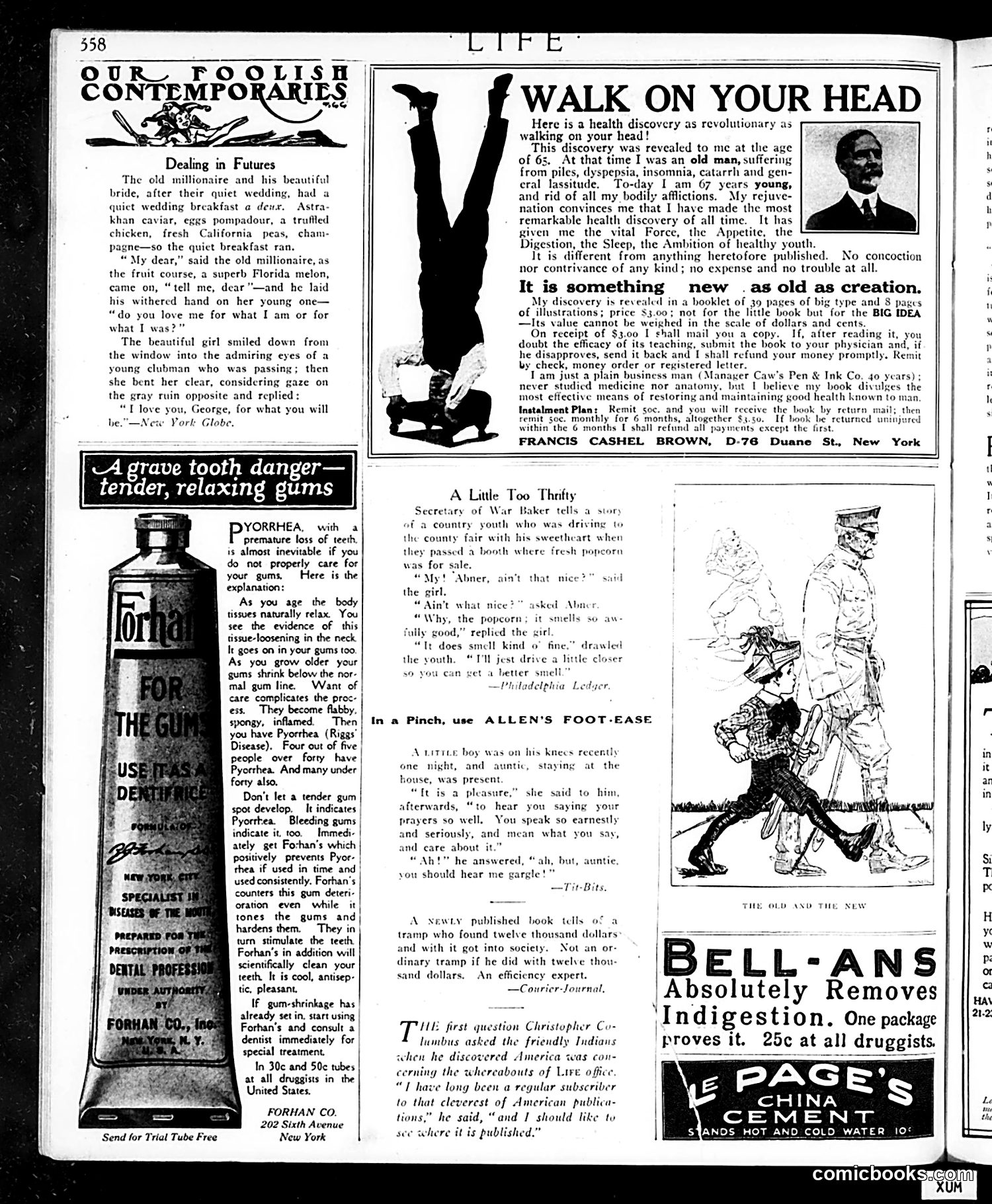
This page exemplifies early 20th-century *Life* magazine's satirical approach: mocking contemporary follies through both editorial cartoons and absurdist advertisements. **"Dealing in Futures"** (top left) satirizes wealthy, aging men marrying young women. The joke hinges on a young woman's mercenary honesty: when an old millionaire asks if she loves him for what he is or was, she gazes at a younger man outside, implying she loves him for neither—but for what he'll *become* (wealthy, presumably, or simply because he's young). **"Walk on Your Head"** is a pseudo-scientific health advertisement promising rejuvenation through an unnamed discovery, sold as a $3 booklet. It's clearly satirical: the absurdist claim, the vague methodology ("no concoction"), and the implausible testimonial (man claims to be 65 but "6 years young") lampoon contemporary quack medicine and credulous consumers. The remaining ads (Forhan's toothpaste, Bell-Ans antacid, Page's tea) are era-typical commercial advertisements, not satire.
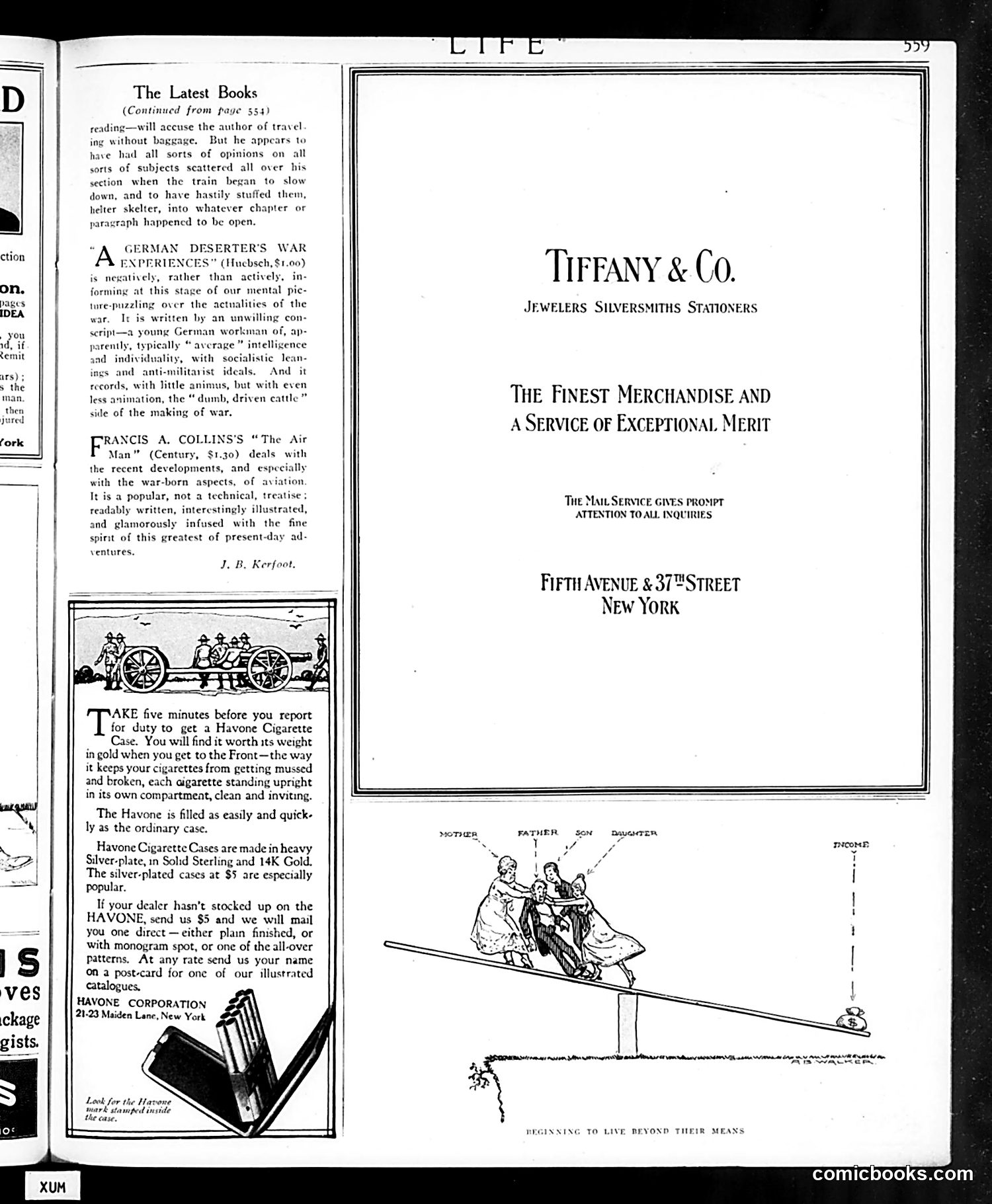
This page is primarily **advertising and book reviews**, not political satire. The left column reviews recent books, including a German soldier's WWI memoir and a popular treatise on aviation development. These reflect American interest in understanding the war and modern technology. The right side features luxury advertisements: **Tiffany & Co.** promoting high-end jewelry and stationery, and **Havone Cigarette Cases**—marketed to soldiers heading to "the Front," suggesting this magazine dates to **WWI era**. The cases are positioned as practical gifts for servicemen. Below is a cartoon captioned "Beginning to Live Beyond Their Means," showing a family (mother, father, son, daughter) on a seesaw or plank—likely satirizing middle-class overspending or financial excess during wartime prosperity. The humor targets consumer excess when national resources should focus on war effort. The juxtaposition of luxury goods ads with this cartoon creates ironic commentary on American consumer culture during wartime.
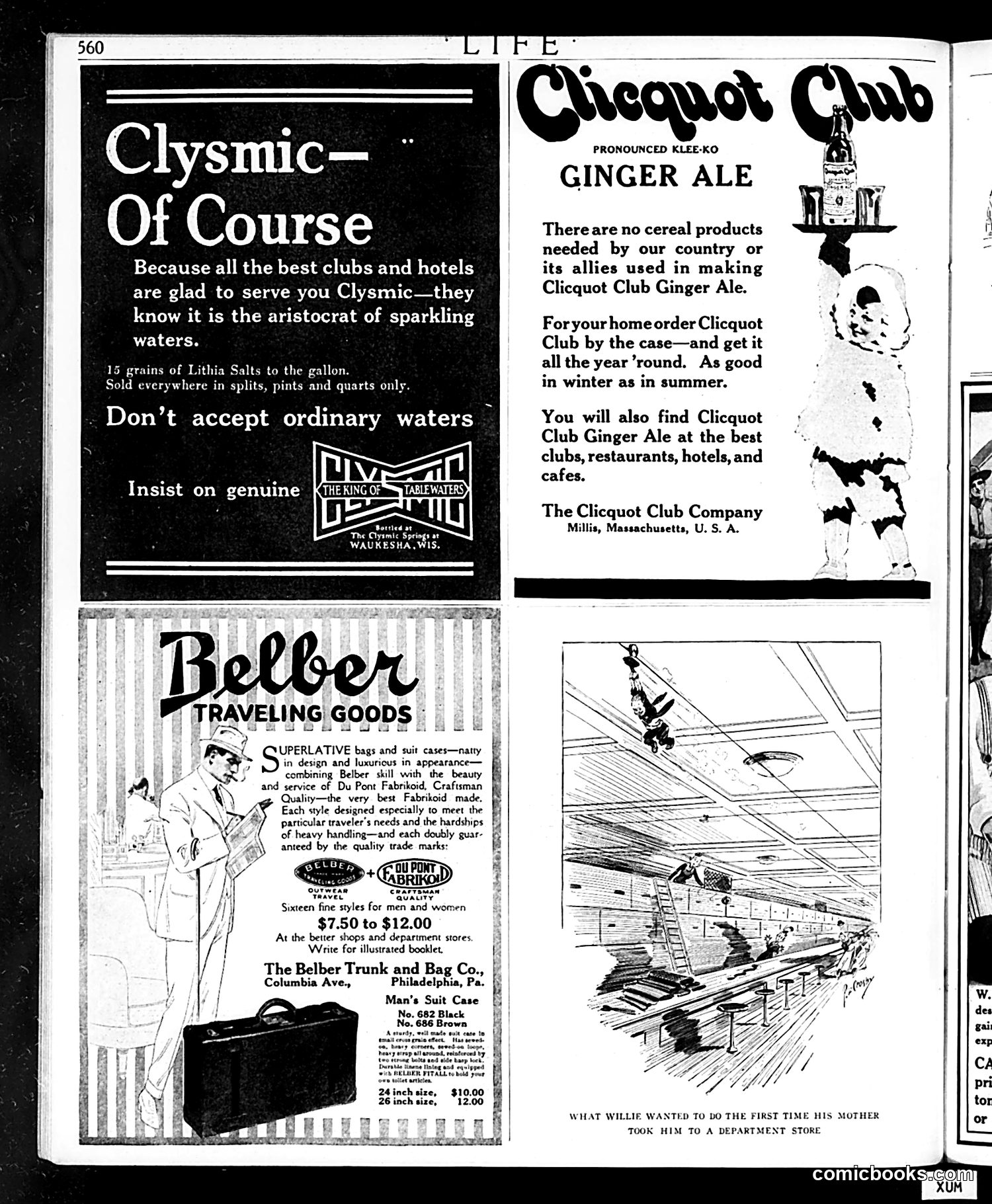
This page consists primarily of **advertisements** rather than political satire. The ads promote luxury goods targeting affluent consumers: Clysmic sparkling water ("the aristocrat of sparkling waters"), Belber traveling luggage, and Clicquot Club Ginger Ale. The **Clicquot Club ad** notably emphasizes that "no cereal products needed by our country or its allies" are used in making the ginger ale—likely a **WWI-era patriotic appeal**, suggesting the product doesn't consume scarce wartime resources. At the bottom is a small cartoon titled "What Willie Wanted to Do the First Time His Mother Took Him to a Department Store," showing a child attempting to slide down what appears to be a railing or architectural feature. This is a **humorous domestic scene** playing on children's mischievous impulses in public spaces—common satirical fodder in the era. The page reflects early 20th-century consumer culture and wartime consciousness.
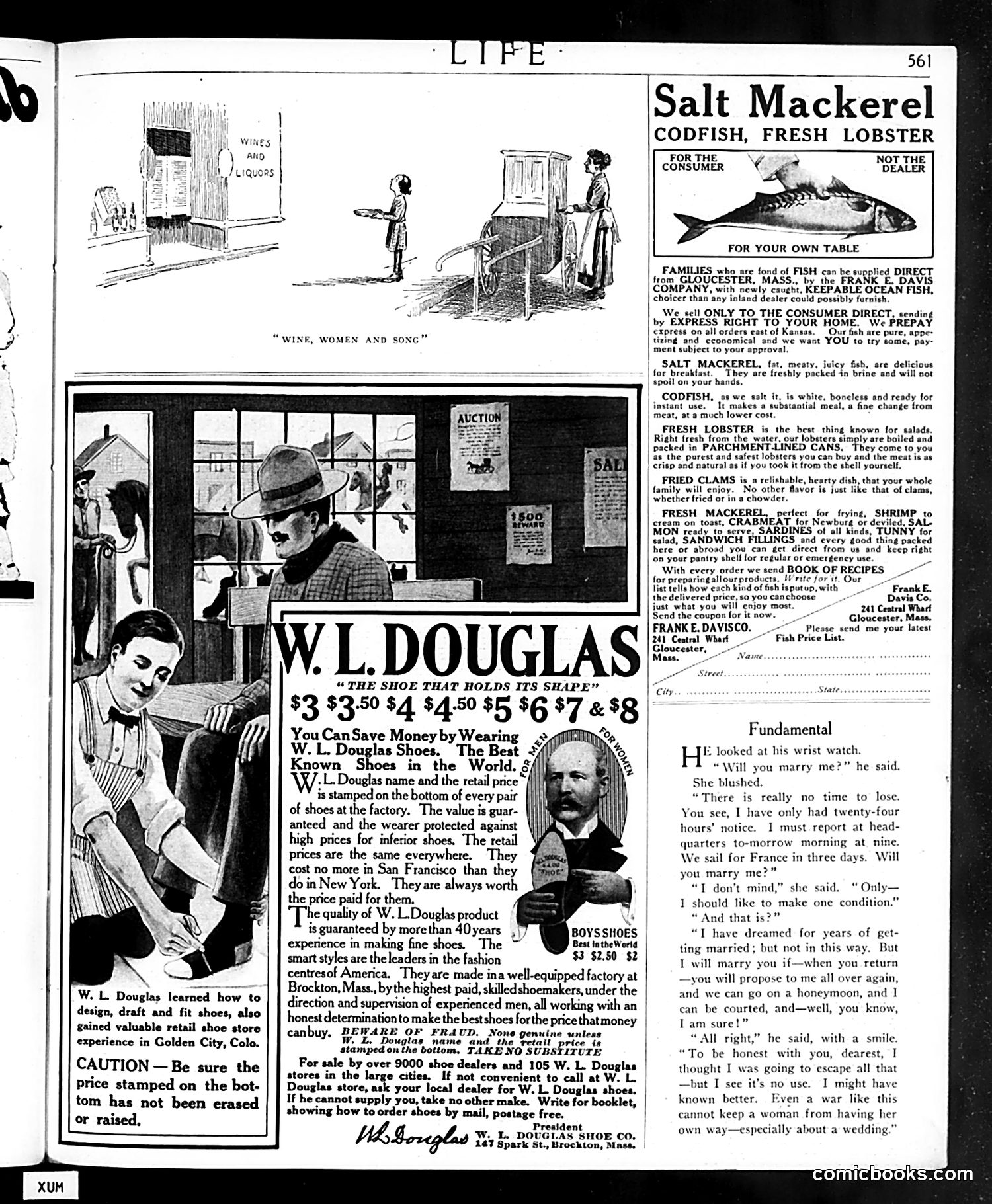
This page contains two major advertisements with no political cartoons. **W.L. Douglas Shoes** dominates the left side. The ad emphasizes that Douglas shoes cost the same everywhere—San Francisco to New York—and that the retail price is stamped on the bottom. A cautionary note warns consumers to verify the stamped price hasn't been "erased or raised," suggesting a common fraud where dishonest dealers would alter pricing. The ad appeals to working-class consumers by guaranteeing "the best shoes for the price that money can buy" and boasting 40 years of manufacturing experience in Brockton, Massachusetts. **Frank E. Davis Company** (right side) advertises fresh seafood—mackerel, codfish, lobster, clams—sold "direct to consumer" by express mail from Gloucester, Massachusetts. The pitch emphasizes freshness, purity, and economy compared to "inland dealers," with the added incentive of a free recipe booklet. Both ads target budget-conscious, practical consumers of the early 20th century, emphasizing direct pricing transparency and quality assurance against perceived dealer fraud or inferior goods.
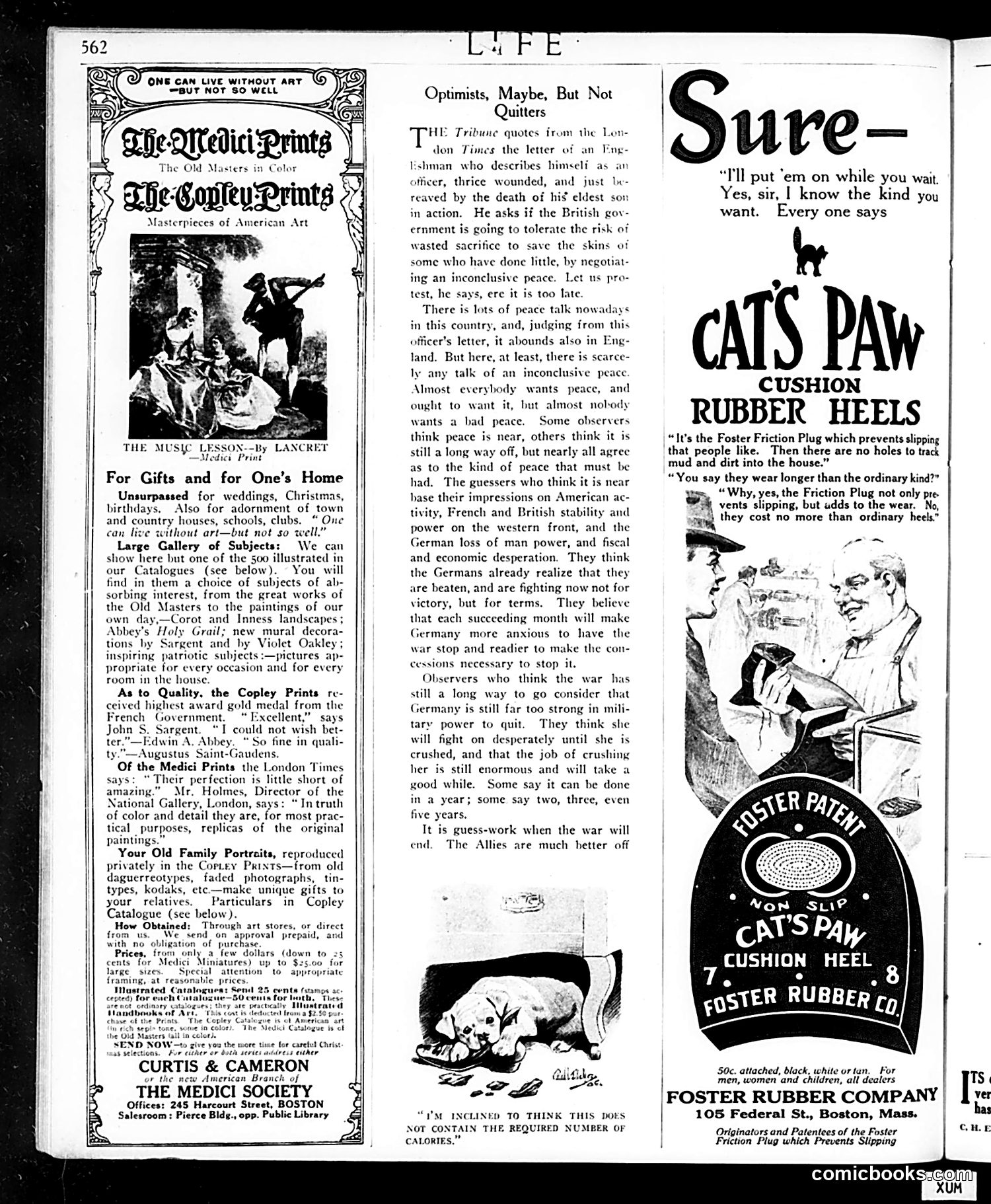
This page combines editorial content with advertisements. The main article, "Optimists, Maybe, But Not Quitters," discusses World War I peace negotiations. It quotes a letter from a wounded British officer who lost his son in combat, arguing against premature peace talks that might waste further sacrifice. The article presents two opposing viewpoints on when WWI will end: optimists believe Germany is already beaten and will soon seek terms; pessimists argue Germany remains militarily strong and will fight until crushed. The author notes widespread agreement that any peace must be decisive—nobody wants "a bad peace," only disagreement on timing. The cartoons appear minor; one depicts a dog with caption suggesting inadequate caloric intake, likely satirizing wartime rationing concerns. The page is primarily advertisements for art prints (Medici and Copley prints) and Foster Rubber Company's "Cat's Paw" cushioned heels—typical 1918 consumer goods marketing during wartime.
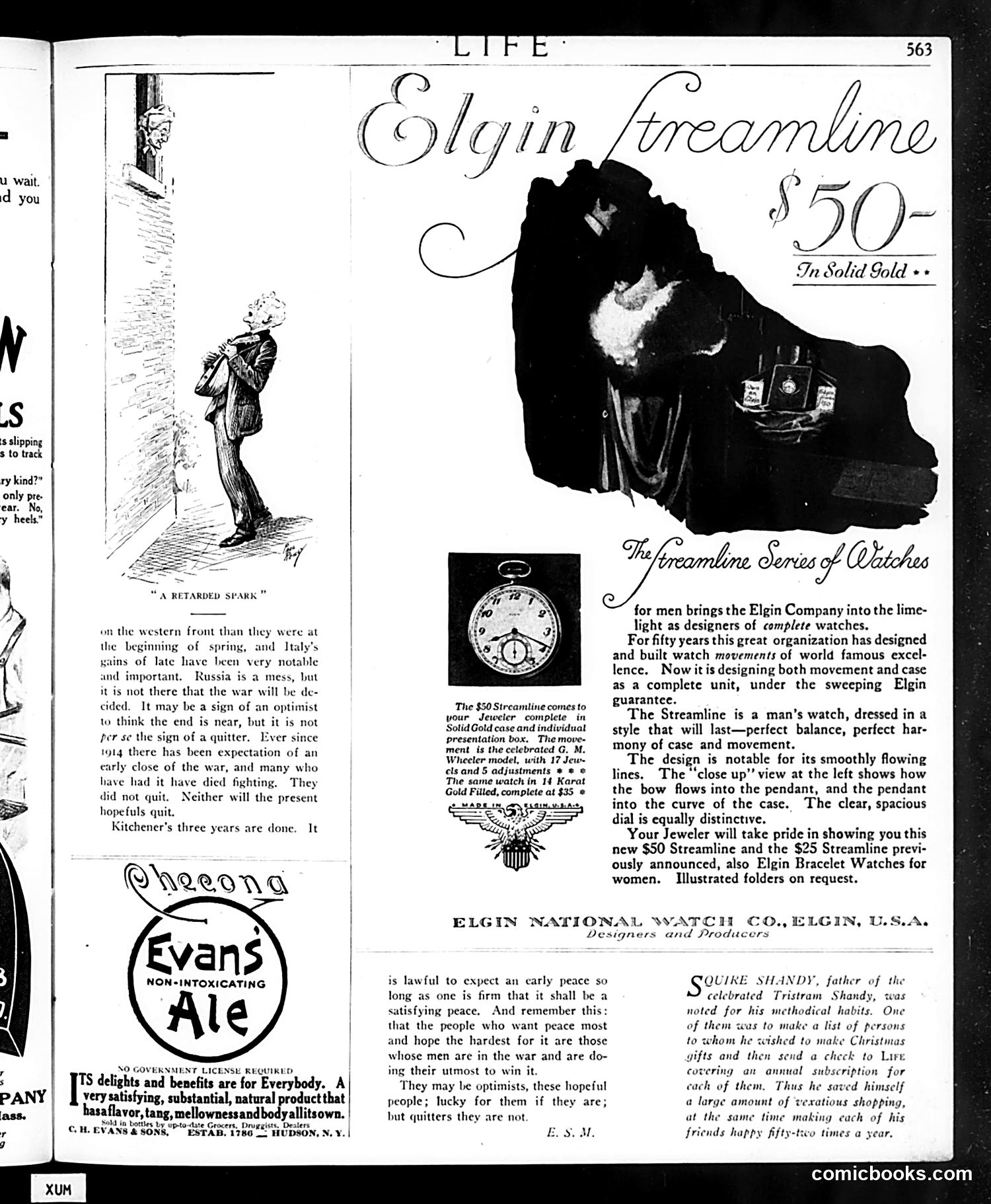
**"A Retarded Spark" Cartoon:** This sketch depicts a thin man in formal dress standing hesitantly at a doorway or wall, looking back over his shoulder. The title suggests someone whose momentum or initiative has stalled—likely commentary on wartime leadership or military progress. The figure appears uncertain or reluctant to advance. **War Commentary (Main Text):** The surrounding article discusses World War I's progress, specifically mentioning the Western Front, Italy's gains, and Russia's internal instability. It argues that expecting an early war's end doesn't mean one is a "quitter"—referencing Kitchener (British war secretary whose three-year tenure had ended). The piece defends optimism about peace as distinct from cowardice, noting that soldiers fighting for peace are not quitters. **Context:** This is WWI-era content arguing against defeatism while acknowledging war fatigue. The page also contains advertisements (Evans Ale, Elgin watches), typical of Life's format.
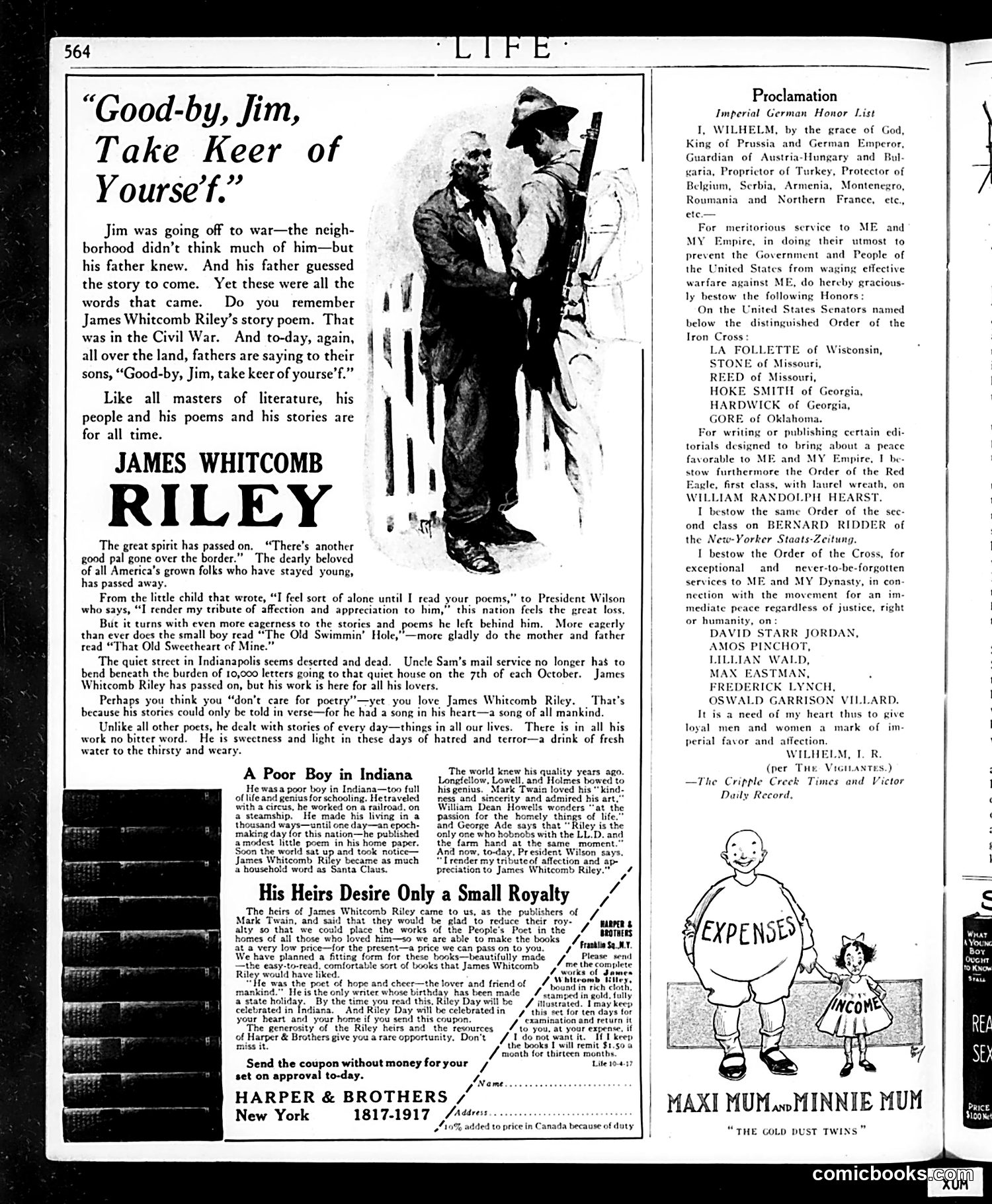
This page commemorates the recent death of poet James Whitcomb Riley, a beloved American writer known for accessible, sentimental verse about everyday life and rural Indiana. The illustration shows a father and son—depicting Riley's famous poem "Good-by, Jim, Take Keer of Yourse'f," about a Civil War father's brief farewell to his departing son. The text praises Riley as a "poor boy in Indiana" who became celebrated by major American writers and President Wilson. Unlike "bitter" contemporary poets, Riley wrote about universal human experiences without cynicism—described as "sweetness and light" during wartime. The page functions largely as an advertisement: Harper & Brothers offers Riley's collected works through a mail coupon, with the heirs' cooperation ensuring "beautifully made" editions. The pitch emphasizes Riley's universal appeal across all social classes and ages, marketing his books as wholesome Americana during a period of national conflict.
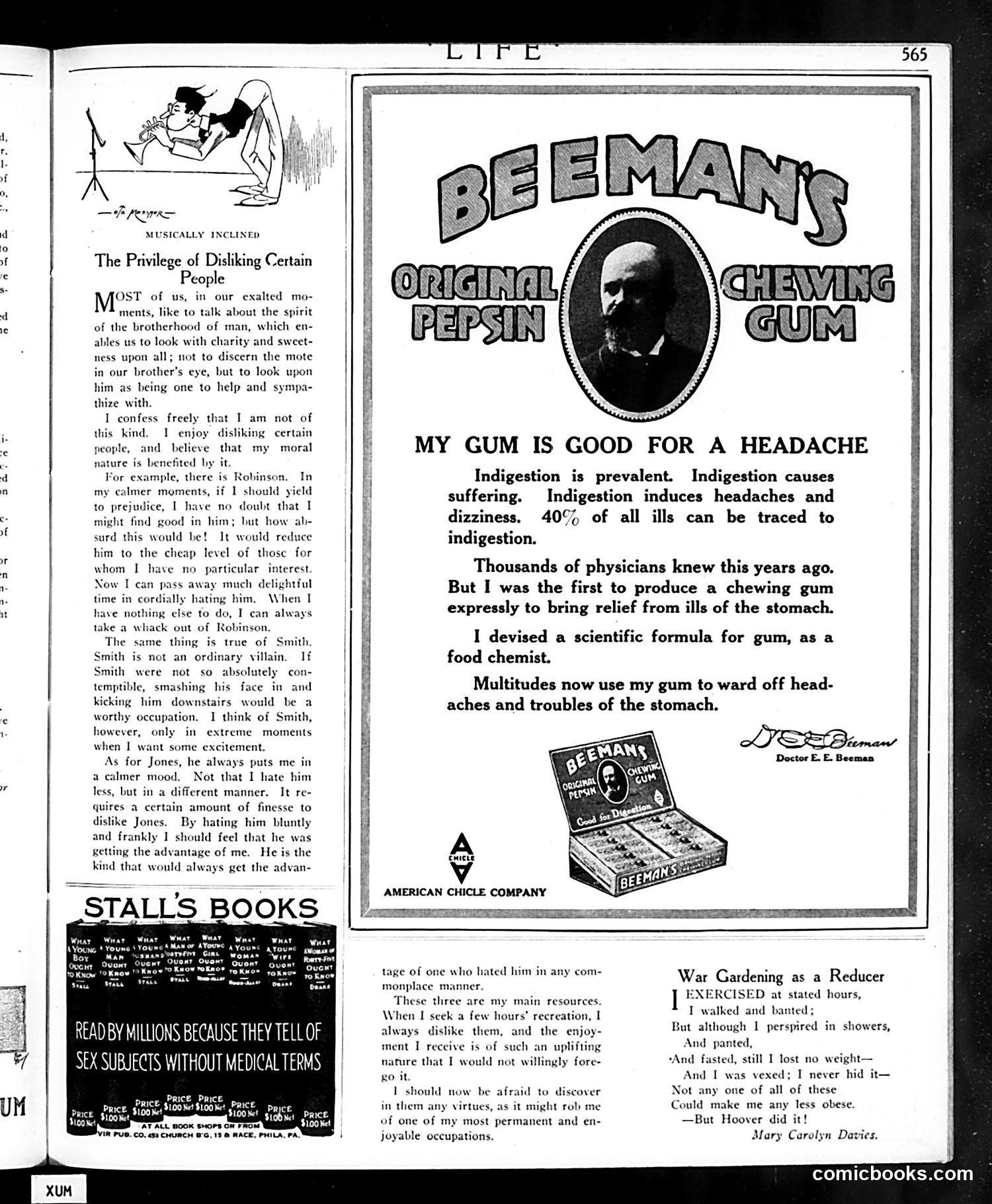
**Left Column - "The Privilege of Disliking Certain People":** This satirical essay mocks sentimentality about universal brotherhood. The author confesses he actually *enjoys* disliking specific people (Robinson, Smith, Jones) and uses them as entertainment—finding pleasure in cordially hating them or fantasizing about violence. The humor lies in the frank admission that disliking certain individuals brings him joy and moral benefit. It's social satire on hypocrisy: we claim to love everyone but actually harbor petty hatreds we indulge privately. **Right Column - Beeman's Chewing Gum Advertisement:** A full-page ad featuring "Doctor E. E. Beeman" claiming his gum cures headaches and indigestion. The ad states 40% of all illnesses trace to indigestion, positioning the gum as medicinal. This reflects early 20th-century advertising's exaggerated health claims before FDA regulations, when products routinely made dubious medical promises. **Bottom Right - "War Gardening as a Reducer":** A humorous poem about wartime rationing/gardening efforts failing to produce weight loss, concluding "But Hoover did it!"—likely referencing Herbert Hoover's WWI food conservation policies.
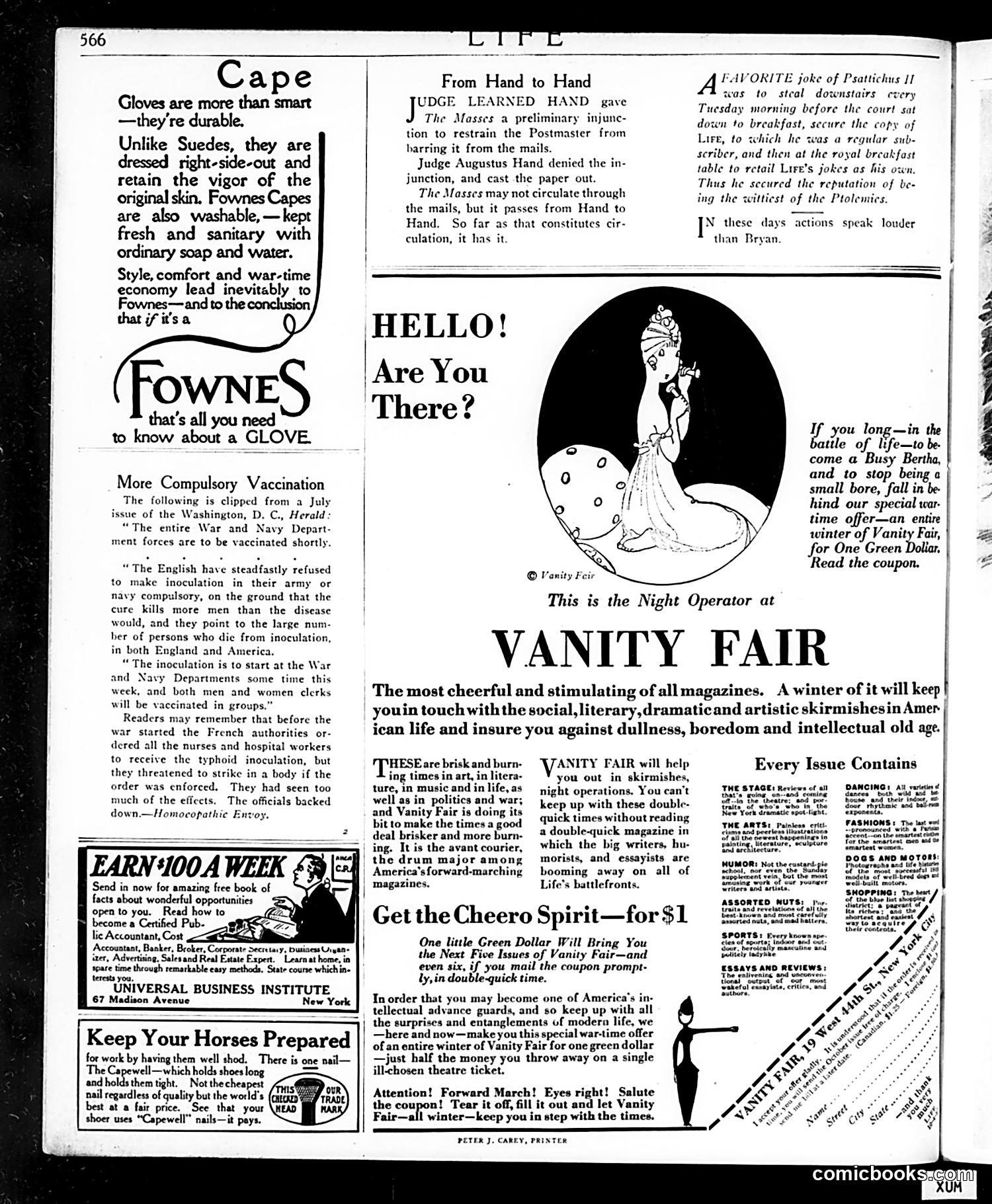
This page contains a clever **visual pun** about censorship during World War I. The main item, "From Hand to Hand," satirizes a real legal case involving *The Masses*, a radical publication that the U.S. Post Office banned from mails. Judge Learned Hand (whose actual surname is the joke's vehicle) ruled against the magazine, but the text notes the publication still circulates "from Hand to Hand"—a literal play on the judge's name. The page also critiques **compulsory vaccination** of military personnel, citing concerns (shared with allied nations) that inoculations caused more deaths than the diseases they prevented—a contemporary medical controversy. Most content comprises **period advertisements** and promotional copy for Vanity Fair magazine, promising to keep readers socially and intellectually current during wartime. The "Night Operator" illustration is Vanity Fair's mascot. The satire targets government overreach and wartime policies, using wordplay and legal irony rather than caricature.
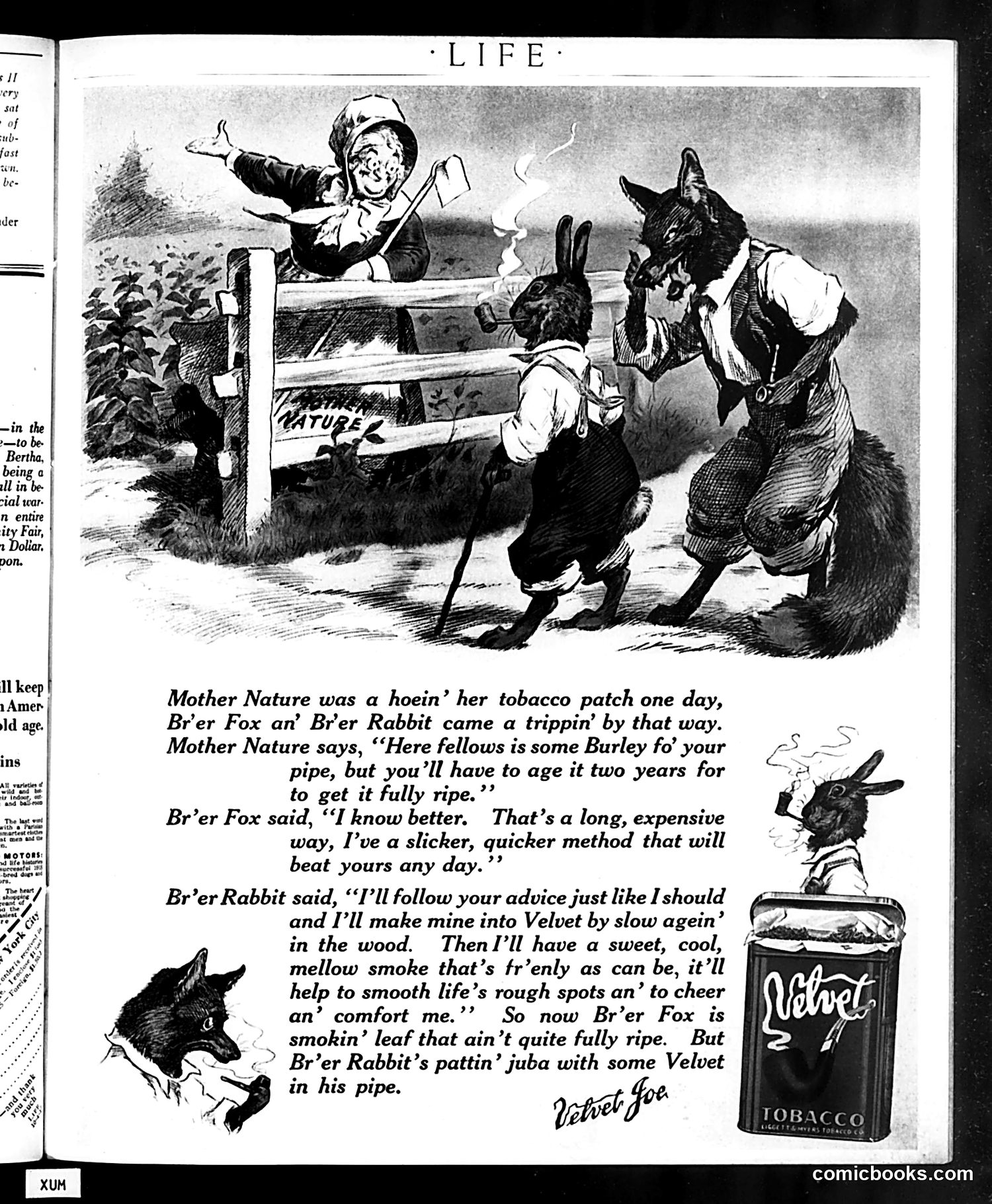
This is a **Velvet tobacco advertisement** disguised as folk humor, using the Uncle Remus tradition of anthropomorphic animal characters. The narrative contrasts two approaches: Br'er Fox takes a "slicker, quicker method" (implied shortcuts or inferior processing) while Br'er Rabbit follows Mother Nature's proper aging process, specifically choosing Velvet brand tobacco, which he allows to age "slow" in wood to achieve a "sweet, cool, mellow smoke." The satire targets competitors who rush production. By framing proper aging as virtuous and quicker methods as inferior, the ad suggests Velvet's competitors cut corners. The folk-tale setting lends authenticity and moral weight to what is essentially a claim about Velvet's superior manufacturing. The figures are stock characters from African American folklore, used here for commercial messaging—a common advertising practice of the era that would now be recognized as exploitative cultural appropriation.
This is primarily a **trademark protection advertisement**, not satire. The Victor Talking Machine Company uses Life magazine's platform to warn the public that "Victrola" is their exclusive brand name. The famous logo—a dog listening to a phonograph horn (trademarked as "His Master's Voice")—appears at top. The company's legal notice below addresses a common problem of the era: competitors were using the word "Victrola" generically to describe any phonograph, diluting Victor's brand identity. The text explicitly warns dealers that using "Victrola" to sell competing phonograph products is "misleading and illegal." This reflects early 20th-century trademark battles, when brand names risked becoming generic terms (like "aspirin" later did). The "Important Notice" emphasizes Victor's competitive advantage: their records and machines were specially coordinated through proprietary manufacturing—implying inferior synchronization with competitors' products. This advertisement reflects business concerns of WWI-era America, not political satire.