
Life, 1917-10-04 · page 21 of 44
Life — October 4, 1917 — page 21: what you’re looking at
What you’re looking at
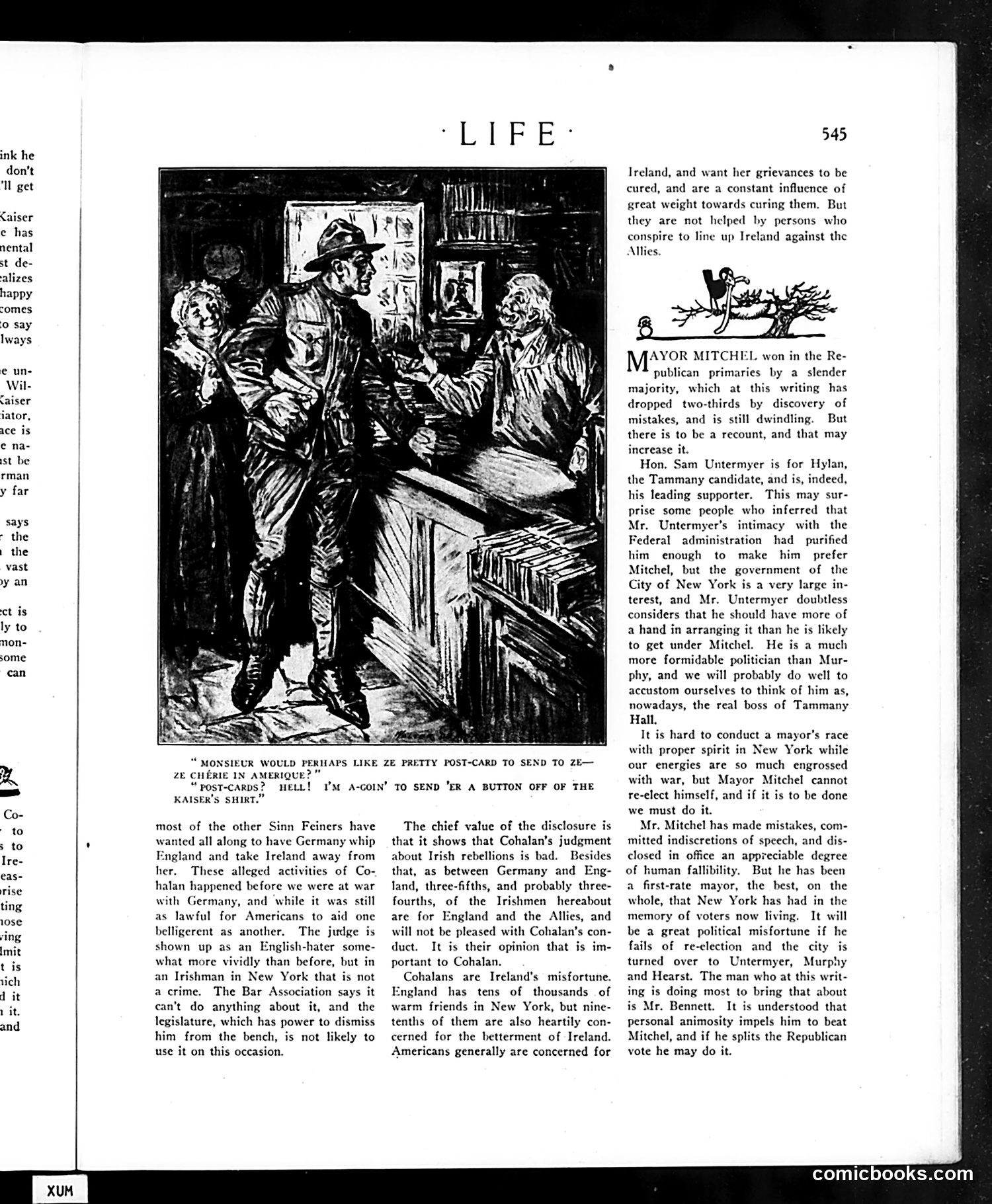
This page contains satirical commentary on New York City politics during WWI. The cartoon depicts a German officer requesting a postcard to send home, with an American soldier offering "a button off of the Kaiser's shirt"—mocking German militarism and expressing American support for the Allies. The text discusses Judge Daniel Cohalan, an Irish-American politician whose pro-Irish independence activities are criticized as potentially sympathetic to Germany. The author argues that while Irish-Americans have legitimate grievances, Cohalan's actions undermine American war effort support and alienate the majority of Irish-Americans who actually support England and the Allies. The piece also covers NYC mayoral politics: Mayor Mitchel's narrow Republican primary victory and concerns that other political figures (Untermyer, Murphy, Hearst, Bennett) may prevent his re-election, which the author views as detrimental to the city. The satire attacks both German militarism and perceived disloyalty among certain Irish-American leaders during wartime.
📄 Transcribed text from this page (OCR, searchable)
Machine-transcribed from the original scan — historical spelling and the odd misread are preserved.
ink he don’t ‘ll get Kaiser e has nental st de- alizes happy caiser iator, ace is ¢ na- st be rman y far says > the ) the vast yy an XUM IE IN AMERIQUE?” ze CHE * HELL! POST-CARDS ? KAISER'S SHIRT.” most of the other Sinn Feiners have wanted all along to have Germany whip England and take Ireland away from her. These alleged activi of Co- halan happened before we were at war with Germany, and while it was still as lawful for Americans to aid one belligerent as another. The judge is shown up as an English-hater some- what more vividly than before, but in an Irishman in New York that is not a crime. The Bar Association says it can't do anything about it, and the legislature, which has power to dismiss him from the bench, is not likely to use it on this occasion. IEUR WOULD PERHAPS LIKE ZE PRETTY POST-CARD TO SEND TO ZE— I'M A-COIN’ TO SEND 'ER A BUTTON OFF OF THE The chief value of the disclosure is that it shows that Cohalan’s judgment about Irish rebellions is bad. Besides that, as between Germany and Eng- land, three-fifths, and probably three- fourths, of the Irishmen hereabout are for England and the Allies, and will not be pleased with Cohalan’s con- duct. It is their opinion that is im- portant to Cohalan. Cohalans are Ireland's misfortune. England has tens of thousands of warm friends in New York, but nine- tenths of them are also heartily con- cerned for the betterment of Ireland. Americans generally are concerned for 545 Ireland, and want her grievances to be cured, and are a constant influence of great weight towards curing them. But they are not helped by persons who conspire to line up Ireland against the Allies. MeAvor MITCHEL won in the Re- publican primaries by a. slender majority, which at this writing has dropped two-thirds by discovery of mistakes, and is still dwindling. But there is to be a recount, and that may increase it. Hon. Sam Untermyer is for Hylan, the Tammany candidate, and is, indeed, his leading supporter. This may sur- prise some people who inferred that Mr. Untermyer’s intimacy with the Federal administration had purified him enough to make him prefer Mitchel, but the government of the City of New York is a very large in- terest, and Mr. Untermyer doubtless considers that he should have more of a hand in arranging it than he is likely to get under Mitchel. He is a much more formidable politician than Mur- phy, and we will probably do well to accustom ourselves to think of him as, nowadays, the real boss of Tammany Hall. It is hard to conduct a mayor's race with proper spirit in New York while our energies are so much engrossed with war, but Mayor Mitchel cannot re-elect himself, and if it is to be done we must do it. Mr. Mitchel has made mistakes, com- mitted indiscretions of speech, and dis- closed in office an appreciable degree of human fallibility. But he has been a first-rate mayor, the best, on the whole, that New York has had in the memory of voters now living. It will be a great political misfortune if he fails of re-election and the city is turned over to Untermyer, Murphy and Hearst. The man who at this writ- ing is doing most to bring that about is Mr. Bennett. It is understood that personal animosity impels him to beat Mitchel, and if he splits the Republican vote he may do it. comicbooks.com