
Life, 1917-10-04 · page 20 of 44
Life — October 4, 1917 — page 20: what you’re looking at
What you’re looking at
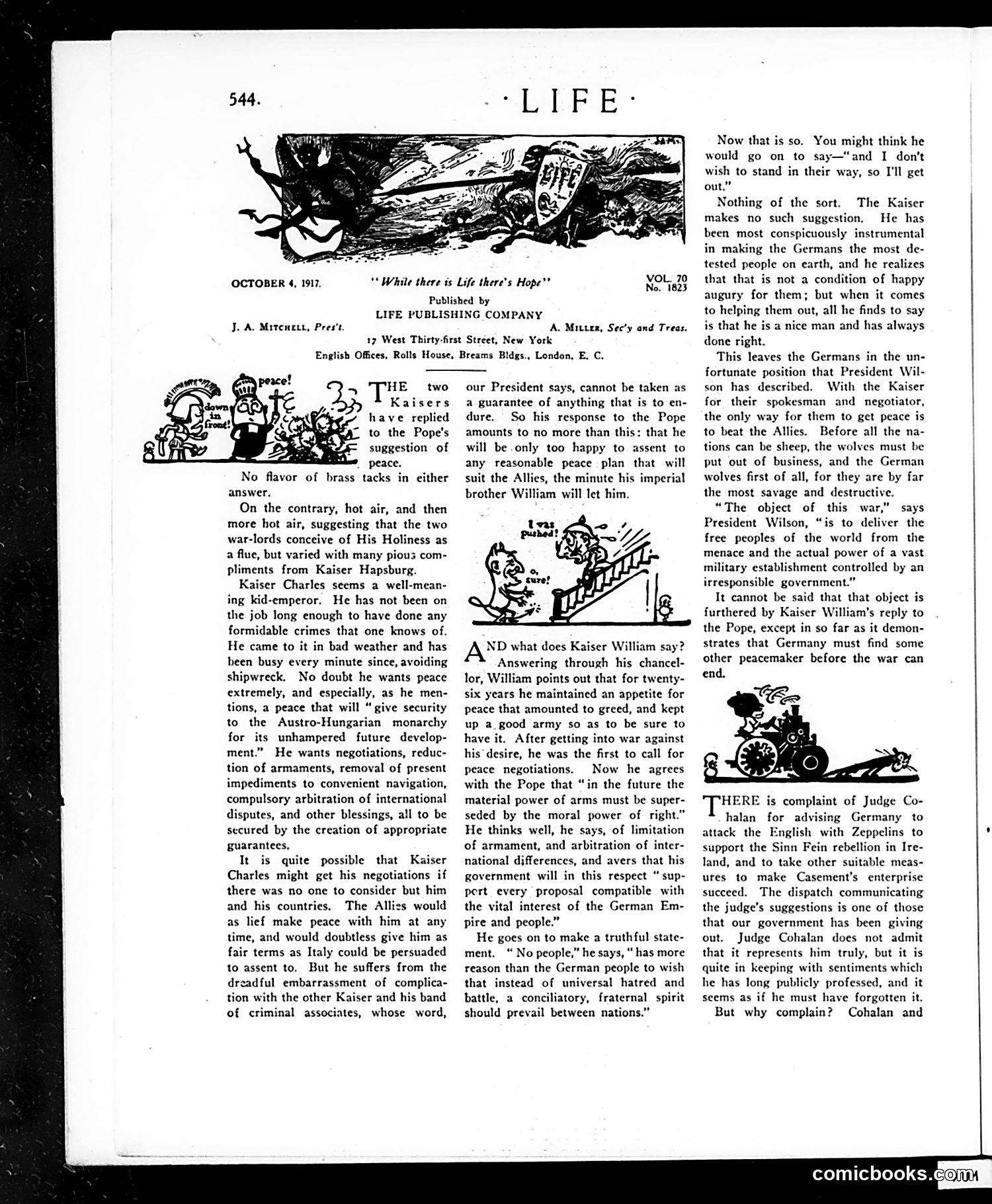
This page satirizes peace proposals submitted to Pope Benedict XV by Austria-Hungary's Kaiser Charles and Germany's Kaiser Wilhelm II during World War I. The satire's point: both emperors offer flowery rhetoric about peace while refusing actual concessions. Kaiser Charles essentially says he'd accept peace—if his ally Wilhelm allows it. Wilhelm claims to desire peace and moral righteousness, yet provides no genuine path to it, merely asserting Germany's vital interests must be protected. The cartoons (visible as small illustrations) mock their hypocrisy and evasiveness. The text sarcastically notes Wilhelm "has always done right"—obviously false given America's view of German war conduct. The broader context: America entered WWI in April 1917. Life, as a patriotic satirical magazine, ridicules Central Powers' peace overtures as insincere propaganda, reinforcing American commitment to defeating them militarily rather than negotiating.
📄 Transcribed text from this page (OCR, searchable)
Machine-transcribed from the original scan — historical spelling and the odd misread are preserved.
OCTOBER 4, 1917. “While there is Life there's Hope” VOL. 70 No, 1823 Published by LIFE PUBLISHING COMPANY J. A. Mirenctt, Pres’t. A. Mutter, Sec’y and Treas. 17 West Thirty-first Street, New York English Offices, Rolls House, Breams Bldgs., London, E. C. HE two Kaisers have replied to the Pope's suggestion of peace. No flavor of brass tacks in either answer, On the contrary, hot air, and then more hot air, suggesting that the two war-lords conceive of His Holiness as a flue, but varied with many pious com- pliments from Kaiser Hapsburg. Kaiser Charles seems a well-mean- ing kid-emperor. He has not been on the job long enough to have done any formidable crimes that one knows of. He came to it in bad weather and has been busy every minute since, avoiding shipwreck. No doubt he wants peace extremely, and especially, as he men- tions, a peace that will “give security to the Austro-Hungarian monarchy for its unhampered future develop- ment.” He wants negotiations, reduc- tion of armaments, removal of present impediments to convenient navigation, compulsory arbitration of international disputes, and other blessings, all to be secured by the creation of appropriate guarantees, It is quite possible that Kaiser Charles might get his negotiations if there was no one to consider but him and his countries. The Allizs would as lief make peace with him at any time, and would doubtless give him as fair terms as Italy could be persuaded to assent to. But he suffers from the dreadful embarrassment of complica- tion with the other Kaiser and his band of criminal associates, whose word, 33 our President says, cannot be taken as. a guarantee of anything that is to en- dure. So his response to the Pope amounts to no more than this: that he will be.only too happy to assent to any reasonable peace plan that will suit the Allies, the minute his imperial brother William will let him. ND what does Kaiser William say? Answering through his chancel- lor, William points out that for twenty- six years he maintained an appetite for peace that amounted to greed, and kept up a good army so as to be sure to have it. After getting into war against his desire, he was the first to call for peace negotiations. Now he agrees with the Pope that “in the future the material power of arms must be super- seded by the moral power of right. He thinks well, he says, of limitation of armament, and arbitration of inter- national differences, and avers that his government will in this respect “ sup- pert every proposal compatible with the vital interest of the German Em- pire and people.” He goes on to make a truthful state- ment. “ No people,” he says, “ has more reason than the German people to wish that instead of universal hatred and battle, a conciliatory, fraternal spirit should prevail between nations.” Now that is so. You might think he would go on to say—‘and I don't wish to stand in their way, so I'll get out.” Nothing of the sort. The Kaiser makes no such suggestion, He has been most conspicuously instrumental in making the Germans the most de- tested people on earth, and he realizes that that is not a condition of happy augury for them; but when it comes to helping them out, all he finds to say is that he is a nice man and has always done right. This leaves the Germans in the un- fortunate position that President Wil- son has described. With the Kaiser for their spokesman and negotiator, the only way for them to get peace is to beat the Allies. Before all the na- tions can be sheep, the wolves must be put out of business, and the German wolves first of all, for they are by far the most savage and destructive. “The object of this war," says President Wilson, “is to deliver the free peoples of the world from the menace and the actual power of a vast military establishment controlled by an irresponsible government.” It cannot be said that that object is furthered by Kaiser William's reply to the Pope, except in so far as it demon- strates that Germany must find some other peacemaker before the war can end, Ae 'HERE is complaint of Judge Co- halan for advising Germany to attack the English with Zeppelins to support the Sinn Fein rebellion in Ire- land, and to take other suitable meas- ures to make Casement’s enterprise succeed. The dispatch communicating the judge's suggestions is one of those that our government has been giving out. Judge Cohalan does not admit that it represents him truly, but it is quite in keeping with sentiments which he has long publicly professed, and it seems as if he must have forgotten it. But why complain? Cohalan and comicbooks.¢om}