
Life, 1917-10-04 · page 24 of 44
Life — October 4, 1917 — page 24: what you’re looking at
What you’re looking at
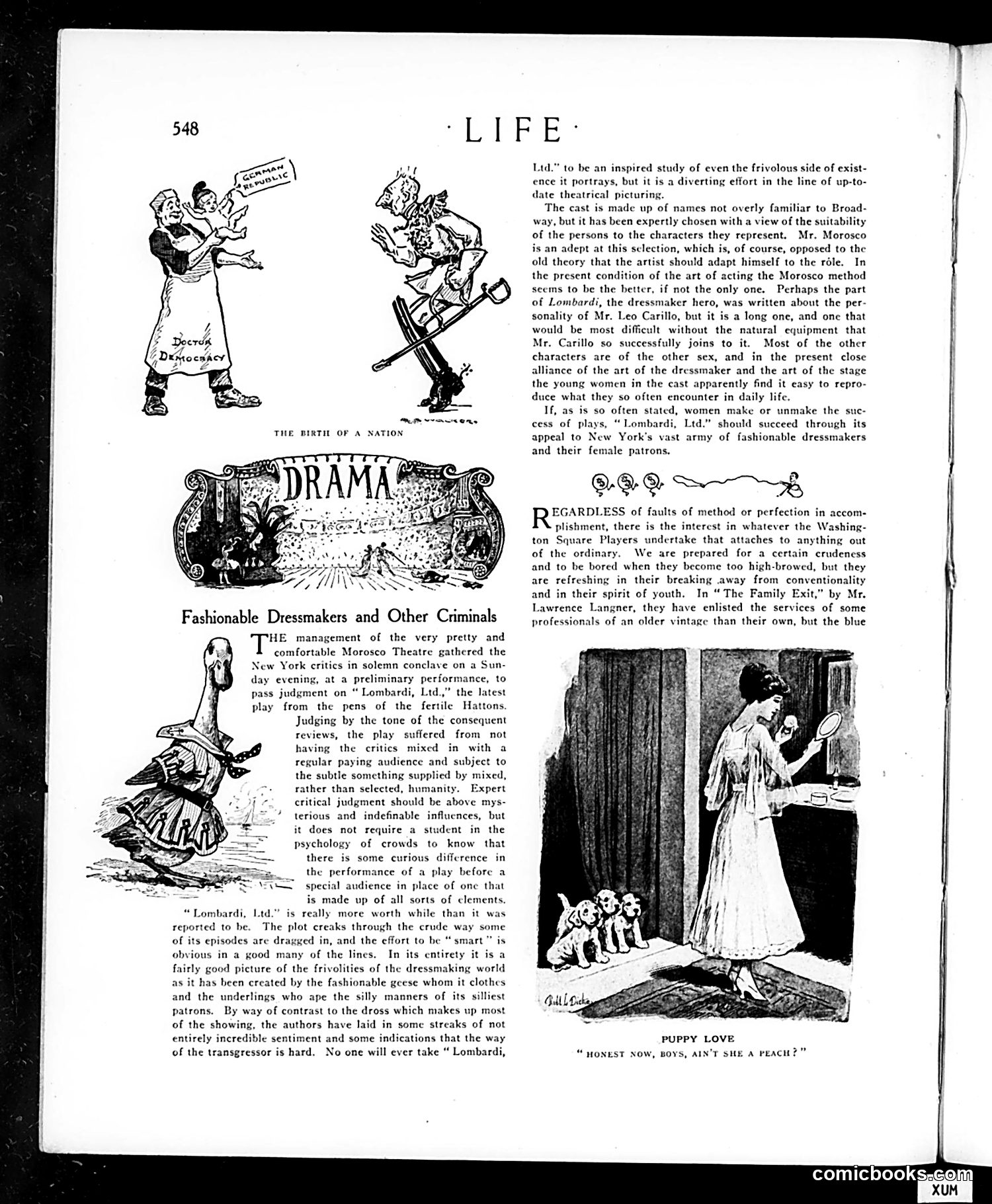
This *Life* magazine page satirizes the theatrical world of its era, particularly the play "Lombardi, Ltd." about the fashion industry. The cartoons labeled "The Birth of a Nation" appear to mock dramatic overreactions—figures are drawn in exaggerated, theatrical poses, likely poking fun at pretentious stage acting or critics' overwrought responses to plays. The main article reviews "Lombardi, Ltd.," a comedy about fashionable dressmakers. The satire targets the frivolous world of high fashion and its patrons, whom the reviewer calls "fashionable geese." The play's humor relies on depicting the dressmaking industry's pretensions and the silly behavior of wealthy clients and their servants who imitate their manners. The "Puppy Love" illustration shows a sentimental domestic scene—a woman with children and a dog—likely contrasting with the superficiality of fashion world satire above it. The underlying message: fashionable society and the dressmaking trade deserve mockery for their vanity and affectation.
📄 Transcribed text from this page (OCR, searchable)
Machine-transcribed from the original scan — historical spelling and the odd misread are preserved.
THE BIRTH OF A NATION Fashionable Dressmakers and Other Criminals HE management of the very pretty and comfortable Morosco Theatre gathered the New York critics in solemn conclave on a Sun- day evening, at a preliminary performance, to pass judgment on “ Lombardi, Ltd.,” the latest play from the pens of the fertile Hattons. Judging by the tone of the consequent reviews, the play suffered from not having the critics mixed in with a regular paying audience and subject to the subtle something supplied by mixed, rather than selected, humanity. Expert critical judgment should be above mys- terious and indefinable influences, but it does not require a student in the psychology of crowds to know that there is some curious difference in the performance of a play before a VV special audience in place of one that is made up of all sorts of elements. “Lombardi, Ltd.” is really more worth while than it was reported to be. The plot creaks through the crude way some of its episodes are dragged in, and the effort to be “ smart obvious in a good many of the lines. In its entirety it is a fairly good picture of the frivolities of the dressmaking world as it has been created by the fashionable geese whom it clothes and the underlings who ape the silly manners of its silliest patrons. By way of contrast to the dross which makes up most of the showing, the authors have laid in some streaks of not entirely incredible sentiment and some indications that the way of the transgressor is hard. No one will ever take “ Lombardi, "to be an inspired study of even the frivolous side of exist- ence it portrays, but it is a diverting effort in the line of up-to- date theatrical picturing. The cast is made up of names not overly familiar to Broad- way, but it has been expertly chosen with a view of the suitability of the persons to the characters they represent. Mr. Morosco is an adept at this selection, which is, of course, opposed to the old theory that the artist should adapt himself to the rdle. In the present condition of the art of acting the Morosco method seems to be the better, if not the only one. Perhaps the part of Lombardi, the dressmaker hero, was written about the per- sonality of Mr. Leo Carillo, but it is a long one, and one that would be most difficult without the natural equipment that Mr. Carillo so successfully joins to it. Most of the other characters are of the other sex, and in the present close alliance of the art of the dressmaker and the art of the stage the young women in the cast apparently find it easy to repro- duce what they so often encounter in daily life. If, as is so often stated, women make or unmake the suc- cess of plays, “ Lombardi, Ltd.” should succeed through its appeal to New York’s vast army of fashionable dressmakers and their female patrons. OB S~ BH EGARDLESS of faults of method or perfection in accom- plishment, there is the interest in whatever the Washing- ton Square Players undertake that attaches to anything out of the ordinary. We are prepared for a certain crudeness and to be bored when they become too high-browed, but they are refreshing in their breaking away from conventionality and in their spirit of youth. In “The Family Exit,” by Mr. Lawrence Langner, they have enlisted the services of some professionals of an older vintage than their own, but the blue PUPPY LOVE “ MONEST NOW, BOYS, AIN'T SHE A PEACH?” comichook aaa