
Life, 1917-10-04 · page 30 of 44
Life — October 4, 1917 — page 30: what you’re looking at
What you’re looking at
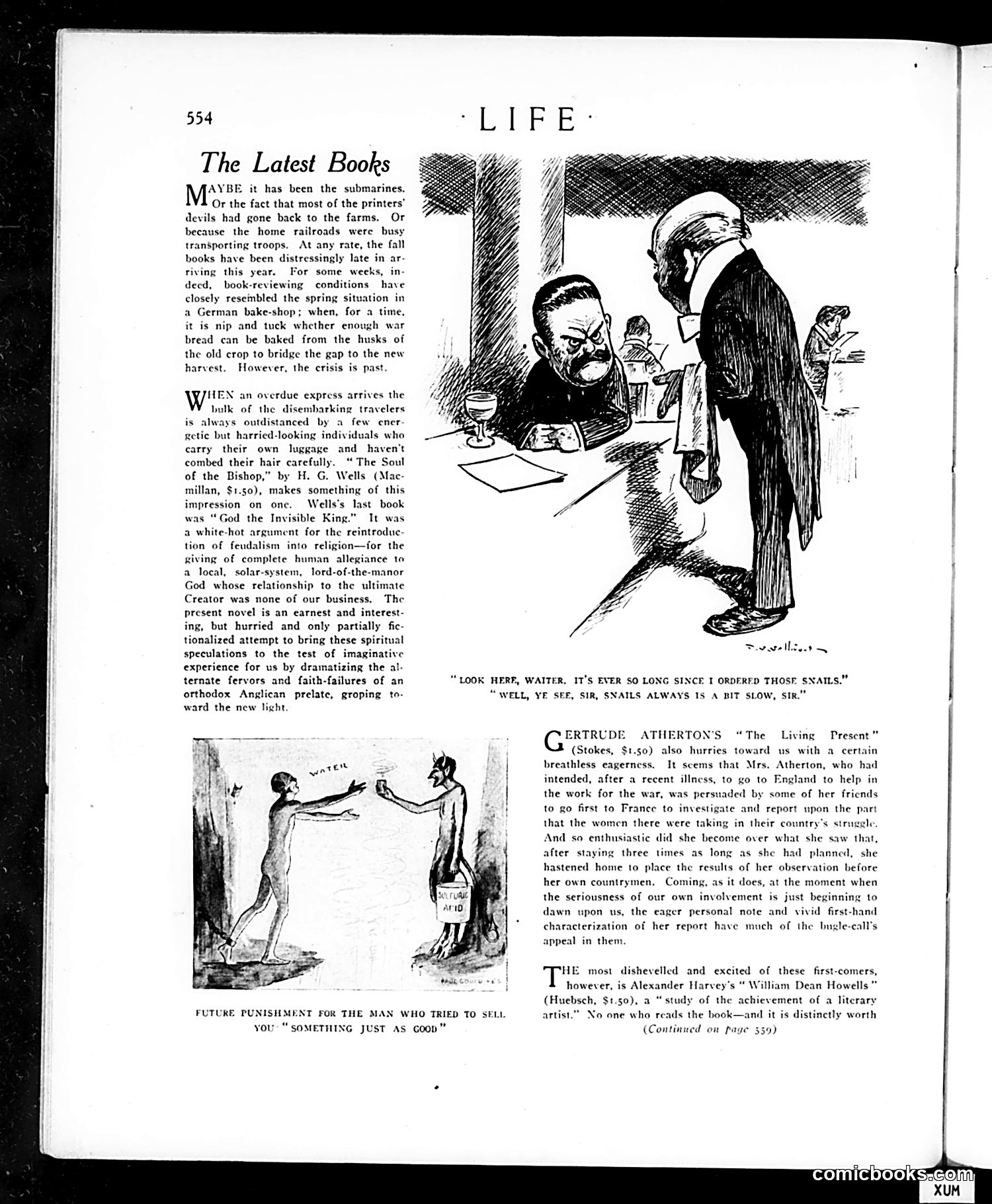
This page reviews newly arrived wartime publications. The top cartoon depicts a waiter and impatient customer—a satirical jab at delayed book deliveries during World War I. The author blames submarines, printer shortages, and railroads commandeered for troop transport for the backlog, comparing the scarcity to a German bakery struggling to bridge supply gaps. The reviews discuss H.G. Wells' *The Soul of the Bishop*, criticized as hastily written spiritual speculation, and Gertrude Atherton's *The Living Present*, praised for its enthusiastic firsthand account of French women's wartime efforts. The lower cartoon (captioned "Future Punishment") appears to satirize commercial deception—punishing someone who sold inferior goods as quality merchandise. The page reflects WWI-era publishing disruptions and American engagement with European conflict narratives.
📄 Transcribed text from this page (OCR, searchable)
Machine-transcribed from the original scan — historical spelling and the odd misread are preserved.
554 The Latest Books Me it has been the submarines, Or the fact that most of the printers’ devils had gone back to the farms. Or because the home railroads were busy transporting troops. At any rate, the fall books have been distressingly late in ar riving this year. For some weeks, in. decd, book-reviewing conditions have closely resembled the spring situation in a German bake-shop; when, for a time, it is nip and tuck whether enough war bread can be baked from the husks of the old crop to bridge the gap to the new harvest. However, the crisi is past HEN an overdue express arrives the bulk of the disembarking travelers is always outdistanced by a few ener etic but harried-looking individuals who carry their own luggage and haven't i combed their hair carefully. “ The Soul of the Bishop,” by H. G. Wells (Mac- millan, $1.50), makes something of this impression on one. Wells's last book was “God the Invisible King.” It was a white-hot argument for the reintroduc- tion of feudalism into religion—for the giving of complete human allegiance to a local, solar-system, lord-of-the-manor God whose relationship to the ultimate Creator was none of our business, The present novel is an earnest and interest- ing, but hurried and only partially fic- | tionalized attempt to bring these spiritual speculations to the test of imaginative experience for us by dramatizing the al- ternate fervors and faith-failures of an “LOOK HERR, WAITER, IT'S EVER SO LONG SINCE I ORDERED THOSF SNAILS.” orthodox Anglican prelate, groping to- “WELL, YE SEE, SIR, SNAILS ALWAYS IS A BIT SLOW, SIR. ward the new light ERTRUDE ATHERTO “The Living (Stokes, $1.50) also hurries toward us with a cert breathless eagerness, It scems that Mrs, Atherton, who had intended, after a recent illness, to go to England to help in the work for the war, was persuaded by some of her friends to go first to France to investigate and report upon the part that the women there were taking in their country’s sirnge Present " And so enthusiastic did she become over what she saw that, after staying three times as long as she had planned, she hastened home to place the results of her observation before her own countrymen, Coming, as it does, at the moment when the seriousness of our own involvement is just beginning to dawn upon us, the eager personal note and vivid first-hand characterization of her report have much of the bugle-call's appeal in them HE most dishevelled and excited of these first-comers, however, is Alexander Harvey's “ William Dean Howells” (Huebsch, $1.50), a “study of the achievement of a literary NISHMENT FOR THE MAN WHO TRIED TO SELI. artist.” No one who reads the book—and it is distinctly worth you “SOMETHING JUST AS Goop” (Continued on page 359) FUTURE PI